PALESTINE

Mon 12 Jan 2026 10:43 am - Jerusalem Time

New York Mayor describes Hamas as 'terrorist'... and a Canadian rabbi responds: You are wrong

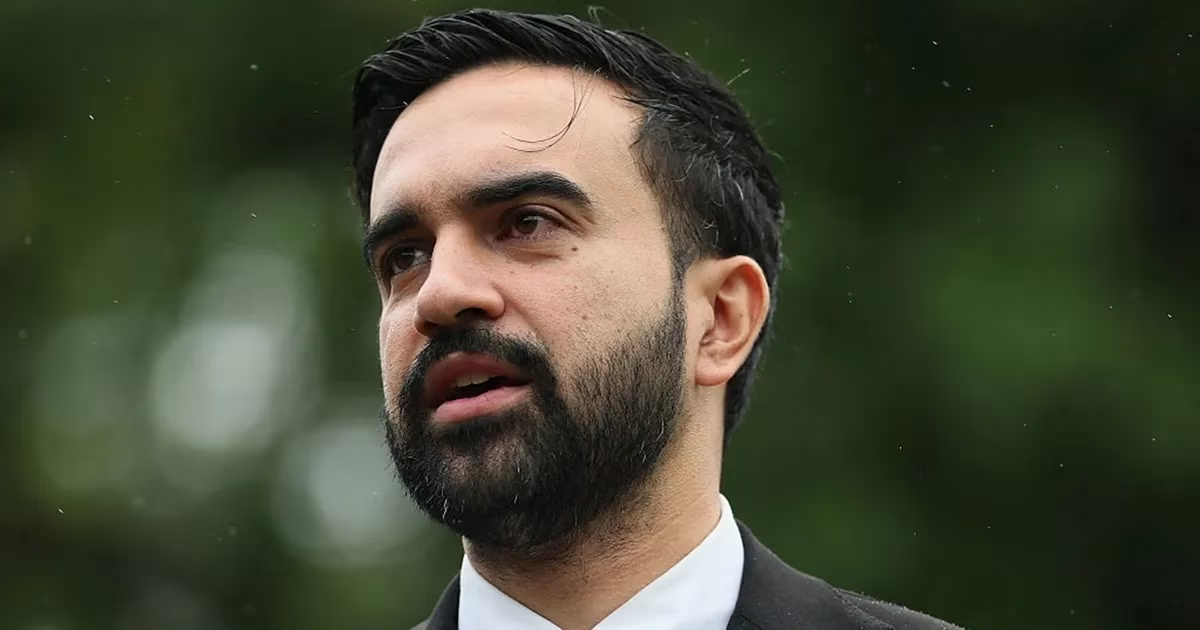
New York City Mayor Zohran Mamdani's description of the Islamic Resistance Movement Hamas as a "terrorist organization" sparked a wave of sharp criticism, most notably a response from Canadian Rabbi David Mivasair, who accused the mayor of bias towards the Israeli narrative, warning him against making "additional moral and political concessions" in the future.

Mivasair said in a direct response to Mamdani's statements: "Zohran, you are wrong, and you know it. Hamas is a Palestinian resistance movement that arose as a result of the brutal genocide committed by Israel for more than 75 years."

He added that "chanting or raising flags did not make anyone feel unsafe," in reference to the recent pro-Palestinian demonstrations.

The Canadian rabbi's response came after Mamdani, the city's first Muslim mayor, condemned the pro-Hamas chants raised during a demonstration organized in a Jewish neighborhood in New York City, saying: "There is no place for supporting terrorist groups in our city," in a statement issued amid media criticism for his delay in commenting on the event.

Last Thursday night, the Kew Gardens Hills neighborhood in Queens witnessed a protest against an Israeli event held inside a synagogue, where anti-occupation activists chanted slogans including: "We support Hamas," "Death to the Israeli army," and "Intifada... people's war," which sparked widespread controversy in American political and media circles.

Mamdani accompanied his statements with a picture of a headline published by the "New York Times" that addressed his previous positions on the protest, and commented on the incident: "There is no place for chants supporting a terrorist organization in our city. We will continue to ensure the safety of New Yorkers as they enter and exit places of worship, while protecting their constitutional right to protest."

In another statement shared by his spokesperson with the Hebrew newspaper "Times of Israel," Mamdani said that "the rhetoric and actions we saw and heard in Kew Gardens Hills last night are wrong and have no place in our city."

The mayor added that his team is "in close contact with the NYPD regarding protests and counter-protests," noting that a number of political officials condemned what happened, including New York Governor Kathy Hochul, and Democratic Representative Alexandria Ocasio-Cortez, who wrote on the "X" platform: "My God, walking into a predominantly Jewish neighborhood and starting to chant 'We support Hamas' is disgusting and antisemitic."

In contrast, American media reports stated that the protests also witnessed pro-Israel Jewish demonstrators insulting and provoking anti-occupation activists, as they chanted against Palestinians, and chanted slogans supporting the US Immigration and Customs Enforcement (ICE), and also chanted abusive phrases against the mayor himself, including "Fuck Mamdani."

OPINIONS

Mon 12 Jan 2026 10:43 am - Jerusalem Time

Distortions in Palestinian Political Consciousness and Weak Political Performance

Dr. Ibrahim Na'irat

Dr. Ibrahim Na'irat

Opinion Writer

Palestinian political culture is an accurate mirror of the complexities of the national experience, with all its long struggle, repeated interruptions, and unfulfilled hopes. Since the inception of the Palestinian national movement, Palestinian political consciousness has been shaped in an exceptional context imposed by the occupation, where politics became an act of resistance more than an institutional practice, and political affiliation transformed into an expression of identity and steadfastness before becoming a tool for managing public affairs. This context, despite its historical importance, has over time contributed to entrenching an emotional political culture that, in many aspects, lacks self-criticism and strategic planning, which has directly reflected on the weakness of Palestinian political performance at its various stages.

The absence of a state and the continuation of the occupation have contributed to the formation of an ambiguous relationship between the citizen and the political authority, where leadership was treated as a symbol of struggle rather than an accountable body. With the establishment of the Palestinian Authority, the desired transformation in political culture from a revolutionary liberation culture to a culture of good governance did not occur. Instead, the same mentality that conflates militant legitimacy with political legitimacy persisted. This confusion weakened institutions, entrenched the personalization of political decisions, and prioritized factional loyalties over competence and programs, leading to a decline in the effectiveness of political performance and its inability to respond to the challenges of a changing reality.

In light of the political division, the fragility of Palestinian political culture has increased, as political disagreement has turned into a state of sharp polarization, where dissenting opinions are excluded and criticism is viewed as a threat rather than a necessity for reform. This atmosphere has contributed to weakening the public sphere, declining the role of intellectual elites, and shrinking popular political participation, as citizens have lost faith in the utility of organized political action, contenting themselves either with withdrawing from the scene or with angry, politically unframeworked expressions. This decline in conscious participation has deprived the political system of one of its most important sources of strength, which is popular oversight capable of correcting the course.

Furthermore, the role of Palestinian journalism, along with the role of the literary movement, intellectuals, and specialized academics, has not been sufficient to match the weight of the stage and the seriousness of the challenges, even though this role is essential in building a conscious and wise political culture within society. In the Palestinian case, the political scene appears saturated with discourse to the point of inflation, as almost no individual lacks a political stance or a sharp opinion. However, this breadth of interest does not necessarily mean depth of understanding or maturity of consciousness. Everyone is politicized, but the fundamental question remains: Is this politicization based on real knowledge and critical analysis, or is it the result of an accumulation of slogans and emotional reactions perpetuated by the media and public speeches?

Local journalism, along with regional media, has contributed to shaping a confused political consciousness among the Palestinian public, where the reporting of events and the exaggeration of positions prevail over analysis and interpretation, and political narratives are often presented without scrutiny or genuine accountability. With the absence of an effective role for investigative journalism and the weakness of spaces dedicated to sound critical thought, the pulse of the street has become prone to rapid fluctuations, governed by emotion more than understanding, and by reaction more than vision. This distortion in collective consciousness has directly reflected on the nature of political participation, which has often become emotional or seasonal participation, lacking continuity, organization, and the ability to have a real impact.

As for the literary movement, intellectuals, and academics, their presence in the public sphere has declined, or they have been marginalized in favor of a rapidly consumed, mobilizing political discourse. With the exception of limited individual initiatives, intellectual elites have not succeeded in playing their natural role as critical intermediaries between authority and society, capable of deconstructing prevailing political discourse and proposing cognitive alternatives that raise the level of public awareness. This absence has paved the way for the dominance of populist discourse and weakened society's ability to distinguish between a well-considered political stance and an emotional one, ultimately leading to a distortion of both political participation and political representation.

The crisis of Palestinian political performance, in this context, is not just a crisis of leadership or institutions, but also a crisis of consciousness fueled by a superficial media culture, an intellectual vacuum in the public sphere, and a relative reluctance of elites capable of producing critical political knowledge. Without restoring the enlightening role of journalism and reactivating the role of intellectuals and academics in public debate, political consciousness will remain fragile, susceptible to guidance and misinformation, and political participation will remain distorted, reflecting division more than expressing the will of a people conscious of their interests and historical choices.

In conclusion, Palestinian political culture remains one of the fundamental keys to understanding the current crisis of political performance. It is not merely a reflection of reality, but an active element in its production and continuation. Without a radical review of this culture, one that goes beyond slogans and touches the essence of political practice, the Palestinian scene will continue to revolve in a vicious circle, where faces change but crises remain the same.

PALESTINE

Mon 12 Jan 2026 5:37 am - Jerusalem Time

More than 20 Palestinian families flee the village of Ras Ain al-Auja in the West Bank

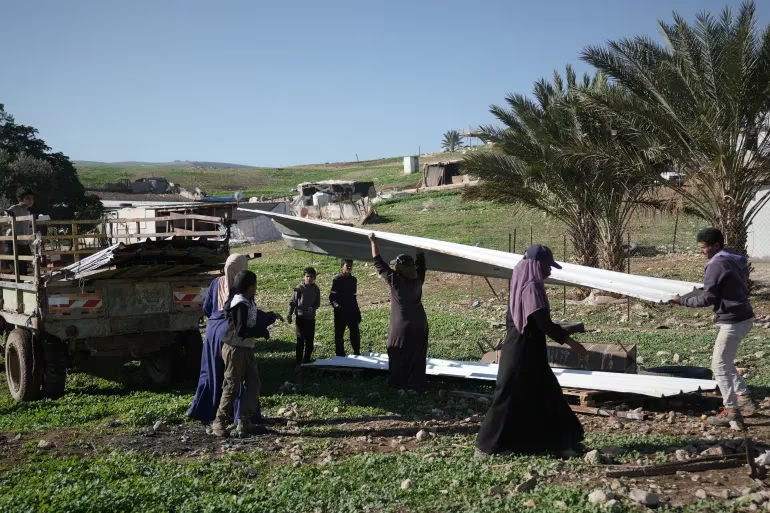
More than 20 Palestinian families have fled the Bedouin village of Ras Ain al-Auja in the central occupied West Bank due to ongoing settler attacks.

Human rights organizations reported that 26 families have left the village, which was home to about 700 people belonging to more than 100 families, who had lived there for decades.

They explained that the families forced to leave last Thursday dispersed throughout the area in search of a safer place, while several other families were packing their belongings and preparing to leave the village today, Sunday.

Despite what were described as "intolerable" harassments by settlers living in unauthorized outposts around the village, Palestinian residents vowed to stay in their homes and not leave.

Sarit Michaeli, the international director of B'Tselem, said, "This makes them among the last remaining Palestinians in the area," confirming that the escalation of violence by settlers has already led to the emptying of neighboring Palestinian villages in the strip of land extending from Ramallah in the west to Jericho along the Jordanian border in the east.

The concern of residents of Palestinian Bedouin communities in the occupied West Bank is escalating with the increasing attacks by Israeli settlers and their seizure of vital lands and resources as part of what is known as "pastoral settlement," a strategy followed by settler groups by sending groups of settlers to gradually seize land.

It is worth noting that the United Nations stated that settlers launched an average of 8 attacks daily last October, and at least 136 attacks were recorded the following month.

The sanctions announced by America, the European Union, and Britain against settler groups for their violence against Palestinians in the West Bank have not prevented them from continuing their attacks.

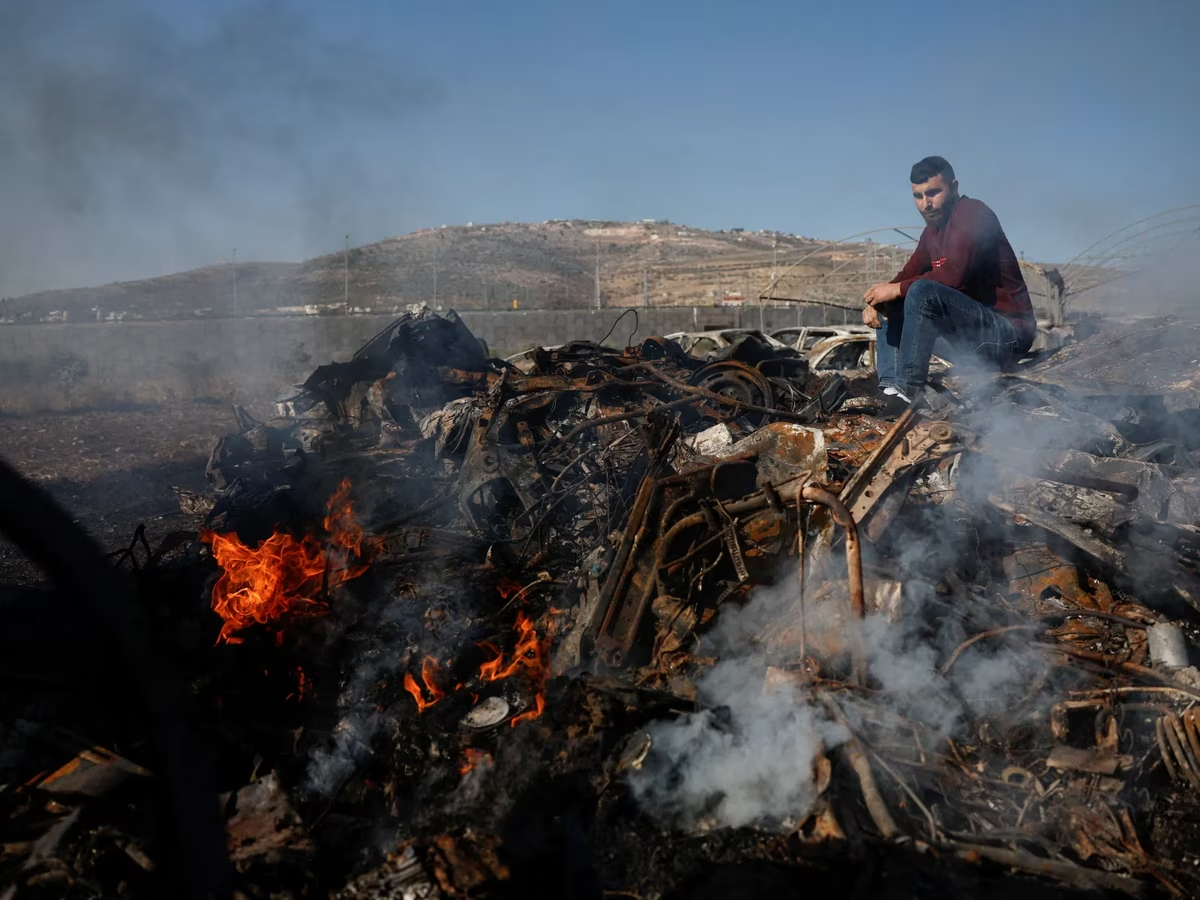
The occupation government supports and arms settler militias to attack Palestinians in Bedouin communities and villages, forcing them to migrate after destroying and burning their homes, seizing thousands of dunams of their grazing lands and water springs, and establishing settlements on their land under the pretext of providing grazing areas for settlers' livestock.

PALESTINE

Mon 12 Jan 2026 1:25 am - Jerusalem Time

Israel Imposes its Security Sovereignty over the West Bank.. A Less Costly Alternative to Direct Annexation

Israel no longer needs to declare the annexation of the occupied West Bank to impose its control over it. Away from official laws and decisions, a new equation is forming on the ground that practically ends the conflict by resolving it militarily, based on the concept of "security sovereignty" as a less costly alternative to direct annexation.

This approach formed the core of the discussion in the "Course of Events" program episode, where it became clear that what is happening in the West Bank is not a temporary escalation, but a strategic path that seeks to fundamentally resolve the conflict by dismantling the conditions for the establishment of a Palestinian state, rather than merely managing the conflict with it.

Since the formation of the far-right government at the end of 2022, field transformations in the West Bank have accelerated, suggesting that Israel is exploiting the regional and international moment to impose facts on the ground that are difficult to reverse, benefiting from the world's preoccupation with the Gaza war and Washington's shifting priorities.

In this context, academic and expert in Israeli affairs Dr. Muhannad Mustafa believes that "resolution" is no longer an ideological slogan, but a multi-stage plan that begins with eliminating any political or geographical basis that would allow for the establishment of an independent Palestinian entity, even before reaching annexation.

According to this perception, security control is no longer merely a precautionary measure, but becomes a complete alternative to "legal sovereignty," where Israel imposes its authority over the land, borders, movement, and resources, without bearing the obligations or international legal consequences of an annexing state.

What distinguishes the current stage, as highlighted in the analysis, is the introduction of a new actor into the control system, represented by armed settler militias operating under the umbrella of the occupation authority, performing a dual function: carrying out the "dirty work" on the ground, and providing deniable cover for the official establishment.

This overlap between the army and settlers, as Mustafa explains, cannot be separated from the concept of security sovereignty, as the militias become part of the tools of governance, not outlaw groups, under systematic political, judicial, and security protection.

Pressuring Paths

In contrast, daily life in the West Bank is read as a direct reflection of this policy, where three pressing paths intersect: violent settlement expansion, escalating economic strangulation, and comprehensive movement restrictions, making the very existence of Palestinians constantly tested.

Dr. Ghassan Al-Khatib, Professor of Political Science at Birzeit University, points out that the goal is not limited to control, but extends to making life "unbearable," gradually pushing Palestinians to consider emigration, in what resembles a slow displacement that does not require official decisions.

However, this path, as Al-Khatib explains, has so far clashed with a remarkable social attachment to the land, especially in rural areas surrounding settlements, where family ties and community solidarity play the role of the last line of defense against settlement encroachment.

But this steadfastness, despite its importance, does not change the fact that Israel acts in the West Bank as a region under its full sovereignty, which makes the discussion about "annexation" closer to a verbal debate, as long as the practices on the ground have surpassed its political meaning.

From this perspective, Al-Khatib believes that judging Israeli behavior is more accurate than merely following statements, as the current pattern of control does not differ much – from what it would be under declared annexation – in essence, but only in form.

Notably, this shift is not happening in isolation from the American stance, where a striking distinction emerges between preventing full annexation through legislation and overlooking gradual annexation practices, which opens the door for Israel to proceed with its strategy without a direct clash with Washington.

The American Stance

Former US State Department official Dr. Thomas Warrick describes this approach as an "absence of a red light" rather than an explicit green light, explaining that the Trump administration focuses on preventing one dramatic step, and ignores the accumulation of small steps.

This approach, as Warrick warns, gives Israel ample space to impose daily realities that do not provoke sharp American reactions, especially given the administration's preoccupation with files such as Gaza, Iran, Syria, and Lebanon, which pushes the West Bank down the list of priorities.

In the Palestinian context, Dr. Bilal Al-Shobaki, head of the Political Science Department at Hebron University, believes that relying solely on the American stance involves a great deal of illusion, especially given a long history of statements not translated into actual pressure.

Al-Shobaki believes that Israel is acting out of a conviction in its ability to resolve the conflict, benefiting from the imbalance of power and American support, which necessitates, for Palestinians, the formulation of a counter-goal that is not based on resolution, but on preventing and thwarting it.

This goal, according to his analysis, cannot be achieved without rebuilding the Palestinian internal position, by ending the division, renewing institutions, and activating the Palestine Liberation Organization, as a representative framework that transcends the limitations of the Palestinian Authority and its administrative function.

In contrast, Israel monitors the Palestinian Authority as an entity capable of being marginalized or terminated, with a preference for maintaining it in a depoliticized form, handling civil affairs without serving as a banner for a competing national project.

This scenario, as Mustafa sees it, is entirely consistent with the logic of "security sovereignty," where the lives of Palestinians are managed without recognizing their right to sovereignty, and the Authority is used as a control tool, not as a political partner.


PALESTINE

Mon 12 Jan 2026 1:23 am - Jerusalem Time

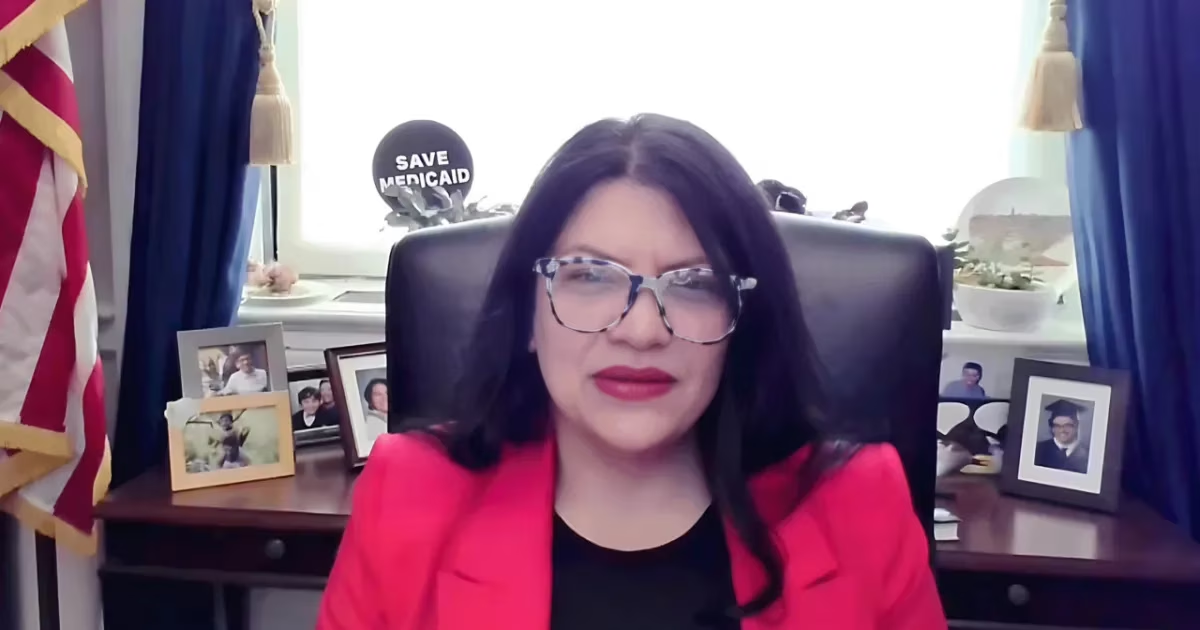
Rashida Tlaib reveals details of a congressional resolution describing what is happening in Gaza as genocide

US Representative Rashida Tlaib revealed details of a draft resolution she submitted to Congress that recognizes that what Palestinians in the Gaza Strip are subjected to amounts to genocide, stressing that recognizing this legal description imposes direct obligations on the United States as a signatory to the Convention on the Prevention of the Crime of Genocide.

Tlaib said that the draft resolution is based on clear legal texts, taken verbatim from the international convention to which Washington is a party, adding that this step is not limited to political or moral description only, but obliges the United States to activate its legal obligations towards what is happening in Gaza.

The American representative of Palestinian origin criticized Washington's participation in what she described as genocide, saying that "despite its ability to stop what has been happening for years, our country could have stopped this a long time ago, but that did not happen, and one war crime after another was committed before our eyes."

Tlaib stressed the importance of continuing to call what is happening in Gaza by its legal name, affirming, "I do not want us to stop talking about Gaza, nor to stop calling what is happening by its true name: it is genocide."

Representative Rashida Tlaib explained that the draft resolution, which she submitted concurrently with the anniversary of the adoption of the Genocide Prevention Convention on December 9, aims to emphasize that the United States, despite being one of the signatory states to the convention, is not applying its legal obligations regarding the Israeli government.

She explained that the text of the resolution "does not only provide a political or moral description, but demands the activation of the legal obligations stipulated in the convention."

Tlaib noted that the draft resolution currently enjoys the support of about 21 other representatives in the House of Representatives, stressing that its approval means the United States recognizes that the Israeli government is committing genocide, which legally entails taking specific measures, including stopping military funding and imposing an arms embargo.

The draft resolution states that the Genocide Prevention Convention obliges signatory states to use all available means to prevent genocide and punish its perpetrators, including investigating the potential complicity of individuals and companies, complying with orders of international criminal courts, and imposing targeted legal sanctions.

Tlaib indicated that the draft resolution faces resistance within the American legislative institution, especially from parties seeking to avoid using the term "genocide" due to its legal implications, explaining that "there are groups strongly pushing to prevent the use of the word genocide, because they know that this word activates binding legal agreements in which the United States participates."

The representative explained that the leadership of the US House of Representatives has not yet officially recognized that what is happening in Gaza amounts to genocide, which constitutes a major obstacle to passing the resolution, the date of which has not yet been clarified. However, she stressed that the importance of the project is not limited to the chance of its approval, but also lies in its being a political tool to organize popular pressure and hold legislators accountable, affirming: "We are using this resolution as an educational tool, to remind my colleagues that we are a signatory state to the Genocide Prevention Convention."

Representative Rashida Tlaib said that American public opinion is witnessing rapid shifts towards what is happening in Gaza, explaining that the majority of Americans, both Democrats and Republicans, have come to recognize that what is happening in the Strip is genocide, and emphasize the importance of stopping military funding.

She added that this shift has begun to be reflected politically, as some political figures have begun to lose their elections due to their continued support for what she described as genocide, and confidence in politicians who refuse to acknowledge it has declined.

Tlaib affirmed that popular pressure will continue if the draft resolution is not passed, with escalating demands for sanctions and an arms embargo, noting that this path does not stop at a single vote in Congress.

PALESTINE

Sun 11 Jan 2026 11:38 pm - Jerusalem Time

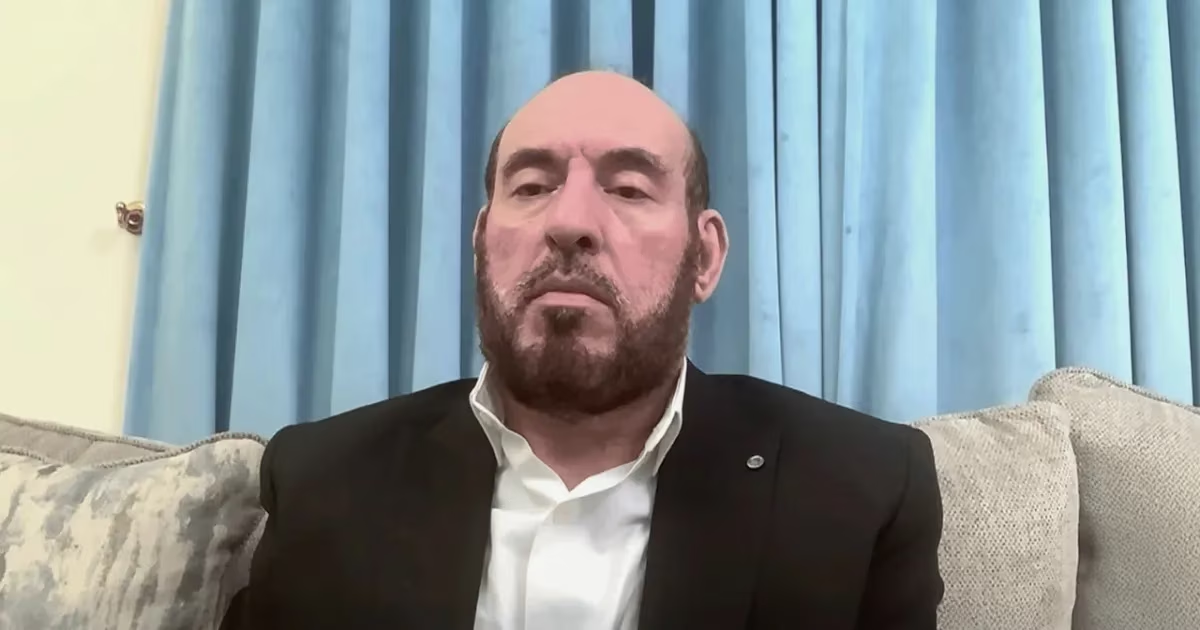
Hamas delegation heads to Cairo to discuss Gaza developments and consolidate ceasefire

Member of the Political Bureau of the Islamic Resistance Movement (Hamas) Muhammad Nazzal said that a delegation from the movement headed to the Egyptian capital Cairo today, Sunday, to discuss political and field developments in the Gaza Strip starting from tomorrow, Monday, and to follow up on the implementation of the ceasefire agreement, in light of what he described as major difficulties hindering its application, and continued Israeli violations.

Nazzal added, in statements to the Al-Masa'iya program, that the movement's delegation is holding meetings with Palestinian factions and forces, in addition to meetings with official Egyptian bodies, to discuss a number of files related to the agreement, foremost among them ways to consolidate the ceasefire and move to its subsequent stages.

Regarding the nature of the ongoing discussions in Cairo, Nazzal explained that they include several main files, the first of which is the formation of a Palestinian committee of "technocrats" to administer the Gaza Strip, a committee whose principle of formation was agreed upon between Palestinian factions and Egyptian authorities, but it faced reservations from the Palestinian Authority and Israel.

He added that the Hamas delegation is working in coordination with the rest of the Palestinian forces to overcome obstacles to the formation of the committee that will manage the Strip, stressing that it is purely Palestinian, and that its primary reference must be Palestinian, while seeking agreement on its members.

The Hamas leader indicated that the Palestinian factions had previously submitted a list of about 40 names to the Egyptian side, some of which were selected, but some names were met with reservations, explaining that the Palestinian Authority is demanding specific names, and emphasizes the necessity that the committee's reference be to the Palestinian Authority and government, which he said Hamas does not object to in principle, provided that competent and independent personalities from the residents of the Gaza Strip residing therein are agreed upon, and enjoy the trust of Palestinian society.

Nazzal said that the occupation, in turn, expresses reservations about some of the proposed names, stressing that the discussion on this file is taking place through mediators, specifically through the Egyptian authorities, in an effort to prevent Israeli Prime Minister Benjamin Netanyahu from exploiting these differences to evade the agreement or procrastinate its implementation.

He added that the second file on the table in Cairo concerns moving to the second phase of the ceasefire agreement, noting that this phase includes several issues, including the necessity of opening the Rafah crossing in both directions, a clause which he said the occupation has not committed to implementing despite it being stipulated in the first phase of the agreement.

The member of the Political Bureau of Hamas said that the third file concerns the entry of relief materials into the Gaza Strip, including "caravans" (prefabricated houses) and tents suitable for winter, in light of the harsh weather conditions the Strip is experiencing, stressing that these needs constitute an urgent humanitarian priority.

Regarding the discussion about the administration of the Gaza Strip and what is known as the "Global Peace Council," Nazzal said that he cannot specify an exact date for moving to the second phase of the agreement, stressing that the main obstacle is Netanyahu and his government, which sees no interest in this transition, despite regional and international desire, including from the American administration, to end the war file and not return to escalation in Gaza.

He affirmed that Hamas was officially informed of the name of Nikolay Mladenov as a candidate to be part of the proposed administration for the Gaza Strip, noting that his name was put forward as an alternative to former British Prime Minister Tony Blair, who was met with reservations from several parties due to his previous positions and biases.

The Hamas leader explained that the movement has no principled reservation about Mladenov's name, who he said has previous experience in this file, but on the other hand, it believes that the tasks of the "Global Peace Council" and the international force associated with it are still unclear, and are shrouded in many questions that need answers.

Nazzal concluded by saying that the coming weeks may reveal more details about the future of these arrangements, in light of the ambiguity that still surrounds the mechanisms for administering the Gaza Strip and moving to the next phases of the ceasefire agreement.

PALESTINE

Sun 11 Jan 2026 6:41 pm - Jerusalem Time

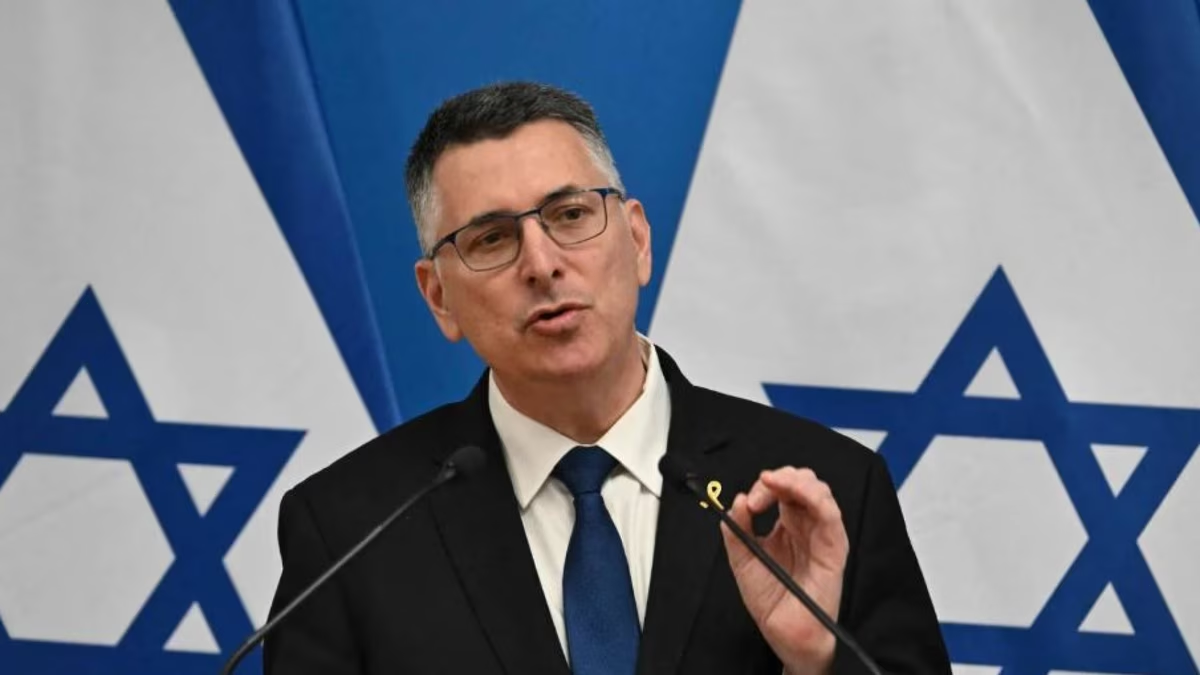
Occupation's Conditions for Trump's Plan: Gaza "Demilitarized" and Tel Aviv Asks Germany to Classify "Revolutionary Guard" as Terrorist

The Foreign Minister announced Tel Aviv's support for the protests in Iran.

On Sunday, the Israeli occupation's Foreign Minister linked the possibility of moving forward with the implementation of US President Donald Trump's peace plan to imposing "strict conditions" related to the military reality in the Gaza Strip, coinciding with an escalation in rhetoric against the regime in Iran.

The Israeli minister affirmed in press statements that "Hamas must completely disarm, and Gaza must be demilitarized," considering that fulfilling this condition is the main gateway "to proceed with the implementation of Trump's plan," without providing further details on the proposed mechanisms for this.

Regarding the Iranian issue, the Foreign Minister announced Tel Aviv's support for the ongoing protests there, stating: "We support the struggle of the Iranian people for freedom and wish them success," in a clear reference to Israel's desire to see political change in Tehran.

On the diplomatic front, Hebrew media revealed an "Israeli" move towards Europe to tighten the noose on Tehran.

Reports stated that Foreign Minister Gideon Sa'ar officially requested his German counterpart to "classify the Iranian Revolutionary Guard as a terrorist organization," as part of a diplomatic campaign seeking to isolate the Iranian regime internationally.

PALESTINE

Sun 11 Jan 2026 6:29 pm - Jerusalem Time

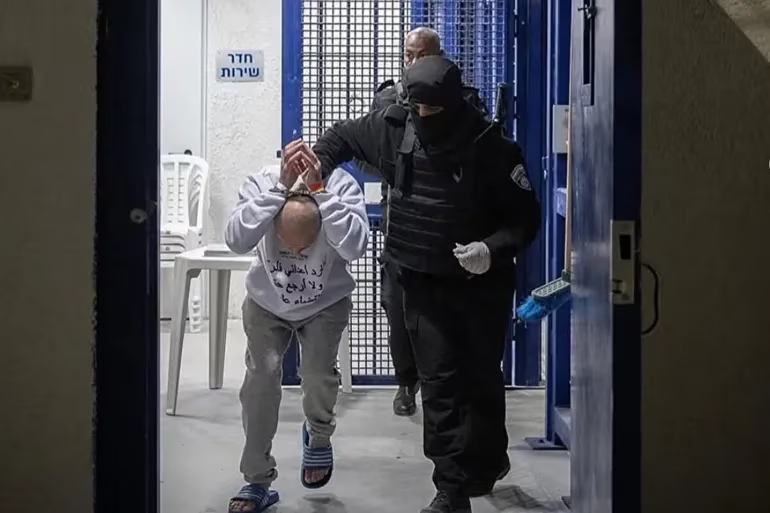
Martyrdom of a Palestinian prisoner from Gaza in the occupation prisons

A joint statement by the Commission of Detainees and Ex-Detainees Affairs and the Palestinian Prisoner's Society confirmed the martyrdom of prisoner Hamza Abdullah Adwan (67 years old) from the Gaza Strip, who was martyred on September 9, 2025, in Israeli occupation prisons.

Adwan was arrested from Gaza on November 12, 2024. He was married and a father of nine children, two of whom were martyred before the outbreak of the last war on the Gaza Strip on October 7, 2023.

It is worth noting that the Palestinian Prisoner's Society confirmed that the number of Palestinian prisoners and detainees killed in Israeli prisons since 1967 has reached 323 prisoners, including more than 100 martyrs since the start of the genocide in Gaza in October 2023.

The society explained in a statement issued on Wednesday that this figure includes cases that Palestinian human rights, medical, and legal institutions were able to document their killing over the past decades, in light of what it described as Israel's "policy of concealment and obfuscation."

The Palestinian Prisoner's Society stated that the period after the outbreak of the Israeli genocide war on the Gaza Strip constituted "the most dangerous and bloodiest transformation in the history of the prisoner movement, both in terms of the number of martyrs and the nature of the crimes committed within the prison system and detention centers."

It clarified that the identities of 86 martyred prisoners have been announced so far after October 8, and that among them are 50 prisoners from the Gaza Strip. The society considered this a clear indication of the escalation of systematic killing policies, especially against Gaza detainees who are subjected to harsh and inhumane detention conditions.

It affirmed that the announced numbers do not represent the final toll, as documentation operations are still ongoing, at a time when "an integrated system of punitive policies continues, including physical and psychological torture, deliberate starvation, neglect and medical crimes, in addition to organized repression and deprivation of the most basic fundamental rights," according to the statement.

It pointed out that Israeli authorities continue to detain the bodies of 94 martyred prisoners inside their prisons, 83 of whom died after the start of the genocide war in Gaza, which constitutes a blatant violation of international humanitarian law.

It considered that the number of martyred prisoners exceeding the 100 mark in a relatively short period represents a dangerous historical precedent, and "reflects an unprecedented level of violence and savagery, turning Israeli prisons into one of the arenas of ongoing genocide."

The Palestinian Prisoner's Society called on the international community and its human rights and judicial bodies to "assume their responsibilities to act immediately to protect prisoners, hold occupation leaders accountable for these crimes, and put an end to the state of impunity."

It is worth noting that Israel detains more than 9,300 Palestinian prisoners, including children and women, who suffer from torture, starvation, and medical neglect, which has led to the death of many of them, according to Palestinian and Israeli human rights reports.

Palestinian human rights organizations, including the Palestinian Prisoner's Society, Addameer Foundation, and the Commission of Detainees Affairs, documented about 7,000 arrests last year, including 600 children and 200 women, while the number of arrests since October 8, 2023, reached about 21,000, including 1,655 children and 650 women, not counting detainees from Gaza and the occupied interior.

PALESTINE

Sun 11 Jan 2026 6:28 pm - Jerusalem Time

Exclusion of Palestinian academic from Australian festival sparks outrage and resignations

The exclusion of a Palestinian-Australian academic from a cultural festival in Adelaide, Australia, and her replacement with an American commentator supportive of the occupation, has sparked outrage among several members of the festival's board of directors, leading to their resignations and withdrawals from participants.

Sources said that the three resignations followed the withdrawal of 70 participants from the Book Week program after the invitation to academic and writer Randa Abdel-Fattah was rescinded.

Sources added that the Adelaide Festival is facing an unprecedented leadership crisis after the resignation of three of its board members: journalist Daniela Ritorto, businessman Donny Walford, and lawyer Nick Lenk, who decided to resign at a board meeting on Saturday after the decision to exclude Abdel-Fattah from the 2026 Book Week program.

Sources commented that the sudden departure followed the withdrawal of 70 writers from the festival scheduled for next month, and it remains unclear how the festival will achieve a quorum, which could impede its legal authority to make decisions regarding the 2026 event.

Under the Adelaide Festival Centre Trust Act 1998, the board must adhere to strict rules regarding gender balance. With Lenk's departure, only one man remains, Brenton Cox, the managing director of Adelaide Airport.

The law stipulates that there must be at least two men and two women on the board. The board has not issued any public comment since announcing the cancellation of Abdel-Fattah's participation last Thursday.

In a statement regarding the writer's exclusion, it expressed "deep shock and sadness at the tragic events that occurred in Bondi" and "the significant escalation in the intensity of societal tensions and debates."

The statement added: "As the board responsible for organizing the Adelaide Festival and all Adelaide Book Week events, including staff, volunteers, and participants, we informed Dr. Randa Abdel-Fattah today, who was scheduled to participate in next month's Book Week events, that we have decided not to proceed with her scheduled participation."

The board stated that while it did not imply "in any way" any connection between Abdel-Fattah or her writings and what happened in Bondi, the decision was made "given her previous statements." The board added: "We have come to the conviction that it is culturally inappropriate to continue to include her in the festival program at this exceptional time and shortly after the events of Bondi."

Hours after the board's announcement, Abdel-Fattah issued her own statement, accusing the festival board of "blatant and shameful" racism against Palestinians and censorship. She described the board's attempt to link her to the Bondi massacre as "disgraceful."

On Sunday, Mark Lawyers in Sydney, on behalf of Abdel-Fattah, contacted the festival's chair, Tracey Whiting, demanding that she provide all statements made by the academic that played a role in the board's decision to exclude her from the 2026 program.

The letter sent by Mark's managing partner, Michael Bradley, stated: "Your letter informed Dr. Abdel-Fattah of the board's decision to exclude her from participating as a speaker at Adelaide Book Week in 2026." It also stated: "Your letter was the first indication Dr. Abdel-Fattah received that her participation was in doubt; there was no communication or consultation with her prior to the decision to exclude her."

Bradley said that the notification his client received from the board did not state any reason for its decision other than that "proceeding with her scheduled appearance would not be culturally sensitive."

However, Bradley noted that the board, in its public statement issued on Thursday, stated that her previous statements were the basis for its decision that allowing her to participate, shortly after the Bondi terrorist attack, would be culturally insensitive.

The legal letter stated: "As a matter of basic procedural fairness to Dr. Abdel-Fattah, please identify each of her previous statements that the board relied upon in making the decision, with details. She has the right to this information."

The firm gave the board until January 14 to respond, along with a request to Whiting and her sub-board to retain all documents related to the matter, in anticipation of any potential legal action.

Sources revealed on Sunday that the Book Week board had resisted attempts to exclude the pro-occupation New York Times writer, Thomas Friedman, from the 2024 Book Week program after he published a controversial article comparing the Middle East conflict to the animal kingdom. Abdel-Fattah accused the festival of not excluding Friedman from the festival that year, even though she and nine other academics lobbied for his exclusion.

South Australian Premier Peter Malinauskas claimed that the festival excluded Friedman in 2024 and reiterated his support for the festival board's decision on Thursday to remove Abdel-Fattah from this year's program. In statements quoted by sources, he said through a spokesperson: "I note that the Adelaide Festival made a similar decision to exclude a Jewish writer from the 2024 Adelaide Book Week program under very similar circumstances." And "I support this decision, and the consistent application of this principle."

On Saturday, News Corp publications, part of Rupert Murdoch's empire, covered the Premier's statement, noting the apparent contradiction between the public outrage over Abdel-Fattah's exclusion, compared to Friedman's alleged exclusion two years prior, which did not spark the widespread boycott currently being witnessed by Book Week, making the holding of the 2026 events seem increasingly impossible. Contrary to the official's claims, the festival rejected a letter sent by Abdel-Fattah and nine academics on February 6, 2026, to the board demanding the withdrawal of Friedman's invitation due to his controversial article. However, the festival board, in a letter seen by sources, rejected this request to exclude Friedman. The letter stated: "Demanding that the Adelaide Festival and Adelaide Book Week cancel the participation of an artist or writer is a very serious request."

The letter was dated February 9, 2024, and signed by the chair of the Adelaide Festival board, Whiting. It stated: "We have an international reputation for upholding artistic freedom of expression. Thomas L. Friedman was scheduled to participate online from New York. However, I have been informed that due to unforeseen circumstances in his schedule, he will not be participating in this year's program." Sources contacted Friedman in New York for comment. After the announcement of her cancellation on Thursday, Abdel-Fattah accused the board of blatant and shameful racism against Palestinians and censorship.

She stated in remarks that she rejects accusations of "hypocrisy" after she demanded Friedman's exclusion in 2024.

She said in a statement: "Friedman's widely criticized article published in the New York Times compared various Arab and Islamic countries and groups to insects and pests that must be eradicated, at a time when the term 'human animals' was used to justify massacres in Gaza."

She added: "We were concerned about the impact of Friedman's views on socially and historically marginalized groups, who have been dehumanized and discriminated against using such racist stereotypes. In fact, one of the examples we provided was how Jews have historically been likened to vermin." She continued: "In contrast, I was canceled because my presence and identity as a Palestinian were deemed culturally insensitive and linked to the atrocities of Bondi. I was canceled because I am Palestinian and an outspoken advocate against the literal erasure of my people."

Abdel-Fattah pointed out that the festival board was hypocritical, as it had cited its commitment to "artistic freedom of expression" in its response to the Friedman case in 2024. She said: "All these alleged values were abandoned when it came time to cancel my participation."

PALESTINE

Sun 11 Jan 2026 6:26 pm - Jerusalem Time

Hamas postpones election of its political bureau head until further notice

Leading sources within the Hamas movement revealed that the movement decided to postpone the election of its general political bureau head, which was scheduled to take place during the first ten days of January.

Sources said that the postponement of this step was until further notice, explaining that "a new date has not been set, but elections could be held at any moment."

One source attributed the postponement to "security and political circumstances and the movement's current preoccupation with negotiations for the transition to the second phase of the ceasefire, with the accelerating momentum currently underway by mediators and the United States."

However, other sources explained that "there are additional reasons, including the disagreement over the arrangements taking place within the movement in the Gaza Strip, which have increased in recent days, and which efforts are being made to resolve."

Hamas is facing its most severe crisis since its establishment in 1987; Israeli targeting, which began after the October 7, 2023 attack, has affected its various wings and levels, causing several organizational and financial crises.

Sources indicate that the accelerating momentum regarding the possibility of transitioning to the second phase largely overshadows the leadership's attention at present, noting that the process of electing a new head for the political bureau will be an important step in rearranging the movement's internal affairs, but this process may take longer than expected.

Sources had stated days ago that the elections would take place within the first 10 days of the new year, explaining that the goal of these elections was to achieve more stability and reassurance within the movement, and to send a clear message to the outside world that it remains cohesive.

The sources then mentioned that the election of a head for the political bureau would not end the role of the current leadership council, which was formed to lead the movement after the assassinations of Haniyeh and Sinwar, noting that it would be considered an advisory council that follows all Hamas issues internally and externally, and consultations would take place among its members regarding the fate of those issues.

In response to a question about whether there were internal disagreements over the personality of the president to be elected to lead Hamas, one source merely said that "the election process is conducted according to the applicable laws and regulations, and there are no disagreements regarding the personality who will lead the movement."

Estimates indicate that Khaled Meshaal, head of the political bureau abroad, and Khalil al-Hayya, head of the political bureau in Gaza, are the most prominent figures for potentially assuming the presidency of the political bureau.

Some sources say that there is strong support within the movement's leadership abroad and in the West Bank for Meshaal to be the head of the movement, while in the Gaza Strip, the majority prefer al-Hayya to take responsibility for leading the movement.

However, sources did not rule out that "a third, unspecified personality might emerge," and one source said: "Nothing can be predicted at the moment, and what is happening cannot be considered a competition due to disagreements over who will be the head of the movement, but it can be described as a (benign competitive process)."

Regarding the disagreements about what is happening in Gaza, sources explained that there are attempts to resolve them, noting that "there is a great deal of objection from most leadership levels, including administrative bodies and others, to the recent internal arrangements."

Sources from Hamas had said days ago, "that a series of leadership changes occurred in the Gaza Strip, after the assassinations of its leaders during the two-year Israeli war, which led to a greater presence of those close to the former movement leader Yahya Sinwar, who was suddenly killed in clashes with an Israeli force in Rafah in October 2024."

According to those sources, the released prisoner Ali al-Amoudi, a member of the political bureau and responsible for the movement's media department before the war, has become the acting head of its political bureau in the Gaza Strip, after he and many of Sinwar's close associates were tasked with managing the movement in the Strip, most of whom reside in Khan Yunis in the southern part of the Strip.

PALESTINE

Sun 11 Jan 2026 6:26 pm - Jerusalem Time

Change in the names of the members of the "Gaza Committee"... and an imminent meeting of factions in Cairo

A well-informed Palestinian source from Ramallah revealed a change in the names of the members of the Gaza Strip management committee, which is about to be announced, during an anticipated meeting of Palestinian factions in Cairo within a day or two, noting that Palestinian Health Minister Majed Abu Ramadan is not currently being considered.

Sources, who declined to be named, said that "Cairo is arranging for a factional (Palestinian) meeting within a day or two," stressing that "there has been talk from Cairo with the Fatah movement, but in general, the movement does not participate in any factional meeting that is not based on the movement's pillars of commitment to the Palestine Liberation Organization and its obligations, international legitimacy, one law, one political system, one weapon, and the unity of institutions and geography."

Sources revealed that "there is a designation for an administrative committee for the Gaza Strip (during the upcoming meeting) by President Trump and partner countries, and there is currently no problem with the names," revealing that changes have occurred in the names and the Palestinian Health Minister is no longer being considered.

He explained that the technocratic administrative committee will most likely be formed of a chairman and members, and without a vice-chairman so far, and most of the names are "outside what was proposed and circulated."

Sources stressed that "the firm Palestinian position is that the committee's reference should be the legitimate Palestinian government, in a way that does not reinforce division and ensures the sovereignty of the State of Palestine, as the Gaza Strip is an integral part of the State of Palestine alongside the West Bank, including Jerusalem, considering it the most important guarantee for the success of the administrative committee's work."

Regarding the participation of the "Fatah" movement, sources explained that "Cairo is making efforts for representatives of the movement to attend, but it adheres to the aforementioned pillars for participation, and the developments that may occur in the coming hours are unknown."

Last Tuesday, Palestinian sources said that Cairo would host a Hamas delegation this week to push for a Gaza agreement. This was confirmed by other well-informed Palestinian sources, stating that "a Hamas delegation will arrive in Cairo on Sunday evening to discuss arrangements for the transition to the second phase."

Meanwhile, Hussam Badran, a member of the political bureau of the "Hamas" movement, said on Sunday afternoon that "the delegation has not yet arrived without specifying a date for the visit."

On Saturday, Bishara Bahbah, head of the "Arab Americans for Peace" committee and a mediator in Gaza, said that the information he received indicates that President Trump will announce the "Peace Council" overseeing an interim administration for the Strip on Tuesday, January 13, followed a day or two later by the formation of the Palestinian technocratic committee during meetings in Cairo.

PALESTINE

Sun 11 Jan 2026 6:11 pm - Jerusalem Time

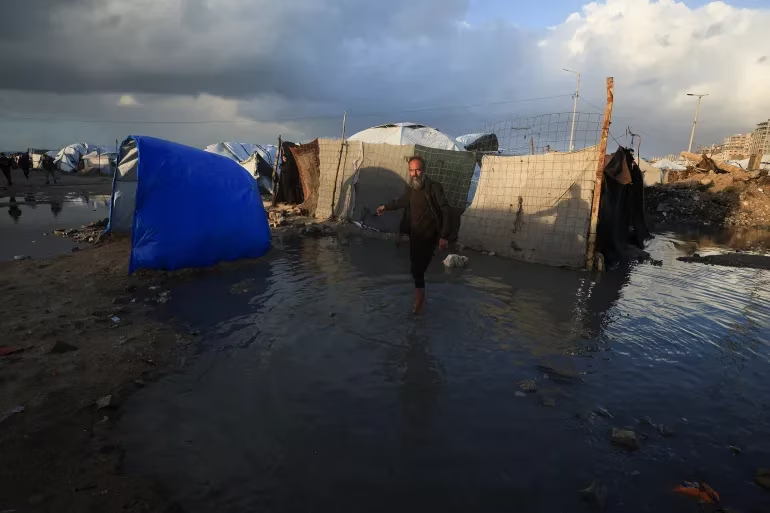
Cold-related deaths in Gaza rise to 21, including 18 children

The government media office in the Gaza Strip announced today, Sunday, that the number of deaths due to severe cold in displacement camps has risen to 21, including 18 children, as a result of the consequences of the Israeli genocide that has lasted for two years.

This came in a statement from the office, the day after the announcement of the death of infant Mahmoud Al-Aqra, one week old, due to severe cold that caused him to shiver before he passed away at Al-Aqsa Martyrs Hospital in the central part of the Strip, according to Adnan Al-Aqra, the child's father.

The office warned of the catastrophic humanitarian repercussions resulting from the severe cold waves hitting the Gaza Strip, in light of the ongoing (Israeli) genocide and suffocating siege, and the widespread destruction of homes and infrastructure, and the forced displacement of more than one and a half million Palestinians.

It added that the number of deaths due to severe cold has risen since the start of the genocide on October 8, 2023, until today, Sunday, to 21 martyrs, all of whom are displaced people from forced shelter camps, and confirmed that among the deaths are 18 children, a dangerous indicator of the magnitude of the humanitarian catastrophe threatening the lives of the most vulnerable groups.

On Friday, a new low-pressure system accompanied by rain and stormy winds began in the Strip, while the Palestinian Meteorological Department said yesterday that there remains a chance of scattered showers in some areas with strong winds reaching speeds of up to 60 kilometers per hour at times.

The government media office pointed out that the number of deaths due to severe cold since the beginning of the current winter season last December reached 4, in the absence of heating means, lack of safe shelter, shortage of blankets and winter clothes, and the continued prevention of sufficient humanitarian aid.

It also strongly warned of the repercussions of subsequent low-pressure systems, and the accompanying waves of frost and severe cold in the coming days, which threaten to increase the number of victims, especially among children, the sick, and the elderly.

The government media office in Gaza held the Israeli occupation fully and directly responsible for these crimes and deadly outcomes, considering them an extension of policies of slow killing, starvation, and displacement.

It called on the international community, the United Nations, and humanitarian and human rights organizations to take immediate and urgent action to provide safe shelter centers, and to allow the entry of heating and relief supplies without restrictions, and to save what remains of lives before it is too late.

On Saturday, the Palestinian Civil Defense in Gaza said in a statement that the current low-pressure system caused thousands of displaced people's tents to fly away and be damaged, stressing that this crisis is a direct result of Israel's prevention of building materials and obstruction of reconstruction.

During the low-pressure systems that have hit the Strip since last December, dozens of residential buildings damaged by previous Israeli shelling collapsed, resulting in casualties.

In a related context, the Ministry of Health in the Gaza Strip announced that the death toll of Palestinian victims due to the Israeli genocide since October 2023 has risen to 71,412 martyrs and 171,314 injured.

The ministry said in a statistical statement that the Strip's hospitals received 3 martyrs and 9 injuries during the past 48 hours.

The Ministry of Health reported that Israel has killed 442 Palestinians and injured 1,236 others in its violations of the ceasefire agreement since last October 11.

In addition to the victims, the genocide, which Israel began on October 8, 2023, with American support, and lasted for two years, left massive destruction affecting 90% of the civilian infrastructure in the Strip, with a reconstruction cost estimated by the United Nations at about 70 billion dollars.

ARAB AND WORLD

Sun 11 Jan 2026 6:10 pm - Jerusalem Time

The Israelization of the United States, its Security, and the Emptying of Law of its Meaning

Washington – "Al-Quds" Dot Com - Said Erekat 

News Analysis


The escalating killings by law enforcement agencies in the United States can no longer be viewed as a series of individual errors or isolated field excesses. What is forming before us, with increasing clarity, is a doctrinal shift in American security philosophy, a shift that is steadily approaching the Israeli model based on one principle: preemptive killing as a tool of governance. It is an "Israelization" of the security mindset, not only in tools, but in logic, language, and the justification of violence.


From a State of Law to a State of Suspicion


The essence of the modern state rests on two principles, and no third: the presumption of innocence, and the monopoly of violence within strict legal limits. However, what we are witnessing today in the United States is the emptying of these two principles of their content. Suspicion has become sufficient for shooting, hypothetical danger has become a justification for actual killing, and investigation is postponed until after the funeral.


This logic is not new to the Israeli experience, where a "potential threat" is treated as a full-fledged crime. The new – and dangerous – aspect is its import into the American interior, in a civilian context where there is no occupation, no declared war, and no permanent state of emergency that is supposed to justify the suspension of rights.


"Kill First" as an Unspoken Doctrine


The United States does not need a formal declaration to adopt the "kill first" doctrine. It is enough to observe the behavior: shooting before negotiation, neutralizing the body instead of containing the situation, and granting immunity instead of accountability. In this doctrine, a human being is not seen as having rights, but as a deferred danger that must be eliminated before it materializes.


Here precisely the American and Israeli experiences converge: the transformation of security from a public service to a tool of control, and from a means of protection to an end that justifies itself.


Federal Agencies: Militarization of the Interior


Israelization is not only manifested in local police violence, but in the rise of armed federal agencies operating with a military logic within the civilian space. These agencies, which enjoy broader legal immunities and weaker oversight, reproduce the Israeli model based on blurring the lines between military and civilian.


When cities become operational theaters, citizens potential targets, and patrols resemble rapid intervention units, we are not facing "law enforcement," but a national security doctrine imposed on society.


Media: Engineering Acceptance of Violence


The "kill first" doctrine is not complete without a media partner. In the Israeli model, the narrative is quickly built: the victim posed a threat, the bullet was necessary, and the ethical question is postponed indefinitely. The same scene is repeated in America: selective leaks, focus on the victim's record, and the absence of the full context of the act.


Thus, the public is not asked to think, but to adapt. Not accountability, but justification. Not justice, but anger management.


The most dangerous aspect of the "Israelization" of the United States is not the number of victims, but the redefinition of the citizen himself. In the new security system, the citizen is no longer a party to a social contract, but an element to be controlled. This transformation produces a state that sees its people as a field for control, not a partner in governance. And with every unpunished killing incident, the dividing line between authority and society is redrawn, not by law, but by fear, which opens the door to a slow, but systematic, collapse of the very idea of democracy.


From Exception to Rule


History teaches us that the most dangerous slips begin when the exception becomes the rule. What was previously justified by "emergency circumstances" has become a routine procedure. And what was considered a scandal has become a fleeting news item. This is the moment when societies lose their moral sensitivity and begin to coexist with violence as something natural.


The United States stands today at this crossroads: either restore the rule of law, or continue on a path that empties the Constitution of its spirit and transforms rights into revocable privileges.


American political elites are mistaken when they think that importing the Israeli model will bring security. The experience itself proves the opposite: preemptive killing does not produce permanent deterrence, but an endless cycle of violence. When the state is run by a doctrine of suspicion, everyone becomes a potential victim. And when force is prioritized over law, the system erodes from within. True security is not built on bullets, but on justice, and anything else is merely temporary management of chaos.


Conclusion: What America Do We Want?


The question is no longer whether the United States is Israelizing its security, but how far it will go down this path. Either a state that recognizes that security without accountability is deferred tyranny, or a state that chooses the easier path: shoot first, write history later.

But history, as all experiences show, does not forgive states that choose the bullet over the law.

PALESTINE

Sun 11 Jan 2026 2:00 pm - Jerusalem Time

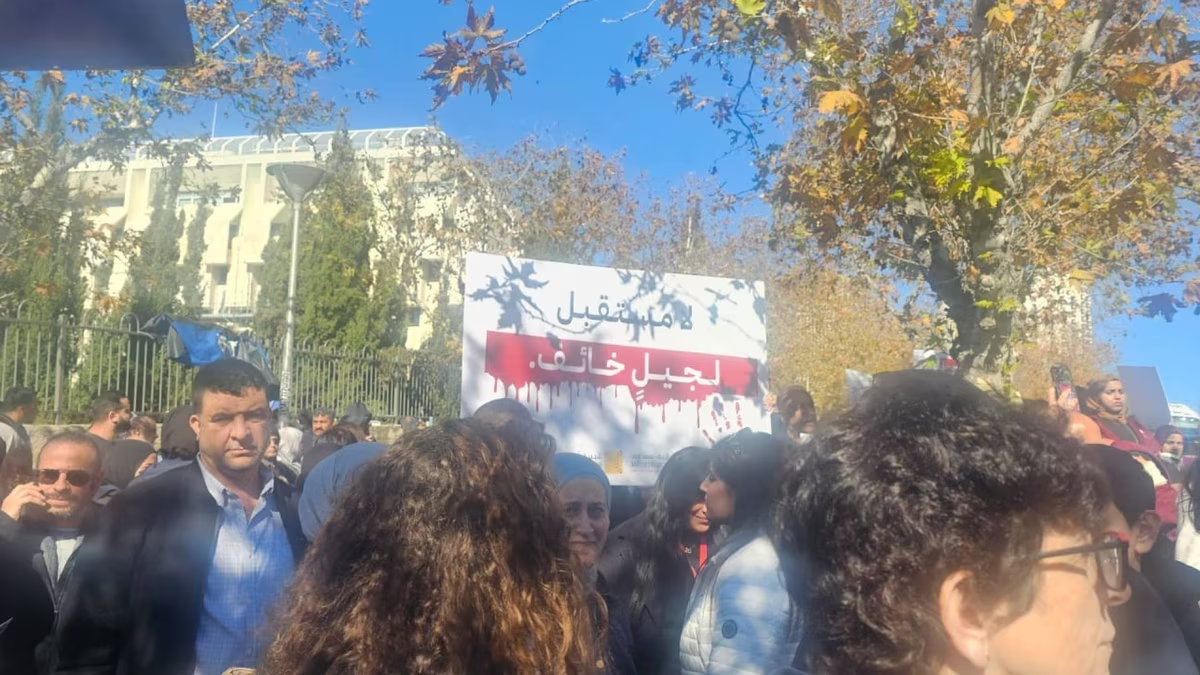
"Rage Demonstration" Shakes the Doors of the Occupation Government in Jerusalem, Chanting Against Crime and Displacement Policies in the Naqab

The Arab masses will no longer accept being easy prey for violence

Large crowds of Palestinians from the occupied interior gathered on Sunday in front of the office of the occupation government's prime minister in Jerusalem, as part of the nationwide "Rage Demonstration" called for by the High Follow-Up Committee for Arab Citizens of Israel.

This popular protest movement came to demand a halt to the bloodshed resulting from the rampant crime in Arab society, and to denounce what they described as the "complicity" of the police and government agencies affiliated with the occupation, in addition to defending the Naqab villages threatened with displacement.

Call to action from all regions

From the early morning hours, large groups of buses and vehicles set off from various towns in the Galilee, the Triangle, and coastal cities, where a main gathering point was organized at the "Latrun Junction" before heading collectively towards Jerusalem.

By midday, demonstrators had gathered in front of government headquarters, raising condemnatory slogans and pictures of crime victims, amidst a strict security cordon imposed by the occupation police around the area.

Mobilizing the street against "civilian massacres"

This demonstration comes as a translation of the decisions of the expanded meeting held recently in the city of Rahat, which included a selection of political leaders, Arab Knesset members, and representatives of the National Committee of Heads of Local Authorities, and the High Steering Committee for Arabs in the Naqab.

The demonstrators vented their anger at the inaction of the occupation's security establishment in curbing criminal gangs, considering that "lack of security" is a systematic policy to dismantle the Palestinian social fabric in the interior. The Naqab issue also emerged as a central concern, with participants chanting against home demolitions and the displacement of residents of unrecognized villages, emphasizing that steadfastness on their land is their only option.
Message from the "Follow-Up Committee"

The High Follow-Up Committee affirmed in the words of its representatives during the demonstration that this protest is only the beginning of a series of escalating steps, stressing that "the Arab masses will no longer accept being easy prey for violence or displacement schemes."

The committee called on the international community to pay attention to the dual existential dangers faced by Palestinians in the interior; between the bullets of crime and the bulldozers of settlement.

PALESTINE

Sun 11 Jan 2026 1:04 pm - Jerusalem Time

Two martyrs in Gaza by occupation forces' bullets and shelling despite ceasefire

Two Palestinian citizens were martyred on Sunday as a result of shooting and shelling carried out by the occupation army in both the Al-Zaytoun neighborhood in Gaza City and the Al-Maghazi refugee camp in the central Strip, in a continued violation by the occupation of the ceasefire agreement announced nearly three months ago.

Palestinian medical sources reported the martyrdom of a citizen after being shot by occupation forces in the Al-Zaytoun neighborhood, south of Gaza City, while another citizen was martyred succumbing to his wounds sustained after shelling targeted a gathering of citizens in Al-Maghazi camp yesterday.

According to Palestinian sources, occupation vehicles stationed east and south of Khan Younis city continued heavy firing during the night and morning hours, coinciding with artillery shelling targeting the southern Al-Mawasi area of Rafah, and airstrikes launched by Israeli warplanes on various areas in the central and southern Strip.

In the northern Gaza Strip, the occupation army detonated booby-trapped vehicles around the Sheikh Zayed roundabout, and blew up residential buildings near the Abu Zaitoun area in Jabalia camp, while warships fired shells towards coastal areas north of the Strip, in addition to heavy shooting targeting the Al-Tuffah neighborhood east of Gaza City.

According to Palestinian data, the occupation has committed hundreds of violations since the agreement came into effect; resulting in the martyrdom of 439 Palestinians and the injury of 1223 others since last October 11.

PALESTINE

Sun 11 Jan 2026 12:32 pm - Jerusalem Time

Nablus Under Siege: Occupation Forces Raid and Arrest Campaign in "Al-Yasmina"

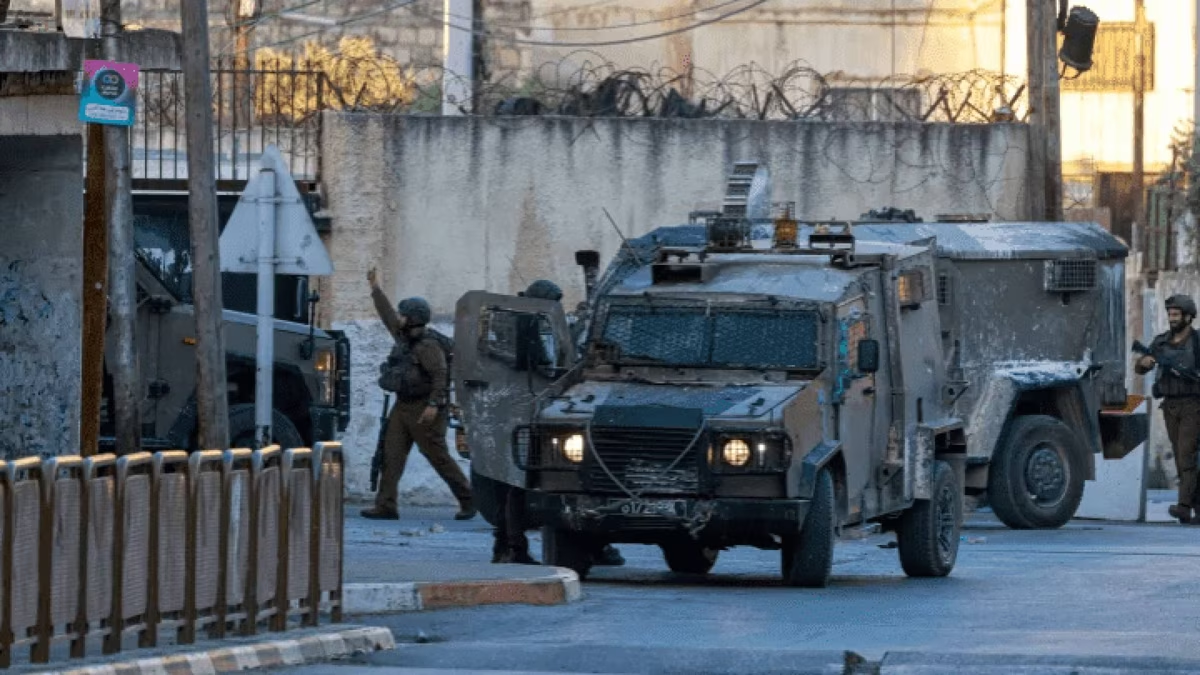
Occupation forces continue to impose a tight siege on the city of Nablus, north of the West Bank, following a wide-scale raid on the Old City, specifically the Al-Yasmina neighborhood, which included a heavy deployment of forces and an arrest campaign.

It was reported that a special "Israeli" force had infiltrated the Al-Yasmina neighborhood before being discovered, leading to armed clashes with Palestinian resistance fighters, followed by the occupation pushing large military reinforcements into the city, including vehicles and foot soldiers.

According to what the occupation army announced, an "Israeli" soldier was moderately wounded by gunfire during the operation, and he was evacuated for treatment, while occupation forces began pursuit operations in the area, amidst continued military deployment and the closure of the Old City entrances.

In a related context, occupation forces arrested the young man "Hamido Zakari" from the Old City of Nablus during the raid.

For his part, the director of medical relief in Nablus, Ghassan Hamdan, reported that a Palestinian family survived after their vehicle was targeted in the vicinity of the Old City.

15 citizens suffered from suffocation due to inhaling tear gas during the occupation forces' raid on the Old City of Nablus, according to reports.

He clarified that among the injured was a 13-year-old child, noting that all injuries received field treatment on site, without the need for transfer to hospitals.

PALESTINE

Sun 11 Jan 2026 12:26 pm - Jerusalem Time

Cairo hosts second phase talks: "Technocrat" committee to manage Gaza and the resistance's patience running out

All eyes are on the Egyptian capital on Monday, where the Egyptian leadership will hold a pivotal meeting to discuss arrangements for the "second phase" of the ceasefire agreement in the Gaza Strip. This meeting comes at a highly sensitive time, amidst intensive efforts to overcome first-phase violations and launch the "civil administration" phase for the Strip.

Topping the agenda of the meeting, which will be chaired by the head of the Egyptian General Intelligence Service, Major General Hassan Mahmoud Rashad, is the formation of an independent "technocrat committee" to manage the affairs of the Strip. According to Palestinian sources, the intention is to select 15 professional figures with experience, away from factional disputes.

Dr. Majed Abu Ramadan, Minister of Health in Dr. Mohammed Mustafa's government, emerged as the most prominent candidate to lead this committee, given his local and regional acceptance. This committee will be entrusted with the tasks of "reconstruction" and organizing municipal and health services, preparing the Strip for a phase of "social mending" and recovery after the war.

The path to the second phase remains contingent on closing the files of the first phase; sources revealed high-level intelligence cooperation to assist Hamas in locating the burial site of the last Israeli prisoner in Gaza.

Completing this file is key to reopening the Rafah crossing in both directions, a condition insisted upon by Egypt and Palestinian forces to actually begin infrastructure repair.

Despite these negotiating atmospheres, the field is experiencing a state of turmoil; the Egyptian mediator received an "angry" message from the Al-Qassam Brigades, warning that "the patience of the resistance fighters may run out" in the face of repeated Israeli violations, the latest of which was the shelling that killed 14 Palestinians.

The resistance accuses Tel Aviv of "evasion" in implementing the withdrawal provisions and aid flow, and believes that Israeli claims of retaliation for "failed" rockets are merely a pretext to undermine the agreement. Therefore, tomorrow's Cairo meeting will be a real test of the Egyptian mediator's ability to curb escalation and push the "administrative committee" forward, to spare the Strip a new wave of bloodshed.

PALESTINE

Sun 11 Jan 2026 12:26 pm - Jerusalem Time

"Elimination of Palestinian Presence".. The Dangers of the "Atarot" and "Nahalat Shimon" Projects on Jerusalem and Sheikh Jarrah

The so-called "District Planning and Building Committee" affiliated with the occupation authorities is preparing, on Monday, to discuss and approve two extremely dangerous settlement plans in occupied East Jerusalem.

The Jerusalem Governorate stated, in a comprehensive press release, that these moves represent a "qualitative escalation" aimed at determining the political fate of the city and geographically separating it from its depth in the West Bank.

The first plan targets the lands of the former "Jerusalem International Airport," where the occupation authorities intend to build about 9,000 settlement units on an area of nearly 1,243 dunams. This project is not merely urban expansion, but rather a human "settlement dam" that chokes communication between Jerusalem and Ramallah.

The Governorate affirmed that this plan seeks to erase the sovereign symbolism of the airport, which was seen as an aerial gateway for the future Palestinian state, and also falls within the vision of "Greater Jerusalem," which aims to annex 10% of the West Bank's area through a network of roads and tunnels connecting the settlements, while isolating Palestinian communities behind the annexation and expansion wall.

As for the second plan, it targets the heart of the Sheikh Jarrah neighborhood (Al-Nuqa'a land), where it stipulates the demolition of homes of about 40 Palestinian families to establish a settlement comprising 316 housing units. This escalation is based on discriminatory laws that allow settlement associations to claim properties dating back to before 1948, while depriving the original owners of the same right to reclaim their properties in West Jerusalem and the 1948 lands.

The Governorate's warnings were strongly worded regarding the linking of these outposts to settlements in "Karem Al-Mufti" and "Jabal Al-Musharif," which means dividing the Sheikh Jarrah neighborhood into two halves and completely isolating it, to establish a "settlement cordon" connecting the eastern and western parts of the city.

The Sheikh Jarrah neighborhood is a unique diplomatic and historical center, having hosted the historic "Shepherd Hotel," the PLO office, and a number of Arab consulates (Saudi, Iraqi, Kuwaiti, and Lebanese). Therefore, targeting it represents an attempt to erase the "Green Line" and change the city's urban identity.

The Jerusalem Governorate concluded its statement by emphasizing that these plans represent "crimes of forced displacement" that violate international law, stressing the continuation of action on all fronts to confront this settlement encroachment aimed at killing any chance for the establishment of a Palestinian state with Jerusalem as its capital.

PALESTINE

Sun 11 Jan 2026 10:58 am - Jerusalem Time

A Palestinian killed after being wounded in Hebron, Israeli soldier injured in clashes in Nablus

A Palestinian was martyred this Sunday morning, succumbing to wounds sustained from Israeli occupation forces' bullets on Saturday evening in the city of Hebron.

The Ministry of Health reported that the General Authority for Civil Affairs informed it of the martyrdom of citizen Shaker Falah Al-Ja'bari (58 years old) by occupation bullets in Hebron last night, and the detention of his body.

Occupation forces had injured Al-Ja'bari in the "Khallat Hadour" area east of Hebron, and prevented ambulance crews from reaching him, claiming he attempted to run over a group of soldiers.

In another context, the Israeli occupation army announced on Sunday morning that one of its soldiers was moderately wounded during clashes that took place in Nablus, north of the West Bank.

The army stated in a communiqué on its "X" platform account: "During a military operation by Israeli army forces in the city of Nablus, a soldier was moderately wounded as a result of gunfire directed at the forces." It added that "the injured soldier was transferred to the hospital for treatment, and his family was informed."

For its part, the "Nablus Battalion" affiliated with Saraya al-Quds said that its fighters discovered a special Israeli unit during its infiltration in the vicinity of the Old City, and "showered" it with intense bursts of bullets, achieving confirmed hits among its ranks.

Shortly before that, Israeli Army Radio reported clashes in the Qasaba neighborhood of Nablus between the Israeli army and Palestinian resistance fighters.

Later, the official "Wafa" agency reported that Israeli occupation forces were besieging the entrance to the Old City of Nablus, amid a widespread deployment within its alleys.

The Palestinian Red Crescent said that occupation forces were detaining a number of journalists in the Old City of Nablus, after they arrived to cover the developments.

Sources told the "Wafa" agency that special Israeli forces infiltrated the Al-Qaryoun neighborhood inside the Old City, followed by the storming of a number of occupation vehicles that entered the city from several axes, heading towards the Old City and its surroundings, and spread in several alleys inside the city, and the Eastern Market, and sounds of live gunfire were heard.

Over the past hours, occupation forces launched a wide arrest campaign in Nablus, Hebron, Ramallah, Qalqilya, and other areas in the West Bank.

PALESTINE

Sun 11 Jan 2026 10:13 am - Jerusalem Time

Israeli Army: Soldier injured in clashes in Nablus, shooter pursued

The Israeli army said a soldier was moderately wounded during what it described as operational activity in the city of Nablus, in armed clashes between Palestinian resistance fighters and the occupation army.

The Israeli army added that it is pursuing the shooter of the soldier.

It had earlier reported the outbreak of armed clashes between resistance fighters and the occupation army after Israeli special units infiltrated the Old City of Nablus in the northern West Bank.

It clarified that military reinforcements had arrived in the vicinity of the Old City in Nablus.

In Ramallah, Fatima Khamayseh reported that "Israeli occupation forces are still continuing their operations in the city of Nablus in the northern West Bank and are continuing their search for the shooter, and are pushing military reinforcements to encircle it and arrest the shooter. There is an incursion into the Askar refugee camp east of Nablus amid talk of house raids, and clashes are heard from time to time."

She explained that what happened was "an incursion by elements of the Mista'arvim unit via two civilian trucks carrying Palestinian license plates that entered the Yasmineh neighborhood in the Old City of Nablus at dawn today, and after the youth of that area discovered these special units, they opened fire on them, which led to their retreat and a request for military reinforcements from the Israeli army."

She concluded that "occupation forces deployed snipers on the roofs of a number of buildings in the Old City simultaneously with the intensive military deployment, and gunfire is heard from time to time amid a complete siege of the area."

In a related context, the Israeli army said its forces opened fire on a Palestinian who tried to run over soldiers in the city of Hebron.

For its part, the Palestinian Red Crescent said that the occupation forces prevented its crews from reaching an injured young man in the Khallet Hadour area in central Hebron.

PALESTINE

Sun 11 Jan 2026 10:01 am - Jerusalem Time

Prominent Republican Senator Calls for Immediate Cut to Military Aid to Israel After Netanyahu's Statements

In a notable development in American political discourse towards Israel, prominent Republican Senator Lindsey Graham, known for decades for his strong support of Israel, called for an immediate reduction in US military aid to Israel, without waiting ten years. This came in response to statements by Israeli Prime Minister Benjamin Netanyahu, who announced that his country seeks to end its dependence on US military aid within a decade.

Graham stated in a post on the "X" platform (formerly Twitter) that the United States "does not need to wait ten years" to begin reducing aid, considering that accelerating this step could save American taxpayers billions of dollars, and these funds could be directed to enhance internal American military capabilities. Graham's statements are particularly significant given his long history as one of the most prominent advocates for military aid to Israel within Congress.

Netanyahu's Statements: Ending Dependence Within a Decade

Graham's statements came after an interview with Israeli Prime Minister Benjamin Netanyahu in The Economist magazine, where he said that Israel aims to "gradually reduce its dependence on US military aid to zero within the next ten years." Netanyahu explained that Israel now has a strong economy and an advanced defense industry that enables it to achieve greater military self-sufficiency.

Netanyahu indicated that his government is investing hundreds of billions of shekels in local military industries, including the development of air defense systems, precision missiles, and cyber technologies, considering that these investments will allow Israel to maintain its qualitative military edge without the need for continuous external support.

US Aid: History and Volume

Under the Memorandum of Understanding signed in 2016, Israel receives US military aid worth approximately $38 billion extending until 2028, averaging $3.8 billion annually. This aid is a cornerstone of the strategic relationship between the two countries, allowing Israel to purchase advanced weapons from the United States, and also strengthening American defense industries themselves.

For decades, this aid has enjoyed near-unanimous support from both Republican and Democratic parties, being considered part of Washington's commitment to Israel's security in a turbulent region. However, Netanyahu's recent statements have opened the door to rethinking the future of this support.

A study organized by the prestigious "Brown" University, published last fall, showed that the United States has directly supported Israel with at least more than $22 billion in weapons since October 7, 2023.

Reactions Within the Republican Party

Graham's stance sparked controversy within Republican circles, as some observers saw his statement as reflecting a broader shift within the party, especially among fiscally conservative currents that have become more skeptical of the utility of foreign spending. These observers believe that the United States faces major internal challenges, from budget deficits to modernizing its military infrastructure, which necessitates a reordering of priorities.

In contrast, a large number of Republicans still consider aid to Israel a strategic investment that serves American interests in the Middle East and maintains the military superiority of a key ally in the face of regional adversaries.

Democratic Positions and the Broader Context

On the Democratic side, positions vary. While the centrist current adheres to supporting military aid to Israel, a growing progressive wing calls for linking this aid to conditions related to human rights and the humanitarian situation in the Palestinian territories. Nevertheless, Graham's call represents a notable precedent, as it comes from a Republican figure whose name has long been associated with unconditional defense of Israel.

Potential Repercussions

So far, there is no official legislative initiative to cut military aid to Israel, but Graham's statements may pave the way for a broader discussion within Congress, especially with the approaching end of the current Memorandum of Understanding in 2028. These statements may also affect the calculations of decision-makers in Israel regarding the pace of reducing dependence on American support.

Lindsey Graham's statements reflect a qualitative shift in American political discourse, as military support for Israel is no longer an unquestionable given within the Republican Party. The call for an immediate reduction in aid, even if presented in economic terms, indicates that the relationship is now measured by the logic of cost and return, not just by traditional ideological or strategic alliances.

On the other hand, Netanyahu's statements reveal a preemptive Israeli attempt to redefine the relationship with Washington on the basis of partnership, not dependence. However, ending aid may carry political and military risks, as this aid is not limited to money only, but also represents a political guarantee and a symbol of American commitment to Israel's security in the face of rapid regional transformations.

OPINIONS

Sun 11 Jan 2026 9:46 am - Jerusalem Time

Timeline and Follow-up on the Genocide Case at the ICJ

Dr. Dalal Saeb Erakat

Dr. Dalal Saeb Erakat

Opinion Writer

The lawsuit filed by South Africa before the International Court of Justice constituted a landmark legal moment, not only because of the gravity of the accusation, but because it reactivated one of the most sensitive international agreements: the 1948 Convention on the Prevention and Punishment of the Crime of Genocide. However, the gravity of this moment lies not only in the issuance of the decision, but in what followed, and we ask two years later: have the Court's orders been left without follow-up, or have they turned into a continuous accountability process? What happened and how do we build on it, and who is responsible?
Phase One: On December 29, 2023, South Africa formally filed its lawsuit before the Court, based on Article IX of the Genocide Convention, which allows any state party to sue another state for breaching the Convention, even if not directly harmed. With this action, the Palestinian issue moved for the first time in decades to the heart of international jurisdiction.
Phase Two: The Court held public hearings on January 11 and 12, 2024, to consider the request for provisional measures. At this stage, the Court was not asked to prove that the crime had occurred, but to assess the existence of a reasonable risk threatening the rights protected under the Convention, and the seriousness of the continued actions subject to the lawsuit. This point was deliberately misunderstood in political and media discourse, as it was portrayed as a “formal stage,” while in reality it is the basis for urgent judicial intervention.
Phase Three: On January 26, 2024, the Court issued its order for provisional measures, and decided that the rights South Africa sought to protect were “plausible and at real risk.” The Court obligated Israel to: take all measures to prevent acts that could constitute genocide, ensure the entry of humanitarian aid and essential services, prevent public and direct incitement to genocide, and submit an official report within one month on compliance procedures. Legally, this decision is binding and not subject to political or selective interpretation.
Phase Four: Since February 2024, indicators of Israeli non-compliance have begun to accumulate through restrictions on aid, the continued expansion of military operations, and the escalation of incitement without accountability. Faced with this reality, many countries joined the case and South Africa returned to the Court, requesting additional measures, especially with the worsening situation in Rafah. New hearings were held on May 16 and 17, 2024, confirming that the case has not been closed, and that the Court retains its jurisdiction as long as the danger persists.
In this timeline, responsibility cannot be limited to the plaintiff state, the Court, or the states that joined the case alone. As a state party to the Genocide Convention, the State of Palestine bears a direct legal obligation to follow up on the implementation of the Court's orders. This means that Palestine's role should not be limited to welcoming decisions, but should include: systematically documenting non-compliance, raising it through legal and diplomatic channels, and explicitly demanding international measures to ensure implementation.
Contentment with a political stance empties international recognition of Palestine of its legal content. For signatory states and recognizing states: a double commitment. More than 150 states have ratified the Genocide Convention. Under it, the obligation is not limited to refraining from committing the crime, but includes preventing it and prosecuting its violation. States that have recognized the State of Palestine bear a double responsibility because they are now called upon to protect it legally. Recognition that is not translated into diplomatic pressure, a review of relations, or public defense of the binding nature of the Court's decisions, turns into a symbolic, ineffective measure.
Justice is a process; the International Court of Justice has not yet issued its final judgment, and that may take years. But the timeline of the case clarifies one fact: international law does not work automatically, but needs states that insist on activating it. The State of Palestine must lead the follow-up process, not merely play the role of a victim. And signatory states, especially those recognizing Palestine, must prove that recognition is a commitment, not a slogan. In this case, dropping the follow-up is dropping accountability, and dropping accountability is undermining rights and the meaning of international justice, and a sign of Israel's continued impunity for daily crimes, which is the main reason for the occupying state's disrespect for any laws or UN resolutions, because it always escapes punishment to the point where it deals with the international system with unprecedented contempt.


OPINIONS

Sun 11 Jan 2026 9:40 am - Jerusalem Time

Between the Statement of Constants and the Imperative of Reform: What Does Fatah Want from its Eighth Conference?

By: Dr. Yasser Abu Bakr

By: Dr. Yasser Abu Bakr

Opinion Writer

The final statement of the thirteenth session of the Fatah Revolutionary Council is not a fleeting statement, nor can it be read outside the dangerous national context in which the Palestinian cause lives amidst a war of extermination, targeting of identity, and attempts to dismantle national representation. From this angle, the statement was politically disciplined, clear in establishing constants, keen on unity of discourse, and cohesive in defending the Palestinian national project in the face of displacement, settlement, guardianship, and suspicious alternatives. This in itself is a credit to the movement at a national moment that cannot tolerate dispersion or adventure.
However, reading the statement from the perspective of a Fatah cadre keen on the movement does not suffice with what it said, but rather pauses for a long time at what it avoided saying, what it postponed, and what it left open to interpretation, especially since the statement was issued at a sensitive organizational moment preceding the Eighth General Conference, whose date was clearly announced, while its path and criteria remained vague.
Politically, it cannot be denied that the statement re-established the correct national ceiling: rejection of displacement, adherence to the PLO as the sole legitimate representative, unity of Palestinian land, priority of stopping the aggression on Gaza, supporting the steadfastness of the camps in the northern West Bank, the centrality of Jerusalem, and defending UNRWA and the right of return. These are not details, but major headlines that reflect Fatah's position at the heart of national consensus, and confirm that the movement is still capable of producing a balanced political discourse in the most complex moments.
The statement is also credited with not ignoring the sensitive issues that have burdened the relationship between the movement and its bases in recent years. It clearly affirmed that the rights and dignity of the families of martyrs, prisoners, and wounded are a trust on the movement's neck, and acknowledged the existence of "confusion" in this file, with a pledge to find an appropriate national formula to address it quickly. It also re-emphasized the centrality of the prisoners' file, and rejected the racist occupation legislation against them.
These are important moral and political signals, but they remain incomplete as long as they have not been translated into clear executive commitments, with specific mechanisms and an announced timetable, to dispel the legitimate concern of the families of martyrs and prisoners, and restore lost trust.
Organizationally, the decision to hold a session of the Revolutionary Council before the General Conference to approve the work of the preparatory committee was a positive step in principle, because it strengthens the role of the Revolutionary Council and gives it a supervisory function. Also, the decision to return those against whom individual dismissal decisions were issued, with the exception of those who committed crimes against our people or whose cases are still pending, represents a step towards long-awaited internal repair, and restores consideration to the idea that the movement is not managed by individual exclusion or whimsical decisions.
However, these steps, despite their importance, remain incomplete if they are not included within a broader reform vision. The statement did not provide a diagnosis of the state of organizational stagnation, did not explicitly acknowledge the decline in the movement's popular presence, and did not address the accumulated trust gap between the bases and the leadership. More dangerously, it avoided delving into the essence of the organizational question that occupies Fatah cadres today: What kind of conference do we want? And how do we ensure that the Eighth Conference is a real renewal station and not a reproduction of the same reality?
Announcing the date of the conference without talking about its membership criteria, or representation mechanisms, or guarantees that prevent non-organizational interventions, does not dispel concern, but rather postpones it. The problem in the movement's history has never been in holding conferences, but in the way to them, and in how their structure and outcomes are formulated. Therefore, merely affirming "the necessity of the conference" without reassuring the bases of the integrity of its path leaves the door open to doubts, and weakens the ability to transform the conference into a moment of real revival.
The statement, in this sense, is strong in politics, but overly cautious in organization. This caution is tactically understandable in a pressing national circumstance, but it should not become a permanent approach. Fatah, if it wants to lead the street, it is not enough to address it with an advanced national discourse, but it must address its cadres with a sincere reformist language that acknowledges the crisis and sets a clear program to address it.
What is required today, after this statement, is not another statement, but a complementary organizational action. What is required are clear decisions before the conference regarding its membership criteria, guaranteeing the independence of the preparatory committee, the complete separation between the organization and any external interventions, and a real and transparent treatment of the file of the families of martyrs and prisoners. What is also required is to link the talk about "the year of Palestinian democracy" with democracy within the movement itself, because one who lacks something cannot give it, and because any call for participation and alignment loses its meaning if it is not accompanied by internal reform that opens the door for the cadre, not just demands their commitment.
This statement is a step forward politically, but it is still an incomplete step organizationally. If it is not completed with tangible reform steps before the Eighth Conference, the movement risks widening the trust gap, not bridging it. Fatah still possesses historical capital, national legitimacy, and the ability to lead, but these elements are not preserved by statements alone, but by a courageous will for reform that begins from within.
Between the statement of constants and the imperative of reform, Fatah stands today before a real test. Either it transforms the Eighth Conference into a station of renewal and responsibility, or it contents itself with managing the moment and postponing difficult questions. The difference between the two options is not determined by the statement, but by the actions that will follow it.

PALESTINE

Sun 11 Jan 2026 8:20 am - Jerusalem Time

Israeli Air Force launches raids on Gaza after martyrdom of Palestinians

The Israeli Air Force launched raids this Sunday morning on various sites in the areas where the occupation army is deployed in the Gaza Strip, after Palestinians were martyred and others injured by its fire yesterday, Saturday.

Israeli raids targeted areas where the occupation army is deployed east of Rafah and Khan Yunis in the southern Gaza Strip, and the Bureij refugee camp in its center.

Yesterday, Saturday, the Israeli army admitted to killing 3 Palestinians in various areas of the Gaza Strip, claiming that they posed an immediate threat to the forces deployed in the field.

In a statement, it claimed that the forces of the 188th Brigade's combat team, operating in the southern Gaza Strip, detected on Saturday, 3 armed Palestinians who crossed what is called the "Yellow Line" and approached the forces, claiming that one of them tried to take military equipment from the army before fleeing the scene.

The statement added that the Israeli Air Force carried out a raid under the guidance of the brigade's fire system, which resulted in the killing of what it described as the "armed man" west of the Yellow Line.

In the northern part of the Strip, the army claimed in the same statement that it detected a number of "armed men" who crossed the Yellow Line and approached the forces, which was considered an immediate threat, according to its expression.

It indicated that the forces opened fire immediately upon detecting them, which led to the killing of two of the "armed men."

Also on Saturday, Palestinian medical sources said that the Israeli army killed two Palestinians and injured several others, in targeting operations carried out in various parts of the Gaza Strip.

The sources confirmed that a number of Palestinians were injured in an airstrike carried out by an Israeli aircraft near the entrance to the Maghazi refugee camp, in the center of the Strip.

Eyewitnesses said that all the areas targeted by the Israeli army had been withdrawn from under the ceasefire agreement.

This came as part of the continuous Israeli violations of the ceasefire agreement in effect since October 10, 2025.

The Israeli army also launched airstrikes and artillery shelling on various parts of the Strip at dawn on Saturday, within the areas under its control according to the ceasefire agreement.

Since the agreement came into effect, Israel has committed hundreds of violations with shelling and gunfire, resulting in the martyrdom of 439 Palestinians and the injury of 1223 others.

ARAB AND WORLD

Sun 11 Jan 2026 8:11 am - Jerusalem Time

The occupation confirms no intention to attack Iran but is preparing for any surprise

The source denied any intention of the occupation to launch a military attack on Iran at this stage.

The Hebrew "Channel 12" quoted an official source as saying that the Chief of Staff of the occupation army held intensive security consultations over the weekend to assess the situation in Iran.

The source confirmed that all security establishment agencies are closely monitoring the latest field developments and escalating protests inside Iran, to detect any repercussions that may affect the regional front.

Denial of attack intention and preparation for surprises

In a message aimed at clarifying the official position, the source denied any intention of the occupation to launch a military attack on Iran at this stage.

However, he stressed that the Israeli occupation army is fully prepared to defend and confront any "surprise" that may result from the export of the Iranian crisis abroad, or an unforeseen security slip.

Military analysts in Tel Aviv believe that these consultations reflect the occupation's fears of "the regime's recklessness" in Tehran as a means to escape internal pressures, which necessitates raising the level of alert in air defense and intelligence systems.

Read also: Palestinian youth injured by occupation bullets on suspicion of attempted "ramming" in Hebron

The occupation remains in a state of permanent session to monitor the repercussions of "digital isolation" and bloody clashes in Iranian cities, while maintaining a policy of "waiting and readiness."

ARAB AND WORLD

Sun 11 Jan 2026 7:19 am - Jerusalem Time

Somali Defense Minister: Israel plans to forcibly displace Palestinians to Somaliland

Somali Defense Minister Ahmed Moallim Fiqi said that Mogadishu has information that Israel plans to forcibly displace Palestinians to what is known as the "Somaliland" region, describing the move as a grave violation of international law and Somalia's sovereignty.

Fiqi called on the Israeli government to withdraw its recognition of what he called the "separatist region," stressing that Prime Minister Benjamin Netanyahu has no legal or legitimate right to grant legitimacy to an entity within a sovereign state.

The minister explained, during an interview with the "Al-Masa'iya" program, that the Israeli move represents a direct aggression against the territorial integrity of Somalia, noting that Israel is exploiting separatist leaders, even though nearly half of the areas that were known as "Somaliland" have announced their joining the Federal Republic of Somalia in the past two years.

Fiqi revealed that Israel also seeks to establish a military base in the region due to its strategic location near the Bab al-Mandab Strait, the Red Sea, and the Arabian Sea, warning that this aims to destabilize and divide countries.

He affirmed that his country will resort to all diplomatic and legal means to reject what he described as the Israeli violation, pointing out that the African Union realizes the seriousness of this precedent for the stability of the continent.

The minister praised the positions of a number of Arab and regional countries, including Saudi Arabia, Qatar, Egypt, and Turkey, in addition to the Arab League and the Gulf Cooperation Council, in supporting Somalia's unity. He also appreciated the position of US President Donald Trump's administration in not recognizing the so-called "Somaliland" region.

PALESTINE

Sat 10 Jan 2026 9:23 pm - Jerusalem Time

Hamas leader: The movement affirmed its readiness to hand over its duties in the Gaza Strip to a "technocrat" committee

Hamas spokesman Hazem Qassem announced on Saturday evening a clear decision taken by the movement to dissolve the governmental bodies currently managing affairs in the Gaza Strip, should an agreed-upon technocrat committee be formed.

Qassem affirmed in a press statement that the movement is ready to hand over all duties to a "technocrat" committee, stressing Hamas's commitment to facilitating all procedures to ensure the committee's success in performing its tasks. He also called for accelerating the formation of this body to begin its responsibilities towards the Strip.

This announcement coincided with statements by the movement's leader, Basem Naim, in which he affirmed that the ceasefire plan proposed by US President Donald Trump, and adopted by the Security Council in Resolution 2803, is facing clear difficulties.

Naim attributed this difficulty to what he described as the evasion of his commitments by the occupation's Prime Minister Benjamin Netanyahu, accusing him of working to escalate the situation and sabotage the agreement to return to war in search of saving his political future.

Naim highlighted the continuous violations by the occupation, pointing to the martyrdom of 13 Palestinians yesterday, Friday, in various areas under what he described as fabricated pretexts. He reiterated the following points:

Read also: Sisi and "Class" call for full implementation of the Gaza agreement and anticipation for Washington's announcement of the features of the second phase

Resistance's Commitment: He affirmed that the resistance has committed to all its obligations according to the agreement, as testified by mediators and the United States. Readiness for the Second Phase: He stressed the movement's readiness to deal positively with the second phase, including the immediate formation of a Palestinian body to administer Gaza and Hamas's withdrawal from the governmental scene. Basic Demands: He linked the success of the plan to the full opening of crossings in both directions and the implementation of the remaining clauses clarified to the mediators. Leader Basem Naim warned that the continued escalation and the catastrophic humanitarian situation in Gaza put the credibility of the mediators and the American guarantor at stake.

He concluded by emphasizing that this situation is unsustainable and could lead to an expansion of the conflict in the region, which Netanyahu appears to be seeking to avoid his inevitable political fate.

PALESTINE

Sat 10 Jan 2026 7:09 pm - Jerusalem Time

Anonymous text messages terrorize settlers: 'We are coming, look at the sky at midnight'

Despite the confusion it caused, the army, Shin Bet, and police did not issue any statements warning of a real security threat.

The past few hours have witnessed a state of tension and anxiety among settlers in the occupation entity, after a large number of them received anonymous short text messages (SMS) on their mobile phones.

Channel 12 reported that the messages were in English with a threatening tone: "We are coming, look at the sky at midnight," which led to widespread circulation and noticeable confusion amid the charged security atmosphere in the region.

A military source confirmed to the occupation army radio (Gal Tzahal) that many people received these reports, as it became clear that the messages were sent via foreign numbers or low-cost bulk broadcasting services.

Read also: "Kidnapping the groom".. A wedding night in occupied Jerusalem turns into a field of repression with occupation bullets.. Video

Despite the confusion it caused, the army, Shin Bet, and police did not issue any statements warning of a real, tangible security threat based on these texts, which reinforces the hypothesis of "psychological warfare."

Security experts so far tend to classify this campaign as a "mass intimidation operation" or a "digital hoax" exploiting the current tension, rather than an indicator of an imminent military operation.

Despite speculations linking these movements to entities supporting Iran, these analyses remain without conclusive evidence and fall within the framework of initial conclusions about the situation.

Most analyses agree that the campaign succeeded digitally in creating a stir, but it remains within the scope of "cheap terror" that is not based on significant technical or operational capabilities, with calls for the public to exercise caution when dealing with such misleading messages.

PALESTINE

Sat 10 Jan 2026 5:08 pm - Jerusalem Time

Sisi and "Kallas" call for full implementation of Gaza agreement and anticipation of Washington's announcement of the features of the second phase

These arrangements aim to provide basic services to citizens and initiate early recovery projects, which are a prelude to comprehensive reconstruction.

Egyptian President Abdel Fattah El-Sisi, during his meeting with the European Union's High Representative for Foreign Affairs, Kaja Kallas, stressed the necessity of full implementation of the ceasefire agreement in the Gaza Strip.

This meeting coincided with reports indicating the imminent transition to the second phase of the agreement, amid Egyptian assurances that the United States will soon announce the entitlements associated with this phase, which is led by the vision of US President Donald Trump.

The Egyptian and European sides affirmed a set of crucial constants to ensure the sustainability of de-escalation in the Strip. Emphasis was placed on ensuring the regular and unrestricted flow of humanitarian aid, with an absolute rejection of any attempts to displace Palestinians from their lands.

President Sisi and Kallas also reiterated their call for accelerating the start of the second phase and launching the reconstruction process, in conjunction with resuming the political track to achieve a just and comprehensive peace based on the two-state solution.

Egyptian Foreign Minister Badr Abdel Atty clarified that the plan associated with President "Trump" includes essential details that will be announced soon by Washington.

The critical importance of this phase lies in the security and service umbrella it will provide, including the deployment of an international stabilization force and the empowerment of the Palestinian Administrative Committee on the ground.

These arrangements aim to provide basic services to citizens and initiate early recovery projects, which are a prelude to comprehensive reconstruction.

The meeting was not limited to the Palestinian issue, as Sisi and Kallas discussed a range of pressing issues affecting global security.

Discussions included the situations in Libya, Sudan, Syria, Lebanon, and Iran, leading up to the Ukrainian crisis.

The two sides agreed on the inevitability of settling these conflicts through peaceful means to preserve the unity and integrity of states, warning that any additional military escalation would have dire consequences affecting the interests of all parties without exception.

PALESTINE

Sat 10 Jan 2026 4:49 pm - Jerusalem Time

US media: Conditions for disarmament by "Israel" may reignite clashes with Hamas

An official in the occupation army affirmed that disarming the movement is inevitable, and if it is not done voluntarily, "it will be forced."

The American newspaper "Wall Street Journal" revealed field preparations by both the occupation forces and the Hamas movement for the possibility of renewed military confrontations between them.

This tension comes amid the movement's insistence on not fully disarming, a condition that "America" and the occupation adhere to as a fundamental pillar for any progress in the anticipated political path.

"America" and the occupation demand that Hamas relinquish its weapons as part of its commitment to a ceasefire agreement.

While the movement shows readiness to abandon what remains of "heavy weapons," it categorically refuses to surrender light weapons, as occupation reports estimate that Hamas has about 60,000 rifles and 20,000 fighters.

On the other hand, the movement is focusing on restoring its damaged military capabilities, especially the tunnel network. The newspaper also quoted Arab and Israeli officials as saying that Hamas received new financial flows that enabled it to resume paying its fighters regularly.

In the context of these movements, the occupation army has prepared plans for a new ground operation targeting areas controlled by Hamas.

The Chief of Staff of the occupation army, Eyal Zamir, stated last November the necessity of preparing for a "wide attack" behind the lines of engagement.

Despite these plans, officials confirm that there is no immediate intention for field entry, as Tel Aviv is giving time for the American plan to proceed, while emphasizing that the timing of the operation remains in the hands of the political leadership.

For his part, "Trump" had issued a stern warning to the movement in December, threatening that "hell" would break out if it did not give up its weapons.

An official in the occupation army affirmed that disarming the movement is inevitable, and if it is not done voluntarily, "it will be forced."

The readiness is not limited to the Gaza Strip; the occupation forces are also considering the possibility of a new round with Hezbollah, believing that a new operation may be necessary to help the Lebanese army disarm the party, while the latter asserts its ability to do so alone.

Tel Aviv is also closely monitoring Tehran's efforts to rebuild its ballistic missile program after the June war, with warnings of strikes to prevent this.

Donald "Trump" reiterated his support for any military action against Tehran if it rebuilds its missile or nuclear programs.

The intersection of disarmament demands with Hamas's insistence on retaining its capabilities gives the coming period a critical character, as strict American warnings and field movements indicate that the option of war remains strongly present if diplomacy falters.