PALESTINE

Fri 13 Feb 2026 9:37 am - Jerusalem Time

Israeli Violations in Gaza and Human Rights Condemnation of the Abuse of Palestinians at the Rafah Crossing

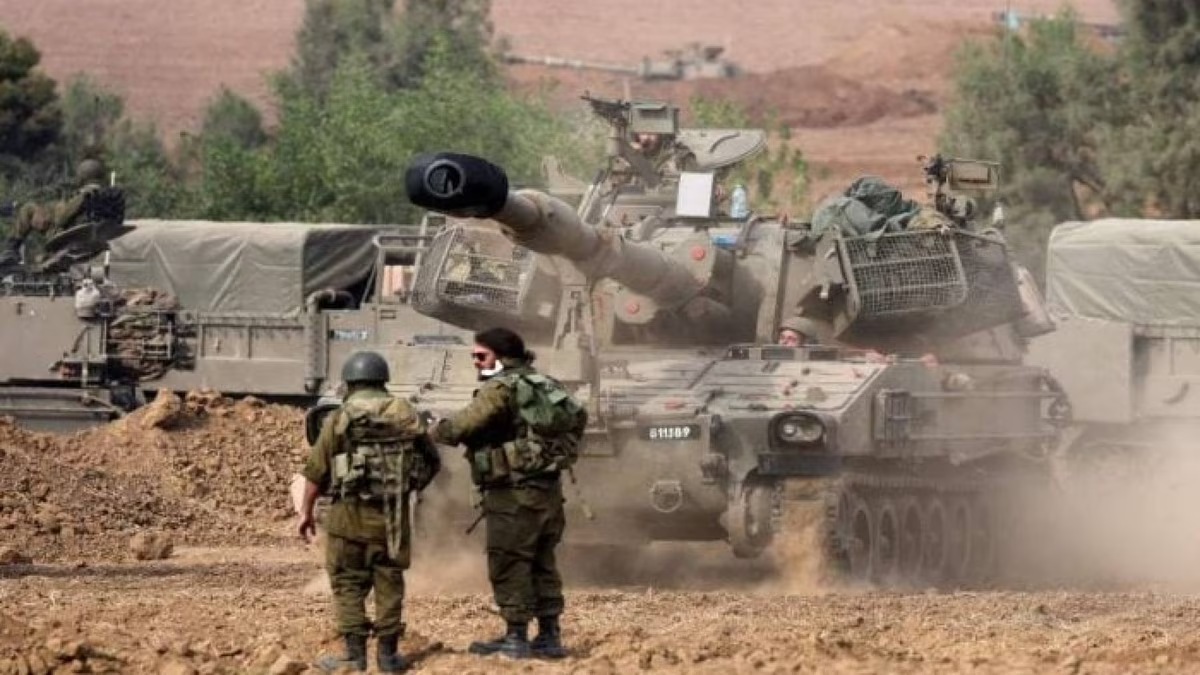
The Israeli occupation army escalated its field violations in the Gaza Strip today, Friday, as engineering units carried out extensive demolition operations of residential buildings in the Al-Tahlia area, east of Khan Yunis city. These military movements fall within the areas of deployment of occupation forces specified by previous understandings, raising fears of a geographical change in the region.

In Gaza City, occupation drones launched attacks targeting citizens' homes around the Al-Zaytoun Club, east of the Al-Zaytoun neighborhood, by directly dropping explosive bombs. Field sources confirmed that these targeting incidents occurred in areas outside the agreed-upon army deployment zone, representing a clear violation of the ceasefire agreement in effect since last October.

The aggressions were not limited to land but extended to the Palestinian coasts, where Israeli warships opened fire with their machine guns towards fishing boats and beaches off Gaza City. Despite no human casualties in this naval attack, it caused a state of panic among citizens trying to resume their livelihoods.

On the human rights front, legal institutions within the occupied territories directed sharp criticism at the occupation authorities, demanding an immediate halt to the systematic abuse policies practiced against Palestinians. The 'Adalah' Center and the 'Gisha' Center affirmed in a joint statement that the restrictions imposed on travelers' movement through the Rafah crossing lack any legal cover and aim to restrict the residents.

An urgent message addressed to the Minister of War and the Legal Advisor to the Israeli government clarified that what is happening at the Palestinian-Egyptian border is a process of 'forced displacement' disguised as security measures. The two centers stressed the necessity of canceling all impossible conditions that prevent thousands of those stranded outside the Strip from returning to their homes and families normally.

The occupation authorities had reopened the Palestinian side of the Rafah crossing at the beginning of February, after months of closure since its military takeover in May 2024. However, reports described the opening as 'formal and very limited,' as it is subject to strict security control that prevents the vast majority from crossing.

Field data indicates that the occupation imposes complex prior security approvals for anyone wishing to enter or exit, with a daily quota not exceeding 50 people. This measure has deprived hundreds of wounded and sick people from traveling to receive necessary treatment, and has also left thousands of Palestinians stranded in diaspora countries with no prospect of return.

Human rights organizations conveyed shocking testimonies from returnees who managed to cross, stating that they were subjected to humiliating treatment, including blindfolding and handcuffing for long hours. The testimonies also included confiscation of personal belongings and money, as part of the collective punishment policy practiced by the forces present at the border point.

Reports revealed cooperation between the occupation army and armed groups within the Strip to secure the transfer of some returnees to special interrogation centers under army control. In these centers, citizens are subjected to harsh interrogations and security pressures, including threats of administrative detention or denial of return if they do not cooperate with intelligence agencies.

Human rights organizations concluded their statement by warning against the continuation of these violations that disregard international and humanitarian laws, emphasizing that international silence on these practices encourages the occupation to proceed with turning crossings into tools of torture and political and security extortion against unarmed civilians.

Israeli measures at the Rafah crossing represent a policy of abuse and illegal restrictions that amount to forced displacement.
ARAB AND WORLD

Fri 13 Feb 2026 9:37 am - Jerusalem Time

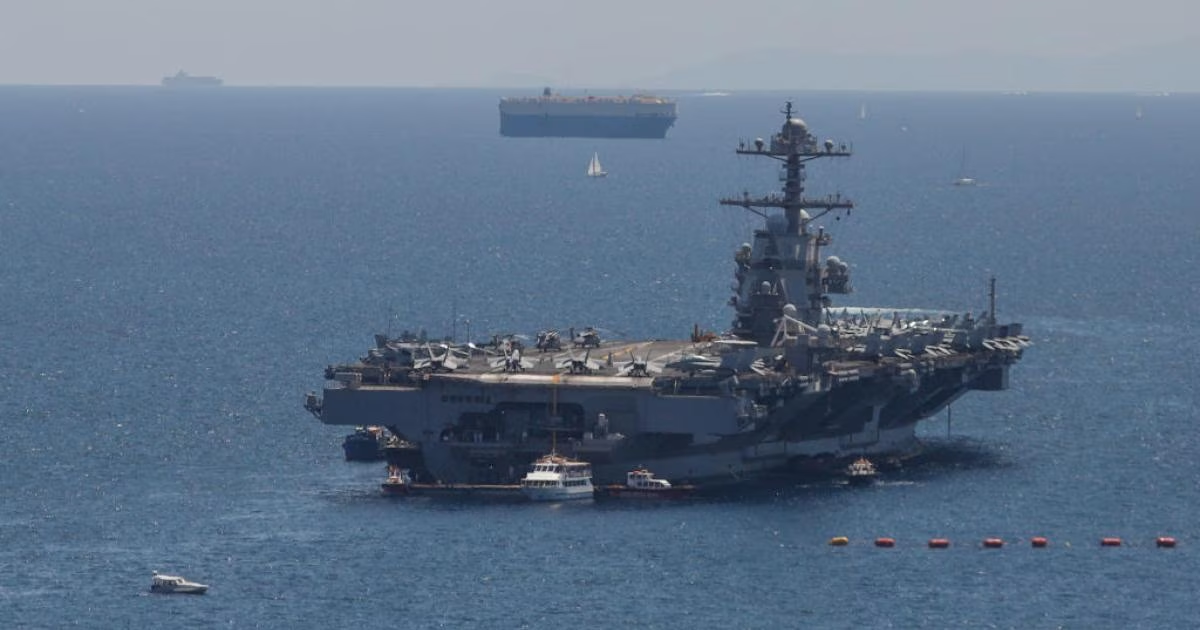
Washington deploys world's largest aircraft carrier to Middle East amid tensions with Iran

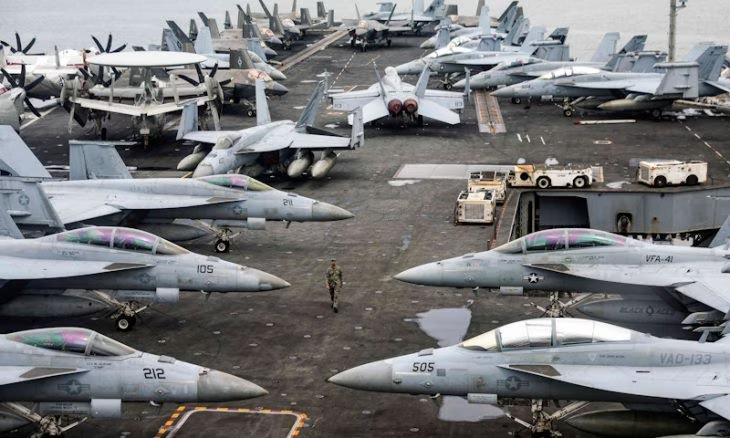
American press reports, citing responsible sources, revealed that the US administration has decided to move the aircraft carrier 'USS Gerald R. Ford', the largest of its kind in the world, towards the waters of the Middle East. This step comes in the context of strengthening the United States' military readiness to confront any potential scenarios, including the possibility of launching military strikes against Iran if diplomatic efforts reach a dead end.

The sources explained that the carrier 'Ford' and its accompanying combat group, which is currently operating in the Caribbean Sea, will begin its journey towards the region without disclosing the precise coordinates of its final destination. This deployment is expected to last for a long period, as officials confirmed that the warships will not return to their main bases in the United States before early May at the earliest.

This military movement will enhance American striking power in the region, as the 'Gerald Ford' will join the 'USS Abraham Lincoln' aircraft carrier already present there. The US Central Command had announced earlier in January that the deployment of the 'Lincoln' comes within Washington's efforts to ensure regional security and stability and confront increasing threats.

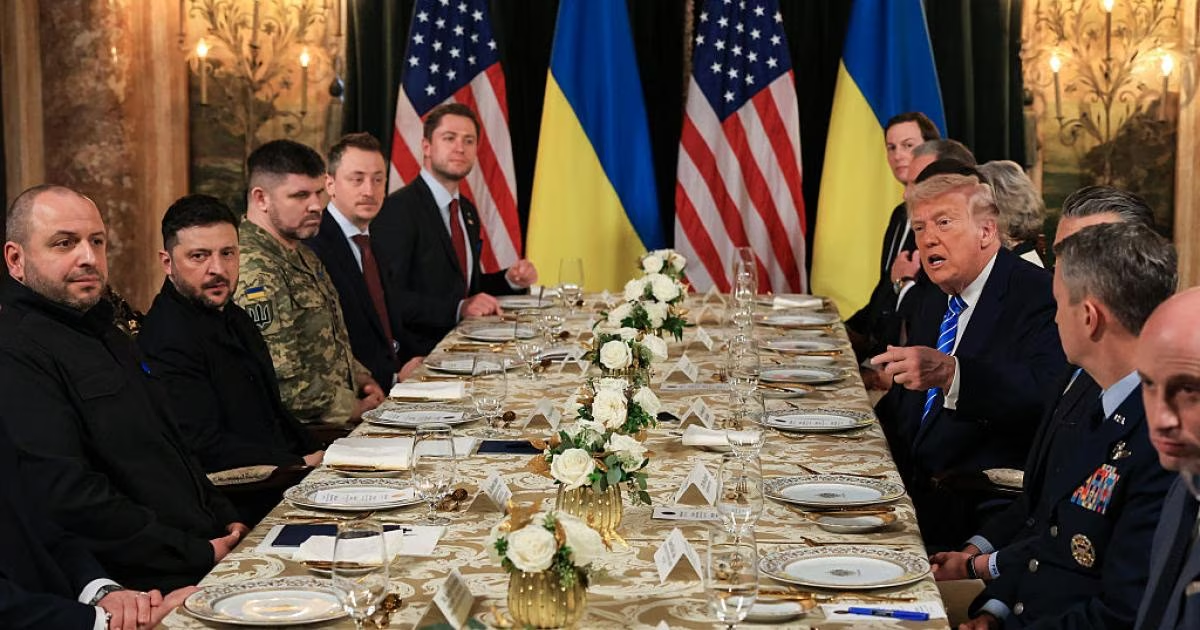
For his part, US President Donald Trump stated that the option of strengthening military presence with a second aircraft carrier remains strongly on the table, especially if the ongoing nuclear negotiations do not yield tangible results. Despite this escalatory tone, Trump described the first round of indirect talks hosted by the Omani capital Muscat as very positive, indicating Tehran's desire to reach an agreement.

In contrast, Tehran adopts a cautious stance, accusing Washington and Tel Aviv of fabricating pretexts to interfere in its internal affairs and attempt to change the existing regime. The Iranian leadership has vowed a firm and harsh response to any military aggression that may target its territories, while at the same time emphasizing that any concession in the nuclear file must be met with a complete and comprehensive lifting of the economic sanctions imposed on it.

The core points of contention are concentrated in strict American demands, as Washington insists on a complete and final cessation of all Iranian uranium enrichment activities. The US administration also stipulates the transfer of the entire stock of highly enriched uranium outside Iranian territory as a fundamental guarantee before signing any new framework agreement that ensures the peaceful nature of the nuclear program.

Regarding logistical preparations, information indicates that the US Department of Defense has received directives to prepare additional options, including the aircraft carrier 'USS George W. Bush'. These comprehensive moves reflect Washington's 'maximum pressure' strategy, which combines massive military buildups with diplomatic channels to extract substantial concessions from the Iranian side in the upcoming meetings next week.

We are considering sending a second aircraft carrier to the region if nuclear negotiations with Iran fail.

ANALYSIS

Fri 13 Feb 2026 9:37 am - Jerusalem Time

The Dilemma of Forbidden Recovery: How Elites and External Interventions Hinder the Rise of Arab Nations?

Possessing power, whether for an individual or a state, is not something that is encouraged or applauded on the international stage; rather, it is an arduous journey fraught with risks and pitfalls. The attempt to recover and overcome weakness is, in itself, an embodiment of strength, but it clashes with a political reality that views the rise of collapsed states as a threat to the interests of other powers that thrive on the weakness of their neighbors.

When a state tries to reclaim its sovereignty and control over its resources after years of collapse or war, it finds itself facing multiple swords seeking to delay this recovery. These external forces aim to maintain a state of political fluidity until the beneficiaries complete their plunder and achieve their expansionist ambitions at the expense of the exhausted state.

In the utilitarian political reality, there is no place for romantic discourse that blames powerful nations for not showing mercy to weak nations, as every nation seeks the interest of its people first. Therefore, the cost of weakness and collapse is high, as a troubled state is seen as easy prey or an opportunity to achieve fleeting circumstantial gains in areas such as tourism or trade.

Observers note that recovery in countries like Lebanon, Iraq, and Libya is proceeding at an extremely slow pace, often almost imperceptible. This slowness is not a coincidence; rather, it is the result of an undeclared international strategy aimed at throwing a wrench in the works to prevent any stability that might harm the interests of the powers benefiting from the chaos.

The continuation of fragmentation and tension serves external agendas that view the stability of these countries as a direct harm to their influence, making the cry of 'recovery forbidden' resonate in the corridors of international politics. However, the biggest obstacle is not limited to external factors alone but extends deep into the internal fabric of these afflicted nations.

The shocking role of local political elites stands out as one of the most dangerous obstacles preventing the restoration of national sovereignty, as these elites engage in internal conflicts that fuel division. Instead of working on a unifying national project, these forces contribute to supporting the plans of foreign parties by obstructing national reconciliation projects and prioritizing personal ambitions.

It is not merely a matter of ordinary political differences but reaches the point of 'national self-betrayal' when elites attack each other at a time when the country needs solidarity. This behavior represents a defect in the national immune system, where the forces that are supposed to protect the state become the tool that contributes to the continuation of its ailment and weakness.

The real problem always lies within, where national elites are called upon to prioritize the interest of recovery and state restoration over any other partisan or factional goals. No political party can enjoy true dignity or power under a sick state beholden to external decisions and the systematic looting of its wealth.

In the Libyan case, it is clear how multiple hands and stray bullets prevent the country from escaping the spiral of open looting of its oil wealth. This situation calls for a rapid national awakening to compensate for lost time and protect the future of coming generations who bear a heavy legacy of conflicts in which they were not a party.

In conclusion, the biggest challenge facing the peoples of Iraq, Lebanon, and Libya is how to close the loopholes through which deadly interventions seep, and to work on building a solid internal front. True recovery begins from within, through political self-denial and unifying efforts to reclaim the state's right to power, sovereignty, and a dignified life.

If political elites stab each other in the back and work to create division, this means that the national self is attacking itself, and herein lies the shock and the most dangerous symptoms of the national self's immune system disease.

PALESTINE

Fri 13 Feb 2026 9:37 am - Jerusalem Time

Post-War Wars: Plans to Execute Prisoners and Escalating Violations Against Gaza

The concept of traditional warfare in the Palestinian reality extends beyond direct military confrontation, transforming into a series of systematic political, economic, and psychological pressures. Despite the ethics and controls imposed by international laws, Zionist practices disregard the premise of peace that should follow the cessation of hostilities, as violations continue since the declaration of the ceasefire in October 2025.

Hebrew media sources have revealed serious developments concerning Palestinian prisoners, as the prison service has begun to accelerate procedures for implementing the death penalty. This move comes after the bill proposed by extremist Itamar Ben Gvir passed its first reading in the Knesset, indicating an official trend towards an unprecedented escalation in repressive tools.

Leaked plans include the establishment of a special complex and a secret facility within a prison exclusively dedicated to carrying out executions. The occupation authorities are also working on training specialized personnel and benefiting from international experiences in this context, in a step aimed at legitimizing the killing of prisoners under a legal cover that completely contradicts the Geneva Conventions.

On the humanitarian front in the Gaza Strip, UNICEF warned of an impending health catastrophe for emerging generations, as approximately 320,000 children under the age of five face the risk of severe malnutrition. These figures reflect a tragic reality resulting from the starvation and siege policies imposed by the Netanyahu government as a tool of ongoing warfare.

The suffering has not stopped at the physical aspect but has extended to the mental health of one million Palestinian children who are in urgent need of support due to successive traumas. These policies express deep-seated hatred aimed at destroying the social and psychological fabric of Palestinian society in both Gaza and the West Bank.

Field statistics indicate that the toll of Palestinian blood has reached terrifying numbers, with over 73,000 martyrs and nearly 180,000 injured. What is alarming is the continued fall of victims even after truce agreements, with 570 martyrs recorded in explicit violations of the signed agreements.

The past two years have witnessed the forced displacement of two million people within the Strip, with over 1,630 violations of the ceasefire agreement by occupation forces. Arrest campaigns have also affected more than 18,700 citizens, turning Palestinian areas into open-air prisons lacking the most basic elements of safety.

The occupation authorities use the weapon of money and basic needs to tighten the noose, by preventing the entry of necessary liquidity to run daily life. Hundreds of students are also deprived of joining their scholarships abroad by closing crossings, destroying the future of an entire generation of aspiring youth.

With the onset of winter, suffering intensifies with the prevention of entry of habitable tents and essential heating means for the displaced in the open. These measures clearly aim to raise the cost of Palestinian steadfastness and make life in the Gaza Strip impossible and unsustainable under the weight of deadly weather conditions.

The international silence regarding these crimes gives the occupation a green light to continue being an entity above international law. While the Netanyahu government boasts in the media about the necessity of maintaining security, it practices on the ground the most heinous forms of abuse and systematic killing, far from any real oversight or accountability from the international community.

In conclusion, these continuous violations reveal an inherent inferiority complex that the occupation authorities try to compensate for by inflicting the greatest possible harm on civilians. The unjust laws tailored to target the indigenous people, while settlers and soldiers are granted complete immunity, confirm that the battle is one of existence and steadfastness in the face of a killing machine that does not recognize humanity.

The occupation government is killing all meanings of life in Gaza with malicious tools and methods, exceeding all international and humanitarian laws.

ARAB AND WORLD

Fri 13 Feb 2026 9:37 am - Jerusalem Time

Trump's picks shake the foundations of the capitalist system: 'Greenland' messages and the dismantling of the Atlantic Alliance

Media sources revealed the content of a message sent by US President Donald Trump to the Prime Minister of Norway, Jonas Gahr Støre, which included a harsh tone and unprecedented demands related to international sovereignty. In his message, Trump linked his not being awarded the Nobel Peace Prize to his disengagement from traditional peace paths, emphasizing that his absolute priority had become focused solely on what he deemed appropriate for the supreme interests of the United States.

Trump questioned the legitimacy of Danish sovereignty over Greenland, claiming that 'ownership rights' are not based on written documents but merely on the docking of old ships, which contradicts historical facts and international law. The US President considered complete control over the island to be the sole guarantee of world security, a move that reflects an expansionist tendency towards the territories of European allies.

The message included an implicit attack on the North Atlantic Treaty Organization (NATO), where Trump demanded that the alliance provide tangible services to the United States in exchange for what he described as his exceptional efforts in supporting the alliance since its establishment. Observers believe that this rhetoric represents public pressure to increase European military spending and transform the alliance into a tool that exclusively serves the American agenda.

These developments coincide with the release of the 'United States National Security Strategy' document in late 2025, which outlined a roadmap for strengthening American might and making the nation 'richer and safer.' The document emphasized the necessity of America remaining the greatest power in human history, adopting language characterized by national arrogance and a break with previous diplomatic concepts.

One of the most prominent features of the new strategy is the folding of the concept of 'the West,' which unites Europe and the United States, and replacing it with the term 'Western Hemisphere,' which is limited to the Americas. This shift is an update to the famous 'Monroe Doctrine,' where Washington seeks to prohibit European intervention in its affairs while permitting American intervention in European sovereign affairs, as in the case of Greenland.

Political analysts describe this trend as 'supreme imperialism' that transcends the agreed-upon rules within the global capitalist system, threatening to dismantle Atlantic cohesion. It appears that Trump is using political 'picks' to undermine the economic and political architecture upon which international relations have been built since the end of World War II, preferring a policy of direct hegemony.

On the economic front, the 'distorted ideology' of market fundamentalism led by the White House stands out, where capitalism transforms into a 'super-imperialist' system that relies on the militarization of financial tools. This degradation of the system, as experts see it, leads to fierce conflicts over resources and precious minerals stored in areas like Greenland, regardless of any environmental or legal considerations.

Regarding the climate file, Trump's policies recall his withdrawal from the Paris Agreement in 2017, preferring to 'revitalize the American economy' at the expense of the planet's well-being. Figures indicate that the United States contributes to environmental pollution at rates tens of times higher than its neighbors and allies, while its contribution to global environmental development remains at its lowest historical levels.

The current scene indicates that the capitalist system is now devouring itself due to Trumpian policies that do not differentiate between adversary and ally in pursuit of 'American greatness.' It is as if history is repeating itself through the struggles of major powers over hidden wealth, placing the world in a anxious period characterized by military threats and political blackmail.

The world is not safe without complete and total control over Greenland... I have done more for NATO than anyone since its inception.

PALESTINE

Fri 13 Feb 2026 9:36 am - Jerusalem Time

Settler attacks injure elderly woman in Hebron, increasing number of female prisoners in occupation jails

An 80-year-old Palestinian woman sustained physical injuries on Thursday evening as a result of a brutal attack carried out by settlers in the Masafer Yatta area, south of Hebron city in the occupied West Bank. Activist Osama Makhamreh reported that a group of settlers attacked Khirbet Ghwein and assaulted citizen Mariam Salim Al-Hawamdeh with sticks, necessitating her transfer by ambulance to the hospital for necessary treatment.

In a related context, local sources stated that occupation forces arrested two citizens after an attack by armed settlers on shepherds in the Khallet Amira and Rajoum A'li areas of Masafer Yatta. The sources explained that the settlers chased the shepherds and released their livestock into citizens' fields to destroy crops, before army forces intervened and arrested the two young men, Khalil and Hamza Al-Adra.

Israeli occupation forces raided the town of Dura, west of Hebron, where soldiers fired live ammunition and tear gas canisters at citizens and their properties. Eyewitnesses reported that Israeli forces abused a number of young men and detained them on the spot, and also forced shop owners to close their doors at gunpoint.

In Bethlehem Governorate, ambulance crews recorded numerous cases of suffocation due to inhaling toxic gas during the occupation forces' raid on the town of Husan. Military vehicles were stationed around the municipal stadium and fired a barrage of stun grenades and gas canisters, leading to clashes with young men who tried to confront the raid.

Occupation forces also raided the town of Al-Khader, south of Bethlehem, amidst heavy firing of live ammunition and gas canisters, although no direct bullet injuries were reported. These raids come as part of an ongoing military escalation targeting Palestinian villages and towns to tighten restrictions on citizens' movements.

In the northern West Bank, settlers attacked the town of Beita, south of Nablus, prompting residents to confront them, leading to violent clashes in the area. Following this, occupation forces raided the town to secure the settlers' withdrawal, while other forces arrested a young man from the Harash Al-Saada area in Jenin city during a search and arrest campaign.

Regarding the issue of prisoners, the Palestinian Prisoner's Club announced an increase in the number of female prisoners in occupation jails to 66 Palestinian women, including 3 children who face harsh conditions. The club stated in a press release that the occupation arrested 10 women in the past few days, noting that most arrests were based on charges related to incitement via social media platforms.

The statement affirmed that the occupation continues to target Palestinian women unprecedentedly since the start of the war of extermination on the Gaza Strip, with more than 680 arrests recorded among women. The club indicated that this statistic includes those who are still in detention and does not include dozens of cases from the Gaza Strip that have not been officially documented due to enforced disappearance.

Occupation authorities detain the majority of female prisoners in Damon Prison in northern Israel, while others are distributed among various interrogation and detention centers. Female prisoners in these jails face tragic conditions, including deprivation of basic human rights and essential needs, amidst a systematic policy of tightening restrictions by prison administrations.

The Prisoner's Club revealed that female prisoners are subjected to continuous abuse, including starvation and deprivation of family visits, in addition to physical and psychological torture. The organization warned of the danger of the 'naked search' policy practiced against female prisoners, describing it as one of the most prominent methods of sexual assault and blatant violations of dignity.

Female prisoners also suffer from deliberate medical neglect and deprivation of necessary treatment, which exacerbates the health condition of sick and injured women among them. These repressive measures come at a time when the pace of attacks inside prisons has escalated in conjunction with the comprehensive aggression against the Palestinian people in all their locations.

According to official data, occupation attacks in the West Bank since October 7 have resulted in at least 1,112 martyrs and about 11,500 injured. The total number of arrests has also risen to over 22,000 cases, in a process aimed at undermining Palestinian existence and facilitating settlement expansion operations.

Prisoner institutions' statistics indicate that the total number of prisoners in occupation jails exceeded 9,300 Palestinians as of early February, including 350 children. The prisoner movement is experiencing one of its most difficult historical periods amid a lack of international oversight and the escalation of retaliatory policies pursued by the occupation government.

Observers believe that the occupation's intensification of killing, arrest, and displacement operations in the West Bank paves the way for imposing a new reality aimed at officially annexing the West Bank. These field movements coincide with the ongoing war of extermination in the Gaza Strip, placing the international community before its responsibilities to stop these grave violations against civilians and prisoners.

Female prisoners face tragic detention conditions and are subjected to various forms of violations, systematic deprivation, and denial, including naked searches.

ISRAELI AFFAIRS

Fri 13 Feb 2026 9:36 am - Jerusalem Time

Occupation Army Announces Extensive Military Drills in Eilat Area Thursday Morning

Sources reported that the spokesperson for the Israeli occupation army announced on Wednesday evening the military forces' intention to conduct extensive training drills in the city of Eilat and its surrounding areas, scheduled to begin on Thursday morning.

The military statement mentioned that these drills are part of the approved annual plan for 2026, through which the military establishment aims to enhance field readiness and raise the combat efficiency of units operating in the Southern Region.

Sources noted that residents of the area and travelers on roads leading to Eilat will witness intensive movements of military vehicles and equipment, in addition to hearing explosion sounds resulting from the field exercises. The army emphasized that these drills are routine and pre-planned.

These measures were planned in advance and are not linked to an emergency security event.

ARAB AND WORLD

Fri 13 Feb 2026 9:36 am - Jerusalem Time

Washington Considers Boosting Military Presence with Second Aircraft Carrier in Anticipation of Confrontation with Iran

International press reports, citing responsible sources, indicate that the American administration is moving to strengthen its military grip in the Middle East by deploying a second aircraft carrier. This step comes in the context of ongoing preparations for the possibility of launching military strikes against Iranian targets if diplomatic efforts reach a dead end.

The sources stated that the US Department of Defense has received clear instructions to begin logistical and field preparations to move a major strategic naval asset towards the region. This move aims to send a strong deterrent message to Tehran and ensure the readiness of US forces to respond quickly to any field developments that may arise amid escalating tensions.

Sources quoted three American officials as saying that President Donald Trump is putting the option of military force on the table as an alternative to stalled negotiations. The officials clarified that the final decision on the move has not yet been officially issued, but military planning is proceeding to avoid any surprise in the event of a collapse of the political path.

If the executive order is issued, the aircraft carrier 'USS George W. Bush' is expected to be moved from the East Coast of the United States. Estimates indicate that the carrier's arrival in the region's waters could take about two weeks, to join the US forces already deployed there.

President Trump had previously stated that he was seriously considering increasing the military buildup in the Middle East as an additional pressure tool on the Iranian regime. The White House links this military escalation to the extent of Tehran's response to American demands regarding its nuclear program and its regional activities, which Washington describes as destabilizing.

It is worth noting that the region is witnessing an intensive American military presence, as the Central Command announced last January the arrival of the aircraft carrier 'USS Abraham Lincoln'. This deployment, according to official statements, aims to support regional security and stability and protect the vital interests of the United States and its allies in international waterways.

Despite the military buildup, Trump described the results of the first round of indirect talks held in the Omani capital, Muscat, as positive. He indicated that the Iranian side showed a desire to reach a new agreement, and a second round of meetings is scheduled for next week to discuss outstanding issues.

In contrast, Tehran adopts a cautious discourse and accuses Washington and Tel Aviv of fabricating pretexts for launching military aggression aimed at changing the political system in the country. The Iranian leadership affirms that it will not stand idly by in the face of any aggression, vowing a decisive and comprehensive response that will affect American interests in the region if it is subjected to any attack.

Iran adheres to its position that all economic sanctions imposed on it must be lifted as a prerequisite for returning to full compliance with the nuclear agreement. Tehran views Western sanctions as 'economic terrorism' targeting the Iranian people and demands international guarantees to prevent Washington from withdrawing from any future agreement.

For its part, the United States insists on strict demands, including the complete cessation of uranium enrichment operations and the dismantling of sensitive infrastructure. Washington also demands the transfer of highly enriched uranium stockpiles out of Iranian territory, which Tehran rejects as an infringement on its national sovereignty and its right to peaceful nuclear energy.

The situation in the Middle East remains open to all possibilities, between the option of de-escalation through diplomacy or sliding into a wide-ranging military confrontation. Regional and international powers are closely monitoring recent American moves, amid fears that the deployment of a second aircraft carrier could ignite the situation in a region already suffering from successive crises.

President Trump is considering sending a second aircraft carrier to the Middle East to prepare for a military operation if negotiations with Iran fail.

PALESTINE

Fri 13 Feb 2026 9:36 am - Jerusalem Time

Occupation forces blow up residential blocks in Khan Yunis and injure a young man north of Jerusalem

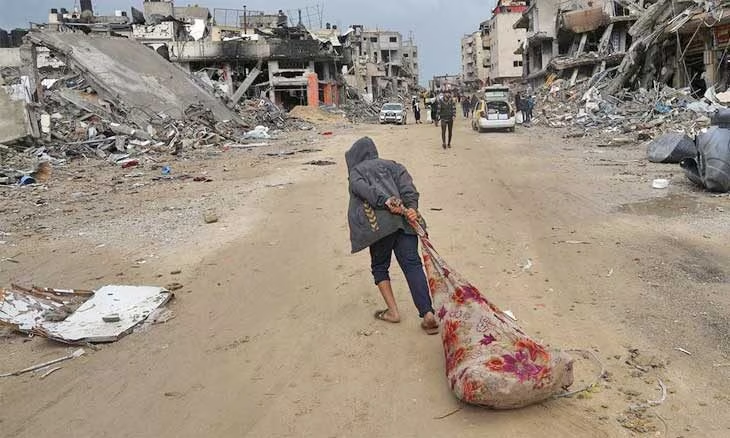
The Israeli occupation army escalated its military operations in the southern Gaza Strip, where engineering units on Friday carried out large-scale demolition operations targeting entire residential blocks in the city of Khan Yunis. Field sources reported that massive explosions rocked the area due to the destruction of buildings, leading to the leveling of residential neighborhoods and their transformation into rubble in record time.

This systematic military strategy aims to create what are called 'buffer zones' or open areas, to secure the positions of Israeli military vehicles and prevent any targeting operations that might originate from among the rubble or existing buildings. Through this policy, the occupation forces seek to change the geographical features of the area and strip it of any urban cover that resistance factions might use in their defensive operations.

Regarding confrontations in the occupied West Bank, Palestinian Red Crescent crews reported that a young man was injured by occupation forces' bullets during a violent raid on the town of Al-Ram, located north of Jerusalem. Clashes erupted between young men and occupation forces, who fired live ammunition and tear gas canisters heavily, resulting in injuries among citizens who confronted the raid.

These attacks in the West Bank are part of a widespread repressive campaign launched by the occupation authorities to impose a policy of deterrence and intimidate peaceful residents through repeated night raids. Daily life in West Bank cities and towns is turning into an open battlefield amid ongoing arbitrary arrests and direct targeting of civilians, which increases the state of tension and field escalation.

These successive explosions aim to level entire neighborhoods to create open areas that ensure the protection of the occupier's positions.

ARAB AND WORLD

Fri 13 Feb 2026 9:36 am - Jerusalem Time

A Palestinian dead in an Israeli raid targeting a car in southern Lebanon and escalating violations of the ceasefire agreement

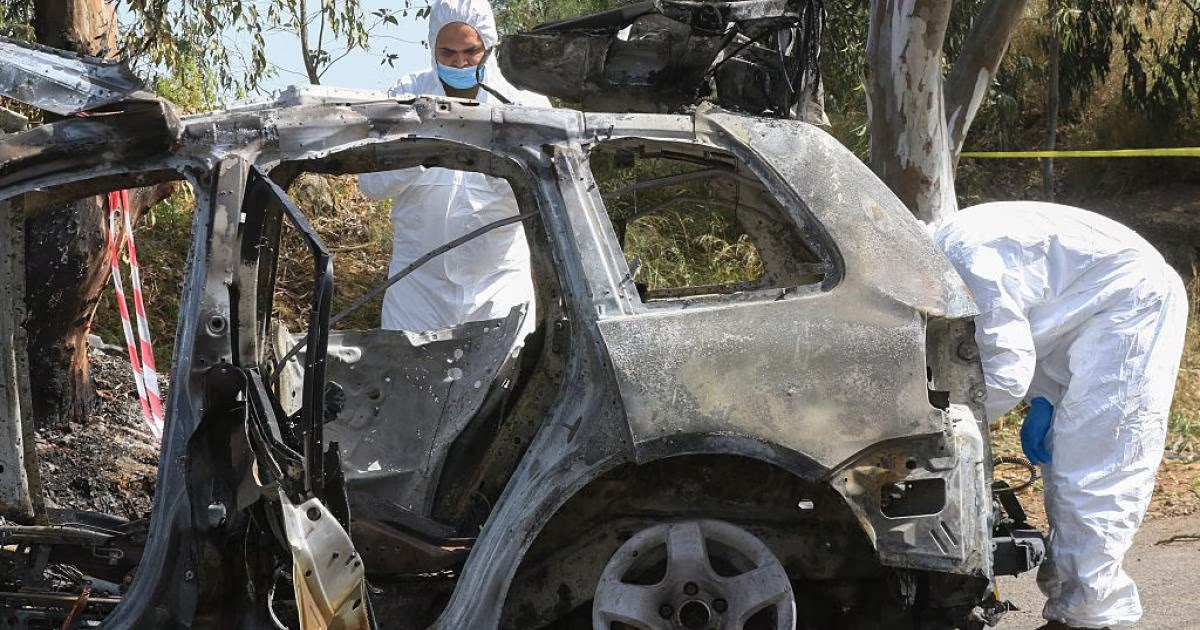
A Lebanese citizen was martyred on Thursday evening following an airstrike carried out by an Israeli occupation army drone targeting a civilian vehicle in the Bint Jbeil district in the south of the country. This operation comes within a series of continuous violations of the ceasefire agreement concluded last November, threatening the fragile stability on the Lebanese border.

Field sources reported that the drone launched three precisely guided missiles towards the car at the intersection between the towns of Al-Tiri and Kunin. The Public Health Emergency Operations Center of the Lebanese Ministry of Health confirmed a casualty as a result of this direct aerial attack, which terrorized local residents in the area.

For its part, the Israeli occupation army issued a statement claiming that the raid targeted an element belonging to the Hezbollah organization in the town of Al-Tiri. The Israeli statement did not provide additional details about the identity of the target or the nature of the activity he was engaged in, merely describing the operation as an attack on a military target.

Southern Lebanon has witnessed almost daily Israeli violations since the ceasefire agreement came into effect in late 2024. These violations vary between airstrikes and artillery shelling, in addition to repeated machine-gun sweeping operations targeting border villages and towns.

In addition to the aerial attacks, Israeli occupation forces continue to impose their field control over five strategic Lebanese hills that they seized during recent military operations. Tel Aviv refuses to withdraw from these positions, disregarding official Lebanese demands to end the occupation of sovereign territories and adhere to international resolutions.

Official statistics indicate that the Israeli aggression, which began in October 2023 and escalated into a full-scale war in September 2024, has resulted in devastating human losses. More than 4,000 martyrs have fallen and about 17,000 people have been injured, in addition to the widespread destruction of infrastructure and residential areas in the South, Bekaa, and the Southern Suburb.

On the internal Lebanese front, the Lebanese army announced last January the completion of the first phase of its plan aimed at disarming the area south of the Litani River. This plan aims to strengthen state authority and confine weapons to the legitimate forces in the area extending 30 kilometers from the Blue Line.

The Lebanese government is scheduled to hold a ministerial meeting next Monday to discuss the monthly report prepared by the army command on the progress of the disarmament plan. The meeting will address the field and political challenges facing the implementation of security agreements in light of the continuous Israeli escalation on the southern border.

Beirut continues its diplomatic efforts to demand that the international community pressure Tel Aviv to stop its daily aggressions against Lebanese sovereignty. Lebanese authorities emphasize that the continued occupation and aerial violations undermine opportunities for achieving sustainable calm and expose the lives of civilians to permanent danger in border villages.

The Israeli enemy's raid on the town of Al-Tiri in the Bint Jbeil district resulted in the martyrdom of a Lebanese citizen.

PALESTINE

Fri 13 Feb 2026 9:35 am - Jerusalem Time

White House Crisis: Former Beauty Queen Fired Over 'Palestine Flag' and Challenging Israeli Policies

Political circles in the United States witnessed widespread controversy following the eruption of a crisis starring Carrie Prejean Boller, former Miss USA first runner-up and member of the White House Religious Freedom Committee. The crisis erupted against the backdrop of an official session dedicated to discussing antisemitism, where deliberations turned into a political and administrative conflict that ended with the announcement of her dismissal from her position.

Boller, of Italian and French descent, is a well-known activist in religious freedom and a former fashion model. She was selected as one of 14 members of the committee established by President Donald Trump by executive order. This committee enjoys legal specificity as its members are appointed directly by the President, making their dismissal procedures complex and raising questions about administrative powers.

The crisis began to unfold when Boller appeared at an official hearing wearing a pin with the flags of the United States and Palestine on her jacket, a clear symbolic indication of her political stance. The matter did not stop at her appearance but extended to interventions described as sensitive and controversial in the context of the ongoing discussion about rights and freedoms.

Boller directly questioned participants about the dividing lines between antisemitism and criticism of Israeli policies, referring to the ongoing protests against what she described as a war of extermination in the Gaza Strip. She questioned whether opposing Zionism or demonstrating against Israeli military practices actually falls under the category of religious hatred.

Opponents of Boller's stance considered that raising these questions in an official session was a breach of protocol and a hijacking of the scheduled agenda in favor of personal positions. In contrast, her defenders argued that what she did represented the essence of democratic debate about the religious and political freedoms that the committee was established to protect.

Official reaction came swiftly from Texas Lieutenant Governor Dan Patrick, who chairs the committee, announcing Boller's immediate dismissal via the X platform. Patrick affirmed in his statement that no member has the right to use official sessions to promote private political agendas, emphasizing that the decision to remove her was his personal and direct decision.

For her part, Boller did not remain silent in the face of Patrick's statement but responded strongly, denying the legitimacy of his dismissal decision. She clarified in a counter-statement that the committee reports directly to President Trump and is not the private property of its chairman, asserting that she does not recognize Patrick's authority to terminate her membership, which came by presidential decree.

Boller concluded her response with a sharp phrase that sparked significant interaction when she said: 'I refuse to bow to Israel,' which observers considered an unprecedented escalation from an official in a White House advisory body. This statement increased the intensity of division in the American street and among political elites regarding the influence of the pro-Israel lobby.

To date, Boller's legal status remains unclear, as her name still appears on the list of members on the official White House website. This contradiction between the announcement of dismissal and the retention of her name opens the door to questions about the legality of the procedures taken by the committee chairman without an official presidential decree.

Social media platforms reacted feverishly to the issue, with former security analysts criticizing the appearance of the Palestinian flag in an official session, describing the move as disgraceful. In contrast, activists and political candidates considered that what Boller was subjected to was a form of political repression due to her ethical stances on the war in Gaza.

This incident reflects the depth of division within American institutions regarding the Palestinian issue, and how voices opposing Israeli policies have begun to infiltrate decision-making circles. Boller's case remains a model for the conflict between freedom of expression and traditional political commitments to the United States' international allies.

I refuse to bow to Israel, and the committee reports to President Trump and does not have the authority to dismiss me.

PALESTINE

Fri 13 Feb 2026 9:35 am - Jerusalem Time

Trump launches multi-billion dollar plan to rebuild Gaza and deploy international force in the Strip

Official American sources revealed that President Donald Trump is moving to announce a massive plan to rebuild the Gaza Strip, which includes allocating billions of dollars and defining the tasks of an international stabilization force approved by the United Nations. These details are scheduled to be revealed during the first official meeting of the Peace Council, which Washington will host on February 19, chaired by Trump himself.

Sources reported that the upcoming meeting will witness high-level participation from delegations representing at least 20 countries, including heads of state and government interested in the settlement file in the region. This international gathering aims to lay the first foundations for implementing the financial and logistical commitments required by the current situation in the Palestinian Strip after months of conflict.

The American president had signed the founding documents of the Peace Council in the Swiss city of Davos on January 23, as a new entity aimed at following up on the implementation of his plan for Gaza. This council gained international legitimacy after the United Nations Security Council approved its establishment, to be the official umbrella for upcoming political and economic moves.

Despite the reservations expressed by some traditional Western powers towards the new entity, influential regional powers such as Saudi Arabia, Qatar, Egypt, and Turkey announced their actual joining of the council. Israeli Prime Minister Benjamin Netanyahu also confirmed, during his recent visit to Washington, Israel's official joining of this path, which enhances the chances of implementing the proposed plans on the ground.

Next week's Washington meeting will focus exclusively on the Gaza Strip file, where Trump will announce the inauguration of a multi-billion dollar financial fund dedicated exclusively to reconstruction. Sources indicated that this fund will rely on voluntary contributions from member states, and the financial offers submitted so far have been described as "very generous" and exceeding initial expectations.

The international stabilization force represents the main pillar of the second phase of the American plan, where Trump is expected to announce the names of the countries that have pledged to send thousands of soldiers to work in the Strip. This force aims to ensure the sustainability of the fragile ceasefire that began on October 10, and to provide a safe environment for reconstruction operations and civil services.

The plan faces complex field challenges, most notably the disarmament file of Palestinian factions, led by the Hamas movement, which stipulates the existence of a clear political path leading to the establishment of a Palestinian state. In this context, the American vision proposes granting a general amnesty to members of the movement who agree to disarm and peaceful coexistence, while providing safe corridors for those who wish to leave.

Among the administrative aspects that the Peace Council meeting will address is the review of the reports of the National Committee for the Administration of Gaza, which is the body formed to undertake daily civil tasks in the Strip. This committee had announced its structure and held its first founding meeting in Cairo last January, to begin exercising its powers in managing the daily affairs of the residents.

The meeting's agenda will also include comprehensive updates on the mechanisms for the flow of humanitarian aid and ensuring its access to those eligible in all areas of the Strip without obstacles. Participants will also discuss the file of restructuring the police force in Gaza, to ensure the maintenance of internal security in coordination with the international stabilization force and the National Administrative Committee, thus preventing the return of armed manifestations.

The American administration seeks, through this international mobilization, to dispel fears that the Peace Council will be a competitor to the United Nations or a tool for intervention in other global conflicts. American officials confirm that the top priority currently is to stabilize Gaza and transform it from a conflict zone into a major workshop for reconstruction and economic development.

In light of these rapid developments, the Palestinian street and the international community are awaiting the outcomes of the Washington meeting, and whether the financial and military commitments will translate into a tangible reality that ends the suffering of the residents. The ability of local and regional parties to adapt to this plan remains the real test of the Peace Council's success in achieving its declared goals.

The President will announce the amount of money raised for the reconstruction of Gaza after receiving generous funding offers from participating countries.

ARAB AND WORLD

Fri 13 Feb 2026 9:35 am - Jerusalem Time

Europe and the United States.. Fears of a Partnership Fracture and a Quest for Strategic Autonomy

This year's Munich Security Conference is being held amidst an atmosphere charged with geopolitical tensions, with broad participation including over 65 heads of state and government. The conference's annual report warns of the European continent entering an era of long-term confrontation, due to the escalation of the Russian war and hybrid activities that threaten the stability of the international order established after the Cold War.

Reports from the conference indicate a significant decline in the confidence of European capitals in Washington as a strategic ally and security guarantor, especially under the policies of President Donald Trump. The United States faces accusations of weakening the international system and reducing its leadership role, which puts the continent before crucial questions about its ability to protect its national security independently.

Meanwhile, the United States called on its allies in the North Atlantic Treaty Organization (NATO) to adopt the concept of partnership instead of dependence during defense ministers' meetings in Brussels. This approach coincided with the alliance's announcement of transferring key command centers to European officers, a move reflecting Washington's desire to redistribute military burdens within the alliance.

Informed sources revealed that the Trump administration is considering a historic decision to relinquish the role of NATO's Supreme Commander in Europe, a position Washington has held since 1951. This radical shift reinforces the hypothesis that the United States seeks to reduce its direct involvement in the defense of the continent, and push Europeans to fully bear their defense responsibilities.

NATO Secretary-General, Mark Rutte, stressed the necessity for allies to increase defense spending to confront growing threats, especially amidst the tension surrounding the Greenland issue. European concerns are increasing regarding escalating Russian military activity and its direct impacts on energy security and the continent's northern borders, necessitating a stricter military response.

For his part, Dr. Ulrich Brückner, Professor of European Studies, believes that the bleak picture painted by the Munich report may be part of a media strategy to attract international attention. He explained in statements to media sources that European concern about the relationship with Washington is real, as transatlantic ties are no longer as strong as they were since the end of World War II.

Brückner pointed out that Europeans are currently trying to formulate a new positioning for the European Union aimed at achieving 'strategic autonomy'. This approach includes fundamental changes in defense spending structures and the development of self-sufficient military capabilities that reduce total reliance on the American security umbrella, which has gradually begun to shrink.

In contrast, Norman Roule, a former US intelligence official, rules out that Trump's goal is to demolish the existing world order, but rather seeks to rearrange it. Roule believes that the US national security strategy still considers Europe a key factor for the prosperity of the United States, but it stipulates a relationship based on parity in cost-sharing.

The current US administration insists that European countries raise their military spending to 5% of their GDP, a demand that sparks wide debate in European capitals. Washington considers this measure necessary to ensure the continuity of the alliance, with an emphasis on integrating trade issues into the equation of shared national security between the two parties.

Academically, Dr. Omar Ashour points out that European concerns are entirely justified given the failure to deter aggression against Ukraine in previous stages. He explained that international commitments, such as the Budapest Memorandum, failed to protect Ukraine's territorial integrity, revealing a significant gap between political ambitions and actual military capabilities.

The European military reality suffers from a paradox: the expansion of the European Union's political influence versus the shrinking of its military field strength over the past decades. Long-term reliance on the United States has weakened the combat readiness of European countries, which became evident during the outbreak of major military confrontations in the eastern part of the continent.

The lingering question in the corridors of the Munich conference is the extent to which the international community can work effectively amidst the decline of international rules in favor of the logic of power. With continued disagreements over thorny issues such as Greenland and NATO burden-sharing, the path towards a 'true partnership' between the two sides of the Atlantic still seems fraught with political and economic challenges.

The American administration will not accept that European countries do not spend 5% of their GDP on defense.

PALESTINE

Fri 13 Feb 2026 9:35 am - Jerusalem Time

Gaza paramedic officer died inside Israeli 'Naqab' detention center

The Commission of Detainees and Ex-Detainees Affairs and the Palestinian Prisoner's Society announced on Thursday evening the martyrdom of detainee Hatem Ismail Rayyan (59 years old), a resident of the Gaza Strip, inside the Israeli occupation's 'Naqab' desert detention center. The announcement came after the General Authority for Civil Affairs was informed of the death of the detainee, who worked as an officer in the ambulance services.

Occupation forces had arrested Rayyan on December 27, 2024, during their raid on Kamal Adwan Hospital in the northern Gaza Strip, where he was taken along with his injured son, Moaz, who remains in occupation prisons until now. This crime comes amid escalating testimonies about systematic torture operations suffered by Gaza prisoners since the start of the war of extermination.

Human rights data indicates that occupation prisons currently hold more than 9,300 Palestinian prisoners, who face harsh conditions including starvation and deliberate medical neglect. These policies have led to the martyrdom of dozens of detainees inside detention centers since October 2023, at a time when the occupation continues its aggression, which has resulted in the martyrdom of more than 72,000 citizens in the Gaza Strip.

The General Authority for Civil Affairs was informed of the martyrdom of detainee Rayyan, who was held in the Naqab detention center. He was a paramedic officer who had been arrested from Kamal Adwan Hospital.

PALESTINE

Fri 13 Feb 2026 9:34 am - Jerusalem Time

International arrangements for the reconstruction of Gaza: Details of the first meeting of the 'Peace Council' led by Trump

Attention turns to the United States on February 19, where the first meeting of the 'Peace Council' launched by US President Donald Trump is scheduled to be held. This meeting is the first official session of the council since its launch, and its primary goal is to organize a donors' conference dedicated to the reconstruction of the Gaza Strip, in the context of pushing for the implementation of the second phase of the ceasefire agreement that has been ongoing for months.

Sources reported that delegations from at least 20 countries, including a number of leaders and presidents, confirmed their attendance at this pivotal meeting. President Trump is expected to announce during the session the dispatch of thousands of soldiers from various countries to participate in the 'International Stabilization Force' planned for deployment in the Gaza Strip, and will also provide a comprehensive briefing on the tasks and security structure of this force.

In addition to security arrangements, the US President intends to unveil a massive funding plan for the Gaza Strip, estimated at billions of dollars, aimed at kickstarting reconstruction and rehabilitating the destroyed infrastructure. This move comes under the mandate the Council received from the UN Security Council to oversee the implementation of ceasefire understandings and manage local governance issues in the Strip.

On the diplomatic front, Indonesia confirmed the participation of its President, Prabowo Subianto, in the meeting, as Jakarta seeks to use this platform to defend Palestinian rights and promote the two-state solution. The Indonesian government also announced its aspiration to sign economic and trade agreements with the American side on the sidelines of this official visit.

For its part, the Pakistani Ministry of Foreign Affairs confirmed that Prime Minister Shehbaz Sharif will head his country's delegation participating in the meeting, accompanied by Foreign Minister Ishaq Dar. This participation comes within Islamabad's efforts to support stabilization plans in Gaza within the international frameworks approved by the United Nations Security Council in its recent resolutions.

Vietnam, in turn, announced its joining as a founding member of the Council, with leader To Lam intending to visit Washington next week to participate in the opening. Hanoi believes that the establishment of the Peace Council represents a necessary step to implement a comprehensive roadmap to end the conflict in the Gaza Strip and ensure that military confrontations do not resume.

In contrast, controversy surrounds the Council's powers, which grant President Trump the exclusive right of veto over decisions and the authority to appoint members for life. This organizational structure has raised international concerns, with some Western capitals considering it an attempt to create an unofficial alternative to the UN Security Council and undermine the traditional UN system.

Russia announced through its foreign ministry that it would not attend the upcoming meeting, indicating that Moscow is still studying its final position on joining the Council. Despite Trump's previous statements about President Putin accepting the invitation, the Kremlin quickly denied this, confirming that the matter is still under evaluation and in-depth study.

European sentiment was divided, with Greece officially announcing that its prime minister would not participate in the meeting, while the EU's foreign policy chief, Kaja Kallas, linked participation to the Council's activities being limited to the Gaza file. In the same context, France refused to join, considering that the Council's charter contradicts UN resolutions and international conventions.

On the Israeli side, Prime Minister Benjamin Netanyahu signed the memorandum of accession to the Peace Council during a meeting with US Secretary of State Marco Rubio in Washington. This step reinforces the Israeli government's involvement in the new arrangements led by the Trump administration for the next phase in the region.

For its part, Hamas strongly condemned Netanyahu's joining of the Council, describing the move as a 'dangerous indicator' that contradicts the principles of international justice. The movement stated in a communiqué that Netanyahu is wanted by the International Criminal Court and accused him of continuing to obstruct ceasefire agreements despite more than three months having passed since the truce was announced.

The Peace Council currently consists of 27 members, including influential Arab countries such as Saudi Arabia, Qatar, the UAE, Egypt, Bahrain, and Morocco. It also includes regional and international countries such as Turkey, Pakistan, Uzbekistan, and Hungary, while Canada agreed to join with an exemption from paying the prescribed membership fees.

The Council's founding charter, announced in mid-January, indicates that it is a permanent international organization aimed at promoting 'good governance' in conflict areas. However, experts note that the charter does not explicitly refer to the Gaza Strip in its general provisions, even though the Council was included as a key tool in Trump's plan to end the war.

The biggest challenge facing the Council remains its ability to gain full international legitimacy in light of the boycott by major powers such as China, Britain, and France. Political circles are awaiting the practical decisions that will result from the February 19 meeting, especially regarding reconstruction funding and the formation of international forces that will undertake security tasks in the Strip.

Trump will announce during the meeting the dispatch of thousands of troops from several countries to participate in the international stabilization force that is supposed to be deployed in the Gaza Strip.

PALESTINE

Thu 12 Feb 2026 10:27 am - Jerusalem Time

Military Maneuvers in Eilat Following Netanyahu-Trump Summit to Discuss Iranian File

The Israeli occupation army began, this Thursday morning, implementing large-scale military maneuvers in the Eilat region located on the Red Sea coast. These field movements come amidst a state of security alert and escalating tensions with Iran, as the army announced that the area would witness intensive activity by emergency and rescue forces and naval units.

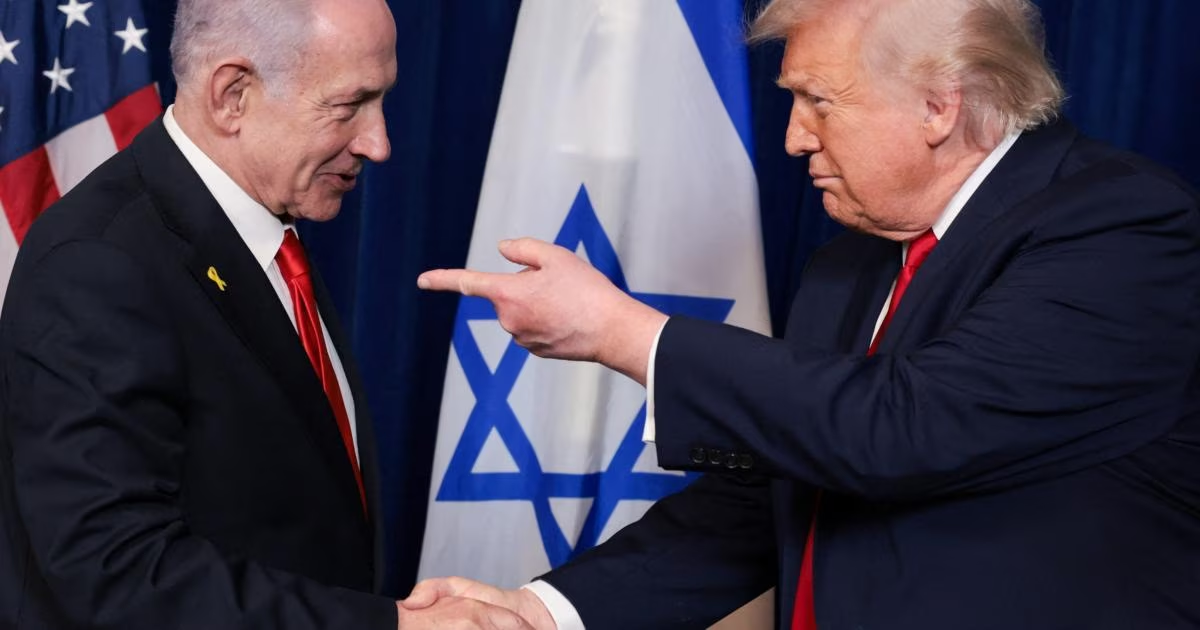
The announcement of these drills came after a lengthy meeting held at the White House between Israeli Prime Minister Benjamin Netanyahu and US President Donald Trump. The discussions lasted for about three hours, focusing primarily on the Iranian nuclear file and the repercussions of the ongoing war in the Gaza Strip, in addition to outlining the strategic alliance in the region.

Informed sources reported that the military exercise in Eilat aims to raise the readiness of forces to deal with potential offensive scenarios on the southern front. A military statement confirmed that the movements include coordination between various security branches, while reassuring settlers in the area that the activity is pre-scheduled and does not warrant concern about immediate security incidents.

For his part, US President Donald Trump stated after the meeting that no final and decisive decision had been reached regarding dealing with Tehran, emphasizing the importance of the negotiation path. Trump indicated that the indirect negotiations recently held in the Sultanate of Oman were 'good,' despite the continued American military buildup in the region's waters.

In the context of field pressures, the United States strengthened its military presence by sending a second aircraft carrier to the Middle East, a move interpreted by observers as a pressure tool to push Tehran towards making concessions. Washington and Tel Aviv demand a complete halt to uranium enrichment operations and the transfer of highly enriched stockpiles outside Iranian territory to ensure the non-production of an atomic bomb.

On the other hand, Tehran adheres to its position rejecting giving up its right to enrichment for peaceful purposes, and links any agreement to a comprehensive lifting of the economic sanctions imposed on it. The Iranian leadership affirms that its missile program and regional influence are red lines that are not open for discussion in any upcoming nuclear negotiations, warning against the consequences of any military adventure.

Analysts believe that Netanyahu seeks, through his meetings in Washington, to push the American administration towards adopting stricter options that may reach direct military action to change the regime in Iran. Concerns are growing that these pressures could lead to a comprehensive regional confrontation if Israel targets vital facilities deep inside Iran.

Regarding the Gaza Strip, both parties discussed field developments and ways to end military operations in a way that guarantees Israeli security interests, amidst political complexities imposed by regional conditions. This diplomatic movement coincided with the continuation of military operations on the ground, making the Palestinian front closely linked to the path of escalation with Iran.

In conclusion, the region remains in a state of anticipation for what the coming days will bring in terms of practical results from these military and diplomatic movements. While the drills continue in Eilat as a deterrent message, the negotiation table in Muscat and the White House remains the arena that will determine the shape of the upcoming conflict in the Middle East.

In the meeting with Netanyahu, we did not reach a decisive decision regarding Iran, except for emphasizing the necessity of continuing negotiations.

ARAB AND WORLD

Thu 12 Feb 2026 10:27 am - Jerusalem Time

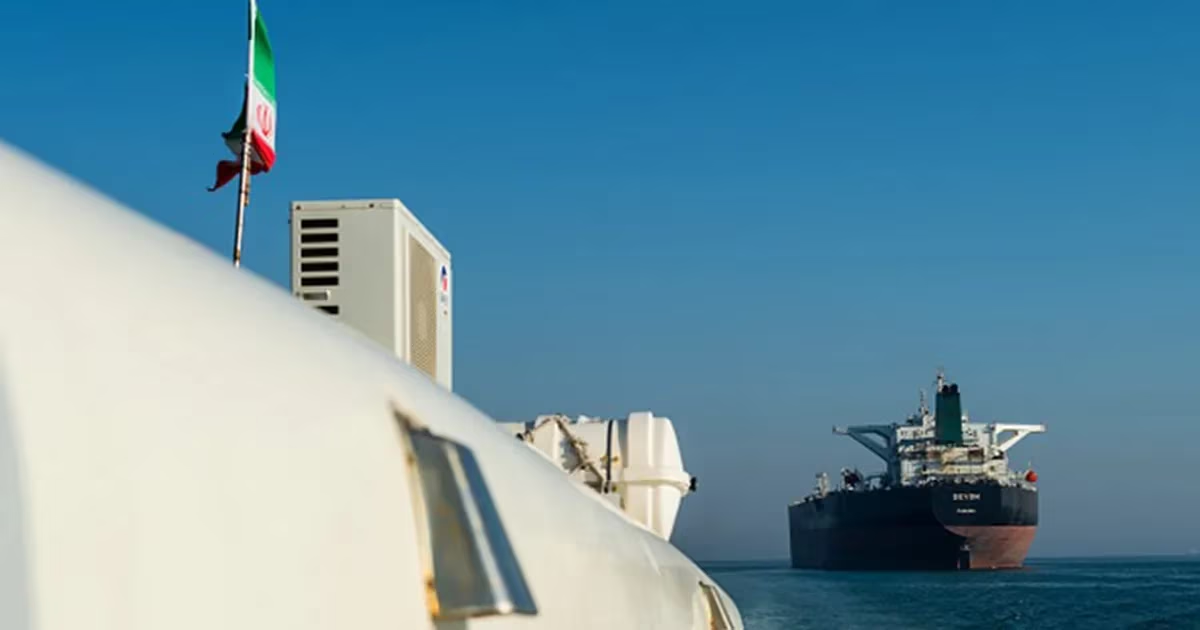
Trump administration considers seizing Iranian oil tankers amid fears of escalation in Strait of Hormuz

International press reports have revealed ongoing consultations within the administration of US President Donald Trump to discuss the possibility of seizing Iranian oil tankers. This proposed step aims to exert maximum pressure on Tehran to push it towards concluding a new and comprehensive political agreement, but the administration is still considering the potential consequences of this decision.

Informed sources stated that the option of seizing ships was raised as a key pressure tool coinciding with the start of the first round of negotiations in the Omani capital, Muscat. Despite the seriousness of the proposal, there is a kind of hesitation in the White House for fear that this step could lead to an unresolved naval confrontation in vital waterways.

Estimates indicate that any US move to detain tankers could be met with a similar Iranian response targeting ships of Washington's allied countries in the region. Serious concerns also arise that Tehran might plant naval mines in the Strait of Hormuz, the passage through which about a quarter of the world's oil supplies flow daily, threatening global energy security.

Observers warned that disrupting navigation or seizing ships would inevitably lead to a sharp jump in crude oil prices. This scenario could put the Trump administration in the face of a domestic political storm, especially with the direct impact on the US economy from any disruption in fuel and energy costs resulting from military tensions.

In a related context, Washington continues its campaign against what is known as the 'shadow fleet,' a group of ships used by Iran and Venezuela to circumvent international sanctions. US authorities have already succeeded in the past two months in detaining several ships that were transporting oil to international buyers, primarily China.

According to data from the US Treasury Department, more than 20 vessels linked to Iranian oil transport have been placed on sanctions lists this year alone. These ships are considered potential legal targets for seizure if the administration decides to expand the scope of its naval operations to include direct interception at sea.

Controlling these tankers requires high-level military coordination, including special forces boarding the ships and providing naval protection to escort them to US ports. Sources confirm that implementing such operations requires allocating additional military resources to ensure the security of seized shipments and prevent any attempts to reclaim them.

For its part, the US Department of Transportation issued a warning to commercial vessels to exercise caution regarding potential Iranian threats in the Gulf region and the Strait of Hormuz. The department clarified that ships might be subjected to interrogation or inspection by Iranian forces, urging captains to coordinate continuously with US naval forces present in the region.

In a field development, the Pentagon announced that US forces successfully intercepted an oil tanker in the Indian Ocean after it attempted to evade embargo measures. The US military affirmed that the operation was conducted in accordance with international laws, emphasizing the continued pursuit of illegal shipments that fund destabilizing activities in the Middle East.

Seizing oil tankers is one of the options being considered by the White House, with the aim of forcing Iran to make concessions in negotiations.

PALESTINE

Thu 12 Feb 2026 10:27 am - Jerusalem Time

Dozens of Palestinians Return to Gaza Strip via Rafah Crossing Amid Tight Israeli Restrictions

Local sources reported the arrival of 46 Palestinian citizens, including women, children, and patients, to the Gaza Strip last Wednesday evening via the Rafah border crossing with Egypt. This return comes amid tight Israeli restrictions imposed by the occupation authorities on movement at the crossing, which they have militarily controlled since May of last year.

Medical sources at the government media office confirmed that the returnees were immediately transferred to Nasser Medical Complex in Khan Yunis city, south of the Strip, upon their arrival. The sources clarified that among the returnees were medical cases that had been receiving treatment in external hospitals before being able to return home under the current circumstances.

In a related context, the Palestinian Red Crescent Society revealed that 47 people departed from the Strip towards Egyptian territories on the same day. The departing list included 17 patients and 30 escorts, in an attempt to secure necessary medical care for the wounded whose treatment within Gaza was impossible due to the collapse of the healthcare system.

The Israeli occupation authorities had reopened the Palestinian side of the Rafah crossing on February 2nd, but this step remained symbolic and very limited. Israel imposes strict surveillance and crippling restrictions that prevent the natural flow of travelers and goods, hindering the implementation of previous international understandings.

The government media office in Gaza indicated that the total number of those who were able to cross back and forth since the reopening of the crossing did not exceed 488 travelers. This figure represents only about 27% of the total 1800 travelers who were supposed to cross according to the specified schedules, reflecting a clear evasion of the occupation's commitments.

Statistical data indicates that 275 travelers departed from the Strip since the beginning of this month, while another 213 were able to return. In contrast, sources recorded the occupation authorities' refusal to allow 26 people to depart to the Egyptian side without clear reasons, increasing the suffering of those stranded on both sides of the border.

Despite expectations published by international media of 100 people crossing daily in both directions, the reality on the ground proves the exact opposite. The actual numbers are still far from meeting urgent humanitarian needs, especially with thousands of emergency cases awaiting their turn to travel.

Health authorities in Gaza estimate that there are approximately 22,000 wounded and sick people in urgent need of leaving the Strip immediately to receive specialized treatment. This need arises from the catastrophic situation in the health sector due to the ongoing war of extermination, which has rendered most major hospitals completely out of service.

In an indication of steadfastness on their land, semi-official data revealed that approximately 80,000 Palestinians have registered on lists to return to the Gaza Strip from abroad. This figure reflects widespread popular insistence on rejecting forced displacement plans and the desire to return home despite the destruction that has affected most residential areas.

It is worth noting that the ceasefire agreement that came into effect in October 2025 stipulated the normal reopening of the crossing in its first phase. However, Israel continues to procrastinate in implementing the terms of the agreement, at a time when the war has left more than 72,000 martyrs and destroyed 90% of the civilian infrastructure in the Strip.

The registration of approximately 80,000 Palestinians to return to Gaza reflects a popular insistence on rejecting displacement and holding onto their land despite the immense destruction.

PALESTINE

Thu 12 Feb 2026 10:26 am - Jerusalem Time

'Greater Jerusalem' Plan: How 'the Cabinet's' Decisions End Oslo Divisions and Legitimise Annexation?

The Israeli occupation authorities have moved beyond the traditional imposition of sovereignty over the occupied city of Jerusalem, transitioning to political and administrative steps aimed at achieving the 'Greater Jerusalem' project. This plan seeks to resolve the demographic conflict in favour of settlers, by annexing villages that were administratively managed by the Palestinian Authority and transforming them into a geographical extension of Israeli sovereignty.

Through the Ministerial Committee for National Security (the Cabinet), the Israeli government has approved a series of decisions aimed at dismantling the legal divisions established by the Oslo II Accord in 1995. Under these new directives, Israel seeks to end the distinction between areas classified as 'A', 'B', and 'C', thereby restoring full occupation control over real estate and land matters throughout the West Bank.

The new decisions include granting extensive powers to demolish Palestinian homes in areas 'A' and 'B', which previously enjoyed a degree of Palestinian administrative or security autonomy. This measure places thousands of structures under the Israeli demolition guillotine on the pretext of lacking permits, equating them with areas classified as 'C' which are under absolute military control.

In a notable legal move, the occupation revoked the Jordanian law that prohibited the sale of land to Jews in the West Bank, and also lifted restrictions on sales to foreigners. This amendment aims to legitimise settlers' ownership of Palestinian land using the same legal mechanisms applied within the cities occupied in 1948, thereby facilitating rapid settlement expansion.

Specialised sources reported that declassifying land records and publishing them publicly is one of the most dangerous provisions of the recent decisions, as it allows settlers and settlement associations direct access to owners' data. The purpose of this step is to facilitate pressure on landowners or attempt to conclude suspicious and fraudulent deals to seize strategic properties.

Jerusalem Governorate is directly affected by these decisions, especially villages and towns located outside the apartheid wall and classified within the 'J2' zone. These areas, inhabited by approximately 180,000 people, face the risk of being erased from any future political settlement by transforming them into isolated enclaves gradually subjected to Israeli law.

Official data indicates that there are 29 Palestinian local authorities in Jerusalem Governorate, including municipalities and village councils, which are now threatened with losing their civil powers. The transformation of these areas into an extension of Israeli sovereignty effectively means ending the Palestinian institutional presence in the vicinity of the holy city and completely encircling it.

Experts in settlement affairs explained that built-up areas in Jerusalem villages located outside the municipal boundaries were classified as 'B', while the empty spaces around them were classified as 'C'. The new decisions end this distinction, allowing the occupation to prevent Palestinian urban expansion in 'B' areas and allocate them for the expansion of existing settlements or the establishment of new outposts.

The village of Nabi Samuel stands out as a stark example of what the occupation plans, where it has been completely isolated and its lands turned into a nature reserve to prevent any Palestinian demographic expansion. This model of isolation and constriction is likely to be replicated in other villages around Jerusalem, leading to the suffocation of Palestinian communities and the indirect displacement of their residents.

The danger of declassifying real estate records lies in the fact that they had been kept by the Civil Administration since 1967 without being made public, but their current announcement opens the door to a settlement 'real estate market'. Observers believe that this step will lead to a wave of forgery and internal strife, ultimately aiming to destabilise Palestinian land ownership.

The Wall and Settlement Resistance Commission affirmed that these measures require a comprehensive national confrontation strategy that includes civil disobedience and strengthening the international boycott of the occupation system. The commission considered what is happening to be a 'legal war' that is as dangerous as the field military operations targeting the Palestinian presence.

Jerusalem Governorate described these decisions in an official statement as the most dangerous since the 1967 setback, given that they fundamentally change the legal status of the occupied land. The Governorate warned that international silence on these steps would lead to the liquidation of the Palestinian cause in Jerusalem and its transformation into a completely Jewish city.

Ultimately, the far-right government in Israel seeks through these decisions to impose 'de facto annexation' of the West Bank without a formal declaration that would provoke the international community. The integration of land systems and the unification of building and demolition laws aim to create a single geographical and legal reality extending from the river to the sea, nullifying any prospect of establishing a Palestinian state.

The Cabinet's decisions are the most dangerous since 1967, representing a desperate attempt to impose a new colonial fait accompli through settlement and changing the legal status of the land.

PALESTINE

Thu 12 Feb 2026 10:26 am - Jerusalem Time

Israel Joins 'Peace Council' in Gaza, Hamas Calls Move 'Farce of the Century'

Israeli Prime Minister Benjamin Netanyahu officially announced Tel Aviv's joining of what is known as the 'Peace Council' dedicated to the Gaza Strip, an entity established and chaired by US President Donald Trump. This step comes amidst international legal pursuits faced by Netanyahu before the International Criminal Court, adding further controversy to the legitimacy of his presence in a system aimed at managing the affairs of the Strip.

For its part, the Islamic Resistance Movement (Hamas) launched a sharp attack on this announcement, describing Netanyahu's joining of the council as the 'farce of the century' and a perpetuation of occupation policies with new faces. The movement's leader, Osama Hamdan, affirmed that the Palestinian people will not accept any form of external guardianship, stressing the rejection of replacing occupation forces with international forces under any name whatsoever.

On the international front, Indonesian President Prabowo Subianto affirmed his intention to attend the inaugural meeting of the council leaders scheduled to be held in the United States on February 19. The Indonesian Foreign Ministry clarified that this participation aims to use the platform to defend legitimate Palestinian rights and push for the reconstruction of the devastated Strip, while adhering to the necessity of achieving lasting peace based on the two-state solution.

Donald Trump launched the 'Peace Council' in mid-January, with the aim of overseeing the interim governance phase in the Gaza Strip and later expanding its tasks to include other international disputes. However, the council faces widespread human rights criticism, as experts believe that its structure reproduces colonial models, especially in the absence of any real Palestinian representation within its decision-making centers.

A state of caution and anticipation prevails in global diplomatic circles regarding this American initiative, as observers fear that this council could undermine the role of the United Nations and its agencies operating in the occupied territories. While some regional parties rushed to engage in the council, Western capitals allied with Washington expressed clear reservations and have refused to join it so far.

The biggest challenge facing this council remains its ability to impose a new political reality in Gaza amidst widespread popular and factional rejection of any external interventions that go beyond the Palestinian national will. Attention is currently focused on the anticipated Washington meeting, which will determine the features of the council's next move and its ability to overcome the legal and political obstacles surrounding its establishment.

The Palestinian people reject any external guardianship, and international forces replacing the occupation army within the Gaza Strip cannot be accepted.

ARAB AND WORLD

Thu 12 Feb 2026 10:26 am - Jerusalem Time

UN report reveals 5 assassination attempts on Syrian President and two ministers thwarted within a year

A formal report issued by the office of the United Nations Secretary-General, Antonio Guterres, revealed serious security details concerning the safety of the Syrian leadership. It confirmed that Syrian President Ahmed Al-Sharaa and Interior Minister Anas Khattab and Foreign Minister Asaad Al-Shaibani were subjected to five failed assassination attempts during the past year. The UN report clarified that all these operations were thwarted before achieving their objectives, indicating that they come within the context of continuous attempts to destabilize the country's new political structure.

According to data provided by the UN Counter-Terrorism Office, these attempts primarily focused on the northern province of Aleppo and the southern province of Daraa, regions that witnessed significant security tensions during 2025. Although the report did not specify exact dates for each operation, it confirmed that President Al-Sharaa was a direct target in attacks that occurred in both provinces, reflecting the armed groups' determination to target the head of state.

The report held a group called 'Saraya Ansar al-Sunnah' responsible for carrying out these attempts, describing it as merely an operational front for ISIS, allowing it to evade direct responsibility. UN sources stated that this tactic provides the organization with greater flexibility in field movements and allows it to continue its subversive activities under different names to avoid direct international pressure.

In a related context, international experts indicated that ISIS still possesses a human force estimated at about 3,000 fighters active in the border region between Iraq and Syria, with most of them concentrated in northern and northeastern Syria. These elements exploit security vacuums and political uncertainty to launch surprise attacks targeting security forces and government officials, in an attempt to undermine national recovery efforts.

The report touched upon the field escalation witnessed in the Palmyra region last December, where an armed ambush led to the killing of two American soldiers and a civilian, in addition to injuring a number of Syrian security personnel. This incident then prompted the American administration to intensify its military operations in cooperation with local forces to pursue the remnants of the organization and destroy its hideouts in the Syrian desert and rugged areas.

On the humanitarian and security front related to the detainees' file, the report revealed the continued detention of more than 25,000 people in Al-Hol and Roj camps until the end of last year, with women and children constituting the largest proportion of residents. The report indicated the start of transfer operations for a number of the organization's detainees from northeastern Syria to Iraqi territory to ensure their detention in more secure facilities, with Baghdad pledging to subject them to fair trials.

It is worth noting that the Syrian government announced last November its official accession to the international coalition to combat terrorism, in a step aimed at coordinating international efforts to eliminate the threats of ISIS. These developments come at a time when Damascus seeks to strengthen its control over all Syrian territories and secure the borders, especially after the recent ceasefire agreements that allowed the Syrian army to take over positions that were managed by other forces.

Assassination attempts represent additional evidence of ISIS's endeavor to undermine the new Syrian government and exploit security vacuums.

OPINIONS

Thu 12 Feb 2026 10:26 am - Jerusalem Time

When Convoys Are Bombed and Public Space Is Violated: A Reading on the Collapse of Human Meaning

Ramallah - "Al-Quds" dot com

Ramallah - "Al-Quds" dot com

Opinion Writer

In our contemporary reality, death is no longer just numbers in statistical tables; rather, it has become embodied in painful details: a child's toy discarded on a burnt road, or an aid truck forcibly stopped before reaching its destination. Targeting relief convoys laden with sustenance for the hungry is not merely a military act; it is a direct assault on human meaning, a message that food and compassion are no longer neutral in times of conflict.

Analytical readings of the scene indicate that the fall of these convoys represents a collective moral failure, where the gap widens between international rhetoric at conferences and the bitter reality on dirt roads. And when international reactions are faint and shrouded in diplomacy, they give killers a green light to continue, confirming that the world now negotiates over words more than it negotiates over the human lives awaiting salvation.

On another note, the violation shifts from the battlefield to the public space through the interrogation of the female body. In a symbolic incident inside a public bus, a casual question about a woman's clothing turns into a tool of oppression and harassment, reflecting a social structure that always places the victim in the position of the accused. This societal silence towards verbal harassment paves the way for deeper violence, where society demands that a woman prove her innocence twice: once because she is a victim, and once because she is a woman.

The issue at its core concerns the ownership of public space and the absent justice. As long as public discourse links safety to a woman's clothing and does not hold the perpetrator accountable, every investigation will remain incomplete. It is a battle of awareness that begins with refusing silence, whether it is towards the bombing of a flour truck or towards an offensive word on a bus, for both represent a moral test in which global and societal conscience alike fail.

When convoys are bombed, the goal is not only to disrupt relief, but to break the idea that humans have a right to survival.

PALESTINE

Thu 12 Feb 2026 9:20 am - Jerusalem Time

Occupation reoccupies 'Arraba camp' in Jenin and forcibly displaces dozens of Palestinians

Palestinian families living in the 'Arraba camp' area, south of Jenin city, began forced evacuations of their homes and properties under the threat of the Israeli occupation army. The families hastily gathered their belongings and agricultural production tools after the deadline set by the military authorities to leave the area they had inhabited for many years expired.

The roots of the conflict in this area date back to 2005, when Israel evacuated the camp, then called 'Dotan,' as part of its unilateral disengagement plan. However, the Palestinian families who sought refuge there since 2013 are now facing the threat of renewed displacement. The site includes old concrete buildings dating back to the Jordanian rule, which farmers and livestock breeders used to secure their livelihoods.
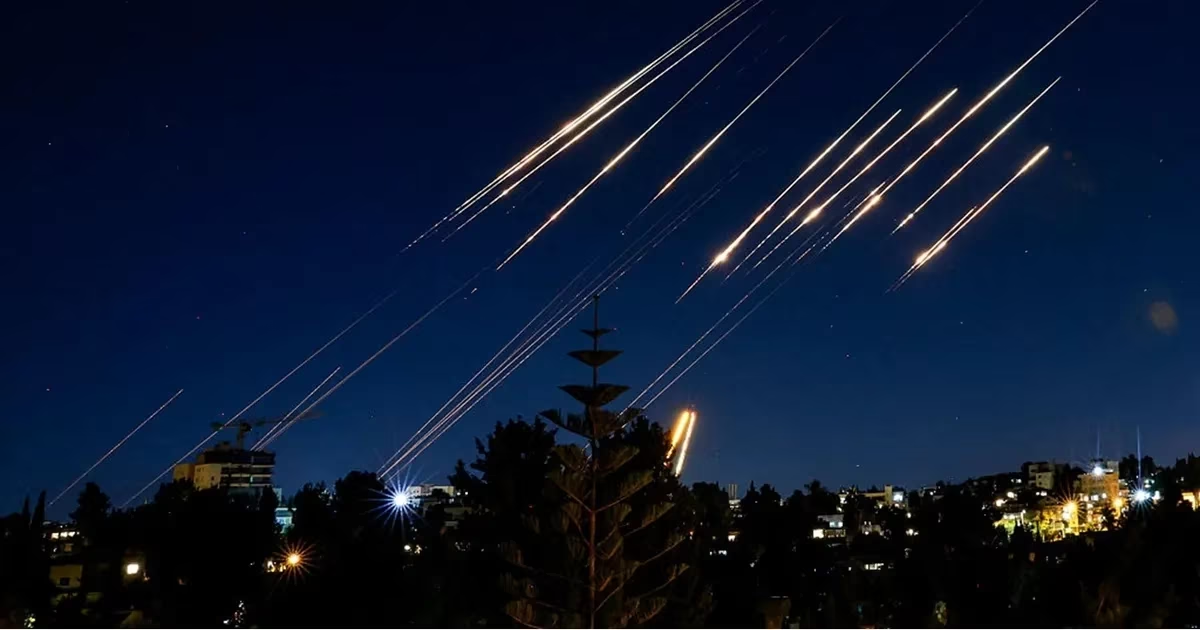
Local sources reported that the occupation army forced about 50 individuals to leave, threatening them with immediate arrest and confiscation of their livestock if they refused to comply with the orders. This step comes under the pretext of the army's intention to redeploy at the site and establish a permanent military post, ending years of relative stability for these families.

Mrs. Umm Muhammad, one of the displaced from the camp, described the eviction decision as a 'catastrophe' that strikes at the future of her children and disperses them to unsuitable living places. She pointed out that her children were forced to drop out of university due to the displacement and the continuous search for alternative shelter that lacks the most basic necessities of life.

For his part, Jamal Rashid, who was overseeing the transfer of his furniture with an agricultural tractor, explained that the evacuation decision was not separate from the systematic displacement policy in the Jordan Valley and Hebron areas. He affirmed that living in the concrete rooms provided protection for their livestock, but the occupation insists on pursuing Palestinians in every Bedouin or rural gathering in the West Bank.

With the expiry of the military deadline, vehicles carrying dozens of individuals moved away from the camp grounds, leaving behind a place that was bustling with life and agricultural activity. Silence now prevails throughout the site, amidst anticipation of the return of Israeli military vehicles and the sounds of gunfire that may accompany the rebuilding of the military barracks.

In a related context, the head of Arraba Municipality, Ahmed Al-Arda, confirmed that the municipality had not received any official notifications from the competent authorities regarding the nature of the new military activity. He explained that the occupation forces repeatedly stormed the site for a full week to inform residents of the necessity of immediate departure under penalty of legal and security prosecution.

Al-Arda warned that the army's return to the camp practically means controlling vast areas of surrounding land under flimsy security pretexts. This step will also isolate Arraba town and the villages south of Jenin from the city center, exacerbating the suffering of citizens in movement and access to basic services.

Experts in Israeli affairs believe that the return to Arraba camp falls within an escalating trend to strengthen the settlement presence in the northern West Bank. These moves come in implementation of political decisions aimed at reshaping the relationship with the Palestinian presence by transforming it into isolated and weak communities.

The current Israeli policy aims to reshape Palestinian identity in areas classified as 'C,' so that the presence of residents becomes temporary and unstable. This is done by intensifying dominance over the land and rebuilding previously evacuated camps, to ensure that no geographically contiguous Palestinian entity is established.

Reports indicate that the occupation seeks to resolve the core of the conflict by transforming it from an issue of an occupied people demanding their rights into a conflict with 'minorities' within a Jewish state. This approach pushes Palestinian citizens towards difficult choices, either forced migration or living under an increasingly brutal system of racial discrimination day by day.

According to official data issued by the Wall and Settlement Resistance Commission, last January witnessed a sharp escalation in land seizure orders on Palestinian lands. More than 744 dunams were seized for military and settlement purposes, including the construction of security roads and the expansion of camps in Nablus, Jenin, and Ramallah governorates.

The planning authorities of the Israeli Civil Administration also approved plans for the construction of hundreds of new settlement units on vast areas of confiscated land. These plans aim to connect existing settlements to each other, tearing apart the geographical fabric of Palestinian villages and towns in the West Bank.

Arraba camp remains a living example of the 'revolving door' policy pursued by the occupation in dealing with evacuated lands, where it returns to them under security pretexts to pave the way for the return of settlers. The displaced residents today face an unknown future in the absence of international protection and the continued accelerated settlement expansion.

With one military notification, years of building a future collapse as if they never existed, and the occupation tries to expel us from every place we seek refuge.

ARAB AND WORLD

Thu 12 Feb 2026 9:20 am - Jerusalem Time

The Clash of Wills Between Tehran and Washington: Ballistic Missiles, the Knot of the “Grand Bargain”

The Iranian capital, Tehran, commemorated the 47th anniversary of the Islamic Revolution amidst a charged political atmosphere, with celebrations featuring striking military parades that included advanced ballistic missiles. In a synchronized move reflecting the intensity of regional tension, Israeli security sources announced the success of new tests for defensive systems designed to intercept long-range missiles, indicating a frantic arms race preceding any potential political understandings.

These military displays are taking place at a time when Washington and Tehran are engaged in arduous and complex negotiations. US President Donald Trump is seeking to conclude what he describes as a historic deal to overcome the shortcomings of the 2015 agreement. Trump desires to achieve a diplomatic breakthrough that permanently ends Iran's nuclear ambitions, while simultaneously avoiding a comprehensive military confrontation that could exhaust the American economy and affect the stability of global energy prices.

For its part, the Iranian leadership, headed by Ayatollah Ali Khamenei, maintains a position that negotiates the right to possess nuclear technology for peaceful purposes, with an absolute refusal to compromise on conventional missile capabilities. Tehran considers its missile system to be the cornerstone of its national deterrence strategy and cannot be subjected to negotiation under the weight of American threats or the economic pressures resulting from prolonged sanctions.

Benjamin Netanyahu enters the crisis with an anticipated visit to Washington, his seventh since early 2025, with the aim of convincing the American administration of the necessity of including the ballistic missile issue as a fundamental clause in any agreement. The Israeli government believes that restricting uranium alone is insufficient if the Iranian missile system continues to develop in terms of accuracy and range, especially after the experience of the military confrontation that occurred last year.

Domestically in Israel, pressures have increased from both the opposition and the coalition. Former War Minister Avigdor Lieberman indicated that the truth about the damage caused by Iranian missiles in the 2025 confrontation has not been fully revealed. Lieberman warned that any agreement that does not include the dismantling or restriction of Iranian missile capabilities would be considered a grave security failure that places Israeli depth in permanent danger.

The authorities in Iran face severe internal challenges as a result of immense economic pressure that has affected living standards and led to scattered popular protests. The Iranian regime is trying to balance its urgent need to lift sanctions and provide economic relief to the public with maintaining its image as a regional power that has not succumbed to dictated terms, which officials there call “strategic patience.”

Informed sources indicate that Trump is trying to balance his desire to appease his regional allies and avoid making them pay the price for any potential military confrontation that might target American bases in the region. Arab allies fear that their territories could become a direct battleground, or that they might be asked to bear the exorbitant financial costs of any military action led by the United States against Iranian facilities.

Despite the complexities, outlines of a compromise formula may emerge, including reducing uranium enrichment levels and the return of strict international oversight in exchange for a gradual lifting of oil and financial sanctions. However, the ballistic missile issue remains the mine that could detonate the entire negotiation process, as Tehran considers it an integral part of its defensive doctrine that cannot be divided or conceded in the face of continuous threats.

This current battle of wills transcends security calculations to become a struggle for international image and prestige; Trump wants to appear as the hero who achieved what his predecessor could not, while the Iranian regime rejects any concession that might be interpreted internally as a sign of weakness. Amidst this tug-of-war, the risk of military escalation remains if one of the parties decides to over-press to impose new realities on the ground.

The nuclear file without ballistic missiles is half a solution, and the Iranian missile arsenal represents a direct threat no less dangerous than nuclear ambitions.

PALESTINE

Thu 12 Feb 2026 5:14 am - Jerusalem Time

Trump announces opposition to Israeli plans to annex the West Bank

US President Donald Trump explicitly announced his opposition to recent Israeli moves aimed at annexing parts of the occupied West Bank to Israeli sovereignty. These positions came during a press interview Trump conducted with the news website 'Axios', where he stressed that his administration does not support this step at the present time due to the existence of other top priority issues occupying the White House.

Trump explained in his speech that he does not see the need to open the West Bank file at this complex stage, pointing out that the United States has enough preoccupations that require full focus. These statements come at a very sensitive time, as they precede by a few hours an anticipated meeting in Washington D.C. between the US President and Israeli Prime Minister Benjamin Netanyahu to discuss regional issues.

Last Sunday, the Israeli Ministerial Committee for Political and Security Affairs, 'the Cabinet', approved a series of decisions aimed at making radical changes to the legal and civil reality within the occupied West Bank. These measures, according to informed sources, aim to strengthen direct Israeli control and undermine the powers granted to the Palestinian Authority in many vital areas.

The new Israeli decisions include expanding the scope of oversight and enforcement powers to include areas classified (A) and (B) according to the Oslo Accords, which were administratively and security-wise under the Palestinian Authority. The occupation authorities justify this step by the existence of violations related to unlicensed construction, in addition to issues related to water sources and the protection of archaeological and environmental sites from alleged encroachments.

Observers believe that these measures give the occupation authorities the green light to carry out widespread demolitions and confiscation of Palestinian properties under newly invented legal pretexts. This development constitutes a dangerous escalation in settlement policy, as Israeli encroachment extends deep into areas that were supposed to be under full Palestinian sovereignty according to previous international understandings.

Trump's statements reflect a kind of divergence of views with Netanyahu's right-wing government, which is strongly pushing for imposing sovereignty over settlements and large parts of the West Bank. Despite the absolute support that the Trump administration provided to Israel in many files, the latest position indicates Washington's desire to curb moves that could lead to an uncontrolled explosion of the security situation.

For their part, Palestinian and international circles warned that Israeli practices in the West Bank aim to definitively eliminate the two-state solution and turn Palestinian communities into isolated enclaves. Political sources confirmed that expanding Israeli powers in areas (A) and (B) is a blatant violation of all signed agreements, and places the international community before its responsibilities to stop silent ethnic cleansing operations.

The question remains about the extent of the impact of Trump's declared position on the Israeli government's decisions on the ground, especially since 'the Cabinet' has already begun to institutionalize these changes. The West Bank file and the recent decisions are expected to top the discussion table between Trump and Netanyahu, in an attempt to reach a formula that balances Israeli ambitions and the American vision for managing the conflict.

I don't support annexation. We have enough things occupying us now, and we don't need to deal with the West Bank file at the present time.

PALESTINE

Thu 12 Feb 2026 5:14 am - Jerusalem Time

Human rights campaign in France to boycott Israeli settlement dates and expose source deception

French human rights activist Bernard Verla criticized the legal and commercial violations accompanying the marketing of dates from Israeli settlements in French markets. Verla explained that there is a clear deliberate omission of information about the true origin of these products, which is a blatant violation of European legislation regulating the import and sale of goods from occupied territories.

The French activist affirmed that there has been an effective European law since 2015 that requires importers and producers to accurately specify the origin of dates. This law stipulates that goods must explicitly state that they originate from 'Occupied Palestinian Territories,' emphasizing that merely placing the Israeli barcode '729' is not legally sufficient to mislead consumers about the true origin.

Verla pointed out in statements to media sources that there is a significant ethical contradiction in how European markets deal with consumers, especially during religious seasons such as the month of Ramadan. He considered that exploiting these occasions to promote products that generate huge profits for the occupation directly contributes to funding ongoing crimes against Palestinians, describing this behavior as financial support for acts of genocide.

The human rights report touched upon the mechanism adopted by the occupation in producing these dates, which primarily relies on the theft of Palestinian lands and the confiscation of water resources allocated to indigenous populations. France and Britain top the list of European countries that import the most of these crops, which are seized from their rightful owners to be marketed abroad under misleading names.

For their part, activists recounted field experiences in French stores revealing the extent of deception practiced against shoppers, where packages bearing the Israeli flag are displayed without clarifying that they come from illegal settlements. Activists described these practices as attempts to specifically entice Muslim consumers to buy products that conceal serious human rights violations and international law.

Human rights campaigns issued urgent appeals to consumers to investigate the sources of goods and look for reliable alternatives such as Algerian dates and other Arab products. The campaign organizers affirmed that boycotting occupation goods is an ethical and humanitarian responsibility that precedes religious or political considerations, and aims to pressure for an end to the funding of the Israeli war machine.

In a related context, activists recalled European trade union stances supporting the Palestinian cause, including the call by the National Union of Workers in Belgium to refuse to deal with flights to Tel Aviv. The union then considered that continuing commercial and logistical cooperation with the occupation, in light of the genocide in the Gaza Strip and the West Bank, constitutes implicit participation in these violations.

Buying these products represents funding for the genocide against the Palestinian people, and boycotting is a moral and humanitarian duty.

ISRAELI AFFAIRS

Thu 12 Feb 2026 5:14 am - Jerusalem Time

Trump insists on negotiation option with Iran, Netanyahu conditions agreement on strict security guarantees

US President Donald Trump revealed details of the intensive discussions he held with Israeli Prime Minister Benjamin Netanyahu at the White House, confirming that he insisted on his desire to complete the negotiation process with Tehran. The closed meeting lasted for nearly three hours, taking place away from the media in a move reflecting the sensitivity of the issues on the table between the two allies.

Trump clarified via his 'Truth Social' platform that he clearly informed Netanyahu that reaching an agreement with Iran remains his preferred option for now. The US President indicated that the final outcomes have not yet been decided, but he seeks to explore the rationality of the Iranian side at this new stage of international discussions.

In a message with a cautionary tone, Trump reminded Iran of the consequences of rejecting previous deals, referring to the military operations that targeted Iranian nuclear sites during last June's confrontation. He affirmed that Washington is closely monitoring Iranian behavior, and that other options remain available should diplomacy fail to achieve American objectives.

For his part, Benjamin Netanyahu focused during the meeting on what he described as Israel's existential security needs, emphasizing that any agreement must include strict restrictions. Netanyahu demanded a complete halt to uranium enrichment operations and the dismantling of current stockpiles, considering military action as potentially the only way to permanently end Iran's nuclear ambitions.

Informed sources reported that the statement issued by the Israeli Prime Minister's office was cool compared to Trump's optimistic tone, indicating gaps in viewpoints. The Israeli statement lacked the traditional phrases describing meetings as warm or positive, merely referring to the continuation of close security coordination between the two sides.

Observers believe that this discrepancy in media discourse may be a deliberate tactic aimed at misleading Tehran and keeping all possibilities open on both political and military fronts. While Trump promotes a peaceful solution, Netanyahu insists on demonstrating adherence to the military option to ensure extracting the maximum possible concessions from the Iranian side.

Reports indicate that Netanyahu entered the White House through a back entrance to avoid photographers' lenses, an unusual procedure reflecting the desire of both parties to lend an air of secrecy to the deliberations. Discussions covered various scenarios for dealing with any potential breakdown of negotiations, including mechanisms for responding to any potential Iranian attack against Israeli interests.

In the context of field pressure, the United States continues to bolster its military presence in the region, having sent a second aircraft carrier to serve as a pressure tool for the American negotiator. These moves aim to compel Tehran to accept conditions that extend beyond the nuclear file to include its ballistic missile program and regional influence in the Middle East.

On the other hand, Tehran shows cautious readiness to discuss the enrichment file, but categorically rejects any interference with its missile program or reduction of its role in the region. Iranian sources affirm that any agreement must preserve the country's sovereignty and its right to nuclear technology for peaceful purposes, warning of an unrestrained response if it is targeted.

Analysts believe that Netanyahu, through these meetings, seeks to push the US administration towards adopting a strategy aimed at changing the regime in Tehran or militarily weakening it. However, Trump's current inclinations lean towards concluding a 'good deal' that ensures Iran does not acquire nuclear weapons without sliding into a comprehensive war that could destabilize the region.

Iranian ballistic missiles raise serious concerns in Israeli security circles, given their ability to reach deep into Israel without prior warning. Officials in Tel Aviv warn that Iran is capable of exhausting air defense systems in the event of a long-term conflict, making the neutralization of this weapon a top Israeli priority.

A White House official confirmed that President Trump was firm about preventing Iran from acquiring nuclear weapons or continuing to enrich uranium at high levels. The official added that the US administration is working to formulate a negotiating framework that ensures strict and comprehensive monitoring of all concerning Iranian nuclear and military activities.

At the end of the meeting, the American and Israeli sides agreed to continue close coordination on the Gaza file and the rapidly evolving regional developments in the region. Despite some differences in details, the shared commitment to preventing Iranian expansion remains the cornerstone of the strategic alliance between Washington and Tel Aviv.

The question remains whether these negotiations will lead to a real breakthrough or are merely a new round of political maneuvers preceding a potential escalation. The coming days will reveal the extent of international parties' ability to sit at one table and formulate understandings that end decades of tension and conflict in the Middle East.

I insisted on continuing negotiations with Iran to see if a deal could be made or not, and if not, we will see what the outcome will be.

ISRAELI AFFAIRS

Thu 12 Feb 2026 5:14 am - Jerusalem Time

Rift in Likud: Gallant's Accusations of Lying Against Netanyahu Pave the Way for His Departure from the Ruling Party

The ruling Likud party in the occupying state is witnessing an unprecedented state of sharp accusations exchanged between its leaders, culminating in the attack launched by former War Minister Yoav Gallant against Prime Minister Benjamin Netanyahu. Gallant described Netanyahu as a 'liar' and accused him of deliberately harming the Israeli army, which observers considered tantamount to an implicit and final resignation from the party's ranks.

Media sources reported that Gallant recently announced his de facto retirement from Likud through his bold statements, which spread widely on social media platforms and news channels. It appears that the former minister left angry with the prime minister, especially after the revelation of a controversial document prepared by Netanyahu for the State Comptroller aimed at exonerating him from responsibility for the events of October 7th.

According to Gallant's view, this document is full of lies and does not match the reality in which he was a partner as Minister of War before the attack and during the first year of the war. Sources confirmed that Gallant sees Netanyahu's behavior as an attempt to falsify historical facts related to the management of the major security crisis that Israel faced.

Gallant accused the prime minister of clear hesitation in making decisive decisions, noting that he refrained from acting to eliminate Hezbollah's capabilities at critical times. He also pointed out that Netanyahu did not initiate the mobilization of reserve forces on October 7th, and was not even present at the military headquarters when the first fateful decisions were made that morning.

Political analyses suggest that the inevitable outcome of this confrontation is the impossibility of Gallant remaining in the Likud party, especially after Netanyahu's supporters filed a lawsuit against him in the party court. This internal legal action practically means his immediate expulsion, and no legal efforts will succeed in returning him to the ranks of the party that Netanyahu controls with an iron fist.

Analysts believe that Gallant's attempt to compete in any upcoming primaries would be political suicide and a waste of financial resources without success. After his resignation from the Knesset in January 2025 and another member taking his place, Gallant lost his parliamentary budget and organizational influence within the ruling party's institutions.

Gallant's career in Likud has been full of transformations. In the 2022 elections, he was considered one of the most prominent candidates and ranked third on the list. At that time, he was seen as one of Netanyahu's potential successors, but the clash over security and legal issues turned him from a strategic ally into a bitter opponent.

Knesset members from the backbenches of Likud exploited these statements to launch a counter-attack on Gallant, seeking to please Netanyahu and affirm their loyalty. These members accused the former minister of becoming a 'political tool' driven by personal hatred, and that he caused severe damage to the state during his tenure as Minister of Defense.

Circles close to Netanyahu believe that Gallant's major 'sin' was his declared desire to conclude an immediate deal for the return of the abductees, and his strong opposition to judicial amendments. These circles believe that Gallant's positions contributed to the internal disintegration that Israel witnessed and led to the deterioration of the strategic security situation.

For his part, Netanyahu, who enjoys absolute influence within Likud, seems keen to finalize Gallant's expulsion to ensure there are no strong dissenting voices. However, Netanyahu is currently avoiding holding a general party conference for fear of additional attacks from other members who might share some of Gallant's criticisms.

Gallant's expected departure from Likud reflects the depth of the division within the Israeli right over the management of the war and accountability for security failures. These developments reveal the fragility of internal alliances amid continued military and political pressures on the current government.

Sources indicate that Gallant, despite his previous attempts to stay and fight from within the party, has reached a complete conviction that his path with Likud has ended. The party events he attended were no longer sufficient to mend the broken relationship with Netanyahu's loyal base.

Ultimately, Gallant's statements remain testimony from 'behind closed doors' on the crisis management methods in the Prime Minister's office. It is testimony that Netanyahu's opponents see as additional evidence of the need for political change, while his supporters see it as merely an attempt at personal revenge after his dismissal.

The question remains in Israeli political circles about Yoav Gallant's next destination, and whether he will lead a new movement or join the centrist opposition. But what is certain now is that the doors of Likud have been completely closed to the man who was once the powerful second-in-command in the party's security apparatus.

Gallant announced his de facto retirement from Likud when he described Netanyahu as a 'liar' without hesitation, accusing him of slander and harming the military establishment.

PALESTINE

Thu 12 Feb 2026 5:14 am - Jerusalem Time

US talks for 'controversial' security company to return to Gaza Strip as part of Trump's plan

The American security company 'UG Solutions', which previously operated in the Gaza Strip, has revealed that it is in advanced talks with the 'Peace Council' sponsored by US President Donald Trump. These consultations aim to define a future role for the company in securing humanitarian operations and reconstruction within the Strip, as part of the new American vision to end the war.

These moves come after the company sparked widespread controversy and sharp international criticism from the United Nations, due to the bloody scenes witnessed at its aid distribution points earlier. The company's name has been linked to the Gaza Humanitarian Foundation, which faced accusations of responsibility for the deaths of hundreds of Palestinians who tried to access food supplies in areas where the Israeli army was present.

A spokesman for the security company confirmed that proposals and information have already been submitted to the Peace Council, the body established by Trump to advance his political plan in the region. The spokesman indicated that the proposal received initial approval, pending the final determination of the security priorities of the Council, which oversees the transitional phase in Gaza.

In a related context, informed sources reported that talks have been ongoing for several weeks with multiple security entities, including 'UG Solutions', without reaching a final agreement so far. These entities seek to form a security force capable of operating in a complex environment, especially with the increasing incidents of looting humanitarian shipments and diverting their routes in conflict areas.

For their part, Palestinian officials expressed grave concern about the return of these private security companies to operate in the Strip, considering that their history is linked to violence against civilians. Amjad Al-Shawa, head of the Palestinian NGO Network, stated that these entities are absolutely unwelcome, emphasizing that the blood of Palestinians shed at their sites is still present in memory.

Despite the criticism, the company defended its security record, claiming that the role of its armed contractors was limited to direct site security without interfering with the movements of the Israeli army or Palestinian factions. The company claimed that the need for it increased due to the inability of humanitarian organizations to protect their convoys from the ongoing security chaos in operational areas.

Reports indicate that the company has already begun recruiting new contractors with combat experience and Arabic language skills to work in as-yet-unannounced locations. Recruitment conditions include proficiency in the use of light weapons, in addition to job requests for females under the title of 'cultural support officers' to ensure proper aid distribution.

These security moves are closely linked to Trump's plan to reconstruct the Gaza Strip in stages, starting from the city of Rafah in the south. The 'Peace Council' is scheduled to hold an expanded meeting in Washington next week to raise the necessary funds to finance these projects supervised by Jared Kushner, the US President's son-in-law.

In previous reports, the United Nations described the operations of the Gaza Humanitarian Foundation as 'inherently dangerous', as they violate the basic principles of humanitarian work that require safe distribution. The international organization explained that relying on private security companies in military contact areas often leads to catastrophic results for the lives of unarmed civilians.

For its part, the Israeli army admitted that Palestinians were injured during previous distribution operations, claiming that its soldiers fired to control crowds and confront what it described as 'direct threats'. Military sources confirmed that they made changes to field operating procedures after those bloody incidents that sparked widespread international outrage.

'UG Solutions' aspires to become the 'preferred security partner' in Gaza, based on its previous experience working with institutions supported by the US administration. The company's ambitions are not limited to the Palestinian territories, as it revealed plans to expand into Syria to provide security services in the vital oil and gas sector there.

The biggest challenge to these plans remains the widespread Palestinian popular and institutional rejection of the presence of armed foreign security contractors within cities. Observers believe that involving private security companies in the humanitarian file may further complicate the field situation and lead to more bloody clashes with local residents.

In the absence of an official response from the Gaza Humanitarian Foundation to recent press inquiries, questions remain about the nature of the mandate granted to these companies. Human rights circles fear that working under the umbrella of the 'Peace Council' may be a cover for escaping legal accountability for any future violations that may occur against civilians.

Finally, the Palestinian street awaits the results of the upcoming Washington meeting, which will largely determine the features of the security and civil administration of the Strip in the coming period. With American companies insisting on returning, fears are growing that humanitarian aid will be turned into a tool for security and political control, away from recognized international frameworks.

The Gaza Humanitarian Foundation and those behind it have Palestinian blood on their hands and are not welcome to return to Gaza.

PALESTINE

Thu 12 Feb 2026 5:13 am - Jerusalem Time

Washington Summit: Will Netanyahu Succeed in Pushing Trump Towards a Military Confrontation with Iran?

The current American administration is navigating between two contradictory paths in its handling of the Iranian file. On one hand, there is a negotiating discourse aiming for a comprehensive historical deal, and on the other, a threat of force and military options if the diplomatic path falters. Data confirms that Washington aspires to an agreement that goes beyond the nuclear dimension to include other issues, without an immediate slide into an open confrontation that could affect the administration's domestic priorities.

In the context of field pressure, the United States' dispatch of a second aircraft carrier to the region was interpreted as a political message aimed at raising the negotiation ceiling and forcing Tehran to make substantial concessions. This step does not necessarily mean a direct decision to start a war, but rather falls within Washington's 'active deterrence' strategy at the current stage.

For its part, the Israeli side expresses deep concern about the possibility of Washington reaching limited understandings that do not address Iranian missile threats or regional influence networks. Benjamin Netanyahu, by advancing the date of his meeting with Trump, sought to clearly lay out Israeli red lines before the new American administration.

Leaks from circles close to the Israeli Prime Minister indicate that he will demand Washington extract a full Iranian commitment to halt enrichment and dismantle the current uranium stockpile. Netanyahu believes that any agreement that does not achieve these demands represents an existential threat to vital Israeli interests and cannot be accepted.

In contrast, Tehran adopts a discourse that blends conditional diplomatic openness with the threat of strict deterrence, having shown willingness to discuss enrichment levels. However, the Iranian leadership sets absolute red lines regarding its missile program and its role in the region, considering them pillars of national sovereignty.

Iranian sources warned that any military targeting, regardless of its size, would be met with an unrestricted and comprehensive response, affirming that Tehran would not hesitate to defend its gains. This stance places negotiations before major challenges given the wide gap between the demands of the different parties.

Experts in Israeli affairs believe that Netanyahu's ultimate goal goes beyond merely improving the terms of the agreement, extending to a desire to overthrow the Iranian regime entirely. These experts believe that Netanyahu is betting on dragging the United States into a direct military confrontation to achieve this strategic goal, which he deems necessary for Israel's security.

Should the Trump administration reject the option of an all-out war, the alternative Israeli strategy will focus on pushing Washington to impose crippling conditions that would foil any attempt at negotiation. This policy aims to keep Iran under maximum sanctions pressure while obtaining an American green light for surgical strikes if necessary.

On the other hand, Iranian academics believe that Washington is entering negotiations with unrealistic expectations that do not align with the current balance of power on the ground. They assert that Iran possesses cards of strength that enable it to significantly harm American interests in the region if an armed conflict erupts.

Tehran emphasizes that the right to enrichment is a national gain that cannot be relinquished in any future settlement, and it rejects any interference in its sovereign affairs. This Iranian insistence is met with American insistence on changing the regime's behavior, making a compromise extremely difficult to reach.

Within the Republican Party, strategic planners believe that Iran is currently in a 'foggy area' due to its deteriorating economy despite the development of its military capabilities. They suggest that Trump adopt a policy that redefines deterrence through a combination of economic sanctions and strategic military positioning.

Upcoming American options may include controlled military escalation in coordination with Israel, aimed at reducing Iran's capabilities without reaching an all-out war. This path largely depends on Tehran's responsiveness to initial pressures and Trump's willingness to risk regional stability.

The question remains about Netanyahu's ability to convince Trump to fully adopt his confrontational vision, especially since the American president often tends to strike grand deals. The coming days will reveal whether the region is heading towards a historical settlement or a military confrontation that could reshape the Middle East.

Netanyahu believes that eliminating the Iranian threat can only be achieved through a war led by the United States to overthrow the regime.