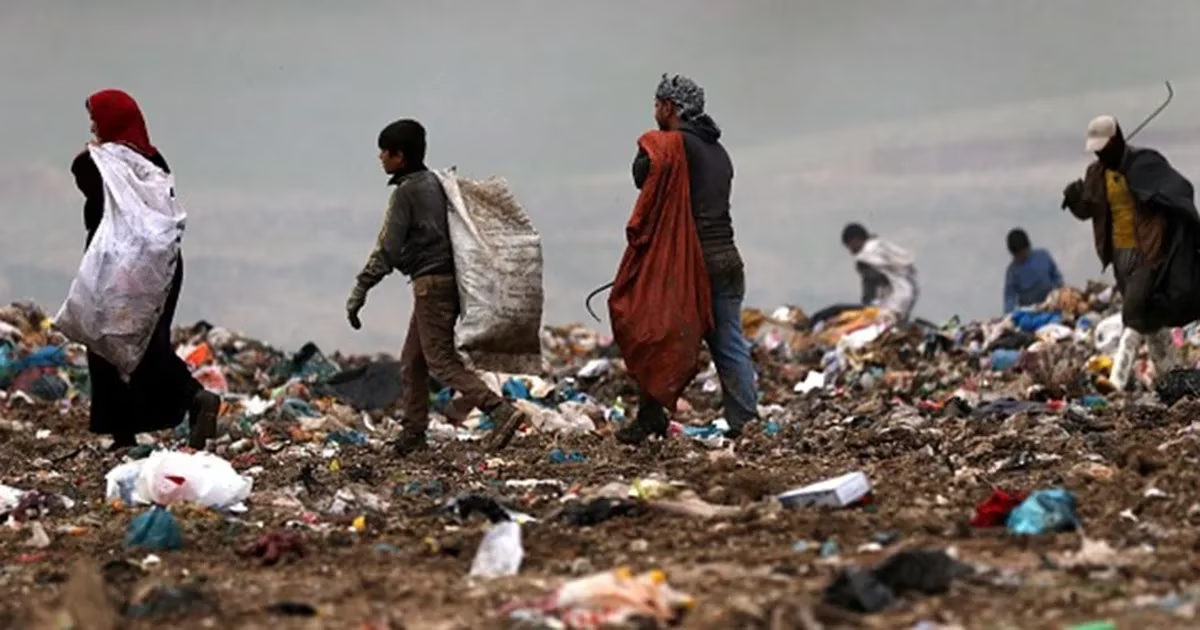







Possessing power, whether for an individual or a state, is not something that is encouraged or applauded on the international stage; rather, it is an arduous journey fraught with risks and pitfalls. The attempt to recover and overcome weakness is, in itself, an embodiment of strength, but it clashes with a political reality that views the rise of collapsed states as a threat to the interests of other powers that thrive on the weakness of their neighbors.
When a state tries to reclaim its sovereignty and control over its resources after years of collapse or war, it finds itself facing multiple swords seeking to delay this recovery. These external forces aim to maintain a state of political fluidity until the beneficiaries complete their plunder and achieve their expansionist ambitions at the expense of the exhausted state.
In the utilitarian political reality, there is no place for romantic discourse that blames powerful nations for not showing mercy to weak nations, as every nation seeks the interest of its people first. Therefore, the cost of weakness and collapse is high, as a troubled state is seen as easy prey or an opportunity to achieve fleeting circumstantial gains in areas such as tourism or trade.
Observers note that recovery in countries like Lebanon, Iraq, and Libya is proceeding at an extremely slow pace, often almost imperceptible. This slowness is not a coincidence; rather, it is the result of an undeclared international strategy aimed at throwing a wrench in the works to prevent any stability that might harm the interests of the powers benefiting from the chaos.
The continuation of fragmentation and tension serves external agendas that view the stability of these countries as a direct harm to their influence, making the cry of 'recovery forbidden' resonate in the corridors of international politics. However, the biggest obstacle is not limited to external factors alone but extends deep into the internal fabric of these afflicted nations.
The shocking role of local political elites stands out as one of the most dangerous obstacles preventing the restoration of national sovereignty, as these elites engage in internal conflicts that fuel division. Instead of working on a unifying national project, these forces contribute to supporting the plans of foreign parties by obstructing national reconciliation projects and prioritizing personal ambitions.
It is not merely a matter of ordinary political differences but reaches the point of 'national self-betrayal' when elites attack each other at a time when the country needs solidarity. This behavior represents a defect in the national immune system, where the forces that are supposed to protect the state become the tool that contributes to the continuation of its ailment and weakness.
The real problem always lies within, where national elites are called upon to prioritize the interest of recovery and state restoration over any other partisan or factional goals. No political party can enjoy true dignity or power under a sick state beholden to external decisions and the systematic looting of its wealth.
In the Libyan case, it is clear how multiple hands and stray bullets prevent the country from escaping the spiral of open looting of its oil wealth. This situation calls for a rapid national awakening to compensate for lost time and protect the future of coming generations who bear a heavy legacy of conflicts in which they were not a party.
In conclusion, the biggest challenge facing the peoples of Iraq, Lebanon, and Libya is how to close the loopholes through which deadly interventions seep, and to work on building a solid internal front. True recovery begins from within, through political self-denial and unifying efforts to reclaim the state's right to power, sovereignty, and a dignified life.
If political elites stab each other in the back and work to create division, this means that the national self is attacking itself, and herein lies the shock and the most dangerous symptoms of the national self's immune system disease.

Share your opinion
The Dilemma of Forbidden Recovery: How Elites and External Interventions Hinder the Rise of Arab Nations?