






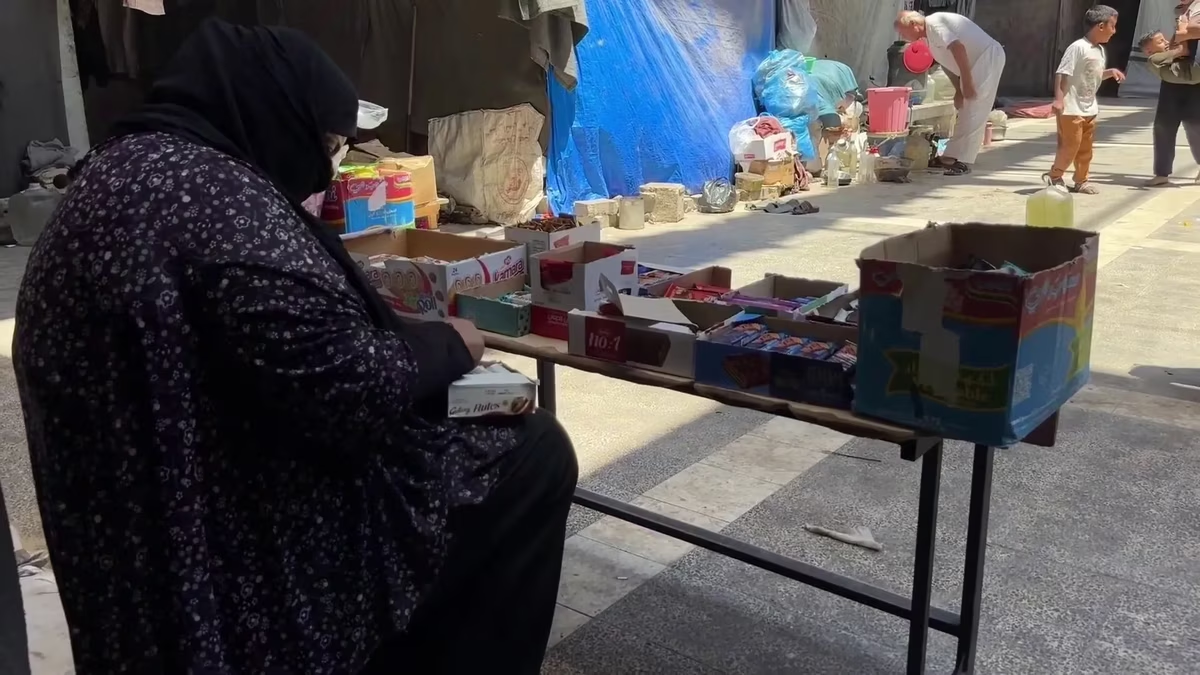
The humanitarian crisis in the Gaza Strip is escalating, casting its heavy shadow over the most vulnerable groups, where displaced women have found themselves with only one option for survival: launching micro-businesses. These modest 'stalls' have become the last line of defense to secure the minimum requirements for daily life, amid a complete loss of traditional income sources and the halt of the local economy.
One of the displaced women, a breadwinner, recounts harsh details of her daily life, where she relies entirely on a small stall to support herself and her only child after years of separation. Sources confirm that the absence of regular aid from relief organizations has made this stall the sole source of livelihood, although it barely provides enough to survive amidst unprecedented price inflation.
In her conversation with media sources, the woman indicates that the perception of divorced and widowed women receiving continuous financial or in-kind support is inaccurate and does not reflect her bitter reality. She finds herself forced to face the burdens of living alone, as the prices of basic necessities have skyrocketed, making it almost impossible to provide even the simplest school supplies for her son.
In a shocking comparison that reflects the extent of inflation, the displaced woman explained that the price of a single school notebook has reached 6 shekels, whereas it was previously bought as part of a complete package for a very small amount. This increase was not limited to stationery but also included food and clothing, which were damaged due to repeated displacement and living in tents lacking the most basic protection.
She describes her daily struggle as an attempt to hold onto life, even though the profit margin on her goods is very small, often not exceeding one shekel per carton. This meager profit quickly evaporates due to high transportation costs and the difficulty of moving between markets in search of goods at prices that displaced consumers can afford.
Cash liquidity emerges as an additional obstacle, as displaced women are forced to use banking payment applications for transportation due to the lack of cash, which further complicates simple commercial operations. Moreover, the phenomenon of buying on credit by other displaced people weakens the ability of stall owners to replenish their goods, as their money remains tied up with tent neighbors who suffer from the same poverty.
These women spend long hours under the sun or in harsh weather conditions behind their stalls, trying to collect a few pennies that may not be enough to buy a single meal. One of the displaced women expresses her helplessness when her child asks for simple needs, emphasizing that giving him from her small capital means the collapse of her only project and the cessation of her livelihood.
Suffering does not stop at selling; it extends to the journey of searching for goods, where women are forced to move between traders and large stalls in search of small price differences that save them one or two shekels. This arduous journey consumes their physical and psychological energy, increasing their feeling of exhaustion amidst the ongoing war and the absence of any horizon for a quick solution.
These individual stories come as part of a tragic overall scene in the Gaza Strip, where the Israeli war machine continues to target civilians and infrastructure since October 2023. This war has left widespread destruction affecting about 90% of vital facilities, making self-reliance through small projects an inevitable necessity to escape hunger.
According to the latest statistics, the death toll has risen to over 73,000 martyrs and more than 173,000 injured, in an unprecedented humanitarian catastrophe. In light of this reality, the 'displaced women's stalls' remain a testament to the Palestinian will to persevere, and a desperate attempt to confront the hell of high prices and limited resources in a geographical area besieged by fire and hunger.
I struggle as much as I can, but I am tired; the suffering includes buying, selling, and standing all day behind the stall to secure my son's most basic needs.
Share your opinion
Displaced Women's Stalls in Gaza: A Daily Struggle Between High Prices and the Specter of Inability to Provide