Washington Message
Washington – Said Arikat – 28/5/2026
News Analysis
As part of an escalating economic pressure campaign, the administration of US President Donald Trump announced on Wednesday new sanctions on Iran, this time targeting an agency recently established by Tehran to manage navigation in the Strait of Hormuz. The move, which coincides with American military operations, reveals Washington's strategy of combining military force and economic strangulation to compel the Iranian leadership to end the war and open the vital waterway through which a fifth of the world's oil and gas trade passes. While Trump hints at an imminent agreement, on-the-ground realities confirm that the path to a settlement remains fraught with escalation and ambiguity.
In parallel with the sanctions, the US military launched new strikes targeting an Iranian military facility, during which it shot down four offensive drones and bombed a ground control station in the coastal city of Bandar Abbas that was preparing to launch a fifth aircraft, according to the Pentagon's claim. A US official described these operations as "measured and purely defensive, aimed at maintaining the ceasefire" in effect since early April 8. However, the Iranian narrative presented a completely opposite picture; Tasnim news agency reported that the Revolutionary Guard fired at an American oil tanker attempting to cross the strait, forcing it to retreat, and asserting that the American strikes hit open areas without losses, in an attempt to absorb the attack media-wise and avoid showing incapacity.
Amidst this volatile scene, a report by Iranian state television about a preliminary peace agreement sparked a wave of speculation that was quickly extinguished by the White House, which described it as "pure fabrication." President Trump, during a cabinet meeting, expressed openness to long-term negotiations, saying of Iranian officials: "They thought they would outlast me, or my eagerness to end the war before the midterm elections... I don't care about the midterm elections." The statement reflects a double bet: while Trump pushes militarily to weaken Iran's negotiating cards, he leaves the door ajar for a settlement that may not mature for months, ignoring internal American pressures that may intensify as election deadlines approach.
However, the most dangerous aspect of this equation is not what is happening behind the scenes of negotiations, but what is unfolding in the American street itself, where the war has become a suffocating burden on citizens' pockets before it becomes a burden on the military treasury. While the administration continues its escalation in the Strait of Hormuz, gasoline prices are soaring at American gas stations, and with them, the bills for consumer goods that exhaust the middle and poor classes. This bitter reality explains why 66% of Americans oppose the continuation of this war and want to end it immediately, in a massive popular referendum ignored by an administration that seems more preoccupied with aligning itself with the desires of Israeli Prime Minister Benjamin Netanyahu than with reading the mood of its exhausted people. It is a cruel paradox: the military adventure exported as a national necessity turns into a daily living nightmare, while the decision-maker is freed from any electoral pressure, openly admitting that he "doesn't care" about the democratic deadlines that are supposed to hold him accountable.
Upon examining the provisions of the alleged agreement, whose existence Washington denied, fundamental gaps emerge that reflect the complexity of the crisis. The draft spoke of reopening the strait for commercial navigation, a partial American naval withdrawal, and a joint Iranian-Omani administration of the waterway, but it completely overlooked two thorny issues: Iran's uranium stockpile and frozen assets. This disregard confirms that any future agreement will be incomplete and vulnerable to collapse unless it includes a comprehensive mechanism to address the legacy of nuclear and financial confrontation. In a striking contradiction, Trump warned the Sultanate of Oman against entering into joint arrangements with Tehran regarding the strait, threatening to launch an American bombing campaign, a signal that encapsulates his administration's doctrine: the strait will remain under direct American guardianship, and any sharing of control over it is a red line.
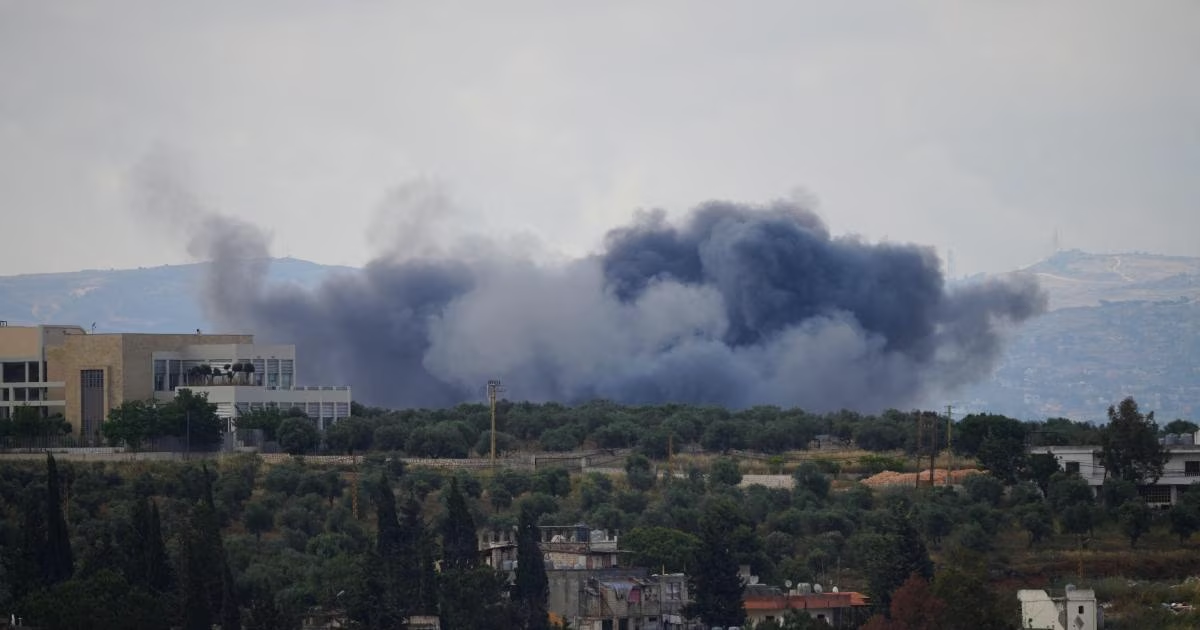
Meanwhile, another theater of war is flaring up on the Lebanese front, where the Israeli army has escalated its threats, issuing evacuation orders for two southern cities and hinting at a new wave of raids. These developments confirm a constant in this complex conflict: diplomacy may move behind the scenes, but violence on the ground does not await its results. Few in Lebanon are betting that efforts to end the major war will extend their protective umbrella to Beirut; experience shows that major settlements are often concluded over the rubble of small capitals, and that peace coming from American-Iranian negotiations may be nothing more than a fragile truce, leaving the region on the brink of a volcano ready to erupt again.
New sanctions on the Iranian navigation agency reflect Washington's "smart strangulation" strategy, moving from targeting traditional entities like the Revolutionary Guard to paralyzing Tehran's institutional capacity to manage its waterways. The idea of Iran establishing a special agency for Hormuz was an attempt to impose a sovereign fait accompli, but Washington treated it as an illegitimate extension of dominance over the global energy artery. This deliberate drying up of any Iranian ability to control the strait sends a dual message: no negotiation on freedom of navigation under threat, and no recognition of any bureaucratic arm that legitimizes its closure.
In the stark contradiction between the American and Iranian narratives regarding the Bandar Abbas strikes, more than just a media debate is read; it is a war of strategic consciousness. Washington seeks to confirm that it retains the right of deterrence even under the umbrella of a truce, while Tehran rushes to deny losses, to maintain the cohesion of its internal front and its regional prestige. But these skirmishes under the fragile ceasefire raise an existential question: how can a lasting agreement hold between two adversaries who do not even agree on the narrative of a single engagement? The continuation of this narrative schism warns that the truce is merely a period of tactical repositioning, not a basis for real peace.
Oman emerges in this scene as a mediator paying a price for the independence of its role, as embodied by Trump's public threat to bomb it if it cooperated with Tehran in the strait. This brandishing of force against a traditional ally reveals the absence of any margin for pure diplomatic maneuvering in the mind of the current US administration; everything is subject to the equation of brute force. This harsh message disrupts Muscat's efforts, which had bet on constructive neutrality to manage the crisis, and confirms that Washington views the strait not as an international passage, but as a strategic backyard where partnership is not accepted. Thus, quiet diplomacy becomes a hostage to public threats.
As for the Lebanese front, the synchronization of Israeli evacuation orders with indicators of Iranian-American negotiating progress encapsulates the great tragedy of this war: Iran may negotiate the fate of the Strait of Hormuz and its frozen assets, but its regional proxies are left to face the storms alone. Hezbollah realizes that any major deal will not necessarily be a protective umbrella for it, but may be a constraint that prevents Tehran from absolute support. This separation between the nuclear and strait tracks on the one hand, and the proxy conflict fronts on the other, indicates that the path to a comprehensive de-escalation remains disconnected, and that the coming peace will be selectively excellent, concluded for the benefit of regional powers while small arenas are left to struggle for their fate in the shadows.