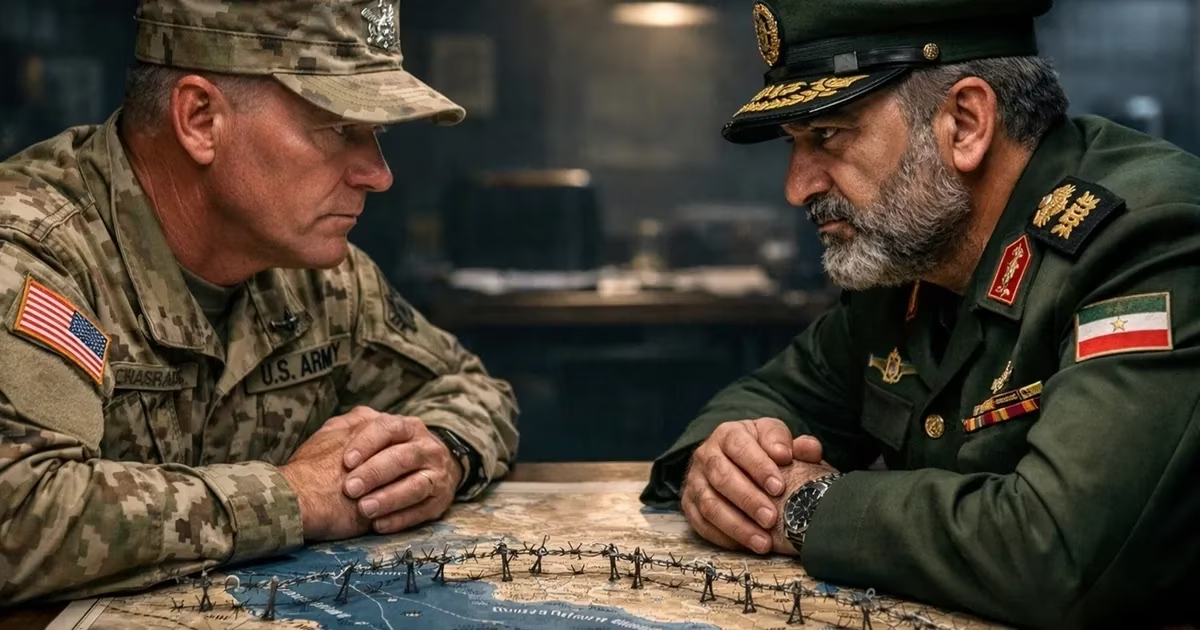







In-depth discussions are escalating in research and intellectual circles about the features of the 'day after' the ongoing war, amidst ambiguity surrounding the future of negotiations and the field results on various fronts. Observers believe that the repercussions of this confrontation will not be limited to the direct parties, but will extend to reshape the international order and relations between major powers, with fundamental impacts on the future of the Palestinian issue and the global ethical system.
In this context, Al-Zaytouna Centre for Studies and Consultations issued a recent scientific paper anticipating the features of the global system in the coming years, suggesting that the world is entering a deep transitional phase. The study indicates that unipolar hegemony has actually begun to decline in favor of a more complex system based on the multiplicity of power centers and the intertwining of hard and soft tools in managing international conflicts.
The research paper prepared by Dr. Walid Abdel Hay confirms that power balances are undergoing a gradual reshaping, with China emerging as a dominant technological and economic power through cross-continental strategic projects. In contrast, Russia seeks to restore its influence by employing its military and geopolitical capabilities, while Washington tries to maintain its leadership position through technological innovation and its network of international alliances.
The criteria of power have changed in the modern era; military arsenals are no longer the sole measure of superiority among nations. Control over vital waterways such as Hormuz and Bab al-Mandab, and control over the advanced electronic chip industry, have become crucial elements in determining who holds the initiative in the new international order forming under the weight of crises.
The study draws attention to the growing role of giant technology companies that have transformed into international actors whose influence extends beyond the economy to shaping global public opinion. These companies now control the flow of data and information, posing unprecedented challenges to the traditional concept of national sovereignty, and making the digital space a political battleground par excellence.
The next phase is expected to witness a decline in direct traditional wars in favor of what is known as 'hybrid wars' that combine multiple and innovative tools. These wars include systematic cyberattacks against infrastructure, the use of economic sanctions as a political pressure tool, in addition to media disinformation campaigns aimed at destabilizing the internal stability of states.
Regarding international alliances, there are indications of an erosion of long-term solid commitments in favor of flexible and temporary alliances dictated by changing interests. This was evident in the sharp criticisms directed by former American leaders at NATO, describing it as a 'paper tiger,' which prompts countries to diversify their security and economic partnerships away from fixed axis politics.
As for the Middle East, it will remain at the heart of international competition due to its vital resources and unique geopolitical location connecting continents. However, the nature of external influence may change, with direct military intervention declining in favor of economic and investment influence tools, with the emergence of leading roles for regional powers seeking to impose new balances in the region.
Strategic readings propose a new concept that goes beyond 'multipolarity' to 'multicentricity,' where digital platforms and non-governmental actors participate in global decision-making. This overlap creates a complex network of influences that makes it difficult for any single state to control the course of international events as was previously the case.
Ongoing transformations raise fundamental questions about whether the world is heading towards a stable balance or towards a state of open and continuous competition. The question also remains about the role of technology in narrowing the gap between developed and developing countries, or whether it will lead to deepening technological and economic dependence in light of the intense race for artificial intelligence.
Understanding these profound transformations is no longer merely an intellectual luxury for researchers, but has become a strategic necessity for decision-makers in the Arab region. The world being reshaped today recognizes only power based on knowledge and the ability to control the flows of the digital economy, which requires analytical tools that go beyond inherited traditional models.
Regarding the value aspect, the current war will reopen the discussion about the role of religious and intellectual values in major international conflicts. The political and military outcomes of this confrontation are expected to affect the future of Islamic movements and the position of political regimes in the region, putting the international ethical system to a real test.
Research from study centers emphasizes the necessity of not waiting for the end of the cannons to start planning for the future, as the new reality is being shaped now in operations rooms and research centers. The strategic fluidity and uncertainty surrounding the global scene require high flexibility in dealing with accelerating variables to ensure a place in the coming international order.
In conclusion, the features of the new international order paint a picture of a world that is both more interconnected and confrontational, where economic interests intersect with geopolitical conflicts. The ability to adapt to the 'digital age' and shifts in major power balances will have the final say in determining the political map of the Middle East in the coming decades.
The world is heading towards a gradual reshaping of power balances, where power is no longer measured by military capabilities alone but by control over technology and vital straits.
Share your opinion
The Labor of the New International Order: A Reading of the Features of the 'Day After' the War and Global Power Shifts