OPINIONS

Thu 16 Apr 2026 3:17 pm - Jerusalem Time

Israel's Siege of Choices: Escalating Power… and Draining Conflict

Every time tensions escalate in the Middle East, questions of identity and migration resurface—not as theoretical discussions, but as a daily reality affecting individuals and reflecting deeper political shifts. At the heart of this scene stands Israel, a state founded on the idea of gathering the diaspora, but which today finds itself facing an increasing paradox: it is not the inevitable destination for all Jews worldwide, nor is it immune to the transformations redefining the very meaning of belonging.

In recent years, governments led by Benjamin Netanyahu have promoted a narrative that positions Israel as the “last resort” for Jews. This argument is based on real facts, including the rise of antisemitic incidents in some Western countries, especially in the wake of major crises such as the 2023 Gaza War. However, the problem lies not in the existence of these phenomena, but in how they are utilized: when the outside world is presented as an increasingly dangerous environment, immigration to Israel becomes an option that seems more urgent, not necessarily as a result of free conviction, but under the pressure of a reframed context.

Nevertheless, this narrative does not reflect the full picture. In cities like New York, Paris, and London, millions of Jews live who see their homelands as firmly stable, and many refuse to reduce their identity to a single national project. For them, Judaism is not confined to a state, nor is it necessarily understood through the policies of the Israeli government. This disparity reflects a broader shift: identity is no longer singular or tied to one center, but has become multiple and distributed across different experiences and contexts.

In contrast, a more complex paradox emerges: the more military operations or hardline policies escalate, the more international criticism increases, and sometimes—and disturbingly—incidents of hostility towards Jews also increase. Thus, Jews abroad find themselves in a problematic position, affected by policies they do not participate in making, and exposed to reactions they cannot control. There is no conclusive evidence that this correlation is intentional, but its results, when they occur, become part of a self-perpetuating political discourse.

In this context, the “siege of choices” within Israel itself becomes apparent. After decades where discussion revolved around a final settlement, a different approach is now advancing, based on “managing the conflict.” The goal is no longer a comprehensive solution as much as it is continuous containment: reducing risks, controlling the pace, and avoiding major decisions that might impose radical transformations.

The 2023 Gaza War provides a clear example of this shift. Repeated military rounds did not open a new political horizon, but rather reproduced a familiar pattern: widespread escalation, followed by intervention to stabilize the situation, then a return to a state of indecision. With each cycle, the distance between the existing reality and the possibility of reaching a final solution widens.

This pattern is no longer confined to Gaza. It has extended to the regional framework, especially with indirect and direct confrontations with Iran, where force is used without imposing a clear political end. This expansion deepens the feeling that the conflict is no longer a transitional phase towards a solution, but has become a self-contained structure.

In the West Bank, this transformation takes a quiet but profound cumulative form. Settlement expansion and the reshaping of geography and administrative reality impose new facts without an official announcement of a political alternative. Over time, these changes make any future settlement more complex and less applicable according to previously proposed models.

Diplomatically, the two-state solution remains present in international discourse, but it lacks actual momentum. Instead of decisive negotiations, a pattern of postponement and crisis management prevails, where issues are dealt with partially without reaching a comprehensive framework.

Under this equation, “Israel's siege of choices” is clearly embodied. It strengthens its presence on the ground and possesses military superiority, but at the same time, it engages in a long-term conflict pattern that imposes cumulative costs. While Palestinians bear the greatest and most direct burden—humanly and materially—a different kind of attrition is forming on the Israeli side: political and diplomatic, with increasing international criticism; reputational, with the erosion of its image in global public opinion; and strategic, with the absence of a decisive horizon that ends the threat instead of managing it.

In this sense, the conflict does not appear to be merely a draining of one party, but an unequal equation: one party is severely drained in the present, and the other is slowly drained in the long term. This equation, despite its imbalance, deepens the dilemma instead of resolving it.

After this dramatic ascent of Israel—militarily and regionally—it seems to be entering a different phase: not necessarily a sharp “descent,” but a transition to a situation where the cost of this ascent itself increases. The superiority reinforced through rounds like the 2023 Gaza War has not translated into political decisiveness, but has been accompanied by escalating pressure—internationally and domestically—making the maintenance of this level of power more complex. In this sense, the ascent is not receding as much as it is facing its limits, where power, instead of opening a horizon for a solution, begins to produce new constraints that reshape choices and push for a review of the path.

This disparity between who holds power and who holds the narrative deepens the dilemma. Settlement has not succeeded, force has not been decisive, and conflict management has not ended it. Over time, these paths turn into a state of mutual attrition, losing the ability to produce a clear way out.

Between the path of the Oslo Accords, which sought a final solution, and the current path based on open conflict management, reality does not return to the starting point, but is reshaped. In this sense, a return to any previous formula does not seem possible as it once was.

Although a return to the path of settlements may not seem like a preferred option at the current moment, it may, over time, become the most realistic option within this siege. Not because all alternatives have been completely exhausted, but because the cost of continuation may exceed the cost of change. Then, settlement may not come as an ideal or voluntary option, but as a response to accumulated pressure that reorders priorities and forces a reconsideration of the existing path.

Thus, the conflict is not heading towards a decisive end, but continues as a long process of adaptation and reshaping. In the absence of a final solution, the most likely scenario is the continuation of this pattern: a conflict that is managed more than it is resolved, until accumulated transformations impose new conditions that redefine what seems possible.

PALESTINE

Thu 16 Apr 2026 3:17 pm - Jerusalem Time

Meyad Abu Al-Rub talks about the story of the photo that swept Western media and angered Tel Aviv

- The controversy surrounding the photo's publication is considered a "qualitative shift" in how Western media addresses the Palestinian issue. - The photo's spread was a milestone that revealed the power of a single image to move global public opinion. - It is not enough for the story to be told; it must be supported by evidence, as law is not based on narrative but on what can be proven. - The photo succeeded in conveying the reality of Palestinians who own nothing in the face of the arrogance of settlers and the occupation army. Ramallah - Exclusive to "Al-Quds" - The young lawyer Meyad Jamal Abu Al-Rub from the town of Qabatiya, south of Jenin, while working with the Wall and Settlement Resistance Commission to support residents during a field activity in the Soba area of Idhna town, west of Hebron, did not know that her photo, taken by Italian photojournalist Pietro Mastrozo about six months ago during an olive picking event, was merely documentation of a local event. Instead, it turned into global media material, gracing the cover of the Italian magazine L'Espresso, later opening a wide discussion that extended from Europe to the United States about the Palestinian narrative and what is happening on the ground, and re-shedding light on the scene of the conflict in Palestine from both a humanitarian and political angle.

Fieldwork that went global On the morning of October 12, 2025, lawyer Meyad Abu Al-Rub participated in an olive picking event as part of "support and steadfastness" activities organized by the Wall and Settlement Resistance Commission in lands threatened with confiscation in the Soba area of Idhna town. The event was not exceptional in the context of her work, but rather part of a recurring activity aimed at enabling Palestinian farmers to access their lands amidst continuous restrictions and field difficulties imposed by the Israeli occupation army and settlers.

Abu Al-Rub states in an interview with "Al-Quds," "These activities are organized in more than one governorate, and include accompanying farmers to their lands and assisting in olive picking in areas where the commission's teams often face harassment or friction with the Israeli army or settlers."

However, what was unexpected, according to her account, was that a simple field moment would later turn into a photo that would reach European media, specifically the cover of the Italian newspaper L'Espresso, published on the twelfth of this month, becoming the focus of a wide political and media debate.

Provocative moment Abu Al-Rub explains that the photo was taken while she was on land supporting residents in picking olives in Idhna town, without being directly aware of the camera or the shooting angle, noting that the photographer who took it was most likely a foreign journalist, and it was later revealed that he was Italian.

Abu Al-Rub says: "The moments were difficult, as the scene was full of challenges, with the presence of armed settlers, some of whom were wearing Israeli occupation army uniforms, and they were provoking and mocking us, and the photo showed part of what happened."

Abu Al-Rub points out that the activity in Idhna town, despite its peaceful nature, faced field escalation at certain moments, as she spoke of the presence of armed settlers in military uniform, and of attempts at provocation, verbal and physical assaults. Abu Al-Rub indicates that an elderly participant was pushed, and she tried to assist him in the field.

Unexpected reactions After the photo spread, as Meyad recounts, reactions escalated unexpectedly. In a short time, it became material circulated by various European media outlets, described as reflecting a humanitarian scene of the conflict in the Palestinian territories.

However, this spread, according to Abu Al-Rub, did not pass without counter-reactions, as she indicated that the Israeli ambassador in Rome considered the photo "misleading" and accused it of being part of a media propaganda that does not reflect reality, even going so far in some statements as to question its authenticity and consider it "fabricated or AI-supported."

This controversy, according to her account, prompted the journalist who took the photo to publish a field video documenting the same moment, in an attempt to confirm that the scene was real and not fabricated, which contributed to reigniting the media debate about the incident.

Wide spread But what Abu Al-Rub considers most important was not the technical debate about the photo or video, but the extent of the international interaction that followed.

Abu Al-Rub says: "The photo moved from one newspaper to another, gracing pages in Italy, Germany, France, and Britain, and later reached American media, becoming a subject of discussion about the nature of what is happening in the West Bank, especially in areas classified as (C) in the West Bank."

Abu Al-Rub indicates that the Palestinian Ambassador to Italy, Mona Abu Amara, personally contacted her and informed her that the photo had sparked wide interaction and sympathy in European media circles, and that it contributed to opening a new discussion about the Palestinian narrative in Western media.

Abu Al-Rub points out that the controversy surrounding the photo's publication prompted some parties to consider it a "qualitative shift" in how Western media addresses the Palestinian issue, where the issue is no longer discussed only from a traditional political angle, but through field photos that reflect the details of daily life in areas of friction.

Abu Al-Rub emphasizes that this media spread highlights the suffering of Palestinians, considering that any photo or media material that helps convey this reality to international public opinion is an important step in the context of human rights and legal work.

Abu Al-Rub believes that the spread of the photo was not just a fleeting media event, but a milestone that revealed the power of a single image to move global public opinion and re-present the Palestinian issue in Western media from a more human perspective.

According to Abu Al-Rub, what happened may be the beginning of a broader shift in international attention, but at the same time, it does not negate the extent of the daily suffering experienced by Palestinians on the ground, which remains much greater than what any photo can convey.

A wide door to field violations Meyad Abu Al-Rub confirms that this coverage was not just visual interest but opened a wide door for discussing the field violations that Palestinians are subjected to during their attempts to access their lands, noting that what happened in that event was not isolated from a broader context of daily friction, provocations, and assaults carried out by the Israeli occupation army and settlers.

Abu Al-Rub confirms that she personally has been subjected to harassment and assaults long before that, recalling another scene from her field experience, when she was seven months pregnant about two years ago and the activity she participated in was subjected to tear gas bombs, which led to her being taken to the hospital for several hours, considering that this reflects the nature of the risks faced by teams working in this field.

Abu Al-Rub insists that the activities remain completely peaceful, and their primary goal is to support Palestinian farmers and enable them to access their lands, amidst the policies of the occupation and settlers that sometimes prevent them from reaching their fields, or subject olive trees to vandalism and cutting.

Abu Al-Rub says: "The photo that spread globally was only a very small part of a broader and more complex reality," emphasizing that what is published in the media does not always reflect the extent of the daily suffering experienced by residents in those areas, but this photo came to reinforce the nature of the violations taking place.

The photo is important in the legal battle Meyad cites her photo taken by an Italian photographer, confirming that Israel tried to discredit it, but the journalist came with a video reinforcing the narrative.

Abu Al-Rub stresses that documentation, through photos and videos, has become a crucial tool in confronting attempts to cast doubt, and for her, the integration of evidence is what gives truth its power, making its denial more difficult.

But what goes beyond the debate about photos is the broader goal she seeks, as Meyad emphasizes that what matters to her is not her person, but the ability of any documented material to move the international community, whether through media, courts, or legal platforms, saying: "We need to shed light on the suffering of our people," noting that every story or massacre needs documentation, so that it can be conveyed to the world in a language it understands.

She recalls in her speech the importance of the photo in international forums, where it was on more than one occasion sufficient to convey the suffering of an entire people.

As for the photo taken by an Italian photographer of her in Idhna town, in her opinion, it may have this impact, if it succeeds in conveying the reality of Palestinians who own nothing in the face of the arrogance of settlers and the Israeli occupation army.

Abu Al-Rub says in a firm tone: "Our activities were peaceful, we did not carry weapons, but we were always the party that was attacked, and then they try to condemn us, so the battle of law, image, and documentation is the important path we have towards revealing the truth."

Daily events turn into legal files In her office in Ramallah, in the legal department of the Wall and Settlement Resistance Commission, lawyer Meyad Abu Al-Rub sits, following the daily stories of citizens and transforming their stories of settler attacks into legal files, documenting the suffering in papers and evidence.

For Meyad, it is not enough for the story to be told; it must be supported by evidence, for the law, as she says, is not based on narrative but on what can be proven.

Abu Al-Rub explains that her work is not limited to presenting the narrative of assaulted citizens, but to building a complete file of evidence.

Escalation of attacks In her office in the legal department, lawyer Meyad Abu Al-Rub continues her work amidst a daily escalation in the volume of cases, saying: "The pace of work increases with each passing day, as a result of the increasing attacks and settlement expansion, which directly reflects on the number of files reaching the commission."

Lawyer Meyad Abu Al-Rub describes a very large reality of escalating violations, noting that settler attacks occur under the protection of the occupation army and with the constant presence of weapons with those settlers. These attacks extend from stealing sheep to burning homes, barracks, and tents.

Abu Al-Rub explains that the extent of suffering appears daily through the influx of citizens to the commission, carrying their stories and what they are subjected to in communities, and in the face of this, the commission relies on the documentation department to monitor these violations and convert them into evidence that preserves the victims' narrative and supports the legal follow-up process.

Continuous follow-up She explains that the nature of their work begins with receiving landowners threatened with confiscation, or those who have received demolition notices for their homes or facilities. Then the legal team takes over the file, prepares the papers, and checks for deficiencies, in preparation for converting it into a clear legal path.

Within this path, according to Abu Al-Rub, the commission relies on a network of lawyers with Israeli licenses, to whom files are transferred for follow-up before the relevant Israeli authorities. Abu Al-Rub emphasizes that the work does not stop at transferring the file, but includes continuous follow-up with lawyers to ensure the progress of procedures, in an attempt to protect what can be protected for citizens and their property.

The Commission... The first interface for citizens Lawyer Meyad Abu Al-Rub confirms that the Wall and Settlement Resistance Commission is the first interface for citizens who are subjected to various forms of aggression from settlers, as its door remains open to receive them and provide support.

Meyad Abu Al-Rub explains that the commission's role is not limited to legal follow-up only, but extends to organizing support campaigns, most notably during olive picking seasons.

Meyad indicates that the support includes in-kind and material assistance aimed at strengthening the steadfastness of citizens in their lands, by providing mobile housing units and basic facilities, in addition to compensation for tents and property that are burned, and even providing sheep and trees, in an attempt to keep them on their land despite the violations.

The steadfast lawyer Meyad Abu Al-Rub talks about an early stage in her life, when she finished high school and faced two choices that for her represented the path to the future: journalism or law. These were not just academic specializations, but rather means to try to understand the Palestinian reality and convey it to the world.

Abu Al-Rub says: "This decision was linked to an awareness that formed within her from a young age, amidst influential events that remained present in her memory, such as the story of Mohammed Al-Durra and other scenes that accompanied her generation in its early years, which made her feel a constant need to convey the truth as it is."

Since her childhood, Meyad noticed the extent of violations against Palestinians, as well as the experience her father lived as a prisoner in Israeli occupation prisons and then his release and becoming a member of the Legislative Council, which generated in her a strong desire to be part of the process of documenting this reality and conveying it to others, as if she was looking for a means to "reveal what is happening to the world," considering that law gave her an opportunity to defend this goal from both a legal and humanitarian perspective.

The loving mother of her homeland and family The context of what happened with the young Meyad Abu Al-Rub was not separate from a reality she lived and lives in the details of her life, as Abu Al-Rub confirms that her work in the legal department of the Wall and Settlement Resistance Commission, in addition to the documentation and support and steadfastness departments, puts her in direct contact with these facts, as the commission works to document violations and support the steadfastness of residents in areas threatened with confiscation.

Lawyer Meyad Jamal Abu Al-Rub is married and a mother of four children (Rizq, 7 years old; Jad, 6 years old; and twins Qais and Sama, 1.5 years old). Her origins are from the town of Qabatiya, south of Jenin, and she works and lives in Ramallah. Her father, the released prisoner and Fatah leader, Jamal Abu Al-Rub from Qabatiya, south of Jenin, spent approximately 24 years in occupation prisons intermittently, which Meyad considers part of what she lived in a personal and family context that reflects on her awareness and involvement in this work.

Great challenges eased by persistence Meyad's work is not limited to the commission's headquarters; she also continues her work from home. Between work calls and the noise of interviews, lawyer Meyad Abu Al-Rub tries to catch her breath, while the cries of her twin children rise around her. She smiles and says that the most frequent question in her day was: How do you balance your work and motherhood of four children? A question that seems simple, but it summarizes daily life crowded with challenges, between following up with her twin children, teaching her other children, household demands, and work pressure, the equation seems complex, but for her, it is possible.

Abu Al-Rub admits that the secret lies not only in time management but in the inner drive that gives her strength, saying: "My children are the motivation," recalling her upbringing which was linked to the land as an existential value, as well as a firm conviction that losing the land means losing meaning and existence.

Meyad tries to convey this awareness to her children, who initially feared for her when she went to activities, especially since she sometimes goes out on days not part of her official working hours. They would anxiously ask her about the presence of the occupation army and settlers, and about the dangers she might face, but today she notices a clear shift in their attitude; they have replaced fear with a desire to participate, saying they want to accompany her and defend their homeland. They are even happy when they see her photos and videos showing her work with the commission's teams, and this was not just a fleeting moment, but a moment when Meyad felt she was growing in their eyes.

She concludes her speech in a calm tone: "This feeling gives me an additional motivation to continue, not only as a mother, but as a human being who sees her work as a mission, especially when dealing daily with painful stories that make me more committed to what I do."


ISRAELI AFFAIRS

Thu 16 Apr 2026 3:17 pm - Jerusalem Time

Israeli academic predicts identity of 'next enemy' after decline of Iranian threat

Boaz Golany, a professor at the Technion – Israel Institute of Technology, reviewed a strategic shift in the list of threats facing the occupation state, indicating that the next phase may see the emergence of Turkey or Pakistan as main enemies. Golany, in an analysis published by the Hebrew newspaper 'Maariv', considered that Israel's security history passed through stages that began with Egypt as a classic enemy, then moved to Iraq, whose power eroded due to wars, leading to Iran, which he believes may soon be forced to abandon its confrontational role.

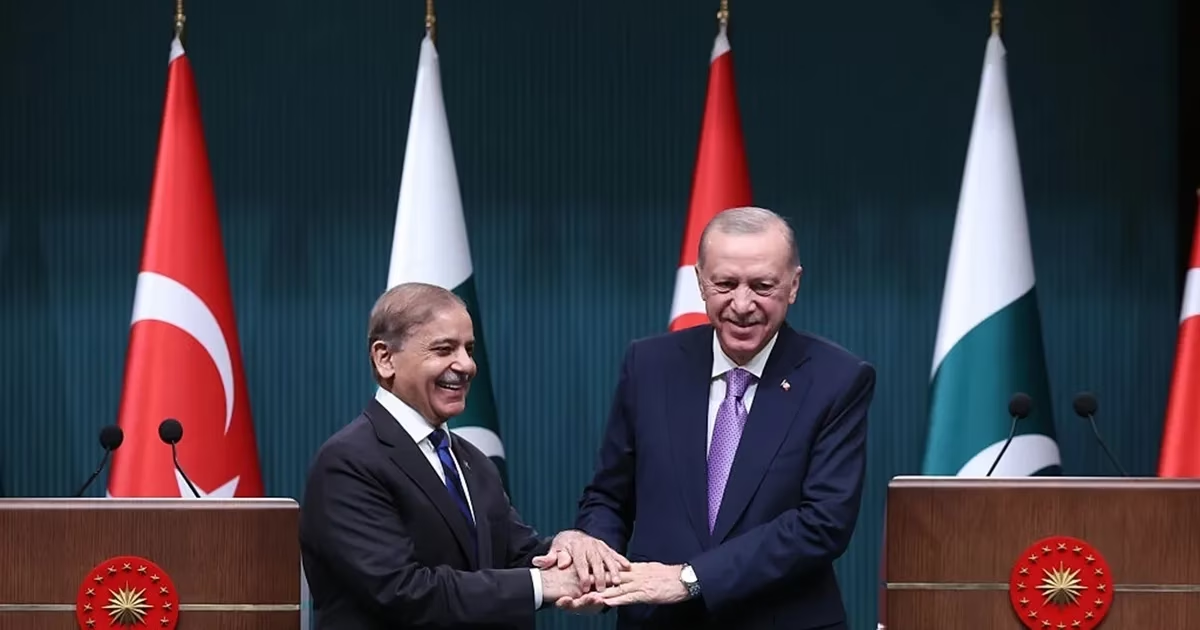
The writer explained that the competition for the title of 'arch-enemy' is currently confined to two regional powers, Turkey and Pakistan, given their possession of large regular armies and a broad Sunni population base. He pointed out that the paradox lies in the fact that both countries maintain close relations with the United States, Tel Aviv's primary strategic ally, which makes dealing with them complex and sensitive diplomatically and militarily.

Regarding the Turkish front, Golany noted that President Recep Tayyip Erdogan has led an escalating path since the 'Mavi Marmara' incident in 2010, leading to a complete diplomatic rupture. He added that the current war in Gaza prompted Ankara to take unprecedented measures, including imposing a comprehensive economic embargo and issuing direct threats of military intervention, which places Turkey at the forefront of direct threats.

On the Pakistani side, the Israeli academic paused at the recent statements by Islamabad's Minister of Defense, which carried a sharply hostile tone towards Israel's existence. The Pakistani minister described Israel as a 'curse on humanity', considering it a cancerous entity planted in the heart of Palestine, statements that reflect the depth of ideological and political hostility that this nuclear state harbors towards the occupation.

Golany warned that the options available to Israel in confronting these two countries are 'equally bad', stressing that Tel Aviv does not have the luxury of choosing its adversaries in the next phase. He emphasized the need to begin building defensive and political strategies that take into account the possibility of confrontation with regional powers that possess military and human resources far exceeding what Israel faced in its previous wars.

The article concluded that Israel's only guarantee in facing this grim scenario is to maintain the strong alliance with Washington and protect it from any cracks. The writer believes that American power is the only tool capable of curbing the ambitions of Turkey or Pakistan, which requires the Israeli leadership to make every possible effort to ensure the continued military and political support from the White House.

Israel must prepare for a scenario in which one of these two countries confronts it immediately after the fighting against Iran ends.

ARAB AND WORLD

Thu 16 Apr 2026 3:16 pm - Jerusalem Time

Pakistani Mediation Achieves Relative Progress in Negotiations Between Tehran and Washington

A high-ranking Iranian official revealed positive signs and relative progress in diplomatic efforts aimed at reaching a comprehensive agreement with the United States of America to end the ongoing state of war. The official clarified that this progress comes despite the persistence of thorny issues and fundamental disagreements that have not yet been resolved, foremost among them issues related to Iran's nuclear program, coinciding with more than half of the two-week temporary truce period having passed.

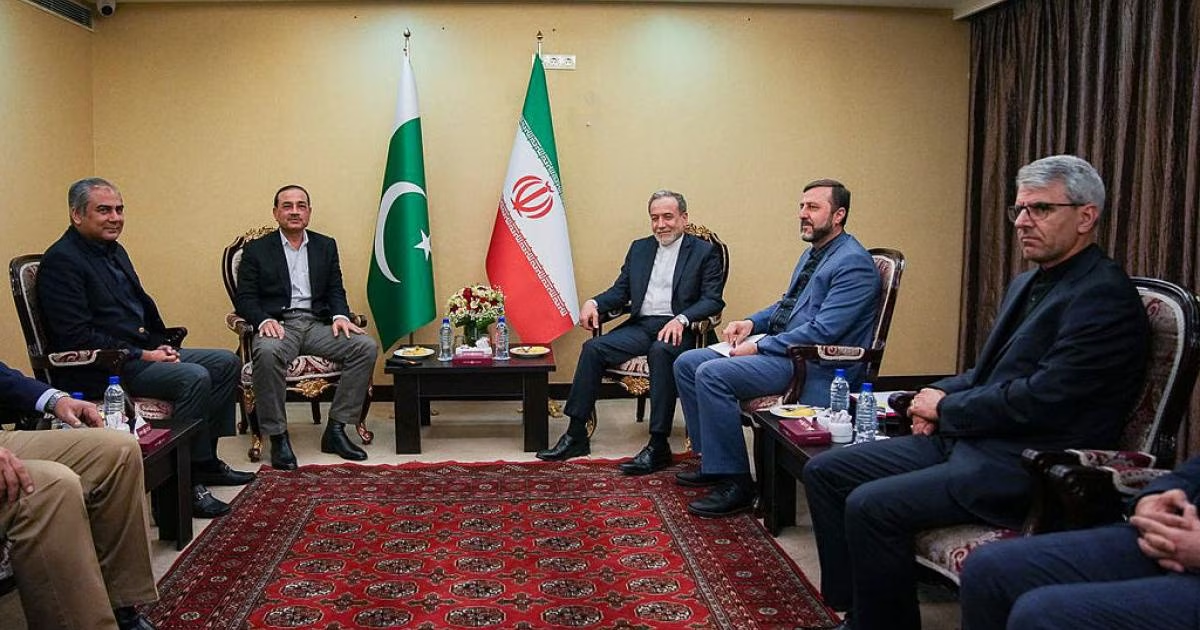
Informed sources reported that the visit of Pakistan's Army Chief, General Asim Munir, to the capital Tehran last Wednesday, played a pivotal role in overcoming some obstacles and narrowing the gap of disagreement between the two parties. These results have boosted hopes in political circles for the possibility of extending the current ceasefire, paving the way for the resumption of new rounds of direct or indirect talks in the coming phase to ensure regional stability.

In a related context, media sources in Tehran indicated that the Iranian side is keeping the details of the discussions held by the Pakistani Army Chief with Iranian officials under strict secrecy and extreme discretion. It appears that Tehran is operating from a position of strength in these negotiations, declaring its adherence to the diplomatic option as the sole means of resolving disputes, which Iranian President Masoud Pezeshkian emphasized in his recent statements regarding his country's commitment to de-escalation.

For its part, the Pakistani Ministry of Foreign Affairs reiterated Islamabad's full support for all efforts for peace and regional stability, following a round of negotiations described as important and sensitive. The Pakistani Foreign Ministry called on all concerned parties to adopt a positive spirit and respect all commitments arising from the current truce, considering that adherence to pledges is the only way to reach a permanent and sustainable settlement that ends the state of tension.

Amidst this intensive activity, the Pakistani Prime Minister is preparing for a high-level diplomatic tour starting from April 15 and continuing until April 18, which is scheduled to include official visits to the Kingdom of Saudi Arabia, the State of Qatar, and the Republic of Turkey. This tour aims to coordinate regional and international positions and mobilize the necessary support for de-escalation initiatives led by Pakistan in the region, ensuring broad political coverage for these moves.

Contacts made by the Pakistani Prime Minister with Saudi Crown Prince Mohammed bin Salman primarily focused on ways to ensure the success of mediation between Tehran and Washington. Islamabad praised Riyadh's leading role in containing regional crises, emphasizing that Saudi-Pakistani cooperation represents a fundamental pillar in attempts to defuse the major crises currently afflicting the region.

It is worth noting that this Pakistani diplomatic activity was not limited to regional countries but also included extensive contacts with officials from more than 20 countries, international powers, and global organizations over the past two weeks. Through this international mobilization, Islamabad seeks to promote the option of direct dialogue as an alternative to military confrontation, emphasizing that diplomacy is the most effective tool for achieving international security and peace under current circumstances.

Iran feels it has the upper hand in the current negotiations, and it is fully committed to the diplomatic path, as confirmed by President Masoud Pezeshkian.

OPINIONS

Thu 16 Apr 2026 3:15 pm - Jerusalem Time

The United States strengthens its military presence in the Middle East and hints at escalatory options within Iran

Washington – Saeed Erikat - 16/4/2026

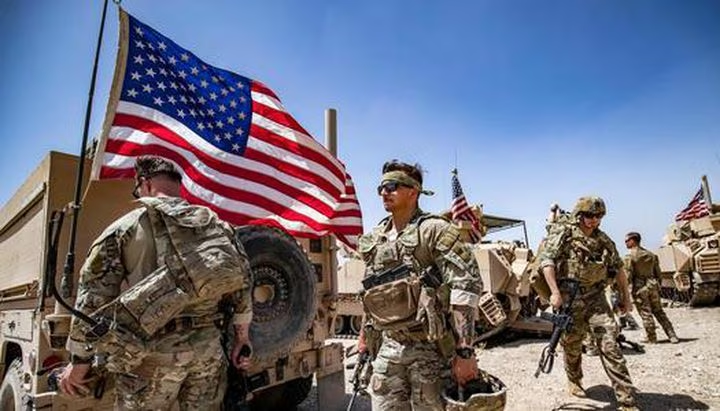
On Wednesday, The Washington Post, citing unnamed American officials, revealed that the United States is preparing to send thousands of additional troops to the Middle East, in parallel with considering resuming a bombing campaign against Iran or moving towards ground operation scenarios within its territory. This escalation reflects a qualitative shift in Washington's approach to the Iranian issue.

According to the report, the reinforcements include about six thousand soldiers aboard the aircraft carrier USS George H.W. Bush and its accompanying warships. Notably, the carrier took a long route around South Africa instead of passing through the Mediterranean and the Suez Canal, a move that suggests precise security calculations, likely related to concerns about potential threats in the Bab al-Mandab Strait.

In parallel, an additional force of about 4,200 American soldiers, including thousands of Marines, is heading from the Pacific aboard the Boxer Amphibious Ready Group, expected to arrive in the region by the end of April. With the completion of this buildup, the number of American forces deployed in the Middle East is expected to exceed sixty thousand, a scene that recalls moments of major tension in the history of the American military presence in the region.

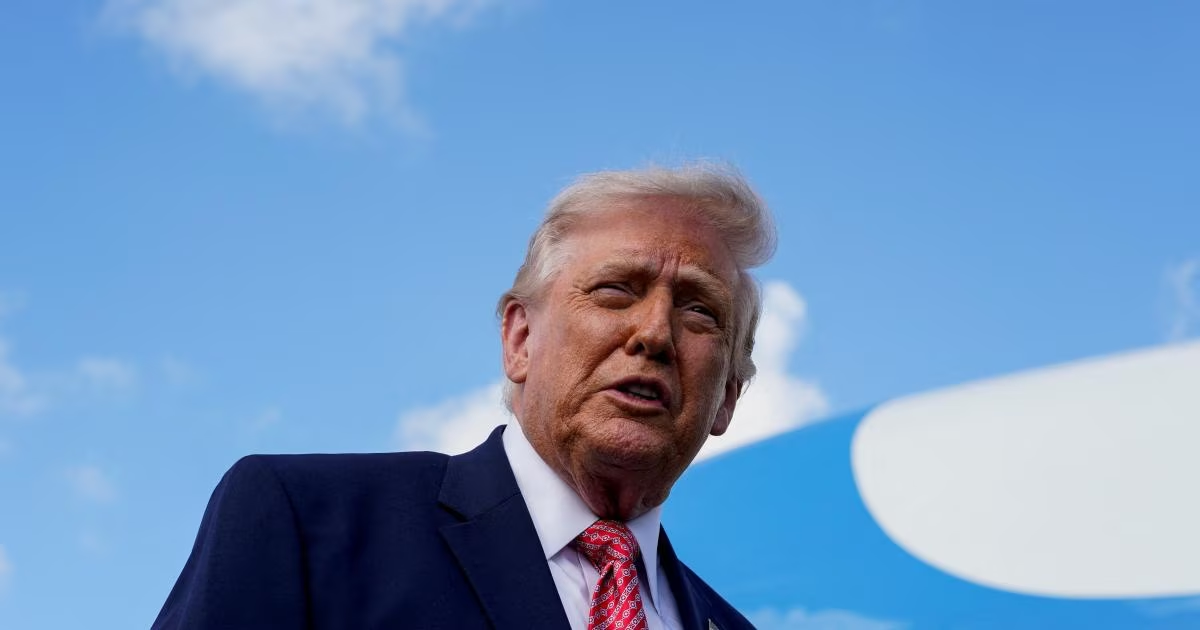
This deployment, along with the tightening of the American blockade on Iranian ports, is presented as a pressure tool to compel Tehran to engage in a diplomatic settlement according to American terms. However, these terms, as proposed by President Donald Trump, go beyond the traditional ceiling for negotiation, as he insists on Iran completely and permanently halting uranium enrichment, even for civilian purposes, a demand widely described as unattainable, which puts the path to de-escalation on the brink of collapse.

The situation becomes more complex with the approaching end of the ceasefire deadline on April 22, amid reports that the American administration is considering carrying out "limited" strikes inside Iran as a means of enforcing compliance. However, such an option, even if presented as tactical, carries the risk of sliding into an open confrontation that could go beyond localized strikes.

Regarding ground options, the report indicated that decision-making circles in Washington discussed a wide range of scenarios, ranging from specialized special forces operations targeting Iranian nuclear materials, and the landing of Marines in coastal areas and strategic islands to secure navigation lines, to taking control of Kharg Island, as a vital node in Iran's oil export network in the Gulf.

Conflicting statements confuse the American domestic scene

Amid this escalation, President Donald Trump's conflicting positions emerged, reflecting a degree of confusion in official discourse. While he emphasizes in some statements his preference for diplomatic solutions and avoiding long wars, he returns in other positions to hint at the use of military force and imposing maximum conditions on Tehran. This fluctuation not only affects external relations but also reverberates within the United States itself, where criticism is escalating from political and media circles that see the lack of strategic clarity as a factor that confuses allies and undermines public confidence in the administration's ability to manage a crisis of this magnitude.

These developments reveal a renewed tendency in American policy to use military force as a negotiating tool, even in issues that require long and complex diplomatic paths. This approach, while achieving immediate pressure, often leads to counterproductive results, as it strengthens the rigidity of adversaries' positions and pushes them to seek strategic alternatives, either through escalation or through building counter-alliances. Moreover, insisting on maximum, practically unenforceable conditions, empties the negotiation process of its content, turning it into mere cover for pre-determined military actions.

The American military buildup in the Middle East also reflects Washington's continued reliance on a traditional security approach, despite profound shifts in the structure of the international system. At a time when major powers are diversifying their tools of influence through economy, technology, and multilateral diplomacy, the United States seems to be reproducing old patterns of dominance. This approach not only drains resources but also weakens Washington's ability to build sustainable partnerships, as its regional partners view the cost of engaging in open conflicts with concern.

According to experts, the most dangerous aspect of this policy is the absence of a comprehensive vision for the post-escalation phase. Recent history shows that American military interventions, when not accompanied by a clear political strategy, lead to complex security vacuums that are difficult to contain. In the Iranian case, any widespread confrontation could quickly extend beyond its geographical boundaries, to include energy corridors and global markets, threatening economic and political repercussions that would affect the American domestic scene itself. Thus, military adventure transforms from a deterrent tool into a source of long-term instability.

ARAB AND WORLD

Thu 16 Apr 2026 3:15 pm - Jerusalem Time

Aoun Rejects US Proposal for Joint Call with Netanyahu, Insists on Halting Aggression First

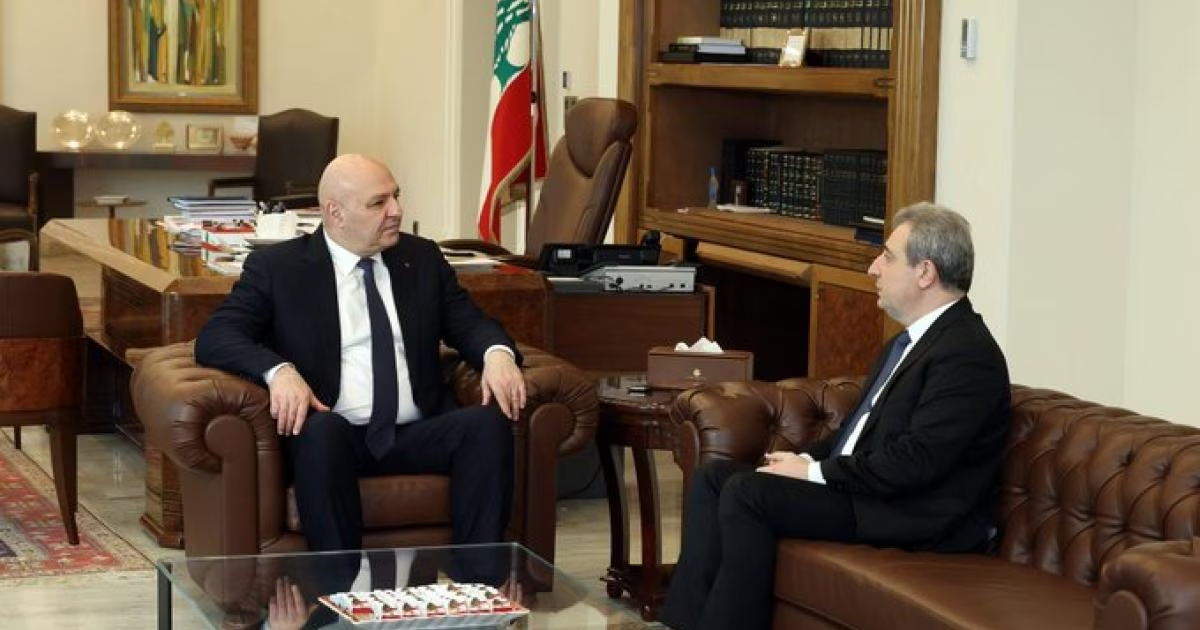
Informed sources reported that Lebanese President Joseph Aoun categorically rejected a US proposal for Israeli Prime Minister Benjamin Netanyahu to join a phone call he was having with US Secretary of State Marco Rubio. The sources clarified that Rubio presented the proposal during the discussions, but the Lebanese presidency preferred to keep communication channels within their current diplomatic framework without direct contact with the Israeli side.\n\nThe Lebanese presidency had previously issued a statement confirming that President Aoun received a phone call from the US Secretary of State, during which Aoun expressed his appreciation for Washington's efforts to reach a ceasefire agreement. The Lebanese President also emphasized the importance of US support for Lebanon at all levels given the current circumstances the country is experiencing.\n\nFor his part, Marco Rubio affirmed during the call the US administration's continued diligent efforts to reach a final formula for halting military operations, ensuring the establishment of peace, security, and stability in the region. The US Secretary expressed his appreciation for the positions taken by President Aoun in managing the complex political and field crisis.\n\nIn a related context, President Joseph Aoun reiterated his assertion that a comprehensive ceasefire represents the natural and sole gateway to any future direct negotiations. He indicated that the Lebanese state is keen to halt military escalation in the South and all Lebanese areas to protect civilians from continuous shelling.\n\nAoun clarified that the top priority currently is to stop targeting women, children, and safe civilians in their homes, and to put an end to the systematic destruction affecting Lebanese villages and towns. These statements come at a time when the Lebanese arena is witnessing sharp differences regarding the mechanisms for dealing with increasing international and regional pressures.\n\nOn the parliamentary level, Speaker of Parliament Nabih Berri held a call with Iranian Parliament Speaker Mohammad Bagher Ghalibaf, during which he stressed the necessity for the announced truce between Washington and Tehran to directly include the Lebanese arena. Berri considered that excluding Lebanon from any regional understandings would increase the suffering of the Lebanese people in light of the ongoing aggression.\n\nThere is a state of conflicting diplomatic narratives regarding the scope of the proposed truce. While Tehran and Pakistani mediation affirm that Lebanon is an integral part of the understandings, Washington and Tel Aviv deny this. The Israeli army continues to carry out its aerial and ground attacks, which have resulted in thousands of casualties and the displacement of hundreds of thousands of residents from the South.\n\nDomestically, political voices opposing the current communication path have emerged, with reports indicating the dissatisfaction of Progressive Socialist Party leader Walid Jumblatt with the nature of indirect discussions. Jumblatt expresses serious concerns about the repercussions of any sudden political or security opening with Tel Aviv on Lebanon's fragile internal stability.\n\nJournalistic sources reported that President Aoun canceled all his scheduled appointments on Thursday to dedicate himself to following the rapidly developing international communications. This step came amid widespread anticipation for the results of the US mediation led by Marco Rubio to bridge views on de-escalation.\n\nIn Washington, reports revealed a meeting between the ambassadors of Lebanon and Israel to discuss the possibility of launching a technical negotiation track, a step that sparked widespread controversy in Beirut. Observers warned that such moves could lead to sharp political divisions that redraw the Lebanese political map based on old alignments.\n\nThe US administration, through these moves, seeks to push the parties towards a temporary ceasefire between Israel and Hezbollah, to serve as a cornerstone for expanding comprehensive regional de-escalation. However, this path clashes with Hezbollah's categorical rejection of any direct peace negotiations with Israel, insisting on the necessity of halting aggression first without preconditions.\n\nThe official Lebanese position remains committed to international legitimacy and Resolution 1701 as a framework for a solution, while emphasizing the rejection of any dictates that exceed national sovereignty. Political circles await the coming hours to see if US pressures will succeed in extracting an Israeli commitment to halt military operations in Lebanon.\n\n"A ceasefire is the natural gateway to any direct negotiations between Lebanon and Israel, and we are keen to stop targeting innocents and destroying homes.

PALESTINE

Thu 16 Apr 2026 3:15 pm - Jerusalem Time

Palestinian Education: 350 Children in Occupation Prisons Face Systematic Deprivation of Education

The Palestinian Ministry of Education and Higher Education reported that Israeli occupation authorities continue to detain approximately 350 Palestinian children in their prisons, under detention conditions that violate all international laws and norms. The Ministry clarified in a statement on the occasion of Palestinian Prisoner's Day that these children are subjected to continuous violations aimed at breaking their will and depriving them of their basic rights.

The Ministry considered that targeting students and children is not merely isolated incidents, but rather part of a systematic Israeli policy to undermine the Palestinian educational system. It affirmed that depriving these young ones of their school seats represents a direct assault on the future of coming generations and an attempt to keep Palestinian society ignorant by disappearing its young cadres behind bars.

Official data indicates that child prisoners suffer from repressive policies including terrifying night arrests and harsh interrogations that lack the minimum standards of justice. The prison service also practices solitary confinement and deprivation of visits against them, in addition to deliberate medical neglect and ill-treatment that leave deep psychological and physical scars.

The Ministry based its report on documented testimonies revealing that occupation forces raid children's homes at night and take them away with their hands tied and eyes blindfolded. These practices, according to the statement, constitute a flagrant violation of the International Convention on the Rights of the Child, which imposes special protection for minors and prohibits their abuse or detention in inhumane conditions.

Educational bodies stressed that the issue of prisoners will remain present in the conscience of the Palestinian people and at the core of the educational and national message. They affirmed their full commitment to supporting student prisoners and enhancing their steadfastness by all available means, considering that education will remain a tool for survival and building in the face of the occupation's continuous attempts to erase national identity.

For its part, human rights sources indicated that the total number of prisoners in Israeli prisons has exceeded 9,600 Palestinians, including 73 women living in tragic conditions. These sources confirmed that prisoners face systematic campaigns of starvation and torture, the intensity of which has escalated recently, leading to the martyrdom of dozens inside detention centers.

Palestinians commemorate Palestinian Prisoner's Day on April 17th of each year, a day adopted by the Palestinian National Council since 1974 in loyalty to the prisoners. On this day, widespread solidarity marches and events are launched in various Palestinian governorates and the diaspora to emphasize the freedom of prisoners as an undeniable national demand.

In a joint statement by prisoner institutions, it was emphasized that the reality of detainees has transformed from traditional occupation policies into part of a comprehensive system of violence linked to crimes of genocide. The institutions clarified that prisons are no longer just places of detention, but have turned into spaces for practicing integrated patterns of physical and psychological abuse against the Palestinian existence.

Human rights reports also revealed an accumulation of horrific evidence and testimonies documenting crimes of rape, sexual assault, and systematic torture inside detention camps. These crimes come within a repressive structure aimed at destroying the human dignity of prisoners, amidst a deafening international silence regarding these blatant human rights violations.

In conclusion of its statement, the Ministry of Education and Higher Education called on all international and human rights institutions to assume their legal and moral responsibilities to pressure Israel to stop these violations. It called for the immediate and unconditional release of all children and school students, and to ensure their safe return to continue their educational journey away from the terror of prisons.

The arrest of students and their deprivation of the right to education represents a systematic policy aimed at undermining the awareness and future of the Palestinian people.

ARAB AND WORLD

Thu 16 Apr 2026 2:23 pm - Jerusalem Time

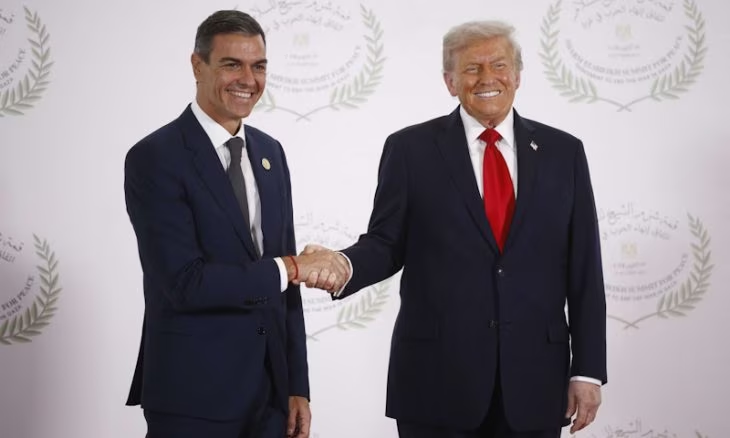
Pedro Sánchez.. How did Spain's Prime Minister become the 'spearhead' of the global left against Trump?

Spanish Prime Minister Pedro Sánchez has cemented his position as one of the most prominent political figures in the global left, benefiting from a series of sharp diplomatic confrontations with US President Donald Trump. This standing comes as Barcelona prepares to host a major international summit for progressives, aimed at strengthening a united front against the rise of the far-right in Europe and worldwide.

Sánchez stands out as an exceptional case in a European continent that has seen a noticeable shift to the right in recent years, as he adopts open immigration policies and progressive social stances. His repeated clashes with the current US administration have transformed him into a symbol of political resistance against the approach represented by Trump on the international stage.

In the latest chapter of tension with Washington, Sánchez expressed categorical opposition to any military action against Iran, refusing to allow US forces to use military bases on Spanish territory. This stance led Trump to threaten to impose trade sanctions on Madrid, but the Spanish government adhered to its sovereign decision rejecting military escalation in the region.

Regarding the Palestinian issue, Sánchez is one of the few Western leaders who has used the term 'genocide' to describe Israeli military operations in the Gaza Strip. His positions have gone beyond media statements to practical diplomatic steps, most notably the official recognition of the State of Palestine in May 2024, a move that shook European political circles.

Observers believe that Spain, thanks to its membership in NATO and the European Union, has given its positions a strategic weight that surpasses other countries that have taken similar steps. Experts at the 'Real Elcano' Institute in Madrid confirmed that this bold foreign policy has given Spain tangible leadership and influence, especially in the Arab world and Latin America.

International press reports indicate that Sánchez has become known in global journalistic circles as 'Trump's arch-nemesis in Europe,' a description that reflects the extent of the ideological gap between the two sides. Sánchez has used his presidency of the 'Socialist International' to disseminate his political vision through major international newspapers, warning of the repercussions of populist policies on global stability.

Barcelona's 'Global Progressive Mobilization' summit is expected to see high-level attendance, including Brazilian President Lula da Silva and Mexican President Claudia Sheinbaum. This summit aims to formulate a common strategy for left-wing parties to confront economic and environmental challenges, and to offer a humane alternative to the hard-right policies sweeping the world.

During his recent visit to China, Sánchez stressed the need for progressive governments to unite and present a vision that transcends narrow national interests and champions shared human values. He considered that current challenges require unprecedented international coordination to protect democratic and social gains that are now threatened by the current global polarization.

Despite external successes, Sánchez faces sharp criticism from the right-wing opposition within Spain, which accuses him of using foreign policy as a tool to escape domestic crises. The opposition Popular Party accuses the Prime Minister of trying to divert attention from corruption investigations involving some of his close associates by instigating diplomatic battles with Washington.

Local opinion polls indicate that the majority of the Spanish people, including segments of opposition voters, support Sánchez's anti-war stances and his support for Palestinian rights. In a recent poll, more than two-thirds of Spaniards expressed their support for the government's decision not to engage in any military conflict against Iran, which strengthens Sánchez's popular standing.

Academics at the University of Barcelona believe that Sánchez is playing the foreign policy card intelligently, as he realizes that this area gives him room for maneuver away from the complexities of the divided Spanish Parliament. Since taking power in 2018, Sánchez has suffered from the absence of a comfortable majority, making his international achievements a means to enhance his political legitimacy at home.

However, some analysts warn that this strategy could isolate Spain from its traditional allies in Europe led by right-wing governments, such as Italy and Germany. Nevertheless, prevailing estimates within the Spanish government suggest that the political and diplomatic gains from leading the progressive movement far outweigh the potential risks.

Madrid's transformation into a center of gravity for the global left reflects Sánchez's ambition to reshape Spain's role as a pivotal player in major international issues. It is no longer limited to European affairs but has extended to formulating firm positions on Middle Eastern issues and relations with major powers, making him a formidable force in the international equation.

In conclusion, Pedro Sánchez's experience remains a model for how to leverage international crises to build cross-border political leadership, despite significant internal challenges. The results of the upcoming Barcelona summit will play a crucial role in determining the ability of this progressive movement to withstand the right-wing wave led by Trump and his allies globally.

We, progressive parties and governments, must unite and carry a positive and humane vision that transcends our borders and internal policies.

PALESTINE

Thu 16 Apr 2026 2:23 pm - Jerusalem Time

Testimonies from 'Sde Teiman': Disabled Prisoners Face Slow Death in Occupation Prisons

The moment of the release of the disabled prisoner Yahya Abu Seif from the Gaza Strip was not just a return to freedom, but an unveiling of the cruelty and helplessness he experienced behind bars. Abu Seif, who lost most of his family members in the war, found himself a sick prisoner confined to a wheelchair, which did not spare him from the Israeli machine of abuse.

In the notorious 'Sde Teiman' prison, Abu Seif spent a full year, which he described as the longest and worst in his life, struggling with his ailing body in the absence of the most basic care. The prison administration denied him the use of his wheelchair for movement, turning his daily life into a series of arduous stations that required superhuman patience.

Abu Seif's story embodies the suffering of thousands of Palestinian prisoners who face a daily struggle with illness in conditions lacking the minimum healthcare. For these individuals, prison is not just walls, but a state of forced helplessness imposed on them amidst continuous isolation and interrogation policies.

In a related context, the tragedy of prisoner Fadi Abu Al-Subh stands out. He was arrested in 2019 while on his way for treatment, and the occupation authorities refuse to release him despite the expiration of his sentence. The prison administration uses emergency laws and new war regulations to extend his detention indefinitely, intensifying the pain of his family who await his release.

Abu Al-Subh's mother states that her son suffers from multiple fractures and metal plates in his legs, yet he is denied treatment or transfer to a hospital. The family considers what Fadi is subjected to as a slow death sentence, given his continuous transfer between Ashkelon, Nafha, and Ramon prisons under extremely harsh conditions.

Data from human rights sources indicate that the number of prisoners in occupation prisons exceeded 9,600 prisoners and detainees by early April 2025. Among these are hundreds of children and women, in addition to over 1,200 prisoners suffering from chronic and serious illnesses that directly threaten their lives.

The prisoner movement has recorded the martyrdom of over 89 prisoners as a result of deliberate medical negligence policies or physical torture inside interrogation centers. Among the martyrs are 52 detainees from the Gaza Strip who died under mysterious circumstances, reflecting the extent of grave violations committed away from international oversight.

Abdullah Al-Zaghari, head of the Palestinian Prisoner's Club, affirmed that the number of prisoners suffering from serious diseases such as cancer and kidney failure is continuously increasing. He explained that the suffering does not stop at illness, but extends to systematic malnutrition and the deprivation of prisoners from clean water and essential medicines.

Prison administrations follow retaliatory policies that include cutting off water for long periods and preventing bathing, in addition to systematic physical assaults that escalated after October 7th. These practices have led to a severe deterioration in the psychological and physical condition of prisoners, especially those held in army camps.

For his part, Islam Abdo, an official in the Ministry of Prisoners, described the file of sick prisoners as one of the most dangerous aspects of violations inside Israeli prisons currently. He pointed out that the deliberate delay in conducting medical examinations and transfers to hospitals aims to physically exhaust prisoners and slowly eliminate them.

Ahmed Abu Ras, a specialist in prisoner affairs, believes that the occupation uses clinics inside prisons as a mere formality for international organizations. In reality, prisoners do not receive any real treatment, but their surgeries are postponed for years, often leading to the exacerbation of the disease to an incurable degree.

Human rights calls for urgent international intervention to save the lives of sick prisoners and provide them with protection in accordance with the Fourth Geneva Convention are increasing. Observers believe that international silence towards these crimes encourages the occupation to continue its policy of enforced disappearance and depriving prisoners of Red Cross visits.

Issam Abu Daqqa, a member of the Prisoners' Committee, stressed that the issue of sick prisoners must remain at the top of the humanitarian and political priorities for Palestinians. The right to treatment and dignity is a fundamental right that cannot be compromised, and the continued detention of critical cases constitutes a full-fledged war crime.

In conclusion, human rights organizations affirm that what is happening in prisons represents a real test for the international justice system, which stands helpless before the occupation's aggression. Saving the lives of sick prisoners is an immediate duty that cannot be postponed, especially given the catastrophic conditions left by the ongoing war on the Gaza Strip.

I spent the longest and worst year of my life in Sde Teiman prison, where I faced my illness and helplessness before facing the jailer.

ISRAELI AFFAIRS

Thu 16 Apr 2026 2:23 pm - Jerusalem Time

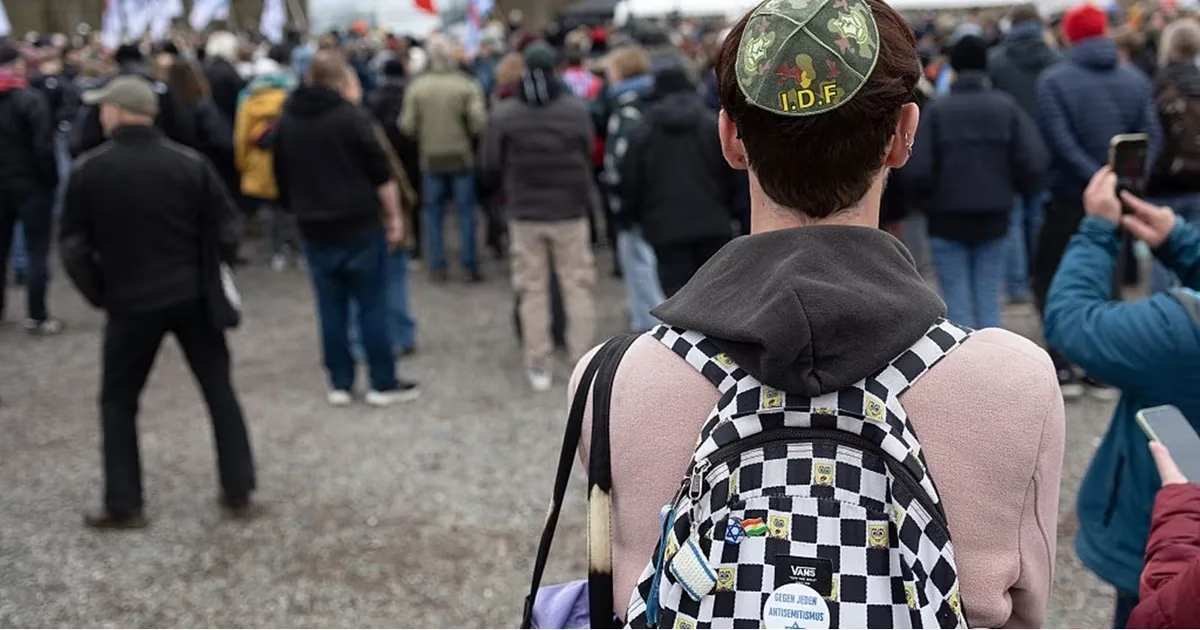
Israeli writer warns of growing anti-Jewish sentiment in Germany and erosion of sense of security

Israeli circles are experiencing a state of increasing anxiety due to what they describe as growing international isolation, the features of which have begun to appear clearly in Western countries. Germany is at the forefront of these countries, witnessing widespread popular movements and demonstrations in solidarity with Palestinian rights, which has raised questions about the future of Jewish communities there.

In this context, writer Zeev Avrahami stated in an article published by Yedioth Ahronoth that his initial impressions upon arriving in Berlin suggested that the German state had learned the lessons of the Holocaust. However, the reality on the ground in recent years has proven otherwise, as he believes that ensuring the safety of Jews is no longer a top priority for the German authorities.

Avrahami pointed out that, as a Jew of Eastern origin, he now prefers to avoid certain areas in eastern Germany near the capital Berlin. He attributes this to the noticeable spread of neo-Nazi groups in those areas, which poses a direct threat to his personal safety and the safety of those who resemble him in appearance.

He also drew attention to continuous warnings for Jews to avoid neighborhoods inhabited by immigrants, such as the famous Neukölln district in Berlin. Despite attempts to downplay the seriousness of the situation there, the prevailing impression is that there is a state of unacceptance and overt hostility towards Israeli and Jewish symbols in those circles.

The article spoke of a new phenomenon in which some Jewish families are forced to remove religious symbols from the facades of their homes and hide any Hebrew writings. These precautionary steps come as a result of the escalation of campaigns that justify violence against Jews, and link their presence to the policies of the current Israeli government led by Benjamin Netanyahu.

Avrahami described the daily life of a Jew in Berlin as requiring a kind of constant self-censorship in public places. Even ordering a taxi has become a source of tension and anxiety, for fear of harassment or verbal and physical assaults based on religious or national identity.

These manifestations were not limited to marginalized neighborhoods, but extended to include areas that were considered safe and modern strongholds for Jews, such as 'Prenzlauer Berg' and 'Mitte'. The writer observed the presence of inciting slogans and swastika drawings on building walls, accompanied by phrases explicitly calling for the killing of Jews, which reflects a serious security deterioration.

In his reading of German society, the writer believes that Germans have succeeded in protecting individual rights, supporting peace, and welcoming immigrants, but in return they allow pro-Palestinian demonstrations to grow. He considered that these demonstrations have reached unprecedented levels in terms of momentum and impact on the German street.

Avrahami criticized what he described as 'Germans' love for dead Jews', referring to the great official interest in commemorating the Holocaust and focusing on history. In contrast, he sees a shortcoming in defending the right of living Jews to live with dignity and safety, considering that some leftist currents exclude Jews from the umbrella of minority protection.

The writer concluded his article by referring to opinion poll results that show a worrying rise of the far-right, where a quarter of Germans may vote for parties described as fascist. He believes that these data, along with student slogans calling for the liberation of Palestine from the 'German guilt complex', place the Jewish community before unprecedented existential challenges.

Germans love dead Jews, referring to their focus on the past without sufficient attention to the lives of Jews in the present.

PALESTINE

Thu 16 Apr 2026 2:23 pm - Jerusalem Time

Direct Talks Between Washington and Hamas in Cairo: US Pressure for Disarmament and Threats of Resuming War

Well-informed sources revealed a significant diplomatic development: the first direct talks between the United States and the Hamas movement in the Egyptian capital, Cairo, since the ceasefire agreement in the Gaza Strip was reached. The meeting included a high-level American delegation led by senior advisor Aryeh Lightstone, who met with the head of the movement's negotiating delegation, Khalil al-Hayya, in the presence of Nikolay Mladenov, who oversees US-backed efforts within what is called the 'Gaza Peace Council'.

During the discussions held last Tuesday evening, Hamas leader Khalil al-Hayya stressed the necessity for the occupation authorities to fully adhere to the terms of the first phase of the existing agreement. Al-Hayya affirmed that stopping airstrikes and expanding the entry of humanitarian aid to all areas of the Strip are essential conditions that cannot be compromised for moving to any subsequent stages of understandings.

In contrast, media reports, citing informed sources, stated that the American side conveyed a hardline Israeli position that stipulates the immediate initiation of procedures for disarming the Hamas movement. Washington considered this demand a fundamental pillar for moving forward with the implementation of the remaining international obligations related to reconstruction and withdrawal, which was met with rejection by the movement's delegation, who deemed the demand unbalanced.

A leading source in the Hamas movement described the American proposal as suffering from a significant flaw in the prioritization of national and humanitarian issues. The source explained that the presented document attempts to reduce the entire political process to the issue of disarmament, while postponing fundamental issues related to the rights of the Palestinian people and ending the siege completely and permanently.

The sessions witnessed warning messages conveyed by Nikolay Mladenov, who hinted at the possibility of the occupation resuming its extensive military operations if the movement did not respond to disarmament demands. Sources indicated that the dialogue included veiled threats that presented the movement with two options: either accept the proposed document or face a return to a full-scale war again.

These moves come within broader international efforts aimed at formulating arrangements for the next phase, which include complex issues such as the deployment of international forces in the Gaza Strip and the withdrawal of the occupation army from areas where it is still present. Despite these efforts, concerns remain about the collapse of the fragile calm amid ongoing field violations and increasing political pressures.

It is worth noting that the ceasefire agreement reached last October through international mediation has not yet succeeded in ending the deep humanitarian suffering in the Strip. Talks continue in Cairo amidst an atmosphere of tension, as mediating parties seek to bridge the significant gaps between the demands of the Palestinian resistance and the security conditions imposed by Israel with American support.

The proposed plan reduces the entire process to the disarmament clause, while marginalizing other commitments and the human rights of Palestinians.

PALESTINE

Thu 16 Apr 2026 2:23 pm - Jerusalem Time

Occupation Chief of Staff Decides to Reinstate Soldiers Involved in Torturing a Prisoner at 'Sde Teiman'

The Chief of Staff of the Israeli occupation army, Eyal Zamir, issued a decision approving the return to service of a group of soldiers involved in torture and sexual assault cases, as part of the reserve forces. This step comes despite the serious accusations against them regarding the abuse of a Palestinian prisoner inside the 'Sde Teiman' military base, a case that sparked widespread international outcry since it occurred last summer.

Journalistic sources reported that the decision includes members of the elite unit known as 'Force 100,' who faced direct accusations of mistreating a detainee from the Gaza Strip in July 2024. Despite the horrific documented violations, the occupation authorities decided to reintegrate them into the military system before completing the necessary internal leadership investigations to assess their professional and ethical conduct.

Details of the case indicate that the Palestinian prisoner was subjected to a series of severe violations, including brutal beatings, dragging on the ground, stomping, electric shocks, and stabbing with sharp objects. These brutal assaults resulted in life-threatening injuries, including fractured ribs and a punctured lung, which required urgent medical intervention at the time to save his life.

For its part, the military prosecution justified its previous decision to drop the indictment against five of the involved soldiers by citing what it described as 'complexities in the structure of the evidence.' Chief Military Advisor Itai Ofir claimed that the return of the victim prisoner to the Gaza Strip prevented the completion of legal evidentiary procedures, which human rights observers considered a clear attempt to legitimize impunity.

In a comment from military sources, it was emphasized that the ongoing investigations do not constitute a legal impediment to recalling these soldiers for service again, with an indication that the leadership investigation will be resumed at an unspecified date. This approach reflects the policy of the Israeli military establishment to overlook crimes committed against Palestinian prisoners and provide legal protection for their perpetrators.

These developments come at a time when human rights organizations' reports indicate an escalation in violations within occupation prisons, where more than 9,600 Palestinian prisoners are held in harsh conditions. These violations range from systematic torture, ill-treatment, and deliberate medical neglect, amidst a complete absence of effective international oversight over Israeli detention and interrogation centers.

The continuation of the investigation does not prevent the recall of soldiers to reserve service, and the leadership investigation will be completed at a later time.

PALESTINE

Thu 16 Apr 2026 2:22 pm - Jerusalem Time

Lebanese Denial and Israeli Confirmation: Mystery Surrounds the 'Historic Call' Announced by Trump

A Lebanese official source categorically denied today, Thursday, the circulating news about arrangements for an anticipated call with the Israeli side, in response to statements by US President Donald Trump. The source confirmed that Beirut had not received any information on this matter through official channels, emphasizing the absence of any current coordination regarding this proposal.

US President Donald Trump had sparked a wave of controversy after a post on his 'Truth Social' platform, in which he hinted at efforts to achieve de-escalation between Lebanon and Israel. Trump mentioned that a call would bring together 'two leaders' from both sides tomorrow, to be the first of its kind in nearly 34 years, which he described as a necessary step to end the crisis.

In contrast, a state of anticipation prevailed in Israeli circles, where Technology Minister and member of the Security Cabinet, Gila Gamliel, confirmed that the call would indeed take place today. These confirmations came via Israeli Army Radio, despite no official statement yet from Prime Minister Benjamin Netanyahu's office regarding the details of the conversation.

Field sources indicate that the call for direct contact is not a new idea, but rather dates back to previous American proposals presented by envoy Tom Barrack during his visits to Beirut. The proposal aimed to break the political stalemate through direct communication between the Lebanese presidency and the Israeli side, which was met with extreme sensitivity within Lebanese political circles.

On the ground, sources reported that Israel significantly expanded its military deployment, moving from controlling five border points to deploying forces from five full military divisions. This move aims to impose a new reality on the ground extending from the Blue Line to the course of the Litani River deep in southern Lebanon.

In a related context, the Israeli Security and Political Cabinet held a lengthy meeting that lasted for about four hours to discuss ceasefire proposals. Despite the long deliberations, the council did not announce clear decisions, amid leaks indicating that significant gaps remain in the terms of the required de-escalation from both sides.

The leaked Israeli conditions, published by Hebrew newspapers, include the establishment of a comprehensive buffer zone up to the Litani River, with guaranteed freedom of military action for the Israeli army in the northern areas. The proposals also include a long-term plan aimed at disarming Hezbollah under direct American supervision, which Lebanon categorically rejects.

In recent days, Israeli airstrikes on the southern suburbs of Beirut have ceased, with sources indicating that this calm came at a direct American request. Fighting is currently concentrated in the southern axes, especially around the town of Bint Jbeil, where Israeli forces are seeking to achieve field gains before any potential agreement.

Observers believe that Israeli Prime Minister Benjamin Netanyahu is seeking to achieve a symbolic 'victory image' on the ground to present to the Israeli public before entering any negotiation process. These moves come amid internal Lebanese division over the feasibility of direct negotiations, especially with the rejecting stances expressed by Parliament Speaker Nabih Berri.

Historically, Lebanon has not witnessed any direct official communication at the level of heads of government with Israel, with the exception of the 1983 negotiations that followed the Israeli invasion. That experience, which took place in Khalde and Kiryat Shmona, still causes sharp division in Lebanese political memory regarding its repercussions on national sovereignty.

Trump's statements caused shock and widespread reaction on social media platforms in Lebanon, where many fear that this step could increase internal division. Lebanese parties are awaiting a ceasefire announcement as a first and essential step before discussing any political paths or border negotiations.

The question remains about the identity of the Lebanese party that might participate in such a call if the news is true, amid speculation that it might be at the prime ministerial level. However, official institutions in Beirut remain committed to their denial, awaiting what the coming hours will bring in terms of field or diplomatic developments.

We are trying to find a period of calm between Israel and Lebanon, it has been a long time since the last conversation between two leaders, and that will happen tomorrow.

OPINIONS

Thu 16 Apr 2026 2:22 pm - Jerusalem Time

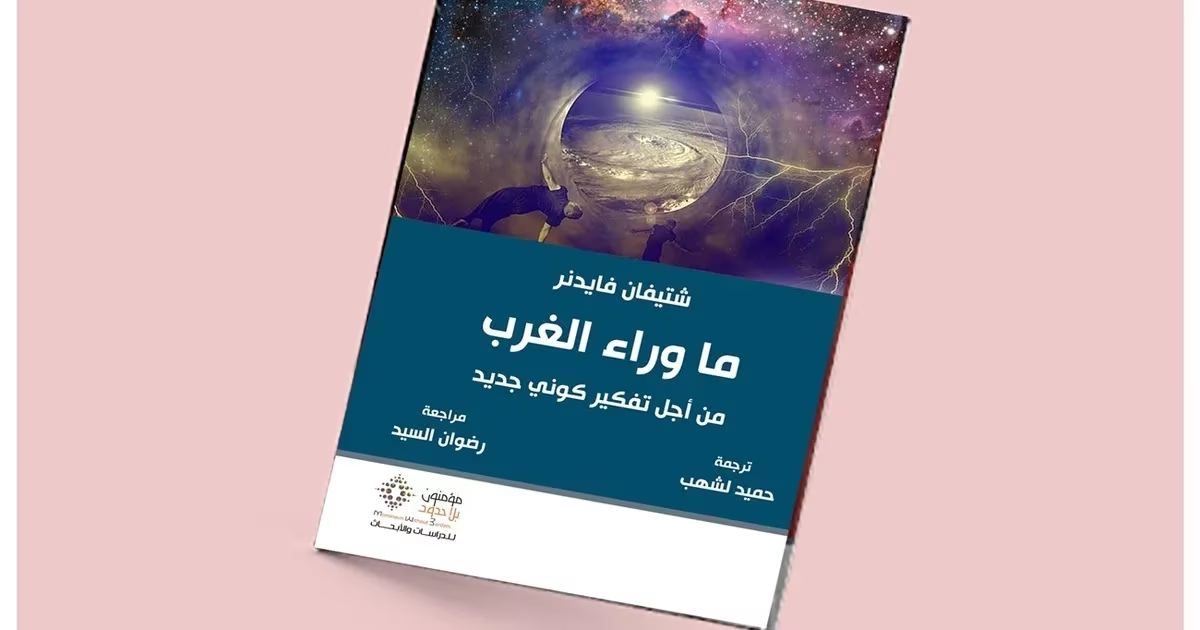
When Reason Defeats Meaning: A Reading of Stefan Weidner's Book on the Crisis of the West and Existential Void

Ramallah - “Alquds ” dot com

Ramallah - “Alquds ” dot com

Opinion Writer

The book 'Beyond the West' by German thinker Stefan Weidner raises fundamental questions about the trajectory of Western modernity, which succeeded in dismantling myth but failed to fill the spiritual void. The author argues that modern reason fulfilled its promises of controlling nature, yet it stripped existence of its moral weight and made humans strangers in a world technically understood but existentially unknown.

The crisis begins at the moment Western reason decided to set strict limits on what can be known, a path established by Immanuel Kant through neutralizing the unseen and excluding it from the realm of empirical knowledge. This systematic exclusion was not merely a philosophical development, but the beginning of a quiet break with everything that cannot be measured or subjected to the laboratory.

With the rise of Friedrich Nietzsche's ideas, the epistemological retreat of the unseen transformed into an explicit declaration of the 'death of God,' which was not so much a celebration of freedom as it was a harbinger of humanity's entry into cosmic isolation. Modern man lost the ultimate reference point that gave the world its coherence, finding himself alone before a void unsupported by revelation and unalleviated by transcendent meaning.

Weidner diagnoses in his book the state of 'silent nihilism' experienced by contemporary man, who works, produces, and consumes with high efficiency without realizing the purpose of his existence. This state results from science transforming from a tool for understanding phenomena into an ideology that monopolizes the definition of truth and marginalizes everything that transcends matter and measurement.

Weidner's thesis does not advocate for a traditional return to religion or a revival of ancient metaphysics, but rather calls for reason to acknowledge its necessary limits. For him, the unseen is not an enemy of reason, but rather the horizon that prevents knowledge from closing in on itself and turning into a false illusion of encompassing reality.

The world that expelled the unseen has not succeeded in replacing it, and the result is a fragile human living in a 'cold' world lacking depth and mystery. The book argues that restoring the 'horizon of the invisible' is an existential necessity to bring back the creative tension of human experience and protect humanity from becoming merely a number in a technical equation.

The author strongly criticizes the illusion of 'epistemological completeness' promoted by rigid modernity, assuming that there is always a surplus in reality that cannot be absorbed. This surplus is what gives things their form and resistance, and without it, the world turns into a smooth surface without meaning and without a horizon that opens to transcendence.

The book stands at the edge of Western reason in its moment of hesitation, attempting to diagnose the civilizational anxiety left by the absence of the unknown. Modernity, which promised liberation, ended up imprisoning humanity within a narrow horizon of rigid realism, where the fear of the void became the real threat instead of the fear of the unseen.

Weidner clarifies that the unseen must transform from an epistemological 'problem' into an epistemological 'condition' that imposes a necessary humility on reason. For reason that does not acknowledge the existence of what transcends it does not become stronger, but falls into the trap of naivety and an oversimplified distortion of the complexities of human existence.

The book's strength lies in its ability to deconstruct the internal logic of modernity without resorting to nostalgic discourse or external religious authority. It pushes reason to its limits to reveal its points of failure, affirming that man is a being whose understanding is never complete because he carries within him an irreducible dimension.

The translator, Dr. Hamid Lashhab, skillfully handles the text, conveying the German philosophical anxiety to the Arab reader, explaining how the unseen was marginalized through a long process of redefining knowledge. The issue was not a sudden liberation, but a systematic displacement of everything that did not serve the technical authority of reason.

Weidner points out that the world wars and totalitarian ideologies of the twentieth century were the first cracks that revealed the inadequacy of self-sufficient reason. These events proved that abandoning the 'transcendent' led to the reduction of man to a function, which caused civilization to lose its moral and existential compass.

The book remains in a controversial intermediate zone; it opens the door to the unseen but hesitates to enter or draw a clear path for its recovery. This hesitation reflects the dilemma of the Western thinker who wants to restore meaning without sacrificing the rational achievements that led to its loss in the first place.

In conclusion, 'Beyond the West' represents a warning cry to a world that believes it has outgrown the unseen, while silently crumbling under the weight of false clarity. It is an invitation to pay attention to the fact that man is not merely a biological or social being, but a being inhabited by a mystery that cannot be fully explained.

The unseen is not the opposite of reason, but its necessary limit that reminds man that he is not everything in this universe.

PALESTINE

Thu 16 Apr 2026 2:22 pm - Jerusalem Time

Angry protests pursue Vance in Georgia condemning US support for the Gaza war

The conservative "Turning Point" conference in Georgia witnessed significant tension after US Vice President JD Vance was subjected to a wave of fierce protests during his speech. Young activists interrupted the speech several times, directly accusing the US administration of participating in the killing of civilians and supporting ongoing military operations in the Gaza Strip and the Middle East, which led to confusion in the student event.

Media sources reported that the hall was filled with angry chants condemning US military involvement, with one protester shouting at Vance: "You are bombing and killing children." Other demonstrators raised slogans with religious and humanitarian dimensions, including the chant "Jesus does not support genocide," in a clear reference to the growing popular rejection within American circles of the political and military cover given to the Israeli occupation.

In an attempt to absorb public anger, Vance acknowledged a gap between the administration and young voters, considering these reservations about Washington's policy in the Middle East understandable. The Vice President claimed that the Donald Trump administration prioritizes diplomatic paths to address regional conflicts, referring to what he described as previous efforts to reach ceasefire agreements, despite the continuation of military operations on multiple fronts.

This incident highlights the growing division within the right-wing and conservative movement in the United States, where young voices and prominent figures have begun to rebel against traditional foreign policy directions. This protest movement coincides with a direct US military escalation against Iran and the tightening of its naval blockade, which increases the intensity of criticism directed at the White House regarding the usefulness of involvement in new regional wars.

I know that young voters have significant reservations about our policy in the Middle East.

PALESTINE

Thu 16 Apr 2026 2:22 pm - Jerusalem Time

Nablus: 80 Military Vehicles Storm Eastern Area to Secure Settlers' Raid on Joseph's Tomb

Israeli occupation forces stormed the eastern area of Nablus city in the northern occupied West Bank early Thursday morning, utilizing massive military reinforcements estimated at about 80 vehicles and military bulldozers. This extensive military movement aimed to provide protection for groups of settlers intending to raid Joseph's Tomb to perform Talmudic rituals, a recurring action that consistently sparks significant field tensions.

Field sources reported that occupation vehicles were heavily deployed in the streets surrounding the tomb, where military bulldozers began closing main and secondary roads with earth mounds to isolate the area from its surroundings. This was accompanied by occupation snipers taking positions on the rooftops of high-rise buildings overlooking the eastern area, to secure the settlers' movement routes and prevent Palestinian citizens from accessing the site.

Following the raid, violent confrontations erupted between dozens of Palestinian youths and occupation forces, who fired a barrage of live ammunition and tear gas canisters. The youths attempted to confront the invading vehicles with stones and Molotov cocktails, while the confrontations continued into the late hours of the night amidst an atmosphere of extreme tension that hung over the eastern neighborhoods of Nablus.

Reports indicate that occupation forces practiced a systematic policy of intimidation against residents of homes near Joseph's Tomb, where some families were forced to evacuate their homes at gunpoint. These repressive measures come as part of a security protocol imposed by the army to secure the settlers, causing panic among children and women and damaging citizens' private property.

Settlers cling to historical claims about the tomb, asserting that it contains the remains of Prophet Joseph (peace be upon him), claims denied by historical and archaeological studies which confirm that the site is an Islamic antiquity registered as an endowment. Palestinians view these repeated raids as an attempt to impose a new settlement reality and entrench Israeli control over religious and heritage sites in the heart of Palestinian cities.

Since the Al-Aqsa Intifada in 2000, Joseph's Tomb has officially been under the sovereignty of the Palestinian Authority, yet the occupation army continues to violate this sovereignty by organizing periodic night raids. These military operations are considered a breach of signed agreements, as the area is transformed each time into a closed military barracks where normal life ceases and traffic and work are disrupted.

National and Islamic forces in Nablus affirm that the continuation of these raids will not change the city's identity, emphasizing that popular resistance will continue to confront Judaization projects. These events coincide with an escalation in the pace of raids and arrests carried out by occupation forces in various West Bank cities, warning of a broader explosion of field conditions in the absence of any political horizon.

Occupation forces stormed the eastern area of Nablus city, accompanied by more than 80 vehicles and bulldozers, to secure the settlers' raid on Joseph's Tomb.

PALESTINE

Thu 16 Apr 2026 2:22 pm - Jerusalem Time

Agriculture in Gaza Struggles Against Collapse: 60% of Land Destroyed and Severe Seed Shortage

The agricultural sector in the Gaza Strip is undergoing a dangerous historical turning point that threatens its complete collapse, due to severe restrictions preventing the entry of seeds and essential production materials. The widespread destruction of agricultural lands during ongoing military operations has led to an unprecedented reduction in local productive capacities, putting the food security of the population at risk.

Field data indicates that the occupation's control over more than 60% of the Strip's area has led to the shrinking of the remaining agricultural land into narrow and crowded areas. These limited spaces are no longer solely designated for agriculture but are now used to establish displacement camps, creating a bitter conflict between the need for shelter and the need to secure food.

In a field tour, sources observed the reality of the remaining nurseries, where farmer Mustafa Al-Astal inspects what is left of vegetable seedlings in his small nursery with strenuous efforts. This nursery is one of only ten nurseries still struggling to survive, after the war caused the destruction of more than a hundred nurseries that formed the backbone of agricultural production in the region.

Farmers express real fears of a complete halt to work if the ban on the entry of raw materials and necessary fertilizers continues. Al-Astal warned that the absence of the simplest elements of agricultural work would inevitably lead to the closure of the few resilient agricultural facilities, meaning the loss of the only remaining source of vegetable seedlings in local markets.

For his part, farmer Sami Al-Falouji embodies the tragedy of the Palestinian farmer, as he is forced to divide his remaining land between his displacement tent and his modest agricultural crop. Al-Falouji confirmed that the last two years were the harshest ever, as the destruction of irrigation networks coincided with the prevention of entry of spare parts and equipment needed to repair what was destroyed by the bombing.

Reports from the United Nations Food and Agriculture Organization (FAO) support these testimonies, confirming that more than 60% of agricultural land in Gaza has been completely out of service. The international organization also noted that half of the agricultural wells in the Strip have been destroyed or damaged, causing a severe water crisis that led to the drying up of vast areas of crops.

The dilemma of the 'Yellow Line' imposed by the occupation stands out as one of the most prominent obstacles to the restoration of agricultural activity, as it cuts off vast areas of the most fertile lands. This bitter reality has put farmers in direct confrontation with economic strangulation policies, amid the absence of any immediate prospect of lifting restrictions on essential agricultural production inputs.

Production in the past two years has been the most difficult due to the destruction of land and water networks and the prevention of entry of essential agricultural supplies.

PALESTINE

Thu 16 Apr 2026 9:35 am - Jerusalem Time

The Tragedy of the Missing in Gaza: Stories of Children Lost to Enforced Disappearance and War Rubble

The tragedy of Palestinian families in the Gaza Strip escalates with the ongoing war, as the issue of the missing has emerged as one of the most painful and complex files. Since August 2025, the fate of child Ahmed Abu Awad remains unknown after he went out to search for food for his hungry family near the Morag axis south of the Strip, joining a long list of children whose news has completely ceased.

Ahmed's mother, Sawsan Al-Raqab, lives in a state of bitter anticipation, having knocked on the doors of all human rights and international institutions to no avail. The heartbroken mother explains that she asked prisoners released from occupation prisons, hoping to find a clue that would lead her to her 15-year-old son, but without reaching any information confirming whether he is a prisoner or a martyr.

In a related context, the story of the Balour family stands out, having lost two children under mysterious circumstances in the Tal al-Hawa neighborhood southwest of Gaza City. The story began with the disappearance of 14-year-old Ashraf in November 2023 while he was out to buy household necessities, before occupation forces imposed a tight siege on the area, preventing access to him.

The tragedy doubled when his older brother Adnan, 23, went out to search for him after unconfirmed reports of him being seen in a nearby area. Since then, Adnan has also disappeared, leaving the family facing two consecutive losses that have turned their lives into an endless search between the rubble of homes and detention records.

In Nuseirat camp, Ayman Saleh recounts the details of his son Mahmoud's disappearance during a ground operation by the occupation army in December 2023. The father says that the family initially refused to leave their home, hoping for Mahmoud's return, who had gone to a nearby place, but the intense shelling forced them to flee without knowing their child's fate.

The father describes the state of loss the family is experiencing, as they searched intensive care units and morgues in all hospitals in the Strip without a trace. This sudden loss led to a deterioration in the mother's health, who lost the ability to speak from the shock and grief over her missing child.

For her part, Nada Nabil, director of the Palestinian Center for the Missing and Forcibly Disappeared, confirmed that the circulating figures on the missing remain estimates due to the difficulty of field documentation. She explained that the total number ranges between 7,000 and 8,000 missing, distributed between those under the rubble and those who were abducted or forcibly disappeared.

Human rights estimates indicate that about 2,900 Palestinian children are currently listed among the missing in Gaza. Among these, it is believed that 2,700 children are still under the rubble of destroyed homes, while it is feared that about 200 children may have been killed in the streets or detained in secret prisons belonging to the occupation.

The competent authorities face enormous challenges in documenting these cases, especially in areas controlled by the Israeli army, which prevents medical teams from entering. Human rights sources confirm that the withdrawal of forces from some areas is the only way to uncover the fate of hundreds of families believed to have been completely annihilated under the rubble.

A recent statistic issued by the Ministry of Social Development showed that the number of child martyrs has exceeded 21,510 since the outbreak of the war. These shocking figures reflect the extent of direct targeting of childhood in the Gaza Strip, turning the Strip into a place lacking the minimum safety requirements for future generations.

The data also revealed a catastrophic social reality, as the number of orphans in the Strip rose to more than 64,000 children. Among these, about 55,000 children lost one or both parents during the recent war, placing a heavy burden on relief and social institutions already exhausted by the siege.

The figures indicate that 34,772 children have lost their mothers, while more than 61,000 children are fatherless. The most cruel of these statistics is the presence of 824 children who are the sole survivors of their families, having lost all their family members in airstrikes that directly targeted their homes.

Israeli authorities continue their systematic policy of obfuscation regarding the names of detainees from the Gaza Strip, which reinforces the hypothesis of enforced disappearance. International organizations demand urgent pressure on the occupation to reveal the fate of detainees and allow the Red Cross to visit them and check on their health and legal conditions.

The file of the missing remains a bleeding wound in the side of Gazan society, where the suffering is not limited to loss but extends to the anguish of uncertainty. Palestinian families appeal to the international community for urgent intervention to end this tragedy and provide the necessary equipment to retrieve bodies from under the rubble and know the fate of their missing children.

I don't know what my child's condition is or what he is experiencing; his name was written among the files of the missing without a specific fate known for him, and I have not left any institution without asking about him.

PALESTINE

Thu 16 Apr 2026 9:35 am - Jerusalem Time

The occupation launches a campaign of threats against local election candidates in the West Bank

Israeli occupation forces have escalated their repressive measures coinciding with the start of the election campaign for candidates in local bodies in the West Bank. These measures included raiding several Palestinian villages and towns, where direct threats of arrest were issued to candidates if they continued in the electoral process or went to the polls.

In the village of Bal'a, east of Tulkarm city, occupation forces raided the homes of several candidates on local lists and intimidated their families. Observers considered these practices a blatant assault on the guaranteed political rights of Palestinians, aiming to deprive them of choosing their representatives in municipal and village councils.

Among those targeted, the name of candidate Bilal Jeetawi stood out. The occupation army raided his home and detained him for long hours along with other candidates from the village. Jeetawi underwent a field interrogation during which he received explicit threats of actual arrest if he continued his electoral path, in an attempt to deter him from exercising his political right.

Jeetawi stated in press remarks that occupation officers warned him against receiving any support from the public of the Islamic Resistance Movement 'Hamas' in the village. The candidate affirmed that he is running in the elections as part of a completely independent list and does not carry any partisan political references in its electoral program, which exposes the falsity of Israeli claims.

Bal'a village is witnessing competition between three electoral lists seeking to manage municipal affairs and serve citizens, but the recent raids have created a state of intense tension. These elections are scheduled to be held on April 25th, amidst security challenges imposed by the presence of the occupation.

For his part, the mayor of Bal'a, Mohammed Suleiman, condemned the continuous Israeli interference in internal Palestinian affairs, describing it as objectionable and unacceptable. Suleiman pointed out that these moves primarily aim to destabilize internal stability and sow seeds of discord among the people.

Suleiman emphasized the Palestinian insistence on completing the electoral process despite all obstacles and threats issued by occupation army leaders. He clarified that going to the polls is a national decision that will not be reversed, stressing that the will of the voters is stronger than field intimidation policies.

These violations are not limited to Bal'a village but have extended to other cities and towns in various West Bank governorates witnessing electoral activity. Independent lists are subjected to intensive pursuits, where the occupation threatens voters themselves with arrest if they decide to participate in voting.

These Israeli practices put the principles of democracy and human rights to the test, as the occupation seeks to disrupt any path that leads to empowering Palestinians to manage their affairs. This tightening raises serious questions about the future of any general legislative or presidential elections under continued Israeli military control.

The occupation army wants to create discord, but we are going to the elections whether the occupation army wants to or not.

ISRAELI AFFAIRS

Thu 16 Apr 2026 9:35 am - Jerusalem Time

The 'Permanent War' Doctrine: How Does the Israeli Leadership Use the 'Existential Threat' to Justify Open Battlefronts?

This week, Israel commemorated the Nazi catastrophe through a series of traditional ceremonies, overshadowed by speeches from political and military leaders seeking to link the Nazi genocide to the contemporary narrative of an 'existential threat.' The ruling elite attempted to convey the conclusion that the continued existence of Jews depends on possessing excessive power, considering that historical weakness allowed the Holocaust to occur, while the current army is tasked with preventing its recurrence.

This narrative reflects a trend among decision-makers in Tel Aviv that preventing calamities requires more than traditional military victory, aiming for 'zero threats' by completely eradicating adversaries. Observers believe that the goals set by Benjamin Netanyahu in this multi-front war are unattainable in practice, but they serve as political cover to justify the continuation of military operations without a time limit.

Field experience has shown that slogans such as 'absolute victory' or 'regime change' are difficult to achieve and almost impossible given the current regional complexities. Nevertheless, Netanyahu insists on pursuing an endless war, promoting the idea that goals will be achieved either through intense military pressure or by imposing harsh diplomatic conditions that other parties cannot meet.

In his latest speech, Netanyahu used past atrocities as a justification to legitimize current military operations, sending sharp messages to the international community, especially Europe. Netanyahu claimed that Israel is defending Western civilization against what he described as 'evil regimes,' attempting to exploit Europe's guilt complex to extract unconditional support for his expansionist and aggressive policies in the region.

For his part, the Chief of Staff of the Israeli Army, Eyal Zamir, adopted a purely offensive approach devoid of traditional defense justifications, describing the current confrontation as a decisive battle. Zamir considered that the army is fighting a war to eliminate existential threats that clearly emerged after the events of October 7, which opens the door to continuous fighting that will not stop until the 'imagined threat' to the security establishment disappears.

Analyses indicate that the Israeli security establishment has expanded its margins of action to include confronting potential dangers and even 'the shadow of danger,' in an attempt to prevent any future security breach. This pattern of military thinking imposes a permanent state of emergency that suppresses any internal discussion about political alternatives or peaceful settlements, making war the only option available on the table.

Mossad chief David Barnea did not deviate from this context, re-proposing the goal of 'overthrowing the Iranian regime' as an imperative for Israel's existential security. Barnea affirmed that Mossad's sabotage and espionage missions will continue even after any potential settlements, emphasizing that the agency will not stand idly by in the face of what he described as an 'additional existential threat' emanating from Tehran.

Regarding domestic public opinion, polls show a societal impulse towards military escalation options, with the overwhelming majority supporting the continuation of the war on the Gaza and Lebanon fronts. Figures reveal that more than 80% of Israelis support military operations in Lebanon until Hezbollah is disarmed, giving the political leadership a popular mandate to continue the military rampage.

Netanyahu appears to be leveraging this public mood to strengthen his fluctuating political position, attempting to translate support for the war into electoral capital for his Likud party. Although this support has not fully translated into party polls, continued aggression remains the winning card Netanyahu is betting on to convince the Israeli voter of his leadership capabilities.

In conclusion, the discourse of total war dominates the Israeli scene, with an almost complete disappearance of any talk of peace or sustainable diplomatic solutions. Even with international mediation negotiations, the prevailing conviction in Tel Aviv is that these paths will not achieve the desired goals, leaving the region in a spiral of continuous fighting and open fronts.

Simply defining war as a decisive battle to eliminate existential threats is a recipe for endless fighting until the threat to existence ends.

ARAB AND WORLD

Thu 16 Apr 2026 9:35 am - Jerusalem Time

Trump reveals direct talks between Lebanon and Israel under US patronage

US President Donald Trump revealed a remarkable diplomatic development: the holding of official talks between the Israeli and Lebanese sides this Thursday. Trump clarified via his 'Truth Social' platform that the US administration seeks, through this step, to create a space for calm and stability between the two parties, noting that the direct communication between the leaders of the two countries has been interrupted for a very long time.

The US President's statements did not include specific details about the identity of the figures who will participate in these talks, or whether communication will be direct between Israeli Prime Minister Benjamin Netanyahu and Lebanese President Joseph Aoun. These moves come amid Washington's desire to bridge viewpoints and overcome historical obstacles that have prevented direct official communication for many years.

This news follows a preliminary meeting described as historic, held in Washington D.C. last Tuesday, where Lebanon's Ambassador to the United States, Nada Hamadeh Maawad, met with Israeli Ambassador Yehiel Leiter. This meeting is considered the first of its kind to bring together diplomats of this level from the two countries in decades, reflecting a fundamental shift in the course of diplomatic relations through intensive American mediation.

The preliminary discussions lasted for more than two hours and took place under the direct supervision of US Secretary of State Marco Rubio, with the participation of the US Ambassador to Beirut, Michel Issa. The meeting focused on breaking the diplomatic stalemate and laying the initial foundations that would allow the two parties to sit at the negotiating table to discuss outstanding issues and common security and border files.

During the extended meeting, the Lebanese and Israeli parties reached a preliminary agreement to launch a round of direct negotiations under the patronage of the United States. These efforts, according to informed sources, aim to reduce on-the-ground escalation and open permanent communication channels to ensure that the region does not slide into wider confrontations, in light of the rapid political changes the region is witnessing.

We seek to provide a breathing space between Israel and Lebanon; it has been a long time since the leaders of the two countries spoke together.

PALESTINE

Thu 16 Apr 2026 9:35 am - Jerusalem Time

After decades of marginalization.. Syrian Kurds begin citizenship procedures under presidential decree

The city of Qamishli and other cities in northeastern Syria witnessed a large influx of Kurdish citizens towards government registration centers, in a historic step aimed at ending decades of deprivation of Syrian citizenship. The halls designated in stadiums and public buildings were crowded with long queues of applicants carrying their old documents and personal photos, awaiting the regularization of their legal status.

These field movements come in implementation of the legislative decree issued by Syrian President Ahmed Al-Sharaa last January, which granted Syrian citizenship to citizens of Kurdish origin residing in the country. The decision includes the category of 'unregistered' who have lived for decades without any official identification papers, which deprived them of the most basic citizenship rights and essential services.

Firas Ahmed, an applicant in Qamishli, expressed the extent of previous suffering, describing living without citizenship as 'clinical death,' as he was unable to register his children or register ownership of his home. Ahmed explained that his family inherited this situation from his grandfather who did not obtain citizenship, which made them live on the margins of the state and society without legal recognition.

The centers opened by the Syrian Ministry of Interior were not limited to Kurdish-majority areas, but extended to include the governorates of Aleppo, Deir ez-Zor, and Raqqa, all the way to the capital Damascus. Government cadres are processing data electronically, with the phrase 'successfully completed' appearing on screens to announce the beginning of a new era for these citizens after many years of waiting.

In addition to granting citizenship, the presidential decree included extensive human rights reforms, including recognizing the Kurdish language as a national language in the country, and approving the cultural and linguistic rights of the Kurdish component. These steps are considered part of broader political entitlements that followed military skirmishes that ended with a comprehensive agreement to integrate the institutions of self-administration into the structure of the Syrian state.

Field sources reported that the agreement signed late last January began to be translated into action on the ground through the entry of security forces into the cities of Hasakah and Qamishli and taking over the management of vital facilities such as the airport. Political partnership also emerged with the appointment of the Kurdish military leader Sipan Hamo as Assistant Minister of Defense for Eastern Region Affairs this March.

Ghalia Kalash, a mother of five, recounts her suffering from deprivation of education and travel, as her children were unable to complete their studies due to the absence of official identity. She pointed out that the family lived in constant anxiety due to their inability to move freely or register their property, which they hope will end with the receipt of the new Syrian identity.

The roots of this issue go back to the controversial 1962 census in Hasakah Governorate, which at that time led to the withdrawal of citizenship from about 20% of Syrian Kurds. Since then, the Kurdish component, which represents an essential part of the Syrian fabric, has faced marginalization policies that affected their practice of their traditions and national celebrations such as Nowruz.

Estimates by the Network of Statelessness Victims in Hasakah indicate that the number of unregistered people currently stands at about 150,000 inside Syria. Human rights activists confirm that this number reflects the scale of the humanitarian tragedy that has continued for more than six decades, expressing their hope that the facilities will also include residents outside the country.

Ali Moussa, a member of the Network of Statelessness Victims, called on the Syrian authorities to show greater flexibility in implementing the decision to include refugees in European countries. He explained that many Syrian Kurds abroad fear returning due to security restrictions or regional war conditions that led to the closure of most airports and border crossings.

For his part, Abdullah Al-Abdullah, head of civil status affairs, confirmed that the registration centers will remain open for a full month, with the possibility of extending this period to accommodate all applications. Al-Abdullah considered that acquiring citizenship is the 'most important compensation' that the state can offer to these citizens after many years of deprivation and legal loss.

Inside the registration centers, Muhammad Ayou talks about the frustration that accompanied him throughout his life due to being deprived of a university degree despite his excellence in high school. Ayou says that the 'unregistered' was treated as a stranger in his homeland, where he needed a 'security paper' just to stay in a hotel in Damascus or obtain a driving license.

The deprivation did not stop at education and work, but extended to include basic political rights such as candidacy and voting, which made Syrian Kurds completely absent from decision-making centers. Applicants today believe that obtaining an identity is not just a paper, but a restoration of dignity and recognition of an existence that was taken from them decades ago.

These developments come amid complex regional circumstances, as the Syrian government seeks to strengthen the internal front and resolve outstanding issues with ethnic components. The international community and human rights organizations regularly monitor the seriousness and speed of implementing these procedures, to ensure that all eligible persons obtain their rights without bureaucratic or security obstacles.

A stateless person is considered dead. Imagine that I cannot register my children, or houses in our names.

ISRAELI AFFAIRS

Thu 16 Apr 2026 9:35 am - Jerusalem Time

Lessons from Hungary: Can the Israeli Opposition Replicate the Experience of Overthrowing the Right?

The echoes of the election results in Hungary continue to resonate strongly within Israeli political circles, especially after the overthrow of Viktor Orbán, Benjamin Netanyahu's most prominent ally on the European continent. Attention is now turning to the Israeli opposition and its ability to leverage this model to break the stalemate of the ruling right-wing coalition, which has withstood attempts at change for many years.

Noa Lavie, an academic specializing in governance and society, believes that the Hungarian experience succeeded in penetrating the wall of pessimism that dominates the Israeli street. Events have proven that systems that seem resistant to change can collapse in the face of a popular movement led by young people who are fed up with repeated promises and a deteriorating economic reality.

The paradox in the Hungarian case is that victory was not achieved by a leftist leader, but was led by Péter Magyar, a right-wing figure who emerged from within the system itself. Magyar's discourse focused on tangible issues affecting citizens' daily lives, such as combating rampant corruption and confronting exorbitant living costs, away from traditional ideological slogans.

Analyses confirm that what happened in Hungary was not an intellectual victory for the left, but a popular uprising against a system that adopted cronyism as a method of governance. Hungarian youth expressed their frustration with economic stagnation and their feeling that the state had turned into a network serving the interests of a select few at the expense of eroding national institutions.

In the Israeli context, a fundamental question arises about the possibility of repeating this scenario, despite the prevailing belief that Israeli youth tend to be conservative and right-wing. Observers believe that a superficial reading of reality may conceal a popular ferment no less dangerous than what Hungary witnessed, especially with the increasing feeling of political alienation.

Statistical data for 2025 indicates a bleak picture of Israeli youth's trust in their state institutions, with only 28.1% trusting the government. This collapse of trust extends to the Knesset as well, reflecting a widening gap between the younger generation and the political class managing the country's affairs.

Figures released by research institutes show that less than 10% of Israeli youth believe they have the actual ability to influence public policies. This feeling of helplessness does not necessarily mean indifference, but rather indicates a deep despair with the current political rules that no longer meet their aspirations for a decent life.

Despite this despair, data showed that youth civic and public participation witnessed a significant increase after the outbreak of the current war, refuting the accusation of their isolation. This generation, involved in fieldwork and civil work, seems to have stopped believing in the traditional political process, but is looking for alternative paths to change.

Historically, youth voting rates in Israel have seen a significant decline, falling from about 80% in 2015 to about 60% in the last elections. However, this rate remains high compared to many European countries, meaning that the young voting bloc can still decide results if it finds the right incentive.

Israeli youth consistently classify themselves within the right wing, and tend to support ruling coalition parties based on national and security considerations. Social surveys also show that a wide segment of them believe in the necessity of loyalty to leaders, which makes the traditional opposition's task of attracting them extremely difficult.

The key to change lies in understanding that the young generation does not seek to undermine authority itself, but yearns for an authority whose integrity and justice it can believe in. Here lies the importance of the Hungarian model, where young people there did not turn into liberals, but chose a new right that promises order and clean governance away from the corruption of the ruling elite.

The victorious Hungarian leader drew a clear and decisive line titled 'Corruption,' which may be the only entry point for political change in an environment dominated by right-wing thought. The public that sanctifies authority may turn against it if it feels that it has lost its moral legitimacy and has become a tool for politicizing appointments and diverting budgets to cronies.

Israel is currently suffering from systematic operations to weaken the 'guardians of the state' and politicize professional institutions, which generates a growing feeling of distress among citizens. This feeling of injustice, especially in times of wars and crises, represents the real fuel for any upcoming political movement aimed at correcting the course.

Ultimately, the challenge facing the Israeli opposition is not to change the ideology of youth, but to provide leadership that speaks the language of justice and dignity. The generation that grew up respecting authority will not accept continuing to support a corrupt system, and will sooner or later realize that true loyalty must be to the state and its values, not to individuals who violate the rules.

The story is not a conflict between right and left, but a deep crisis of trust in the government and the youth's belief in the future under a system managed by cronyism.

PALESTINE

Thu 16 Apr 2026 9:34 am - Jerusalem Time

The Cry of 20,000 Wounded in Gaza: Death Lurks for Patients Awaiting Treatment Abroad

The health sector in Gaza is facing an unprecedented collapse, threatening the lives of thousands of injured individuals whose only dream is to leave the Strip for treatment. This tragedy is embodied in the story of a young woman from Al-Bureij refugee camp, who has suffered severe leg injuries since June 2024 due to an attack on her family's home. She requires complex bone and joint grafting surgeries, medical procedures that have become impossible within the shattered hospitals in the Strip.

This young woman is just one of over 20,000 injured and wounded individuals struggling with pain while awaiting the opening of crossings. Medical reports confirm that the cessation of military operations has not ended the suffering; rather, it has revealed chronic wounds and lives threatened by slow death due to the absence of treatment prospects, amid the local health system's inability to deal with critical cases requiring advanced surgical intervention.

The mother of three injured girls recounts the human burden the family endures, as everyone needs urgent bone grafting surgeries. With the father also injured and having lost his joint, the living and medical burdens increase, making the demand for a treatment opportunity abroad the only way to regain the ability to walk and be self-reliant, especially for the girls who are still young.

In another corner of suffering, the story of 'Dialah,' a child with Down syndrome, stands out. She suffers from heart deformities and severe pulmonary hypertension. She was scheduled for open-heart surgery before the war broke out, but the circumstances of forced displacement and missed medical appointments thwarted this opportunity, leaving the child to face the terror of shelling and a weakened heart muscle simultaneously.

The areas to which the residents have been displaced lack any educational institutions or rehabilitation centers that accommodate people with special needs, which exacerbates the deterioration of their psychological and physical condition. Relatives of patients indicate that children with intellectual or motor disabilities have become the most marginalized group, lacking the most basic specialized health and nutritional care appropriate for their conditions.

Children with cerebral palsy also suffer from severe deterioration due to the forced cessation of neurological and physical therapy treatments. The families of some injured individuals explained that prolonged stays in displacement tents led to the appearance of skin ulcers and serious complications, amidst calls for the establishment of specialized camps that provide healthy food, clean water, and medical wheelchairs for these vulnerable groups.

Medical sources in the Gaza Ministry of Health reported that the catastrophe reached its peak with the death of 1268 patients who were on waiting lists since the Israeli army took control of the Rafah crossing. These victims had official medical referrals, but the closure of the only crossing prevented them from reaching external hospitals, turning medical referrals into mere worthless papers in the face of death.

Official statistics indicate that there are approximately 20,000 cases awaiting travel, including 440 cases classified as 'life-saving' that cannot be postponed. The list also includes 4,500 children and 6,000 injured individuals, in addition to 4,000 cancer patients who face a death sentence due to the depletion of chemotherapy drugs and the cessation of radiotherapy centers within the Gaza Strip.

1268 patients have died while awaiting their turn to travel for treatment since the closure of the Rafah crossing.

ARAB AND WORLD

Thu 16 Apr 2026 9:34 am - Jerusalem Time

Widespread Field Escalation in Southern Lebanon and Israeli Cabinet Postpones Ceasefire Decision

The Lebanese front is witnessing an unprecedented military escalation, as Israeli occupation forces have intensified their aerial raids and artillery shelling on wide areas in the South and Bekaa. According to field sources, the intense shelling targeted about 72 cities, towns, and villages, resulting in the martyrdom of 22 individuals, including three paramedics who died while performing their humanitarian duty, in addition to varying injuries among civilians.

In response, the resistance in Lebanon retaliated with a series of intensive operations since dawn on Wednesday, with Hezbollah announcing 59 attacks targeting occupation movements and vehicles. These attacks included 15 settlements and strategic military sites, reflecting the escalating pace of direct confrontation along the front lines.

The fiercest clashes are concentrated in the town of Bint Jbeil, where Hezbollah fighters are engaged in fierce battles against the encroaching forces attempting to besiege the town for days. The occupation army admitted that five of its soldiers sustained varying injuries after being hit by a precise rocket barrage targeting their gatherings in the vicinity of the town.

Reports from the field indicate that the occupation is actively seeking to impose a buffer zone in the eastern sector, while expanding the scope of its military operations deeper into the territory. Local sources observed intense artillery shelling on the town of Debbine, described as covering fire to facilitate attempts at ground advancement towards the heights of Rihan and Balat.

Politically, the meeting of the Israeli Ministerial Cabinet (the Cabinet) concluded without reaching a final formula regarding a ceasefire agreement. Informed sources stated that the discussions did not translate into practical decisions, despite increasing international pressure and proposals put forward for discussion in recent hours.

Media reports quoted Israeli officials saying that US envoy Steve Witkoff presented a new proposal for de-escalation, aimed at ending the ongoing hostilities. This proposal was the subject of intensive discussions, but the divergence of views within the Israeli government prevented its approval so far.

In a remarkable diplomatic development, sources revealed a direct meeting between Israeli and Lebanese officials last Tuesday, the first of its kind in four decades. The meeting focused on discussing ways to de-escalate, but the field results still indicate the continuation of the military confrontation option.

Observers believe that the occupation's intensification of its operations in the eastern sector aims to achieve field gains before submitting to any potential political agreement. These moves come amidst an atmosphere of anticipation that prevailed in political circles after talks of an imminent breakthrough in understandings under direct American patronage.

Despite the hopes that have recently revived regarding the possibility of stopping the bloodshed, the stubborn Israeli stance remains the main obstacle. This is the third time that high expectations for de-escalation have been raised only to end without tangible results due to the occupation's insistence on continuing the aggression.

On the ground, the town of Debbine, located north of the city of Khiam, remains a focal point in the current conflict, as the occupation army attempts to control it to open new axes. The resistance is fiercely confronting these attempts, using rockets and artillery to impede the advance of Israeli vehicles in that rugged area.

Amidst this political deadlock, the humanitarian situation in southern Lebanon is likely to further deteriorate with the continued targeting of medical teams and public facilities. Rescue teams continue search operations under the rubble in the targeted towns, amid warnings of the expansion of shelling to include new populated areas in the Bekaa and the South.

The Israeli Cabinet meeting concluded without any actual decision regarding the approval of the ceasefire proposal on the Lebanese front.

PALESTINE

Thu 16 Apr 2026 9:34 am - Jerusalem Time

Italian magazine cover documents settler assault on Palestinian woman, sparking occupation's anger

The famous Italian weekly magazine 'L’Espresso' caused a wide wave of controversy within political and media circles, after choosing a shocking image to adorn the cover of its April issue. The cover was titled 'The Assault', showing a heavily armed settler intimidating a Palestinian woman who appeared dazed and shocked in one of the areas of the occupied West Bank.

The image, which provoked the ire of the occupation authorities, was captured by photographer 'Pietro Masturzo' in the suburbs of Hebron, specifically during the olive harvest season in October of last year. Immediately after the cover's spread, platforms affiliated with the occupation launched an attack on the magazine, claiming that the image was not real or was designed using artificial intelligence techniques to distort the image of settlers abroad.

For his part, the occupation's ambassador to Italy entered the crisis, describing the magazine's visual content as 'misleading' and aiming to overturn the facts on the ground in the West Bank. The occupation's diplomacy considered that this type of journalistic coverage contributes to inflaming European public opinion against Israeli policies, demanding accuracy in reporting events related to the conflict.

In a decisive response to these accusations, the management of 'L’Espresso' magazine and photographer 'Masturzo' published additional video clips from the scene of the event, confirming beyond any doubt the authenticity of the published image. The sources explained that the videos document the full moments of the assault, refuting the claims of digital fabrication that pro-occupation commentators tried to promote through social media.

The details of the incident date back to October 12 in the village of 'Idhna' in the Hebron Governorate, where Palestinian families were exercising their natural right to harvest olives. Field sources reported that a group of armed settlers, some of whom were wearing military uniforms, stormed agricultural lands and harassed farmers, before the occupation forces later intervened to impose a complete ban on harvesting operations in the area.

The occupation's ambassador to Italy described the cover as misleading and distorting reality, while the magazine responded by publishing visual evidence confirming the authenticity of the documentation.

ARAB AND WORLD

Thu 16 Apr 2026 9:34 am - Jerusalem Time

Israeli escalation in Quneitra: Ground incursions and bulldozing operations target the Syrian southern countryside

Israeli occupation forces have escalated their field violations in the Quneitra governorate, southwestern Syria, carrying out new incursions targeting populated villages. Field sources reported that a military force consisting of six vehicles stormed the village of Al-Asbah in the southern countryside after setting off from the Tel Al-Ahmar West site. Soldiers raided and searched civilian homes and vandalized their property, causing panic among local residents.

In a related context, the Israeli movement was not limited to the southern countryside but extended to include the northern areas of the governorate through another incursion by a force comprising three military vehicles. This force was observed stopping briefly at the Al-Halabi village company before continuing its movement towards Al-Mushairifa village, a step that reflects the occupation's determination to expand its field presence and cross internationally recognized border lines.

Israeli aggressions also included artillery shelling targeting the vicinity of Tel Al-Ahmar East and agricultural lands located north of the Breiqa Dam in the southern Quneitra countryside. This shelling, which occurred last Tuesday evening, is part of a series of targeting operations aimed at intimidating farmers and preventing them from accessing their lands, exacerbating the difficult living conditions for residents of the border area.

Regarding geographical changes, media sources confirmed that bulldozers belonging to the occupation army carried out extensive bulldozing and expansion operations in the areas south of Breiqa village. These operations are accompanied by strict security restrictions that prevent shepherds and farmers from carrying out their daily work, which observers see as an attempt to impose a new geographical and military reality that transcends previous border understandings.

Since the major political transformations witnessed by Syria in December 2024, the border region has recorded repeated violations of the disengagement agreement signed in 1974. These violations varied between setting up temporary military checkpoints, carrying out raids and arrests targeting civilians, including children and sheep herders, in addition to the continued bulldozing of lands and annexation of new areas under flimsy security pretexts.

Despite the absence of any military threats from the new Syrian administration towards the occupation, Israeli aircraft continued to launch air raids on various sites deep inside Syria. These attacks resulted in civilian casualties, in addition to the destruction of military installations, vehicles, and ammunition belonging to the army, indicating an Israeli strategy aimed at weakening Syrian defensive capabilities during the transitional phase.

Occupation forces infiltrated Al-Asbah village, searched civilian homes, and broke down their doors, causing panic among the residents.

PALESTINE

Thu 16 Apr 2026 9:34 am - Jerusalem Time

The Engineering of Hunger in Gaza: When a Loaf of Bread Becomes a Strategic Weapon

The escalating bread crisis in the Gaza Strip cannot be viewed as merely a transient disruption in supply chains or a logistical setback resulting from war conditions. Rather, it is a stark expression of the reshaping of conflict tools. In this context, food transforms from a self-evident human right into a major strategic pressure point aimed at breaking the will of the population and undermining the fundamental elements of their steadfastness.

Politically, this crisis reveals a systematic pattern of conflict management that relies on the politicization of vital needs. The imposed siege does not merely tighten the economic noose; it seeks to redefine the relationship between power and population through absolute control over the most minute details of daily life and the means of survival.

Disrupting the operation of bakeries and preventing the entry of flour and fuel shipments goes beyond being a field security measure; it becomes an authoritarian practice aimed at engineering the vital space of Gazans. In this equation, humanitarian aid transforms from a neutral relief act into a tool of control and regulation, where the continuation of life becomes hostage to external political decisions.

Economically, the crisis is embodied in the complete collapse of the production and consumption system within a closed and besieged environment. Bakeries, which are simple production units, rely on a complex network of vital inputs such as electricity and fuel, and any harm to these elements immediately leads to the paralysis of the entire food system.

This production paralysis leads to severe economic distortions, where the black market emerges and prices inflate wildly, turning bread into a scarce commodity subject to the logic of scarcity, not need. This reality creates deep class divides and redistributes suffering, making poverty double and coupled with severe food and health deficits.

Socially, the bread crisis imposes a new reality that reshapes relationships within Palestinian society in Gaza. The scenes of long queues stretching for hours are not just images of misery; they are an emerging social structure centered around the 'act of waiting,' which has transformed from wasted time into a suspended existential state.

Under this immense pressure, major challenges arise for traditional values of social solidarity due to dire need and limited resources. Nevertheless, inspiring forms of social resistance emerge, where people share the little available, reflecting the community's ability to innovate mechanisms for survival despite systematic policies of oppression.

Humanly, this crisis touches the core of human dignity. In the popular consciousness, bread is not just calories for survival; it is a symbol of recognition of an individual's humanity. The necessity for parents to stand for hours and sometimes return empty-handed leaves deep psychological wounds that transcend the physical pain of hunger to a feeling of complete helplessness.

Hunger in Gaza transforms into a complex psychological state that includes constant anxiety and the erosion of hope, creating fertile ground for existential despair. This transformation makes the food crisis an issue whose dimensions extend beyond the material to threaten the psychological and social identity of the besieged Palestinian individual.

Legally and ethically, the bread crisis places the international community before sharp questions about the efficacy of international humanitarian laws. While conventions stipulate the protection of civilians and ensuring access to supplies, reality reveals a huge gap, where 'war of needs' is used as an alternative or complement to traditional military operations.

This type of warfare does not only target bodies with bullets and shells but also targets the conditions of their survival and continuation by drying up food sources. The deliberate transformation of food denial into a military strategy represents a dangerous shift in the ethics of warfare and puts the credibility of the entire international system at stake.

Strategically, this policy falls under what can be called 'cumulative pressure management,' where society is exhausted through a series of successive crises. After electricity, water, and medicine crises, bread comes as the final link in a comprehensive series of exhaustion aimed at occupying society with the details of daily survival.

This systematic exhaustion aims to divert attention from any political or resistance action and to immerse individuals in the spiral of searching for a loaf of bread. However, this strategy may ultimately lead to counterproductive results, as comprehensive pressure can generate an uncontrolled explosion that completely reshapes the field and political landscape.

In conclusion, the bread crisis in Gaza remains a testament that contemporary conflict is no longer limited to borders and geography but has extended to include the most minute details of life. Understanding the dimensions of this crisis requires an awareness that a loaf of bread is not just a consumer item but a meeting point for major political, economic, and humanitarian complexities.

Restricting the entry of flour and fuel is not merely a security measure but an authoritarian practice that re-engineers the vital space of Gaza's residents, making survival itself hostage to a political decision.

PALESTINE

Thu 16 Apr 2026 9:34 am - Jerusalem Time

730 Medical Personnel in Occupation Prisons: Horrific Testimonies of Torture Against Abu Safiya and Al-Homs

The suffering of the families of Palestinian medical personnel detained in Israeli occupation prisons continues, with doctors Hussam Abu Safiya and Marwan Al-Homs held behind bars in extremely harsh humanitarian conditions. The two families live in a state of constant anxiety and longing, amidst attempts to find solace by hanging their pictures in displacement tents to keep their memory alive despite the forced separation.\n\nThe occupation forces arrested Dr. Hussam Abu Safiya, director of Kamal Adwan Hospital, in late December 2024, after a tight siege on the hospital and repeated threats to medical staff. Since then, his family has missed his leadership and spiritual role at home, with his son Elias confirming that his father's absence ended the state of tranquility and stability the family had enjoyed.\n\nDr. Abu Safiya's relatives received news of a court hearing for him after a 60-day information blackout, but his true health status remains shrouded in mystery. The occupation authorities prevent lawyers from visiting him under the pretext of security conditions, which exacerbates fears about his fate in light of reports of systematic abuse against him.\n\nAbu Safiya's colleagues recount the details of the last moments before his arrest, where he insisted on staying inside Kamal Adwan Hospital to reassure patients and the wounded despite direct threats. He was later transferred to a field interrogation point at Al-Fakhoura School, where he was forced to remove his white coat and stethoscope before being taken to an unknown destination.\n\nTestimonies from released prisoners from the notorious 'Sde Teiman' detention center revealed that Abu Safiya was subjected to severe beatings and physical and psychological abuse from the first days of his detention. Released prisoners conveyed a message from the doctor, urging human rights organizations to take urgent action and not remain silent about the field executions and abuse doctors are subjected to inside the camps.\n\nHuman rights sources reported that Dr. Abu Safiya's health condition is extremely worrying, as he has been held in solitary confinement for long weeks without formal charges. The doctor has lost a significant amount of weight due to the starvation policy and is suffering from a deterioration in his psychological state due to the inhumane detention conditions imposed by the occupation.\n\nIn a related context, the family of Dr. Marwan Al-Homs, director of field hospitals, is experiencing the shock of his abduction by an Israeli special force in July 2025. Al-Homs expected to be martyred at any moment while performing his duty, but his family never imagined that he would be abducted while wounded from in front of the International Committee of the Red Cross headquarters.\n\nDr. Al-Homs's wife, Umm Obada, lives with her seven children in a modest tent in a displacement camp southwest of Khan Younis, where a picture of her husband in his white coat hangs from the tent's ceiling. The family faces harsh living conditions after losing their sole provider and appeals to the world to intervene to save his life from the clutches of torture inside prisons.\n\nInformation from inside the prisons indicates that Dr. Al-Homs suffered broken ribs as a result of the brutal interrogation and physical torture he endured while wounded. The occupation also exerted psychological pressure on him by briefly arresting his nurse daughter Tasneem and blackmailing him with her, in addition to threatening to bomb his family in displacement tents.\n\nMohammed, Dr. Al-Homs's son, took on the responsibility of supporting his mother and siblings at an early age, trying to fill the large void left by his father amidst the war of extermination and famine. Mohammed used his social media platforms to raise awareness about his father's case and the suffering of medical personnel who are systematically targeted to destroy the healthcare system.\n\nPrisoner institutions confirm that the number of Palestinian detainees has exceeded 9,600 prisoners, including more than 730 medical personnel arrested since the beginning of the aggression. The occupation makes no distinction in its brutal treatment between civilians and doctors, which previously led to the martyrdom of Dr. Adnan Al-Bursh under torture, raising serious concerns for the lives of the rest.\n\nThe director of Al-Dameer Foundation, lawyer Alaa Al-Skafi, explained that what doctors like Al-Homs and Abu Safiya are subjected to represents a blatant violation of international humanitarian law. He pointed out that the occupation uses solitary confinement and deprivation of treatment as tools to break the will of medical personnel who stood firm in the field to serve their people.\n\nFor its part, the International Committee of the Red Cross expressed its deep concern over being denied access to detainees in Israeli prisons since October 2023. The committee's spokesperson, Amani Al-Naouq, confirmed that they receive daily distress calls from families who do not know the fate of their loved ones, emphasizing the need to grant the committee immediate access to detainees.\n\nThe issue of medical personnel prisoners remains a bleeding wound in the side of the Palestinian cause, as these doctors face slow death in the occupation's cells. Families and human rights organizations demand real international pressure to ensure their release and protection as protected persons under international conventions that criminalize targeting humanitarian teams.\n\n"We have done nothing wrong; we are performing our humanitarian duty towards the wounded and sick amidst the siege.

OPINIONS

Thu 16 Apr 2026 8:21 am - Jerusalem Time

Washington Manages Israeli Escalation on Lebanon within a Negotiating Framework, and a Biased American Approach to Israel

Washington – Said Arikat – 16/4/2024

News Analysis

The United States is pursuing a delicate diplomatic path to manage the Israeli escalation on Lebanon, preferring to avoid pushing for an immediate ceasefire, in favor of working to develop a sustainable negotiating framework that allows both parties to engage in direct dialogue. This approach, revealed during a background briefing following a high-level meeting at the State Department, reflects an approach based on "managing complexity" rather than imposing ready-made solutions, in a conflict where regional and internal calculations are intertwined in a highly sensitive manner.

According to high-ranking officials, Washington was keen to clarify a pivotal point: no American demand for a ceasefire was raised during the talks, contrary to what was circulated in media circles. "This position is attributed to a realistic reading of the field, where hostilities continue, while each party adheres to its conditions"; the Lebanese government calls for an immediate cessation of military operations, while Israel believes that suspending its operations is not possible as long as rocket fire continues, some of which is said to have coincided even with the meeting. According to American officials.

In this context, American officials acknowledge the duality of pressures: on the one hand, deep concern about the humanitarian cost, especially the widespread displacement waves within Lebanon; and on the other hand, the continuous affirmation of Israel's right to defend itself. Accordingly, Washington believes that imposing a ceasefire from outside, without mutual acceptance, will not be sustainable, but may turn into a fragile truce that will quickly collapse under the weight of field realities.

Instead, the American strategy focuses on establishing a "negotiating framework" rather than an "immediate settlement." The last meeting, which lasted longer than scheduled, was described as a "constructive first step," not only in terms of content, but also in terms of symbolism, as it is considered one of the first meetings of this level between the two sides since the early nineties. According to participants, the atmosphere was characterized by cautious positivity, with each party presenting its concerns, and the outlines of potential paths began to form, without translating into concrete proposals yet.

Washington affirms that its role remains limited to "building trust" not imposing dictates. The American administration, despite its influence, recognizes the limits of its ability to direct the course of the conflict, given the presence of international and non-international actors. Hence, it seeks to keep communication channels open, and create a negotiating environment that allows for a gradual accumulation of trust, rather than jumping to uncertain outcomes.

However, the most prominent obstacle remains the position of "Hezbollah," which is a central player in the field, but is not recognized by the United States as a legitimate negotiating partner. Washington insists that any sustainable agreement must be between two states: Israel and Lebanon, with the strengthening of the Lebanese state's position as the sole representative. This position also explains the American reservation about any parallel negotiation channels that may arise between Israel and the party, due to the potential repercussions on Lebanon's sovereignty and on the prospects for long-term stability.

In the background, Iran is present as an influential factor in American calculations. Washington believes that reducing Tehran's influence in Lebanon is a prerequisite for any sustainable settlement, and at the same time seeks to "separate the tracks" between this file and its broader talks with Iran on nuclear and regional issues. The American administration affirms that allowing Iran to determine the outcomes of the Lebanese situation will be a factor aggravating the crisis, not an entry point for its solution.

The American approach is not limited to the security dimension, but extends to the economy as a pillar of stability. Washington proposes reforms in the banking sector, improving the investment environment, and enhancing financial transparency as supporting elements for the Lebanese state's ability to assert its authority. This relationship is approached as a "chicken and egg" dilemma: there is no security stability without economic recovery, and no cohesive economy in the absence of security.

Despite the cautiously optimistic tone that accompanied the talks, American officials realize that the road is still long and full of challenges. The field is volatile, the gaps between the parties are large, while multiple diplomatic paths intersect, some of which are public and others are taking place away from the spotlight. Reports about the possibility of a short-term truce remain unconfirmed, given the limited access to all negotiating channels.

Nevertheless, Washington indicates that any reduction in the level of violence is a welcome step, provided that it does not come at the expense of the broader negotiating path. Stopping the fighting, although an urgent humanitarian goal, does not negate the need for a political framework that addresses the roots of the conflict and prevents its recurrence.

In conclusion, the American approach reflects a deep understanding that the conflict between Israel and Lebanon does not tolerate quick solutions or ready-made recipes. However, this approach faces increasing criticism, which sees it as a structural bias towards Israel, manifested in the refusal to exert serious pressure to stop military operations, despite their high humanitarian cost, especially in southern Lebanon.

Critics argue that Washington, by focusing on "managing the conflict" rather than ending it, gives Israel a wider temporal and military margin to continue its operations, while keeping Lebanon in the position of receiving pressure. This imbalanced balance is seen as reflecting a constant American priority to protect Israeli interests, even at the expense of regional stability.

The exclusion of "Hezbollah" from any official negotiating path also raises questions about the realism of the American approach, as it is difficult to imagine a sustainable settlement without the involvement of the main actor on the ground. Some analysts believe that this exclusion aims not only to strengthen the Lebanese state, but also to reshape the internal balance of power in a way that limits the influence of Washington's adversaries, within a policy closer to "divide and conquer."

At the regional level, the attempt to separate the Lebanese track from tensions with Iran appears, in the view of critics, to be a selective approach, ignoring the structural interconnectedness between the arenas of conflict. It is feared that this separation will lead to partial treatments that will not last long, given the continuation of the factors that fuel tension.

In light of this, it seems that the American bet on the "strength of the process" rather than the "speed of results" may face a difficult test, not only in its ability to achieve a diplomatic breakthrough, but also in its ability to convince regional parties that Washington is playing the role of an impartial mediator, not a biased party.