ARAB AND WORLD

Mon 20 Apr 2026 2:55 pm - Jerusalem Time

Intense Pakistani Mediation to Save Iranian-American Negotiations Amidst Exchange of Accusations

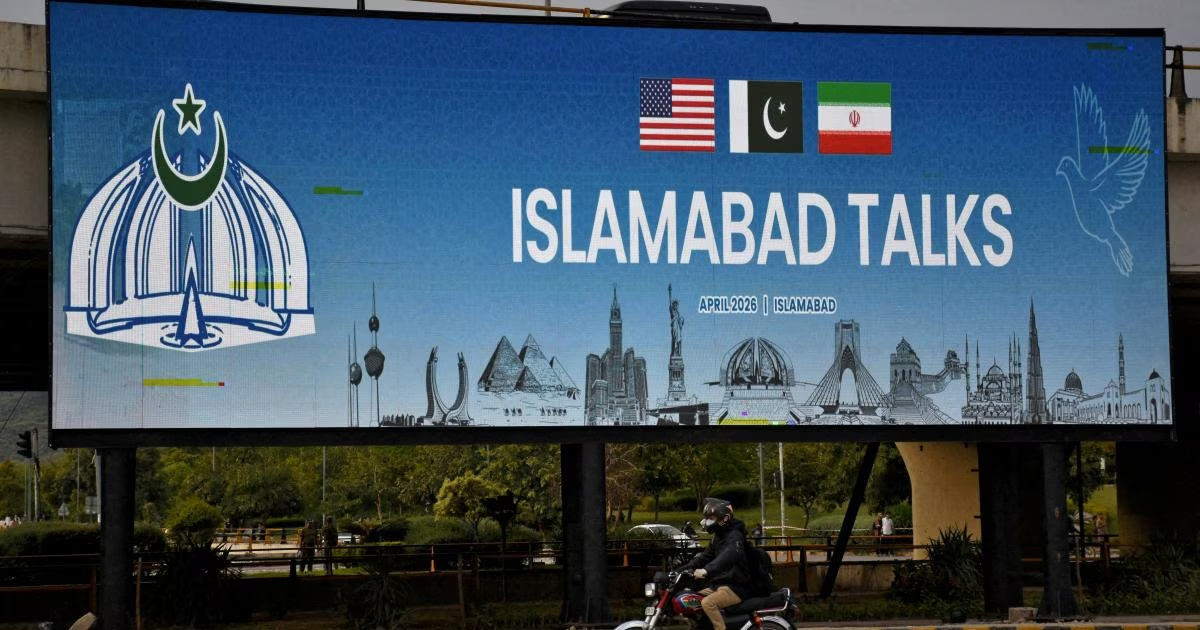
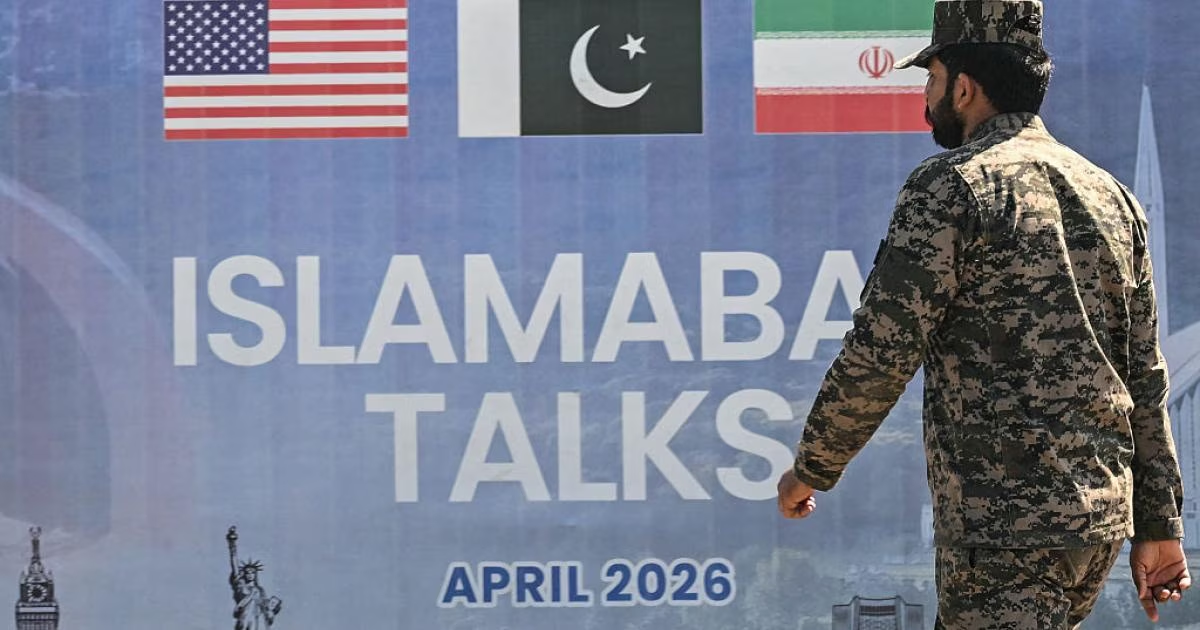
The Pakistani capital, Islamabad, is witnessing intense diplomatic activity to ensure the resumption of the anticipated negotiations between the United States and Iran, amidst an atmosphere charged with tension and distrust between the two parties. Pakistani authorities are working through high-level contacts to overcome the obstacles that have recently emerged, coinciding with the approaching end of a two-week truce between the two sides.

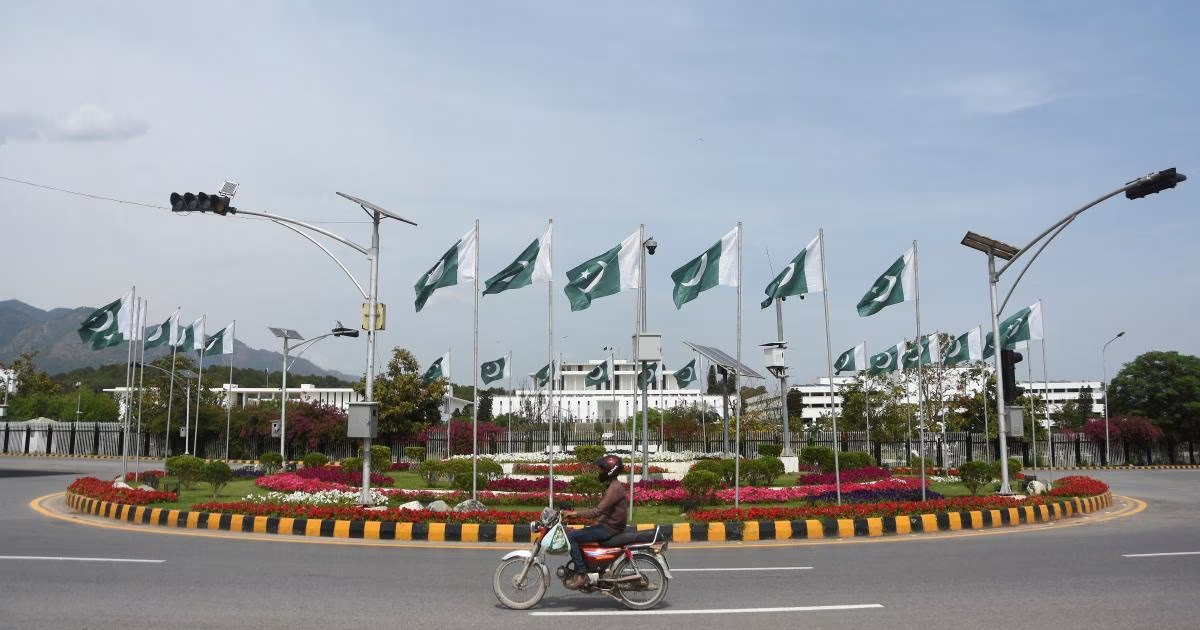
Informed sources reported that the Pakistani capital and a number of major cities have been placed on high security alert, in anticipation of the arrival of negotiating delegations tomorrow, Tuesday. Despite no final official announcement from the Pakistani government, field and logistical movements indicate extensive preparations to host this crucial round of talks.

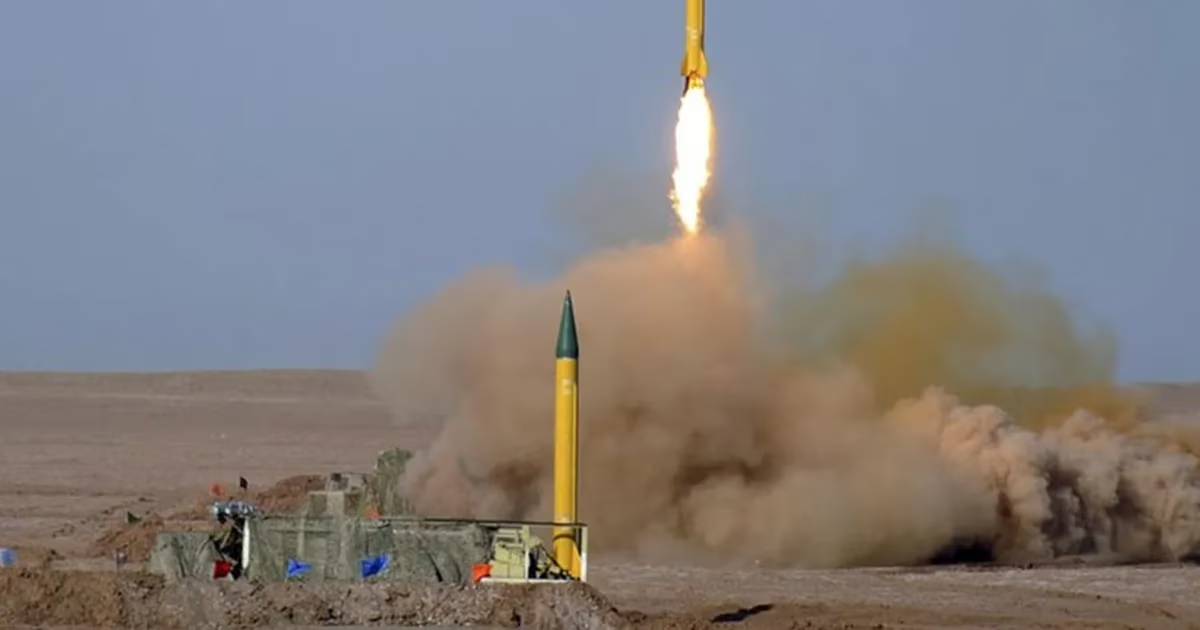
For its part, Tehran has shown firm stances regarding the issues on the table, with sources quoting a senior Iranian official as saying that the country's defensive capabilities are not part of any political bargaining. The source clarified that Iran's missile program represents a sovereign, non-negotiable pillar, stressing that any attempt to link it to the nuclear file will lead to a dead end.

Tehran accused Washington of continuing to impose a blockade on the Strait of Hormuz, considering these military moves undermine any real opportunities for achieving peace or building trust. Iranian political circles believe that the continuation of American economic and military pressure contradicts statements from the White House regarding the desire for a diplomatic solution.

In a related context, the spokesperson for the Iranian Foreign Ministry, Ismail Baqaei, escalated his criticism of the American administration, describing its behavior as 'unserious' in the negotiation process. Baqaei indicated that Washington had committed clear violations of the ceasefire terms, stressing that no final decision has yet been made regarding participation in the second round.

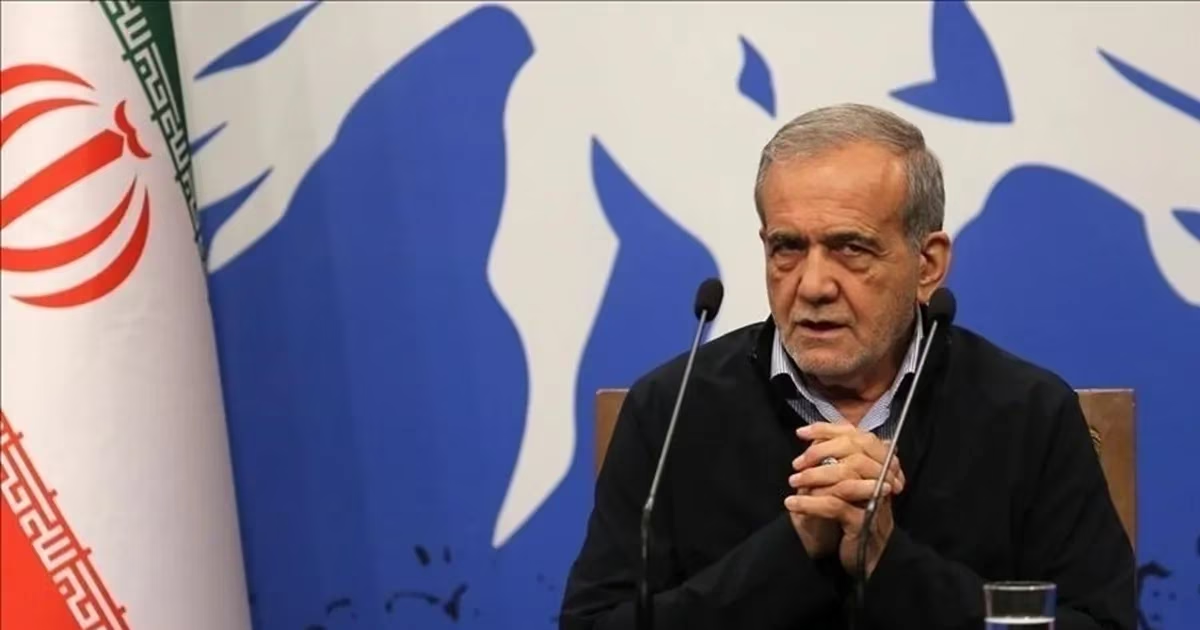
At the political leadership level, Iranian President Masoud Pezeshkian called for the necessity of adopting 'rational means' in managing the current crisis to reduce the escalation with the United States. However, Pezeshkian stressed that the principle of 'distrust' in dealing with the American side remains a strategic necessity that cannot be abandoned in light of past experiences.

Internationally, Beijing entered the crisis, with the Chinese Foreign Ministry describing the current phase as 'critical' and requiring restraint from all concerned parties. China expressed its deep concern over the recent detention of an Iranian cargo ship, considering that such actions further complicate the diplomatic scene and hinder de-escalation efforts.

Chinese diplomatic sources affirmed Beijing's readiness to play a constructive role in supporting the talks in Islamabad, calling for strict adherence to the ceasefire agreement. China believes that regional stability fundamentally depends on the success of major powers in reaching understandings that end the state of anticipation and continuous field tension.

Reports from Islamabad indicate that the gaps between Washington's and Tehran's positions remain wide, especially regarding the mechanism for lifting sanctions and nuclear guarantees. Despite strenuous Pakistani efforts, observers believe that mutual distrust represents the biggest obstacle to achieving any real breakthrough in the upcoming round of negotiations.

Amidst these developments, the diplomatic path remains suspended between the desire to avoid comprehensive confrontation and adherence to the national constants of each party. All eyes turn to Islamabad tomorrow to see whether international pressure and Pakistani mediation will succeed in bringing the two parties to the table once again.

Iran's defensive capabilities, including its missile program, are a red line and non-negotiable in any diplomatic process.

PALESTINE

Mon 20 Apr 2026 2:55 pm - Jerusalem Time

Systematic looting.. Settlers steal thousands of livestock from Palestinians under the protection of the occupation

The theft of sheep, cattle, and Palestinian property in the West Bank has transformed from individual incidents into a widespread and organized phenomenon enjoying direct protection from the Israeli occupation army. Video clips and human rights reports document the integration of roles between settlers and the army in targeting Palestinian communities, with the aim of undermining farmers' livelihoods and forcing them to leave their lands.

According to data obtained by sources from the human rights organization 'Al-Baydar', more than 12,000 head of livestock were stolen in 2025, while about 1,500 more were stolen from the beginning of 2026 until now. These figures reflect the scale of the economic catastrophe facing Palestinian farmers who find themselves alone in confronting armed gangs.

In the village of Ein Yabroud, northeast of Ramallah, citizen Muhammad Hujeir recounts bitter suffering, as settlers stole three horses from him in just one year. Hujeir confirmed that his attempts to recover his horses failed, and he was even subjected to severe physical assault by 14 settlers who attacked his home under the gaze of the occupation forces.

Hujeir explained that the financial losses he incurred due to the theft of his horses amounted to about 50,000 shekels, noting that the army closed the village entrances during the attack to prevent any assistance from reaching the residents. He described the situation in the village as tragic, where sheep thefts are repeated daily and affect dozens of heads from various families.

In another testimony, citizen Salim Turki Hamayel recounted the details of the raid on his farm last Monday dawn, where settlers stole an entire flock consisting of 74 head of the finest sheep. Hamayel estimated his loss at between 50,000 to 60,000 dollars, confirming that the settlers used tools to cut the fence and destroy surveillance cameras.

His wife, Umm Abdullah, confirmed that this flock was the family's sole source of income, and with its loss, the family is now without financial income. This situation embodies the reality of hundreds of Palestinian families who rely entirely on animal production for their daily livelihood and face the risk of extreme poverty due to these thefts.

In a related context, activist Kazem Al-Hajj Muhammad indicated that settler attacks in the areas northeast of Ramallah have become daily and organized. He explained that the aim of firing bullets and intimidating farmers is to entrench the policy of 'pastoral settlement' which aims to control the largest possible area of open Palestinian land.

For his part, Ghassan Abu Alia, head of Al-Mughayyir Agricultural Association, revealed the establishment of a new settlement outpost near the village lands that has gradually begun to encroach on agricultural areas. He confirmed that the occupation army directly intervenes by firing gas bombs and bullets to secure the sabotage operations carried out by settlers against the association's workers and farmers.

Statistics indicate that the occupation has already seized more than 45,000 dunams in the Al-Mughayyir area alone, while it continues to pursue citizens in the remaining areas. These continuous pressures aim to bring Palestinian farmers to a state of despair, which facilitates the process of evacuating the land for settlement expansion.

On the political level, Salah Al-Khawaja, director of the Central Directorate in the Wall and Settlement Resistance Commission, revealed an unprecedented settlement leap. The Israeli 'Cabinet' secretly approved the construction of 34 new settlements, raising the total number of approved settlements under the current government to 103 settlements.

Al-Khawaja explained that these approvals are equivalent to about 70% of the total settlements built since 1967 until 2022, indicating a frantic acceleration in annexation operations. This plan aims to connect major settlements to each other, and create a settlement fence that completely isolates Palestinian villages from their surroundings.

Al-Khawaja warned of the 'Greater Jerusalem' project, which seeks to isolate the areas of Sawahra, Abu Dis, and Al-Eizariya from the north and south of the West Bank. This approach will turn Palestinian areas into isolated and besieged 'cantons', eliminating any possibility of geographical connection between Palestinian cities and towns.

Going back in history, Al-Khawaja believes that what is happening today is a development of the 'Ayalon' project that was proposed after the 1967 setback to divide the occupied territories. While the project aimed to divide the West Bank into 7 states, the occupation today seeks to turn it into 176 small cantons surrounded by settlements from all sides.

Despite this harsh reality, Palestinian farmers emphasize the option of steadfastness and remaining on their lands, no matter the sacrifices. Farmers sent messages calling on the Palestinian people not to give up their land and to confront the policies of forced displacement led by settlers with official support from the occupation government.

The thefts are no longer individual incidents, but an organized phenomenon protected by the army aimed at driving farmers to despair and abandoning their lands.

PALESTINE

Mon 20 Apr 2026 2:55 pm - Jerusalem Time

Field escalation in southern Lebanon: Destruction of Israeli tanks and efforts to impose a land and sea buffer zone

Lebanese Hezbollah announced today, Monday, that its fighters successfully destroyed four Merkava tanks belonging to the Israeli army, after they fell into a well-planned ambush in the town of Taybeh. Field sources clarified that the targeted vehicles were part of a military convoy attempting to advance towards Deir Siriane, where explosive devices, planted earlier, detonated.

In an official statement, the party confirmed that this Israeli movement represents a clear violation of the existing calm understandings, noting that the convoy, consisting of eight armored vehicles, sustained direct hits. Israeli forces were seen working to remove debris from the site hours after the explosions that targeted the advancing force.

Meanwhile, local sources reported that the occupation army carried out extensive demolition operations targeting a number of residential buildings in the towns of Shamaa, Naqoura, and Bayada within the Tyre district. These operations coincided with intensive low-altitude flights of Israeli reconnaissance planes and drones, which caused a state of severe tension in the region.

The town of Tyre Debba witnessed the funeral of a number of martyrs who fell in recent attacks, amidst ongoing efforts by rescue teams to recover more bodies from under the rubble. Civil defense teams face extreme difficulties in reaching some targeted sites due to continuous shelling and direct military threats in the border villages.

On the field level, the Israeli army also issued urgent warnings to residents of about 60 villages in southern Lebanon, asking them not to return to their homes until further notice. This step comes as part of Tel Aviv's efforts to establish what it describes as a buffer zone extending south of the Litani River, threatening to turn dozens of villages into closed military zones.

Reports from the region indicated that the demolition of residential blocks continues at an escalating pace, especially in the city of Khiam, which is subjected to systematic destruction of neighborhoods. This Israeli strategy aims to erase urban features in about 55 towns located within the first and second border lines to ensure complete fire control.

Israeli ambitions were not limited to land but extended to include attempts to impose a new reality at sea through what is known as the 'Maritime Yellow Line'. Israel seeks to impose a buffer zone 10 kilometers deep within the Lebanese economic zone, which could threaten Lebanese sovereignty over the Qana oil field, which was previously agreed upon.

Monitoring sources clarified that the villages targeted by the warnings fall within the direct Israeli control, which are militarily classified as 'red zones'. The Israeli army prevents any form of access to these areas, relying on ground forces or concentrated artillery and aerial bombardment to prevent the return of normal life to them.

In a remarkable development, the participation of civilian contractors and Israeli demolition companies was observed in the destruction of infrastructure, educational, and residential facilities in the 'Yellow Zone'. This coordination reflects an Israeli desire to accelerate systematic demolition operations to ensure that these areas are uninhabitable in the foreseeable future, as part of a scorched-earth strategy.

These developments come at a sensitive time, as international concerns about a complete collapse of the concluded cease-fire agreements are increasing. The international community is anxiously monitoring the expanding scope of destruction in southern Lebanon, amidst Israeli insistence on imposing new security conditions that go beyond internationally recognized border understandings.

Israeli occupation forces committed a new violation of the truce through military movements deep within the southern towns.

OPINIONS

Mon 20 Apr 2026 10:43 am - Jerusalem Time

"The High Representative".. not SO high!

Dr. Ibrahim Melhem

Editor-in-Chief

The least that can be said is that since the appointment of the Bulgarian Nikolay Mladenov as "High Representative" and governor of the Gaza Strip, the man assigned to a colonial mission has remained silent on the daily violations in the Strip, and the only time he spoke... he lied. He claimed that the trucks entering the Strip reached 600 trucks daily; a statement that did not need official denial, as the visible scenes in the markets took care of the task, with a severe shortage of supplies and rising prices of available ones, scarcity of water, and international organizations announcing their withdrawal from their missions according to "World Food Programme" and "World Central Kitchen" statements, amidst a serious deterioration in food security. Criticizing the Bulgarian representative does not exempt the Palestinian head of the committee, Dr. Ali Shaath, and all members, from the national responsibility they were assigned to alleviate the suffering of their people in the Strip, which is afflicted by fear, hunger, and a lack of money, lives, and fruits. We know them, president and members, by their patriotism and keenness, and that some of them endured chapters of genocide and lost loved ones, and we know that some of them have already resigned, or were prevented from objecting to policies and plans, but the "dictates of the representative" should not silence their voices. They are not just employees, but rather delegates for the mission of saving a people who are dying daily. Where are the promises the committee made to itself? Foremost among them is the introduction of "caravans" that would ensure a dignified temporary life for the displaced until reconstruction, as stated by its head at the beginning of his tenure, and that the national committee would be the link that restores the nation's unity and dignity. Gaza does not need fictitious numbers written in international reports to beautify the face of the "new mandate," but rather needs a reality that the hungry can feel in a loaf of bread, a sip of water, a pill of medicine, baby milk, and a safe tent from mobile death. Silence in the face of hunger is participation in it.

PALESTINE

Mon 20 Apr 2026 10:43 am - Jerusalem Time

Gaza Landfills: Hotbeds of Epidemics and a Last Resort for the Destitute Under Siege

Warnings are escalating about an unprecedented environmental and health catastrophe in the Gaza Strip, where thousands of displaced Palestinians find themselves forced to live in dilapidated tents next to massive landfills. This crisis is a result of the destruction of infrastructure and homes during military operations, pushing families to seek shelter in areas lacking the most basic public safety requirements.\n\nLocal sources reported that the accumulation of waste in streets, residential neighborhoods, and displacement camps poses a direct threat to the lives of residents. This deterioration is due to the inability of municipal crews to access the main landfills located in the eastern border areas, as a result of security restrictions and a lack of machinery and fuel necessary for transportation and processing operations.\n\n The Joint Services Council for Solid Waste Management in the central and southern parts of the Strip warned that the continuation of this situation portends the outbreak of deadly epidemics. Foul odors and toxic fumes resulting from spontaneous or deliberate burning of garbage spread around these landfills, creating a fertile environment for the proliferation of disease-carrying insects and rodents.\n\nChildren, in particular, suffer from the spread of acute skin and intestinal diseases due to direct contact with pollutants in these areas. The danger increases as families are forced to use materials extracted from waste, such as plastic and paper, as alternatives to missing fuel for cooking and heating inside their worn-out tents.\n\nIn a field testimony, displaced person Atta Maarouf explained that living near the landfill was not a choice but was imposed by harsh circumstances and the lack of housing alternatives. He pointed out that the absence of cooking gas and fuel forced them to scavenge through garbage for any flammable materials, emphasizing that extreme poverty compelled some to turn these landfills into their sole source of livelihood.\n\nEconomic reports indicate a tragic reality, with unemployment rates in the Strip soaring to nearly 80% according to World Bank estimates. This comprehensive economic collapse has made the majority of families entirely dependent on scarce humanitarian aid entering through heavily controlled crossings.\n\nIn Gaza City, a painful scene unfolds of children scavenging through piles of garbage, not only in search of items to sell but also for food scraps to satisfy their hunger. These scenes come after international bodies declared an actual famine in northern areas, with expectations of its spread to central and southern areas amid the ongoing siege.\n\nThirteen-year-old Samer Wadih spoke of suffering repeated injuries while searching through waste, noting that hunger sometimes drives them to eat whatever scraps they find. This testimony reflects the scale of the humanitarian tragedy experienced by the younger generation in the absence of food security and basic health services.\n\nFor her part, displaced person Shurooq Abdel Aal expressed her deep concern for her children, who suffer from a continuous rise in temperatures and mysterious symptoms. She said that insects constantly invade their tents, demanding the provision of safe and clean shelter to protect her family from a slow death amidst the waste.\n\nOn the international level, the regional director of the World Health Organization warned that the outbreak of diseases in Gaza would not remain confined within its borders. She affirmed that continuous restrictions on the entry of medical aid and fuel hinder any real efforts to contain the successive health crises affecting overcrowded displacement centers.\n\nDespite a ceasefire agreement, the situation on the ground has not seen a tangible improvement in service and environmental aspects. Municipalities still lack the heavy equipment needed to remove rubble and rehabilitate landfills, making waste management an almost impossible task given the currently available resources.\n\nCivil defense sources confirm that the spread of waste near displaced persons' gatherings represents a ticking time bomb that could explode at any moment in the form of a widespread epidemic. These bodies demand international pressure to allow the entry of specialized machinery and spare parts necessary to restart the public sanitation system in various governorates of the Strip.\n\nThe continued prevention of the entry of mobile homes and building materials exacerbates the housing crisis, forcing citizens to remain in unhealthy environments for long periods. This imposed siege prevents any attempts at reconstruction or even the restoration of vital facilities that have been extensively damaged over the past two years.\n\nIn conclusion, the landfill crisis remains another face of the suffering of Gaza's residents that did not end with the cessation of military operations. Between the hammer of hunger and the anvil of epidemics, Palestinians continue their struggle for survival under living conditions described by international reports as unfit for human life.\n\n"We collect paper, nylon, and firewood to light fires for baking and cooking, as there is no gas or fuel, and the lack of income has forced us to work inside the landfills despite their dangers.

ARAB AND WORLD

Mon 20 Apr 2026 10:43 am - Jerusalem Time

Pezeshkian warns against American and Zionist 'adventures' in call with Pakistani Prime Minister

Iranian President Masoud Pezeshkian announced his country's firm stance on recent military and political movements in the region, stressing that Tehran will not stand idly by in the face of any new escalation. These statements came during a phone call he made with Pakistani Prime Minister Shahbaz Sharif, during which the two sides reviewed the latest developments in the ongoing negotiations in Islamabad and the efforts made to consolidate the ceasefire.

Pezeshkian accused the United States of America of pursuing policies that undermine diplomatic efforts, describing the continued naval blockade and ongoing threats as a clear violation of previously reached understandings. The Iranian President indicated that these actions reveal Washington's intentions to circumvent peaceful solutions and fuel tension in vital waterways.

In a message described as stern, Pezeshkian informed his Pakistani counterpart that Iranian forces are on high alert for comprehensive defense against any adventure that American or Zionist powers might undertake. He warned that any ill-considered step would have catastrophic repercussions for regional security, stressing that protecting Iranian sovereignty remains a top priority that is non-negotiable.

The conversation between the two leaders also touched upon the importance of enhancing cooperation between neighboring countries to ensure the stability of the region away from external interventions, which he described as 'destructive'. Pezeshkian expressed his hope that the efforts of regional countries would unite to block the path of international powers seeking to impose their own agendas at the expense of the interests of the region's peoples and its political stability.

The Iranian President concluded his speech by emphasizing Tehran's strategy based on good neighborliness and developing bilateral relations with Pakistan and the rest of the surrounding countries. He stressed that lasting peace can only be achieved by ending the foreign military presence and stopping threats targeting the security of navigation and international trade in the region.

Iran is determined to defend comprehensively against any new American or Zionist adventure targeting the security of the region.

PALESTINE

Mon 20 Apr 2026 10:43 am - Jerusalem Time

Martyr and injuries in night raids on Gaza and an Israeli decision to close the Rafah crossing

A Palestinian citizen was martyred and several others sustained varying injuries early Monday morning, as a result of aerial raids carried out by Israeli occupation aircraft on various areas in the Gaza Strip. Field sources reported that the shelling targeted the Al-Bureij refugee camp in the central region, leading to the martyrdom of one person and one injury, while at least three citizens were injured in another targeting of the western area of Gaza City.

These field developments come amidst continued Israeli violations of the theoretically ongoing ceasefire agreement, as occupation forces continue to carry out daily shelling and shooting operations. According to official data, these continuous breaches have resulted in casualties almost constantly, undermining efforts to stabilize the calm in the afflicted Strip.

In a related context, the government media office in Gaza revealed shocking statistics related to Israeli violations, indicating that approximately 2,400 violations have been monitored since the agreement came into effect last October 10th. The office clarified that these violations were not limited to military operations only, but also included policies of direct killing, arbitrary arrests, tightening the siege, and using starvation as a pressure tool.

Regarding human casualties, the Ministry of Health in Gaza announced an increase in the number of martyrs since the ceasefire was declared in October to 776 martyrs, in addition to 2,171 injured. These figures reflect the extent of the continuous escalation despite international understandings, as the Israeli war machine continues to claim the lives of civilians in various governorates of the Strip.

Considering the total toll since the outbreak of the war on October 7th, medical records have registered the martyrdom of 72,552 citizens and the injury of 172,274 others. This data confirms the scale of the unprecedented humanitarian catastrophe experienced by the residents of the Strip, amidst systematic destruction of infrastructure and a health system that has become unable to cope with this massive number of victims.

On another note, the Palestinian Crossings and Borders Authority announced that the occupation authorities decided to completely close the Rafah land crossing south of the Strip starting today, Monday. This decision will result in a complete halt to the movement of evacuating wounded and sick people who need surgical operations and specialized treatments not available inside Gaza, putting their lives at imminent risk.

Occupation authorities did not provide any clear justifications for closing the crossing, which is the only remaining lifeline for the residents of the Strip to the outside world, nor was there any official comment from the Israeli side. This closure is a repetition of the policy of collective punishment, as the crossing has previously been closed for long weeks, exacerbating the suffering of thousands of urgent humanitarian cases.

Regarding the health situation, the spokesperson for the Palestinian Red Crescent Society, Raed Al-Nims, stated that more than 18,000 patients and injured people are still waiting for their turn for urgent medical evacuation. He pointed out that the strict restrictions imposed by the occupation since the partial reopening of the crossing last February have only allowed about 700 patients to leave, which is a very small number compared to actual needs.

In addition, returnees to the Gaza Strip conveyed painful testimonies about being subjected to abuse and detention by occupation forces present at the crossing, where travelers undergo harsh interrogations lasting for long hours. It was supposed, according to the terms of the ceasefire agreement, that the crossing would be opened normally and the movement of individuals and goods facilitated, but Israel has reneged on these commitments since day one.

Israel committed 2,400 violations of the ceasefire agreement in the Strip during half a year of its implementation, including killing, arrest, siege, and starvation.

ARAB AND WORLD

Mon 20 Apr 2026 10:43 am - Jerusalem Time

Clash of Values and Politics: An Open Confrontation Between the Vatican and the White House Threatens Trump's Future

The relationship between the Vatican and the White House has entered a dark tunnel of open confrontation, where the conflict is no longer merely a difference in political views, but has transformed into a deep clash of values. This tension became clearly evident after the sharp criticisms directed by Pope Leo XIV at US President Donald Trump, against the backdrop of his violent threats towards Iran, which placed religious values in direct opposition to extreme nationalist tendencies.

The US President had caused global shock when he wrote on social media platforms phrases suggesting comprehensive annihilation, indicating that an entire civilization could perish in one night. This condescending rhetoric, described by observers as reflecting megalomania, prompted the global conscience to act, as diplomatic sources considered such written statements to express a conscious will and not merely a fleeting slip of the tongue.

For its part, the Vatican was quick to respond, with Pope Leo XIV, the first Pope of American origin, affirming that threatening peoples with annihilation is morally and humanly unacceptable. The Pope emphasized in his statements that the matter goes beyond the complexities of international law to reach the essence of morality, calling for the protection of civilians, children, and the elderly from the ravages of wars that begin with irresponsible verbal escalation.

The reaction from the White House was swift and abrupt, with Trump describing the Pope as a 'very bad' person and accusing him of weakness, a move analysts considered unprecedented in the history of relations between Washington and the Holy See. This spat not only angered the Vatican but also raised concerns within the US administration and among Washington's allies who saw Trump's statements as a threat to international peace and security.

Historians and commentators believe that Trump's methods of using 'violent language' and targeting minorities intersect with historical populist narratives witnessed in the last century. While Trump derives his legitimacy from an electoral democratic system, the Pope represents a spiritual authority for nearly one and a half billion Catholics worldwide, making the clash between them a global ideological polarization par excellence.

The election process of Pope Leo XIV, which took place through the closed conclave of cardinals in the Sistine Chapel, had carried great hopes for promoting global peace. Although Trump initially congratulated the Pope on his 'Truth Social' platform, expressing pride in him being the first American Pope, this welcome quickly evaporated in the face of differing visions on issues of immigration, wars, and social justice.

The Pope's criticisms were not limited to the Iranian file but extended to warning against the danger of democratic systems sliding into what he described as 'the tyranny of the majority'. In a message addressed to participants in a meeting at the Vatican, the Pope affirmed that democracy cannot remain sound unless it is rooted in moral values that protect the rights of all, not just those who hold power or the numerical majority.

During an African tour that included Cameroon, the Pope sharply criticized foreign powers that plunder the continent's wealth, considering them a primary cause of widespread poverty. These statements were seen as an indirect attack on the imperialist system adopted by the current US administration, further intensifying the polarization between the Vatican and Washington on foreign policy issues.

JD Vance, the US Vice President, entered the confrontation defending the administration's policies, considering that the Pope erred in his theological interventions concerning the use of force. Vance demanded that the Pope exercise caution when discussing matters related to national security, reflecting a deep gap in understanding the role of religious institutions in guiding public policies.

Adding to the Christian anger towards Trump was his posting of an expressive image showing him in a position suggesting an embrace from 'Jesus Christ', which many considered a desecration of religious symbols and blatant political exploitation. Although Trump enjoys a wide Christian electoral base, this move angered conservatives who saw it as crossing all moral and religious red lines.

Reports indicate that this ongoing spat could erode Trump's popularity among American Catholics who view the Pope as a supreme authority. With increasing criticism of his management style and his disregard for human values, the possibility of Congress moving to interrogate him has begun to loom, amid fears that his policies could lead to complete international isolation for the United States.

This difficult historical era puts the relationship between religion and politics to the test, where values of peace and dialogue clash with tendencies of bullying and destruction. It seems that the coming years will witness more ideological interaction that may reshape political trajectories in the West, amidst urgent calls for the emergence of wise leaders who prioritize humanistic tendencies over narrow interests.

Today, as everyone knows, a threat has been issued to the Iranian people, and this is truly unacceptable; it is a moral issue concerning the well-being of an entire people.

OPINIONS

Mon 20 Apr 2026 5:00 am - Jerusalem Time

Washington Escalates in Gulf of Oman, Seizes Iranian Ship: New Threat to Fragile Truce and Vague Negotiations

Washington – Said Arikat – 20/4/2026

News Analysis

In a field development that threatens to undermine the temporary truce between the United States and Iran, Washington announced on Sunday that a US naval destroyer intercepted an Iranian cargo ship in the Gulf of Oman, after it ignored orders to stop, before US Marine forces seized it. The operation came at a highly sensitive time, with the scheduled ceasefire approaching its end this week, and Washington preparing to send a high-level delegation to Pakistan for new talks with Tehran.

President Donald Trump said that the destroyer USS Spruance fired at the ship's engine room, disabling it, before Marines boarded and seized it. He justified the move by stating that the ship was subject to US sanctions and had a “history of illegal activities,” confirming that US forces were inspecting its cargo.

In contrast, Tehran presented a different narrative, as semi-official Iranian media reported that US forces fired on an Iranian commercial ship, but claimed that naval units of the Revolutionary Guard forced the Americans to retreat. This discrepancy reflects the ongoing war of narratives and indicates the seriousness of the field situation in sensitive maritime passages.

Hormuz Strait at the Heart of the Conflict

The incident occurred south of the Strait of Hormuz, through which about 20 percent of global oil trade passes. Iran had imposed restrictions on navigation in the strait, while Washington responded by imposing a blockade on Iranian ports, turning the maritime passage into a direct confrontation point between the two sides.

Trump had previously accused Iran of violating the truce by attacking two Indian ships that tried to cross the strait, considering it a “complete breach” of the ceasefire agreement. It appears that Sunday's incident was part of the US deterrence policy and an attempt to impose facts on the ground before the next round of negotiations begins.

Negotiations in Pakistan Amidst Conflicting Messages

Coinciding with the military escalation, the US administration announced that it would send a delegation led by Vice President JD Vance, and including Steve Witkoff and Jared Kushner, to Islamabad this week, seeking to revive negotiations with Iran.

However, Iranian media indicated that Tehran has not yet officially agreed to hold the meeting, raising questions about the seriousness of the diplomatic path, or whether Washington is using the announcement of negotiations as a political and media pressure card rather than an actual agreement.

The previous round, held days ago in the Pakistani capital, ended without a tangible breakthrough, despite representing the highest level of direct contact between the two sides in decades.

Trump's Threats Complicate the Scene

Days before the truce ended on April 22, Trump escalated his rhetoric, threatening to strike Iranian civilian infrastructure if the Strait of Hormuz was not opened and the ceasefire was not extended.

He said via his “Truth Social” platform that the United States would target “every power station and every bridge in Iran” if Tehran refused a “fair and reasonable deal,” a speech that reflects a logic of coercion more than negotiation.

Regional and Economic Repercussions

In Pakistan, authorities appeared to be preparing for an imminent round of negotiations, as they imposed strict security measures in Islamabad with the deployment of ten thousand additional personnel. In Lebanon, thousands of displaced families began returning to the south after a separate truce came into effect, while Hezbollah expressed conditional readiness to cooperate with the state to end the war with Israel.

Economically, US Energy Secretary Chris Wright acknowledged that fuel prices in the United States could remain high for months, contradicting Trump's previous promises that the war's effects would be “short-lived.”

What is happening reveals a clear contradiction in US policy: sending a high-level negotiating delegation simultaneously with carrying out a military operation against an Iranian ship. This pattern suggests that Washington does not see negotiations as an alternative to force, but rather as a complement to it. However, using military pressure during negotiations often pushes the adversary to harden their stance, not to concede, and reduces the chances of reaching a sustainable agreement.

The strait has transformed from a global economic passage into a political bargaining chip that threatens the entire international economy. Every escalation there immediately impacts oil prices, inflation, and supply chains. Major powers treat the passage as an arena of influence, while the world pays the cost of this conflict. Continuing this approach makes the global economy hostage to a sudden military decision.

Trump's threat to target Iranian bridges and power stations not only pressures Tehran but also sends a negative message to mediators and allies. Targeting civilian infrastructure is internationally viewed as a dangerous escalation and undermines any image of Washington as a party seeking peace. Ultimately, hawkish language may satisfy the domestic political audience, but it rarely produces successful compromises.

ISRAELI AFFAIRS

Mon 20 Apr 2026 5:00 am - Jerusalem Time

The Battle of Numbers in Israel: Polls Draw Conflicting Maps for the Future of Netanyahu's Coalition

The Israeli political arena is witnessing a flood of opinion polls as the presumed election date in October approaches, with these numbers transforming from mere statistical indicators into tools in the heated political battle. The divergent readings between research institutions and media outlets reveal a deep division in assessing the strength of the ruling coalition led by Benjamin Netanyahu versus the opposition camp.

In the latest data released by Maariv newspaper, the Likud party appears stable at 25 seats, while Naftali Bennett's alliance emerges as a parallel force with 24 seats. These figures indicate a tangible decline for the current coalition, which may not exceed 49 seats, giving the opposition an opportunity to form a government with a majority of 61 seats even without relying on Arab parties.

In contrast, Israel's Channel 14 presented a more optimistic picture for the right, granting Likud 35 seats and raising Netanyahu's camp's share to 65 seats. This stark disparity reflects the ideological gap between media platforms, as Channel 14 is known for its close ties to decision-making circles on the right and the settler community.

As for Channel 12, it charted a middle course, giving the opposition a numerical advantage of 69 seats if Arab parties are included, but it confirmed that this advantage dissipates when they are excluded. The biggest obstacle facing the opposition remains the refusal of its leaders to form a government that relies on Arab lists, which keeps the political crisis ongoing without a clear resolution.

In the context of searching for alternatives, the 'Zman Israel' website reviewed a scenario of a merger between Naftali Bennett, Gadi Eisenkot, and Yair Lapid, which could produce a massive parliamentary bloc of up to 38 seats. However, analysts believe that this merger changes the balance of power within the opposition itself more than it changes the overall ability to overthrow the right-wing coalition.

Despite the Likud's party decline in some polls, Benjamin Netanyahu still leads the 'suitability for prime minister' scene with comfortable margins over his rivals. In Channel 12's poll, Netanyahu surpassed Yair Lapid by 42% to 27%, indicating a real leadership crisis suffered by the opposition in finding a convincing alternative for the public.

Gadi Eisenkot's name stands out as one of the consistent winners in recent polls, showing continuous growth in his popularity, surpassing historical opposition leaders. This rise puts additional pressure on Yair Lapid, whose results have shown a decline to critical levels that could threaten his political future as an opposition leader.

The polls also reflect a clear tendency among the Israeli public towards security hawkishness, especially regarding the northern front with Lebanon. Sources reported that the vast majority of Israelis oppose a ceasefire with Hezbollah before strict security conditions are met, which reinforces the right's discourse in the current phase.

The identity of the polling agency directly affects the announced results, with institutions like 'Midgam' and 'Kantar' standing out as entities trying to maintain a professional commercial character. In contrast, Channel 14's polls, supervised by Shlomo Filber, raise widespread controversy due to his previous association with Netanyahu's inner circle before becoming a state witness.

The general mood in Israel is still affected by the repercussions of the ongoing war, with voters linking their political choices to the ability to achieve security. Results show that 62% of respondents in Maariv expect a direct confrontation with Iran soon, which enhances the presence of existential issues at the expense of economic and social files.

For religious parties, 'Shas' and 'United Torah Judaism' maintain relative stability in their voting power, making them the kingmakers in any future coalition. In contrast, religious Zionist parties face the risk of not crossing the electoral threshold in several polls, which could scatter the cards of the far-right in the upcoming elections.

Arab parties, represented by the Front, Arab for Change, and the United List, maintain representation ranging from 5 to 10 seats in various scenarios. Despite their numerical importance, these parties remain politically isolated due to the 'veto' imposed by centrist and right-wing opposition parties on partnering with them in government.

The discrepancy in poll results confirms that there is no single face for Israeli society at the moment, but rather visions shaped according to the screen the voter watches. This contradiction makes it difficult to predict the results of the upcoming elections, turning every new poll into fuel that ignites the conflict between competing camps.

In conclusion, it seems that Netanyahu is banking on time and his image as a 'security man' to overcome internal crises and the disintegration of his coalition in the polls. As the decisive months approach, these numbers will remain the primary driver for alliances and mergers that could completely reshape the Israeli political map before the ballot boxes open.

The Israeli opposition is searching for its leader as much as it is searching for a majority that enables it to govern, given Netanyahu's superiority in personal suitability indicators.

PALESTINE

Mon 20 Apr 2026 4:59 am - Jerusalem Time

Children of Gaza Between Anemia and Skin Diseases: A Generation Facing a Long-Term Health Catastrophe

Displaced families in the Gaza Strip are living a worsening humanitarian tragedy inside tents that lack the most basic necessities for a dignified life, where infants face severe health risks due to the absence of essential supplies. Mothers and grandmothers stand helpless before the cries of little ones whose delicate bodies are ravaged by sores due to the use of primitive and unhygienic alternatives to diapers, whose prices have now exceeded the purchasing power of most families.

Field testimonies from inside displacement centers indicate that the price of a pack of diapers jumped from 20 shekels before the war to more than 150 shekels currently, with continued increases amid a severe shortage of supplies. This exorbitant cost has forced families living without income to buy diapers piece by piece, with each piece costing more than 10 shekels, an amount that burdens already exhausted heads of households.

In this bitter reality, grandmother Umm Muhammad Abu Al-Kas recounts the suffering of her grandchildren who cannot sleep at night from severe pain and hunger, as their skin is covered in rashes from using cloth and nylon bags. She confirms that the absence of formula milk and its high price has made raising an infant in these circumstances an almost impossible task, especially with the lack of healthy nutritional alternatives that newborns need in their first months.

For her part, Ms. Dunia Dalloul describes her arduous search for detergents and medical ointments that are now completely missing from the markets or are sold at exorbitant prices that cannot be afforded. She says that the absence of water and soap has turned her child's body into a map of severe inflammations, as she is forced to use remnants of worn-out and rough cloth, which exacerbates the child's skin condition in the absence of options.

Living priorities for Gazan families are painfully intertwined, as families find themselves having to choose between providing treatment for chronic diseases or buying essential children's supplies. Suhaila Al-Khour, whose son suffers from a heart condition, bitterly wonders how to balance the cost of her father's medicine with buying diapers to protect her grandchildren from diarrhea and skin diseases that are ravaging them due to pollution.

On the medical front, Dr. Ghassan Matar, a family doctor at the Haidar Abdel Shafi Community Association, warned of a terrifying deterioration in the general health condition of children in the Gaza Strip. He explained that the rates of anemia have shockingly jumped from 10% before the war to about 70% currently, a dangerous indicator of the scale of the nutritional catastrophe affecting the younger generation.

Matar attributed this sharp increase in infections to severe malnutrition and the comprehensive economic collapse that has rendered families unable to secure essential proteins and vitamins. He stressed that the absence of eggs, milk, and nutritional supplements from Gazan tables has led to a general weakening of children's immunity, making them susceptible to various types of infections and diseases associated with malnutrition.

Suffering is not limited to nutrition but extends to the emergence of new and complex skin diseases that were not previously common, due to the lack of personal hygiene and overcrowding in shelters. Medical sources reported that the absence of wet wipes and skin care supplies has led to an exacerbation of skin rashes, turning into bacterial and fungal infections that are difficult to treat due to the shortage of medicines.

Official data issued by the Palestinian Ministry of Health indicates that the Gaza Strip received more than 61,000 new births between January 2025 and March 2026. These newborns were born at the peak of the humanitarian crisis, with most of them lacking primary healthcare and necessary immunizations, putting their health future at stake amid the ongoing suffocating siege.

In a related context, field sources confirmed that journalists and humanitarian workers are not separate from this suffering, as they face the same challenges in providing milk and diapers for their children. Behind the cameras and journalistic reports lie personal stories of journalist mothers struggling to secure the minimum needs for their children, who are threatened by anemia and skin diseases just like the rest of the sector's residents.

Specialists warned that the continuation of this situation portends a long-term health catastrophe from which the bodies of this generation may not recover for years to come, as iron and vitamin deficiencies in the early stages of development leave permanent effects on mental and physical development. The imposed siege, which prevents the entry of essential health and food supplies, represents a slow death sentence for thousands of children who survived the bombing.

Children in Gaza remain trapped between the hammer of hunger and the anvil of disease, amid international silence and an inability to bring in essential humanitarian aid that ensures their survival. The scenes coming from displacement tents reflect a tragic reality beyond all description, where the simplest rights of childhood, such as hygiene and food, become distant dreams amid the ongoing war of annihilation.

The child in Gaza is trapped between empty intestines lacking iron and vitamins, and skin diseases due to the absence of healthy alternatives, portending a long-term health catastrophe.

PALESTINE

Mon 20 Apr 2026 4:59 am - Jerusalem Time

Intersection of Fronts: How Israel Used Escalation with Iran to Tighten the Noose on Gaza?

Questions are escalating regarding the future of the Palestinian cause in light of the open conflict between Israel and Iran. Observers believe that the occupation has diligently sought to exploit this confrontation as a smokescreen to divert attention from what is happening in the Gaza Strip. With international powers preoccupied with monitoring the hot fronts in Tehran and Lebanon, Tel Aviv found a wider space to isolate Palestinians away from intense international scrutiny.

The decline in media coverage momentum for the Gaza Strip has given the Netanyahu government complete comfort in evading its humanitarian and legal obligations. No real breakthrough was seen at the crossings, and humanitarian aid remained trapped by Israeli restrictions, bringing back the specter of famine to loom over the Strip once again, despite repeated talks of calm understandings.

On the ground, Israeli violations in Gaza did not stop, as systematic assassination operations continued, targeting resistance elements and government administrative cadres. Occupation forces also continued their scorched-earth policy by detonating residential blocks and demolishing homes, exploiting the general military alert in the region to justify their continuous escalation against civilians and displaced persons.

On the political and legislative fronts, the far-right government exploited these circumstances to pass dangerous strategic decisions, most notably the Knesset's approval of the prisoners' execution law. This racist trend coincided with repressive measures in occupied Jerusalem, including the closure of Al-Aqsa Mosque throughout Ramadan and Eid al-Fitr, in a move aimed at imposing a new temporal and spatial reality.

In the context of political pressures, the American role emerged as a tool to maximize pressure on Palestinian resistance factions, specifically the Hamas movement. Washington put forward what was known as the 'Mladenov paper,' which included explicit demands for disarmament, accompanied by threats of a return to all-out war if the proposal was rejected, which Palestinians considered an attempt to impose surrender.

In parallel with these pressures, the region is awaiting the results of the upcoming talks in Pakistan, where US Vice President J.D. Vance is leading a high-level delegation to negotiate with the Iranian side. These moves come before the expiration of the current ceasefire scheduled for next Wednesday, amid Israeli assessments indicating the possibility of these diplomatic efforts failing.

The Israeli army, for its part, raised its alert level to the maximum, imposing strict military censorship on the movements of reserve forces and air defense units. These preparations come amid monitoring of exceptional Iranian movements described as a prelude to a potential attack, in response to the non-inclusion of the Lebanon front in previous calm agreements.

Despite these challenges, analysts believe that the war has produced results that may benefit the Palestinian cause in the long run, the most important of which is the erosion of American deterrence power in the region. Developments have shown Washington's inability to impose its absolute will, which opened the door for other international powers such as China and Russia to strengthen their presence as strategic alternatives in regional balances.

Israel's failure to militarily end what it describes as 'threats' in Lebanon, Yemen, and Gaza reinforces the idea of exhausting the occupation on multiple fronts. This long-term attrition directly affects the military, security, and economic structure of the occupying state, and makes the option of absolute military decisive action a distant prospect in light of the steadfastness of the resistance.

There is a growing state of apprehension among major regional countries such as Turkey, Saudi Arabia, Egypt, and Pakistan towards Israeli expansionist ambitions. These countries have come to realize that Israel's success in liquidating the Palestinian cause may make them subsequent targets in the regional hegemony project, creating an intersection of interests with the steadfast Palestinian position.

The regional anxiety about 'Greater Israel' gives the Palestinian side room for political maneuver if it manages the current phase well. The resistance in Gaza and the West Bank today represents the last line of defense that protects the entire region from violation, which requires intermediary and guarantor countries to bear historical responsibility to fortify the Palestinian negotiating position.

The Palestinian negotiator today faces a fateful challenge: the necessity of steadfastness and hardening positions to extract the entitlements of the first phase of calm. This position must be based on rejecting any concessions that affect the essence of national rights, while emphasizing that the will of the occupation and the American administration is not an inevitable fate that can be imposed by force.

Ultimately, Gaza remains the compass despite attempts at marginalization, as events have proven that any regional stability that does not pass through the gateway of Palestinian rights is fragile stability. The interconnectedness of fronts from Tehran to Gaza confirms that the Palestinian cause remains the primary driver of conflict in the Middle East, no matter how many attempts are made to circumvent it.

Attention is now turning to what the next few days will bring, whether in the negotiation halls in Pakistan or on the confrontation field in the Gaza Strip. While Netanyahu tries to buy time, the Palestinian resistance continues to bet on the factor of time and the changing international and regional balances to break the cycle of siege and continuous aggression.

The occupation government exploited the circumstances of the war and the preoccupation with it to impose paths with a strategic negative impact on the Palestinian cause, benefiting from the decline of Gaza in the global coverage agenda.

PALESTINE

Mon 20 Apr 2026 4:59 am - Jerusalem Time

Albanese describes Israeli army as 'most depraved' after video of child abuse in Ramallah

The UN Special Rapporteur on human rights in the Palestinian territories, Francesca Albanese, launched a sharp attack on the practices of the Israeli army, describing it as "the most depraved" ever. This firm stance came in a post on her official account, commenting on leaked video clips documenting brutal assaults carried out by occupation soldiers against Palestinian children in the occupied West Bank.

Albanese affirmed that the scenes she witnessed provide absolute certainty about the moral level reached by the occupation army in its dealings with unarmed civilians. She pointed out that the video showing the abuse of a child in Al-Mughayyir village, located near Ramallah city, is a horrific scene that reflects a systematic policy of intimidation and continuous assault on Palestinian childhood.

The circulated clips, which sparked widespread anger on social media platforms, show three soldiers detaining two children in a terrifying manner, with one of them violently dragging a child no older than nine by his clothes. The camera also documented the soldier pushing the child right and left amidst screams of fear, in a scene that embodies the extent of daily violations suffered by residents of Palestinian villages and towns.

Local sources reported that this incident occurred during a wide-ranging raid carried out by the occupation army on Al-Mughayyir town last Saturday, which developed into a comprehensive siege of the village on Sunday. This raid coincided with coordinated attacks carried out by groups of extremist settlers on citizens' properties, leading to violent confrontations that resulted in injuries among Palestinians.

This incident comes in the context of an unprecedented escalation witnessed in the West Bank since October 2023, where official data indicate that more than 1,149 Palestinians have been killed and about 11,750 others injured. The pace of arrests has also increased dramatically, affecting nearly 22,000 citizens, amid the continuation of night and day raids on Palestinian cities and camps.

Regarding child prisoners, statistics indicate that the occupation authorities are holding about 360 children in their prisons who live in harsh conditions lacking the minimum requirements of human and legal rights. These children suffer from abusive procedures and harsh field interrogations no different from what adult prisoners face, which places the international community before its responsibilities towards protecting minors under occupation.

The Israeli army continues to carry out daily military operations interspersed with direct assaults on citizens and their private property, turning the lives of Palestinians into a series of continuous suffering. Human rights reports confirm that these practices, supported by settlers, aim to displace residents and expand settlement areas in the heart of the occupied West Bank.

I have seen enough to say with absolute certainty that the Israeli army is the most depraved.

PALESTINE

Mon 20 Apr 2026 4:59 am - Jerusalem Time

Israeli soldier smashes statue of Christ in southern Lebanon, army confirms incident

Media sources reported on Sunday that a soldier in the Israeli occupation army smashed a statue of Jesus Christ in the town of Deir Syriac in southern Lebanon. A video clip circulated showing the soldier using a heavy hammer to smash the head of the statue inside the town, which sparked a wave of widespread condemnation in local and international circles.

For its part, the Israeli army issued an official statement confirming that the initial examination proved the authenticity of the circulated recording, indicating that the soldier in question was working within the forces present in the southern Lebanon area. The statement claimed that this behavior contradicts military values, stressing that an investigation has been opened by the Northern Command to take the necessary disciplinary measures against those involved.

This incident comes amid escalating popular and media anger towards Israeli practices targeting holy sites and religious symbols in conflict areas. Observers believe that this act represents a blatant violation of international norms that protect religious sites and symbols during military operations, which further complicates the already tense field situation.

On the ground, the Israeli aggression against Lebanon continues, which has so far resulted in more than 2,294 martyrs and thousands injured, in addition to the displacement of more than one million people from their villages and cities. Official statistics reveal the extent of the massive destruction inflicted on infrastructure and residential areas as a result of continuous raids and ground operations.

In the context of political moves, US President Donald Trump announced that a temporary ten-day ceasefire agreement had been reached, following contacts he made with Lebanese and Israeli leaders. This short pause aims to provide an opportunity for diplomatic efforts, despite doubts surrounding the extent of the parties' commitment on the ground.

Despite the announcement of a temporary truce, Israeli Security Minister Yisrael Katz affirmed Tel Aviv's intention to maintain military control over all areas where Israeli forces have penetrated in southern Lebanon. Katz stressed in his statements that the army will not withdraw from the positions it occupied during the recent aggression, indicating an intention to impose a new geographical reality.

In this context, Hebrew reports revealed the establishment of what is called the 'Yellow Line', an imaginary security strip drawn by the Israeli army south of the Litani River to define the areas of its forces' presence. This line extends to a depth of between 4 and 10 kilometers inside Lebanese territory, forming a new buffer zone militarily controlled by Israel.

The 'Yellow Line' path begins from the coastal town of Naqoura to the town of Khiam in the eastern sector, passing through strategic towns such as Bint Jbeil, Ayta al-Shaab, and al-Adeisseh. Through this demarcation, Israel aims to establish permanent strongholds for its forces deep in southern Lebanon, which the Lebanese side completely rejects.

Information obtained from media sources indicates that Israeli forces are currently present in about 55 Lebanese towns and villages, where they are carrying out sweeping operations and consolidating their positions. These movements coincide with the continuation of field violations affecting public and private property, including places of worship and cultural and religious symbols.

The situation in southern Lebanon remains prone to further escalation in light of the contradiction between ceasefire announcements and Israeli field movements aimed at imposing a long-term occupation. International circles are concerned about the extent to which the sanctity of holy places and the protection of civilians are respected under these complex circumstances that Lebanon is experiencing.

The incident is currently under investigation by the Northern Command, and is being dealt with at the command and disciplinary levels.

PALESTINE

Mon 20 Apr 2026 4:59 am - Jerusalem Time

Martyr in Jabalia and military escalation targeting Khan Yunis and central areas

Field sources reported the martyrdom of young Khalil Nasr due to intense gunfire from occupation forces in the Halawa camp in the Jabalia al-Balad area, north of the Gaza Strip. This incident comes amid a continuous escalation in the northern areas, where military vehicles continue to directly target civilian gatherings and homes, exacerbating the already deteriorating humanitarian conditions in these besieged areas.

In the southern part of the Strip, occupation warships launched intense artillery and missile shelling targeting the beaches of Khan Yunis city, causing panic among displaced people residing in tents near the coast. Concurrently, military vehicles stationed on the borders opened machine-gun fire towards agricultural lands and residential areas east of the central governorate, amid suspicious military movements in the vicinity of those areas.

Occupation forces continue to carry out systematic demolition operations of residential blocks, with local sources monitoring widespread demolition of homes in what is known as the 'Yellow Line'. These actions fall within the policy of destroying infrastructure and what remains of citizens' property, in clear violation of announced understandings, indicating the occupation's insistence on changing the geographical and demographic features in large areas of the Strip.

Regarding official statistics, Ministry of Health data revealed a bloody toll of continuous violations since last October 10, with 775 martyrs and over two thousand citizens injured during the alleged truce period. This raises the total toll of the ongoing aggression since October 7, 2023, to over 72,000 martyrs and 172,000 injured, in an unprecedented humanitarian catastrophe entering its third year.

The human cost of these violations since the start of the ceasefire has reached approximately 775 martyrs and 2,171 injured citizens.

PALESTINE

Mon 20 Apr 2026 4:59 am - Jerusalem Time

Two martyrs and wounded in separate Israeli attacks on Gaza Strip

Israeli occupation forces continued their field violations in the Gaza Strip, where two Palestinians were martyred and four others were injured in separate incidents that occurred on Sunday. These attacks come in the context of a series of ongoing breaches of the ceasefire agreement that came into effect on October 10, 2025, threatening the fragile calm in the Strip.

In details of the field aggression, an Israeli drone targeted a motorcycle that was traveling on Salah al-Din Street east of the Nuseirat refugee camp in the central Strip. Medical sources confirmed that the raid resulted in the martyrdom of one citizen and the injury of three others with varying degrees of wounds, who were subsequently transferred to Al-Awda Hospital for treatment.

Al-Awda Hospital stated in a brief statement that its teams dealt with the body of a martyr and three injuries, noting that among the wounded was a child who was injured by shrapnel from the airstrike. This coincided with intense overflights of Israeli reconnaissance planes in the airspace of the central region of the Strip.

In the northern Strip, local sources reported the martyrdom of a Palestinian due to direct gunfire from occupation army vehicles stationed in the border areas. The shelling targeted the tents of displaced persons in the Halawa camp located east of Jabalia, causing a state of panic and confusion among the displaced families.

In the city of Deir al-Balah, a 16-year-old boy was seriously injured after being targeted by drone fire in the desalination area. Eyewitnesses stated that the targeting occurred in a civilian area where no occupation forces were present, despite the Israeli army's control over large areas exceeding half of the Strip's area.

The eastern areas of the central governorate and the southern Strip witnessed a remarkable escalation, as helicopters and military vehicles fired heavily towards citizens' lands. Israeli artillery also shelled areas east of Khan Yunis city, coinciding with warships targeting the city's coast with shells and heavy machine guns.

These field developments come two years after the genocide war launched by Israel on Gaza since October 2023, which left massive destruction. According to official statistics, that war resulted in the martyrdom of more than 72,000 and the injury of more than 172,000 Palestinians in an unprecedented toll.

For its part, the government media office in Gaza revealed the extent of Israeli violations since the signing of the ceasefire agreement, confirming the monitoring of about 2,400 breaches. These violations varied between direct killing, arbitrary arrests, tightening the siege, and using the policy of starvation against the civilian population in various governorates.

In a related context, the Ministry of Health in the Strip indicated that the continuous violations of the agreement have so far led to the martyrdom of 775 Palestinians and the injury of 2,171 others. These figures reflect the occupation's insistence on undermining international understandings and continuing to target civilians and infrastructure amid complete international silence.

Israel committed 2,400 violations of the ceasefire agreement, including killing, arrest, siege, and starvation.

ARAB AND WORLD

Mon 20 Apr 2026 4:58 am - Jerusalem Time

Tehran Rejects Second Round of Negotiations with Washington, Criticizes 'Excessive Demands'

Official sources in the Iranian capital, Tehran, confirmed on Sunday evening the political leadership's opposition to holding a second round of direct talks with the United States of America. This decisive stance comes just hours after statements by US President Donald Trump, in which he indicated that his negotiating team would travel to Pakistan on Monday to complete efforts to end the ongoing conflict.

Media reports clarified that Tehran views the new American invitation as merely an attempt at political maneuvering, especially after the failure of the first round hosted by Islamabad last week. The sources emphasized that the absence of tangible results in previous meetings is primarily due to what they described as 'American intransigence' and a lack of seriousness in making concessions to end the state of tension.

Iranian official bodies attributed the rejection decision to three main factors, topped by American demands described as excessive and unrealistic, in addition to the continuous fluctuation in the positions of the current US administration. Tehran also considered that the continued naval blockade imposed on Iranian ports represents a fundamental obstacle preventing any fertile ground for serious or fruitful diplomatic negotiations.

In a related context, media sources close to decision-making circles in Iran described reports promoting a second round as part of a 'media campaign' led by Washington. This campaign, according to the Iranian view, aims to exert additional psychological and political pressure on Tehran, and to try to hold it responsible for the faltering diplomatic path by exchanging accusations before the international community.

For his part, US President Donald Trump had announced earlier that a high-level delegation would arrive in the Pakistani capital tomorrow evening, Monday, to continue the dialogue. Despite this explicit announcement from the White House, the Iranian side maintained official silence regarding sending any envoys, before recent reports emerged confirming the absence of any Iranian intention to participate in this meeting.

Information from the White House indicates that the American delegation was scheduled to be headed by Vice President 'J.D. Vance,' who led the stalled round of negotiations early last week. The delegation also includes Special Envoy 'Steve Witkoff,' in addition to 'Jared Kushner,' the son-in-law of the US President, reflecting the importance Washington attaches to this path despite significant obstacles.

In a further escalation, media sources quoted informed officials as saying that no future negotiations would be engaged in as long as the US Navy continues to blockade the Strait of Hormuz. This Iranian condition is considered a red line, as Tehran links returning to the negotiating table with the lifting of military and naval restrictions imposed by the United States on vital waterways in the region.

Excessive American demands, the constant change in Washington's positions, and the continued naval blockade offer no promising prospects for serious negotiations.

PALESTINE

Mon 20 Apr 2026 4:58 am - Jerusalem Time

Occupation decides to completely close Rafah crossing and suspend evacuation of thousands of wounded

The Crossings and Borders Authority in the Gaza Strip announced on Sunday evening that the Israeli occupation authorities have decided to completely close the Rafah land crossing starting from Monday. The authority clarified in a brief statement that this measure will directly lead to the cessation of all evacuation operations for the wounded and sick who require urgent medical interventions outside the Strip, without clarifying the reasons behind this sudden decision.

This closure comes at a time when the health sector in Gaza is suffering from a near-complete collapse, as Israel imposes strict restrictions on movement through the crossing since its partial reopening. The Israeli side has not issued any immediate comment on the motives for the closure, which repeats previous scenarios that saw the only outlet for the residents of the Strip to the outside world disrupted for continuous weeks.

In a related context, the spokesperson for the Palestinian Red Crescent Society, Raed Al-Nims, revealed shocking figures related to the humanitarian situation, indicating that more than 18,000 patients and wounded are still awaiting their turn on medical evacuation lists. Al-Nims confirmed that the number of those who were able to leave the Strip since the reopening of the crossing did not exceed 700 patients, which is a very small number compared to the enormous needs and the danger threatening the lives of the injured.

In addition to the closure crisis, local sources reported that Palestinian citizens returning to the Gaza Strip through the crossing were subjected to serious violations by the occupation forces stationed there. These violations included acts of abuse and prolonged detention, in addition to harsh interrogations and psychological pressure suffered by travelers before being allowed to reach their homes inside the Strip.

It is worth noting that the Israeli occupation army has full control over the Palestinian side of the Rafah crossing since its invasion in May 2024, and it was reopened last February within a very limited scope. The crossing constitutes the only remaining lifeline for the residents of Gaza, and its closure represents a death sentence for hundreds of critical cases for whom treatment is not available in the besieged and targeted hospitals.

Movement of patient evacuations will stop tomorrow, Monday, as a result of the closure of the Rafah crossing by the occupation.

ARAB AND WORLD

Mon 20 Apr 2026 4:58 am - Jerusalem Time

Trump attributes his laryngitis to 'screaming' at Iranians

Amid escalating political tensions, US President Donald Trump made unusual statements linking his health condition to his approach to the Iranian issue. Trump claimed that the intensity of discussions and pressures he exerts on Tehran led to him developing laryngitis, reflecting his confrontational style in dealing with thorny international issues.

These statements came during a television interview with anchor Maria Bartiromo, where the conversation touched on sensitive issues including the security of the Strait of Hormuz and the future of stalled negotiations. Instead of providing traditional diplomatic answers, Trump chose a tone that blended seriousness and sarcasm to explain his vision for dealing with international adversaries.

The US President affirmed in his speech that force is the only language that works with the Iranian side, noting that 'gentle treatment' had not achieved the desired results in the past. He considered his continuous shouting to be part of the maximum pressure strategy he adopts to compel Tehran to comply with American demands.

On the ground, Trump expressed great optimism about the course of ongoing military operations, describing the combat performance of the forces as 'exemplary'. He indicated that victory was imminent and that the war was nearing its end, which created a contrast between his talk of military decisive action and the continuation of diplomatic crises.

In a related context, reports from the White House revealed that Vice President J.D. Vance is currently leading the US negotiating delegation. The negotiating team includes prominent figures, suggesting that Trump's statements about 'screaming' may be a metaphorical expression of general policy rather than an accurate description of direct negotiation sessions.

Trump's statements did not pass without sparking a wave of sarcasm and analysis on social media platforms, with some considering them part of the President's usual 'political show'. Observers criticized this approach, emphasizing that managing issues of the magnitude of the conflict with Iran requires diplomatic wisdom that goes beyond merely uttering catchy phrases.

For his part, political science specialist Birmingham commented on these statements, considering that Trump's resort to shouting reflects his frustration at his inability to fully impose his agenda. He added that Iran has proven to be a power that cannot be easily subdued, describing threats of 'ending civilization' as being outside the framework of political rationality.

Websites were also filled with sarcastic comments, with some activists pointing out that Trump's shouting might be directed from the White House balcony and not in closed negotiation rooms. Others considered that losing one's temper and shouting is evidence of losing both the political and military arguments, which weakens the American position internationally.

Despite the criticism, Trump's supporters insist that this direct approach is what the United States needs to restore its prestige in the Middle East. Questions remain about the extent to which these statements will affect the actual course of negotiations, especially given the presence of an official negotiating team trying to balance the President's escalation with diplomatic necessities.

I was screaming at the Iranians all day... and that's why I have laryngitis, they don't understand gentle treatment.

PALESTINE

Mon 20 Apr 2026 4:58 am - Jerusalem Time

Massive Global Demonstrations Commemorate Prisoners' Day and Condemn Israeli Execution Laws

Thousands of demonstrators took to the streets in the West Bank, Morocco, and Australia today, Sunday, in a widespread public movement to commemorate Palestinian Prisoners' Day, which falls on April 17th each year. These movements come amidst exceptional circumstances experienced by detainees inside occupation prisons, coinciding with an escalation in repression and racist legislation targeting their lives.

In the city of Nablus, in the northern West Bank, citizens gathered in a central march that started from the municipality building and proceeded to Martyrs' Square in the city center. Participants carried pictures of prisoners and Palestinian flags, chanting slogans demanding the breaking of chains and the internationalization of the detainees' issue in international forums to confront systematic policies of abuse.

Nablus Governor Ghassan Daghlas affirmed during the event that the occupation authorities continue to tighten their siege on the Palestinian people, alongside unprecedented violations against prisoners. Daghlas pointed out that the Israeli Knesset's approval of the law to execute prisoners represents the peak of legal terrorism practiced by the far-right government against Palestinian freedom fighters.

On March 30th, the Israeli Knesset approved a law allowing the implementation of the death penalty against Palestinian prisoners, with a majority of 62 members. This legislation, which received widespread support from right-wing parties, targets prisoners accused of carrying out operations that resulted in the deaths of Israelis, currently estimated at around 117 prisoners.

In the Moroccan capital, Rabat, massive crowds participated in a solidarity march that paraded through the main streets to the Parliament building, condemning Israeli crimes. Demonstrators carried banners calling for the protection of prisoners from daily abuses, demanding that the international community pressure the occupation to revoke the recent arbitrary laws.

In the Australian city of Melbourne, a massive demonstration took place with the participation of members of Arab communities and foreign sympathizers, expressing their rejection of the Israeli law that permits executions. Protesters called on the Australian government to take firm stances against Israeli practices and to work towards ensuring the release of detainees held in inhumane conditions.

Activists in Australia announced the extension of Prisoners' Day commemoration activities to include a full week of awareness and protest activities. These events aim to highlight the various forms of torture and degrading treatment suffered by Palestinians and to raise global awareness about their just cause in the face of the Israeli machine of oppression.

In Tunisia, activities supporting the Gaza Strip and prisoners continued, with a solidarity march condemning ongoing Israeli violations of ceasefire agreements. Participants stressed the need to grant prisoners their full freedom, expressing their anger at the approval of legislation that legitimizes premeditated murder under the guise of the Israeli judiciary.

For its part, the Commission of Detainees and Ex-Detainees Affairs revealed shocking reports regarding conditions inside the Israeli 'Etzion' prison, describing the treatment there as the worst in decades. The commission quoted legal sources who were able to visit a number of detainees, stating that the prison service has escalated repression and intimidation operations to an unprecedented degree.

Documented testimonies from inside the prison included brutal practices such as raiding cells with police dogs and constantly directing abusive insults at prisoners. Detainees are also forced to kneel for long hours in painful positions, with severe beatings inflicted on anyone who tries to object or is unable to carry out military orders.

Official statistics indicate the presence of more than 9,600 Palestinian prisoners in occupation prisons, including dozens of women and hundreds of children suffering from starvation policies. These prisoners face deliberate medical neglect that has led to the martyrdom of dozens inside captivity, amidst a complete absence of international oversight over Israeli detention centers.

It is worth noting that the pace of abuse against prisoners has sharply escalated since the outbreak of the genocide war on the Gaza Strip on October 7, 2023. These violations continue with American political and military support, leading to the exacerbation of the humanitarian crisis inside prisons and transforming them into arenas for systematic revenge against everything Palestinian.

The occupation imposes a comprehensive siege on our people and practices escalating violations against prisoners, culminating in the approval of the unjust execution law.

ARAB AND WORLD

Mon 20 Apr 2026 4:58 am - Jerusalem Time

Trump Announces 'Framework Agreement' with Iran, Tehran Hesitates to Participate in Islamabad Negotiations

US President Donald Trump revealed new developments in the Iranian file, indicating that a general framework agreement has been reached with Tehran. In a media interview, Trump expressed cautious optimism about the course of the talks, emphasizing that reaching a final agreement is now possible despite the uncertainty surrounding the next phase.

These statements come ahead of the second round of negotiations scheduled to begin in the Pakistani capital, Islamabad, on Monday. These intensive diplomatic moves aim to end the conflict with Iran, especially as the deadline for the current ceasefire approaches.

Sources in the White House confirmed that the United States will send a high-level delegation to participate in the Islamabad talks. The delegation includes prominent figures in the US administration, led by Vice President J.D. Vance, in addition to envoys Steve Witkoff and Jared Kushner, reflecting the importance Washington attaches to this round.

J.D. Vance will lead the US delegation in this crucial round of negotiations with the Iranian side. The US team seeks to translate the 'framework agreement' mentioned by Trump into executive provisions that ensure regional stability and permanently end military operations.

Coinciding with the diplomatic activity, the US aircraft carrier 'Gerald Ford' has returned to the waters of the Middle East, according to official sources. This military move comes amid escalating tensions, with Washington aiming to strengthen its field presence during the negotiation process.

In contrast, a state of hesitation prevails in the Iranian capital, Tehran, where no final decision has been issued regarding participation in the Islamabad round. Informed sources reported that decision-making circles in Iran are still studying the feasibility of engaging in new negotiations under the current circumstances.

Iranian state media quoted its sources as saying that there are no clear prospects for the success of this round of talks or for making them fruitful. Tehran attributes this pessimism to what it describes as unrealistic and exaggerated American demands, which hinder reaching compromises that satisfy both parties.

Iran's Supreme National Security Council is still holding intensive meetings to study the implications of the current negotiation path. Iranian discussions focus on evaluating the US position and the seriousness of its commitment to previous understandings, away from the language of threats sometimes adopted by Washington.

Tehran strongly criticizes what it describes as the 'US naval blockade,' considering it a clear violation of the existing ceasefire understandings. Iranian official bodies believe that US military movements in the region contradict the stated desire to reach a diplomatic solution to the crisis.

Iranian sources described optimistic American statements about an imminent agreement as merely a 'media game' aimed at pressuring the Iranian negotiator. Tehran believes that Washington is trying to suggest positive progress to justify its positions before the international community, while fundamental obstacles remain unresolved.

I feel that we can reach an agreement with Iran, and a general framework agreement has already been reached, but we do not know where things will go.

PALESTINE

Mon 20 Apr 2026 4:58 am - Jerusalem Time

Tel Aviv hints at resuming intense fighting in Gaza, Smotrich demands re-establishment of settlements

Hebrew media sources close to the Israeli Prime Minister's office revealed that the occupation army has begun actual arrangements to return to intensive fighting in the Gaza Strip early next month. These military movements come amid escalating political tension within the Israeli government coalition and demands to end the relative calm.

In a related context, Israeli Finance Minister Bezalel Smotrich renewed his explicit calls for the full re-occupation of the Gaza Strip and the establishment of Jewish settlements on its lands. Smotrich considered this step necessary to confront what he described as Hamas's refusal to dismantle its military capabilities or abandon its weapons.

Smotrich's statements came during an official event for the re-opening of the 'Sanur' settlement in the northern West Bank, a settlement that was evacuated in 2005. Defense Minister Yisrael Katz and a number of officials participated in this event, reflecting a governmental trend towards strengthening settlement on various fronts.

For its part, Hamas affirmed its adherence to the necessity of obliging the occupation to implement the requirements of the first phase of the ceasefire agreement before moving to any new understandings. This came during meetings held by the movement's leadership with international mediators and Palestinian factions in the Egyptian capital, Cairo, to discuss the path of calm.

The movement stressed in an official statement that it has dealt positively with all proposed initiatives, including US President Donald Trump's plan and the Sharm El Sheikh agreements. It demanded the complete withdrawal of occupation forces from the Strip and the opening of crossings to begin reconstruction operations and end the escalating humanitarian suffering.

On the ground, reports from the Gaza Strip indicate that the ceasefire agreement is witnessing continuous and almost daily Israeli violations. These violations range from artillery shelling and direct firing at civilians and farmers in border areas, which undermines the chances of stabilizing the calm.

According to data from the government media office in Gaza, occupation forces have committed about 2,400 violations of the agreement since it came into effect last October. These violations included killings, detentions, severe siege, in addition to the systematic starvation policy practiced against the residents of the Strip.

The Ministry of Health in Gaza reported that these violations resulted in the martyrdom of 775 people and the injury of more than two thousand citizens with various injuries during the past six months. These figures confirm the fragility of the existing agreement in light of the continued limited Israeli military operations and repeated attacks.

The second phase of the US-sponsored peace plan began in mid-January under UN Security Council resolutions. However, the Palestinian side accuses Israel of reneging on its basic commitments, especially regarding the entry of sufficient medical and relief aid.

Official data indicates that the occupation continues to place obstacles to the entry of shelter materials and fuel necessary to operate vital facilities in Gaza. This intransigence threatens the collapse of the political path that began in October 2025 and aims to end the genocide that destroyed most aspects of life.

It is worth noting that the Gaza Strip was subjected to a comprehensive destructive war that began on October 8, 2023, and lasted for more than two years with extensive American military and political support. This war left a heavy toll of victims exceeding 72,000 martyrs and 172,000 injured, most of whom were children and women.

Israeli military operations also caused the destruction of approximately 90% of the infrastructure and residential buildings in the Strip, making reconstruction a huge challenge. In light of the current threats of a return to fighting, the international community fears a deeper humanitarian catastrophe that may affect what remains of the elements of life in Gaza.

I call on the Prime Minister to issue orders to the army to immediately prepare for the full occupation of the Gaza Strip, impose Israeli control, and establish settlements there.

ISRAELI AFFAIRS

Sun 19 Apr 2026 3:20 pm - Jerusalem Time

Boiling in Israel after soldiers killed in southern Lebanon: Accusations against Netanyahu of 'submitting' to Trump

Political and military circles in Israel are experiencing a state of extreme tension after two soldiers were killed and others injured in southern Lebanon, despite the ongoing ceasefire agreement. This continuous bleeding has fueled feelings of anger and reproach towards the government, amid accusations that the political leadership is making promises that have no basis in reality.

Security assessments in Tel Aviv indicate that Iran may move towards blowing up the ongoing negotiations with the United States, not out of a desire for comprehensive escalation, but as a tactical pressure tool. In contrast, voices within the ruling establishment are emerging that wish to return to direct military confrontation on the Lebanese and Iranian fronts to achieve objectives that have not yet been accomplished.

Fears are escalating in the Israeli street that northern areas will remain under the threat of Hezbollah rockets, with critics arguing that Netanyahu and his security minister Katz are involved in arrogant rhetoric that has not changed the reality on the ground. There is a general feeling of bitterness resulting from the conclusion that Hezbollah still retains its military capabilities and its ability to paralyze life in the northern settlements.

For his part, Agriculture Minister and Cabinet member, Avi Dichter, tried to absorb public anger by saying that the nature of fighting with armed organizations always makes borders unclear. Dichter acknowledged that the ceasefire came in response to a direct request from US President Donald Trump, emphasizing the need to maintain the alliance with Washington to confront the Iranian threat.

In the context of field criticisms, military observers expressed their dissatisfaction with the Israeli army's failure to control the Lebanese town of Bint Jbeil despite weeks of intense fighting. Reserve General Yossi Peled pointed out that the gap between the slogans promoted by politicians and the actual results on the ground has become a heavy burden on public morale.

Military analyst Amos Harel believes that the current agreement is fragile, especially after Trump informed the Israeli side of the need to stop bombing immediately. Harel described the new American position as an unprecedented step that prevents Israel from moving freely in Lebanese airspace, which further complicates the security situation.

On the popular level, the municipality of Kiryat Shmona and a number of Galilee settlements announced a general strike, with calls for massive demonstrations in Jerusalem protesting what they described as 'submission'. Northern residents consider the ceasefire agreement to be a surrender to external pressures, leaving them to face an unknown fate in the face of continuous Hezbollah threats.

In a critical reading of the scene, General Michael Milstein considered that excessive reliance on military force without a clear political vision is the main reason for what he described as the current failure. Milstein warned that replacing realistic planning with 'fantasy' and selling illusions to the public will ultimately lead to severe and irreparable strategic damage.

Other experts also warned against attempting to replicate the 'Yellow Line' experience from the Gaza Strip and apply it in Lebanon, stressing that the nature of the land and the resistance in southern Lebanon are completely different. These experts believe that establishing a security belt could turn into a trap for Israeli soldiers due to improvised explosive devices and ambushes, instead of being a defensive solution.

Hebrew media mocked official statements talking about the imminent achievement of peace with Lebanon, noting that reality proves the exact opposite. Reports recalled statements by the Israeli ambassador who heralded Israelis visiting Lebanon in swimsuits, considering them a kind of underestimation of the enemy's capabilities and steadfastness.

Media sources confirm that Netanyahu is facing a political nightmare as general elections approach, as he finds himself unable to market the image of 'security master' that he has always boasted about. This predicament may push him to try to convince the American administration of the need to resume military operations to escape his successive internal crises.

In light of this political deadlock, informed sources do not rule out that Netanyahu may resort to a new military escalation in the Gaza Strip in search of a 'victory image' that would restore some of his lost popularity. The pressures exerted by the far-right and northern residents are tightening the noose on the government and pushing it towards escalatory options with uncertain outcomes.

On the other hand, Shimon Sheffer believes that Iran has proven its strength and steadfastness, contrary to Israeli claims, and has effectively imposed an equation of linking fronts. Sheffer explained that continuing the policy of lying and misleading the public will only lead to more shocks when slogans collide with the bitter reality on the northern and eastern fronts.

The scene in southern Lebanon remains open to all possibilities, in light of continued field friction and Hezbollah's rejection of any change in the previous rules of engagement. With increasing American pressure, Israel finds itself in a dilemma between the desire to continue the war and the international restrictions imposed by Washington in a sensitive transitional phase.

Betting on force without a political vision is the cause of failure, and there is a large gap between politicians' promises and the reality on the ground.

OPINIONS

Sun 19 Apr 2026 3:20 pm - Jerusalem Time

Multiple Readings and Positions on the Aggression Against Iran: A Vision of Regional and Local Repercussions

Ramallah - “Alquds ” dot com

Ramallah - “Alquds ” dot com

Opinion Writer

Major events naturally create a state of sharp divergence in political stances and alignments, which was clearly manifested following the recent American-Israeli aggression against Iran. This division in Arab and Islamic public opinion reflects the complexity of the scene, where the threads of military conflict intertwined with complex political and sectarian calculations in the region.

The proliferation of military confrontations and the targeting of civilian facilities and vital installations in Gulf states by Iranian strikes significantly complicated matters. This development prompted broad sectors to re-evaluate their positions, while others remained steadfast in their preconceived convictions governed by political loyalties or historical rivalries with Tehran.

The balanced stance on this crisis rests on three fundamental dimensions, beginning with an unequivocal rejection and condemnation of the American-Israeli aggression. Conversely, strikes targeting civilian facilities in Gulf states cannot be accepted, with the necessity of affirming the Iranian people's right to freedom and a dignified life away from oppression.

The rejection of external aggression against Iran was not merely an emotional state, but rather the result of a precise assessment of the situation and its repercussions on the entire nation. The project led by Washington and Tel Aviv explicitly aims to redraw the region's maps and form a 'new Middle East' in which absolute sovereignty belongs to the Zionist entity.

This Zionist project resonated with some fragile Arab regimes that rushed towards normalization, considering it a lifeline for their survival. Christian Zionist ideology plays a pivotal role in guiding current American policy, where support for Israel is viewed as a sacred religious duty that transcends traditional political interests.

Iran was targeted not because of its sectarian or ethnic identity, but because it represented a model that resisted American subjugation since 1979. Despite observations on its policies, it remains a stumbling block to full Zionist expansion in the region, which explains the Western insistence on curbing its influence and capabilities.

The failure of the aggression to achieve its strategic goals, namely the destruction of the nuclear program and the overthrow of the regime, is not a gain for Tehran alone but for the region as a whole. This failure obstructs the Zionist hegemony project and gives the peoples of the region hope in their ability to confront the schemes of fragmentation and dependency imposed by major powers.

Iran, like other countries, has a legitimate right to possess nuclear technology for peaceful purposes in accordance with international treaties. Despite religious fatwas prohibiting nuclear weapons, the American desire to prevent any Islamic country from possessing technical knowledge remains the primary driver of repeated aggressions.

Western powers previously succeeded in destroying Iraq's peaceful nuclear program and exerted immense pressure that forced Libya to abandon its technical ambitions. Pakistan remains the only exception that escaped this strict oversight thanks to complex regional and international circumstances that enabled it to build its own nuclear deterrent.

The danger of the Zionist project will not stop at Iran's borders but extends to include other countries such as Syria, Turkey, Egypt, and Saudi Arabia. Therefore, condemning the aggression is a 'duty of the hour' to defend the collective self of the nation, regardless of deep disagreements with Iranian internal policies or regional interventions.

Serious and sincere dialogue must remain the only way to resolve existing problems with Iran, paving the way for building a unified Islamic force. Continued discord only serves external powers that seek to drain the region's resources and keep it in a state of perpetual conflict and absolute dependency.

Iranian strikes targeting infrastructure in the Gulf were a political misstep that contributed to widening the rift with neighboring peoples. These actions reinforced the fears of neighbors and prompted some to lean more into American protection, a trend that facts have proven ineffective in moments of real crisis.

Arab and Gulf states must seriously consider building a common defense system based on diversifying weapons sources and self-reliance. Relying on American bases has proven to be a failure, as Washington left its allies to face their fate alone during the peak of the recent military escalation.

In conclusion, the real bet remains on the Iranian people, who proved their patriotism by rejecting the aggression despite suffering from internal oppression. The authorities in Tehran must repay this people through real political and economic reforms, otherwise, waves of popular anger will return strongly once the cannons of war fall silent.

Condemning the aggression was not an endorsement of Iranian policies, but rather a duty of the hour to defend ourselves and our nation and to confront conspiracies targeting everyone.

ANALYSIS

Sun 19 Apr 2026 3:19 pm - Jerusalem Time

Middle East Transformations: Network Conflict Replaces Traditional Alliances

Today, the Middle East is no longer a space where balances are settled through rigid alliances or clear ideological alignments. Instead, it has transformed into an open arena where states move with extreme caution. In this landscape, international relations are characterized by proximity without adhesion and distance without complete rupture, reflecting a new geopolitical reality forming away from traditional patterns.

Israel stands at the heart of this transformation, not just as a party to a traditional conflict, but as an actor seeking to redefine the entire regional game. This strategy aims to make its presence a functional center around which regional networks revolve, using seemingly neutral tools such as energy, technology, and cross-border economic corridors.

Current Israeli policy seeks to shift the center of gravity away from the Palestinian issue, attempting to strip it of its character as a national political liberation cause. The ultimate goal is to transform it into merely a humanitarian and security file devoid of strategic impact, thereby facilitating the gradual construction of dominance networks that make adapting to them a less costly option than opposing them.

In this complex context, the behavior of major regional powers such as Turkey, Saudi Arabia, Egypt, and Pakistan cannot be understood as an attempt to form an opposing axis in the classical sense. Rather, these movements appear as simultaneous attempts to position themselves within the new reality and ensure that the region's future is not shaped without considering the vital interests of these states.

Turkey, which aspires to a role beyond its geographical borders, today balances its political discourse supporting the Palestinian cause with its strategic necessities. Ankara realizes that isolating itself from Eastern Mediterranean arrangements or international energy equations will not serve its ambitions as a rising regional power, making its maneuvers characterized by high political realism.

As for Saudi Arabia, it is undergoing a profound transformation aimed at redefining its position as a regional stability maker, not just a financial power. Its cautious openness reflects a conscious attempt to control the pace of rapid changes and prevent Israel from becoming an economic and security monopoly center in the region, while maintaining its own conditions for entering any new equation.

For its part, Egypt moves according to a conservative logic closely linked to protecting its national security and strategic position in the Eastern Mediterranean. Cairo views the ongoing transformations as a test of its ability to prevent an imbalance of power, and therefore maintains an organized relationship with Israel, opening doors for cooperation when necessary and closing them when an imbalance is perceived.

Away from the geographical heart of the stage, Pakistan emerges as a cautious observer carrying significant symbolic weight in the Islamic world. Despite maintaining a clear political distance from Israel, its internal priorities make it focus on monitoring the scene and ensuring that its interests are not harmed by the ongoing reshaping of the regional map.

What unites these countries is not a unified political project or a common ideology, but a collective realization that the region is fundamentally changing, and it is impossible to remain outside this change. However, this realization does not necessarily translate into a military or political alliance, given the differing calculations of each state and its definition of threat sources.

The illusion of grand alliances has dissipated, replaced by a more complex pattern of flexible network relationships built and dismantled according to need and interest. These networks are managed by the logic of short-term gain, not long-term commitment, making the ability to maneuver politically far more important than the strength of aligning behind a single axis.

The four regional powers do not appear to be moving towards forming a unified front for direct confrontation with Israel, but rather seeking to forge a complex balance that constrains Israeli hegemonic ambitions. This balance, despite its fragility, represents the most realistic option in a region that can no longer tolerate major military adventures or comprehensive clashes that could destabilize everyone.

The nature of the system currently forming points to a Middle East without a single center and without fixed axes, where each power tries to maintain its position within the game. The real conflict today is not about traditional military victory, but about the ability to endure and not allow others to redefine the roles of states within a system they did not participate in creating.

Despite attempts at marginalization, the Palestinian issue remains the cornerstone of any real stability, as economic corridors alone cannot replace political rights. Regional powers realize that completely bypassing this issue could lead to unexpected explosions that threaten all the networks of interests currently being built.

Ultimately, we are facing a region reinventing itself away from grand slogans, where the language of numbers and geopolitical interests governs the paths of states. This new reality compels everyone to adopt flexible strategies capable of dealing with successive changes in a highly fluid and complex security and political environment.

The ability to maneuver in the region today has become more important than the strength of alignment, where balance itself becomes a goal, not just a result of conflict.

ARAB AND WORLD

Sun 19 Apr 2026 3:15 pm - Jerusalem Time

Islamabad turns into a military barracks in preparation for crucial US-Iranian negotiations

The Pakistani capital, Islamabad, and the neighboring city of Rawalpindi witnessed an unprecedented security alert, coinciding with ongoing preparations to host the second round of diplomatic negotiations between the United States and Iran. These moves come as part of intensive Pakistani efforts to revive channels of dialogue between the two parties and avoid any potential military escalation in the region.

Field sources reported that the comprehensive security plan included the deployment of thousands of police and security forces, with the establishment of more than 600 fixed and mobile checkpoints throughout the two cities. These strict measures aim to secure the arrival and departure routes of diplomatic delegations participating in this sensitive round of talks.

Pakistani authorities decided to completely close vital areas surrounding Nur Khan Air Base and Islamabad International Airport starting from midnight on Sunday. The decisions also included imposing an absolute ban on drone flights over the capital and its suburbs, to ensure the highest levels of aerial protection during the meeting period.

The measures extended to include a widespread closure of public and private facilities in the New Town, Siddiqueabad, and Chaklala areas, where services in restaurants, markets, banks, bakeries, and even fitness clubs were suspended. Instructions were also issued to evacuate university residences and suspend studies and public activities in those areas until further notice.

In a move reflecting the scale of the security challenge, the Deputy Commissioner of Rawalpindi announced a comprehensive suspension of all public and private transportation and cargo operations, leading to a complete paralysis of traffic. Security agency leaders were observed supervising the implementation of these restrictions on the ground, using precise geographical data to secure the diplomatic quarter.

To enhance field readiness, the Pakistani government summoned more than 18,000 soldiers from the armed forces to support security agencies in controlling major entry and exit points. These military reinforcements are part of a security protocol that Islamabad usually implements when hosting high-level international meetings affecting regional security.

This round of negotiations primarily focuses on attempting to extend the existing truce between Washington and Tehran, which is scheduled to expire next Tuesday. Although the first round witnessed some initial understandings, the failure to resolve fundamental issues makes the Islamabad meeting a last chance to prevent a slide towards confrontation.

At this sensitive stage, Pakistan seeks to focus on extending the truce between Washington and Tehran and working to prevent a return to the path of escalation.

ARAB AND WORLD

Sun 19 Apr 2026 3:15 pm - Jerusalem Time

Lavrov: Washington broke its promises regarding NATO expansion, and a Palestinian state is key to regional stability

Russian Foreign Minister Sergey Lavrov, during his participation in the Antalya Diplomacy Forum, revealed details of the verbal promises made by the United States to his country regarding the non-expansion of the North Atlantic Treaty Organization (NATO). Lavrov explained that Washington later abandoned those commitments under the pretext that they were not documented in writing, considering that the accession of new countries to the alliance falls within sovereign decisions that no one has the right to interfere with.

The head of Russian diplomacy pointed out that the international scene is witnessing radical transformations after a decade of unilateral American dominance over the global system. He stressed that the world is moving rapidly towards multipolarity, as new regional powers and technological and financial centers have begun to impose their presence and influence on the international political and economic map in a tangible way.

Regarding the economic aspect, Lavrov noted the continuous decline in the status of the dollar as a global reserve currency, citing previous criticisms directed by former US President Donald Trump at the policies of the Joe Biden administration. He considered that these policies directly contributed to weakening the American currency and the loss of international confidence in the stability of the financial system led by Washington.

The Russian minister stressed that Moscow has no ambitions to interfere in the internal affairs of NATO member states, but it carefully monitors attempts to turn Ukraine into a platform for interference in Russian affairs. He accused Western powers of reneging on security promises and systematically working to escalate military tension in areas adjacent to the Russian borders.

Regarding the Ukrainian crisis, Lavrov affirmed that Russia has never closed the doors to dialogue, but the obstacle lies in Washington's pursuit of dominance and tightening its sanctions policy instead of seeking diplomatic solutions. He explained that the current US administration adopts an exclusionary approach aimed at subjugating other parties to its political and economic will.

Lavrov criticized the European confusion in dealing with the energy file, pointing out that the old continent is still in dire need of Russian gas and oil despite its refusal to conclude long-term contracts. He added that targeting gas pipeline infrastructure forced European countries to buy energy resources at exorbitant prices, which negatively affected their economic stability.

In a comparison between US administrations, Lavrov explained that current President Joe Biden cut all channels of communication with Moscow, which led to a diplomatic deadlock. In contrast, he noted that Donald Trump had previously expressed a desire to open channels for dialogue, which reflects a divergence in international crisis management between the two parties.

Regarding the Middle East, Lavrov stressed that the establishment of an independent and sovereign Palestinian state is the only and necessary way to permanently end the Israeli-Palestinian conflict. He also reiterated Russia's firm position that Israel's occupation of the Syrian Golan Heights is an illegal act and contrary to all international resolutions and conventions.

The Russian minister touched on the Venezuelan file, considering that US pressure on President Nicolas Maduro under the guise of combating drugs is nothing but flimsy pretexts. He affirmed that the real goal of these moves is to control the enormous oil wealth that Venezuela possesses and to subjugate its political decision to American interests in the region.

Lavrov warned of the phenomenon of rising Nazi movements in some European countries, describing this trend as posing a direct threat to international peace and security. He considered that the behavior of some governments that support these trends represents a form of World War III, stressing that Russia has the historical experience and sufficient capacity to deal with these challenges.

Lavrov concluded his statements by affirming that his country will continue to defend its national interests in the face of Western encirclement attempts, stressing the need to build a just international system that respects the sovereignty of states. He explained that the new balances of power in the world will impose a different reality that will force traditional powers to recognize the interests of others away from the policy of dictates.

The establishment of an independent Palestinian state is the only way to end the Israeli-Palestinian conflict, and the occupation of the Golan is illegal.

ISRAELI AFFAIRS

Sun 19 Apr 2026 3:14 pm - Jerusalem Time

Yitzhak Brick warns: Iran's missile program is an existential threat and Trump is not working for our benefit

Retired Major General in the occupation army, Yitzhak Brick, believes that the security and political establishment is misjudging the real dangers facing the state, pointing out that the current focus on closing the Strait of Hormuz or uranium enrichment levels in Iran is merely a preoccupation with superficial matters. Brick explained that the fundamental threat lies in the massive missile arsenal developed by Tehran, in addition to the network of allies and proxies spread throughout the region.

In an analytical article published by Maariv newspaper, Brick stressed that addressing the uranium crisis and opening shipping lanes represents treating the visible symptoms while ignoring the underlying chronic disease. He affirmed that allowing Iran's missile program to grow unchecked, with continued financial and military support flowing to Tehran's allies in Lebanon, Gaza, Yemen, and Iraq, is an implicit approval of Iran's transformation into a destructive conventional power.

The retired general warned that Iran's possession of approximately ten thousand precision missiles poses a direct existential threat, even in the absence of a nuclear bomb. He indicated that Israel might suddenly find itself facing a formidable missile army with international cover, while Tehran simultaneously and frantically seeks to acquire nuclear weapons to enhance its influence and deter its adversaries.

Brick touched upon American policy under Donald Trump, calling for the necessity of telling the Israeli public the truth that the American president is not acting from a Zionist perspective. He explained that Trump adopts the 'America First' principle in all his decisions, meaning that Washington's economic and political interests take precedence over any security considerations concerning its allies in the Middle East.

Brick believes that Trump's efforts to end the war in Lebanon and impose a ceasefire on Israel are merely tools to achieve internal stability in the United States. For the American administration, opening international shipping lanes represents a significant economic achievement and a symbol of political victory, regardless of the long-term security repercussions for the Israeli side.

The article warned that conceding the Strait of Hormuz as a pressure card at this time represents a major strategic loss against Tehran, especially with the end of Trump's term approaching. Once the current administration departs, Israel may find itself completely alone in confronting Iran, which will have rehabilitated its economy and become richer and more armed than ever before.

Brick cautioned that the expected scenario if the current approach continues is Israel's loss of all deterrence fronts it has tried to build over decades. He considered that absolute reliance on American support in all security and military matters represents a dangerous gamble with uncalculated consequences, especially given the fluctuations in political interests in Washington.

To prevent the collapse of the deterrence system, Brick called on the Israeli leadership to work immediately on several parallel axes to ensure strategic survival. Foremost among these axes is the necessity of strengthening regional alliances with Arab countries that share Israel's concerns about Iranian expansion, to create a unified and strong front of resistance.

He also called for the necessity of rebuilding bridges of trust and relations with both Republican and Democratic parties in the United States to ensure sustained support that is not tied solely to the person of the president. He stressed that diversifying sources of political and diplomatic support is an urgent necessity to confront radical changes in American foreign policy towards regional issues.

Brick concluded his vision by emphasizing the importance of building a completely independent military force for the army, capable of dealing with existential threats without needing to wait for a green light or urgent supplies from abroad. He considered that true sovereignty lies in the ability to protect national security by self-reliant means, away from the fluctuations of international alliances.

Ten thousand precision missiles pose an existential threat even without nuclear implications, and Israel may find itself facing a formidable missile army.

PALESTINE

Sun 19 Apr 2026 3:14 pm - Jerusalem Time

Suffocating Health Crisis: 18,000 Wounded and Sick in Gaza Await Medical Evacuation Amidst Strict Restrictions

The Israeli occupation continues to impose strict restrictions on movement through the Rafah crossing, which has deprived more than 18,000 wounded and sick individuals in the Gaza Strip of their opportunity to receive necessary treatment outside the Strip. Medical sources reported that the continued closure of crossings and the rationing of critical cases' exit place the dilapidated health system before unprecedented challenges, given the inability of local hospitals to deal with complex injuries and chronic diseases.

The Palestinian Red Crescent Society revealed in recent statements that the number of patients who were able to leave the Strip since the limited reopening of the crossing on February 2nd did not exceed 700 cases. The society explained that this meager number reflects the large gap between the increasing medical needs and the pace of evacuation, which is subject to strict security control by the occupation authorities, exacerbating the suffering of thousands of those waiting.

For his part, the spokesperson for the Red Crescent, Raed Al-Nims, stated that the current pace of evacuation operations is absolutely disproportionate to the magnitude of the health catastrophe experienced by the residents of the Strip. Al-Nims pointed out that thousands of cases classified as critical face a real threat to their lives due to the severe shortage of medical supplies and specialized medicines, emphasizing that delays in granting security approvals prevent the timely rescue of the injured.

The spokesperson added that many patients have already passed away while on long waiting lists, without being able to reach external hospitals. He stressed that the selection of cases is based on precise medical criteria according to the degree of danger, but these criteria always clash with the procedural obstacles set by the occupation, leading to the deterioration of patients' health before their departure.

In conclusion of his statements, the Red Crescent issued an urgent appeal to the international community and UN organizations to intervene immediately to ensure the permanent and stable opening of crossings for humanitarian cases. The society demanded the necessity of neutralizing the medical file from any political or security considerations, and providing safe and sustainable corridors that ensure the flow of the wounded and injured to specialized treatment centers to save what can be saved of lives.

We are facing lives at stake, and there are patients who have passed away while waiting on long lists due to the absence of life-saving medical services.

PALESTINE

Sun 19 Apr 2026 3:14 pm - Jerusalem Time

Occupation uses civilian contractors to destroy villages in southern Lebanon and replicate the Gaza experience

Hebrew press reports have revealed a dangerous trend by the Israeli army aimed at replicating the strategy of widespread destruction it employed in the Gaza Strip and applying it to villages in southern Lebanon. Sources indicated that the military establishment has already begun implementing plans to level large areas of land to prevent Lebanese residents from returning to their homes in border areas.

In detailing this strategy, sources reported that the Israeli army has signed contracts with civilian contractors to undertake the demolition of homes and the destruction of infrastructure in Lebanese villages. This step aims to accelerate demolition operations and relieve the burden on combat units, with work being carried out under intense air cover and precise military supervision to ensure the completion of required tasks.

Reports noted that the payment mechanism for these contractors is directly linked to the extent of the destruction achieved, as they receive financial compensation based on the number of housing units demolished. It is noteworthy that a number of these contractors and workers have prior experience in this field, having participated in similar operations within the Gaza Strip in recent months.

The current Israeli plan includes systematic destruction of buildings within a geographical scope extending up to three kilometers deep into Lebanese territory from the Blue Line. This targeted area includes dozens of villages and towns that the occupation seeks to transform into an uninhabited buffer zone, using bulldozers and explosives supervised by engineering units.

For its part, the Israeli army spokesperson merely stated that forces continue their activity in the geographical area they control in southern Lebanon. The army claimed that these operations aim to remove threats directed against residents of the north, without directly addressing the details of contracts with civilian demolition companies or the nature of the systematic destruction.

In a related context, field data indicates that occupation forces effectively control about one-third of the area extending between the international border and the Litani River. This control is being used to expand bulldozing operations and establish new military points, raising concerns about the occupation's intention to remain for long periods in these areas and change their geographical features.

On the humanitarian front, field sources observed a reverse displacement movement of residents from southern areas towards northern Lebanon, driven by escalating fears of the fragile truce collapsing. Many residents believe that the current calm is only a temporary phase, especially with the continued demolition operations and suspicious military movements carried out by occupation forces.

Repeated Israeli violations increase the prevailing anxiety among displaced persons who are hesitant to fully return to their destroyed villages. Thousands of Lebanese currently reside in shelters or rented apartments, awaiting clarity on the ground situation and the end of proposed calm periods, in the absence of real guarantees for their protection from targeting.

Recent hours have witnessed field developments that further complicated the scene, as the Israeli army targeted individuals in the south, claiming they belonged to Hezbollah. Reports also recorded incidents affecting United Nations Interim Force (UNIFIL) troops, indicating that tension remains dominant despite talks of understandings for a ceasefire.

The situation in southern Lebanon remains suspended between the residents' desire to restore their normal lives and the Israeli destruction machine that continues its work. Facts on the ground confirm that replicating the Gaza experience in Lebanon is not just a media threat, but a reality translated through contractors' bulldozers devouring border villages one after another.

The Israeli army is working to replicate the Gaza experience and apply it in southern Lebanon through systematic destruction of infrastructure and homes.