PALESTINE

Wed 06 May 2026 10:11 am - Jerusalem Time

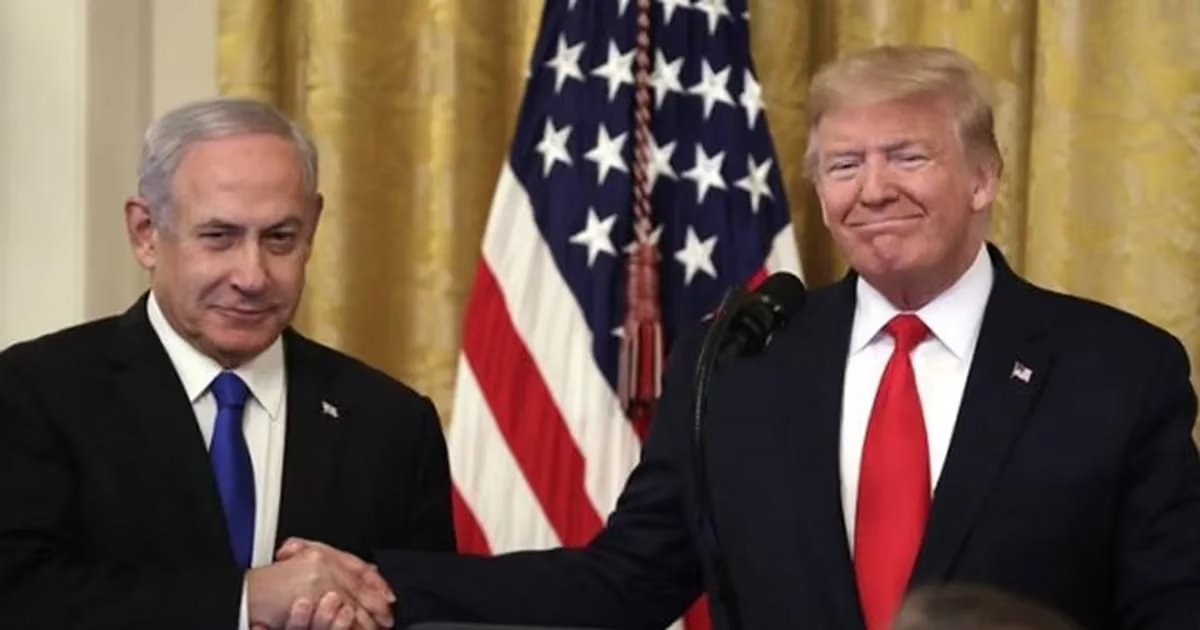
Beirut Hesitates on 'Summit Meeting' with Netanyahu: US Pressure and Fears of Internal Strife

Official circles in Beirut are dealing with extreme caution and clear reservation regarding American proposals for a direct meeting between Lebanese President Joseph Aoun and Israeli Prime Minister Benjamin Netanyahu. These moves come amid escalating political and military pressures accompanying the stalled negotiations under Washington's sponsorship, with Lebanese fears of an explosion of internal divisions.

The US administration is pushing for accelerated political and security negotiations, but the Lebanese leadership believes that any early meeting, while military aggression continues and large areas in the south are occupied, would be political suicide. Informed sources confirm that prudence is currently the master of the situation to avoid giving the occupation diplomatic gains without tangible returns on the ground.

In this context, sources revealed that the US Ambassador to Beirut, Michel Issa, tried to promote the idea of a tripartite meeting bringing together Aoun and Netanyahu in the presence of President Donald Trump at the White House. This proposal aims to find a direct entry point for launching comprehensive negotiations, but the Lebanese response was conditional on ending aggressive military manifestations first.

The US Embassy had previously linked Lebanon's obtaining international guarantees for its full sovereignty to holding this direct meeting. The American side considered that such a meeting could open the door to final security and border arrangements, in addition to the flow of humanitarian aid and reconstruction funds with a direct guarantee from Washington.

For his part, Lebanese President Joseph Aoun quickly set a clear ceiling for these proposals during his political meetings at Baabda Palace, emphasizing that the top priority is to stop the aggressions. Aoun clarified that his country is proceeding with negotiations because there are no alternative options, but he stressed that the goal is complete withdrawal, the return of prisoners, and the establishment of stability.

Political observers believe that negotiations have not actually started yet, and what has happened so far is nothing more than preparatory sessions between ambassadors in Washington. Beirut fears that any ill-considered meeting could give Netanyahu a free political achievement that he has not been able to achieve through the military machine in the southern field.

Analyses indicate that the Lebanese state fears that rushing into summit meetings could lead to serious internal tensions that might open the door to security strife. Therefore, the government insists that any high-level meeting must be the culmination of successful negotiations that achieve a complete withdrawal, and not just a ceremonial photo serving external agendas.

Beirut also adheres in its diplomatic discourse to the Arab Peace Initiative approved at the Beirut Summit in 2002, which links normalization to a comprehensive withdrawal from the occupied Arab territories. This commitment represents a bulwark against pressures trying to drag Lebanon into separate paths away from established national and patriotic principles.

In an attempt to find a diplomatic solution, proposals are currently being discussed to avoid a direct meeting by holding separate bilateral meetings between the Lebanese and Israeli presidents with the American president. This scenario aims to avoid embarrassing President Aoun internally and maintain the cohesion of the Lebanese political front while awaiting the maturation of initial security understandings.

On the technical front, preparations are underway for a third round of meetings at the level of Lebanese Ambassador Nada Hamadeh and Israeli Ambassador Yehiel Lit in the American capital. These rounds aim to establish a technical framework for direct negotiations at the level of military delegations, away from the pressing political spotlight that could hinder the process.

On the ground, occupation forces continue to violate the truce announced since mid-April, with ongoing bloody shelling and destruction of homes in border villages. This escalation on the ground further complicates the Lebanese position and makes the idea of sitting with Netanyahu unacceptable popularly and politically at present.

The Lebanese state finds itself facing difficult choices amid the imbalance of power and the massive destruction inflicted on infrastructure and civilians. Nevertheless, the primary bet remains on the ability of the Lebanese negotiator to extract a ceasefire without making political concessions that affect national sovereignty or legitimize the occupation.

On the other hand, Hezbollah's position is unequivocally against any form of direct negotiation, considering it a concession that benefits Tel Aviv. Despite this rejection, the party expresses support for diplomatic paths led by the state, provided they lead to an end to aggression and the implementation of clear agreements that preserve the country's dignity.

In conclusion, Lebanese authorities affirm that openness to negotiation does not in any way mean moving towards normalization, but rather it is a necessity to end the war. The Lebanese ceiling remains firm on the need to separate the technical security track from major political steps that require national consensus and regional conditions completely different from the current situation.

The timing is currently unsuitable for any meeting with Netanyahu before a security agreement is reached and Israeli aggressions against the country are stopped.

PALESTINE

Wed 06 May 2026 10:11 am - Jerusalem Time

Foreign Policy: Trump's Gaza Plan Faces a Dead End and a Vicious Cycle of Political Paralysis

Foreign Policy magazine painted a bleak picture of the future of the Gaza Strip, describing the current situation as a complete political and security stalemate that threatens to keep the region in a state of permanent instability. The analysis published by writer John Haltiwanger indicated that the current US administration has so far failed to provide a clear vision to overcome the deadlock that followed the announcement of the fragile ceasefire, which has led the political process into a vicious cycle.

The article highlighted the escalating crisis facing the peace plan proposed by US President Donald Trump, especially after Hamas adhered to its position rejecting disarmament before the complete withdrawal of the Israeli occupation army from the Strip. This fundamental contradiction in visions led to a complete paralysis in the implementation of the 20-point American plan, which was announced last September, putting the Strip in a dangerous state of stagnation.

According to the analysis, the challenge of disarmament has become the main obstacle preventing any progress on the ground, as the movement controls parts of the Strip while the occupation continues its presence in other wide areas. The US administration appears to lack an alternative strategy to deal with this reality, especially with Washington's increasing preoccupation with other regional issues, most notably the escalation with Iran.

For his part, US Secretary of State Marco Rubio affirmed that the core of the agreement is primarily based on disarming Hamas, considering it the central issue for a solution. Despite Rubio's attempts to create an atmosphere of optimism by talking about promising indicators, the data on the ground indicate the exact opposite, as Hamas refuses to give up its weapons until the Israeli withdrawal phases are completed.

In contrast, the Israeli government adopts a rigid stance that rejects any military withdrawal before ensuring the complete disarmament of Palestinian factions, which creates a gap of distrust that is difficult to bridge. This stark contradiction in preconditions has made it impossible to move to advanced stages of settlement, leaving civilians in Gaza to pay the price of this ongoing political impasse.

Shira Efron, an official at the American Rand Corporation, reinforced this argument by describing the situation as moving one step forward and two steps back, pointing to the absence of genuine will among the concerned parties. Efron, who resides in Tel Aviv, believes that Israel, Hamas, and even the Palestinian Authority are not actually seeking the success of the plan as much as they are trying to avoid blame for failure and shift it to the other side.

The plan was supposed to enter its second phase last January, which includes the formation of an interim technocratic government and the actual start of extensive reconstruction operations. However, none of these goals have been implemented, as the government has not started its work and the reconstruction wheel has not begun, despite the implementation of some limited aspects of the first phase related to prisoner exchange.

With this paralysis continuing, international and UN warnings are escalating about the possibility of the fragile truce collapsing and fighting resuming more widely and fiercely. UN officials warn that failure to resolve the disarmament issue could lead to a renewed explosion of the situation, putting Gaza at a critical crossroads that threatens a renewal of comprehensive conflict at any moment.

The entire agreement depends on the disarmament of Hamas, but the reality on the ground contradicts American optimism in the absence of a clear strategy to overcome the stalemate.

PALESTINE

Wed 06 May 2026 10:10 am - Jerusalem Time

Political moves by the Palestinian President's son raise questions about the future of succession in 'Fatah'

Informed sources have revealed intensive political moves by Yasser Abbas, son of Palestinian President Mahmoud Abbas, aimed at securing a seat for him in the senior leadership bodies of the Fatah movement. This step comes at a sensitive time for the Palestinian Authority, as a succession struggle looms with the approaching date of the movement's General Conference in Ramallah.

Yasser Abbas, 64, is expected to run for membership in Fatah's Central Committee, the highest leadership body in the movement, during the conference scheduled for mid-May. This conference is the first of its kind in nearly ten years, making it a pivotal moment in shaping the power map within the Palestinian political system.

Yasser Abbas, who for many years was known as a businessman managing huge investments in the tobacco and contracting sectors, has recently begun to appear publicly in an unofficial political capacity. He has been seen on several official occasions accompanying his father, including foreign visits that included meetings with international leaders such as Russian President Vladimir Putin and Egyptian President Abdel Fattah El-Sisi.

Sources reported that the President's son held a series of meetings in recent weeks with leaders of the security establishment in the West Bank, as well as representatives of the Prisoner's Club and influential forces in the Palestinian street. These meetings aim to rally the necessary support before the vote of approximately 2,500 conference members to elect the new leadership.

Reports indicate that President Mahmoud Abbas, who has turned 90, has begun to assign sensitive tasks to his son, most notably entrusting him last year with overseeing the Palestinian weapons file in Lebanese camps. Although Yasser has not previously held any official position in the Authority or the movement, his escalating influence has sparked widespread speculation about his preparation to succeed his father.

In contrast, these moves have been met with muted and public criticism from within Fatah circles, where opponents believe that promoting the President's son to the scene may deepen the crisis of trust between the street and the leadership. They warn that the absence of general elections since 2006 makes any change in leadership through appointment or inheritance popularly unacceptable.

Sabri Saidam, a current member of the Central Committee, commented on these reports by indicating that the movement's internal regulations allow any member who meets the conditions to run. Saidam expressed hope that the upcoming conference would inject new blood into the leadership to confront the complex challenges facing the Palestinian cause at the current stage.

The Palestinian Authority faces accumulated crises, including declining popularity and escalating accusations of corruption, as well as a suffocating financial crisis resulting from Israel's withholding of tax revenues. In light of this reality, observers believe that Yasser Abbas's entry into politics may further complicate the scene rather than provide solutions to existing crises.

Critics believe that the Abbas family has exploited its political influence to promote its commercial interests in the West Bank, accusations that Yasser and his brother Tareq have always denied. However, the link between money and power remains a weakness exploited by opponents to question the legitimacy of any future political role for the President's sons.

Prominent names in the succession race include Hussein Al-Sheikh, Secretary-General of the PLO Executive Committee, and Marwan Barghouti, who is imprisoned in Israeli jails. Barghouti enjoys overwhelming popularity in opinion polls, making any attempt to impose an alternative a daunting task for the presidential institution in Ramallah.

Political analyst Reham Odeh indicated that Yasser Abbas's success in reaching the Central Committee does not necessarily mean his popular acceptance in any future presidential elections. She explained that the Palestinian street looks forward to a comprehensive democratic process that ends the state of political stagnation that has lasted for nearly two decades.

The Palestinian Authority was established under the Oslo Accords as a temporary entity, but over time it transformed into a permanent administration facing existential challenges amid settlement expansion and the collapse of the peace process. The current leadership struggle further increases the uncertainty about the future of the Palestinian national project.

Sources within Fatah described Yasser Abbas's potential role as merely the 'beginning' of a plan aimed at bringing him to the Executive Committee of the Palestine Liberation Organization. This path would grant him legal and political influence that extends beyond the movement's boundaries to represent the Palestinian people in international forums.

While the President's office remains silent regarding these reports, anticipation remains the dominant sentiment awaiting the outcome of the Fatah conference in May. The results of this conference will have a significant impact on determining whether the Authority will move towards radical reforms or continue its approach of maintaining the status quo by rotating positions within the inner circle.

Abbas is trying to poke holes in Fatah's ship by installing his son as an heir, and the movement's men must confront and reject this.

ISRAELI AFFAIRS

Wed 06 May 2026 10:10 am - Jerusalem Time

Between the Nuclear Deal and the Strait of Hormuz.. An Israeli Reading of Trump's "Dilemma" with Iran

Political and intelligence circles within the Israeli occupation state are experiencing a state of anticipation and concern regarding the path the American administration is taking in its dealings with the Iranian file. Observers believe that negotiations between Washington and Tehran have reached a dead end, which has placed President Donald Trump before a series of options, all described as 'bad' and difficult to implement.

In this context, General Eldad Shavit, a researcher at the Institute for National Security Studies and former head of the research department at the Mossad, stated that Trump is trying to market an image of 'victory' to the American public and the world. Trump claimed in his statements that the pressures succeeded in destroying Iran's military power, but the reality indicates that there is no basis for this narrative given the continuation of field challenges.

Shavit pointed out in an analysis published by Hebrew media that the fundamental question lies in the extent of Washington's actual control over the scene; if Iran has truly been defeated, why does it refuse to submit to American conditions? And why do commercial ships still face direct threats in international waterways, exposing freedom of navigation to constant danger?

The American administration faces a real dilemma in the Strait of Hormuz, which has become a focal point in the current conflict, where experts believe that any miscalculation or misinterpretation of military movements could lead to a wide-ranging conflict. This scenario completely contradicts Trump's electoral promises in which he pledged to avoid engaging in long and costly wars.

Intelligence sources believe that Iran is trying to delay reaching a partial agreement through calculated escalation, to present it later as a limited measure aimed at protecting its interests. This tactic puts Washington in a defensive position, where it is content with managing the current crisis instead of finding radical solutions that completely end Iran's nuclear ambitions.

For the Israeli side, the danger lies in the possibility of Trump accepting a partial agreement that may seem strategically weak, which gives Tehran an opportunity to gain time. Tel Aviv fears that this path will lead to Iran retaining its enriched uranium stockpile, allowing it to quickly restore its nuclear capabilities in the future.

Shavit believes that American action against nuclear components or Iranian pressure tools in the seas may be seen in Washington as an attempt to regain the initiative. However, these limited military steps may not achieve their desired goals, but may give Tehran an additional incentive to escalate in other regional arenas where it has strong influence.

Israeli concerns are mainly focused on two central questions: the first relates to the fate of the technical nuclear capabilities that Iran currently possesses, and the second relates to the Lebanese arena. Tel Aviv is carefully monitoring Washington's attempts to prevent regional escalation, fearing that this may come at the expense of the vital security interests of the occupation state.

The analysis clarifies that what Trump might consider a major political achievement serving his campaign, may represent a dismal failure from the perspective of military leaders in Israel. The primary goal for the occupation is not merely to bring Iran back to the negotiating table, but to permanently strip it of the ability to possess a military nuclear weapon.

Amidst the ongoing crisis, the American president finds himself in a political 'trap', as Tehran does not respond to his basic demands, while internal and external pressures on him increase. It has become difficult for the White House to present the current situation as a clear diplomatic success, especially with the Strait of Hormuz turning into a powder keg ready to explode.

Intelligence readings indicate that the coming days will be decisive, as Trump may be forced to make military decisions he did not want in order to break the stalemate. The American desire to avoid war clashes with a field reality that forces it to act to protect its international prestige and ensure the security of navigation in the most important global energy corridors.

Sources confirm that Israel is pushing for no concessions on the enrichment issue, considering that any American retreat on this file would represent an existential threat to it. Israeli circles demand the necessity of strict international guarantees that prevent Iran from rapid recovery after any potential agreement, which seems out of reach at present.

In conclusion, the complex scene shows that the options available to Washington are narrowing day by day, while Iran continues to use its naval and nuclear power cards to maneuver. This situation puts Israeli interests at stake, awaiting the outcome of upcoming American moves amidst mutual threats.

What can be considered a political achievement for Trump, may be considered an unsatisfactory result in Tel Aviv, which fears the retention of Iranian nuclear capabilities.

ARAB AND WORLD

Wed 06 May 2026 10:10 am - Jerusalem Time

German Foreign Minister Supports Continued Israeli Presence in Southern Lebanon, Sa'ar Denies Annexation Ambitions

German Foreign Minister, Johann Wadephul, explicitly expressed his support for the continued presence of Israeli army forces in specific areas of southern Lebanon, considering it a necessary step to secure northern Israeli areas from Hezbollah attacks. This stance came during a press conference held in the capital Berlin with his Israeli counterpart, Gideon Sa'ar, who is on an official visit to Germany to discuss regional developments.

The German minister stressed the necessity for the Lebanese government to act decisively to implement measures to disarm Hezbollah, while at the same time condemning the military operations carried out by the party against Israeli targets. Despite his support for the Israeli military presence, he warned against ending the conflict by targeting Lebanese civilians or turning their country into an open war zone.

For his part, Israeli Foreign Minister Gideon Sa'ar claimed that Tel Aviv has no expansionist ambitions in Lebanese territories, and that ground operations are limited to purely defensive objectives. Sa'ar indicated that settlers in the north are living in a difficult security reality, claiming that the ground incursion aims exclusively to provide them with protection and prevent border threats.

In a related context, Wadephul expressed his hope that the ongoing negotiations between the Lebanese and Israeli sides would succeed in reaching a sustainable agreement that protects civilians from both sides. He affirmed that the sight of young generations in Lebanon growing up amidst the rubble of destroyed homes is morally unacceptable and will not contribute to enhancing Israel's long-term security.

On the ground, sources reported that the Israeli occupation army carried out about 60 aerial and ground attacks on various areas in Lebanon during the past twenty-four hours. These aggressions resulted in the martyrdom of five people and the injury of others, amidst the continued aggression that has been escalating significantly since the beginning of last March.

In contrast, Hezbollah announced the execution of 17 military operations targeting gatherings of occupation soldiers, military vehicles, and tanks in contact areas in southern Lebanon. Field sources confirmed that these operations came in response to continuous Israeli incursions and attempts to establish new military points within Lebanese territories.

Reports indicate that the occupation army continues systematic demolition operations and the bombing of residential blocks in border towns, despite a fragile ceasefire agreement. The occupation has established a buffer zone up to 10 kilometers deep, where the presence of residents or journalistic teams is prohibited, deepening the humanitarian crisis in those areas.

Occupation forces also imposed what they called the 'Yellow Line,' a field demarcation that separates dozens of southern villages from their geographical surroundings and the rest of the Lebanese regions. These measures come as part of attempts to impose a new geographical and security reality by force, amidst international silence regarding these violations that affect Lebanese sovereignty.

According to the latest statistics from the Lebanese Ministry of Health, the toll of victims of the Israeli aggression since March 2nd has reached about 2,700 martyrs, in addition to more than 8,200 injured. These figures illustrate the scale of the humanitarian catastrophe caused by the intense and continuous shelling of residential areas and civilian facilities in various governorates.

On the political front, it appears that the ceasefire agreement reached in mid-April is facing the risk of complete collapse due to repeated Israeli violations. Despite the extension of the agreement until this May, military operations and the partial occupation of some southern villages are still ongoing, emptying the agreement of its content.

HUMANITARIAN suffering continues in southern Lebanon with Israel's insistence on continuing its scorched-earth policy and destroying the infrastructure of border towns. The international community is cautiously monitoring the outcomes of these developments, amidst conflicting German diplomatic statements and the reality on the ground imposed by the occupation.

It is unacceptable for the young generation in Lebanon to grow up amidst the ruins of their parents' homes, and this will not make Israel safer.

OPINIONS

Wed 06 May 2026 5:34 am - Jerusalem Time

The Ideology Behind the Policy: How FDD’s Worldview Is Shaping Trump’s Iran Strategy


By: Said Arikat


May 6, 2026


News Analysis


Washington, D.C-The quiet insertion of a senior operative from the Foundation for the Defense of Democracies (FDD) into Donald Trump’s Iran negotiating team is not a routine staffing decision. It is a revealing moment—one that exposes the deeper ideological architecture driving U.S. policy in the Middle East. Nick Stewart’s appointment to Steve Witkoff’s team signals not a turn toward diplomacy, but a consolidation of a long-standing agenda rooted in confrontation, coercion, and alignment with Israeli strategic priorities.


To understand the significance of this move, one must first confront what FDD is and what it represents. Established in the aftermath of 9/11, the organization has consistently positioned itself as a hardline advocate for militarized U.S. foreign policy in the Middle East. Critics have long argued that FDD functions less as an independent think tank and more as an ideological extension of Israeli security doctrine. Its intellectual framework has repeatedly mirrored the priorities of successive Israeli governments, particularly in its uncompromising stance on Iran and its rejection of Palestinian political claims.


Beyond its policy advocacy, FDD’s influence is inseparable from the network of donors who have sustained and amplified its reach. Chief among them was the late casino magnate Sheldon Adelson, alongside his wife Miriam Adelson. Adelson, until his death in 2021, was one of the most prominent financial backers of hawkish pro-Israel causes in Washington, and a central figure in Republican political funding. Miriam Adelson has since carried forward that role, emerging as one of Donald Trump’s most significant donors in the 2024 presidential election cycle. Their financial support has not only underwritten institutions like FDD but has also helped align political power, policy advocacy, and ideological messaging in ways that continue to shape U.S. Middle East policy at its highest levels.


This alignment has had tangible consequences. During Trump’s first term, FDD played a pivotal role in shaping some of the most consequential—and controversial—decisions in modern U.S. Middle East policy. Chief among these was the relocation of the U.S. embassy from Tel Aviv to Jerusalem in 2018. While presented as a recognition of “reality,” the move effectively endorsed Israel’s unilateral claim over the contested city, disregarding decades of international consensus and diplomatic precedent. FDD figures were among the most vocal proponents of this shift, lobbying aggressively within the administration and framing it as both strategically necessary and morally justified.


The embassy move was not an isolated act. It was part of a broader policy package that systematically dismantled the already fragile infrastructure of U.S.-Palestinian engagement. The closure of the American Consulate in East Jerusalem—an institution that had operated for more than 130 years as a direct channel to Palestinians—was another decisive step. Its absorption into the newly relocated embassy symbolized the erasure of a distinct American diplomatic presence in Palestinian affairs. Once again, voices aligned with FDD supported the move, arguing that separate diplomatic tracks for Israelis and Palestinians were unnecessary—a position that effectively denied the political reality of occupation.


Equally consequential was the Trump administration’s decision to cut off all U.S. funding to the United Nations Relief and Works Agency for Palestine Refugees (UNRWA). This move targeted one of the most critical lifelines for millions of Palestinian refugees across the region. FDD had long campaigned against UNRWA, portraying it as an obstacle to peace rather than a humanitarian necessity. The funding cut not only exacerbated an already dire humanitarian situation but also aligned with a broader effort to redefine—and ultimately diminish—the Palestinian refugee issue itself.


Against this backdrop, Stewart’s appointment takes on a deeper meaning. It suggests continuity, not change. It indicates that the same ideological forces that shaped Trump’s earlier Middle East policies are once again asserting influence—this time in the context of escalating tensions with Iran.


The timing is particularly telling. Reports indicate that Iran has submitted a proposal aimed at de-escalation and a potential end to hostilities within 30 days. Yet Trump’s response has been dismissive, framing the proposal as insufficient and reiterating a preference for continued pressure. The inclusion of an FDD figure in the negotiating team reinforces the perception that diplomacy is not the primary objective. Instead, the goal appears to be the maintenance—and intensification—of a pressure campaign designed to weaken Iran economically and strategically.


This approach is consistent with FDD’s long-standing advocacy. The organization was a key supporter of the U.S. withdrawal from the Joint Comprehensive Plan of Action (JCPOA) in 2018, a move that dismantled a functioning multilateral agreement in favor of a “maximum pressure” strategy. The results of that strategy are now evident: increased regional instability, accelerated Iranian nuclear activity, and a near-total collapse of diplomatic trust.


What makes the current moment particularly dangerous is the convergence of ideology and power. When a think tank with a clear and consistent bias toward confrontation gains direct access to policymaking, the line between analysis and advocacy becomes blurred. Policy is no longer shaped by a balance of perspectives but by a singular worldview—one that sees compromise as weakness and diplomacy as concession.


The broader implications extend beyond Iran. They speak to the erosion of U.S. credibility as a neutral actor in the Middle East. Decisions such as the embassy move, the consulate closure, and the UNRWA funding cut have already signaled a departure from even the pretense of balance. The re-emergence of FDD’s influence risks further entrenching this perception, making it increasingly difficult for the United States to function as an effective mediator in regional conflicts.


Moreover, the reliance on ideologically aligned institutions raises fundamental questions about the policymaking process itself. To what extent are U.S. foreign policy decisions being driven by national interests, and to what extent are they shaped by external agendas and lobbying networks? The case of FDD suggests that these lines are increasingly difficult to distinguish.


In the end, Stewart’s appointment is not just about one individual or one negotiation team. It is about the persistence of an approach that prioritizes pressure over dialogue, alignment over independence, and ideology over pragmatism. If history is any guide, this path is unlikely to produce stability—let alone peace.


Instead, it risks repeating the same cycle: escalation, isolation, and missed opportunities for diplomacy. And in a region already burdened by decades of conflict, that is a cost the world can ill afford.

ARAB AND WORLD

Tue 05 May 2026 1:03 pm - Jerusalem Time

Intelligence Assessments: Military Strikes Failed to Achieve Decisive Breakthrough in Disrupting Iran's Nuclear Program

Informed sources reported that US intelligence assessments indicate that the timeline Iran needs to develop a nuclear weapon has not fundamentally changed since last summer. This assessment comes despite widespread air attacks launched by US and Israeli forces, which were believed to have delayed Iran's nuclear program by up to a full year.

The sources stated that estimates of Tehran's nuclear capabilities have remained largely stable, even two months after the military operations launched by President Donald Trump's administration. This stability in the timeline reflects a significant challenge to the declared goals of the war, foremost among which was to definitively prevent the Islamic Republic from acquiring a nuclear bomb.

Analysts believe that achieving a real and sustainable disruption in Iran's nuclear program requires more than just aerial bombardment, as it necessitates the complete destruction or removal of its highly enriched uranium stockpile. Reports clarified that this goal has not yet been achieved, leaving the program's intellectual and material infrastructure capable of recovery and operation within close timeframes.

Intelligence agencies had estimated, prior to the outbreak of military confrontation in June 2025, that Iran was capable of producing enough uranium for one bomb within a period ranging from three to six months. With the targeting of vital facilities such as Natanz, Fordow, and Isfahan, this timeline extended to between nine months and a year, a delay described as 'limited' compared to the scale of the attacks.

In a related context, the International Atomic Energy Agency (IAEA) expressed concern over its inability to locate approximately 440 kilograms of 60% enriched uranium. International estimates suggest that these quantities may have been moved and stored in fortified underground facilities in the Isfahan region, following the suspension of international inspections that were previously in place.

IAEA data indicates that Iran's current stockpile of highly enriched uranium could be sufficient to produce about ten nuclear bombs if a decision is made to raise enrichment levels to weapons-grade. This stockpile represents the biggest obstacle to international efforts aimed at curbing Iran's nuclear ambitions through traditional military means alone.

For her part, White House spokeswoman Olivia Wells stated that recent military operations succeeded in destroying large parts of Iran's nuclear facilities. Wells affirmed that the Trump administration remains committed to preventing Tehran from acquiring any nuclear weapon, emphasizing that military pressure will continue until all strategic objectives are achieved.

Regarding military objectives, US officials, including Vice President J.D. Vance, explained that the war directly aimed to end the Iranian nuclear threat. However, the disparity in results stems from Israeli strikes focusing on nuclear sites, while US attacks concentrated on destroying conventional military capabilities and defense industry infrastructure.

In an analysis of the situation, Eric Brewer, a former US intelligence analyst, said that Iran still retains essential nuclear materials despite the bombing. Brewer added that Tehran has apparently succeeded in distributing its stockpile to deep and highly fortified sites that are difficult to access via conventional airstrikes, giving it resilience and maneuverability.

Reports indicate that officials in Washington discussed more escalatory options for dealing with this issue, including the possibility of special ground operations. These proposed operations aim to recover or destroy stockpiles of highly enriched uranium located in underground facilities, specifically in the fortified complexes in the city of Isfahan.

On the other hand, Iran continues to categorically deny seeking to acquire deadly weapons, asserting that its program is for peaceful purposes only. Tehran bases its defense on previous reports that indicated the cessation of its warhead development program since 2003, despite continued Western doubts about its retention of files and technical elements from that program.

In conclusion, international experts such as David Albright believe that the assassinations of Iranian nuclear scientists may have a deeper long-term impact than aerial bombardment. Albright explained that the loss of human technical expertise increases uncertainty about Tehran's ability to assemble an effective nuclear weapon, emphasizing that 'knowledge does not die' but the ability to implement it is severely affected.

Knowledge is not destroyed by aerial bombardment, but technical expertise and the ability to implement are what are affected by the assassination of scientists and the targeting of facilities.

PALESTINE

Tue 05 May 2026 1:02 pm - Jerusalem Time

Albanese launches her book 'When the World Sleeps' in Athens and accuses the occupation of exploiting Greece's fears

The Greek capital, Athens, witnessed a prominent cultural and political event for the launch of the new book by the UN Special Rapporteur on Human Rights in the Occupied Palestinian Territories, Francesca Albanese. The book, titled 'When the World Sleeps – Stories, Words, and Wounds of Palestine,' seeks to shed light on the lived reality of Palestinians, away from narratives that marginalize their human suffering.

During her speech at the ceremony, Albanese sharply criticized the occupation's policies, noting that Tel Aviv seeks to exploit Greece's security concerns to advance its own interests in the region. She affirmed that her book includes ten real-life stories that give Palestinians a voice and clear human features in the face of the war machine that attempts to erase their identity and fundamental rights.

The new literary and documentary work focuses on three core axes, starting with emphasizing the humanity of the Palestinian people and their inherent right to dignity and equality. The book also stresses the necessity of activating international accountability mechanisms against Israeli occupation leaders involved in grave violations of international humanitarian law, while demanding non-selective justice for victims.

Through the chapters of her book, Albanese reviews the details of daily life under the burden of siege and aggression in the Gaza Strip, and the harsh conditions faced by the residents of Jerusalem behind the separation wall and military checkpoints. The book also addresses the escalating violence of settlers and the army in West Bank cities such as Hebron and Nablus, documenting the suffering of children and civilians in those areas.

In a related political context, the UN Rapporteur warned against the occupied Palestinian territories becoming a 'testing laboratory' for Israeli military technologies and advanced espionage software. She explained that these weapons are field-tested on the bodies and lives of Palestinians before being exported and marketed to other countries as products proven effective in the field.

Albanese concluded the event by calling for serious international action to hold accountable governments and companies that conclude arms deals or commercial exchanges with the occupation system. She stressed the importance of investigative journalism and parliamentary inquiries in exposing these abuses, affirming that continued global silence is what fuels ongoing crimes against the Palestinian people.

The occupying state uses Palestinian territories as a laboratory to test its weapons and espionage programs before marketing them globally.

PALESTINE

Tue 05 May 2026 1:02 pm - Jerusalem Time

After a year and a half of his declared martyrdom.. A Gazan family receives news of their son being alive in occupation prisons

A state of shock mixed with tears prevailed in the Abu Shaar family home in Gaza City, after the mother, Maha Abu Shaar, received a phone call from a lawyer confirming that her son Eid was still alive. This news came after a year and a half of ambiguity surrounding the young man's fate, as the family and surrounding parties firmly believed that he had been martyred during the ongoing war.

The chapters of suffering began on December 15, 2024, when the young man Eid went out to look for a job near the Netzarim axis area in the central Gaza Strip and has not returned since. From that moment, all means of communication with him were cut off, which led the family on an arduous search journey that included hospitals and international Red Cross centers without success, only to later receive unofficial news of his martyrdom.

The mother bitterly recounts how she lived long months of pain, but she categorically refused to perform the absentee funeral prayer for her son, emphasizing that a mother's intuition guided her towards hope. As soon as she heard the lawyer's voice confirming the news, the mother entered a hysterical crying fit, pleading for confirmation of the information that thousands of Palestinian families, who still do not know the fate of their missing children, had been waiting for.

For his part, Saleh Abu Shaar, the prisoner's cousin, explained that the family had knocked on every possible door and contacted various relevant authorities since his disappearance in December 2024. He pointed out that the Israeli occupation deliberately concealed any information about his fate throughout the past period, before recently allowing information about his presence inside its detention centers to be leaked.

The prisoner's father recalled the harsh search journey that led him to the martyrs' morgues in various hospitals in the Strip, where he was looking for any trace of his eldest son among the victims. The father confirmed that the information that reached the family about a month ago began to indicate his presence in 'Ofer' prison, which was officially confirmed through the legal visit and recent contacts made by the lawyer with the family.

In a scene reflecting Palestinian social traditions in dealing with loss, the prisoner's grandfather indicated that the family had already set up a mourning house for their grandson after losing hope of finding him alive. Today, the mourning house has turned into a joyful gathering and the distribution of sweets, amidst wishes that this joy will be completed with Eid's release from captivity and his actual return to his home in Gaza.

The family stressed in their conversation with media sources that their young son does not belong to any political or military organization, and that his departure on the day of his disappearance was motivated by the search for a livelihood in light of the harsh economic conditions. This incident once again highlights the issue of missing persons in the Gaza Strip, which is one of the most complex issues in light of the ongoing Israeli military operations.

Official statistics indicate that the genocide war launched by Israel on the Strip since October 2023 has left tens of thousands of martyrs and wounded, as well as thousands of missing persons under the rubble or in occupation prisons. Thousands of Palestinian families await a miracle similar to what happened with the Abu Shaar family, to end the state of anxiety and anticipation that has been gnawing at their hearts for years.

I never agreed to perform the absentee funeral prayer, my heart always told me that my eldest son was still breathing and would return to my embrace one day.

ARAB AND WORLD

Tue 05 May 2026 1:02 pm - Jerusalem Time

Obama: Netanyahu Repeated to Trump the Same Justifications for War on Iran He Previously Gave Me

Former US President Barack Obama revealed the behind-the-scenes pressures exerted by Israeli Prime Minister Benjamin Netanyahu to push Washington towards a military confrontation with Tehran. Obama explained in a recent press interview that Netanyahu presented current President Donald Trump with the same pretexts and arguments he had previously put forward during his presidency, with the aim of inciting a comprehensive war against Iran, affirming that his previous vision regarding these demands remains accurate and steadfast.

Obama expressed deep skepticism about the strategic utility of these moves, questioning whether Netanyahu's objectives truly served the interests of the Israeli people or American national security. He noted that the disagreements between him and the Israeli Prime Minister are historically documented, especially concerning the nuclear deal concluded in 2015, which Obama considered a means to prevent escalation, while Netanyahu sought to undermine it until he succeeded in convincing Trump to cancel it in 2018.

The former president touched upon the catastrophic repercussions that followed the collapse of the nuclear deal, as Iran has since sought to rapidly enhance its nuclear capabilities. Sources indicated that this confrontational path ultimately led to the outbreak of two major military confrontations, the first beginning in the summer of 2025, while the second erupted in late February 2026, reflecting the failure of the maximum pressure policy to achieve regional stability.

In the context of his criticism of the current political discourse, Obama commented on the violent threats recently directed by Donald Trump against Iran, in which he hinted at the annihilation of an entire civilization. Obama considered that such statements lack basic respect for human dignity, emphasizing that the responsibility of American leadership requires protecting innocent people even in countries ruled by autocratic regimes, rather than being drawn into the language of mass destruction.

Obama concluded his remarks by warning against abandoning core values and falling into the trap of arrogance and political selfishness in managing international crises. He warned that the absence of wisdom in dealing with thorny issues could lead to the collapse of the global order in catastrophic and unpredictable ways, calling for the necessity of adhering to human values to ensure that strategic mistakes, for which the entire world would pay the price, are not made.

Netanyahu may have achieved what he wanted, but does this ultimately serve the interests of the Israeli people? I doubt it.

ISRAELI AFFAIRS

Tue 05 May 2026 1:02 pm - Jerusalem Time

Economic Corridor Project: Israel Prepares to Become a Land Bridge Connecting India to Europe

The Israeli government is preparing in the near future to approve a practical decision, the first of its kind, to implement the Economic Corridor Project (IMEC), which was announced by US President Joe Biden in September 2023. This ambitious project aims to create a continental connectivity axis extending from India through Middle Eastern countries to Europe, transforming Israel into a vital land bridge connecting East and West.

The relevant government ministries are currently working to accelerate plans for the Israeli section of the initiative, which includes the construction of a dedicated railway for transporting goods coming from India via Mediterranean ports. The plan is not limited to land transport only, but also includes the extension of advanced communications and energy infrastructure, such as fiber optics and oil and gas pipelines alongside the train route.

A study conducted by the Israeli Ministry of Finance showed the enormous economic potential of this axis, especially in light of the security challenges faced by maritime straits such as Hormuz, Bab al-Mandab, and the Suez Canal. The project seeks to create an alternative geographical route that ensures the flow of time-sensitive goods and avoids delays caused by the closure of international waterways.

Initial estimates indicate that limited implementation of the project is capable of injecting approximately one billion shekels annually into the state treasury from transit and operation fees alone. Experts also expect that the large volume of goods flow will lead to a reduction in the cost of living in Israel, as a result of improved supply chain efficiency and reduced international shipping costs.

As part of the first implementation phase, the Ministry of Transport will begin detailed planning for the construction of a 12-kilometer railway connecting the city of Beit She'an with the Jordan River crossing (Sheikh Hussein). This step aims to complete the railway link with the eastern side, ensuring the smooth movement of trains between Israel and its neighbors in the region within the regional network.

The plans also include a feasibility study to double the railway lines leading to Haifa Port to accommodate the expected increase in cargo shipments. In parallel, work will be done to expand the capacity of border crossings, with plans to increase the capacity of the Jordan River crossing from 50,000 trucks annually to more than 210,000 trucks, along with the establishment of land ports and advanced logistics areas.

On the security front, the government is working to develop advanced technological surveillance systems that allow for precise inspection of trains and shipments without the need to unload them or disrupt their movement. These technologies aim to ensure the security of regional trade and maintain the credibility of the new land route as a safe and fast option for international companies and investors.

For his part, Finance Minister Smotrich affirmed that this project represents a strategic breakthrough that enhances Israel's security and economic standing in the region. During discussions with the Indian side, he stressed the need to accelerate implementation steps, considering that the project aligns with a broader vision that includes joint energy projects such as the proposed gas pipeline between Saudi Arabia and Israel.

Israel is no longer a villa in the jungle, but an integral part of the regional economic fabric and a strategic growth engine.

OPINIONS

Tue 05 May 2026 1:02 pm - Jerusalem Time

American Voters.. A Negative View Towards Israel

Recent polls conducted by several national public opinion research institutions, including American voters, have shown a sharp decline in public support for Israel. For example, a Gallup poll last February showed that when participants were asked who they sympathized with most, 41% chose Palestinians, compared to only 36% who chose Israel. This contrasts significantly with the results of the same Gallup poll in 2023, where 54% of participants expressed sympathy for Israel, while 36% expressed sympathy for Palestinians. Then, a few weeks ago, the Pew Research Center published a poll showing that 60% of participants had a negative view of Israel. To better understand these changes in voter opinions, the role of Israel's wars with Lebanon and Palestinians in shaping their perspectives, and how voters want the US government and members of Congress to deal with this issue, the Arab American Institute and the organization "Voters for Justice in Palestine," in North Carolina, commissioned "John Zogby Strategies" to conduct a nationwide poll on these issues. The poll included 1001 potential American voters (with a margin of error of +/- 3.2). It is clear that Israeli behaviors are no longer accepted by the majority of American voters, and have even been rejected by supporters of Israel. For example, 41% of voters believe that Israeli actions against Palestinians are "excessive and amount to genocide," while only 32% disagree. The difference among "Democrats" is much larger. Answers to a question about whether the United States should do more to pressure Israel to end its occupation of Palestinian territories show similar results. These issues and others related to Israel's behavior receive continuous opposition to Israel's policies, primarily from "Democratic" or independent voters. This opposition is led by sub-categories of young or non-white voters. There is also a deep demographic divide among "Republican" voters, with young "Republicans" (under 45) holding negative views towards Israel's actions that are closer to those of "Democrats" than to those of older "Republicans." In fact, in almost all survey questions, the only real base of support that Israel can rely on is older, white "Republican" voters. This group constitutes a dwindling minority of the overall electorate. The poll results also show that there are electoral consequences associated with these shifts, as the majority of voters believe they would be more inclined to support candidates who call for reducing or ending military aid to Israel (45% versus 27%), or who reject funding or support from sources associated with the American Israel Public Affairs Committee. Rejection rates are much higher (more than double) among "Democrats," independents, and non-white voters. The majority of "Democrats," "Republicans," and independents (and all major demographic groups) agree on the need to hold Israel accountable and prosecute it for the killing of American citizens, with 58% of potential voters believing Israel should be held accountable, compared to only 16% who oppose its prosecution. The same applies to Israel's bombing of Lebanon, with potential American voters, by a two-to-one margin, believing that the US administration should do more to pressure Israel to stop the bombing and withdraw from southern Lebanon. By a nearly two-to-one margin, voters express concern that Israel's bombing and occupation of Lebanon harms US interests in the Middle East. In both cases, these percentages apply to all major demographic groups except "Republicans," who are divided on the issue. While voters express clear negative opinions towards Israel's actions and support a US policy that pressures Israel to curb its actions and hold it accountable, the poll also shows that a significant minority (between a quarter and a third of all respondents) honestly admit the need for more information before making decisions on some of the political issues raised. As the midterm elections approach, there are indications that voters' aversion to Israel and its policies is already affecting Congress and the upcoming midterm elections. Last month, 40 out of 47 US senators, who are "Democrats" or allied with them, voted to block certain military supplies to Israel, an unprecedented number of elected officials who have taken such a stance in an election year. This included the majority of Jewish American senators. Dozens of members of Congress have also publicly pledged to reject support from pro-Israel lobbying groups in their re-election campaigns. Although some of these members were previously major recipients of funding from pro-Israel donors. These are important and significant developments, and it is important to note them in the future.

OPINIONS

Tue 05 May 2026 1:02 pm - Jerusalem Time

On the Brink of Explosion: How Israelis Read the Escalation... and How They Push Towards It?

It is not new for Israeli military analysts to warn of the danger of escalation, but what is new is the way this warning is framed, where a tone of genuine concern is mixed with a calculated amount of dramatic suspense, in the context of a clear attempt to rearrange responsibilities, so that Israel appears to be standing on the sidelines observing, not as an active party contributing to shaping the course of events. In many Israeli readings, the Gulf turns into something akin to an open theater, and cinematic metaphors are invoked to describe what is happening, as if we are watching an “action movie on the shores of Hormuz.” However, this language is not innocent; rather, it reflects a mentality that sees war as an event whose rhythm can be controlled, or even exploited, as long as it does not directly rebound on the Israeli interior, and as long as its cost remains distributed across other arenas. Within this narrative, the scene is reduced to one character, Donald Trump, who is presented as the ultimate decision-maker, solely capable of pushing the region into war or bringing it back to calm. This reduction seems convenient for Israel, because it shifts the center of gravity to Washington and reduces its presence as a pressuring party, even though its actual behavior indicates the opposite. In reality, Trump's behavior reveals a clear contradiction between rhetoric and practice; he threatens to destroy Iran, but avoids engaging in an all-out war, and escalates politically and militarily at the same time he seeks a way out. This contradiction cannot be separated from the American domestic context, where war fatigue is increasing, and concerns about its economic repercussions, especially regarding energy prices, are growing. Thus, Trump seems to be seeking a political achievement without being dragged into the cost of war, which is an inherently fragile equation, because it constantly pushes the opposing party to test its limits. In contrast, Iran does not seem far from this logic, as it practices a form of calculated escalation that approaches the brink of confrontation without crossing it. Strikes targeting oil interests or maritime passages are not necessarily intended to ignite an all-out war, but rather aim to establish a deterrence equation and convey precise messages about the ability to inflict harm. However, this type of “critical balance” remains fraught with risks, because the accumulation of calculated steps may at some point lead to a loss of control. In this specific context, Israel appears as an “absent presence” in the discourse, but in reality, it is a key player in pushing towards expanding the circle of tension. Benjamin Netanyahu is not content with supporting the option of confrontation with Iran, but also works in parallel to keep the surrounding fronts in a state of low-intensity ignition, whether in Lebanon or in the Gaza Strip. In Lebanon, the ceasefire cannot be considered effective in the true sense, as strikes continue within carefully drawn limits, keeping the escalation under control without ending it. This situation does not reflect stability as much as it expresses continuous management of tension, where the possibility of sliding into a wider confrontation remains present at any moment, especially given the fragility of the rules of engagement. Between these two fronts, the limits of escalation are not only drawn by field considerations, but also by a broader political ceiling imposed by Washington. The rhythm within which operations move, in Lebanon as in Gaza, is inseparable from the calculations of the American administration, which tries to control the level of engagement and prevent it from sliding into a comprehensive regional confrontation. Thus, the question is no longer only related to what Israel wants or what other powers respond with, but to the extent to which Donald Trump is willing to allow these limits to be crossed, or redrawn according to his interests and internal balances. As for Gaza, matters take on a clearer character, where indicators accumulate of preparations for a new phase of escalation, through escalating political and military rhetoric, and re-proposing objectives that were not resolved in previous rounds. In this context, Gaza does not appear to be merely a separate arena of confrontation, but part of a broader pressure system used within regional calculations, which also applies to the Lebanese front. In this sense, Israel is not content with monitoring the escalation, but contributes to shaping its environment, by maintaining a permanent state of tension that allows it to maneuver, and keeps confrontation options open without bearing the cost of a full-scale explosion. Despite all this escalation, another path, less present in the media, is not absent, which is the continuation of indirect negotiation channels, revealing that the region is not necessarily heading towards an inevitable war, but is experiencing a state of continuous bargaining under fire. Iran links any progress to the lifting of the blockade, while the United States seeks to extract concessions on the nuclear file, while each party uses escalation tools to improve its negotiating terms. However, this overlap between negotiation and escalation creates an extremely fragile situation, where stability becomes dependent on the ability of all parties to precisely control the rhythm, which cannot be guaranteed given the multiplicity of fronts and the intertwining of interests. In light of this, the danger does not lie in a clear intention to launch an all-out war, but in the nature of the stage itself, where contradictory calculations intersect: an American administration seeking an achievement without cost, Iran practicing a policy of brinkmanship, and Israel pushing towards expanding the circle of engagement without being its direct arena. In such an environment, wars do not need major decisions as much as they need a small mistake. Then, the confrontation will not remain confined to the Gulf, and the fronts will not remain separate, but the entire region may turn into an open arena that is difficult to contain or predict its outcomes.

OPINIONS

Tue 05 May 2026 1:01 pm - Jerusalem Time

The Freedom Project... Not All of Israel and Not All of America

The equation of a ceasefire between America and Iran has been in place for about a month, without the war stopping, neither in words and threats, nor in the blockades of ports by fleets, battleships, and aircraft carriers. The chances of resuming the bombing, almost entirely in the hands of US President Donald Trump, have certainly decreased, so he gave diplomacy and negotiations their full scope, and in case of a stalemate, he would keep the situation as it is, neither war nor peace. He then issued a practical decision to end the blockade on the detained ships - about 400 ships - which had no stake in the raging conflict, and there are about twenty thousand sailors detained there since late February. But Iran clearly announced, more than once, that these ships whose governments are not involved in aggression against it can pass through coordination with the Iranian state, and Indian, Chinese, and Greek ships have done so... etc., meaning that the one detaining the movement of these neutral and peaceful ships is the American fleet that blockaded the blockaded strait. And of course, there is no need for protection from the American navy, as long as Iran agrees to it, and we do not think that the detained ships can risk leaving because America will protect them, but rather when they hear that Iran has agreed to their departure. America will not be able to protect them in that Gulf, and without Iran's approval, these ships will be the biggest losers for reasons related to their large cargo and slow speed. And we do not think that Iran will reject what it requested before, even if it comes from America as a decision from its president Trump, without conditions, because it is not the one that prevents or stops these ships from leaving, but we think that Trump's decision came from this humanitarian exit, and the "Freedom Project" to climb down from the tree, or rather from the trees he climbed to pick their fruits, but when he reached their tops, he discovered that they were fruitless, the enriched uranium tree, the ballistic missile tree, the regime change tree, the terrorist organizations tree, and finally the strait tree. Then he discovered that climbing down was harder than climbing up, not because climbing down is harder than climbing up, but because the costs of climbing down are exorbitant, and that the slogan "America is great again" has fallen, and that the relationship with NATO has unraveled, and that the midterm elections have been decided, and that the only party standing with America is Israel, and not all of Israel, and not all of America.

OPINIONS

Tue 05 May 2026 9:45 am - Jerusalem Time

Between the Pulse of Elections and the Agony of Politics

At a moment when Palestinian political life seems to be reeling between stagnation and erosion, certain electoral processes emerge as a faint pulse attempting to inject life back into the veins. Neither municipal elections nor Fatah movement elections are mere routine organizational procedures; rather, they can be read as signals, however limited, of the possibility of revitalizing a political reality approaching its deathbed.

At the municipal level, elections represent a rare space where citizens engage with politics away from grand slogans and sharp divisions. Here, issues of water, roads, and waste become an entry point for rebuilding trust, even if partially, between people and institutions. When a citizen goes to the ballot box to choose a local council, they are not just exercising an administrative right, but also testing the possibility of change from within the system, instead of being completely beholden to a general state of helplessness.

However, this space, despite its importance, remains limited in its impact if not complemented by deeper reforms. Municipalities, no matter how successful, cannot alone compensate for the absence of a general political horizon or solve the crisis of national representation. Nevertheless, the mere regularity of the electoral process, and the existence of competition, even if partial or constrained, constitutes a break from the long period of stagnation.

As for the Fatah movement, any internal elections carry implications that extend beyond the organizational framework. The movement, which historically formed the backbone of the Palestinian political system, now finds itself facing the challenge of redefining its role and restoring its vitality. Internal elections are not just a mechanism for choosing new leaders; they are a test of the movement's ability to renew itself, absorb transformations, and re-inject internal legitimacy that it has lost over time.

However, the fundamental question remains: Do these elections reflect a genuine will for reform, or are they merely a rearrangement within the same structure? Renewal is not measured solely by changing names, but by the extent of the ability to produce a different political vision, open up to broader participation, and seriously address accumulated crises of trust.

In this context, it is important that Palestinian factions do not become an obstacle to public awareness, or a barrier that limits its ability to interact with political, economic, organizational, and administrative changes. The public is no longer just a passive recipient, but has become a partner in understanding daily complexities and shaping positions. Therefore, what is required of these factions is not to confiscate this awareness or forcibly contain it, but to embrace it and align with its aspirations, thereby ensuring the rebuilding of trust between the popular base and organizational structures, instead of widening the gap between them.

Between the municipalities and Fatah, a complex picture emerges: there is movement, but it is cautious; and there are elections, but they are surrounded by doubts. Nevertheless, it cannot be ignored that any electoral act, in a context suffering from discontinuity, represents in itself an act of resistance to stagnation.

Perhaps these processes are not enough to save a dying political reality, but they remind us that life has not completely left it yet. In the small details, and in local and organizational ballot boxes, the gradual restoration of a politics that has lost its compass of representation, but has not yet lost the possibility of regaining it, may begin to emerge.

However, this faint pulse, however promising it may seem, will not be enough to bring life back to the Palestinian political system unless it is complemented by its major requirements: free presidential and legislative elections that redefine legitimacy and open the door to a real transfer of power. The problem is no longer just the absence of mechanisms, but the narrow political horizon that has turned the democratic process into an exception instead of a rule.

Any attempt to revitalize the political reality without comprehensive renewal will remain like repairing a cracked surface, while the foundations themselves need rebuilding. Hence, the necessity of encouraging the emergence of new political parties, free from a heavy legacy that has shackled political imagination for decades, and hampered the system's ability to adapt to the profound transformations that have occurred in Palestinian society, both internally and in its relationship with its surroundings.

Flexibility must be the hallmark of this stage, not as a slogan, but as an actual practice translated into programs, policies, and working mechanisms. It is no longer acceptable for traditional movements to merely change their names or recycle their discourse, while their goals and methods remain trapped in the past. Real change requires a radical review: in vision, in tools of political action, and in the form of the relationship with the public.

These movements have accumulated an undeniable legacy of struggle, but over time it has become a burden when surrounded by an aura of sanctity and charisma, making internal criticism difficult and renewal a postponed risk. Herein lies the paradox: while these forces, to varying degrees, realize the depth of the crisis they face, their response is still below the level of the challenge.

But life will not return to the Palestinian political system except through free presidential and legislative elections, with encouragement for the establishment of new parties free from a legacy that may be heavy and an obstacle to change and keeping pace with the transformations that have affected the Palestinian people. Flexibility must be the hallmark of this stage, indeed an existential necessity. Even old movements are required to adopt orientations and approaches that lead to change, not only in their names, but in their goals, methods, and working mechanisms to align with the current stage. The rigid legacy that has acquired sanctity and charisma has made many movements cling to their glories more than they open up to the future, and although there is an awareness within them of this reality, change is still below the required level.

Observers may believe that these entitlements are optional, but organizations, especially Fatah, must realize that maintaining this pattern or reproducing failure will not pass without political cost, but may push the Palestinian people to bypass them if a fundamental change does not occur that creates hope and heralds real capabilities for initiative and rebalancing deterrence with the occupation.

Change does not happen by awareness alone, but by political will and the ability to make decisions that may be costly in the short term, but are necessary for long-term survival. As for merely managing the crisis, or postponing confrontation with the requirements of reform, it will only deepen the gap between the political system and society.

In this context, municipal elections or even internal factional elections seem to be only a first step in a long path. A path that, if not completed by comprehensive rebuilding based on pluralism, renewal, and openness, will remain unable to save a reality that can no longer tolerate further postponement.

The current moment requires not only reform, but political courage that redefines what is possible, breaks rigid molds, and opens the way for new generations with different visions. Only this dynamism can transform faint signals into a real path that restores meaning to politics, trust to society, and the system's ability to continue.

OPINIONS

Tue 05 May 2026 5:47 am - Jerusalem Time

Under the Guise of War on Iran: Settler Crimes Expand Unchecked in the West Bank

Washington – Said Arikat – 5/5/2026

News Analysis

At a time when the world's attention is focused on the ongoing war and its regional repercussions, a growing wave of violence led by settlers is escalating in the West Bank, taking advantage of the international preoccupation and declining levels of monitoring and political pressure. This reality formed the core of a news analysis published by the American newspaper The New York Times on Monday, May 4, 2026, highlighting alarming shifts in the nature and intensity of the violence, and the political and security environment that allows it to expand without effective deterrence.

The report highlights harsh human scenes reflecting the depth of the daily tragedy for Palestinians in the West Bank, where attacks have transformed from isolated incidents into a near-daily pattern of organized assaults. In the town of "Qasra," the young man Amir Ode was killed, while his father was stabbed and severely beaten, in an incident that encapsulates the nature of the new violence, which is no longer limited to intimidation but has extended to direct killing. Eyewitnesses confirm that settlers are now permanently armed, which has changed the balance of confrontation, leaving local residents unable to defend themselves.

These attacks are not limited to killing but extend to multiple forms of violations, including physical and sexual assaults, burning of property, and theft of land and livestock. In the Jordan Valley, an entire family was subjected to a brutal attack, while other young men were killed while trying to protect their property. These incidents, according to UN data, have led to the killing of 13 Palestinians, the injury of hundreds, and the displacement of hundreds more from their homes in less than two months.

It is noteworthy in this context that the escalation of violence coincides with international preoccupation with the war, raising questions about the relationship between the regional context and the supervisory vacuum exploited by settler groups. Experts believe that these groups consider the current moment an opportunity to intensify their attacks with the aim of imposing new realities on the ground, represented by emptying Palestinian areas and replacing them with settlers, as part of a long-term project to reshape the demographic map.

In contrast, the performance of Israeli agencies, both police and army, faces sharp criticism. Despite announcements of investigations into some incidents, figures indicate that the vast majority of these cases are closed without charges being filed. Moreover, soldiers, who are supposed to be responsible for protecting civilians, often delay intervention or merely observe, and some reports even speak of cases of sympathy or even participation in the attacks.

These security failures intertwine with a broader political context, where parties within Israel accuse the right-wing government of downplaying or overlooking the phenomenon. This accusation is reinforced by statements from some officials who questioned the extent of the violence, despite increasing field evidence. Furthermore, government policies, such as increased security support for settlements, are interpreted by critics as providing indirect cover for these practices.

In this climate, some extremist groups have become bolder in expressing their goals, including openly calling for the expulsion of Palestinians from their lands. This discourse, which was previously circulated in narrow circles, has become more present in the public sphere, reflecting a shift in the general mood within some settler communities.

This escalation in settler violence reveals a structural flaw in the accountability system, where laws become selective tools instead of comprehensive deterrents. The absence of accountability is not limited to administrative negligence but reflects an incomplete political will to confront the phenomenon. With the repeated closure of cases without indictment, a culture of impunity is entrenched, encouraging further escalation. In this context, violence becomes not a deviation from the norm, but an extension of it, within an environment that allows for the normalization of attacks and their transformation into habitual behavior that does not provoke effective deterrence.

International pretexts of major wars lead to a dangerous supervisory vacuum that Israel exploits to entrench a violent settlement reality in the West Bank, where settlers carry out their organized attacks against Palestinians under the direct protection of the occupation army. These practices are not isolated incidents but reflect a systematic structure of violence and impunity, making Israeli settlement a unique case in our contemporary world. In the absence of real international deterrence, these crimes become a tool to reshape geography by force, imposing realities that undermine any prospect for a just political solution.

The escalation of extremist settler discourse raises deep questions about the transformations within Israeli society itself, and the extent to which it accepts or rejects these trends. When exclusionary discourse moves from the margins to the public, and is met with silence or justification, it indicates a change in moral and political standards. This transformation not only affects Palestinians but also reflects on the structure of the Israeli state and its international image. In this climate, it becomes difficult to separate the actions of individuals from state policies, complicating any attempt at accountability or reform.

Since the 1990s, Israel has consistently exaggerated the Iranian threat and presented it as an imminent existential danger, in an effort to divert international attention from its policies on the ground in the occupied West Bank. This security discourse was not merely a strategic assessment but transformed into a political tool to justify settlement expansion and accelerate land confiscation, in parallel with escalating violence against Palestinians to push them towards forced displacement. While the world is preoccupied with monitoring tensions with Iran, the imposition of facts on the ground continues away from accountability, deepening the imbalance of justice and undermining any possibility of peace based on rights.

PALESTINE

Tue 05 May 2026 5:47 am - Jerusalem Time

Iyad Jarboa.. A Palestinian child who condenses years of life caring for his paralyzed parents in a displacement tent

In the city of Deir al-Balah, specifically inside one of the dilapidated displacement tents, 12-year-old Iyad Jarboa sleeps on the ground next to his paralyzed father's bed. The child's sleep turns into a continuous monitoring mission, as he remains vigilant for any call that might come from his father, Nehad, in the darkness of the night, to fulfill his endless needs in the bitter reality of disability.

Iyad's responsibilities far exceed his young age. In this cramped tent, every simple movement becomes a burden that requires prior arrangement and strenuous physical effort. The child gets up with every movement of his father, whether to adjust his position or to help him relieve himself, making his frail body the main pillar on which the family's survival depends.

With the dawn, a new chapter of daily suffering begins, as Iyad divides his attention between his paralyzed father and his mother, Zainab, who suffers from amputated legs. He moves with skill acquired from the harshness of experience, bringing them water and preparing a suitable place for them, abandoning the childhood dreams he was supposed to live among school desks.

His older sister, Rahaf, 14 years old, shares this heavy burden. She, too, left school to become a second breadwinner. Rahaf shares with her brother the tasks of tidying the tent and preparing breakfast, a forced transformation from a life of books and exams to a life of full responsibility for incapacitated parents.

Providing water is one of the toughest daily battles Iyad faces, as he has to carry six plastic gallons and run after distribution tankers. He covers long distances over soft sand, which increases the weight of the load, and returns repeatedly until he fills the family's simple stock of potable water.

Signs of fatigue and exhaustion are clearly visible on Iyad's face with every trip he makes, but his determination pushes him to continue without stopping. His small body leans under the weight of the heavy gallons, but he fully realizes that the continued life of his parents inside the tent depends entirely on these strenuous steps he takes daily.

After securing water, Iyad heads to the charitable 'Tekkiyeh' to stand in long queues in search of a meal to satisfy his family's hunger. The child stands among crowds of adults and children, carrying his bowl, waiting for his share of food, which represents the only available meal in light of the suffocating siege and dire economic conditions.

Iyad speaks, tears preceding his words, about his buried dream of returning to school and playing with his peers without fear or responsibility. He bitterly says that he deprived himself of his childhood, his friends, and his right to education, only to be the support his parents need in these exceptional circumstances that the Gaza Strip is experiencing.

For her part, the mother, Zainab, expresses her deep pain as she sees her young child performing tasks beyond his physical capacity, especially when he has to carry her or drag her chair over the sand. The mother confirms that Iyad's first awareness was associated with hospitals and the meanings of amputation and wounds, before he understood the meaning of playing or enjoying life like other children in the world.

As for the father, Nehad, who used to manage an art institution before the war and supported dozens of employees, he looks at his son with broken eyes filled with sadness and gratitude. The father wakes up every morning thinking about the burden he places on his child, sadly wondering how this small body can meet all these exhausting needs.

The wheelchair parked at the entrance of the tent has become a symbol of life divided between two bodies exhausted by incapacity, which Iyad skillfully maneuvers to facilitate his parents' movement. The child precisely schedules his parents' outings from the tent, trying to balance the necessity of his mother going to the market and his father's need to breathe fresh air after days of forced confinement.

Despite all these burdens, Iyad tries to steal a few minutes to play with his friends in the camp, where he regains some of his lost innocence. He runs and laughs lightly for fleeting moments, but his eyes remain fixed on the tent, as if an invisible thread always reminds him of his great responsibility awaiting him inside.

The family confirms that this immense pressure has begun to leave clear psychological effects on Iyad, as he suffers from nocturnal disturbances and sudden crying spells. His body screams at night with what he suppresses during the day of fatigue and patience, a natural reflection of the magnitude of the tragedy experienced by a child who suddenly found himself in the role of a head of a family burdened with wounds.

Iyad's day ends as it began, waiting for a new call or an urgent task inside the tent that offers its inhabitants no privacy or comfort. The child's dream remains simple and great at the same time; to see his parents well and safe, and to one day find a way back to the school desks he longs for.

I deprived myself of childhood, my friends, and my education to help my mother and father, and I wish to learn like other children.

PALESTINE

Tue 05 May 2026 5:46 am - Jerusalem Time

Warnings of an impending thirst crisis in Gaza as summer approaches

Gaza City and large areas of the Strip face a real threat of reaching a severe thirst stage, amid the worsening water crisis and the reliance of residents on limited and unstable sources. Official sources in the Gaza Municipality reported that citizens are currently forced to rely on what remains of desalination plants and groundwater wells that have not been affected by seawater intrusion, especially in the eastern areas and parts of the north.

The spokesperson for the Gaza Municipality, Husni Muhanna, confirmed that these available sources cover only a small fraction of the actual needs of both residents and displaced persons. He explained that the systematic destruction of water networks and main wells has led to a sharp decline in the operational capacity of vital facilities, making water security a difficult daily task.

Field data indicate that some desalination plants in Gaza, Khan Yunis, and Deir al-Balah are still operating at their minimum capacity, but they face significant obstacles related to a lack of fuel and spare parts. This severe shortage of essential supplies and power generators directly impacts the regularity of water pumping operations and its distribution to densely populated residential areas.

Regarding Gaza City, Muhanna revealed that the water crisis, at its peak, exceeded 70% of the population who do not receive water regularly through the dilapidated networks. This reality has pushed the municipality to seek alternative and temporary solutions for water distribution, despite the immense pressures and the difficult humanitarian situation imposed by the continued siege and destruction.

With the approach of summer and rising temperatures, fears of an unprecedented escalation of the crisis are increasing due to rising water demand. Officials warned that if the situation remains as it is without urgent intervention, it will inevitably lead to a widespread thirst catastrophe, threatening public health and increasing the suffering of displaced and resident families.

The Gaza Municipality stressed the need for international action to immediately open the crossings to allow the entry of technical equipment and fuel necessary for the maintenance and operation of wells. It also called for the provision of alternative energy sources to ensure the continuation of a minimum level of basic services, emphasizing that large areas of the city have become completely isolated from the water network due to the total destruction of infrastructure.

The continuation of the current situation with rising temperatures portends a dangerous exacerbation of the crisis, which could lead to a widespread thirst crisis.

PALESTINE

Tue 05 May 2026 5:46 am - Jerusalem Time

Dilapidated Equipment and Suffocating Siege: Kidney Patients in Gaza Face Risk of Mass Death

Medical warnings are escalating from within the dialysis rooms at Al-Shifa Medical Complex in Gaza City, where patients face a tragic reality resulting from dilapidated equipment and a lack of basic resources. Sources reported that the facility, which has been subjected to repeated shelling, suffers from continuous breakdowns of dialysis machines, putting the lives of hundreds at stake in the absence of alternatives.

In a scene that embodies the scale of the catastrophe, engineering and maintenance teams at the Ministry of Health are forced to race against time to keep the devices operational. Technicians perform complex and urgent maintenance on the machines at the very moment a patient is connected to them, to ensure the continuity of the blood dialysis process without sudden interruptions that could lead to death.

Ma'zen Al-Araishi, Director General of the Engineering and Maintenance Department at the Ministry of Health, confirmed that this reality threatens the lives of about 700 kidney patients across the Strip. He pointed out that the artificial kidney departments in major hospitals such as Al-Shifa Complex, Al-Aqsa Hospital, and Nasser Medical Complex are effectively on the verge of complete cessation of operations.

The continued operation of these devices depends on precise periodic maintenance programs according to international medical standards, where devices must be replaced or maintained after specific operating hours. With these hours exceeded without real maintenance, the devices become out of service, exacerbating the long waiting list for patients whose health condition cannot tolerate any delay.

The crisis is not limited to equipment only but extends to water purification stations, which are the essential lifeline for the dialysis process. This process requires water with very precise specifications, free of salts and impurities, which has become almost impossible to provide due to the breakdown of central stations in the Strip's major hospitals.

The Ministry of Health accused the occupation authorities of tightening the siege on the health sector and preventing the entry of essential humanitarian and medical aid despite existing understandings. This ban includes spare parts necessary for periodic maintenance, as well as filters and chemicals designated for water purification, which paralyzes the entire medical system.

As a result of this severe shortage, doctors were forced to make difficult decisions, including reducing the number of hours of weekly dialysis sessions for patients. After a patient used to receive three sessions, each lasting five hours, the duration has been reduced to only three hours, and in some cases, the number of sessions has been reduced to only two.

Statistics from the Palestinian Ministry of Health indicate that there are about 30,000 patients and wounded currently crowded inside the dilapidated hospitals in the Gaza Strip. These cases are awaiting coordination to travel through crossings to receive treatment abroad, after the local system lost its ability to deal with injuries and critical medical conditions.

This crisis comes at a time when Israel continues to violate the ceasefire agreement that began last October, by launching sporadic raids and changing the agreed-upon field lines. The restriction on the entry of trucks loaded with medical supplies also continues, deepening the wounds of the sector, most of whose infrastructure has been destroyed by the war.

International and Palestinian institutions renew their demands for the necessity of pressuring the occupation authorities to open all crossings, especially the Rafah crossing, to save thousands of lives. Doctors warn that the continuation of the current situation will turn waiting periods into final death sentences for patients who do not have the luxury of time to wait for political solutions.

What is happening is a mass death sentence for patients whose bodies are accumulating toxins as a result of the breakdown of purification stations and the prevention of spare parts entry.

PALESTINE

Tue 05 May 2026 5:46 am - Jerusalem Time

Settlers loot Eid sacrifices in Hebron under the protection of occupation forces

Palestinian citizen Musa Al-Adra, a resident of the 'Rujum A'li' area in Masafer Yatta, south of Hebron, was subjected to a brutal assault by groups of settlers who stormed his home and sheep pen under the cover of darkness. The attackers cut the barbed wire fence surrounding the pen, causing the flock to scatter, while the occupation forces provided the necessary cover for the settlers to carry out their crime without any intervention to stop them.

Al-Adra woke up to the commotion of the sheep and rushed to try and save his only source of livelihood, but he faced an organized and armed gang that abused him and severely beat him. Faced with the large number of attackers, the citizen had no choice but to shout for help from his children and neighbors in the village, who rushed to assist under extremely dangerous security conditions.

During the attempt to confront the settlers, Musa's brother intercepted the attackers with his private vehicle. They responded by stabbing him with a knife and smashing the front windshield of his car before fleeing, taking a large part of the flock with them. Local sources reported that the settlers deliberately inflicted as much physical and material harm as possible on the family to intimidate them and prevent them from defending their property.

After arduous search operations, Al-Adra found only 20 sheep out of more than 200 he owned, with the rest stolen and taken to a nearby Israeli settlement. Among the missing were about 70 lambs that Al-Adra had cared for throughout the year to be used as sacrifices for the blessed Eid al-Adha, incurring heavy financial losses that the family cannot compensate.

In a familiar pattern of procrastination, the Israeli police and army refused to cooperate with the victim despite his immediate call to them at the moment of the attack. Instead, they added to his suffering by detaining him for hours inside the police station in the 'Kiryat Arba' settlement. The occupation authorities initially refused to officially receive his report, a behavior that confirms the clear complicity between the security system and the settlers in the West Bank.

Al-Adra expressed his genuine fears for the lives of his children, noting that he was forced to leave the sheep and return home quickly for fear that the settlers would throw incendiary 'Molotov' cocktails at his house and burn his family. This attack comes less than three weeks after settlers uprooted 50 olive trees from his land, indicating a systematic targeting of his presence in the area.

Human rights data indicates that these attacks fall within an Israeli strategy aimed at weakening the Palestinian economy in areas classified as 'C' to push residents towards forced displacement. These attacks vary between burning crops, demolishing structures, seizing pastures, and killing or stealing livestock, turning the lives of Palestinian farmers into a daily nightmare.

According to data issued by the human rights organization 'Al-Baydar', the phenomenon of livestock theft has seen a dangerous escalation, with settlers stealing more than 12,000 head of livestock since the beginning of 2025 until today. These figures, compared to 1,500 head stolen in 2024, confirm an unprecedented escalation in the economic war waged by settlers against Palestinian pastoral communities.

These attacks are not random; they are organized and politically systematic, aimed at weakening our economy and terrorizing us into displacement, but we will remain steadfast on our land.

PALESTINE

Tue 05 May 2026 5:46 am - Jerusalem Time

Widespread Field Escalation: Hezbollah Carries Out 11 Operations in Southern Lebanon, Occupation Continues Violations in Gaza

Lebanese Hezbollah announced the execution of 11 qualitative military operations targeting gatherings of vehicles and soldiers of the Israeli occupation army in several border towns in southern Lebanon. Hezbollah affirmed in its statements that these movements come in the context of a legitimate response to repeated Israeli violations of the ceasefire agreement, which have resulted in civilian casualties and widespread destruction of property.

The targets included intense rocket salvos and artillery shells that hit occupation strongholds in the towns of Al-Bayada, Al-Qantara, and Ainata, in addition to direct targeting of soldiers in Deir Mimas and Adsheet Al-Qasir. Field sources indicated that the attacks were precise, with various weapons used to ensure direct hits among the infiltrating forces.

In a prominent field development, the party's drone unit carried out an attack with a swarm of kamikaze drones on a newly established artillery position in the town of Rab Tlathin. A command post belonging to the occupation army in the town of Al-Bayada was also targeted by another drone, reflecting the resistance's ability to monitor and target sensitive Israeli army points behind the front lines.

A direct clash occurred at point-blank range in the Khallet Al-Raj area north of Deir Sirian between Hezbollah fighters and an Israeli force that attempted to advance towards the town of Zawtar Al-Sharqiya. The fighters used light and medium weapons in the confrontation, which resulted in confirmed casualties, with injured individuals seen being evacuated by land towards the Misgav Am settlement before being transported by helicopters to hospitals inside the occupied territories.

For its part, the Israeli occupation army acknowledged the moderate injury of two of its soldiers during the fierce clashes that erupted in the border area. Israeli medical sources reported that the injured were transferred to Rambam Hospital in Haifa for treatment, while the occupation continues its policy of obscuring the true extent of its field losses.

Regarding civilian casualties, the Lebanese Ministry of Health announced the martyrdom of 17 people in the past twenty-four hours due to ongoing Israeli raids and shelling. This brings the total death toll from the aggression since early March to 2,696 martyrs and over eight thousand injured, amid continued demolition of homes and facilities in southern villages.

In the Gaza Strip, Israeli violations of the ceasefire agreement, in effect since last October, continued, with citizen Musa Al-Abyad martyred by occupation bullets in the Beit Lahia area. Local sources reported that the targeting occurred in the Al-Atatra area, which is outside the control of the occupation army, representing a blatant violation of the field understandings reached.

The aggressions did not stop there, as Israeli artillery targeted the eastern neighborhoods of Gaza City on Monday morning, coinciding with gunfire and shells from warships towards the coasts of Rafah and Khan Yunis. These developments come amid anticipation of an Israeli cabinet meeting to discuss the field situation, with occupation leaders threatening to return to the option of an all-out war.

These operations come in defense of Lebanon and its people, and in response to the Israeli enemy's violation of the ceasefire and the aggressions that have affected the southern villages.

ARAB AND WORLD

Tue 05 May 2026 5:46 am - Jerusalem Time

Tehran denies targeting UAE, accuses US Army of being behind Fujairah incidents

Iranian authorities denied their involvement in the recent attacks targeting the territory of the United Arab Emirates, as a high-ranking official confirmed in statements reported by official sources that Tehran had not included any targeting of the UAE in its plans, in the first reaction to Abu Dhabi's announcement of intercepting missiles and drones.

In a related context, Iranian military sources pointed the finger at American movements in the region, considering that the explosions and fires recently witnessed in Fujairah Port are the result of a military 'adventure' by the US Army. These sources clarified that the goal of these movements is to create illegal passage corridors for ships in the sensitive region.

For its part, the UAE expressed its strong condemnation of these attacks, describing them as a 'dangerous escalation' that threatens the security of the region. These field developments come as the first breach of the undeclared ceasefire agreement between Washington and Tehran, and coincide with declared American efforts to secure international navigation in the Strait of Hormuz.

What happened in Fujairah Port was the result of a US Army adventure to create a passage for illegal ship transit.

PALESTINE

Tue 05 May 2026 5:46 am - Jerusalem Time

Occupation forces intercept Freedom Flotilla ships off the coast of Greece

Informed sources from the Freedom Flotilla Coalition reported today, Monday, that boats belonging to the occupation forces began intercepting the path of ships participating in the 'Global Resilience Flotilla' campaign while they were sailing in international waters off the Greek coast. This military action comes within the framework of efforts to obstruct the arrival of aid convoys, which primarily aim to break the suffocating siege imposed on the Gaza Strip for many years.

The organizers of the flotilla condemned this move, describing it as a 'desperate attempt' by the occupation authorities to impose a policy of starvation and prevent the arrival of vital supplies to the residents of the Strip. The coalition also stressed in a statement that targeting civilian ships in international waters constitutes a grave violation of international treaties and maritime laws that guarantee freedom of movement for humanitarian missions, holding the occupation fully responsible for the safety of volunteers on board the ships.

Observers believe that this naval escalation places the occupation government in a new diplomatic predicament with the international community, especially with European countries, foremost among them Greece, near whose coasts the incident occurred. These developments coincide with increasing global popular and human rights pressures demanding the opening of safe and sustainable corridors for the entry of medical and food aid into Gaza amid the worsening humanitarian crisis there.

In a related context, this interception comes at a time when the Eastern Mediterranean is witnessing increasing tensions, which complicates the maritime and political landscape in the region in general. The organizers of the Resilience Flotilla affirm that these threats will not deter them from continuing their humanitarian mission, noting that international solidarity with the Palestinian cause is growing despite all attempts at intimidation and prevention practiced by the occupation in the open sea.

Targeting aid convoys in international waters represents a blatant violation of maritime laws and a desperate attempt to maintain the siege on Gaza.

PALESTINE

Tue 05 May 2026 5:46 am - Jerusalem Time

Warnings of a naval military clash between Israel and Turkey over the Gaza blockade-breaking fleet

Hebrew media reports, citing well-informed security sources, have revealed serious concerns about the outbreak of a direct military confrontation between the Israeli and Turkish navies. These warnings come against the backdrop of ongoing preparations in Turkish ports to launch a new naval fleet aimed at breaking the blockade imposed on the Gaza Strip, which puts the already tense relationship between the two sides to an unprecedented field test.

Sources reported that the security establishment in Tel Aviv is closely monitoring the movements of a fleet comprising about 20 ships and boats in the Turkish city of Marmaris on the Mediterranean Sea. This initiative is led by the Turkish organization 'Humanitarian Relief Foundation', the same entity that was responsible for the journey of the famous 'Mavi Marmara' ship in 2010, which ended in a massacre committed by Israeli commandos and led to a diplomatic rupture that lasted for years.

Estimates indicate that the Israeli Navy has raised its alert level and begun developing operational plans to intercept the ships before they reach the territorial waters of the Strip, although the place and time of intervention have not yet been decided. The biggest Israeli concern lies in the possibility of Turkish naval intervention to provide military protection for the fleet, which could lead to a direct confrontation between the naval vessels of the two parties in the Eastern Mediterranean region.

These developments come just days after the Israeli Navy successfully intercepted another solidarity fleet that set sail from the Italian island of Sicily, where 20 ships were stopped and 175 international activists on board were arrested. These activists were later deported to Greece after their attempt to reach the shores of Gaza was thwarted, which Israel considers a model for dealing with attempts to break the naval blockade.

On the political front, Israel is making intensive diplomatic efforts through back channels with Ankara in an attempt to persuade the Turkish government to prevent the fleet from departing from its ports. These moves aim to avoid a scenario of military escalation that could get out of control, especially in light of the sharp political rhetoric exchanged between the Turkish and Israeli leaderships regarding the ongoing war in the Palestinian territories.

Observers believe that the current situation is extremely sensitive, as any miscalculation in the field could ignite a major regional crisis in the Mediterranean waters. Security circles are awaiting what the coming days will bring, amid the insistence of relief organizations to proceed with their journey, against Israeli insistence on preventing any breach of the naval blockade imposed on the Gaza Strip.

This is the first time that the possibility of a direct confrontation between the Israeli and Turkish armies at sea has been seriously raised.

PALESTINE

Tue 05 May 2026 5:45 am - Jerusalem Time

Human Rights Center Reveals 'Endurance Fleet' Activists Face Death Threats in Occupation Prisons

The Adalah Legal Center revealed shocking details regarding the detention conditions of global Endurance Fleet activists, Brazilian Thiago de Avila and Spanish Seif Abu Kashk, inside Israeli occupation prisons. The center confirmed that the activists are subjected to direct death threats and severe mistreatment aimed at undermining their resolve and criminalizing their humanitarian activities.\n\nThese details emerged following a legal visit by lawyers Hadeel Abu Saleh and Lubna Touma to Shikma Prison, where the two activists are held in tragic detention conditions. Legal sources reported that the detainees entered their sixth day of an open hunger strike, consuming only water, to express their rejection of the illegal abduction they experienced in international waters.\n\nThe lawyers quoted Brazilian activist de Avila as saying that he underwent marathon interrogation sessions, each lasting about eight continuous hours. During these interrogations, occupation officers explicitly threatened him with physical liquidation or a century-long prison sentence, in an attempt to intimidate him and force him to retract his solidarity stances.\n\nThe two activists face a policy of complete isolation in cells lacking the most basic human necessities, where strong, continuous lighting is directed at them around the clock to prevent them from sleeping. This practice is considered a form of systematic psychological torture used by the Israeli Prison Service to cause sensory disturbances and severe physical and psychological exhaustion for detainees.\n\nIn addition to sleep deprivation, the activists are held in a facility characterized by extreme cold, which exacerbates the suffering of the hunger strike and physical weakness. Occupation authorities also permanently blindfold them when they are moved outside their cells, a procedure applied even during routine medical examinations inside the detention center.\n\nAdalah Center stressed that blindfolding detainees during medical examinations constitutes a blatant violation of medical ethics and international conventions. The center clarified that the nature of the investigations, which focused on the Endurance Fleet, proves that the purpose of the arrest is to intimidate international solidarity activists and prevent humanitarian aid from reaching the besieged Gaza Strip.\n\nIn its statement, the human rights center demanded the immediate and unconditional release of de Avila and Abu Kashk, holding the occupation authorities fully responsible for their lives. The statement indicated that the continuation of these repressive measures reflects the occupation's insistence on persecuting anyone who tries to shed light on the humanitarian suffering in the Palestinian territories.\n\nIn a related context, the Israeli Ashkelon court decided to extend the detention period of the activists for two additional days under the pretext of completing investigations. This extension comes despite reports of Spanish activist Seif Abu Kashk being subjected to systematic torture since his arrest, according to statements issued by the global Endurance Fleet administration.\n\nThe occupation army carried out a piracy operation in international waters off the coast of Crete last Wednesday evening, targeting the fleet's boats heading to Gaza. The operation resulted in the detention of a large number of activists who were carrying a message of solidarity and humanity to break the siege imposed on the Strip for many years.\n\nStatistics issued by the fleet organizers indicate that the mission included 345 participants from 39 different countries, including public figures and Turkish citizens. Occupation forces managed to seize 21 boats and detain about 175 activists, while the remaining ships were forced to return to Greek territorial waters.\n\nThis journey is the second attempt by the "Global Endurance Fleet" to break the siege, after a previous attempt in September 2025 also ended with an Israeli military attack. These repeated initiatives confirm the international civil society's insistence on challenging Israeli policies that impose collective punishment on the residents of the Gaza Strip.\n\nThe Gaza Strip has been suffering from a suffocating siege imposed by the occupation authorities since 2007, leading to a catastrophic deterioration in all aspects of basic life. This suffering has doubled with the ongoing war of extermination that has destroyed infrastructure and homes, leaving hundreds of thousands of displaced people without shelter or medical services.\n\nThe targeting of international solidarity activists with torture and death threats places the international community before its legal and moral responsibilities to protect activists. Human rights sources confirm that the silence of international institutions regarding these violations encourages the occupation to continue violating international humanitarian law with impunity.\n\nFinally, the fate of the Endurance Fleet activists remains dependent on the extent of international pressure that can be exerted on the occupation government to ensure their safety and release. Solidarity activities continue in several world capitals to demand an end to the abuse of activists and the opening of crossings for urgent humanitarian aid to the residents of the Strip.\n\nInterrogators issued explicit threats to activist de Avila, stating that he would either be killed or spend 100 years in prison.

PALESTINE

Tue 05 May 2026 5:45 am - Jerusalem Time

Environmental Massacre in Turmus Ayya: Uprooting of 1000 Ancient Olive Trees for Settlement Expansion

Residents of Turmus Ayya, a town located northeast of Ramallah, woke up to a tragic scene embodying the policy of uprooting memory and land together; groups of settlers destroyed and uprooted approximately 1000 ancient olive trees in the town's plain. This operation, described as systematic 'agricultural cleansing,' raises the total number of trees lost in the area recently to about 20,000, between uprooting and deliberate drying.

Farmers from the town reported that the trees that fell in one night had roots stretching back decades, representing the backbone of the place's identity and a primary source of livelihood for their families. They pointed out that the barren land left by the destruction is being silently reshaped to plant alternative crops such as grapes, in a clear attempt to change the geographical and historical features of the plain in favor of the surrounding settlement expansions.

For his part, farmer Abdullah Abu Awad confirmed that the targeted lands are private Palestinian property, documented with official papers, and the occupation authorities have not issued any legal decisions to confiscate them. Nevertheless, the reality on the ground imposes a forced ban on landowners from accessing their land, while paths and areas are opened for settlers to move freely and use heavy machinery to clear the soil.

Since October 7, 2023, the suffering of Turmus Ayya residents has entered a more dangerous phase, as access to the agricultural plain has become fraught with danger and almost impossible under threat of arms. Residents' testimonies monitor settlers entering at night with bulldozers and agricultural machinery to plow the land and redraw its boundaries, amid real fears of the entire plain being transformed into a closed settlement outpost, depriving future generations.

The loss in Turmus Ayya is not limited to the material aspect or the number of uprooted trees but extends to the symbolic moral significance of the olive tree as a living witness to historical Palestinian existence. In light of this continuous targeting, residents live in a state of existential anxiety due to the continued international silence that leaves their lands exposed to radical changes carried out under the cover of darkness, threatening to end the human-land relationship forever.

What is happening is the uprooting of life itself before it is the uprooting of trees.

PALESTINE

Tue 05 May 2026 5:45 am - Jerusalem Time

Martyrs and wounded in Gaza as Israeli violations of ceasefire agreement continue

Israeli occupation forces escalated their field attacks in the Gaza Strip since the morning hours of this Monday, with medical sources reporting the martyrdom of three citizens and the injury of others in a series of aerial and artillery attacks. The targeting focused on the northern part of the Strip, where citizen Musa Salem Al-Abyad (44 years old) was martyred by occupation bullets in the Al-Atatra area west of Beit Lahia, an area located outside the direct military control according to recent understandings.

In the central part of the Strip, an Israeli occupation army drone targeted a group of citizens in Al-Bureij refugee camp, resulting in the martyrdom of young Anas Hamad and several of his companions, in a serious field violation of the ceasefire agreement in effect since October 10th. These raids coincided with intense artillery shelling that targeted the eastern neighborhoods of Gaza City and Khan Yunis, while warships opened fire with their machine guns and shells towards the coasts of Rafah and Khan Yunis in the southern part of the Strip.

Field reports indicate that these attacks are part of a series of continuous violations for the 207th consecutive day of what is known as the 'Sharm El Sheikh Agreement'. The toll of victims from these violations since the signing of the agreement has reached approximately 830 martyrs and more than 2300 wounded, as the occupation continues its operations of demolishing residential blocks and civilian facilities and indiscriminate firing towards civilians in border and coastal areas.

On the political front, Palestinian circles are awaiting an imminent meeting of the Israeli cabinet to discuss the field situation in Gaza, amidst repeated Israeli threats to return to the option of an all-out war. These developments come in light of a catastrophic humanitarian reality left by the genocide war since October 2023, which has led to the martyrdom of 72,000 Palestinians and the injury of 172,000 others, in addition to the destruction of about 90% of the Strip's infrastructure.

The occupation forces continue their operations of demolishing civilian facilities and indiscriminate firing, exacerbating the humanitarian tragedy in the affected areas despite the existence of a declared agreement.

ARAB AND WORLD

Tue 05 May 2026 5:45 am - Jerusalem Time

UAE announces interception of Iranian missiles in first violation of ceasefire agreement

The UAE Ministry of Defense announced today, Monday, that the country was subjected to a missile attack launched from Iranian territory, in a field development that is the first of its kind since the ceasefire agreement came into effect. The ministry clarified in an official statement that it detected four 'Jawal' type missiles that were heading towards the country's airspace, which necessitated the immediate activation of air defense systems.

Military sources confirmed that air defenses successfully intercepted and destroyed three missiles over territorial waters, while the fourth missile fell into the sea without causing any damage. The ministry reassured the public that the explosions heard in various parts of the country were a result of successful aerial interception operations of hostile threats.

This sudden escalation puts the ceasefire agreement to a real test, amidst regional and international anticipation of the repercussions of this attack. The Emirati authorities called on citizens and residents to obtain information from official sources, affirming the readiness of the armed forces to deal with any threats to the security and safety of the state's territory.

Three missiles were successfully dealt with over the state's territorial waters, and another fell into the sea.

PALESTINE

Tue 05 May 2026 5:45 am - Jerusalem Time

Official Report: Occupation and Settlers Carried Out Over 1600 Attacks in West Bank During April

An official report issued by the Wall and Settlement Resistance Commission showed a dangerous escalation in the pace of Israeli violations in the occupied West Bank during last April. According to documented data, the occupation army and settlers carried out a total of 1637 attacks targeting citizens and their properties, ranging from direct demolition and sabotage to land confiscation.

The sources clarified that the occupation army was responsible for carrying out 1097 attacks, while settlers launched another 540 attacks under the protection of regular forces. These violations were primarily concentrated in Nablus Governorate, which recorded 402 attacks, followed by Hebron Governorate with 340 attacks, and then Ramallah and Al-Bireh Governorates with 312 violations, reflecting a systematic targeting of Palestinian centers of gravity.

Regarding the destruction of infrastructure and housing, the occupation authorities carried out 37 demolition operations affecting 78 different Palestinian structures. These operations included the demolition of 37 inhabited homes, leading to the displacement of dozens of families, in addition to the destruction of 34 agricultural structures and 5 commercial establishments, in a step aimed at undermining the economic and livelihood resilience of Palestinians.

The Palestinian environment and agriculture were not spared from this assault, as the report documented the uprooting, destruction, and poisoning of approximately 4414 olive trees in the governorates of Hebron, Bethlehem, Ramallah, Jerusalem, and Nablus. These attacks are part of a policy to destroy the agricultural sector and prevent farmers from accessing their lands, especially in areas near existing settlements or new outposts.

Regarding settlement expansion, the Commission revealed the establishment of 21 new settlement outposts in just one month, most of which took on an agricultural and pastoral character to control the largest possible area of land. The occupation authorities also issued 6 military orders to seize 42 dunams of citizens' land under the pretext of paving security roads or establishing buffer zones around settlements.

The report indicated that settlers carried out 124 acts of property sabotage and 20 acts of direct confiscation and theft, with full protection provided to them by the occupation army. These practices coincide with the closure of vast areas of Palestinian land under flimsy security pretexts, while settlers are allowed to expand and move freely within these closed areas.

The Wall and Settlement Resistance Commission warned that these policies aim to impose a coercive environment that expels the indigenous population, paving the way for widespread forced displacement. These practices specifically target Bedouin communities and areas classified as (C), seeking to empty the land of its owners and undermine the historical Palestinian presence in those areas.

At the planning level, the relevant Israeli authorities studied 10 structural plans for settlement expansion, including 6 plans deep in the West Bank and 4 within the boundaries of the occupation municipality in Jerusalem. These moves confirm the occupation's transition from random expansion to imposing comprehensive and legalized geographical facts aimed at resolving the conflict over the land and definitively changing the features of Palestinian geography.

Occupational policies have shifted from managing settlement expansion to imposing comprehensive and legalized geographical facts through official decisions aimed at tampering with Palestinian geography.

PALESTINE

Tue 05 May 2026 5:45 am - Jerusalem Time

Israeli Military Confessions: West Bank a Scene of 'Open Killing' and Systemic Discrimination in Favor of Settlers

Hebrew press reports, based on internal statements by military officials, revealed that the occupied West Bank has moved beyond traditional security tension to become a stage for implementing a new model of absolute control. Three dangerous trends intersect in this reality: lenient rules of engagement towards Palestinians, judicial leniency with settler terrorism, alongside a systematic economic strangulation policy aimed at undermining the Palestinian Authority.

In a rare confession reflecting the depth of racial discrimination, Major General Avi Balot, commander of the Central Command in the occupation army, admitted to double standards in dealing with stone-throwers based on their national identity. Balot explained that his army hesitates to open fire on settlers due to what he described as 'serious social repercussions,' while Palestinians are treated as immediate military targets.

Leaked data indicates that the criterion for danger in the West Bank is no longer linked to the act committed, but to the identity of the perpetrator; a Palestinian who throws a stone may face death by soldiers' bullets. In contrast, settler attacks are dealt with within complex political and social calculations that often ensure their protection and impunity.

The military commander revealed strict instructions implemented near friction zones, where soldiers are allowed to shoot and injure suspected Palestinians in their lower extremities. Balot boasted about the existence of what he described as 'memorials' for Palestinian workers who tried to infiltrate to work inside the Green Line and were shot by soldiers, considering it a field deterrent.

The confessions culminated in Balot's statement, in which he confirmed that killing rates in the West Bank have reached levels not seen in the region since 1967. He indicated that the army killed about 1500 Palestinians during the last three years, claiming that a very small percentage of them were 'innocent,' in an attempt to justify the expanded use of lethal force.

In a related context, reports showed that in 2025 alone, 42 Palestinians were killed by occupation forces on the pretext of throwing stones at settlement roads. Stone-throwing has transformed from a popular protest act into a legal and military justification for preemptive killing, making the West Bank an open arena for constant targeting without the need for political or legal cover.

Regarding settler terrorism, media sources quoted Balot describing their attacks as 'Jewish terrorism,' especially after three Palestinian villages were burned for three consecutive nights. Despite the gravity of these crimes, which included burning homes and vehicles, the occupation authorities arrested only a very limited number of participants and released them on flimsy guarantees.

This security and judicial impasse is exacerbated by political decisions taken by Defense Minister Yisrael Katz, who halted the use of administrative detention against settlers involved in acts of violence. This decision significantly restricted the security agencies' tools in dealing with extremist settler groups, giving them a green light to continue their systematic attacks against Palestinian villages.

Military complicity was not limited to turning a blind eye to violence but extended to supporting field settlement expansion through the establishment of 150 settlement farms in coordination with the army. Military commanders considered these farms a strategic tool to prevent what they described as 'illegal Palestinian construction' in Area C, thus entrenching the reality of creeping annexation.

Economically, the occupation authorities continue their financial strangulation policy by withholding huge sums of Palestinian clearance funds, estimated at about 14 billion shekels. These confiscated amounts are increasing at a rate of 400 million shekels per month, placing the Palestinian Authority in a suffocating liquidity crisis that threatens its ability to meet its basic obligations towards citizens.

These financial policies, in addition to preventing thousands of workers from reaching their workplaces, have led to a sharp deterioration in living conditions in the West Bank. Since October 2023, the number of Palestinian workers in the occupied interior has sharply decreased, depriving the Palestinian economy of cash flows that exceeded one billion shekels per month.

International data indicates that economic pressures have pushed workers to risk their lives through rugged smuggling routes, leading to dozens of deaths and injuries by occupation forces. Here, financial policy converges with military orders to create a hostile and deadly environment for Palestinians, where the search for a livelihood becomes an adventure that may end in death.

For their part, Israeli analysts believe that what is happening in the West Bank is a 'decisive project' that seeks to radically and permanently change the face of the region away from the spotlight. This project, led by the religious nationalist right, aims to impose full Israeli sovereignty and transform political shocks into opportunities to displace Palestinians or subjugate them to a new reality.

The reports conclude that Israel no longer manages the West Bank with a temporary security logic, but according to a comprehensive vision that reshapes the relationship with the land and its inhabitants. In this context, the Palestinian is treated as a constant threat that must be neutralized, while the violent settler is seen as part of the social fabric that must be contained, placing the entire region on the verge of an imminent explosion.

We are killing as we have not killed since 1967; the West Bank is no longer just a scene of tension but has become a laboratory for a deeper transformation in the structure of Israeli control.