PALESTINE

Sun 15 Feb 2026 8:10 am - Jerusalem Time

Lazzarini warns of systematic Israeli efforts to liquidate 'UNRWA' and destroy its services

The Commissioner-General of the United Nations Relief and Works Agency for Palestine Refugees (UNRWA), Philippe Lazzarini, affirmed that the Israeli occupation authorities continue to exert systematic political pressure aimed directly at eliminating the agency. Lazzarini warned that these moves threaten the vital services on which millions of Palestinian refugee families in various operational areas depend.

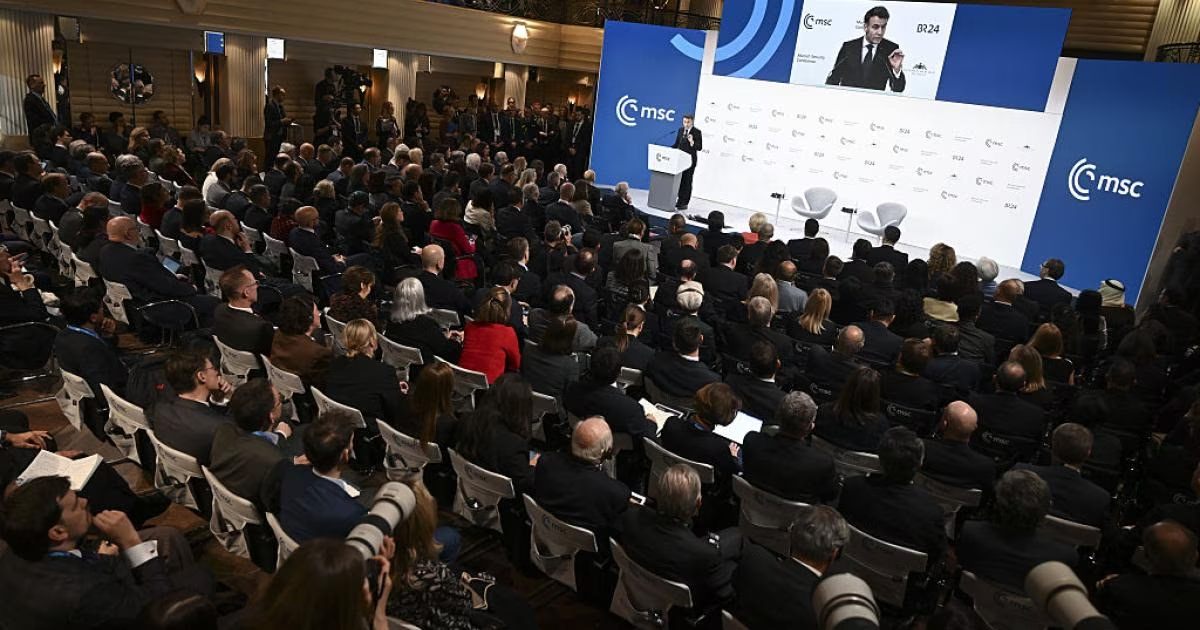
The UN official described the humanitarian situation in the Gaza Strip as still tragic, noting during his participation in the Munich Security Conference that the residents there are deprived of the most basic necessities of life. He explained that civilians struggle daily to survive amidst the ongoing war of extermination and the widespread destruction of essential facilities.

Lazzarini highlighted the educational catastrophe in the Strip, stating that children in Gaza have not been able to attend school for more than two consecutive years. He stressed that the continued operation of UNRWA is an urgent necessity to provide healthcare and primary and secondary education, which are fundamental rights that Israel seeks to undermine by targeting the agency.

The Commissioner-General pointed out that Israeli violations of international law included the demolition of the agency's headquarters in occupied East Jerusalem, which he considered a dangerous precedent. He added that these actions fall within a broader plan to end the institutional presence of the United Nations in the occupied Palestinian territories and change the demographic and legal reality.

Regarding the situation in the West Bank, Lazzarini warned of the escalating settler violence and the systematic seizure of Palestinian lands with the support of the occupation authorities. He called on the international community to take urgent action to shed light on these practices before they lead to a complete undermining of the chances for achieving a two-state solution in the future.

Lazzarini recalled international legal obligations, referring to the International Court of Justice's affirmations of Israel's obligation to cooperate with UNRWA and other UN organizations. He considered the storming of UN headquarters a blatant violation of diplomatic immunities, calling on Arab Gulf states to increase their financial and political support to counter Israeli harassment campaigns.

These statements come at a time when relief work faces unprecedented legislative challenges, after the Israeli Knesset approved a law prohibiting UNRWA's activities and preventing official communication with it. This legislation sparked a wave of international condemnation, with Britain and ten allied countries demanding the opening of crossings and an end to the demolitions that affected the agency's facilities last month.

On the other hand, field reports documented that ministers in the occupation government, including Itamar Ben-Gvir, directly incited the destruction of UNRWA properties. The agency continues to provide its services to millions of refugees in Gaza, the West Bank, and occupied Jerusalem, despite all the field and legal obstacles imposed by the occupation to disrupt its humanitarian role.

Israel continues its political pressure to eliminate UNRWA, and we witnessed the demolition of our headquarters in occupied East Jerusalem.

PALESTINE

Sun 15 Feb 2026 8:09 am - Jerusalem Time

Trump's Peace Council: A Diplomatic Cover for War Arrangements and Entrenching the Occupation in Gaza

Doubts are escalating regarding the true feasibility of the first anticipated meeting of the so-called 'Peace Council' in Gaza, scheduled to be held in Washington under the patronage of US President Donald Trump. Observers believe that the political scene is dominated by an atmosphere of preparation for striking Iran and moving towards a comprehensive regional confrontation, which fundamentally contradicts the declared claims of seeking a peaceful settlement in the Palestinian territories.

In an indication of the nature of upcoming trends, Israeli Prime Minister Benjamin Netanyahu was absent from the arrangements for this council, content with sending his Foreign Minister Gideon Sa'ar to attend Thursday's February 19 meeting. This absence reflects a lack of genuine Israeli desire to respond to any political arrangements that might impose restrictions on the occupation army's field movements in the Gaza Strip.

On the ground, the occupation authorities continue to obstruct the provisions of the first phase of Trump's plan, especially regarding the opening of the Rafah crossing in both directions. Despite the superficial agreements on managing the crossing with European and Palestinian presence, the reality proves the control of occupation officers over the movement of individuals, where travelers are subjected to meticulous abuse and interrogation, with the assistance of local militias linked to the occupation to impose control.

Statistics indicate a suffocating humanitarian crisis, with about 80,000 Palestinians registering their names on lists of those wishing to return to their homes in Gaza, while more than 20,000 injured and sick await the opportunity to leave for treatment. However, the entity imposes arbitrary conditions that prevent the return of those who left the Strip before the outbreak of the war in October 2023, in a clear attempt to reduce the number of Palestinians within the Strip.

Events have proven the falsity of American and Israeli bets on what is called 'voluntary displacement,' as Washington was shocked by the massive Palestinian turnout to return despite the destruction of their homes. Although the war destroyed about 90% of the infrastructure and houses, adherence to the land remained the strongest Palestinian response to the extermination and displacement schemes that targeted a quarter of a million people, between martyrs and injured.

On the military front, the issue of disarming the resistance emerges as an absolute priority in the second phase of Trump's faltering plan, with US envoy Steve Witkoff and Jared Kushner seeking to impose this condition. According to international reports, the plan aims to gradually disarm the factions, making this a prerequisite for starting reconstruction operations or the withdrawal of occupation forces from populated areas.

These plans face structural challenges, as the resistance relies on local manufacturing within tunnels and workshops, making its monitoring or emptying its stores almost impossible by traditional means. Moreover, the countries nominated to participate in the 'international stabilization force' show great apprehension about entering into direct confrontation with the faction fighters, whose number the occupation estimates at about 20,000 fighters.

In a related context, the occupation authorities handed over combat equipment and modern vehicles to local militias, including the 'Abu Shabab' group, to act as an alternative security arm in areas such as Rafah. This step aims to create internal strife and provide security cover for the occupation, while Israeli forces remain entrenched over more than 60% of the Strip's area, ignoring hundreds of violations of the ceasefire agreement.

As for the West Bank, the scene is no less dangerous, as the final chapter of the actual annexation plan is being implemented by transferring land and building powers to the occupation's civil administration. This coincides with the arming of hundreds of thousands of settlers who launch daily attacks against Palestinian villages, amid international silence that contents itself with hollow condemnation statements that change nothing of the reality.

In conclusion, it appears that the 'Peace Council' is nothing but a camouflaged sign for a real war council aimed at liquidating the Palestinian issue and entrenching the occupation. The facts on the ground, from the Judaization of Jerusalem and incursions into Al-Aqsa and the destruction of Gaza, confirm that the region is heading towards new rounds of conflict, and that American promises of establishing an independent Palestinian entity are nothing but illusions to pass Israeli hegemony projects.

What is happening is not cooking up peace, nor providing opportunities to obtain some rights, and renewed wars are closer than a fingertip, making the Peace Council merely a camouflaged sign for a real war council.

PALESTINE

Sun 15 Feb 2026 8:09 am - Jerusalem Time

Dead and wounded in intense Israeli raids targeting the north and south of the Gaza Strip

A number of Palestinian martyrs and wounded fell this Sunday morning, following a series of air raids carried out by Israeli occupation aircraft on various areas in the Gaza Strip. These field developments come amid continued Israeli violations of the ceasefire agreement in effect since last October 10, which put an end to a two-year war of extermination.

In the southern Strip, field sources confirmed the martyrdom of four citizens as a result of a direct targeting by an Israeli drone in the Al-Maslakh area, west of Khan Yunis city. The sources explained that 'quadcopter' aircraft fired heavily in the vicinity of the operation, which hindered the arrival of ambulance crews to transport the injured, who remained bleeding at the targeting site for a long time.

As for the northern Strip, four other Palestinians were martyred as a result of shelling carried out by an Israeli drone targeting a gathering of citizens and a tent sheltering displaced people in the Al-Faluja area. This attack coincided with air raids and intense artillery shelling that targeted the Sheikh Zayed area and Jabalia camp, with the participation of military helicopters that fired heavily at citizens' homes.

Saturday witnessed a similar escalation that resulted in the injury of four Palestinians, including two girls and an elderly man, by bullets and shells from the occupation army in various areas of the Strip, especially in the Al-Manshiya area in Beit Lahia. These repeated attacks reflect the fragility of Israeli commitment to international understandings sponsored by regional and international parties within initiatives to end the conflict.

For its part, the Hebrew media claimed that army forces spotted five fighters emerging from a tunnel opening in the Beit Hanoun area north of the Strip and dealt with them. Channel 12 Hebrew claimed, quoting military sources, that initial estimates indicate the killing of four of these fighters, noting that the military operation in that area is still ongoing.

These breaches deepen the wounds of the Gaza Strip, which is still recovering from the effects of the two-year war that left more than 72,000 martyrs and 171,000 wounded, according to official statistics. That war caused the destruction of nearly 90% of the infrastructure and residential facilities, making daily life for residents extremely difficult and complex.

On the international level, the United Nations estimates the cost of rebuilding what the Israeli war machine destroyed at about $70 billion, at a time when residents face enormous challenges in securing shelter and basic services. Observers fear that these continuous breaches will lead to a complete collapse of the ceasefire agreement and a return to comprehensive confrontation.

The injured are still at the bombing site, and ambulances cannot reach them due to heavy firing from quadcopter aircraft.

PALESTINE

Sun 15 Feb 2026 8:09 am - Jerusalem Time

9 Palestinians killed in a series of Israeli raids and targeting in the Gaza Strip

The Gaza Strip witnessed a new field escalation on Sunday, resulting in the martyrdom of 8 Palestinians in air raids and artillery shelling that targeted various areas in the north and south of the Strip. The Israeli attacks focused on the city of Khan Yunis and the Al-Faluja area, leading to casualties among civilians and displaced persons in those areas, which suffer from a tight siege and continuous targeting.

In details of the field massacres, medical sources at Nasser Hospital confirmed the arrival of the bodies of 4 martyrs who died as a result of Israeli shelling targeting areas outside the deployment range of the occupation army's vehicles south of Khan Yunis city. This coincided with a direct targeting of displaced persons' tents in the Al-Faluja area north of the Strip, where sources at Al-Shifa Hospital reported the martyrdom of 4 other citizens who were inside one of the targeted tents.

For its part, the Israeli occupation army announced the killing of a Palestinian, claiming he crossed the so-called 'Yellow Line' in the northern area of the Gaza Strip, alleging that the young man posed a threat to the forces stationed there. This incident comes amid the continuation of ground military operations, which include the demolition of residential blocks and the destruction of infrastructure in the border and internal areas of the Strip.

Regarding injuries, medical teams at Al-Awda Hospital recorded the injury of a child with varying wounds as a result of gunfire by occupation forces targeting displaced persons' tents in the Netzarim area in the central Strip. Nasser Medical Complex also received two injured people who were wounded by Israeli fire in areas located in the central and western parts of Khan Yunis city, indicating the expansion of random targeting against civilians.

Field sources reported that the occupation army carried out extensive demolition operations of residential buildings in the eastern areas of Khan Yunis, Rafah, and Gaza cities, accompanied by intense air raids. These operations aim to create buffer zones and destroy what remains of citizens' homes in areas where Israeli military vehicles repeatedly penetrate.

In the northern Strip, ambulance and emergency sources stated that an Israeli 'quadcopter' drone fired live ammunition directly at citizens in the Al-Manshiya area of Beit Lahia town. This attack resulted in a Palestinian being moderately wounded, and he was immediately transferred to Al-Shifa Medical Complex in Gaza City to receive the necessary treatment amid a severe shortage of medical capabilities.

These bloody developments come at a time when occupation forces continue to tighten their military grip on all axes of the Gaza Strip, with continued targeting of shelters and areas that the occupation claims are 'safe'. Reports from hospitals confirm that the pace of injuries and martyrs is constantly escalating as a result of concentrated shelling on displaced persons' gatherings and populated homes.

4 Palestinians were martyred in the occupation's shelling of a displaced persons' tent in the Al-Faluja area north of the Strip, amid continued targeting operations and demolition of buildings in the area.

PALESTINE

Sun 15 Feb 2026 8:09 am - Jerusalem Time

Peace Council Sets Next March as Date to Begin Disarming Factions in Gaza

Sources within what is known as the 'Peace Council' revealed the outlines of the timeline for the new American vision for the Gaza Strip, with next March (Adar) set as the target date to begin disarming Hamas. This step comes within the framework of political arrangements aimed at ending military manifestations in the Strip, in preparation for a new transitional phase supervised by international and regional parties.

The launch of this process is directly linked to a Palestinian 'technocrat' government assuming its full administrative and security powers in Gaza, to be the sole civilian authority managing public affairs. According to sources, the plan aims to permanently remove the movement's military system, and ensure it does not return to influence political or field decisions in the next phase.

On the ground, reports indicated that the occupation authorities have already begun preparing a 'local alternative' by supplying Palestinian militias in the Strip with advanced combat and logistical equipment. These preparations included modern rifles and 'Toyota Land Cruiser 2026' four-wheel-drive vehicles, in an effort to enable these elements to impose a new security reality consistent with the standards of the proposed deal.

Security assessments indicate that the city of Rafah, south of the Strip, will be the 'first laboratory' for implementing disarmament procedures and imposing public tranquility. This area is currently under the influence of local armed groups, which are seen as a key pillar in the project to build the 'new Palestinian city' promoted by the American administration as a model for economic reconstruction.

For his part, US President Donald Trump adopts a vision based on transforming conflict hotspots in Gaza into areas of economic attraction and huge investment projects. Those in charge of this plan believe that economic prosperity and transforming the Strip into a commercial center is the primary guarantee to prevent the return of military tensions and achieve what they describe as 'absolute superiority' and permanent stability in the region.

Transforming conflict zones into giant economic projects is the only guarantee for achieving absolute superiority and sustainable stability.

ANALYSIS

Sun 15 Feb 2026 8:08 am - Jerusalem Time

Academic Analysis Deciphers 'Trump's Madness': Calculated Strategies for Control and Personal Gain

International press reports have highlighted President Donald Trump's behavioral methodology, considering what appears publicly as narcissistic actions or outrageous demands to be, at its core, a well-crafted strategy. Writer Tom Rogers, in an article published by 'Newsweek' magazine, pointed out that Trump follows a consistent pattern through which he aims to extract personal gains in every issue he raises. This behavior, which defies traditional norms, is not merely temper tantrums, but rather a tool to impose absolute control over the American political scene.

This analysis is based on a critical reading of an upcoming book titled 'The Ten Commandments of Trump,' authored by Professor Jeffrey Sonnenfeld, a professor at Yale University and one of the foremost experts in leadership management. The book provides a precise academic dissection of the approach Trump uses to subdue his political opponents and reshape public opinion. The author believes that understanding these behavioral mechanisms is essential to comprehending how Trump manages crises and major deals.

Sonnenfeld's insights gain particular credibility given his long and unique relationship with Trump, which began with a sharp media rivalry over 'The Apprentice' program. Despite their disagreements, Trump expressed admiration for the professor's intelligence to the extent that he previously offered him the presidency of 'Trump University,' an offer that was rejected. This close proximity allowed the author to observe Trump closely and conclude that his actions are not random but rather an 'organized mechanism' applied in various contexts.

Among the ten strategies identified by the book, Trump's aggressive negotiation tactics stand out, which Sonnenfeld describes as a 'punch to the face.' Unlike traditional diplomacy that seeks to build trust, Trump begins any dialogue with a shocking stance or an extreme demand aimed at disrupting the psychological balance of the other party. This initial intellectual terrorism forces the opponent to make concessions they would not have considered under normal circumstances.

When Trump retreats slightly from his initial extreme demand, the negotiating party feels a sense of relief or illusory victory, while Trump has already achieved his real goal. This tactic ensures he secures massive deals on his own terms, while keeping opponents in a state of perpetual confusion. This method is a cornerstone of his dealings with political leaders and businessmen alike.

As for the second strategy, it concerns the creation of public awareness, known as the 'sleeper effect' or continuous repetition until belief. In this context, Trump relies on making certain claims, even if they lack validity, and repeating them with excessive confidence and unwavering certainty. Over time, these falsehoods begin to penetrate media circles and his supportive audience until they transform into undeniable facts.

This approach ultimately exhausts the public's ability to distinguish between truth and fiction, giving Trump the power to reframe reality to align with his agenda. By controlling the media narrative, he is able to neutralize objective facts and replace them with a version of reality that serves his immediate political interests. This tactic is one of the most dangerous tools he uses to manipulate public opinion.

The 'I alone can fix it syndrome' serves as a third strategy to reinforce his image as an epic hero who possesses magical solutions unavailable to others. Trump uses exaggerated preferential language to describe his achievements, attempting to make himself the center around which all national success revolves. This institutional narcissism drives him to try to directly link every public achievement to his personal name, reinforcing his superiority complex.

The article points to real-world examples of this behavior, such as Trump's condition that the historic Pennsylvania Station be renamed after him in exchange for approving its refinancing. This tendency to 'gild everything' and stamp it with his name reflects a deep desire to immortalize his personal legacy at the expense of public institutions. It is a strategy aimed at merging national identity with his personal identity in the minds of citizens.

Rogers believes that understanding these 'commandments' is the only way to decipher what appears to some as a state of madness or psychological instability. Trump is, in fact, a brilliant 'engineer of chaos,' who uses psychological and social rules to impose his control over others. His seemingly reckless actions are actually precisely calculated steps within a political chess game always aimed at enhancing his influence.

Sonnenfeld's upcoming book does not merely observe situations but provides a framework for understanding the future of American politics under Trump. If these behaviors are calculated strategies, then dealing with them requires entirely different tools than traditional political ones. Analysts warn that ignoring this methodology could lead to further erosion of democratic and institutional norms.

The analysis also addresses how Trump always succeeds in turning crises that might end any other politician's career into opportunities to boost his popularity among his solid base. By portraying himself as a victim of a 'corrupt' system, he uses the strategy of repetition to convince millions that an attack on him is an attack on them. This emotional connection makes it difficult for legal or logical facts to penetrate the wall of loyalty he builds.

In conclusion, the article asserts that Trump's 'method of madness' has redefined the concept of political leadership in the modern era. Instead of striving for consensus, Trump thrives in an environment of polarization and conflict, using his psychological tools to ensure he remains in the spotlight. Reading this methodology has become an urgent necessity for anyone seeking to understand the profound transformations in the international landscape.

Sources indicate that this type of academic analysis contributes to revealing the mechanisms by which politics is currently managed in Washington. With the approaching release of Sonnenfeld's book, observers expect it to spark a wide debate about the limits of personality and narcissism in public service. What some see as madness, others see as the pinnacle of political cunning in the 'post-truth' era.

What appears on the surface as madness or random actions from Trump are, in reality, calculated strategies aimed at achieving personal gains and imposing absolute control over the political scene.

PALESTINE

Sun 15 Feb 2026 8:08 am - Jerusalem Time

Injuries and widespread raids.. The occupation escalates its aggression on West Bank towns

Various areas of the occupied West Bank witnessed, on Saturday evening, a new escalation in the attacks by the Israeli occupation forces, resulting in injuries among Palestinian citizens. Medical and local sources reported that the occupation army intensified its raiding and incursions in the governorates of Nablus, Salfit, and Ramallah, coinciding with the continuation of systematic repressive policies against the residents.

In Bethlehem Governorate, the Palestinian Red Crescent Society announced that it had received a report of a citizen being shot by the occupation in the village of Husan, located west of the city. The society confirmed that army forces prevented medical teams from reaching the site of the injury to provide necessary first aid, which falls within the occupation's policy of obstructing humanitarian work.

In the city of Tulkarm, north of the West Bank, medical teams were able to transport a young Palestinian man to the hospital after he was shot with live ammunition in the foot area. The injury occurred near the Nazlet Issa military checkpoint north of the city, where occupation soldiers opened fire at the young man without clear justification, leading to his transfer for urgent treatment.

In the central West Bank, occupation forces stormed the village of Al-Mughayyir, northeast of Ramallah city, where they carried out a widespread campaign of abuse against the residents. Local sources stated that the soldiers detained a number of citizens and severely beat them, and also raided homes and commercial shops, causing destruction, amidst intense firing of sound bombs and toxic gas.

Nablus Governorate was not immune from these incursions, as occupation vehicles penetrated the towns of Aqraba and Burin, south of the city. Occupation soldiers fired a barrage of tear gas canisters towards citizens' homes, causing suffocation cases, in a move aimed at intimidating residents and imposing strict restrictions on their daily movements.

In a related context, the occupation army stormed the town of Kafr ad-Dik, west of Salfit city, where forces spread in the main streets and closed vital entrances to the town. Soldiers stopped passersby and interrogated them on the spot, which led to traffic obstruction and created a state of tension among citizens who face continuous restrictions.

These field developments come amid an escalating pace of Israeli violations in the West Bank since October 7, 2023. Observers and Palestinians believe that these attacks, which include killing, displacement, and settlement expansion, pave the way for official plans aimed at annexing large parts of the West Bank and imposing occupation sovereignty over them.

Official data indicate that the toll of the Israeli aggression in the West Bank has reached record levels, with at least 1,112 Palestinians martyred and about 11,500 others injured. Arrest campaigns have also targeted about 22,000 citizens, amid the ongoing war of extermination waged by the occupation on the Gaza Strip and its repercussions on all Palestinian territories.

Occupation forces prevent ambulance crews from reaching an injured person in Husan village, west of Bethlehem.

PALESTINE

Sun 15 Feb 2026 8:08 am - Jerusalem Time

Including an 11-year-old child.. Horrific testimonies of occupation soldiers' assault on children in the village of Al-Mughayyir

Palestinian child Mahmoud Fouad Abu Alia, 11 years old, revealed horrific details of his arrest and assault by Israeli occupation forces in the village of Al-Mughayyir, northeast of Ramallah. Sources reported that a military force consisting of five soldiers stormed a commercial store where the child was present to buy his needs, violently dragging him and taking him to an unknown location amidst a state of terror that prevailed in the area.

Child Mahmoud described the moments of abuse he was subjected to inside the military vehicle, indicating that the soldiers severely beat him on his face and all over his body. He added in his testimony that the assailants used rifle butts to hit him on his back, while ordering him to remain completely silent and preventing him from screaming or expressing his pain throughout the detention period, which lasted for about an hour.

The suffering did not stop at beatings and detention, but extended to include a direct threat to his life after his release at the eastern entrance of the village. The child confirmed that a settler who was in the area fired live bullets at him immediately after he was left by the occupation soldiers, which amplified the state of psychological shock and fear he experienced during that harsh experience, reflecting the reality of childhood in the occupied territories.

For his part, Fouad Abu Alia, the child's father, explained that his son suffered injuries and bruises that even adults could not endure due to the excessive violence used against him. The father indicated that the family immediately took Mahmoud to the hospital for necessary medical examinations, where reports showed clear bruises in various parts of his body, stressing that targeting children in Al-Mughayyir village has become a repeated and systematic policy.

In a related context, the store owner, Ataf Abu Alia, who witnessed the incident, confirmed that the soldiers entered the store suddenly and dragged child Mahmoud without any justification or pretext. The witness explained that the child was not doing anything but buying some simple necessities, but four soldiers pounced on him and began physically assaulting him in front of those present before dragging him to the military jeep stationed outside.

This incident comes at a time when data from Palestinian prisoner institutions indicate an escalation in the targeting of minors, with at least 350 children held in occupation prisons. These numbers are part of a larger toll exceeding 9,000 prisoners living in difficult detention conditions, amidst human rights warnings that the arrest of children is becoming a tool to intimidate Palestinian society and break its will.

International and local human rights reports confirm that the occupation authorities annually arrest between 500 and 700 Palestinian children, who are then brought before military courts that lack the minimum standards of international justice. Psychologists warn of the deep and long-term effects of these violations on an entire generation of children who are deprived of their most basic rights to safety, play, and education.

My right is to live in peace and play, but the Palestinian child does not live his childhood.

ISRAELI AFFAIRS

Sun 15 Feb 2026 8:08 am - Jerusalem Time

Trump and Netanyahu agree to escalate 'maximum pressure' against Iran coinciding with negotiations

Informed sources reported that US President Donald Trump and Israeli Prime Minister Benjamin Netanyahu reached common understandings during their recent meeting in Washington, which stipulate intensifying economic and political pressures on Iran. This approach comes in conjunction with ongoing negotiation rounds, in an attempt to impose a new reality that forces Tehran to make fundamental concessions.

Media reports stated that the two sides agreed to activate the 'maximum pressure' policy with full force, with the aim of pushing Iran to finally abandon its nuclear ambitions. A US official confirmed that the administration is dealing with the Iranian side with complete realism, stressing that the ball is now in Tehran's court, and that no agreement that does not guarantee real and strict conditions will be accepted.

During the meeting, an in-depth discussion took place regarding the possibilities of reaching a new nuclear agreement, with Netanyahu expressing great skepticism about Tehran's intentions. The Israeli Prime Minister was quoted as telling Trump that concluding an agreement with the Iranian regime is impossible, considering that Tehran will not respect any commitments it signs, which reflects the gap in assessing diplomatic feasibility.

In contrast, President Trump expressed cautious optimism about the possibility of reaching a settlement, indicating his desire to give the diplomatic path one last chance to consider the results. Trump clarified that he would closely monitor developments before making final decisions regarding the nature of the future relationship with the Iranian nuclear file and its regional implications.

For their part, the US President's envoys, Steve Witkoff and Jared Kushner, who attended the meeting, stated that historical experiences make reaching an agreement extremely complex. However, they indicated that the negotiations are making relative progress, awaiting the Iranian response to the American demands that will be presented to Trump for decision.

Estimates in Tel Aviv indicate that Washington may move in the next phase to impose severe economic sanctions targeting countries that continue their commercial dealings with Tehran. This political path is accompanied by strengthening the American military buildup in the region, including sending additional aircraft carriers as a clear deterrent message.

Media sources attribute Trump's change in tone towards hinting at regime change and setting a final deadline for negotiations ending next month, to Netanyahu's direct influence on shaping the American position. Political circles are awaiting Senator Lindsey Graham's visit to Israel, where Tel Aviv seeks to leverage his influence to reinforce hardline approaches against Tehran.

On another note, concern prevails in Israeli circles about the convening of the 'Peace Council' in Washington in mid-February, with the participation of high-level Qatari and Turkish figures. Israel fears that these meetings may affect Trump's vision and present a different narrative to the Israeli position regarding Iranian threats in the region.

On the ground and politically, the parties are preparing for the second round of US-Iranian negotiations in Geneva next week, amid Tehran's insistence on its right to enrich uranium. These talks are taking place in an atmosphere charged with military movements and escalating political pressures aimed at shaping the features of the next phase in the Middle East.

It is impossible to conclude an agreement with Iran, and even if you sign an agreement with it, it will not respect it.

PALESTINE

Sun 15 Feb 2026 8:08 am - Jerusalem Time

Palestinian-Turkish agreement to supply Gaza Strip with 20,000 mobile housing units

Dr. Ali Shaath announced reaching a strategic agreement with Turkish Foreign Minister Hakan Fidan, aimed at addressing the escalating housing crisis in the Gaza Strip resulting from widespread destruction. The agreement stipulates providing the Palestinian National Committee for Gaza Management with approximately twenty thousand mobile housing units 'caravans' as a first batch within a massive relief project. This step seeks to provide dignified housing alternatives for thousands of families who lost their homes during previous periods, helping to restore social stability in the most affected areas.

Shaath clarified that the understandings with the Turkish side have moved beyond the theoretical framework and effectively entered the implementation phase, with specialized teams beginning to complete all necessary logistical arrangements. These arrangements include preparing a sea bridge to transport these housing units from Turkish ports towards the region, with a focus on accelerating the shipping pace to ensure an urgent response to the pressing needs of displaced persons before humanitarian crises related to weather conditions worsen.

In a related context, the established plan includes securing safe and organized entry routes for these housing units into the Gaza Strip through coordination with relevant international parties. These efforts aim to ensure that housing aid reaches the most needy groups directly, according to field survey lists conducted by the competent authorities. These movements reflect the National Committee's ability to manage complex service and humanitarian files with high efficiency in cooperation with regional partners.

It is worth noting that this project represents a link in a series of efforts aimed at restoring life to the affected areas in the Strip and alleviating the burden of forced displacement. This batch is expected to be followed by other steps to strengthen temporary and permanent infrastructure, amidst ongoing discussions with multiple international parties to contribute to the reconstruction file. Through this agreement, the Turkish side affirms its continued humanitarian support for the Palestinian people in facing current challenges.

Discussions with the Turkish side have effectively moved to the implementation phase to secure dignified shelter for thousands of families.

ISRAELI AFFAIRS

Sun 15 Feb 2026 8:07 am - Jerusalem Time

Broadcasting Authority: Trump's attack on Herzog may hinder efforts to pardon Netanyahu

Official media sources reported today, Saturday, that the public attack launched by US President Donald Trump on his Israeli counterpart Isaac Herzog may cast a negative shadow on Benjamin Netanyahu's presidential pardon file. The sources explained that these public pressures may reduce the chances of the prime minister obtaining a legal exit from his ongoing trial, especially in light of the political and legal sensitivities surrounding this thorny issue.

Trump had sharply criticized Herzog after meeting Netanyahu at the White House last Thursday, considering that the Israeli president should be ashamed for not using his powers to grant a pardon to Netanyahu. The latter faces serious charges including fraud, bribery, and breach of trust, at a time when his allies in Washington are pushing to permanently close these judicial files.

For his part, Israeli President Isaac Herzog quickly responded to these statements, confirming that the issue of the pardon is still under careful legal review. Herzog stressed that the final decision will be made based on professional and legal standards, away from any internal pressures or external dictates, in a clear indication of his rejection of direct American interference in judicial sovereignty.

Reports indicate that Trump has moved from secret and written requests to direct public attacks, which may have completely counterproductive results. Observers believe that this approach may push Herzog to demonstrate the independence of the presidency and be strict in the conditions for a pardon, to avoid appearing subservient to American desires before an Israeli society divided on this issue.

According to the analyzes received, Trump's statements are largely consistent with the narrative promoted by Netanyahu and his entourage, which claims that the prosecutions are political targeting. It appears that the US President wanted to provide political support to Netanyahu at a low cost, especially after the latter failed to achieve tangible accomplishments in major regional files such as the Iranian file during his last visit to Washington.

Netanyahu faces charges in three major corruption cases, where the prosecution in Case 1000 accuses him of receiving valuable gifts in exchange for facilities for businessmen. Case 2000 relates to negotiations with a newspaper publisher to obtain positive coverage, while Case 4000 deals with providing facilities to a telecommunications company in exchange for media support, issues that have shaken Israeli society for years.

Netanyahu had submitted an official request to Herzog last November for a pardon, but he stipulated not admitting guilt or retiring from political life. This position represents a major legal obstacle, as Israeli law does not allow the president to grant a pardon unless the accused admits the charges against him, which Netanyahu has completely rejected since the start of his trial.

In addition to internal crises, Netanyahu faces increasing international pressure as he is wanted by the International Criminal Court on charges related to war crimes. Trump's intervention at this time further complicates the diplomatic scene, as this intervention is seen as a precedent in normalizing blatant American interference in internal judicial affairs, which may strain institutional relations between Tel Aviv and Washington.

Herzog should be ashamed of himself for not granting a pardon to Netanyahu, who is on trial for fraud and bribery.

PALESTINE

Sun 15 Feb 2026 8:07 am - Jerusalem Time

International demands to activate the second phase of the Gaza war ceasefire and recognize the Palestinian state

Sigrid Kaag, a member of the Executive Council stemming from the Gaza Peace Council, stressed the urgent need to immediately implement the second phase of the ceasefire agreement in the Strip. Kaag explained during her participation in a dialogue session at the Munich Security Conference that the success of this step primarily depends on the availability of international political will and the necessary pressure to ensure adherence to the agreed-upon provisions.

The international official warned of the catastrophic consequences of the continued cycles of armed conflict, for which innocent civilians in Gaza are increasingly paying the price. She indicated that the international community is called upon to act seriously to end this humanitarian suffering, considering that the collective failure to protect the most vulnerable groups necessitates a radical transformation in the mechanisms for dealing with the Palestinian issue.

Regarding thorny issues, Kaag called for caution in dealing with the clause on disarming the Hamas movement, describing it as the most complex clause in the second phase of the agreement. She justified this position by linking weapons to people's dignity and lives in the current circumstances, emphasizing that the implementation of this clause must be subject to the discretion of the Executive Council members to ensure its application at the appropriate time, away from the desires of the conflicting parties only.

Kaag affirmed that the establishment of an independent Palestinian state is an inherent right guaranteed by international law and UN resolutions, and not a grant or 'prize' offered in exchange for certain political behaviors. She categorically rejected using this right as a tool for intimidation or as a 'carrot' in the negotiation process, calling for empowering Palestinians to lead their political path themselves to build a sustainable state away from guardianship or conditions.

For his part, Saudi Foreign Minister Prince Faisal bin Farhan outlined a roadmap for the next phase, starting with an immediate ceasefire and ensuring the stability of the Strip. Bin Farhan stressed that the top priority lies in launching comprehensive reconstruction operations, to be a starting point for a clear and irreversible political path that guarantees the right of the Palestinian people to self-determination and the establishment of their state.

The Saudi minister explained that sustainable peace in the Middle East will only be achieved through the establishment of an independent Palestinian state. He pointed to a growing international conviction that peaceful coexistence requires respect for the national and political rights of Palestinians, affirming the Kingdom's support for the '20-point plan' aimed at ending the conflict and achieving regional stability.

In a related context, Norwegian Foreign Minister Espen Barth Eide revealed diplomatic moves led by his country in coordination with Saudi Arabia and Arab and European parties to recognize the Palestinian state. Eide explained that this approach aims to recognize Palestine without waiting for the final results of the stalled negotiations, in order to break the political stalemate and ensure that the current war does not end without a comprehensive solution.

The Norwegian minister strongly criticized reliance on bilateral negotiations that have proven their failure over the years, especially in light of the continuous obstruction by Benjamin Netanyahu's governments. Eide considered that granting Israel veto power over Palestinian rights has become a major obstacle to peace, which necessitates proactive international action to impose a new political reality that ends the historical conflict.

Establishing a Palestinian state is a right for Palestinians, not a prize granted in exchange for certain behavior, and it should not be used as a tool for intimidation in negotiations.

ISRAELI AFFAIRS

Sun 15 Feb 2026 8:07 am - Jerusalem Time

Official Data Reveals: Over 50,000 Soldiers in the Occupation Army Hold Foreign Nationalities

Recent official data, revealed by Hebrew media sources on Saturday, showed that approximately 50,632 soldiers in the Israeli occupation army hold at least one foreign nationality in addition to their Israeli nationality. This revelation came based on data provided by the army in response to a request submitted by the 'Hatzlacha' association, which specializes in transparency and freedom of information, highlighting the extent of international overlap in the human composition of the military establishment.

The American nationality topped the list of foreign nationalities within the army by a wide margin, with 12,135 soldiers holding it, followed in second place by French nationality with 6,127 individuals. Russian nationality came in third with 5,067 soldiers, reflecting the diversity of origins and backgrounds from which fighters in various military units of the occupation hail.

The announced list also included large numbers of European nationality holders, with more than 3,000 soldiers holding German nationality, and a similar number holding Ukrainian nationality. Statistics also recorded the presence of more than a thousand soldiers for each of the British, Romanian, Polish, Canadian, and Ethiopian nationalities, while the remaining numbers were distributed among various international nationalities around the world.

In a striking detail regarding the multiplicity of legal loyalties, the data indicated that 4,440 soldiers hold two additional foreign nationalities, while 162 soldiers possess three foreign nationalities in addition to Israeli. Sources clarified that this information, requested in March 2025, represents the first time such precise details have been disclosed, despite the army's refusal to clarify the distribution of these soldiers between regular forces and reserve forces.

These figures come at a time when military estimates indicate that the regular army strength is about 170,000 soldiers, while the reserve system includes between 400,000 and 460,000 personnel. These statistics raise questions about the commitments of these soldiers to their home countries, especially in light of potential international legal prosecutions against foreign nationals participating in military operations.

This is the first time the army has revealed in detail the distribution of foreign nationalities among its personnel.

PALESTINE

Sun 15 Feb 2026 8:07 am - Jerusalem Time

Gaza Management Committee Conditions Its Success on Full Powers, Hamas Expresses Readiness to Hand Over

The head of the National Committee for the Management of the Gaza Strip, Ali Shaath, linked the committee's ability to carry out its tasks and responsibilities to the necessity of granting it comprehensive and undiminished administrative and civil powers. Shaath affirmed that the committee cannot perform its work efficiently and with full independence without real empowerment on the ground, emphasizing that this path is the only guarantee for achieving the desired goals in the difficult transitional phase the Strip is undergoing.

Shaath considered in his statements that this empowerment represents the main gateway to opening horizons for serious international support for the extensive reconstruction operations needed by the afflicted Strip. He also indicated that the presence of an empowered administrative authority would create suitable conditions for the complete withdrawal of Israeli occupation forces, paving the way for the restoration of normal daily life for the residents who have suffered from the ravages of war and siege.

Regarding the political references the committee will rely on, Shaath clarified the importance of aligning upcoming moves with international frameworks and proposed plans, including US President Donald Trump's twenty-point plan. He also stressed the necessity of adhering to UN Security Council Resolution 2803, to ensure legal and international cover that supports the committee's legitimacy and facilitates its dealings with external parties and donors.

For its part, the Hamas movement responded quickly to these proposals, with movement leader Basem Naim affirming full commitment to facilitating the national committee's tasks and ensuring its success in all areas of the Strip. Naim announced the movement's immediate readiness to hand over all governmental and civil institutions and bodies to the committee, in a step aimed at unifying administrative authority and alleviating the living burdens on citizens in Gaza.

The head of the committee described the statements issued from within the Strip regarding the readiness to hand over institutions as a positive and pivotal step in halting the accelerating humanitarian deterioration. He explained that joint coordination to ensure the unimpeded flow of humanitarian aid is the top priority at present, in parallel with developing executive plans to begin restoring infrastructure and vital facilities that have been extensively damaged.

In conclusion of his statements, Shaath issued an urgent appeal to international mediators and all concerned parties for the necessity of swift action to address outstanding issues and overcome obstacles that may hinder the committee's work. He affirmed that the humanitarian reality in Gaza can no longer tolerate any procrastination or delay, indicating that the committee will work with the highest standards of transparency and accountability to ensure rights reach their owners and achieve the desired stability.

The Palestinian people cannot tolerate further delay, and we are committed to performing the mission with a spirit of responsibility and the highest degrees of transparency and accountability.

PALESTINE

Sat 14 Feb 2026 3:15 pm - Jerusalem Time

National Committee for Gaza Administration Welcomes Readiness of Forces to Hand Over Public Institutions

The National Committee for the Administration of the Gaza Strip expressed its great welcome of the statements and positions issued from within the Strip, which showed full readiness to hand over all public institutions and facilities to the committee. The committee affirmed in an official statement that this step directly serves the interests of the Palestinian citizen and contributes to creating an atmosphere that enables it to exercise its administrative responsibilities during the upcoming phase.

Informed sources indicated that Hamas and the rest of the Palestinian forces have shown tangible openness towards the committee's work, expressing their readiness to facilitate a smooth and organized transfer of tasks. Observers believe that this consensus paves the way for the committee to play its full role in managing the transitional phase that the Strip is undergoing, ensuring the continuity of essential services for the residents.

The committee considered that the announcement of readiness for the transfer of administrative authorities represents a pivotal station in the course of its work as a transitional administration, and provides a real opportunity to halt the escalating humanitarian deterioration. It stressed that preserving the steadfastness of citizens who have faced severe suffering throughout the past period is at the core of its priorities during the current and future phases.

In a related context, the committee clarified that it cannot effectively and efficiently carry out its tasks unless it is granted full administrative and civil powers, in addition to the necessary police powers to maintain security and order. It affirmed that these requirements are essential to ensure the implementation of its plans aimed at rehabilitating vital facilities and providing public services without bureaucratic or security obstacles.

It is worth noting that the National Committee for the Administration of the Gaza Strip was formed last January as an independent technocratic body comprising 15 members of Palestinian competencies, headed by Ali Shaath. Its establishment came in response to UN Security Council Resolution 2803, and within the framework of the 20-point plan proposed by the US administration to end the conflict and begin reconstruction operations.

The committee operates under the direct supervision of the Peace Council, chaired by the United States, and with follow-up from High Representative Nikolay Mladenov to ensure the implementation of international commitments. The plan aims for the committee to take over the daily and civil affairs, including the health, education, and municipal sectors, and the distribution of humanitarian aid, leading to a comprehensive reconstruction phase.

These transitional arrangements seek to pave the way for the return of a unified Palestinian authority to manage the affairs of the West Bank and Gaza Strip under one umbrella. International and local parties hope that the committee will succeed in overcoming the current challenges and transforming these understandings into a tangible reality that ends the suffering of the Strip's residents and establishes a new phase of stability and development.

The announcement of readiness for an organized transition represents a pivotal station for us to begin exercising our duties as the transitional administration of the Strip, and a real opportunity to halt the humanitarian deterioration.

ARAB AND WORLD

Sat 14 Feb 2026 3:15 pm - Jerusalem Time

Accelerated US Moves to Resolve Sahara Dispute: Anticipated Negotiation Round to Develop 'Autonomy'

International political circles are awaiting the United States to host, at the end of this February, a third and decisive round of negotiations concerning the Western Sahara dispute. This round aims to develop the autonomy proposal put forward by Morocco, amidst US efforts to reconcile this proposal with some technical demands presented by the Polisario Front in previous rounds.

These moves come after the Spanish capital, Madrid, hosted last week the second round of talks that included the main parties to the conflict, Morocco and the Polisario Front, in addition to Algeria and Mauritania as observers. These meetings took place under direct bilateral supervision from Washington and the United Nations, where the autonomy framework was adopted as the basic foundation for discussion.

Informed sources reported that the US administration is pushing to accelerate the pace of negotiations, having set February 27 and 28 as a preliminary date for the third round. The White House wishes to reach a comprehensive framework agreement before the end of next May, to ensure the transition to practical implementation stages before entering new international political complexities.

This intensive timeline is linked to an anticipated report to be presented to the UN Security Council next April, to assess the progress made in implementing UN Resolution 2797. This resolution explicitly states the necessity of serious political negotiations that take the Moroccan autonomy initiative as a realistic basis for a final and permanent solution.

Leaked data indicates that the negotiations have moved beyond generalities, with the principle of autonomy being decided upon and the revision of a 40-page technical document beginning. This document includes the integration of some demands contained in the Polisario's vision, provided they do not conflict with the essence of Moroccan sovereignty over the Saharan provinces.

In a related context, Washington, during the recent Madrid meetings, ruled out a return to old proposals such as 'Baker Plan II' which stipulated a transitional period ending with a referendum on self-determination. Instead, the current US administration is focusing on confining any political development within the framework of expanded autonomy exclusively under Moroccan sovereignty.

International experts, in coordination with Washington, are scheduled to participate in drafting the legal and administrative powers for the Sahara region, to ensure it enjoys broad independence in managing its local affairs. Interestingly, European experts, including France and Spain, have been excluded from these precise technical formulations, limiting them to the direct parties and international sponsors.

Regarding regional positions, Algeria's commitment to supporting the Polisario Front's stance is noted, with an emphasis on demanding strong international guarantees for any agreement reached. In contrast, Mauritania maintains a position of positive neutrality, with the condition of preserving its vital security and economic interests in the areas bordering its northern frontiers.

The proposed draft for discussion includes granting the Sahrawis the right to elect a local parliament and government, while the authority to appoint the head of the autonomous region remains with the Moroccan monarch based on election results. All symbols of Moroccan national sovereignty will also be preserved, including currency, external diplomatic representation, and national defense.

Media reports indicate that the proposed model may draw some of its provisions from Spain's autonomy system, especially regarding constitutional oversight mechanisms. Among these is the possibility of including a clause that allows the center to intervene in exceptional cases if there is a threat to the constitutional order or a deviation from the provisions of the concluded political agreement.

There are still outstanding issues that require in-depth discussions in the upcoming February round, foremost among them how to manage and share natural resources such as phosphates and fish wealth. Open files also include technical issues such as the region's flag, the extent of independence of local economic decisions from the capital Rabat, and the nature of trade relations with neighboring countries.

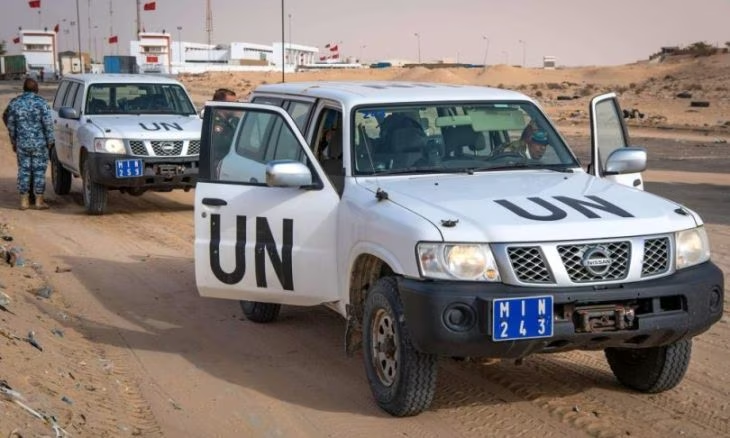
It is expected that the tasks of the United Nations Mission 'MINURSO' will undergo a radical transformation in the next phase, as the Security Council will discuss changing its original mandate related to the referendum. The mission may transform into a monitoring and support force for implementing the autonomy agreement, and ensuring all parties adhere to the new security and administrative arrangements that will be agreed upon.

Observers believe that the current US pressure reflects Washington's desire to close this chronic file that affects the stability of the North Africa and Sahel region. The US administration is betting that reaching an agreed-upon solution will enhance regional security cooperation and open new economic horizons in the Maghreb region.

Finally, the success of the February round remains contingent on the parties' ability to make mutual concessions on the precise technical details that follow the approval of the general principle. While Morocco expresses cautious optimism, the Polisario Front and Algeria await the nature of the international guarantees that Washington will provide to ensure the durability and stability of any future political solution.

The White House wants to sign a comprehensive framework agreement to resolve the conflict before the end of May to move to its actual implementation on the ground.

PALESTINE

Sat 14 Feb 2026 3:15 pm - Jerusalem Time

Escalation of settler and occupation forces' attacks in the West Bank and Jerusalem: Injuries and forced displacement operations

Cities and villages in the West Bank continue to face an escalating wave of systematic attacks carried out by Israeli occupation forces in cooperation with extremist settler groups. These field operations directly target individuals, properties, and agricultural lands, leading to injuries and the arrest of a number of citizens during raids on various areas.

In Bethlehem Governorate, medical sources confirmed that a Palestinian citizen was injured by live bullets fired by occupation forces in an area near the apartheid wall. This coincided with a widespread arrest campaign carried out by Israeli military units after raiding citizens' homes in several towns, amid strict security measures imposed by the occupation authorities.

Balata refugee camp, east of Nablus city, witnessed a military operation during which occupation forces stormed the camp's alleys, forcing a number of Palestinian families to leave their homes at gunpoint. This step comes in the context of ongoing field operations aimed at tightening the noose on residents in Nablus city and its surroundings and destroying the infrastructure of the camps.

In a dangerous development, more than 50 armed settlers from the 'Price Tag' and 'Hilltop Youth' gangs carried out a brutal attack on the village of Talfit, south of Nablus. The attackers launched from the 'Yish Kodish' settlement and its surrounding outposts, targeting the homes of unarmed citizens with stones and cold weapons, resulting in direct injuries and damage to private property.

Local sources reported that the initial settler attack resulted in injuries to three Palestinians, in addition to smashing the windows of four homes and causing severe damage to ten vehicles. The villagers tried to confront the settlers with their bare chests before the occupation forces intervened to provide protection for the attackers and disperse the Palestinians by force.

The number of injured in Talfit village rose to about 25 people during the violent confrontations that erupted after the occupation army stormed the village to support the settlers. The injuries varied between live and metal bullets, tear gas suffocation, in addition to stab wounds and injuries resulting from stone-throwing, with some cases described as serious.

In the Ramallah countryside, settlers continued their war on trees and stones, as extremist groups uprooted and destroyed dozens of olive trees in the plain of Turmus Ayya town. The neighboring village of Al-Mughayyir is also subjected to semi-daily attacks and repeated military incursions aimed at intimidating farmers and preventing them from accessing their vital agricultural lands.

As for the northern Jordan Valley, forced displacement policies escalated, as continuous settler attacks forced seven Palestinian families to evacuate their homes in Khirbet al-Mita. In Khirbet Makhoul, residents confronted similar assault attempts, amid warnings of Israeli plans aimed at emptying the area of its indigenous inhabitants for the sake of settlement expansion.

Occupied Jerusalem was not immune from these attacks, as the Jerusalem Governorate reported that settlers infiltrated the town of Sur Baher and vandalized citizens' property. The attacks included disabling the tires of more than 10 trucks and private vehicles during the dawn hours, a step that has been repeated many times as part of what is known as hate crimes targeting the Palestinian presence.

Observers and Palestinians believe that this integration of roles between the occupation army and settler gangs represents an official policy aimed at imposing a new demographic reality. These coordinated attacks seek to push residents towards forced migration by making their daily lives impossible, and facilitating full control over vast areas of West Bank land.

Settler attacks and army incursions reflect an organized policy aimed at controlling land, displacing residents, and creating a new demographic reality.

PALESTINE

Sat 14 Feb 2026 3:14 pm - Jerusalem Time

Mistrial Declared for Stanford University Students in Pro-Gaza Protest Case

On Friday, US Judge Hanley Cheu issued a ruling declaring a mistrial in the case brought against five students from the prestigious Stanford University. This prosecution stems from the students' participation in widespread pro-Palestinian protests condemning the aggression on the Gaza Strip that the university witnessed during 2024. The judge's decision came after the jury officially informed the court that they had reached an impasse, preventing a final verdict.

The courtroom witnessed marathon deliberations that lasted for several days, during which the jurors attempted to reach a unified decision regarding the charges against the students. Court data showed a sharp division in opinions, with 9 jurors voting for conviction on charges of vandalism versus 3 who opposed it, while opinions were split 8 to 4 regarding the charge of criminal conspiracy to trespass. Under US criminal law, a lack of consensus automatically leads to a suspension of the case and the invalidation of current trial proceedings.

The events of the case date back to June 2024, when a group of students barricaded themselves inside the university president's office in an escalating move. At the time, the protesters demanded that the Stanford University administration divest from companies that support the occupation entity and contribute to the continuation of the war on Gaza. The students considered their action to be within the right to freedom of expression and ethical protest against grave human rights violations.

For his part, Santa Clara County District Attorney Jeff Rosen expressed insistence on prosecuting the students, emphasizing that the case is not about constitutionally guaranteed freedom of speech. Rosen claimed in his statements that the protests caused severe material damage to property estimated at hundreds of thousands of dollars, affirming his serious intention to request a new trial before another jury. The prosecution believes that material vandalism exceeds the boundaries of peaceful political action.

In contrast, Anthony Brass, the defense attorney for the students, welcomed the mistrial decision, describing it as a victory for those with a living conscience who refuse to remain silent about what is happening in Gaza. Brass pointed out that addressing humanitarian and student activism within criminal courts is a misguided approach, emphasizing that these issues should be resolved in the context of institutional transparency and ethical investment instead of resorting to severe judicial penalties.

This trial represents one of the most prominent legal cases resulting from the student movement that swept American universities in 2024, in which participants faced charges described as the most serious. Official statistics indicate that this wave of protests resulted in the arrest of more than 3,000 people in various states. While some students preferred to enter into legal settlements to resolve their situations, these five students chose to fight the legal battle to the end in defense of their political convictions.

The division within the Stanford jury reflects the deep polarization within American society regarding the Palestinian issue and policies supporting the occupation. While broad segments of youth and students are pushing for changes in foreign and investment policies, legal and administrative authorities insist on imposing strict restrictions under the guise of maintaining public order. This case remains open to several possibilities given the prosecution's insistence on a retrial.

This failure to reach a verdict represents a victory for those with a living conscience, and humanitarian activism should not be handled within criminal courts.

PALESTINE

Sat 14 Feb 2026 3:14 pm - Jerusalem Time

ElBaradei attacks Trump's 'absurd' proposals and criticizes international paralysis regarding Palestine

Former Egyptian Vice President, Mohamed ElBaradei, launched a scathing attack on what he described as the 'imbalance of international justice' in dealing with the Palestinian issue. ElBaradei expressed his strong condemnation of the current international and Arab stances, considering that the international community has become hostage to American decisions and is unable to curb ongoing Israeli violations.

In a post published on his official account, ElBaradei used a sarcastic tone to summarize the complex political scene, pointing out that the Israeli discourse is based on historical myths to exclude Palestinians from their land. He explained that the occupation seeks to impose its full control from the river to the sea, threatening the indigenous population with forced displacement or facing a tragic fate.

ElBaradei strongly criticized Arab and Islamic reactions, describing them as traditional and not exceeding the ceiling of condemnation 'in the strongest terms.' He believed that merely demanding the international community to bear its legal and moral responsibilities is no longer effective in light of the clear bias of major powers, especially the United States.

The former Egyptian official touched upon the proposals adopted by US President Donald Trump, describing them as absurd and unjust to the Palestinian people. He indicated that these proposals are based on the idea of emptying the Gaza Strip of its inhabitants after turning it into rubble, and searching for alternatives for them in the African continent in exchange for financial incentives.

ElBaradei also mocked American promises promoting the transformation of the Gaza Strip into a tourist area rivaling the global 'Riviera,' considering that these promises ignore the political and human rights of Palestinians. He affirmed that this vision aims to liquidate the issue and transform it from a national liberation cause into a suspicious investment project.

ElBaradei warned that Israeli ambitions are not limited to the Gaza Strip but extend to the West Bank, which the occupation authorities have long had their sights on. He explained that current efforts aim to create conditions for officially annexing the West Bank and ending any hope of establishing an independent and geographically contiguous Palestinian state.

In the context of his analysis of the international situation, sources reported that ElBaradei believes that UN organizations have lost their ability to have a real impact, as they merely issue statements and resolutions that remain confined to drawers. He considered that the peace file has completely left the UN corridors to become entirely subject to the American administration and its unilateral perceptions.

ElBaradei concluded his reading of the scene by quoting verses from the Holy Quran, indicating his confidence that the schemes aimed at liquidating the Palestinian presence will ultimately not succeed. His statements reflect a state of general frustration with the international system that has failed to stop the ongoing war of extermination since October 2023.

It is worth noting that these criticisms come at a time when the Gaza Strip and the West Bank are witnessing an unprecedented escalation by the occupation forces, including killings, arrests, and intensive settlement expansion. Observers believe that these field movements are consistent with political proposals aimed at imposing a new reality that ends the aspirations of the Palestinian people for freedom and independence.

What is happening in the Palestinian issue reveals the extent of the imbalance in international justice, and the current American proposals are characterized by absurdity.

PALESTINE

Sat 14 Feb 2026 3:14 pm - Jerusalem Time

Gaza aggression death toll exceeds 72,000 martyrs, occupation continues to obstruct rescue operations

Medical sources in the Gaza Strip reported today, Saturday, a tragic increase in the death toll from the ongoing Israeli aggression since October 7, 2023, with the number of documented martyrs reaching 72,051. The sources indicated that the number of injured has risen to 171,706, amid a near-complete collapse of the health system and the harsh humanitarian conditions faced by displaced persons in various areas of the Strip.

Field reports stated that hospitals received only two martyrs and 15 injuries during the past twenty-four hours, a number that does not reflect the actual reality due to the large number of victims under the rubble and in the streets. Relief teams confirm that the occupation forces deliberately prevent ambulances and civil defense from reaching targeted areas, which prevents the recovery of the missing and portends a continuous increase in the final list of victims.

In additional statistical details, sources revealed that 591 martyrs have fallen and 1,598 others have been injured since last October 11, a period that witnessed escalation despite talks of certain understandings. Field teams, despite limited capabilities and destroyed infrastructure, were able to recover the bodies of 726 martyrs who had fallen in previous periods of the aggression, in a mission described as extremely difficult and dangerous.

Gaza health officials stressed that the occupation's continued detention of bodies and prevention of access to them constitutes a flagrant violation of international conventions and basic human rights. Official bodies called on the international community to intervene immediately to open safe humanitarian corridors and facilitate the work of rescue teams, warning of catastrophic health and environmental consequences as a result of the martyrs' bodies remaining under the rubble for long periods.

There are large numbers of victims still in the streets and under the rubble of destroyed buildings, as the occupation forces prevent rescue teams from reaching them.

OPINIONS

Sat 14 Feb 2026 3:14 pm - Jerusalem Time

Rolling Crises and a Warning of Bankruptcy

Two days ago, the Palestinian Minister of Finance held a press conference stating that the Palestinian treasury is not only empty but also collapsed. If the scale of these figures were in any other country or government, it would have immediately declared its collapse. However, the situation in Palestine is different from the rest, as the primary reason driving this collapse is the occupation and its racist government, which continues to withhold funds and confiscate millions of shekels, pursuing a policy of ending Palestinian representation. Therefore, we find that survival, patience, and possessing elements of steadfastness are more important than all numbers and indicators in a real confrontation with this occupation that works to suffocate the lives of Palestinians.

The new thing the Minister of Finance said is what his predecessors said. In recent years, the Palestinian treasury has not recovered, and since the Corona pandemic, we have fallen into the trap of "do you want more homeland or more money," leading to this situation where land is being seized and confiscated for the construction of new settlements, segregation walls, and bypass roads of a racist nature. And because governments come and go without accountability, promises scatter and dissipate at the moment of their resignation. From one era to another, disappointments continue, and the financial collapse in the Palestinian treasury continues, which could have been one of the richest budgets in the region, as it has no production cost and receives taxes on everything a consumer society imports, from cigarettes, petroleum, and gas to food and medicine.

Let's go back a little to the Minister of Finance's press conference; this conference, in my opinion, threatens stability and social cohesion, and it is an ill-advised and uncalculated step. He should not have held a press conference warning of worse to come; rather, it would have been more appropriate for him to remain, as every month, working in the shadows away from the media and press conferences, especially as he is making a dangerous statement about general bankruptcy and the high figures of debt.

The current government, since its formation, promised to improve the general situation and put in place a set of plans that it said would be sufficient to improve the economic and living reality. For two years, no improvement has occurred; instead, the reality is worsening, and pressures on citizens are increasing, and the situation has not improved in important sectors such as education and health. It is true that it came amidst a raging war of extermination, but this does not exempt it from accountability for what it promised and failed to achieve.

In every country in the world, governments that fail to achieve the minimum of what they promised resign for others to come, perhaps able to alleviate the burdens. If they do not resign, they are dismissed by a decision that serves the interests of the people, and neither of these has happened to date, despite the need and necessity for change. There is no doubt that the bankruptcy of the treasury and the accumulation of debts, which have reached astronomical figures, increase the burden on citizens, raise the level of pressure, and lead to undesirable consequences.

PALESTINE

Sat 14 Feb 2026 3:14 pm - Jerusalem Time

Rafah Crossing Under Restrictions: A Lifeline Shackled by Violations and Militias Coordinating with the Occupation

The Rafah border crossing with Egypt remains the sole lifeline for the besieged Gaza Strip, especially given Israel's absolute control over all other land crossings. The besieged Strip covers an area of approximately 360 square kilometers, where its residents have faced a suffocating siege by land, sea, and air for decades, which intensified after the events of October 7th and the subsequent war of extermination.

More than two years after the war, which left a heavy toll of over 76,000 martyrs and missing persons, operations at the Rafah crossing began on a trial and limited basis on February 2nd. This step comes after the announcement of a ceasefire in October 2025, but the reality on the ground indicates that the crossing remains under effective control and strict security restrictions by the occupation army.

Official data indicates that the Israeli occupation is reneging on its commitments regarding the agreed-upon number of travelers within the ceasefire understandings. While hundreds were expected to cross daily, only 488 travelers were able to move within nine days, a percentage that does not reach a third of the agreed-upon numbers, exacerbating the suffering of thousands of injured and stranded individuals.

Human rights sources reported that travelers returning to the Gaza Strip are subjected to systematic abuse, including being taken to military interrogation centers at gunpoint. Testimonies speak of armed individuals belonging to local militias supported by the Israeli army, such as the 'Yasser Abu Shabāb' militia, intercepting buses and searching passengers in humiliating ways that violate privacy and human dignity.

The UN Human Rights Office revealed dangerous patterns of violations, including handcuffing and blindfolding returnees and confiscating their personal belongings at military checkpoints. The office also documented attempts by occupation officers to extort Palestinians and offer them money in exchange for working as informants or agreeing to voluntary displacement and not returning to the Strip again.

Field reports confirm that returnees are forced to pass through five complex inspection stations, starting from the Egyptian side and ending with occupation army soldiers stationed deep within the Strip. A European mission and a Palestinian administration participate in these procedures, but the final say remains with the occupation, which uses its 'counter-terrorism apparatus' belonging to local militias to interrogate citizens.

The citizen Adel Omran recounts harsh details of his return journey, where armed men stormed the bus and took the passengers in military vehicles to the 'Moraj' area between Rafah and Khan Younis. There, everyone underwent thorough searches and lengthy interrogations by occupation soldiers about the reasons for their departure and return, in a clear attempt to instill fear in the hearts of Palestinians clinging to their land.

For her part, an elderly Palestinian woman returning from a medical trip in Egypt described the interrogations as lasting more than three hours under harsh and humiliating conditions. She explained that the questions focused on people killed during the war, indicating that the purpose of these procedures is to gather intelligence and exert psychological pressure on vulnerable groups of patients and the elderly.

Human rights organizations, including 'Adalah' and 'Gisha' centers, demanded an immediate halt to these policies, which they described as amounting to 'forced displacement.' These organizations emphasized in urgent messages to Israeli officials that imposing prior security approvals and restricting return movement constitutes a grave violation of the Geneva Conventions and international humanitarian law.

The health sector in Gaza is suffering from a catastrophic situation, with approximately 22,000 injured and sick people awaiting the opportunity to leave for treatment abroad due to the destruction of hospitals. In contrast, about 80,000 Palestinians have registered their names to return to the Strip, a clear message of defiance to the occupation, confirming their categorical rejection of displacement plans despite the immense destruction.

Figures issued by the government office in Gaza indicate that strict restrictions only allow a symbolic number of crossings that do not meet the minimum humanitarian needs. Out of 1,800 people who were supposed to cross, only 275 were allowed to leave and 213 to arrive, while dozens of cases were denied departure without clear legal reasons.

The involvement of local militias such as the 'Abu Shabāb militia' in the management and inspection of the crossing raises serious concerns about the future of Palestinian administration in the Strip. Observers believe that this step aims to create distorted security alternatives operating under the command of the occupation to implement security agendas that serve the goals of the siege and hinder any attempt to restore national sovereignty over the crossings.

The director of the UN office, Ajith Sunghay, warned that the coercive practices employed aim to deter Palestinians from exercising their right to return to their homes. He stressed that ensuring the safe and dignified return of families is the minimum international responsibility that must be fulfilled after two years of widespread destruction that affected all aspects of life.

Under these circumstances, the Rafah crossing remains a testament to the continuation of Israeli policies of abuse that turn the hope for relief into a continuous agony. While thousands of Palestinians await their turn to cross, the question remains as to when this crossing will transform into a true bridge to freedom instead of being a tool for restriction and security blackmail.

What returnees are subjected to, such as blindfolding, handcuffing, and confiscation of property, constitutes a blatant violation of international law, which guarantees the right of return without arbitrary restrictions.

PALESTINE

Sat 14 Feb 2026 3:11 pm - Jerusalem Time

Occupation blows up Fatah office in Nablus and forces Jerusalemite to demolish his home

Israeli occupation forces, on Saturday morning, blew up an office belonging to the Palestinian National Liberation Movement (Fatah) in Balata refugee camp, east of Nablus city, causing widespread destruction to the building and neighboring properties. Sources reported that a military force stormed the camp and planted high-explosive devices inside the office before detonating them remotely, which caused a massive fire and extensive material damage, after forcing families living in the vicinity to evacuate their homes at gunpoint.

In occupied Jerusalem, the occupation authorities continued their policy of forced demolition, as Jerusalemite citizen Samir Aliyan Arar was forced to demolish his home with his own hands in the town of Jabal Al-Mukaber. This step was taken to avoid paying the exorbitant demolition costs for the occupation's machinery, in implementation of a decision issued by the occupation municipality under the pretext of building without a license. Local sources stated that the 80-square-meter house, built in 2018, housed a family of seven who are now homeless, noting that the occupation had previously imposed fines on the family amounting to nearly 100,000 shekels.

Concurrently, the occupation army escalated its incursions into various areas of the West Bank, including towns in the governorates of Ramallah, Jenin, and Bethlehem. Eyewitnesses confirmed that the invading forces carried out searches and provoked residents, without any direct arrests being reported during these raids, which come in the context of the ongoing tightening of restrictions on Palestinians in various governorates.

Occupation forces forced Palestinians living in the vicinity of the targeted office to leave their homes before carrying out the demolition operation.

PALESTINE

Sat 14 Feb 2026 3:11 pm - Jerusalem Time

Hamas Sets Strict Conditions for Receiving International Forces in Gaza and Warns Against 'Alternative to Occupation'

The Hamas movement has defined its official and final stance regarding international proposals for sending peacekeeping missions to the Gaza Strip in the coming phase. This announcement followed official statements from Indonesia expressing its full readiness to contribute approximately 8,000 soldiers as part of a large-scale international force, which brought political and field discussions to the forefront of events.

Hamas leader Basem Naim affirmed that the movement does not reject the principle of international forces in principle, but it sets a set of strict criteria to ensure the sovereignty of Palestinian decision-making. He clarified that acceptance of these forces is contingent on them not becoming a tool aimed at changing the political or internal security reality in the Strip under international cover.

The movement stressed that the only acceptable role for these forces is to act as a 'buffer force' stationed along the border lines to separate the warring parties. This presence, according to the Palestinian vision, aims to ensure the sustainability of the ceasefire and prevent the recurrence of military operations or a return to a comprehensive confrontation.

Naim warned that any attempt to expand the tasks of these forces to include intervention in Palestinian civil, administrative, or security affairs would be met with an absolute rejection. He indicated that Palestinians would treat any force that exceeds its border tasks as an 'alternative occupation authority,' which could lead to a direct clash with the forces on the ground.

Sources clarified that this position does not express Hamas's solitary orientation, but rather is the result of a series of coordination meetings that included various Palestinian factions. This national consensus reflects real fears of international attempts to impose external guardianship that would seize Palestinian sovereignty over the land and confiscate independent national decision-making.

In a related context, reports indicated that the anticipated international force might include military formations from more than 12 friendly countries, including major Islamic countries. However, welcoming these countries remains conditional on their full commitment to the terms of Palestinian agreement that prevent any direct friction with the local population or interference in the administrative structure of the Strip.

The biggest challenge facing this mission lies in how to balance the proposed international plans, including the new US administration's plan, with the conditions set by the factions on the ground. The complex geographical nature of the Gaza Strip requires extremely precise security protocols to avoid any misunderstanding that could lead to the failure of the entire peacekeeping mission.

The 'Peace Council' expected to be formed is anticipated to serve as a political and legal umbrella to coordinate the work of these international forces and define the scope of their movements. The success of this experiment remains dependent on the ability of international parties to avoid 'political adventures' that could undermine trust with the active Palestinian forces on the ground.

Any interference in internal Palestinian affairs will force us to view these forces as an alternative to occupation, not as a peacekeeping force.

PALESTINE

Sat 14 Feb 2026 9:01 am - Jerusalem Time

Ben Gvir raids Ofer Prison and threatens prisoners with execution ahead of Ramadan

Israeli National Security Minister Itamar Ben Gvir raided the cells of Palestinian prisoners in Ofer military prison, located near Ramallah, this Friday morning. Ben Gvir was accompanied on this provocative tour by the director of the Israeli Prison Service, inspecting the cells where hundreds of prisoners are held amidst strict and unprecedented security measures.

Media sources reported that the raid coincided with widespread suppression operations carried out by prison units, including the firing of tear gas canisters and stun grenades inside closed rooms. Video documentation also showed occupation forces pointing automatic weapons directly at prisoners in their cells, causing extreme tension within the prison sections.

During his tour, Ben Gvir issued direct threats to Palestinian prisoners, warning them against any protest actions or movements coinciding with the holy month of Ramadan. The extremist minister boasted about the restrictions he has imposed on detention conditions since taking office, considering that prisons have become places of deterrence and no longer provide any means of comfort, as he previously claimed.

In the context of his inflammatory statements, Ben Gvir assured Prison Service personnel that the current changes are insufficient, emphasizing his diligent efforts to pass a law allowing the execution of Palestinian prisoners. These statements come at a time when international concerns are growing about Israeli prisons turning into centers of slow killing under official political cover from the far-right government.

A human rights report issued by the 'B'Tselem' center earlier this year revealed that Israeli prisons have transformed into a 'systematic network of torture camps.' The report confirmed that the official policy followed involves physical and psychological abuse, deliberate starvation, in addition to deliberate medical neglect and complete isolation from the outside world and lawyers.

Statistics indicate that at least 84 prisoners have died in detention centers from October 2023 until the end of 2025, while other human rights organizations raise the number to 94 martyrs. According to the latest data, approximately 10,863 prisoners are held in occupation prisons, including 350 children and 48 female prisoners, living in harsh detention conditions lacking the most basic human necessities.

Prisons have become a real prison, not a hotel, and I seek to push for the approval of the death penalty for prisoners.

OPINIONS

Sat 14 Feb 2026 9:01 am - Jerusalem Time

When Identity is Replaced by Concepts: How Soft Culture Works in Silence?

Can a society's identity be taken away without a single shot being fired? Not through war, nor through geography, but through concepts. Through language whose meanings quietly shift, values that are re-articulated without us noticing, and terms that infiltrate our daily consciousness until they become self-evident and unquestionable. This is precisely where soft culture operates; not as a tool of cultural expression, but as a means of reshaping collective consciousness, where individuals are not explicitly asked to abandon their identity, but to gradually redefine it, until it becomes a diluted, decontextualized version, capable of integrating into a rootless global system. The danger lies not in globalization as an intellectual openness, but in its disguised form when it transforms into a quiet process of (conceptual rape), where the meanings of homeland are replaced by abstract citizenship, belonging by individual opportunity, culture by skill, and education by employment.

In this context, the school is no longer merely an educational institution, but has become one of the most important arenas for this silent transformation. Today's curricula do not just transmit knowledge, but convey complete perceptions of humanity, the world, and what should be important in a student's life. When these curricula multiply without a unifying cultural reference, it does not result in intellectual richness as much as it produces confusion in meaning and fragmentation in the way the student views themselves and their society. Here, Jerusalem and the Palestinian interior emerge as a highly sensitive model for this problem, where curricula do not just coexist, but narratives, values, and divergent discourses coexist within a single educational space, making the student live a daily passage between different conceptual worlds, without critical tools to protect their consciousness from quiet appropriation.

In such a reality, the question of identity becomes an educational question par excellence, and the role of the intellectual, the teacher, and the educational institution is not to transmit knowledge, but to protect meaning...

In Jerusalem and the Palestinian interior, the multiplicity of educational curricula is not limited to natural educational differences, but transforms into a complex situation that touches the core of identity. Curricula here are not just textbooks, but carriers of narratives, perceptions, values, and divergent discourses about history, geography, and belonging. The student finds themselves receiving knowledge from different sources, sometimes carrying contradictory views about who they are, where they came from, and to what context they belong. Here, multiplicity does not become richness, but rather confusion in meaning and disorientation in belonging. The multiplicity there is not limited to educational diversity, but extends to a multiplicity of narratives, values, and perceptions about history and belonging. The student receives knowledge from different educational sources, sometimes carrying divergent views about their identity and cultural context, and at the same time, Palestinian curricula face pressures related to external funding dictates. Here, multiplicity is no longer intellectual richness as much as it becomes confusion in meaning and disorientation in belonging.

The problem lies not only in the difference in content, but in the absence of an educational vision capable of managing this difference. The school, instead of being a space for building a coherent understanding of the world, can turn into a silent battleground between multiple references. Over time, the student develops a kind of unconscious disconnect between what they learn and what they feel represents them, so their consciousness grows on shaky ground, not on a solid foundation of understanding and certainty.

In parallel, globalization advances with its soft culture, not through slogans, but through daily details: in digital content, in learning tools, in imported cognitive models, and in the language that redefines concepts. The process of influence no longer requires direct imposition; it is enough to re-articulate major concepts such as success, freedom, progress, and identity within general global frameworks, gradually separating them from their cultural and national context.

And here the problem deepens: the student who lives methodological pluralism within their school is simultaneously exposed to a global knowledge flood through the digital space, which in turn carries different perceptions of humanity, society, and values. Between these two paths, cultural specificity may erode without them realizing it, not because someone asked them to abandon it, but because they did not find the framework that connects it to their daily cognitive reality. And we can imagine the danger of this for future generations...

The most dangerous aspect of this scene is not the loss of information, but the rape of concepts. Words are emptied of their original contexts and refilled with new meanings. (Progress) becomes synonymous with detachment from roots, (globalism) an alternative to particularity, and (knowledge) separated from values. Over time, a generation emerges that possesses a great deal of information, but lacks the compass that gives it the ability to interpret it within its cultural and national context.

Curricula are not just teaching tools, but part of a quiet struggle over narrative and consciousness. When a student receives divergent narratives about their history and identity, without conscious educational framing, they become susceptible to the formation of a fragmented consciousness, in which they may not feel a complete belonging to any of these narratives.

Here, perhaps the fundamental question arises: Is the function of education to accumulate knowledge, or to build understanding? And is it enough to give the student multiple pieces of information, without giving them the ability to connect them, analyze them, and re-articulate them within their own vision? Rather: How do we help them understand what they learn within their cultural and human context?

We are not facing a crisis of information shortage, but a crisis of meaning. And we are not facing a challenge in tools, but in the vision that governs their use. Between the multiplicity of curricula and the encroachment of globalization, the student stands at an intellectual crossroads, where they need a school that not only teaches them what to think, but how to understand themselves and the world around them.

Identity is not protected by slogans, but preserved when meaning remains coherent, when concepts remain connected to their roots, and when the school remains a space for building understanding, not for accumulating information.


LATEST NEWS

Sat 14 Feb 2026 9:01 am - Jerusalem Time

Epstein Scandals Haunt the White House: Accusations Against the Department of Justice for Protecting Trump and a Struggle to Uncover Documents

The repercussions of the files of the late American billionaire Jeffrey Epstein, convicted of widespread sexual exploitation crimes, continue to send shockwaves through global political and legal circles. These documents have led to complex judicial investigations, resignations of high-ranking officials, and even divisions within European royal families.

In the heart of Washington D.C., US President Donald Trump called for moving past this issue and focusing on the future, a move his Democratic opponents considered an attempt to cover up facts that could incriminate the current administration. These calls come at a time when the opposition insists on the full disclosure of all withheld documents to ensure justice.

For her part, US Attorney General Pam Bondi emerged as the first line of defense for President Trump before Congress, where she affirmed in her testimony that the current administration is the most transparent in US history. However, these statements were met with sharp criticism from members of the Democratic Party who view her conduct as political bias.

Reports indicate that Jeffrey Epstein operated a complex sexual exploitation network targeting underage girls, some as young as 14. Epstein's life ended in his New York cell in 2019, leaving unanswered questions about the international figures involved with him in these suspicious activities.

The list of names linked to the case includes high-profile figures, among them former President Bill Clinton, British Prince Andrew, and former Israeli Prime Minister Ehud Barak. Donald Trump's name also appeared in the documents, placing him under public and legal scrutiny despite the administration's continuous denial of any illegal connection.
In this context, Yvette Alexander, a member of the Washington D.C. Council, affirmed that the Department of Justice has a responsibility to protect the community and victims, not to defend the occupant of the White House. She clarified that the remaining documents contain explicit names of perpetrators and thousands of victims awaiting legal redress.

Alexander stressed in statements to media sources that the Attorney General has not yet met with any of the victims whose names are mentioned in the files, raising doubts about the seriousness of the ongoing investigations. She considered that the current focus is on protecting political interests rather than prosecuting those involved in Epstein's network.

Attention was also drawn to the situation of Ghislaine Maxwell, Epstein's associate, who is serving her sentence under conditions described as 'comfortable,' while trying to negotiate to avoid revealing more secrets. Observers believe that the prosecution's failure to obtain her full testimony represents a major loophole in the criminal case.

On the other hand, political analyst Peter Rough believes that the case has become an arena for partisan conflict, with Democrats seeking to politically condemn Trump despite some events having occurred more than two decades ago. Rough pointed out that the passage of time has led to the disappearance of some evidence and changes in witness testimonies, making legal conviction a complex matter.

Rough warned that the full release of documents might include unverified information, which could open the door to the publication of claims that are difficult to verify and harm the reputation of potentially innocent people. He considered that the Attorney General personally taking over the investigations is a departure from the professional context that requires specialized investigators.

For his part, Leon Fresco, former Deputy Assistant Attorney General, focused on the principles of transparency and accountability as essential pillars for resolving this crisis. He clarified that there is a clear law from Congress mandating the publication of documents, and that any delay or intermittent publication fuels conspiracy theories and erodes public trust in judicial institutions.

Fresco noted that global interest in the case stems from the involvement of figures who provided services or received social facilities from Epstein, leading to resounding resignations. He affirmed that the fundamental question now concerns the accuracy of the information provided by officials to Congress about the nature of their previous relationships with the convicted billionaire.

Legal experts believe that the top priority should be to identify the systemic loopholes that allowed Epstein to continue his crimes for many years without deterrence. They call for radical reforms in human trafficking laws and ensuring that these crimes do not fall under the statute of limitations, no matter how long it takes or how high-ranking the involved parties are.

In conclusion, the Epstein case remains a true test of the integrity of the American judiciary and its ability to separate political tug-of-wars from achieving criminal justice. As information continues to flow, the American public awaits what the coming days will bring in terms of surprises that could reshape the political landscape before the upcoming elections.

The Department of Justice bears the responsibility of protecting the United States and holding criminals accountable, not protecting the President from the repercussions of Epstein's files.

LATEST NEWS

Sat 14 Feb 2026 9:00 am - Jerusalem Time

Munich Security Conference: Europe Seeks Strategic Autonomy Amid Eroding Trust with Washington

The annual Security Conference kicked off its new session in the German city of Munich, with high-level diplomatic and military attendance including more than 60 heads of state and government. Current wars and shifting power balances topped the agenda of the meetings, which aim to shape the future of European security in light of accelerating energy and technological challenges.

German Chancellor Friedrich Merz affirmed in his opening speech that the global order is undergoing a radical transformation not seen for many decades. Merz pointed out that the international rules that previously governed the world have significantly eroded, considering that rising powers such as China are rephrasing these rules in line with their national ambitions and strategic interests.

The German Chancellor stressed the necessity for the European continent to possess an independent security and defense strategy capable of confronting challenges without complete reliance on external parties. He noted that the political and strategic gap between the two sides of the Atlantic has begun to widen, which compels European countries to adopt a policy of strength to protect their interests in a turbulent world.

For his part, US Secretary of State Marco Rubio acknowledged that the features of the 'old world' have indeed faded in the face of current geopolitical transformations that impose a new reality. Rubio explained that Washington finds itself compelled to re-evaluate its leadership role in the coming period, in line with international changes and the extent of commitments required from it towards its allies.

In a stance characterized by firmness towards dependence on Washington, French President Emmanuel Macron called for achieving complete and comprehensive European independence in defense and political fields. Macron considered that transatlantic relations are going through a period of uncertainty, demanding that the American administration clarify the nature of the commitments it can offer to Europeans in light of escalating crises.

The first day of the conference witnessed explicit European demands for the American side to stop directing continuous criticism at the old continent and work to revive mutual trust. Participating leaders warned that continued media and political bickering weakens the Western front against common threats posed by competing powers in the East.

Finnish President Alexander Stubb presented a detailed vision on possible areas of cooperation with the United States, noting that NATO remains the primary umbrella for defense and technology. Stubb explained that there are vital issues such as strategic minerals and icebreakers that can be worked on jointly, despite friendly differences on climate issues and international institutions.

In a related context, NATO Secretary General Mark Rutte revealed a 'change in mindset' within NATO circles, where Europe has begun to play a greater leadership role. Rutte affirmed that strengthening the European component within the alliance does not mean separation, but rather strengthens the link between the two sides of the Atlantic and makes it more flexible in facing global crises.

The conference activities continue until next Sunday, where the capital of Bavaria hosts a series of closed meetings and informal discussions between participating delegations. These meetings are taking place amidst strict security measures in the historic city center, with the aim of reaching common understandings on issues of collective security and strategic deterrence.

The discussions in Munich reflect an intense European desire to reduce reliance on traditional security guarantees and move towards building advanced self-capabilities. Observers agree that the results of this conference will determine the shape of international alliances in the coming years, especially in light of the intense technological and economic competition between major powers.

The rules-based international order no longer exists as it once did, and China is reinterpreting it to serve its interests.

PALESTINE

Sat 14 Feb 2026 9:00 am - Jerusalem Time

Khalil Tafakji to "Al-Quds": Qalandia Road, a silent killer of the Palestinian state and a declaration of war on it

The expert in settlement affairs, Khalil Tafakji, described Qalandia Road as a silent killer of geographical contiguity, aiming to define the borders and contiguity of the desired Palestinian state and eliminate this possibility.

He explained that the plan for this road is old and new, as the military order for it was issued in 1983 under number 50 for roads, which stipulates the establishment of longitudinal and transverse roads in the heart of the West Bank, with the aim of embodying and achieving an infrastructure on the ground that serves the settlements in the heart of Jerusalem and its surroundings, and at the same time achieving the goal of dividing the West Bank longitudinally and transversely, to facilitate security and military control over it.

Tafakji pointed out that this road plan was objected to at the time, leading to its freezing, then it was brought up again during the arrival of the Palestinian National Authority in the nineties, within the framework of discussing what was called the plan to revive this project, which resulted in what is known as Road No. 9, which starts from Baqa al-Gharbiyya in the Palestinian interior towards the Palestinian Jordan Valley area, and was called "Trans-Samaria" and is linked to Road 45, which passes through Kafr Qasim and penetrates the West Bank to the Jordan Valley.

This plan had been frozen until September of last year, when it was approved with a strategic goal of establishing the Atarot settlement with 9,000 settlement units, in order to link this settlement with settlements located outside the racist wall, such as "Migron", "Kochav Yaakov" and "Beit El" settlements, in addition to separating the infrastructure, especially the West Bank roads from the settlement roads. This, according to the occupation's planning, leads to rapid traffic for Israeli settlers without checkpoints or impediments within what they call Greater Jerusalem in the Israeli concept, which is equivalent to 10% of the West Bank's area.

Tafakji considered that Qalandia Road, which is six thousand kilometers long, devours the lands of Qalandia, Al-Ram, and Jaba, and tunnels are spread along it to connect it with the ring road that encircles Jerusalem, including tunnels to connect the Gush Etzion settlements in the south, and the ongoing accelerated implementation of what has become known as the "Sovereignty" road, which touches the areas of Al-Eizariya, Abu Dis, and Eastern Sawahreh, with the aim of isolating Palestinian communities through Palestinian infrastructures that differ from the settlers' infrastructures, completely isolating Palestinian towns from the settlements that devour everything in their path..?!

Tafakji concluded that Qalandia Road or Road 45 is an intensive expression of expanding Israeli settlement to impose a fait accompli and achieve the dream of Greater Jerusalem and create a complete separation process and prevent geographical contiguity between Palestinian and Israeli towns.

PALESTINE

Sat 14 Feb 2026 9:00 am - Jerusalem Time

Ocasio-Cortez: Unconditional US Military Aid to Israel "Enabled Genocide" in Gaza

Said Erikat

Opinion Writer

US Democratic Representative Alexandria Ocasio-Cortez (from New York) stated that unconditional US military aid to Israel contributed to "enabling a genocide in Gaza," calling for a reconsideration of this support and linking it to US law, particularly the "Leahy Law," which prohibits funding foreign security units when credible information exists about their involvement in gross human rights violations.

Ocasio-Cortez's remarks came during a session at the Munich Security Conference on Friday, which addressed the future of US foreign policy. In response to a question from Israeli journalist Hagar Shezaf of Haaretz about whether the Democratic Party's candidate in the 2028 elections should re-evaluate aid to Israel, the representative replied that the issue "is not just about a presidential election," but about the necessity for the United States to adhere to its laws.

Ocasio-Cortez clarified that she believes "unconditional aid, no matter what the other party does, doesn't seem logical," considering that this approach contributed to the deaths of "thousands of women and children" in Gaza, describing it as "avoidable." She added that applying the Leahy Laws is "appropriate" when serious violations emerge, because these laws obligate Washington to halt funding in such cases.

The Leahy Law, named after former US Senator Patrick Leahy, prohibits the provision of support from the Departments of Defense and State to units of foreign security forces if credible information is available linking them to the commission of significant violations. However, the application of these laws to Israel has long been a subject of debate in Washington, despite the State Department's assertion that Israeli units are subject to the same standards as any other country.

Charles Blaha, former director of the office responsible for auditing "Leahy" at the US State Department, said that Israel being subject to the same standards might be true "in theory," but it is "not true in practice," referring to what he sees as a double standard in application.
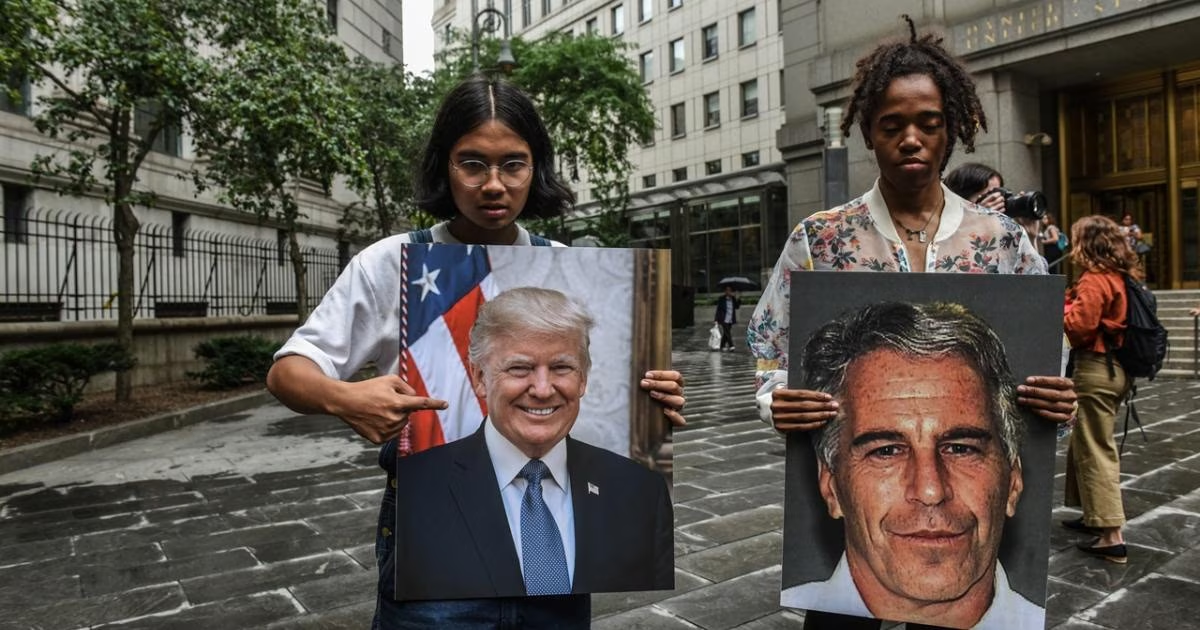
In contrast, US Ambassador to NATO Matt Whitaker refrained from directly answering a question about re-evaluating aid, merely stating that Israel is "one of the United States' closest allies," a response that reflected the continued political sensitivity within the official US establishment regarding any public discussion about the conditions of military support.

In another context, Ocasio-Cortez had earlier attacked President Donald Trump, accusing him of seeking to usher the United States into an "era of authoritarianism" through a foreign policy based on withdrawal and redistribution of global influence. She said that Trump and his Secretary of State Marco Rubio are working to "pull the United States out of the world" to create a system that allows him to dominate the Western Hemisphere and Latin America, while giving Russia wider leeway to pressure Europe.

The representative presented what she called an "alternative vision" for a leftist foreign policy, calling for a return to a "rules-based order," but without the "hypocrisy" of traditional American policy, referring to the double standards between American rhetoric on human rights and its actual policies towards its allies.

Recent developments indicate that the issue of the war in Gaza is poised to play an increasing role in the Democratic Party's electoral calculations. While the extent of the issue's impact on the 2028 elections remains unclear, a number of Democratic names being floated as potential candidates have already begun to face embarrassing questions about aid to Israel, amidst an internal division between a traditional current that favors continuing the previous approach, and a more critical one that adopts rhetoric similar to Ocasio-Cortez's.

Ocasio-Cortez's statements reflect a shift in the debate within the Democratic Party from the level of moral objection to the level of legal accountability. Invoking the Leahy Laws does not just raise a political question, but puts Washington to the test of applying the law to allies as well as adversaries. This shift could open the door to increased institutional and media pressure, especially with the expanding international documentation of war victims in Gaza, and the difficulty of continuing the discourse of "unconditional support" without internal cost.

According to observers, what confuses Democrats is that Gaza has become an intersection point between domestic politics and international discourse. On the one hand, the party attacks Trump as a threat to the existing rules-based global order, and on the other hand, it finds itself accused of double standards due to continued military support for Israel. If the party fails to produce a new formula that balances alliance and accountability, the issue could turn into a renewed electoral burden in 2028, especially among the youth and progressive wing of the party.