






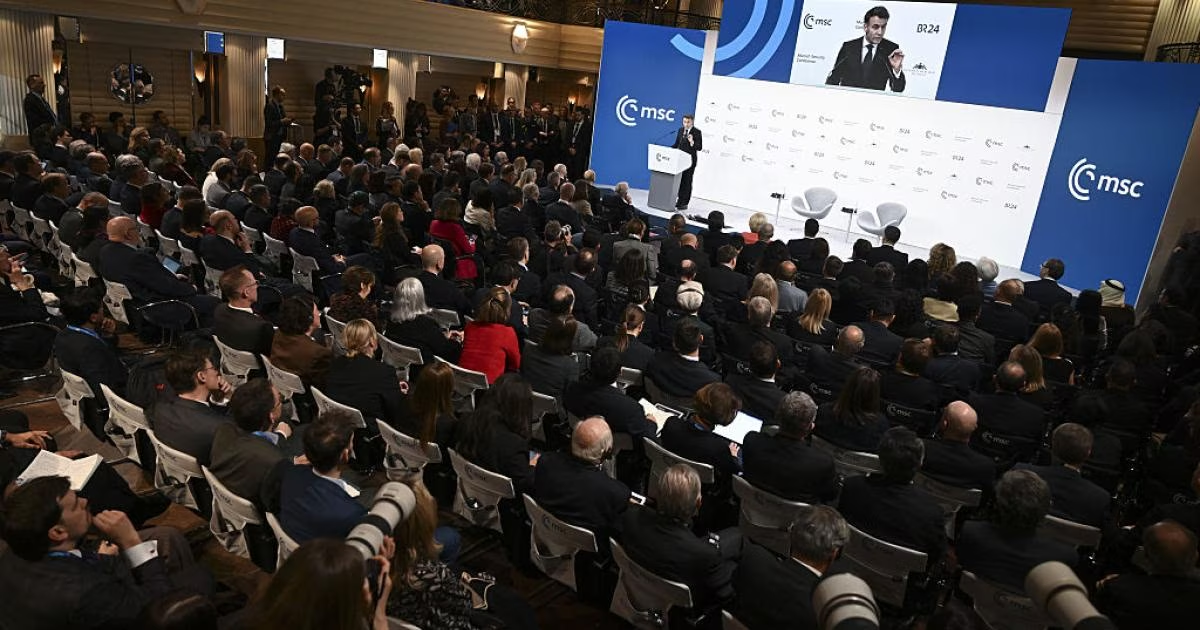
The annual Security Conference kicked off its new session in the German city of Munich, with high-level diplomatic and military attendance including more than 60 heads of state and government. Current wars and shifting power balances topped the agenda of the meetings, which aim to shape the future of European security in light of accelerating energy and technological challenges.
German Chancellor Friedrich Merz affirmed in his opening speech that the global order is undergoing a radical transformation not seen for many decades. Merz pointed out that the international rules that previously governed the world have significantly eroded, considering that rising powers such as China are rephrasing these rules in line with their national ambitions and strategic interests.
The German Chancellor stressed the necessity for the European continent to possess an independent security and defense strategy capable of confronting challenges without complete reliance on external parties. He noted that the political and strategic gap between the two sides of the Atlantic has begun to widen, which compels European countries to adopt a policy of strength to protect their interests in a turbulent world.
For his part, US Secretary of State Marco Rubio acknowledged that the features of the 'old world' have indeed faded in the face of current geopolitical transformations that impose a new reality. Rubio explained that Washington finds itself compelled to re-evaluate its leadership role in the coming period, in line with international changes and the extent of commitments required from it towards its allies.
In a stance characterized by firmness towards dependence on Washington, French President Emmanuel Macron called for achieving complete and comprehensive European independence in defense and political fields. Macron considered that transatlantic relations are going through a period of uncertainty, demanding that the American administration clarify the nature of the commitments it can offer to Europeans in light of escalating crises.
The first day of the conference witnessed explicit European demands for the American side to stop directing continuous criticism at the old continent and work to revive mutual trust. Participating leaders warned that continued media and political bickering weakens the Western front against common threats posed by competing powers in the East.
Finnish President Alexander Stubb presented a detailed vision on possible areas of cooperation with the United States, noting that NATO remains the primary umbrella for defense and technology. Stubb explained that there are vital issues such as strategic minerals and icebreakers that can be worked on jointly, despite friendly differences on climate issues and international institutions.
In a related context, NATO Secretary General Mark Rutte revealed a 'change in mindset' within NATO circles, where Europe has begun to play a greater leadership role. Rutte affirmed that strengthening the European component within the alliance does not mean separation, but rather strengthens the link between the two sides of the Atlantic and makes it more flexible in facing global crises.
The conference activities continue until next Sunday, where the capital of Bavaria hosts a series of closed meetings and informal discussions between participating delegations. These meetings are taking place amidst strict security measures in the historic city center, with the aim of reaching common understandings on issues of collective security and strategic deterrence.
The discussions in Munich reflect an intense European desire to reduce reliance on traditional security guarantees and move towards building advanced self-capabilities. Observers agree that the results of this conference will determine the shape of international alliances in the coming years, especially in light of the intense technological and economic competition between major powers.
The rules-based international order no longer exists as it once did, and China is reinterpreting it to serve its interests.
Share your opinion
Munich Security Conference: Europe Seeks Strategic Autonomy Amid Eroding Trust with Washington