ARAB AND WORLD

Wed 25 Feb 2026 3:16 am - Jerusalem Time

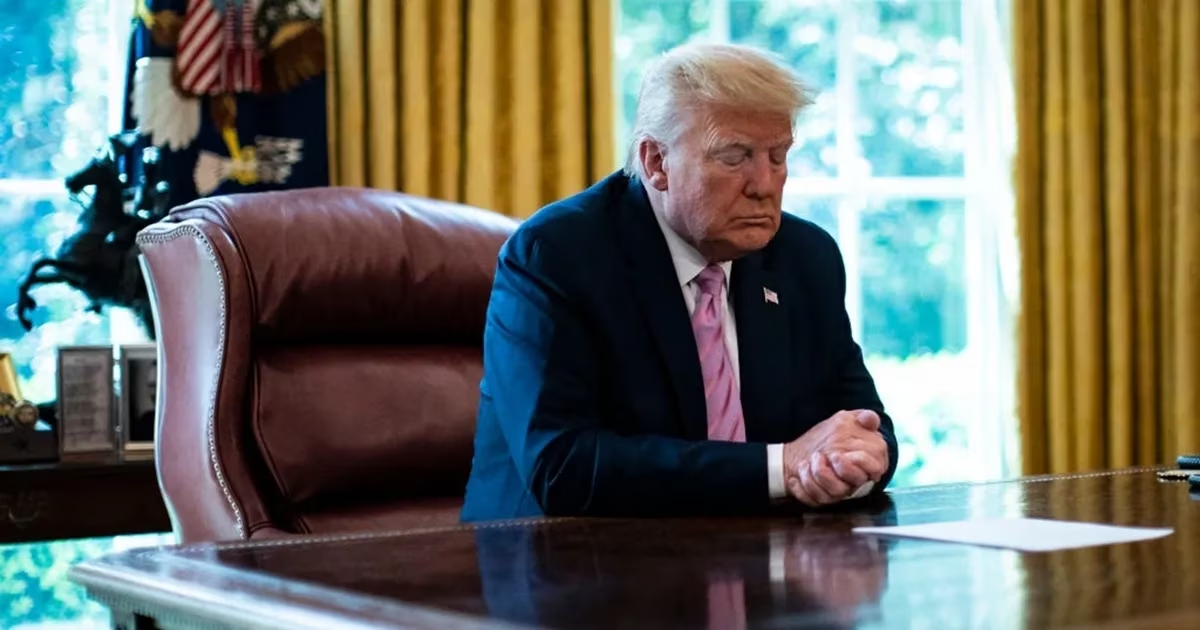
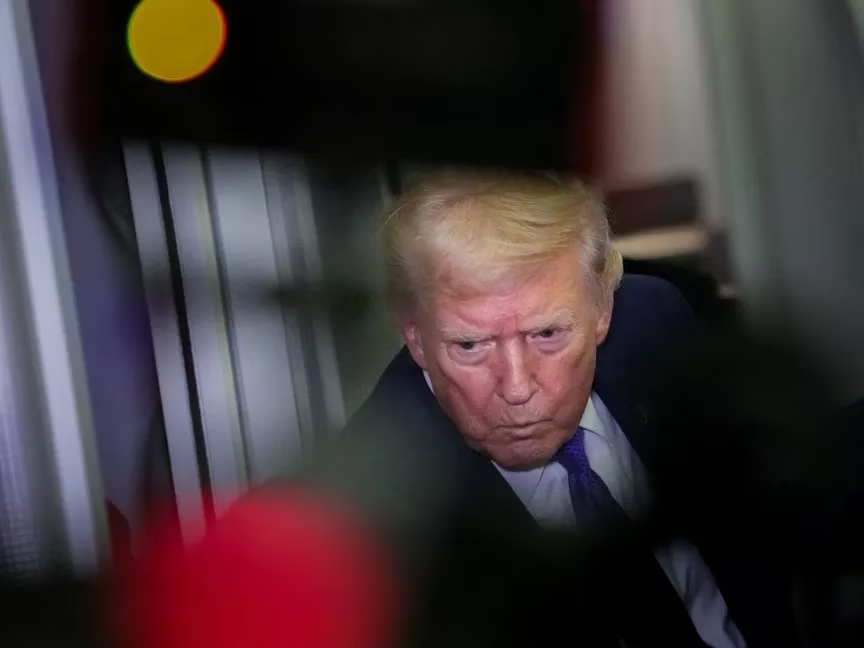
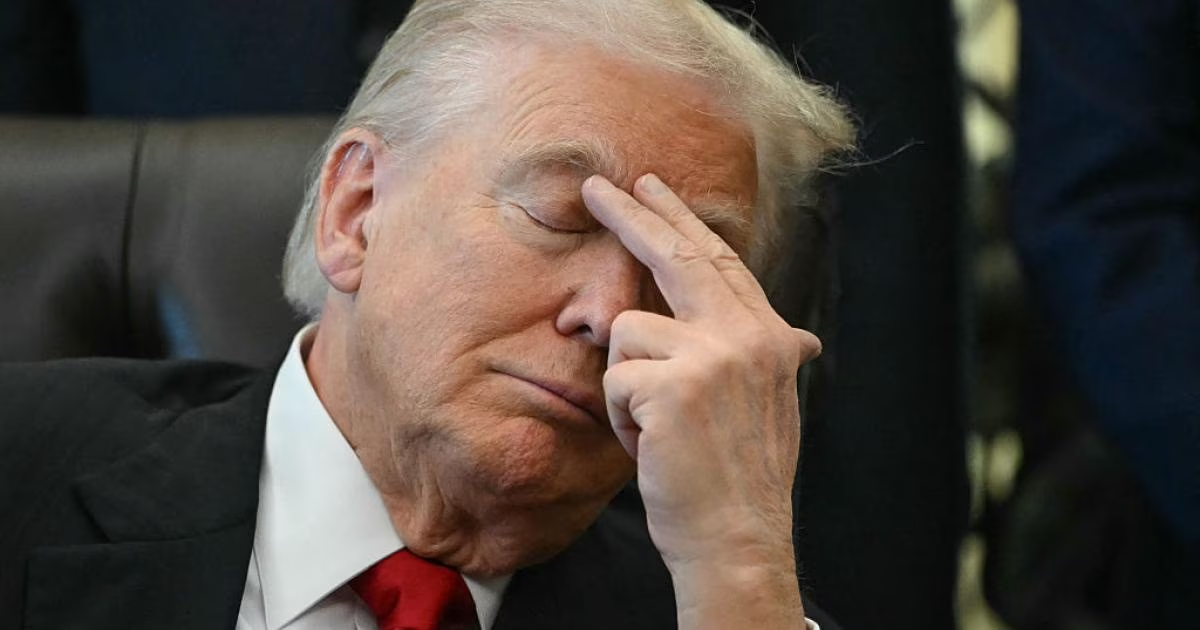
Poll: Majority of Americans See Trump as 'Erratic' as He Ages

A recent opinion poll conducted in collaboration between media sources and Ipsos found that six out of ten Americans believe President Donald Trump has become erratic as he ages. This view included a significant segment of Republican Party members, indicating growing public concern about the eligibility of political leadership in the United States.

The results of this six-day poll came ahead of the anticipated State of the Union address by the 79-year-old president to Congress. These public pressures follow a series of criticisms and rebukes directed at the president by lawmakers and judges over the past month, placing his performance under public scrutiny.

According to detailed data, 61% of participants described Trump as having become erratic, with these percentages distributed to include 89% of Democrats and 64% of independents. The surprise was the inclusion of about 30% of Republicans in this view, which reflects a crack in the solid mental image the White House tries to market about the president.

In contrast, the White House was quick to respond to these results, with spokesman Davis Engel describing the poll as based on false and desperate narratives aimed at undermining the administration. Engel affirmed that Trump's mind remains sharp and he possesses unparalleled energy, considering his easy access to the public as fundamentally distinguishing him from his Democratic predecessor, Joe Biden.

Despite these criticisms about his age, Trump's overall popularity has not seen a sharp decline in recent months, stabilizing at around 40%. This percentage represents a slight increase of two percentage points from the beginning of this month, although it remains below the 47% with which he began his term.

The numbers reflect a general dissatisfaction with the age of the political class in Washington in general, not just Trump. 79% of poll participants supported the idea that elected officials in the US capital are too old to represent the aspirations and needs of most American citizens.

Statistics indicate that the average age in the Senate is 64, while in the House of Representatives it is about 58. Democratic voters appear to be the most inclined to demand younger faces, with 58% of them considering their Senate leader, 75-year-old Chuck Schumer, to be past the appropriate age for government service.

Donald Trump began his second term in January 2025 at the age of 78, making him the oldest president in US history on his inauguration day. Since returning to power, he has made rapid decisions including imposing widespread tariffs and deploying federal forces to deal with irregular migration, steps his supporters see as proof of vitality.

Observers believe that Trump's victory in the 2024 elections was closely linked to the mental decline observed in his predecessor, Joe Biden. Biden ended his term at the age of 82, a record Trump is set to break soon, as he will celebrate his 80th birthday next June, reigniting the debate about the ability to bear the burdens of office.

The poll showed a significant decline in the percentage of those who describe Trump as intelligent and capable of dealing with major challenges, with the percentage currently falling to 45%. This percentage had reached 54% in previous polls conducted in September 2023, indicating a gradual erosion of confidence in his mental abilities over time.

Despite the general decline, Republicans remain committed to their positive view of the president, with 81% describing him as sharply intelligent in the latest poll. This percentage has not changed much from last year, showing a sharp division in American public opinion based primarily on partisan and political loyalties.

Among independents, the results were harsher, with only 36% believing Trump still possesses sharp intelligence, compared to 53% in 2023. This sharp drop among the independent voting bloc could pose a significant challenge for the current administration in passing its policies or maintaining its political momentum in upcoming elections.

Among Democrats, the percentage of those who see the president as capable of facing challenges fell from 29% to just 19%. These figures reinforce the state of political polarization, where the president's opponents see every slip of the tongue or erratic action as additional proof of his unsuitability to continue leading the world's foremost superpower.

It is worth noting that this online poll conducted by media sources included a wide sample of 4,638 American adults from various states. Experts confirm that the margin of error of two percentage points makes these results a strong indicator of shifts in American public sentiment regarding the issue of the aging of political leaders.

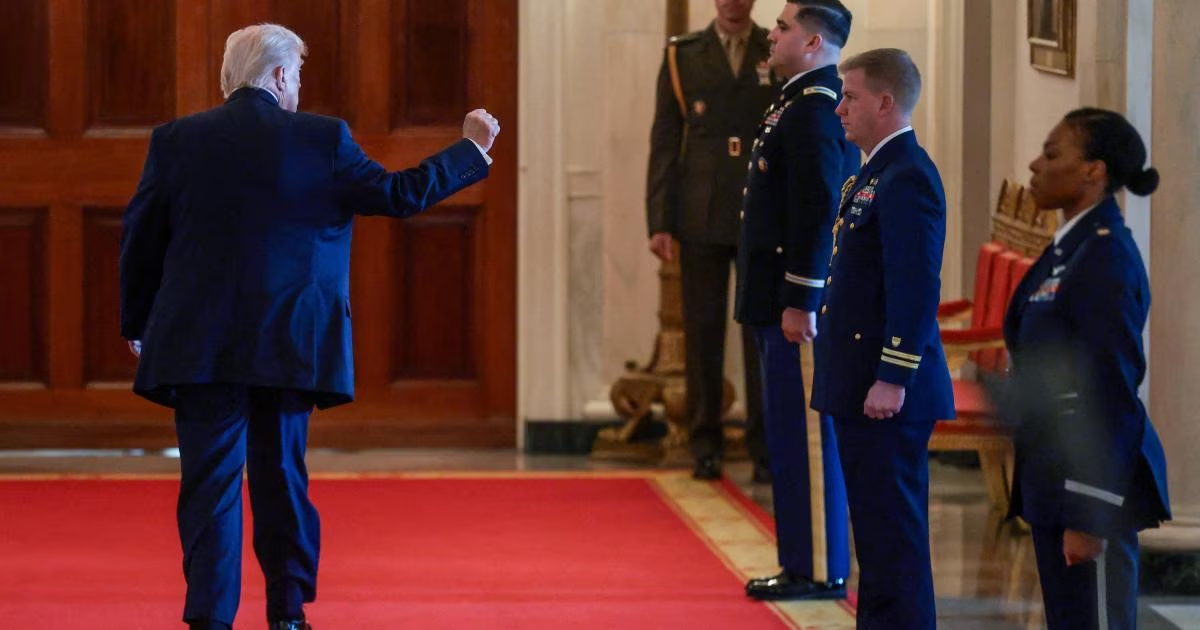
Trump's sharp mind and unparalleled energy distinguished him from his predecessor, Joe Biden.

PALESTINE

Wed 25 Feb 2026 3:16 am - Jerusalem Time

Al-Hindi: 'Peace Council' is an American play, and betting on disarming the resistance is just an illusion

The Deputy Secretary-General of the Islamic Jihad movement, Mohammed Al-Hindi, described the recent formation of the 'Peace Council' as merely a theatrical show lacking any connection to the reality on the ground in the Gaza Strip. Al-Hindi clarified that this council has not brought about any tangible change in the course of the aggressive war, nor has it succeeded in curbing the continuous Israeli crimes against Palestinian civilians.

The Palestinian leader pointed out that the equation upon which the council was based grants the United States absolute sovereignty and ensures complete security for Israel, while the Palestinian will for self-determination is absent. He considered Palestinian representation in this framework to be completely missing, as Palestinians are intended to limit their role to managing municipal affairs through technocratic committees stripped of political decision-making.

Al-Hindi stressed that the proposed vision fully adopts the Israeli narrative, especially regarding linking the reconstruction of the Gaza Strip to the surrender of resistance weapons. He criticized the absence of any serious discussion about the withdrawal of occupation forces or holding them accountable for the continuous violations of the ceasefire agreement, including the continued closure of crossings and obstruction of the entry of relief aid and tents.

Regarding the martyrdom of a number of Al-Quds Brigades leaders, Al-Hindi affirmed that the loss of leaders has never been a reason for the Palestinian people's will to break or their resistance to stop. He explained that the Palestinian struggle, spanning over a century, is capable of producing new generations of fighters who become more determined and steadfast with every sacrifice made by the movement.

Despite acknowledging the military impact on factions due to the comprehensive war that targeted infrastructure over two years, Al-Hindi stressed that the popular spirit is the true source of strength. He recalled that the Palestinian people confronted the occupation in the 1987 Intifada with only stones, emphasizing that the current battle is being waged against a broad Western alliance led by Washington.

Sources reported that Al-Hindi affirmed that his movement does not rely on successive American administrations, whether during the era of Donald Trump or Joe Biden, due to the consistent strategic bias towards Israel. He explained that the resistance's agreement to some understandings was exclusively aimed at stopping massacres against civilians, and not based on trust in the American mediator who adopts the Israeli narrative.

Al-Hindi touched upon the statements of the American ambassador in Tel Aviv, Mike Huckabee, regarding Israeli expansion, considering them to reveal the true essence of the Zionist project and its connection to evangelical currents in Washington. He noted that the absence of official American condemnation of these statements confirms the depth of complicity, despite attempts to reassure Arab allies with worthless verbal promises.

In his assessment of the field situation, Al-Hindi said that the occupation's hand has become absolute in military targeting within Gaza and Lebanon, amidst suspicious international silence. He added that humanitarian relief and reconstruction files have been transformed into tools for political blackmail and procrastination, with the aim of extracting political concessions that the occupation failed to achieve on the battlefield.

The Deputy Secretary-General of Islamic Jihad affirmed that maintaining a degree of military strength is what gives Palestinians weight in regional and international equations, warning that weakness will only bring displacement. He considered that what is happening in the West Bank of daily desecration despite the absence of heavy weapons proves that the occupation's ambitions are not only linked to the existence of armed resistance.

Al-Hindi concluded his remarks by referring to the American military buildup off the Iranian coast, considering Israel to be the party most eager to ignite a comprehensive regional confrontation. He affirmed that any escalation in the region will not close the page on the Palestinian issue, which will remain alive as long as the people remain steadfast on their land and choose resistance as the only path to liberation.

Betting on surrendering resistance weapons in exchange for reconstruction is a great illusion, and what is happening in the West Bank, with its desecration despite the absence of heavy weapons, is the greatest proof of that.

PALESTINE

Wed 25 Feb 2026 3:15 am - Jerusalem Time

Netanyahu conditions Gaza reconstruction on Hamas disarmament and vows to continue operations in the West Bank

The Prime Minister of the occupation, Benjamin Netanyahu, reiterated his commitment to fully disarming the Gaza Strip, considering the dismantling of Hamas's military capabilities as a fundamental pillar of his government's plans for the next phase. Netanyahu indicated that this goal would proceed and would not be reversed, describing it as a security necessity that is non-negotiable.

During a speech at a special conference for the General Security Service (Shin Bet), Netanyahu claimed there were understandings and agreements with international parties, which he referred to as 'international force' and 'peace council,' regarding the inevitability of ending armed manifestations in the Strip. He explained that the occupation presents the international community with two options to implement this plan, asserting that it will be achieved 'either the easy way or the hard way.'

Regarding the field conditions in the West Bank, Netanyahu praised the close security coordination between the occupation army and the Shin Bet, especially in operations targeting Palestinian camps. He mentioned that efforts are ongoing to 'uproot centers of gravity' within those areas, in an attempt to undermine the resistance infrastructure and prevent the escalation of operations against Israeli targets.

Netanyahu also praised the leadership of the Shin Bet, describing its head as a 'skillful and proactive leader,' and appreciating the essential role the agency plays in protecting what he called the occupation's national security. He stressed that these moves are part of a broader vision to create a new regional axis to confront the increasing security challenges in the region, as he put it.

Netanyahu concluded his statements by directly linking the reconstruction of the Gaza Strip to the disarmament process, warning that any progress in this path would not occur without ensuring the dismantling of the military power of Palestinian factions. These statements come at a time when the region is witnessing escalating tensions, amid mutual threats with other regional parties that Netanyahu warned of unprecedented reactions if the occupation is subjected to any attack.

Gaza's disarmament will happen; either the easy way or the hard way, but it will inevitably be achieved.

ARAB AND WORLD

Wed 25 Feb 2026 3:15 am - Jerusalem Time

The Equation of Steadfastness and Confrontation: Why Does Tehran Refuse to Surrender to Trump's Pressures?

Questions are escalating in the White House corridors about the motives preventing Tehran from declaring its full surrender to the 'maximum pressure' policy pursued by US President Donald Trump. Diplomatic mediator Steve Witkoff revealed Trump's bewilderment at the Iranians' unwillingness to yield, despite unprecedented naval deployments and economic pressures aimed at forcing them to make fundamental concessions.

Observers believe that these statements may give Tehran an unintended negotiating advantage, as they show Trump in a position unable to enforce his threats that have been ongoing for months. While the American president aspires to conclude a historic agreement that surpasses what his predecessor Obama achieved, he finds himself stuck between the option of an all-out war, whose consequences he fears, and the failure of diplomatic persuasion efforts.

In a related context, Gulf academic predictions sparked widespread controversy about Iran's imminent acceptance of 90% of American conditions, which include reducing the nuclear program and dismantling ballistic missiles. However, the probabilities of a military attack remain high due to mutual distrust, reflecting the complexity of the political and military landscape in the region.

On the other hand, voices within the United States are emerging, advocating for the necessity of getting rid of the Iranian regime instead of negotiating with it, considering any agreement to be temporary and weak. This trend was highlighted by Trump's re-posting of videos calling for an end to the diplomatic path and focusing on regime change as the only solution to end the nuclear threat.

However, the military reality poses different challenges, as the Chairman of the US Joint Chiefs of Staff, General Daniel Kane, warned against sliding into a long-term conflict with Iran. This warning was met with a sharp response from Trump, who considered it 'fake news,' asserting that victory would be easy and guaranteed if a decision for military confrontation were made.

Recent American statements about Iran approaching nuclear bomb production within one week bring to mind the pretexts used before the invasion of Iraq decades ago. This verbal escalation paves the way for legitimizing any potential military strike that might target vital Iranian facilities before the assumed deadline.

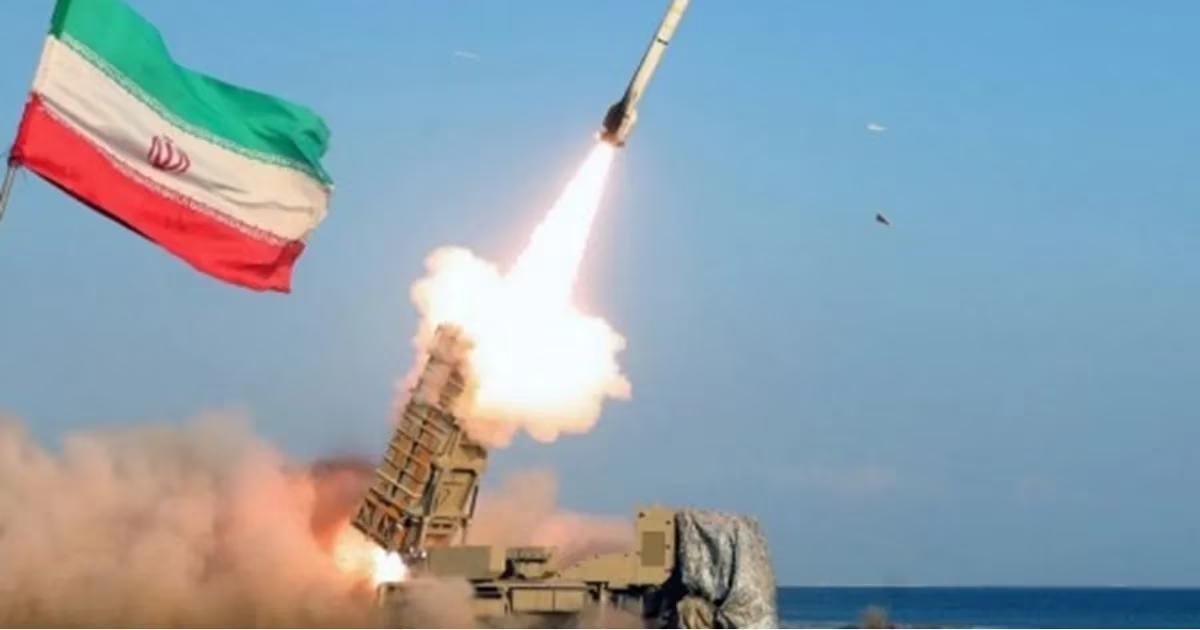
On the ground, reports indicate unprecedented American military deployments in the region, including hundreds of fighter jets, aircraft carriers, and tens of thousands of soldiers. Despite the enormity of this force, military experts doubt its sufficiency to overthrow the regime or control the ground without the need for double the number of ground troops.

Iran's situation differs from the Iraqi experience in 2003 in terms of the absence of regional or internal support for any foreign military intervention. Moreover, the Iranian regime has shown an exceptional ability to use excessive force to suppress any internal rebellion, making the bet on its collapse from within during a war a risky endeavor.

Additionally, Iran possesses an alternative leadership structure, prepared in advance to deal with assassinations that may target its political or military figures. Tehran draws inspiration from Hezbollah's experience in Lebanon, which managed to quickly replace its senior leaders after a series of Israeli assassinations, ensuring the continuity of the chain of command.

US Secretary of State Marco Rubio summarized the secret of Iranian 'stubbornness' in the ideological dimension, noting that dealing with a leadership that makes its decisions based on religious foundations makes negotiations extremely complex. This ideological dimension gives the Iranian negotiator an ability to endure and maneuver that transcends traditional political calculations based on material profit and loss.

Furthermore, the model of resistance in the Gaza Strip stands out as a source of inspiration for Tehran and its allies in the region, where resistance factions have been able to withstand for two years against a massive military arsenal. This steadfastness reinforces the conviction among the Iranian leadership that advanced military technology does not always guarantee decisive battles against the will of peoples or nations with historical depth.

Iran is currently trying to avoid widespread destruction by offering 'acceptable' concessions in the nuclear file, provided that it is not deprived of its rights enjoyed by other countries in the region. However, American insistence on disarming all Iranian power cards puts the region on the brink, with only the option of retaliation or chaos looming.

Any large-scale military attack will necessarily lead to a re-production of backwardness and economic decline throughout the Middle East. This is what Netanyahu and his allies seek to achieve to ensure the absolute superiority of the Israeli occupation, far from any existential threats that rising regional powers might pose.

In conclusion, the scene remains open to all possibilities, between last-minute diplomacy and the drums of war beating strongly in Washington and Tel Aviv. The coming days will reveal whether Iran will succeed in weathering this storm, or whether the region is heading for a political and military earthquake that will change its face for many years.

They wonder why the Iranians haven't come to us to say that we don't want to possess nuclear weapons under this immense pressure.

ARAB AND WORLD

Wed 25 Feb 2026 3:15 am - Jerusalem Time

Warnings of Dire Consequences for Trump's New Military Appetite in the Middle East

International media sources reported that US President Donald Trump's new tendencies towards military escalation in the Middle East could backfire badly, despite his previous promises to end armed conflicts. Observers believe that Trump, who has long condemned foreign interventions, has begun to show an increasing appetite for wars he once described as futile, putting his credibility and foreign policy at stake.

Trump had previously stated that the true measure of success lies not only in battles Washington wins, but in wars it successfully ends or avoids fighting altogether. However, recent field movements indicate a massive deployment of US military force in the region, with continuous hints of taking decisive action regarding a military confrontation with Iran.

Analyzes suggest that last year's experiences, including limited operations against Iranian nuclear facilities and movements in Venezuela, convinced Trump of the effectiveness of rapid military force. This sense of victory has created a state of overconfidence that could push the US administration towards unpredictable adventures in a highly complex regional environment.

Experts warn that the pursuit of quick victories could end in a long-term strategic defeat, especially since the proposed operations against Tehran carry risks far exceeding previous campaigns. This danger stems from the fluctuation of US objectives, which range from destroying the nuclear program to the implicit pursuit of regime change.

The objectives put forward by Washington, such as ending Iran's support for resistance movements like Hezbollah and Hamas and destroying its missile arsenal, cannot be achieved through limited airstrikes. These goals require deep political concessions or a comprehensive internal uprising, which makes military action alone an inadequate tool for achieving sustainable results.

The ambiguity of military objectives increases the likelihood of the United States sliding into a long-term conflict, giving Tehran a greater opportunity to organize effective responses. Recent experiences have shown that the depletion of US defensive capabilities, such as THAAD interceptor missiles, occurs very quickly during intense missile confrontations.

This policy places tens of thousands of American soldiers stationed in military bases in the region directly in the line of Iranian fire, whether through drones or ballistic missiles. Moreover, the vital infrastructure of Washington's allies, particularly desalination plants and oil facilities, remains easy targets in any comprehensive confrontation.

Despite Iran's previous attempts to avoid uncontrolled escalation, the regime's feeling of an existential threat could change the rules of engagement and increase its willingness to take risks. Any widespread attack could backfire, contributing to rallying the Iranian street behind its leadership instead of weakening it under the weight of external pressures.

The lessons of overthrowing regimes in Iraq, Libya, and Syria remain a warning of the catastrophic consequences of foreign military interventions that leave widespread chaos. These conflicts not only led to massive human losses but also created fertile environments for the growth of terrorist groups that threatened global security for many years.

In a related context, the goals of regime change in Iran intersect with the desires of Benjamin Netanyahu's government, which sees the collapse of Tehran as a supreme strategic interest for the occupying state. However, the chaos resulting from such a collapse could pose a real and direct threat to the Arab Gulf states, which are on the front lines of the confrontation.

It seems that Trump relies in his calculations on the geographical distance of the United States, believing that the Atlantic Ocean will protect American territory from the repercussions of Middle East wars. But history proves that US presidents, including Barack Obama, found themselves forced to intervene on the ground again due to unexpected events resulting from the security vacuum.

The striking paradox is that Trump, who campaigned as a peace candidate and opponent of the wars in Iraq and Afghanistan, is now closer than ever to engaging in a new conflict. This shift raises international concern that his desire for a 'military victory' could lead to an uncontrollable regional catastrophe.

Informed sources indicate that internal and external pressures play a significant role in directing the White House's compass towards escalation, despite warnings of military resource depletion. Relying on hard power as a first option reduces the scope for diplomacy and increases the chances of miscalculation from both sides.

In conclusion, the question remains whether Trump will back down at the last minute, as he has done in previous situations, or whether his propensity for risk will lead the region into a dark tunnel. Any tactical military success he might achieve now could be the detonator that ignites major strategic crises that successive US administrations will suffer from.

Success can breed overconfidence, and if Trump continues to deploy US forces in search of quick victories, he may end up with a long-term defeat.

PALESTINE

Wed 25 Feb 2026 3:15 am - Jerusalem Time

With primitive tools and solid will... Gazans face mountains of rubble in a popular 'recycling epic'

Amidst the ruins of the destroyed Al-Karama neighborhood, citizen Ahmed Mansour (45 years old) struggles to remove the rubble of his home with his bare hands, in a scene that summarizes the reality of thousands of families who have been deprived of housing and overcrowded camps. Mansour is forced to demolish the remaining walls of his dilapidated house himself, in preparation for setting up a tent to shelter him and his family on the land where he grew up, considering that returning to the rubble is a declaration of attachment to the place and a rejection of displacement.

Areas in the northern Gaza Strip, such as Sheikh Radwan, Al-Tawam, and Al-Karama, are turning into popular workshops that do not cease under the scorching sun and thick dust. There, citizens do not wait for international decisions or official reconstruction plans, but rather begin to shape their new lives with plastic jars and manual iron cutters, transforming 'death cement' into the first building blocks of their daily steadfastness.

The field scene is bustling with the movement of young people who lift heavy bricks as if they are restoring fragments of their memories, while manual hammers strike concrete blocks with a monotonous rhythm that represents the true sound of resistance. These men turn their arms into human cranes, and their fingers, bruised by rough edges, into precise engineering tools that extract hope from the heart of pain.

Statistical data indicate an unprecedented urban catastrophe, as the amount of rubble resulting from the war reached about 57.5 million tons, according to a report by the United Nations Development Program issued in December 2025. This huge figure reflects the destruction or damage of nearly 80% of the sector's buildings, which has turned entire neighborhoods into accumulated layers of fragmented concrete that block streets and suffocate life.

The increase in the volume of debris was terrifying, as the quantity jumped by more than 133% within a few months, after it was estimated at 22.9 million tons at the beginning of 2024. These figures reflect the accelerating pace of systematic destruction practiced by the occupation, which puts Gaza in front of one of the most complex construction waste management crises in modern history.

UN analyses confirm that the current volume of rubble exceeds what all Israeli wars on Gaza since 2008 combined have left behind, which puts the residents before a challenge that exceeds traditional capabilities. With the continued prevention of heavy equipment entry, Gazans find themselves forced to deal with mixed and complex materials that require advanced separation techniques that are not currently available.

In light of this reality, local initiatives have emerged, such as the 'Rawafed' team founded by Basem Al-Madhoun, who began by trying to clean his own home before the idea turned into a collective effort. The team aims to help residents clear the debris of their homes to start life anew, relying on primitive tools and simple bulldozers that do not meet the scale of the catastrophe.

Al-Madhoun and his team face significant obstacles posed by the occupation, which prevents the entry of advanced machinery for crushing stones or recycling iron. Israeli forces deliberately bombed available equipment during military operations to obstruct any attempt at self-sufficiency, and to keep the reconstruction file hostage to political decision and military control.

Near the demolition sites, recycled rubble traders such as 'Abu Nael' are active, working to extract twisted iron rods and straighten them manually to sell them at low prices. Abu Nael says that they are looking for their livelihood amidst death, and are trying to provide alternatives for construction in light of the cement shortage and factory closures, so that citizens may find a wall to lean on instead of a tent.

The bitter economic reality has even affected the rubble trade, as the price of a used brick has risen from one shekel before the war to four shekels currently due to the scarcity of materials and the costs of extracting them manually. Despite this increase, many displaced people find themselves unable to pay the price, which exacerbates the suffering of living in the open or under worn-out tent fabrics.

The cruelty in Gaza has reached the point of using used and cleaned stones from the rubble to build graves and prepare them for martyrs, in the absence of new construction materials. Here, the necessity of survival mixes with the pain of farewell, where the stone extracted from a destroyed house is the same material that covers the body of the homeowner who ascended in the bombing.

The rubble removal operations in Gaza are not just a technical procedure to clear the way, but rather a small sovereign act practiced by bare hands in the face of international and regional decisions that try to keep the place suspended. Every stone cleaned of dust is a promise of a future wall, and every iron rod straightened is a new nerve that strengthens the torn land by missiles.

The popular epic continues in Gaza to tell the world that when people are deprived of basic building materials, they build their reconstruction with what is available from yesterday's debris. This scene, which may seem primitive, represents the counter-narrative of the Palestinian idea of displacement, where Gazans insist that the house be born from the debris, and the city be reborn, even if after a while.

Between scissors that cut iron and a jar that transports gravel, the features of a legendary steadfastness are formed daily, transcending the language of cold numbers and statistics. It is a battle of will waged by the Palestinian human against attempts to erase his urban existence, confirming that the roots of survival in this land are deeper than the machines of destruction or the policies of siege can reach.

We are the owners of the house, working from dawn to dusk to prepare the land and set up our tents over our rubble, and we will remain roots that cannot be uprooted no matter how much they persist in destruction.

ARAB AND WORLD

Wed 25 Feb 2026 3:15 am - Jerusalem Time

The Military Buildup Predicament: How Trump Entangled Himself in a Confrontation with Iran?

An analytical report published by the 'Financial Times' revealed a worsening crisis facing US President Donald Trump in his handling of the Iranian file. The report clarified that betting on massive military buildups off the Iranian coast has not yet led to the desired results, as the administration expected Tehran's surrender and acceptance of American conditions immediately upon seeing the fleets.

Sources indicated that a sense of frustration began to seep into Trump, which was evident in his sharing of video clips questioning the feasibility of negotiating with the Iranian regime. This shift reflects a real predicament facing the White House, which finds itself between two bitter choices: retreating and the failure of the pressure strategy, or moving forward towards a comprehensive confrontation.

The newspaper quoted Aaron David Miller, an expert at the Carnegie Endowment for International Peace, as saying that the US President has trapped himself with public pledges to support internal protests in Iran and deploy massive military forces. Miller believes that Trump is now in a position that requires him to extract huge concessions to justify this buildup, otherwise he will be forced into a war he does not actually want.

It seems that the previous political successes of the US administration in other international files have given Trump excessive confidence in his ability to subdue Tehran. However, the on-the-ground and political reality in the Middle East has proven more complex, as Iran has shown no signs of backing down despite repeated threats of limited or comprehensive military strikes.

For her part, Middle East affairs expert Rosemarie Kilanek observed a contradiction in the justifications Trump is offering for a potential attack. While there is talk at times of destroying the nuclear program, at other times the goal of weakening armed groups loyal to Tehran or destroying its ballistic missile arsenal, which does not pose a direct threat to US territory, emerges.

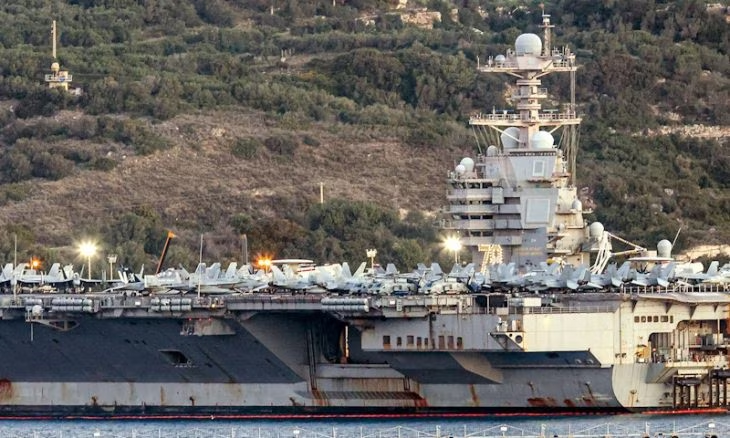
In the context of the field escalation, the aircraft carrier 'USS Gerald R. Ford' arrived in the eastern Mediterranean, joining a military buildup that is the largest since the invasion of Iraq. Despite this striking power, officials in Washington wonder why Tehran is holding out and not heading to the negotiating table to provide guarantees regarding its nuclear weapons.

Steve Witkoff, Trump's special envoy, claimed that Iran may be very close to possessing enough material to make a nuclear bomb, an assessment that sparks wide debate among international experts. The administration is using this claim to push for a quick agreement, warning that the alternative would be a 'very harsh measure' that goes beyond what was taken in the first term.

Despite the threatening tone, Trump faces internal opposition and warnings that any military strike would lead to retaliatory action targeting American assets and allies. Regional experts confirm that Iran has the ability to strike energy infrastructure in the region, which could ignite a global economic crisis that does not serve Washington's interests.

In an attempt to deny internal disagreements, Trump responded to reports that the Chairman of the Joint Chiefs of Staff opposed launching a military attack. Trump affirmed via his 'Truth Social' platform that he is the ultimate decision-maker, emphasizing his preference for a diplomatic solution, but warned of a 'bad day' awaiting Iran if the agreement fails.

For his part, Defense Secretary Pete Hegseth affirmed that the armed forces are ready to provide all military options to the President if Tehran decides to refuse. However, these options remain fraught with risks, especially with intelligence estimates indicating that the ability to launch an intensive air attack may be time-limited and insufficient to resolve the conflict.

Israeli intelligence reports indicate that the current buildups, despite their enormity, may only be sufficient for an air operation lasting a few days. This assessment puts additional pressure on American military planners who fear being drawn into a long-term war of attrition that drains resources and human capabilities.

On the domestic political front, Trump faces a division within his electoral base regarding the option of war, with a large portion of Republicans preferring to avoid costly military interventions. Opinion polls showed that a large percentage of voters fear a repeat of previous war scenarios that did not achieve sustainable stability in the region.

Observers believe that Trump's current boldness stems from his conviction that Tehran responded weakly to previous actions such as the assassination of Qassem Soleimani or the withdrawal from the nuclear deal. But this bet may be misleading, as current circumstances and changing regional alliances may push Iran towards unconventional and unexpected reactions.

Ultimately, the US President finds himself in a race against time to extract the 'deal of the century' with Iran before being forced to make difficult military decisions. The question remains whether the 'brinkmanship' strategy will succeed in achieving Washington's goals, or whether it will lead the region to a major confrontation whose end cannot be predicted.

Trump has put himself in a no-win situation; either extract a major Iranian concession to avoid a war he does not want, or be dragged into it by force.

ARAB AND WORLD

Wed 25 Feb 2026 3:15 am - Jerusalem Time

Foreign Policy Analysis: Why the West Misunderstands Khamenei's Mindset and the Stakes of Surrender?

Analytical sources in Foreign Policy magazine reported that the common assumption in Washington decision-making circles about the possibility of subjugating Iranian Supreme Leader Ali Khamenei through sanctions and military isolation is an inaccurate assumption. Researcher Arash Reisinejad explained that this approach ignores the nature of the man at the heart of the Iranian political system, where surrender is not a viable political option for him under any circumstances.

The analytical reading indicates that Khamenei's political identity was forged amidst opposition to the Shah's regime and refined in prison cells, leading to the bitter experience of the Iran-Iraq War. This biography has made the concept of "resistance" in his lexicon a deeply rooted personal identity, not merely a tactical maneuver to achieve temporary gains or alleviate economic pressures.

Khamenei believes that the Islamic Revolution, which began in 1979, is an ongoing state and an unfinished struggle, where sanctions and external sabotage are proof that the revolution is still alive and facing its enemies. From this perspective, international pressures are not seen as obstacles to be removed by concession, but rather as moral tests that prove the correctness of the regime's revolutionary path.

The analysis draws attention to the Iranian leader's literary inclinations, citing his admiration for the novel "And Quiet Flows the Don," which deals with steadfastness amidst wars and major crises. This mindset views turmoil as a formative factor that refines leadership character, where the hero does not seek quick victory as much as he strives to survive honorably amidst overwhelming chaos.

There is a historical ghost haunting the decisions of the current Iranian leadership, which is Ayatollah Khomeini's acceptance of UN Security Council Resolution 598 at the end of the war with Iraq, which he then described as "drinking the cup of poison." Khamenei, who inherited power without the absolute religious charisma of his predecessor, refuses to repeat this scene, which some within revolutionary circles considered a painful concession.

For Khamenei, refusing to "drink the cup of surrender" is not only about the relationship with the United States, but also an attempt to free himself from the dominance of Khomeini's legacy and build legitimacy based on ideological consistency. He believes that accepting a settlement under the name of "unconditional surrender" would undermine the narrative he has built for decades about his steadfastness and resilience in the face of major powers.

Khamenei's vision of power is based on a historical lesson drawn from the fall of the Pahlavi regime, where he believes that hesitation and weakness in the face of protests accelerated the Shah's collapse, not repression. This lesson makes him believe that retreating under pressure leads to more demands, and that showing any sign of fragility will accelerate the complete collapse of the regime.

Regarding military threats, the analysis indicates that the West overlooks the "martyrdom policy" rooted in Shiite and Iranian revolutionary thought, where martyrdom is revered as a final moral victory. Death in the cause of resistance does not mean defeat in Khamenei's view, but rather bestows sanctity on the continuity of the approach and transforms the ruler from a besieged leader into an eternal symbol of dignity.

This perspective makes the possibilities of assassination or targeted killing a means of solidifying Khamenei's legacy rather than deterring him, as his economic and political failures will be reframed as a heroic sacrifice. The leader's "martyrdom" may give his successors greater flexibility in the future to make pragmatic decisions without appearing weak, relying on the mantle of the martyred leader.

As for the nuclear file, Khamenei does not view it merely as a bargaining chip or a means to possess a bomb, but rather as an integral part of the "dignity policy" and independence from Western hegemony. The nuclear program in the official narrative is proof that the state is still revolutionary and capable of challenging American will, which makes conceding it under duress an existential betrayal.

Sources familiar with Iranian affairs confirm that the US withdrawal from the 2015 nuclear deal reinforced Khamenei's conviction that Washington is an untrustworthy party. This withdrawal reaffirmed his view that concessions do not bring stability, but rather open the door to deeper interventions targeting the very existence of the Islamic Republic.

Although sanctions have inflicted severe damage on the Iranian economy and destabilized internal stability, identity-related commitments remain stronger than material temptations. Nuclear enrichment is repeatedly portrayed as a matter of national independence, and accepting its dismantling under threat is considered humiliation, and humiliation in the leader's thought is more dangerous than economic deprivation.

The analysis concludes that Washington's dilemma with Tehran is not merely geopolitical, but a psychological and philosophical dilemma related to understanding the opponent's motives. The United States faces a leader who sees settlement under duress as a collapse of identity, and prefers personal risk and even death to accepting a symbolic defeat that ends the legacy of the revolution he lived for.

Ultimately, this analysis does not rule out the possibility of future shifts in Iranian policy, but it emphasizes that these shifts will not come through the gateway of public surrender. "Flexibility" may be possible if framed in a way that preserves dignity, but betting on Khamenei's collapse under maximum pressure is a bet that ignores the personal and ideological historical realities of the leader.

For Khamenei, concession under maximum pressure will not be merely a tactical adjustment, but an existential break with his authority and identity.

ARAB AND WORLD

Wed 25 Feb 2026 3:14 am - Jerusalem Time

White House: Diplomacy is Trump's First Option with Iran, Lethal Force Ready

The American presidency announced that President Donald Trump's primary approach to dealing with the Iranian issue is based on the diplomatic path as a top priority. White House spokeswoman, Caroline Leavitt, clarified that the administration prefers peaceful solutions but will not hesitate to resort to strict military options.

Leavitt stressed in press statements that President Trump is fully prepared to give orders to use the lethal force of the US military if necessary. She affirmed that the President is the sole and final decision-maker in determining the nature of the response to Iranian moves that may threaten American interests.

In a related context, Secretary of State Marco Rubio is preparing to hold a high-level meeting with senior congressional leaders to brief them on the latest developments regarding the Iranian issue. This diplomatic move comes at a time when Washington's corridors are witnessing intense discussions about the optimal strategy for dealing with Tehran's nuclear ambitions.

Informed sources indicated a divergence of views between the White House and the US Central Command regarding field operational mechanisms. The sources stated that President Trump is frustrated by the military leadership's lack of full alignment with his vision, which tends towards delivering painful and direct military strikes.

For her part, the White House spokeswoman refuted all reports based on anonymous sources about the President's military plans. Leavitt described these leaks as completely false, warning against relying on unofficial information aimed at distorting the current administration's political vision.

On the ground, the largest American aircraft carrier, 'Gerald R. Ford,' arrived at the naval base in Souda Bay on the Greek island of Crete. This step comes as part of a large-scale military buildup plan led by the United States in the Middle East to enhance its deterrent presence.

Technical reports indicate that the aircraft carrier is now less than 900 kilometers from the central operational area. The carrier is expected to reach the Central Command's operational headquarters within a few days, which will raise the level of military readiness in the region surrounding Iran.

Leavitt cited reports by international observers confirming the success of the military operation carried out by the United States against Iranian nuclear facilities last June. The American administration considered these results to strengthen its position in pressuring Tehran to return to the negotiating table on Washington's terms.

President Trump had set a deadline of ten to fifteen days in mid-February for concluding a new agreement with Tehran. The President is expected to address these threats and the Iranian nuclear program in detail during the State of the Union address scheduled for this evening.

President Trump's first option is always diplomacy, but he is prepared to use the lethal force of the United States military if necessary.

PALESTINE

Wed 25 Feb 2026 3:14 am - Jerusalem Time

Trump administration races against time to calm Arab anger sparked by its ambassador's statements on 'Greater Israel'

International press reports revealed that the administration of US President Donald Trump is making intensive diplomatic efforts with several Arab countries, with the aim of containing the wave of anger sparked by the statements of the US ambassador to Israel, Mike Huckabee. Sources reported that Trump's team sought to clarify the administration's position after Huckabee's talk about the concept of 'Greater Israel' and its supposed control over vast areas in the Middle East.

The American moves included a series of direct contacts with high-ranking Arab officials to clarify what was stated in Huckabee's interview with journalist Tucker Carlson. American officials tried to emphasize that these statements do not necessarily reflect a fundamental shift in US foreign policy towards the region and the sovereignty of its states.

According to informed sources, Deputy Secretary of State Chris Landau and Under Secretary of State for Political Affairs Alison Hooker participated in these efforts. These officials explained to the concerned countries that what Huckabee said expresses personal views stemming from his intellectual background, and does not represent the official position adopted by the White House.

Ambassador Huckabee had caused widespread controversy when he answered a question about Israel's right to control an area extending from 'the Nile to the Euphrates' according to certain interpretations. Huckabee said that 'it's fine if they take it all,' although he later indicated that Israel is not actually seeking to achieve that at the present time.

These statements sparked official condemnations from more than 12 Arab and Islamic governments, describing the position as dangerous and inciting sedition. Countries such as Saudi Arabia, Egypt, Jordan, and the UAE considered these statements to contradict previous pledges made by the Trump administration regarding regional stability.

This crisis comes at a very sensitive time, as Washington is trying to rally the support of Arab countries for its plans related to the reconstruction of the Gaza Strip and securing the region. The administration also fears that these statements could hinder military and security cooperation with countries that host important American bases such as Qatar and Jordan.

Sources quoted a prominent Gulf diplomat as saying that such statements threaten to undermine strategic goals aimed at integrating Israel into the regional environment. The diplomat stressed the need to respect the sovereignty of Arab countries and not to prejudice it under any ideological or religious pretext.

For its part, the US Embassy in Israel tried to alleviate the severity of the crisis through a statement in which it claimed that the ambassador's statements were 'taken out of context.' Despite this, Huckabee continued to defend his position on social media platforms, criticizing media outlets that focused on his talk about Israeli expansion.

Mike Huckabee, an evangelical Christian, is known for his absolute and long-standing support for the settlement movement in the occupied West Bank. He is seen within international diplomatic circles as one of the most hardline and extremist voices in the Trump administration regarding the Palestinian-Israeli conflict.

Officials in the US State Department, who requested anonymity, indicated internal divisions over the ambassador's statements. They confirmed that Huckabee's positions do not represent the ideal image of the American position, which tries to balance supporting Israel and maintaining Arab alliances.

The ambassador's statements directly contradict electoral and political promises made by Trump to Arab and Muslim leaders during his election campaign. Trump had affirmed on several occasions that he would work to prevent Israel's annexation of the West Bank to ensure opportunities for achieving lasting peace in the region.

Observers believe that this incident highlights the challenges facing the US administration in controlling the statements of its officials with strong ideological leanings. These positions cause diplomatic embarrassment that complicates the mission of US envoys in the Middle East who seek to build trust with regional partners.

In the absence of a direct official comment from the US State Department on press inquiries, questions remain about the extent of Huckabee's influence on actual decision-making. Arab capitals fear that these statements may be a test balloon for future policies that may be officially adopted.

Finally, the relationship between Washington and its Arab allies remains under scrutiny with the repetition of such controversial statements. The international community is monitoring the White House's ability to rein in extremist voices within its team to ensure that the region does not slide into further tension and sovereign conflicts.

The sovereignty of Arab states should not be underestimated, especially as we are attempting to create a unified Middle East that includes Israel.

PALESTINE

Wed 25 Feb 2026 3:14 am - Jerusalem Time

UN warns of escalating settler violence in West Bank amid complete impunity

The United Nations Human Rights Office in Palestine confirmed that the pace of settler violence in the occupied West Bank is continuously escalating without any legal or security deterrent. The office clarified in an official statement that these attacks occur under a state of complete impunity, exacerbating the humanitarian and security conditions for Palestinian residents in various governorates.

The UN statement documented the killing of Palestinian Nasrallah Abu Siam in the outskirts of the Mikhmas area outside occupied Jerusalem by a group of settlers. The office clearly indicated that the occupation authorities have taken no effective measures to detain the suspects or conduct a serious investigation into the incident, which reinforces the policy of turning a blind eye to settler crimes.

The report revealed a wave of forced displacement affecting 42 Palestinian families since February 17 due to settler intimidation. The displacement operations were concentrated in the Al-Burj area in the Jordan Valley, Ein Sinia village, and the Al-Khalayel areas in Al-Mughayyir and Ramun villages in Ramallah Governorate, where settlers exert field pressure to force residents to leave.

In the context of field violations, local sources reported that an Israeli settler severely beat Ms. Wedad Makhamreh after he stormed Khirbet al-Markaz in Masafer Yatta, south of Hebron. The settler provocatively searched citizens' homes and livestock pens, causing a state of terror and panic among women and children in the targeted area.

Masafer Yatta communities suffer from systematic and repeated attacks, including storming homes and grazing livestock on private citizens' lands to destroy crops. Residents of these areas appeal to international bodies to provide immediate protection to them to stop the settler encroachment aimed at emptying the land of its rightful owners for the sake of settlement expansion.

On the ground, the Israeli occupation army continued its extensive military campaign on the town of Ya'bad, north of the West Bank, where forces renewed their incursion into the town for the second consecutive day. These incursions included thorough searches of homes and tampering with their contents, in addition to setting up military checkpoints that hinder the daily movement of citizens during the month of Ramadan.

The mayor of Ya'bad, Amjad Atatreh, said that this campaign comes within a systematic policy aimed at empowering settlers and expanding their influence in the area surrounding the town. He explained that the occupation seeks to impose a new fait accompli that facilitates control over agricultural lands and prevents farmers from accessing them under flimsy security pretexts.

Atatreh pointed out that settlers established a new settlement outpost in the vicinity of Ya'bad several months ago, to serve as a launching pad for their attacks on farms and properties. He affirmed that the pace of arrests and raids has significantly escalated, with several cases of arrests and injuries among citizens recorded as a result of field confrontations with occupation forces.

Regarding the issue of prisoners, human rights sources stated that occupation forces have arrested more than 100 Palestinians from various areas of the West Bank since the beginning of the holy month of Ramadan. These arrests come as part of an intensive campaign launched by Israeli security agencies coinciding with holidays and religious occasions, which increases the state of popular tension.

Official Palestinian data indicates that the number of prisoners held in Israeli prisons has exceeded 9,300, living in very harsh conditions. Among these prisoners are 66 women and 350 children, suffering from policies of medical neglect and continuous abuse since the start of the recent military escalation last October.

Since the outbreak of the war on the Gaza Strip, the West Bank has witnessed an unprecedented escalation that has led to the martyrdom of at least 1,117 Palestinians and the injury of about 11,500 others. The total number of arrests in the West Bank and Jerusalem has reached about 22,000 cases, a figure that reflects the extent of the systematic targeting of the Palestinian social and political structure.

Palestinian observers warned that these practices, which combine settler violence and organized military operations, pave the way for the official annexation of the West Bank. Palestinians believe that these steps aim to undermine any future opportunity for the establishment of an independent Palestinian state and disregard international legitimacy resolutions.

At the conclusion of its statement, the United Nations Human Rights Office called for the complete end of the Israeli occupation and the cessation of all illegal settlement activities. It also stressed the necessity of evacuating settlers from the occupied territories and providing international protection for the Palestinian people who face the daily threat of displacement and killing.

Confrontations continue in the northern West Bank, especially in Jenin and Nablus, where popular resistance confronts repeated incursions carried out by the occupation army. Field sources confirm that the policy of collective punishment and the destruction of infrastructure in camps and towns will only increase the Palestinian street's determination to steadfastness and confrontation.

Settler violence is increasing relentlessly and without deterrence amid complete impunity in the occupied West Bank.

PALESTINE

Wed 25 Feb 2026 3:14 am - Jerusalem Time

Deception Strategy: Netanyahu Seeks 'Alternative Axis' to Confront the Gaza Genocide Dilemma

The Israeli leadership and its allies realize more than ever the extent of the erosion that has afflicted the entity's image and international standing, especially with the widening scope of genocide crimes in the Gaza Strip and the entrenchment of the apartheid system throughout occupied Palestine. This awareness leads to desperate attempts to restore the Zionist narrative by using overwhelming force as a tool of dominance supported by an extreme right-wing American vision.

This vision is evident in the statements of Trump's ambassador to Tel Aviv, Mike Huckabee, who did not hesitate to interpret Zionism according to biblical beliefs that grant Israel a supposed right to the land from the Euphrates to the Nile. These trends expose the falsity of previous American promises of peace and confirm that the current joint effort focuses on imposing a new reality that bypasses all legitimate Palestinian rights.

In this context, Benjamin Netanyahu's talk about his government's efforts to form a regional alliance to confront what he described as the 'Sunni and Shia' axes comes as an attempt to ensure Israel's future stability. This proposal reflects a deep dilemma resulting from international prosecutions for war crimes and aims to create a regional umbrella that protects the project of ultimate control over the land.

The axis that Netanyahu heralds indicates the possibility of American arrangements to direct military strikes or maximum pressure on Iran to bring about a change in the existing regime. It appears that Washington is using its warships and aircraft carriers to impose specific deadlines, paving the way for a 'nascent' alliance that serves Israeli and American interests at the expense of Arab national security.

The irony lies in the absence of strong Arab responses to the American ambassador's statements that affect the sovereignty of Arab countries and negate their political existence from the map. At the same time, Netanyahu leaks information about the imminent joining of Arab countries to his special axis, exploiting the state of dispersion and internal fears that are being amplified in favor of projects that serve only the survival of regimes or the weakening of the Palestinian cause.

Israel's attempts to build an axis to protect itself will not be a real alternative to the will of the resistance that has confronted liquidation projects throughout the past decades. Despite the occupation's boasting of its ability to resolve the conflict, the on-the-ground and political reality proves that military force alone cannot break the will of peoples striving for liberation and the restoration of their usurped rights.

The current Israeli policy relies on systematic deception that promotes mutual benefit and rapprochement between peoples through the gateways of economy, security, and water. But these illusions were practically buried under the rubble of Gaza and the remains of its victims, as the Israeli war machine proved that its true goal is settlement and preventing the establishment of any independent Palestinian entity.

Before the events of October 7th, Israel relied on a solid Western axis and influential lobbies that controlled the global narrative, but this narrative has fractured unprecedentedly. Images of brutality and crimes committed against women and children overshadowed all attempts at falsification, which even senior American leaders acknowledged in their recent statements.

Israel's narrative, which attempted to demonize Palestinians and portray them as 'human beasts,' has been cornered within the halls of the International Court of Justice and the International Criminal Court. Anyone seeking to provide cover for these crimes is now threatened with legal prosecution as an accomplice in the war of genocide, which has deprived the occupation of the 'victim' advantage it exploited for many years.

The Palestinian experience has demonstrated a high ability to expose alleged plans about illusory peace and revealed the hypocrisy of the international community that condones Zionist arrogance. This steadfastness is what drives Netanyahu today to search for alternative axes that try to close the circle of the new Nakba and entrench the apartheid system as an unchangeable fait accompli.

The exposed Israeli-American deception before the Arab street will rebuild a state of bitter hostility and awareness of the gravity of the Zionist danger and its expansionist ambitions. Projects targeting 'Greater Israel' are no longer mere theories, but have become declared policies promoted by ambassadors and diplomats in broad daylight.

The living forces in the region will remain in a state of continuous proliferation and awareness to confront the Zionist illusions that believe in their ability to crush the owners of the land and history. History is not made by collaborators, but written by peoples who refuse to have their will falsified or to relinquish their national and national sovereignty, no matter the sacrifices.

The existential anxiety shown by the occupation leaders and their frequent talk about 'axes of existence security' is the greatest proof of the failure of their project to integrate into the region. An axis built on the blood of innocents and the ruins of cities cannot provide sustainable security, but rather sows the seeds of an impending explosion that will overturn all these fragile arrangements.

Ultimately, the reliance on Palestinian and Arab popular awareness remains the rock upon which all Israeli axes of deception shatter. The truth revealed by the blood of Gaza is stronger than any media machine, and international justice, though delayed, has begun to tighten the noose around the criminals who once thought they were above the law.

Netanyahu's alleged axis is an expression of the Israeli dilemma stemming from the legacy of war crimes and genocide in Gaza, and an attempt to find safe cover for the project of controlling the land.

PALESTINE

Wed 25 Feb 2026 3:14 am - Jerusalem Time

Palestine in the Eye of the Storm: Scenarios of the Major Confrontation Between the Occupation and Iran Until 2026

Since the beginning of 2025, the Middle East has witnessed radical transformations that have transcended traditional tensions, pushing the region into a comprehensive reshaping of its security and political equations. The occupation government, led by Benjamin Netanyahu, is at the forefront of this scene through an unprecedented escalation in rhetoric directed against Tehran, moving beyond conventional deterrence policies towards demanding a fundamental change in the regional rules of the game.

This escalatory rhetoric has been accompanied by field military movements and long-range aerial maneuvers, aimed at sending clear messages about the readiness of the Israeli air force to reach Iranian depth. Through these movements, Israel seeks to prevent Tehran from approaching the nuclear threshold, which places the entire region on the brink of an explosion that could be triggered by any miscalculated spark.

In contrast, Iran has not remained a mere spectator, but has established a counter-deterrence equation by showcasing its advanced missile capabilities and intensifying naval maneuvers in strategic waterways. Tehran has also activated its regional alliance network to ensure that any military strike targeting it will not be confined to a single geography, but its effects will extend to multiple fronts.

As for the American position under Donald Trump, it seemed to be trying to balance absolute commitment to Israel's security with avoiding a slide into a comprehensive and exhausting war. Washington realizes that engaging in a wide conflict with Iran could weaken its ability to confront rising Chinese competition and the ongoing complexities of the Russian-Ukrainian issue.

As a result of these calculations, the US administration moved to strengthen air defenses in the region and deploy strategic naval units in the Gulf waters, while maintaining a gray area between deterrence and direct involvement. This area is inherently dangerous, as it keeps all possibilities open for any field escalation that could spiral out of control at any moment.

With the transition to the second half of 2025, the confrontation shifted to the level of indirect operations and intense cyber warfare between the two parties. The Syrian arena witnessed successive Israeli strikes, coinciding with an increase in the intensity of clashes on the southern Lebanon front between the occupation forces and Hezbollah, creating a low-intensity but high-risk state of war.

Palestine returned to be at the heart of this complex equation, not only as a daily arena of conflict, but as a vital part of the region's mutual deterrence system. The occupation authorities tried to link the field escalation in the West Bank and Gaza Strip to what they described as 'Iranian incitement,' in a transparent attempt to legitimize the expansion of their military operations against Palestinians.

For their part, Palestinian resistance factions believe that any major confrontation in the region will not leave Palestine isolated, but rather it will be an integral part of its repercussions. With the advent of 2026, mutual statements began to take on the character of psychological and political preparation for the possibility of an imminent direct confrontation between the warring parties.

Field data indicates an intensification of Israeli aerial maneuvers and the deployment of additional American defense systems, countered by an explicit Iranian declaration that the response to any targeting will be direct. This scene places the Israeli entity before a harsh internal test, especially with the possibility of opening simultaneous fronts extending from the Gulf to the Lebanese and Palestinian borders.

Palestine lives in these historical moments in the eye of the storm, facing the challenge of political marginalization in the corridors of international diplomacy preoccupied with the nuclear file. At the same time, field escalation imposes itself strongly, where any security event in the occupied territories turns into a political and military message within the conflict of major axes.

The greatest danger lies in the occupation's exploitation of the regional state of emergency to implement annexation and settlement plans and accelerate the Judaization of Jerusalem away from international attention. Observers fear that a war with Iran could become an ideal cover for redrawing the demographic and geographic map in the West Bank and imposing new realities that will be difficult to reverse in the future.

On the international level, Russia emerges as a beneficiary of the confusion in American policy in the region, despite its unwillingness for a comprehensive explosion that threatens its interests in Syria. Meanwhile, China maintains extreme caution, placing the security of energy lines and global trade at the top of its priorities, making the Middle East an arena for the intersection of great power interests.

The possibility of an explosion remains strong due to the intensity of military mobilization and continuous inflammatory rhetoric, where any tactical error could lead to a comprehensive confrontation. The most dangerous aspect of this stage is the region's habituation to the idea of war and the transformation of threats into daily reality, which prepares the political environment to accept conflict as a natural and sole option.

In conclusion, Palestine stands between the hammer of the occupation, which invests in regional chaos, and the anvil of conflict, which could open multiple fronts without clear political guarantees. Nevertheless, the certainty remains that any future arrangements for the Middle East will not be complete without a just solution to the Palestinian issue, which remains the core of stability or explosion in this region.

Any reshaping of the Middle East will not be complete without Palestine, because the core of the crisis in this region has always been linked to this land.

PALESTINE

Wed 25 Feb 2026 3:14 am - Jerusalem Time

Widespread Controversy After 'Freedom for Palestine' Phrase Removed from BAFTA Awards Broadcast

Cultural and media circles witnessed a wave of sharp criticism directed at the British Broadcasting Corporation, after it removed a crucial segment from director Akinola Davies Jr.'s speech during the British Academy Film and Television Arts (BAFTA) Awards ceremony. The phrase 'Freedom for Palestine' was completely absent from the recorded version later broadcast on BBC One and its digital platforms, raising questions about the editorial policy adopted towards current political issues.

Director Davies had won the award for Outstanding Debut by a British Writer, Director or Producer for his film 'A Father's Shadow,' and used the platform to deliver a comprehensive humanitarian message. In his speech, he expressed solidarity with migrants and war survivors, who face conditions of occupation and dictatorship in various parts of the world, describing their resilience and dreams as a form of legitimate resistance.

Davies concluded his speech by listing countries and regions suffering from humanitarian crises, including Nigeria, Congo, and Sudan, culminating in the call for 'Freedom for Palestine.' However, the audience was surprised that the version broadcast two hours after the ceremony was limited to thanking his family and crew, completely omitting the political and humanitarian stances he had declared, which activists considered an attempt to silence voices supporting the Palestinian cause.

In a related context, the broadcast sparked further controversy after retaining an incident where activist Jon Davidson, an advocate for the rights of those with Tourette's syndrome, uttered a racist slur while presenting an award. Although the slur was involuntary due to Davidson's neurological condition, the BBC's decision to keep it while removing the political phrase supporting Palestine ignited a debate about double standards in dealing with controversial content.

For his part, host Alan Cumming tried to contain the situation in the hall, explaining to the audience that some shocking words might be due to medical symptoms beyond the control of those with Tourette's syndrome. Cumming later emphasized in a statement the need to understand the nature of this disability, apologizing to anyone who might have been offended by the words heard during the live and recorded broadcast.

Despite the medical explanations, observers considered the disparity in handling the two incidents to reflect clear selectivity; where a racist slur was tolerated on the grounds of disability, while strict censorship was imposed on a peaceful political stance. No official comment has yet been issued by the BBC to justify the removal of the phrase of solidarity with Palestine, nor has director Akinola Davies Jr. commented on the censorship incident that affected his speech.

It is worth noting that the award-winning film 'A Father's Shadow' is considered one of the prominent cinematic works nominated to represent the United Kingdom at the global Academy Awards. The film tells the story of two brothers in Nigeria during the 1993 elections, highlighting the social complexities and political pressures faced by families amidst major transformations, which gives the work a political dimension consistent with its director's stances.

The dreams of those living under occupation, dictatorship, and oppression are an act of resistance.

OPINIONS

Tue 24 Feb 2026 9:20 pm - Jerusalem Time

After the Applause: Has Trump Boxed Himself In on Iran?.

February 24, 2026

News Analysis

Washington, D.C- By all visible measures, Washington and Tehran are once again locked in a cycle of escalation that feels uncomfortably familiar. Military assets are moving—overwhelmingly American. Diplomatic channels remain open but strained. Public rhetoric is sharp. Regional actors are bracing. The central question circulating in policy circles and newsrooms alike is stark: does the United States intend to strike Iran this week—or next?


The short answer, based on available reporting and strategic indicators, is that there is no confirmed strike order. The longer answer is more complex—and more revealing about how brinkmanship works when one side amasses extraordinary force and then must decide whether to use it.


Recent reporting in The Washington Post and the Financial Times describes one of the most significant U.S. force repositionings in the Middle East in years—arguably the largest since the run-up to the 2003 invasion of Iraq. Aircraft deployments to Europe and the Gulf, naval movements, missile defenses, and elevated readiness levels have created the visible architecture of potential military action. Non-essential diplomatic personnel have reportedly been withdrawn from sensitive posts.


Military buildup does not automatically equal military decision. But scale matters.


When deployments approach levels not seen since 2003, they do more than signal deterrence—they create momentum. President Donald Trump may now face a strategic dilemma of his own making. Massive forward positioning can strengthen leverage at the negotiating table. It can also narrow political room to de-escalate. Once carriers are in place and bombers deployed, standing down risks appearing weak; striking risks triggering a wider war. The very visibility designed to intimidate an adversary can box in the decision-maker.


This dynamic is amplified by rhetoric. U.S. negotiator Steve Witkoff has warned publicly that Iran could be as little as a week away from producing weapons-grade material sufficient for a nuclear device. Such claims heighten urgency and compress political timelines. If Tehran is portrayed as being days from the nuclear threshold, patience begins to look like negligence. The public framing of immediacy can generate its own pressure for action—even if intelligence assessments are more nuanced behind closed doors.


Washington has invoked similar timelines before. Assertions about narrowing breakout windows have historically been used to justify intensified sanctions, covert action, or military planning. The question now is whether the administration’s own warnings have created expectations that demand visible response.


Iran’s nuclear advances are maybe real and concerning to Western governments. Enrichment levels, stockpiles, and technical expertise have expanded over recent years. But “a week away” from weapons-grade material is not the same as possessing a deliverable nuclear weapon. The distinction between enriched material and a functional device is significant, both technically and politically. Conflating the two can accelerate escalation.


Within Washington, debate reportedly continues. Senior military leaders have cautioned about escalation risks and the unpredictability of Iranian retaliation. Iran is not Iraq in 2003. It possesses layered air defenses, dispersed and hardened infrastructure, significant missile capabilities, and a network of regional partners capable of asymmetric retaliation. U.S. forces across Iraq and Syria, maritime traffic in the Gulf, and Israeli territory all fall within potential response theaters.


Tehran, for its part, frames the U.S. posture as overt aggression. From its vantage point, it is Washington that has surged forces thousands of miles from home, tightened sanctions, and publicly contemplated strikes. Iran’s deterrence doctrine is built around raising the cost of attack through regional leverage. Any U.S. strike—however limited in conception—would likely trigger responses that extend beyond a single exchange of fire.


Diplomatic channels remain open, but they operate under intense coercive shadow. Negotiations conducted while carriers patrol nearby waters carry implicit ultimatums. Critics argue that this sequencing positions Washington less as a reluctant defender and more as the actor setting the escalation ladder in motion.


Political timing further complicates matters. Some analysts speculate that if military action is under serious consideration, the White House may wait until after President Trump’s State of the Union address. The precedent is instructive. On January 28, 2003, President George W. Bush used his State of the Union to describe Iran, Iraq, and North Korea as an “axis of evil,” framing a strategic narrative that preceded the invasion of Iraq less than two months later. Major speeches can consolidate domestic support and define adversaries in moral terms, narrowing diplomatic exits.


The risk today is not only miscalculation with Iran, but strategic overcommitment at home. By deploying forces at a scale surpassed only by 2003 and amplifying warnings of imminent nuclear breakout, the administration may have raised the political cost of restraint. If no strike follows, critics may question the necessity of the buildup. If a strike does follow, the United States could enter a cycle of retaliation that proves far more costly than anticipated.


So is war imminent?


There remains no public confirmation of an attack order. Credible outlets continue to use conditional language. Diplomacy, though strained, persists. The most likely short-term scenario remains continued brinkmanship—force posture sustained, rhetoric sharpened, negotiations pressured.


But the atmosphere feels combustible precisely because choices have accumulated. Massive deployments create expectations. Dire timelines create urgency. Presidential rhetoric shapes domestic calculus.


The Middle East today stands not simply in the shadow of deterrence, but in the shadow of American escalation dominance. Whether that dominance translates into action—or becomes a strategic corner from which Washington must carefully back away—may depend less on Iranian moves than on whether the White House can reconcile its rhetoric, its deployments, and its appetite for risk.

PALESTINE

Tue 24 Feb 2026 3:47 am - Jerusalem Time

International $10 Billion Plan for Gaza Reconstruction: Housing, Transportation, and World-Class Sports Facilities

US Special Envoy Steve Witkoff revealed the outlines of the next phase for the reconstruction of the Gaza Strip, indicating that international efforts have begun to take on a tangible executive character. Witkoff affirmed that the primary focus in this phase will be on vital sectors directly affecting the lives of residents, foremost among them housing and infrastructure.

The US envoy explained in statements to international media that the budget mobilized so far aims to address the widespread destruction in the Strip. The plan includes parallel tracks, starting with debris removal and preparing land for new construction operations and the building of modern housing units.

These moves follow the first constitutive meeting of what is known as the 'Peace Council,' held in Washington D.C. under the direct patronage of the US administration. During this meeting, it was announced that international efforts had successfully raised an initial sum of $10 billion allocated for relief and reconstruction operations.

According to official data, Arab and Islamic contributions formed the backbone of this funding, with countries in the region providing more than $7 billion. The list of contributing countries included Saudi Arabia, Qatar, Kuwait, UAE, Morocco, and Bahrain, in addition to other Islamic countries such as Kazakhstan and Azerbaijan.

In a related context, sports emerged as one of the key pillars of the reconstruction plan, with a strategic partnership agreement signed between the 'Peace Council' and the International Federation of Association Football (FIFA). This partnership aims to use sports as a tool for social and psychological development for the younger generations in the Gaza Strip.

The ambitious sports projects include building 50 mini-pitches distributed near schools and residential areas to ensure easy access for children. Additionally, 5 full-sized international standard stadiums will be established in different neighborhoods of the Strip to stimulate local sports activity.

Among the most prominent features of the sports plan is the establishment of an advanced FIFA academy aimed at discovering and developing football talents in Gaza according to international standards. Construction will also begin on a new national stadium with a capacity for 20,000 spectators, to be a sports edifice capable of hosting major events.

An independent budget of approximately $75 million has been allocated for these sports projects, raised to ensure the highest possible quality of facility implementation. Project organizers believe that this step will contribute to creating a positive environment for Palestinian youth away from the atmosphere of conflict.

Regarding transportation, Witkoff revealed plans to develop a modern mass transit system aimed at facilitating the movement of citizens within the cities of the Strip and between its governorates. This system will rely on technologies that contribute to reducing congestion and providing safe and fast alternatives for daily commuting.

Despite the optimism shown by the US administration, international reports from the World Bank indicate that the scale of destruction requires much larger budgets. These reports estimate that the total cost of comprehensive reconstruction could exceed $50 billion over the next decade.

The 'Peace Council' plan faces complex logistical and political challenges, especially concerning the mechanisms for introducing construction materials and ensuring aid reaches its beneficiaries. International sources are working to establish strict protocols to ensure the flow of funds and materials away from any security or political obstacles.

Witkoff concluded his statements by indicating that the coming months will be crucial in testing the ability of international parties to overcome fundamental obstacles. The issue of disarmament and ensuring security stability remains one of the most prominent issues that the Peace Council seeks to address to ensure the sustainability of reconstruction projects.

The allocated funds will be directed towards implementing vital projects, including providing housing, developing transportation, and removing rubble to prepare land for construction.

OPINIONS

Tue 24 Feb 2026 3:42 am - Jerusalem Time

Washington Democrats Confront a Buried Reckoning: Did Gaza Cost Harris the White House?

February 24, 2026

News Analysis

Washington, D.C – A confidential internal review by senior Democrats has concluded that the Biden administration’s handling of the Gaza war materially damaged Vice President Kamala Harris and contributed to her defeat by Donald Trump in the November 2024 election, according to a report by Axios. The study, described as the party’s most comprehensive assessment of the loss, has been kept under wraps by Democratic leadership—an unusual decision that is fueling fresh tensions inside a party already divided over U.S. policy toward Israel.


The existence of the study is politically explosive not only because of its findings but because of the effort to suppress them. Officials at the Democratic National Committee had indicated last year that the audit’s conclusions would not be made public, arguing that disclosure could distract from preparations for upcoming elections. Yet the continued secrecy, long after ballots were counted, has deepened suspicion among activists and intensified an ideological struggle between progressive and moderate Democrats.


At the heart of the dispute lies the Gaza war and Washington’s unwavering support for Israel during the conflict. Progressive lawmakers and grassroots organizers have sharply criticized what they describe as unconditional U.S. backing for Israel, demanding that military assistance be tied to human rights benchmarks. Moderates, by contrast, have largely defended the traditional pro-Israel posture while urging humanitarian relief and de-escalation. Harris, thrust into a compressed campaign after President Joe Biden stepped aside, attempted to straddle this divide—affirming Israel’s right to defend itself while calling for a ceasefire and expressing sympathy for both Palestinian civilians and Israeli hostages.


According to sources cited in the report, that balancing act came too late and lacked the clarity needed to reenergize younger voters and progressives disillusioned with the administration. Democratic aides reportedly met behind closed doors with pro-Palestinian advocates to discuss the war’s electoral impact. Activists from the Institute for Middle East Understanding Policy Project told party officials that the Biden-Harris stance had depressed youth enthusiasm and turnout in key battleground states. Two individuals familiar with the meeting said party data corroborated that assessment.


The DNC has denied any attempt to conceal findings related specifically to Israel, saying it consulted hundreds of stakeholders and is incorporating lessons learned into its strategy for the 2026 midterms. But the controversy persists, with critics accusing party leaders of shielding politically sensitive conclusions to avoid widening internal fractures.


Harris herself has hinted at regrets. During promotional events for her memoir, she suggested that the administration should have voiced stronger public criticism of Israeli Prime Minister Benjamin Netanyahu’s prosecution of the war. She wrote that Biden’s declining approval ratings—partly linked, in her telling, to perceptions that he gave Netanyahu a “blank check”—hampered her campaign. Privately, she urged greater empathy toward civilians in Gaza, she said, but stopped short of openly breaking with the president during the race.


The episode underscores a broader evolution in Democratic politics. For decades, foreign policy rarely determined electoral outcomes compared with economic concerns. Yet 2024 suggested that images from Gaza and debates over U.S. complicity resonated deeply with younger and more diverse voters. For many in Generation Z, moral consistency has become a litmus test; geopolitical pragmatism alone no longer suffices.


Keeping the report secret may reflect a tactical calculation to contain factional conflict. Strategically, however, the risks are considerable. In the aftermath of defeat, parties typically engage in candid self-assessment to rebuild trust and sharpen priorities. Prolonged opacity invites leaks, conjecture, and alienation. If Democrats fail to clarify where Gaza fits within their broader foreign policy narrative, they may confront recurring enthusiasm gaps in future cycles.


Harris’s predicament also illuminates the structural limits of vice-presidential power. Efforts to differentiate herself from Biden without appearing disloyal placed her in a gray zone that muddied her message. In polarized times, calibrated ambiguity can appear evasive. A clearer stance—even at the cost of internal controversy—might have proven less damaging than perceived hesitation.


Whether Democrats ultimately release the full findings or continue to manage them internally will shape not only the party’s strategic recalibration but also its credibility with a generation that demands transparency. The Gaza debate is no longer a distant foreign policy dispute; it has become a domestic political fault line. How Democrats address that reality may determine whether 2024 was an aberration—or a warning.

PALESTINE

Tue 24 Feb 2026 3:21 am - Jerusalem Time

Strategic Shifts: How Saudi Arabia is Redrawing Middle East Balances Away from 'Dependency'?

The Arab region is witnessing dramatic shifts in the balance of power, as the outlines of a new Saudi vision begin to take shape amidst the devastating war on the Gaza Strip. This vision seeks to redraw regional balances by curbing Israeli and Emirati ambitions, and avoiding a slide into a comprehensive confrontation with Iran, reflecting a transformation that goes beyond traditional calculations of normalization processes.

These trends became clear through allowing the Saudi academic Dr. Ahmed Al-Tuwaijri to publish a scathing analysis criticizing the policies of the United Arab Emirates. Al-Tuwaijri described the rulers of Abu Dhabi as having thrown themselves into the arms of Zionism, warning that they were turning into a 'Trojan horse' for Israel's greater project in the region, a discourse unprecedented in media close to the authorities.

The article sparked widespread international reactions, as it was subjected to pressure from Tel Aviv and Washington, leading to its temporary withdrawal before higher orders were issued to republish it. This action reflects a Saudi political decision to adopt a stricter discourse towards former allies who are now seen as competitors or threats to the Kingdom's supreme national interests.

Observers believe that the rift between Riyadh and Abu Dhabi is no longer just a fleeting disagreement between leaders, but has turned into a deep strategic clash. Riyadh feels increasingly uneasy about the UAE's attempts to expand in Yemen, Sudan, and Somaliland, moves that Saudi Arabia considers to be undermining regional stability and threatening its leadership position.

Regarding the Palestinian issue, there is a sense of humiliation within Saudi decision-making circles due to Israeli practices in Gaza. The Kingdom, which has presented historical peace initiatives based on the land-for-peace principle, finds today that the ruling mentality in Israel rejects any real cooperation, which has led Riyadh to radically change its diplomatic tone.

Sources confirm that the scale of the 'genocide' in Gaza has made it impossible for the Kingdom, as the heart of the Islamic world, to stand by idly. This shift has led to the freezing of paths that previously seemed viable, and has placed more complex conditions on any future rapprochement with the Israeli occupation, with a focus on fundamental Palestinian rights.

On the broader regional level, Saudi Arabia is adopting a strategy aimed at dismantling Israeli hegemonic projects that seek to divide Arab countries into ethnic and sectarian cantons. Riyadh realizes that the schemes targeting Syria and Lebanon are ultimately aimed at making Israel the sole dominant military power, which the Saudi leadership rejects outright.

In contrast, the Kingdom has maintained a policy of détente with Iran despite continuous American pressure. Riyadh believes that regional stability comes through dialogue, not military confrontation, which could have catastrophic consequences for everyone, especially given Tehran's possession of powerful and destructive leverage in the event of an existential threat.

Saudi diplomacy has made intensive efforts to persuade the American administration to give negotiations a chance away from the language of military threat. Analyses confirm that the Kingdom has thrown its full weight behind preventing any attack that might target Iranian facilities, fearing reactions that could include closing the Strait of Hormuz or targeting international bases in the region.

This balanced Saudi stance has aroused the resentment of some circles in Washington, where Senator Lindsey Graham attacked recent Saudi trends. Graham considered that the Saudi position strengthens Iran's power in the current conflict, calling on Riyadh to return to the traditional alignment that serves American and Israeli interests.

Despite these pressures, Riyadh appears to be diversifying its alliances, with increasing rapprochement with Turkey and deeper coordination on regional issues. This trend reflects a Saudi desire to build a regional bloc capable of balancing Western-backed Israeli influence and protecting the Kingdom's economic and political interests.

Economic competition between Saudi Arabia and the UAE plays a pivotal role in this transformation, as Riyadh seeks to attract global investments to become the leading economic center in the region. This ambition clashed with Abu Dhabi's desire to maintain its commercial superiority, leading to a gap that widened over time to include political and security issues.

Sources indicate that Saudi Arabia no longer accepts the role of a 'small neighborhood' that some regional powers try to portray it as, but rather is reclaiming its role as a pivotal state leading Arab decision-making. This independence in political decision-making disturbs powers that have become accustomed to the region's countries being subservient to Western projects without reservation or condition.

In conclusion, the new Saudi vision remains hostage to developments on the ground in Gaza and the upcoming American elections. However, the only constant is that Riyadh has decided to stop making free concessions and begin to impose its conditions as a major regional power that cannot be bypassed in any future arrangements for the Middle East.

The extent of evil and genocide that occurred has convinced the Kingdom that peace cannot be achieved with the mentality that governs Israel.

LATEST NEWS

Tue 24 Feb 2026 3:20 am - Jerusalem Time

Trump hints at a 'bad day' for Iran and intensified US military movements in the region

US President Donald Trump issued a stern warning to the Iranian leadership, asserting that Tehran would face very severe consequences if a political agreement is not reached. Trump clarified via his 'Truth Social' platform that he prefers the diplomatic path, but will not hesitate to make difficult decisions if ongoing negotiations fail.

The US President denied the accuracy of reports claiming opposition from senior military leaders to a potential attack, describing them as misleading slanders. He affirmed that General Dan Keane, Chairman of the Joint Chiefs of Staff, fully understands that military victory would be available and easy if a decision for confrontation is made, emphasizing that the authority to declare war falls within his exclusive prerogatives.

As part of recent diplomatic efforts, Trump granted his envoys, Steve Witkoff and Jared Kushner, an additional deadline to negotiate with the Iranian delegation in Geneva, Switzerland. The meeting is scheduled for next Thursday, in a final attempt to exhaust all political avenues before moving to more stringent options.

On the ground, the United States has significantly begun to reinforce its military presence in the region, with the aircraft carrier 'Gerald Ford' arriving at the Greek island of Crete. This step serves as a prelude for the carrier to join US forces stationed in the Middle East, thereby increasing Washington's readiness to deal with any emergency.

Concurrently, shipping sources reported the arrival of US aerial refueling aircraft at Ben Gurion Airport in the occupied territories. These aircraft are a vital component in any long-range air operation, indicating an elevated level of logistical coordination between Washington and Tel Aviv.

On the Israeli front, Prime Minister Benjamin Netanyahu chaired a small security meeting to discuss scenarios related to a potential US strike against Iranian facilities. Leaders of security and military agencies participated in the meeting, including the Ministers of Defense and the heads of Mossad and Military Intelligence, to assess Israeli readiness to cope with this escalation.

Media sources reported that Tel Aviv is awaiting the nature of restrictions Washington might impose on any Israeli reaction in the initial hours of an attack. However, assessments suggest understandings that would give the Israeli Air Force 'a green light' for immediate action if Iran targets Israeli depth with ballistic missiles.

Netanyahu reiterated his threats to Tehran during a speech in the Knesset, vowing a response beyond Iran's imagination if it commits a 'historic mistake' by attacking Israel. These statements come at a time when the Israeli government is pushing the US administration to adopt the option of direct military confrontation to end the nuclear threat.

Sources reported that the Chief of Staff of the Israeli Army, Eyal Zamir, made a secret visit to Washington earlier this month that was not announced at the time. The visit aimed to present the Israeli vision regarding Iranian risks and to try to influence military decision-making centers within the Pentagon.

Reports revealed a divergence of views within the US military leadership regarding the feasibility of military action against Tehran. While the Chairman of the Joint Chiefs of Staff shows caution towards the unclear consequences of conflict, the commander of US Central Command appears more inclined to support the option of military force to deter Iranian threats.

Recent Israeli movements indicate a multi-level strategy that includes political, military, and security pressure on the US administration. Netanyahu, through his continuous meetings with American officials, aims to obstruct any path that leads to an agreement that does not guarantee the complete dismantling of Iranian capabilities.

In a related context, Shlomi Binder, the official responsible for assessing Iranian missile capabilities, recently visited the United States to coordinate on strategic objectives. Discussions included identifying the locations of Iranian leadership and vital facilities that could be targets for military operations or precise assassinations in the event of a confrontation.

Sources confirm that Israel is working to convince Washington that any delay in military decisive action will lead to an exacerbation of risks in the future. The Israeli security establishment believes that current conditions may be favorable for delivering a decisive blow to the Iranian regime and its controversial nuclear program.

In conclusion, anticipation remains the dominant factor, awaiting the outcome of the negotiation round in Geneva next Thursday. Either diplomacy succeeds in defusing the explosion, or the world finds itself facing a large-scale military confrontation that could change the map of balances in the entire region.

If we cannot reach an agreement, it will be a very bad day for Iran, and the decision of war rests solely with me.

ARAB AND WORLD

Tue 24 Feb 2026 12:36 am - Jerusalem Time

Assassination of Syrian journalist Alaa Mohamed in his Latakia home following a controversial live broadcast

The Syrian street woke up to a major shock following the announcement of the assassination of journalist and member of the Civil Peace Committee, Alaa Mohamed, in a mysterious incident that sparked a wide wave of questions about the motives and the perpetrators. The deceased's body was found inside his home in the countryside of Qardaha city in Latakia governorate, where it was discovered that he had sustained a direct gunshot wound to the head, leading to his immediate death.

The incident gained dramatic dimensions due to its timing, as it occurred just a few hours after the journalist appeared in a live broadcast on his official YouTube channel. In his last appearance, Mohamed discussed a number of sensitive issues affecting the current Syrian reality, which led many to link the content of the broadcast to the physical liquidation he suffered in his home.

During the broadcast, which lasted for a period before his death, approximately four hours, Alaa Mohamed addressed the field developments in Daraa governorate, specifically the statement issued by the Shura Council of the people of Busra al-Sham city. The late journalist considered that the issue of southern Syria cannot be separated from the complex regional and international balances governing the overall Syrian scene.

His discussion was not limited to the south but extended to include the state of security chaos and armed clashes witnessed in areas of Deir ez-Zor and the capital Damascus recently. Mohamed expressed deep concern about the escalating pace of violence, noting that the absence of security stability hinders any real attempts to lift the country out of its current crisis.

The late journalist directed scathing criticism at the performance of the Syrian government, clearly questioning the actual achievements made on the ground in recent months amidst deteriorating living conditions. He expressed clear skepticism about the ability of official institutions to make a tangible breakthrough in the wall of the Syrian crisis in the foreseeable future, which observers considered a high ceiling of criticism.

In a related context, activists on social media platforms recalled previous posts by journalist Alaa Mohamed, in which he had revealed that he had received explicit threats from unidentified parties. He clarified in those posts that these threats came against the backdrop of his activity in civil peace committees and his political stances that were not pleasing to some influential parties.

Media and human rights circles widely reacted to the crime, with local sources considering that Mohamed's assassination with a bullet to the head carries clear messages of intimidation to all critical voices. Activists called for the necessity of protecting journalistic work and ensuring the safety of those working in public affairs, warning against the country sliding into a new wave of political assassinations.

For its part, security sources stated that the competent authorities immediately launched extensive investigations at the crime scene to collect available forensic evidence. Current investigations aim to trace the threads of the incident and review cameras surrounding the area, in an attempt to identify the perpetrators and the party behind issuing the orders to carry out the operation.

Regarding popular reactions, a state of sadness and anger prevailed among the deceased's friends and colleagues, who described him as a brave man who paid with his life for speaking the truth. The circulated comments confirmed that the absence of Alaa Mohamed represents a loss for civil peace efforts in the region, especially since he always sought to reconcile viewpoints and reject violence among the people of the same nation.

In conclusion, anticipation remains the master of the situation pending the results of official investigations, amidst international and local demands for the necessity of uncovering the perpetrators and bringing them to justice. This crime raises major questions about the future of freedom of expression in Syria, and the extent to which journalists can carry out their work without fear of persecution or physical liquidation.

If you want to know the real perpetrator, look for who benefits from this chaos and fragmentation.

PALESTINE

Tue 24 Feb 2026 12:36 am - Jerusalem Time

Washington orders families of its diplomats to leave Beirut amid escalating regional tensions

The US State Department, on Monday evening, issued urgent orders for its embassy staff in the Lebanese capital, Beirut, and their family members to immediately leave the country. The department clarified that this decision comes amid the rapid deterioration of the security situation in the Lebanese capital, necessitating a reduction in non-essential diplomatic presence.

This directive is an update to a previous request issued a few hours earlier, which was limited to non-emergency personnel. However, the new security assessment necessitated including all family members of diplomats. Official sources confirmed that this step reflects deep concern within the US administration about the possibility of sudden violent events.

In a related context, the US State Department imposed strict restrictions on the movement of its remaining diplomatic staff within Lebanese territory, prohibiting personnel from personal travel without prior permission. The department indicated the possibility of imposing additional restrictions based on the assessments of the head of the security mission amid increasing unspecified threats.

The American statement warned citizens against traveling to Lebanon definitively, based on a range of risks including terrorism, civil unrest, and kidnappings. Washington also warned of risks associated with unexploded landmines and the danger of direct armed conflicts in several areas, especially border ones.

These diplomatic measures coincide with a significant escalation in talk about a potential US military strike targeting Iranian facilities. For weeks, the United States has been strengthening its military presence in the Middle East, a move observers see as aimed at pressuring Tehran to abandon its nuclear ambitions.

Washington and its ally Israel accuse the Iranian side of diligently seeking to acquire nuclear weapons that threaten regional stability, which Tehran consistently denies, asserting the peaceful nature of its program. In contrast, the Iranian leadership vows a decisive and harsh response to any military aggression that may target its territory, considering US moves an attempt to change the ruling regime.

In an analysis of the field situation, political researchers believe that Lebanon finds itself at the heart of this raging conflict between major powers, where any direct confrontation between Washington and Tehran will be reflected on the Lebanese arena. All scenarios remain open, despite the precautionary measures taken by some parties to avoid sliding into war.

In recent days, Israel has intensified its military strikes targeting Hezbollah and Hamas sites, sending clear field messages. These operations aim to affirm Israel's ability to reach distant targets and warn Lebanon against engaging in any potential Iranian reaction.

Observers believe that the expected scale of destruction in the event of a comprehensive confrontation would be unprecedented, which explains the state of diplomatic and security alert in the region. However, some opinions still suggest that these moves may fall within psychological warfare and mutual political pressure before reaching a point of collision.

Despite the absence of conclusive indicators that Lebanon will be the main arena for the next war, previous experiences necessitate extreme caution. If the issue turns into an existential threat to the active parties in the region, traditional rules of engagement may fall in favor of an open confrontation whose end cannot be predicted.

Washington's decision to evacuate the families of its diplomats suggests that the 'drums of war' may have already begun to beat in the corridors of decision-makers. Anticipation remains the master of the situation in Beirut, which lives in a state of constant anxiety, awaiting the outcome of military and diplomatic moves in the coming days.

The latest American move gives matters a different dimension, and perhaps it is a precautionary measure similar to what usually happens in the atmosphere of preparation for a major battle.

PALESTINE

Tue 24 Feb 2026 12:36 am - Jerusalem Time

Widespread International Warning Against 'De Facto Annexation' of West Bank and Undermining of Two-State Solution

Foreign ministers from 19 Arab, Islamic, European, and Latin American countries issued a joint statement on Monday evening, expressing their strong rejection of Israeli moves aimed at imposing 'de facto annexation' on the occupied West Bank territories. The ministers warned that these unilateral measures contribute to definitively undermining the two-state solution, threatening the security and stability of the entire region.

Key countries whose foreign ministers signed the statement included Saudi Arabia, Jordan, Egypt, Qatar, Palestine, and Turkey, alongside European countries such as France, Norway, Spain, Portugal, and Sweden. The Secretaries-General of the League of Arab States and the Organization of Islamic Cooperation also joined the statement, affirming the existence of a cross-continental international consensus against recent settlement policies.

In the strongest terms, the ministers condemned the series of decisions recently taken by the Israeli government, which grant the occupation authorities broad powers to strengthen their illegal control over West Bank territories. The statement considered these steps a blatant violation of international laws and conventions, and directly aimed at altering the geographical and demographic reality on the ground.

The joint statement indicated that these Israeli decisions are not merely administrative measures, but rather part of a clear political path seeking to proceed with the annexation of Palestinian territories in an internationally unacceptable manner. The signatories affirmed that this approach obstructs all diplomatic efforts aimed at achieving peace, including initiatives related to ending the war in the Gaza Strip according to the twenty-point plan.

The ministers demanded that the occupation government immediately retract these decisions and adhere to its international responsibilities as an occupying power. They stressed the necessity of refraining from any steps that would bring about permanent changes in the legal or administrative status of the Palestinian territories, emphasizing that these practices strike at the core components for the establishment of an independent Palestinian state.

The statement drew attention to the unprecedented acceleration in the pace of settlement expansion, especially with the activation of dangerous settlement plans such as the 'E1' project and the publication of tenders related to it, which represents a deliberate attack on the two-state solution. The ministers considered that these expansions aim to isolate East Jerusalem from its Palestinian surroundings and fragment the West Bank to prevent any future geographical contiguity.

At the conclusion of their statement, the ministers reiterated their rejection of any measures aimed at changing the legal character or demographic composition of the territories occupied since 1967, including the occupied city of Jerusalem. The signatory states affirmed their absolute opposition to any form of annexation, calling on the international community to assume its responsibilities in protecting the two-state solution and ensuring respect for international legitimacy.

Illegal Israeli settlements, and decisions designed to promote them, constitute a blatant violation of international law and are part of a path aimed at unacceptable de facto annexation.

PALESTINE

Tue 24 Feb 2026 12:36 am - Jerusalem Time

Injuries from Occupation gunfire and settler attacks in the West Bank

Four Palestinian citizens were injured by Israeli occupation army gunfire on Monday evening in two separate incidents in the cities of Al-Bireh and occupied Jerusalem. Field sources reported that clashes erupted after occupation forces stormed Al-Am'ari refugee camp in Al-Bireh, resulting in two injuries who were transferred for treatment, without disclosing precise details about their health condition.

In a related context, the Palestinian Red Crescent Society announced that its teams dealt with two live bullet injuries in the town of Al-Ram, located northeast of occupied Jerusalem. Sources explained that the shooting targeted the two young men near the separation wall, an area that frequently witnesses targeting of citizens and workers attempting to reach their workplaces.

The city of Nablus witnessed a remarkable escalation on the ground, as large forces of the occupation army stormed the eastern area and a foot patrol spread on Amman Street, coinciding with attacks carried out by settlers at dawn today. Groups of settlers set fire to parts of Abu Bakr Al-Siddiq Mosque, located between the villages of Tell and Surra, and spray-painted racist slogans in Hebrew on its walls.

In the town of Turmus Ayya, north of Ramallah, settlers exploited the Ramadan Iftar time to storm the home of a Palestinian family in the Al-Sahl area, causing panic among residents. These attacks come as part of a systematic escalation led by settler groups under the protection of the occupation army, with the Ministry of Endowments having monitored attacks on 45 mosques last year.

Regarding the prisoners' issue, occupation authorities today released eight prisoners from the Gaza Strip who were held in the notorious 'Sde Teiman' detention center. The released prisoners arrived at Al-Aqsa Martyrs Hospital through coordination with the Red Cross, where they showed signs of severe emaciation and severe wounds and torture, a living testimony to the inhumane detention conditions.

Also on the ground, an occupation police officer sustained minor injuries after a Palestinian truck collided with his car near the Za'tara military checkpoint south of Nablus. Occupation forces arrested the truck driver and his companion after they attempted to leave the scene, while Israeli security agencies began investigating the background of the incident to determine whether it was a deliberate operation or an accidental traffic accident.

Official statistics indicate that the West Bank has been in a state of turmoil since October 2023, with at least 1117 martyrs and thousands injured. Occupation authorities also continue their frantic arrest campaigns, with more than 9300 prisoners currently held in prisons, including dozens of women and hundreds of children who face extremely difficult detention conditions.

The attacks by the occupation and settlers continue in the occupied West Bank, targeting citizens and their holy sites amid complete international silence.

OPINIONS

Tue 24 Feb 2026 12:31 am - Jerusalem Time

When the Language of Force Isn't Enough: Trump, Iran, and the Test of Understanding the Middle East

In international politics, the problem is not always about possessing tools of power, but rather about understanding the environment in which those tools are used. Power, no matter how intense, can transform from a means of pressure into a complicating factor if the context is misjudged. This reality became clear in former US President Donald Trump's approach to Iran, where the policy of “maximum pressure” formed a cornerstone in managing a highly sensitive and intertwined issue.

Since his arrival at the White House, Trump presented himself as a man of decisive action and grand deals. In his political logic, as in the business world from which he came, pressure generates concessions, and raising the threat level opens the door to negotiations from a stronger position. When his administration decided to withdraw from the Iranian nuclear agreement in 2018, the decision was not merely an exit from an international accord, but an announcement of a transition to a new phase: unprecedented economic sanctions, escalating rhetoric, and clear military deterrence messages.

The premise was straightforward: if the cost became high enough, Tehran would recalculate.

However, this premise collided with a reality more complex than traditional pressure equations assume. In Western systems, where governments are influenced by public opinion and election cycles, economic pressure can lead to a reshaping of internal balances. Policies recede, new forces emerge, and calculations shift under the weight of popular cost. In Iran, the equation is fundamentally different.

The Iranian political system is not merely an executive government replaceable through ballot boxes, but an ideological-institutional structure established after the Iranian Revolution in 1979, where religious authority intertwined with political power. The legitimacy of the regime is not based solely on economic performance, but on a foundational narrative built on independence and rejection of external hegemony. In such a context, an external threat is not read as ordinary political pressure, but as a test of legitimacy itself.

Herein lies the paradox. A threat that is supposed to weaken the regime can turn into a tool for internal mobilization. If the legitimacy of authority is linked to a discourse of “resistance,” then public compliance with external pressures might be understood as a retreat from the core of the project. Instead of creating internal division, pressure might push towards greater cohesion in the face of an “external enemy.”

This does not mean that sanctions did not hurt. The Iranian economy was subjected to severe pressures, the currency depreciated, and inflation rates rose. But in ideological systems, economic pain does not automatically translate into political concession. Sometimes it transforms into an element in the discourse of steadfastness, reproducing the official narrative rather than undermining it.

In contrast, the “maximum pressure” policy achieved limited tactical gains. It raised the cost of some of Iran's regional activities and demonstrated political resolve to an American domestic audience that demanded a tougher stance. But at the same time, it narrowed the scope for political maneuver. The higher the threat level, the higher the opposing rhetoric. And the more the space for retreat diminished, the more complicated a settlement became.

The Middle East, in general, is not an arena managed according to simple linear pressure logic. It is a space saturated with a long history of interventions, sovereignty sensitivities, and mutual deterrence balances. And Iran is not an isolated state that can be contained within its geographical borders; rather, it is a regional player whose interests and influence intersect in Iraq, Syria, Lebanon, and Yemen. Therefore, any escalation with it does not remain bilateral, but transforms into a network of multi-level interactions, where the calculations of regional and international powers intertwine.

The fundamental question here is not whether force is a legitimate tool in international politics — it undoubtedly is — but how and when it is used. Deterrence itself is not a strategic error. But there is a big difference between deterrence as part of an integrated strategy and threat as a rhetorical pressure tool detached from an understanding of the other party's deep structure.

In the Iranian case, pressure touched the core of the regime's political identity, not its administrative margin. And when the core is targeted, retreat becomes symbolically costly as much as it is politically costly. Therefore, it was not surprising that Tehran responded with counter-escalatory steps, whether in the nuclear file or in regional spheres of influence, reflecting a logic of balance rather than capitulation.

Ultimately, escalation did not lead to a clear strategic change in Iran's behavior, as much as it led to a more rigid repositioning. As for sustainable stability — the declared goal of any deterrence policy — it remained elusive. And here the broader lesson emerges: the Middle East is not managed by market mentality alone, nor is it understood through the logic of abstract power. It is a space controlled by equations of identity, legitimacy, and symbolism as much as it is controlled by material interests.

Force may be necessary at certain moments, but its effectiveness is linked to its alignment with a deep understanding of the context. In political environments with deep ideological roots, escalation may not lead to capitulation, but to greater rigidity. Between the language of force and the logic of identity, the limits of influence are determined — and the cost of misjudgment is revealed.

ARAB AND WORLD

Tue 24 Feb 2026 12:10 am - Jerusalem Time

Secret Report Reveals: Biden Administration's Stance on Gaza War Derailed Harris in 2024 Election

International press reports, citing informed sources within the American Democratic Party, revealed that a confidential internal study conducted by the Democratic National Committee (DNC) reached shocking conclusions regarding the reasons for the failure in the 2024 presidential election. The sources explained that the Biden administration's rigid stance on the war in the Gaza Strip was the primary driver behind the decline in candidate Kamala Harris's popularity and her loss to her Republican opponent.\n\nThe leaked information indicated that the Democratic Party preferred to keep the results of this investigation under wraps, fearing the political repercussions and the rift these results could create among the party's various wings. This approach reflects a state of deep concern within the party establishment about the extent of public anger, especially among young and progressive voters who saw the administration's policies as complicity with Israeli violations.\n\nAccording to Axios, officials who evaluated the campaign's mistakes acknowledged that Biden's approach of militarily and politically supporting Israel alienated large segments of the voting base. This sharp division between the progressive and moderate wings on the Palestinian issue put Harris in a critical position, as she was unable to present a balanced vision that would convince angry voters.\n\nDuring her short election campaign, Kamala Harris tried to play a political balancing act by showing traditional support for Israel while verbally calling for a ceasefire. However, this rhetoric failed to allay the concerns of voters who demanded concrete measures to stop the war, making her declared sympathy for Palestinian civilians seem insufficient in the face of the continued flow of weapons.\n\nSources from the Middle East Policy Project at the Institute for Middle East Understanding reported that they held closed-door discussions with aides at the Democratic National Committee to discuss the implications of the conflict. During these meetings, party officials admitted that internal data clearly showed that the administration's policies towards Gaza were "very negative" and directly affected the party's chances at the polls.\n\nActivists who participated in those deliberations confirmed that the Democratic National Committee was fully aware that the loss of youth and progressive votes was organically linked to unconditional support for Israel. Despite this awareness, the party leadership continued to ignore public warnings, preferring to maintain traditional alliances at the expense of a changing popular base.\n\nHamed Bandas, a spokesperson for the institute, accused the Democratic Party of trying to conceal the truth from its members and the public by refusing to publish the report. Bandas explained that transparency in presenting these results is crucial before the upcoming midterm elections, to avoid repeating the same strategic mistakes that led to the harsh defeat.\n\nIn contrast, DNC spokesperson Kendall Witmer tried to deny the accusation of deliberate cover-up of the results, noting that the non-publication was due to organizational reasons. The committee justified its position by the desire not to distract party efforts, asserting that it had contacted hundreds of entities to evaluate the electoral experience without providing details about the essence of the results related to Gaza.\n\nIn a related context, Kamala Harris began to reveal aspects of that period behind the scenes through her memoirs titled "107 Days." Harris admitted in her book that the administration should have been more strict and public in criticizing the way Israeli Prime Minister Benjamin Netanyahu managed military operations in the Strip.\n\nHarris revealed in her memoirs that she felt the burden of President Biden's unpopularity, which she explicitly attributed to his giving a "blank check" to Netanyahu throughout the months of the war. This belated admission reflects the extent of the pressures the former Vice President was experiencing between her loyalty to the administration and her political ambition, which clashed with the wall of public rejection.\n\nThe memoirs also included details about Harris's attempts to "plead" with Biden in closed rooms to show more humanitarian sympathy for civilian victims in Gaza. However, these attempts remained confined to the walls, as Harris chose public silence and did not oppose the President during the election campaign, which observers considered a fatal strategic mistake.\n\nAnalysts believe that these leaks confirm that the Palestinian issue is no longer just an external file in American politics, but has become an influential internal factor in election results. The ability of voters who support Palestinian rights to influence the balance of power within the Democratic Party has become a reality that the party leadership cannot ignore for long.\n\nSources indicate that DNC officials are currently working to integrate some of the results of this secret research into their discussions with future candidates for election campaigns. This measure aims to try to mend the relationship with youth bases, without having to announce a radical change in foreign policy towards Israel, which might anger donors.\n\nThe question remains in the corridors of the Democratic Party about the ability of the new leadership to learn lessons from the secret Gaza report before it is too late. As internal tensions continue, the American voter, especially minorities and youth, continues to monitor the party's seriousness in changing its approach to Middle East issues.\n\nAs an administration, we should have done more, and our criticism of the way Netanyahu managed the war should have been public.

PALESTINE

Tue 24 Feb 2026 12:10 am - Jerusalem Time

Emaciated bodies and signs of torture.. The occupation releases 8 prisoners from Gaza via the Kissufim crossing

The Israeli occupation authorities today, Monday, released eight Palestinian prisoners from the Gaza Strip, after a period of detention in the notorious 'Sde Teiman' detention center. The released prisoners arrived at Al-Aqsa Martyrs Hospital in Deir al-Balah, in the central part of the Strip, where they were transferred by International Committee of the Red Cross teams through the 'Kissufim' military checkpoint east of the central governorate.

The released prisoners showed clear signs of severe emaciation and extreme thinness, in addition to traces of wounds and bruises resulting from torture. Medical sources reported that the health condition of the released prisoners requires intensive care due to severe malnutrition and deliberate medical neglect they were subjected to during their detention.

This step comes amid increasing human rights reports documenting grave violations inside Israeli detention camps, where detainees are deprived of the most basic human rights. Testimonies from survivors confirm that the occupation practices a systematic policy of starvation by providing very meager meals lacking essential nutrients, which puts the lives of prisoners in constant danger.

In a moving testimony, the released prisoner Khaled Sweilem expressed his shock at the harsh conditions he and his comrades experienced inside the 'Sde Teiman' detention center. Sweilem showed clear signs of distress as he wished for the swift release of thousands of prisoners who are still facing slow death behind bars, emphasizing that what is happening inside is beyond description.

Field data indicates that the occupation continues to detain thousands of Palestinians from Gaza since the beginning of the aggression, placing them in detention centers that lack international standards. Local sources report that the limited releases that occur from time to time reveal the extent of the crimes committed against civilians who are abducted from displacement centers and residential areas.

According to official statistics, more than 9,300 Palestinian prisoners are still held in occupation prisons, including 66 women and 350 children living in tragic conditions. Concerns for the lives of these prisoners are increasing amid the continuation of policies of abuse and deprivation of treatment, which in previous cases led to the martyrdom of a number of detainees as a result of torture.

It is worth noting that this release comes as a continuation of previous understandings that took place last October, but the pace of new arrests far exceeds the number of those released. Human rights organizations demand the necessity of opening an international investigation into the violations taking place inside the 'Sde Teiman' detention center and other prisons that have turned into centers for systematic torture against Palestinians.

I wish freedom for all prisoners held in Israeli prisons who are suffering greatly.

PALESTINE

Tue 24 Feb 2026 12:10 am - Jerusalem Time

Egyptian-Saudi Summit in Jeddah Affirms Rejection of Displacement and Calls for Implementation of Gaza Peace Plan

The Saudi city of Jeddah hosted a bilateral summit between Egyptian President Abdel Fattah El-Sisi and Saudi Crown Prince Mohammed bin Salman, where discussions focused on strengthening strategic relations between Cairo and Riyadh. The Crown Prince warmly welcomed the Egyptian President, and the meeting included an Iftar banquet during Ramadan, reflecting the deep fraternal ties between the two countries amidst rapidly escalating regional challenges that demand high-level coordination.

The Gaza Strip issue topped the agenda for the two leaders. Informed sources confirmed that both sides emphasized the necessity for all concerned parties to adhere to the ceasefire agreement to end the humanitarian suffering. The two leaders called for the immediate implementation of the peace plan proposed by US President Donald Trump, which had previously received approval from the UN Security Council, as a framework for a comprehensive political solution in the region.

In a related context, Sisi and Bin Salman called for the necessity of opening humanitarian corridors to ensure an increased flow of relief and medical aid to the residents of the Strip without any obstacles. Both sides also pointed to the importance of urgently commencing reconstruction operations to repair what the war had destroyed, emphasizing that regional stability is closely linked to improving the living conditions of the Palestinian people and providing them with the means for a dignified life.

The Egyptian-Saudi summit reiterated the firm and unwavering stance against any attempts aimed at displacing Palestinians from their lands or liquidating the issue at the expense of neighboring countries. The two leaders clarified that achieving lasting stability in the Middle East will only be realized through the implementation of the two-state solution, which guarantees the establishment of an independent, sovereign Palestinian state, meeting the legitimate aspirations of the Palestinian people in accordance with international resolutions.

Regarding regional issues, the two parties discussed ways to de-escalate tensions in the region to avoid sliding into broader conflicts that could threaten Arab national security. The meeting emphasized the importance of strengthening joint Arab solidarity based on the principles of respecting state sovereignty and non-interference in their internal affairs, considering Egyptian-Saudi coordination as a fundamental pillar for protecting supreme Arab interests.

The visit concluded with official farewell ceremonies, where the Saudi Crown Prince personally escorted the Egyptian President to King Abdulaziz International Airport, a symbolic gesture of the strength of the alliance between the two countries. This summit reflects the convergence of views between Cairo and Riyadh on crucial issues, foremost among them the Palestinian cause and the necessity of finding a political horizon to end the cycle of violence in the region.

Both sides emphasized their rejection of any attempts to displace the Palestinian people from their land, and that a lasting solution lies in the implementation of the two-state solution.

PALESTINE

Tue 24 Feb 2026 12:10 am - Jerusalem Time

International Bloc of 20 Countries Demands Israel Immediately Reverse West Bank Annexation Decisions

Foreign ministers from 20 Arab, Islamic, and European countries expressed their strong condemnation of Israeli moves aimed at expanding illegal control over occupied West Bank territories. A joint statement issued by these countries, including Saudi Arabia, Qatar, Egypt, France, and Turkey, stated that recent Israeli actions represent a dangerous escalation that threatens the prospects for achieving a just and comprehensive peace in the region.

Signatory countries to the statement, published by the Saudi Ministry of Foreign Affairs, affirmed that decisions to reclassify Palestinian lands as 'state lands' and accelerate the pace of settlement construction constitute a blatant violation of international law. The ministers pointed out that these steps directly contradict UN Security Council resolutions and the advisory opinion issued by the International Court of Justice, necessitating international action to halt them.

The collective statement demanded that the Israeli government immediately reverse all decisions aimed at creating permanent changes in the legal and political status of the occupied territories. The ministers also stressed the importance of ending the escalating settler violence against Palestinian citizens and the necessity of holding all those responsible for the grave violations committed in various cities and villages of the West Bank accountable.

Regarding occupied Jerusalem, the ministers warned against undermining the existing historical and legal status in East Jerusalem and its Islamic and Christian holy sites. The statement affirmed the pivotal role of the historical Hashemite custodianship in protecting these holy sites, considering that repeated violations in the holy city pose a direct threat to security and stability at both regional and international levels.

The twenty countries called on the occupation authorities to immediately release the Palestinian tax revenues held by them and to commit to transferring them in accordance with the provisions of the Paris Economic Protocol. The statement clarified that these financial revenues are an essential lifeline to enable the Palestinian Authority to provide necessary services to the residents of the Gaza Strip and the West Bank under current circumstances.

The ministers reiterated their countries' firm commitment to achieving a lasting peace based on the two-state solution and in accordance with the Arab Peace Initiative and relevant international legitimacy resolutions. They stressed that the establishment of an independent Palestinian state on the June 4, 1967 borders is the fundamental and sole condition for achieving regional integration and true stability in the Middle East.

These diplomatic moves come after the Israeli government recently approved decisions allowing the seizure of vast areas of Palestinian land and their transfer to 'state property.' The Ministerial Committee for National Security Affairs (the Cabinet) also approved measures granting the occupation authorities broad administrative and civil powers within areas under the Palestinian Authority's administration, a move described as a silent de facto annexation.

On the ground, the West Bank has witnessed an unprecedented escalation since October 2023, with official sources reporting the martyrdom of more than 1,115 Palestinians and the injury of thousands by the bullets of occupation forces and settlers. The pace of arrests has also increased to include about 22,000 citizens, amid a systematic policy aimed at imposing a new demographic and geographical reality that complicates the path of any future political settlement.

Israel's recent decisions to reclassify Palestinian lands as 'state lands' constitute a flagrant violation of international law and Security Council resolutions.

PALESTINE

Tue 24 Feb 2026 12:09 am - Jerusalem Time

International Initiative to Launch a Stable Digital Currency in the Gaza Strip to Overcome Financial Restrictions

International media sources have revealed serious efforts led by officials working with the "Peace Council" to explore the possibility of launching a stable digital currency (Stablecoin) specifically for the Gaza Strip. This pioneering step comes within the framework of international and regional endeavors to restructure the collapsed financial system in the Strip and overcome severe monetary congestion obstacles imposed by the occupation's restrictions on the movement of funds and liquidity.

According to press reports citing informed sources, the "Peace Council," established under Security Council Resolution 2803, is working in coordination with the "Gaza Management Committee" to define the regulatory and legal framework for this currency. This cooperation aims to formulate an integrated financial system that ensures transparency of financial operations and prevents money laundering, while providing an advanced technological platform that facilitates the flow of international aid and its fair and direct distribution to the population.

Data indicates that the proposed currency will be directly linked to the value of the US dollar and will be supported by major Palestinian and Gulf companies to ensure its stability and acceptance in the markets. These technical efforts are led by specialized consultants, including Liran Tankman, with the aim of finding digital alternatives to the traditional banking system, which has been severely damaged by ongoing military operations and the imposed financial blockade.

These financial developments coincide with massive international pledges announced at the recent Washington meeting, where donors committed to paying approximately $17 billion for the reconstruction of the Gaza Strip. Those in charge of the digital currency project seek to ensure a safe and effective disbursement mechanism for these funds, especially in light of the continued occupation violations, which have reached 1808 violations since the ceasefire last October, complicating the arrival of aid through traditional channels.

Despite these economic ambitions, field challenges remain, as statistics show that aid entry does not exceed 259 trucks per day, representing only 43% of the agreed-upon quantities. Observers believe that the successful launch of the digital currency could represent a qualitative leap in managing the economies of conflict zones, as it provides relative financial independence and protects savings and daily transactions from collapse or confiscation.

This initiative aims to provide a secure monetary environment that enables residents and institutions to conduct commercial transactions away from the fluctuations of traditional currencies and the restrictions of the occupation.

ARAB AND WORLD

Tue 24 Feb 2026 12:09 am - Jerusalem Time

Croatian President Forbids Military Cooperation with Occupation and Attacks Defense Minister's Visit to Tel Aviv

Croatian President Zoran Milanović expressed strong objection to the official visit made by his Defense Minister, Ivan Anušić, to the occupied territories and his meeting with officials in the occupation government. Milanović stressed the necessity for the Croatian government to sever all forms of defense coordination and military cooperation, whether existing or planned for the future, considering these steps inconsistent with the required orientations under current circumstances.

By virtue of his constitutional powers as the supreme commander of the Croatian Armed Forces, Milanović announced that he would not permit any military cooperation programs between his country's army and the Israeli occupation army. He clarified in official statements via his social media accounts that the discussions held by the Defense Minister with his Israeli counterpart, Yoav Gallant, regarding strengthening military ties are completely rejected by him.

In contrast, the Croatian Defense Minister had affirmed via the 'X' platform that his visit aimed to build stronger defense relations and explore avenues for bilateral cooperation between the two sides. This divergence in positions between the presidency and the Ministry of Defense reflects an internal division regarding the mechanism for dealing with the Israeli occupation amidst the ongoing crimes committed against civilians in the Gaza Strip.

These were not President Milanović's first stances, as he had previously issued explicit calls to his government for the official recognition of the State of Palestine as a historical and legal right. In previous statements, the Croatian President described the occupation's practices as reflecting a 'murderous system,' warning that the absence of international accountability encourages the continuation of bloodshed in the region.

These political moves in Croatia come against the backdrop of tragic reports about the extent of destruction in the Gaza Strip, where statistics indicate that more than 72,000 martyrs have fallen and over 171,000 others have been injured. Military operations have also caused the destruction of about 90% of vital facilities and infrastructure, with UN estimates suggesting that reconstruction costs could exceed $70 billion.

Recognizing the State of Palestine is an inherent right of its people, not a favor granted to them, and the Israeli regime will continue to kill as long as there are those who protect it.