







February 24, 2026
News Analysis
Washington, D.C- By all visible measures, Washington and Tehran are once again locked in a cycle of escalation that feels uncomfortably familiar. Military assets are moving—overwhelmingly American. Diplomatic channels remain open but strained. Public rhetoric is sharp. Regional actors are bracing. The central question circulating in policy circles and newsrooms alike is stark: does the United States intend to strike Iran this week—or next?
The short answer, based on available reporting and strategic indicators, is that there is no confirmed strike order. The longer answer is more complex—and more revealing about how brinkmanship works when one side amasses extraordinary force and then must decide whether to use it.
Recent reporting in The Washington Post and the Financial Times describes one of the most significant U.S. force repositionings in the Middle East in years—arguably the largest since the run-up to the 2003 invasion of Iraq. Aircraft deployments to Europe and the Gulf, naval movements, missile defenses, and elevated readiness levels have created the visible architecture of potential military action. Non-essential diplomatic personnel have reportedly been withdrawn from sensitive posts.
Military buildup does not automatically equal military decision. But scale matters.
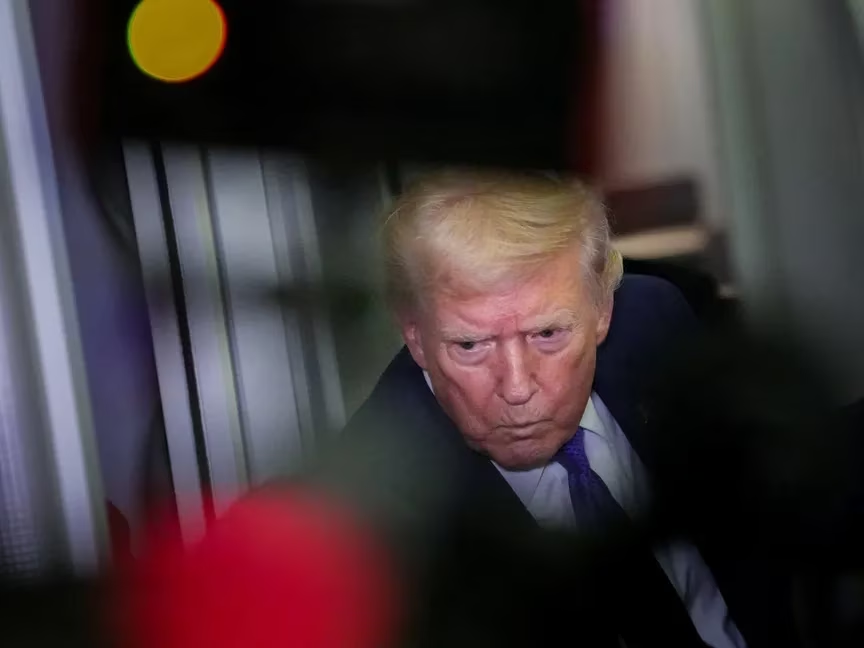
When deployments approach levels not seen since 2003, they do more than signal deterrence—they create momentum. President Donald Trump may now face a strategic dilemma of his own making. Massive forward positioning can strengthen leverage at the negotiating table. It can also narrow political room to de-escalate. Once carriers are in place and bombers deployed, standing down risks appearing weak; striking risks triggering a wider war. The very visibility designed to intimidate an adversary can box in the decision-maker.
This dynamic is amplified by rhetoric. U.S. negotiator Steve Witkoff has warned publicly that Iran could be as little as a week away from producing weapons-grade material sufficient for a nuclear device. Such claims heighten urgency and compress political timelines. If Tehran is portrayed as being days from the nuclear threshold, patience begins to look like negligence. The public framing of immediacy can generate its own pressure for action—even if intelligence assessments are more nuanced behind closed doors.
Washington has invoked similar timelines before. Assertions about narrowing breakout windows have historically been used to justify intensified sanctions, covert action, or military planning. The question now is whether the administration’s own warnings have created expectations that demand visible response.
Iran’s nuclear advances are maybe real and concerning to Western governments. Enrichment levels, stockpiles, and technical expertise have expanded over recent years. But “a week away” from weapons-grade material is not the same as possessing a deliverable nuclear weapon. The distinction between enriched material and a functional device is significant, both technically and politically. Conflating the two can accelerate escalation.
Within Washington, debate reportedly continues. Senior military leaders have cautioned about escalation risks and the unpredictability of Iranian retaliation. Iran is not Iraq in 2003. It possesses layered air defenses, dispersed and hardened infrastructure, significant missile capabilities, and a network of regional partners capable of asymmetric retaliation. U.S. forces across Iraq and Syria, maritime traffic in the Gulf, and Israeli territory all fall within potential response theaters.
Tehran, for its part, frames the U.S. posture as overt aggression. From its vantage point, it is Washington that has surged forces thousands of miles from home, tightened sanctions, and publicly contemplated strikes. Iran’s deterrence doctrine is built around raising the cost of attack through regional leverage. Any U.S. strike—however limited in conception—would likely trigger responses that extend beyond a single exchange of fire.
Diplomatic channels remain open, but they operate under intense coercive shadow. Negotiations conducted while carriers patrol nearby waters carry implicit ultimatums. Critics argue that this sequencing positions Washington less as a reluctant defender and more as the actor setting the escalation ladder in motion.
Political timing further complicates matters. Some analysts speculate that if military action is under serious consideration, the White House may wait until after President Trump’s State of the Union address. The precedent is instructive. On January 28, 2003, President George W. Bush used his State of the Union to describe Iran, Iraq, and North Korea as an “axis of evil,” framing a strategic narrative that preceded the invasion of Iraq less than two months later. Major speeches can consolidate domestic support and define adversaries in moral terms, narrowing diplomatic exits.
The risk today is not only miscalculation with Iran, but strategic overcommitment at home. By deploying forces at a scale surpassed only by 2003 and amplifying warnings of imminent nuclear breakout, the administration may have raised the political cost of restraint. If no strike follows, critics may question the necessity of the buildup. If a strike does follow, the United States could enter a cycle of retaliation that proves far more costly than anticipated.
So is war imminent?
There remains no public confirmation of an attack order. Credible outlets continue to use conditional language. Diplomacy, though strained, persists. The most likely short-term scenario remains continued brinkmanship—force posture sustained, rhetoric sharpened, negotiations pressured.
But the atmosphere feels combustible precisely because choices have accumulated. Massive deployments create expectations. Dire timelines create urgency. Presidential rhetoric shapes domestic calculus.
The Middle East today stands not simply in the shadow of deterrence, but in the shadow of American escalation dominance. Whether that dominance translates into action—or becomes a strategic corner from which Washington must carefully back away—may depend less on Iranian moves than on whether the White House can reconcile its rhetoric, its deployments, and its appetite for risk.
Share your opinion
After the Applause: Has Trump Boxed Himself In on Iran?.