






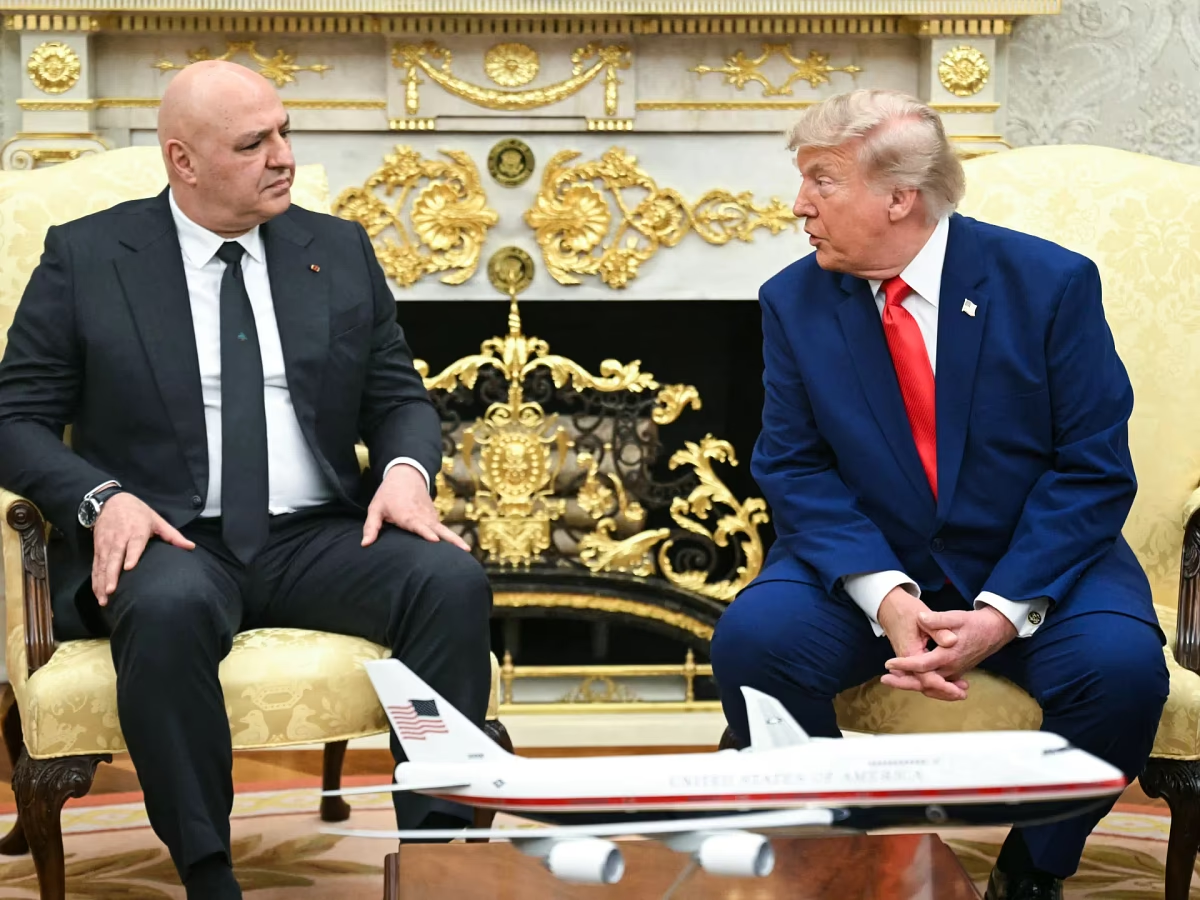
The meeting hosted at the White House between US President Donald Trump and his Lebanese counterpart Joseph Aoun marked a pivotal turning point in the trajectory of bilateral relations between Washington and Beirut. Although the announced results may seem protocol-driven, they carry deep political messages indicating an American desire to inaugurate a new phase that restores credibility to Lebanese state institutions.
Initial understandings included an explicit commitment to resume direct commercial flights between the United States and Lebanon, a measure that transcends the economic dimension to reach the security and sovereign dimensions. This step requires strict control and inspection standards that can only be undertaken by a state with real and complete control over its vital facilities and airports.
Observers believe that this approach represents a vote of confidence in the Lebanese state's ability to restore its sovereignty, which has been incomplete for decades. This American assessment comes at a sensitive time, as Washington seeks to prove that Beirut now possesses sufficient power to begin extending its actual authority over its entire national territory, away from the dominance of irregular forces.
If this path succeeds, the biggest losers will be Hezbollah and, behind it, Iran, who exploited the weakness of the central government for many years. The party has acted as a state within a state, managing its foreign policy and military relations independently of official Lebanese decisions, which has led to catastrophic consequences for the country's stability.
Lebanon suffered an economic and security collapse that peaked in 2019, prompting the United States to take an unprecedented step by paying the salaries of the Lebanese army. This step was a lifeline to prevent the demise of the state as an effective entity, and reflects the extent of international concern about the vacuum that was being filled by militias loyal to Tehran.
The importance of current moves stems from a pilot program that involves the withdrawal of Israeli forces from areas in the south and their handover to the Lebanese army. This program will be accompanied by intensive American support, including advanced training and the provision of necessary military equipment to enable the armed forces to effectively perform their defensive duties.
This development strikes at the heart of the narrative promoted by Hezbollah as the sole defender of Lebanese territories against Israel. With the national army taking responsibility for border protection with international support, the fundamental pretext on which the party relies to retain its weapons outside the state framework falls away.
Regionally, Hezbollah finds itself in a difficult defensive position after the fall of the Syrian regime, which represented its logistical lifeline. The absence of the strategic depth provided by Damascus has made the process of supplying the party with Iranian weapons and equipment a complex and almost impossible task in the new reality.
Sources reported that Tehran is anxiously monitoring the closure of vital corridors it built over the years, and is striving to involve Lebanon in ceasefire understandings to save its proxy. However, international and local pressures are increasing to disarm the party and strictly implement relevant international resolutions.
Reports indicate that Hezbollah may resort to escalatory options, including threatening confrontation with the Lebanese army or brandishing the specter of civil war. This behavior reflects a state of despair and loss of confidence in the future, as confident powers do not need to threaten to destroy civil peace to maintain their political gains.
The Trump administration is adopting a strategy of prioritizing economic development and investment as a tool to ensure long-term stability in Lebanon. Washington understands that achieving radical change requires creating an attractive economic environment that makes citizens rally around the project of a strong state capable of providing prosperity and security.
Despite these positive indicators, significant challenges remain for the Lebanese armed forces, which need to strengthen their ranks and unify their political decision. Moreover, the risk of militia elements infiltrating evacuated areas remains unless a real deterrent force is available to prevent any future security breaches.
This process also faces internal political resistance from parties that fear the repercussions of openness to the international community or changing traditional rules of engagement. The path towards restoring full sovereignty appears to be a long marathon race that requires strategic endurance and broad national consensus that transcends sectarian divisions.
In conclusion, the Washington meeting represents an explicit call for Lebanon to return to the international fold as an independent and sovereign state. While the United States is betting on Beirut's role in ending the era of proxies, the coming days will reveal the extent of Lebanese institutions' ability to seize this historic opportunity to end absolute Iranian influence.
Every square mile the Lebanese army extends its control over is equivalent to a square mile where Hezbollah's foundational justification for existence crumbles.
شارك برأيك
Trump and Aoun's White House Meeting: Has the Phase of Reducing Hezbollah and Iran's Influence Begun?