






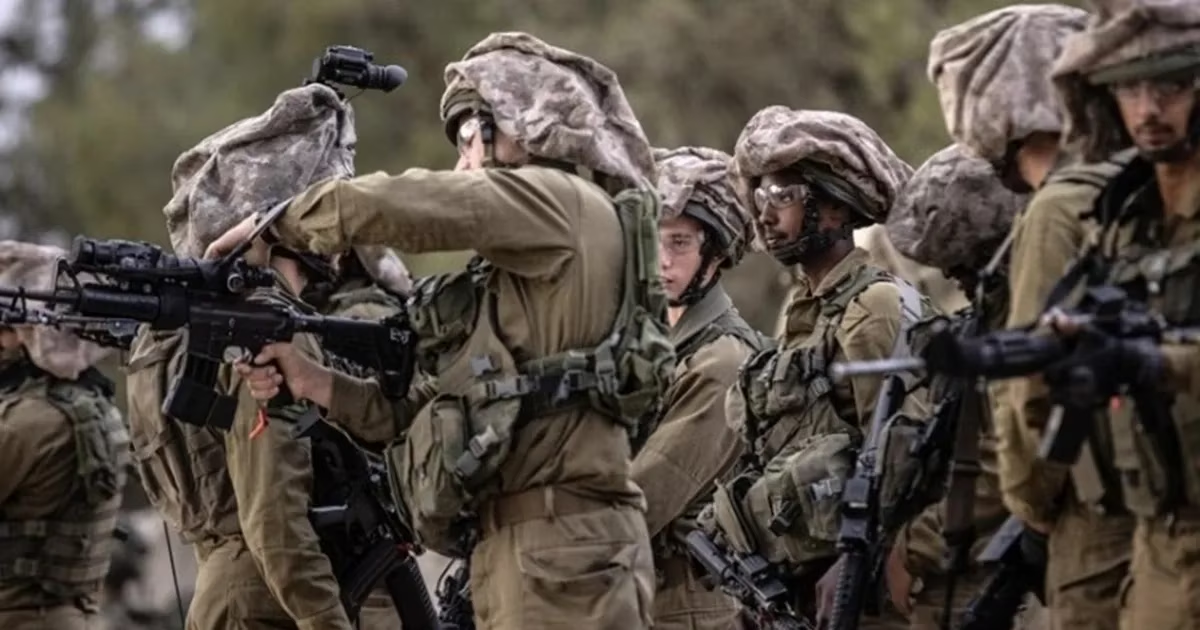
The Israeli occupation army continues to deepen its military presence in the Gaza Strip through a new strategy aimed at transforming temporary control into a permanent reality on the ground. Sources reported that the occupation has begun building and equipping 40 advanced military sites distributed in strategic areas within the Strip, differing in design from the traditional bases the army knew in previous fronts.
Reports indicate that these military sites were designed to be fortified complexes capable of accommodating joint combat teams including infantry, armored, and military engineering units. The cost of establishing a single site reached about 5 million shekels, reflecting the scale of financial and logistical investment the occupation is pouring into establishing its strongholds within Palestinian territories.
The military engineering of these bases relies on prefabricated concrete buildings that provide rapid and effective protection from direct fire and projectiles, with the possibility of moving and repositioning them according to field needs. This military architectural style resembles the complexes previously established by American forces in Iraq and Afghanistan to counter guerrilla attacks and swift operations.
In the context of geographical control, the occupation army now dominates about 64% of the Gaza Strip's area, regions that have been emptied of their residents and turned into closed military zones. These sites are densely spread in the northern part of the Strip, while work continues to complete the remaining ones in the central and southern areas to ensure comprehensive security coverage.
The occupation's plan includes establishing 'warning zones' and protection surrounding these sites, where deep trenches are being dug for hundreds of meters to prevent any advance of Palestinian vehicles or motorcycles. These measures aim to reduce direct friction with the resistance and provide sufficient safe distances for forces stationed within the bases.
Regarding field instructions, the occupation army command issued strict orders to its soldiers to target any Palestinian attempting to cross 'yellow lines' or approach main axes such as Salah al-Din Road. This historic road, which once connected the north of the Strip to its south, has been transformed into a devastated path filled with checkpoints and military points that divide Gaza's parts.
In parallel with above-ground construction, the occupation continues extensive excavation and exploration operations to uncover tunnel networks, which represent the biggest concern for its forces. Occupation sources claim they have managed to destroy and close about 450 kilometers of tunnels since the start of the aggression, using demolition and concrete pouring techniques to permanently disable them.
Military operations also included restoring the border security barrier and developing the 'hourglass' fence that was breached on October 7. The fence has been equipped with special gates and modern remote-controlled surveillance sites, fitted with defensive systems capable of countering suicide drones targeting observation points.
In a field tour that revealed the extent of the tragedy, the humanitarian situation in Gaza was described as a 'ticking time bomb' threatening to explode at any moment due to the inhumane conditions in which the residents live. About 2.2 million Palestinians are under the weight of siege and destruction, while hundreds of thousands of them are crowded into dilapidated tents in the overcrowded Al-Mawasi area.
Field observations show that the Al-Mawasi area in the southern Strip alone contains about 400,000 displaced people living in tin and nylon rooms amidst the rubble of partially destroyed buildings. Israeli military sites overlook these gatherings from high sand hills, placing the displaced under direct surveillance and continuous occupation fire.
The occupation was not content with fixed fortifications but also paved special roads connecting military sites to facilitate vehicle movement and avoid improvised explosive devices planted in dirt roads. These roads are considered protected 'supply arteries' that allow the army rapid maneuvering and troop movement between different sectors without exposure to mine risks.
Reports indicate intense intelligence and fire coordination between the 40 sites, all linked to a joint operations room that exchanges monitoring and sensing data. This integrated system allows for precise strikes and mutual fire support in case any site is attacked, enhancing the forces' ability to withstand for long periods.
These massive military preparations reflect the occupation's intention to remain for long periods within the Strip and impose a new security reality that tears apart Gaza's geographical unity. These measures go beyond mere transient military operations to reach the level of a comprehensive 're-occupation' that includes changing the landscape and building permanent military infrastructure.
In conclusion, the scene in Gaza remains suspended between the hammer of Israeli military fortifications and the anvil of the escalating humanitarian catastrophe afflicting civilians. With the continued construction of these bases, fears are growing of turning the Strip into a large prison divided into isolated cantons subject to strict technological and military surveillance around the clock.
Beneath the surface in Gaza lies a real ticking time bomb and a long-term threat: 2.2 million Palestinians living in inhumane conditions.

شارك برأيك
The occupation solidifies its occupation of Gaza with 40 military sites and surrounding trenches