






Washington Message
Washington – Said Arikat – 16/6/2026
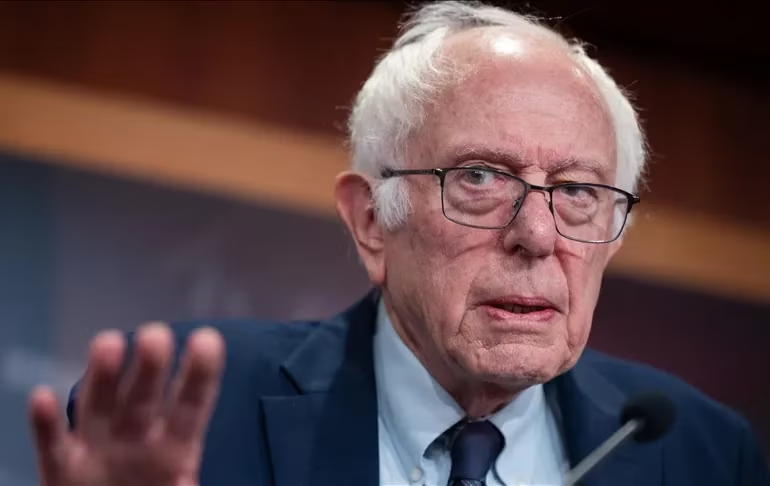
A new political battle is escalating within the US Congress over the National Defense Authorization Act for fiscal year 2027, after progressive Senator Bernie Sanders called for the removal of a controversial clause aimed at expanding military and technological integration between the United States and Israel, considering that this approach grants Tel Aviv privileges beyond what NATO countries enjoy.
Sanders said that a small percentage of Americans support the continued unrestricted arming of Israel, questioning the reasons for Congress's insistence on including a clause that grants it an unprecedented level of military integration with the United States. He stressed that "Section 219" of the defense budget bill must be completely removed from the final legislation.
This clause holds particular importance because it embodies a vision long advocated by Israeli Prime Minister Benjamin Netanyahu, who on previous occasions considered it part of his strategic plan to reshape military relations between the two countries. This comes at a time when Netanyahu faces increasing international criticism and accusations of committing war crimes and crimes against humanity in Gaza.
Earlier, the House Armed Services Committee rejected an amendment proposed by Democratic Representative Ro Khanna to repeal the clause, before proceeding to approve the broader bill. The Senate Armed Services Committee also approved referring the bill to the next legislative stages.
In a notable development, Republican Representative Thomas Massie, known for his anti-foreign intervention stances, announced that he, in cooperation with Khanna, had submitted a new amendment to remove the clause. The proposal needs the support of a sufficient number of members of the House Rules Committee to be put to a vote.
The controversy is not limited to Section 219 alone, as the bill also includes Section 622, which provides for the expansion and enhancement of intelligence sharing between Washington and Tel Aviv. Proposed areas of cooperation include cybersecurity, counter-terrorism, monitoring missile threats, drones, and advanced military technology, in addition to exchanging information related to governmental and non-governmental entities in the region.
This clause, introduced by Republican Senator Tom Cotton, grants Israel broader access to US intelligence information, while reducing restrictions on the exchange of that information.
Opponents of the project believe that these clauses reflect a growing trend within Washington to redefine the relationship with Israel in a way that goes beyond traditional military aid towards a deep and lasting institutional partnership that is difficult to subject to political and popular oversight.
In this context, former CIA official Paul Pillar wrote that US support for Israel over the past decades has exceeded $300 billion, mostly in the form of military and economic aid. He pointed out that Netanyahu has sought in recent years to adapt to the decline in American public support for Israel by pushing for alternatives that are less visible to the public than direct aid, but are more entrenched and sustainable.
According to Pillar, the strategy of Israel and its allies within the United States is to replace clear financial aid with deeper forms of military, technological, and institutional integration, so that the relationship becomes less subject to public debate and more difficult to reverse in the future.
Section 219 provides for the establishment of a formal defense technology cooperation initiative between the United States and Israel, and obliges the US Secretary of Defense to appoint a senior official within the Pentagon to coordinate and expand defense and technology cooperation programs between the two sides.
These proposals acquire additional sensitivity in light of previous warnings issued by the US Department of Defense regarding the growing risks of espionage associated with Israel, which has a long record of intelligence activity within the United States. In recent months, accusations have also emerged against Israel of attempting to influence efforts to end the war with Iran, which has intensified the debate within American political and security circles.
The ongoing battle over Section 219 reveals a qualitative shift in the nature of the US-Israeli relationship. The dispute is no longer focused on the size or financial value of aid, but on a more strategic issue related to the extent of integration between the two military establishments. Critics of the project fear that this path will reduce the ability of future US administrations to re-evaluate the relationship with Israel according to changing US national interests, because a deep institutional link becomes more difficult to dismantle than traditional aid programs that Congress can amend or cancel by direct political decision.
Sanders', Massie's, and Khanna's positions also reflect a rare intersection between ideologically distant political currents. Progressives oppose the project because of the war in Gaza and its humanitarian consequences, while isolationist conservatives reject it based on considerations of national sovereignty and avoiding involvement in foreign conflicts. This unusual alliance indicates a growing trend within American politics that questions the traditional assumption that support for Israel should remain outside the scope of debate. It also reveals a widening gap between public sentiment and some political elites who unconditionally support Israel.
If these clauses are approved in their current form, they could establish a new phase of bilateral relations that goes beyond the concept of a traditional ally to a semi-integrated security partnership. However, this transformation carries political and strategic risks, as it may link the United States more closely to Israeli military options in the region, and increase the likelihood of its being drawn into crises in which it is not a direct party. It may also raise increasing questions about the limits of American decision-making independence, especially amid the ongoing internal debate about the cost of involvement in Middle East conflicts and US national security priorities.
شارك برأيك
Sanders Leads Campaign to Remove Military Integration Clause with Israel from Pentagon Budget