






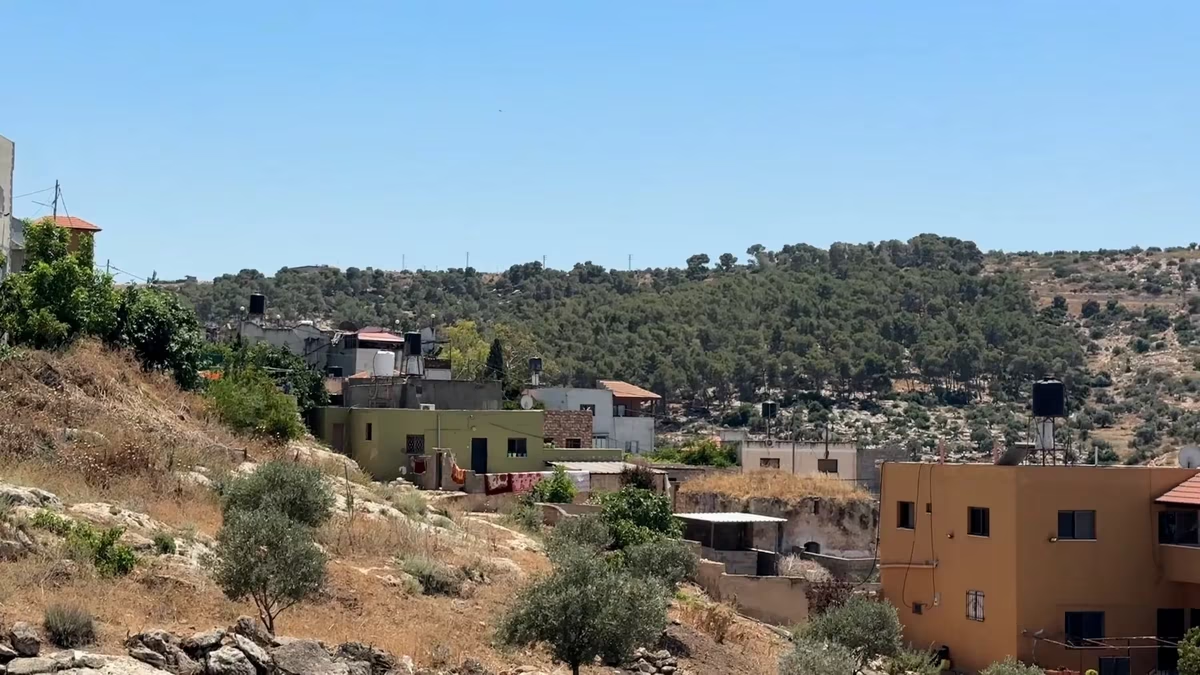
Residents of Aaba village and neighboring towns in the northern West Bank face an imminent danger threatening their agricultural lands and economic projects, following the occupation army's initiation of infrastructure preparation for a new camp. This camp is located on a vital road that serves as a lifeline for the eastern villages in Jenin city, portending a radical change in the region's geography and the security of its residents.
The new military facility extends over an area estimated at about 22 dunams of Aaba town's land, owned by citizens from the neighboring Qabatiya town. The occupation authorities had seized these areas under a military order issued in mid-May, as part of a plan to expand military presence in the region.
The concerns are not limited to the concrete walls that have begun to rise in the area but extend to include the destruction of agricultural greenhouses, sheep pastures, and tourist facilities that were preparing for the summer season. Residents fear that the camp's presence will lead to the closure of transportation routes and deprive them of access to their livelihoods, which they have established over many years.
In a field testimony, sources reported that the occupation army seized a modern summer house belonging to citizen Alaa Al-Asmar and converted it into an advanced military observation point. This building, which cost its owners about 1.5 million shekels, was seized before its owners could rent or use it for a single night at the beginning of the summer season.
Citizen Al-Asmar explained that a military force informed him of the temporary seizure of the 'chalet,' but the soldiers are still stationed there, threatening to turn the temporary damage into a permanent loss. He pointed out that customers and vacationers will refrain from coming to the area due to the intensive military presence and the resulting security risks.
For his part, Burhan Azmouty, head of the village council in Aaba, stated that the camp is located in the 'Al-Ahwad' area, directly adjacent to eastern Aaba town and Wadi Al-Daba' area. He confirmed that the majority of the lands surrounding the camp are planted with olive trees, which represent the backbone of the economy for Palestinian families in that region.
The village council warns of strict security restrictions that may prevent farmers from accessing their lands, even those far from the camp site. Sheep herders who depend on the adjacent valley will also be affected, forcing them to buy fodder at high prices due to the loss of natural pastures.
Regarding daily movement, sudden military checkpoints have begun to appear on the bypass road leading to Jenin city, hindering the movement of workers, students, and patients. Residents have been forced to resort to alternative, rough, and long roads, which has increased transportation costs and living burdens on citizens amid difficult economic conditions.
Activists specializing in settlement affairs believe that this camp cannot be separated from the major transformations that Jenin Governorate has recently witnessed. Activist Mufid Jalghoum pointed out that the occupation seeks to redraw the field reality by building military centers and towers and paving roads connecting various settlement sites.
Analyses indicate that the strategic goal of these moves is to pave the way for the return of settlers to the settlements evacuated in 2005, such as 'Ganim' and 'Kadim.' One of these settlements is located less than 200 meters from Aaba village, making the new camp a link in an integrated settlement project.
Experts warned that Jenin is entering a new phase of direct daily friction with the occupation army and settlers, beyond the classifications of the Oslo Accords for areas 'A,' 'B,' and 'C.' This new reality aims to tighten the noose on Palestinian villages and turn their outskirts into areas of constant surveillance and aggression under the pretext of security.
Official data issued by the Wall and Settlement Resistance Commission indicate a sharp escalation in military orders aimed at confiscating lands in Jenin Governorate. In May alone, about 393 dunams were targeted, most of which were allocated for establishing new military sites and points to enhance field control.
This escalation comes in a broader context that included documenting about 40,000 attacks carried out by occupation forces and settlers in the West Bank from October 2023 until the end of 2025. These systematic attacks led to the displacement of entire communities and the seizure of vast areas of agricultural and pastoral lands.
In light of these facts, it appears that the new camp in the 'Hadad' area is not just a temporary military facility but a tool to impose a new geographical reality. Palestinians in Jenin continue to resist these plans by all available means, despite the high cost they pay from their livelihoods and personal security.
The greatest fear is not related to the camp alone, but to its relationship with a broader path for the return of settlement north of Jenin, especially in the settlements of Ganim and Kadim.




شارك برأيك
Land Occupation and Tourism Destruction.. A New Israeli Camp Swallows Jenin Lands