






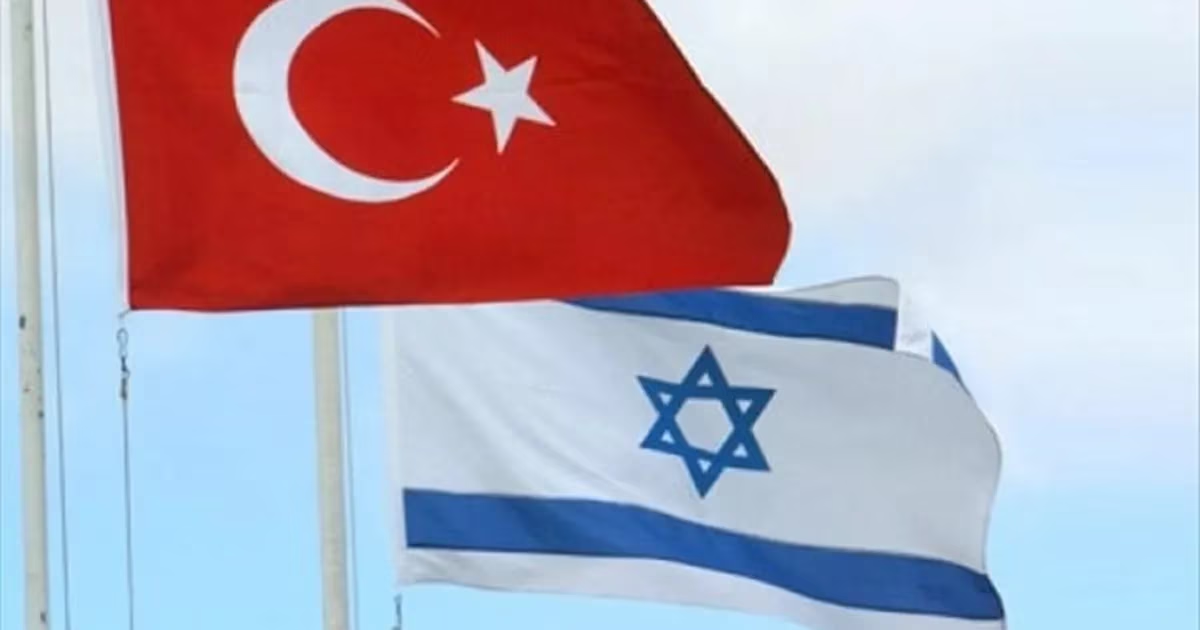
Questions are escalating in research and strategic circles about the future of balances in the Middle East region, in light of the emergence of hypothetical scenarios indicating the possibility of the Israeli occupation resorting to what is known as a 'preemptive strike'. These analyses come at a time when the region is witnessing increasing tensions, prompting research centers to anticipate the possibility of Tel Aviv taking military action if it feels a direct existential threat.
Research sources, through an extensive analysis by American researcher Michael Rubin, reported that the idea of a preventive strike remains theoretically on the table within the context of assessing current regional tensions. The analysis indicated that some strategic scenarios raise the possibility of Israel taking large-scale military action if threats reach a level that the Israeli leadership considers an existential danger that cannot be ignored.
The study published on the '19FortyFive' website was based on a prominent historical model, the 1967 war, when Israel launched a surprise attack on Egypt and other Arab countries. The author considered this model to be the primary reference for understanding how Israel makes decisions to take military action to neutralize what it describes as imminent threats before they occur.
The analysis clarified that the current political climate brings to mind the rhetorical escalation that preceded major wars in the region, citing historical comparisons dating back to the 1950s and 1960s. Sources indicated that the escalating tone of hostility between regional parties contributes to reinforcing hypotheses of direct military confrontation in the near future.
The article touched upon the factors that prompted Israel to decide on war in 1967, most notably the closure of the Strait of Tiran and the Suez Canal to Israeli navigation. Analyses considered that these steps, along with military mobilization at the time, were the main impetus for launching the rapid preemptive attack that changed the map of the region.
Sources indicated that the concept of 'existential threat' still sparks wide debate among historians and legal experts around the world. While international law lacks a precise definition of the term 'imminent danger,' states often place their national security above rigid legal or academic considerations.
The researcher believes that Israel operates in a highly complex regional environment, where surrounding countries possess strategic and geographical depth many times greater than its own area. This geographical difference imposes complex security calculations on Israeli decision-makers, making the idea of transferring the battle to the enemy's territory always a preferred option.
The analysis emphasized that the narrow geographical area in vital regions within Israel makes it more sensitive to any military movements in neighboring countries. Hence, the 'defense by offense' strategy adopted by the Israeli military establishment to confront what it sees as potential threats from rising regional powers such as Turkey.
The study confirmed that talk of a preemptive strike against Turkey currently falls within the framework of 'strategic assumptions' rather than actual political decisions taken. The purpose of these readings is to try to understand the potential paths of conflict in light of the rapid geopolitical changes sweeping the Middle East.
Sources indicated that the mutual political statements between Ankara and Tel Aviv increase the intensity of strategic concern for both sides. Although a direct confrontation may seem unlikely in the foreseeable future, military calculations put all possibilities on the table to avoid any strategic surprises.
The analysis clarified that Turkey's growing military power and its active regional role represent a new challenge to traditional Israeli calculations. This challenge prompts Western think tanks to question the limits of mutual deterrence and how to manage crises between two countries with advanced military capabilities.
The author considered that invoking the Six-Day War model aims to highlight the Israeli military doctrine that does not hesitate to initiate an attack. However, current international conditions differ radically from those in the 1960s, making any military adventure fraught with unprecedented risks.
The website concluded in its analysis that these hypothetical scenarios reflect the depth of tension in the region and the reopening of the debate about the balance of power. The excessive sensitivity in the regional environment makes any movement or statement a potential spark for changing the rules of engagement that have been in place for decades.
In conclusion, the question of the possibility of a preemptive strike remains dependent on the evolution of field and political threats. Strategic studies continue to warn that miscalculation by any party could lead the region to slide into a comprehensive confrontation that exceeds current expectations.
States treat the issue of survival as a priority that transcends theoretical or academic considerations in international law.
شارك برأيك
Preemptive Strike Scenarios: Will Israel Repeat the 1967 Model with Turkey?