






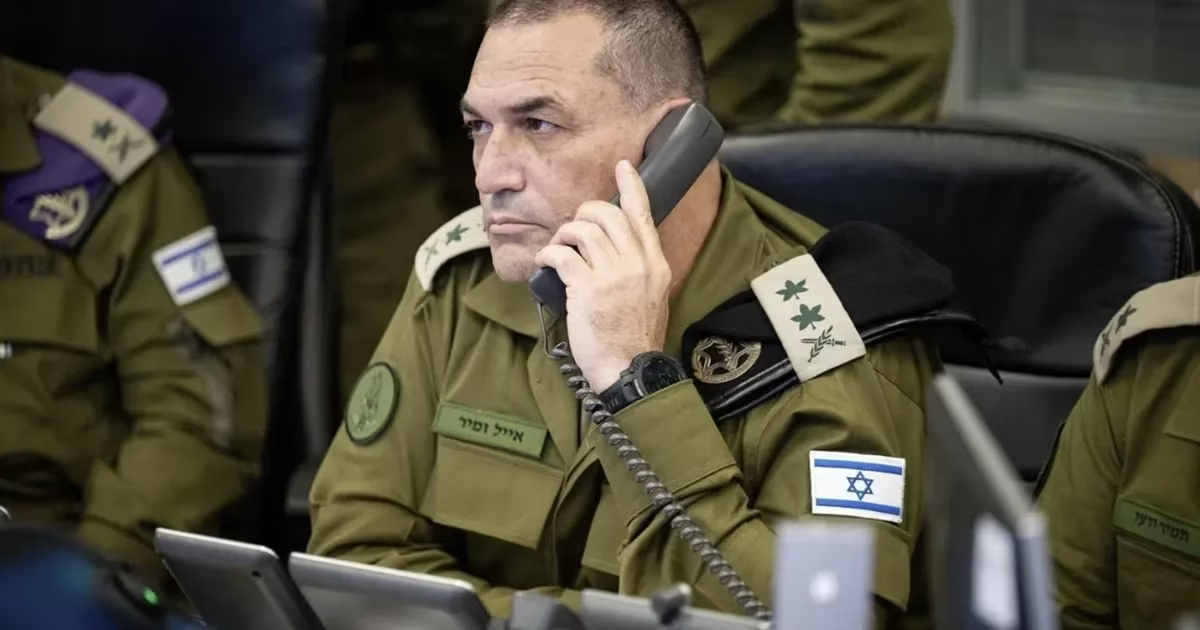
Warnings are escalating within Israeli military circles about a real danger threatening the army's collapse, as Ayal Zamir issued an alarm cry regarding the accumulation of military burdens for more than two and a half years. Observers believe that the current government is neglecting the necessity of providing a competent army on the borders, which could, over time, lead to the collapse of the entire state due to weak military readiness.
Media sources reported that the army suffered heavy losses as a result of sending insufficiently trained units to the battlefronts under the pressure of continuous operations. The sources clarified that these units faced severe difficulties in field control, leading to a high rate of injuries and deaths among soldiers who did not comprehend the strategic objectives for which they were sacrificing their lives.
Reports indicate a sharp decline in soldiers' combat motivation in the face of a political leadership described as incapable of convincing them of the justice of the ongoing battles. Fighters feel that they are being led to their demise in absurd and dangerous missions for which they have not received adequate training, and which primarily aim to satisfy political balances within the ruling government coalition.
Military corridors frequently compare the current situation of the Israeli army to historical scenarios of the collapse of major armies such as the Soviet Army and the American Army in Vietnam. Experts criticize the presence of ministers in the government who have never served militarily and do not realize the extent of suffering experienced by armored reserve companies that lack even the minimum number of medics and equipment.
Signs of organizational collapse are evident in the refusal of some brigade commanders to carry out orders to enter complex conflict zones such as Beirut, in addition to a decline in enlistment rates. In some cases, only 200 soldiers arrive out of a battalion of 500, reflecting the growing trust gap between soldiers and their military and political leadership alike.
Soldiers suffer from severe physical and psychological exhaustion as a result of being forced to conduct patrols and combat operations extending for 20 hours a day for two consecutive years. The army urgently needs periods of fitness recovery, rest, and treatment for physical and psychological injuries, but the pressure of multiple fronts prevents this, leading to a decline in decision-making ability.
The actual collapse begins when chronic fatigue takes over units, where soldiers execute orders automatically without initiative or fighting spirit. Serious operational incidents increase, and the maintenance of vital equipment declines, endangering the lives of fighters due to the absence of distinguished competencies who have left service for psychological or social reasons.
Informed sources revealed that successive failures have caused a sharp division within the army's high command, where accusations are exchanged and responsibility is evaded. Groups within the leadership have begun to emerge, supporting and opposing certain decisions, threatening the unity of military command and making the execution of complex tasks almost impossible in the absence of cohesion.
The issue of the law exempting Haredim from military service is considered the straw that might break the camel's back, as it provokes widespread anger among reserve soldiers who bear the greatest burden. Fighters believe that lawmakers do not realize the extent of personal and family sacrifices they make, at a time when privileges are granted to other groups that evade national duty.
The burden of fighting in Gaza, Lebanon, Syria, the West Bank, and Iran falls on a small segment not exceeding 4% of the population, creating a feeling of social injustice. These soldiers return from the battlefronts to see tax money spent on groups that do not participate in defending the state, which shatters morale and pushes towards slow disintegration.
Soldiers strongly criticize the Prime Minister's statements describing Israel as a global power capable of continuing to fight 'whatever the cost' without defining clear political objectives. Fighters believe that this 'arrogance' ignores the severe shortage of manpower and pushes the army towards a long-term attrition for which it has not been prepared structurally or logistically.
Ministry of Defense data showed that about 20,000 soldiers need treatment for PTSD, a number expected to double in the coming years with ongoing operations. In addition, the army lost about 900 killed and 10,000 wounded, figures that constitute a severe moral blow to those remaining in service and who are asked to extend their military terms.
Regular soldiers face immense psychological pressures that lead them to question their future under a government that attacks the Chief of Staff merely for presenting realistic problems to decision-makers. This clash between the military and political levels reinforces an atmosphere of despair within field units and reduces the chances of achieving any real victory on the ground.
In conclusion, the government's disregard for Zamir's warnings and its preoccupation with accusing him of leaking information reflects the depth of the political and security crisis. Instead of addressing the causes of the impending collapse, the political leadership contents itself with promoting false morale, ignoring that victory is not achieved through speeches but through a cohesive and qualified army that trusts its leadership and objectives.
The army is slowly disintegrating due to an enormous and inhumane number of tasks, and soldiers feel they are being led to certain death to satisfy political ambitions.
شارك برأيك
Signs of Collapse: Warnings of the Israeli Army's Disintegration Under the Weight of Attrition and Political Leadership's Neglect