






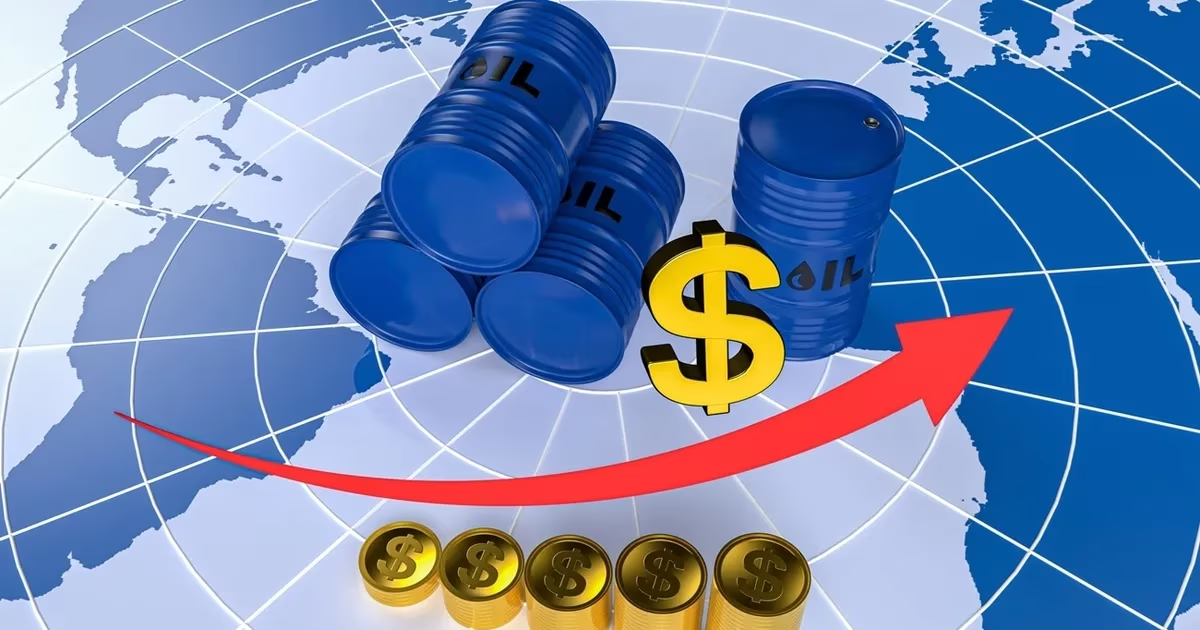
The military tensions witnessed in the waters of the Arabian Gulf in early 2026 are no longer just a fleeting security confrontation; they now signal a deep structural shift in the global financial system. While Washington attempts to market 'Operation Epic Fury' as a measure to ensure stability, observers believe it represents the culmination of the struggle over the 'petrodollar' system that has governed the international economy for half a century.
American economic power fundamentally relies on the mandatory trading of oil in dollars, which creates sustained global demand, allowing Washington to finance its massive deficit and maintain its military influence. However, the events of 2026 revealed the fragility of this system in the face of major geopolitical conflicts, as the traditional pillars of oil cooperation began to collapse under the weight of military escalation.
Tehran had prepared for this confrontation over years by building parallel financial networks away from the dominance of the 'SWIFT' system, which had been weaponized for sanctions. By linking with Chinese and Russian systems, Iran succeeded in creating alternative routes for energy trade, enabling it to withstand the maximum pressure strategy pursued by the US administration.
The strikes targeting Iranian nuclear and missile facilities last February accelerated the pace of the shift towards 'de-dollarization' in international transactions. Reports indicate that this trend is no longer limited to Washington's adversaries but has extended to cautious allies who have begun to fear the use of the US currency as a political tool to impose political will.
Economic data released in March 2026 indicates severe disruptions in energy markets, with Brent crude prices soaring past $92 per barrel. This surge was a direct result of supply disruptions through the Strait of Hormuz, through which about a fifth of the world's oil passes, putting the global economy on high alert.
Domestically in the US, the war has caused enormous financial drain, with military operations estimated to cost around $900 million per day. This massive spending, coupled with rising inflation rates and eroding purchasing power, has begun to spark a wave of public discontent within the United States due to the deterioration of citizens' daily living standards.
Iran's move to demand that oil importers settle transit fees in the Strait of Hormuz in Chinese Yuan poses a direct challenge to the heart of the petrodollar system. If major industrial powers respond to these demands to secure their energy needs, it would mean the end of the US dollar's historical monopoly over the global oil market.
The dollar's loss of its status as the exclusive currency for energy will force the United States to compete for capital in an equal international arena for the first time in decades. This shift will deprive Washington of the 'safety net' provided by the recycling of oil money into US Treasury bonds, weakening its ability to finance its foreign policies.
Analysts believe that Washington is falling into the trap of 'yesterday's war,' attempting to protect an old monetary system using military force, at a time when the world is moving towards multipolar digital finance. Over-reliance on the military machine to maintain financial hegemony has become counterproductive, pushing countries to seek alternative security and economic solutions.
The current crisis embodies a vicious cycle; the more military escalation there is to protect the dollar, the greater the incentive for regional and international powers to move away from it entirely. This contradiction places American decision-makers before difficult choices: either continue the costly confrontation or accept a new global financial reality in which the dollar alone does not hold the ultimate say.
The shift towards a multipolar financial world will necessarily reduce the United States' ability to impose effective economic sanctions in the future. When sanctions lose their value as a pressure tool, Washington will be forced to re-evaluate its overall strategy in dealing with rising powers in the Middle East and Asia.
Central banks around the world have already begun to diversify their reserves, moving towards gold and regional currencies as a precautionary measure against dollar volatility linked to conflicts. This trend reflects a loss of confidence in the neutrality of the US-led financial system and enhances the chances of success for economic blocs such as 'BRICS'.
Ultimately, the conflict in the Gulf transcends being a dispute over regional influence, becoming a true test of the resilience of American hegemony in the 21st century. If Washington fails to secure waterways and restore confidence in its currency, we may witness a sudden end to the era that began after World War II.
The painful economic adjustment that the dollar's decline might impose on the US domestic front will have far-reaching political and social consequences. Thus, history may record that the 2026 war was the point at which the dollar transformed from a deadly strategic weapon into an economic burden accelerating the demise of unipolarity.
The true victim of the 2026 Iran war may not be the regime in Tehran, but rather the absolute supremacy that the US dollar has always enjoyed.
شارك برأيك
Gulf Conflict 2026: Will Confrontation with Iran End the 'Petrodollar' Era?