






The direct conflict between the United States and Iran has entered a new phase of escalation with the third week of confrontations, as Washington announced the dispatch of additional military reinforcements to the Middle East region. These movements raise serious questions about the possibility of the region sliding into a more dangerous confrontation, especially in the Strait of Hormuz, which is considered the artery of global trade and energy.
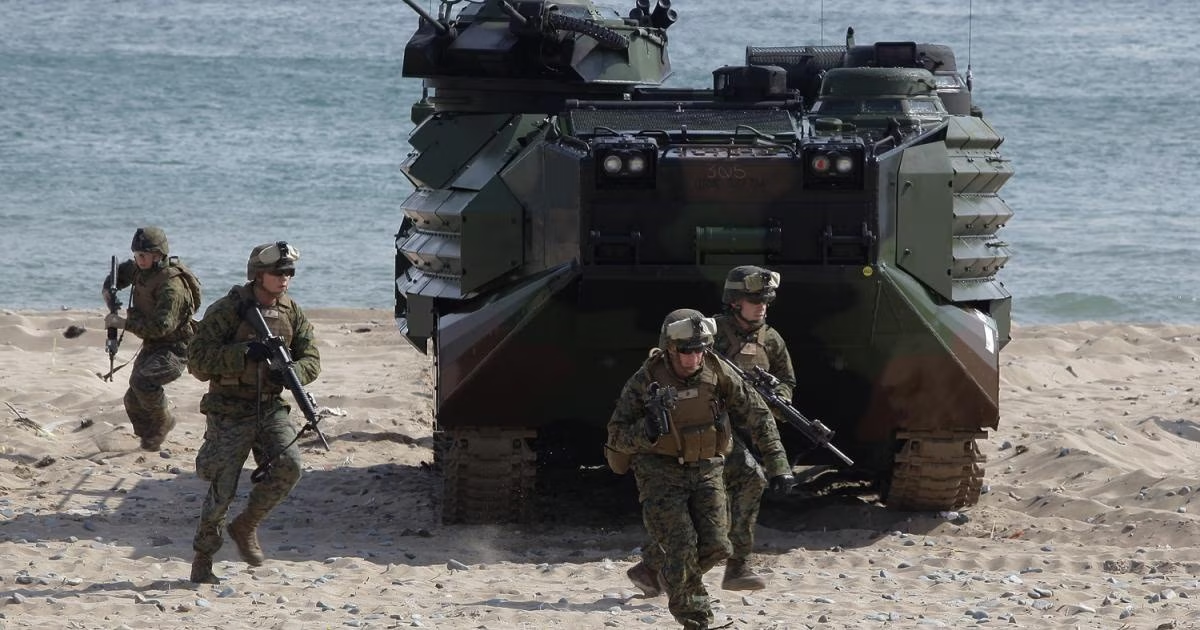
The new force, which includes about 2,500 US Marines, represents a remarkable development in the course of ongoing military operations, according to international press sources. This force is officially known as the 31st Marine Expeditionary Unit, an elite unit specialized in rapid intervention and complex amphibious operations that require immediate response.
Defense sources reported that the primary mission of this unit will be concentrated in the vicinity of the Strait of Hormuz, to counter one of the Pentagon's biggest fears, which is the ability of Iranian forces to lay naval mines. This waterway is extremely vital, as approximately 20% of the total global oil consumption flows through it, making its security a top priority for US national security.
Military estimates indicate that recent airstrikes have prompted the Iranian side to change its strategy, by reducing reliance on large warships and shifting towards fast boats. These small boats are capable of carrying naval mines and laying them in shipping lanes, and are difficult to detect by traditional aerial reconnaissance means due to their small size and high speed.
With the arrival of the unit from the Indo-Pacific region, the US military command will have wider options to carry out swift operations against islands near the strait. According to military experts, these forces can carry out limited and targeted raids with heavy air support to clear sites that could be used as launching pads for Iranian naval attacks.
Despite the tactical advantages of this force, observers warn that such operations could lead to an expansion of the war and its getting out of control. Short-term military gains may be followed by reactions that lead to a comprehensive regional escalation, which international parties are trying to avoid despite continuous military buildups.
The Marine Expeditionary Unit is characterized by its high capability to deploy vehicles and forces to battlefields at high speed, which gives it special appreciation within the US military. Although its number of personnel seems limited compared to the 50,000 US troops deployed in the region, the nature of its missions makes it crucial in the current balance of power.
In addition to combat operations, the unit possesses advanced capabilities in electronic warfare, as it can carry out anti-drone operations using advanced jamming devices. These devices can be installed on warships or accompanying oil tankers to provide comprehensive protection against suicidal aerial attacks adopted by pro-Iranian factions.
These units are usually deployed on large amphibious assault ships, which serve as floating military bases capable of operating advanced F-35 Lightning II fighters. These ships also include 'Osprey' vertical transport aircraft and combat helicopters, in addition to landing craft that transport infantry and artillery directly from sea to shore.
However, this deployment is not without strategic challenges, as it leaves a security vacuum in the Pacific region, which is witnessing tensions with China and North Korea. The dispatch of the 31st Unit from its headquarters in Okinawa, Japan, means the absence of a rapid response force in sensitive areas such as Taiwan, reflecting the extent of the pressure faced by US defenses globally.
Historically, these units have been known as the 'emergency force' that Washington resorts to in major crises, from evacuating diplomats to full-scale wars. Military history recalls that elements of these units were among the first forces to set foot on Afghan soil in 2001, which confirms their pioneering role in foreign military interventions.
Marine Expeditionary Units represent the US emergency force capable of carrying out rapid raids and amphibious operations in the most complex conditions.
شارك برأيك
Qualitative American reinforcements in the Middle East: What are the missions of the 31st Marine Expeditionary Unit in confronting Iran?