






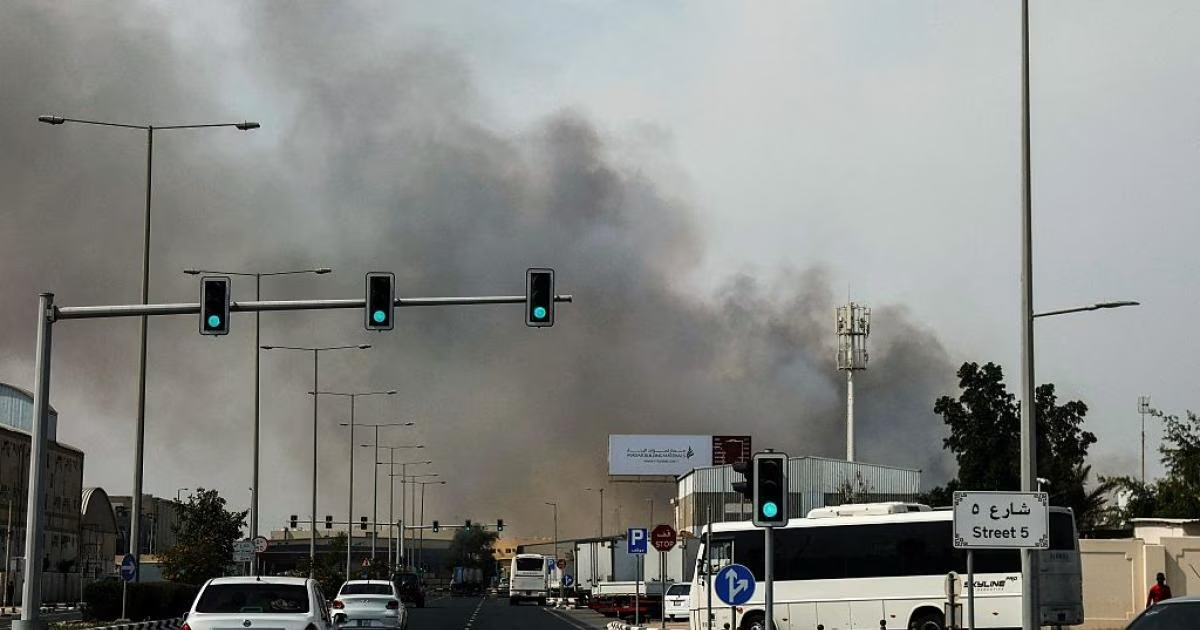
The intensity of the military confrontation in the Middle East is escalating with the continued widespread American-Israeli aggression on Iranian territories, as warplanes launched successive waves of airstrikes that began last night and continued until daylight hours. The attacks focused intensely on the capital, Tehran, targeting sensitive sovereign sites including the Revolutionary Court and the vicinity of the Red Crescent headquarters, in addition to destroying air defense systems, missile launch platforms, and command infrastructure.
Field reports indicated that the bombing affected 24 out of 31 Iranian provinces, reflecting the comprehensiveness of the military operation aimed at paralyzing the defensive capabilities of the Islamic Republic. In response, the Iranian Revolutionary Guard announced the success of its air defenses in shooting down an advanced American 'MQ-9' drone, emphasizing that the armed forces are on high alert to repel any new breaches of Iranian airspace.
In a dangerous naval development, the Revolutionary Guard announced targeting the American aircraft carrier 'Abraham Lincoln' with four ballistic missiles in the region's waters, despite Washington's denial of direct hits. This coincided with strict Iranian measures to impose an effective closure of the Strait of Hormuz, where Tehran issued stern warnings to all commercial vessels and oil tankers about the consequences of crossing the strategic waterway through which one-fifth of the world's oil production passes.
On the ground, Iranian television confirmed the targeting of an oil tanker north of the Sultanate of Oman after it ignored repeated warnings and attempted to cross the strait, which resulted in four injuries and the evacuation of twenty others, according to the Omani Security Center. This escalation led to a near-total paralysis of navigation, with press sources reporting that at least 150 oil tankers halted their movement in the open waters of the Gulf to avoid increasing security risks.
Regarding extended military operations, the Iranian army announced the start of the seventh and eighth waves of Operation 'True Promise 4', which included bombing American military bases in Gulf countries and the Kurdistan region of Iraq. The military statement clarified that these strikes come in response to the facilities provided to hostile aircraft, stressing that all bases from which the attacks were launched would be legitimate targets for Iranian missiles.
Gulf countries experienced a harsh night of bombing, with the UAE subjected to what were described as the most severe strikes, hitting Dubai and Abu Dhabi airports and Zayed Port, leading to rising columns of thick smoke in the sky of the Emirati capital. The UAE Ministry of Defense announced three deaths and 58 injuries as a result of these attacks, while media sources confirmed that an apartment inhabited by Israelis in Abu Dhabi was hit by a suicide drone, resulting in two injuries.
In the Sultanate of Oman, drones targeted the commercial port of Duqm, while violent explosions were heard in the Saudi capital Riyadh and Doha, Qatar, as a result of attempts to intercept ballistic missiles. Sources in Qatar reported missile fragments falling in the industrial area after air defense operations, amid regional and international concern that the conflict is spiraling out of control and turning into a comprehensive regional war that spares no one.
Moving to the Israeli front, Iran launched a widespread missile attack targeting the cities of Tel Aviv, Jerusalem, Haifa, Galilee, and areas in the Negev. The Tel Aviv municipality announced that about 200 buildings were damaged to varying degrees due to direct shelling and fragments from interceptions, while the Israeli Ministry of Health recorded 456 injured people transferred to hospitals in the past twenty-four hours as a result of the intense missile barrages.
The deadliest strike was in the Beit Shemesh area of Jerusalem, where an Iranian missile hit a residential area causing massive destruction and the immediate death of nine people, while the search is still ongoing for twenty missing persons under the rubble. This strike is considered one of the most violent attacks on the occupied territories since the beginning of the current escalation, prompting Israeli authorities to tighten home front measures and open shelters in all cities.
Political data indicates that the assassination of Iranian Supreme Leader Ali Khamenei was the major turning point that pushed towards this comprehensive confrontation, as Israeli Prime Minister Benjamin Netanyahu seeks to compensate for the failures of October 7 by targeting the head of the Iranian regime. This strategic shift has put the region before open scenarios, especially with Iran possessing long coastlines along the Arabian Gulf, making securing navigation by force extremely difficult.
Economically, global markets immediately began to be affected by the closure of the Strait of Hormuz, especially China, which relies heavily on navigation in this passage and consumes about 90% of Iranian oil exports. Four major oil companies announced the suspension of all their voyages through the strait, in response to notifications from the British Maritime Trade Operations Authority, which received official Iranian messages stating the closure of the waterway to international navigation until further notice.
In this complex scenario, international powers continue to monitor the situation with extreme caution, amid Qatari calls for de-escalation and a Saudi summons of the Iranian ambassador, in an attempt to contain the repercussions of the strikes that reached deep into the Gulf. With the continued exchange of missile waves, it appears that the region has indeed entered a phase of comprehensive war that many international parties have warned about over the past months, with no horizon for diplomatic solutions at present.
In conclusion, the field remains the judge in light of all parties' insistence on continuing military operations, as Tehran confirms that its response will not stop at the current borders, while Washington and Tel Aviv continue to mobilize their capabilities to launch more raids. The intertwining of international oil interests with political and military conflicts in the Strait of Hormuz and the Gulf puts the global economy at stake, awaiting what the coming hours will bring in developments in Operation 'True Promise 4'.
The Iranian army announces the start of the seventh and eighth waves of Operation 'True Promise 4' in response to the targeting of sovereign sites in the country.
شارك برأيك
Comprehensive Regional Escalation: Intense Raids on Tehran and Iranian Retaliation Targeting the Gulf and Israel