






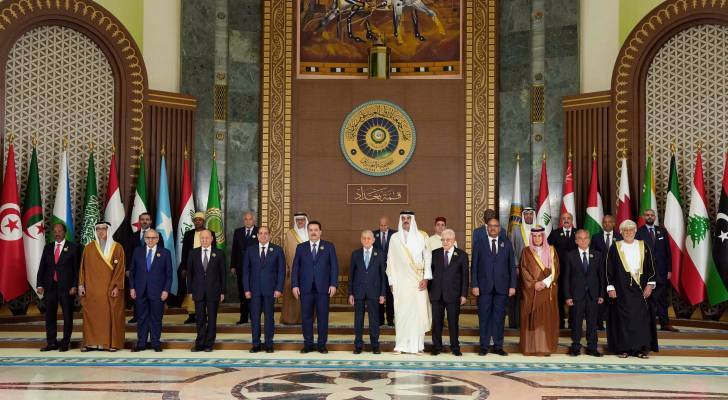
The final statement of the Arab Summit, which concluded today, called for the immediate delivery of humanitarian aid to the Gaza Strip, given the ongoing Israeli aggression and the worsening humanitarian situation.
Arab leaders called on Saturday for an end to the war on Gaza and clearly condemned the Israeli occupation's attempts to displace Palestinians from the Strip. This came at the 34th Arab Summit held in Baghdad with the participation of a number of presidents, princes, and representatives of Arab countries.
The statement urged the international community to shoulder its responsibilities and pressure for an end to the bloodshed in Gaza, stressing the importance of urgent action to end the suffering of civilians and provide them with the necessary protection.
The summit was also attended by UN Secretary-General António Guterres, Arab League Secretary-General Ahmed Aboul Gheit, the Organization of the Islamic Conference, the Gulf Cooperation Council, the European Union, and Spanish Prime Minister Pedro Sánchez.
This summit comes approximately two months after an extraordinary summit hosted by Cairo, during which Arab countries adopted a plan to rebuild Gaza without displacing its population.
In addition, the "Baghdad Declaration," a copy of which was obtained by Al Arabiya.net and Al Hadath.net and scheduled to be issued at the conclusion of the 34th regular summit, includes several Arab and regional issues, most notably the Palestinian cause, according to a draft of the declaration.
The centrality of the Palestinian issue
The Palestinian issue was at the forefront of the Baghdad Declaration, which reaffirmed the "centrality of the Palestinian issue."
He called for an immediate end to the war in Gaza and urged the international community, particularly influential countries, to "assume their moral and legal responsibilities to pressure for an end to the bloodshed and ensure the unhindered entry of urgent humanitarian aid to all areas in need in Gaza."
The Baghdad Declaration called on all countries to provide political, financial, and legal support for the joint Arab-Islamic plan for reconstruction and early recovery in Gaza, which was adopted by the emergency Arab Summit in Cairo last March, and by the foreign ministers of the Organization of Islamic Cooperation in Jeddah the same month.
The Baghdad Declaration welcomed the proposals and initiatives put forward by Arab countries to establish a fund for the reconstruction of Gaza.
He stressed the importance of joint coordination to pressure for the opening of all crossings to allow the entry of humanitarian aid into all Palestinian territories.
He also called for a just and comprehensive peaceful settlement of the Palestinian issue, supporting Palestinian President Mahmoud Abbas' call to hold an international peace conference and take irreversible steps to implement the two-state solution, in accordance with the Arab Peace Initiative and international legitimacy resolutions.
He called for the deployment of international protection and peacekeeping forces under the United Nations in the occupied Palestinian territories until the two-state solution is implemented.
He also called on the UN Security Council to take the necessary measures to implement the "two-state solution."
He also called on all Palestinian factions to agree on a comprehensive national project and a unified strategic vision.
The declaration also commended the positions of European countries, Spain, Norway, and Ireland, in recognizing the State of Palestine, and reiterated its support for South Africa's position in the lawsuit against Israel.
The final statement of the Arab Summit in Baghdad emphasized the sanctity of occupied Jerusalem and its status among the heavenly religions.
The statement condemned all Israeli aggression attempts aimed at Judaizing the city, changing its Arab, Islamic, and Christian identity, and undermining the historical and legal status quo at its holy sites.
The statement stressed the need to protect the holy sites in Bethlehem and not to harm their cultural and religious identity.
The statement affirmed support for the Hashemite custodianship of the Islamic and Christian holy sites in Jerusalem, which is assumed by His Majesty King Abdullah II bin Al Hussein, and its role in preserving its Arab, Islamic, and Christian identity.
The statement emphasized that Al-Aqsa Mosque, the blessed Al-Aqsa Mosque compound, which covers an area of 144 dunams, is a place of worship exclusively for Muslims.
The statement also expressed support for the role of the presidency of the Al-Quds Committee and the Bayt Mal Al-Quds Agency, headed by His Majesty King Mohammed VI, King of the Kingdom of Morocco.
Support Syria
Regarding developments in Syria, the declaration affirmed respect for the choices of the Syrian people, with all their components and sects, and commitment to the security and stability of Syria, which are reflected in the security and stability of the region. It also affirmed support for the unity of Syrian territory, rejected all interference in internal affairs, and condemned the ongoing Israeli attacks on Syrian territory, the violation of its sovereignty, and attempts to undermine and destroy its national capabilities.
The declaration also emphasized "the necessity of proceeding with a comprehensive transitional political process that preserves diversity and societal peace, while respecting the beliefs and sanctities of all segments and components of the Syrian people, and rebuilding Syria." In this regard, it welcomed US President Donald Trump's recent announcement to lift sanctions on Syria.
He called for the adoption of a comprehensive national dialogue conference that would include all components of the Syrian people, appreciating the willingness of Iraq, the current Arab League Summit host, to host the conference in coordination with the General Secretariat of the Arab League and Arab countries. This will ensure the realization of Syria's national interest, ensure effective participation, and enhance social coexistence in Syria.
Lebanon's stability
The Baghdad Declaration affirmed support for Lebanon in confronting challenges and preserving its security, stability, and territorial integrity, and protecting its internationally recognized borders against any attacks on them or on the state's sovereignty. It welcomed the municipal elections and encouraged all political entities to reach an understanding, avoid the language of exclusion, and implement the necessary economic reforms.
He also affirmed full solidarity with Yemen in preserving its sovereignty and unity, and supporting efforts to achieve stability and security, end the state of war and division, and find solutions through internal dialogue.
Sudan's unity
He stressed the importance of finding a political solution to end the conflict in Sudan in a manner that preserves its sovereignty, territorial integrity, and the safety of its people. He also emphasized the need to allow safe passage for humanitarian workers. He called on all parties to engage in crisis resolution initiatives, such as the Jeddah Declaration and other initiatives. He also welcomed the statement issued by the Intergovernmental Authority on Development (IGAD), which stipulated the unification of platforms for resolving the crisis in Sudan.
Libyan crisis
The Baghdad Declaration affirmed support for Libya and its resolution of the crisis through national dialogue, in a manner that preserves the unity of the state, achieves the aspirations of its people, and ensures lasting stability. It also rejected all forms of interference in Libya's internal affairs, calling for the withdrawal of all foreign forces and mercenaries from Libyan territory within a specified timeframe. It also called on all parties in Libya to continue the political process and achieve national reconciliation.
Water rights and the condemnation of terrorism
He also stressed the "necessity of establishing a nuclear-weapon-free zone and other weapons of mass destruction in the Middle East, in accordance with agreed-upon terms of reference."
He stressed that water security is a fundamental pillar of Arab national security, emphasizing in this context the importance of supporting the efforts made by Iraq, Egypt, Sudan, and Syria to guarantee their legitimate water rights.
The Baghdad Declaration affirmed the Arab states' firm position in condemning all forms and types of terrorism and associated ideologies, combating organized crime, and combating drugs, human trafficking, and money laundering.
He welcomed Iraq's efforts to confront and combat terrorist presence and threats, and called for the activation of deterrent measures to combat hate speech, extremism, and incitement.
US-Iran talks
The Arab leaders expressed support for the talks between Iran and the United States to reach positive outcomes for the peaceful use of nuclear energy. The declaration also praised the role of the Sultanate of Oman in these talks and reaffirmed its commitment to close cooperation with the United Nations and its specialized agencies.
شارك برأيك
Final statement of the Arab Summit: We urge the international community to pressure to stop the bloodshed in Gaza.