







Some believe that achieving victory in war primarily depends on a nation's military strength, meaning that a war between two militarily unequal parties is always expected to be decided in favor of the stronger party. While there is some justification for this belief, as military power can give the superior party an advantage when war breaks out, granting it high destructive capability to inflict damage on the adversary, it is not sufficient to be the sole determining factor for victory. The important thing is not starting the war, or having an advantage at its outset, but rather possessing the ability to steer its course in a way that allows control over its outcomes. In steering the course of wars, another factor alongside military capability, and perhaps the most important in controlling their results, is the varying ability of warring parties to bear their costs, not only material but also moral. Whoever among the warring parties groans first, regardless of the size and extent of their military power, loses, and the loss may befall the stronger party against the weaker in terms of military power. If the belief that military power is a reliable indicator for determining the victorious party in war were true, the outcome of wars would be guaranteed and known in advance, and wars would not have happened in the first place. The militarily weaker party should – according to this assumption – learn the lesson in advance and surrender, to spare itself the destruction that the stronger party would inflict upon it. But this belief fails to explain France's bitter defeat in its war in Indochina, or in its attempt to suppress the Algerian revolution, and why the Soviet Union suffered a painful defeat in Afghanistan. And why the United States, the world's greatest military power, suffered a crushing defeat in its successive wars from Korea to Vietnam and Afghanistan, and even Iraq. The important thing in wars is not a party's ability to use its military superiority to inflict severe damage on the other party (such as destroying its infrastructure and various facilities), but rather to achieve a favorable political outcome when the war ends. In short, in wars, inflicting damage is employed as a means to achieve an end (as happened in the two World Wars between powers of equal military strength), but if it turns into an end in itself aimed at punishment, it may fail miserably (as happened in the case of American wars on Vietnam, Afghanistan, and Iraq between militarily unequal powers). Our reluctance to accept the validity of the belief that military superiority decides wars in favor of stronger parties over militarily weaker ones leads us to propose another type of assumption that may seem strange at first glance and contrary to intuitive expectation: that the ability of internally more prosperous parties (in terms of economic prosperity and open political participation) to bear the costs of war remains less than the ability of parties less endowed with these two characteristics. The intuitive expectation is that economically prosperous and politically democratic countries are more vital and capable than economically weak and politically authoritarian countries of bearing the costs of war. Countries of the first type are supposed to possess the economic capacity and political vitality that enable them to support the war they decide to wage, while countries of the second type do not possess these components. But the question that justifies our differing assumption, and needs investigation and an answer, remains: Why, then, do developed countries, with clear historical evidence of America's and France's failures, fail to achieve victory in their wars when facing parties militarily weaker than them, economically less prosperous, and less vital in their political systems? In an attempt to provide an introduction to an explanation supporting the assumption presented above, it is worth paying attention to the impact of public opinion on the course of political life in democratic countries, such as America and France. The political level in such countries may decide to start a war against a certain party and mobilize public opinion to support the decision. Public opinion responds to the decision, may accept the justification provided by the political level for waging war, and grants its support. But this support is not guaranteed to continue; rather, it is subject to fluctuation and change, based on changing circumstances. Most likely, and given the prevailing general feeling of superiority, especially over a party it considers inferior in terms of progress, public opinion in prosperous countries expects positive results, summarized as waging a winning war against that party, which will be swift, quick, and of limited cost. Public opinion does not care about the hidden cost of war, which the state bears and whose results do not appear quickly, but it is highly sensitive to the visible cost, which directly affects individuals in society, who see and quickly suffer from its negative consequences. This cost is summarized by the level of human losses that must be borne, on the one hand, and the material losses that affect individuals' pockets, on the other. As long as the cost is limited in both directions, public opinion can bear it, but if its pace escalates in one direction, and more dangerously if it does so in both, due to the weaker party in the war managing the war in a way different from the stronger party's expectation, especially by turning it into a costly and long-term war of attrition, then public opinion begins to shift, and may turn against the war, directing criticism at the political level. When the level of criticism reaches a high degree, and may erupt in street protests, as happened in the case of the American war on Vietnam, the political level becomes anxious and fears accountability and loss in the upcoming elections. Therefore, it begins a process of self-review and changing direction, and searches for a way out of the predicament it has put itself in. The situation of the political level in these prosperous countries worsens according to the type of war it wages. Wars are of two types: "war of necessity," which is a war imposed on the state when its existence is threatened, requiring it to defend itself. This type of war always enjoys high public support, with public opinion rallying around the political level and providing all necessary support to achieve victory, no matter the sacrifices. In this type of war, the homeland is exposed to an existential threat, and defending it is a national duty for which all costs are cheap. The second type is "war of choice," which does not result from an existential threat targeting the state, justifying the necessity of waging war to protect its existence, but rather the political level chooses to initiate it for reasons it believes are important. This type of war, being avoidable, is the type that can easily provoke public opinion against it, especially if the reasons provided to justify waging it do not gain acceptance and support, and if its course becomes complicated and it is no longer a "clean and quick" war as expected and hoped. In contrast, the countries targeted by prosperous countries in wars of choice, being weaker, suffer from economic fragility, high levels of poverty, and the absence of political freedoms that turn political participation into a process of mobilizing support for the ruling regime. This reassures the countries waging these wars that they can achieve a quick and low-cost victory over those weak countries with fragile internal structures. But when the inevitable happens, the attacking countries are surprised by the resilience of the resistance they face, despite the destruction they inflict on the targeted country. The reason behind this resilience is multifaceted. On the one hand, regardless of the severity of internal differences, the majority of the people usually unite when their country is subjected to external aggression, so the war becomes for them a "war of necessity," in which defending the homeland dictates the duty of strengthening solidarity and internal cohesion, and rallying behind the political system, even if temporarily. On the other hand, due to the fragility of the economic situation and the dominance of the political and security system, the peoples of the targeted countries have high immunity, having become accustomed to hardship, forced to adapt quickly and manage their lives with minimal costs, and they are not greatly harmed by external harshness added to the harshness of internal life, for life for them is a series of escalating difficulties. Therefore, these peoples, unlike the peoples of prosperous countries, can withstand shocks and suppress the pain caused by being targeted by the weapons of mass destruction directed at them by those countries. The immunity of targeted countries increases when their political system is ideological or doctrinal, as this gives it the advantage of being able to mobilize the masses, and provides it with support based on firm conviction in the hearts of its followers. This gives an additional motivation to these individuals to defend not only the country but also the political system targeted by the attacking countries. This becomes part of the faith formation of individuals belonging to the system, providing them with great moral strength, which often outweighs the material superiority of the attacking military force. *** America and Israel are waging a "war of choice" against Iran. While Netanyahu was able to justify this war to Israelis, the task was more difficult for Trump, who kept trying to find a convincing reason to promote it to Americans. This war was not "clean and quick" as he wished, but rather closer to a quagmire in which he became more entangled each day. In contrast, this war was a "war of necessity" for Iran, fighting to defend its existence and its ideological political system. Therefore, steadfastness in the face of the American-Israeli attack was not an option for the Iranian regime and its supporters, but a fundamental condition for survival. Therefore, Iran chose to turn this war, which Trump wanted to be swift, into a long war of attrition, thereby involving the region in the furnace of battle and plunging the entire world into an escalating economic crisis. From the beginning, American public opinion was not supportive of this war, the reason for which it did not know, and the pace of its criticism began to increase with the fall of American soldiers on the battlefield, on the one hand, and the rise in inflation and the increase in commodity prices in the markets, especially fuel, on the other. Trump began to suffer from a escalating crisis that could destabilize the remainder of his term. His party is at risk of losing the midterm elections next fall, which means losing control of Congress, with the possibility of Democrats then opening the door to constitutional procedures to impeach the president. As in America's previous wars, which inflicted immense destruction on the targeted countries, destruction will befall many structures and facilities in Iran. But just as America lost those wars and did not achieve the desired outcome, America will also lose this war with Iran. The conclusion to be drawn from the lessons of history is: the limited extent of what military power can achieve, even if superior, in the face of the immunity of endurance.

PALESTINE
Sun 15 Mar 2026 9:06 am - Jerusalem Time
Preparations for the deployment of an international force in Gaza in early May as part of Trump's plan

Official sources reported that the Israeli occupation has begun actual arrangements for the deployment of an international military force in the Gaza Strip in early May. This step comes as part of the implementation of the second phase of the plan developed by US President Donald Trump to settle the situation in the Strip after the cessation of widespread military operations.
Available information indicates that the international force will primarily consist of approximately 5,000 soldiers from Indonesia, along with symbolic units from Kazakhstan, Morocco, Albania, and Kosovo. These forces are scheduled to officially begin their field missions on the first of next month, according to the proposed timelines in the stabilization plan.
It is expected that the force's missions in its first phase will focus within the vicinity of a new Palestinian city currently being constructed with financial support from the United Arab Emirates in the Rafah area, south of the Strip. These forces will secure the new residential area before moving on to broader deployment phases in other areas.
The security plan includes expanding the scope of the international forces' presence later to reach areas within what is known as the 'Yellow Line'. This line is a hypothetical border to which the Israeli army temporarily withdrew under a ceasefire agreement, separating the occupation's strongholds and areas where Palestinians are allowed to be present.
As part of logistical preparations, high-level military delegations from the countries participating in the international force are expected to arrive in the occupied territories within the next two weeks. These delegations will conduct field reconnaissance tours within the Gaza Strip to assess the security situation and determine final deployment points before the actual deployment begins.
In parallel, sources revealed that hundreds of foreign soldiers will head to Jordan next month to engage in intensive military training. These trainings aim to prepare the forces for the special tasks they will be entrusted with inside Gaza, and to ensure high coordination between the different units participating in the international force.
Preparations for the arrival of Indonesian forces had already begun last February, with Indonesia being the largest contributor to this force. This step is considered an essential part of the 'International Stabilization Force' stipulated in the US administration's vision to end the bloody conflict in the Strip.
The White House had announced earlier this year the adoption of administrative structures that will lead the transitional phase in Gaza. These structures consist of four main bodies: the Peace Council, the Gaza Executive Council, the National Committee for Gaza Management, in addition to the International Stabilization Force.
The International Stabilization Force will be entrusted with sensitive responsibilities, including leading comprehensive security operations in the Strip and overseeing disarmament operations. The force will also be responsible for securing humanitarian aid convoys and ensuring the unhindered delivery of reconstruction materials to affected areas.
These field movements are based on UN Security Council Resolution 2803, issued in November 2025, which provided international legal cover for Trump's plan. The plan consists of 20 articles, all aimed at ending the state of war and establishing a new security and political reality in the Gaza Strip.
It is worth noting that the current ceasefire agreement came into effect on October 10, 2025, putting an end to a two-year genocide. That war left unprecedented destruction in the modern history of the Strip, making international intervention an urgent necessity to restore life to normal.
According to official statistics, the Israeli aggression resulted in the martyrdom of more than 72,000 and the injury of over 171,000 Palestinians with varying degrees of wounds. Military operations also caused the destruction of about 90% of civilian infrastructure and residential buildings in various governorates of Gaza.
UN reports estimate that the cost of reconstructing what the war destroyed in the Gaza Strip amounts to approximately 70 billion US dollars. International parties hope that the deployment of the international force will contribute to providing the necessary security environment for the flow of reconstruction funds to begin and for the construction of vital facilities to commence.
These developments represent a crucial turning point in the Palestinian issue, as the Palestinian street awaits the extent to which these forces can curb Israeli aggressions. Field and political challenges remain the true test of the success of this international force in establishing lasting stability in the afflicted Strip.
The International Stabilization Force will lead security operations in Gaza, disarm, and secure the delivery of humanitarian aid and reconstruction materials to the Strip.
ARAB AND WORLD
Sun 15 Mar 2026 9:06 am - Jerusalem Time
Military Escalation in the Gulf: US Raids Target Iran's Kharg Island, Trump Threatens Oil Lifeline
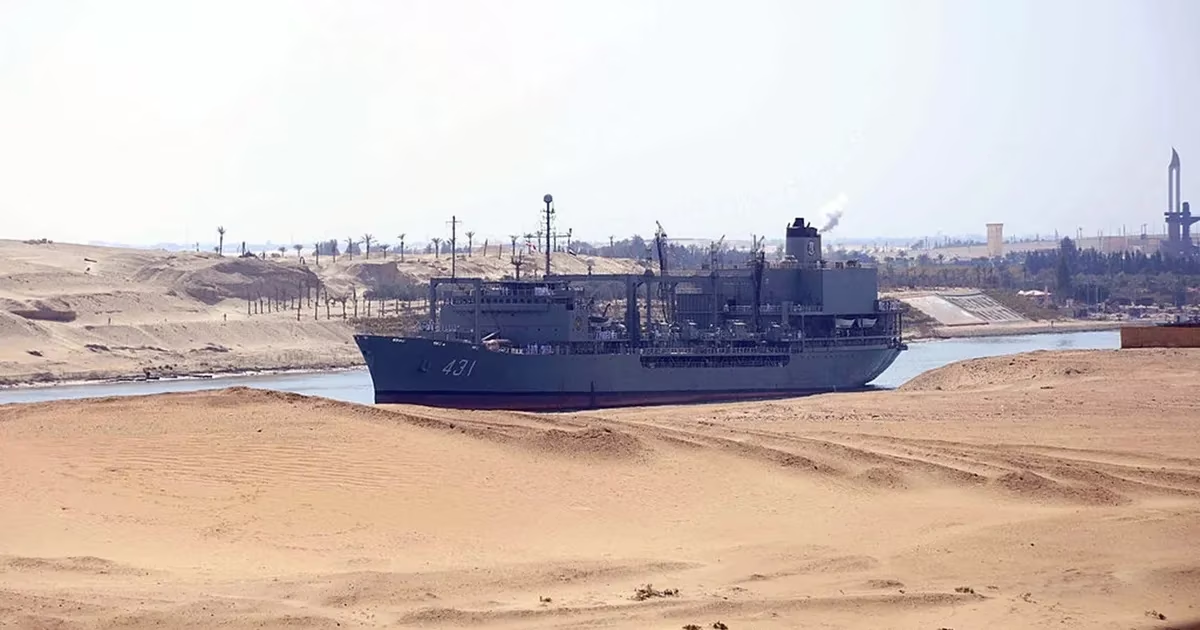
US President Donald Trump announced early Saturday that US armed forces had carried out a series of intensive airstrikes targeting Iran's Kharg Island, located in the northeastern part of the Gulf. Trump confirmed in statements on his 'Truth Social' platform that the operation resulted in the destruction of all specified military targets on the island, which he described as 'the jewel in Iran's crown'.
Military sources clarified that the US Central Command (CENTCOM) oversaw the execution of these strikes, which the White House considered one of the largest aerial operations in the region. The US side indicated that the attack focused exclusively on military sites, avoiding, at this stage, any damage to the vital oil facilities on the island.
In a clear warning message, the US President hinted at the possibility of targeting oil infrastructure in future instances, emphasizing that this option would remain on the table if Tehran attempted to obstruct navigation in the Strait of Hormuz. He affirmed that Washington would not allow the security of vessels transiting international waterways freely and safely to be threatened.
In response, Iranian Parliament Speaker Mohammad Bagher Ghalibaf quickly warned that any aggression against Iranian territory or islands would be met with a firm response. Ghalibaf threatened to abandon all military and political restrictions, indicating that harming these islands would turn the Gulf waters into a bloody confrontation arena for invaders.
Iranian media reports, citing Fars news agency, stated that oil facilities on Kharg Island sustained no material damage as a result of the recent US bombardment. Local sources confirmed that technical operations at the oil port were unaffected, despite the state of maximum security and military alert that prevailed in the region following the raids.
Kharg Island, also known as 'Khark', holds immense strategic importance as it represents the lifeline of the Iranian economy. The small island, covering no more than 20 square kilometers, is the primary platform through which most Iranian crude oil flows to global markets, making it both a point of vulnerability and strength.
Geographically, the island is located 25 kilometers off the coast of Bushehr province, and its deep waters allow for the docking of giant oil tankers. This natural advantage has made it superior to shallow coastal ports, where large vessels cannot approach the Iranian mainland, thus confining major export operations to this point.
Economic data indicates that between 90% and 95% of Iran's total oil exports pass through the advanced facilities on Kharg Island. The island is connected to a complex network of onshore and offshore pipelines that transport crude oil from major oil fields in Ahvaz, Marun, and Gachsaran to massive storage tanks.
The island possesses enormous storage capacities, reaching approximately 30 million barrels of crude oil, with reports indicating that 18 million barrels were actually stored at the beginning of this month. In addition to oil, the island hosts petrochemical facilities and liquefied natural gas processing plants, further increasing its economic value.
Globally, any disruptions on Kharg Island directly impact international energy markets, especially since Iran produces about 3.3 million barrels per day. China is the largest beneficiary of oil passing through this island, as independent Chinese refineries heavily rely on Iranian supplies, which constitute a significant portion of their maritime imports.
Historically, this is not the first time Kharg Island has found itself in the line of fire; it was a primary target during the 'Tanker War' in the 1980s. During that period, the island was subjected to over 2,800 aerial and missile attacks by Iraqi forces, but it continued to operate despite the extensive destruction it suffered then.
Observers believe that targeting the island militarily represents a dangerous escalation that could lead to the ignition of multiple fronts in the region, given its proximity to the Strait of Hormuz. Approximately one-fifth of global oil supplies pass through this strait, meaning that any comprehensive confrontation there would lead to insane jumps in global energy prices and affect supply chains.
Tanker tracking data indicates that Iranian exports via the island witnessed a significant increase prior to the recent tensions, approaching two million barrels per day at certain periods. This intensive activity made the island an attractive target for US economic and military pressure aimed at reducing Tehran's financial resources.
Anticipation remains the order of the day in the Gulf region, awaiting the next steps from both sides, amid Washington's threat to strike the economy and Tehran's threat of an open military response. These developments put global energy security at stake, while major capitals monitor the repercussions of this direct clash between the two powers in one of the world's most sensitive regions.
US Central Command carried out one of the most powerful airstrikes in Middle East history, completely destroying every military target on the jewel of Iran's crown: Kharg Island.
ARAB AND WORLD
Sun 15 Mar 2026 9:06 am - Jerusalem Time
Iran's Revolutionary Guard vows to eliminate Netanyahu and confirms targeting of American bases
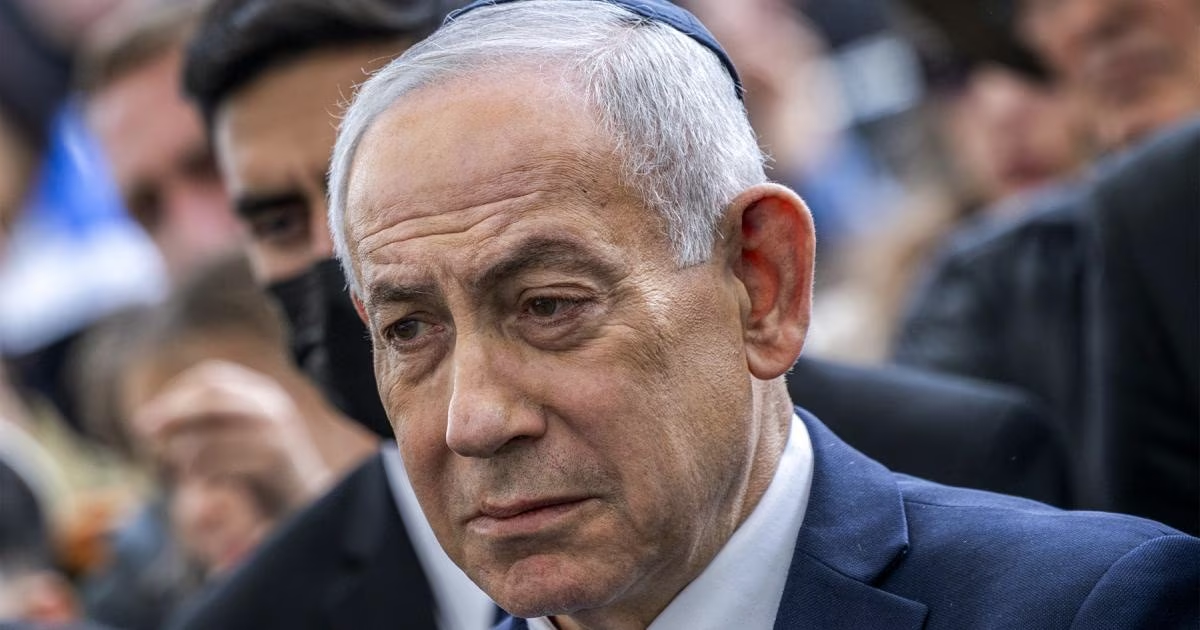
The Iranian Revolutionary Guard issued a strongly worded statement this Sunday morning, vowing to pursue Israeli Prime Minister Benjamin Netanyahu and physically eliminate him if it is proven that he is still alive. These threats come amidst a wave of ambiguity and rumors that have swept social media platforms regarding Netanyahu's fate, especially after the circulation of questionable video clips said to have been produced by artificial intelligence.
Informed sources confirmed that the Israeli Prime Minister's office quickly denied these reports on Saturday, describing them as false claims aimed at causing confusion. The circulated video had shown Netanyahu with unnatural features and a hand with six fingers, which led digital content verification experts to confirm that the clip was fabricated and had no factual basis.
In the context of field operations, the Revolutionary Guard announced the implementation of what it described as the 52nd wave of Operation 'True Promise 4', which targeted vital facilities within the occupied territories. The statement clarified that Iranian heavy missiles and drones successfully destroyed strategic targets in the industrial sectors of Tel Aviv, in response to what it described as the crimes of the occupation and the United States against Iranian civilians and workers.
Iranian strikes were not limited to the Israeli interior but also included three major American military bases in the region: Al-Harir base in Erbil, and Ali Al-Salem and Arifjan bases. The statement indicated that these attacks come as part of an initial and retaliatory response for the blood of the martyrs who fell in Iranian industrial cities as a result of recent aggressions led by Washington and Tel Aviv.
Sources reported that the sound of sirens and ambulances did not cease in the targeted areas, amidst implicit admissions from Israeli institutions of an increase in injuries and material losses. The Revolutionary Guard considered that the prevailing state of turmoil within the Israeli establishment reflects the depth of the crisis the entity is experiencing, especially with conflicting reports about the whereabouts of Netanyahu and his family.
The region has witnessed an unprecedented escalation since the end of last February, with Israeli and American forces launching intensive attacks targeting senior leaders in the Iranian political and security hierarchy. These attacks resulted in the killing of Supreme Leader Ali Khamenei and a number of prominent officials, prompting Tehran to adopt a strategy of direct and widespread retaliation with ballistic missiles and suicide drones.
Within the framework of this open conflict, Iran continues to target what it describes as American interests in several Arab countries, leading to casualties and severe damage to civilian infrastructure. These moves have been met with widespread condemnation from the affected countries, at a time when it appears that the direct confrontation between regional and international parties has entered a new phase of breaking bones and settling scores.
If this criminal, killer of children, is still alive, his pursuit and elimination will continue with full force.
PALESTINE
Sun 15 Mar 2026 9:05 am - Jerusalem Time
Massacre in Tubas.. The occupation annihilates a Palestinian family and settler attacks escalate in Nablus

The northern areas of the occupied West Bank have witnessed a bloody escalation in recent hours, resulting in the martyrdom of five Palestinians in separate attacks carried out by the occupation army and groups of settlers. The most prominent crime occurred in the town of Tammun, south of Tubas city, where Israeli special units committed a horrific massacre targeting a Palestinian family driving their private vehicle early this Sunday morning.
Medical sources from the Palestinian Red Crescent Society reported that their teams received the bodies of four martyrs from one family: the father Ali Khaled Bani Odeh, his wife Waad, and their two children Mohammed and Othman, who were not more than six years old. The sources explained that the Israeli force fired a heavy barrage of live bullets directly at the vehicle, leading to the immediate martyrdom of the family members in a tragic scene that shook the region.
One of the children who survived the massacre recounted the harsh moments he experienced inside the vehicle, where he hid under the seats while watching his parents and siblings take their last breaths under the occupation's bullets. Occupation forces prevented ambulance crews and citizens from approaching the targeted car for several hours, before later allowing the transfer of the bodies and the handover of two other children who were destined to survive certain death.
In a related context, 28-year-old Amir Moatasem Mahmoud Odeh was martyred, succumbing to serious injuries he sustained as a result of an attack by armed settlers on the town of Qusra, south of Nablus city. Local sources confirmed that the settlers fired live bullets indiscriminately at citizens' homes and properties, leading to other injuries among civilians and severe beating incidents.
Reports issued by the Wall and Settlement Resistance Commission indicate a dangerous escalation in the pace of settler attacks, with more than 192 attacks recorded in the past two weeks alone. These systematic attacks are carried out under the direct protection of the occupation army and aim to terrorize Palestinians in their villages and towns as part of a policy aimed at expanding settlement areas and changing the demographic reality in the West Bank.
Also on the ground, occupation forces continued their incursions and raids in the towns of Qabatiya and Yamoun in Jenin governorate, which included thorough searches of homes, tampering with their contents, and terrorizing their residents. Occupation forces also detained a young man from the town of Yamoun and subjected him to forced field interrogation before withdrawing from the area, amidst scattered confrontations with young men who confronted the incursion.
Cities and villages in the West Bank are experiencing a state of extreme tension amid the ongoing Israeli military operations, as forces also stormed the town of Beit Furik, east of Nablus, and fired toxic gas and sound bombs at citizens. These developments come at a time when observers warn of a wider explosion of the situation as a result of the continued policy of field killings and the protection of escalating settler crimes.
The occupation targeted the vehicle with a barrage of bullets in the center of Tammun town and prevented ambulance crews from reaching the victims in the first moments.
ANALYSIS
Sun 15 Mar 2026 9:05 am - Jerusalem Time
Strait of Hormuz on the Brink of Explosion: Trump Calls for Naval Alliance, Tehran Threatens American Interests

Washington – Said Arikat – 3/15/2026
News Analysis
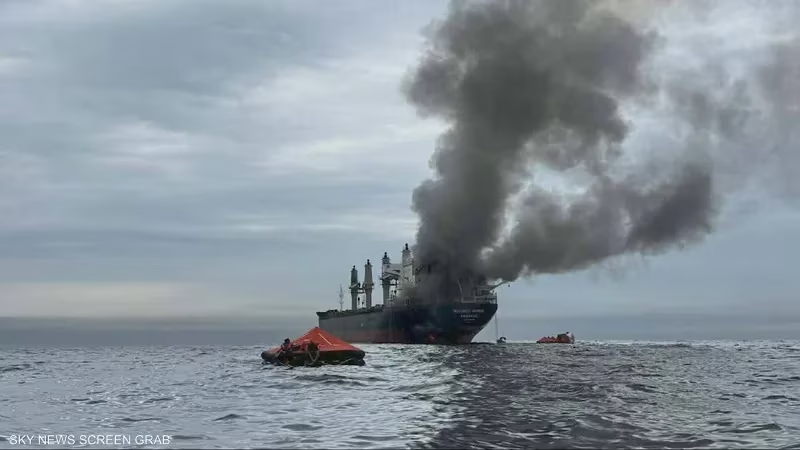
Tensions in the Gulf region escalated after statements by US President Donald Trump, who announced that the United States is working to form an international naval alliance to protect the Strait of Hormuz and keep it open to global navigation, indicating that many countries may send warships to the region alongside US forces as part of this broad military move. Trump said that countries such as China, France, Japan, South Korea, and the United Kingdom have been harmed by Iran's attempts to obstruct navigation in the strait, and therefore they must participate in its protection, in his words.
He added that US forces destroyed what he described as one hundred percent of Iran's military capability, but at the same time warned that Tehran is still capable of sending drones, planting naval mines, or launching short-range missiles along the vital waterway. He affirmed that the United States will continue to bomb the Iranian coast and sink military boats and ships if necessary to ensure the strait remains open and safe. He said in a firm tone that Washington will make the Strait of Hormuz safe and free one way or another soon.
These statements came after the US Central Command announced a large-scale military strike targeting Iran's Kharg Island, where it confirmed that US forces bombed more than ninety military targets during what it described as a precise operation.
In response, Tehran warned that any targeting of its energy facilities would lead to a direct response to American interests in the region. Iranian Foreign Minister Abbas Araghchi said in an interview with NBC News on Saturday that his country would target American companies or companies in which the United States has stakes if Iranian facilities were bombed by the United States or Israel.
He added that Tehran would act cautiously to avoid harming densely populated areas, but stressed that Iran would not hesitate to respond to any aggression. He also indicated that the strikes that targeted Kharg Island were launched, according to him, from the United Arab Emirates, specifically from "Ras Al Khaimah" and "Dubai," condemning the use of populated areas as platforms for launching American "HIMARS" missiles.
In a related development, the Iranian Revolutionary Guard announced that American interests in the UAE, including ports, docks, and military sites, have become legitimate targets after the American attacks, and also called on residents to stay away from ports and military bases to avoid civilian casualties.
At the same time, media reports indicated a fire broke out at a major energy facility in Fujairah after shrapnel fell during the interception of a drone, with no injuries reported among workers. These developments indicate that the Strait of Hormuz has once again become the main center of tension in the conflict between Washington and Tehran, as the US administration considers freedom of navigation a red line that cannot be allowed to be threatened, while Iran considers the increasing military and economic pressure to target its sovereignty and national security, which makes the region on the verge of an open confrontation that may extend beyond the strait to affect the overall balance of security and energy in the Middle East.
Observers believe that Trump's statements reflect a clear desire to internationalize the confrontation over the strait instead of limiting it to a bilateral conflict with Iran. The call for Asian and European countries to send naval vessels means that Washington seeks to share the cost of protecting the world's most important oil passage, and also tries to enhance the legitimacy of its military actions by showing that the issue is not only about an American-Iranian conflict but about the security of the global economy.
However, this approach faces skepticism from experts who warn that any large military buildup in the strait could increase the chances of unintended friction between naval forces and turn the narrow passage into a dangerous show of force. Moreover, relying solely on military deterrence does not guarantee preventing limited attacks that may be carried out by irregular forces or small naval units, a scenario many fear will keep energy markets in a state of permanent tension in the coming period, especially if the political and military escalation between the two sides continues without effective negotiation channels capable of containing the crisis before the region slides into a wider confrontation that could affect global trade, the stability of oil prices, and the entire international economy in the near future.
Trump's statement about securing the Strait of Hormuz reveals a traditional American approach based on military force as the primary tool for managing international crises. However, this approach ignores that sensitive maritime passages are not managed solely by military deterrence but also by political understandings and regional security arrangements. Any open escalation around the strait could push Tehran to respond with asymmetric methods such as naval mines and drones, which are low-cost tools but capable of disrupting major fleets and global energy markets in just a few hours, and a large naval alliance could also
The warning issued by Iranian Foreign Minister Abbas Araghchi, in turn, reveals the nature of Iran's strategy in managing escalation with Washington. Tehran knows that the traditional balance of power clearly favors the United States, so it threatens to target economic interests and companies instead of direct military confrontation. Energy companies, ports, and transportation networks represent real pressure points on the global economy. Moreover, threatening commercial interests could create disagreements between Washington and its allies, who rely more on the stability of trade and energy in the Gulf than on long-term military adventures, which Iran is trying to exploit politically.
The broader dimension of this escalation relates to the future of global energy security. About one-fifth of the world's seaborne oil supplies pass through the Strait of Hormuz, and any disruption, however limited, immediately affects oil prices, insurance, and international shipping. Therefore, talk of a US-led naval alliance is not only about protecting navigation but also about reasserting American influence in the Gulf at a time when other international powers, such as China, are increasing their attempts to expand their economic and naval presence in the region, making the strait a theater of open geopolitical competition and not just a sensitive waterway.
ARAB AND WORLD
Sun 15 Mar 2026 9:05 am - Jerusalem Time
Trump refuses to negotiate with Tehran, confirms destruction of its military capabilities and securing the Strait of Hormuz
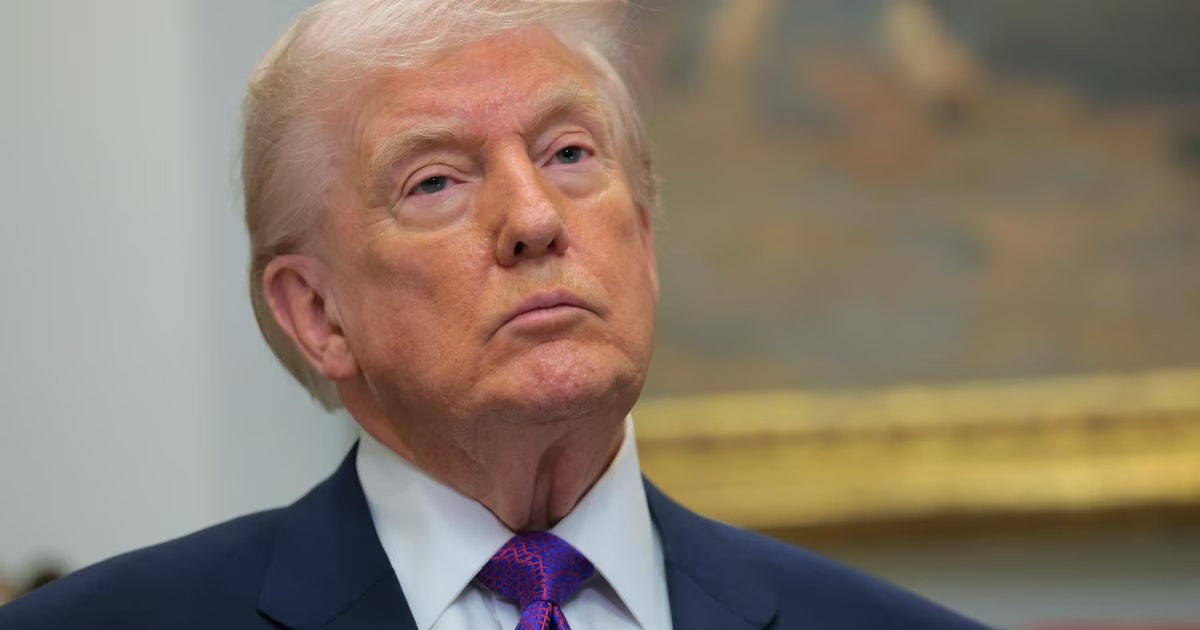
US President Donald Trump announced that the United States is currently not prepared to enter into negotiations to end the military conflict with Iran, despite what he described as Tehran's desire to reach an agreement. Trump clarified in a lengthy phone interview that the current conditions do not meet American aspirations, emphasizing the necessity for any future agreement to include strict restrictions ensuring the complete abandonment of nuclear ambitions.
The US President indicated that the joint military operations carried out by Washington and Tel Aviv have achieved tangible results on the ground since their launch last month. Trump claimed that the US military succeeded in neutralizing a large part of the Iranian arsenal, including the destruction of most ballistic missiles and drones, in addition to targeting vital manufacturing centers for these weapons.
Regarding human casualties, initial data revealed the deaths of 13 American soldiers since the outbreak of confrontations, the latest of whom were six crew members of a refueling aircraft that crashed in Iraqi territory. These developments come amid ongoing reciprocal attacks, where Tehran targeted what it describes as American interests in several Arab countries, leading to civilian casualties and widespread material damage.
Trump addressed the issue of global energy security, confirming that he had invited several major countries to contribute to securing the Strait of Hormuz, which is the lifeline for global oil supplies. He explained that countries such as China, France, Britain, and South Korea might participate in sending warships in coordination with Washington to ensure the waterway remains open for international navigation.
Despite escalating tensions, the US President refrained from confirming whether the US Navy would actually begin escorting oil tankers through the strait, but he described this option as 'very likely'. He also downplayed public concerns about the noticeable rise in fuel prices, considering that current efforts aim to secure long-term stability in the region.
Regarding the military targets hit, Trump confirmed the targeting of the strategic Kharg Island, which is the main center for Iranian oil exports, claiming that the strikes almost completely destroyed the island. These statements partially contradicted previous reports by the US Central Command, which confirmed precise strikes targeting only military sites while avoiding oil infrastructure.
Trump justified the discrepancy in statements about the duration of the war, indicating that military operations are progressing significantly ahead of their predetermined schedule. He added that US forces avoided completely destroying some vital energy lines to prevent taking many years to rebuild them in the future, despite hinting at repeating strikes in other locations.
In a controversial political context, Trump questioned the fate of Iran's new Supreme Leader Mojtaba Khamenei, noting his complete absence from the public scene since taking office. The US President mentioned rumors about his death, confirming that no one has been able to prove his existence alive until now, describing the matter as a great mystery.
Trump refused to disclose the existence of communication channels with alternative Iranian leaders, merely stating that there are figures who can lead the country towards a better future. He affirmed that he prefers not to reveal any details related to these individuals to avoid endangering their lives under the current circumstances experienced by governing institutions in Tehran.
The US President expressed his surprise at the Iranian reaction, which included attacking other countries in the Middle East, considering that this escalation complicates the chances of reaching quick diplomatic solutions. He stressed that military pressure will continue until Tehran submits to Washington's conditions, which go beyond a mere ceasefire to a radical change in regional behavior.
Regarding international alliances, Trump indicated that his posts on 'Truth Social' reflect increasing international commitment to confront Iranian threats in waterways. He confirmed that coordination with allies and trade partners affected by the closure of the strait has reached advanced stages, with international naval reinforcements expected to arrive in the region soon.
Concerning the field situation in Iraq, sources clarified that the crash of the American refueling aircraft represents a logistical blow, but it will not affect the pace of ongoing air operations. Trump affirmed that the US military has the capability to resolve matters within a few days if operations continue at the current intensity, threatening to destroy almost everything.
Trump's administration faces internal criticism due to conflicting messages about the ultimate goals of the war, with analysts believing that contradictory statements aim to wage psychological warfare on the Iranian leadership. However, the White House insists that the strategic goal remains clear: preventing Iran from acquiring nuclear weapons and stopping its military influence in the region by all means.
Trump concluded his remarks by emphasizing that the United States will not be drawn into a 'weak' agreement as happened in previous periods, and that military power is the only guarantor of achieving lasting peace. Anticipation remains high in global markets and political circles, awaiting what the coming days will bring, whether field confrontations or behind-the-scenes diplomatic moves.
Iran wants to make a deal, and I don't want to make it now because the conditions are not sufficient, and any future deal must be very strict.
ARAB AND WORLD
Sun 15 Mar 2026 9:05 am - Jerusalem Time
Unprecedented Escalation.. Iraqi Factions Launch 27 Attacks Against US Bases in One Day
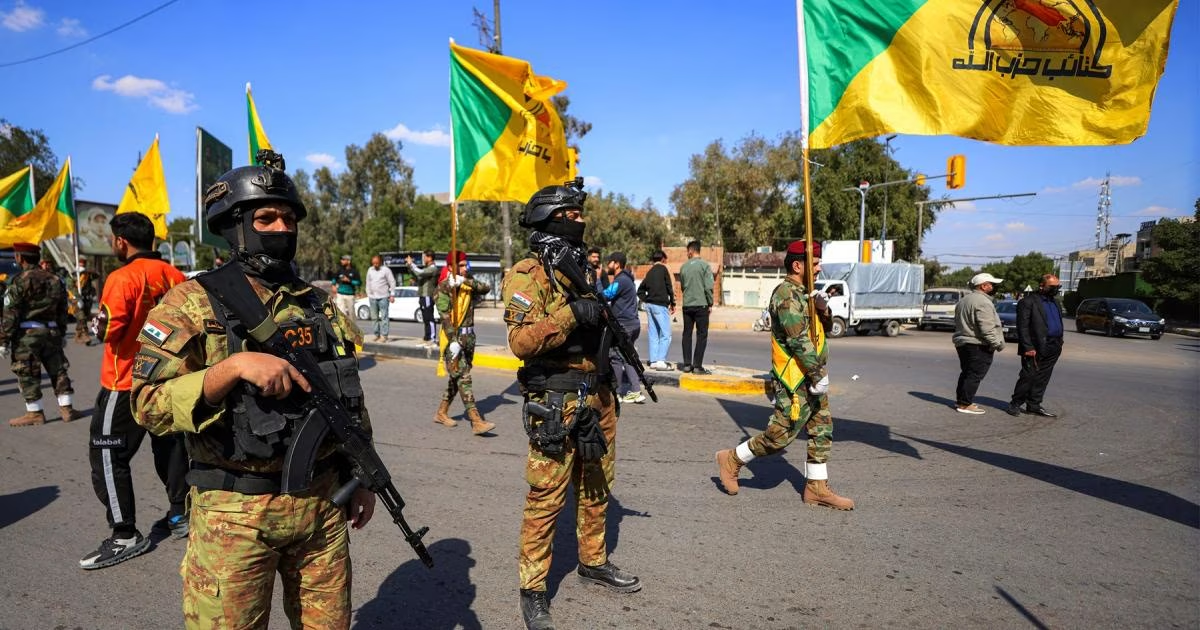
The Iraqi arena witnessed a remarkable military escalation following the announcement by what is known as the 'Islamic Resistance in Iraq' of carrying out 27 military operations targeting US bases in the country and the surrounding region within just twenty-four hours. In their intensive attacks, the factions used a mix of ballistic missiles and drones, affirming that these operations come in response to the continuous military escalation witnessed in the region since late February.
Field sources explained that the recent attacks were characterized by heavy fire and multiple axes, as dozens of suicide drones targeted logistical and military sites belonging to the US army. This move comes in the context of the open confrontation in which regional powers have engaged, placing the security of US bases in the region under continuous and unprecedented threat in terms of the pace of operations.
In an analysis of the military scene, strategic estimates indicate that the number of fighters in these Iraqi factions has reached approximately 238,000 elements, distributed between regular forces and reserve forces. This force consists of about 68 armed factions, officially linked to the Commander-in-Chief of the Iraqi Armed Forces, which gives them legal cover and wide influence within state institutions.
'Kata'ib Hezbollah Iraq' stands out as one of the strongest of these formations, having been established under the direct supervision of the Quds Force and possessing close communication channels with the Iranian Revolutionary Guard. Alongside it, other influential forces emerge such as Asa'ib Ahl al-Haq, Harakat Hezbollah al-Nujaba, Kata'ib Sayyid al-Shuhada, in addition to Saraya al-Salam and Kata'ib Babylon, forming a complex military map.
These factions' structure is characterized by sectarian and social diversity that reflects the Iraqi fabric, as it is not limited to the Shiite component only, but also includes fighters from Sunnis, Christians, Turkmen, and Yazidis. This diversity gives the factions the ability to spread across various Iraqi governorates, making it difficult to deal with them as a single monolithic bloc, but rather as a complex system of influence.
In terms of armament capabilities, these groups now possess an arsenal comparable to international armies, including 'Quds 2' missiles with a range of about 800 kilometers. The factions have also developed locally made cruise missiles and 'Fajr', 'Grad', and 'Katyusha' type missiles, giving them the ability to strike long-range targets with increasing accuracy.
In addition to missile power, the factions employ advanced combat tactics including guerrilla warfare, fighting in densely populated urban environments, and carrying out qualitative ambushes. This military strategy has disrupted American calculations in the region, especially with the factions' ability to hide, move quickly, and use drones for reconnaissance and suicide operations.
Politically, these forces exert significant pressure within the Iraqi parliament and government, where their positions on the American presence range from absolute rigidity and demands for immediate withdrawal, to political pragmatism. This influence puts the government in Baghdad before difficult choices, as it seeks to avoid confrontation with Washington without entering into direct conflict with these powerful factions.
Sources indicate that the Popular Mobilization Forces, which are an essential part of this system, have played a pivotal role in the recent operations against American interests. These attacks have caused material and human losses, prompting the American side to re-evaluate its defensive strategy at bases deployed in Iraq and Syria.
Amidst the ongoing aggression launched by the United States and Israel against Iran since last February, which resulted in the assassination of high-ranking leaders, it appears that the Iraqi arena will remain a primary launching pad for retaliation. Current data confirm that the Iraqi factions have decided to raise the level of confrontation, portending further escalation in the coming days and expanding the scope of targeting to include vital interests in the region.
Iraqi factions possess a diverse arsenal of weapons comparable to regular armies, and employ guerrilla warfare and ambush tactics.
ISRAELI AFFAIRS
Sun 15 Mar 2026 9:05 am - Jerusalem Time
Air Defense Stockpile Crisis: Israel Informs Washington of Severe Shortage in Ballistic Interceptor Missiles
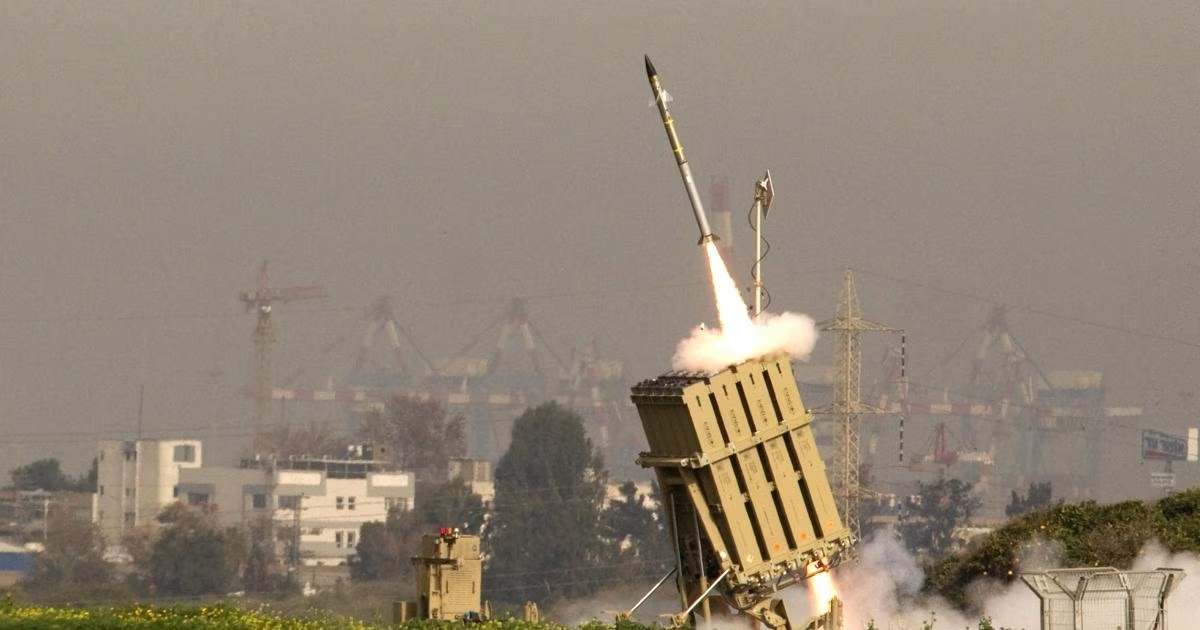
American officials revealed that Israel has informed the United States of a severe and alarming shortage in its stockpile of interceptor missiles designed to counter ballistic missiles. This admission comes at a sensitive time, with direct military confrontation ongoing and an escalation in missile attacks launched by Tehran towards Israeli targets.
These developments raise serious concerns among security circles regarding the ability of Israeli air defense systems to withstand and continue intercepting long-range attacks. The defensive systems have been under unprecedented pressure since late February, coinciding with intense exchanges of strikes that resulted in significant human casualties among leadership ranks.
Media sources reported that Israel entered the current round of conflict already suffering from a previous depletion of its defensive stockpiles. Confrontations last summer consumed massive quantities of interceptor missiles, leaving the current inventory at critical levels that are disproportionate to the existing threat.
Further complicating the field situation is Iran's resort to developing new offensive tactics, including adding cluster munitions to some of its ballistic missiles. This step aims to disrupt radar systems and increase the difficulty of interception, which necessarily leads to a faster depletion of Israel's already limited defensive stockpile.
For its part, sources in Washington confirmed that the American administration had been aware of this crisis for several months, describing the situation as expected given the intensity of fire. Despite this understanding, pressure continues to mount on the White House to make a decision regarding supplying Tel Aviv with more missiles from the American strategic reserve.
While American officials acknowledge the Israeli shortage, they emphasize that U.S. forces in the region still maintain sufficient defensive capabilities. An American official clarified that Washington possesses what is necessary to protect its bases and interests, while Israel continues to seek urgent solutions to fill the gaps in its defense system.
Israel currently relies on tactical alternatives to counter Iranian missiles, most notably the use of fighter jets in aerial interception operations. However, military experts continue to assert that specialized interceptor missiles are the most effective and reliable means against heavy and long-range ballistic threats.
The Iron Dome system, the pride of Israel's defense industry, was primarily designed to deal with short-range projectiles. This specialization makes it less efficient in confronting advanced ballistic missiles, placing the entire burden of protection on systems like 'Arrow' and 'David's Sling'.
On the political front, U.S. President Donald Trump recently indicated that the United States possesses vast stockpiles of munitions. However, these statements are met with assessments from military analysts who suggest that escalating global tensions might make Washington cautious about depleting its reserves for the benefit of its allies.
Estimates from strategic study centers indicate the enormous consumption of munitions, with Washington having launched about a quarter of its 'THAAD' missile inventory in a previous confrontation. That confrontation, which lasted only 12 days, demonstrated how quickly even the most advanced defensive weapons can be depleted in modern warfare.
The financial cost of interceptions reached astronomical figures, with the value of Patriot missiles used in just five days estimated at approximately $2.4 billion. These figures reflect the economic and logistical challenge facing countries engaged in long-term, high-intensity missile conflicts.
In an attempt to preempt the worsening crisis, the Pentagon has begun concrete steps to increase production lines for advanced missile defense systems. This move aims to ensure the availability of sufficient quantities of 'THAAD' and medium-range missiles to secure the needs of U.S. forces and support allies when absolutely necessary.
As of now, the Israeli army and the White House maintain official silence regarding reports of dwindling stockpiles. The question remains about Israel's ability to manage its defensive battle should Tehran decide to escalate its missile attacks in the coming days.
Israel entered the current war already suffering from a decline in its interceptor missile stockpile after heavy use during previous confrontations.
PALESTINE
Sun 15 Mar 2026 9:05 am - Jerusalem Time
Journalists' Syndicate: Occupation arrested 22 journalists in the West Bank since the beginning of 2026

The Palestinian Journalists' Syndicate revealed in a recent human rights report a surge in Israeli prosecutions against media crews in the occupied West Bank. The syndicate confirmed that the occupation army has arrested 22 journalists, including four female journalists, since the beginning of this year 2026, as part of a systematic campaign aimed at silencing the Palestinian narrative and preventing the documentation of field violations.
The statistical data in the report indicated that January saw the peak with 13 arrests, followed by February with 7 cases, while two cases have been recorded since the beginning of March. Syndicate sources noted that the occupation authorities later released a number of detainees, while others remain held in harsh conditions that lack the minimum international legal and human rights standards.
The occupation's methods for carrying out these arrests varied, with some occurring through raids on journalists' homes and terrorizing their families, or through direct detention at military checkpoints spread between cities, in addition to targeting them while they were performing their work in field coverage. The violations were not limited to arrest but also included the confiscation of technical equipment and personal phones, and the destructive tampering with the contents of homes and media offices.
In the context of financial and legal restrictions, occupation courts imposed exorbitant financial fines on a number of journalists, in addition to strict restrictive measures that included forced house arrest and expulsion from the blessed Al-Aqsa Mosque. The syndicate stressed that the repeated use of administrative detention, which occurs without formal charges, is a blatant violation of international conventions that guarantee the protection of journalists and freedom of media work in conflict zones.
This brings the total number of journalists held in occupation prisons to 39, living in difficult detention conditions amidst a widespread escalation in the West Bank. These arrests come against a volatile field reality that has resulted, since October 2023, in the martyrdom of 1127 citizens in the West Bank and the arrest of about 22,000 others, reflecting the scale of the comprehensive attack launched by the occupation against the Palestinian people and its institutions.
This systematic targeting represents a dangerous escalation to restrict press freedom and an attempt to deter journalists from reporting the occupation's crimes.
ARAB AND WORLD
Sun 15 Mar 2026 9:04 am - Jerusalem Time
Intensive Diplomatic Moves: Lebanon Prepares for Negotiations with Israel Amid Reports of a French Peace Proposal
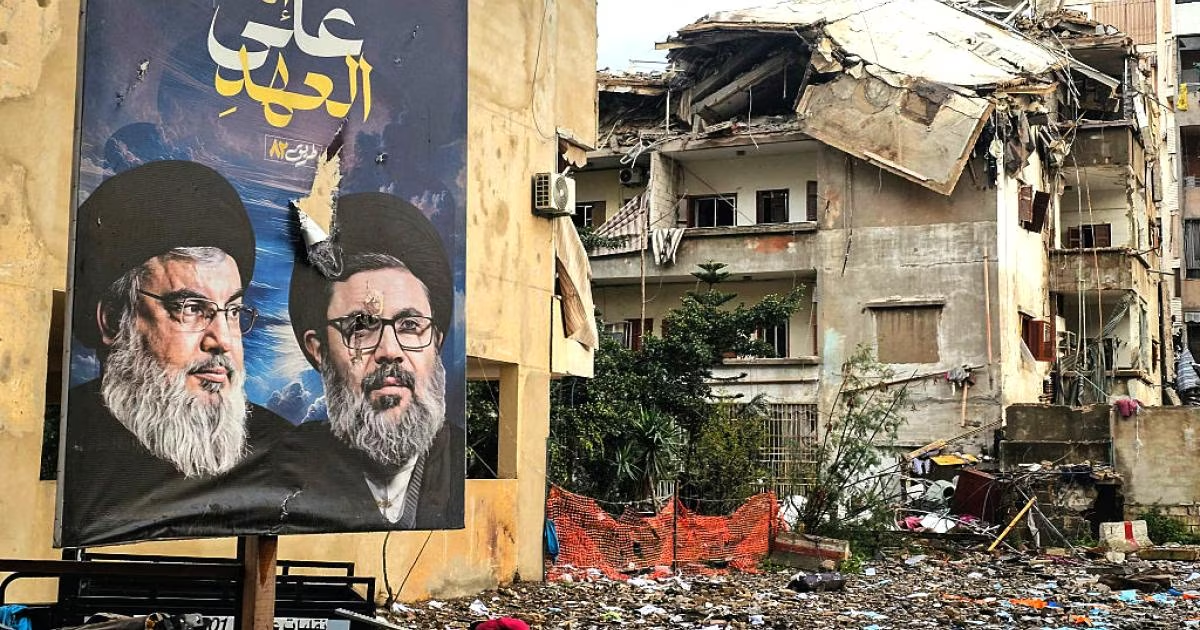
Official sources reported that the Lebanese capital, Beirut, has begun serious efforts to form a high-level delegation with the aim of entering into direct negotiations with Israel to stop the ongoing war. This step comes amid escalating international and field pressures, as the Lebanese government seeks a political solution to spare the country further massive destruction.
For its part, the French Ministry of Foreign Affairs denied the existence of an official 'French plan' imposed on the parties, stressing that Paris's role is limited to facilitating dialogue and supporting the openness of the Lebanese authorities to talks. The ministry clarified in a statement that determining the agenda and content of the negotiations is a sovereign matter that concerns only the Lebanese and Israeli parties.
International press reports had revealed a draft proposal formulated by Paris, which includes unprecedented steps to end the conflict, including Lebanon's preliminary recognition of the State of Israel. According to these reports, the proposal aims to build a new political framework that ensures respect for sovereignty and territorial integrity between the two sides under international supervision.
The leaked information indicates that the French proposal calls for the start of negotiations at the senior diplomatic level to reach a 'political declaration' within one month. These talks are expected to evolve to include first-tier political leaders, with a French desire to host these historic meetings in Paris.
The proposed project includes strict adherence to UN Security Council Resolution 1701, in addition to the 2024 ceasefire agreement. It also imposes on the Lebanese government the responsibility to prevent any attacks launched from its territory, and to implement a comprehensive plan to disarm Hezbollah and completely ban its military activities.
Regarding field arrangements, the plan stipulates the redeployment of the Lebanese army in the areas south of the Litani River to impose state authority. In return, Israel commits to withdrawing from all territories it has occupied since the start of the current military operations, within a timeframe not exceeding one month.
The French side also proposes the establishment of an international monitoring mechanism led by the United States to address any potential violations of the ceasefire. UNIFIL forces will verify that the area south of the Litani is free of weapons, while an international coalition with a UN mandate will oversee disarmament in the rest of the Lebanese areas.
The initiative seeks to reach a permanent 'non-aggression' agreement between Beirut and Tel Aviv within two months of the start of negotiations. This agreement aims to end the official state of war that has existed between the two countries for decades, and to commit to resolving all future disputes through peaceful and diplomatic means.
Under this agreement, Israeli forces will withdraw from five strategic locations in southern Lebanon that they had controlled in November 2024. This step is considered part of confidence-building measures that precede the final stage related to the final and permanent demarcation of the land borders.
The final stage of the proposed vision includes the demarcation of the Lebanese borders with both Israel and Syria, with this file to be completed by the end of 2026. This measure aims to close the file of border disputes that have been the spark for many military confrontations over the years.
On the Lebanese side, sources confirmed that President Joseph Aoun's initiative for negotiations is strongly on the international table, amid widespread European welcome. However, officials in Beirut stress the need for a clear Israeli commitment to the truce before engaging in the details of the negotiating delegation.
In contrast, Israeli Prime Minister Benjamin Netanyahu tasked former minister Ron Dermer with managing the Lebanese file and coordinating directly with the new US administration. Dermer will lead any potential negotiations, focusing on ensuring the security arrangements demanded by Tel Aviv in the northern region.
Despite cautious optimism, observers believe that reaching a final agreement will face significant obstacles related to internal balances in Lebanon and Israel's increasing security demands. Officials from both sides affirm that the success of these endeavors depends primarily on the strength of American leadership and mediation in the coming period.
At the same time, Israel continues to threaten to expand its ground operations to dismantle Hezbollah's military structure, putting negotiations under field pressure. Israeli sources claim that the goal is complete control over the south of the Litani, which makes the diplomatic path a race against time to prevent further escalation.
It is up to the two parties, and only to the two parties, to determine the agenda of these talks, and France supports the openness of the Lebanese authorities to direct talks.
OPINIONS
Sun 15 Mar 2026 4:27 am - Jerusalem Time
The War Israel Long Pushed For: How Washington Walked Into an Imperial Trap

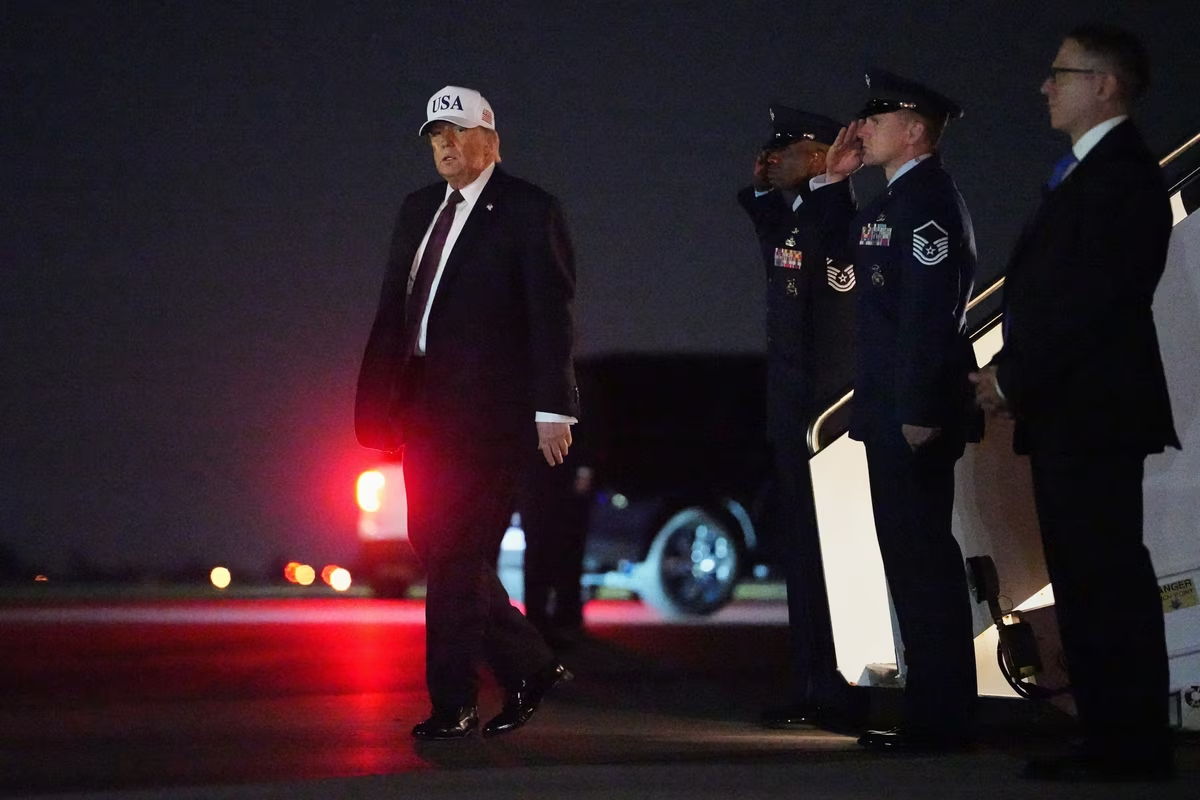
By: Said Arikat
March 15, 2026
News Analysis
When historians examine moments of strategic overreach, they often see the same pattern repeat itself. A powerful nation convinces itself that its military superiority can reshape a distant political reality. Intervention is framed as limited, necessary, even inevitable. Yet as conflicts unfold, costs rise, objectives shift, and the supposed strategy slowly reveals itself as a trap.
According to columnist and foreign policy analyst Fareed Zakaria, the United States may now be entering precisely such a predicament in its confrontation with Iran. Writing in The Washington Post, he argues Washington has fallen into what he calls an imperial trap—the recurring belief that military force can reorder complex societies abroad.
Zakaria’s warning is sobering yet familiar. But one question remains insufficiently examined: how the United States arrived at this moment of escalation. Explanations focused solely on American ambition risk overlooking regional pressures, alliance politics, and years of lobbying that gradually narrowed Washington’s choices until confrontation appeared almost inevitable.
Zakaria argues that Washington has once again succumbed to the illusion that military power can engineer political transformation abroad. The temptation has appeared before. Wars in Iraq and Afghanistan began with limited objectives but evolved into long campaigns aimed at remaking entire political systems. The intervention in Libya similarly began as a humanitarian mission before producing prolonged instability.
The lesson from each episode was clear: destroying regimes is far easier than building viable political orders. Iran presents an even greater challenge. It is not a fragile state but a complex society of nearly ninety million people, with entrenched institutions, a powerful national identity, and a political system designed to survive sanctions and external pressure. Assuming bombs alone can transform such a society ignores decades of history and political resilience.
Zakaria also warns that the conflict risks diverting American strategy from what many analysts consider the central geopolitical challenge of the century: the rise of China. For two decades after the attacks of September 11, Washington devoted enormous resources to wars across the Middle East. During the same period, Beijing concentrated on economic expansion, technological development, and expanding geopolitical influence.
The result was a steady shift in the global balance of power. Now, just as Washington has begun pivoting toward the Indo-Pacific, confrontation with Iran threatens to draw the United States back into another prolonged regional conflict. Wars of this kind rarely remain limited. They consume diplomatic attention, military resources, and political capital that might otherwise be directed toward longer-term strategic priorities.
Complicating matters further is rhetoric from Donald Trump suggesting that regime change in Iran could become a central objective. Yet regime change is not simply a military operation. It requires political legitimacy, organized opposition leadership, functioning institutions, and a credible plan for governance after the fall of an existing system.
None of those elements currently appear fully developed. Iran’s opposition movements remain fragmented, and no unified leadership stands ready to assume power should the current system collapse. In such circumstances, regime collapse could produce a far more destabilizing outcome: internal fragmentation, militia warfare, and prolonged civil conflict. Such chaos would hardly advance American strategic interests.
Zakaria also characterizes the current military strategy as “scattered, shifting and uncertain.” The stated goals of the campaign appear to evolve rapidly—from degrading military capabilities to crippling nuclear infrastructure and increasingly to discussions about political transformation. When objectives shift this quickly, they often signal the absence of a clearly defined end state.
Beyond the battlefield lies another profound risk: economic shock. Iran sits near the center of the global energy system, and the conflict has already threatened key infrastructure. The most sensitive chokepoint remains the Strait of Hormuz, through which a large share of the world’s oil supply passes each day. Any disruption there could send global energy markets into turmoil, triggering rising fuel prices and new inflationary pressures.
Yet focusing solely on American miscalculation misses another decisive force: the long campaign by Israeli leaders—most prominently Benjamin Netanyahu—to persuade Washington that confronting Iran militarily was unavoidable. For decades Netanyahu warned that diplomacy, containment, and sanctions would ultimately fail, leaving force as the only reliable option.
That message echoed repeatedly in speeches before the United Nations, appearances at the U.S. Congress, and countless meetings with American presidents. Each time, Netanyahu insisted the threat from Iran was existential and could not be contained indefinitely, urging Washington toward a far more confrontational posture.
During the ongoing war, Benjamin Netanyahu himself acknowledged that striking Iran was something he had advocated for nearly four decades. The remark confirmed what many observers had long suspected: the confrontation now unfolding reflects years of sustained Israeli pressure encouraging Washington to confront Tehran militarily.
The political context became even clearer when Marco Rubio acknowledged that Washington knew Israel was preparing to strike Iranian targets and understood such a move would likely pull the United States into the conflict. American involvement, therefore, was not purely spontaneous but shaped by alliance dynamics and escalating regional military moves.
Seen in this light, the war emerges not only from imperial temptation in Washington but from a tightening web of alliances, fears, lobbying, and strategic signaling between Israel and the United States that steadily reduced diplomatic space until confrontation seemed unavoidable.
Still, Fareed Zakaria offers a broader warning. Great powers rarely recognize imperial traps while entering them. Early interventions appear manageable, even necessary. Only later, when costs mount and objectives blur, does the trap become visible.
The United States still commands unmatched military strength. But power alone does not guarantee strategic success. History—from Iraq to Afghanistan—shows how battlefield success can dissolve into prolonged instability once governing realities replace combat plans.
What makes this moment particularly troubling is how openly the road to war unfolded. For years, Benjamin Netanyahu urged Washington toward confrontation and, by mobilizing allies across the U.S. Congress, helped generate the political pressure that ultimately nudged Donald Trump toward war.
The result is a striking reality: after decades of pushing from Israel’s leadership and persistent lobbying in Washington, the United States now finds itself fighting the very war Netanyahu long urged it to wage.
OPINIONS
Sat 14 Mar 2026 8:39 pm - Jerusalem Time
Solid Institutional Building Is Not a Luxury, But a Unique Form of Resistance

In the course of the Palestinian-Israeli conflict, there have been historical moments when the possibility of transitioning to a different political reality seemed closer than it does today. Among the most prominent of these moments was the period following the Oslo Accords, when the Palestinian National Authority was formed as a political and administrative framework that could gradually evolve into the nucleus for building the institutions of a Palestinian state capable of organizing society and enhancing its steadfastness. This phase was a historical opportunity to strengthen the Palestinian presence at a time when conditions were favorable, and relations with Israel were better than they are today. The rule of law and good governance could have become tools to connect society with institutions, ensuring legitimate and clear representation for the Palestinian majority.
This moment was not solely a result of Palestinian dynamics; it also stemmed from transformations within the political society in Israel, particularly the rise of what was known as the peace camp within the Israeli Labor Party, led by figures such as Yitzhak Rabin and Shimon Peres. This movement gambled on the idea that a Palestinian authority capable of managing its society within a clear institutional framework could form the basis for a long-term political settlement, providing the Israeli peace camp with a strong argument to continue with the settlement project.
The gamble was based on the idea that Palestinians, by building strong institutions and establishing the rule of law, would present a model of a society capable of unifying internal positions and regulating the public sphere. The rule of law was meant to unite society with the institution, keeping opposition within legal frameworks without deviating from the institutional path, which would prevent any individual actor or group from altering the Authority's approach to dealing with the occupation. This meant that any individual initiative, or a small field event such as a child throwing a stone, would not be able to overturn the balance of the political process or negotiations.
However, the absence of a clear central vision and decision-making, coupled with weak institutional building, made this gamble fragile. The Palestinian public sphere remained open to multiple initiatives and political centers, leading to the erosion of internal and external trust in the Authority's ability to commit to an organized negotiation process. This also contributed to the rise of more hardline right-wing currents within Israel, threatening any peace project based on institutional betting.
The experience of Oslo and the Palestinian Authority clearly shows that weak institutions not only weaken Palestinian society but also weaken the trust of the other party in the Palestinian partner, making the field more susceptible to daily fluctuations and field crises. Under occupation, specifically, solid institutional building becomes not a luxury, but a unique form of resistance. A society that possesses strong institutions and clear laws is more capable of steadfastness and organizing public life, preventing the occupation from exploiting any internal weakness, whether through political tug-of-war or scattered individual initiatives.
Even in the event of a more hardline Israeli right-wing camp rising, the existence of strong Palestinian institutions would have changed the nature of the confrontation. A society that is institutionally and socially cohesive becomes more resilient, making it difficult for any external party to bet on penetrating or dismantling it. Strong institutions give society the ability to effectively manage the public sphere, unify political decisions, and establish the rules of the political game, so that opposition remains within the framework of the law and individual initiatives are managed in a way that does not threaten institutional unity.
This experience offers a clear lesson: institutional building does not guarantee peace or settlement, but it provides society with long-term tools of strength. Strong institutions not only enhance the ability to negotiate but also provide the ability to withstand internal and external pressures, allowing Palestinians to maintain their cohesion and unity of decision, whether in the settlement phase or in the face of escalating conflict. Furthermore, effective institutions reflect an image of an organized Palestinian entity, capable of representing the entire society, which enhances the legitimacy of decisions and makes it difficult for the occupation to exploit vacuum or divisions.
In this sense, thinking about the Oslo period and the Palestinian Authority is not just about lost political opportunities, but about the internal strength that could have been achieved, and what could have made Palestinian society more resilient, more capable of facing difficult transformations, and achieving a clear institutional political presence in the face of occupation. The most prominent lesson is that societies that succeed in building solid institutions become more capable of facing transformations, whether they lead towards settlement or conflict, and institutions transform from an administrative tool into a backbone of actual resistance.
ARAB AND WORLD
Sat 14 Mar 2026 7:45 pm - Jerusalem Time
Founder of an American defense company: Washington lacks the political will to invade Iran by land
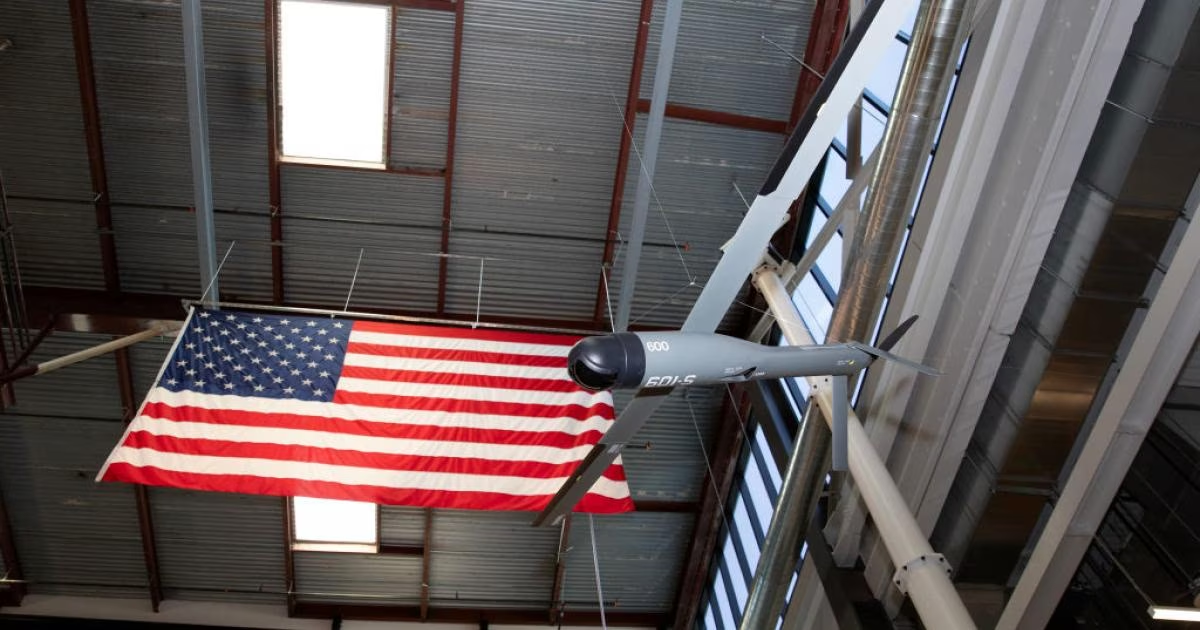
The region is witnessing an accelerating military escalation as the Israeli-American aggression against Iran enters its third week, with Washington beginning to move thousands of Marines towards the Middle East. These movements come amid a state of strategic ambiguity surrounding the ultimate goals of the ongoing military operations, with questions about the possibility of the confrontation expanding into a direct ground clash.
In this context, media sources quoted Palmer Luckey, founder of 'Anduril' defense industries, a company specializing in the production of drones and electronic systems, as saying that the United States currently lacks the 'political will' necessary to send ground forces. Luckey explained that decades of military interventions in the region have depleted popular support and logistical capacity to sustain any long-term ground campaign.
Luckey, whose company is valued at approximately $60 billion, considered that previous American 'adventures' in the Middle East have stripped the country of its ability to wage major conventional wars. He clearly indicated that he does not believe that American forces are currently capable of repeating massive military operations on the scale of 'Victory Day,' describing this inability as a strategic problem in itself.
Despite his general support for President Donald Trump's approach, Luckey noted that the Commander-in-Chief faces a new strategic reality that dictates a different kind of warfare. He stressed that the United States is not prepared to engage in a conflict similar to World War II, neither in terms of military readiness nor in terms of national consensus on war objectives.
Luckey's statements intersect with field data indicating an intensive American military buildup in the Strait of Hormuz, where leaks revealed the transfer of amphibious and marine forces from American bases in Asia. These reinforcements aim to solidify the American military presence in the region concurrently with ongoing airstrikes and military operations against Iranian targets.
On the American domestic front, opinion polls show a significant gap between military ambitions and public acceptance, with nearly three-quarters of Americans opposing any ground intervention in Iran. This public rejection reflects a state of discontent with foreign policies that have led to Washington's involvement in long, draining conflicts over the past two decades.
Sources indicate that the current American administration is trying to balance intensive military pressure with avoiding a slide into an all-out ground war whose political consequences it may not be able to bear. However, the continued flow of troops and equipment into the Strait of Hormuz suggests that all military options remain on the table despite warnings about the absence of political will.
In conclusion, observers believe that Palmer Luckey's statements reflect concern within the American military manufacturing sector about the limitations of human and political capabilities in confronting an adversary the size of Iran. The question remains about Washington's ability to manage this conflict without the need for direct ground intervention, in light of widespread public rejection and increasing geopolitical complexities.
Our adventures in the Middle East over the past two decades have stripped America of its ability to sustain a ground military campaign.
PALESTINE
Sat 14 Mar 2026 7:44 pm - Jerusalem Time
Gaza: Death toll rises amid Israeli violations and sandstorm exhausts displaced people

Medical sources in the Gaza Strip reported the martyrdom of 7 Palestinian citizens and the injury of 13 others during the past forty-eight hours, bringing the total number of victims of the Israeli aggression since October 2023 to 72,234 martyrs and 171,852 injured. The sources explained that this toll comes amid continued daily Israeli violations of the ceasefire agreement in effect since October 2025, as the occupation continues its bombing and shelling operations in various areas of the Strip.
In field details, a Palestinian woman from the Abu Shawarb family was martyred by the bullets of the occupation forces in the Maghazi camp, while medical teams recorded the injury of two children in Khan Yunis city after a wall collapsed due to strong winds. Official data indicates that the number of victims of Israeli violations since the agreement came into effect has risen to 659 martyrs and 1,754 injured, reflecting the fragility of Israeli commitment to the announced calm.
Regarding search and rescue operations, specialized teams were able to recover 756 bodies from under the rubble of buildings destroyed by the Israeli war machine, since the cessation of major military operations. Hundreds of bodies are still missing under the rubble due to the lack of capabilities and heavy equipment needed to remove the debris, which adds to the tragedy of families waiting to bury their loved ones.
Humanitarianly, a strong sandstorm carrying dust and sand hit the Gaza Strip today, Saturday, exacerbating the suffering of approximately 1.9 million displaced people living in dilapidated tents that lack the minimum means of protection. The active winds caused a number of tents to tear and fly away, especially in coastal areas and on the seashore, leaving hundreds of families in the open amid dusty weather conditions that increase health risks.
For its part, the General Directorate of Civil Defense issued urgent warnings to citizens about the need to take preventive safety measures to confront the dusty air mass. The directorate urged displaced people and residents to avoid leaving shelters except for extreme necessity, while emphasizing the wearing of medical masks, especially for patients suffering from respiratory crises and chronic diseases affected by air quality.
Civil Defense teams stressed the importance of re-securing tents and tarpaulins firmly using weights and available fastening methods to avoid them being uprooted by strong winds. This storm comes at a critical time when displaced people are suffering from a severe shortage of blankets and winter clothes, making facing weather fluctuations a real challenge that threatens the lives of children and the elderly in overcrowded camps.
In a related context, the spokesperson for the Gaza municipality called on the international community and humanitarian organizations to intervene urgently to provide safe alternatives for displaced people and protect them from natural disasters and ongoing military aggressions. He pointed out that the dilapidated infrastructure in the Strip is no longer able to absorb any additional pressures, whether resulting from military operations or the harsh weather conditions affecting the region.
During the past 48 hours, the Strip's hospitals received 7 martyrs and 13 injured as a result of the ongoing Israeli aggressions.
ARAB AND WORLD
Sat 14 Mar 2026 7:44 pm - Jerusalem Time
International Reports: AI Leads a Revolution in US War Management and Target Generation

International press reports have revealed a radical shift in the US military's war management strategies, with artificial intelligence becoming the primary driver of battlefield decision-making processes. This development was clearly evident during recent military operations in Iran, where the Pentagon was able to target over two thousand sites in just four days, a pace that far exceeds traditional human capabilities in planning and analysis.
This unprecedented pace relies on advanced AI systems that process massive streams of intelligence data derived from satellites and drones. These technologies allow for the immediate generation of bombing options, reducing the time needed to identify targets from days and hours to mere seconds or minutes. This marks the first widespread field use of generative AI models in battlefields.
Informed sources clarified that over the past two years, the US Department of Defense has extensively integrated AI-powered technologies, foremost among them the 'Maven Smart System'. Developed by 'Palantir', this system serves as a core operating platform for Pentagon data and is used alongside advanced language models like 'Claude' to analyze combat situations in real-time.
Technical experts believe that the great importance of these models lies in their transition from merely summarizing data to the stage of inference and logical step-by-step reasoning in military problems. This shift has led to a massive increase in the volume of military decisions made, giving field commanders superior maneuverability and rapid response capabilities in complex, information-dense combat environments.
Despite the technological promises of accelerating military decisive action, these technologies raise deep concerns regarding oversight and legal accountability. Debate has recently escalated over the limits of using these models after disagreements between technology companies and the Pentagon, especially concerning the risks associated with generating targets that may not undergo sufficient human review before execution.
Human rights reports highlighted the repercussions of this extreme speed, pointing to the bombing of sensitive civilian facilities such as a girls' primary school in the Iranian city of Minab. Ambiguity still surrounds the extent of AI systems' involvement in including such sites in targeting lists, and whether the error resulted from a technical malfunction or inaccurate human assessment.
Data from the Iranian Red Crescent indicates that joint operations by the United States and the occupying state resulted in damage to over 20,000 non-military buildings, including thousands of residential units. This massive scale of destruction raises urgent questions about the criteria for target selection amidst increasing reliance on algorithms that may lack human sensibility and ethical judgment.
Researcher Jessica Dorsey compared the current campaign with the previous campaign against ISIS, illustrating the vast difference in operational efficiency and speed. While the international coalition took six months to carry out two thousand strikes in Iraq and Syria, US forces achieved the same number in just four days, highlighting the extent of the transformation technology has brought to the 'kill chain'.
The 'Maven' system acts as the software brain that manages the entire kill chain, from target identification and prioritization to weapon selection and damage assessment. This chain previously relied on bureaucratic paper procedures requiring approvals from senior leadership, which significantly delayed military operations.
Sophia Goodfriend, a researcher at Cambridge University, confirms that large language models have demonstrated a superior ability to prepare massive target lists compared to human effort. This technology allows armies to operate at an unprecedented scale, making aerial targeting a continuous and comprehensive process covering vast geographical areas in record time.
According to statements from US geospatial intelligence officials, the number of 'Maven' system users exceeded 20,000 across dozens of military entities by mid-2025. Estimates indicate that this number is continuously rising, with international allies such as NATO joining to use this advanced system in their operations.
US military leaders aim to achieve an ambitious goal of making a thousand high-quality decisions in just one hour on the battlefield. This approach reflects the desire to transform war into a precise computational process, where targets are excluded or selected based on instantaneous analyses performed by machines at lightning speed.
In addition to targeting systems, AI is used in autonomous navigation and computer vision in various conflict zones, including Gaza and Ukraine. Image recognition programs help identify missile launchers and mobile military assets, solving the 'bottleneck' problem soldiers faced when manually reviewing drone footage.
Dorsey concludes her questions about the extent to which actual human control can be exercised over systems that perform millions of calculations per second. The biggest challenge for international law remains how to track these decisions and hold those responsible accountable in the event of violations, especially when 'human judgment' becomes a mere formality in the face of machine speed.
Artificial intelligence has allowed for a qualitative leap in the volume of decisions and the speed with which military personnel can make those decisions during complex operations.
ARAB AND WORLD
Sat 14 Mar 2026 7:44 pm - Jerusalem Time
Operation 'Eaten Storm' Confounds Occupation's Calculations and Reveals Gaps in Northern Front Assessments
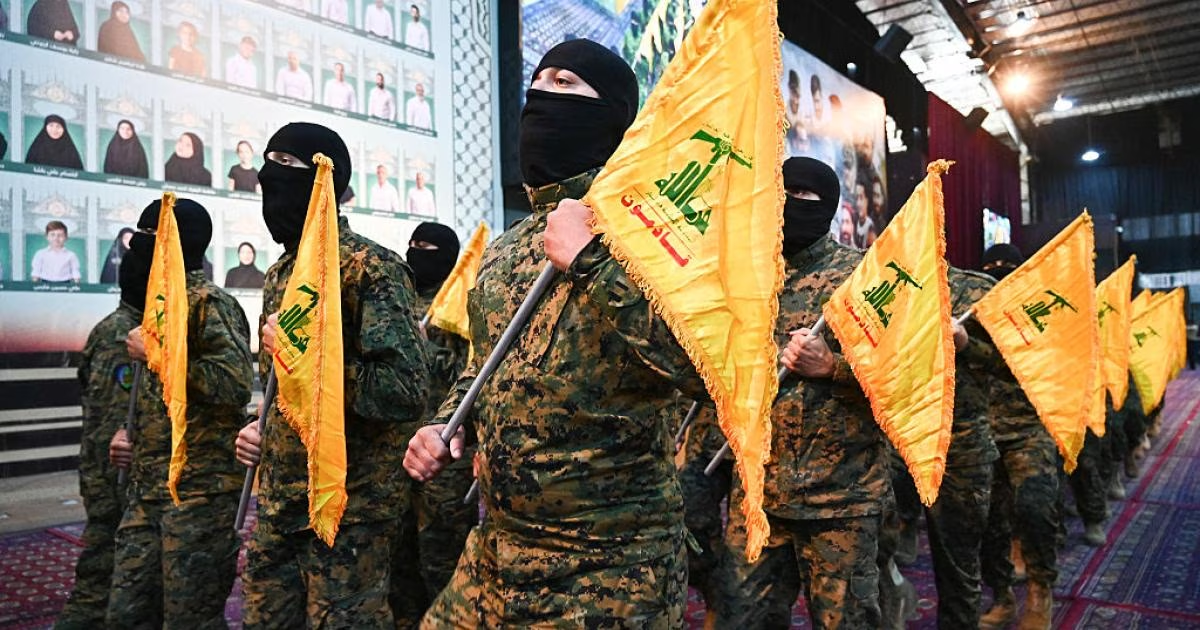
Political and military circles in Israel are witnessing a remarkable shift in rhetoric regarding Hezbollah's military capabilities, following a series of qualitative attacks recently carried out by the party. Field sources reported that this development has reopened the debate within the security establishment about the accuracy of previous assessments that indicated a decline in the party's combat power.
Official Israeli assessments since the 2024 war had promoted the idea that 'Radwan Forces,' which represent the elite unit of the party, had suffered devastating blows that rendered them ineffective. These reports claimed that previous military operations, particularly what was known as the 'Pager Operation,' had led to significant paralysis in the party's command and control system.
Israeli optimism peaked with the start of the current confrontations, as officials in Tel Aviv considered the party incapable of launching large-scale attacks. This conviction was based on the nature of the initial responses, which Israel deemed limited, reinforcing the impression that the party's military arsenal had been significantly depleted.
However, these convictions began to fade after Hezbollah carried out an operation named 'Eaten Storm' last week. This operation was characterized by high coordination and simultaneous attacks launched from multiple axes, targeting wide areas in the occupied Galilee region, causing a shock in Israeli military circles.
Press sources reported that recent intelligence reports showed an unexpected surprise for the security establishment, represented by the party's ability to redeploy units of the 'Radwan Regiments' in areas south of the Litani River. This information contradicts the official narrative that claimed the army's success in clearing border areas and destroying military infrastructure there.
In a related context, international media reports revealed a new Israeli approach aimed at expanding the scope of military operations deep into Lebanese territory. Sources quoted officials in Washington and Tel Aviv as saying that there is a serious study to extend the ground operation to the Litani River, under the pretext of eliminating the party's military presence there.
Data indicates that the occupation may adopt a 'scorched earth' strategy in southern Lebanon, similar to what it used in the Gaza Strip in recent months. This approach aims at comprehensive destruction of residential areas and infrastructure to ensure that military manifestations do not return to the border region, amidst warnings of catastrophic humanitarian consequences.
Domestically, criticism of the government and the army intensified from Israeli analysts and journalists who questioned the credibility of official statements. They considered that exaggerating Hezbollah's weakness was intended for domestic consumption, but the reality on the ground proved the existence of significant intelligence gaps.
On the ground, the occupation army continues its widespread aggression on Lebanese territories since the beginning of March, causing severe human and material losses. According to official statistics, hundreds of martyrs have fallen, including a large percentage of children and women, due to intensive air raids that targeted the southern suburbs, the Beqaa, and the South.
These developments coincide with a broader regional escalation that began in late February, where international powers engaged in direct confrontations. Hezbollah's response came by targeting sensitive military sites, confirming the continuation of the deterrence equation despite the fragile ceasefires that were discussed in previous periods.
Amidst the continued limited ground incursion that began on March 3, border villages are witnessing fierce clashes at point-blank range between party fighters and occupation forces. Sources confirm that the Lebanese resistance is showing great steadfastness in the face of advance attempts, which further complicates Israeli calculations for the next phase.
New field data came as a surprise to the security establishment, which had affirmed its success in keeping elite forces away from the borders.
LATEST NEWS
Sat 14 Mar 2026 7:44 pm - Jerusalem Time
Injuries and widespread damage in an Iranian missile attack targeting Eilat and Tel Aviv
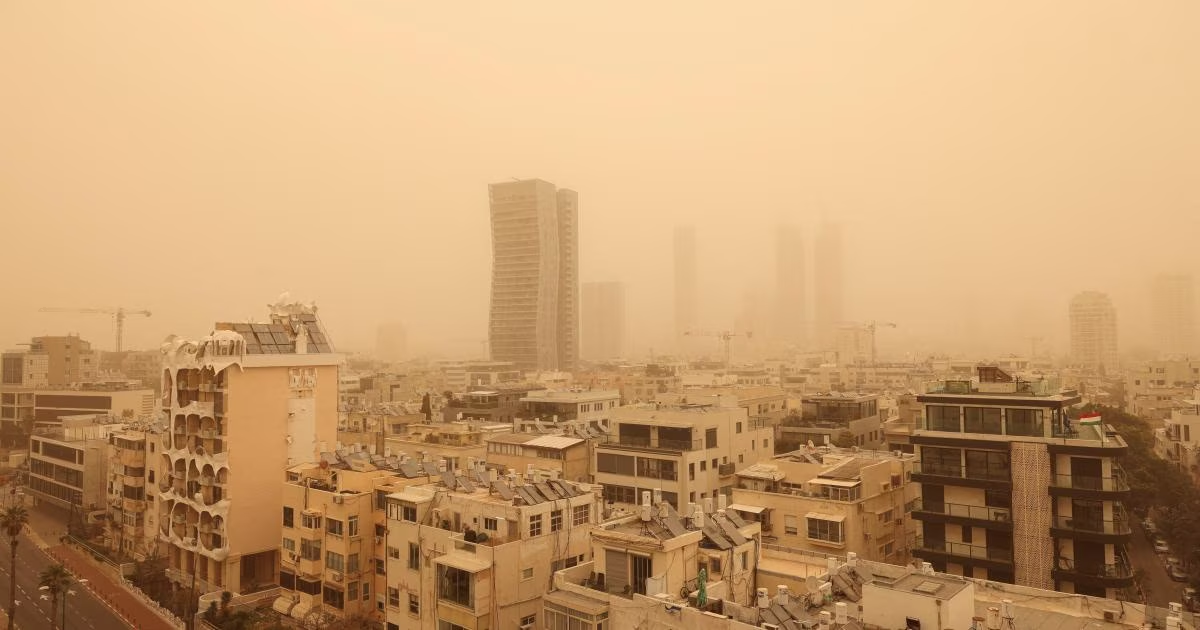
The past few hours have witnessed a significant escalation on the ground following official Iranian sources announcing the launch of successive waves of missiles towards Israeli targets. These barrages come as part of what Tehran described as a continuous response to attacks on its territory, confirming that the operation falls under the name 'True Promise 4', directly targeting the Israeli interior.
Inside Israel, medical sources confirmed that seven people were transferred to hospitals in the coastal city of Eilat for treatment due to the impact of Iranian missiles. Field reports indicated that one of these injuries was described as serious, while a state of panic prevailed among settlers following the sound of violent explosions that shook the southern city.
The state of alert extended to include the occupied city of Jerusalem, where sirens blared throughout the city and its surrounding areas, prompting residents to seek shelter. Local sources reported hearing massive explosions in the city's sky resulting from attempts to intercept incoming missiles, while shrapnel fell in various areas.
In the greater Tel Aviv area, media outlets reported a missile falling in an open area, causing traffic disruption and halting movement in some facilities. Several sites in central Israel were also damaged by the latest missile barrage, with material damage recorded to infrastructure and buildings near the impact sites.
Regarding the reasons for the change in bombing tactics, informed sources explained that the reduced number of missiles launched in this phase does not mean a decline in capabilities, but rather is the result of a specific military strategy. The first phase of the attacks focused on neutralizing and destroying radars and air defense systems belonging to American and Israeli bases in the region.
This prior neutralization of air defenses made it easier and more effective for missiles to reach their targets than before, reducing the need to launch hundreds of missiles at once to overwhelm the systems. Military leaders believe that a limited number of missiles is now sufficient to achieve direct hits after the decline in interception efficiency on the other side.
In terms of technological development, Iranian forces have begun using the third and fourth generations of their ballistic missiles, which are models characterized by high accuracy and double destructive power. These missiles rely on modern guidance technologies that make them difficult to detect or shoot down before reaching their designated ground zero.
The greatest danger lies in the cluster warheads carried by these missiles, where a single warhead weighs more than a ton of explosives. As the missile approaches its target, the main warhead explodes, fragmenting into more than 80 smaller missiles, ensuring a wide area of destruction and complicating the tasks of rescue and firefighting teams.
In the Western Galilee region, sirens continued to operate for long periods in anticipation of missiles or suicide drones that might enter the airspace from different fronts. The field situation remains prone to further escalation amid the continued Iranian missile barrages and the occupation's vow to respond to these unprecedented attacks.
Iran has started using third and fourth-generation missiles, which are more advanced and accurate and possess cluster warheads that fragment upon reaching the target.
ANALYSIS
Sat 14 Mar 2026 7:44 pm - Jerusalem Time
Trump's Predicament in the Third Week: Iranian Resilience and Expanding Fronts of Confrontation
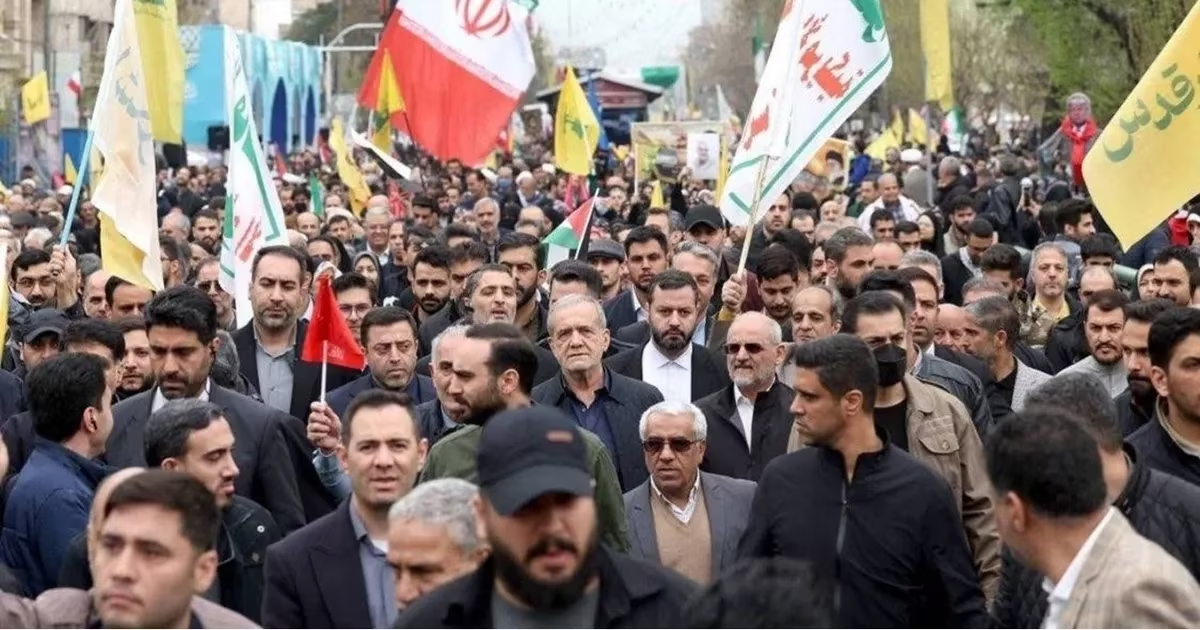
The aggressive war launched by US President Donald Trump against Iran has entered its third week, amidst what can be described as an 'American predicament.' The White House faces an impasse in achieving its strategic goal of overthrowing the Islamic Republic regime and transforming the country into a تابع (follower) orbiting in the American and Zionist spheres.
Observers believe that from the very first moment, Trump sought to replicate the Venezuelan scenario in Tehran, coveting control over Iranian resources and neutralizing the largest strongholds of resistance in the region. However, this plan encountered unexpected obstacles due to the cohesion of the Iranian internal front, despite the intensity of the American firepower used.
This war has created a kind of Arab and Islamic consensus rejecting the aggression, not necessarily out of love for the Iranian regime, but out of fear of the repercussions of upsetting the balance of power in favor of the Zionist project. Regional countries realize that Trump's success in his endeavor would threaten the political and existential map of all neighboring countries without exception.
Despite the martyrdom of Imam Ali Khamenei in the first week of the confrontation, Iran demonstrated strategic steadfastness that surprised Western intelligence circles. Tehran absorbed the initial military shock and quickly moved to a phase of organized response at political, military, and popular levels.
Iranian cities witnessed millions of citizens taking to the streets in massive demonstrations, confirming popular support for the new leadership. This popular movement sent a clear message to Trump that the war would not be a short stroll, but a long-term, systematic, and popular confrontation that would not accept surrender.
At the beginning of the third week, Imam Mojtaba Khamenei assumed leadership, and Iran began to impose counter-conditions that mediators conveyed to the American side. The new leadership insists that any understanding for a ceasefire must be comprehensive for the entire region, rejecting any partial solutions related to Iran's internal affairs alone.
Military operations in the second week evolved to take on a coordinated regional character, manifested in the night of joint shelling between the Revolutionary Guard and Lebanese Hezbollah. This direct field coordination disrupted American and Zionist calculations and proved that the resistance front operates according to a unified operations room.
The escalation was not limited to the Lebanese front but extended to include the effective and influential entry of the Iraqi Popular Mobilization Forces into the confrontation. This expansion of the conflict area confirmed the failure of the strategy to isolate Iran and turned the war into a widespread attrition that threatens American interests in several countries.
Israeli Prime Minister Benjamin Netanyahu is betting on American technological and air power to decide the battle, but field realities have proven the limitations of this bet. Despite overwhelming technical superiority, missiles and aircraft have not succeeded in breaking the will of the fighters in the Revolutionary Guard, Basij, and the Iranian army.
Trump is currently experiencing a state of despair regarding the possibility of achieving a quick victory or bringing about a radical change in the structure of the Iranian political system. The steadfastness shown by Tehran in the first and second weeks has presented the American administration with choices, the least bitter of which is still harsh, amidst increasing international pressure to de-escalate.
The military buildup assembled by Trump, the largest since the end of World War II, has not succeeded in extracting an unconditional Iranian surrender. On the contrary, Washington is now seeking diplomatic exits to save face before its allies and adversaries alike.
The current experience has proven that absolute air superiority does not necessarily mean winning the war on the ground, especially against peoples willing to sacrifice. The millions of masses who filled the squares formed a political shield that cannot be penetrated by smart missiles or concussion bombs.
World capitals are awaiting what the coming days of the third week will bring, in light of the hardening Iranian stance and the expansion of the engagement circle. It appears that the American bet on 'shock and awe' has eroded against the reality of 'war of attrition' mastered by regional forces allied with Tehran.
In conclusion, 'Trump's predicament' remains the title of the current phase, as he finds himself stuck in a war with no clear end in sight. While Washington was expecting a phone call requesting surrender, it is now receiving harsh conditions to restore calm to the inflamed region.
It has been proven that control of the air, no matter how great the initial shock, does not win a war against a composed leadership and millions of people.
LATEST NEWS
Sat 14 Mar 2026 7:44 pm - Jerusalem Time
US escalation against 'CNN': Pentagon and White House attack war coverage with Iran
The relationship between the US administration and the media has seen a new escalation, as the Pentagon and the White House directed harsh criticism at 'CNN' over its coverage of the war with Iran. This attack comes at a sensitive time when the region is witnessing intense military operations, reflecting the depth of the gap between official discourse and independent journalistic reports.
During a press conference held on Friday, US Secretary of Defense Pete Hegseth dedicated part of his speech to attacking the news network, focusing on a report that addressed Tehran's military capabilities. Hegseth considered what the network published about the possibility of Washington underestimating Iran's ability to close the Strait of Hormuz to be completely lacking in credibility.
The US Secretary described the report as 'clearly absurd,' demanding the emergence of what he called 'true national journalism' that aligns with national interests in times of conflict. Hegseth did not stop at criticizing the content but also touched upon the administrative aspects of the network, expressing his hope for its ownership and management to transfer to new parties as soon as possible.
In his statements, Hegseth referred to David Ellison, head of 'Paramount Skydance,' as a prospective replacement to lead the network, considering his assumption of the position a positive step. These statements come as Ellison's company prepares to complete a massive acquisition deal for 'Warner Bros. Discovery,' the owner of the news network.
This shift in ownership is linked to political balances, as Larry Ellison, David's father and founder of 'Oracle,' is one of the primary funders of the deal and a prominent supporter of President Trump. Despite these ties, David Ellison had previously pledged to maintain the editorial independence of the network and not subject it to political pressures.
For its part, the White House entered the fray through its spokesperson, Karoline Leavitt, who used the 'X' platform to describe the network's report as '100% fake.' Leavitt confirmed that military plans to confront any threat in the Strait of Hormuz have been in place and ready for implementation for decades, and are an integral part of the current strategy.
The spokesperson clarified that scenarios for dealing with the closure of maritime passages were included in the Trump administration's plans even before the launch of the large-scale military operation known as 'Raging Fury.' She stressed that questioning American readiness is not based on factual evidence but aims to stir unwarranted concern.
In contrast, 'CNN' management was quick to respond to these accusations, with its CEO Mark Thompson issuing a statement defending the integrity of the network's journalistic work. Thompson affirmed that the primary goal always remains to convey the truth to viewers, regardless of the nature of the pressures that the executive authority may exert.
Thompson concluded his statement by noting that political leaders usually resort to questioning the credibility of the press when it raises fundamental questions about their fateful decisions. He stressed that threats and insults will not deter the network from performing its professional duty of monitoring power and providing accurate information to the global public.
Any political threat or insult will not change our commitment to telling the truth to viewers in the United States and around the world.
ANALYSIS
Sat 14 Mar 2026 7:43 pm - Jerusalem Time
Ignatius: US Military Superiority Will Not End Conflict with Iran Soon
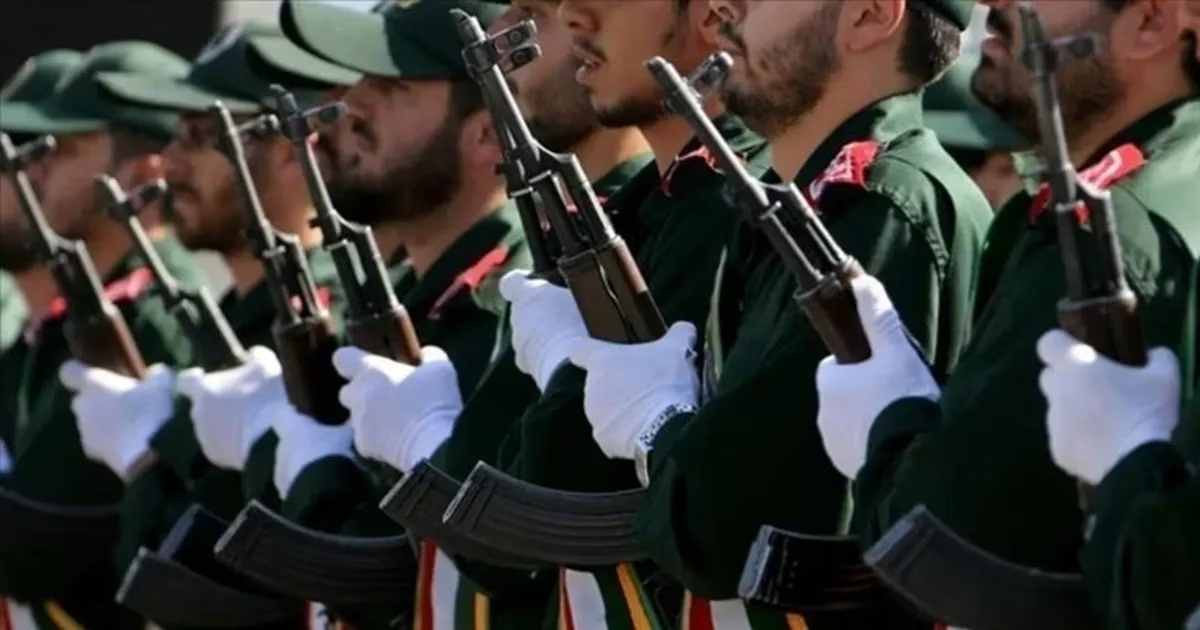
American writer and analyst David Ignatius believes that the question of how the escalating conflict in the Middle East will end may not find a satisfactory answer in the foreseeable future, especially concerning Iran. In an article published by the "Washington Post," he suggested that the conflict might see a temporary de-escalation, including a ceasefire and the resumption of navigation in the Strait of Hormuz, but this would not end the root causes of the confrontation.
Ignatius pointed out that Iran's military power has suffered devastating blows, destroying most of its nuclear facilities, missile arsenal, and naval fleet, in addition to the elimination of several senior leaders. However, the writer believes that the Iranian regime remains standing and resilient, as deceased leaders have been replaced by others without any signs of an internal popular uprising to overthrow the authority.
The article predicted that US President Donald Trump would declare victory as usual, likening this announcement to tactical Israeli victories that failed to definitively eliminate adversaries in Gaza or Lebanon. He explained that superiority in firepower does not necessarily mean achieving political stability, citing previous American experiences in Afghanistan and Vietnam.
Ignatius warned that the United States might find itself caught in a cycle of "mowing the lawn," a term used by the Israeli occupation to describe repeated military operations that do not resolve the conflict. He emphasized that history proves that strategic bombing designed to break the will of peoples often leads to counterproductive results and increases adherence to national identity and resistance.
In his reading of the future of Iranian leadership, the writer indicated that the next phase might witness a shift towards a "second version" of the Islamic Republic, with the Revolutionary Guard controlling the levers of the state. He noted that the selection of Mojtaba Khamenei as his father's successor might fuel a desire for revenge, especially since he lost family members during the current war.
On the diplomatic front, Ignatius did not rule out the emergence of pragmatic figures within the Iranian regime attempting to find channels of communication with the Trump administration to alleviate pressure. However, he cautioned that this path might not meet the aspirations of popular forces who hoped for a radical change in the regime, which intelligence experts currently see as difficult to achieve.
The article quoted Gulf sources and Iranian officials confirming that Tehran's will to fight has not yet been broken, and that the regime is banking on the factor of time and the West's weaknesses. He explained that Iranians are closely monitoring American public opinion polls that show declining support for the war, which strengthens their position to continue the confrontation until their status is recognized.
The writer touched upon regional risks, indicating that Gulf countries, especially the UAE, might be forced to strengthen their independent defenses or open direct diplomatic channels with Tehran. He considered that complete reliance on the American umbrella might become costly and unreliable under Trump's policies, which tend to burden allies with financial protection costs.
Ignatius also warned of the possibility of a return of armed operations linked to Iranian networks abroad, describing this scenario as potentially more deadly than previous experiences in the Middle East. He stressed that the absence of a comprehensive political solution would make any military victory merely a temporary truce preceding a new round of violence.
The article criticized some statements made by officials in the Trump administration, such as Defense Secretary Pete Hegseth, which focus on striking Iran at its moment of weakness without considering the long-term effects. He pointed out that targeting cultural sites or civilian infrastructure could generate lasting popular anger that would be difficult to contain in the future.
Ignatius believes that the war has fundamentally changed the geopolitical reality, making a return to the pre-confrontation era impossible. He explained that the United States would have to remain on constant alert in the Gulf to ensure freedom of navigation, which contradicts Trump's desire to reduce foreign military commitments.
In concluding his analysis, the writer cited Kermit Roosevelt's memoirs about the 1953 coup, emphasizing that any real change in Iran must come from within and by the will of the people and the army. He called on the US administration to consider how to support the Iranian people instead of relying solely on military force, which has proven its limitations in achieving a decisive political victory.
Informed sources confirmed that concern prevails in decision-making circles regarding the economic consequences of continued tension in the Strait of Hormuz, despite overwhelming military superiority. Questions remain about Washington's ability to translate its field achievements into a sustainable peace agreement that guarantees regional security and definitively ends Tehran's nuclear ambitions.
The regional scene remains open to all possibilities, as American electoral calculations intertwine with the Iranian Revolutionary Guard's ambitions for survival. While Trump declares victory, on-the-ground data indicates that the confrontation has entered a new chapter of attrition warfare that could extend for many years.
If there is one lesson to be learned, it is that military success does not usually translate into political victory, as the adversary returns again and again.
ARAB AND WORLD
Sat 14 Mar 2026 7:43 pm - Jerusalem Time
New Israeli Escalation: Evacuation Warnings for Seven Neighborhoods in Beirut's Southern Suburb and Worsening Displacement Crisis

The Israeli occupation army renewed its military threats against Beirut's southern suburb, issuing urgent evacuation warnings affecting seven densely populated residential neighborhoods. These threats included Haret Hreik, Ghobeiry, Laylaki, Hadath, as well as Burj al-Barajneh, Touwita al-Ghadir, and Chiyah, causing a state of panic among civilians.
An Israeli occupation army spokesperson claimed that these measures were a result of military activities carried out by Hezbollah in those areas, asserting that the army was forced to act forcefully against them. The Israeli statement demanded residents to immediately leave their homes and move to safe distances, prohibiting their return until new instructions are issued.
These field developments further complicate the humanitarian situation in Lebanon, as the number of displaced people is escalating beyond local absorption capacity. Lebanese authorities face immense challenges in securing shelter for thousands of families who have fled continuous shelling and threats in the suburb and the south.
In response to this crisis, field sources reported that the Lebanese government has begun preparing and opening approximately 100 additional shelters in various areas. This step aims to provide quick alternatives for families who found themselves homeless due to the expansion of Israeli targeting.
Government agencies are striving to clear public squares and main streets in Beirut and its suburbs of displaced persons' gatherings that have begun to impede traffic. This task is a primary concern for authorities attempting to maintain the flow of vital roads despite suffocating congestion and difficult security conditions.
On the relief front, informed sources described the volume of international aid reaching Lebanon as still very scarce and not meeting the minimum needs. Despite the arrival of some shipments from France, the European Union, and Jordan, the gap between available resources and increasing needs remains wide.
The Lebanese government is awaiting the arrival of additional aid promised by countries such as Qatar and Belgium, in an attempt to alleviate pressure on the health and shelter sectors. Observers believe that the international community's preoccupation with other regional issues may have contributed to the decline of the Lebanese crisis on the international priority scale.
The Lebanese government had launched an urgent appeal to the international community, demanding immediate financial support to confront the repercussions of the ongoing aggression. This appeal came during high-level meetings in which the Lebanese state affirmed its inability to face the catastrophe alone amidst the existing economic collapse.
For his part, UN Secretary-General António Guterres affirmed that Lebanon urgently needs about $350 million in emergency funding to address the displacement crisis. Guterres clarified that these amounts are allocated to secure urgent medical supplies for hospitals and to provide shelters equipped with the minimum necessities of life.
Medical needs are primarily concentrated in southern Lebanon and the southern suburb, where health facilities suffer from immense pressure and a shortage of staff and equipment. Human suffering continues to worsen as public roads turn into temporary shelters for families who could not find a place in overcrowded shelters.
Hezbollah's activities force the Israeli army to act against it with force, and residents must evacuate the areas immediately for their safety.
PALESTINE
Sat 14 Mar 2026 7:43 pm - Jerusalem Time
West Bank Markets in the Grip of Recession: War and Siege Extinguish the Joy of Eid

The cart of the street vendor 'Abu Shaheen' roams the streets of Nablus city, north of the West Bank, laden with seasonal vegetables, but his voice, which passersby were accustomed to hearing, did not receive the usual echo this year. Despite the last ten days of Ramadan and the approaching Eid al-Fitr, commercial activity appears subdued and burdened by the worries of war and regional tensions that have cast a shadow over Palestinian consumer behavior.
Abu Shaheen describes the state of the markets as 'miserable,' indicating that the fear of the unknown has led many to drastically reduce their spending and settle for minimal purchases. The vendor believes that citizens now prefer to hold onto cash instead of shopping, in anticipation of any security or economic developments that may arise amid the ongoing escalation in the region.
For her part, government employee Mona Al-Aghbar expresses the compounded pressures facing Palestinian families, as the Eid season coincided with a suffocating salary crisis and escalating political tension. She explained that the irregular disbursement of financial dues forced her to reorder her priorities, limiting purchases to necessities only to ensure Eid clothes for her three children.
Nablus city, a vital economic center, faces a strict military siege imposed by the Israeli occupation on its main entrances, isolating it from surrounding villages and towns. This field closure has led to the absence of 'external purchasing power' that the city's markets primarily depend on, especially shoppers from rural areas and from within Palestine.
Traders in the city confirmed that the closure of checkpoints, such as the Beit Furik checkpoint, for several consecutive days caused a complete paralysis in some commercial sectors. They believe that the continued restriction on movement is the biggest obstacle to any attempt to revive the market, especially during seasons that are supposed to witness annual sales peaks.
Economic estimates indicate that the Palestinian market has lost about $9 billion since the start of the war in October 2023, due to the disruption of workers prevented from reaching their workplaces. This financial bleeding has led to a tangible decrease in general purchasing power, causing the head of the household to direct their limited spending towards food supplies and fuel only.
In the clothing and retail sector, trader Ayman Al-Masry speaks of goods piling up in warehouses due to citizens' reluctance to buy non-essential items. Al-Masry explained that traders are living in a state of uncertainty, as their capital is frozen in seasonal goods that may not find buyers, threatening their ability to meet their financial obligations to suppliers.
Al-Masry adds that consumer patterns have shifted radically towards household storage of food items and gas, fearing supply disruptions or complete closure of crossings. This shift has created a significant gap in the market, where luxury sectors suffer from a severe recession, while essential goods sectors face significant pressure that could lead to shortages in some items.
Yassin Dweikat, spokesperson for the Nablus Chamber of Commerce, explained that the city witnessed slight signs of recovery before Ramadan, but these quickly dissipated with the escalation of regional tensions. He pointed out that the absence of shoppers from within the occupied territories, who represent a significant commercial pillar, contributed to deepening the financial crisis plaguing shops.
Dweikat noted that accumulated financial crises, primarily the occupation's withholding of Palestinian clearance funds, estimated at $255 million monthly, have caused a liquidity shortage. This reality has placed traders under dual pressure, as they face the costs of accumulated inventory amid a complete absence of the usual purchasing activity at such times.
In an attempt to stir the stagnant waters, many traders resorted to offering huge discounts and sales on clothes, shoes, and sweets. Through these steps, they aim to collect any amount of cash liquidity to cover their operating expenses, despite realizing that the fear dominating consumers is stronger than any price temptations.
Regarding food security, official sources in the Ministry of Economy confirmed that the strategic stock of essential goods such as flour, oil, and sugar is sufficient for six months. However, Dweikat warned that uncalculated hoarding could create artificial crises in the markets, urging citizens to buy only according to actual need.
Economic circles are anxiously monitoring the repercussions of tension in international waterways, such as the Strait of Hormuz, and its impact on global commodity prices. Experts believe that any increase in shipping costs or global energy prices will inevitably reflect on the Palestinian market, already burdened by crises, which could lead to a new wave of unaffordable price hikes for consumers.
The scene in the West Bank markets remains suspended between traders' hopes for an imminent breakthrough and a field and political reality that is becoming increasingly complex. While families prepare to celebrate Eid with minimal means, shops remain full of goods and empty of customers, a picture that summarizes the depth of the economic crisis left by the war and siege.
People became fearful and tightened their belts; they refrain from buying and prefer to hold onto cash in anticipation of any emergency.
ANALYSIS
Sat 14 Mar 2026 7:43 pm - Jerusalem Time
The Cruel Law of History: Has the Era of Empires' Fall Begun from the Gates of Gaza?
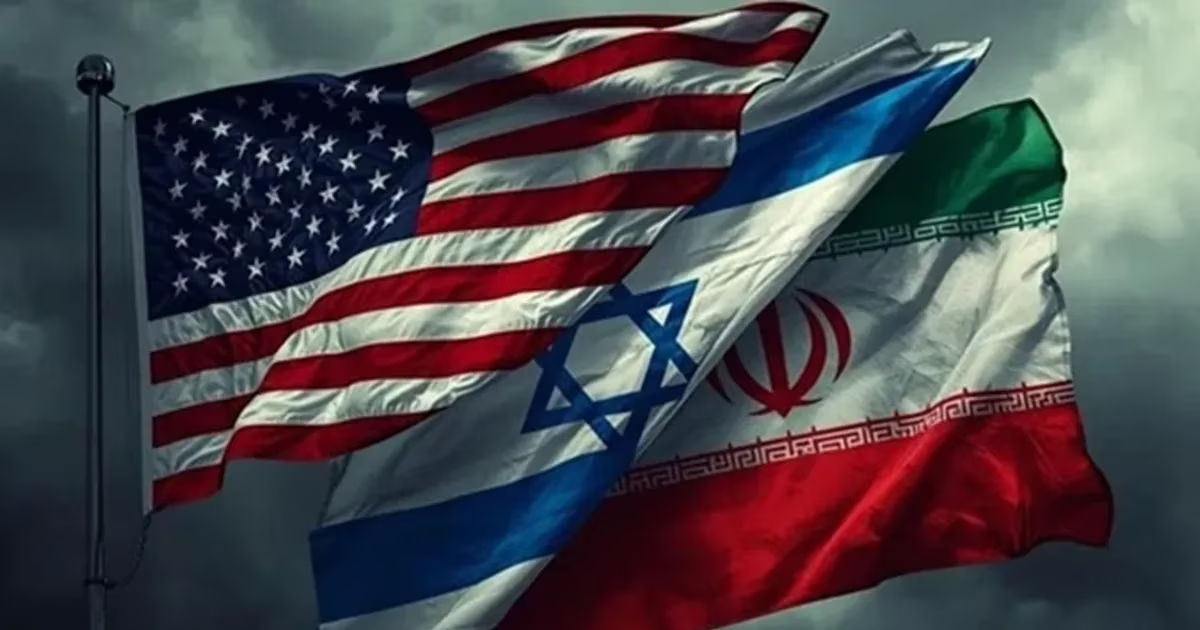
The current international scene appears to be closer to a moment of profound historical transformation, as the ongoing war in the Middle East and the escalating tension between Israel, America, and Iran point to a widespread political and strategic predicament. These events are no longer to be read solely within the framework of traditional military power balances, but in the context of the erosion of the political and moral prestige of the powers that have dominated the international system since the end of World War II.
In the Israeli case, it has become clear that the war aimed at restoring its eroded deterrence image in the Gaza Strip has led to completely counterproductive results. Israel has become entangled in a spiral of military and political crises that exposed the fragility of the 'absolute superiority' idea, and placed its conduct under the microscope of global moral scrutiny for the first time in many decades.
The humanitarian tragedy in Gaza is no longer just a fleeting news item; it has become a fundamental pillar in a broad international discussion about the limits of military power in imposing political realities. This Israeli predicament is organically linked to the American predicament, as Washington finds itself drifting behind short-sighted policies that lack a coherent strategic vision, especially in managing the conflict with Tehran.
The policies of successive US administrations, particularly the impulsiveness of the Donald Trump era, have contributed to pushing the region to the brink of confrontation without offering a clear vision for the ultimate outcomes. The world's greatest power seemed to be acting on a reactive logic rather than a leadership logic, leading to the erosion of the 'moral prestige' that Washington claimed to protect through slogans of human rights and international law.
This erosion of prestige is not merely a propaganda issue; it is a fundamental element in the stability of states, as Ibn Khaldun explained in his theory on the rise and fall of states. A state reaches the peak of its power when authority is balanced with justice, but when power transforms into a tool for mere domination and loses its ability to achieve justice, it inevitably enters a phase of gradual weakness and decline.
Moving to the Iranian role, we find that Tehran exploited the strategic vacuum left by the American invasion of Afghanistan and Iraq to expand its regional influence unprecedentedly. However, this expansion, which included Iraq, Syria, Lebanon, and Yemen, carried within it the seeds of a long-term crisis, as it was associated with militia networks and internal conflicts rather than stability and development projects.
Today, Iran faces a complex equation: widespread geographical influence fraught with enormous political, economic, and security burdens, embodying the concept of 'imperial overstretch' coined by historian Paul Kennedy. This concept describes the situation in which a state exceeds its economic and political capabilities in managing its external influence, ultimately leading to the depletion of its core resources.
History will record that the Gaza Strip was the first to break the prestige of the Israeli occupation, not only through its steadfastness in the face of the longest war of extermination but also through its legendary resilience on the ground and its rejection of displacement plans. Gaza exposed the entity's image as a brutal occupying power and redefined the conflict in the global consciousness as a matter of human justice against a military killing machine.
In contrast, Iran emerges as the first developing country to dare to confront the United States face-to-face, benefiting from the strategic mistakes of the major powers. This confrontation is no longer just a limited regional conflict; it has become a reflection of a broader battle for prestige and legitimacy in an international system undergoing a difficult birth and radical shifts in the balance of power.
While these international balances are changing, the official Arab system appears to be in a state of helplessness and stagnation, unable to formulate a unified position or influence the tumultuous transformations. The current Arab division makes the region captive to the policies of regional and international powers, as if the official Arab decision has become out of sync with the historical time in which other nations are moving.
The voice of the victims always remains more eloquent than political statements. The tragedy of the Syrian child in the Mediterranean waters and the faces of Gaza's children facing hunger and bombardment are living testimonies to the failure of the international system. These moral transgressions and the blood shed without cause are recorded in the annals of history and will not pass without a price paid by each party according to its role and responsibility.
The painful lesson offered by current events is that power without justice, and authority without mercy, quickly pave the way for total collapse. Empires, no matter how great, remain hostage to their moral system and their relationship with humanity, and history does not forgive those who betrayed justice or invested in the suffering of peoples for fleeting political gains.
The historical reckoning is inevitably coming for everyone who contributed to undermining the values of human dignity, as reality proves that the erosion of legitimacy is the actual prelude to the fall of great powers. What is happening in Gaza and the region today is not just another round of conflict; it is a rewriting of the rules of moral and political engagement that will govern the world in the coming decades.
Ultimately, the human being clinging to their right remains the true driver of history, while powers that rely on mere oppression fade away. The steadfastness of the oppressed in the face of advanced war machines sends a clear message that the era of absolute domination has passed, and a new dawn of power balance has begun to form from amidst the rubble and destruction.
Great powers do not suddenly fall due to a single military defeat; their decline usually begins with the erosion of their political and moral legitimacy in the eyes of others.
PALESTINE
Sat 14 Mar 2026 7:43 pm - Jerusalem Time
7 Dead in Two Days.. Sandstorm Doubles the Tragedy of Displaced Persons in Gaza Strip

The severity of the humanitarian suffering in the Gaza Strip escalated today, Saturday, as the blood of martyrs mingled with the dust of sandstorms that swept through the tents of displaced persons. Medical and field sources reported the martyrdom of a Palestinian woman by Israeli occupation army bullets in Al-Maghazi camp, coinciding with the injury of two children with varying degrees of wounds due to the collapse of a wall in Khan Yunis city as a result of the strong winds hitting the area.
In details of the field attacks, sources stated that occupation vehicles stationed in the eastern areas of Al-Maghazi camp fired live bullets directly at the woman from the Abu Shawarb family, leading to her immediate death. This incident comes in the context of a series of ongoing violations of the fragile ceasefire agreement that came into effect last October.
Official statistics issued by the Ministry of Health in Gaza revealed that hospitals received seven martyrs and 13 injured during the past forty-eight hours. With this new toll, the number of victims of Israeli violations since the start of the truce has risen to 659 martyrs and more than 1700 injured, raising questions about the seriousness of adherence to the concluded agreements.
Regarding the total toll of the aggression since October 2023, the ministry confirmed that the number of officially registered martyrs reached 72,234 martyrs, while the number of injured exceeded 171,000. Medical teams indicated that search operations under the rubble are still ongoing, with 756 bodies recovered since the cessation of major military operations.
Away from the bullets, displaced persons in the Strip faced a harsh climatic challenge with a dense sandstorm that covered the sky with a dark orange color. This storm led to an almost complete lack of horizontal visibility, and caused dust and sand to infiltrate the dilapidated tents housing hundreds of thousands of families in open displacement areas.
Residents in various shelter areas tried to secure their tents using ropes and heavy stones for fear of them being uprooted by strong winds. Thousands of families, including children, the sick, and the wounded, live in conditions lacking the minimum elements of protection from weather fluctuations, which exacerbated the deterioration of the health condition of those suffering from respiratory diseases.
For his part, the spokesman for the Gaza Municipality, Husni Muhanna, stated that the sandstorm caused severe damage to residents' property and tents, especially in shelter centers located along the coast. Muhanna explained that the continuation of these weather conditions in the absence of infrastructure puts the lives of thousands at stake, calling for immediate international intervention to provide alternative housing.
Muhanna issued an urgent appeal to the international community and relief organizations to pressure for the entry of humanitarian aid and mobile homes (caravans). He stressed that temporary solutions in the form of canvas tents are no longer effective in the face of successive low-pressure systems and sandstorms that repeatedly hit the afflicted Strip.
In the context of preventive measures, the General Directorate of Civil Defense in Gaza issued a set of recommendations to residents to deal with the dust wave. The directorate called on citizens to avoid leaving their tents except for extreme necessity, emphasizing wearing masks or using wet cloth to cover the nose to avoid suffocation.
UN and local estimates indicate that about 1.9 million Palestinians are now forcibly displaced within the Gaza Strip out of 2.4 million people. These suffer from the loss of permanent shelter after the destruction of vast areas of residential neighborhoods, making them vulnerable to direct targeting or death due to harsh environmental and health conditions.
Despite the relative calm that the ceasefire agreement is supposed to provide, the field reality indicates the continuation of Israeli hostile operations. These violations vary between intermittent artillery shelling and firing at farmers and displaced persons, making a return to normal life a distant prospect in light of the ongoing siege.
Harsher weather conditions exacerbate the suffering of thousands of families living in tents that lack minimal protection, amidst ongoing difficult humanitarian conditions.
ISRAELI AFFAIRS
Sat 14 Mar 2026 7:42 pm - Jerusalem Time
The 'Crusade' Doctrine in the Pentagon: How Does the US Secretary of Defense View the Islamic World?

US Secretary of Defense Pete Hegseth sparked a wide wave of controversy in political and international circles following his statements that directly linked US military operations against Iran with a religious ideological discourse. Hegseth affirmed in media interviews that the US armed forces do not fight solely with their technical capabilities, but are supported by 'God's providence,' warning that questioning Washington's resolve is a strategic mistake made by adversaries.
Observers believe that this type of discourse reinforces the prevailing impression in the Islamic world that the United States is waging a 'religious war' under political and military cover. During his recent appearance, the Secretary emphasized the superiority of the American fighter not only in equipment but also in will and spiritual connection, considering the current confrontation a struggle against 'extremists' seeking to fulfill destructive religious prophecies.
Hegseth did not limit himself to verbal statements but brought this religious spirit into the halls of the Pentagon, where he quoted verses from 'Psalms' during official ceremonies for the repatriation of soldiers' remains. The Secretary spoke of the Lord as 'the rock' who trains the hands of soldiers for battle and their fingers for war, reflecting a deep overlap between his personal beliefs and his official duties as the leader of the world's most powerful army.
Hegseth's vision is based on a firm conviction that the United States is a Christian nation in its essence and historical formation, which he seeks to preserve and enshrine within the military institution. The Secretary believes that the 'arsenal of faith' is no less important than the 'arsenal of liberty,' calling for the restoration of the religious identity that he believes has been marginalized in favor of secular language in recent decades.
The symbols chosen by the Secretary show the depth of his influence by the history of the Crusades, as he bears tattoos of the 'Jerusalem Cross' and Latin phrases that were the motto of European fighters in the Middle Ages. These symbols, according to analyses by international media sources, are not mere adornment but express the 'God wills it' philosophy he adopts in confronting what he describes as existential threats.
In his book 'American Crusade,' Hegseth goes further, describing the current phase as a 'crusading moment' that requires a Christian mobilization similar to what happened a thousand years ago. The book warns of the danger of 'Islamists' who seek to reshape societies, emphasizing the necessity of military, cultural, and geographical confrontation to push back this tide.
The Secretary adopts a hardline stance on the concept of 'Islam as a religion of peace,' considering it an 'illusion' that hinders the American mission to protect its values and interests. He claims in his writings that Islam has been in a perpetual state of war with those he describes as 'infidels' since its inception, a confrontational view that raises fears of transforming political conflicts into ideological wars that do not accept compromises.
In terms of foreign policy, Hegseth's absolute support for the Israeli occupation stands out as part of his 'Christian Zionist' doctrine. He sees Israel's strength and existential defense as part of biblical prophecies, considering the alliance between Washington and Tel Aviv a religious and moral alliance that transcends traditional geopolitical interests.
Within the Department of Defense, the Secretary launched initiatives aimed at strengthening the role of military chaplains and amending their guidance manuals to include more explicit religious language. He also began organizing monthly prayers at the Pentagon and hosting religious figures who advocate for 'Christian Nationalism,' raising concerns among organizations defending religious freedoms within the military.
Military human rights sources reported receiving numerous complaints about the transformation of discourse within combat units into language associated with 'the end times.' Experts warn that this trend provides rich propaganda material for extremist groups in the Islamic world, portraying the conflict as a new crusade directly targeting Muslim countries.
Academic research indicates that Hegseth's ideas represent a blend of 'Christian Nationalism' and 'American Exceptionalism,' a vision that arranges the world in a hierarchy placing Christians at the top. This thinking makes the conflict with countries like Iran a battle of values and beliefs, not merely a dispute over regional influence or the nuclear program.
Despite the criticism, Hegseth appears to enjoy support from a broad popular base that believes the United States must return to its religious roots to confront global challenges. These supporters believe that 'tolerance' in the Secretary's view may mean 'surrender,' which he completely rejects in the context of his management of defense and national security files.
The Secretary's attempts to reconcile Christian teachings of peace with his calls for military confrontation reflect the nature of the current phase of the US administration. He believes that the commandments of 'turning the other cheek' do not apply to a Secretary of Defense tasked with protecting a nation in conflict, thereby legitimizing the use of excessive force under religious cover.
In conclusion, Pete Hegseth represents a new model of American leadership that does not hide its ideological agenda, putting US relations with the Islamic world to a real test. As the military and political war continues, the question remains about the extent of the impact of this 'crusading' vision on regional stability and the future of international alliances.
America was founded as a Christian nation, and it remains a Christian nation in its DNA, and we are not only warriors armed with the arsenal of liberty, but we are also armed with the arsenal of faith.
OPINIONS
Sat 14 Mar 2026 7:42 pm - Jerusalem Time
Speculation Mounts Over Israeli Ground Invasion of Lebanon Amid Escalating Regional War
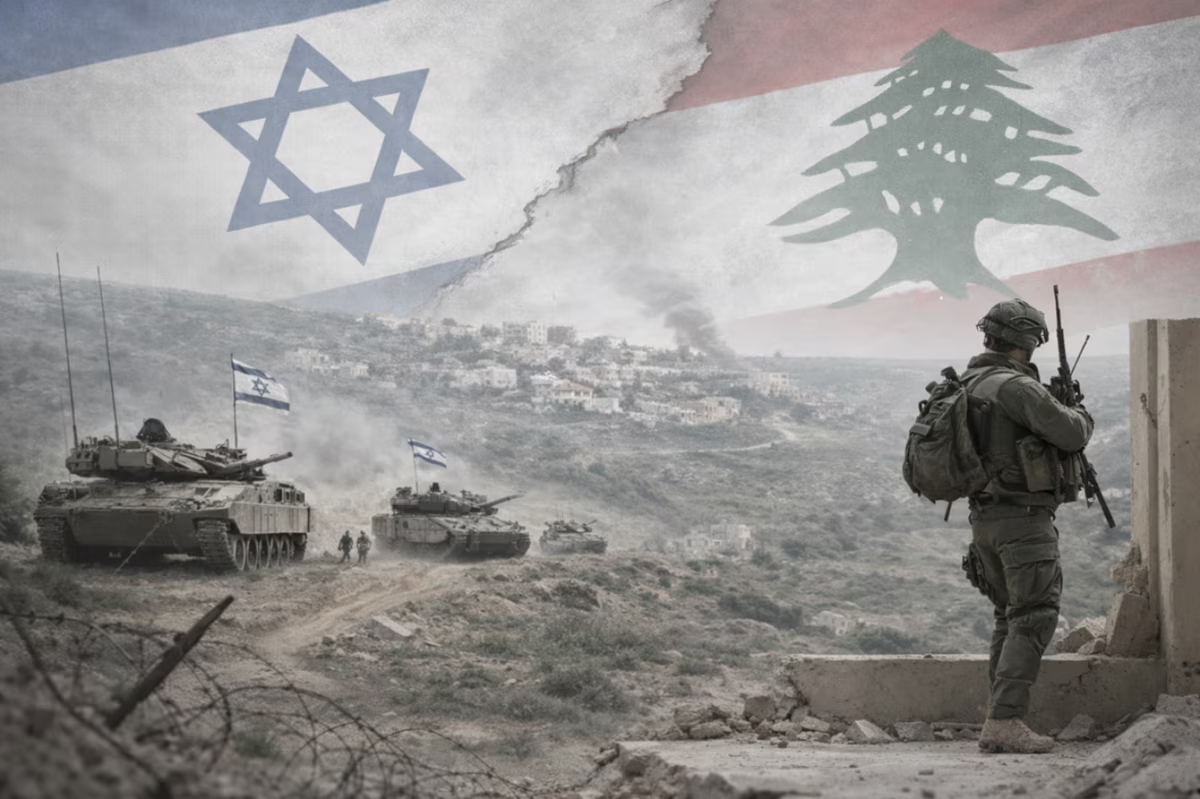
Washington – Said Arikkat – 3/14/2026
News Analysis
Speculation has been mounting in recent weeks about the possibility of Israel launching a large-scale ground invasion into Lebanese territory, a move that could represent the most dangerous expansion of the ongoing war in the region since the confrontation with Iran erupted in late February. American and Israeli media reports indicate accelerated military preparations on Israel's northern border, while diplomatic warnings are increasing that any major ground operation could push the region into a new phase of escalation that would be difficult to contain politically or militarily, especially given the currently very high tensions between Tehran and Washington and their allies in the Middle East.
According to what the American news website Axios reported on Saturday, citing Israeli and American officials, the plan being discussed by Tel Aviv involves expanding ground operations with the aim of controlling areas south of the Litani River and pushing Hezbollah fighters north away from the Israeli border, in addition to destroying the party's military infrastructure in southern villages. An Israeli official says that the government, led by Benjamin Netanyahu, had been inclined to contain the confrontation to focus on the Iranian front, but the launch of more than two hundred rockets from Lebanon changed calculations and pushed the military leadership to consider the option of a potential large-scale ground invasion.
Field reports indicate that since the war with Iran erupted, the Israeli occupation army has maintained large armored units and infantry forces near the Lebanese border and has carried out limited incursions into some border villages in recent weeks. On Friday, the occupation army announced the dispatch of additional reinforcements and the call-up of reserve forces in preparation for a wider operation. Officials say the immediate goal is to control the land and dismantle Hezbollah's positions and weapons depots, but observers warn that such an operation could quickly turn into a long war of attrition within the densely populated southern villages and towns.
In contrast, Hezbollah affirms its readiness to confront any potential ground invasion. Leader Naim Qassem said that Israeli threats do not intimidate the party but could turn into a military trap for the attacking forces. This stance is based on the experience of the long conflict with Israel, where the party previously managed to force the Israeli army to withdraw from southern Lebanon after years of fighting, and also engaged in a fierce confrontation in the 2006 war, which leads its leaders to believe that any new ground incursion will face violent and prolonged resistance within the party's local environment there.
Humanitarianly, the cost appears set to rise rapidly. The Israeli occupation army has issued widespread evacuation orders in southern Lebanon, which for the first time included towns north of the Litani River, in addition to areas in the southern suburbs of Beirut. Lebanese estimates indicate that about eight hundred thousand people have been forced to flee their homes, while the death toll has exceeded seven hundred people, many of whom are civilians. Humanitarian organizations have warned that the expansion of ground operations could exacerbate the humanitarian crisis in a country already suffering from a severe economic collapse and weakness in health infrastructure and basic services for many, many years.
Politically, American sources confirm that the Trump administration has asked Israel to avoid targeting Beirut airport or major government facilities, but these controls do not significantly change the reality of broad American support for the military operation. Axios quoted an Israeli official as saying that Tel Aviv feels it has full American support. Washington, at the same time, is betting that military pressure will lead to broader negotiations that may ultimately result in an agreement that officially ends the state of war that has existed between Israel and Lebanon since 1948, at least theoretically, until today.
However, developments in the regional war make these calculations extremely complex. The confrontation escalated after the assassination of Iranian Supreme Leader Ayatollah Ali Khamenei in a joint American-Israeli attack, an event that pushed Tehran and its allies to expand their military response across multiple fronts, including Lebanon, Iraq, and the Gulf. UN experts also warned that American and Israeli strikes against Iran and Lebanon could constitute a violation of international law and threaten to expand the conflict to include the entire region, especially with the threat to energy routes in the Gulf and the Strait of Hormuz, through which a large part of the world's oil passes today.
The increasing talk of a potential Israeli ground invasion of Lebanon reveals an old strategic dilemma facing Tel Aviv whenever it considers an incursion into Lebanese territory. Historical experience from the 1982 invasion to the 2006 war shows that military control does not necessarily mean achieving political or security stability; rather, occupied territories often turn into a long-term war of attrition, which Israeli military planners are well aware of. But internal political calculations and regional deterrence calculations sometimes push the Israeli leadership to risk large-scale operations despite the expected human and military cost in such a scenario.
Observers believe that the Trump administration's stance reflects a traditional pattern in American policy based on granting Israel a wide margin of military freedom of action while contenting itself with some formal controls related to infrastructure or civilians. However, this political and military support places Washington practically in the position of a partner in any potential escalation, especially if the ground invasion turns into a broader regional confrontation with Iran and its allies. At that point, the American administration may find itself facing a difficult equation that combines protecting its Israeli ally and avoiding slipping into an open war in the Middle East that may exceed its calculations.
The ongoing escalation on the Lebanese front cannot be separated from the broader war between the United States and Israel on one side and Iran on the other. The assassination of Iranian leader Ali Khamenei constituted a strategic turning point that pushed Tehran's allies in the region to direct involvement in the confrontation. Hence, Lebanon becomes a central arena in this complex conflict where local, regional, and international elements intertwine. With continued mutual strikes, the risk of the war expanding beyond the borders of Lebanon and Israel increases, threatening global energy routes and regional stability and placing the region before a new phase of long strategic uncertainty.
PALESTINE
Sat 14 Mar 2026 2:40 pm - Jerusalem Time
British Soldier Documents 'Amusement Executions' of Starving Gazans at American Aid Centers

A British recruit named David McIntosh revealed horrific details he witnessed during his military service in the Gaza Strip, where he documented, through video clips, the brutality of Israeli occupation forces in dealing with Palestinian civilians searching for food. The recruit explained that these violations occurred around aid distribution points belonging to the 'Gaza Humanitarian' organization, an initiative previously launched by the United States to secure relief in the Strip.
The video clips published by McIntosh on his personal accounts showed Israeli soldiers positioned on their tanks, opening fire directly and shockingly at queues of starving people. The recruit described these actions as being carried out for 'amusement' by the soldiers, noting that the locations where these crimes occurred were the same where hundreds of Palestinians were killed while waiting to receive meager food rations.
Commenting on the scenes, the British recruit affirmed that what he saw was extremely painful and incomprehensible, despite him working within a joint force that included elite elements of the American army. He praised the skills of his colleagues in the joint force but stressed that the Israeli forces surrounding those locations showed no humanity, deliberately targeting unarmed civilians in cold blood.
McIntosh accused the occupation army of systematically attempting to sabotage relief efforts by terrorizing and killing residents at their most vulnerable moments. He pointed out that Palestinians in those areas refused to surrender to hunger or let their families die, which was met with occupation bullets, committing clear and easily documented war crimes at those sensitive points.
This testimony sparked a wide wave of anger across social media platforms, where activists and human rights defenders circulated the clips as additional evidence of the genocide. Bloggers recalled the violations associated with the work of the 'Gaza Humanitarian' organization, considering that its presence did not provide protection for civilians but rather turned them into easy targets for Israeli snipers and shells.
Local sources reported painful testimonies from families who lost their children at those locations, with one citizen mentioning that his uncle was martyred while searching for food for his children at the same point the soldier filmed. Testimonies confirmed that the occupation prevented any attempts to document these field executions, even going so far as to bury some victims alive under the rubble of distribution centers.
Observers described the scenes as an embodiment of 'human hunting' operations, where starving people are lured into exposed areas under the pretext of aid distribution and then targeted. Human rights activists believed that these clips expose the falsity of the humanitarian slogans raised when these centers were established, emphasizing that the absence of international accountability encouraged the occupation to continue these practices.
Palestinian activists pointed out that the 'Gaza Humanitarian' organization left the Strip, leaving behind a legacy of blood and harsh memories, as it was accused of being 'harsher than shells.' They considered that what the British soldier published represents the beginning of a new phase of uncovering facts that the occupation tried to obscure throughout the war, stressing the need to present this evidence to international courts.
In a related context, some residents of the Strip noted that American soldiers participating in the joint force were not far from the scene, with some accusing them of implicit or actual participation in some attacks. They affirmed that the tragedy of hunger imposed by the occupation was exploited militarily and security-wise to lure citizens into real 'death traps' under the guise of relief.
Statistical data issued by the Government Media Office in Gaza indicates shocking figures related to the victims of these centers, where approximately 1109 Palestinians were directly martyred as a result of shelling or shooting inside or around American distribution centers. Among these victims were 225 children, 852 adults, and 32 elderly people, all of whom died while trying to secure a livelihood.
According to statistics, the total number of martyrs targeted while waiting for aid throughout two years of war reached 1506 martyrs, in addition to more than 19,000 injured. This means that the number of martyrs who fell in front of the 'Gaza Humanitarian' organization's centers alone represents about 73% of the total victims of aid targeting in the Strip.
The organization began its work in May of last year as an alternative imposed by circumstances and Israeli restrictions on international and UN agencies. However, UN experts warned from the outset that this mechanism was inadequate and lacked safety guarantees, as it operated only 4 centers at a time when the Strip needed hundreds of relief points to avoid overcrowding and targeting.
Field reports confirm that the transformation of relief centers into fields of field executions reflects a systematic starvation policy pursued by the occupation authorities to break the will of the popular base. The British soldier's testimony reinforces this narrative, describing the scenes as resembling clips from dark fantasy films, where humans are killed simply for their desire to survive.
In conclusion, these documents and clips remain a living testament to one of the most horrific chapters of the war on Gaza, where hunger was mixed with bullets. Human rights activists demand the necessity of opening an independent international investigation into the role of the joint forces and the direct responsibility of the occupation for turning humanitarian aid into a means of organized mass killing.
Israeli forces were openly firing at civilians for amusement at aid sites.
PALESTINE
Sat 14 Mar 2026 12:25 pm - Jerusalem Time
Injuries from settler bullets and seizure of livestock in an attack targeting Kisan village in Bethlehem

Kisan village, located east of Bethlehem city, witnessed a violent attack this Saturday morning carried out by groups of settlers under the protection of occupation forces. The assault resulted in four Palestinian citizens sustaining injuries of varying degrees, as settlers directly fired live ammunition at residents, leading to injuries in the lower extremities, while others were severely beaten with rifle butts and sharp tools.
Local sources confirmed that Red Crescent ambulance crews dealt with two live bullet injuries, one 52 years old and the other 39 years old, and they were transferred to the hospital for treatment after their condition was described as moderate. The sources indicated that the occupation forces deliberately obstructed the access of ambulances to the attack site initially, delaying the provision of first aid to the injured who were bleeding in the field.
The attack was not limited to physical assault but extended to looting property, as settlers seized approximately 100 head of sheep belonging to citizen Attallah Ibrahim Abyat. This theft comes in the context of the economic squeeze policy practiced by settlers against Palestinian farmers and herders in areas classified as 'C', with the aim of forcing them to leave their lands for the benefit of pastoral settlement expansion.
For its part, the Wall and Settlement Resistance Commission clarified that the pace of these attacks has dangerously escalated since the end of last February, with more than 192 settlement attacks recorded in various governorates of the West Bank. This wave of violence has led to the martyrdom of six individuals and the displacement of four entire Palestinian families, amidst settlers' exploitation of current regional circumstances and international preoccupation to implement annexation and silent displacement plans.
Kisan village, in particular, suffers from continuous targeting, as it is surrounded by settlement outposts that devour vast areas of its pastoral and agricultural lands. Observers confirm that these attacks are not spontaneous but come within a systematic plan to impose a new reality on the ground, through intimidating residents and preventing them from accessing their lands, and destroying the elements of their livelihood resilience in rural and marginalized areas.
The assault comes within the framework of repeated and systematic attacks targeting citizens and their property in the region to forcibly displace them.
ARAB AND WORLD
Sat 14 Mar 2026 12:25 pm - Jerusalem Time
Closure of the Strait of Hormuz Disrupts Global Navigation, Hundreds of Ships Stranded in Alternative Ports
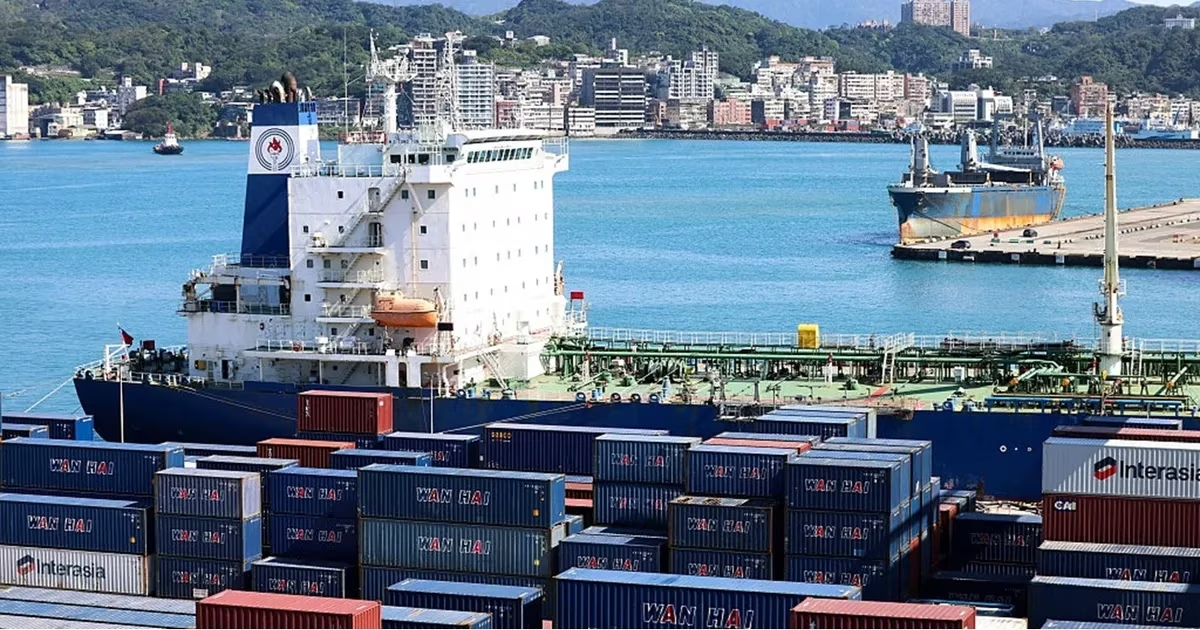
The Israeli-American war on Iran has begun to impose a bitter economic reality on global trade, with its effects extending from the energy sector to impact international supply chains. The fighting has effectively led to the closure of the Strait of Hormuz by an Iranian decision, the most vital shipping lane between Iran and Oman, causing a partial paralysis of ship movement.
Informed sources reported that the closure of the strait has caused more than a hundred commercial vessels to be stranded in Gulf waters, amidst a frantic rise in maritime transport costs. Shipping companies face unprecedented challenges in securing alternative routes, leading to severe congestion in ports on the Indian Ocean, far from the conflict zone.
Italian businessman Emanuele Grimaldi, CEO of the 'Grimaldi' Group, confirmed that shipments of European cars destined for the Gulf could not reach their destination due to shelling and fighting. He explained that these shipments were forced to stop in distant African ports such as Kenya, where they were stored in secure areas awaiting stabilization of the situation.
Economic reports indicated that the war, which shook oil and gas markets over the past two weeks, has begun to permeate other industrial and commercial sectors. Major shipping hubs in Asia are currently suffering from a severe fuel shortage, while dozens of ships remain trapped within the Gulf waters unable to exit or unload their cargo.
Grimaldi mentioned that one of his company's ships is still searching for an alternative port to unload thousands of cars, while another ship remained completely trapped inside the Gulf. The major crisis lies in the fact that most nearby ports have reached their maximum capacity, as unloading a single ship requires vast areas of logistical land.
Major global shipping companies, including 'Maersk' and 'Hapag-Lloyd', announced the suspension of their operations on some key routes leading to the Middle East. This decision was made for maritime safety reasons, which immediately resulted in increased delays in cargo arrivals and higher insurance costs for ships worldwide.
This disruption represents a significant setback for the shipping sector, which was trying to recover from the repercussions of the Red Sea attacks that lasted for two years. With escalating risks in the Strait of Hormuz, companies were forced to rely entirely on the Cape of Good Hope route around Africa, despite the long distance and exorbitant additional costs.
Maritime transport experts are monitoring the situation with great concern, especially with the potential for direct impact on fuel supplies in the Asian continent. Although shipping routes across the Pacific heading to America have not been fully affected yet, the continued closure of the strait threatens the collapse of the global supply system if the conflict prolongs.
Vincent Clerc, CEO of Maersk, said that the closure of the Strait of Hormuz hinders efforts to replenish strategic oil reserves in Asia. He revealed that his company has ten ships stranded inside the Gulf, emphasizing that a return to normal operations would require at least ten days after any ceasefire agreement is reached.
One of Maersk's ships was directly hit by projectile fragments while sailing between Qatar and Oman, leading to a fire on board. The ship is currently stopped off the coast of Dubai to assess the damage, an incident that confirms the high danger faced by commercial vessels in this volatile region.
Alternative ports such as Mumbai in India witnessed unprecedented container congestion, leading to a significant jump in shipping prices from China. According to specialized data, the average cost of transporting a single container increased by 56% since the start of US and Israeli military strikes on Iranian territory.
One Chinese exporter recounted the suffering of his goods destined for Dubai, which were forcibly diverted to Karachi port in Pakistan. These shipments face daily ground fees of up to $200, while shipping companies demand additional amounts under the name of 'war fees' to transport them overland to their final destination.
Some global shipping companies have resorted to activating a rare legal procedure known as 'end of voyage', which allows them to deliver shipments to unagreed ports. This procedure is similar to a 'force majeure' situation, where the carrier disclaims responsibility for delivering goods to the original port due to compelling wartime conditions that prevent navigation.
Analysts confirm that the complete closure of a maritime area to commercial vessels is a historical precedent in the modern era of the shipping sector. Attention is now focused on international efforts to try and open safe passages, amidst warnings that the continuation of the current situation will lead to a new wave of global inflation affecting the prices of all basic commodities.
The closure of the Strait of Hormuz has made it difficult to replenish oil reserves in Asia, and resuming operations could take ten days even in the event of a ceasefire.