






By: Said Arikat
April 10, 2026
News Analysis
Washington, D.C- At a moment when Lebanon is enduring one of the most intense and destructive military campaigns in recent memory, Washington’s announcement of yet another diplomatic meeting on the prospects of a ceasefire appears increasingly detached from reality. What is being presented as diplomatic engagement is, in practice, little more than political theatre—an effort to manage the optics of a war the United States has neither the will nor the political courage to restrain.
Behind the language of “concern” and “de-escalation,” a harsher truth is becoming impossible to ignore: the United States is not merely failing to stop the war in Lebanon—it is enabling the conditions under which it continues.
According to a U.S. official cited in correspondence received by Al-Quds newspaper’s Washington bureau, the upcoming meeting reflects fears in Washington that the conflict could spiral into a broader regional war. Yet these fears have not translated into policy. They remain confined to statements, briefings, and carefully calibrated diplomatic language that has no measurable impact on Israel’s conduct on the ground.
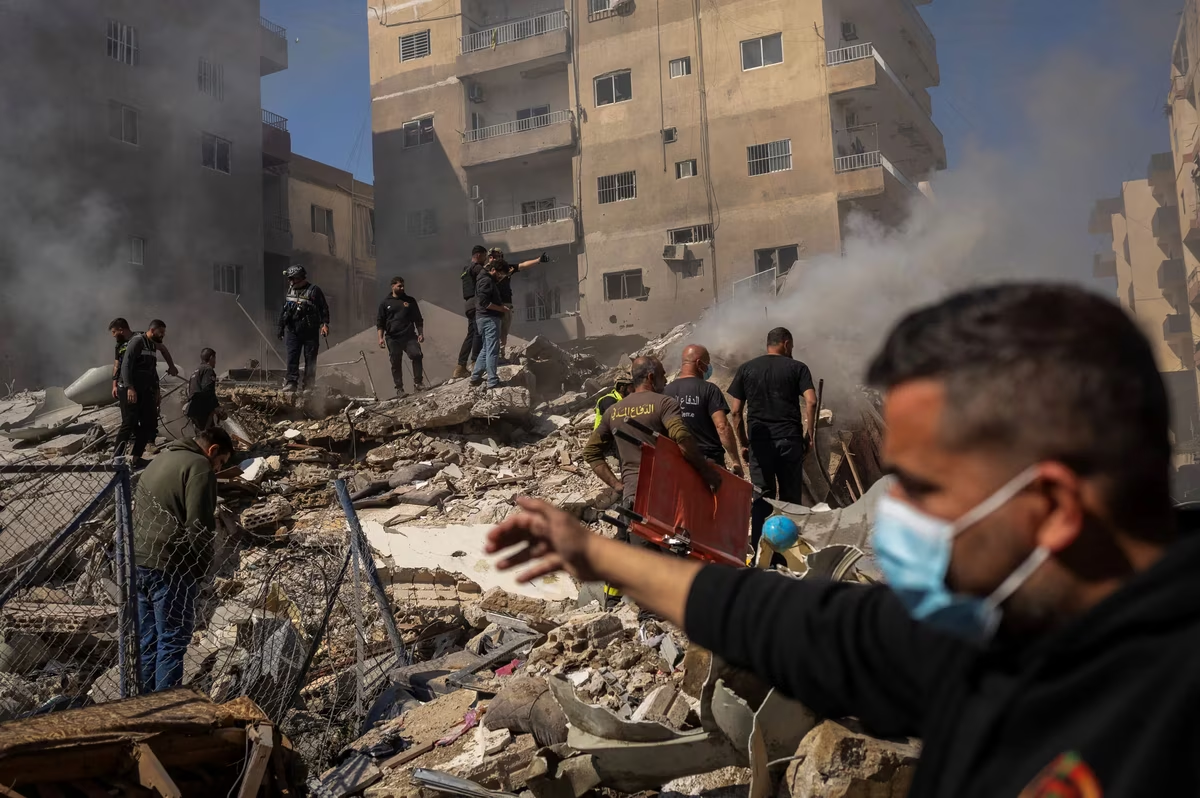
In Lebanon, the consequences of this paralysis are devastating. More than 300 people have reportedly been killed and over 1,100 wounded, the overwhelming majority civilians, in the span of ten-minute of Israel’s criminal assault on Wednesday, April 8. Entire neighborhoods in Beirut’s southern suburbs and large areas in the south have been flattened. Infrastructure has been systematically destroyed, and mass displacement continues under sustained bombardment. The scale and intensity of the assault have left little ambiguity about the nature of the war being waged: a campaign of overwhelming force against a densely populated civilian environment.
Yet despite this, Washington continues to act as though expressions of concern constitute a form of policy. They do not.
Israel’s military campaign proceeds with near-total impunity, sustained by unwavering U.S. political backing and an uninterrupted security relationship that shields it from meaningful consequences. The result is a structural imbalance in which Israel acts freely, while the United States periodically reacts rhetorically—after the damage is done, and without altering the underlying dynamics.
President Donald Trump’s reported call to Prime Minister Benjamin Netanyahu urging him to “low-key attacks on Lebanon” fits this pattern precisely: a symbolic gesture that acknowledges excess without imposing restraint, and signals discomfort without changing behavior. It is diplomacy reduced to commentary on a war it does not attempt to stop.
Netanyahu’s strategy, meanwhile, is unapologetically built on escalation. Israel continues to pursue a doctrine in which overwhelming military force is not a last resort but a negotiating instrument. The devastation of civilian areas is not an unintended consequence—it is part of the pressure architecture through which political outcomes are being shaped.
Within this framework, Israel’s reported openness to negotiations with Lebanon “at the earliest opportunity” is not a contradiction but a continuation of the same strategy: escalation first, negotiation later, on terms rewritten by force. Even Lebanese political statements, including calls for disarmament in Beirut, are absorbed into this logic and repurposed as evidence of success achieved under fire.
What emerges is a disturbing symmetry: Israeli escalation proceeds with full diplomatic insulation, while American diplomacy proceeds without enforcement power. One operates with force, the other with language—but the result is a single, coherent reality on the ground: continued destruction without consequence.
The United States insists on its role as mediator. But mediation without leverage is not mediation at all—it is performance. And in this case, it is performance that coincides with the systematic devastation of a country already pushed to the edge.
Parallel diplomatic tracks, including the upcoming U.S.–Iran talks in Islamabad led by Vice President J.D. Vance, are being presented as part of a broader regional effort to stabilize multiple fronts. Yet the assumption that fragmented diplomacy can offset active, escalating wars is increasingly untenable. The region is not moving toward order; it is moving through overlapping crises with no effective mechanism of restraint.
At the core of the current failure is not misunderstanding, but unwillingness: the unwillingness of Washington to use its considerable leverage over Israel, and the willingness of Israel to continue a campaign that has already exacted a devastating civilian toll. Together, these positions produce a system in which war is continuous, diplomacy is reactive, and accountability is absent.
Inside Lebanon, attempts to introduce politically sensitive issues such as disarmament into negotiations conducted under sustained bombardment only deepen the asymmetry. These are not neutral discussions—they are negotiations conducted under duress, where one side speaks from rubble and the other from the position of overwhelming force.
In such conditions, diplomacy ceases to function as a pathway to resolution. It becomes part of the conflict’s infrastructure—absorbing its consequences, legitimizing its continuation, and insulating its perpetrators from meaningful pressure.
For now, Lebanon remains caught in a cycle where destruction advances with operational speed, while diplomacy lags behind as a record of concern rather than a mechanism of restraint. And Washington, far from acting as a brake on this trajectory, appears increasingly positioned as its political enabler—speaking in the language of peace while presiding over the conditions of war
Share your opinion
Diplomacy Under Fire: Washington’s Complicity and Israel’s Unchecked War on Lebanon