PALESTINE

Mon 05 May 2025 9:54 am - Jerusalem Time

One dead, 58 arrests, and 34 demolitions and bulldozing operations in Jerusalem last month

The Jerusalem Governorate monitored Israeli occupation violations in the governorate during April. These violations focused on arrests, detainee orders, demolitions, eviction orders, deportation orders, and house arrests, in addition to daily raids on the blessed Al-Aqsa Mosque.


Martyrs:


In April 2025, the Jerusalem Governorate witnessed the continuation of the occupation's crimes against the Palestinian people. Citizen Arafat Qadous, from the village of Iraq Burin in the Nablus Governorate, was martyred after being chased by occupation forces near the racist separation and expansion wall in the town of Al-Ram, north of occupied Jerusalem, while trying to reach his workplace within the 1948 territories.


Colonists' attacks:


During April, the governorate monitored (31) attacks by settlers, including two attacks involving physical harm, which reflects a dangerous escalation in settler attacks against Palestinian citizens, their property and their holy sites, as they all took place under the protection of the Israeli occupation forces.


Injuries:


About (45) injuries were recorded as a result of live and rubber-coated metal bullets and severe beatings, in addition to cases of suffocation from gas, including two injuries as a result of the settlers’ attacks.


Crimes and violations in the blessed Al-Aqsa Mosque:


The blessed Al-Aqsa Mosque witnessed an unprecedented Israeli escalation in flagrant violation of the historical and legal status quo, and a blatant violation of international law and UNESCO resolutions affirming that Al-Aqsa Mosque is a purely Islamic place of worship.


During April, (10,111) settlers stormed Al-Aqsa Mosque under the protection of the occupation forces, in addition to (6,139) others under the cover of “tourism”. The settlers carried out provocative tours and performed Talmudic rituals in various areas of Al-Aqsa Mosque, in a direct violation of the sanctity of the holy place.


During the Jewish Passover holiday of 2025, which extended from April 13 to 19, the blessed Al-Aqsa Mosque witnessed a dangerous escalation in the pace of violations and incursions, as 6,865 settlers stormed the mosque, a significant increase over previous years.


Targeting national figures in Jerusalem:


Jerusalem has also witnessed a continuation of the occupation's systematic policy of targeting Palestinian political and religious figures, in an attempt to undermine the Palestinian national presence in the city and disrupt the role of these figures in defending Jerusalem and its residents.


On April 21, Israeli intelligence summoned Minister of Jerusalem Affairs Ashraf al-Awar for investigation and served him with a notice ordering his deportation from the West Bank for six months, on the grounds of engaging in "activities on behalf of the Palestinian National Authority."


On the same day, Israeli occupation forces raided the home of the Mufti of Jerusalem, Sheikh Muhammad Hussein, in the al-Sal'a neighborhood of Jabal al-Mukaber, in a clear message of continued targeting of the city's top religious leadership.


On April 27, an Israeli court held a trial session for Jerusalem Governor Adnan Ghaith, before deciding to postpone the hearing until September. This comes as part of a series of ongoing legal proceedings against the governor, which aim to combat symbols of Palestinian sovereignty in the occupied capital.


Arrest cases:


During April, the Jerusalem Governorate recorded the arrest of (58) Jerusalemites, including (3) women and (5) children.


Occupation court decisions against detainees:


The occupation courts have imposed unfair decisions on detainees, ranging from actual prison sentences to house arrest, deportation orders, and hefty fines. Some detainees have also been subjected to travel bans, and the detention of a large number of detainees has been extended for months, and even years, without clear charges being brought against them.


Actual imprisonment:


The Jerusalem Governorate monitored the issuance of (27) actual prison sentences by the occupation courts against Jerusalemite prisoners during April, including (11) administrative detention sentences, i.e. without specifying a charge against the detainees. These sentences reflect the occupation’s escalating policy of targeting detainees, which contributes to the exacerbation of their suffering.


House arrest:


In April 2025, the Jerusalem Governorate monitored the issuance of (4) house arrest decisions by the occupation authorities.


Deportation decisions:


The occupation authorities issued (13) deportation decisions against Palestinians, including (6) decisions to deport them from the blessed Al-Aqsa Mosque.


Travel ban decisions:


The occupation authorities cite security reasons to prevent Palestinians from traveling, particularly in occupied Jerusalem. In April, the occupation authorities issued a travel ban.


Demolitions, bulldozing and property seizures:


The occupation authorities carried out (34) demolition and bulldozing operations, including (5) forced self-demolition operations during which Jerusalemites were forced to demolish their homes to avoid fines, and (25) demolition operations carried out by force by occupation machinery, in addition to (4) bulldozing operations, targeting Palestinian lands and streets, under the pretext of unlicensed construction, at a time when strict restrictions are imposed on obtaining building permits, making it almost impossible for Jerusalemites.


Demolition, forced eviction and land seizure decisions:


Demolition orders are part of the Israeli occupation's policy of displacing Palestinians from their lands in occupied Jerusalem. The occupation authorities issue these orders under the pretext of unlicensed construction or building violations, even though Palestinians are often denied building permits due to the restrictions imposed on them.


These decisions include notices demanding that residents demolish their homes within a short period of time, or else the occupation bulldozers will carry out the demolition and impose heavy fines.


The largest number of these notices was in the town of Anata, where the occupation issued 35 of the 47 notices recorded in the Jerusalem Governorate.


Crimes and violations against Jerusalem's institutions and landmarks


During April, occupied Jerusalem witnessed a continuation of widespread Israeli violations targeting religious, national, and educational institutions, alongside an escalating assault on media freedoms and trade union activity. This reflects a systematic policy to obliterate Palestinian national identity and undermine the Palestinian presence in the city.


One of the most prominent features of this approach has been the targeting of educational institutions. The so-called Arab Education Department of the Israeli municipality announced the closure of Al-Furqan School in Shuafat, which serves approximately 1,200 students, on the grounds that it was operating without a license, despite the school having been in operation for thirty years.


In a related development, Israeli occupation forces stormed Al-Quds University in Abu Dis and fired tear gas canisters onto the campus, a blatant violation of the sanctity of academic institutions and the right to education.


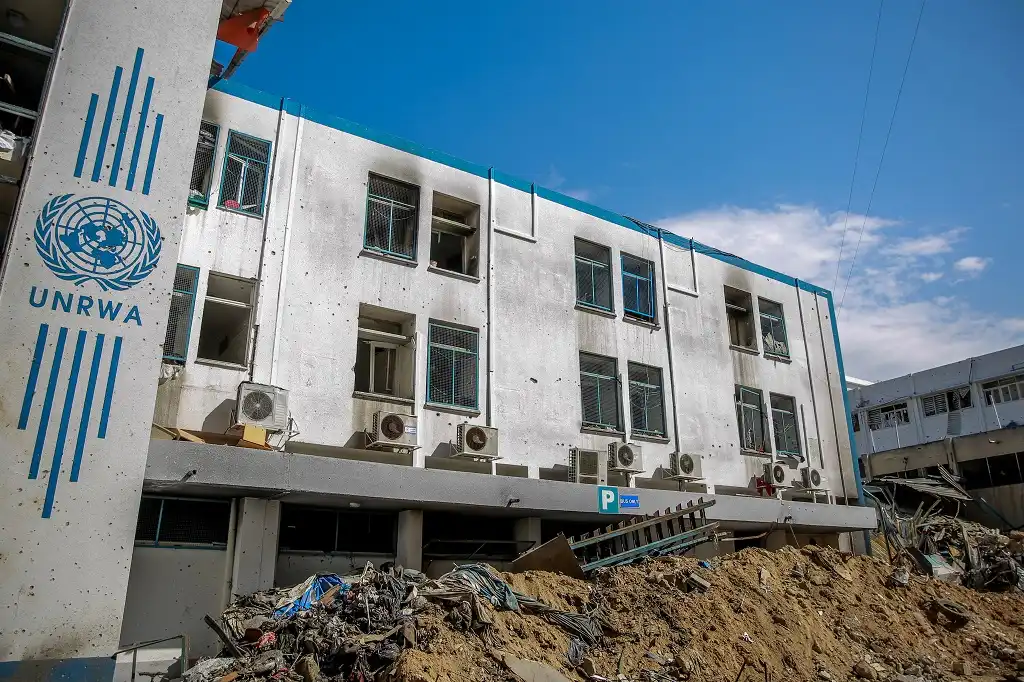
The assault on national institutions continued, as occupation forces closed the headquarters of the General Federation of Palestinian Trade Unions on Salah al-Din Street and arrested its secretary, Fawzi Shaaban, for his union work. They also raided a printing press belonging to the family of released prisoner Ahmed Obeid in Issawiya. These attacks extended to include international institutions, as they stormed a UNRWA school in Shuafat camp and handed its administration a military order ordering its closure on May 8. This same order also occurred with five other UNRWA schools in the city.


Media freedoms were not spared from these practices. Israeli occupation forces arrested journalist Nadine Jaafar at Bab al-Ghawanmeh and released her on condition that she be kept away from Al-Aqsa Mosque. They also shot journalist Mohammed Samreen while covering the demolition operations in Anata, damaging his vehicle. This is a dangerous escalation targeting journalistic work and the truth.


In the religious sphere, the occupation authorities escalated their violations against holy sites, assaulting Christians during Holy Saturday celebrations at the Church of the Holy Sepulchre, preventing a number of them from entering. They also raided the home of the Mufti of Jerusalem, Sheikh Muhammad Hussein, in a move that reflects the continued targeting of religious symbols in the city.


Arbitrary measures against Palestinian officials continued, with Israeli intelligence summoning Minister of Jerusalem Affairs Ashraf al-Awar and handing him a six-month ban from the West Bank, on the grounds that he was carrying out activities on behalf of the Palestinian National Authority.


This escalation culminated in a decision by the extremist minister in the Israeli occupation government, Itamar Ben-Gvir, to close the offices of the Jerusalem Fund and Endowment in Jerusalem, in flagrant violation of all international norms and laws. This decision comes as part of a systematic campaign led by the occupation government to dry up the sources of Palestinian civil society work and confiscate everything that supports Jerusalemites and contributes to their economic and social empowerment.


Together, these attacks highlight the magnitude of the challenges facing Palestinian institutions in Jerusalem and reveal an ongoing Israeli strategy aimed at emptying the city of its national and religious significance and undermining all aspects of Palestinian sovereignty there.


Colonial projects:


During April, the Jerusalem Governorate observed continued intensive settlement activity in Jerusalem. Seven new settlement plans were tracked through official announcements issued by the Jerusalem Municipality. These plans are divided into various stages, including deposit, approval, and tenders. On April 17, settlers opened a Jewish religious school near the Western Wall.


In April, three plans were approved in Jerusalem, and a tender was issued for the development of public spaces, a park, and swimming pools in the Gilo settlement.


On April 8, a number of Israeli ministers and rabbis inaugurated a new settlement project aimed at demolishing 95 homes in occupied Jerusalem, in preparation for the construction of 392 new settlement units in the same area.


On April 16, Israeli bulldozers from the Boaz settlement outpost began paving new settlement roads within the dangerous E1 settlement plan, in the lands of the town of Issawiya, specifically in the Abu George Triangle area, the Bir al-Maskub settlement complex, and Wadi Sneisel.


These roads extended towards the Shai police station, affiliated with the Ma'ale Adumim settlement, in an attempt to connect the settlements to each other and achieve geographical settlement contiguity at the expense of Palestinian lands.


On April 22, the occupation authorities discussed a new settlement plan to expand the Gilo settlement southeastward, as part of a project known as "Southeast Gilo," which aims to seize 176 dunams of Palestinian land in Beit Jala for the construction of 1,900 settlement units. According to available data, 29% of this land is privately owned by Palestinians, while 15% is managed by the so-called "Custodian of Absentee Property," and 44% of the land is not officially registered.


In this project, the occupation authorities rely on the "Absentee Property Law," which is used as a tool to seize Palestinian lands belonging to owners who were forcibly displaced.

PALESTINE

Mon 05 May 2025 9:48 am - Jerusalem Time

"Two States in One Homeland": An Innovative Vision or a Confrontation with the Truth?

Awni Al-Mashni: The "Two States in One Homeland" vision represents a fundamental shift in approaching the conflict based on relative justice, not a balance of power.

Dr. Jamal Harfoush: The "Two States in One Homeland" vision could be used as a pretext to justify the de facto annexation of the West Bank under a new name, thus undermining the two-state solution.

Suleiman Basharat: Israel thwarted the two-state solution after the Oslo Accords and will not accept the principle of partnership or peaceful coexistence.

Nizar Nazzal: The political visions put forward since the Madrid Conference in 1991 have not been implemented due to Israel's denial of the rights of the Palestinian people.

Dr. Aqel Salah: Israel views Palestine, from the sea to the river, as the "Jewish state," and is even seeking to expand its borders, making any political solution unlikely.

Hani Abu Al-Sabaa: Israel did not seriously engage with any of the political initiatives put forward, most notably the Arab Peace Initiative at the Beirut Summit.


The "Two States in One Homeland" vision, proposed by writer and political analyst Awni Al-Mashni and published by Al-Quds newspaper, offers a possible approach to resolving the Palestinian-Israeli conflict. It shifts the concept of peace from temporary agreements based on the balance of power to a permanent formula based on relative justice. However, the new vision clashes with a complex reality dominated by Israeli brutality.


Al-Mashni presents his vision, titled "Two States in One Homeland," as a political solution to the Palestinian-Israeli conflict. It is based on strengthening common ground and respecting the uniqueness of each people. Jerusalem should remain united under joint security authority, with open borders that allow for freedom of movement and residence with full civil rights. It also removes obstacles such as the refugee issue and settlements, allowing for dual citizenship and gradual solutions.


In separate interviews with Al-Quds, writers, political analysts, specialists, and university professors believe that true peace requires achieving the minimum national aspirations of the weaker party and achieving a permanent settlement, free from the illusion of resolving the conflict. However, this vision faces significant challenges, most notably the internal Israeli reality, which is dominated by the extreme right, and which reinforces a culture of superiority and hatred. This makes any political settlement nearly impossible in the absence of effective left-wing forces capable of offering serious alternatives.


Writers, analysts, and university professors point out that, in light of the ongoing genocide and war, stopping the violence becomes a humanitarian and moral priority, requiring international pressure and serious intellectual debate between Palestinian and Israeli societies to explore the potential of this vision as a comprehensive solution that balances rights and reality.


The vision provides a realistic possibility for a permanent solution.


Writer and political analyst Awni Al-Mashni says that the vision he proposes for resolving the conflict based on "two states in one homeland" represents a fundamental shift in the approach to the Palestinian-Israeli conflict, shifting the concept of peace from a temporary agreement based on a balance of power to a permanent formula based on "relative justice."


Al-Mashni points out that historical experience demonstrates the fragility of solutions based solely on the balance of power, as they collapse immediately upon a shift in these balances, as occurred after World War II when agreements collapsed with the dissolution of the Soviet Union.

Al-Mashni asserts that lasting peace cannot be achieved unless the weaker party—in this case, the Palestinians—feels that it has achieved the minimum of its national aspirations without threatening the existence or interests of the other party. He explains that this vision offers a realistic possibility for a permanent solution, rather than chasing the illusion of a "conflict resolution" promoted by right-wing Israeli forces.


Al-Mashni explains that one of the most significant challenges facing this solution lies within Israel's internal reality. He notes that Israeli society has been hijacked for more than two decades by the extreme Zionist right, which has reshaped its consciousness around the illusion of absolute victory and total control.


Israeli society is burdened with hatred and racism.


Al-Mashni asserts that the convergence of this material power with biblical myths has produced a "delusional megalomania," which has made Israel a society burdened with hatred, racism, and obsessed with superiority, constituting the most significant obstacle to any political settlement.


Al-Mashni criticizes the absence of effective Israeli left-wing forces possessing the courage and initiative to fight for peace. He believes these forces are suffering from erosion and fear, and lack the strength necessary to present serious political alternatives to the hegemony of the right.


Al-Mashni believes that the failure of conflict management policies, along with the failure to "resolve" it through military force, especially in light of the ongoing genocide, is leading Israel, as a society, and its political and intellectual elites, to a moment of real confrontation with reality, namely that wars do not end the conflict with an entire people.


Al-Mashni asserts that the Palestinians, despite attempts to weaken them, possess a permanent capacity to reorganize and resurge, which means that the notion of "resolving the conflict" is nothing more than another illusion. He emphasizes that there is no eternal conflict, and that the Israeli right may succeed in postponing a solution, but it will not be able to prevent it forever.


Any discussion must follow the cessation of the war of extermination.


Al-Mashni emphasizes that any discussion of this vision must come after the ongoing war has ceased and the genocide has been ended, because this priority is no longer solely Palestinian, but has become a humanitarian, moral, and global one. The international community, and peace advocates within Israel, bear the responsibility of pressuring Israel to halt these crimes first.


Al-Mashni explains that it is then necessary to open a serious intellectual debate within both Palestinian and Israeli societies about the vision of "two states in one homeland," because it is not a partial or selective vision, but rather a "comprehensive package" that carries a delicate balance between rights and reality. It cannot be treated as a list of options, choosing what suits and discarding what neither side likes.


Al-Mashni emphasizes that this vision is not a set of ideas or experimental initiatives, but rather the culmination of a century of conflict and failed initiatives. It is a serious attempt to reshape reality and transform challenges into opportunities.


Al-Mashni asserts that the future itself, with all its variables, will impose this vision on the ground, because it stems from reality, not ideology. He says, "This is not a missionary call, but rather an objective reading of the course of history, and the logic of reality is what will make it achievable."


A bold attempt to break the historical deadlock


For his part, Professor Jamal Harfoush, Professor of Scientific Research Methods and Political Studies at the University of Brazil's Academic Research Center, asserts that unconventional political proposals, such as the "Two States in One Homeland" idea proposed by writer and political analyst Awni Al-Mashni, represent a bold attempt to break the historical deadlock in the Palestinian-Israeli conflict.


However, Harfoush emphasizes that assessing this vision faces multidimensional challenges that take into account local, regional, and international contexts, as well as deconstructing its legal, sovereign, and identity components, while taking into account factional, official, popular, Arab, and international positions.


Harfoush explains that the opportunities available to this approach lie in its ability to break the zero-sum equations that have dominated the conflict, which are based on exclusion.


Harfoush points out that this vision opens up prospects for coexistence within a geographic unit, with a separate identity and sovereignty, which could unblock the existing political stalemate. It also benefits from regional and international shifts, as international support for the traditional two-state solution declines, making this proposal an attempt to adapt to an international reality that prioritizes stability.


A joint security approach to Jerusalem


Harfoush believes that a joint security approach to Jerusalem, as proposed by the proposal, could be welcomed by the European Union and the United Nations, as it reduces the likelihood of escalation in the holy city.


Harfoush points out that the collapse of hope for establishing an independent Palestinian state could create a psychological environment, particularly among younger generations, that makes them more willing to accept alternative solutions that achieve civil rights and ensure survival on the land.

However, Harfoush warns of the major challenges facing this proposal, most notably that it clashes with legitimate national visions and the historical rights of the Palestinian people. The vision could be viewed as a concession of national principles, such as the right to self-determination, the establishment of a sovereign state, and the return of refugees in accordance with UN Resolution 194.

Harfoush points out that this proposal will face categorical rejection from the majority of Palestinian factions, including Hamas, Islamic Jihad, and the Popular Front.


Institutional Israeli rejection poses a challenge


In contrast, Harfoush points out that institutional Israeli rejection poses another challenge, as even the center-right in Israel rejects the idea of equality or political partnership, considering the entire land to belong to the Jews, while Israeli security rejects any notion of "shared security" in Jerusalem.

Harfoush points out that Mashni's vision could be used as a pretext to justify the de facto annexation of the West Bank under a new name, undermining the internationally recognized two-state solution and creating a new reality that serves the occupation.

Harfoush asserts that historical mistrust, fueled by hatred and destruction, especially with the ongoing genocide in Gaza, renders talk of a geographic partnership disconnected from reality.

Regarding the repercussions, Harfoush points out that these proposals could deepen the Palestinian national divide, as nationalist and Islamic factions would view them as a stab in the back of the liberation struggle, while some liberal or authoritarian elites might support them as a means of preserving political privileges.

Harfoush explains that the Arab scene is divided, with Arabs preoccupied with their internal issues, and some inclined to accept distorted solutions due to normalization. However, countries like Jordan and Egypt will refuse to cancel the two-state solution for fear of jeopardizing their national security.


A "smart map" to freeze the conflict


Internationally, Harfoush notes that the vision may be viewed as a "smart map" for freezing the conflict, but it will not gain legal recognition unless it is based on UN resolutions. It also redefines the concepts of "liberation," "return," and "sovereignty," opening philosophical and legal debates, but it will not be popularly accepted without the end of the occupation.

Harfoush asserts that any future peaceful solution will not be the result of theoretical ideas, but will be based on major transformations on the ground, such as the collapse of the occupation system or a change in the regional balance of deterrence.

Harfoush emphasizes that true peace requires absolute justice and explicit recognition of the rights of the Palestinian people, along with international legal guarantees that deter the occupation from continuing its settlement and racist policies.

Harfoush asserts that the vision of "two states in one homeland" will remain a mere theoretical idea unless it is based on a just legal basis and genuine political will, noting that it will be put to trial before the conscience of the Palestinian people, who reject any compromise on their national rights.


An approach that ignores the essence of the problem


For his part, writer and political analyst Suleiman Bisharat asserts that the idea of "two states in one homeland" proposed by writer Awni al-Mashni as a solution to the Palestinian-Israeli conflict ignores the core of the problem, which is the nature of the Israeli occupation as a colonial, settler-colonial project based on the negation of the other.

Basharat explains that this approach legitimizes Israel's presence on Palestinian land, ignoring historical facts and international law, which affirm that Palestinian territories, at least since the June 4, 1967, borders, are occupied territories.

Basharat points out that the conflict is not between two peoples coexisting on the same land under a normal system, but rather between an ideological, religious occupation project that seeks to eliminate the Palestinians as owners of the land and historical presence, and a Palestinian people defending their rights.

Basharat asserts that international law, including UN resolutions and the advisory opinion of the International Court of Justice in The Hague, clearly establishes that Israel is an occupying power, and that the Palestinian territories are not in dispute but occupied territory whose occupation must end.

Basharat cites the experience of the 1948 Palestinians as evidence of Israel's impossibility of accepting genuine political or civil participation. He explains that despite their adherence to the Israeli legal system since the Nakba, Israel has not granted them full civil and political rights, negating any hope of accepting the "two states in one homeland" concept, which requires equality between Palestinians and Israelis.


Israel's ideological vision of replacement.


Basharat asserts that the practical reality shows that Israel is transforming the West Bank into an uninhabitable area through settlement expansion and systematic violence, with the goal of expelling Palestinians, which aligns with Israel's ideological vision of replacement.

Basharat asserts that implementing this proposal will face fundamental obstacles, including the concept of the right to exist, the political system, and full civil rights.

Basharat points out that the behavior of settlers and the occupation in the West Bank reveals plans to expel Palestinians, not to coexist with them.

Basharat believes this approach ignores attacks on holy sites, such as Al-Aqsa Mosque, which the Israeli religious mindset seeks to demolish in order to build a Jewish temple, thus blocking any real partnership.

Basharat warns that this vision will be little more than an unworkable theoretical proposition, noting that Israel, which thwarted the two-state solution after the Oslo Accords, will not accept the principle of partnership or peaceful coexistence.

Basharat asserts that Israel's expansionist ambitions in the Middle East, extending beyond the Palestinian territories to geopolitical hegemony, make it unwilling to abandon its illusions or accept a solution that guarantees equal rights for all.

Basharat believes that Israel will categorically reject this proposal, just as it rejected the Arab Peace Initiative at the Beirut Summit in 2002, when then-Israeli Prime Minister Ariel Sharon described it as "not worth the paper it was written with."

Basharat points out that continued American support enhances Israel's ability to impose its expansionist vision, which ignores interim solutions and seeks a "decisive plan" to ensure complete control.

Basharat asserts that these proposals for a peaceful settlement will remain confined to the pages, folded due to Israeli rejection before any other party, and will find no place except in the annals of history.


The conflict has become more complex and intricate.


For his part, Nizar Nazzal, a researcher specializing in Israeli affairs and conflict issues, asserts that political visions aimed at finding peaceful solutions to the Palestinian-Israeli conflict will fall on deaf ears, pointing out that such initiatives are doomed to failure under the current circumstances.

Nazzal explains that the conflict has become more complex and intricate due to the absence of a unified Palestinian decision, the extremism of the Israeli government, unlimited American support for Israel, along with Arab impotence and Western complicity.

Nazzal points to the Palestinian division as a major factor impeding any political progress. Hamas controls the Gaza Strip, while Fatah controls the West Bank. The Palestinian political system remains flabby and unable to engage with initiatives due to the lack of a unified leadership.

Nazzal emphasizes that the geographical separation between Gaza and the West Bank further complicates the situation, making the formulation of a unified Palestinian discourse unlikely.

Nazzal asserts that the current far-right Israeli government refuses to recognize the Palestinian people and views them as mere individuals without national rights.


Absence of realistic Israeli leadership


Nazzal explains that this government, led by extremist clerics and rabbis, embraces an extremist religious and nationalist Zionist vision, clings to the issue of Jerusalem as the eternal capital of Israel, and rejects any concessions that would undermine this position.

Nazzal points out that the Israeli street has veered toward religious Zionism, with the political left and center fading away, which means the absence of a realistic Israeli leadership capable of dealing with political solutions.

Meanwhile, Nazzal explains that the new vision proposed by writer and political analyst Awni Al-Mashni addresses sensitive issues such as the return of refugees, which is at the core of the Palestinian cause.

Nazzal points out that any hint of conceding refugee rights will be met with widespread Palestinian rejection, especially among Palestinians in the diaspora, who will consider themselves permanently excluded from any settlement.

Nazzal asserts that the issue of Jerusalem will not be accepted by Palestinians, or even by some Arabs and Muslims, which reduces the chances of any initiative's success.


Regional war by next October


Nazzal warns that the region is heading towards a dangerous escalation, predicting a regional war by next October involving Israel and the United States on one side, and Iran, Iraq, Yemen, and Syria on the other.

Nazzal points out that the current Israeli government is an ideological and extremist "war government," which does not believe in peace and has committed acts of ethnic cleansing and genocide against the Palestinians, making the Palestinian people unwilling to tolerate or accept a settlement without Israel being held accountable.

Nazzal explains that Israel acts as a state above the law, supported by continued American cover that focuses on war rather than political solutions.

Nazzal asserts that the political visions proposed since the Madrid Conference in 1991 have not been implemented due to Israel's denial of the rights of the Palestinian people.

Nazzal asserts that the current Israeli government, with its extremist ideological nature, makes any hope of achieving a political solution impossible in the foreseeable future, especially in light of unconditional American support and continued Arab impotence.


The chances for this proposal are zero.


Palestinian writer and political researcher Dr. Aqel Salah expresses extreme pessimism about the feasibility of implementing the proposal presented by writer Awni Al-Mashni for a solution to the conflict, which resembles a watered-down two-state solution. He believes the chances of this proposal being implemented are slim in light of Israel's extremist policies and the absolute American support for them.

Salah asserts that Israel views the conflict with the Palestinians from a religious and Talmudic ideological perspective, viewing Palestine from the sea to the river as the "Jewish state." Israel even seeks to expand its borders, making any political solution that guarantees Palestinian rights unlikely.

Salah points out that Israeli Prime Minister Benjamin Netanyahu, who has led opposition to the Oslo Accords since 1996, will not accept a proposal like Mashni's, or any other proposals based on a simplified two-state solution.

Salah explains that Israel is moving toward further extremism, refusing to recognize any Palestinian rights, even at the level of limited self-rule.

Salah believes that Israeli policy aims to eliminate the Palestinian entity by targeting the Palestinian Authority in its current form, making the implementation of any peaceful proposal nearly impossible.


Peace proposals face major obstacles


Salah asserts that peace proposals face significant obstacles under an extreme right-wing Israeli government, backed by American support that has continued to support Israel's sovereignty since the 1991 Madrid Conference.

Salah explains that the United States shares Israel's political vision, clearly favors Israeli interests, and provides them with protection by all means, thus strengthening their complete control over the Palestinian territories.

Salah points to the decline in the Arab role in supporting the Palestinian cause, which has become a secondary issue for many Arab countries.

Salah points out that some of these countries have normalized their relations with Israel without reaching a just solution to the issue, weakening the Palestinian position. Furthermore, the Palestinian leadership has abandoned the legitimacy of resistance in favor of a peaceful solution, which has achieved little progress, as Israel refuses to recognize this option.

Salah warns that any future peace solutions may be less fair than the Oslo Accords and will serve Israeli interests more effectively, given all these factors.


Administrative and economic arrangements only


Salah expects the US administration, led by President Donald Trump, to impose a coercive political solution limited to administrative and economic arrangements, while maintaining Israeli control over the Palestinian territories.

Salah points out that this solution might include annexing the major settlement blocs in the West Bank, while allowing for some formal Palestinian representation to manage population density.

Salah asserts that any vision that ignores the refugee issue or accepts continued settlement activity would be "nationally deficient" and would not be accepted by the Palestinian people.

Salah emphasizes that the presence of massive settlement blocs in the West Bank negates any possibility of establishing a sovereign Palestinian state, even if it is only formal.

Salah points out that factors such as Israeli extremism, American and Western support, the declining Arab role, and Palestinian division will continue to pose real challenges to any peace initiative, warning that these proposals may remain confined to theories with no hope of implementation.


Field facts thwart the possibility of achieving a settlement


For his part, writer and political analyst Hani Abu Al-Sabaa says that Israel has historically proven, over the decades, that it has not demonstrated a genuine commitment to any of the political initiatives proposed to resolve the Palestinian-Israeli conflict. He points out that the reality on the ground clearly indicates a persistent effort by its successive governments, particularly the right-wing ones, to impose facts on the ground that would thwart any possibility of achieving a just political settlement.

Abu Al-Sabaa explains that the first international steps to resolve the Palestinian-Israeli conflict came after the 1967 setback, when the UN Security Council passed Resolution 242, which called for Israel's withdrawal from the territories it occupied in exchange for Arab recognition of the State of Israel. This effectively meant accepting the principle of a "two-state solution" on the June 4, 1967, borders. However, Israel ignored the resolution and went even further, annexing East Jerusalem and the Golan Heights between 1980 and 1981, and continuing its attacks by invading southern Lebanon until its army, led by Ariel Sharon, reached the outskirts of Beirut.

Abu Al-Sabaa asserts that Israel has not seriously addressed any of the political initiatives put forward, despite the fact that Arab states have presented several initiatives guaranteeing peace and recognition, most notably the Arab Peace Initiative at the Beirut Summit in 2002.


Political solutions are an opportunity to procrastinate and buy time.


Abu Al-Saba' points out that the Oslo Accords signed in 1993 between the Palestine Liberation Organization and Israel represented a glimmer of hope at the time, but Israel quickly began besieging the Palestinian Authority and escalating its settlement policies and land confiscation.

Abu al-Sabaa believes that subsequent developments proved that Israel was planning to undermine any prospect of a solution through repeated incursions into Al-Aqsa Mosque and the digging of tunnels beneath it. This led to widespread popular confrontations, which were met with Israeli military incursions into the West Bank, shattering the fragile trust generated by the Oslo Accords.

Abu Al-Sabaa points out that the current Israeli government, with its extreme right-wing leanings, views political solutions as nothing more than an opportunity to stall and buy time, amid European silence and American support that Israel interprets as tacit approval of aggressive practices against the Palestinians.

Abu Al-Sabaa says, "With US President Donald Trump's visit to the region approaching, calls for a solution and an end to the war may once again be heard. However, the reality on the ground confirms that Israel is moving in a completely different direction: imposing hegemony and igniting conflicts on multiple fronts, far from any real intention of achieving a political settlement."


PALESTINE

Mon 05 May 2025 9:03 am - Jerusalem Time

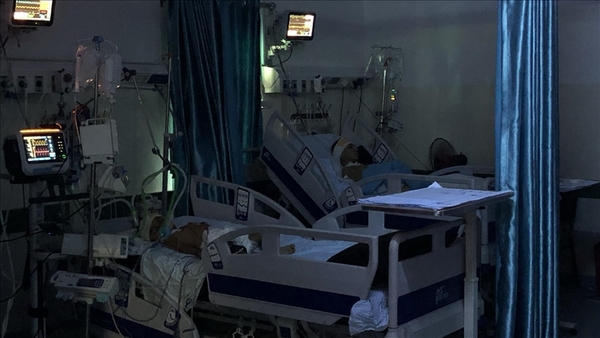
UNRWA: Our medical services in Gaza suffer from a severe shortage of resources.

The United Nations Relief and Works Agency for Palestine Refugees (UNRWA) warned that its medical services in the Gaza Strip are suffering from a "severe shortage" of resources, in light of the blockade and genocide perpetrated by Israel in the Strip.


The agency said in a post on the X platform last night that "about a third of the essential (medical) supplies in the sector have run out, and the other third is expected to run out in less than two months."


She noted that it remains one of the most prominent health actors in Gaza.


She stressed that its medical services are suffering from a severe shortage of resources due to the ongoing blockade and Israeli bombardment of the Gaza Strip.

PALESTINE

Mon 05 May 2025 9:00 am - Jerusalem Time

The Cabinet approves the expansion of the military operation in the Gaza Strip.

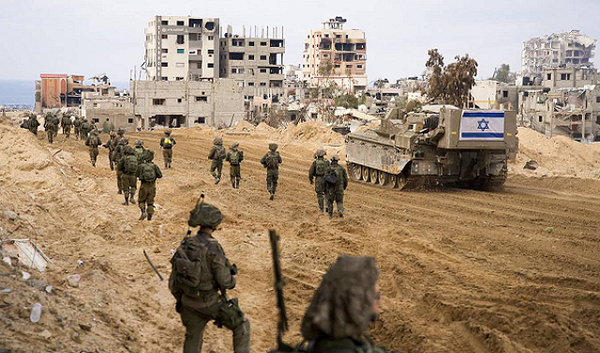
Israel's security cabinet unanimously approved an expansion of the military operation in the Gaza Strip early Monday morning, despite warnings from Chief of Staff Eyal Zamir that the move could endanger the lives of Israeli hostages.


According to Israeli media, the implementation of the decision will be postponed until after US President Donald Trump's visit to the Middle East, scheduled for ten days, giving the Israeli government time to arrange the necessary field and diplomatic measures.


In a notable move, the cabinet has approved in principle the outlines for future humanitarian aid distribution to Gaza residents, despite opposition from extremist National Security Minister Itamar Ben-Gvir.


The plan indicates that this aid will not be provided immediately, but will be administered in the future through an international fund that ensures that none of it reaches Hamas. A date for the start of this plan has not yet been determined.


During the meeting, Ben-Gvir expressed his rejection of the aid, saying, "I don't understand why we need to feed them. They have enough there, and we have to bomb Hamas's warehouses."


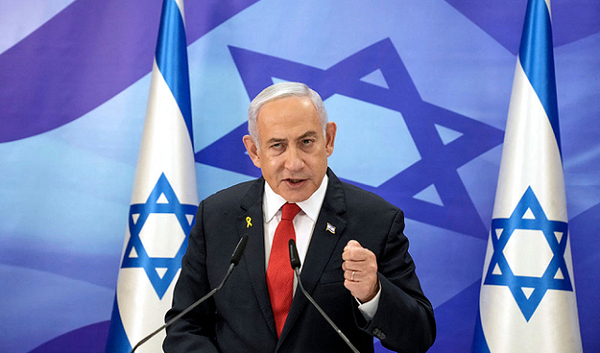
In contrast, the Chief of Staff warned that such statements and policies could endanger the army. Prime Minister Benjamin Netanyahu commented, saying, "Ministers are permitted to express positions that conflict with the army's assessments."


The closed-door cabinet meeting lasted for seven hours, with Shin Bet chief Ronen Bar absent, being represented by his deputy. The meeting was devoted to reviewing military assessments and planning for expanding the scope of operations in Gaza, in addition to discussing the hostage situation and humanitarian aid.


At the conclusion of the session, the cabinet approved plans to intensify the fighting and expand the mobilization of reserve forces. According to Yedioth Ahronoth, the forces to be called up will be divided into two groups: one will be tasked with offensive missions deep inside the Gaza Strip, while the other will replace the regular brigades that will participate directly in the new operation.


This process is expected to be one of the most sensitive phases since the outbreak of the war, given escalating regional tensions, foreign interventions, and conflicting priorities within the Israeli government itself.

PALESTINE

Mon 05 May 2025 8:58 am - Jerusalem Time

Israeli occupation forces prevent educational staff from reaching their schools in the Jordan Valley.

Today, Monday, the Israeli occupation forces prevented dozens of teachers from reaching schools in the Palestinian Jordan Valley.


Azmi Balawneh, the Director of Education in Tubas, reported that the occupation authorities are currently preventing approximately 130 members of the teaching staff in the northern Jordan Valley, and 150 students in schools in the central and southern Jordan Valley, from passing through the Hamra military checkpoint.


The Hamra checkpoint, located at a crossroads linking the West Bank governorates and the Palestinian Jordan Valley, has been subject to military reinforcements and repeated closures of civilian movement for two years.


A large segment of citizens rely on checkpoints to reach their workplaces, given that the Tayasir checkpoint, east of Tubas, remains closed for most of the day, and that the latter is experiencing increased security.

PALESTINE

Mon 05 May 2025 8:54 am - Jerusalem Time

Arrest campaign in the West Bank and occupied Jerusalem

This morning, Monday, the Israeli occupation forces launched a large-scale arrest campaign in the West Bank and occupied Jerusalem.


In Nablus, several occupation vehicles stormed the eastern part of the city from the Awarta checkpoint in the south, raided a house in the Askar al-Jadid camp, searched it, ransacked its contents, and arrested the young man, Abdul Hadi Muhammad al-Shawish.


In Bethlehem, the occupation forces arrested Jamil Muhammad al-Tanha (45 years old) after raiding and searching his home in the town of Tuqu'.


In Tulkarm, Moaz Nour, Suhaib Abu Farah, and Ahmed Zuhdi Jitawi were arrested after raiding their homes in the town of Bal'a.


In occupied Jerusalem, the occupation forces arrested high school student Abdul Rahman Obeid and Mohammed Marwan after raiding their homes and ransacking their contents in the town of Issawiya.


In Ramallah, the occupation army stormed the village of Al-Mughayyir with several military vehicles, launched a large-scale raid on residents' homes, and detained a number of young men, subjecting them to field investigations. Meanwhile, the village's schools announced a delay to school hours.


In the same context, Israeli occupation forces stormed the village of Al-Qabiya, west of Ramallah, and launched a campaign of raids on a number of homes.


In Jenin, occupation forces stormed the town of Yamoun from several directions, raided and searched several homes, and arrested Anas Abu Salah and Yamen al-Ja'bari after searching their homes.


The occupation's aggression on the city and camp of Jenin continues for the 106th consecutive day, and the occupation forces are escalating their raids on towns and villages in the Jenin governorate, raiding and searching homes, while carrying out widespread detention and arrest operations against citizens.


In Hebron, occupation forces raided the Sinjar area in the town of Dura, arresting Bashar Younis al-Suwaiti and Nour al-Baradei, searching their homes and ransacking their contents. They also seized two vehicles from the Tahrir area in the city of Hebron.


The occupation forces also raided the homes of citizens in the village of Imneizel, east of Yatta, south of Hebron.

PALESTINE

Mon 05 May 2025 8:51 am - Jerusalem Time

The United Nations rejects Israel's plan to distribute aid to Gaza.

The United Nations rejected the Israeli occupation's proposal to deliver aid to Gaza under its forces' control.


The UN Humanitarian Country Team in Gaza stated in a statement last night that Israel's plan would violate basic humanitarian principles, as it aims to increase control over essential goods as a pressure tactic, as part of a military strategy.


The proposed delivery mechanism would require UN approval to distribute supplies through Israeli checkpoints, under conditions determined by the Israeli military.


The UN team warned that the proposed strategy would force civilians into military areas to collect rations, endangering them and aid workers, and that the plan would likely contribute to further forced displacement.


The United Nations said: "It can only support plans that respect the humanitarian principles of humanity, neutrality, independence, and impartiality."


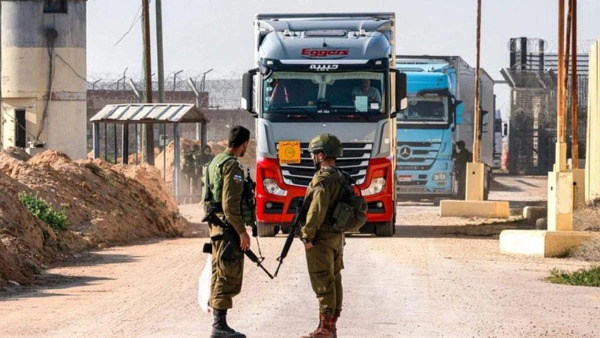
Since March 2, Israel has completely closed the Gaza Strip's crossings, paralyzing the entry of food, medical supplies, and relief aid amid warnings of a total humanitarian collapse.


Human rights reports show that Gaza's 2.4 million residents are now almost entirely dependent on aid, which now arrives only in limited or intermittent forms.

PALESTINE

Mon 05 May 2025 8:47 am - Jerusalem Time

Gaza under fire: New massacres against displaced people amid widespread military escalation

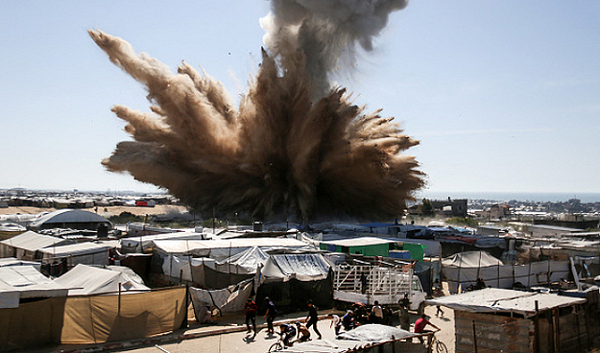
Israeli forces continued their massacres against civilians and displaced persons in the Gaza Strip on Monday, with a widespread military escalation targeting several areas in the north and south.


In the latest developments: Israeli artillery shelled the Qizan al-Najjar area, located south of Khan Yunis, in the southern Gaza Strip, this morning, causing extensive damage to the targeted area.


Meanwhile, Israeli warplanes launched two airstrikes targeting the town of Abasan al-Kabira, east of Khan Yunis, in the southern Gaza Strip, causing material damage and as yet unknown human losses.


In a related development, the army launched heavy artillery shelling targeting areas north of the Nuseirat refugee camp in the central Gaza Strip, as part of the ongoing military escalation targeting areas densely populated with civilians.


In another development on the ground, Israeli military vehicles opened fire on areas northeastern Al-Bureij refugee camp in the central Gaza Strip, amid intense reconnaissance aircraft flights.


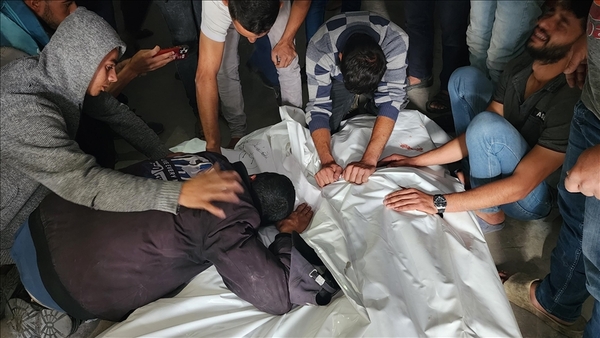
In the latest chapter of the aggression, Israeli warplanes bombed three residential apartments in the "Al-Rumuz" tower in the Al-Karama neighborhood, northwest of Gaza City, killing at least 15 civilians and wounding 10 others, according to civil defense crews.


An Israeli airstrike on the Al-Attar family home in Beit Lahia, north of the Gaza Strip, killed four Palestinians and injured five others, with reports of missing persons trapped under the rubble.


In the south, Israeli shelling continued on the outskirts of the town of Abasan al-Kabira, east of Khan Yunis, as well as on northern areas of the Nuseirat refugee camp in the central Gaza Strip, leaving dozens dead and wounded, most of them children, women, and the elderly.


Medical sources reported a number of deaths and injuries as a result of targeting displaced persons' gatherings in Khan Yunis.

PALESTINE

Sun 04 May 2025 10:42 pm - Jerusalem Time

UNRWA: Our medical services in Gaza suffer from a severe shortage of resources.


The United Nations Relief and Works Agency for Palestine Refugees (UNRWA) warned on Sunday that its medical services in the Gaza Strip are suffering from a "severe shortage" of resources, in light of the blockade and genocide being perpetrated by Tel Aviv, with American support, against the Strip.


"Nearly a third of the sector's essential (medical) supplies have run out, and the other third is expected to run out in less than two months," the agency said in a post on the XN platform.


She noted that it remains one of the most prominent health actors in Gaza.


She stressed that its medical services are suffering from a severe shortage of resources due to the ongoing blockade and Israeli bombardment of the Gaza Strip.


On Friday, UNRWA Commissioner-General Philippe Lazzarini warned in a post on Twitter that the Israeli blockade on the Gaza Strip "will silently kill" more children and women every day, in addition to those killed by bombing.


On Thursday, Ismail al-Thawabta, director of the government media office in Gaza, told Anadolu Agency that the Strip had entered an "advanced stage of famine" due to the ongoing Israeli blockade and the closure of crossings to the entry of aid and goods since March 2.


Since March 2, Israel has closed the Gaza Strip's crossings to the entry of food, relief, medical aid, and goods, causing a significant deterioration in the humanitarian situation for Palestinians, according to government, human rights, and international reports.


The 2.4 million Palestinians in Gaza are entirely dependent on such aid after 19 months of genocide have rendered them impoverished, according to World Bank data.


This humanitarian crisis comes amid the displacement of more than 90 percent of Gaza's Palestinians from their homes. Some have experienced this situation more than once, living in overcrowded shelters or out in the open without shelter, which has increased the spread of diseases and epidemics.


Since October 7, 2023, with full American support, Israel has been committing systematic genocide in the Gaza Strip, leaving more than 170,000 Palestinians dead or wounded, most of them children and women, and more than 11,000 missing.


PALESTINE

Sun 04 May 2025 10:32 pm - Jerusalem Time

Israeli occupation forces arrested two citizens from Yanun, south of Nablus.

Israeli occupation forces arrested two citizens from Khirbet Yanun, south of Nablus, on Sunday evening.


Local sources reported that the occupation forces arrested citizens Muslim and Obada Al-Ajouri after detaining them for several hours.


PALESTINE

Sun 04 May 2025 9:09 pm - Jerusalem Time

UNRWA Commissioner calls for European support to pressure Israel to end the Gaza blockade

The Commissioner-General of the United Nations Relief and Works Agency for Palestine Refugees (UNRWA), Philippe Lazzarini, said that he urged Spanish Foreign Minister José Manuel Albares, during a phone call on Sunday, to mobilize European support to pressure Israel to end the "deadly blockade" imposed on the Gaza Strip.


The agency later said that the Israeli blockade had caused a severe shortage of its medical services in the Gaza Strip.


UNRWA announced on its X account that approximately one-third of essential supplies in the Gaza Strip have run out, noting that another third is expected to run out in less than two months.


Israel has suspended the entry of humanitarian aid into the Gaza Strip since early March in order to increase pressure on Hamas, exacerbating the dire conditions for Palestinians in the Strip.

ARAB AND WORLD

Sun 04 May 2025 8:46 pm - Jerusalem Time

Trump wants a "complete dismantling" of Iran's nuclear program, but may allow civilian nuclear energy.

US President Donald Trump on Sunday further obfuscated what exactly he wants from Iran and its nuclear program.


Trump stated on NBC News' weekly "Meet the Press" program that the goal of his administration's nuclear talks with Iran is to achieve the "total dismantlement" of Tehran's nuclear program, but at the same time he is open to allowing the Islamic Republic to pursue civilian nuclear energy.


Trump made the comments in an interview conducted on Friday and broadcast on Sunday.


"I think I'm open to hearing that, you know?" Trump said, hinting in his interview with Kristen Welker at the possibility of allowing Iran to develop nuclear energy for non-military purposes.


In a related development, Reuters revealed how US President Trump surprised Israeli Prime Minister Benjamin Netanyahu last month by gambling on immediately starting negotiations with Iran. Now, the success of these talks hinges on securing key concessions to prevent the Islamic Republic from developing a nuclear bomb, according to eight sources.


The shift to negotiations with Iran last April came as a shock to Netanyahu, who had traveled to Washington seeking Trump's support for military strikes on Iranian nuclear facilities. He learned less than 24 hours before a joint White House press conference that US talks with Iran would begin within days, according to four sources familiar with the matter who spoke to Reuters.

PALESTINE

Sun 04 May 2025 7:15 pm - Jerusalem Time

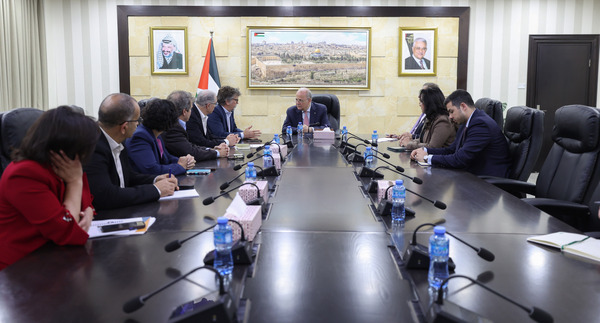
Mustafa discusses with ANERA coordination efforts to bring aid into the Gaza Strip

Prime Minister Mohamed Mustafa met with a delegation from the humanitarian organization ANERA, headed by President and CEO Sean Carroll, in the presence of Minister of Planning and International Cooperation Wael Zaqout and Minister of Social Development and Relief Samah Hamad.


The Prime Minister and the delegation discussed ways to provide and support relief and humanitarian aid for our people in the Gaza Strip, given the occupation's two-month ban on aid entering the Strip. They also discussed the need to coordinate these efforts with relevant ministries and the government's emergency operations room to maximize the use of available resources and meet urgent needs.


Mustafa also stressed the importance of supporting the government's relief efforts in the West Bank, particularly given the ongoing aggression and forced displacement of residents in the northern West Bank governorates. He also emphasized the need to provide temporary shelter and relief aid, as well as support projects to create job opportunities and provide income for families whose breadwinners have lost their jobs as a result of the aggression.


The Prime Minister stressed the importance of forming an international coalition to pressure the occupation to allow aid into the Gaza Strip, given the risk of a widening famine due to the severe shortage of food and medical supplies, as well as the scarcity of tents and temporary shelters.

PALESTINE

Sun 04 May 2025 5:12 pm - Jerusalem Time

Netanyahu vows to respond to Houthi missile attack on Ben Gurion Airport


Israeli Prime Minister Benjamin Netanyahu said Sunday that his country's response to the Houthi group, after a missile fired from Yemen landed at Ben Gurion Airport, will not be "just one strike, but rather multiple strikes."


This came in a video address broadcast by Netanyahu on his Twitter account, following a rocket attack Sunday morning on Ben Gurion International Airport in Tel Aviv, resulting in seven people being slightly injured and the announcement by approximately 10 international airlines that they were suspending flights to Israel.


Netanyahu said: "We have acted in the past (against the Houthis), and we will act in the future."


He added, "The United States, in coordination with us, is moving against them. It won't be just a strike and that's it - but there will be strikes."


The Israeli Arrow and American THAAD air defense systems failed to intercept a ballistic missile that landed in an open area near planes at Terminal 3 at the airport, according to Channel 12.

PALESTINE

Sun 04 May 2025 4:36 pm - Jerusalem Time

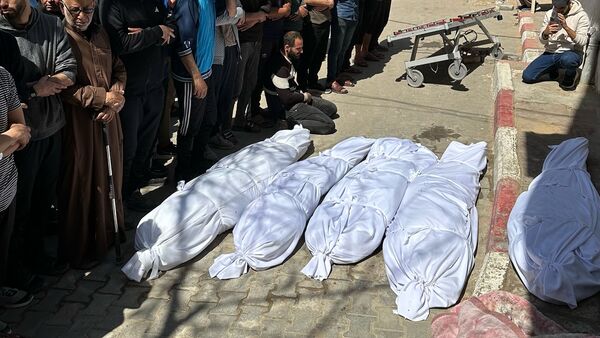
23 dead are the result of Israeli raids on the Gaza Strip since dawn today.

The death toll from Israeli airstrikes on the Gaza Strip since dawn on Sunday has risen to 23, including 19 in the southern Gaza Strip.


In Khan Yunis, south of the Gaza Strip, citizen Nisreen al-Abd Qassem was killed and others were injured when the Israeli occupation bombed the home of journalist Rami Abu Shamala in the al-Amal neighborhood of Khan Yunis.


Four members of the Qanan family were also killed in a bombing that targeted an apartment in the Al-Mawasi area, west of the city.


Ibrahim Bassem al-Najjar was killed and others were injured in an Israeli airstrike that targeted a tent housing displaced persons in the Wadi Saber area, south of the town of Abasan al-Kabira, east of Khan Yunis. Meanwhile, Salem al-Jabour and Bayan Naji Hussein al-Najjar died of wounds sustained in a previous airstrike on the city.


Earlier, ten civilians, including seven women and a child, were killed in an attack targeting a tent for displaced people in the Al-Mawasi area, west of Khan Yunis.


The body of the child Saif Abdel Rahman Al-Sinwar was also recovered, following yesterday's bombing of the Al-Bayram family home in Khan Yunis camp.


In the central Gaza Strip, citizen Fatima Raed Ahmed Abu Huwaishel was killed and eight others were injured in a bombing that targeted the Abu Huwaishel family home in the Nuseirat refugee camp.


In Gaza City, citizen Mohammed Habib (33 years old) was martyred, and his wife was injured, when occupation aircraft targeted the Al-Tuffah neighborhood east of the city.


In the northern Gaza Strip, citizen Hassan Zakaria al-Za'anin died of serious wounds he sustained in an Israeli bombardment of the town of Beit Hanoun a few days ago.


In the same context, rescue crews reported finding the body of martyr Khaled Ahmed Al-Kafarneh on the roof of Al-Shawa School in the town of Beit Hanoun.

PALESTINE

Sun 04 May 2025 4:05 pm - Jerusalem Time

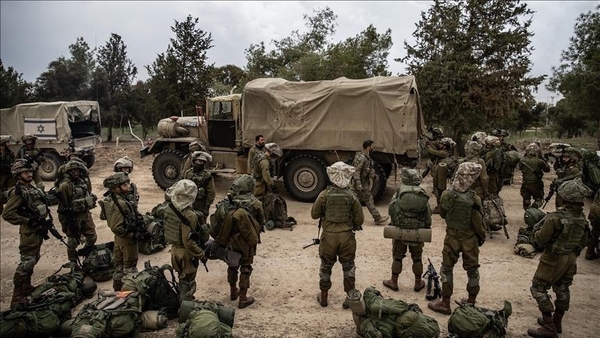
The Israeli occupation orders the recruitment of tens of thousands of reserve soldiers to expand the Gaza war.

Hebrew media reported on Sunday that tens of thousands of Israeli reserve soldiers received draft orders in preparation for an expanded war of extermination in the Gaza Strip, while many declared their intention to refrain from serving due to exhaustion.


Yedioth Ahronoth reported that "the security cabinet is expected to approve plans to escalate the fighting in Gaza today (Sunday), which will also require a large-scale mobilization of reserve forces."


According to the newspaper: "Over the past few days, tens of thousands of reserve soldiers have received notifications from their commanders, asking them to prepare for this."


For its part, Haaretz newspaper reported: "The Israeli occupation army began sending conscription orders to tens of thousands of reserve soldiers last night in preparation for expanding the scope of the fighting in Gaza."


The Israeli army was quoted as claiming that Hamas "continues to oppose the proposals presented in the negotiations."


Hamas said on Friday that it had presented a vision based on a comprehensive, simultaneous, five-year ceasefire agreement, which Netanyahu rejected and insisted on fragmenting the issues.


According to Haaretz, the army reiterated its position that "the declared goals of the war - foremost among them the return of the abducted (prisoners) - have not changed."


Tel Aviv estimates that there are 59 Israeli prisoners in the Gaza Strip, 24 of whom are still alive. Meanwhile, more than 9,900 Palestinians are languishing in its prisons, suffering torture, starvation, and medical neglect, many of whom have died, according to Palestinian and Israeli human rights and media reports.


The newspaper also quoted unnamed Israeli military sources as saying, "It is still unclear how long reserve service will continue under the new orders."


The same sources added, "The majority of the reserve personnel will be recruited to replace regular soldiers on the northern border and in the West Bank, with the aim of redeploying additional regular units to expand the fighting in the Gaza Strip."


The newspaper said: "With this, the Israeli army deviates from the planned framework of operational activity presented to reserve soldiers over the next 12 months."


She revealed that "even before the recruitment orders were sent out, many commanders and fighters announced that they did not intend to join the next round of combat, citing fatigue."


On Saturday, thousands of Israelis demonstrated in central Tel Aviv to protest the government's decision to expand the war of extermination in the Gaza Strip, believing it would kill living prisoners in the Strip and wipe out their bodies.


On Friday, Israeli Prime Minister Benjamin Netanyahu decided, during security consultations attended by Defense Minister Yisrael Katz and Chief of Staff Eyal Zamir, to expand the genocide in Gaza, including the call-up of thousands of reserve soldiers, according to Yedioth Ahronoth.


In early March, the first phase of a ceasefire and prisoner exchange agreement between Hamas and Israel, which went into effect on January 19, 2025, concluded with Egyptian and Qatari mediation and US support, and which the Palestinian movement adhered to.


However, Netanyahu, who is wanted by the International Criminal Court, evaded the start of the second phase and resumed the genocide in Gaza on March 18, in deference to the most extreme faction within his right-wing government, to further his own political interests, according to Hebrew media.


Since October 7, 2023, and with full American support, Israel has been committing systematic genocide in the Gaza Strip, leaving more than 170,000 Palestinians dead or wounded, most of them children and women, and more than 11,000 missing.

PALESTINE

Sun 04 May 2025 1:17 pm - Jerusalem Time

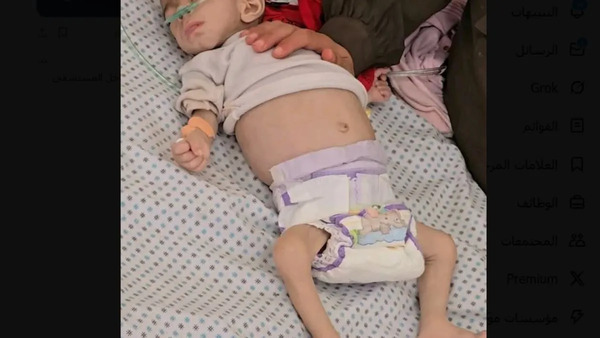
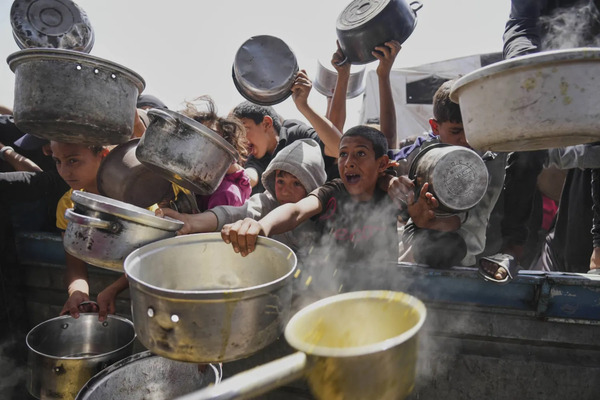
Janan died of starvation along with 57 other children and elderly people.

Yesterday morning, Saturday, infant Janan Saleh Al-Skafi died at Al-Rantisi Hospital west of Gaza City due to malnutrition resulting from the famine in the Strip, bringing the number of malnutrition victims in the Gaza Strip to approximately 57.

The infant, Al-Skafi, a resident of Gaza City, was receiving treatment and medical attention at Al-Rantisi Hospital, which had been rehabilitated after being bombed during the war.

Medical sources reported that approximately 60,000 children are suffering from malnutrition due to the Israeli occupation's strict blockade of the Gaza Strip, its closure of all crossings, and its prevention of the entry of essential supplies and humanitarian aid, including food, water, medicine, and even fuel, for approximately 64 days.

UNICEF warned that more than 96% of women and children in Gaza are unable to meet their basic food needs. A United Nations report indicated that 1.95 million Palestinians out of a population of 2.2 million are suffering from critical levels of food insecurity.

Since the first hours of the devastating Israeli war on the Gaza Strip, starvation, particularly in northern Gaza, has been a weapon of mass destruction, genocide, murder, siege, and destruction.

The Government Media Office in the Gaza Strip said in a statement that the number of victims of starvation and severe malnutrition has risen to 57 since the start of the war, the vast majority of whom are children, but also include the sick and elderly.

The office condemned in the strongest terms "the Israeli occupation's continued use of food as a weapon of war and its imposition of a stifling siege on more than 2.4 million people in the Gaza Strip by completely closing the crossings for the 63rd consecutive day."

He added that the number of martyrs due to starvation is likely to increase "in light of the ongoing crime of completely closing the crossings and preventing the entry of humanitarian aid, baby formula, nutritional supplements, and dozens of types of medicine."

The Government Media Office called on the international community and humanitarian and human rights organizations to take immediate and effective action to open the crossings and allow the entry of food and medicine "before it is too late."

Meanwhile, aid organizations in Gaza stressed that food, water, and fuel are running out and that the prices of the remaining scarce supplies are unaffordable, according to the Associated Press.

Oxfam in Gaza said that mothers in the Strip are feeding their children only one meal a day amid a stifling hunger crisis.

The Palestinian NGO Network warned that 70 community kitchens in Gaza will close within a week if the blockade continues and aid is prevented from entering.

For its part, the Norwegian Refugee Council noted that food production in Gaza is almost impossible due to Israeli airstrikes on the agricultural sector, adding that the Israeli navy is targeting fishermen in the Gaza Strip.

The council announced that no relief organization in Gaza had any tents left to distribute to the displaced, saying, "If Israel continues its blockade of Gaza, thousands will die and the system will completely collapse."

He added that Israel has created a situation in which Palestinians in Gaza cannot grow their own food or fish.


medicine shortage

Meanwhile, the Kuwait Specialized Hospital in Rafah, south of the Gaza Strip, warned of a severe shortage of most essential medicines and foods for patients.

He stated that the Gaza Strip is suffering from a severe shortage of more than 75% of essential medicines, noting that the ability to continue providing medical services is at stake, given that stocks of medicines and medical supplies are insufficient for more than a week.

He stressed that most medical services would cease without urgent and immediate intervention.

Since March 2, Israel has closed the Gaza Strip's crossings to the entry of food, relief, medical aid, and goods, causing a significant deterioration in the humanitarian situation for Palestinians, according to government, human rights, and international reports.

OPINIONS

Sun 04 May 2025 12:35 pm - Jerusalem Time

The fall of regimes and the reality of sectarian fighting in the Arab East: Where are we headed?


Christine Hanna Nasr

The aftermath of the Arab Spring has had repercussions, particularly on the regimes that fell, particularly in Iraq, and also in Syria, specifically after the fall of the ruling Baath regime, which was represented by the Baath Party and a single party. After the fall of the former Assad regime and the assumption of power during the transitional period by the new Syrian President, Ahmad al-Sharaa, we note an increase in the problems accumulated as a result of the Assad family’s rule, which lasted for more than 55 years. Here, we note that it is a regime that left a legacy of devastation in Syrian society, represented by ethnic and sectarian divisions, especially when Syrian society was divided into several sections, including a section supported by Iran and Hezbollah, which supports the ruling minority with its Alawite component, and the other section of the Syrian Sunni component supported by Turkey and represented by the Syrian National Army, which supported and armed the Syrian National Army. Unfortunately, this created a major rift between the two components in one country, especially in light of the exclusion of other components by the ruling component, which monopolized power and controlled the country’s resources at the expense of marginalizing other components.

Unfortunately, after the fall of Bashar al-Assad’s regime and until now, everyone expected that Syria would enter a new phase of state-building, i.e., the new Syria, and what I can call the best phase for healing old wounds after years of revolution, with the aim of reaching a new phase of building a pluralistic, democratic, secure and stable state. Unfortunately, the alternative, especially in this transitional phase of governance, was to enter the scene of the Syrian state, which can be described as difficult and crisis-ridden, i.e., the phase of division and sectarian fighting, the pace of which has increased day after day, until we began to see scenes of sectarian fighting that would explode and destroy the fabric of Syrian society, and dismantle the national unity between the components of the single state. For example, what happened in the sectarian fighting in the areas of the Syrian coast with an Alawite majority, which ruled Assad’s Syria, as well as the sectarian massacres in Tartus and Latakia, where we witnessed a state of clear rift and psychological, political and social destruction, and an increase in sectarian fighting and the spread of sectarian manifestations in the state. Unfortunately, it is undoubtedly a remnant of the defunct regime, as Syria is now entering a phase of fighting. Sectarianism, including a bloody reality between the components of a single nation, is based on differences in religion, belief, and ancient inherited blood feuds. These massacres, committed against the Alawite component on the Syrian coast, have clearly been characterized by collective revenge against the Alawite component associated with the defunct Assad regime.

Damascus and its suburbs also witnessed an outbreak of bloody clashes, specifically in the Druze-majority suburb of Jaramana, and the town of Ashrafieh Sahnaya, administratively affiliated with the Damascus countryside. The number of victims in these areas increased due to the manifestations of sectarian fighting and clashes. Unfortunately, the conflict now in Syria is not a military or political conflict, but rather an existential sectarian conflict, the predominant feature of which is the accusation of treason against the different other, and an increase in the psychology and motives for revenge and murder among the various components of the same homeland. Here we find that society, instead of being cohesive, is losing its cohesion, and the respect for pluralism in one country is fading. Peace and coexistence are also absent, and flimsy, empty pretexts are used for sectarian fighting. Unfortunately, all of this is a remnant of the defunct Assad regime, which played a role in deepening the principle of exclusion and discrimination between the various components of society, and the regime’s monopolization of exclusionary rule that brutalizes others.

Here we find that Syria is now embroiled in a conflict that has deepened the increasingly abhorrent sectarianism, rather than calming the situation for this Syrian society, already exhausted by the war, which has lasted for more than 14 years and has left the people financially, economically, socially, security-wise, and politically exhausted.

Unfortunately, one of the factors deepening sectarian strife is the presence of armed foreign militias coming from neighboring countries. It seems that their goal is to prevent the new transitional government from succeeding in establishing security, but rather to distract it from establishing security and stopping internal fighting, instead of devoting itself to building the new Syrian state. Therefore, the factions and foreign fighters must be removed from Syrian territory. Now in Syria, it is clear that there is no national reconciliation between the components of a single nation, as we are witnessing the concept of a narrow state, meaning the loss of the feeling of the principle of tolerance between its various ethnic components. The state must be a strong state with its various cohesive components, dominated by the character of strong national unity.

The question here is, when will homelands be built in the countries of the Arab East, which are witnessing wars? When will the sectarian structure of these countries and societies disintegrate? When will a strong national structure take root in its place and will just civil rule be imposed on all the various components of the state? In other words, when will we face a model of a strong, secure, and diverse state that is not based on sectarianism, revenge, and infighting between the various components of the people? When will a social contract be built whose goal is citizenship, not sectarian infighting or narrow, supremacist ideas? When will society succeed in establishing comprehensive national dialogues to unify them and achieve their unified demands, along with succeeding in fortifying society against factors of collapse, along with achieving success in spreading civil peace and preventing internal collapse.

The answer is that there is no exploitation by any country with external influence and through a loyal army linked to it, which it unfortunately exploits to inflame the internal situation and create a state of sectarian strife, in order to achieve its external goals, which it will achieve by creating a state of internal chaos in countries, in order to achieve gains for external forces that do not care about the citizen and the homeland, but rather its primary goal is to weaken countries and societies in order to dominate them, occupy them, control the capabilities of the homeland and divide it socially and geographically.

PALESTINE

Sun 04 May 2025 12:28 pm - Jerusalem Time

13 Palestinians dead including a child and 8 women, and wounded in the occupation's bombing of various parts of the Gaza Strip.

Thirteen civilians, including a child and eight women, were killed Sunday morning in Israeli shelling of various parts of the Gaza Strip.


Local sources, citing medical sources, reported that two civilians, including a woman, were killed and others were injured when the occupation forces bombed a home belonging to the Abu Huwaishel family in the Nuseirat refugee camp.


The same sources added that 10 citizens, including seven women and a child, were killed when the occupation forces bombed a tent housing displaced persons in the Al-Mawasi area, west of Khan Yunis.


It noted that two citizens died of their wounds as a result of the occupation's bombing of Khan Yunis and Beit Hanoun.


Separately, medical sources in Gaza said that the occupation authorities are preventing international and UN organizations from accessing fuel storage sites designated for hospitals, claiming that they are located in red zones.

The same sources explained that the occupation is obstructing fuel supplies from reaching hospitals, threatening to shut them down, as they rely on generators to power vital departments.

It noted that the available fuel supplies in hospitals are sufficient for only three days.

Since October 7, 2023, the Israeli occupation forces have launched an aggression against the Gaza Strip, resulting in the deaths of 52,495 citizens, the majority of whom were children and women, and the injury of 118,366 others. This is a preliminary toll, with a number of victims still under the rubble and on the streets, unable to be reached by ambulances and rescue teams.

PALESTINE

Sun 04 May 2025 11:51 am - Jerusalem Time

The Palestinian Government Communication Center monitors the most important interventions implemented by the government during the past week.

The Government Communication Center issued a report outlining the most important developmental and reform interventions implemented by the Palestinian government during the past week (April 27, 2025 - May 3, 2025), as follows:

The report explained that Prime Minister and Foreign Minister Mohamed Mustafa held discussions in London last Monday with his British counterpart, Keir Starmer, and Foreign Secretary David Lammy regarding the Israeli aggression on Gaza and the West Bank, including Jerusalem. They emphasized the need for a ceasefire and the entry of humanitarian aid.

It was agreed to upgrade relations to a strategic partnership, sign a memorandum of understanding to enhance cooperation in various fields, and affirm commitment to the two-state solution and ending the occupation as the only path to achieving a just peace.

Britain also expressed its intention to recognize the State of Palestine and the Palestinian people's right to self-determination, and announced a £101 million support package to strengthen the Palestinian economy, governance, and institutional reform.

The Palestinian Energy and Natural Resources Authority signed a $655,000 agreement to supply medium and low-voltage cables to the Gaza Strip.

- A government-funded project was also completed to install 200 kilowatt solar cells in the Solomon's Pools area of Bethlehem, with the aim of supplying service buildings with sustainable energy and reducing reliance on external sources.

The Water Authority in the Gaza Strip is carrying out maintenance work on 25 wells and distributing desalinated water at a rate of 1,300 cubic meters per day, in cooperation with UNICEF. It also signed an agreement with the German government to implement a sustainable management program for non-conventional water, with the aim of improving wastewater management and sustainable reuse. The Authority is also continuing to study the site of the Malaki Dam as part of a project that includes a treatment plant in Tulkarm and the transfer of water from Nablus to the Jordan Valley for use in agriculture and renewable energy generation.

The Ministry of Agriculture launched a unique project to support the resilience of farmers in the Jerusalem Governorate, in cooperation with the Bayt Mal Al-Quds Agency in Rabat, through an urgent aid package to provide production inputs.

The Minister also discussed with the Shuyukh Municipality the needs of farmers and the development of the Martyr Khalil Al-Wazir Nature Reserve. The Ministry opened agricultural offices in Kafr Thulth and Al-Funduq/Qalqilya to enhance services, and implemented three training courses in Nablus as part of the "Relap" project, benefiting 79 farmers. Within the framework of the same project, 27 small grant agreements were signed with Jenin farmers. The Ministry received the first phase of the Samou Station for Animal Breed Improvement, funded by the European Union. This phase included a laboratory, a training hall, and other facilities.

The Ministry distributed 790 olive seedlings to 12 farmers in Salfit as part of the "Greening Palestine" project, and 130 5-cubic-liter water tanks to 35 Bedouin communities in Jerusalem, with funding from the FAO.

Three training days were also held for 60 female farmers in Bethlehem on milk production, a field day at Al-Ummah School in Al-Ram to plant a garden, and an organic fertilizer production workshop for female farmers in Al-Auja in the Jordan Valley.

The President issued a decree-law on competition to foster a fair investment environment and prevent monopolies, building on the Ministry of National Economy's efforts to promote competition and prevent monopolies. The Ministry also announced the opening of import applications for goods within the 2025 quota, referred five violators to the Public Prosecution, issued 29 notices, seized 19.5 tons of non-compliant goods, conducted 94 inspection tours, and collected 15 samples for testing.

The Ministries of Local Government and Finance completed settlement and clearing procedures for three new local authorities. The Minister of Local Government also conducted an inspection visit to Jenin Governorate to review relief efforts for displaced persons and the needs of local authorities.

This week, the Ministry completed several street rehabilitation projects in Beitunia, Zeita, Marka, and Dura, in addition to delivering a waste truck to the Halhul Municipality through the Municipalities Fund.

The Wall and Settlement Resistance Commission supported the steadfastness of the residents of Sinjil and Anata in the face of settler attacks, by distributing tents and building materials such as wooden planks, zinc sheets, and water tanks.

The Ministry of Jerusalem Affairs participated in the 18th "Flower of Cities" Festival, affirming its continued support for culture despite the expulsion of its minister from the West Bank. The festival honored writers from Palestine, Jordan, and Egypt, in the presence of national and cultural figures.

The Ministry of Foreign Affairs and Expatriates continues to direct Palestinian embassies around the world to enhance diplomatic and humanitarian efforts and expose the crimes of the occupation.

The Minister of State for Foreign Affairs also participated in the 163rd session of the Council of the League of Arab States, stressing the importance of supporting the wounded in Gaza and the Palestinians in Egypt. She also presented a comprehensive briefing to the Arab Ministerial Committee on Jerusalem, calling for confronting attempts to displace our people.

The Ministry of Culture launched 37 cultural projects, including 11 to support the resilience of creative individuals in Jerusalem. The Minister of Culture also launched the Jerusalem Award for Arab Women in Literary Creativity and met with cultural and youth figures in the Tubas Governorate to promote the role of culture.

Palestine participated in an international meeting to protect heritage, while the Ministry organized numerous cultural events in the governorates, including literary and educational workshops, theatrical performances, seminars, evenings, youth gatherings, and folk tales. The events aimed to support national identity, empower women, and enhance the presence of culture in marginalized areas threatened by settlement expansion.

The Ministry of Public Works has completed the rehabilitation of the alternative road between Masha and Az-Zawiya in Salfit, carried out maintenance work on roads damaged by low-pressure systems in Hebron, and paved and leveled the connecting and ring roads in Qalqilya in cooperation with the municipality.

The Environmental Quality Authority followed up on 17 complaints, conducted 51 inspection tours of industrial facilities, and monitored the effects of a fire at a random landfill northwest of Ramallah. It issued a report documenting Israeli environmental violations during the first quarter of 2025, and organized awareness-raising activities and planted medicinal seedlings in areas threatened with seizure, with local community participation.

In its 58th session, the Cabinet approved recommendations for preparing the 2025 legislative agenda. The Minister of Justice also discussed with a delegation from the UNDP and Sawasya the "Business and Human Rights Frameworks" initiative, aimed at enhancing integration between the justice and economic sectors and developing alternative means of dispute resolution.

The Ministry of Tourism and Antiquities launched the first phase of the General Inventory of Tangible Cultural Heritage in Palestine project, and a cultural tourism trail in the Old City of Al-Bireh to raise awareness of heritage and support local products. It also concluded the "Know Your Country" program, in cooperation with the Ministry of Education and the Jericho Municipality, to introduce students to archaeological sites.

The Ministry of Awqaf and Religious Affairs implemented a series of religious, educational, and social activities, most notably honoring hundreds of male and female Quran memorizers in Jenin, Hebron, and Ramallah. The Ministry also launched specialized courses in inheritance law and Quran memorization as part of the "Distinguished Memorizer" program in Tulkarm. Women's training courses in Nablus aimed at empowering women economically were also held, as were awareness-raising workshops in Jenin and Dura, and a lecture on cyber-extortion in Hebron.

The Ministry of Social Development continued its relief efforts over the past week. The minister conducted a field visit to Jenin to monitor the conditions of displaced persons, announcing the collection of 1.5 million shekels and the distribution of 426,000 shekels across the directorates. She also inspected shelters hosting 600 displaced families.

In Tubas, the Ministry of Development provided aid worth NIS 60,000. In Tulkarm, it distributed 500 mattresses and 500 hygiene kits worth NIS 127,000. The Ministry's directorate in Qalqilya also sent aid worth NIS 12,250 to Tulkarm. Various interventions were also implemented in Nablus, Yatta, Jerusalem, Jericho, and Bethlehem, including psychological support, protection files, health insurance, economic empowerment, and honoring 29 active organizations.

The Ministry of Education and Higher Education held a series of meetings to follow up on the implementation of a joint Jordanian-Palestinian initiative to support students from Gaza who are expected to graduate. This initiative allows them to complete their courses through free self-study. With the participation of the Minister of Education and Higher Education, Birzeit University launched the Graduate Student Research Forum for the 2024-2025 academic year. The Minister also discussed with the French Development Agency (AFD) support for Nablus University's vocational and technical education. The Ministry also organized an introductory workshop on the Horizon Europe program, with the participation of European experts.

Palestine achieved an exceptional accomplishment by taking the top three places in the Quantum Computing and Artificial Intelligence Hackathon, held in Abu Dhabi from April 24 to 28, 2025, with the participation of international teams. This achievement came after Palestinian teams qualified through the Palestine Quantum Computing Hackathon, organized by the Ministry of Telecommunications and Digital Economy in cooperation with the Palestinian Computing Hackathon Committee.

The Minister of Labor signed an agreement with the Gift of the Givers Foundation to provide urgent in-kind assistance to affected workers in camps in the northern West Bank. She also called on donors to support Palestine's accession to the International Labor Organization as an observer, and to promote initiatives in entrepreneurship, telework, occupational safety, and vocational education and training.

In support of citizens' steadfastness in areas threatened with confiscation, the Ministry of Transportation continues to facilitate the licensing of tractors and the updating of drivers' licenses on the spot, without the need to visit the directorates. Approximately 100 licenses have been granted in the south and east of Ramallah.

The Ministry is also working to strengthen infrastructure in Tulkarm and Jenin, in cooperation with municipalities.

ARAB AND WORLD

Sun 04 May 2025 10:58 am - Jerusalem Time

Columbia University Protesters' Investigation Orders Concern the Justice Department

The New York Times revealed that informed sources told the newspaper that a senior Justice Department official appointed by Trump ordered an extensive investigation into the Columbia University student protesters over the past few months, sparking anger and concern among prosecutors and investigators who viewed the request as politically motivated and lacking legal basis.


The sources added to the newspaper that the request to investigate students who protested Israel's conduct in the Gaza conflict also drew opposition from a federal judge, who deemed some of the steps sought by the official, Emil Bove III, unjustified and potentially violating the First Amendment to the US Constitution.


The scope of the investigation, conducted by the Justice Department's Civil Rights Division, has not been previously reported. The ensuing dispute highlights the tensions gripping the department as administration officials seek to implement President Trump's agenda. This proposal involves redirecting the Civil Rights Division away from its traditional approach of protecting minority rights to a new mission: fulfilling a campaign promise to crack down on student protesters amid allegations of rampant anti-Semitism on campus.


According to current and former officials, these demands from political appointees at the Justice Department are part of the reason for the exodus of lawyers from the department in recent weeks.


The federal investigation into the student protests at Columbia University appears to have stalled for now, but it represents one of the most contentious episodes so far within the Justice Department during Trump's second term. The people told the newspaper that the dispute has created ongoing ill will within the department, as well as in the courts and the FBI.


When asked for comment, Deputy Attorney General Todd Blanche said, "This is a false story concocted by a group of people who have allowed anti-Semitism and support for Hamas terrorists to fester for years, standing by and doing nothing."


The Trump administration has pledged to address the university protests against Israel's military campaign in the Gaza Strip, saying they reflect anti-Semitism that warrants punishment. These efforts target both college administrators, whom Trump officials say should have done more to curb campus protests, and the student activists themselves, some of whom have been detained by immigration officials. The activists, in turn, accuse authorities of conflating criticism of Israeli and US policies with anti-Semitism.


The investigation began shortly after masked protesters stormed Milbank Hall, a building at Columbia University's Barnard College, on February 26 to demonstrate against the expulsion of students accused of disrupting a Modern Israel History lecture. Video footage shows students shoving a security guard and occupying a hallway. School officials said the guard was assaulted and hospitalized with minor injuries. Boff, a senior Justice Department official, ordered an immediate investigation, primarily into one specific student group, Columbia University Against Apartheid, according to three people familiar with the matter who spoke on the condition of anonymity to discuss details meant to remain confidential.


At Pough's urging, prosecutors in the Civil Rights Division were asked to obtain a list of the group's members. However, investigators rejected this instruction because they were skeptical that such a list existed, given the opaque nature of online forums. Even if it did exist, vetting people's memberships seemed like a potential violation of their First Amendment rights, according to these individuals.


One of the Justice Department lawyers assigned to the case was Samantha Tribble, a seasoned civil rights prosecutor who secured a federal conviction against Derek Chauvin, the Minneapolis police officer who killed George Floyd in 2020, the people said. The people said prosecutors told them that Poff was seeking a list so the information could be shared with immigration agents. The people said prosecutors within the Civil Rights Division feared their criminal investigation could be used to facilitate a Trump administration campaign of intimidation and deportation against student protesters. They added that prosecutors refused to compile such a list that could be provided to Immigration and Customs Enforcement agents. The people said Poff then shifted his focus to obtaining a search warrant for the group's Instagram account. They said they instructed prosecutors to request a search warrant for non-public data associated with the account.


These people said that prosecutors' superiors informed them that Poff was seeking a list so that the information could be shared with immigration agents. These people said that prosecutors within the Civil Rights Division had become concerned that their criminal investigation was being used to facilitate a campaign of intimidation and deportation by the Trump administration against student protesters. They said that prosecutors refused to compile such a list that could be provided to Immigration and Customs Enforcement agents. They added that Poff then shifted his focus to obtaining a search warrant for the group's Instagram account. They said they instructed prosecutors to request a search warrant for non-public data associated with the account. They said the premise of the request was also controversial within the department. Poff insisted that the Instagram account in question had been used to issue a threat, while prosecutors argued that the statement did not meet the legal definition of a threat. In late March, the social media company suspended the group's account for failing to meet its "community standards."


Blanch added in his statement that the search warrant request, which focused on Columbia University's campaign against apartheid, "included an image from CUAD's social media accounts showing the inverted triangle symbol used by Hamas to identify targets of violence, spray-painted on Columbia University property with red paint designed to look like blood."


He said the investigation was "ongoing," apparently referring to a related criminal investigation by federal authorities, which "included an independent judge finding good cause to believe there was evidence of land at Columbia University housing and concealing illegal immigrants."


Before Trump addressed the Justice Department on March 14, Blanch told the audience that the department was investigating whether anyone involved in the Columbia University campus protests violated civil rights and anti-terrorism laws.


Blanche expressed his firm belief in the wisdom of conducting such an investigation. But behind the scenes, the professional lawyers harbored deep doubts about the merits of the case they had been assigned to, and deep fears about the potential consequences of their refusal.


Bove's demands angered staffers in the Civil Rights Division, but many managers were afraid to respond, having watched Bove a month earlier press prosecutors in another division, the Public Integrity Division, to drop criminal charges against New York Mayor Eric Adams, according to the three people. That division, which once had about 30 lawyers, now has only a handful.


Bennett Gershman, a law professor at Pace University who specializes in prosecutorial ethics, told the newspaper that Mr. Bove's described behavior was "astonishing."


“He did something that prosecutors are absolutely prohibited from doing—using government law enforcement powers to attempt to intimidate these individuals or destroy their rights,” Gershman said. “This goes far beyond the bounds of prosecutorial professionalism and adherence to the principles of justice.” In his statement, Blanche said that “the unethical and inaccurate allegations made by deep state terrorist sympathizers, who have stood by as members of the Jewish faith, have been targeted across the country” and will not deter Attorney General Pam Bondi and the Department of Justice from “vigorously investigating criminal conduct and rooting out anti-Semitism.”


When federal prosecutors investigating the student protests applied for a search warrant, a New York magistrate judge denied the request, saying the government lacked sufficient cause, the people said.


In an unusual move, Poff insisted that the plaintiffs appeal the ruling to a district court judge, according to these people. After reviewing the request, Judge John J. Koeltl of the federal court for the Southern District of New York instructed Chief Magistrate Judge Sarah Netborn to reconsider the request, according to these people.


But the second time, the government lawyers' fate was even worse. Judge Netburn not only denied the search warrant request, but also ordered the government to abide by a special condition: If prosecutors try to refile such a request before another federal judge, they must include a transcript of the confidential discussions in her court, according to these people.


Part of the judge's skepticism stems from the absence of lawyers from the Manhattan federal prosecutor's office in the case, these people said. But prosecutors in the Southern District of New York were wary of signing on to the effort and had little role in it, according to these people. A spokesman for the U.S. Attorney's Office in Manhattan declined to comment.


While civil rights prosecutors conducted the investigation Bove requested, they often opposed specific steps he wanted to take, these people said, arguing that they were either not justified by the available facts or conflicted with the law and past practice, or both.


At one point, Bove instructed FBI agents on the New York Joint Terrorism Task Force to don their SWAT vests, go to the Columbia campus, and stand in formation near any protesters. These individuals said the instruction was viewed within the Civil Rights Division as completely inappropriate and a blatant attempt to intimidate students. The FBI agents did not demonstrate any such show of force.


By early April, the investigation appeared to be largely over, but nothing prevented Bove or others from reviving it. But in the aftermath, people familiar with the case said it only exacerbated ill will and mistrust between political appointees at the Justice Department's headquarters in Washington and the New York attorney general's office, as well as between those political appointees and veterans of the Civil Rights Division.

ARAB AND WORLD

Sun 04 May 2025 10:00 am - Jerusalem Time

Qatar rejects Netanyahu's statements, stressing its lack of "the lowest levels of moral responsibility."

Qatar has rejected Israeli Prime Minister Benjamin Netanyahu's accusations, describing his statements as inflammatory and irresponsible.

Qatari Foreign Ministry spokesman Majed Al-Ansari said in a post on the X platform on Sunday that the State of Qatar "categorically rejects the inflammatory statements issued by the Israeli Prime Minister's Office, which lack the minimum levels of political and moral responsibility."

Al-Ansari considered that "portraying the continued aggression against Gaza as a defense of 'civilization' brings to mind the rhetoric of regimes throughout history that have used false slogans to justify their crimes against innocent civilians."

He added that since the outbreak of the war on the Gaza Strip, the State of Qatar, in coordination with its partners, has worked to support mediation efforts aimed at stopping the war, protecting civilians, and ensuring the release of hostages.

He said, "A legitimate question must be raised here: Were at least 138 hostages released through military operations described as 'justice,' or through mediation, which is being criticized and unjustly targeted today?"

Al-Ansari continued, "On the other hand, the Palestinian people in Gaza are experiencing one of the worst humanitarian disasters of the modern era, from a stifling blockade and systematic starvation, to deprivation of medicine and shelter, to the use of humanitarian aid as a weapon of political pressure and blackmail. Is this the 'civilization' they are trying to market?"


The Qatari Foreign Ministry spokesperson emphasized that "Qatar's principled foreign policy does not conflict with its role as an honest and reliable mediator. Disinformation campaigns and political pressure will not deter it from standing with oppressed peoples, defending the rights of civilians regardless of their backgrounds, and advocating for international law without fragmentation or selectivity."

He also stressed that "the State of Qatar continues its close work with both the Arab Republic of Egypt and the United States of America to achieve an immediate ceasefire, ensure the flow of humanitarian aid, and advance a just and lasting peace based on the values of justice and humanity, not violence and double standards."

He concluded by saying, "The State of Qatar reaffirms its firm belief that true peace can only be achieved through a just and comprehensive settlement based on international legitimacy resolutions, ending the occupation, and guaranteeing the legitimate rights of the Palestinian people, foremost among which is the establishment of an independent state on the 1967 borders, with East Jerusalem as its capital."


Al-Ansari's remarks came in response to inflammatory statements issued by Netanyahu's office attacking Qatar for demanding that Israel, before the International Court of Justice, halt the genocide in the Gaza Strip and allow the entry of food and medical aid into the territory.

Netanyahu said, according to what was reported by his office, that "it is time for Qatar to stop manipulating opinions with its double standards and to decide whether it will stand with civilization or with the barbarism of (the Islamic Resistance Movement) Hamas," as he put it.

OPINIONS

Sun 04 May 2025 8:54 am - Jerusalem Time

The cruel departure

Hamada Faraana

Netanyahu was unable to achieve his goals in response to the October 7 operation. He failed despite occupying the entire Gaza Strip. He was unable to locate the Israeli prisoners and release them without a prisoner exchange. He failed to end and eliminate the resistance. Because he possesses the power, armament, and superiority, he chose the path of death for the Palestinians.

Not a single woman raised the white flag, and all of them who appeared said with truth and faith: We will not leave, we will remain above the rubble, the ruins, and the destruction, we will not leave here, we will stay, we will not leave, and the bombing and death will come to them.

Death is the harsh choice. It sweeps away the Palestinians there, and sweeps away friends here. The engineered unionist friend, Qaher Safa, departed too soon. The force of life did not defeat him, not in Yemen, not in Syria, not in Jordan. Death defeated him, and we lost him, because of his inability to continue protesting.

All those who lost him, disagreed with him, with his stubbornness, with his strength, with his belief in his refined and gentle Jordanian citizenship, and his steadfast Palestinian identity. He was an elected unionist who disagreed with the "Muslim Brotherhood" and confronted them, and allied with the leftists and nationalists and clashed with them. He was not just a number, but a unique kind of man. A unionist, a patriot, a professional, a nationalist, possessed of stubbornness, without any trace of hatred, possessed of giving and rejected rottenness, a heritage that was progressive, as well as conservative, a mixture of life's givens.

I don't think that the disease defeated him or overcame him, despite its damnable assault on him and his body, because I am certain from my knowledge of him, that he passed away because of his inability to protest sufficiently. The Israeli invasion of the Gaza Strip: killed him, the Israeli invasion of the Gaza Strip accompanied by death and killing, coincided with the disease, so he passed away rejecting what was happening to the people of Gaza, to his people who spent the details of his life pleading for his desire for freedom and to return to Palestine.

Protest and rejection are the title of Qaher Safa, its substance. He was not compromising even on the simplest requirements of life and his right to it, and for this reason he lost his rights to stability, reassurance, and equal citizenship like the rest of humanity.

He was unable to return, and died outside Palestine, along with his membership in the Palestinian National Council. The consolation for him is that Jordan, its people, and its soil remained warm with him. This is confirmed by the fact that the pure Jordanian soil embraced him and will continue to preserve it until he returns as part of what he had, through his family and friends, who will carry his trace and return with him towards the river, spreading his breath there after they cross the bridge, before they reach Jericho and Kafr Malik.

We mourn the loss of a friend, and we are deeply saddened by the destruction, killing, starvation, thirst, and deprivation of the right to life that is happening to the Palestinian people in Gaza.

This is how the people of Karak, Ma'an, Tafilah, Salt, Madaba, Jerash, Irbid and Ramtha, Bani Hassan and Bani Sakhr are, all those who love Jordan, adore it, owe it loyalty and dignity, live their daily lives in solidarity, and their noble human interaction with their people and their extension in Gaza, and even to the rest of Palestine. The pain is one, the dream is one, and Jordan's security, stability, progress, democracy and pluralism are the title of the Jordanian lever for the freedom and independence of Palestine. This is why we miss Qaher Safa, with whom we believed in the credibility of our Jordanian citizenship, and "our Palestinianness to the marrow of the bone", as I have said everywhere, and I say it and repeat it, and I will not back down from it. Loyalty to Jordan, as is loyalty to Palestine.

Qaher Safa has departed. May God forgive him and offer our condolences to his family. We will follow him, and we have no choice but to continue on the path he walked for a better future for all our people in Jordan and Palestine.

OPINIONS

Sun 04 May 2025 8:38 am - Jerusalem Time

An army that fears its image!

Amin Al-Hajj


As the occupation celebrates the 77th anniversary of the declaration of its state, in a scene that raised questions, the occupation army decided to conceal the faces of 120 of its soldiers during the annual ceremony to "honor" them. They were merely shown in a manner that concealed their features, without publishing their names. This decision may seem like a small detail in a security protocol, but in reality, it reflects profound implications that expose the contradictions in the discourse of "military pride" that it constantly boasts about. What does it mean to honor a soldier without a face? In essence, honoring is a celebratory act that shows appreciation and public recognition for someone who has performed a "heroic" act. But when a soldier is prevented from appearing publicly, or his face is hidden, the equation of honor turns into a state of fear. Is it honoring or concealment? Pride or denial?

Hiding soldiers' faces implicitly means that he is either unable to protect them, unable to bear the consequences of their actions, due to their involvement in violations that could lead to legal accountability, or simply fears that their identities will be known and they will be targeted. Here, the soldier is transformed from a "symbol of courage" into a ghost in a system that fears accountability.

But concealment doesn't just reflect an escape from accountability, but also an evasion of the self, as psychoanalysts have argued. What isn't perceived internally manifests externally in the form of "fate." Thus, the outside world becomes a stage for internal conflict. When a state is embarrassed to display its combat symbols, it declares—consciously or unconsciously—a loss of confidence in its moral narrative. What's hidden isn't just the face of a soldier, but rather a mirror of lost legitimacy, one that it fears confronting because it reveals what it seeks to deny. Concealment here isn't just a means of protection; it's a collective defense mechanism to protect a fractured narrative from collapsing in the face of a simple moral question: What have we done? Consequently, concealment here is no longer an option, but an existential necessity for a system that has come to recognize itself as morally and legally exposed.

The soldier's image is not merely a visual identity; it is a political narrative. Hiding faces in the age of the image is an implicit admission that the image has become damning evidence that incriminates, not exonerates. After a series of clips documenting his crimes against civilians—from killing and starving children and women to destroying homes—he realized that the image could transform him from a claimant to legitimacy into an accused war criminal.

In an unequal battle, the image may defeat the bullet, and awareness may prevail over force. Military superiority does not guarantee victory when the executioner is defeated in the media arena, the camera becomes a court, and the image becomes a weapon that moves the streets and tightens the noose on the machine of oppression. Although its influence is still limited, it is expanding day by day.

An army that cannot display photos of its soldiers is not worthy of being proud of. How can it be presented as the "most moral army," as its leaders claim, while concealing those it claims are "role models"? How can a society be proud of its army while keeping its "heroes" anonymous, for fear of international law or a public opinion that no longer believes the old lies?

What's worse is that this concealment exposes the depth of the moral dilemma it is experiencing. It knows that what it is committing on the ground, in Gaza, the West Bank, the displaced villages, and throughout the region, cannot be publicly defended or marketed as "national pride," even if it could temporarily. Therefore, in this context, the soldier is no longer a symbol of heroism, but rather a moral burden hidden from view, so that the world does not see the true face of the occupation. Thus, the occupation does not appear as it claims, but as it is: fearing its image, ashamed of its soldiers, and hiding behind false masks. The hero is not the one whose face is hidden, but the one who reveals it to the public to tell the story of the truth.


.........


An army that cannot display photos of its soldiers is not worthy of being proud of. How can it be presented as the "most moral army," as its leaders claim, while concealing those it claims are "role models"? How can a society be proud of its army while keeping its "heroes" anonymous, for fear of international law?


PALESTINE

Sun 04 May 2025 8:34 am - Jerusalem Time

The US and Israel are close to agreeing on a "new mechanism" to deliver aid to Gaza.

The United States, Israel, and representatives of a new international organization are close to reaching an agreement on how to resume the delivery of humanitarian aid to Palestinians in Gaza without Hamas controlling it, Axios reported, citing Israeli officials and a US source.

Israel suspended all humanitarian aid, including food, water, and medicine, to the Gaza Strip after the collapse of the ceasefire agreement in Gaza two months ago, exacerbating the humanitarian crisis.

UN relief agencies say food supplies in Gaza will run out within days, while Israeli officials claim the stock will be completely depleted within three to four weeks.

Axios reported that an internationally managed foundation supported by countries and charitable organizations will deliver aid to Gaza. It will be led by humanitarian figures and an advisory board of prominent international figures.

Israeli officials said that according to the plan, "several compounds will be established in part of Gaza, and Palestinian civilians will be allowed to go to them once a week to receive one aid package per family, sufficient for seven days."

A source familiar with the plan stated that "Israel has committed to funding and implementing the engineering work necessary to build the infrastructure for safe aid distribution sites," adding that the parties to the agreement are in advanced discussions with donor countries that will fund the organization's operations, including the purchase of humanitarian aid.

He continued, "A private American company will be responsible for delivering aid logistically and providing security inside and around the complexes."

Israeli officials stated that Israeli military forces will not participate in the distribution of aid and will not be present inside the compounds, but will provide security in the surrounding areas, according to Axios.

The website added that American and Israeli officials want the new mechanism up and running when US President Donald Trump visits the region in two weeks.

Trump is expected to visit Saudi Arabia on May 13, then travel from there to Qatar and the UAE.

Israeli officials said they want the mechanism up and running before Israel also expands its ground operation in Gaza, expected later this month if the stalemate in prisoner swap and ceasefire negotiations continues, according to Axios.

An informed source told the US website that the new mechanism will meet Trump's goal of allowing humanitarian aid into Gaza, while adhering to Israeli government directives that no aid reach Hamas.

A US State Department official added, "We understand that the mechanism will deliver aid to those in need, with guarantees that it will not be misused or abused by groups like Hamas and Islamic Jihad."

"President Trump and Secretary Rubio expect all UN agencies and international aid to work within the framework of the mechanism to ensure that these vital resources do not reach Hamas," the official continued, according to Axios.

Israeli officials say the new aid distribution system will weaken Hamas "because it will deprive it of revenue and reduce the population's dependence on it," Axios reported.


PALESTINE

Sun 04 May 2025 8:32 am - Jerusalem Time

Bombing of homes and tents, and marches pursuing gatherings of hungry people in front of the takayas and water wells.

39 martyrs, most of them children, in horrific massacres

11 martyrs from the Al-Bayram family were killed when their home in Khan Yunis camp was bombed.

10 martyrs in the occupation's bombing of the Ghattas family home in Shuja'iyya

A fisherman was killed and three others were injured by Israeli fire in the northern Gaza Strip.

Three civilians were killed and others injured after the bombing of the Al-Gharabli building on Salah al-Din Street.

4 martyrs in bombing of Al-Daraj neighborhood


The Israeli occupation forces continue their aggression against the Gaza Strip for the 46th consecutive day, resuming their genocidal war. This comes amidst the tragic humanitarian conditions facing the population, amid severe food and medicine shortages and a near-total collapse of basic services.


Since dawn yesterday, Saturday, 39 citizens, including children, have been killed as a result of the occupation's bombing of several sites in the Gaza Strip.

The death toll from the genocidal war on the Gaza Strip has risen to 52,495 martyrs and 118,366 wounded since October 7, 2023.

The Ministry of Health in Gaza reported that the death toll includes 2,396 martyrs and 6,325 injuries since March 18, when the occupation resumed its aggression on the Gaza Strip following the ceasefire agreement.

Over the past 24 hours, 77 martyrs arrived at Gaza Strip hospitals, including 7 who were recovered. 275 others were injured, and a number of others remain buried under the rubble and debris, as well as on the streets, unable to be reached by ambulances and civil defense teams.


In detail, the occupation committed new massacres by bombing the homes and tents of the displaced in Khan Yunis, which resulted in the martyrdom of 19 citizens, as the occupation aircraft bombed the home of the Al-Bayram family in Khan Yunis camp, which led to the martyrdom of 11 citizens, among whom were identified: Ayman Ahmed Al-Bayram (57 years old), Abeer Ayman Al-Bayram (23 years old), the child Muhammad Ayman Al-Bayram (11 years old), the infant Alma Yasser Khaled Awad (one year old), An’am Muhammad Al-Bayram (44 years old), Hiba Zidan Asaf (19 years old), the infant Saif Abdul Rahman Al-Sinwar (one year old), and the infant Yahya Abdul Rahman Al-Sinwar (one month old).

A martyr arrived at Nasser Medical Complex after his tent was targeted in the complex street, and his name is Bassem Al-Qudra. His wife and two sons were injured, while a citizen was killed and others were injured in the bombing of a tent sheltering displaced people in the Al-Mahta area. In addition, the child Hassan Abdul Tuman (4 months) was killed as a result of the bombing that targeted a tent for displaced people in the Asdaa area to the north.

In this context, ten citizens were killed and others were injured, after the occupation bombed a house east of Gaza City.

Local sources reported that civil defense and rescue teams recovered ten bodies killed when Israeli warplanes bombed the Ghattas family home on Nazir Street in the Shuja'iyya neighborhood.

Meanwhile, a drone targeted a group of civilians in the Daraj neighborhood of Gaza City, killing four and wounding others.

A number of citizens were killed and others injured on Saturday evening when Israeli warplanes bombed a residential building in Gaza City.

A correspondent for the official Palestinian news agency, WAFA, reported that at least three civilians were killed and others were injured after an Israeli warplane bombed the Al-Gharabli building on Salah al-Din Street, east of Gaza City.

In the same context, a number of civilians were injured after an Israeli drone dropped bombs near the Baptist Hospital in Gaza.

Two sisters were also killed yesterday evening when Israeli aircraft bombed a house in the town of Al-Fakhari, southeast of Khan Yunis, in the southern Gaza Strip.

A fisherman was killed and three others were injured by Israeli naval fire in the sea north of Gaza City.

The Israeli occupation artillery also shelled the Qizan al-Najjar area, south of Khan Yunis, in the southern Gaza Strip.

Meanwhile, a number of citizens were martyred after an Israeli drone bombed a group of civilians, killing several of them, including children, and wounding others, in the Al-Mawasi area west of Rafah.

A female citizen was killed and five others were injured after Israeli aircraft bombed a tent housing displaced persons in the Al-Barakah area of Deir al-Balah, central Gaza Strip.

A child was also injured when an Israeli quadcopter drone fired bullets at the Al-Huda camp for displaced persons in the Al-Zeitoun neighborhood, southeast of Gaza City.

The occupation forces also bombed land in the Al-Rahma camp for displaced persons in the Al-Maslakh area, west of Khan Yunis, in the southern Gaza Strip.


PALESTINE

Sun 04 May 2025 8:23 am - Jerusalem Time

The aid distribution mechanism: a dubious plan fraught with security and political suspicions.

Dr. Saeed Shaheen: The plan to distribute aid through an international mechanism is "necessary and dubious," and Israel is exploiting it politically and for security purposes.

Talal Okal: This mechanism is extremely dangerous due to its humanitarian and political repercussions, and will keep the people of Gaza "permanent hostages" at the mercy of this aid.

Yasser Manna: This mechanism is not a "humanitarian rescue plan," but rather an attempt to redesign the occupation and transform the disaster into a manageable, not accountable, or solvable, situation.

Samah Khalifa: This plan, which is being promoted as a humanitarian initiative, may be a cover for strengthening Israeli control over the Gaza Strip and serving future projects.

Imad Moussa: An unprecedented step in the history of conflicts, it aims to advance the genocide project through "humanitarian hands" that serve Israel and evade international accountability.

Muhammad Joda: The new mechanism is not a humanitarian step, but rather a political one aimed at redrawing the map of influence in Gaza using both soft and hard tools.

Amid an unprecedented humanitarian catastrophe in the Gaza Strip, widespread questions are being raised about a new mechanism being promoted for distributing humanitarian aid, under the supervision of donor countries and international institutions, and with direct Israeli oversight.

In separate interviews with Al-Quds, writers, political analysts, experts, and university professors say that while the plan appears to be an urgent need to save the lives of Gaza's residents, concerns are growing that it conceals political and security objectives behind the guise of humanitarian action.

They point out that this plan could become a tool for controlling and dominating the people of the Gaza Strip, particularly given the reported involvement of private security companies and Israeli military oversight of distribution points.

They warn that this initiative could be used to whitewash Israel's international image, while it continues to pursue its relentless military and aggressive policies. They point out that what appears to be an attempt to alleviate hunger is in reality "crisis management, not a solution," at a time when there is no real prospect of halting the aggression or reaching a just political settlement.

An important step, but...

Dr. Saeed Shaheen, a professor of political media at Hebron University, warns of the potential security and political dimensions of the mechanism for distributing humanitarian aid to the population of the Gaza Strip, which is reportedly being implemented through an international organization run by donor countries and charitable organizations, under direct Israeli supervision.

At the same time, Shaheen stresses the importance of this step in saving millions of lives amid the unprecedented humanitarian catastrophe facing the Gaza Strip. It is necessary but questionable, as Israel could exploit it politically and for security reasons.

Shaheen explains that the new aid distribution mechanism is being promoted as requiring Palestinian civilians in Gaza to receive "one aid package per week, sufficient for seven days," under direct Israeli security supervision.

Shaheen says, "Although this plan carries 'extreme danger and sensitive security implications,' it represents a 'top priority' at the present time, given the hunger ravaging the bodies of nearly two million Palestinians in the besieged Gaza Strip, a result of a systematic Israeli policy aimed at 'bringing Palestinians to their knees through starvation and thirst.'"

Shaheen points out that there are legitimate concerns that these aid distribution points could become "security centers under humanitarian cover," used to track Palestinian resistance fighters. He emphasizes that Israel does not take any step without careful consideration and planning.

Shaheen adds, "Everything Israel does is governed by careful calculations to reap political, security, and military gains. Today, it seeks to undermine Hamas's authority through this move, as part of a long-term strategy."

Shaheen considers this plan, despite its ambiguity and danger, "a positive step at this time," given the urgent need to save the lives of civilians who have become hostages to hunger and siege, amid a war of extermination that has been ongoing for more than 17 months.

The priority is to stop the daily killing and genocide.

Shaheen stresses that the priority remains to stop the daily killing and genocide that Israel continues to commit against women, children, and men.

Shaheen believes that through this mechanism, Israel "achieves double benefits." On the one hand, it appears responsive to international pressure, which alleviates political and diplomatic pressure. On the other hand, it continues its military operations without interruption, exploiting the world's preoccupation with other crises in the region.

Shaheen explains that Israel is working to divert international attention from its crimes in Gaza by "fabricating regional security and political crises," such as its repeated strikes in Syria, its threats to strike Iranian nuclear facilities, and its continued aggression against Lebanon and Yemen, all with direct American support and backing.

"Israel believes this mechanism serves its interests entirely," Shaheen says, "and can halt it whenever it wants, as long as part of the international community shares its crime, while the other part is unable even to demand that it comply with international humanitarian law."

Famine in the Gaza Strip has reached catastrophic levels.

For his part, writer and political analyst Talal Okal believes that Israel's resort to a new mechanism for distributing humanitarian aid in the Gaza Strip, implemented under the supervision of donor countries, international cover, and Israeli oversight, is essentially aimed at easing mounting international pressure on it. The famine in the Gaza Strip has reached catastrophic levels, and images of hunger and disease have become clearly visible to global public opinion.

Awkal explains that this plan is inseparable from Israel's attempt to escalate pressure on Hamas and its popular base by deepening the chaos and division within Gazan society and demonstrating the inability of the movement's administrative institutions to meet the population's basic needs.

Okal points out that Israel seeks, through this mechanism, to implement a precise separation between those it classifies as "civilians not affiliated with resistance factions" and those it considers legitimate targets for its policy of strangulation and starvation. According to Okal, implementing this policy requires a "complex security database" that enables it to determine who is eligible to receive aid and who is not, according to Israeli standards. This constitutes direct interference in the social and demographic fabric of the Gaza Strip.

Humanitarian and political repercussions

Awkal describes this mechanism as "extremely dangerous," given its humanitarian and political repercussions. He asserts that it will keep Gaza's residents "permanent hostages" at the mercy of this aid, subjecting them to ongoing review processes aimed at examining their compliance with the standards set by Israel.

Okal believes that US support for this mechanism reflects the complexity of the political landscape and indicates the difficulty of reaching a ceasefire agreement in the near term. He asserts that these measures aim to force Hamas to submit to Israeli conditions without offering any guarantees that the aggression will cease, casting doubt on the movement's ability to yield to such pressure.

Israeli strategy for crisis management

In turn, writer and researcher on Israeli affairs, Yasser Manna, says that the new mechanism being promoted for distributing humanitarian aid in the Gaza Strip falls within the context of an Israeli strategy aimed at managing the crisis, not resolving it, and controlling the Palestinian population under a semblance of humanitarianism that conceals deeper political and security objectives.

Manaa explains that this mechanism, which will be implemented through an international organization under the supervision of donor countries and a private American security company, and in direct coordination with the Israeli military, which will secure the perimeters of the distribution points, represents a dangerous shift in the nature of dealing with the humanitarian disaster in Gaza.

Manaa says, "What appears to be a humanitarian step in form is, in reality, a war-making operation using civilian tools, excluding Palestinian actors and subjecting the population to the logic of humanitarian management under security control."

Manaa points out that the new mechanism is inseparable from the logic of the occupation, which seeks indirect control over the population of the Gaza Strip. He emphasizes that transforming aid into an external institutional project, entirely managed from outside the local environment, reinforces an Israeli vision that views the Gazans as a mere "logistical file" to be temporarily contained, rather than as a people who must be saved and empowered to exercise their rights.

Perpetuating the state of human collapse

Manaa asserts that this move aims to contain the famine in Gaza without halting the aggression or reaching a genuine political settlement, as part of a broader Israeli strategy that seeks to "perpetuate the state of humanitarian collapse" and prevent a popular explosion or escalation of international pressure by providing "domesticated humanitarian housing" that is completely subject to Israeli political and military oversight.

Manaa explains that the goal of the United States' support for this mechanism is not limited to the apparent mitigation of the disaster, but rather falls within an attempt to restore the morally collapsed American role in the eyes of international public opinion, by presenting an institutional model that appears "neutral," while actually serving the existing Israeli strategy.

Manaa warns that any potential success of this plan would be "technical only," noting that the regularity of shipments, the clarity of distribution points, and the coordination of operations do not negate the fact that they are taking place within a colonial system that continues to conduct bombing, control border crossings, and prevent reconstruction. This makes talk of a "humanitarian success" an attempt to normalize the disaster and prolong the war.

Manaa asserts that this mechanism "is not a humanitarian rescue plan, but rather an attempt to redesign the occupation and transform the disaster into a manageable situation, not amenable to accountability or resolution." He emphasizes that what is happening is "managing hunger, not ending it; controlling the population, not protecting it; and perpetuating the war, not stopping it."

The plan conceals political and strategic objectives.

For her part, writer and political analyst Samah Khalifa asserts that the pressure exerted by US President Donald Trump on Israeli Prime Minister Benjamin Netanyahu to adopt a plan to distribute humanitarian aid to the Gaza Strip conceals political and strategic objectives aimed at improving the international image of both Trump and Israel, while violations against Palestinian civilians continue.

Khalifa points out that this plan, which is being promoted as a humanitarian initiative, may be a cover for strengthening Israeli control over the Strip and serving future projects.

According to Khalifa, the Israeli military continues to target civilians in Gaza, claiming they are Hamas members, without providing convincing evidence.

Khalifa cites incidents such as the targeting of a group of unarmed young men while they were drinking tea, asserting that Israel no longer cares about justifying its killings, raising questions about how it can ensure the protection of civilians during aid distribution.

Khalifa asks, "How many people will be killed on suspicion of belonging to Hamas while traveling to receive aid?" Especially given that many Palestinians have lost their identity documents as a result of the war.

Khalifa criticizes the proposed aid distribution plan, noting that Israel may use extensive back-and-forth inspections of civilians to ensure "that aid is not duplicated" or to ensure the absence of Hamas members, which would exacerbate the suffering of the population.

Khalifa points out that Israel's insistence on preventing aid from reaching Hamas means depriving Israeli prisoners held by the movement of food and medical care, potentially leading to their death from starvation.

Khalifa asserts that this situation contradicts Hamas's goal of preserving the lives of prisoners for use in prisoner exchange negotiations, which could lead the movement to abandon them to their inevitable fate.

Fear of placing tracking devices inside aid

Khalifa warns that Israel's commitment to funding engineering work to build infrastructure for aid distribution could be a step toward preparing the Strip for complete control, paving the way for future settlement or economic projects.

Khalifa points to the possibility that Israel is using tracking devices in aid to monitor civilians and detect Hamas locations, raising doubts about the plan's true intentions.

Khalifa believes that Trump, through this plan, is seeking to polish his image as a "man of peace" with his voters, despite his failure to fulfill his previous promises to stop wars and support oppressed peoples.

Khalifa asserts that Israel is exploiting this media initiative to portray itself as a humanitarian state fighting "terrorism," while ignoring the tragic situation in Gaza, where famine and disease are spreading due to the lack of medical care.

Khalifa warns that the health and environmental situation in the Gaza Strip portends a catastrophe, noting that Israel's goal is not to save civilians, but rather to prevent the international community from becoming angry.

"Israel wants civilians to die quietly without causing environmental problems," Khalifa says, emphasizing that starvation will not eliminate Hamas, which does not rely on such aid, and that international cooperation in establishing distribution points may be part of a broader plan to strengthen Israeli control over Gaza.

Israel seeks to polish its humanitarian image

Writer and political analyst Imad Musa says that the Israeli occupation government, headed by Benjamin Netanyahu, continues its genocidal crimes in the Gaza Strip, while ostensibly seeking to polish its humanitarian image through alleged aid distribution plans.

Musa believes that the aid distribution move is unprecedented in the history of conflicts, aiming to advance the genocide project through "humanitarian hands," while achieving strategic goals that serve Israel and avoid international accountability.

According to Musa, Israel is pursuing a deliberate strategy with three main objectives: prolonging the starvation of Gaza's population by controlling the flow of aid, thus exacerbating the humanitarian crisis; holding the international community or Palestinian parties responsible for any delays in funding or disruptions in aid delivery, thus portraying Israel as a party seeking humanitarian solutions; and absolving itself of moral and legal responsibility for violations through a "victim-blaming" strategy.

Musa warns that Israel may fabricate incidents that it blames on the Palestinians, such as accusing Palestinian parties of responsibility for casualties, to appear to be adhering to the laws of war and avoid international accountability.

Musa describes this plan as a "miserable attempt" to conceal the genocide project, noting that it is the product of an internal debate among members of Netanyahu's government to find a way out that preserves Israel's strategic objectives from the war.

Excluding Egypt from any effective role in managing the crisis

Moussa asserts that the plan's success or failure depends on the international stance, particularly Egypt's, as Israel seeks to exclude Egypt from any effective role in managing the crisis, with the goal of monopolizing the Gaza Strip and strengthening its control over it.

Moussa calls on Egypt to counter this plan by exerting pressure to ensure unfettered access to aid and exposing the true intentions behind Israel's actions, to prevent it from achieving its political and military objectives under the guise of humanitarian action.

Musa asserts that this move reflects a recurring Israeli approach to the conflict, which relies on manipulating the media narrative to portray Israel as a humanitarian state while continuing its aggressive policies.

Musa points out that Israel's continued obstruction of aid and restrictions on civilian movement exposes the falsity of humanitarian claims, warning that the primary goal is to prepare the Gaza Strip for future projects that serve the occupation's agenda.

Reengineering control of the sector

For his part, writer and political analyst Mohammed Joda warns against the new mechanism for distributing humanitarian aid in the Gaza Strip, which comes amid an unprecedented humanitarian catastrophe. Hunger has reached dangerous levels, threatening the lives of hundreds of thousands of residents, he notes, noting that there are numerous caveats to address.

Joudeh believes that this mechanism, despite its humanitarian appearance, raises serious doubts about its true objectives, warning that it may be part of a broader strategy to reengineer control of the Gaza Strip under a humanitarian guise.

Joudeh explains that the proposed mechanism, which includes indirect Israeli oversight and the participation of a private American security company, appears on the surface to be a response to urgent humanitarian needs.

Joudeh warns that this framework could turn aid distribution points into tools for surveillance and control, and potentially exploit humanitarian needs to achieve political and security objectives.

Joudeh points out that allocating a single aid package per week does not match the scale of the humanitarian disaster, as the Strip suffers from a complete collapse of infrastructure and the absence of a health system, exacerbating famine and threatening the lives of the population.

Joudeh asserts that the mechanism's stated goal is to regulate aid distribution and ensure its delivery to civilians, but the reality reveals deeper objectives.

A systematic campaign to undermine UNRWA's role

Joudeh believes this move comes within the context of a systematic campaign to undermine the role of the United Nations Relief and Works Agency for Palestine Refugees (UNRWA) and local organizations, following repeated accusations that UNRWA cooperates with Hamas.

Joudeh believes that this new mechanism aims to impose new facts on the ground that diminish the role of the Palestinian resistance and deepen the political and geographic divisions in the Gaza Strip, while Israel and the United States seek to portray themselves as "saviors" to the international community.

Joda points out that the success of this mechanism depends on several factors, including Gaza residents' acceptance of it, the effectiveness of distribution, and continued funding.

Joudeh believes that the loss of trust in Israel and private security companies makes it unlikely that the mechanism will achieve sustainable success or constitute a real solution to the crisis.

Joudeh points out that the Israeli-American move does not come in a vacuum, but rather falls within a strategy aimed at "privatizing" humanitarian aid and linking it to a security and political vision, rather than a neutral humanitarian approach.

Joudeh explains that the political objectives of this mechanism go beyond simply delivering aid. It seeks to reshape humanitarian governance in Gaza away from Hamas and UNRWA, weakening any manifestations of local sovereignty or national representation. It also aims to normalize an indirect security presence through an American company, potentially paving the way for international or partial administration of the Strip.

The chances of success of this mechanism seem weak.

Joudeh points out that this mechanism also seeks to ease international pressure on Israel by demonstrating "seriousness" in delivering aid, while maintaining control on the ground and politically.

Joudeh warns that the chances of this mechanism's success in the medium and long term appear slim for several reasons, most notably the lack of popular trust in the parties overseeing it, particularly given that it is being overseen by Israel, the country responsible for the blockade and destruction.

Joudah points to the potential for escalating security tensions around distribution points if aid is linked to monitoring or selection procedures.

Joudeh believes that the complexities of financing and operation, along with potential opposition from international and UN bodies, could hinder the plan's implementation. He noted that Palestinian parties, led by Hamas, will not accept this mechanism as a fait accompli, given its sovereign dimension.

Joudeh asserts that the new mechanism is not merely a humanitarian step, but rather a political one par excellence, aiming to redraw the map of influence in Gaza using both soft and hard tools.

Despite potential international support and funding, Joudeh believes that popular and national rejection could thwart this plan or render it meaningless unless it is part of a comprehensive and just political solution that ends the occupation and addresses the roots of the crisis rather than merely treating its symptoms.

ARAB AND WORLD

Sat 03 May 2025 10:15 pm - Jerusalem Time

UN official calls for independent investigation into attack on Gaza aid ship off Malta

The UN High Commissioner for Human Rights called on Saturday for an "independent, impartial, and effective investigation" into the drone attack on a Freedom Flotilla ship, which was en route to the Gaza Strip to deliver humanitarian aid to Palestinians, in international waters off the coast of Malta.


This was stated by Commission spokesperson Thamin Al-Khitan in a statement, in response to a question from an Anadolu Agency correspondent regarding the attack on a ship belonging to the Freedom Flotilla coalition.


The UN spokesman said they had seen "disturbing reports" about the incident, but added that they "cannot be independently verified."


He stressed that it is absolutely necessary for the competent authorities to conduct an "independent, impartial and effective investigation" into the incident.


He pointed out the need to ensure accountability as a result of the independent investigation.


The aid ship, part of the Freedom Flotilla Coalition, which was created with the participation of international initiatives and campaigns from around the world to stop Israel's attacks on the Gaza Strip, was attacked by drones yesterday, Friday, at 00:23 Malta time (+2 GMT), amid secret security measures taken to confront potential risks.


The attack caused a hole in the ship's hull and a fire in its bow, according to coalition sources.


• The Israeli siege of Gaza

The UN spokesman pointed out that Gaza has been subject to an Israeli blockade for years, and that this blockade significantly restricts the entry and delivery of humanitarian aid into the Strip.


Al-Khaitan considered the siege imposed on Gaza a "collective punishment" against the Palestinians in the Strip.


He continued, "The blockade has been tightened in recent months, and since March 2, 2025, Israel has banned the entry of all goods into the Gaza Strip, exacerbating the already deteriorating humanitarian situation."


He pointed out that collective punishment is prohibited under international humanitarian law and is considered a war crime.


Since March 2, Israel has closed the Gaza Strip's crossings to the entry of food, relief, medical aid, and goods, causing a significant deterioration in the humanitarian situation for Palestinians, according to government, human rights, and international reports.


Palestinians in Gaza are entirely dependent on such aid after Israel's ongoing genocide over the past 19 months rendered them impoverished, according to World Bank data.

PALESTINE

Sat 03 May 2025 10:07 pm - Jerusalem Time

Hebrew media: The army calls up 60,000 reserve soldiers and prepares for a large-scale ground escalation.

Hebrew media reported Saturday evening that the Israeli occupation army began implementing the first phase of its plan to expand its ground operations in the Gaza Strip, by issuing summonses to approximately 60,000 reserve soldiers, in preparation for an expected military escalation in the coming days.


The Hebrew newspaper Haaretz reported, citing military sources in the occupation entity, that the call-up process will begin gradually tonight, as part of a plan developed by Chief of Staff Eyal Zamir, which was recently presented to both Prime Minister Benjamin Netanyahu and Defense Minister Yisrael Katz during an official meeting.


According to the Israeli Channel 10, the plan includes evacuating residents from Gaza City and the northern and central areas of the Strip, in a manner similar to what happened in Rafah. It also includes imposing military control over specific areas, combing them, and remaining there for an extended period.


The plan, dubbed "Little Gaza," aims to reduce the geographical size of the Gaza Strip, given the faltering negotiations over the detainees, according to Hebrew sources.


The plan also includes the establishment of temporary humanitarian complexes for distributing aid, similar to the existing complex in the southern Gaza Strip between the Morag and Philadelphia roads, with strict security measures imposed around them.


For its part, Channel 14 reported that the occupation army has begun moving regular forces from the West Bank and the north to the Gaza front, as part of field preparations to expand the ground offensive, pending final approval from the security cabinet.


Hebrew reports indicate that the next phase will witness a significant escalation in military pressure on Hamas, with the expansion decision linked to developments in the detainee issue in the Gaza Strip.

ARAB AND WORLD

Sat 03 May 2025 8:56 pm - Jerusalem Time

Netanyahu denies secret coordination with Trump's ousted adviser on Iran

Israeli Prime Minister Benjamin Netanyahu denied on Saturday any coordination between him and former US National Security Advisor Mike Waltz regarding a potential Israeli attack on Tehran, which an American newspaper reported was one of the reasons for Waltz's dismissal.


Last Thursday, US President Donald Trump announced the dismissal of Waltz, less than four months after assuming the position, and immediately appointed him as Washington's ambassador to the United Nations, a move awaiting Senate confirmation.


Trump did not disclose the reason for the dismissal, but US press reports linked it to a scandal involving Waltz last March, when he accidentally added a reporter to a Signal conversation with Trump's top national security aides regarding the US bombing campaign against the Houthi group in Yemen.


The Washington Post reported today, citing two informed sources, that one of the reasons for Waltz's dismissal was that he "had upset Trump after Netanyahu's visit to the Oval Office in early February, when the national security adviser appeared to share the Israeli prime minister's belief that the time had come to strike Iran."


The two sources said that Waltz "appeared to be engaged in intense secret coordination with Netanyahu regarding military options against Iran ahead of an Oval Office meeting between the Israeli prime minister and Trump."


One of them noted that "Waltz wanted to take US policy in a direction that Trump was uncomfortable with, because the United States did not attempt to reach a diplomatic solution."


"It got to Trump, and the president wasn't happy about it," he added.


In response, Netanyahu's office said in a statement, "The Washington Post report about secret coordination between Netanyahu and Waltz regarding Iran is incorrect."


The statement claimed that "Netanyahu did not have any contact or meeting with Waltz regarding Iran," noting that the only encounter between them was a "friendly meeting" last February at Blair House (a guest house across from the White House), prior to Netanyahu's meeting with President Trump, with the participation of US Special Envoy Steve Witkoff.


The statement continued, "Waltz also participated in another meeting between Netanyahu and US Vice President J.D. Vance, before the Israeli Prime Minister left Washington."


The office explained that "since then, there has been only one phone call between Netanyahu and Witkov, and it did not address the Iranian issue," it claimed.