ARAB AND WORLD

Sat 19 Jul 2025 9:45 am - Jerusalem Time

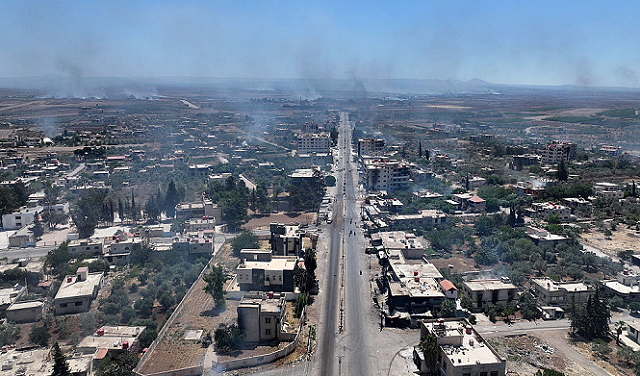
Syria: Ministry of Defense "preparing to enter" to break up clashes in Sweida

Syrian news reports indicate that "fighting has ceased" in the Sweida province this morning, Saturday, amid the "arrival of more armed elements and fighters" from several Syrian provinces. This coincided with the United States' announcement of a "ceasefire agreement between Israel and Syria" on Friday evening. However, "scattered clashes" between tribal fighters and Druze groups continued at the entrance to Sweida in the south of the country.

US envoy to Syria, Tom Barak, announced that Israeli Prime Minister Benjamin Netanyahu and interim Syrian President Ahmad al-Sharaa "agreed to a ceasefire," supported by Washington.

He pointed out that the agreement was "adopted by Turkey, Jordan, and neighboring countries," calling on "armed groups from the Druze community and Bedouin tribes to lay down their arms and work with other minorities to build a new Syrian identity," as he put it.

Meanwhile, the Syrian presidency announced in a statement that it was working to dispatch a "specialized force" to break up the ongoing clashes in Sweida, calling for "restraint."

This violence in the Sweida Governorate, in which Israel intervened, undermines the efforts of the transitional authorities headed by Sharaa to extend their authority across all of Syria, more than seven months after they ousted the previous regime.

Syrian authorities withdrew their forces from As-Suwayda province on Thursday, as Sharaa declared his desire to spare the country a "large-scale war" with Israel, which has threatened to escalate its airstrikes, claiming it "will not allow the targeting of the Druze minority" and emphasizing that it "will prevent the deployment of government-affiliated military forces in southern Syria."

Al-Araby Al-Jadeed reported Friday night that forces from the Syrian security and defense ministries were scheduled to enter Sweida on Saturday morning to break up the clashes.

The Ministry of Defense gave tribal fighters hours to hand over heavy weapons seized from armed group headquarters in Sweida, and gave them a deadline to leave Sweida at dawn today.

The Syrian Internal Security Forces announced that any armed vehicles or personnel would be prohibited from passing through the Damascus-Daraa/Damascus-Suwayda highway until further notice.

humanitarian situation

The city of Sweida remains deprived of electricity and water, amid a weak communications network. Field reports describe the humanitarian situation as "catastrophic," with no milk even available for babies.

According to UN reports, the violence has forced approximately 80,000 people to flee their homes in Sweida, the International Organization for Migration announced Friday.

It's worth noting that clashes erupted Sunday in the Sweida Governorate between armed Druze and Bedouin militants, sparked by the alleged kidnapping of a Druze vegetable merchant, followed by tit-for-tat kidnappings.

As clashes intensified, government forces announced on Monday their intervention in the governorate to break up the clashes.

The Druze population in Syria is estimated at around 700,000, most of whom live in the south of the country, particularly in the As-Suwayda Governorate.

OPINIONS

Sat 19 Jul 2025 9:42 am - Jerusalem Time

War on Resilience: Starvation in Gaza and the Draining of Dignity

Written by: Dr. Samah Jabr

Written by: Dr. Samah Jabr

Opinion Writer

A woman in her fifties spoke to me one day, her tongue still tinged with old pain, about a childhood memory that had haunted her. During the siege of Tel al-Zaatar camp in 1976, when hunger became a daily norm, her older brother stole a loaf of bread and hid it under his mattress, thinking it would secure his life for another day. But the loaf rotted before he could be eaten, and when the father discovered what had happened, he found no mercy in his heart and severely beat his son. The cruelty toward the son reflected the cruelty of the siege itself, where bread became a prize and the struggle for a living became a test of family ties.


Tel al-Zaatar was one chapter in a long history of starvation being used as a weapon against Palestinians. The siege that claimed thousands of lives there was no exception in the history of warfare; starvation is an old and recurring tool, from the Siege of Leningrad in World War II to Darfur, Yemen, Syria, and Ethiopia's Tigray region. Today, this story is being rewritten in a more brutal way in Gaza, where the food blockade has become a systematic tool that targets not only the body but the entire psychological and social fabric.


In 2024, the International Criminal Court issued arrest warrants for Israeli occupation leaders, accusing them of using starvation as a weapon of war, a crime legal experts describe as "community torture"—slow-burn violence that seeps deep into groups, sapping their resilience and then seeking to break it. Legal scholar Tom Dannenbaum argues that starvation "shreds a person's ability to prioritize morality, pitting the instinct for survival against the bonds of love and friendship, gradually emptying victims of their meaning and values."


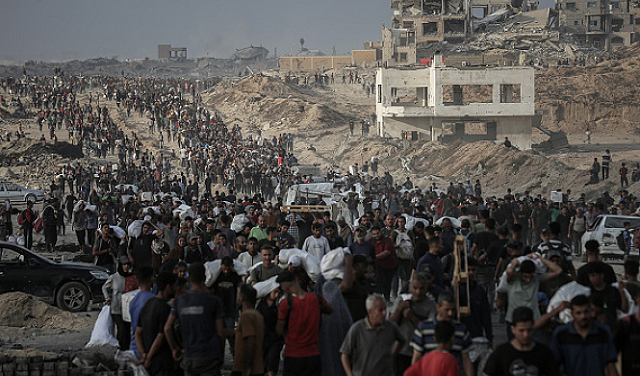
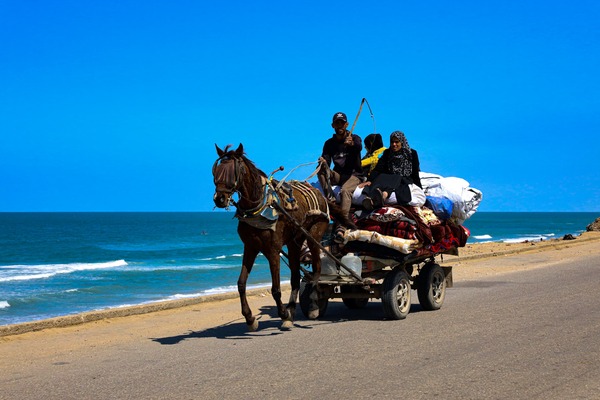
"Sumud" has long been a moral slogan and a source of pride for Palestinians, but under the current blockade, it has become a heavy psychological burden. What recent literature describes as "resilience fatigue" encapsulates this tragedy: not individual exhaustion, but a long-term collective drain on resilience. Motivation declines, emotional dullness increases, and feelings of guilt and burnout become daily companions, even for children and adolescents. More than 85% of Gaza's population has been forcibly displaced to overcrowded camps lacking clean water and privacy, where survival itself has become an imposed duty, and steadfastness has transformed from a value into a new moral imperative.


Over time, the blockade seeps into the collective psyche in the form of a chronic siege mentality: a constant sense of danger, a lack of trust in the outside world, and a binary worldview divided into "us" and "them." Psychological literature describes this condition as "permanent psychological defense," where communities lose the ability to plan for the future or build trust. In Gaza, where the blockade has extended for decades and wars recur without accountability, generations are being born who see the world only through the lens of fear and disappointment, forming a collective identity besieged from within, unable to rebuild its relationship with the world.


Starvation not only threatens biological life, but also reshapes collective memory and human relationships. In Ethiopia's Tigray, 87% of families have resorted to skipping meals and starving adults in favor of their children, sometimes going days without food. These practices leave deep psychological scars and reshape family bonds. In Gaza today, parents are forced to divide up small meals and send their children to crowded takiyas for meals, while children are taught that survival requires compromising values and social cohesion.


History teaches us that the effects of starvation do not end with the end of wars. The Great Chinese Famine (1959–1961), which killed tens of millions, left psychological scars that extended for generations. Studies half a century later have shown that survivors suffer significantly higher rates of depression, and that its effects are transmitted through parenting patterns and biological stress responses, becoming a collective legacy passed down from generation to generation. Gaza today stands on the cusp of a similar legacy of psychological distress spanning decades.


To confront this complex violence, urgent food shipments are not enough. Comprehensive responses are needed that rebuild the health system, including mental health services, and create safe spaces for individuals to recover, free from the moral blackmail of resilience. Starvation is a weapon that reshapes memory, identity, and relationships, and human success in confronting it is measured by people's ability to preserve their dignity, meaning, and memory in the face of a declared war on their resilience.

PALESTINE

Sat 19 Jul 2025 9:18 am - Jerusalem Time

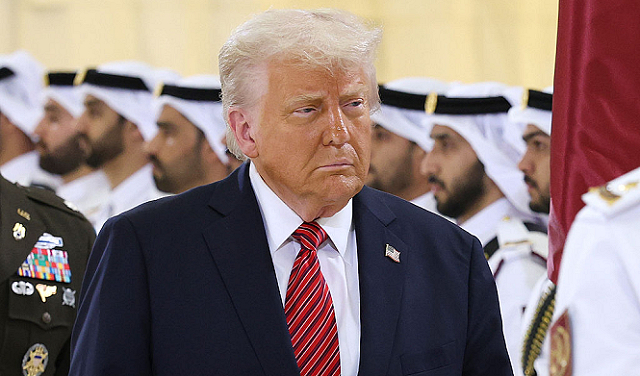
Trump expects a deal between Hamas and Israel in the next few days.

US President Donald Trump predicted during a dinner with US lawmakers at the White House on Friday evening that ten more hostages from Gaza would be released soon, and praised the efforts of his Middle East envoy, Steve Witkoff.

Negotiators from Israel and Hamas have been engaged in the latest round of ceasefire talks in Doha since July 6, discussing a US-backed proposal for a 60-day ceasefire that would see the release of 10 hostages and the remains of 18 slain prisoners. Trump said, "We've got most of the hostages back. We'll have 10 more coming very soon, and we hope this will be over quickly."

According to Palestinian sources, Israel has yet to respond to the maps presented by the mediators regarding the Gaza Strip, and continues to speak vaguely about the mediators' ideas regarding humanitarian aid, considering the Israeli delegation in Doha to be merely a formality.

A Palestinian source stressed in a statement to Arab media that the Israeli allegations about Hamas's reluctance to respond are baseless, and that the opposite is true, he said.

According to the Israeli Broadcasting Corporation, Tel Aviv is considering sending a second delegation of senior officials to the Qatari capital, Doha, allegedly in an attempt to achieve a breakthrough in the prisoner exchange negotiations with Hamas, with the goal of achieving a breakthrough in the exchange deal with Palestinian factions in Gaza.

The committee did not provide further details regarding the composition of the delegation or the proposals being discussed in the negotiations, but it considered next week to be a pivotal week in Doha, with both Israel and Hamas accepting the final proposal.

Hamas said on Friday that the Israeli army's failure to free its prisoners by force confirms that it has no choice but to proceed with a prisoner exchange deal based on the resistance's terms and will.

Since July 6, indirect negotiations have been underway in Doha between Israel and Hamas, mediated by Egypt and Qatar and supported by the United States.

For his part, Abu Obeida, the military spokesman for the Qassam Brigades, the armed wing of Hamas, spoke in a video address, his first since last March, about the resistance's current strategy, admonishing the nation and its ruling regimes, and emphasizing that the resistance is fully prepared to continue a long battle of attrition.

In his speech, Abu Obeida said that four months have passed since the occupation resumed its aggression after "breaking the covenants and reneging on the agreement concluded with the resistance." He noted that during this period, the resistance has caused "hundreds of soldiers dead and wounded, and thousands more suffering from psychological illnesses and trauma."

He added that the resistance and Qassam Brigades fighters are "surprising the enemy with new tactics and methods," having learned lessons from the longest confrontation in the history of the Palestinian people. He also revealed repeated attempts in recent weeks to capture Israeli soldiers.

Abu Obeida emphasized that the Qassam Brigades leadership, at this stage, is relying on a strategy based on "killing the enemy, carrying out special operations, and seeking to capture its soldiers," adding that "the resistance in Gaza is the greatest military school for resisting a people against their occupiers in modern history."

PALESTINE

Sat 19 Jul 2025 8:43 am - Jerusalem Time

West Bank: Palestinian families forced to leave their homes due to settler attacks

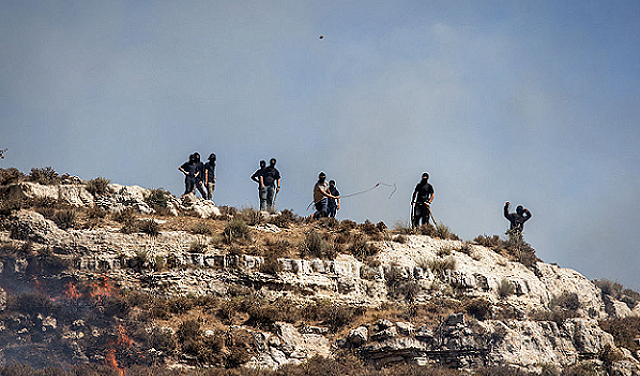
Two Palestinian families were forcibly displaced from their homes in the Al-Maleh area of the northern Jordan Valley, following an escalation in attacks carried out against them by settlers, under the protection of the Israeli occupation army.

WAFA reported, citing local sources, that two families demolished their homes and moved to the Al-Auja area near Jericho, following an increase in settler attacks.

It's worth noting that the Al-Maleh area witnessed a settler attack on Thursday evening, which included firing into the air, assaulting citizens and their property, stealing dozens of heads of livestock, and killing more than 100 heads of livestock.

The region is witnessing a significant escalation in armed settler attacks against residents and their property, as part of a policy of ongoing pressure to force them to leave their land.

Jerusalemites forced to evacuate a residential building

In occupied Jerusalem, residents began emptying their property of a six-apartment building on Friday evening, preparing to demolish it under pressure from the Jerusalem municipality.

According to local sources, the Halwani family has emptied their apartment building in the town of Beit Hanina, in preparation for its self-demolition, ordered and forced by the Israeli municipality. The sources noted that 25 people, most of them children, live in the apartments.

It's worth noting that residents are forced to demolish their homes themselves to avoid paying hefty fines and the cost of municipal equipment, with the demolition costing hundreds of thousands of shekels.

PALESTINE

Sat 19 Jul 2025 8:36 am - Jerusalem Time

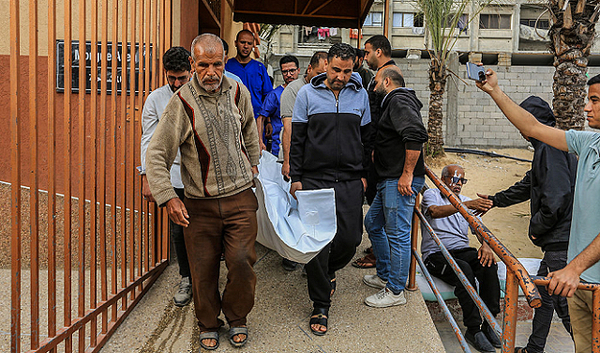
32 dead and dozens of injuries among those waiting for aid in the southern Gaza Strip.

Thirty-two citizens were killed and dozens injured on Saturday by Israeli occupation forces' fire against starving civilians north of Rafah, south of the Gaza Strip.

Local sources reported that Israeli occupation forces opened fire on starving civilians near the American-Israeli aid center north of Rafah, killing 25 civilians and wounding at least 70 others.

Two dead arrived at Nasser Medical Complex in Khan Yunis, south of the Gaza Strip, at dawn today, following shelling of the tents of displaced people in the Japanese neighborhood and Taiba Towers.

Six civilians were killed and 16 others injured in an Israeli airstrike that targeted a tent housing displaced persons near the Al-Tabi'in School in the Al-Daraj neighborhood in central Gaza City.

Two citizens were killed and five others were injured when a group of citizens were targeted in the Al-Hakmiya area near Ibn Sultan Mosque in Jabalia Al-Balad, north of Gaza.


PALESTINE

Sat 19 Jul 2025 8:34 am - Jerusalem Time

Mossad chief visits Washington, seeking US support for Gazans' displacement to three countries

Mossad chief David Barnea visited Washington this week to seek its assistance in convincing countries to support a plan to deport Palestinians from the Gaza Strip, according to two informed sources, according to the American website Axios.

During his meeting with US President Donald Trump's Middle East envoy, Steve Witkoff, Barnea informed the Israeli government that Israel is holding private talks with Ethiopia, Indonesia, and Libya on the matter.

Two sources familiar with the meeting said that Barnea informed Witkov that the three countries had expressed a preliminary willingness to resettle large numbers of Palestinians from Gaza, while suggesting that the United States offer incentives to those countries and help Israel persuade them.

For his part, Witkov has not expressed any commitment to this, and it is not clear whether Washington will actually intervene in this matter, according to one of the sources.

In February 2025, US President Donald Trump proposed a plan to deport Gazans from the Strip, but the White House backed down from the idea after receiving significant objections from Arab countries, according to US officials.

Axios quoted Israeli officials as saying that the Trump administration informed them that if Prime Minister Benjamin Netanyahu wanted to move forward with this plan, he would have to find countries that would agree to resettle Palestinians from Gaza. Netanyahu subsequently tasked the Mossad with searching for countries willing to settle large numbers of Palestinians to be displaced from the Strip.

Meanwhile, Israel is working on a plan to relocate Gaza's approximately two million residents to an area it has dubbed a "humanitarian city" in the southern part of the Strip, near the border with Egypt. This plan has raised concerns in Egypt and many Western countries, amid fears that Israel is preparing for the mass expulsion of Palestinians from Gaza, a goal long sought by Netanyahu's far-right partners.


Axios reported that although the Israeli government claims that any displacement will be "voluntary," this description is almost meaningless under the current circumstances.

During Netanyahu's recent visit to Washington, Trump was asked about the issue and referred the question to Netanyahu, who said that Israel is working "very closely" with the United States to find countries that will agree to resettle Palestinians from Gaza. He added, "We are close to reaching an agreement with several countries," according to Axios.

Netanyahu added, "I think Trump has a smart vision. It's called freedom of choice. If people want to stay, they can stay, but if they want to leave, they should be able to. It shouldn't be a prison."

An Israeli official stated after the meeting between Trump and Netanyahu that the US president expressed interest in continuing to push for the "deportation" of Palestinians from Gaza.

PALESTINE

Sat 19 Jul 2025 8:31 am - Jerusalem Time

UN warns against normalizing mass deprivation in Gaza.

The United Nations warned that mass deprivation is becoming the norm in Gaza, noting that the Israeli occupation authorities have issued another displacement order, this time for parts of northern Gaza.

The UN Office for the Coordination of Humanitarian Affairs (OCHA) said that the movement of humanitarian aid within Gaza remains restricted, with only seven of 13 attempts to coordinate the movement of aid workers and supplies with the Israeli authorities having been facilitated.

ARAB AND WORLD

Fri 18 Jul 2025 10:25 pm - Jerusalem Time

The Jewish Anti-Zionist Conference calls for Israel's expulsion from the United Nations and its punishment.

A meeting of more than 1,000 Jewish and non-Jewish anti-Zionists in Vienna, Austria, called on all states and communities to fulfill their obligations under the Convention on the Prevention and Punishment of the Crime of Genocide and to take all necessary measures to stop the ongoing genocide in Gaza, including sanctions.

While this is the first event of its kind in Europe, it has already laid the foundation for planning a second conference in 2026.

The final statement adopted by the conference (July 13-15) said: “We, the speakers and organizers of the conference, issue this general appeal, which reflects the collective positions reached during the three days of deliberations.”

He added, "As anti-Zionist Jews and allies of Zionism, we stand with all Palestinians—in Palestine and in exile—against Zionism and its crimes, including genocide, apartheid, ethnic cleansing, and occupation. We affirm the right of peoples under occupation to resist by all means, as recognized in numerous UN resolutions."

The statement emphasizes: “It is essential that Jews of conscience everywhere unite in opposition to Zionism, in cooperation and solidarity with the global movement for the liberation of Palestine. We are committed to expanding our movement beyond its European roots to include anti-Zionist voices from around the world, including the Global South. We unreservedly condemn all war crimes committed by Israel since October 7, 2023, including ethnic cleansing, military apartheid, the annihilation of cities, the destruction of schools, medical killings, and mass starvation as a tool for the forced expulsion of over two million Gazans, as well as the ongoing genocide of hundreds of thousands—one of the worst war crimes of our time.” These actions have already been recognized by the International Criminal Court and the International Court of Justice, although the State of Israel has categorically rejected the demands of both courts. It has also rejected numerous calls from both the UN General Assembly and the Security Council in the same manner. As a result, nearly two million civilians are now imprisoned in a small area of the Gaza Strip, without access to food, water, medicine, shelter, or medical care. The new crimes are just the latest additions to a long history of similar crimes, dating back to 2007.

The statement denounces the fact that: "Despite repeated violations of UN General Assembly and Security Council resolutions, as well as extensive reports issued by UN special rapporteurs, no sanctions have been imposed on Israel."

The Jewish Anti-Zionist Congress declared: "Sanctions should include suspending Israel's membership in the UN General Assembly, as happened in 1974 with South Africa for practicing apartheid. Israel's crimes are clearly more horrific."

The declaration noted that none of these war crimes and crimes against humanity could have been committed or continued "without the active and enthusiastic support of Western powers - through military aid, financial support, and political and diplomatic cover - led by the United States, the European Union, the United Kingdom, Canada, Australia, and New Zealand."

The declaration affirmed that "by enabling and arming a criminal state that commits genocide," these governments bear legal and moral responsibility under the 1948 Genocide Convention.

The conference noted that while the United Nations has deployed international forces for decades to "separate the combatants" between Israel and Egypt, and Israel and Lebanon, it has never established a protection force "to protect Palestinian lives from the systematic oppression and terrorism perpetrated by the Israeli state." The declaration stated, "We agree that the time has come to enact such a humanitarian measure. Without it, Israel will continue its mass crimes against the Palestinians."

PALESTINE

Fri 18 Jul 2025 10:19 pm - Jerusalem Time

Axios: Israel discusses with Ethiopia, Indonesia, and Libya the possibility of receiving residents from Gaza.

Mossad chief David Barnea, who visited Washington this week, reportedly asked US President Donald Trump's Middle East envoy, Steve Witkoff, for US assistance in deporting Gaza residents, possibly to Ethiopia, Libya, or Indonesia.


Barnea visited Washington this week as Israel seeks the Trump administration's help in deporting Palestinians from Gaza, Axios reported, citing two sources familiar with the matter.


The two sources said that Barnea informed the US special envoy and Tekoff that Ethiopia, Indonesia, and Libya had expressed their willingness to receive Palestinian refugees from Gaza, and that Washington should offer "incentives" to those countries to agree to the transfer.


However, Witkoff has not made a commitment on the issue, according to the source.


US officials also say the White House is reluctant to transfer Palestinians from Gaza amid opposition from Arab states.


These efforts come months after US President Donald Trump proposed (on February 4, 2025) the indefinite transfer of all Gaza residents during the Strip's reconstruction, turning Gaza into a Middle Eastern riviera. Arab countries and most Western countries strongly opposed the idea, while Israeli Prime Minister Benjamin Netanyahu and his coalition enthusiastically supported it.


Israeli officials told the website that the Trump administration informed them that if Netanyahu wanted to move forward with this idea, he would have to find countries willing to accept Palestinians from Gaza.


Netanyahu tasked the Israeli foreign intelligence agency, Mossad, with finding countries willing to accept large numbers of Palestinians displaced from the Gaza Strip.


Nearly all Palestinians in Gaza were displaced during the war, often multiple times, and most buildings in Gaza were damaged or destroyed.


Israel is developing a plan to transfer the entire two million residents of the Gaza Strip to a small "humanitarian zone" near the border with Egypt, which experts around the world acknowledge will become a detention center similar to the Nazi concentration camps where Jews were held during World War II.


This plan has raised concerns in Egypt and many Western countries that Israel is preparing for a mass expulsion of Palestinians from Gaza, something Netanyahu's ultranationalist coalition partners and many within his own party have been pushing for years.


A senior Israeli official claimed that, as part of the understandings with the three countries, the transfer of Palestinians would be "voluntary, not forced," and that Israel would commit to allowing any Palestinian leaving Gaza to return to it at any time.


However, the idea that these mass deportations can be considered “voluntary” under these circumstances is controversial.


It's worth noting that when Netanyahu visited the White House last week, Trump was asked about this issue, and he referred it to the Israeli prime minister. Netanyahu said that Israel is working "very closely" with the United States to find countries that will agree to accept Palestinians from Gaza, and he confirmed that "we are close to finding several countries."


Netanyahu said, "I think President Trump had a wonderful vision. It's called freedom of choice. You know, if people want to stay, they can, but if they want to leave, they should be able to leave. It shouldn't be a prison situation."


Axios reported that after dinner at the White House (July 7, 2025), a senior Israeli official told reporters that Trump had expressed interest in continuing to push for the "deportation" of Palestinians from Gaza. The White House did not comment on the matter at the time.

ARAB AND WORLD

Fri 18 Jul 2025 10:17 pm - Jerusalem Time

German Chancellor: What is happening in Gaza is no longer acceptable

German Chancellor Friedrich Merz renewed his call for a ceasefire in the Gaza Strip, saying that what is happening is "no longer acceptable."

During a press conference in Berlin on Friday, he called on Israel to allow urgent humanitarian aid to reach the Palestinians, amid European diplomatic efforts to contain the crisis.

He stressed that "what is happening there is no longer acceptable to us," noting that his country is pushing for an immediate ceasefire, in addition to the provision of comprehensive humanitarian aid to the Palestinians.

PALESTINE

Fri 18 Jul 2025 8:53 pm - Jerusalem Time

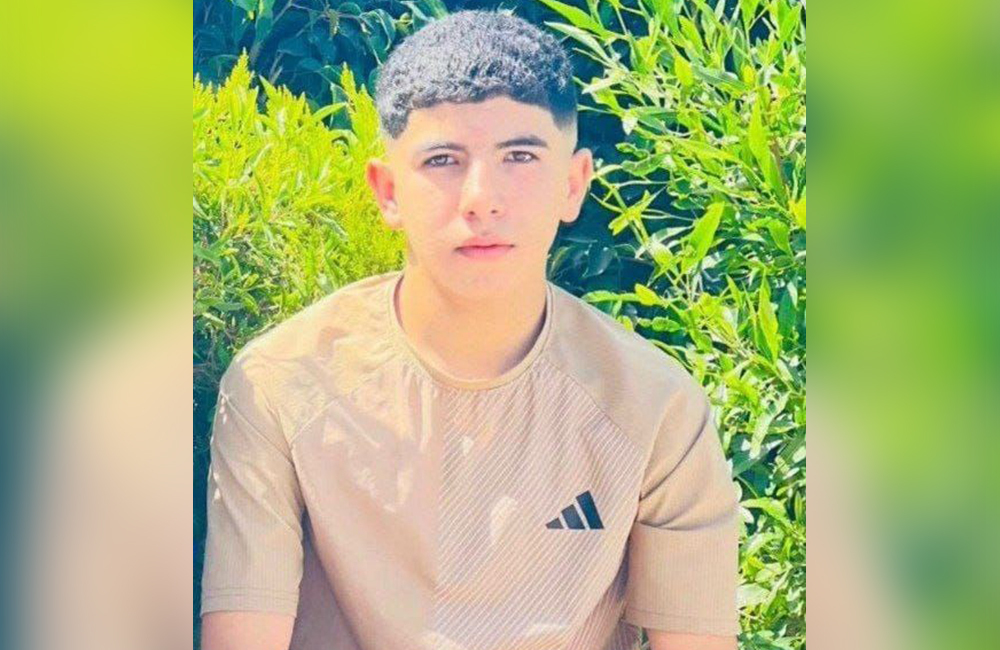
A child was killed by Israeli occupation forces in Ya'bad, Jenin Governorate.

A child died of his wounds from Israeli occupation bullets on Friday in the town of Ya'bad, south of Jenin.

Local sources said that the occupation forces fired live bullets at the child Amr Ali Khaled Qabha (14 years old), while he was in one of the town’s streets, and prevented ambulances from reaching him to provide him with treatment.

She added that the child's father tried to reach him, but the occupation forces severely beat him and detained him before an ambulance could reach him and transport him to the hospital, where doctors pronounced him dead. She noted that the occupation forces closed the main entrance to the town of Ya'bad with cement blocks.

In the same context, the occupation forces stormed the town of Kafr Ra'i in the south and raided the homes of the citizens: Hussein Al-Atrash and Saher Fayyad Al-Sheikh Ibrahim.

PALESTINE

Fri 18 Jul 2025 5:08 pm - Jerusalem Time

Hebrew media: 18 Israeli soldiers have committed suicide since the beginning of 2025.

Hebrew media reported on Friday that 18 Israeli soldiers have committed suicide since the beginning of 2025, including three in July, compared to nine soldiers during the first half of 2024.

"The data indicates a significant increase in the number of suicides in the army this year compared to previous years," Israeli Army Radio said.

She noted that it was based on "Israeli military data obtained from sources familiar with the details, and not official information from the military itself."

She said, "In the first half of 2025, 15 Israeli soldiers committed suicide, in addition to three soldiers this month, making a total of 18 soldiers since the beginning of the year."

She added, "In contrast, in the first half of 2024, suicide data was half that number, or 9 soldiers."

PALESTINE

Fri 18 Jul 2025 5:05 pm - Jerusalem Time

The President condemns the bombing of the Latin Monastery Church in Gaza and offers his condolences to Cardinal Pierbattista Pizzaballa in a phone call.

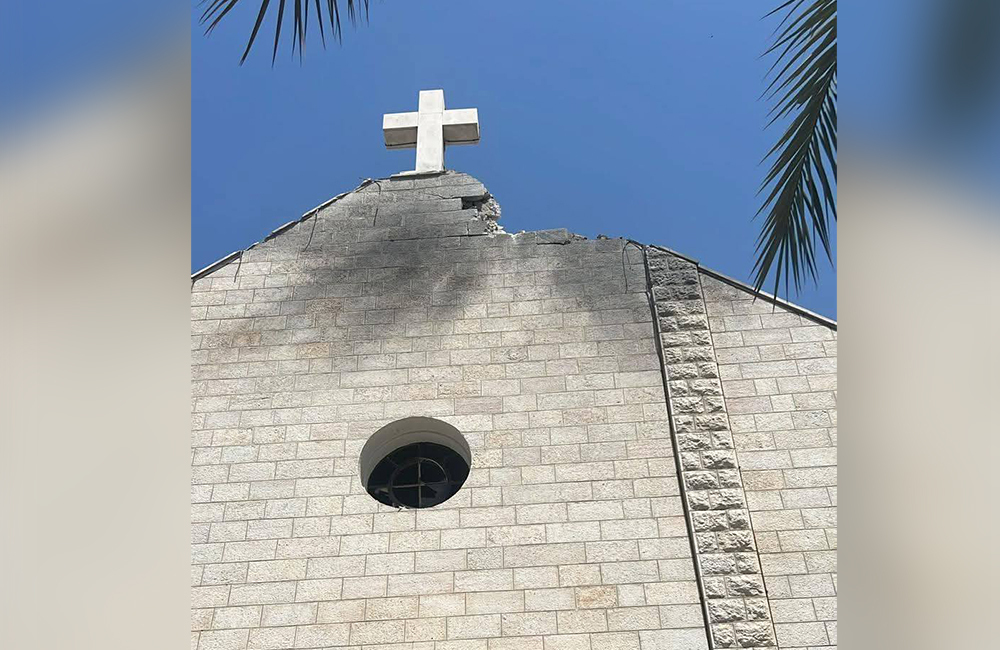
Palestinian President Mahmoud Abbas condemned the Israeli occupation forces' bombing of the Latin Monastery Church in Gaza on Friday. He also offered his condolences in a phone call to the Latin Patriarch of Jerusalem, Cardinal Pierbattista Pizzaballa, over the killing of three citizens and the wounding of more than 10 others in the Israeli occupation's bombing of the church on Thursday, which was also sheltering 600 displaced people.

His Eminence stressed the importance of preserving holy sites and working to protect and strengthen the authentic Christian presence in Palestine.

The President also spoke by phone with the church's pastor, Gabriel Romanelli, to check on his health after the injury he sustained as a result of the occupation's bombing.

His Eminence also addressed, alongside His Beatitude Cardinal Pierbattista, His Beatitude Patriarch Theophilos III, Patriarch of the Greek Orthodox Church, in the presence of Father Gabriel Romanelli, Pastor of the Holy Family Church for the Latins, Father Silas Habib, Pastor of the Greek Orthodox Church, Father Youssef Asaad, Assistant Pastor of the Holy Family Church in Gaza, the Head of the Churches Committee in Gaza, the Medical Director of the Baptist Hospital, Chairman of the Council of Church Agents Maher Ayyad, and a group of Christians, reassuring them of their conditions, stressing that this calamity that has befallen our people and our land must end with the end of the aggression and the end of the occupation.

The President considered this targeting an extremely dangerous development in the series of escalating attacks on Christian and Islamic holy sites and the entire Palestinian people, and reveals a systematic policy of desecration targeting civilians and places of worship simultaneously, without any regard for international conventions or humanitarian and religious values.

His Excellency called on the international community and mediators to accelerate and sustain the ceasefire, release hostages and prisoners, allow the entry of aid, ensure the complete withdrawal of the occupation forces, allow the State of Palestine to assume its full responsibilities in the Gaza Strip, assist the displaced to return to their areas, provide them with basic services, and engage in the reconstruction process and a political process that ends the occupation of the entire Palestinian territory occupied since 1967, with East Jerusalem as its capital, in accordance with international legitimacy resolutions.

PALESTINE

Fri 18 Jul 2025 2:34 pm - Jerusalem Time

Hamas: Israel has no choice but to make the deal

The Islamic Resistance Movement (Hamas) said that after the occupation failed to free the prisoners by force, it had no choice but to reach a deal with the resistance according to its terms and will.

The movement added in a statement that the resistance, with its steadfastness and diverse tactics, is confusing Israel's calculations, seizing the initiative from it, and surprising it with tactics it is unable to understand or counter, according to the movement.

She stressed that the occupation is accumulating failures, and its war on Gaza is "a mirror of its failure in a battle that will remain etched in the memory of the conflict as a strategic turning point that reveals the fragility of its entity."

Hamas stressed that "the famine imposed by the occupation on the Gaza Strip is a deliberate crime against humanity."

She called for "urgent popular and official action to save the hundreds of thousands of starving people besieged in Gaza."


PALESTINE

Fri 18 Jul 2025 2:33 pm - Jerusalem Time

Patriarchs and heads of churches in Jerusalem condemn the occupation's bombing of the Latin Church in Gaza.

The patriarchs and heads of churches in Jerusalem condemned the Israeli occupation's bombing of the Latin Church in Gaza City yesterday, Thursday.

The Patriarchs and Heads of Churches said in a press statement on Friday: “We express our solidarity with the Latin Patriarchate of Jerusalem and those who took refuge in the Holy Family Catholic Church in Gaza City, following the criminal attack launched by the Israeli army on the church compound on Thursday morning. This attack resulted in extensive damage to the church buildings, claimed the lives of three people, and injured ten others, including the church’s pastor, Gabriele Romanelli.”

The statement continued: "Places of worship are sacred places that must be protected from violence. They are also protected under international law. Targeting a church that houses nearly 600 displaced people, including children with special needs, is a flagrant violation of this law, an insult to human dignity, a violation of the sanctity of life, and a desecration of a holy place."

The Patriarchs and Heads of Churches in Jerusalem called on world leaders and UN agencies to take urgent action to enforce an immediate ceasefire in Gaza, leading to an end to the war. They also called for full protection of all religious and humanitarian sites, and for urgent relief to be provided to hundreds of thousands of starving people in the Gaza Strip.

-

PALESTINE

Fri 18 Jul 2025 2:32 pm - Jerusalem Time

A one-and-a-half-year-old girl died of malnutrition in Deir al-Balah.

A one-and-a-half-year-old girl died on Friday due to malnutrition in Deir al-Balah, central Gaza Strip.

Medical sources reported that hospitals in the Gaza Strip are treating hundreds of people suffering from severe hunger and malnutrition, as they are suffering from severe symptoms of famine.

Sources indicated that 17,000 children are suffering from severe malnutrition, and that patients are also being treated for stress and memory loss resulting from severe hunger.

She stressed that hospitals do not have enough beds or medicines to treat the huge number of people suffering from severe malnutrition.

The United Nations Relief and Works Agency for Palestine Refugees (UNRWA) warned that malnutrition among children under the age of five doubled between March and June, as a result of the Israeli blockade of the Gaza Strip.

She explained that UNRWA health centers and medical points conducted approximately 74,000 malnutrition tests for children during this period, identifying approximately 5,500 cases of global acute malnutrition and more than 800 cases of severe acute malnutrition.

PALESTINE

Fri 18 Jul 2025 9:55 am - Jerusalem Time

Settlers kill 117 sheep in an attack on the northern Jordan Valley.

Last night, settlers stole and killed dozens of sheep in the northern Jordan Valley.

Head of the Al-Malih village council, Mahdi Daraghmeh, reported that settlers stole dozens of sheep belonging to families in Al-Malih in the northern Jordan Valley, killing approximately 117 of them after taking them to the nearby Al-Shaq area.

Draghmeh added that the settlers killed the sheep with knives and live bullets, in a dangerous escalation against citizens and their property in the northern Jordan Valley.

The Al-Malih area witnessed a difficult night after armed settlers attacked residents' tents, assaulted them and their property, stole their livestock, and killed dozens of them.

OPINIONS

Fri 18 Jul 2025 9:54 am - Jerusalem Time

Al-Karamah crossing... where dignity is violated!

Yasser Abu Bakr

Yasser Abu Bakr

Opinion Writer

It seems that Palestinians have no refuge from their suffering, not in their land, not in their exile, not even on their way home. At the King Hussein Crossing—or what is metaphorically called the "Karamah Crossing"—the tragedy unfolds in all its details, and the humiliations accumulate until they reach their climax, reproducing the pain of the occupation at the hands of what is supposed to be "brotherly."


On July 16, 2025, a Palestinian citizen and his wife embarked on a return journey from Jordan to the West Bank. They entered the so-called "VIP" area around 10:00 a.m., only to find themselves in the midst of utter chaos and a five-hour wait to complete procedures that under normal circumstances would take no more than half an hour.


It wasn't just a delay or a programming glitch; it was a clear example of a pattern of indifference, favoritism, bribery, and yelling at people, in a place that was supposed to provide "comfortable service."

Where is the service? Where is the respect? Where is the dignity?


This route is normally reserved for 200-300 passengers per day, but during the peak summer months, the number exceeded 2,000. The result is massive profits for Jet Airways, amounting to more than 180,000 Jordanian dinars per day—all at the expense of passengers, young and old, sick and women, who endure a life of humiliation and degradation.


People were forced to pre-book through an online platform that uses Visa cards, in a society suffering from blockades, poverty, and poor banking services. It would have been more effective, even more obvious, to launch the platform months before the season, rather than at the height of summer, when exams, vacations, and social events are all over.


The question here is: Who benefits from this chaos? Who decided that reservations should be limited to those with electronic devices unavailable to many? And why aren't there humane alternatives, such as reservation offices at the bridge or transit areas?


So this humiliation is no coincidence. When ticket outlets at the border crossing are closed, everyone is redirected to the "VIP" lane at exorbitant fees, gates are closed to those without online reservations, and dozens of travelers are sent back to spend another night in Amman hotels—the issue is no longer an administrative failure, but rather a deliberate attempt to reap profits at the expense of humankind.


The Palestinian government's complete absence from the bridges issue represents a clear failure. The Palestinian citizen is not asking for a miracle, but rather for his most basic right: dignified passage to his homeland.

Where is the Ministry of Foreign Affairs? Where is the Civil Affairs Authority? Where is the Ministry of Interior? Where is the Crossings Unit? And where are the voices of the national factions and civil society?


The well-known political saying goes: “Follow the money,” and you will find out who benefits.

Yes, what's happening at the Karameh crossing is no mystery. It's a system of interests that exploits people's suffering, amid suspicious silence and overt or covert complicity.


As for our message to those concerned, we say:


Enough.

Enough humiliation of the Palestinians at the gates of their homeland.

Enough official silence on the trade practiced in the name of facilitation.

Stop burdening people with the cost of management mistakes, monopoly and quick profit.


The Palestinian suffering does not end at the separation wall or a military checkpoint, but rather extends to the gate that should have been a crossing point of dignity... but instead becomes a station for renewed humiliation and financial humiliation.


note :

This article is based on a true testimony, and on the tongue of one of the travelers who documented the experience on 07/16/2025. The details contained in it can be verified by witnesses and companions.

OPINIONS

Fri 18 Jul 2025 9:53 am - Jerusalem Time

Macron condemns Israeli bombing of Latin Church in Gaza

Ramallah - "Al-Quds" Dot Com

Ramallah - "Al-Quds" Dot Com

Opinion Writer

French President Emmanuel Macron condemned the Israeli occupation's bombing of the Latin Church in Gaza City on Thursday, which resulted in the deaths of three civilians and the injury of others.

"I spoke with Cardinal Pizzaballa, the Latin Patriarch of Jerusalem," Macron said in a post on the X platform tonight, affirming "France's solidarity with all Palestinian Christians who, from Gaza to Taybeh, are today under threat."

The French president stressed that "the continuation of this war is unjustifiable. A ceasefire must be established immediately, and civilians and hostages must be freed from the threat of permanent war."

Macron's position came shortly after French Foreign Minister Jean-Noël Barrot announced in a post on the X platform that Paris condemns the bombing of the Holy Family Catholic Church in Gaza, "which is under France's historical protection."

Barro added that he expressed his country's sympathy and solidarity to the Latin Patriarch in Jerusalem, saying, "These attacks are unacceptable. It is time to stop the massacre in Gaza."

OPINIONS

Fri 18 Jul 2025 9:47 am - Jerusalem Time

Is it time for a government shutdown?

Lawyer Salah Ali Musa

The term "government shutdown" has become part of American culture for reasons completely different from the current situation we are experiencing. However, we can take several steps on the Palestinian level related to the possibility of the Palestinian government announcing a partial and/or total shutdown and/or declaring a state of emergency through a government decision and/or a law and/or a decree declaring a state of emergency in the country due to the economic crisis and the inability of the Authority to meet its financial obligations. Indeed, it is on the verge of bankruptcy in the broad sense, not the commercial sense of the word.

It is unreasonable for the activities of ministries, public institutions and non-ministerial institutions to continue to carry out their work as if everything is fine. It is enough to close our eyes to the facts that shake our being every day and shake our feelings at every moment until we have become ashamed of ourselves for what we have reached. We are in constant humiliation, unstoppable oppression and unprecedented oppression. There is no stopping the killing in Gaza, no stopping the starvation in Gaza, no stopping the attacks of settlers in the West Bank, no workers, no trade, and humiliation at checkpoints until it reached the peak of humiliation and oppression at the only crossing that connects us to the world. The crisis of the shekel and fuel, the crisis of poverty and need, the crisis of debts and loans, the crisis of defaming each other. We do not tire or get bored even though everyone is in distress, and some are still carrying out their work as if everything is fine. The time has come for the president and the prime minister to take a bold, direct and specific decision. The time has come for a partial and/or total closure while maintaining the basic services of the government. The time has come, without delay, to take steps that confirm that we are all in the same The place and the aspirations, people want to see tangible steps that leave an impact, even if it is moral, on their lives, so that they can say yes, we are one body, not separate bodies, we are one people, not influential or non-influential groups and parties. What is required can be, but does not necessarily have to be, limited to what we say, as follows:

1. Declaring a state of emergency in the country, either by presidential decree or issuing a decree-law declaring a partial and/or total government shutdown, or by a government decision to do so. In emergency situations, the government can seize control of many resources and manage them, and suspend the implementation of many laws, such as the issue of loans or borrowing.

2. Restructuring the government by reducing the number of ministries and their responsibilities, such that the government consists of 9 ministers in addition to the Prime Minister, and consists only of the ministries of health, education, interior, foreign affairs, finance, economy, labor, local government, and transportation. This is after merging the ministries of social development, justice, and relief with the ministry of labor, merging the ministries of industry, trade, and communications with the ministry of economy, merging the ministries of culture, tourism, antiquities, and agriculture with local government, and planning with the ministry of finance. After that, reducing work to two days a week in all ministries except the ministries of health and education. This will reduce operational costs and stop paying transportation allowances for days when employees do not work.

3. Dissolving the Wall Authority, the Land Authority, and the Settlement and Water Authority, merging them into a single body, and dissolving all funds with legal personality, such as the Employment Fund, the Cooperation Authority, and others.

4. Nationalizing a number of private sector institutions that have been affected at the expense of the Palestinian people, as the state of emergency allows for exceptional measures.

5. Closing a number of embassies around the world and merging them to reduce costs. It is unreasonable for people to go hungry while ambassadors and their colleagues enjoy the privileges of education for their children in host countries, along with all the attendant benefits.

6. Closing down the official news agencies and merging them with the General Authority for Radio and Television, and merging all official and/or affiliated media outlets with the General Authority only to reduce expenses, including Al-Hayat newspaper, for example, and other media outlets whose continued existence only makes matters worse.

7. Stop importing or selling any products that have a local alternative, increase supervision of local products, and tighten related procedures.

8. Reducing the salaries of senior employees in public, ministerial, and non-ministerial institutions, with a portion of these salaries allocated to meet the government’s obligations. This reduction shall be by law (emergency) or by a decree-law related to the partial government shutdown.

9. Launching and forming the broadest popular coalition of all civil society institutions, public figures, unions, and the government to expedite the issuance of a decree-law and/or the declaration of a state of emergency by forming a supreme crisis management council led by the government in partnership with the private and civil sectors and financial institutions, headed by the Monetary Authority, to implement the proposals and/or add to and/or amend them.

What we are proposing seems to be a path of expansion and revolution, or some might describe it as madness. We say that everything around us has turned into absolute madness, distress, and unprecedented oppression. We need real steps. It is enough to rely on traditions in dealing with the disaster, and enough to think of the same methods. In conclusion, we say that the idea of the bonds that the government is considering issuing will only increase the situation with a new challenge. The most viable solution is to manage the crisis in a different way that makes all those with influence and decision-making powers part of the solution, not part of the accusation before the people. Then, employees will support any government step, even if they receive salaries that do not exceed 50% of the value of their rights. If you are satisfied with the leadership of our people, then you must be equal to the situation, because we have all reached a point that targets our physical existence. We must act because the time has passed, and remedying it has become an individual obligation for each and every one of us. We must survive, no matter the cost, and by any means available nationally. Is there anyone who will respond or remedy it?!

PALESTINE

Fri 18 Jul 2025 9:45 am - Jerusalem Time

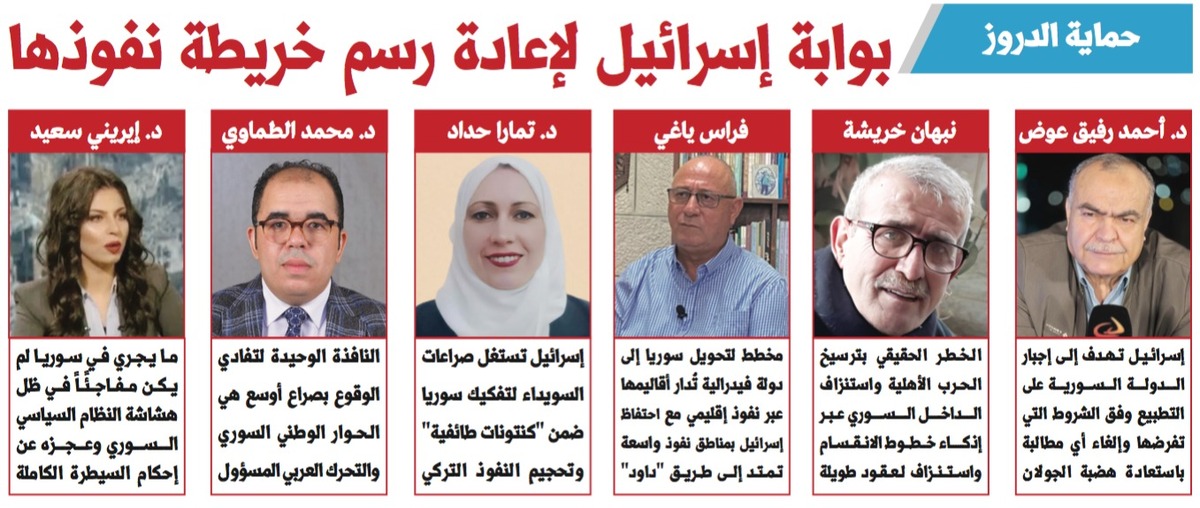
Protecting the Druze: Israel's gateway to redrawing its map of influence

Dr. Ahmed Rafiq Awad: Israel aims to force the Syrian state to normalize relations under its own conditions and cancel any demand to restore the Golan Heights.

Nabhan Khreisha: The real danger lies in the entrenchment of the civil war and the depletion of the Syrian interior by fueling division lines and draining it for decades.

Firas Yaghi: There is a plan to transform Syria into a federal state whose regions are governed through regional influence, while Israel retains broad areas of influence extending to the "Road of David."

Dr. Tamara Haddad: Israel is exploiting the conflicts in Sweida to divide Syria into "sectarian cantons" and limit Turkish influence.

Dr. Muhammad al-Tamawi: The only way to avoid a wider conflict is through Syrian national dialogue and responsible Arab action.

Dr. Irene Said: What is happening in Syria was not surprising, given the fragility of the Syrian political system and its inability to assert complete control.

Despite attempts to contain the crisis in Syria's Sweida province and Syrian President Ahmad al-Sharaa's announcement that an agreement had been reached, fears of renewed strife persist, amid growing warnings of Israeli attacks that have already occurred and may occur again.

In separate interviews with "I," writers, political analysts, specialists, and university professors believe that Israeli attacks and interventions target southern Syria under the guise of protecting the Druze. Others argue that what is happening transcends sectarian dimensions and conceals a project to reshape the maps of influence in the region. The situation raises serious questions about Tel Aviv's intentions to impose a security reality extending from the Golan Heights to the depths of Iraq.

Writers, analysts, specialists, and university professors assert that Israel seeks to establish demilitarized zones between the Golan Heights and Jabal al-Arab to ensure its freedom of movement and prevent any armed formations that might impede its expansion. This, in parallel, is the implementation of the so-called "David's Corridor" project, which represents a practical step toward linking transportation networks in accordance with Israel's strategic interests.

They warn that Israel's goal is not limited to normalization with Damascus on its own terms, but extends to imposing complete hegemony over Syrian decision-making. A greater danger looms on the horizon: the dismantling of the social fabric and the transformation of Syria into a soft arena open to long-term conflicts that could spill over into surrounding countries.

Tel Aviv plans to kill several birds with one stone

Writer and political analyst Dr. Ahmed Rafiq Awad warns that Israel, by claiming to protect members of the Druze community in Syria, is actually seeking to achieve strategic goals far beyond its declared humanitarian slogans. He asserts that Tel Aviv plans to kill several birds with one stone by imposing its control over vast areas between the Golan Heights and Jabal al-Druze (Jabal al-Arab).

Awad explains that Israel aims to make this large area, which is much larger than the Gaza Strip, a completely demilitarized zone, free of any Palestinian organizations, armed factions, or local forces that might pose a threat to its security, allowing it to move freely within it.

Awad points out that some believe this move could pave the way for Israel to reach western Iraq, extending all the way to the Euphrates River, via the so-called "David's Corridor," a strategic project to reshape the transportation network throughout the region and connect it to Israeli interests.

Awad asserts that Israel also aims, through these steps, to compel the Syrian state to normalize relations under its own terms, including signing an agreement that would eliminate any future claim to the occupied Golan Heights. This would cement Israel's occupation as a fait accompli. Tel Aviv also seeks to prevent the formation of a Sunni axis that could serve as an alternative to the axis that has been battered and weakened in recent years.

Awad explains that Israel's goals are not limited to imposing normalization, but extend to imposing complete hegemony over Syrian decision-making and political behavior in Damascus, which effectively means the region entering a new phase of Israeli regional influence.

The policy of destroying the social fabric through minorities

Awad warns that this control will have direct repercussions for Lebanon, Iraq, the Palestinians, and Jordan, giving Israel a strategic advantage in imposing its agenda, not through integration and coexistence, but rather through hegemony and comprehensive control.

Awad asserts that Israel has historically adopted a policy of destroying the social fabric through minorities, as happened in Lebanon with some Christians, and in Iraq and Syria with the Kurds. Today, it is using the same pretext by protecting the Druze. It is also attempting to dismantle Palestinian society from within by inciting regionalism and tribalism, as part of the "divide and conquer" policy pursued by every occupier.

Awad warns that maintaining the status quo will lead the entire region into a phase of "Israeli hegemony," where Israel becomes the leader and protector of the region. This is an extremely dangerous situation for Arab states and societies, posing a direct threat to the unity of the nation-state and its ability to protect its social and political fabric.

A new fragmentation project to undermine the structure of the Syrian state

For his part, journalist Nabhan Khreisheh warns that the recent Israeli attacks on military sites in Damascus and southern Syria, which coincide with the outbreak of clashes in the Sweida province between Druze groups and regime forces, are not merely a response to what Tel Aviv calls "security threats" or a bid to protect minorities. Rather, they fall within a broader context that suggests a new fragmentation project is underway, undermining the structure of the Syrian state and preventing any regional power from reasserting control over it.

Khreisha points out that after Israel transferred military units from the Gaza front to the northern border, it raised the slogan of "protecting the Druze" as a cover to stir up sensitive sectarian tensions.

Khreisha believes that Tel Aviv is well aware that the collapse of stability in southern Syria offers it a rare strategic window to dismantle the Syrian central government and keep Damascus hostage to internal conflict, while the regime and its allies struggle to regain full control.

According to Khreisheh, Israel's exploitation of familial and political ties with the Druze in the Golan Heights and historic Palestine aims, in practice, to transform them into a "human security belt" separating it from the Syrian interior and providing it with a buffer zone under the pretext of humanitarianism. However, in essence, it is a tool for security exploitation par excellence.

In Khreisha's estimation, the situation in southern Syria is more complex than Israel's bet on a declared partition. As-Suwayda is not an island isolated from a broader sectarian and tribal environment, and any separate Druze entity could ignite major tensions and provoke regional powers. Israel, therefore, is leaning toward a de facto "soft zone" formula, rather than demarcating clear borders.

The real danger is the entrenchment of the logic of civil war.

Khreisha believes that the real danger lies not in the direct success of the partition project, but rather in the entrenchment of the logic of civil war and the exhaustion of Syria's interior by inflaming the division lines, thus transforming Syria into a depleted arena for decades to come. This doubles the responsibility on national and regional powers to contain this strife before it becomes a reality that is difficult to change.

Khreisha places this scenario within a broader regional picture, where the crises in Gaza, Syria, Lebanon, and the West Bank intertwine within a single equation. The war on Gaza, which has lasted for more than twenty months, has transformed into a war of attrition that threatens to shift Israel's strategic weight toward new fronts, northward in Syria and Lebanon and eastward in the West Bank, with the aim of shuffling the cards and fragmenting any axis supporting Gaza.

Khreisha summarizes the features of the next phase with three possible scenarios: the first, the soft fragmentation of Syria through loose regions rather than official entities, reminiscent of the experience of southern Lebanon; the second, the descent of the Palestinian-Israeli conflict into small regional wars that exhaust everyone; and the third, the rise of identity-based and sectarian tendencies, transforming minorities into geographical tools for external action rather than national components.

Journalist Nabhan Khreisha asks: Will the Middle East remain hostage to maps imposed from abroad, or does it possess the will to create a new regional contract that will block the path to partition and open war?

Israel is working to consolidate its security influence in southern Syria.

For his part, writer and political analyst Firas Yaghi believes that the repeated Israeli strikes on Syrian territory are not isolated from a broader project to reshape Syria's geographic and political map. Yaghi asserts that Israel, despite its reluctance to create a state of total chaos within Syria for fear of opening the way for Iranian and Hezbollah expansion, is working to consolidate its security influence in the south of the country, extending to the eastern regions, with the aim of ensuring its control and securing its vital interests.

According to Yaghi, the Israeli plan is based on transforming Syria into a federal state with a weak, unified center, while the regions are administered by different regional sponsors. This would leave the southwestern regions under direct Israeli control, while extending its influence through the southeast toward the Kurdish regions of Hasakah, Deir ez-Zor, and the Syrian Jazira, in what is known as the "David's Road."

Yaghi explains that, through this approach, Israel is not seeking to protect the Druze as much as it is using them as a bargaining chip to reshape the internal balance. He emphasizes that the idea of a Druze state, a Kurdish state, an Alawite state, and even a Sunni state all fall within the framework of a soft partition that does not eliminate the Syrian state as a unified entity on paper, but rather effectively divides it into functional cantons.

In contrast, Yaghi points out that recent mediation attempts, conducted through Arab and non-Arab channels, were aimed at arranging security understandings between Israel and Syria. However, Israel wanted to send a message to the Syrian regime—headed by Ahmed al-Sharaa—that it had misjudged the situation and believed it could impose its agenda based on a green light in the Sweida and Jabal al-Arab regions. However, Israel asserts that its influence in Sweida is an integral part of its broader project in southern Syria.

Israel operates with an American green light on all issues.

Yaghi explains that Israel is operating with an American green light, which is not limited to the Syrian issue alone, but extends to the entire region. The recent meeting between Netanyahu and Trump discussed all the hot issues, but it turned out that no final resolution was reached on any of them. This has returned the situation to square one, making it seem as though Israel is starting its project all over again: "from Gaza to Lebanon, Syria, Iran, and even the West Bank."

Yaghi believes that Netanyahu is seeking to impose a new fait accompli based on a "geopolitical shift," which does not require a formal change of borders. Rather, he would be satisfied with expanding settlement annexation in the West Bank and resolving the issues of Jerusalem and refugees, while simultaneously imposing Israeli guardianship over the components of the region's countries and providing them with security protection. This would entail building alliances similar to the Abraham Accords.

Yaghi warns that Netanyahu will not back down from this path, which guarantees his continued hold on power and the ability to overcome the domestic charges against him. He is working to market himself as a leader who has revitalized Israel as a dominant regional power and built the second Israeli state.

However, according to Yaghi, the success of this plan will clash with the interests of major regional powers such as Egypt, Turkey, and Iran, and Netanyahu's dreams remain hostage to the balance of power that will be shaped by the repercussions of the multiple wars raging in the region.

Middle East map engineering from the southern Syrian gateway

For her part, writer and political researcher Dr. Tamara Haddad believes that Israel is exploiting the ongoing conflicts and clashes within the Sweida Governorate between certain Druze groups, specifically the Sheikh al-Hijri group and Syrian Bedouins, on the one hand, and the intervention of Syrian security forces, on the other, to achieve a broader goal: reengineering the map of the Middle East through southern Syria.

Haddad believes that Israeli Prime Minister Benjamin Netanyahu is still seeking to implement his vision of dividing Syria into sectarian, religious, and ethnic "cantons," resembling a new Sykes-Picot map, but in a more fragmented version.

Haddad explains that the plan includes the establishment of a "Suwayda state" extending from southern Syria to the north of the occupied Palestinian territories, and possibly extending to include a portion of Lebanese territory. The goal is to create a Druze entity that would separate Syria's interior from the border with Israel and provide it with a long-term security buffer zone.

According to Haddad, Israel is pushing to deepen the internal division between Druze figures who support remaining under the banner of a unified Syrian state and others who are drawn to cooperation with Israel, such as the Sheikh al-Hijri group and some figures associated with the leader of the Druze community in Israel, Muwaffaq Tarif. This division creates chaos and prevents Druze unity, facilitating foreign intervention and making the southern arena vulnerable to the use of weapons and open conflict.

Political messages extend beyond Syria to Türkiye

Haddad points out that the repeated Israeli strikes targeting sites of sovereign symbolism, such as the presidential and general staff headquarters in Damascus, carry political messages that extend beyond Syria itself. They are also a direct message to Turkey, which is expanding its influence through military bases in northern Syria.

Haddad notes that Israel seeks to limit Turkish influence and send clear signals that it will not allow Ankara to become a dominant player in the Syrian conflict.

Haddad believes this scenario coincides with the continued development of the "safe corridor" or "David's Corridor," which Israel dreams of establishing to connect its borders with Iraq.

Haddad emphasizes that the absence of serious local initiatives within Syria to contain the tensions could open the door to escalating chaos, especially given the absence of a unified Druze leadership capable of reaching a clear agreement with the Syrian state. This would give Israel a pretext for further military interventions at a time and place of its choosing.

Haddad believes the complexity of the Syrian situation is increasing with the fragmentation of control between the Syrian regime and the coastal regions, Homs, and Hama, and the presence of the US-backed Syrian Democratic Forces east of the Euphrates River, alongside the control of Turkish-backed opposition factions in the north. Meanwhile, Israel continues its attacks under the pretext of "preventing Iranian expansion."

Haddad points out that the region stands on the cusp of an open escalation that may fall short of a full-scale war, but is likely to lead to intermittent wars and a policy of continuous bombing, with Israel advancing toward southern Syria and Lebanon. This is amidst a regional competition for influence that could explode at any moment unless genuine efforts are made to contain this crisis and prevent Syria from disintegrating into fragile cantons that serve Israeli security alone.

A scene in which sectarian, geopolitical and security dimensions intertwine

Egyptian researcher in political economy and international relations and professor of political science, Dr. Mohamed El-Tamawy, says that what is happening today in southern Syria, specifically in the Suwayda Governorate, reflects a highly complex landscape in which sectarian, geopolitical, and security dimensions intertwine. He explains that recent events cannot be separated from the broader regional context, which is being reshaped in the absence of any serious political solutions.

Al-Tamawi believes that the Israeli military movements, including repeated strikes on Syrian territory, coupled with the transfer of two military divisions from the Gaza front to the northern border with Syria, clearly indicate Israeli preparations to expand the rules of engagement to new fronts.

Al-Tamawi points out that the timing of the Israeli actions coincides strikingly with the internal clashes taking place in Sweida, a Druze-majority city. This brings to the forefront Israel's long-standing and new attempts to exploit sectarian tensions to impose areas of influence or present itself as a "false protector" of a specific sect, serving the agenda of a soft partition of Syrian territory.

Although members of the Druze community, as Tamawi explains, have consistently rejected any foreign interference in their internal affairs, Tel Aviv is attempting to exploit moments of division and institutional weakness within Syria to create new realities on the ground that will consolidate its security and political presence in the south.

At the same time, Al-Tamawi stresses that partition is not inevitable if there is a Syrian national will capable of thwarting such scenarios.

The region is going through a "re-mapping" phase.

Al-Tamawi believes the region is currently undergoing a "mapping reshuffle," whether on the borders of Syria, Gaza, or Lebanon. He points out that the ongoing Israeli escalation aims to drag these fronts into a simultaneous clash that will exacerbate chaos and hinder any path to a settlement.

Al-Tamawi explains that the political impasse and the decline of traditional international roles leave the Syrian arena empty for re-fragmentation projects through sectarian and ethnic conflicts.

Al-Tamawi believes that the popular movements in Sweida, while seemingly local, express deeper frustrations within Syrian society, which continues to suffer the effects of a long, unresolved war. Given the continued international silence regarding Israeli violations, the possibility of the situation exploding into a wider conflict is becoming more real than ever.

Al-Tamawi asserts that the only way to avoid this catastrophic scenario lies in two parallel paths: the first is a genuine Syrian national dialogue that reorganizes the country's internal affairs, and the second is a responsible Arab effort to restore Syria to its natural environment before foreign powers complete their plans to divide it into fragile spheres of influence that serve only the interests of others.

Israel exploits the Druze issue as a strategic card

For her part, Egyptian academic and political analyst Dr. Irene Said believes that what is happening in Syria is not surprising, given the fragility of the Syrian political system and its inability to assert complete control. She asserts that Israeli intervention has played a crucial role in inflaming the situation, especially with the expansion of military attacks that have reached the heart of the capital, Damascus.

Saeed points out that the events in Sweida would not have remained confined had Israel not played a role in redirecting the compass of the internal Syrian conflict and linking it to broader issues.

Saeed explains that Israel relies on the Druze as a strategic asset to leverage when necessary, whether through negotiating through them or by tightening its security grip on southern Syria, in line with its interests in repositioning itself geopolitically within Syrian territory.

Saeed believes that Tel Aviv is not content with rapid military strikes, but rather seeks to create a reality similar to what is happening in Gaza, where military operations have become a tool for changing facts on the ground, rather than merely tactical targets.

Saeed explains that Israeli Prime Minister Benjamin Netanyahu is pursuing strategic gains, even if this is done independently of direct American directives. This is especially true given the clear understandings between the Syrian regime and US President Donald Trump in previous stages, with the Syrian regime showing tacit acceptance of the Israeli presence in southern Syria without any significant real confrontation.

Expanding Israel's borders and influence

Saeed believes that Israel is seeking to reshape the map of the Middle East to allow it to expand its borders and influence, citing Ben-Gurion's statement that Israel's borders will be determined by its people, indicating that the ceiling of Israeli ambitions extends beyond what the official discourse declares, from "the river to the sea."

However, Saeed believes there are factors that could limit these plans, most notably the Arab role led by Cairo, the deep network of economic interests linking the Gulf to Washington, and Trump's desire—still present in American Republican movements—to avoid the region being drawn into a comprehensive war whose repercussions would be difficult to control.

Saeed asserts that the opportunity still exists for Arab powers to block the occupying state's plans by seriously engaging in negotiations to halt the Gaza war, paving the way for a comprehensive strategic map that would also ensure calm in Lebanon and Syria.

Saeed stresses that this requires Arab regimes to demonstrate a greater degree of political prudence, tighten control over state institutions, and defuse internal divisions that the occupation exploits to achieve territorial gains.


OPINIONS

Fri 18 Jul 2025 9:44 am - Jerusalem Time

A Voice Crying in the Wilderness: Father Manuel Moslem as I Knew Him

 Counselor Dr. Ahmed Youssef

Counselor Dr. Ahmed Youssef

Opinion Writer

For me, Father Manuel Musallam was not just a Christian cleric from Palestine. He was an exceptional national figure, a unique humanitarian and militant symbol. I knew him closely during his years of residence in the Gaza Strip, and I am no exaggerator when I say that I found in him a spirit resembling the spirits of the prophets, a living conscience that spoke out for the truth in the face of injustice, uncompromising, and fearless in the name of God.

When Israel was attacking Gaza and destroying homes and mosques, Father Manuel would go out to the people, and in his deep fatherly voice, he would address his people:

“If they destroy your mosques, open our churches for you to pray in; we are one people, our blood is one, and our cause is one.”

Like other intellectuals and thinkers, I have often wondered: What is the secret behind Father Manuel's unique charisma? What makes his words leave such a profound impact? And how can a Christian man be accused of being a "Christian Hamasite" because of his staunch defense of the resistance and his public support for Hamas?

I followed his positions and writings with great interest, and I supervised the development of a knowledge and documentary encyclopedia about him, published in ten books by the Bayt al-Hikma Institute for Consulting and Conflict Resolution. I contributed three titles to the encyclopedia, through which I sought to document this unique model of struggle.

Father Manuel was a free Palestinian voice, uncompromising in his opposition to the occupation and unwavering in his opposition to injustice. He relentlessly criticized Israeli policies and denounced the atrocities of ethnic cleansing and mass killing, particularly in the ongoing war of extermination in the Gaza Strip. He also relentlessly criticized American and Western policies, viewing their complicity with Israel's war criminals, led by Netanyahu, as a blatant betrayal of human and moral values.

In the midst of the massacres, Father Manuel was among the first voices to speak out for the truth and call for breaking the wall of silence. He wrote, spoke out, appealed to living consciences, and called on the Christian world to stand with the oppressed, not the executioners. He believed that blind Western bias toward Israel does not serve peace, but rather perpetuates occupation, violence, and injustice.

As for Al-Aqsa Mosque, it held a special place in his heart. He visited it, met with Sheikh Ikrima Sabri, and repeatedly emphasized that defending Islamic holy sites is a national and moral duty, not unique to one religion. He would repeat:

"Jerusalem unites us, Al-Aqsa is the symbol of our unity, and resistance is the honor of the nation."

Therefore, it was not strange that he was accused of being a “Hamas Christian,” and he saw this accusation as nothing more than a badge to wear on his chest with pride.

In Gaza, he lived among the people, sharing their suffering and resilience. He didn't have a lavish home or a luxurious office, but rather a simple room, a warm smile, and a generous hand. His schools in Zababdeh and Gaza were beacons of education and patriotism, welcoming all Palestinians, regardless of sect or religion.

He always used to say:

"We are one people in the face of occupation. We do not care what extremists in the East or the West say, and we are not divided by beliefs if we are united by land and identity."

This deep understanding of the unity of destiny is what made him a unifying national symbol.

His positions were not the product of a momentary emotional outburst, but rather the fruit of a deeply held intellectual and spiritual conviction. He advocated for the reconversion of Hagia Sophia into a mosque, believing that the sanctity of the place is preserved through worship, not tourism. When faced with a fierce Western attack, he did not back down, but responded forcefully:

"Return the Mosque of Cordoba to the Muslims, then talk about Hagia Sophia!"

Over the long years I knew him, I never witnessed him back down from a word of truth or compromise on a principle. He was present at Ramadan iftars, in hospitals in solidarity with the victims of assassinations, and in every situation that called for a word of truth and a stand of honor.

Despite his Yemeni origins, which trace back to a family that passed through Jordan and settled in Palestine, he never felt like an "immigrant." Rather, he saw Palestine as the land of the message and the homeland that embraced all its children, Muslims and Christians, in unity of blood and destiny.

I collected some of his writings and testimonies in a book titled "Father Manuel Musallam: Inspired by the Nation." I saw in it a picture of a living conscience, a national conscience, and a resistant mindset that combined faith in humanity, belonging to the land, and the defense of justice, no matter the cost.

As I write about him today, I recall the image of a figure who remained proud despite the storms.

Father Manuel Musallam, as I saw him, was a national icon and a living human conscience, who knew no equivocation and was adept at speaking nothing but the truth.

In short:

A man passed by here... and left an unforgettable impression.

ARAB AND WORLD

Fri 18 Jul 2025 9:08 am - Jerusalem Time

Washington accepts Netanyahu's explanation that the bombing of the church in Gaza was a mistake.

The White House said that Israeli Prime Minister Benjamin Netanyahu told US President Donald Trump on Thursday that the strike on a Catholic church in Gaza was a "mistake."

White House spokeswoman Caroline Levitt told reporters that Trump had a phone call with Netanyahu after the president's "unfavorable reaction" to learning of the strike.

"The Israelis' targeting of the Catholic Church was a mistake, and that's what Prime Minister Netanyahu told President Trump," she added.

For her part, US State Department spokeswoman Tammy Bruce indicated in her press conference on Thursday that the administration accepts the Israeli explanation and will conduct an investigation into the circumstances of the incident.

"In this case, of course, it was an accident," Bruce said. "I think Netanyahu's response was a fitting start."

Bruce added, "We offer our condolences to the citizens of the Catholic Church for the victims. We have asked Israel to investigate the raid and ensure the safety of all civilians, including Christian citizens. This is one of our repeated demands to everyone in our efforts to stop the war and engage in a ceasefire, given the horrific dynamics prevailing around the world when this situation continues."
The spokeswoman reiterated: "Israel has expressed its deep sorrow for the damage and for any civilian casualties, and the IDF, as you know, is investigating. And of course, for further information, we refer you to the government of Israel. I can tell you, as I think Caroline (White House spokeswoman) also indicated, that President Trump also spoke to the prime minister, and I think he was not happy."

Spokesperson Ross read from the Israeli military statement, which claimed: "The IDF is aware of reports of damage to the Holy Family Church in Gaza City and injuries at the scene. The circumstances of the incident are under review. The IDF is making every effort to minimize harm to civilians and civilian facilities, including religious sites, and regrets any damage caused."

"So, I think that's a good indication of their understanding of what the world expects, what we expect, and of course, their appreciation for the president's call as well, which is helpful to all of us," Bruce concluded.

Netanyahu announced that Israel "deeply regrets" the strike on the church, describing it as a "tragedy," according to a statement from his office. Netanyahu claimed, "Israel deeply regrets that stray munitions struck the Holy Family Church in Gaza. Every innocent life lost is a tragedy. We share the pain of the families and the faithful."

An Israeli drone targeted the Latin Monastery Church in the Old City of Gaza City on Thursday, leaving three dead: Fumiya Ayyad, 88, Najwa Ayyad, 74, and Saad Issa Salama, 64, and a large number of wounded, including the church's pastor, Father Gabriel Romanelli, who was injured in the foot. The bombing also destroyed large parts of the targeted site. The Israeli army said earlier that it was investigating the incident.

Dozens of displaced Christian families reside in the church, which is considered one of the oldest Christian religious centers in the Gaza Strip.

PALESTINE

Fri 18 Jul 2025 9:04 am - Jerusalem Time

Updated | 30 dead, including 7 aid seekers, since dawn

Sources in Gaza hospitals confirmed that 30 Palestinians were killed by Israeli army fire in the Strip since dawn today, including seven aid seekers.
The official WAFA news agency reported that five citizens, including three women and a child, were killed and more than 20 others were injured in the occupation's bombing of displaced people's tents in the Mawasi area of Khan Yunis.
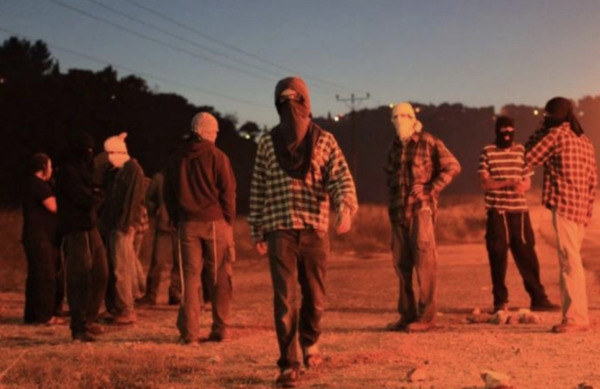
It added that a citizen and her son were killed and nine others were injured when an Israeli drone bombed Al-Hanawi School northwest of Khan Yunis. A child was also killed and others were injured in a bombing that targeted a tent housing displaced people near Al-Ard Al-Tayyiba in Mawasi, Khan Yunis.

It pointed out that other citizens were killed and others were injured when the occupation forces bombed the Sahloul family home near the Al-Shafi'i Mosque in the western camp in Khan Yunis.

The occupation forces' artillery fired shells, simultaneously with heavy gunfire on the eastern, western and northern areas of Gaza City.

Over the past 24 hours, 56 civilians were killed in the ongoing Israeli airstrikes on the Gaza Strip.

The ongoing Israeli war of extermination on the Gaza Strip, which began on October 7, 2023, has left more than 198,000 dead and wounded, most of them children and women, and more than 10,000 missing. Hundreds of thousands have been displaced, and famine has claimed the lives of many, including children, as well as widespread destruction.

PALESTINE

Thu 17 Jul 2025 11:07 pm - Jerusalem Time

Mediators present updated proposal for Gaza ceasefire agreement

US and Israeli media reported on Thursday that mediators presented Israel and Hamas with an updated proposal for a potential prisoner exchange and ceasefire in the Gaza Strip, while Qatari-US talks on the negotiations were held.

The American news website Axios quoted two sources as saying that Qatar, Egypt, and the United States presented the updated proposal to the two parties yesterday.

For its part, Israel's Channel 12 quoted sources as saying that Qatari mediators yesterday presented Israel and Hamas with an updated proposal that includes all the progress made over the past ten days. Egypt and the United States also signed the proposal.

According to the sources, the two main updates in the proposal relate to the extent of Israel's withdrawal from Gaza during the ceasefire, and the ratio between the number of Palestinian prisoners to be released and the number of Israeli prisoners, as part of a potential deal.

Channel 12 also quoted Israeli officials as saying that Israel had made significant concessions regarding the territory the army would remain in during the ceasefire.

Earlier today, the Israeli Broadcasting Authority quoted officials as saying that Israel had presented mediators with updated maps showing a broad withdrawal of its forces from the Morag axis between Rafah and Khan Yunis in the southern Gaza Strip.

The Israeli Broadcasting Corporation, citing these officials, said that the dynamics in the Doha talks are positive, and that there is still a need to narrow the gaps between the parties.

In this context, an Israeli army spokesman said today that the army is prepared to exercise greater flexibility and deploy along new borders in the Gaza Strip for the sake of negotiations.

Meanwhile, Israeli media reported that a meeting of the security cabinet had begun to discuss the latest developments in the ongoing talks in Doha aimed at concluding an agreement including a prisoner exchange and a ceasefire.

Israel's Channel 13 reported the night before yesterday that significant progress had been made in the Doha talks, saying that "the path to a deal is now paved."

Since July 6, indirect negotiations have been underway in Qatar between Hamas and Israel in a renewed attempt to reach a prisoner exchange and ceasefire agreement.

Over the past few days, media reports have indicated that Israel has presented maps that maintain its occupation of approximately 40% of the Gaza Strip, including the Morag axis extending between Rafah and Khan Yunis, a position rejected by Hamas.

Al-Aqsa TV quoted Hamas spokesman Jihad Taha last night as saying that the movement would not accept the separation of any area from the Gaza Strip and would reject the continued presence of the occupation army there.

Opposition to withdrawal

Meanwhile, Israeli Defense Minister Itamar Ben-Gvir said today that the army's withdrawal from the Morag axis was a grave mistake, and called on Prime Minister Benjamin Netanyahu to reverse it.

Ben-Gvir also called on Netanyahu to halt negotiations and issue the necessary instructions to occupy all of Gaza and encourage immigration and settlement.

Earlier today, the Israeli minister said he would make a decision at the appropriate time regarding his withdrawal from the government, noting that he did not want to withdraw from the government and wanted to continue as a minister.

Netanyahu has repeatedly indicated the possibility of reaching a 60-day ceasefire agreement, but has repeatedly stated that any agreement must allow Israel to resume fighting.

The current negotiations are based on an American proposal stipulating the release of half of the living Israeli prisoners (10 out of 20 prisoners), with the truce paving the way for talks leading to a ceasefire.

Hamas is demanding guarantees to halt the Israeli war, which has been ongoing since October 2023, and stresses that any agreement must include a complete cessation of hostilities and unconditional access for aid and reconstruction.

For their part, the families of the Israeli prisoners held in Gaza called for an end to attempts to obstruct efforts to end the war and recover all of these prisoners.

The Israeli Broadcasting Authority reported that representatives of prisoners' families and activists blocked Ayalon Street in Tel Aviv this morning, raising banners reading "Netanyahu is obstructing the will of the people. Bring everyone back" and "Get out of Gaza."

She added that families and activists chanted slogans accusing Netanyahu of obstructing a prisoner exchange deal against the will of the community and dragging Israel into an eternal war.

Combo of Qatari Prime Minister and Foreign Minister Sheikh Mohammed bin Abdulrahman Al Thani and US President Donald Trump

Qatari Prime Minister Sheikh Mohammed bin Abdulrahman (right) and US President Trump (agencies)

White House talks

As negotiations continue in Doha, an Al Jazeera correspondent reported that Qatari Prime Minister and Foreign Minister Sheikh Mohammed bin Abdulrahman Al Thani met with US President Donald Trump last night at the White House and discussed the ceasefire negotiations in Gaza.

Last Tuesday, Qatari Foreign Ministry spokesman Majed Al-Ansari said that negotiations for a ceasefire in the Gaza Strip were still in the early stages, stressing that negotiating teams remained in Doha.

Al-Ansari added that Qatar is continuing its efforts to reach a ceasefire agreement in Gaza as soon as possible.

A week ago, Axios reported that a Qatari delegation met with senior White House officials for several hours before the Israeli prime minister's meeting with the US president.

Trump has repeatedly spoken recently about the possibility of reaching an agreement on Gaza soon.

PALESTINE

Thu 17 Jul 2025 10:17 pm - Jerusalem Time

Palestinian Council of Ministers warns of a phase in which national institutions may be unable to continue providing their services due to the continued withholding of clearance funds.

The Council of Ministers warned, Thursday evening, of the repercussions of the ongoing comprehensive Israeli war on our people in the Gaza Strip and the West Bank, including Jerusalem, as well as the continued settler attacks, restrictions on movement at crossings, the closure of checkpoints, and the withholding of clearance funds, which constitute more than two-thirds of the state's revenues. This threatens the ability of government institutions to provide basic services to citizens, especially in the health, education, social protection, and various other vital sectors.

The Council noted that the value of the withheld funds has now exceeded 8.2 billion shekels, in addition to the clearing of the past two months, bringing the total withheld amount to approximately 9.1 billion shekels. This has significantly impacted the government's ability to fulfill its financial obligations towards various vital sectors, especially the health sector, which suffers from a shortage of medicines and medical supplies. This threatens to paralyze the health sector, in addition to undermining the ability of other institutions to perform their duties. It also highlights dangerous indicators such as the rising levels of poverty and unemployment and their repercussions on civil and societal peace and internal stability.

The Council also warned that the continuation of this situation, and the government's failure to fulfill its obligations to employees and various sectors, will negatively impact the quality of services and the performance of its various functions. This could lead to a decision to temporarily suspend the work of some government departments and drastically reduce employee working hours.

The Cabinet affirmed that the Palestinian leadership, headed by Mr. President, is continuing its intensive political and legal efforts to restore the rights of our people. It called on various countries of the world, especially the United States, as a signatory to the Oslo Accords, and France, as the host country of the Paris Agreement, to exert more pressure to compel Israel to implement the signed obligations. It also warned of the danger of running out of time to take the necessary effective action to ensure stability and peace in the region.

In a related context, the Council of Ministers affirmed that despite all these complexities and difficult circumstances, it continues to work to recover our withheld financial rights and secure all possible resources to meet financial obligations, particularly employee salaries and those of various sectors.

The Council directed heads of government departments to expedite the necessary measures to regulate public institutions' working hours in a manner consistent with the current challenge and the continuity of service provision.

PALESTINE

Thu 17 Jul 2025 8:13 pm - Jerusalem Time

A citizen from Tubas died of his wounds and his body was detained.

The General Authority of Civil Affairs announced, on Thursday evening, that it had informed the Ministry of Health of the death of citizen Firas Ahmed Raja Subuh (47 years old) as a result of critical wounds he sustained by Israeli occupation bullets this morning in Wadi al-Far'a, south of Tubas, and that the occupation is detaining his body.

Israeli occupation forces stormed the Jabal al-Thawr area in Wadi al-Far'a at dawn after special forces infiltrated the area and surrounded a house. They then wounded Subuh and arrested him inside the house, according to security sources.

PALESTINE

Thu 17 Jul 2025 8:05 pm - Jerusalem Time

Ben-Gvir brags about starving Palestinian prisoners in Israeli jails

Israeli National Security Minister Itamar Ben-Gvir boasted on Thursday about starving Palestinian prisoners in Israeli jails.

Ben-Gvir arrived on Thursday at the Israeli Supreme Court, which is considering a petition submitted by the Association for Civil Rights in Israel (ACRI) (a non-governmental organization) to stop the starvation of Palestinian prisoners.

Since Ben-Gvir assumed his duties as Minister of National Security at the end of 2022, the conditions of Palestinian prisoners in Israeli prisons have deteriorated significantly.

A significant drop in the weight of prisoners has been observed due to the policies imposed by Ben-Gvir in prisons.

Ben-Gvir said in a post on the X platform: "I arrived at the Supreme Court to attend a hearing on the petition of the Association for Civil Rights in Israel, regarding the living conditions and detention of Palestinian prisoners."

"Instead of discussing how to enhance deterrence, they question whether the menu is balanced, healthy, and contains enough vitamins," he added sarcastically.

Ben-Gvir described this as "madness and delusion. The State of Israel is in a state of war (of genocide in Gaza), and while our soldiers are sacrificing their lives, the Supreme Court is busy with hearings for a group of hypocrites," he said.

Proudly starving Palestinian prisoners, Ben-Gvir said, "I am here to ensure that terrorists receive the minimum of food."

For its part, the Association for Civil Rights in Israel said in a Facebook post: "Ben Gvir will soon appear in court as a defendant."

She added that Ben-Gvir "arrived at the Supreme Court himself to cause a stir, perhaps to disrupt the session and intimidate the judges, to take photos with police officers, and to make populist statements."

It also noted that "the petition was submitted to the court after countless testimonies were published describing a systematic policy of food shortages, to the point of starvation," while the court did not specify when it would issue its ruling on the petition.

According to data from the Israeli Prison Service, there are 10,762 Palestinian prisoners in Israeli prisons.

Since October 7, 2023, Israel, with American support, has been committing genocide in Gaza, leaving more than 198,000 Palestinians dead or wounded, most of them children and women, more than 10,000 missing, hundreds of thousands displaced, and a famine that has claimed the lives of many.

Since the beginning of the genocide, Israel has arrested thousands of Palestinians, later releasing a small number of them who showed signs of torture and severe hunger, unlike the Israeli prisoners released by Hamas who appeared to be in good health.

PALESTINE

Thu 17 Jul 2025 6:47 pm - Jerusalem Time

Settlers attack the towns of Kafr Malik, Sinjil, and Jaljalia in Ramallah.

Settlers stole agricultural equipment in the town of Kafr Malik on Thursday, while others moved mobile homes to the vicinity of a colonial outpost built on land in the town of Sinjil. A third group attempted to attack homes on the outskirts of the town of Jaljalia in the Ramallah Governorate.

Eyewitnesses reported that a number of settlers brought a crane to dismantle and steal iron rods and brackets that formed the framework of greenhouses built by residents of Ein Samia, east of Kafr Malik.

Citizens from Sinjil also observed three trucks carrying caravans and mobile homes heading to the Magharbat area north of the town, where the Givat Haroya settlement is located.

In the same context, citizens confronted a number of settlers who attempted to attack homes on the outskirts of the town of Jaljalia, north of Ramallah.

ARAB AND WORLD

Thu 17 Jul 2025 4:29 pm - Jerusalem Time

Washington condemns the Hague Group, its statement, and its adoption of "unprecedented measures" to hold Israel accountable.

The US State Department, commenting on Wednesday on the meeting of the "Hague Group" in the Colombian capital, Bogotá, and its statement announcing unprecedented measures to hold Israel accountable for its genocidal war against Palestinians in the besieged Gaza Strip, said it opposes the group and the principles to which it adheres.

"The United States strongly opposes efforts by the so-called multilateral bloc to weaponize international law and use it as a tool to advance a radical anti-Western policy and agenda," the State Department said in a press release to DropSite.

The statement added: "The so-called Hague Group, led by Cuba and South Africa, one communist and the other authoritarian, with their poor human rights records, seeks to undermine the sovereignty of democratic states and isolate Israel globally."

The statement threatened that the United States would do everything in its power to protect Israel and completely thwart the Hague Group.

On July 16, the Hague Group announced that 12 countries had agreed to "unprecedented measures" aimed at halting the Israeli genocide of Palestinians in Gaza, following an emergency summit held in Bogota, Colombia. According to the summit's final statement, the measures include imposing an arms embargo on Israel, preventing ships carrying weapons to Israel from docking in ports, reviewing public contracts that support the Israeli occupation of Palestine, fulfilling commitments to ensure accountability for the most serious crimes under international law, and supporting the prosecution of Israeli war criminals at the national and international levels.

Of the 31 countries that attended the historic summit, only Bolivia, Colombia, Cuba, Indonesia, Iraq, Libya, Malaysia, Namibia, Nicaragua, Oman, Saint Vincent and the Grenadines, and South Africa committed to fully implementing the measures. According to the statement, the remaining 18 countries "unanimously agreed on the need to end the era of impunity" and supported a unified call for an immediate ceasefire in Gaza.

“These 12 countries have taken a crucial step forward,” said Francesca Albanese, UN Special Rapporteur on the situation of human rights in the occupied Palestinian territories, during the closing ceremony. “Now it is time for countries—from Europe to the Arab world and beyond—to join in.”

"We came to Bogotá to make history—and we did," said Colombian President Gustavo Petro. "Together, we have begun the work of ending the era of impunity."

He added, "These actions demonstrate that we will no longer allow international law to be treated as optional, or for Palestinian lives to be made disposable."