PALESTINE

Sun 24 May 2026 5:16 pm - Jerusalem Time

Two sisters from Gaza win international award with innovation to recycle debris

From the heart of suffering and destruction left by the war in the Gaza Strip, an inspiring success story emerged for sisters Tala and Farah Moussa, who managed to turn the rubble of their bombed home into an opportunity for creativity. Their team, named 'Building Hope', succeeded in winning first place in the 2026 Earth Prize at the Middle East level, a prestigious international competition concerned with sustainability and entrepreneurship for school students and youth.

This achievement is a historical precedent, as the team of the displaced sisters in Nuseirat camp became the first Palestinian team to reach this global level in the competition's history. This victory came after fierce competition with more than 6,000 teams from various countries around the world, reflecting the ability of the Palestinian mind to innovate even in the harshest living conditions and under the weight of the siege and continuous aggression.

The project idea relies on innovating a decentralized and simple system for recycling household waste and educational facilities destroyed by the occupation. Tala Moussa explained in statements to press sources that the primary goal is to benefit from the accumulated rubble in the reconstruction process of the Strip, especially in light of the severe shortage of basic construction materials and the prevention of their entry through closed crossings.

Regarding the technical mechanism of the innovation, Tala explains that the process begins with collecting rubble from destroyed sites, then finely grinding it, after which available local environmental components such as clay, glass, and straw are added. This innovative mixture is poured into special molds and left to dry for a full week, resulting in a building block ready for use in embankments and non-load-bearing walls.

For their part, the sisters emphasized that the motive behind this project was the enormous scale of destruction that affected about 90% of Gaza's facilities, leaving approximately 60 million tons of rubble according to UN estimates. Farah Moussa pointed out that this innovation represents a practical response to the occupation's policies that hinder the entry of cement and building materials, making the rubble itself a raw material for rebuilding.

The sisters expressed their pride in this global recognition, describing the moment the results were announced as a historic moment that will not be erased from their memory. They affirmed that their ambition will not stop at the prize, but they seek to transfer this experience to the rest of the youth in the Gaza Strip by organizing training workshops aimed at generalizing the idea and enabling citizens to self-repair their homes temporarily.

This innovation comes at a time when the Gaza Strip is suffering from successive humanitarian and environmental crises due to the ongoing war that has left tens of thousands of martyrs and wounded. The 'Building Hope' project represents a glimmer of hope for thousands of displaced families, as it offers sustainable environmental solutions that contribute to alleviating the housing crisis and recycling solid waste resulting from the systematic Israeli shelling of residential areas.

Our project has found a temporary alternative solution for reconstruction in light of the occupation's closure of crossings and its prevention of the entry of necessary building materials.

ARAB AND WORLD

Sun 24 May 2026 5:16 pm - Jerusalem Time

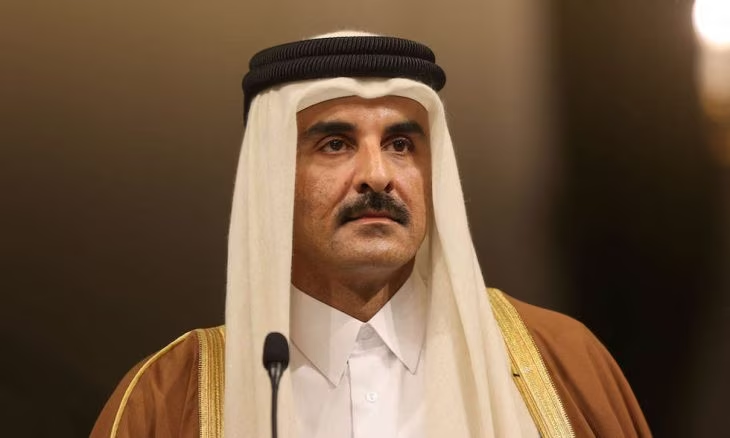
Intensive Qatari moves to support mediation between Washington and Tehran amid warnings of a 'temporary truce'

The diplomatic arena is witnessing accelerated Qatari moves aimed at strengthening the mediation efforts led by Pakistan between the United States of America and the Islamic Republic of Iran. These efforts come within the framework of broad international coordination seeking to contain escalating tensions in the region and ensure they do not slide into a comprehensive confrontation that threatens international peace and security.

In this context, Sheikh Tamim bin Hamad Al Thani, the Emir of Qatar, engaged in extensive telephone consultations that included US President Donald Trump and a group of Arab and regional leaders, among them the King of Bahrain, the King of Jordan, the President of the UAE, the Saudi Crown Prince, the Egyptian and Turkish Presidents, in addition to the Pakistani Army Chief.

The telephone discussions focused on reviewing current developments in thorny regional issues, where leaders exchanged views on mechanisms for de-escalation and preventing the expansion of conflicts. Participants expressed their appreciation for the continuous coordination with the American side, while also commending the pivotal role played by Pakistan in bringing together the viewpoints of Washington and Tehran.

During the call, the Emir of Qatar stressed the necessity of intensifying joint diplomatic work among active countries to confront security and political challenges. He affirmed that dialogue and negotiation remain the only path capable of sparing the region the repercussions of military escalation and its dangerous effects on the stability and resources of peoples.

In a related context, Sheikh Mohammed bin Abdulrahman bin Jassim Al Thani, the Qatari Prime Minister and Minister of Foreign Affairs, held a call with his Kuwaiti counterpart to discuss ways to support the ongoing mediation. The meeting addressed strengthening bilateral cooperation and coordinating Gulf positions aimed at finding common ground for a sustainable peace agreement that ends the state of permanent tension.

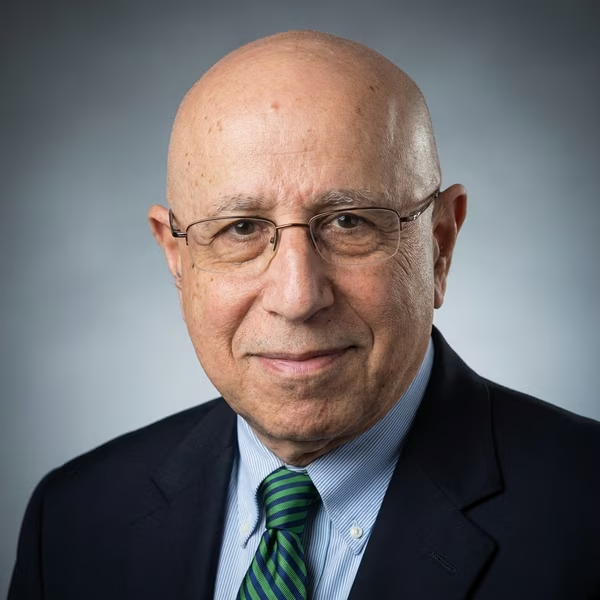
For his part, Dr. Khalid Al-Jaber, Director General of the Middle East Council on Global Affairs, provided an analytical reading of the anticipated agreement, describing it as a 'temporary freeze' rather than a final settlement. He explained that the trust gap between the American and Iranian sides remains deep, especially concerning the nuclear program and roles of influence in the Middle East.

Al-Jaber indicated in his statements that what is currently happening is a process of reordering political priorities for each party; Washington seeks to avoid an uncalculated regional explosion, while Tehran is looking for a breather to alleviate suffocating economic pressures. The analyst believes that this de-escalation carries within it the seeds of future crises that may erupt when political circumstances change.

Analysis pointed out that the current truce might be linked to a specific timeline, such as the end of major international events like the World Cup, making it a 'situational truce'. He considered that American policy historically relies on the principle of managing escalation according to temporary interests, without reaching radical solutions that completely end the conflict with the Iranian regime.

Al-Jaber warned that American pressure tools, whether economic sanctions or political moves, might strongly return to the forefront once the current phase ends. In contrast, he believes that Iran will not easily give up the regional power cards it possesses, meaning that the possibilities of direct or indirect friction remain in the near future.

The political analyst praised the role played by Gulf countries, specifically Qatar and Saudi Arabia, in keeping communication channels open and preventing the collapse of the negotiation process. He affirmed that Gulf capitals fully realize that any military clash between Washington and Tehran would cost the region dearly on economic and security levels.

Despite the success in postponing the explosion, there is a Gulf understanding that the current agreement may not provide sufficient guarantees to prevent the return of tension. Therefore, Gulf countries are working to invest the current period of calm to strengthen their internal fronts and boost investment and economic sectors, while keeping all possibilities open to deal with any sudden escalation.

Al-Jaber described the next phase as a period of 'cautious calm' rather than permanent stability, as the region remains in anticipation of what the upcoming rounds will yield. The historical relationship between Washington and Tehran is characterized by recurring cycles that begin with de-escalation and end with a return to confrontation, leaving the region in a state of continuous waiting.

Sources reported that the recent Qatari moves come as a continuation of Doha's traditional role as a center for international mediation and resolving complex disputes. Through these efforts, Qatar seeks to create a balance that preserves the interests of all parties and prevents the region from sliding into security chaos that may not be controllable under current international circumstances.

In conclusion, the bet remains on the extent of the commitment of the concerned parties to the terms of the initial understandings and the ability of mediators to transform the 'temporary freeze' into a long-term political path. Nevertheless, the structural challenges in the American-Iranian relationship remain the biggest obstacle to achieving true and comprehensive peace that ends decades of mutual hostility.

The current agreement does not reflect a real end to the conflict as much as it reflects a temporary freeze of it, as the fundamental differences between Washington and Tehran still exist.

PALESTINE

Sun 24 May 2026 5:16 pm - Jerusalem Time

Hebron: Settler attacks and financial crisis plague Eid al-Adha season

Just a few days before the blessed Eid al-Adha, an unprecedented state of stagnation hangs over the sheep market in Hebron, south of the West Bank. Commercial activity has significantly declined in one of the most important livestock markets, where traders spend long hours waiting for a few customers, a scene that reflects the depth of the economic crisis hitting the Palestinian territories.

Inside the market, hundreds of sheep stand in pens without buyers, while traders struggle to complete limited deals amidst complaints of insane price hikes. Observers believe that this season is one of the most difficult the sector has faced in many years, due to the intertwining political, field, and economic factors.

Traders' testimonies indicate that prices have doubled significantly, with the price of a kilogram of lamb jumping from five dinars in past years to more than ten and a half dinars currently. This increase has made the cost of a single sacrificial animal reach about 700 Jordanian dinars, an amount that exceeds the financial capacity of the majority of Palestinian families.

The financial crisis plaguing the Palestinian Authority has cast a heavy shadow over the market, especially with the irregular payment of government employees' salaries and accumulating debts. Sources reported that the decline in purchasing power has made citizens prioritize basic living necessities over the ritual of sacrifice, which has become very expensive under the current circumstances.

In addition to the financial crisis, settler attacks stand out as a major factor in destroying the livestock sector, especially in the Bedouin areas and Masafer Yatta. Sheep herders are subjected to almost daily attacks, including livestock theft and physical assault, leading to a severe shortage in supply and increased production and breeding costs.

In an incident that occurred on Thursday dawn, groups of settlers stole a flock of about 50 sheep after infiltrating a Palestinian residence in Masafer Yatta. These systematic thefts aim to pressure Palestinian herders and force them to leave their lands, which directly impacts the stability of meat prices in local markets.

Trader Mohammed Ahmed Al-Labib, who has been in this profession for five decades, described the current situation as "almost halted," noting a decline in his sales from 50 sheep in previous seasons to only 5 this year. Al-Labib sadly wondered how people could afford to buy sacrificial animals when they are struggling to secure daily sustenance amidst a lack of job opportunities.

Official data from the Palestinian Central Bureau of Statistics indicates an alarming rise in unemployment rates in the West Bank, reaching 28%. This economic deterioration resulted from the ongoing war on the Gaza Strip and the tightening of Israeli military restrictions, which led to thousands of workers losing their jobs inside the Green Line and in local sectors.

Livestock breeders in Area C face double challenges, as they are prevented from accessing natural pastures under threat of arms from settlers and occupation forces. This field siege forces breeders to buy fodder at high prices, which raises the final cost for the Palestinian consumer who is already suffering from financial hardship.

In a related context, the Wall and Settlement Resistance Commission documented more than 1600 attacks carried out by settlers in April alone, including property damage and livestock theft. These attacks are often carried out under the protection of the occupation army and directly target the backbone of the pastoral economy in rural Hebron and the West Bank.

Trader Riyad Al-Jabarin, who lives in Masafer Yatta, confirmed that purchasing demand does not exceed 20% compared to previous years, attributing this to the lack of cash liquidity among citizens. He explained that an employee who receives a small portion of his salary cannot allocate a large sum to buy a sacrificial animal given other living commitments.

The Palestinian Authority has been suffering from a suffocating financial crisis since 2019, which has sharply worsened this year due to Israel's withholding of clearance funds. Unpaid dues and the financial deficit reached about $4.26 billion, rendering the government unable to meet its obligations to employees, suppliers, and vital sectors.

Farmers complain about the lack of sufficient governmental and institutional support to cope with their losses resulting from settler attacks, as the breeder finds himself alone in facing systematic theft and killing of his livestock. This lack of support reinforces the state of frustration and pushes some to abandon the profession of livestock breeding they inherited from their fathers.

In conclusion, it seems that this year's Eid al-Adha will lack many of its usual manifestations in Hebron, as economic and security concerns overshadow the festive atmosphere. The Palestinian trader and citizen remain in a constant struggle between preserving religious rituals and a bitter living reality imposed by occupation policies and settler attacks.

People have no money, and some cannot find food and drink, so how will they buy sacrificial animals under these harsh conditions?

PALESTINE

Sun 24 May 2026 5:16 pm - Jerusalem Time

Settlers attack citizens' lands in Beit Einun under the protection of the occupation forces

Groups of settlers, today, attacked the lands of Palestinian citizens in the Beit Einun area, located north of the city of Hebron in the occupied West Bank, in a new escalatory step targeting the properties of residents in the area.

Local sources and eyewitnesses reported that the assault took place under security cover directly provided by the occupation forces to the settlers, as they secured their presence in the area and facilitated acts of sabotage and violations that affected agricultural lands and private properties.

In the same context, the occupation forces imposed a security cordon, preventing landowners and citizens from approaching the area or attempting to repel settler attacks, which prevented them from being able to defend their properties that are under constant threat of seizure and destruction.

Occupation forces provided support to the settlers to carry out their violations against lands and properties, and prevented citizens from accessing them.

PALESTINE

Sun 24 May 2026 5:15 pm - Jerusalem Time

Warnings of a health catastrophe.. Scabies invades occupation prisons as a systematic torture tool

The Palestinian Prisoner's Club issued a warning cry about a new and dangerous wave of scabies (scabies) spreading among detainees in Israeli occupation prisons. The club confirmed that the pace of the disease's spread has escalated alarmingly recently, as a result of what it described as the deliberate collapse of the health system within detention and interrogation centers.

The club based its report, issued today, Sunday, on dozens of legal visits carried out by the lawyers' team during April and May of this year. Field testimonies revealed catastrophic humanitarian and health conditions, where prisoners are systematically deprived of basic medical treatment and care, which has led to sections becoming infested hotspots.

Legal testimonies indicate that severe overcrowding plays a major role in transmitting the infection, as each cell contains at least eight prisoners, with an average of three of them contracting the skin disease. These rooms lack the minimum conditions for hygiene and sterilization, which has made the disease a tool of physical and psychological torture used against detainees to break their will.

The human rights report monitored the occupation authorities' deliberate cancellation of a number of scheduled legal visits recently, citing that the prisoners targeted for the visit were infected. The Prisoner's Club considered this step an attempt to cover up the extent of the health catastrophe inside the prisons, and to prevent lawyers from documenting the serious medical violations to which the infected are exposed.

The highest rates of infection were concentrated in Ofer, Megiddo, and Naqab prisons, where detainees in Megiddo prison, in particular, suffer from severe symptoms beyond skin itching. These symptoms included severe abdominal and head pains and general body aches, raising real fears of the spread of other epidemics in the absence of effective medical supervision.

The statement clarified that many prisoners entered a cycle of recurrent infections, where the detainee partially recovers and then returns to square one due to the continued deteriorating environmental conditions. Continuous infection cases exceeding five months were recorded without receiving any effective therapeutic dose, which led to an unprecedented worsening of the health conditions of the infected.

Lawyers documented the appearance of serious complications including boils, deep skin ulcers, and acute infections that exhaust the bodies of prisoners. Severe itching and continuous pain caused a state of permanent sleep deprivation, and some cases even reached the point of losing the ability to move normally as a result of health deterioration and general weakness.

On the psychological level, prisoners live in a state of prolonged exhaustion, where their highest aspirations have become limited to obtaining a therapeutic ointment or an opportunity to shower. The club confirmed that the daily suffering with the disease overshadowed other political and human rights demands, which reflects the immense psychological pressure exerted by the occupation through the policy of medical negligence.

The club accused the prison administration of implementing policies aimed at accelerating the spread of infection, by confiscating personal cleaning materials and preventing prisoners from exposure to sunlight or ventilation of cells. Detainees are also forced to wear wet or dirty clothes for long periods due to the lack of clothes and blankets, in conditions lacking human dignity.

According to official statistics, 89 prisoners have been martyred inside prisons since the beginning of the last war, and medical negligence and the spread of diseases were among the main factors in these deaths. Currently, more than 9,400 Palestinians are held in occupation prisons, including hundreds of children and women, all facing the risk of slow death amid complete international silence.

Detention sections have turned into infested hotspots, where at least 8 prisoners are held in a single cell, and at least 3 of them are infected with scabies.

PALESTINE

Sun 24 May 2026 5:15 pm - Jerusalem Time

Widespread Israeli Escalation in the West Bank: Demolitions in Ramallah and Settler Attacks in Salfit

Israeli occupation forces escalated their military operations today, Sunday, in various governorates of the West Bank, carrying out a series of incursions, demolitions, and arrests. Local sources reported that occupation bulldozers demolished a house in the village of Shaqba, west of Ramallah, after storming it with intensive military reinforcements, displacing its residents.

In the Hebron governorate, the occupation authorities issued 21 new notices for the demolition of Palestinian structures and homes in various areas, in a move aimed at restricting the Palestinian presence. Israeli forces also stormed the Beit Awwa municipality headquarters south of the city, and surveillance cameras documented soldiers spreading inside the public building's corridors.

According to official data issued by the Wall and Settlement Resistance Commission, last April witnessed 37 demolition operations targeting 78 Palestinian structures. These structures were distributed among 37 inhabited homes and 34 agricultural structures, with most of these operations concentrated in the governorates of Jerusalem, Ramallah, and Bethlehem.

In the northern Jordan Valley, occupation forces closed a dirt road and destroyed vital water networks in the Atouf plain, located east of Tammun. Moataz Bisharat, head of the settlement file in Tubas, explained that these measures come within a plan to construct a 22-kilometer settlement road at the expense of citizens' lands.

Regarding arrests, occupation forces launched a raid campaign in Jerusalem and Hebron, targeting a number of citizens, including children and the elderly. In the town of Beit Anan, northwest of Jerusalem, a child was arrested after his family's home was searched and its contents tampered with, amidst a state of tension that prevailed in the area.

In the town of Beit Ummar, north of Hebron, local sources reported that occupation forces arrested the elderly citizen Youssef Hassan Ikhlil, aged 72. The arrest operation also included four children aged between 15 and 16, after their homes in the town were stormed and they were taken to interrogation centers.

In the context of settler attacks, the town of Kifl Haris in the Salfit governorate witnessed a violent attack carried out by dozens of settlers under the protection of the occupation army. The attackers attempted to burn the town's mosque and throw stones at citizens' homes, resulting in extensive material damage to public and private property.

Munir Abu Yaqoub, head of the Kifl Haris Municipal Council, confirmed that about 30 settlers participated in the attack, which also targeted Palestinian vehicles, with six of them being smashed. He pointed out that the residents confronted the settlers and prevented them from reaching the mosque, stressing that the town suffers from almost daily attacks.

Settler attacks in Salfit were not limited to residential properties but also extended to the agricultural sector in the Wadi Al-Shaer area. Sources reported that a group of settlers uprooted and cut down a number of ancient olive trees, in an attempt to intimidate farmers and prevent them from accessing their lands.

These developments come amid a continuous escalation of the demolition and displacement policy pursued by the occupation authorities in the West Bank. These measures coincide with a significant increase in organized settler attacks targeting Palestinian villages and towns, exacerbating the humanitarian and security situation in the region.

Occupation forces closed the road with earth mounds and began destroying water networks, as part of bulldozing operations aimed at constructing a settlement road extending for about 22 kilometers.

PALESTINE

Sun 24 May 2026 5:15 pm - Jerusalem Time

5 Martyrs, Including an Entire Family, in a New Massacre in Central Gaza Strip

Israeli occupation forces committed a new massacre early Sunday morning, resulting in the martyrdom of five Palestinian citizens, including three from one family, following airstrikes that targeted various areas in the Gaza Strip. Medical sources confirmed the arrival of the bodies of martyr Muhammad Ibrahim Abu Mallouh, his wife Alaa Majdi Zaqlan, and their infant child Osama, to Al-Aqsa Martyrs Hospital, after their home in Nuseirat camp was targeted.

Security sources explained that Israeli warplanes fired two missiles at a residential apartment that housed dozens of displaced people in a previously damaged building in the camp, leading to varying injuries among civilians. The sources stressed that all the victims who fell in this attack were unarmed civilians who were sheltering inside the targeted building.

In the city of Deir al-Balah, the Israeli air force carried out a violent raid that completely destroyed a residential building and caused severe damage to neighboring homes, without any human casualties reported in that area. These raids come in the context of a continuous escalation witnessed in the central sector since the early morning hours, exacerbating the suffering of residents and displaced people.

On the maritime front, Israeli warships continued their attacks by targeting fishermen's boats off the coast of Gaza City with heavy machine gun fire and shells, resulting in a fisherman sustaining moderate injuries. The Israeli navy deliberately pursues fishermen in their livelihood as part of a series of daily violations it commits against Palestinians in coastal areas.

On the ground, local sources reported hearing massive explosions in the northern and southern areas of the Strip resulting from systematic demolition operations carried out by the occupation army on buildings and facilities. These operations focused on the eastern areas of Beit Lahia town to the north, as well as around Bani Suheila roundabout east of Khan Yunis city, where entire residential blocks were destroyed.

For his part, Hamas leader Mahmoud Mardawi stated that the occupation is disregarding the ceasefire agreement by continuing to target civilians and expand the scope of military operations. Mardawi pointed out that the Israeli army now effectively controls about 64% of the Gaza Strip, which represents a serious violation of previously reached understandings.

Hamas called on international mediators to intervene immediately to compel the occupation authorities to implement the provisions of the first phase of the ceasefire agreement and stop the ground encroachment. The movement warned that the continuation of these violations threatens the stability of the fragile calm and pushes towards further escalation amid the catastrophic humanitarian conditions in the Strip.

In a related context, the Ministry of Health in Gaza revealed a shocking toll of victims since the start of the ceasefire agreement, with 890 Palestinians martyred and more than 2,600 others injured. These figures reflect the extent of ongoing Israeli violations despite international efforts aimed at stabilizing the calm and ending the suffering of civilians.

It is worth noting that the Gaza Strip suffers from massive destruction affecting about 90% of its infrastructure as a result of the war of extermination that began in October 2023, which left more than 72,000 martyrs. UN reports estimate that the cost of rebuilding what the Israeli war machine destroyed could reach 70 billion dollars, amid a complete paralysis affecting all vital sectors.

The occupation continues to violate the ceasefire agreement through shelling, targeting civilians, and shooting, and has expanded its ground control to include about 64% of the Strip's area.

ARAB AND WORLD

Sun 24 May 2026 5:15 pm - Jerusalem Time

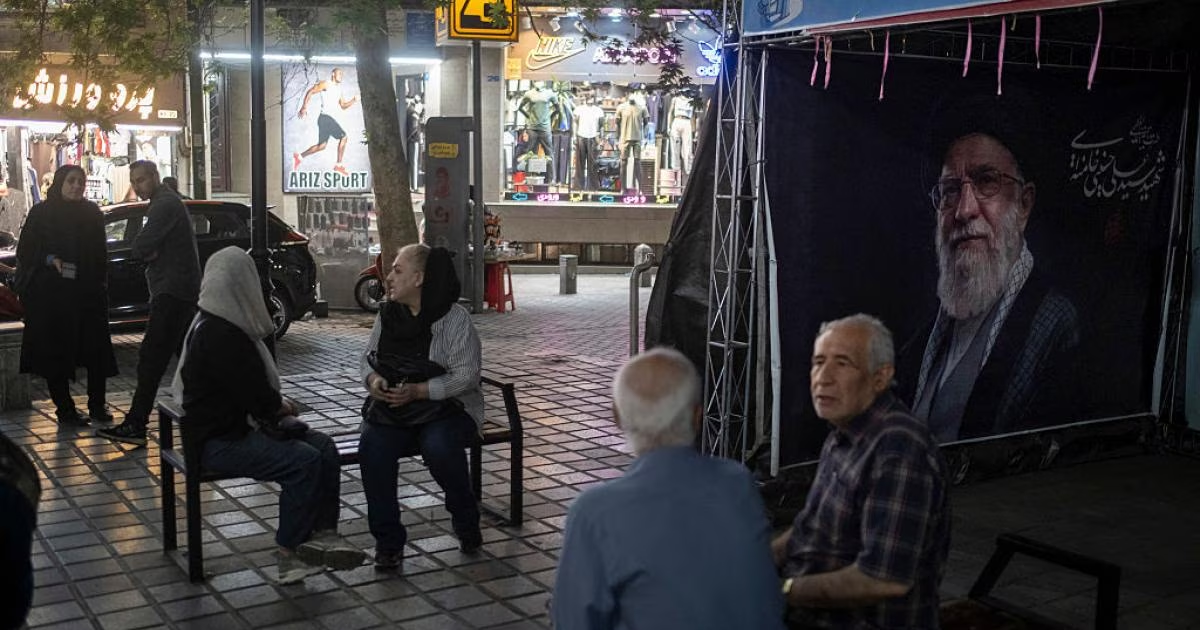
Unveiling the Terms of a Memorandum of Understanding Between Tehran and Washington: Comprehensive End to War and Lifting of Oil Sanctions

Iranian media sources have revealed the outlines of a proposed memorandum of understanding between Tehran and Washington, aimed at ending military operations on all active fronts in the region. The draft includes provisions allowing Iran to resume exporting its oil and petrochemical products, in exchange for its commitment to de-escalate field tensions and ensure the security of international navigation.

The proposed memorandum indicates a specific timeline for implementing the first steps, with a 30-day period allocated to address issues related to the Strait of Hormuz. This clause aims to restore navigation and ship traffic through the strait to their normal levels that prevailed before the outbreak of the war in the Gaza Strip and the expansion of the conflict.

The draft also included a 60-day period dedicated to in-depth discussions on the Iranian nuclear file, which remains a fundamental point of contention. Sources clarified that Tehran has not yet agreed to any restrictive measures concerning its nuclear program within this initial phase of understandings.

Under the proposal, the United States commits to fully lifting the naval blockade imposed on Iranian ports within one month of signing the memorandum. This step is accompanied by the release of a portion of frozen Iranian funds abroad, providing the Iranian economy with a necessary financial breather in the first phase of the agreement.

Informed sources confirmed that the potential agreement seeks to end the war on all fronts, including the Lebanese front, which has witnessed significant escalation recently. The proposal also addresses the possibility of withdrawing US forces from some areas near the Iranian border as part of confidence-building measures between the two parties.

Regarding the nuclear file, a high-ranking Iranian source stressed that Tehran has not pledged to transfer its stockpile of highly enriched uranium out of the country. The source indicated that complex nuclear issues will be deferred to later stages of negotiations and will not be part of the preliminary agreement currently being worked on.

Reports indicate that Iran refuses to suspend its nuclear activities for a long period as a precondition, insisting that discussions of these details are linked to Washington fulfilling its economic commitments. There are still ongoing disagreements over two key clauses in the memorandum of understanding, requiring additional rounds of discussions through international mediators.

For its part, international sources reported that the United States and Iran are on the verge of signing an agreement to extend the ceasefire for an additional two months. During this period, the Strait of Hormuz is expected to be opened to global navigation without imposing any additional fees, with Tehran committing to remove the naval mines it has laid.

The American vision for the agreement includes the necessity for Washington to obtain Iranian guarantees not to seek to possess nuclear weapons under any circumstances. The US administration also demands a clear timeline for negotiating the suspension of the uranium enrichment program and the disposal of sensitive stockpiles accumulated by Tehran in recent years.

Reports spoke of Iran providing verbal commitments through mediators, expressing willingness to make certain concessions in the enrichment file in exchange for tangible economic incentives. Political circles are awaiting an official response from the White House regarding these details, amid official silence from the US administration regarding recent leaks.

The success of this memorandum largely depends on the ability of both parties to overcome mutual distrust and adhere to the proposed timelines. Observers believe that the lifting of oil sanctions represents the trump card Tehran seeks to obtain, while the security of navigation in Hormuz is an urgent demand of the international community.

The draft also includes provisions related to the suspension of sanctions on oil derivatives throughout the negotiation period, to ensure the continuity of the diplomatic process. This measure aims to prevent the collapse of understandings if nuclear talks falter in their early stages, providing economic cover for the Iranian side.

Despite cautious optimism, the issue of US military presence in the region remains a thorny point that could hinder the achievement of a final and comprehensive agreement. While Tehran demands a clear withdrawal, Washington believes its presence is necessary to ensure the implementation of the agreement's provisions and protect its allies in the region from any potential threats.

In conclusion, this proposed memorandum represents a serious attempt to de-escalate regional tensions that have reached unprecedented levels over the past year. The coming days will play a crucial role in determining whether these understandings will turn into a binding agreement that ends the ongoing conflict between Washington and Tehran.

The Iranian nuclear file is not part of the preliminary agreement with the United States and will be addressed in the final agreement negotiations.

ARAB AND WORLD

Sun 24 May 2026 5:15 pm - Jerusalem Time

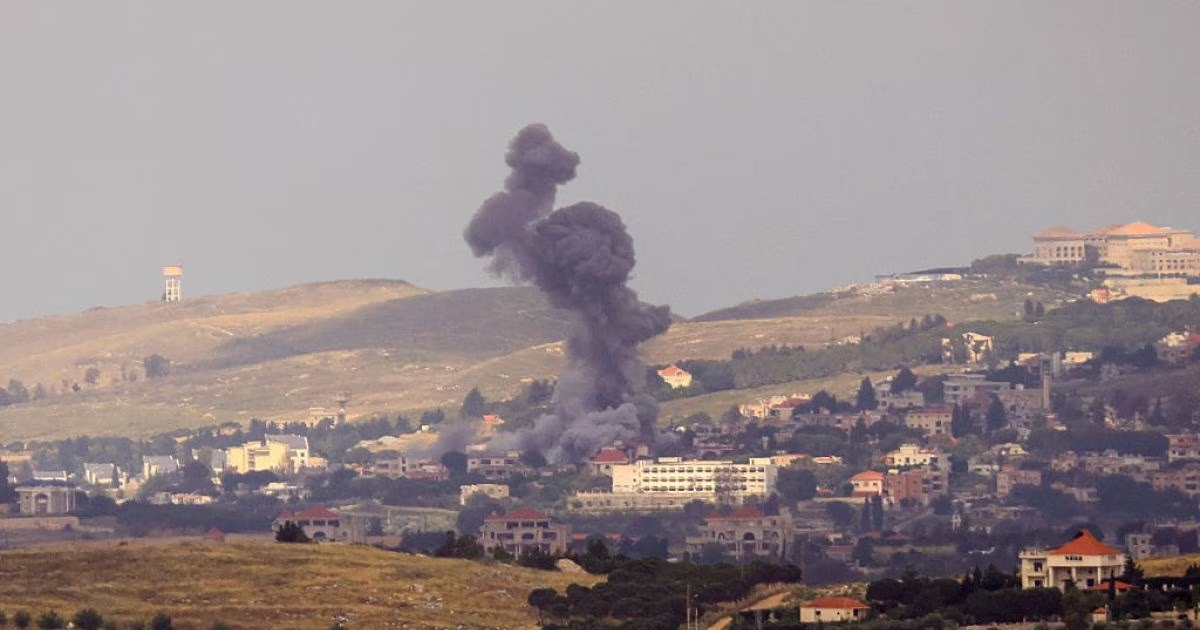
Field escalation in southern Lebanon: Deadly Israeli raids and intensive Hezbollah operations

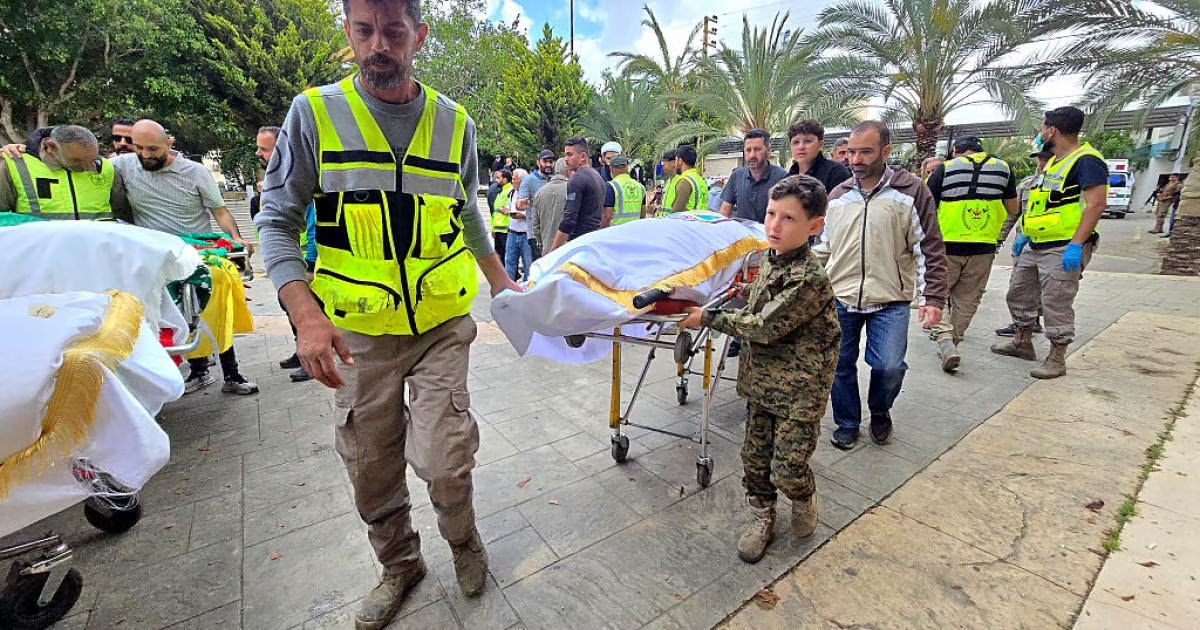
Israeli warplanes intensified their aerial raids today, Sunday, on wide areas in southern Lebanon, with shelling targeting towns in the districts of Tyre, Nabatieh, and Bint Jbeil. These attacks resulted in at least one martyr and several injured in the town of Al-Bazourieh, while a woman was martyred and two people were injured in a night raid that targeted the town of Toura, where funeral ceremonies for the victims took place amidst an atmosphere of sadness and tension.\n\nIn the Nabatieh district, Israeli fighter jets launched a morning raid on the town of Zawtar Al-Sharqiyah, coinciding with another aerial targeting of the town of Kafr in the Bint Jbeil district. No accurate final count of casualties in these areas has been reported yet, but material damage was extensive in the targeted residential neighborhoods, reflecting the occupation's insistence on expanding the scope of field targeting.\n\nOn the political front, MP Hussein Fadlallah, from the Loyalty to the Resistance Bloc, called on the Lebanese government to review the current negotiation process. Fadlallah called for suspending any negotiations with the Israeli side if they do not lead to a comprehensive agreement that guarantees an immediate cessation of aggression and ensures the return of displaced persons to their villages, stressing that a partial approach does not serve the Lebanese national interest.\n\nFadlallah pointed out in his statements to the regional dimension of the crisis, explaining that Tehran links any potential understandings with the United States to ending the war in Lebanon and the rest of the support fronts. These statements reflect the interconnectedness of field and political issues in the region, in the absence of any real signs of an imminent de-escalation that would end the suffering of civilians on both sides of the border.\n\nField sources in the South reported that Hezbollah carried out qualitative operations targeting Israeli army movements in the border areas. The party announced targeting a gathering of soldiers in the area between Al-Bayada and Naqoura, an area that witnesses repeated confrontations that previously forced the occupation to evacuate its operational centers under the pressure of strikes.\n\nAs part of the ongoing response, Hezbollah confirmed in military statements the targeting of a gathering of occupation vehicles in the vicinity of the Deir Sirian River for the fifth time using artillery shells and guided missiles. These strikes aim to disrupt Israeli attempts to establish positions in sensitive points near the riverbed, inflicting losses in equipment and lives on the attacking forces.\n\nResistance operations also included a direct targeting of occupation soldiers in the town of Rashaf with a concentrated rocket barrage that achieved direct hits, according to military reports. These reciprocal operations continue amidst an open escalation that observers fear could turn into a comprehensive confrontation, especially with the continuation of Israeli air raids that do not differentiate between military and civilian targets.\n\n"The Lebanese government must suspend negotiations with the occupation if a comprehensive agreement guaranteeing a ceasefire and the return of displaced persons is not reached.

ARAB AND WORLD

Sun 24 May 2026 5:15 pm - Jerusalem Time

Washington announces agreement with Tehran approaching to open Strait of Hormuz and ease sanctions

International diplomatic efforts are accelerating to reach a final draft agreement between the United States and Iran, aimed at ending the state of military tension in the Middle East region. Official sources reported significant progress in the ongoing talks, amidst cautious optimism about the possibility of reaching understandings that would end the outstanding crises between the two parties.

In statements made from the Indian capital, New Delhi, US Secretary of State Marco Rubio revealed the possibility of an official announcement regarding the agreement later today, Sunday. Rubio indicated that the next few hours might bring positive news to the world, especially concerning the safety of navigation in the strategic Strait of Hormuz.

Diplomatic sources confirmed that the negotiations, sponsored by Pakistan, primarily focus on technical issues related to Iran's nuclear file and securing waterways. The American side clarified that its objectives at this stage were clear, centered on ensuring global trade freedom and stopping maritime threats.

The US administration accused Tehran of hostile behavior in the region, including planting naval mines and detaining civilian ships as political hostages. Washington considered that any upcoming agreement must ensure a complete cessation of these practices to guarantee the stability of global energy markets.

In contrast, press sources quoted a high-ranking Iranian official confirming that Tehran has not yet agreed to hand over its stockpile of highly enriched uranium. The source clarified that the nuclear file, with its complex details, is not part of the preliminary agreement currently being worked on, but will be deferred to later stages.

The Iranian side stressed that the issue of shipping the uranium stockpile out of the country has not yet been resolved, and that current negotiations are focused on de-escalation on the ground. Observers believe that this stance reflects Tehran's desire to retain strong leverage before entering into negotiations for a comprehensive final agreement.

Reports from Washington indicate that the proposed agreement will allow commercial vessels to pass freely through the Strait of Hormuz without paying any additional transit fees. The proposal also includes a 60-day extension of the ceasefire, giving the parties an opportunity to catch their breath and build mutual trust.

Under these understandings, Iran will be able to resume selling its oil in global markets more freely, in exchange for a gradual easing of economic sanctions imposed on it. This clause aims to alleviate living pressures within Iran and prevent an economic collapse that could lead to widespread social unrest.

US President Donald Trump had previously stated that a large part of a memorandum of understanding aimed at achieving peace with Iran had been negotiated. Trump affirmed that his administration seeks to avoid involvement in open military conflicts that do not achieve clear strategic objectives for the United States.

Political analysts believe that both parties, American and Iranian, are currently looking for political exits that save face and spare them the high cost of war. Washington does not wish to deplete its resources in a long-term military deployment, while Tehran seeks to lift the economic blockade that has stifled its budget.

Experts believe that the continuation of the conflict without a political horizon will lead to a decline in the image of the United States as a power capable of resolving disputes in the region. At the same time, Iran realizes that the devastation of war could cost it hundreds of billions of dollars for reconstruction, which it cannot afford given the freezing of its assets.

Analytical readings indicate that most of the provisions put forward in the current agreement are not entirely new, but rather a repetition of points discussed in the previous nuclear agreement. The main debate now revolves around the permissible enrichment ratios and the mechanisms of international oversight over sensitive Iranian nuclear facilities.

President Trump seeks to market this agreement as a major 'political victory' for his administration, even if the amendments to the old agreement are limited and not fundamental. Resuming navigation in the Strait of Hormuz and opening diplomatic channels serve the electoral and political agenda of the White House at this stage.

Despite optimism about the imminent signing, there are still fears of negotiations faltering at the last minute due to outstanding technical issues. The world remains in anticipation of the official announcement that could change the shape of political and economic balances throughout the Middle East region.

I believe there is a possibility that the world may receive good news in the next few hours regarding the Strait of Hormuz.

PALESTINE

Sun 24 May 2026 5:11 am - Jerusalem Time

Ignoring 'Gaza Effect' in Democrats' Loss Report Sparks Outrage Within Party

The final report prepared by the Democratic National Committee (DNC) on the reasons for the 2024 presidential election loss has caused astonishment and anger within the party's ranks. This controversy arose after the 192-page document completely omitted any mention of the war in the Gaza Strip or its political repercussions. Observers considered this omission an attempt to ignore one of the most divisive issues in American public discourse over the past year.

Journalistic sources reported that the report, overseen by strategist Paul Rivera, did not include keywords such as 'Israel' or 'Palestine' or even a reference to 'Arab Americans.' This disregard comes despite repeated warnings from the party's progressive wing about declining public enthusiasm due to the previous administration's policies regarding the aggression on Gaza. Democratic circles described this approach as 'burying one's head in the sand' and an evasion of genuine review requirements.

Informed sources involved in preparing the report revealed that initial drafts and field interviews extensively discussed the impact of the Gaza issue on Kamala Harris's prospects. Quantitative data collected by the team confirmed that the stance on the war directly harmed the party's popularity among youth and Muslim voters. Nevertheless, participants were surprised by the complete disappearance of these findings from the final version presented to the party leadership.

In the context of reactions, David Hogg, a former DNC official, expressed his dismay at this deliberate concealment of electoral facts. Hogg explained that he had informed the report's compilers of the necessity to acknowledge the pivotal role Gaza played in the loss of youth votes. He pointed out that ignoring this variable weakens the party's ability to regain the trust of its grassroots in upcoming elections.

Anger was not limited to the progressive wing but extended to pro-Israel Democratic figures who expressed their bewilderment at the complete absence of the issue. Haley Soifer, Executive Director of the Jewish Democratic Council, said she searched the report's text for any reference to Jews or Israel and found nothing. She considered this omission a huge gap in the evaluation process, which was supposed to be comprehensive and transparent.

For their part, Arab American organizations confirmed that they had provided clear data to party officials showing the extent of the damage to the Democratic ticket resulting from unconditional support for the occupation. These organizations clarified that DNC officials admitted in closed meetings the impact of this issue, but preferred to exclude it from the official document. This contradiction reflects a deep crisis in how the party deals with human rights and foreign policy issues.

In an attempt to evade responsibility, Ken Martin, Chairman of the Democratic National Committee, issued a controversial clarifying statement. Martin claimed that he published the report as he received it from the author without interference, but quickly emphasized that he did not necessarily endorse what was included or excluded from it. Martin described the document as 'not ready for presentation,' a clear indication of leadership dissatisfaction with the quality of the review provided.

Abdul El-Sayed, one of Michigan's most prominent progressive figures, criticized this approach, considering that the party refuses to learn from its catastrophic mistakes. El-Sayed affirmed that the 'uncommitted' movement, which garnered hundreds of thousands of protest votes, was a clear cry that Democratic decision-makers failed to grasp. He added that continued disregard for the grassroots' demands regarding Palestine would lead to further internal divisions.

In a related context, international reports indicated that this internal turmoil coincides with a severe deterioration in the United States' global image. Recent opinion polls showed that Arab public opinion now views Washington as completely biased against Palestinian rights. This bias has led to increasing accusations of hypocrisy directed at the US administration, especially when comparing its stance on Gaza with its stance on the Ukrainian crisis.

Results from the 'Arab Barometer' for 2025 showed that the United States has lost much of its moral influence in eight pivotal Arab countries. In contrast, international powers such as China and Russia have begun to gain new areas of trust among Arab peoples. Observers believe that this shift results from the peoples' awareness of American selectivity in applying the principles of international law and human rights.

Political analysts warned that the Democratic Party's continued disregard for the 'Gaza effect' would complicate Washington's efforts to build future regional alliances. Arab governments find themselves under increasing popular pressure that prevents them from aligning with biased American policies. This reality poses a significant challenge to any diplomatic attempts aimed at expanding normalization agreements or enhancing stability in the region.

Kamala Harris's campaign had faced widespread protests in swing states, especially Michigan and Pennsylvania, due to the Gaza issue. Despite repeated attempts by activists to make their voices heard within the party's national convention in Chicago, the leadership insisted on preventing any Palestinian speaker from taking the stage. It appears that the latest report has solidified this exclusionary approach that refuses to acknowledge the new political reality.

Gaza's absence from the Democratic review report is not merely an administrative oversight but reflects a deep ideological struggle within the party. While the traditional leadership insists on protecting the alliance with Israel from any criticism, the rising generation believes that this alliance has become a moral and electoral burden. This division threatens the party's unity and its ability to mobilize voters in upcoming election cycles.

In conclusion, the question remains about the Democratic Party's ability to correct its course amidst this ongoing denial. Field facts and electoral data clearly indicate that Gaza was not just a foreign issue but a primary driver of American voter behavior. Without a courageous confrontation of these facts, the party will continue to suffer from a bleeding of votes in its traditional and most vital bases.

Quantitative data review clearly showed that Gaza harmed Biden and Harris, but these conclusions disappeared from the final version of the report.

PALESTINE

Sun 24 May 2026 5:11 am - Jerusalem Time

Environmental Disaster in Gaza: A Million Tons of Waste Besieges Displaced Persons, Skin Diseases Ravage Children

Displaced families in the Gaza Strip are living a tragic reality beyond endurance, as makeshift landfills have become forced neighbors to their dilapidated tents. Hajjah Ni'ma, one of the displaced, recounts her daily suffering in examining the bodies of her grandchildren, which have been ravaged by skin diseases due to insects and foul odors emanating from accumulated garbage, affirming that life under these conditions has become harder than death itself.

The crisis is exacerbated by the continued Israeli occupation preventing waste disposal trucks from reaching the main landfills located in border areas, such as the 'Sofa', 'Al-Fakhari', and 'Juhur al-Dik' landfills. This prohibition has crammed nearly two million people into very narrow spaces lacking the most basic public hygiene requirements, turning shelters into hotbeds of epidemics.

Local estimates indicate that the volume of accumulated waste in various governorates has reached approximately one million tons, distributed among more than 23 makeshift landfills amidst the displaced persons' tents. Mohammed Musleh, head of the Al-Maghazi municipality, confirmed that the occupation deliberately obstructs the transfer of these massive quantities, making environmental control almost impossible given the available resources.

On the medical front, field clinics are sounding the alarm with an unprecedented increase in the number of people infected with contagious skin diseases. Dr. Halima Abu Sharbin reported that she receives at least 150 cases daily suffering from skin inflammations and sores, noting that overcrowding and garbage accumulation are the main reasons behind this rapid outbreak.

The suffering is not limited to skin diseases but also extends to digestive system diseases and acute gastroenteritis due to widespread environmental pollution. Displaced persons complain of the spread of lice, scabies, and rashes, in the absence of clean water and necessary cleaning materials to limit the transmission of infection among family members and adjacent tents.

Local sources confirm that governmental and municipal services have been almost completely paralyzed since the beginning of the aggression, and despite attempts at a partial return to work, the extent of the destruction remains an obstacle to any comprehensive cleaning operation. The occupation strictly prohibits the entry of heavy equipment and spare parts needed to repair dilapidated waste collection trucks.

For its part, the Union of Municipalities of the Gaza Strip warned that the sector produces approximately 2,000 tons of solid waste daily that does not find a way for proper treatment. This daily accumulation complicates the environmental scene and turns makeshift landfills into ticking time bombs threatening the public health of the besieged population in confined spaces.

In a related context, Saeed Al-Aklouk, an official in the Ministry of Health, warned of the danger of these makeshift landfills becoming a permanent reality, due to the direct threat they pose to the groundwater reservoir. He explained that toxic leachate has already begun to seep into the ground, threatening to contaminate the only remaining water source for the sector's residents.

On the international level, Alessandro Marakic, an official with the United Nations Development Programme, described the waste problem in Gaza as 'enormous and beyond local capabilities.' He pointed out that the three main landfill sites are located in areas that the occupation prohibits access to, making dealing with two million tons of untreated waste an international challenge.

The United Nations is working to develop emergency plans to deal with this disaster, including proposals to establish advanced treatment plants that can convert waste into electrical energy. However, these plans remain contingent on Israeli approval for the entry of necessary machinery and equipment to begin work on the ground, which the occupation has so far refused.

The continued accumulation of garbage among the displaced persons' tents is not just a visual disaster, but an existential threat that directly affects the lives of children, women, and the elderly. Flies and insects now cover everything, and foul odors penetrate the tents amidst high temperatures that accelerate the organic decomposition of waste.

Observers believe that the occupation's intransigence in preventing the entry of sanitation and waste collection equipment comes within the framework of a systematic policy of restriction on the sector's residents. This policy has led to the complete collapse of the environmental system, making the most basic human right, which is living in a clean environment, an elusive matter for Palestinians in Gaza.

In light of this bitter reality, the residents of the sector and municipal authorities demand the necessity of real international pressure to open corridors for environmental and humanitarian equipment. Delaying the treatment of the waste crisis means a slow death sentence for thousands of families ravaged by epidemics away from direct war machines.

In conclusion, the scene of accumulated waste remains a testament to the magnitude of the tragedy experienced by the Gaza Strip, where political and military crises intertwine with environmental and health disasters. While the world awaits political solutions, the children of Gaza continue their daily struggle with diseases and insects in an environment no longer suitable for human life.

Death has become easier than this life where waste and insects besiege us from all sides inside the displacement tents.

PALESTINE

Sun 24 May 2026 5:11 am - Jerusalem Time

Despite losing 200 of its members.. Al-Najjar family in Khan Yunis celebrates the wedding of 50 grooms and brides

Amidst the rubble of war and in the heart of displacement tents in the Al-Mawasi area west of Khan Yunis city, the joyful ululations mixed with the pain of loss, as the sons of the Al-Najjar family held a mass wedding for 50 grooms and brides. This step comes amidst extremely complex humanitarian conditions experienced by the Gaza Strip, serving as a declaration of steadfastness and adherence to remaining on the land despite continuous bombing and siege.

Mohammed Al-Najjar, the patriarch of the family, which has lost nearly 200 of its members during the ongoing aggression, affirmed that holding this ceremony at this time is a clear message of defiance. He explained in statements to media sources that Palestinians prove day after day that they are committed to life and building new families, as an act of resistance aimed at preserving offspring and national identity on their soil.

Al-Najjar pointed out that the war and the widespread destruction it caused did not succeed in breaking the family's will, but rather pushed them towards greater social solidarity to bring joy to hearts exhausted by suffering. He stressed that this mass wedding will not be the last, expressing his hope that other Palestinian families will adopt such initiatives to enhance solidarity and alleviate the burdens on young people.

Regarding logistical challenges, the family patriarch explained that the marriages were completed thanks to the internal cooperation among family members who stood as one man to support the grooms. Despite the severe shortage of resources and the high cost of living, the family succeeded in providing the minimum requirements, including preparing special tents to serve as homes for the new couples, most of whom lost their homes in the airstrikes.

In the context of facilitating matters for young people, the family adopted a policy of reducing dowries and not exaggerating material requirements, based on a religious and social vision aimed at protecting young people amidst crises. Those in charge of the initiative considered facilitating marriage a national necessity to confront the occupation's attempts to disrupt the normal course of life in the besieged Strip.

Residents of the Gaza Strip face catastrophic living conditions, including a lack of fuel, a shortage of potable water, and a scarcity of medicines, yet these difficulties have not prevented the people of Khan Yunis from seeking spaces for joy. These social occasions turn into platforms for popular solidarity, where displaced people share simple moments of happiness with their neighbors in the tents, restoring hope to them.

Al-Najjar directed touching messages to Palestinian youth, calling on them to adhere to family values and mutual compassion, considering that a cohesive family is the last fortress in the face of calamities. The people of the Strip continue to innovate ways to survive, transforming displacement tents from symbols of suffering into wedding halls that confirm that the will to live is stronger than the machine of destruction.

This wedding is not just a social occasion, but a message to the world that we are a people who love life despite the killing, displacement, and attempts at uprooting.

OPINIONS

Sat 23 May 2026 8:03 pm - Jerusalem Time

Ben-Gvir Is Not an Exception. He Is the True Face of Israel


By Said Arikat


May 23, 2026


News analysis


Washington, D.C- Every time Israel’s Minister of National Security, Itamar Ben-Gvir, provokes outrage with his racism, cruelty, or open incitement against Palestinians, Israeli officials and their defenders abroad rush to reassure the world that he does not represent the “real Israel.” They describe him as an extremist, a fringe figure, an embarrassment to the country’s democratic image. But after decades of occupation, siege, mass killing, dispossession, and dehumanization of Palestinians, such claims no longer withstand scrutiny.


Ben-Gvir is not an aberration. He is not a distortion of Israeli politics. He is its clearest and most honest expression.


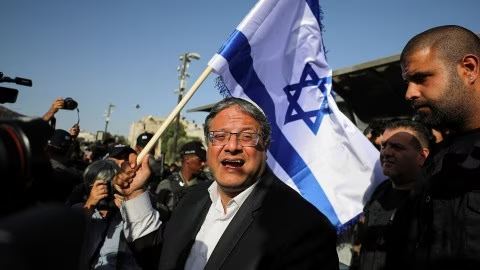
The recent scandal surrounding Ben-Gvir once again exposed this reality. A widely circulated video showed him mocking foreign activists detained after participating in a flotilla attempting to challenge Israel’s blockade on Gaza. The activists appeared kneeling on the ground with their hands bound while Ben-Gvir waved an Israeli flag and shouted triumphantly, “We are the masters of this land.” Western governments expressed outrage. Commentators called the spectacle disgraceful and shocking.


But shocking to whom?


For Palestinians, there was nothing surprising about the scene. What the world witnessed in that brief video was merely a public glimpse into the mentality that has shaped Israeli policy toward Palestinians for generations: domination, humiliation, and the conviction that Palestinians exist outside the boundaries of equal humanity.


What makes Ben-Gvir disturbing is not that he says something radically different from earlier Israeli leaders. It is that he says openly what others often tried to disguise behind diplomatic language. From David Ben-Gurion to Benjamin Netanyahu, Israeli leaders have repeatedly justified Palestinian dispossession and violence against Palestinians as necessary for the preservation of a Jewish state built on exclusive power and control.


Over the years, Palestinians have been described by Israeli politicians, military figures, and public personalities as “animals,” “cockroaches,” “human beasts,” and demographic threats. Such language is not accidental. History repeatedly shows that dehumanization is a prerequisite for systematic violence. When people are reduced to vermin or subhuman creatures, their suffering becomes easier to justify, their deaths easier to rationalize.


The tragedy is that this rhetoric no longer belongs solely to fringe extremists. It has become normalized across much of Israeli political and social life.


The evidence is overwhelming.


Throughout Israel’s assault on Gaza, Israeli soldiers themselves uploaded videos celebrating destruction, mocking Palestinian suffering, dancing in bombed homes, and boasting about devastation inflicted on civilian neighborhoods. The horrifying aspect was not only the violence itself, but the pride with which it was displayed. Soldiers filmed themselves destroying homes, humiliating detainees, and laughing amid ruins where entire Palestinian families had been buried under rubble.


These were not hidden crimes exposed by whistleblowers. Many were proudly posted online by the perpetrators themselves.


This behavior reflects a deeper transformation within Israeli society. Poll after poll now shows broad public support among Israeli Jews for extreme measures against Palestinians, including forced displacement and permanent domination. Surveys conducted since the Gaza war began indicate overwhelming opposition to Palestinian statehood and substantial support for policies amounting to annexation and ethnic cleansing.


That reality is precisely why Ben-Gvir and Finance Minister Bezalel Smotrich are no longer marginal political figures. They are central figures because they articulate sentiments that increasingly resonate with large segments of Israeli society.


Israeli journalist Ben Reiff recently wrote that “No One Represents Israeli Politics Today Better Than Itamar Ben-Gvir.” He was correct. Ben-Gvir’s rise did not occur despite Israeli society. It occurred because Israeli society has steadily moved in his direction.


This transformation did not happen overnight. It is the culmination of decades of occupation and impunity. Successive Israeli governments expanded settlements, entrenched military rule over millions of Palestinians, imposed a suffocating blockade on Gaza, and normalized permanent inequality between Jews and Palestinians. Each step shifted the boundaries of what was considered acceptable.


Ideas once associated with extremist Kahanism — Jewish supremacy, expulsion of Palestinians, open calls for ethnic cleansing — gradually entered the political mainstream. Netanyahu himself played a decisive role in legitimizing these forces by bringing them into governing coalitions to preserve his hold on power.


Today, Ben-Gvir does not hide his beliefs because he no longer needs to. He understands that the political climate increasingly rewards brutality rather than punishes it.


That is why efforts by Israeli officials and Western apologists to distance Israel from Ben-Gvir ring so hollow. If Ben-Gvir truly represented an alien force rejected by Israeli society, he would not hold one of the most powerful positions in government. He would not command enormous influence over policing and internal security. He would not be embraced by coalition partners. Most importantly, his rhetoric would not resonate so deeply with broad sectors of the public.


The uncomfortable truth is that Ben-Gvir reflects not merely a government, but a broader political and moral collapse.


For decades, many in the West clung to the illusion that Israel remained fundamentally liberal and democratic, temporarily led astray by hardliners. That illusion is becoming increasingly impossible to sustain. The policies now condemned internationally — collective punishment, mass displacement, siege, annexationist ambitions, and open incitement against Palestinians — are no longer confined to fringe groups. They are embedded within the governing structure itself.


Ben-Gvir simply strips away the euphemisms.


He says publicly what others imply privately. He celebrates openly what others attempt to justify bureaucratically. He exposes, with disturbing clarity, the logic underlying decades of occupation and domination.


This is why so many Palestinians view international outrage over Ben-Gvir with deep skepticism. The world suddenly recoils when cruelty is displayed crudely on camera, yet remains largely silent when the same cruelty is institutionalized through checkpoints, bombings, siege, home demolitions, land confiscation, and military occupation.


Ben-Gvir did not invent this system. He inherited it, embraced it, and now embodies it.


To portray him as an unfortunate exception is therefore intellectually dishonest. He is not the disease; he is the symptom of a society and political order that has steadily normalized supremacy and dehumanization.


The world should stop pretending otherwise.

ARAB AND WORLD

Sat 23 May 2026 7:25 am - Jerusalem Time

Ignoring Gaza in US 'Democratic' report sparks sharp divisions within the party

A report issued by the Democratic National Committee (DNC) sparked a wave of widespread controversy and sharp criticism after the report, dedicated to reviewing the reasons for losing the 2024 elections, omitted any mention of the Israeli war on the Gaza Strip. Observers and activists within the party considered this oversight a major flaw in understanding the real reasons that led to the decline in the party's popularity among vital segments of voters.

Journalistic sources reported that the report, prepared by Democratic activist Paul Rivera, faced accusations of attempting to gloss over the on-the-ground realities that affected Kamala Harris's presidential campaign. Progressive activists confirmed that they conveyed serious concerns to the report's preparers about the impact of the Biden administration's stance on the Middle East conflict on the enthusiasm of young and progressive voters, but these observations did not make their way into the final text.

For his part, David Hogg, who previously served as vice-chair of the DNC, revealed that he explicitly demanded recognition of the role the Gaza issue played in losing the votes of the youth generation. Hogg explained that he raised these concerns in lengthy meetings with party officials, emphasizing that ignoring this issue hinders the party's ability to regain the trust of its electoral base in upcoming elections.

The criticism was not limited to the progressive wing but extended to pro-Israel Democrats who were shocked by the complete absence of the issue. Hali Soifer, CEO of the Jewish Democratic Council of America, said she searched the report for words like 'Gaza,' 'Israel,' or even 'Jews' and found no trace of them, describing this omission as a 'gross oversight' that does not reflect the reality of political discussions within the United States.

In a related context, members of the Policy Project at the Institute for Middle East Understanding confirmed that they informed the report's authors that the absolute support provided by the Biden administration to Israel cost the party tangible electoral losses. They pointed out that the DNC's own data showed that this stance had a negative impact electorally, yet these findings were excluded from the final published report.

Margaret Deirios, the project's executive director, called on DNC Chair Ken Martin to disclose information and data confirming the party's negative impact due to the Gaza issue. Deirios believed that transparency on this issue is the first step towards reforming the party's political course, warning that continued denial will lead to further bleeding of electoral votes.

Ken Martin, the DNC Chair, responded to these criticisms by asserting that he published the report as he received it from the assigned committee without any intervention of deletion or addition. Martin clarified that he does not necessarily endorse all the conclusions contained in the report, nor does he bear responsibility for the issues that were ignored, in an attempt to distance himself from the storm stirred by the content.

Data indicates that divisions over Gaza shook the foundations of the 2024 election campaign, with the 'uncommitted' movement emerging as a pressure group during the primaries. This movement garnered hundreds of thousands of votes in protest against the White House's policy, and despite continuous pressure on Kamala Harris to change her approach, she remained committed to the general line set by Biden regarding the war.

Abdul El-Sayed, a former progressive candidate in Michigan, believes that the report's omission of the Gaza war's impact is a continuation of a pattern of political mistakes made by the party. El-Sayed affirmed that the failure to acknowledge the repercussions of the human rights issue in Gaza on election results reflects a state of unwillingness to confront reality and learn from the harsh lessons imposed by the ballot boxes.

In turn, James Zogby, a veteran DNC member and president of the Arab American Institute, noted that the party is beginning to face the actual consequences of voters' changing views towards Israel. Zogby cited a record number of Democratic senators voting against arms deals for Israel, considering that the party's grassroots are now ahead of its leadership in understanding the dimensions of the humanitarian crisis in Gaza.

Sources concluded that the issuance of the report in this incomplete form increases financial and political pressure on the Democratic Party leadership, which faces a deep crisis of trust. With the 2026 elections approaching, the Gaza issue appears to remain a fundamental point of contention threatening party unity, especially with the growing influence of pro-Israel lobbying groups in the face of rising progressive movements.

Failure to acknowledge the impact of the party's failure on human rights issues on election results reflects an unwillingness to face the consequences and learn from mistakes.

ARAB AND WORLD

Sat 23 May 2026 7:25 am - Jerusalem Time

Trump expects an imminent end to the conflict with Iran amidst intense diplomatic activity in Tehran

US President Donald Trump made striking statements indicating the approaching end of the military and political confrontation with Iran, asserting that his administration succeeded in curbing Tehran's nuclear ambitions. Trump clarified to a crowd of his supporters in New York State that things would end very soon and in a way that would positively impact the American economy and cost of living.

The American President stressed that Iran would not be given any opportunity to possess nuclear weapons under any circumstances, noting that the pressures exerted by Washington had begun to bear fruit. Trump predicted that the world would witness unprecedented figures in terms of economic gains, pointing out that commodity and car prices would see a significant decrease once this issue is resolved.

Meanwhile, responsible sources in the White House confirmed that the President's general inclination is towards a diplomatic solution, but it remains conditional on the extent of Tehran's response to American demands. The sources added that Washington would not hesitate to take firm measures if the Iranian leadership refused to conclude an agreement that guarantees international security and stability.

The sources indicated that the success of the 'Epic Fury' operations, economic pressures, and the imposed blockade, gave the American administration the initiative in the ongoing negotiations. They affirmed that Trump has enough time to reach the 'best possible agreement', stressing that he will not be drawn into signing any 'bad' or hasty agreement that does not serve American interests.

On the ground and diplomatic front, press reports revealed that Trump held an emergency meeting with senior members of the national security team to discuss scenarios for dealing with the Iranian file. The President received a comprehensive briefing on the status of current negotiations and alternative plans in case the political path collapses, reflecting the seriousness of the American position.

In a move that fueled speculation about the criticality of the coming hours, Trump canceled his usual schedule and decided to stay in Washington over the weekend. The President announced his apology for not attending his son 'Donald Jr.'s' wedding, justifying it by the existence of urgent governmental circumstances requiring his direct presence at the decision-making center.

In parallel, media reports stated that the US military raised its readiness for the possibility of launching new airstrikes against Iranian targets. These preparations come as a final pressure message coinciding with the intense diplomatic efforts led by regional parties in the Iranian capital, Tehran.

For its part, Tehran received Pakistani Army Chief Marshal Asim Munir, in a visit described as 'the last chance' to bridge the views between Washington and Tehran. Islamabad seeks through this move to prevent the resumption of an all-out war and find a consensual formula that satisfies both parties and ends the escalating tension.

Mediation was not limited to the Pakistani side, as a high-level Qatari delegation arrived in Tehran to participate in overcoming obstacles to the anticipated agreement. Doha is working in coordination with international parties to ensure that the region does not slide into a widespread military confrontation that could get out of control.

In contrast, the Iranian Foreign Ministry expressed cautious optimism, confirming that talks are still ongoing despite the existence of fundamental contentious issues that have not yet been resolved. Iranian sources indicated that talking about an imminent agreement might be premature unless comprehensive understandings are reached on all points.

Sources close to the Iranian negotiating team clarified that Tehran's primary focus is currently on 'ending the war' and fully lifting the restrictions imposed on it. The sources stressed that the Iranian side would not move to discuss any secondary issues before obtaining final guarantees of a cessation of hostilities.

Despite the complexities, Iranian sources acknowledged significant progress in some files compared to previous negotiation rounds, thanks to the efforts of mediators. However, reaching the final wording remains contingent on Washington's flexibility in dealing with Iranian demands related to sovereignty and security.

The intense diplomatic movements, including the presence of the Pakistani Interior Minister in Tehran for two days, indicate that negotiations have entered a 'bottleneck' phase. Mediators are currently trying to narrow the gaps in views on the mechanisms for implementing the agreement and guarantees of adherence to it by both parties.

Anticipation remains the master of the situation in world capitals, as eyes turn to Washington and Tehran to see whether the coming hours will bring a historic agreement or military escalation. Trump's statements about an 'imminent end' remain the most prominent indicator of the possibility of a dramatic breakthrough in this thorny issue.

We stopped them... They will never get a nuclear weapon, and we will end this very soon.

ARAB AND WORLD

Sat 23 May 2026 7:24 am - Jerusalem Time

Israeli Escalation Targets Eastern and Southern Lebanon: Intense Raids Target Paramedics, Causing Dozens of Casualties

The mountainous areas in eastern Lebanon and the coastal city of Tyre in the south witnessed a series of violent aerial raids carried out by Israeli warplanes on Friday and Saturday nights. Field sources reported approximately seven raids targeting the eastern mountain range adjacent to the Syrian border, an area that had remained relatively outside the direct targeting circle since the recent ceasefire agreement came into effect.

In the city of Tyre, the shelling targeted two residential buildings in and around the city after immediate Israeli evacuation orders were issued to residents. The occupation authorities justified these attacks under the pretext of facilities being used by Hezbollah elements, which led to a new wave of displacement and panic among civilians in the targeted areas.

This field escalation comes after a bloody day that saw 11 martyrs, including six paramedics, as a result of more than sixty Israeli attacks targeting southern villages and towns. These aggressions varied between aerial raids and concentrated artillery shelling, in addition to sweeping and detonation operations in border areas, putting the fragile truce agreement to a real test.

Sources monitored direct targeting of rescue teams, where six people, including two paramedics, were martyred in a raid on the Burj Rahal - Deir Qanoun Al-Nahr triangle. The injuries occurred while paramedics were attempting to evacuate wounded individuals from a previous raid that targeted a motorcycle, indicating a pattern of double attacks targeting medical crews.

In the town of Hannawiyah, four other paramedics were martyred and two were injured to varying degrees as a result of two raids that directly targeted an ambulance center and a staging point belonging to the Islamic Health Authority. The raids also targeted the Al-Hafour area located between the towns of Siddiqin and Qana, resulting in additional casualties among civilians present in the area.

The city of Nabatieh was not spared from this escalation, as a drone targeted a small pickup truck in the heart of the crowded commercial market. The attack resulted in the martyrdom of one person and the injury of others, a step that reflects the occupation's determination to pursue civilian and commercial targets deep within major southern cities.

For its part, the Lebanese Ministry of Health revealed in its periodic report the registration of 22 martyrs and 39 injured in the past twenty-four hours alone. These figures reflect the scale of the ongoing Israeli military escalation despite international understandings that aimed to de-escalate tensions and cease hostilities.

With the continuation of this wave of violence, the total number of victims of the Israeli aggression since the beginning of last March has risen to 3111 martyrs and 9432 injured. These tragic statistics underscore the depth of the humanitarian crisis Lebanon is experiencing amidst repeated Israeli violations of Lebanese sovereignty and signed agreements.

The Lebanese Ministry of Health announced the registration of 22 martyrs and 39 injured in the past 24 hours, raising the total number of victims of Israeli aggression since last March to over 3,000 martyrs.

PALESTINE

Sat 23 May 2026 7:23 am - Jerusalem Time

Investigation reveals details of a mysterious Israeli military site in the Iraqi desert

An investigative report conducted by a specialized team in cooperation with media sources has revealed intriguing details concerning a mysterious military site in the Al-Nukhaib desert, western Iraq. The investigation relied on a precise analysis of satellite images and field data that monitored intense activity which appeared and disappeared suddenly in the Wadi Hamer area near Najaf last March.

Research efforts focused on an area estimated at about 150 square kilometers, where satellite images showed striking changes in the terrain located 180 kilometers west of the city of Najaf. The data indicated that the site is near a facility likely to be an old military base, which provided ideal cover for suspicious movements.

According to 'Sentinel-2' satellite images, ground leveling and preparation operations began in the bed of a dry wadi known as Wadi Hamer after February 24. By March 3, images showed the completion of a dirt track in the form of a temporary landing strip or airfield designated for receiving military aircraft.

'Planet Labs' images taken on March 2 showed the presence of temporary facilities and seven massive objects lined up in an organized manner, their dimensions consistent with combat helicopters or large logistical equipment. The investigation confirmed that these visual indicators strongly suggest the presence of a foreign force operating deep within Iraqi territory.

These technical data intersected with field reports of suspicious aerial activity, which led to the death of Iraqi shepherd Awad Al-Shammari after he approached the suspicious area. Sources quoted relatives of the victim as saying that an unknown helicopter directly targeted his truck to prevent him from revealing what was happening at the site.

Comparison between images taken at close intervals showed the disappearance of temporary facilities by March 6, with clear traces of heavy vehicle and aircraft movement remaining. Experts suggest that the site was evacuated very quickly upon completion of the mission assigned to the infiltrating force, before natural factors erased the remaining traces.

In a dangerous field development, an Iraqi army reconnaissance force was subjected to aerial bombardment while attempting to survey the area in early March, resulting in the death of an Iraqi soldier. Although accusations were directed at the US army at the time, the latter categorically denied carrying out any landings or strikes in the Najaf desert.

Iraqi Army Chief of Staff, Abdul Amir Yarallah, confirmed that a military unit was indeed bombed and arrived at the site the next day to find traces of an unknown force that had already withdrawn. Media sources obtained photos of ammunition remnants from the target site showing the use of advanced 'Hellfire' missiles.

Examination of the debris showed technical phrases referring to the American 'AGM-114' missile, a type that Israel acquired in large quantities last year. This physical evidence strengthens the hypothesis that the force present in Wadi Hamer was a special Israeli force that carried out a secret operation.

The investigation links these movements to previous statements by Israeli Air Force Commander, Tomer Bar, who referred to operations carried out by special units in distant areas he described as 'igniting the imagination'. It appears that the Iraqi desert was the scene of one of these operations that required the establishment of temporary infrastructure.

According to technical analysis, the length of the prepared track in the wadi reached about 1700 meters with a width of 50 meters, specifications that allow the operation of 'C-130 Hercules' tactical transport aircraft. Israel possesses this type of aircraft capable of landing and taking off from unpaved dirt runways in difficult geographical conditions.

The flat and isolated nature of Wadi Hamer provides an ideal environment for carrying out rapid operations away from radar and ground monitoring, especially with its relative proximity to the Iranian border. The report concludes that the accumulation of evidence from satellite images and ammunition remnants makes the hypothesis of an Israeli site an objective reality.

Despite the disappearance of most of the landing strip's features by April due to rain and weather factors, questions still remain about the nature of the mission that was carried out. The official Iraqi silence and the mystery surrounding the incident raise many speculations about the extent of the security breach in the western desert areas.

The nature of Wadi Hamer makes it a theoretically suitable location for establishing temporary dirt landing strips and carrying out rapid operations away from detection.

PALESTINE

Sat 23 May 2026 7:23 am - Jerusalem Time

Testimonies of detainees held by the occupation reveal details of their meetings with 'Gaza Ghost' Izz al-Din al-Haddad

The Hebrew newspaper 'Yedioth Ahronoth' published a detailed report containing new testimonies from former detainees held by the resistance in the Gaza Strip, focusing on the personality of Izz al-Din al-Haddad, the commander of the Gaza Brigade in the Al-Qassam Brigades. The detainees, who were released in previous deals, stated that Al-Haddad is one of the most prominent leaders they dealt with directly, describing him as an influential figure highly sought after by the occupation's security agencies.

The testimonies given by 'Gali', 'Ziv', and 'Emily' confirmed that the military commander, nicknamed 'Al-Hajj', speaks Hebrew fluently, which enabled him to communicate with them without an intermediary. They indicated that Al-Haddad deliberately used his linguistic skills to psychologically influence them and discuss the details of military operations carried out by the resistance in the field.

In one of the direct confrontations, the detainees quoted Al-Haddad as boasting about the October 7 operation: 'You thought our attack would come from underground through tunnels, but we surprised you from above and bypassed the border wall.' These statements, according to the detainees, reflect the pride that Al-Qassam leaders showed in the strategic success they achieved in breaking the occupation's security system.

The detainee 'Ziv' recounted details of his meeting with Al-Haddad in various locations within the Strip, where the military commander was keen to clearly reveal his identity to them. On one occasion, Al-Haddad approached him and asked him in Hebrew if he knew who he was talking to, before introducing himself as the commander of the Gaza Brigade, merely using the title 'Al-Hajj' given to him by his companions.

The testimonies also included references to geographical deception attempts that Al-Haddad practiced with the detainees to maintain the secrecy of locations. When one of the detainees thought he was in Khan Younis, Al-Haddad responded with a sarcastic smile, assuring him that he was still in the heart of Gaza City, which reflects the field control of military commanders despite intense bombardment.

For his part, the detainee 'Gali' mentioned that he met Al-Haddad at least four times, and on one of these occasions, he was accompanied by high-ranking leaders from the Hamas movement. Gali described how Al-Haddad used a laptop to display photos of other detainees, as part of an information gathering process or to exert psychological pressure to find out the fate of some soldiers.

'Gali' indicated that Al-Haddad showed him photos of soldier 'Itay Chen' and spoke extensively about the training that preceded the 'Al-Aqsa Flood' operation and how the separation fence was breached. The detainee confirmed that all these meetings were documented with special cameras belonging to the resistance, indicating precise security and media documentation of all stages of detention.

In an incident described as 'strange', the detainees spoke about being suddenly moved from the darkness of the tunnels to the Gaza seashore under the sun. They described that moment as shocking to their sight after a long period of living underground, where they were transported in vehicles equipped with cameras that recorded their reactions to the external environment.

The detainees considered the purpose of the 'seashore' tour to be purely propaganda, as Hamas sought to demonstrate its ability to move freely in the Strip despite the occupation's aerial surveillance. The movement also aimed to convey a message that it treats detainees humanely and allows them to see the sun and live a semi-normal life in exceptional circumstances.

For her part, the detainee 'Emily' stated that the title 'Al-Hajj', which everyone calls Izz al-Din al-Haddad, came after he performed the Hajj pilgrimage in Mecca. She confirmed that Al-Haddad meticulously followed everything published in the occupation's media, as he listened daily to the occupation army radio 'Gali Tzahal' and the Hebrew-speaking 'Reshet Bet' radio.

'Emily' explained that Al-Haddad's ability for strategic follow-up was astonishing, as he analyzed Hebrew news as soon as it was released and discussed war developments with the detainees. She added that his proficiency in Hebrew was very high, with a slight accent that did not affect the clarity of his speech or his understanding of complex military and political terms.

The testimonies mentioned that Al-Haddad spent long periods with the female detainees to follow up on their daily affairs and ensure their basic needs were met, which aligns with previous reports about the role of brigade commanders in direct supervision of the detainee file. These details confirm that the Al-Qassam leadership managed the file at high leadership levels to ensure maximum political and security gains.

These leaks come at a time when the occupation army continues its attempts to reach Izz al-Din al-Haddad, whom the Hebrew media calls 'the Ghost' due to the repeated failure of assassination attempts. These testimonies reveal a different picture from what the occupation promotes about the destruction of the Al-Qassam Brigades' leadership structure in the northern and central Gaza Strip.

You thought we would come to you from below through tunnels, but we came to you from above... from the wall above ground.

PALESTINE

Sat 23 May 2026 7:23 am - Jerusalem Time

Two martyrs in Gaza and Rafah, and artillery escalation targeting Khan Yunis

Two Palestinian citizens were martyred today, Friday, in separate attacks carried out by Israeli occupation drones on the Gaza Strip and the city of Rafah. These aggressions come in the context of the continuous escalation practiced by the occupation forces, disregarding the declared ceasefire agreement since October of last year, which led to the worsening of humanitarian and field conditions in various areas of the Strip.

In details of the attacks, medical sources reported the arrival of the body of martyr Raafat Adel Breika, 42 years old, to the hospital after he was directly targeted by a drone west of the city of Rafah. Eyewitnesses confirmed that a 'quadcopter' drone launched a bomb at the martyr while he was in the Al-Shakoush area, where he was working as a shepherd, which led to his immediate martyrdom.

In Gaza City, another Palestinian was martyred as a result of a raid launched by an Israeli reconnaissance plane that targeted the vicinity of his home located next to Al-Radwan Mosque in the Asqoula area, east of the city. The shelling caused material damage in the surrounding area, amid a state of panic among residents who face repeated targeting despite the fragile calm that the ceasefire agreement is supposed to provide.

The field in the southern Strip also witnessed a remarkable escalation, as Israeli artillery heavily shelled the eastern areas of Khan Yunis city. This shelling coincided with the occupation forces carrying out two demolition operations of residential buildings in the northeastern side of the city during the night hours, in a step aimed at destroying what remains of the infrastructure and residential blocks in those areas.

Official data issued by the Ministry of Health indicates that the toll of victims of occupation violations since the entry into force of the October 10, 2025 agreement has reached 883 martyrs and 2,648 injured. These high figures reflect the extent of the systematic violations practiced by the Israeli army through aerial and artillery shelling and direct firing at civilians in various governorates of the Gaza Strip.

It is worth noting that the genocide war launched by the occupation since October 8, 2023, has left a heavy legacy of destruction, with the number of martyrs exceeding 72,000 and the injured 172,000. The ongoing military operations have also caused the destruction of about 90% of the Strip's infrastructure, making life in the targeted areas a daily challenge in the absence of basic services and the continuation of military threats.

Since the ceasefire agreement came into effect, the Israeli occupation army has killed about 883 Palestinians and injured 2,648 others as part of its continuous series of violations.

PALESTINE

Sat 23 May 2026 7:23 am - Jerusalem Time

Field escalation in southern Lebanon: Hezbollah attacks command centers and the occupation intensifies its raids

Areas of southern Lebanon witnessed, this Friday afternoon, a new wave of violent military escalation, as Israeli aircraft launched a series of raids targeting the area between Haris and Kafra, in addition to intense shelling that targeted the vicinity of Tibnin Hospital. Field sources reported that the aerial aggression coincided with intense artillery shelling that targeted the town of Yaroun and Al-Ghandouriya in the Bint Jbeil district, causing severe material damage to properties.

Israeli artillery shelling also targeted the town of Al-Haniyeh using heavy 155 mm shells, while the outskirts of Bayt Sayyad, Debbin, and Kassar Zaatar neighborhood in the city of Nabatieh were subjected to similar strikes. These developments come amidst continued Israeli violations targeting infrastructure and populated areas deep inside Lebanon, exceeding previous understandings.

In contrast, Hezbollah announced the implementation of a series of qualitative military operations against the occupation army's positions, where its fighters targeted a newly established command center in the town of Al-Bayada with a precise rocket barrage. The party confirmed in its statement that the strike achieved a direct hit, indicating that these operations come as a response to the continuous Israeli aggressions on southern villages and towns.

As part of its aerial attack tactics, Hezbollah used kamikaze drones to target an armored personnel carrier belonging to the occupation army at the Al-Raheb site, in addition to shelling a platform belonging to the 'Iron Dome' system in the Biranit barracks. Sources explained that these attacks aim to paralyze the defensive and logistical capabilities of the Israeli forces stationed along the border strip.

For its part, the Israeli occupation army admitted that several booby-trapped drones launched from Lebanese territory had fallen, noting that air defense systems were able to intercept only two drones during the recent attacks. Israeli Channel 12 confirmed that a number of these drones exploded in areas and 'kibbutzim' completely adjacent to the border, causing panic and confusion.

Sirens continuously sounded in the settlements of the Western and Upper Galilee, especially in 'Zar'it', 'Misgav Am', and 'Margaliot', in anticipation of more drone infiltrations. Sources reported that the alarms were activated three times in less than forty minutes, reflecting the extent of military pressure Hezbollah is exerting on the northern front.

In a related context, field reports indicate that Hezbollah is focusing its attacks on the encroaching Israeli forces that control an area estimated at 600 square kilometers in southern Lebanon. The Israeli side has recently begun to complain that its deployed forces have become easy and frequent targets, amidst political and military pressure to expand military operations beyond the border areas.

On the Palestinian front, the bloodshed did not stop, as two Palestinians were martyred this Friday in Gaza and Rafah due to continued Israeli aggressions. The martyr Raafat Adel Breika (42 years old) was killed after being targeted by a bomb from a 'quadcopter' drone in the Al-Shakoush area west of Rafah, while another citizen was martyred in a raid that targeted the vicinity of his home in the Asqoula area east of Gaza City.

Eastern areas of Khan Yunis city were subjected to intense artillery shelling, accompanied by the occupation army carrying out extensive demolition operations of residential buildings in the northeastern part of the city during night hours. These crimes come at a time when the death toll from Israeli violations since the ceasefire agreement last October has reached approximately 883 martyrs and 2648 injured.

Overall statistics for the ongoing genocide war since October 2023 indicate that more than 72,000 have been martyred and 172,000 others injured, with 90% of the infrastructure destroyed. In Lebanon, economic losses resulting from the aggression are estimated at around $20 billion, with expectations of a sharp economic contraction of up to 10% due to the disruption of vital sectors.

Recent developments reflect the occupation's failure to secure its northern borders despite ground operations, as satellite images revealed severe damage to strategic bases such as 'Ramat David' and 'Nevatim'. The field scene remains open to all possibilities amidst the resistance's insistence on retaliation and escalating internal Israeli demands to change the confrontation strategy.

Hezbollah continues to target encroaching Israeli forces in southern Lebanon, which control about 600 square kilometers of Lebanese territory.

PALESTINE

Sat 23 May 2026 7:23 am - Jerusalem Time

Four European Countries Demand Occupation to Immediately Stop Settlement and Warn Construction Companies

Four major European countries, Italy, France, Britain, and Germany, issued a joint statement on Friday, demanding that the occupation authorities immediately and comprehensively cease all settlement activities in the occupied West Bank. In their statement, the countries expressed their deep concern over the continued Israeli urban expansion on Palestinian lands, considering these steps to undermine the chances of peace and stability in the region.

The quadripartite statement strongly condemned the escalation of settler attacks against Palestinian citizens and their properties, describing the current levels of violence as unprecedented and directly threatening civilian lives. The signatory countries stressed the necessity for the occupation government to fulfill its responsibilities in providing protection for Palestinians and ensuring full legal accountability for all who commit acts of violence or violations in the occupied territories.

In an escalating move towards the economic aspect of settlement, the four countries issued a clear warning to international contracting and construction companies against participating in any tenders related to the construction of settlements. Sources confirmed that economic involvement in these projects carries legal and political risks, calling on the private sector to adhere to international law and not contribute to perpetuating the occupation through illegal construction projects.

The joint European position also included a clear demand for transparent and impartial investigations into all allegations and complaints directed against the practices of the occupation forces in the West Bank. The countries emphasized the importance of ending the administrative authorities of the occupation in the occupied territories, stressing that the continuation of the current situation and the escalation of violations require firm international intervention to ensure the application of justice and the protection of human rights.

We call on the occupation government to end its settlement expansion and administrative authorities in the occupied territories, and to ensure full legal accountability for settler violence.

PALESTINE

Sat 23 May 2026 7:23 am - Jerusalem Time

In a first since 1967.. Settlers storm Al-Aqsa with 'vegetable offerings' and injure two guards

Occupied Jerusalem witnessed a dangerous and unprecedented field development today, Friday, as a group of settlers managed to storm the courtyards of the blessed Al-Aqsa Mosque and bring in 'vegetable offerings' for the first time since the occupation of the city in 1967. Local sources reported that nine settlers stormed the courtyards carrying what is known as the 'bread offering,' in a move described by the Jerusalem Governorate as a dangerous escalation that violates the sanctity of the place and aims to impose a new reality.

Field sources stated that a state of panic and tension prevailed among the worshipers, especially since the incursion occurred during the peak of the Friday afternoon prayer, when the courtyards were crowded with women and children. The settlers managed to reach the area of the Dome of the Rock, which is very close to the women's prayer area, causing a state of terror and protest among those present before the guards intervened.

Regarding the details of the entry operation, sources explained that the extremist group used the element of surprise by entering quickly and suddenly from the direction of Bab Al-Ghawanmeh, located in the northwestern corner of the mosque. Al-Aqsa Mosque guards tried to confront the intruders and prevent them from advancing, but hand-to-hand clashes occurred, resulting in two guards being injured to varying degrees as a result of the settlers directly assaulting them.

Reports indicated that the offerings brought in are related to what is called the Hebrew 'Feast of Shavuot' (Descent of the Torah), which are pieces of bread stained with blood used in certain Talmudic religious rituals. The success of the settlers in bringing these materials into the heart of Al-Aqsa Mosque is considered a security and historical breach, as previous attempts were thwarted at the outer gates by the stationed guards.

This escalation comes after a series of incitement calls launched by the so-called extremist 'Temple organizations,' which urged settlers to intensify incursions during this period. Observers considered that choosing Friday for the incursion represents a change in the strategy of extremist groups, as incursions were previously limited to Sundays through Thursdays and under strict protection from the occupation police through Bab Al-Maghariba.

Despite the Israeli police later intervening to remove the settlers and take them for questioning, the situation in the Old City and around Al-Aqsa Mosque remains noticeably tense. The occupation authorities impose strict restrictions on the entry of Palestinians, including thorough inspections and the confiscation of personal IDs at the gates, coinciding with the deployment of security reinforcements on the roads leading to the mosque.

It is worth noting that last year witnessed a similar attempt to bring in animal offerings through Bab Al-Ghawanmeh, but the vigilance of the guards prevented the settlers from reaching the inner courtyards at that time. Jerusalemites confirm that the repetition of these attempts and their development into bringing in vegetable offerings today reflects a green light given by the Israeli government to extremist groups to carry out their rituals inside Al-Aqsa Mosque.

This incursion represents a remarkable and unprecedented development in terms of timing, entry mechanism, and the nature of the materials brought into the mosque.

PALESTINE

Sat 23 May 2026 7:23 am - Jerusalem Time

Peace Council warns of funding crisis threatening $70 billion Gaza reconstruction plan

The Peace Council, chaired by US President Donald Trump, issued an urgent report emphasizing the need to address the growing gap between financial pledges and actual disbursements allocated for the reconstruction of the Gaza Strip. The report indicated that the ambitious plan, with a total cost of approximately $70 billion, could face a real financial crisis if delays in funding are not remedied.

Trump had established this council to directly oversee his plan aimed at ending the conflict in Gaza and rebuilding areas destroyed by the war. Despite the UN Security Council's recognition of this body, major powers still remain silent about joining it, preferring traditional channels for international funding.

Press sources reported that the Council has received only a small fraction of the $17 billion that member states had previously pledged. This severe liquidity shortage poses significant obstacles to moving forward with the implementation of construction and relief projects planned within Trump's vision for the region.

For its part, the Council denied in an official statement the existence of permanent funding restrictions, describing itself as an implementation-focused organization that requests capital according to field needs. The statement affirmed that the allocated funds are intended to cover construction costs and support the activities of a new transitional government in the Strip, which is supported by Washington.

In its report submitted to the UN Security Council on May 15, the Council stressed that bridging the funding gap has become an urgent matter that cannot be postponed. It considered that keeping funds as mere paper promises prevents the achievement of tangible results felt by the residents of the Strip who suffer from the effects of widespread destruction.

The Council issued an open invitation to countries and organizations not affiliated with it to contribute to reconstruction efforts without delay. It also urged countries that had made previous commitments to accelerate disbursement procedures to ensure the continuity of relief and construction operations in the Palestinian territories.

Although the Council refrained from specifying the actual amount of funds it received, the report confirmed that the pledges remained at $17 billion. The Council presidency did not issue any additional comment on the reasons behind the delay in the arrival of this financial aid from donor countries.

A Peace Council official stated that the body is keen to push UN members to fulfill their responsibilities towards Gaza. He explained that Special Envoy Nikolay Mladenov will provide a comprehensive briefing to the Security Council on May 21 to review the details of the report and the obstacles facing the plan.

Countries such as Saudi Arabia, the UAE, Qatar, Kuwait, and Morocco stand out among the main donors who have pledged financial support to the Council. These moves come at a time when estimates indicate that the cost of rebuilding what was destroyed by Israeli military operations will exceed $70 billion.

The reconstruction plan faces serious field challenges, as resistance factions refuse to surrender their weapons despite the ceasefire announced last October. In contrast, the Israeli occupation army continues to maintain a military presence in large areas of the Strip with ongoing intermittent airstrikes.

The report described the scale of destruction in Gaza as catastrophic, with about 85% of residential buildings and vital facilities affected. Technical teams affiliated with the Council estimate that there is an urgent need to remove approximately 70 million tons of rubble before any real construction operations can begin.

International reports indicate a state of hesitation among some European and Asian countries to inject funds through Trump's Peace Council. These concerns are primarily due to questions about transparency and financial oversight mechanisms, as these countries prefer traditional channels such as UN agencies.

The Council's charter imposes strict membership conditions, where the duration of membership for countries is limited to three years only unless a contribution of one billion dollars is paid. It is not yet clear whether any of the donor countries have paid this amount to obtain a permanent seat on the supervisory body for reconstruction.

The gap between commitments and disbursements represents the difference between a framework that exists on paper and one that achieves tangible results on the ground for the people of Gaza.

OPINIONS

Sat 23 May 2026 7:22 am - Jerusalem Time

Tulsi Gabbard's Resignation: A Rift Within the Trump Administration or a Moral Withdrawal from Foreign Wars?

Washington's Message

Washington – Said Arikat – 5/23/2026

Tulsi Gabbard, the Director of National Intelligence in President Donald Trump's administration, announced her resignation from her ministerial post, justifying her decision by the need to dedicate herself to caring for her husband, who is suffering from a rare bone cancer. However, the resignation, which came at a highly sensitive political and security moment, seemed to be more than just a personal decision, especially given the increasing divergence between Gabbard's anti-foreign war stances and Trump's push to expand American military interventions, particularly in Iran.

In her resignation letter, which she published via social media, Gabbard stated that she would officially leave her post at the end of June, confirming that her husband "faces significant challenges in the coming weeks and months." Trump responded with a brief commendation, stating that she "did an amazing job," and announced the appointment of her deputy, Aaron Lucas, as acting Director of National Intelligence.

But behind the official statements, clear indications of an "internal rift" within the American administration emerged, especially after the military strikes launched by the United States in coordination with Israel against Iran last February. Gabbard, who has built her political presence for years on rejecting American wars in the Middle East, found herself in a position that fundamentally contradicted her traditional rhetoric.

This contradiction became evident during congressional hearings, when Gabbard repeatedly avoided directly endorsing or justifying the war on Iran, and refused to engage in the administration's rhetoric of an "imminent Iranian threat." Indeed, her statements before the Senate Intelligence Committee, in which she affirmed that Iran had not resumed its nuclear program after previous American strikes, seemed to contradict Trump's narrative, who insisted that war was necessary to prevent an imminent danger.

This disagreement was not isolated. The resignation of the Director of the National Counterterrorism Center, Joe Kent, in March in protest of the war, reflected the existence of a current within the administration that believes American military involvement in an open confrontation with Iran could lead to catastrophic political, economic, and security consequences.

Gabbard is considered one of the most prominent American figures who has adopted an anti-military intervention rhetoric since the Iraq War. She is a veteran who served in the US Army, which gave her criticisms of foreign wars additional weight within the American populist movement, both on the right and the left. Throughout her career as a Democratic representative for Hawaii, she consistently attacked what she described as "regime change wars" that squandered American lives and destroyed entire nations without real results.

Gabbard's resignation reveals the depth of the division within the American establishment regarding the limits of American military power, especially after years of costly wars in the Middle East. While a new conservative current pushes for the reassertion of American hegemony by force, the presence of an isolationist and populist current is growing, believing that foreign interventions have drained the American economy and weakened Washington's international standing. From this perspective, Gabbard appears closer to representing a growing American mood that rejects open military involvement, especially after the bitter experiences in Iraq and Afghanistan, where long wars have become an internal political and moral burden that is difficult to defend before the American public.

Observers indicate that Gabbard tried in recent months to maintain a delicate balance between political loyalty to Trump and her personal convictions against wars. However, the escalation of the confrontation with Iran, and the possibilities of its regional expansion, made this balance almost impossible, especially with the growing pressures within the administration to unify the security and media discourse behind the President.

Her resignation also comes as part of a series of prominent female departures from Trump's second government, following the exit of former Homeland Security Secretary Kristi Noem, former Attorney General Pam Bondi, and former Labor Secretary Lori Chavez-DeRemer, amidst political crises, investigations, and increasing criticism. This reinforces the impression of recurring administrative turmoil within the White House, at a time when the administration faces escalating internal and external challenges.

Aaron Lucas, a figure close to libertarian conservative circles, who previously worked with Richard Grenell during Trump's first term, and is associated with the Cato Institute, known for its positions advocating for reducing American military interventions abroad, will temporarily succeed Gabbard.

The Trump administration's handling of the Iranian file reflects a dangerous shift in the relationship between intelligence agencies and political decision-making. Instead of intelligence assessments guiding the decision-making process, it seemed that security officials were required to adapt facts to align with the President's political rhetoric. It was precisely here that Gabbard emerged as a cautious voice within the establishment, refusing to grant full intelligence cover for a war she was not convinced was necessary. This tension brings to mind the atmosphere before the invasion of Iraq in 2003, when intelligence information was used to justify a political decision that had already been made.

Analysts believe that Gabbard's departure may give the Trump administration a wider margin to unify the security establishment behind its escalatory strategy towards Iran, especially with the decline of dissenting voices within the administration. However, this may, in turn, carry greater risks, given the absence of internal balances that partially curbed the White House's push towards military options.

It is difficult to separate Gabbard's resignation from broader shifts within American politics, where the traditional consensus supporting foreign military interventions is gradually receding. Long wars, economic crises, and growing internal polarization are all factors that have led large segments of Americans to question the utility of "preventive wars" and slogans of spreading democracy by force. From this perspective, the departure of a figure like Gabbard does not represent merely a transient administrative incident, but may be an additional indicator of the escalating crisis of trust between the ruling elites and the American public, especially regarding the use of military force beyond borders.

PALESTINE

Sat 23 May 2026 7:22 am - Jerusalem Time

United Nations: Occupation continues war crimes in Gaza, death toll exceeds 880 since truce

The United Nations Human Rights Office in Palestine reported that systematic Israeli violations in the Gaza Strip have not ceased since the signing of the ceasefire agreement approximately seven months ago. UN sources clarified that the living conditions of the population have become unprecedentedly tragic, with Palestinians, including children, subjected to continuous killings in various areas of the Strip without deterrence.

Mei Al-Sheikh, the spokesperson for the office, revealed what she described as horrifying statistics regarding the scale of crimes committed since last October, noting that more than 880 martyrs have fallen due to the bullets and shells of the occupation forces during the supposed truce period. She affirmed that these figures reflect the Israeli side's lack of seriousness in adhering to signed agreements and its continued targeting of civilians.

She stressed that the occupation authorities used the truce as a cover for carrying out field executions and concentrated shelling, which led to the martyrdom of 180 civilians recently in displacement centers and public streets. The methods of killing varied between concentrated naval and aerial bombardment, turning the lives of displaced persons in tents into a continuous hell lacking the most basic safety requirements.

UN reports monitored the continuation of intense aerial attacks, especially through the use of drones and missile and artillery shelling from warships. The UN official warned of a complex humanitarian catastrophe, given the complete inability to begin any reconstruction projects due to strict Israeli restrictions on the entry of essential materials.

The United Nations accused Israel of deliberately suffocating the Gaza Strip humanely through a policy of rationing food and medicine entry, and spreading a state of constant panic among displaced families along the coastal strip. It considered that the continuation of these aggressive policies completely contradicts the essence of the ceasefire, and makes the displacement situation a sustainable crisis that afflicts most of the Strip's residents.

In a related context, the government media office in Gaza warned of the repercussions of reducing the quantities of fuel and aid reaching the population, stressing that the humanitarian crisis has reached unprecedented levels. The office indicated in an official statement that the restrictions imposed on crossings aim to keep the Strip in a state of permanent attrition and prevent any attempt at economic or livelihood recovery.

Official data showed that travel through the Rafah crossing last week did not exceed 28% of the actual number of targeted humanitarian cases, with only 403 travelers departing out of 2400 emergency cases. These figures reflect the extent of the restrictions imposed on the movement of individuals, especially the wounded and sick who need urgent treatment outside the besieged Strip.

Regarding relief supplies, only 2287 trucks entered Gaza out of more than 4200 trucks that were supposed to arrive, representing a deficit exceeding 70%. The statement clarified that this severe shortage of aid and fuel disrupts the work of hospitals and vital facilities, and places hundreds of thousands of families under the threat of hunger and disease.

For his part, Nikolay Mladenov warned the UN Security Council of the danger of this tragic reality becoming a permanent situation in the absence of a real horizon for reconstruction. These warnings coincided with appeals launched by the World Health Organization and UNRWA, in which they confirmed that thousands of wounded face the risk of death due to lack of medical care and the collapse of the food, health, and water systems.

The occupation turned the truce into a cover for continuous killing operations that resulted in the deaths of 180 civilians recently in tents and in the streets.

PALESTINE

Fri 22 May 2026 4:36 pm - Jerusalem Time

Significant Decline in Israeli Raids in Southern Lebanon, Army Commander Affirms Steadfastness Against Skepticism

Israeli occupation forces have escalated their systematic targeting of medical personnel and health facilities in southern Lebanon, with warplanes launching a fierce night raid targeting the town of Hannawiyah in the Tyre district. Field sources reported that the shelling hit two points belonging to the Islamic Health Authority, resulting in the martyrdom of four and the injury of two others in an initial toll expected to rise.\n\nThis targeting comes as part of a series of attacks that have repeatedly targeted paramedics for months, with statistics indicating the martyrdom of over 120 Lebanese paramedics due to Israeli raids. Days earlier, the occupation had destroyed a vital health center in the Maashouk area of Tyre city, which provided essential care services to thousands of citizens in the region.\n\nIn a related development, the past hours witnessed a remarkable decline in the pace of Israeli airstrikes, reaching only about 13 raids compared to previous averages of 30 to 40 raids daily. This sudden decrease raised a series of questions in Beirut's political circles about the underlying motives behind this relative calm and its sensitive timing.\n\nMonitoring sources linked this decline to the possibility of political or security movements taking place away from the spotlight, especially with the approaching date of an anticipated military meeting in Washington. The meeting is scheduled to include military delegations at the Pentagon later this month, amidst speculation that it is linked to broader regional negotiation tracks involving international issues.\n\nOn the ground, artillery shelling continued to target several border towns, while occupation forces carried out demolition operations of residential homes in the town of Khiam. Camera lenses captured thick plumes of smoke rising from inside the town of Naqoura, reinforcing hypotheses about the resistance targeting a military vehicle or tank belonging to the occupation army in that area.\n\nIn contrast, Hezbollah announced the execution of 16 military operations targeting positions and gatherings of occupation soldiers along the border line. The resistance used suicide drones and guided missiles in its attacks, confirming direct hits in the areas of Bayada, Ras Naqoura, and Deir Syriane, in response to continuous aggressions against civilians.\n\nIn the context of official stances, Lebanese Army Commander General Rudolph Hekal delivered a firm message on the occasion of the Resistance and Liberation Day, known as 'Order of the Day'. Hekal affirmed that the military institution is subjected to campaigns of skepticism and accusations of negligence, stressing that these pressures will not deter the army from fulfilling its national duties in protecting the land and the people.\n\n"The Army Commander explained that military personnel are exerting their utmost efforts under extremely complex field and security conditions to confront the repercussions of the ongoing Israeli aggression. He indicated that the army continues to carry out its operational tasks in the south despite the looming dangers, affirming that the institution will remain cohesive and strong in the face of all current challenges.\n\nHekal's statements come at a sensitive time, following the issuance of American decisions to impose sanctions on Lebanese figures, including army officers, on charges related to providing intelligence information. The Army Commander considered that such pressures aim to destabilize internal stability, stressing that the army will remain the impenetrable dam against any conspiracies targeting civil peace.\n\nGeneral Hekal emphasized in his speech that national unity is the strongest weapon Lebanon possesses in confronting crises, calling on military personnel to maintain their readiness and high morale. He affirmed that the sacrifices of the martyrs and wounded from the military institution are the fundamental guarantee for protecting Lebanese sovereignty and preserving the dignity of citizens.\n\nBorder areas in the central and western sectors are witnessing intensive overflights by Israeli reconnaissance aircraft, despite the decrease in the number of combat raids. Lebanese circles are cautiously monitoring field developments, awaiting the outcome of international diplomatic moves aimed at containing the escalation and preventing the region from sliding into a comprehensive confrontation.\n\nIn conclusion, the scene in southern Lebanon remains open to all possibilities, between field escalation targeting health infrastructure and anticipation of the results of military talks in Washington. The suffering of border villages continues with ongoing artillery shelling, amidst official and popular Lebanese insistence on upholding the right to defend the land and confront Israeli aggressions.\n\nCivil peace and national unity are the strongest weapons to protect Lebanon and its stability, and the army will remain an impenetrable dam against conspiracies.

ARAB AND WORLD

Fri 22 May 2026 4:34 pm - Jerusalem Time

Trump and the 'Slopaganda' Weapon.. How is AI Drowning Political Propaganda in Chaos?

Former US President Donald Trump has emerged on the global political scene as one of the leaders most frequently using artificial intelligence technologies to craft his media messages. This goes beyond mere image manipulation, extending to a systematic strategy aimed at blurring the lines between fact and fiction in the minds of voters and followers.

A recent in-depth analysis of Trump's posts on the "Truth Social" platform showed a significant jump in his use of AI-generated content. The number of AI-produced images increased sevenfold during the current month of May, indicating a radical shift in his propaganda tools.

Experts and analysts refer to this new behavior as "slopaganda" or chaotic propaganda, which relies on flooding platforms with intense and sometimes misleading visual content. This policy aims to create a state of perpetual confusion among the public, making it difficult to distinguish between reality and imagined scenarios.

Digital data indicates that Trump has published more than 2700 posts since the beginning of 2026, representing a high rate of 19 posts per day. Approximately half of these posts include visual media, enhancing his ability to attract attention away from official and traditional media channels.

These techniques are used to create mental images that bestow a legendary aura upon Trump's persona, depicting him in heroic situations or imagined military victories. They are also employed to present political promises and fictional infrastructure projects that have not yet been implemented, to give an impression of future achievement.

This strategy has not been without sharp personal attacks that have crossed the line from humor to direct insults against his political opponents. In previous incidents, racist posts targeting former President Barack Obama's family through distorted images were observed, before being deleted later after a wave of criticism.

The use of artificial intelligence has extended to thorny international issues, with Trump publishing videos showing future visions for the reconstruction of the Gaza Strip. This step reflects his desire to use technology to portray political illusions and dazzling promises that are far ahead of reality, with the aim of gaining popular support.

Journalistic sources confirm that the White House often finds itself on the defensive, justifying these digital behaviors with arguments described as unrealistic. Trump's team attempts to evade moral and professional responsibility for publishing false content by considering it a form of free political expression.

Social media users reacted to these analyses with mixed opinions, with some believing that Trump is fully aware of the impact of these images on the press, which will describe him as unbalanced. Others considered artificial intelligence to be a very effective tool in mobilizing popular support and bypassing traditional media censorship.

Ultimately, Trump emerges as the biggest beneficiary of the artificial intelligence revolution in the political sphere, successfully delivering his messages without needing to prove their veracity. The "Truth Social" platform remains the primary laboratory for this digital experiment that may redefine the concept of election propaganda in the modern era.

Artificial intelligence technologies have enabled Trump to produce faster and more impactful posts that attack his opponents and add a dramatic flair to his political ideas.

OPINIONS

Fri 22 May 2026 4:34 pm - Jerusalem Time

Depletion of American Defenses in Israeli Skies

Washington's Message

Washington - Said Arikat - 22/5/2026

The Washington Post revealed, in a report based on secret assessments within the US Department of Defense, that the US military depleted a huge portion of its strategic stock of advanced interceptor missiles during its defense of Israel in the recent confrontation with Iran, using quantities of high-tech munitions far exceeding what Israel itself used. This revelation caused shock within American military and political circles, after highlighting the extent of Israeli reliance on the American defensive umbrella, and also opened the door to increasing questions about Washington's ability to maintain its global military readiness, in light of escalating international tensions and the expanding scope of security challenges facing the United States.

According to information reported by the newspaper from American officials, the United States launched more than two hundred missiles from the "THAAD" interceptor system, which is approximately half of the Pentagon's available stock of this advanced system. American warships in the eastern Mediterranean also used more than one hundred missiles of the "Standard 3" and "Standard 6" types to intercept Iranian missiles. In contrast, Israel used fewer "Arrow" and "David's Sling" systems, reflecting increasing Israeli reliance on American capabilities during the war.

This disparity led military analysts to warn of far-reaching consequences, especially since current American production lines do not seem capable of quickly compensating for this depletion. Researcher Kelly Greico from the "Stimson Center" described the figures as "striking," confirming that the United States bore the brunt of missile defense operations, while Israel retained a significant portion of its defensive stock. This means, according to experts' estimates, that any new confrontation could put Washington in a real arms crisis, especially if tensions escalate in Asia or Eastern Europe.

This development reveals a profound shift in the nature of the military relationship between Washington and Tel Aviv. Despite the political rhetoric that presents Israel as a self-sufficient military power, the facts on the ground have shown almost complete reliance on the American umbrella when facing a broad strategic threat. Moreover, the depletion of American stock in defense of Israel raises internal questions in the United States about the feasibility of continued open support, at a time when Washington faces escalating challenges with China, North Korea, and Russia. This issue is likely to become a subject of debate within Congress as criticisms mount regarding the cost of foreign wars on American national security.

The revelation of the decline in American stock raised concerns among Washington's allies in Asia, especially Japan and South Korea, who rely on American deterrence against North Korea and China. Experts believe that any weakness in American defense systems could send wrong messages to adversaries, encouraging them to test Washington's ability to manage simultaneous crises on more than one front. The war also revealed the limited American industrial capacity to produce advanced munitions at a pace suitable for modern, long-term wars.

In parallel, the Pentagon defended the performance of American forces, emphasizing that military cooperation with Israel was conducted with the highest degree of coordination. Ministry spokesman Sean Parnell said that interceptor systems are only part of an integrated defense network that included fighter jets, anti-drone systems, and advanced monitoring systems. The Israeli embassy in Washington also stressed that cooperation between the two sides serves common interests, and described Israel as the most ready and effective military partner for the United States in the region.

The current military depletion is not only related to the war with Iran but also reflects a deeper crisis in American strategy in the Middle East. For years, American administrations have tried to reduce their direct military involvement and focus on confronting China in Asia, but repeated wars in defense of Israel bring Washington back into the same cycle of depletion. Moreover, Israel's increasing reliance on American capabilities weakens the narrative promoted by Tel Aviv about its self-military superiority. More dangerously, this war showed Iran's ability to impose a high strategic cost despite the severe blows it suffered, meaning that any new confrontation could be more complex and dangerous.

American intelligence estimates indicate that Iran still retains a large percentage of its missile arsenal, despite the extensive strikes that targeted its facilities and military bases. The closure of the Strait of Hormuz also led to disruption of global energy supplies and rising inflation rates, increasing pressure on the American administration. While President Donald Trump continues to threaten to resume military operations, officials warn that any new round will lead to greater depletion of American stock, especially after some Israeli defense batteries were taken out of service for maintenance.

The recent war reveals that the balance of deterrence in the region is no longer entirely decided in favor of Israel and the United States as previously thought. Despite the significant air and technological superiority, Washington and Tel Aviv were unable to prevent Iran from retaining a significant portion of its missile capabilities. The continued need to launch hundreds of interceptor missiles reflects the magnitude of the threat posed by the Iranian arsenal. Most importantly, this confrontation highlighted the fragility of the global economy to any disruption in the Gulf, which could push major international powers to exert increasing pressure to contain the escalation and prevent the region from turning into a long-term open war zone.

In the background, American officials spoke of a pivotal role played by Israeli Prime Minister Benjamin Netanyahu in convincing President Donald Trump to proceed with the war, through promises to weaken the Iranian regime and push the country towards major internal changes. However, the developments of the battles on the ground differed from initial expectations, after Iran showed an ability to continue launching missiles and maintain a significant part of its military infrastructure. The prolonged duration of the confrontation also led to escalating disagreements among decision-making circles in Washington regarding the feasibility of continuing operations, amid fears of the United States sliding into a new war of attrition in the Middle East, whose political, economic, and military outcomes are difficult to control. In the near future and across the entire region.

PALESTINE

Fri 22 May 2026 4:33 pm - Jerusalem Time

Palestinian Presidency Condemns Occupation's 'Piracy' Against the Fleet of Steadfastness and Demands Accountability for Ben-Gvir

The Palestinian Presidency issued a strongly worded statement condemning the crime committed by the occupation's National Security Minister, Itamar Ben-Gvir, following the interception and detention of the 'Global Fleet of Steadfastness' ships in the open Mediterranean Sea. The Presidency affirmed that this assault, which occurred in international waters, constitutes a blatant violation of international humanitarian law, as the activists were on a peaceful humanitarian mission aimed at breaking the siege imposed on the Gaza Strip and delivering relief aid to the besieged population.

The Palestinian Authority expressed its deep dismay at the provocative scenes published by Ben-Gvir during his visit to Ashdod port, which showed Arab and international solidarity activists handcuffed and lying on the ground in a humiliating position. Sources indicated that the occupation authorities exerted psychological pressure on the detainees, including forcing them to listen to the Israeli anthem, which reflects the racist mentality with which the current government operates and its boasting of human rights violations before the international community.

On the ground, the occupation's crimes continued in the Gaza Strip, where citizen Raafat Adel Barika (42 years old) was martyred after being targeted by a bomb from a 'quadcopter' drone in the Al-Shakoush area west of Rafah. This coincided with intense artillery shelling targeting the eastern neighborhoods of Khan Yunis, in addition to extensive demolition operations of residential buildings northeast of the city, raising the death toll from Israeli violations since last October to 883 martyrs and thousands injured.

In a related context, the attacks extended to Lebanese territories, where four people were martyred in a raid targeting a health authority center in the town of Hanaway, amidst economic estimates indicating that the aggression's losses in Lebanon have reached approximately 20 billion dollars. The Palestinian Presidency called on the United Nations and the international community to assume their legal and moral responsibilities to pressure Tel Aviv to lift the siege on Gaza and stop the war of annihilation that has left 90% of the Strip's infrastructure destroyed.

The abuse and humiliation suffered by international activists constitute an illegal act and maritime piracy that contradicts the freedom of international navigation.