





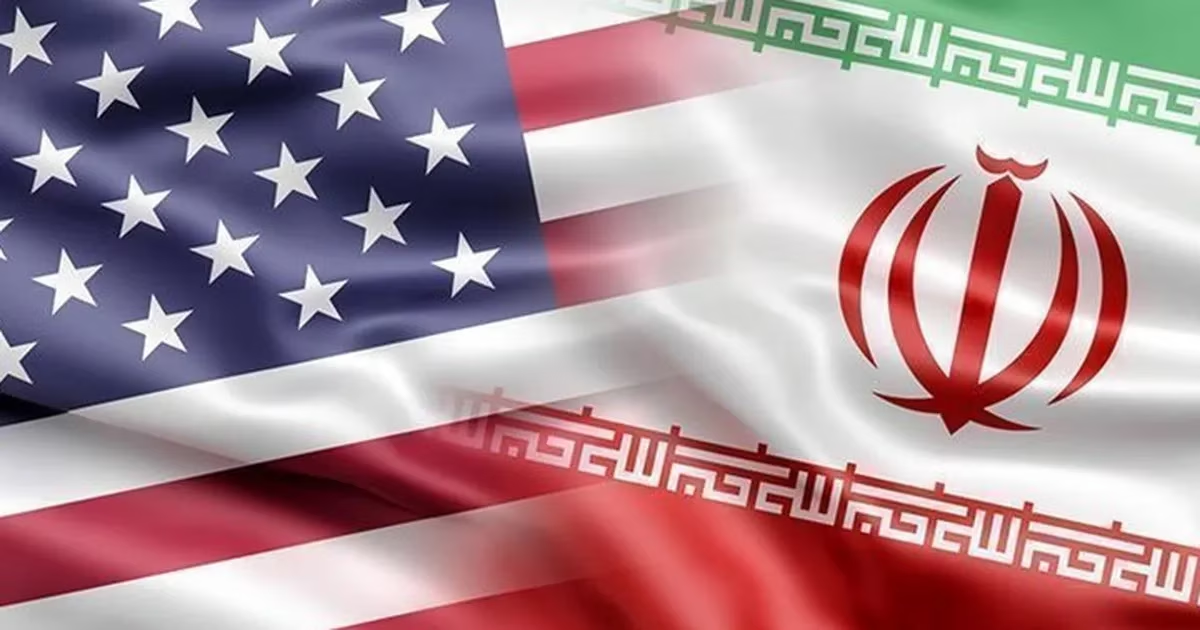
Recent satellite images have shown a significant acceleration in the fortification of Iranian nuclear facilities, coinciding with the reconstruction of missile sites that were damaged during recent military confrontations. These developments come at a time when international indicators are escalating regarding the possibility of an imminent US military strike against strategic targets deep within Iran.\n\nInformed sources reported that the US administration has received reports indicating the military's readiness to carry out a potential attack by the end of this week. This has been accompanied by the detection of extensive military reinforcements, including naval vessels and air squadrons, that have arrived in the Middle East in recent days to raise the level of alert.\n\nAccording to technical analyses by the Institute for Science and International Security in Washington, Tehran is deliberately using massive quantities of reinforced concrete to strengthen its sensitive facilities. The images also showed operations to cover vital sites with thick layers of soil to reduce the impact of any air raids that might target these vital centers in the near future.\n\nImages taken on February 10 documented continued work at the entrances of tunnels belonging to a massive underground complex near the Natanz area. The footage clearly shows new concrete blocks being poured at the eastern and western entrances of the complex, with a widespread presence of construction machinery and heavy equipment around the site targeted for fortification.\n\nAt the Parchin military complex, located southeast of the capital Tehran, specifically at the 'Talaghan 2' facility, the construction of a massive concrete structure completely surrounding the site has been completed. Technical teams have begun burying the structure with soil, a step that, according to expert estimates, aims to enhance the facility's resilience against bunker-buster bombs.\n\nRegarding missile capabilities, analyses revealed intensive activity to reconstruct facilities destroyed during Israeli strikes last June. This work is concentrated in strategic bases that had been partially out of service due to direct targeting of launch platforms and solid fuel storage facilities.\n\nAt the Imam Ali missile base in Khorramabad, images from early January showed the reconstruction of three vital facilities out of 12 that were completely destroyed. Renovation work is also underway on a fourth facility, while three other facilities are still under construction amidst excavation and expansion operations for ballistic missile launch platforms.\n\nAs for the 'Tir 7' industrial complex near Isfahan, satellite images detected the reconstruction of facilities related to the production of centrifuge parts. This challenge comes despite international sanctions imposed on this complex since October 2025, reflecting Tehran's determination to restore its nuclear manufacturing capabilities.\n\nDiplomatically, indirect negotiations are taking place in Geneva, Switzerland, between Iranian and American officials in an attempt to defuse the escalating crisis. Iranian Foreign Minister Abbas Araghchi confirmed that "guiding principles" had been reached, but the general atmosphere still indicates a wide gap between the two sides.\n\nIn contrast, US Vice President J.D. Vance stated that Tehran had not adhered to the red lines set by President Donald Trump. Vance indicated that the US administration is closely monitoring Iranian movements on the ground, considering the continued construction at nuclear sites an unacceptable escalation.\n\nThese developments come after a violent 12-day military confrontation between Iran and the Israeli occupation, which saw an intense exchange of missiles and drones. Washington had announced at the time that air strikes had completely destroyed nuclear and missile sites, which is refuted by the new satellite images showing a return to activity.\n\nObservers believe that the accelerated pace of construction at Iranian military sites reflects a "race against time" strategy before any potential confrontation. Iran seeks to secure its facilities under layers of concrete and soil to make the cost of militarily targeting them prohibitive and with uncertain results for the United States and its allies.\n\nTechnical reports indicate that the 'Tir 7' complex is a key link in the nuclear program, and its reconstruction means the resumption of production of precise components for centrifuges. This development places negotiators in Geneva before a complex reality on the ground, where Iran is imposing new facts on the ground that precede any potential political agreement.\n\nIn conclusion, anticipation remains the dominant sentiment in the region as the end of the week approaches and the presumed date for US military readiness. While Iranian mechanisms continue to pour concrete over their facilities, US forces continue to strengthen their presence in nearby bases, portending a new round of escalation that could change the regional balance of power.\n\nIran is working to enhance the protection of its sensitive facilities by pouring large quantities of concrete and covering key sites with thick layers of soil.

ARAB AND WORLD
Mon 23 Feb 2026 9:37 am - Jerusalem Time
Satellite images reveal accelerated nuclear fortifications and reconstruction of Iranian missile capabilities
OPINIONS
Mon 23 Feb 2026 9:37 am - Jerusalem Time
Huckabee's statements: Political cover for the occupation

It is absurd to try to falsify the crystal-clear truth, illogical to argue with a fool suffering from complete bias, and unreasonable to distort facts in the manner presented by US Ambassador Mike Huckabee. Instead of being a diplomat who weighs his words before speaking, he came out like a fool uttering nonsense, in an attempt to appease the far-right and the occupation government. Perhaps the saddest thing is these timid stances, both international and Arab, which, as usual, have wavered between condemnation, denunciation, and statements of disapproval.A clear and blatant American behavior, and if American policy were different, the US State Department should have come out to denounce what its ambassador in Tel Aviv said. However, this matter proves once again the involvement of American foreign policy in all that has happened and is happening, and that it agrees with the occupation's policies, disregards all condemning voices, and gives no weight to anyone.What is striking about these statements is that they give the occupation more green light to continue its settlement, annexation, and Judaization operations, and to proceed with its racist policies that contradict international law, UN resolutions, and its charters. The occupation will also use such statements as a cover for all its practices, and a shield to protect itself from international and UN bodies, even though what Mike Huckabee said is nothing more than a flood of lies, and an excerpting of a religious narrative pushed into political contexts, which is extremely dangerous and an advanced step in American support for a racist narrative based on ethnic cleansing and occupation.A false claim presented by the American ambassador, clear and blatant, but the level of the Arab and international response is below the required level, and this gives the occupation one opportunity after another to persist and transgress and violate international resolutions, which pushes the West Bank towards explosion, and this is what the occupation seeks through the series of policies and operations it carries out, to provoke the anger of the West Bank and Jerusalem, and thus be able to escalate its operations aimed at displacement and extermination.Mike Huckabee's statements at this time represent a high degree of bias and a major lie attempting to falsify the land and the rights of the people. Perhaps in the last two years, we have not been surprised by such lies and bias, and we have witnessed what is greater than that during the war of extermination in Gaza, and what is happening these days through the imaginary illusions of mandate and guardianship and the claims of the Peace Council, under the pretexts of spreading stability and reconstruction.In his famous poem written after the siege of Beirut in 1982, titled "In Praise of the High Shadow," Mahmoud Darwish says:Hiroshima, HiroshimaOnly we listen to the thunder of stones; HiroshimaOnly we listen to the absurdity and usefulness in the soulAnd America on the walls gives every child a cluster bomb toyO Hiroshima, the Arab lover, America is the plague and the plague is AmericaWe slept, the planes woke us up and the voice of AmericaAnd America for America..
ARAB AND WORLD
Mon 23 Feb 2026 9:35 am - Jerusalem Time
On the Brink: Between Last-Minute Diplomacy and a Show of Force in the US-Iran Confrontation

News Analysis
Developments are accelerating in the US-Iranian scene in a way that reflects a pivotal moment that could redraw the balances of the entire region. On February 22, 2026, "Axios" quoted a senior American official as saying that Washington is ready to hold a new round of negotiations in Geneva if it receives a detailed Iranian proposal for a nuclear deal within 48 hours. This conditional offer does not seem to be merely a procedural step, but rather a dual political message: the door to diplomacy is not yet closed, but it will not remain open for long. The Donald Trump administration is putting the ball in Iran's court, linking any meeting to Tehran demonstrating written seriousness, indicating that the time for general statements is over.
Notably, the American official did not rule out discussing an interim agreement before reaching a comprehensive deal, which reflects an understanding of the complexity of the gap between Washington's demand for "no enrichment" and Tehran's insistence on retaining its right to enrichment, even symbolically. This interim proposal reveals tactical pragmatism, but it also carries the risks of consecrating temporary solutions that could turn into deferred crises. Previous experience with interim agreements has shown that the absence of structural trust makes every understanding vulnerable to collapse at the first political test.
In contrast, Trump escalated his rhetoric on February 20, brandishing the military option if negotiations fail, and indicating that "bad things" could happen, even hinting that regime change in Tehran might be "the best thing that could happen." This language goes beyond the framework of nuclear non-proliferation to reshaping the Iranian political environment, raising questions about the ultimate goal: is it a technically controlled nuclear deal, or a re-engineering of Iran's internal balance? This overlap between security and politics weakens reassuring messages and reinforces Iranian suspicions that the issue is deeper than mere centrifuges.
The rhetorical escalation coincided with the largest US naval buildup in the region since 2003. The USS Abraham Lincoln aircraft carrier was deployed, accompanied by guided-missile destroyers, in addition to the USS Gerald Ford, the world's largest carrier, with extensive air reinforcements including advanced fighters and early warning and refueling aircraft. This deployment gives Washington high deterrence capability and operational flexibility, but at the same time raises expectations and reduces the margin for retreat without political cost. When two aircraft carriers are amassed, retreating without a tangible gain is closer to a symbolic loss.
However, the absence of significant ground forces is noted, suggesting that Washington is not preparing for an invasion or occupation, but rather for limited air and missile options. However, the concept of a "limited strike" itself remains problematic. According to experts, Iran has accumulated unconventional response tools over the past years, from precision missiles to drones, as well as a network of regional allies capable of expanding the theater of operations. Any direct targeting of the leadership, especially if it affects Supreme Leader Ali Khamenei, could lead to a response that goes beyond tactical calculations towards an open confrontation that would be difficult to contain.
In this context, Iranian Foreign Minister Abbas Araqchi's statements reflected a mixture of defiance and openness. He affirmed that Iran does not seek war but will not accept threats, and that the window for a deal is still open if Washington commits to an actual lifting of sanctions, considering the military buildup more a message of political pressure than a prelude to war. This approach reveals a delicate Iranian attempt to balance containing escalation and maintaining an image of steadfastness internally, as the leadership in Tehran realizes that retreating under threat may be interpreted as weakness affecting its legitimacy, but at the same time, it is aware that sliding into a comprehensive confrontation will carry a heavy economic and security cost.
Hence, internal calculations intersect with regional and international equations at a sensitive point: every American military step, even if described as limited or surgical, could open multiple response paths that go beyond the limits of the strike itself, whether through conventional or unconventional tools, or by expanding the geographical scope of engagement. Any widespread disturbance will also affect Gulf security, energy prices, and navigation in the Strait of Hormuz, putting European allies and major powers before difficult choices between supporting deterrence and preventing an explosion.
Thus, according to experts, diplomacy, despite its narrow window, becomes less costly than testing power assumptions. However, its success requires strict verification mechanisms, a clear timeline for lifting sanctions, and a political will capable of transforming fiery messages into written understandings. Between a show of force and the exchange of proposals, the region remains dependent on the ability of both parties to realize that any miscalculation could turn tactical pressure into a strategic shift whose outcomes no one has complete control over.
OPINIONS
Mon 23 Feb 2026 9:35 am - Jerusalem Time
Under the Nuclear Pretext: Is the Region Approaching a Comprehensive Confrontation to Redesign It?
Ramallah - "Al-Quds" Dot Com
Opinion Writer
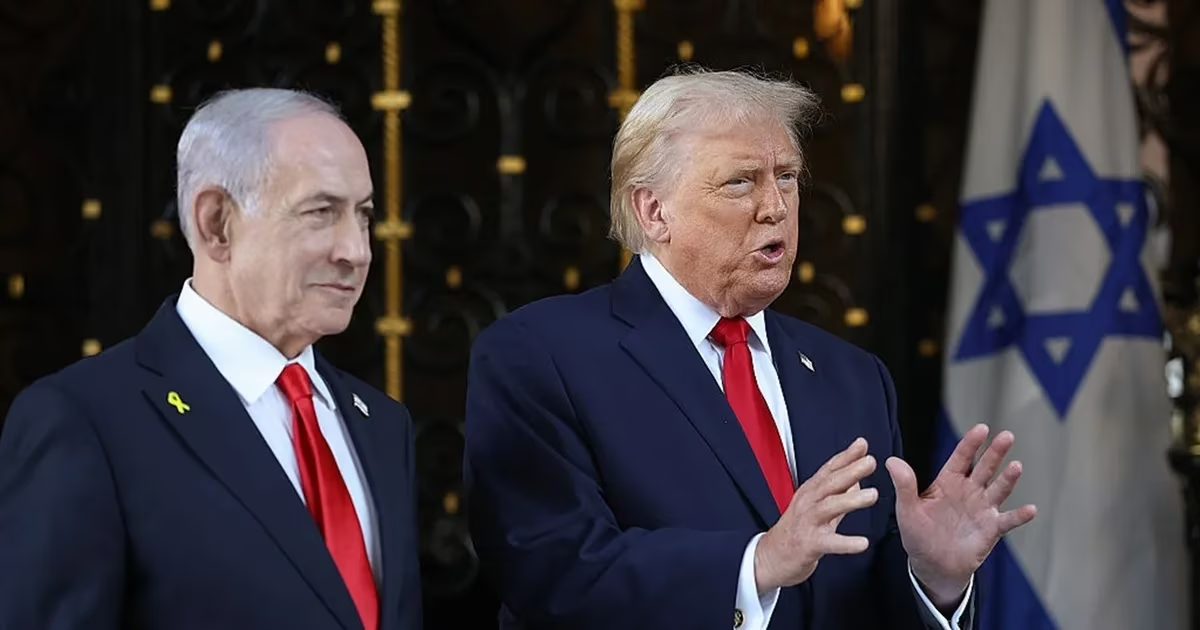
For many years, the Western world has been preoccupied with Iran's nuclear file, a path that led to the signing of an international agreement during the tenure of former US President Barack Obama. This agreement represented a real test of Tehran's intentions, but Donald Trump's withdrawal from it in his first term brought things back to square one, as Iran did not exceed the agreed-upon enrichment levels until after this withdrawal.
Iran consistently insists that its nuclear program is for peaceful civilian purposes and shows flexibility in subjecting it to strict international oversight. However, the United States and its allies continue to impose harsh economic sanctions, indicating that the goal goes beyond the nuclear file towards an attempt to undermine the existing regime or force it into complete surrender to Western dictates.
Western double standards are clearly evident when comparing the treatment of Iran with other countries such as India and Pakistan, which joined the nuclear club with little opposition. Moreover, overlooking North Korea's nuclear program and the absolute silence on Israel's nuclear arsenal raise fundamental questions about the true motives behind the escalation against Tehran.
Observers believe that the uproar surrounding Iran is primarily aimed at protecting Israeli interests, as Tel Aviv considers any Iranian capability an existential threat. The occupation state exploits these fears to constantly incite against any diplomatic rapprochement between Washington and Tehran, demanding impossible conditions that ensure its continued dominance as the sole power in the region.
In addition to Israeli concerns, the 'Iranian bogeyman' is used as a pretext to fuel the fears of neighboring Arab countries, in an effort to expand the scope of the 'Abraham Accords'. This policy aims to create security and military alliances between Israel and Gulf states under the umbrella of jointly confronting alleged Iranian threats, which serves the American vision for the region.
Despite Iranian attempts at de-escalation towards its neighbors, the US administration continues to work to prevent Tehran from developing any nuclear program, whether civilian or military. Benjamin Netanyahu's role as a key player in this incitement stands out, as he was the first to reject the 2015 agreement and continued to pressure until he managed to convince Trump to cancel it.
Field data indicates that previous negotiations were merely a cover for systematic targeting operations that took place over the past years. American and Israeli parties claimed significant achievements in destroying Iran's missile and nuclear infrastructure, but the return to threatening war suggests that strategic goals have not yet been achieved.
It appears that the failure to overthrow the Iranian regime through popular protests and economic pressures has pushed towards more aggressive options. It is clear from the course of events that the ultimate goal is to redesign the Middle East in line with Israeli and American interests, while attempting to block any expansion of Chinese interests in the region.
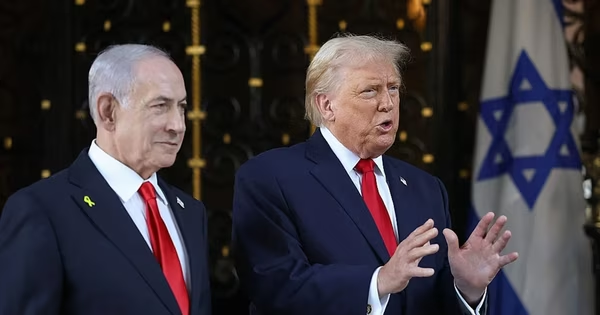
There are indications of high-level coordination between Washington and Tel Aviv, despite what is sometimes rumored about differences between Netanyahu and Trump. It seems that their recent meetings aim to arrange matters for a potential confrontation, while Tehran remains on high alert, with its finger on the trigger in anticipation of any military treachery.
Trump pursues a policy of distraction through contradictory statements, sometimes speaking of limited surgical strikes, and other times hinting at a comprehensive war using space-based platforms. Meanwhile, the massive US military buildup in the region continues, including aircraft carriers, destroyers, and a continuous airlift of equipment.
Hebrew media sources reported that the aircraft carrier 'Ford' may arrive in the region within a few days, which coincides with the deadline set by Trump. This timing raises concerns that the deadline given for negotiations is merely additional time to complete the military buildup necessary to launch a large-scale military operation.
Republican Senator Lindsey Graham, close to Trump, was explicit in his recent statements during his visit to Israel, where he affirmed that Washington and Tel Aviv are on the verge of taking decisive action. Graham described the Iranian leadership in harsh terms, emphasizing that there is no gap in positions between Trump and Netanyahu regarding dealing with Tehran.
The exorbitant cost of this military buildup, estimated at hundreds of millions of dollars, indicates that the matter has gone beyond mere deterrence or containment policy. The United States does not move its fleets of this size unless there is an actual intention to carry out a military operation that fundamentally changes the balance of power in the region.
In conclusion, the coming days remain pregnant with possibilities, as the short deadline set by Trump is not enough to address complex issues that have accumulated over decades. It is likely that the region stands on the brink of a volcano, awaiting the zero hour that could ignite a major war aimed at solidifying the occupation's sovereignty and redrawing the political map.
Overthrowing the regime in Iran is the key to redesigning the entire region according to the Israeli, American, and Western vision.
ISRAELI AFFAIRS
Mon 23 Feb 2026 9:34 am - Jerusalem Time
US Supreme Court breaks Trump's exclusivity and restricts his customs powers
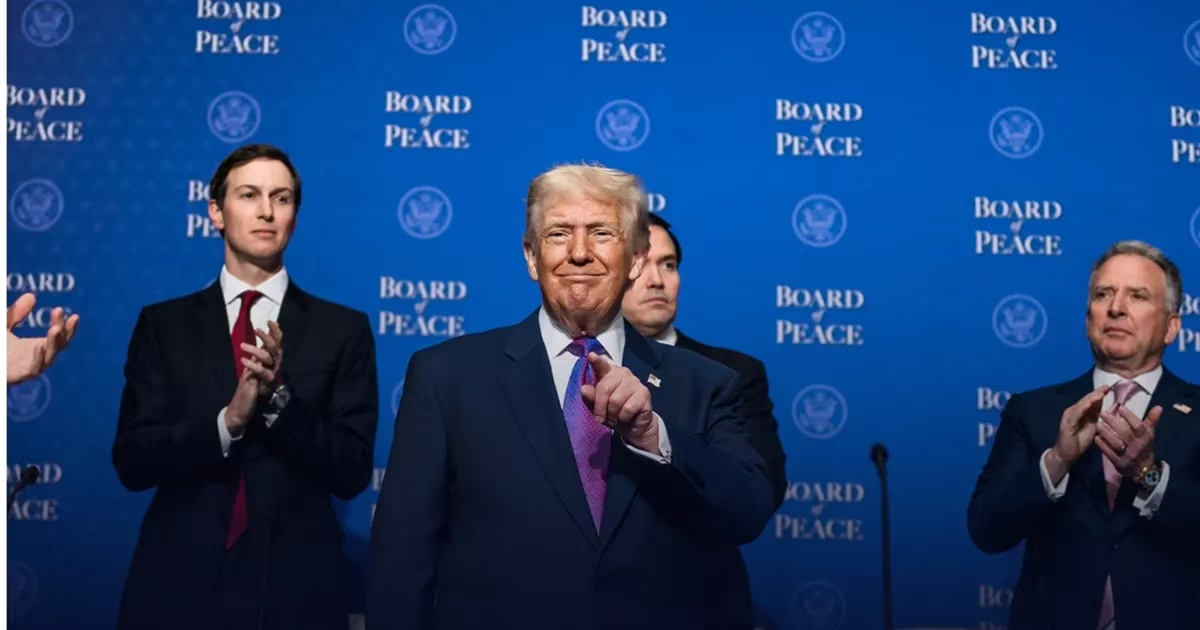
The political and legal arena in the United States witnessed a radical shift following a historic ruling by the Supreme Court, which deemed unconstitutional President Donald Trump's exclusive right to impose comprehensive customs duties and tariffs. This decision was based on the illegitimacy of using emergency law to bypass Congress's powers in trade issues, putting an end to the 'big stick' economic policy Trump pursued against more than 100 countries.
This ruling comes at a time when Trump is facing a decline in his absolute influence, despite his apparent control over the joints of the political system and the Republican Party. Observers considered the court's decision to be the beginning of a 'flood' to break the executive branch's monopoly on power, especially after two judges appointed by Trump himself voted against him, reflecting the judiciary's independence in confronting presidential overreach.
Internationally, Trump sparked widespread controversy by establishing what is called the 'World Peace Council' in Washington, under the name 'Donald J. Trump Institute for Peace'. Trump appointed himself president of this council for life, imposing membership fees of up to one billion dollars that go to a special fund he directly supervises, in a move considered a deliberate marginalization of existing international organizations.
The new council witnessed the participation of controversial figures, led by Israeli Prime Minister Benjamin Netanyahu, who is wanted by the International Criminal Court on charges of war crimes in Gaza. Tony Blair, the former British Prime Minister, also participated in the inaugural session, which sources described as a showy and theatrical display, aimed at enhancing Trump's image as a global peacemaker according to his own vision.
In contrast, Trump's initiative faced a massive international boycott by traditional US allies, led by Britain, France, Germany, Italy, and Canada. This boycott came in protest against the council's attempt to usurp the role of the United Nations, and its complete disregard for Palestinian rights and the legal references that oblige Israel to withdraw from the occupied territories.
Reports indicate that the goals of the 'Peace Council' go beyond diplomacy to include major economic projects, as Jared Kushner proposed a huge real estate project for the Gaza Strip at a cost of $25 billion. The project aims to transform the coasts of Gaza into tourist resorts for the wealthy, which critics see as an attempt to liquidate the Palestinian issue through real estate investment and cancel the right of return.
Trump did not hesitate to use threatening language against countries refusing to join his council, as he threatened to raise customs duties on French imports by 200%. This approach to dealing with allies led to increased international polarization, and prompted countries such as Norway, the Vatican, and Croatia to take a firm stance by refusing membership in an entity that replaces international legitimacy.
Domestically, the American citizen is suffering from the consequences of these policies, as high customs duties have caused an increase in financial burdens on consumers. Despite the administration's claims of ending wars, military movements and the mobilization of reinforcements against Iran indicate the continuation of the escalation approach, which led to a record decline in Trump's popularity in his first year.
The US Congress, dominated by Republicans, faces sharp criticism for its 'blind loyalty' to Trump's decisions and the approval of appointments of ministers and agency heads who lack competence. However, the recent Supreme Court ruling has restored hope for the possibility of activating the system of checks and balances, and preventing the president from unilaterally making decisions on war and peace or major tax policies.
The current transformations indicate that Trump's project based on 'executive exclusivity' has begun to collide with the rock of the judiciary and the refusal of allies to submit to economic intimidation. While Trump seeks to raise funds under the guise of 'reconstructing Gaza', questions remain about his ability to continue this approach amidst increasing legal and political challenges at home and abroad.
The Supreme Court ruling came as an earthquake that struck Trump's agenda, ending an era of exclusivity in making major economic decisions without returning to Congress.
PALESTINE
Mon 23 Feb 2026 9:34 am - Jerusalem Time
Young man Muhammad Hanani was killed after being wounded by occupation bullets in Nablus

Medical sources in the West Bank announced, at dawn today, Sunday, the martyrdom of the young man Muhammad Hanani, due to the serious injuries he sustained from Israeli occupation army bullets during the storming of Nablus.
Local sources clarified that the martyr Hanani had previously suffered a direct live bullet injury, which medical teams described as severe and extremely critical, during citizens' confrontation of the occupation forces' raid on the town of Beit Furik, located east of Nablus.
Clashes had erupted in the town after the occupation vehicles advanced, where soldiers fired live and metal bullets at the youths, leading to Hanani's injury and his urgent transfer to the hospital in an attempt to save his life, before doctors announced his death at dawn today.
The young man sustained extremely critical injuries during the clashes that erupted after the occupation forces stormed the town of Beit Furik.
PALESTINE
Mon 23 Feb 2026 9:34 am - Jerusalem Time
Young man injured, widespread arrests, and home demolitions in new Israeli escalation in the West Bank

A young Palestinian man sustained head injuries on Sunday evening after Israeli occupation forces fired rubber bullets during their raid on the city of Al-Bireh in the central occupied West Bank. Medical sources confirmed that Red Crescent teams dealt with the injury in the Sateh Marhaba area and transferred him to the hospital for necessary treatment, while local sources described the confrontations as violent.
Al-Amari refugee camp and the Sateh Marhaba neighborhood in Al-Bireh witnessed a widespread incursion by Israeli forces, who fired a barrage of live ammunition and tear gas canisters at citizens and their homes. Concurrently, occupation vehicles spread through the town of Tuqu' southeast of Bethlehem, where they carried out search operations and provoked residents amidst the firing of stun grenades and gas, leading to cases of suffocation that were treated on site.
As part of the policy of urban restriction, an Israeli court issued a decision to demolish a two-story Palestinian home in the town of Al-Khader west of Bethlehem, under the pretext of building without a permit. The occupation authorities informed the homeowners of the need to evacuate immediately in preparation for the demolition, which comes a week after the demolition of an inhabited residential building in the city of Hebron.
In the northern Jordan Valley, occupation forces arrested six citizens from Bardala village after they were subjected to a brutal assault by a group of settlers. Human rights sources reported that the arrests came after the citizens tried to defend themselves and their sheep pens from the settlers' attack, a scene that is repeated daily to displace residents from pastoral areas.
In Nablus Governorate, occupation forces continued their repressive practices by forcing shop owners in the town of Huwara to close their doors at gunpoint. The occupation authorities did not provide any legal justifications for this measure, which aims to paralyze economic activity in the town, which has been suffering from a strict siege and continuous attacks for many months.
For its part, the Wall and Settlement Resistance Commission revealed in a recent report a dangerous escalation in the pace of settler terrorism, with 468 attacks recorded in January alone. These violations varied between direct physical violence, uprooting fruit trees, burning agricultural crops, and preventing farmers from accessing their lands in various governorates of the West Bank.
These developments come amidst the ongoing war of extermination in the Gaza Strip, where the death toll in the West Bank since October 7 has risen to more than 1,117 martyrs. Official data also indicates that approximately 11,500 Palestinians have been injured, while the number of detainees in occupation prisons has exceeded 22,000, including occupied East Jerusalem.
Our teams transferred a young man who was shot with a rubber bullet in the head during the raid on the Sateh Marhaba area in Al-Bireh to the hospital.
ARAB AND WORLD
Mon 23 Feb 2026 9:33 am - Jerusalem Time
Drums of War Beat: What is Trump Planning for Iran and What are the Limits of a Potential Strike?
The ultimate goals of the intensified American military movements in the Middle East remain shrouded in mystery, as President Donald Trump continues to send direct threats to Tehran. Despite the reinforcement of combat capabilities, Washington has not clearly revealed whether a potential strike would target the wings of the Revolutionary Guard, or the missile arsenal as Israel demands, or if it aims to undermine the foundations of the Iranian regime entirely and return it to the pre-1979 era.
In a significant development, Trump gave the Iranian leadership a deadline of 10 to 15 days to prove its seriousness in reaching a comprehensive nuclear agreement, hinting at military options if they fail. According to press reports, the plans on the White House's table include extremely dangerous scenarios, among them targeting Supreme Leader Ali Khamenei, at a time when Washington insists that any new agreement must dismantle ballistic capabilities and stop supporting armed factions in the region.
On the ground, sources reported that the US military is currently deploying a strike force comprising 13 warships, led by the aircraft carrier 'USS Abraham Lincoln', with the world's largest aircraft carrier 'Gerald Ford' joining the fleet in the Mediterranean. This military buildup aims, according to observers, to impose a new balance of power through a 'short, high-impact campaign' that cripples Iranian infrastructure without sliding into a long-term war of attrition.
Politically, these movements are causing internal concern in Washington, where the Democratic opposition is demanding a return to Congress before making a decision on war. In contrast, regional powers and Gulf states have warned of the repercussions of any military adventure that could lead to the spread of chaos and unprecedented destabilization of the region, especially in light of Tehran's vow to respond to any attack on its territory.
Trump wonders why Iran is not surrendering in the face of the massive American military buildup in the region.
PALESTINE
Mon 23 Feb 2026 9:33 am - Jerusalem Time
A dead in Beit Lahia and escalation of Israeli demolition operations in the Gaza Strip

Medical and field sources reported the martyrdom of 27-year-old Basma Azzam Banat, who was shot by Israeli occupation forces in the town of Beit Lahia, north of the Gaza Strip. This direct assault occurred in an area outside the declared Israeli military control, representing a dangerous escalation in targeting unarmed civilians.\n\nThe young woman's martyrdom coincided with the occupation army's intensification of systematic demolition and bombing operations targeting Palestinian citizens' homes. These operations focused on areas within what is known as the 'Green Line' under occupation control, in addition to other border areas that witnessed widespread destruction of residential buildings.\n\nIn the Al-Zaytoun neighborhood, southeast of Gaza City, engineering units belonging to the occupation army carried out extensive bombing operations around the Wadi Al-Ara'is area. This area falls within the 'Yellow Line,' which represents a temporary security buffer, where the occupation seeks to change the geographical features of the area through these operations.\n\nThe destruction operations were not limited to Gaza City but extended to include the eastern area of Khan Yunis city, south of the Strip. Eyewitnesses reported hearing massive explosions resulting from the demolition of entire residential blocks within the Yellow Line, as part of the scorched-earth policy pursued by the army.\n\nThese field developments come amid continued Israeli violations of the ceasefire agreement that came into effect on October 10th. Despite the announced understandings, Israeli attacks have not stopped, taking various forms including sniping, shelling, and limited incursions.\n\nDocumented statistics up to last Saturday indicate that the number of casualties from these violations has risen alarmingly, with 614 Palestinians martyred and approximately 1643 others sustaining various injuries. These figures show the extent of Israeli disregard for international agreements and regional guarantees to halt the aggression.\n\n"The Yellow Line" is defined as an imaginary line established under the ceasefire agreement to separate areas of Israeli troop deployment and areas where Palestinians are allowed to be present. Under this division, the occupation army controls about 53 percent of the Strip's area, especially in the eastern and northern parts.\n\nThe early hours of Sunday witnessed a wave of intense airstrikes and artillery shelling that targeted various areas of the Gaza Strip. The shelling focused on areas with heavy military presence, leading to a state of panic among displaced people trying to return to check on their homes.\n\nThese events are an extension of the genocide war that began on October 8, 2023, and continued for two consecutive years with extensive American military and political support. This war has left an unprecedented humanitarian catastrophe in modern history, turning the Strip into an uninhabitable area.\n\nAccording to official data, the number of martyrs since the beginning of the aggression has exceeded 72,000, while the number of injured has surpassed 171,000, most of whom are women and children. Military operations have also caused the destruction of approximately 90 percent of the infrastructure and civilian facilities in all governorates of Gaza.\n\nThe occupation continues to violate ceasefire understandings by targeting civilians and destroying what remains of residential blocks in border areas.
ISRAELI AFFAIRS
Mon 23 Feb 2026 9:33 am - Jerusalem Time
Netanyahu reveals efforts to form an international coalition including Arab states to confront 'radical axes'
Israeli Prime Minister Benjamin Netanyahu, during a cabinet meeting, revealed his government's directions to build a broad regional and international alliance aimed at redrawing the political map in the region. Netanyahu indicated that this alliance would act as a united front in confronting what he described as radical axes that threaten regional stability from his perspective.
Informed sources clarified that the proposed system would not be limited to the immediate regional scope but would extend to include rising international powers such as India, in addition to countries from the African continent and Asia. Through this proposal, Netanyahu seeks to integrate Israel into a fabric of cross-continental alliances that ensure it a central role in international politics.
Netanyahu spoke about the necessity of a common vision uniting these countries, especially in light of the rising influence of what he called the Shiite axis and the radical Sunni axis. He considered that the current challenges compel the countries he described as 'moderate' to unite to protect their future and strength in the face of increasing threats.
The Israeli Prime Minister claimed that his government had recently delivered strong and effective blows to the Shiite axis, paving the way for strengthening this new alliance. Netanyahu believes that success in dismantling adversaries' capabilities requires completing political construction through strategic partnerships with countries that share Israel's security vision.
These statements come concurrently with arrangements for a visit by Indian Prime Minister Narendra Modi, reflecting the Israeli desire to strengthen the (Indian-Israeli-European) axis. This plan includes incorporating Greece and Cyprus as key partners in the Eastern Mediterranean region to enhance security and economic cooperation.
Netanyahu stressed that cooperation among the parties to this alliance would achieve major strategic benefits, and would not be limited to military aspects but would extend to developmental fields. He affirmed that the ultimate goal is to ensure Israel's resilience and secure its future by creating a supportive regional environment for its political orientations.
In a related context, observers believe that Netanyahu's talk of 'Sunni and Shiite axes' aims to exploit sectarian divisions in the region to achieve political gains. The Israeli discourse seeks to portray Israel as a natural ally for some Arab countries in confronting other regional powers, thereby bypassing the core of the Palestinian-Israeli conflict.
No official comment has yet been issued by the Arab or African countries that Netanyahu referred to in his discussion about joining this supposed alliance. The capitals concerned remain silent regarding these claims, which place them in the same trench as the Israeli occupation against other regional powers.
Analyses indicate that Netanyahu is trying to market a new security doctrine based on transforming the conflict from its Arab-Israeli nature to a conflict between 'moderation and radicalism.' This strategy is considered a means to escape international pressures related to Palestinian rights by presenting major security issues that concern international powers.
Involving countries like Greece and India also aims to transform Israel into a land and sea bridge connecting Asia to Europe, making the security of the occupation an international economic interest. This approach seeks to impose a new geopolitical reality that marginalizes traditional issues and focuses on shared logistical and security interests.
Critics believe that this proposal represents an attempt to create a 'regional NATO' in which Israel is the mastermind and operational center. This project aims to legitimize the occupation's presence as an indispensable force in the international security system, especially amid escalating tensions in the Middle East.
Domestically, Netanyahu is trying through these statements to demonstrate his ability to lead Israel towards new diplomatic horizons despite increasing international isolation. He uses the 'grand alliances' file as a propaganda tool to strengthen his political position before both the Israeli public and international partners.
Conversely, these statements raise concerns about fueling sectarian conflicts in the region by classifying powers based on sectarian affiliations. Experts warn that being drawn into this vision could lead to the region being engulfed in endless conflicts, ultimately serving the expansionist agenda of the occupation.
The question remains about the feasibility of forming such an alliance given the significant contradictions in the interests of the countries mentioned by Netanyahu. While Israel seeks to impose its hegemony, Arab and Islamic peoples remain committed to rejecting normalization and alliance with an entity that continues its ongoing violations in the Palestinian territories.
We seek to establish an axis of countries that see reality, challenges, and goals with one eye, in contrast to the radical axes.
ARAB AND WORLD
Sun 22 Feb 2026 8:49 pm - Jerusalem Time
Iran Balances Nuclear Diplomacy with 'Emergency Succession' Arrangements to Counter US Threats
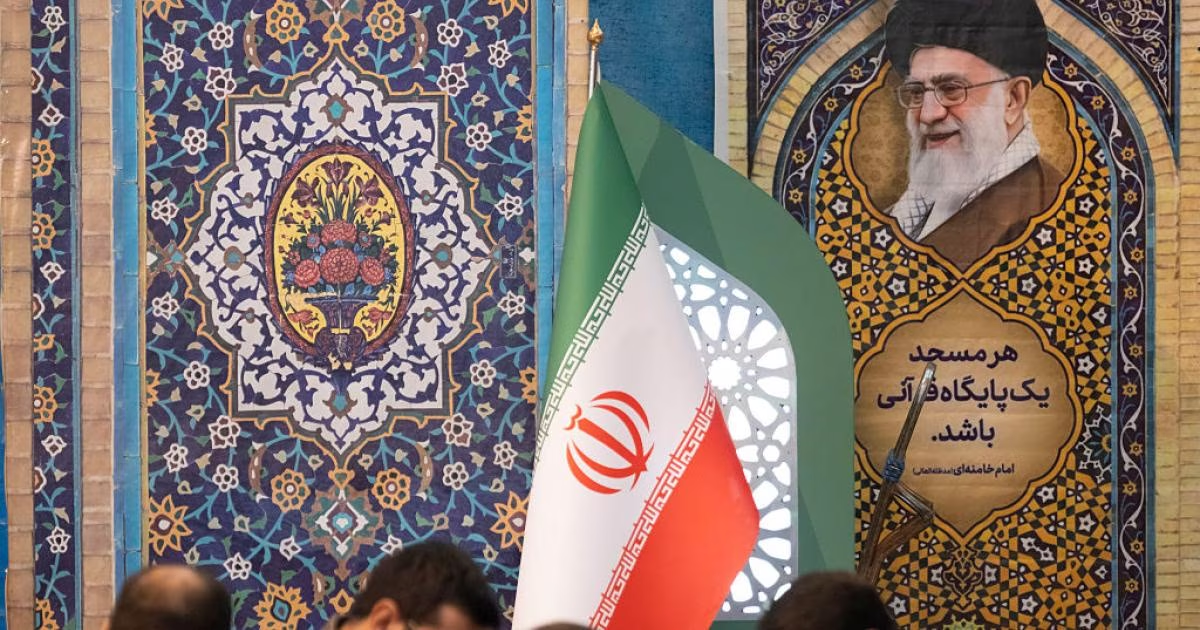
Iranian Foreign Minister, Abbas Araghchi, announced a real opportunity to reach a diplomatic settlement with the United States regarding the nuclear file, despite the escalating tone of military threats. Araghchi clarified that reaching a solution that serves all parties is still possible if the necessary political will is available to overcome current obstacles.
The Iranian minister revealed that his country is engaged in drafting an agreement and specific technical elements, following two rounds of intensive discussions hosted in Muscat and Geneva this month. These moves come at a sensitive time when the region is witnessing unprecedented American military buildups aimed at pressuring Tehran.
Despite the openness to dialogue, Araghchi stressed that Iran will not relinquish its sovereign right to enrich uranium, considering it an inherent right of the state that cannot be negotiated. He affirmed that the decision in this regard rests solely with Tehran, which represents the central point of contention that international parties are trying to address.
In the context of responding to field threats, the foreign minister warned that any American aggression would be met with a decisive response targeting Washington's vital interests in the Middle East. He described any military action against his country as an act of aggression that grants Tehran the full right to defend itself by all available means.
For its part, the US administration expressed its conditional readiness to return to the negotiating table in Geneva next Friday, according to media sources quoting officials in Washington. The American side stipulates receiving a detailed and comprehensive Iranian offer regarding the nuclear program within the next forty-eight hours to proceed with this round.
On the internal Iranian front, international press reports revealed that high-level directives were issued by Supreme Leader Ali Khamenei aimed at fortifying the regime's structure against any sudden targeting. These directives included the Secretary of the Supreme National Security Council, Ali Larijani, with a focus on developing scenarios to ensure the continuity of governance in the event of the absence of the supreme leadership.
Khamenei's precautionary measures included defining four levels of succession for all sensitive sovereign, military, and governmental positions. The Supreme Leader asked senior officials to name four potential replacements for each leadership position, to ensure that there is no administrative or field vacuum if any of them are subjected to an assassination attempt or are unable to perform their duties.
Khamenei also authorized a small, trusted circle of his close associates to make fateful decisions in extreme emergencies, especially if contact with the Supreme Leader is lost. These steps reflect growing concern among the Iranian leadership about the possibility of adversaries resorting to direct targeting operations against political and military figures.
On the ground, the United States has raised its military presence in the region to record levels not seen since 2003, coinciding with the invasion of Iraq. These reinforcements aim to pressure Tehran to abandon its missile and nuclear programs, as well as to reduce the influence of its regional allies, whom Washington describes as proxies.
In contrast, political circles in Tehran believe that American and Israeli moves aim to create pretexts for direct intervention and regime change. Iran insists on the demand for the lifting of comprehensive economic sanctions as a prerequisite for imposing technical restrictions on its nuclear program, while affirming its readiness to respond to any attack, regardless of its size.
If the United States attacks us, this is an act of aggression, and what we do in response will be self-defense and targeting Washington's interests in the region.
OPINIONS
Sun 22 Feb 2026 8:48 pm - Jerusalem Time
Israel and US After October: The Power of Deterrence and the Re-engineering of the Balance of Power in the Middle East

At the heart of the Middle East, where geography intertwines with history and politics overlaps with daily security, Israel operates in a complex environment that blends direct and indirect threats, powerful allies and growing adversaries, and interconnected local and regional arenas. Since its establishment, Israeli security doctrine has been designed on a strict premise: survival requires continuous military superiority and constant readiness to use force if necessary. The limited strategic depth, narrow geography, and sensitive home front have made security an absolute priority, superseding all other considerations.
At the core of this doctrine lies deterrence, particularly through the policy of nuclear ambiguity, which forms a strategic umbrella preventing a slide into a comprehensive regional war. This policy has succeeded in preventing conflicts between states but has not been sufficient to stop non-state threats such as the Hamas movement in Gaza, or Iranian expansion through its proxies in Lebanon, Syria, and Yemen. Here it becomes clear that nuclear deterrence and classical military superiority do not cover all dimensions, highlighting the role of specific offensive operations as a tool to re-adjust the balance of power.
After the surprise attack by Hamas on October 7, 2023, Israel entered a new phase of complexity. The attack exposed the weakness of traditional deterrence and redefined the threat as existential and immediate. The Israeli response was not limited to Gaza but extended to Hezbollah threats in Lebanon, sending deterrent messages to Iran, and targeting Houthi sites in Yemen after threats to navigation and reciprocal attacks. This transition from managing a low-intensity conflict to multi-front wars reflects a strategic shift: the goal is no longer limited to deterrence alone, but has become the reshaping of the security environment according to the priorities of defending existence.
In this context, the United States plays the role of the dominant power attempting to re-impose regional order and prevent chaos from expanding. After October, Washington demonstrated military mobilization and a direct threat to Iran, while simultaneously conducting negotiations to de-escalate tensions and prevent the conflict from escalating into a wider confrontation. This blend embodies American precision that combines offensive and defensive realism: military mobilization represents a clear threat to Iran and a signal of Washington's ability to use force, while negotiations are used to reduce risks and avoid an open war that could drain resources and increase regional complexity. American support includes regional alliances, intelligence, and nuclear deterrence, forming a strategic cover for Israel and its allies and protecting American interests in the Gulf and the Eastern Mediterranean.
Gaza is no longer just a local escalation arena, but has become a starting point for broader regional transformations. Every Israeli strike there re-tests deterrence and dismantles Hamas's qualitative capabilities, but it carries an international political and moral cost. In the north, deterrence against Hezbollah is tested within precise calculations to avoid the engagement escalating into a full-scale war. As for the confrontation with Iran, it shows the precise limits of direct deterrence, where Israel and America must manage threats without being drawn into a wide conflict. In Yemen, strikes against the Houthis show an expansion of the concept of security to include the maritime domain and trade routes, confirming that the Israeli conflict is no longer confined within its traditional borders.
From here, Israel and the United States can be depicted as an interconnected network of parallel strategic actions: Israel seeks to re-establish control in Gaza and impose deterrence equations in Lebanon, Iran, and Yemen, while America works on a broader level to support deterrence, balancing military threat and managing negotiations to stabilize the regional balance of power and protect its interests and ensure the continuation of partial American hegemony.
A Moment of Middle East Re-engineering
Israeli Prime Minister Benjamin Netanyahu's statements that the Middle East is at a crossroads and that Israel is ready for any scenario are not just mobilizing rhetoric, but an expression of the understanding that the region is entering a phase of realignment that could change the rules of the game for decades. His threat to Iran of a strong response in case of an attack on Israel reflects a transition from a policy of implicit containment to direct and explicit deterrence. The battle is no longer just about limited strikes, but has become closer to an open deterrence equation.
The Israeli discourse extends beyond Iran to include a broader network of influence, comprising Hezbollah, Hamas, and other armed groups, reflecting a view that the threat is multi-front and interconnected. In contrast, former Prime Minister Naftali Bennett's warnings of the potential formation of an “anti-Sunni axis” led by Turkey and Saudi Arabia, with the possible involvement of Pakistan, show concern about the transformation of the Sunni environment itself if popular and political anger escalates due to the Gaza war.
The regional scene is not binary between a Shiite and a Sunni axis, but a complex network of intertwined interests. Israel, which sought to expand the circle of Arab normalization, finds itself facing a dual equation: confronting Iran and its proxies without losing the regional path, and maintaining deterrence without pushing moderate states to reposition themselves under public pressure.
Power and Image
After October, Israel moved not only to demonstrate military power but also to re-establish its image as a deterrent regional power. Multi-front military operations and warnings against any Iranian move are a message of strength directed at adversaries and allies alike: Israel has regained the initiative and is capable of operating in more than one arena simultaneously.
American support reinforced this image, not only with military and intelligence aid but also with political and diplomatic cover, which gave Israel greater room for maneuver in managing its operations. However, maintaining the image is no less important than military capability; prestige in the Middle East is a deterrent element in itself, and any erosion of it could encourage adversaries or cause some capitals to recalculate.
But the challenge lies in managing the consequences of power: excessive use of it may enhance short-term deterrence, but it may push regional powers to seek counter-balances, whether at the political or diplomatic level. The Middle East today is not an arena of rigid axes, but a network of flexible alignments; Israel seeks to consolidate its superiority and deter its adversaries, and America supports this path within the management of the global balance.
Conclusion
In the narrow space between power and politics, between deterrence and negotiations, and between attrition and stability, Israel is trying to reshape the regional environment and adjust the balance of power to ensure its security, while America works to protect its interests and maintain the hegemony of the partial international order. Israel needs to keep the image of power present, while carefully managing the consequences of this power, to avoid counter-regional realignments that could redraw the borders of the Middle East for many years to come. October 7, 2023, was not just a military event; it was a moment of strategic transformation, opening the door to re-engineering the balance of power, and making deterrence, power, and alliances intertwined tools in the game of survival and stability in a transforming Middle East.
PALESTINE
Sun 22 Feb 2026 8:48 pm - Jerusalem Time
Gaza's Fishing Sector: Complete Collapse and Fishing Areas Approaching Zero

The remnants of shattered boats in Gaza's port stand as eyewitnesses to the systematic destruction that has afflicted the fisheries sector. Official reports have confirmed the 100% collapse of this vital sector due to the ongoing aggression. This collapse has not been limited to equipment alone but has also affected the port's infrastructure and fish farms, which were a primary economic lifeline for the besieged population.
Before the outbreak of the recent war, the fishing sector represented a lifeline for approximately 4,000 Palestinian fishermen, providing daily sustenance for families comprising nearly 50,000 people. However, this profession has now turned into a perilous journey, with fishermen paying a heavy price, including the martyrdom of 238 and the injury and arrest of around 450 others while carrying out their work.
Field sources reported that the occupation directly targets anyone approaching the coastline, even if the distance does not exceed one mile. These attacks include direct shooting, confiscation of boats, and destruction of nets and equipment, making access to marine resources impossible under strict military control.
This collapse was not instantaneous but is the result of a suffocating naval blockade that has lasted for over 18 years, severely exacerbated during the last two years of war. The direct losses incurred by the agricultural and fishing sectors have reached approximately 2.8 billion dollars, reflecting the scale of the economic catastrophe that has befallen local producers.
In the markets of the central sector, specifically in Deir al-Balah, the absence of fresh fish, for which Gaza's sea was famous, is evident, replaced by imported frozen and chilled varieties. The process of introducing these alternatives is subject to complex arrangements and exorbitant financial costs, which raises their prices and makes them out of reach for the majority of citizens.
The scarcity of fish coincides with a sharp decline in the purchasing power of hundreds of thousands of Palestinians living under the burden of displacement and poverty. Even in the rare instances when some species are available, citizens find themselves unable to afford a fish meal that was once an essential part of the daily Gazan table.
Historically, the Oslo Accords stipulated the right of Palestinians to fish up to 20 nautical miles, but the reality on the ground was completely different. Since 2006, the occupation authorities have reduced this distance to only 6 miles, imposing this reality by force of arms and continuous intimidation against unarmed fishermen.
After October 2023, the permitted area shrank, at times reaching a depth of no more than 3 kilometers, before settling at only 800 meters from the shore. UN reports confirm that fishing in these very narrow areas harms the marine environment and leads to the depletion of small fish, threatening the vital sustainability of the sea.
For his part, Zakaria Bakr, head of the Fishermen's Committees, explained that the sea is practically closed and the actual fishing area is 'zero miles'. He pointed out that the occupation uses 'quadcopter' drones to drop bombs on anchored boats, confirming the killing of 67 fishermen in the very close area to the shore that is claimed to be permitted.
This suffering comes in the context of a comprehensive war of annihilation that has left more than 72,000 martyrs and 171,000 injured, with massive destruction affecting 90% of civilian infrastructure. In the absence of international initiatives to save the fishing sector, thousands of fishermen remain jobless and without hope of restoring their sole source of livelihood in the foreseeable future.
The current fishing area is zero miles, and the sea is practically closed to fishermen who face death when approaching the shore.
ARAB AND WORLD
Sun 22 Feb 2026 8:47 pm - Jerusalem Time
Security expert: US military buildup in the region portends an imminent strike against Iran
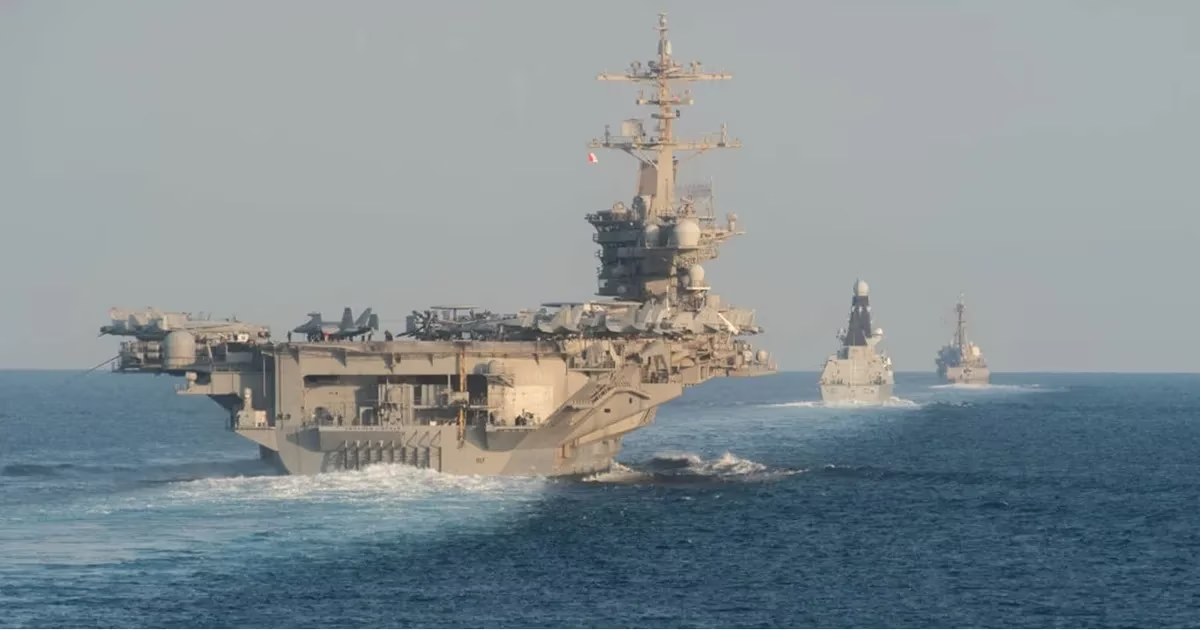
Security sources and analyses have reported that the United States has raised the pace of its military preparations in the Middle East to unprecedented levels, indicating a high probability of military action against Iran. Professor Robert Pape, director of the Chicago Project on Security and Threats, explained that the size of the air power currently stationed in the region represents between 40 to 50 percent of the total available US air capabilities worldwide, which is a dangerous indicator that goes beyond traditional deterrence.
According to updated data as of mid-February 2026, this military deployment recalls the massive preparations that preceded the Iraq wars in 1991 and 2003. Pape affirmed that Washington has historically not accustomed to mobilizing such a massive force near the borders of a potential adversary without subsequent widespread air operations, especially since the buildups are still continuously increasing and expanding geographically.
Currently, the naval strike force is centered around two groups of giant aircraft carriers, the 'Abraham Lincoln' and the 'Gerald R. Ford,' distributed between the Arabian Sea and the Mediterranean Sea. These carriers are supported by formations of warships, destroyers, and nuclear submarines that have taken strategic positions in the Arabian Gulf and the Red Sea, giving US forces the ability to maneuver and strike from multiple axes simultaneously.
On the aerial front, reports have monitored the presence of advanced squadrons of 'F-35A' stealth fighters and 'F-15E' and 'F-16' aircraft in military bases distributed among Gulf countries and Jordan. These fighters are accompanied by a massive fleet of 'C-17' strategic transport aircraft and dozens of aerial refueling aircraft, in addition to advanced command, control, and intelligence systems aimed at managing the theater of operations with high efficiency.
In the context of securing these forces and regional allies, Washington has reinforced air defense systems through the extensive deployment of 'Patriot' batteries, as well as the deployment of the advanced 'THAAD' missile defense system in Saudi Arabia or Qatar. Analysts believe that this integration between offensive and defensive power indicates that preparations have moved beyond the theoretical planning stage to operational readiness for a potential preemptive strike.
The United States has never before deployed a force of this magnitude against a potential enemy without launching air strikes.
ISRAELI AFFAIRS
Sun 22 Feb 2026 7:42 pm - Jerusalem Time
Former Israeli Security Official: Trump Ends Iran's 'Weapon of Time' with Offensive Strategy
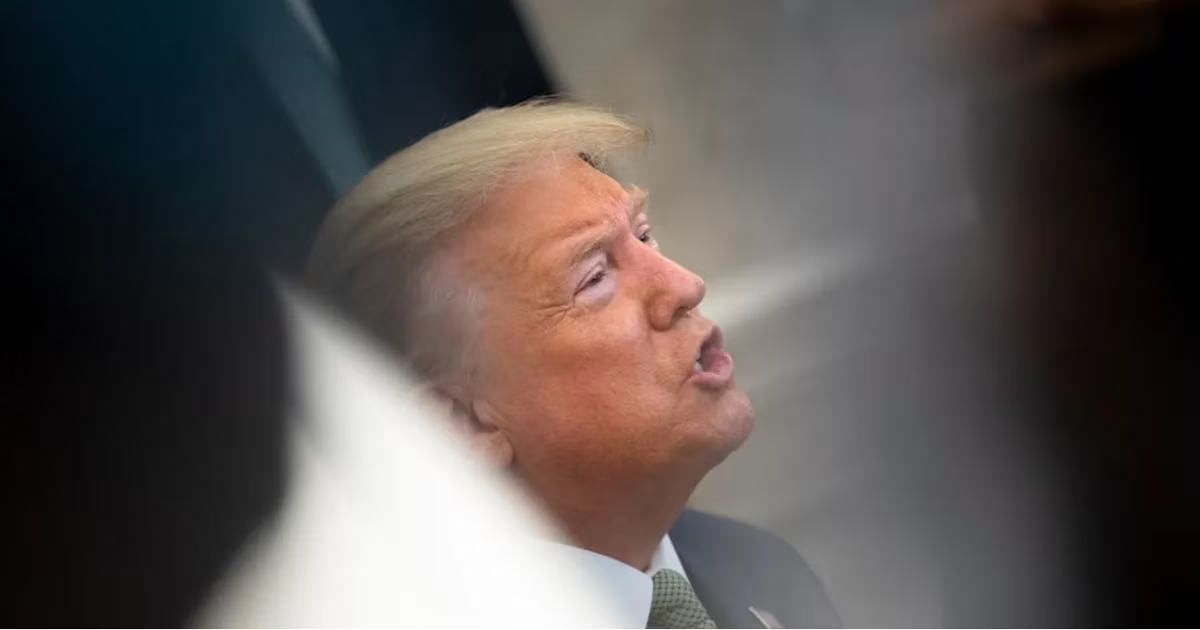
Former head of the Israeli National Security Council, Tzachi Hanegbi, revealed his vision for the ongoing shifts in American policy towards the Iranian file. Hanegbi explained that President Donald Trump is currently adopting a strategy he described as 'winning,' primarily aimed at undermining Tehran's ability for political maneuvering, which has continued for many years.
The former Israeli official pointed out in statements reported by Hebrew media sources that the Iranian regime had previously excelled at evading Western powers, both in the United States and Europe. He considered this evasion to be the dominant characteristic of international relations before Trump came to power and changed the rules of the political game.
According to Hanegbi, the real strength in Trump's approach lies in stripping Iran of the 'weapon of time,' which Tehran cleverly used for decades against successive American presidents. This weapon allowed the Iranian regime to postpone international obligations while continuing to develop its nuclear program away from real pressure.
Hanegbi continued, explaining that the Iranians historically succeeded in obstructing diplomatic paths through an endless series of talks, meetings, and exchange of official documents. He also noted their deliberate creation of side crises and illusory initiatives aimed at distracting decision-makers in Washington and EU capitals.
These Iranian tactics always presented the American administration with a difficult moral and political dilemma, as officials wondered if an agreement was possible. This hesitation led international powers to avoid taking decisive or dangerous steps, fearing the collapse of the fragile diplomatic path drawn by Tehran.
In contrast, Hanegbi believes that Trump completely turned the tables by using time to his advantage instead of leaving it to the Iranians, as his approach relies on complete clarity. He sends a message that Iranian procrastination will not be met with passive waiting, but with intensive field and military movements that strengthen American power cards.
The former security official explained that Trump is currently working to strengthen military forces in the region and simultaneously improve defensive and offensive capabilities. This readiness aims to confront Iran with the reality that the price will be very high once Washington declares the end of the diplomatic deadline.
Hanegbi believes that the Iranian dilemma is now confined to two bitter choices, as a result of the continuous pressure exerted by the White House. The current American strategy leaves no room for the ambiguity that Iranian diplomacy thrived on in previous eras, putting the regime in a tight corner.
Hanegbi implicitly criticized previous agreements, specifically those concluded during the Obama era, considering them to lack the element of permanence and stability. He stressed that Trump's vision is based on the necessity for agreements between countries to be strong and able to withstand for centuries, not just temporary settlements.
Hanegbi concluded his statements by indicating that the implicit message Trump is sending to Tehran is to definitively prevent the acquisition of nuclear weapons. He emphasized that the new American approach rejects commitments being merely 'ink on paper,' but seeks real guarantees to prevent future bloodshed.
Trump made a brilliant move by depriving Iran of the ultimate weapon it had used for decades against all American presidents: time.
ISRAELI AFFAIRS
Sun 22 Feb 2026 7:42 pm - Jerusalem Time
Dimensions of Rubio's Speech in Munich: An American Attempt to Reshape the Western Alliance on Ideological Grounds
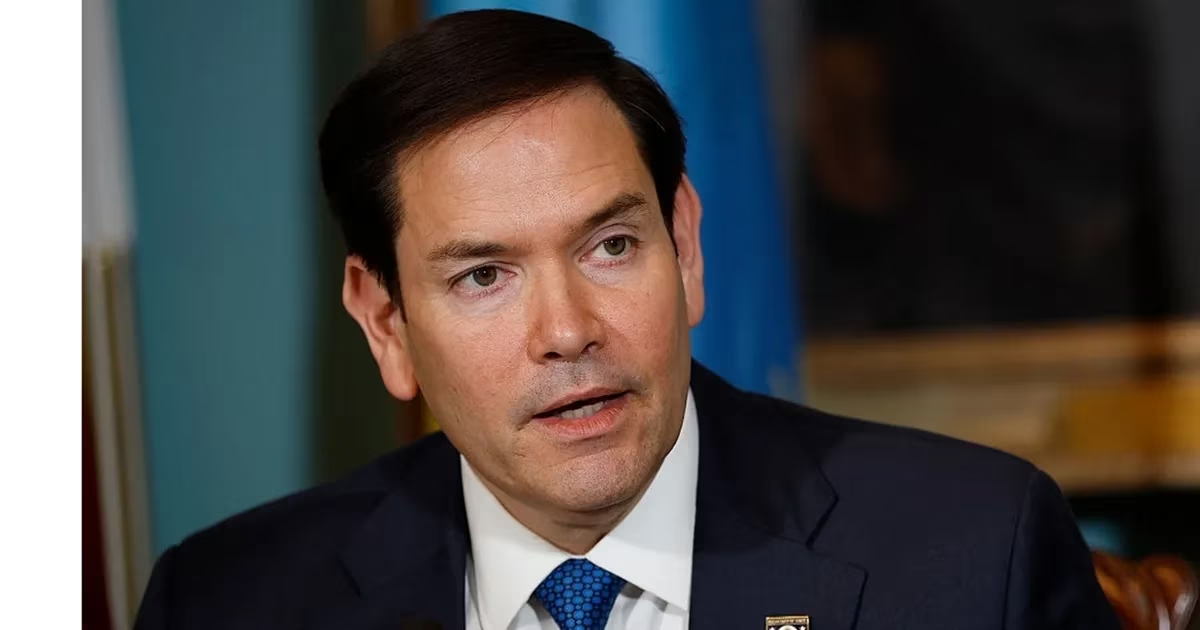
Marco Rubio's speech to security leaders at the Munich Conference carried intense strategic messages, primarily aimed at addressing the European psyche through the gateway of civilization and religion. Through his speech, Rubio sought to reassemble the European diaspora that had begun to slip from American hegemony, attempting to mend the Western alliance on solid ideological foundations.
The American official clearly criticized the economic policies pursued by the West in recent decades, considering them to have caused a decline in the industrial base of major countries. He also pointed out that encouraging immigration from cultures not aligned with Western identity now threatens social cohesion in both the Old Continent and the United States.
This revelation reflects the core concepts from which the current American administration operates, as it seeks to reshape the Western front according to a conservative vision. This trend is clearly evident in the attempt to impose an intellectual framework that links political interests and shared cultural values to confront international adversaries.
Historically, the rise of the New Evangelical movement played a pivotal role in shaping American foreign policy over the past twenty years. This was evident in the speech of former President George H.W. Bush, which was characterized by a clear religious tone, leading up to the current era which sees a similar influence in decision-making circles.
Although former President Donald Trump was not known for his personal piety, he politically relied entirely on the conservative evangelical base. This alliance translated into major strategic decisions, most notably the recognition of Jerusalem as the capital of the Israeli occupation in 2017 and the relocation of the American embassy there.
In contrast, this American vision faces a complex European reality based fundamentally on the principle of secularism and the separation of religion from the state. While France adopts a strict model of laïcité, other countries like Germany and Britain content themselves with cooperative models that maintain the state's civil and liberal nature.
However, the last decade has witnessed a tangible shift with the steady rise of conservative right-wing movements across the European continent. Observers link this rise to increasing fears of losing cultural identity, especially after the large waves of refugees following political crises and wars in the Arab region.
The war in Syria and the influx of millions of refugees into Europe led to strong adverse reactions within host communities. Right-wing parties exploited these demographic fears to strengthen their political presence, warning against what they described as a threat to the 'Christian roots' of the European continent in the face of demographic changes.
This cultural anxiety coincided with suffocating economic crises exacerbated by the repercussions of the coronavirus pandemic, making right-wing discourse more acceptable to broad segments of the population. The religious rise in Europe is no longer merely a shift in faith, but has become a means of searching for a lost identity amidst globalization and comprehensive secularism.
The history of Christian Democratic parties in Europe, such as the Christian Democratic Union in Germany, originated primarily to confront fascism and communism after World War II. Today, these roots resurface as a moral and political reference to confront contemporary challenges threatening the structure of the family and society.
This shift has created a hidden clash between conservatively oriented societies, especially in Eastern Europe, and the liberal institutions of the European Union. Some governments have resorted to using Christian symbolism as a tool to assert national sovereignty in the face of what they see as encroachment by the secular bureaucracy in Brussels.
From this perspective, Rubio's vocabulary, which focused on 'shared heritage' and 'common destiny' between the two sides of the Atlantic, can be understood. He believes that Europe's strength is a guarantee for the survival of Western civilization, calling for unity to confront rising powers, foremost among them China, which he described as an economic and powerful competitor.
While Rubio calls for postponing conflict with China through dialogue, other priorities in his speech emerge concerning the Middle East. He shows absolute support for the Israeli occupation, backed by American military movements aimed at imposing complete control over decision-making in the region to enable the civilizational vision he preaches.
In conclusion, Rubio's speech in Munich represents a political document expressing a rising American current that blends military power and religious ideology. It is a serious attempt to redefine international alliances based on identity, placing the world before a new stage of polarization that transcends economic interests to cultural conflicts.
The alliance between the United States and Europe is essential for defending their common civilization in the face of current global challenges.
ISRAELI AFFAIRS
Sun 22 Feb 2026 7:42 pm - Jerusalem Time
Turkey as an Alternative Strategic Threat: Is Ankara Becoming a 'New Iran' in Israeli Calculations?
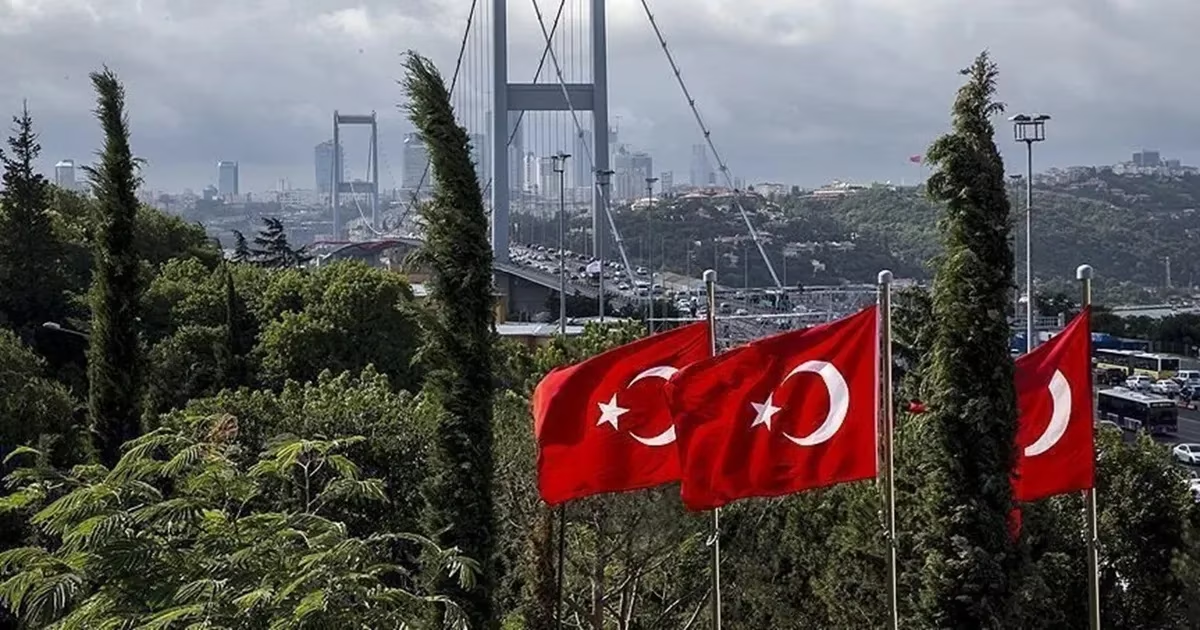
Political and security circles in Tel Aviv are witnessing a remarkable shift in identifying sources of existential threat, with former Prime Minister Naftali Bennett's statements serving as a strong indicator of this change. Bennett believes that Turkey, backed by Qatari funding, has begun to displace Iran from its position as Israel's primary strategic threat, reflecting concern over the emergence of a renewed conflict with an adversary possessing modern tools of power and a thriving economy.
For decades, Israeli security concerns have focused on the Shiite axis led by Tehran, its nuclear program, and its military proxies in the region. However, the new reading indicates the rise of a Sunni axis led by Ankara, a NATO member, which possesses geopolitical ambitions that transcend traditional boundaries, placing Israel before a more complex challenge than the traditional confrontation with Iran.
International politics expert, Meliha Altunışık, confirms that Turkish President Recep Tayyip Erdoğan possesses a superior ability to transform ideology into effective political leverage. Unlike the internationally isolated Iranian model, Turkey adopts an approach that blends political pragmatism with ideological foundations, making its actions unpredictable and difficult to contain for decision-makers in Israel.
From the perspective of Israeli strategists, the threat extends beyond the Turkish state to include a bilateral alliance with Qatar, accused of spreading Muslim Brotherhood ideology and providing political and financial cover for resistance movements. This influence extends to sensitive issues in Syria and the Gaza Strip, with continuous attempts to influence regional balances and win over major Arab powers away from the path of normalization with Israel.
Concerns arise from the scenario of a 'tripartite axis' that could bring together Turkey, Qatar, and Pakistan, which would completely change the strategic map given Islamabad's nuclear capabilities. International experts believe that Turkey's success in solidifying these alliances would mean that Israel would not only face missiles launched from Tehran but would also confront an organized Sunni world possessing strategic deterrent tools.
Economically, the confrontation escalated to a breaking point after Ankara's decision in May 2024 to impose a comprehensive trade ban on Israel. This measure, which included vital sectors such as cement and aluminum, marks the first time Turkey has used its economic power as a G20 nation to impose comprehensive political sanctions, disrupting Israeli trade calculations.
Israeli Foreign Minister, Israel Katz, considered Turkey's actions a sacrifice of economic interests to support Hamas, but analysts see a deeper message. The Turkish boycott reminds Israel that Ankara is not afraid to use its extensive economic influence in Europe and Asia as a tool of political pressure, which doubles the cost of hostility with it.
The current animosity carries deep historical dimensions related to the Ottoman legacy in Palestine, which Erdoğan constantly evokes in his political speeches to portray Turkey as a protector of holy sites. Academics believe that this historical resonance grants Turkish actions a cultural legitimacy in the Arab region that Iran lacks, making the Turkish discourse more acceptable and influential in the Islamic street.
The fundamental question remains whether classifying Turkey as a 'coming Iran' is a realistic assessment or merely a political provocation aimed at preempting Turkish expansion. While some warn that exaggerating this threat could push Ankara towards more radical alliances, the only certainty is that Israel has come to fear the 'credibility' of the Turkish adversary, which combines military power with international integration.
Turkey combines pragmatism and ideology, making it a credible and unpredictable party at the same time.
ARAB AND WORLD
Sun 22 Feb 2026 7:42 pm - Jerusalem Time
Washington conditions Geneva negotiations on an Iranian proposal and questions in the White House about 'not surrendering'
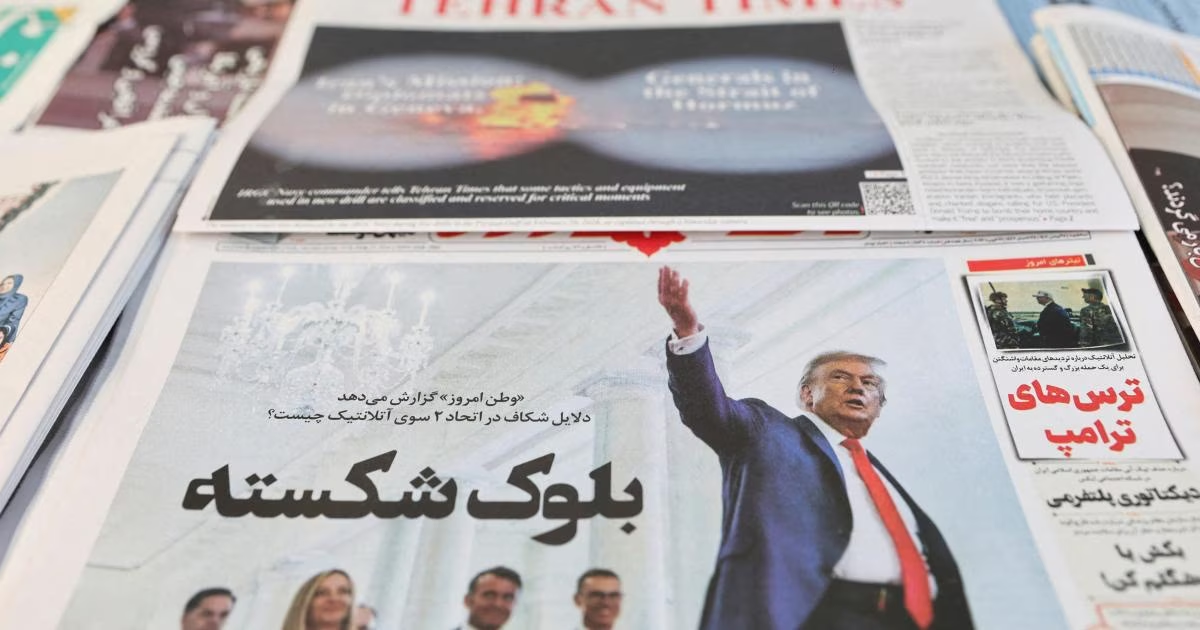
Responsible sources revealed a US approach to discuss the possibility of reaching a temporary nuclear agreement with Tehran, as a preemptive step before any comprehensive understandings about the Iranian nuclear program. These moves come at a sensitive time when the region is witnessing an escalation in political and military rhetoric between the two parties, with international attempts to bridge views and avoid direct confrontation.
The US administration set a clear time condition for resuming dialogue, as Washington expressed its readiness to hold a new round of talks in the Swiss city of Geneva next Friday. This date is linked to the seriousness of Tehran in submitting a technical and detailed proposal within the next forty-eight hours, which Washington considers a test of Iranian intentions before engaging in a new diplomatic round.
For his part, Steve Witkoff, the special envoy of US President Donald Trump, expressed the administration's surprise at the continued Iranian stance refusing to compromise. Witkoff indicated in media statements that President Trump is wondering about the reasons that prevent Iran from 'surrendering' to the current pressures and agreeing to curb its nuclear ambitions definitively, especially in light of the economic crises it faces.
In the context of field escalation, sources reported that President Trump issued orders for an unprecedented military buildup of US forces in the Middle East. These preparations include plans for the possibility of launching a large-scale air attack on Iranian facilities that could last for several weeks, putting the region on the brink of a comprehensive military explosion if the diplomatic path fails.
In contrast, Tehran did not remain silent in the face of these threats, as the Iranian leadership threatened to target all US military bases deployed in the region. Iranian sources confirmed that any aggression against its territory would be met with a crushing response that would affect US interests and its allies, stressing that the policy of 'maximum pressure' would not force the country to abandon its nuclear rights.
The US envoy warned of the technical development reached by the Iranian nuclear program, noting that uranium enrichment operations have reached 60 percent. Witkoff considered that this percentage far exceeds civilian energy needs, stressing that Tehran may be only one week away from possessing industrial-grade materials suitable for producing nuclear warheads, which represents a red line for Washington.
In a remarkable political move, Witkoff revealed a meeting he had with Reza Pahlavi, the son of the deposed Shah of Iran, based on direct instructions from President Trump. Although the details of the discussions were not disclosed, this meeting indicates Washington's desire to coordinate with Iranian opposition figures abroad to increase internal pressure on the ruling regime in Tehran.
Pahlavi had previously called for the necessity of US military intervention to end what he described as the suffering of the Iranian people, considering that military decisive action could save many lives. He urged the US administration to stop prolonging negotiations with Tehran, considering that procrastination gives the Iranian regime enough time to complete its nuclear project and threaten regional security.
Why, under these pressures, and with all this enormous naval power there, have they not come to us and said we declare that we do not want a weapon?
PALESTINE
Sun 22 Feb 2026 7:42 pm - Jerusalem Time
On the fifth day of Ramadan.. Settlers storm Al-Aqsa amid escalating arrest campaigns in the West Bank

Dozens of extremist settlers stormed the courtyards of the blessed Al-Aqsa Mosque this Sunday afternoon, on the fifth day of the month of Ramadan, under strict protection from the Israeli occupation police. Local sources reported that the intruders carried out provocative tours and performed Talmudic rituals in the courtyards, in a move aimed at consecrating the temporal and spatial division of Islamic holy sites.
These incursions come as part of a revised timetable by the alleged Temple groups in cooperation with the occupation authorities, where the period of incursions during the holy month extends for five continuous hours, starting from early morning until just before noon. These measures aim to restrict Palestinian worshippers who face severe restrictions in accessing the mosque since the beginning of the month.
In a related context, the occupation forces launched a wide-ranging arrest campaign in the West Bank since the beginning of Ramadan, affecting more than 100 Palestinian citizens. On Sunday morning, the arrests targeted 8 citizens from Qalqilya Governorate and Azzun town, including three children: Yahya, Yaqoub, and Rashad Salim, in addition to other young men identified as Aboud Noufal, Amir Khader, and Adham Oweinat.
Field data indicates that the occupation continues its systematic policy of abuse, with the number of prisoners in jails rising to more than 9,300, including 350 children and 66 female prisoners living in harsh conditions. These arrests coincide with the tightening of the military stranglehold through nearly 1,000 fixed and mobile checkpoints that cut off cities and villages in the West Bank.
In occupied Jerusalem, the occupation authorities forced citizen Majdi Attia to self-demolish his home in the town of Issawiya, under threat of exorbitant fines and demolition costs by occupation machinery. This policy is part of forced displacement plans targeting the Palestinian presence in the holy city and the vicinity of the Old City.
Violations were not limited to Jerusalem but extended to the village of Al-Mughayyir, where 11 Bedouin families from the 'Khalayel community' were forced to leave due to repeated settler attacks. The area witnessed violent attacks that resulted in the injury of four Palestinians, including a child, under the full protection provided by the occupation army to settler groups in Masafer Yatta and Al-Mughayyir.
These developments reflect a dangerous escalation since October 2023, with official statistics indicating the martyrdom of 1,117 and the injury of approximately 11,500 others in the West Bank. The total number of arrests during this period reached about 22,000, as part of a comprehensive campaign aimed at undermining the steadfastness of Palestinians in their lands.
Human rights sources confirmed that the occupation is racing against time to impose new realities in Jerusalem through 'Biblical Gardens' projects and the demolition of homes in the Al-Bustan neighborhood. These plans are accompanied by direct physical assaults on worshippers in Al-Aqsa and the imposition of extensive security measures that isolate the holy city from its geographical surroundings in the West Bank.
It is worth noting that Israeli incursions into Al-Aqsa Mosque began to take on an official character by decision of the occupation police since 2003, ignoring all calls issued by the Islamic Endowments Department. Settler groups exploit holidays and religious occasions to increase the pace of these incursions, which usually stop in the last ten days of Ramadan to avoid direct confrontations.
Palestinians emphasize that these practices, which include killing, arrest, demolition, and settlement expansion, fall within a comprehensive war of extermination aimed at obliterating the Arab and Islamic identity of the region. Despite all restrictions and barriers, thousands continue to march towards Al-Aqsa Mosque to affirm the Islamic nature of the place and reject the accelerating Judaization policies.
The incursions represent part of the occupation's attempts to impose a changing reality in the mosque and the occupied city, and to obliterate its Arab and Islamic identity.
ARAB AND WORLD
Sun 22 Feb 2026 7:41 pm - Jerusalem Time
Larijani Leads 'Shadow Government': How Iran Prepares for War Scenarios and Succession of the Leader
International press reports have revealed radical shifts in the structure of Iranian leadership, with Ali Larijani, the veteran politician and former commander in the Revolutionary Guard, emerging as a pivotal figure effectively managing state affairs under direct mandate from Supreme Leader Ali Khamenei. This move comes amidst escalating threats of military strikes from the United States and widespread internal protests, prompting the leadership to turn to Larijani due to his extensive experience in national security matters.
Sources indicated that the rise of Larijani, 67, has led to a noticeable decline in the role of President Masoud Pezeshkian, who has faced major political challenges since taking office. Pezeshkian, who always describes himself as a 'doctor, not a politician,' implicitly acknowledged the difficulty of dealing with the complex crises facing the country, delegating many executive powers to the Supreme Leader's inner circle.
Larijani's powers have expanded in recent months to include overseeing the suppression of internal opposition and coordinating relations with regional and international allies such as Russia, Qatar, and Oman. He is also currently managing the sensitive nuclear file with Washington and developing logistical and security plans for governing the country in the event of a direct military confrontation with US forces in the region.
In recent statements, Larijani affirmed that Tehran has used the past months to address weaknesses and enhance its defensive capabilities unprecedentedly. He stressed that Iran does not wish to ignite war but will not hesitate to respond forcefully if attacked, noting that current military readiness surpasses any previous time.
Information from Iranian officials indicates that the Supreme Leader has issued strict directives to ensure the regime's survival if senior leaders are assassinated. These directives included establishing four successive layers of succession for all sovereign and military positions, with each commander required to name four potential replacements to immediately assume their duties when necessary.
Khamenei also authorized a very small circle of advisors to make crucial decisions if he loses contact or is absent from the scene, to ensure no power vacuum. This circle includes Larijani, Major General Yahya Rahim Safavi, and Brigadier General Mohammad Bagher Ghalibaf, who was appointed as the de facto deputy to the Supreme Leader to command the armed forces in wartime.
During a 12-day disappearance last June, coinciding with military escalation, Khamenei secretly named three candidates to succeed him as Supreme Leader. Although Larijani is not a candidate for this position due to not holding a high religious rank, he remains the primary driver of executive and security policies during the transitional phase.
On the ground, Iran has placed its armed forces on high alert, considering US military strikes 'imminent and inevitable' despite ongoing diplomatic channels. Preparations included deploying advanced ballistic missile platforms on the western border with Iraq and along the southern coasts overlooking the Arabian Gulf.
Iranian forces conducted a series of intensive military exercises, including tests of long-range missiles and a temporary closure of the vital Strait of Hormuz. These moves aim to send clear deterrence messages to US bases in the region and affirm Tehran's ability to disrupt global energy supplies if targeted.
Domestically, a strict security plan has been put in place, including deploying special police units and Basij battalions in the streets of major cities to prevent any unrest that might accompany military operations. These measures aim to establish intensive checkpoints and track any elements suspected of cooperating with foreign intelligence agencies to destabilize internal security.
Iranian leadership is discussing 'political survival' scenarios that ensure the continued administration of the state even if the Supreme Leader is killed or key command centers are destroyed. Names like Larijani, Ghalibaf, and Hassan Rouhani emerge as potential leaders of a state administration council, despite challenges related to public acceptance of these figures due to past issues.
International experts believe that Khamenei, by distributing powers, seeks to protect the regime's legacy and ensure a smooth transition of power under complex war conditions. Analysts consider that the Supreme Leader fully realizes that his sudden absence could lead to the disintegration of the regime, and therefore he is working to strengthen the institutional 'glue' that binds the state's pillars.
Larijani's escalating influence was evident in his recent visit to Moscow and meeting with Russian President Vladimir Putin, as well as his extensive media activity that overshadowed President Pezeshkian's presence. Sources reported that Pezeshkian himself now seeks authorization from Larijani before making sensitive executive decisions, such as lifting internet restrictions.
In an incident reflecting the new balance of power, Foreign Minister Abbas Araghchi contacted the presidency to inquire about a response to US warnings regarding the execution of protesters. Instead of making a direct decision, Pezeshkian directed the minister to consult Larijani for final guidance, confirming that the real decision-making center has effectively shifted to Larijani's office.
We are prepared in our country, and certainly, we are stronger than before; we do not seek war and will not start it, but if it is imposed on us, we will respond.
PALESTINE
Sun 22 Feb 2026 7:41 pm - Jerusalem Time
Netanyahu announces new regional axis amid technical progress in US-Iran negotiations

Israeli Prime Minister Benjamin Netanyahu announced Tel Aviv's intention to build a new strategic alliance aimed at redrawing the political map in the region. Netanyahu clarified that this axis would transcend traditional alignments to include international powers such as India, in addition to Arab and African countries and Mediterranean states like Cyprus and Greece.
These Israeli moves come at a sensitive time, with increasing reports about the postponement of a military strike that Tel Aviv had planned to direct against Iranian targets. Intelligence assessments had indicated that the attack was scheduled to be carried out over the weekend, but political pressures and developments led to its deferral.
Political circles in Israel are watching with increasing concern what is leaking from behind the scenes of the American administration regarding the possibility of making concessions to Tehran. Tel Aviv fears that Washington might allow Iran to retain 'symbolic' nuclear capabilities, including centrifuges, which Israel views as a direct threat to its national security.
In a related context, Israeli concerns emerged about the influence of President Donald Trump's inner circle, particularly Jared Kushner and Steve Witkoff. Reports indicate that these figures are adopting an approach that pushes for a comprehensive deal with Tehran to avoid sliding into an open military confrontation in the Middle East.
For his part, US Senator Lindsey Graham called on the US administration not to be drawn into calls for de-escalation that might give Iran an opportunity to strengthen its influence. Graham emphasized in statements to Israeli media the necessity of maintaining a policy of maximum pressure to ensure the complete dismantling of the Iranian nuclear program.
On the Iranian side, official sources revealed clear gaps in the ongoing negotiations with the American side regarding the sanctions file. The sources clarified that the dispute primarily focuses on the scope of lifting and the proposed timeline for releasing frozen Iranian assets in exchange for nuclear restrictions.
A new round of talks is scheduled to begin early next March, coinciding with the expiration of a deadline previously set by the White House. During this round, both parties seek to formulate a 'roadmap' that ensures the achievement of common interests and ends the current political stalemate.
Tehran has put forward several technical options to address the concerns of the international community, including the possibility of diluting its stockpile of highly enriched uranium instead of shipping it abroad. Iranian proposals also included the idea of establishing a regional uranium enrichment consortium under international supervision to ensure the peaceful nature of the program.
Iran stipulates, for progress in this path, full international recognition of its right to possess nuclear technology for peaceful purposes. Iranian officials affirmed that reaching an 'interim agreement' might be possible if Washington shows sufficient flexibility in the file of economic cooperation and lifting trade restrictions.
As part of economic incentives, Tehran offered an investment package that allows major American companies to enter as contractors in oil and gas fields. Tehran stressed at the same time that it would not relinquish its full sovereignty over its natural and mineral resources, regardless of the outcome of the negotiations.
Iranian Foreign Minister Abbas Araghchi, for his part, indicated that work is underway to prepare a draft alternative proposal that will be submitted in the coming days. This diplomatic move comes amid President Trump's hinting at limited military options aimed at deterring Iranian nuclear ambitions.
Despite the political tension, reports spoke of 'tangible progress' in the technical discussions that recently took place in the Sultanate of Oman. These developments focused on determining the permissible enrichment levels and the volume of the stockpile that Iran can retain within its fortified facilities.
Tehran relies heavily on the role played by the Director-General of the International Atomic Energy Agency, Rafael Grossi, to bridge viewpoints. Grossi seeks to achieve a diplomatic breakthrough that ensures the full and regular return of the agency's inspectors to Iranian facilities to dispel international doubts.
In conclusion, the region remains in a state of cautious anticipation with the continued American military buildup in the Middle East. While negotiations continue behind closed doors, the specter of confrontation remains in light of the significant divergence between Tehran's demands and the red lines set by Tel Aviv and Washington.
We are working to form a new axis that includes India, Arab, African, and Mediterranean countries to confront current challenges.
PALESTINE
Sun 22 Feb 2026 7:41 pm - Jerusalem Time
Israeli escalation in Ramadan: 100 Palestinians arrested in West Bank, widespread incursions into Al-Aqsa

The Palestinian Prisoners' Society announced a dangerous escalation in the arrest campaigns carried out by Israeli occupation forces since the beginning of the holy month of Ramadan, with raids targeting more than 100 citizens in various West Bank governorates. The society noted that these campaigns were characterized by excessive violence and systematically targeted women, children, and released prisoners, reflecting a policy of collective punishment coinciding with religious occasions.
On Sunday morning, the city of Qalqilya and the town of Azzun witnessed widespread incursions resulting in the arrest of 8 Palestinians, including three young brothers: Yahya, Yaqoub, and Rashad Salim. Local sources reported that occupation soldiers severely beat their father before taking the children to an unknown location, while arrests in Qalqilya included Aboud Nofal, Amir Khader, Adham Oweinat, Amr Hilal, and Mazen Abu Al-Sheikh.
In occupied Jerusalem, settlers continued their violations by storming the courtyards of the blessed Al-Aqsa Mosque under tight protection from the occupation police. These incursions come at a time when Israeli authorities impose strict restrictions on the entry of Palestinian worshippers, increasing tension in the holy city during the days of the holy month.
Field sources reported that occupation forces reinforced their military presence by deploying approximately 1000 fixed and mobile checkpoints and iron gates that cut off the connections between West Bank cities and villages. These measures completely obstructed the movement of citizens and turned population centers into open prisons, exacerbating the humanitarian and economic suffering of the residents.
Regarding settler attacks, extremist groups attacked the Bedouin community of 'Bir Al-Maskoub' near Al-Eizariya, southeast of Jerusalem, in addition to targeting citizens' homes in the town of Beit Furik, east of Nablus. Settlers also set fire to an agricultural house in the town of Abu Falah, northeast of Ramallah, before fire brigades were able to control the blaze that erupted after army forces stormed the town.
In the context of forced displacement policy, press reports revealed an escalation by the Israeli army in destroying Bedouin communities in areas classified as 'C'. Reports indicated that the so-called 'National Guard' affiliated with extremist minister Itamar Ben-Gvir operates without legal constraints to displace Palestinians, which recently led to the departure of 11 families from the 'Al-Khalayel community' in Al-Mughayyir village under the weight of intimidation.
In the town of Al-Isawiya in occupied Jerusalem, occupation authorities forced citizen Majdi Attiya to self-demolish his home, a policy aimed at displacing Jerusalemites and emptying the city of its original inhabitants. Palestinian families resort to self-demolition to avoid paying exorbitant fines imposed by the occupation municipality if its mechanisms carry out the demolition.
Human rights reports documented the injury of 4 Palestinians, including a child, due to attacks carried out by settlers in Al-Mughayyir village and Masafer Yatta areas in Hebron. Settlers wearing military uniforms also assaulted the elderly Mufdi Rabai and his son Majd in Al-Tuwana village, as part of a clear role-sharing between settlers and army forces in carrying out attacks.
Official statistics indicate that the number of prisoners in occupation prisons has risen to more than 9,300, including 350 children and 66 women. These prisoners face tragic detention conditions, including systematic torture, starvation policy, and deliberate medical neglect, which has resulted in the martyrdom of dozens inside prisons since the beginning of the recent aggression.
Since October 8, 2023, Israel has intensified its undeclared war in the West Bank in parallel with the aggression on the Gaza Strip. These operations included direct killing, mass arrests, and destruction of infrastructure, in an attempt to undermine the Palestinian presence and impose a new settlement reality that will be difficult to change in the future.
The toll of victims in the West Bank since that date has reached approximately 1,117 martyrs and more than 11,500 injured, while the number of detainees has exceeded 22,000 Palestinians. Human rights organizations confirm that these figures reflect the extent of organized terrorism practiced by the occupation against unarmed civilians amid complete international silence.
In conclusion, national and Islamic forces warned of an explosion of the situation due to the continuation of these violations, especially in light of the targeting of Al-Aqsa Mosque and the escalation of settler attacks in villages and towns. Popular activities called for the necessity of strengthening national unity and confronting displacement and arrest schemes aimed at breaking the will of the Palestinian people.
The occupation increased the pace of arrest campaigns with the beginning of Ramadan, to include women, children, and former prisoners amid harsh punitive conditions.
PALESTINE
Sun 22 Feb 2026 7:41 pm - Jerusalem Time
Behind the Scenes of the 'Peace Council': Billion-Dollar Investment Plans Raise Concerns of Profiteering in Gaza

International press reports have shed light on the behind-the-scenes workings of the so-called 'Peace Council' established by US President Donald Trump to oversee security and reconstruction efforts in the Gaza Strip. Sources warned that this project could turn into a platform for profiteering by the political and financial elite close to the White House, under the guise of humanitarian initiatives and the development of destroyed infrastructure.
During the council's inaugural meeting, President Trump's son-in-law, Jared Kushner, attempted to downplay concerns about personal financial gains from the reconstruction process. Kushner affirmed that the project team consists of volunteers who are making significant efforts without seeking personal profits, emphasizing that the goal is regional stability and the development of the Strip.
However, these statements clashed with reports indicating vast investment opportunities that attendees of the meeting are seeking to seize, directly or indirectly. Kushner himself revealed at the Davos Economic Forum a 'master plan' worth approximately $30 billion, aimed at transforming Gaza's historical landmarks into industrial zones, data centers, and tourist resorts.
Observers in Washington believe that Kushner represents a key channel for the flow of public and private funds into Gaza, especially with his management of 'Affinity Partners,' which invests billions of dollars on behalf of Gulf sovereign wealth funds. These connections raise questions about the use of political influence to secure massive commercial contracts in conflict zones.
In a related context, the White House announced the collection of nearly $17 billion for the Gaza Reconstruction and Development Fund, which will be technically managed by the World Bank. However, the 'Peace Council,' chaired by Trump in his personal capacity, will be responsible for setting policies and directing the spending of these massive sums, giving it extended authority that transcends official presidential terms.
Signs of commercial competition began to emerge clearly with leaked information about contracts being awarded for the construction of military bases and logistical facilities for international forces tasked with protecting civilians. Leaked documents indicated that American companies specializing in disaster response submitted plans guaranteeing exorbitant profits of up to 300% in exchange for monopolizing transportation and logistical services for many years.
Investor presentations also revealed promises of very high annual returns ranging from 46% to 175% during the first year of operation in the new 'Gaza Supply System.' International contractors liken the current situation in Gaza to what happened in Iraq and Afghanistan, where businessmen and large corporations raced to get rich from internationally funded reconstruction contracts.
For his part, billionaire Yakir Gabay, the Israeli representative on the Council, called for transforming the Gaza Strip's coast into what he described as the 'Mediterranean Riviera.' His vision includes building some 200 hotels, tourist resorts, and artificial islands, considering the coast an untapped real estate asset that could economically change the face of the region.
In the same vein, Marc Rowan, CEO of 'Apollo Global Management' and a member of the Council, provided an estimate of the inherent economic value of Gaza's assets. According to his estimates, the value of the coast, housing stock, and infrastructure exceeds $115 billion, affirming that these assets only need to be opened up to global investment and necessary financing.
The dominance of real estate magnates and private investment firms in the council's formation raises deep concerns about the lack of transparency and ethical standards in the reconstruction process. Political experts warn that prioritizing purely commercial logic may disregard the real needs of the Palestinian population who have suffered the ravages of war and destruction.
Informed sources reported a significant gap between ambitious investment plans and the deteriorating humanitarian reality in the Strip, where the focus is on profitable projects instead of urgent relief. Analysts believe that the role of businessmen in shaping Gaza's future may fundamentally conflict with the requirements of justice and Palestinian national sovereignty.
In conclusion, the 'Peace Council' remains under international scrutiny, amidst questions about its ability to balance the commercial interests of its members with its stated humanitarian mission. The absence of clear accountability mechanisms opens the door to wide possibilities for abuse of power and the diversion of donor funds to serve private agendas.
Reconstructing Gaza will provide amazing investment opportunities for the private sector, and everyone is trying to get a piece of this project.
PALESTINE
Sun 22 Feb 2026 12:33 pm - Jerusalem Time
Gaza Health: Two martyrs and 3 injuries in 24 hours, cumulative toll exceeds 72,000 martyrs

The Palestinian Ministry of Health in the Gaza Strip announced today, Sunday, an increase in the number of victims of the ongoing aggression, with hospitals receiving two martyrs and 3 injured in the past twenty-four hours. Medical sources confirmed that these numbers represent only those whom the teams were able to reach and transport to official health facilities in various areas of the Strip.
The Ministry clarified in its daily report that a large number of victims are still under the rubble of destroyed homes and in rugged road passages, as field conditions prevent civil defense and ambulance teams from reaching them. Rescue teams face enormous challenges in recovery operations due to the lack of heavy equipment and the continued security risks in several axes in the Gaza Strip.
Regarding the statistics recorded since the announcement of the ceasefire on October 11th, health data revealed the martyrdom of 614 citizens and the injury of 1,643 others with various wounds. Rescue teams and volunteers also managed to recover 726 bodies from various areas that had witnessed intense military operations at earlier times.
As for the comprehensive cumulative toll since the outbreak of the aggression on October 7, 2023, official medical records show an increase in the number of martyrs to 72,072, while the number of injured reached 171,741. These figures show the scale of the unprecedented humanitarian catastrophe experienced by the residents of the Strip over more than a year of bombing and destruction.
The Ministry of Health stressed that its staff continues to provide emergency and essential medical services to citizens despite the scarcity of resources and the targeting of the health system. The Ministry indicated that the teams are working under very harsh conditions to try to limit the tragic repercussions of the aggression and provide possible care for thousands of injured and sick people under the ongoing siege.
A number of victims are still under the rubble and in the streets, with ambulance and civil defense teams unable to reach them until now.
ISRAELI AFFAIRS
Sun 22 Feb 2026 12:32 pm - Jerusalem Time
Israeli estimates: West Bank annexation plans fuel Jewish terrorism against Palestinians

Warnings are escalating within Israeli circles about the serious repercussions of the right-wing government's policies aimed at annexing occupied West Bank territories. Observers believe that these political moves have been accompanied by a lax approach by army forces towards settler attacks, leading to a steady growth in what is described as Jewish terrorism directed against Palestinian citizens and their property.
In this context, media sources quoted the Chief of Staff of the Army, Eyal Zamir, confirming during a recent military event the seriousness of crimes of a nationalistic nature. Zamir stressed that these actions do not serve the security system, but rather directly harm the image of the state and the army, calling on the competent authorities to take immediate action and not stand by as spectators in the face of violent groups.
Despite these official statements, field realities indicate a wide gap between the declared discourse and practices on the ground. It has become common for military leaders to be asked to provide testimonies about the deteriorating situation in the West Bank, amid increasing doubts about the security system's willingness or ability to curb settlers who now feel absolute immunity.
Statistics recorded at the beginning of 2026 indicate a dramatic shift in the nature of the field conflict in the West Bank. January of this year recorded a number of victims of Jewish terrorism exceeding the number of victims of operations carried out by the Palestinian resistance, which reflects the unprecedented boldness and initiative of settlement groups in carrying out their attacks.
One of the most prominent pieces of evidence of this escalation is what happened in the village of Ein ad-Duyuk in the Jericho area, where groups of settlers stormed the village using heavy machinery and bulldozers. This attack resulted in widespread destruction affecting a large number of Palestinian homes, in an organized operation aimed at displacing residents and seizing their lands.
Human rights sources reported horrific testimonies of about 50 settlers storming the area, where they seized all property and livestock without any deterrent. The victims expressed their astonishment at the silence of the civil administration and army forces that were present near the attack site, without moving a finger to stop the systematic looting and destruction.
In an attempt to justify the security failure, military sources claimed that forces went to the site immediately after receiving reports, but were unable to identify the suspects. These claims contradict the extent of the destruction left by the attack, as the destruction of 20 homes was documented, meaning that the attackers spent a long time at the site under the eyes of cameras and military surveillance.
On the legal front, the police merely issued routine statements about ongoing investigations involving security officials. These investigations often end without real charges being brought, which reinforces the conviction among Palestinians that there is institutional complicity aimed at protecting the perpetrators and ensuring the continued pressure on the Palestinian presence.
Reports reveal a hidden tension between the government's political orientations pushing for annexation, and some security levels that realize the cost of this chaos. However, it seems that the political decision ultimately prevails, imposing a new reality that transcends the military and civil laws in force in the occupied territories.
One of the most dangerous observed developments is the Central Command of the army recruiting residents of random farms and settlement outposts into what is known as the regional defense system. This measure granted extremist settlers official status, as they now wear military uniforms and carry army weapons while carrying out their attacks on Palestinian villages and towns.
Consistent testimonies from international and local human rights organizations confirm that in many cases, the attackers wear full military uniforms. This overlap between settler and soldier has made it difficult for victims to distinguish between an attack carried out by settler gangs and an official military operation, exacerbating the state of personal insecurity for Palestinians.
Analysts believe that this phenomenon is not just isolated incidents, but rather part of a broader strategy aimed at creating an environment that expels Palestinians from areas classified as 'C'. By integrating settlers into the security system, the government ensures the implementation of the de facto annexation agenda away from international accountability or direct diplomatic pressure.
The continuation of this approach warns of a comprehensive explosion in the occupied territories, as attacks are no longer limited to vandalizing trees or simple property. Instead, they have moved to the stage of mass demolition of homes and complete control over natural resources, under a political cover that provides legal and field protection for the perpetrators of these crimes.
In conclusion, the question remains about the international community's ability to intervene to stop this deterioration, in light of internal Israeli reports acknowledging the growing power of 'Jewish terrorism'. Silence on these practices not only contributes to undermining the two-state solution but also opens the door to a new wave of violence that no party may be able to control in the future.
All types of crimes, including nationalistic ones, do not enhance security, but rather harm settlements, the army, and the state.
PALESTINE
Sun 22 Feb 2026 12:32 pm - Jerusalem Time
New Israeli Escalation in Gaza: Intense Raids and Worsening Crisis for Displaced in Tents

The Israeli occupation army escalated its military attacks early Sunday morning, with its warplanes launching seven airstrikes targeting various areas in the Gaza Strip. The attacks focused on the cities of Rafah in the south and Gaza in the north, coinciding with widespread demolition operations of residential buildings in areas where military vehicles had advanced, leading to the destruction of citizens' property and exacerbating panic among residents.
In the context of field assaults, medical sources reported the martyrdom of two Palestinians due to gunfire by occupation forces in Khan Yunis city and Jabalia refugee camp. Three other citizens were injured by occupation bullets east of Gaza City, accompanied by indiscriminate artillery shelling that targeted residential neighborhoods near the contact lines, while the occupation army claimed to have eliminated an armed individual who approached its forces north of the Strip.
Field statistics indicate that the occupation has committed hundreds of violations of the ceasefire agreement in effect since October 10th. These continuous violations have resulted in the martyrdom of 612 people and the injury of approximately 1640 Palestinians with varying degrees of wounds, placing fragile understandings under the pressure of ongoing military escalation and daily violations.
On the humanitarian front, Amjad Al-Shawa, head of the Palestinian NGO Network, warned of the deteriorating living conditions for displaced persons due to the prevention of mobile homes ('caravans') from entering. Al-Shawa affirmed that the occupation continues to control large areas of the Strip and is working to expand what is known as the 'Yellow Line' towards populated areas, tightening the noose on residents and depriving them of vital spaces.
Al-Shawa explained that thousands of Palestinian families are still living in dilapidated tents or in the open without any real shelter solutions to protect them from weather fluctuations. He accused the occupation authorities of reneging on humanitarian understandings that stipulate the entry of shelter supplies, noting that Israeli forces effectively control about 60% of the total area of the Gaza Strip.
Expanding the scope of buffer zones and military control has directly led to a reduction in available space for residents, especially in the eastern and northern areas, which are considered the food basket of the Strip. These measures complicate international and local relief efforts and limit the ability of institutions to reach the most affected groups by the aggression and ongoing siege.
Regarding border crossings, human rights sources confirmed that the entry of humanitarian aid remains below the required level and does not meet the minimum needs of the population. The occupation authorities impose strict restrictions on the entry of building materials and prefabricated homes, hindering any attempt to address the escalating housing crisis that hundreds of thousands have suffered from for many months.
Approximately 2.4 million Palestinians live in the besieged Gaza Strip for over 18 years, including 1.5 million displaced persons who lack the most basic necessities for a dignified life. Israel continues to prevent the entry of sufficient quantities of food, medicine, and medical supplies, placing the health and relief sectors before unprecedented challenges amid the ongoing aggression and siege.
Thousands of families are still residing in dilapidated tents or in the open, in the absence of real shelter solutions and the prevention of mobile homes from entering.
PALESTINE
Sun 22 Feb 2026 12:32 pm - Jerusalem Time
Washington reveals details of a $17 billion plan for Gaza reconstruction and Israeli calls for displacement

The US Special Envoy for the Middle East, Steve Witkoff, unveiled the outlines of a comprehensive economic plan for the Gaza Strip, based on the financial pledges announced by President Donald Trump. Witkoff clarified that the allocated funding will primarily be directed towards implementing massive projects in the housing and public transportation sectors, noting that these steps are part of a comprehensive vision to reshape the living reality in the Strip after the end of military operations.
During the founding meeting of what is known as the 'Peace Council' in Washington, US President Donald Trump affirmed his commitment to providing $10 billion to support this initiative. Reports indicated that nine other countries pledged to contribute a total of $7 billion, raising the current available funding ceiling to $17 billion, with official expectations to double this figure to $34 billion in later stages of the reconstruction process.
In a related context concerning security arrangements, five countries expressed their preliminary readiness to participate in an international force aimed at ensuring stability within the Gaza Strip and implementing development projects. Witkoff described these moves as 'inspiring,' emphasizing that the top priority will be to remove the massive rubble left by the war and prepare the ground for what he called the anticipated 'renaissance of Gaza' under direct international and American supervision.
On the other hand, controversial statements emerged from within the Israeli Knesset, where extremist Knesset member Zvi Sukkot called for the evacuation of the Gaza Strip's Palestinian residents, estimated at two million people. Sukkot claimed that the continued presence of residents poses a security risk, calling for what he described as 'encouraging voluntary migration' as a means to circumvent international laws prohibiting forced displacement, considering that tunnels still represent an ongoing threat.
These political and financial developments come at a time when Gaza is suffering from an unprecedented humanitarian catastrophe due to the ongoing war since October 2023, which has resulted in the martyrdom and injury of hundreds of thousands, most of whom are women and children. Field statistics confirm that the Israeli war machine has destroyed nearly 90% of vital facilities and infrastructure, making the proposed reconstruction projects a tremendous challenge for the international community.
With these funds, we will be able to remove the rubble and prepare Gaza for a renaissance, and this is just the beginning.
OPINIONS
Sun 22 Feb 2026 12:32 pm - Jerusalem Time
Peace now has an institute and a lifelong president!

The least that can be said is that the Peace Council dispersed after millions of dollars that we heard about but never saw, just as we heard about what was collected during previous wars, while not a single brick was laid in the homes of the Strip, which remained destroyed until the war of extermination on October 8th, and has not yet reached its end.In the language of deals that Trump's businessmen master, not politics, the Peace Council will be managed, which was said not to be limited to Gaza, but its influence will extend to address other global crises, as stated in remarks by US Secretary of State Marco Rubio, who said that the solution in Gaza will represent an international model that will be generalized to settle similar global crises, which raised the concerns of European countries that refused to participate in it, emphasizing the importance of adhering to the multilateral international system represented by the United Nations and the Security Council.In the manner of "and the beautiful women are deceived by praise," Trump overpraised his inflated self, and showered praise on his "wonderful" team. While he claims to be a "firefighter," he does not hesitate to wave a matchstick in an incendiary region.Trump does not seek to solve crises, but to "privatize" them, as the Palestinian issue has become for the real estate mogul merely an "investment portfolio" managed by war brokers under the banner of peace... and peace.One day after the dispersal of the "Peace Council," the US Ambassador to Israel, "Mike Huckabee," revealed the hidden truth and "spilled the beans" by saying: Israel has a biblical right in the Middle East, and it has the right to annex areas within it.We recall the saying of the poet of the Mu'allaqat, Tarafa ibn al-Abd:The days will show you what you were ignorant of, and he who you did not provide will bring you news.
OPINIONS
Sun 22 Feb 2026 12:32 pm - Jerusalem Time
With the National Committee for the Administration of Gaza... Palestinian Self-Rule Enters a New Era

The announcement of the establishment of the "National Committee for the Administration of Gaza," within the authority and powers of the "Peace Council," and even before it began its assigned tasks, was met with skepticism and belittlement from Palestinians, while being welcomed by Arabs and internationally. However, what cannot be denied is that the event finally allows for a silent end to the Oslo phase, which represented the last model of "non-sovereign" Palestinian self-governance during more than a century of administrative experiences under imperial or colonial rule. In the context of the global disorder overseen by Donald Trump, armed with the arrogance of excessive American military power, the Palestinian people are not the only or the strongest among the peoples and nations of the world who have been forced to submit to his will or mood. While Hamas reluctantly agreed to Trump's plan, the organization/authority expected to reap the return of its administration to the Strip and a seat at the decision-making table. Despite remaining players in the Palestinian political arena, one militarily defeated in Gaza and the other politically defeated in the West Bank, their influence no longer extends beyond the right of "non-objection" regarding the formation of the National Committee, nor does it reach the point of insisting on stopping the war of extermination or opening the vital Rafah crossing or basic life issues such as bringing in 200,000 mobile homes to relieve a distressed people. The Only Arena in the Country In light of the "compulsory or voluntary" Arab complicity with the sovereignty of the Peace Council and its senior and middle management mechanisms, and despite European and international reservations towards the Council, especially regarding its charter which is considered an abandonment of the UN system established 75 years ago, it is a project blessed by the UN Security Council, and the Peace Council and its mechanisms have become "the only arena in the country." The PLO realized early on the inevitability of imposing Trump's distorted formula on all principles, legitimacies, and norms regarding the Palestinian issue, and tried with limited success to introduce its own formulas, texts, and preferences into both Trump's original plan and the Security Council resolution and the composition of the National Committee. The organization has also maintained, and continues to maintain, close coordination with the Egyptian patron regarding internal political and security matters, and with Saudi Arabia regarding the promised and conditional political horizon in the UN resolution, of course. But the final path in the international plan to fulfill the Palestinian people's "desire" for "self-determination" - meaning not necessarily because it is a "right" - remains a mirage. As for Hamas, it is looking for any way out to survive humanly and politically, to reduce the widespread blame directed at it and the repercussions of the Al-Aqsa Flood - according to the majority of opinion poll results. While it announced its directives to its cadres to facilitate the transfer of government administrations to the supervision of the National Committee on the eve of its entry into the Strip to take over its duties, as well as its readiness to hand over its offensive weapons, some of the staunchest supporters of the resistance among analysts and thinkers have concluded that the Flood "not only did not achieve its declared goals, but brought about their opposite." Consequently, the two Palestinian parties, exhausted by two years of bloody war and an existential struggle with an exterminationist colonial project on the one hand, and their historical legitimacy on the other, are now ready to accept any formula that does not exclude them from the arena, despite the limited space available for demanding, or even complaining. The Peace Council... The New Reality I leave it to analysts and researchers from various parties to prepare the indictment against the Peace Council, which will certainly be long, and to hold accountable those responsible for both Oslo and the Al-Aqsa Flood. These are natural critical processes after the major transformations the region has witnessed. But it seems to me today that we must deal with the new reality, which has been accepted by all Palestinian and Arab parties, some under duress, for a temporary American mandate in a part of the occupied Palestinian territory, or rather for actual American sovereignty in the Gaza Strip replacing direct Israeli occupation and Israeli exclusivity in Palestinian affairs. This involves the transfer of the administration of the Strip from the authority of the "de facto government" to a new de facto government, under the supervision of the Peace Council and through professional Palestinians who do not belong to any political faction, even if they have their national past and their connections here and there, Palestinian and Arab. At the same time, the direct influence of the Palestinian Authority in the Strip, and in the occupied West Bank as well, is being removed or restricted, after it had worked for two years to prepare itself to fill the governance and security vacuum. This is the new reality, and the Palestinian people must realize how to deal with it and avoid its worst consequences, and perhaps even resist them intelligently and not just by condemnation. Indeed, the goals, laws, and structures of Oslo, or even those prevalent in the contemporary Palestinian revolution phase, no longer govern the scene. The greater Palestinian national struggle for freedom and independence faces a new dilemma of dispersion and human and material defeat, perhaps more difficult than what it faced in previous stages, but full of possibilities that were not present before this stage. Therefore, I seek here to reach an initial realistic understanding of what the experience of establishing, operating, and empowering the National Committee might bring, in light of the experiences of its predecessors and their lessons - if any - and also the size, level, and urgency of the Committee's responsibility stipulated by the Security Council resolution, and defined by supervising "civil service and administration" in the afflicted Strip. There are a number of important paradoxes and indications in the formation of this new administration, mandated by major global powers, and within the limits of its powers and capabilities, and in its legitimacy and the possibility of it deviating from the path of subservience to the existing mandatory/occupying power, which was the dominant feature of previous self-governance experiences. The Succession of Palestinian Self-Rule Eras Since the announcement of the Peace Council charter and the formation of the National Committee, pessimistic assessments have poured in, some due to Donald Trump taking the reins of managing Palestinian affairs, and the resulting extension of imperial-royal control over the fate of the issue, and some fearing a new transitional phase "supposedly for two years" that distances the issue further from sovereignty and justice, and renews and prolongs the suffering of a people exhausted by the struggle against colonialism and genocidal wars. What much of this criticism overlooks is that the new formula for Palestinian administrative self-governance that is crystallizing today does not differ much in terms of powers and expected role from the Palestinian Authority today in the West Bank, albeit under different names and political references. Therefore, the Gaza committee formula, as some portray it, is not different from what remains of the Authority's influence in the West Bank, where the PLO supervises and/or blesses both, while the organization retains the official international representative status of the Palestinian people. That is, the National Committee will not constitute an independent political entity as Trump, Kushner, and Netanyahu might like, just as the Palestinian Authority is not considered a political entity separate from the organization. Regardless of the legal debate about Palestinian legitimacy, it is important to acknowledge that this is not the first time the Palestinian people have been under the hegemony of an external, imperial, mandatory, occupying, colonial power, although we hope it will be the last. Without delving into a historical study here, we note that for more than a century, and even before the crystallization of a distinct Palestinian national identity, the Arab people in Palestine faced a series of forms of self-governance, more or less controlled by the center, and struggled in various forms and with the participation of all social classes, for liberation and then independence. Of course, the global balance of power allied with the Zionist movement has historically not been in favor of the Palestinian national right, and the latter sufficed with a policy of adaptation, survival, and preventing displacement, until the Arab-Jewish demographic balance in Palestine was achieved in 2025. During the Ottoman imperial rule, the provinces of Palestine were mainly administered by their people "politically affiliated with the Ottomans," and through local service, financial, judicial, and military administrations. Then, during 30 years of British Mandate, Arabs as well as Jews had their main place - but not leadership - in all administrations of the ruler ("High Commissioner"). The Mandatory Authority dealt with the political representatives of each party according to its policy favoring the Zionist project, i.e., through continuous cooperation with the Jewish Agency and representative Zionist institutions, and by excluding and banning the Arab Higher Committee. While the Palestinian people have been under direct Israeli rule since 1948 (inside Israel until today and since 1967 in the occupied territories), there was a "civil administration" affiliated with the Israeli army managing the affairs of the Palestinian people through 20,000 civil and service employees (who were later absorbed into the Authority's ministries). Then, with the Oslo framework after 1995, a "Palestinian Transitional Self-Government Authority" was established with functionally and geographically restricted powers (which remains the legal name stipulated despite its renaming as the "Palestinian National Authority"). With this long history and bitter experience with forms and succession of models of hostile external rule imposed on the Palestinian people, the constant has been the resistance of that people, in all arenas of confrontation with policies of extermination, deprivation, and exclusion, with a wide range of means according to the conditions and balances of each battle and front, sometimes advancing and sometimes retreating. This is perhaps the most important historical lesson in our assessment of the fate of the National Committee and the national project itself in the face of what is to come. Exaggerated Risks of Separation We also find some parties, especially those loyal to the PLO's vision, looking with reservation at the distinctive formula granted to the National Committee by its primary patron, the Peace Council, instead of the return of full administrative, security, and political national authority, a formula that it had planned and maneuvered with various parties to achieve. Nevertheless, the composition of the Committee does not show any political color hostile to the organization or to Fatah at all "and perhaps the opposite is true," including a wide range of experienced professional classes that were largely excluded from the structures of the Gaza and Ramallah authorities. Despite their non-factional affiliation, all the zealous people of the Gaza Strip know its people, their concerns, their communities, their traditions, and their politics better than others. It is certain that the most dangerous political challenge the Committee may face will come from the highest leadership levels: the Executive Council, composed of the President's Israel-loving group, through the High Representative Mladenov, who is more sympathetic to the Palestinian position. The Committee's task will be to present the preferred Palestinian vision, the reasonable Palestinian technical solution, and the authentic expertise available, in the face of a decision, plan, or instructions regarding humanitarian, economic, and internal security matters. This will require exceptional astuteness in dealing with the Israeli adversary, and persistent demands on the American patron to resort to logic and Palestinian rights, and to be armed with Arab patronage in this, in addition to accommodating the PLO so that it does not see the Committee as a separate or rebellious entity from it and from the national project. Above all, the Committee remains responsible not only to its conscience, but to two million Palestinians who need professional and honest administration in dealing with their catastrophe. Knowing that the Committee does not possess independent resources, institutions, or systems from those available under the slogan of "one authority, one law, one weapon." Perhaps the strongest argument the Committee can hold onto to resist the pressures it will be subjected to from the Executive Council of Gaza is that its legal status places it under the administration of the Peace Council, but that is only subject to two conditions. The first is that the Peace Council's mandate from the UN Security Council is the basis of the Committee's political "legitimacy," regardless of the internal regulations formulated by Trump's team as the Council's charter and its anticipated first decision. Then, the Security Council resolution links the establishment of the Committee to the Arab League, which worked to establish the Committee before Trump came to power. In addition, the Council must be reminded that its mission does not involve "regime change" in Palestine, and such a policy is not preferred by the Trump administration despite its imperial actions. The mission of the Council and its agencies is limited to helping Palestinians manage their affairs and rebuild what existed after the war within the framework of existing laws and Palestinian administrations, and not building a new, separate Palestinian Gazan system from the unity of the national project. Perhaps there was a valid reason before 2023 for fears that the isolated Gaza Strip under Hamas rule and besieged by Israel, after 15 years of a different path from the rest of the homeland, had become a separatist project, and that the geographical unity of the occupied territories was no longer inevitable. But those who warned of the "emirate in Gaza" project can now pause, as that project no longer exists if it ever actually existed, and Hamas no longer dreams of its detailed imaginary draft for after the defeat of the entity "the promise of the hereafter" published in 2021, especially after the 2.2 million Gazans of the hereafter and their daughters visited them for two years. Risks of Disaster Capitalism It is often overlooked that the "reconstruction" phase is many months away, in terms of the priorities of addressing the needs of relief and shelter phases, then the phase of starting to remove rubble and then rehabilitating and operating service facilities, all before the stages of economic recovery or permanent and comprehensive reconstruction. Despite this fact, the prevailing vision among Trump and those around him focuses on a real estate investment project of more than $115 billion (with a $55 billion return on investments over 10 years). Through this plan, the Gaza Strip will be acquired and "developed" real estate and economically according to a strange Western architectural design and an acquisitive investment doctrine where there is no place for humans or the Palestinian people to determine their destiny or draw their future map. Thus, we saw at the launch ceremony of the Peace Council the gap between the updated formula of "disaster capitalism" presented by Jared Kushner with shiny maps and images (that policy pursued by American and European money in many post-conflict situations, most notably Iraq and the list goes on), on the one hand, and the modest Palestinian humanitarian vision on the other, which was included in the speech of the Commissioner-General of the National Committee, Dr. Ali Shaath, focusing on the magnitude of the catastrophe that the Committee will do its best to alleviate its burden on the "distressed people of Gaza." This conflict over spatial and architectural planning visions and priorities is not new, but rather reflects a Palestinian professional and scientific pluralism in the issue of planning, and the self-ability to determine the future. In a recent Palestinian study, no less than six "authentic" Palestinian spatial plans were identified, covering among them all possible conceptions for the future Gaza Strip, and a number of them were completed before 2023. Since the war, many international institutes and companies have worked on formulating a similar number of plans for Palestine that reflect their interests, in addition to an additional number of "expert" international plans for the future governance of Gaza and Palestine in what is called "the day after." Therefore, as long as the Palestinian side "the organization, the committee, and the Arab patrons" insists on adopting their planning models and not the imaginary ones proposed by greedy and strange parties, the temptations of disaster capitalism can be confronted, especially since its success poses a great danger to Palestinian resources and to individual and collective Palestinian rights, and will not pass unnoticed. Perpetuating an Authoritarian Ideological Division Far from the Concerns of the People - Or the Unity of the Struggle Under the Umbrella of the State of Palestine? More than two years after the launch of the Israeli genocidal campaign that affected and continues to affect all Palestinians: people, land, identity, and belief, the majority of the Palestinian people expected, and were exhausted by repeated demands to end the division and achieve national unity politically, militarily, and governmentally. Unfortunately, all Palestinian parties failed, from Fatah and the PLO factions to Hamas and the resistance factions, passing through the bewildered leftist factions between the two poles, in addition to the financial and liberal elites who became accustomed to the division and adapted to it, and contributed intentionally or unintentionally to its perpetuation. Ultimately, the train of reunifying the organization or rehabilitating the authority for updated governance has passed, and with time, the experience of division will become a subject of historical study and a bitter memory for the majority of Gazans who look to the future and try to turn the page on the terrifying past as much as possible. All influential Palestinian parties must understand that the entitlement of the Peace Council and the Gaza Committee, and their loss of their previous legitimacy and the absence of unified Palestinian representation globally, constitute strong driving forces to reorient the compass of Palestinian political action to ensure a smooth transition to the next phase and to mobilize all elements of Palestinian power at home and in the diaspora. This requires courage in formulating new liberation agendas and national demands that deal with the new field reality of apartheid in all of Palestine, and just social programs that restore to people even a part of their deprived rights, and modern political representation through young professional leaders and faces who have been deprived of responsibilities in managing the affairs of the Palestinian people, not associated in the eyes of the general public with the tragedies of past years. Such a proposal is not revolutionary or rebellious, but rather a frank conclusion of the repercussions of the dilapidated state of Palestinian governance and the inevitability of getting rid of the legacy of both the non-liberationist Oslo and the non-national separatist projects. Therefore, the upcoming self-governance experience in the context of the Gaza administration committee and its absorption of cadres from both Hamas and the Authority governments, can be seized by Palestinians not only in defense of the larger project and its reconstitution process, but because it is the high price that must be paid to stop the Israeli genocidal advance in Gaza and deter it, and to provide the minimum necessities of life and hope for its people. It may seem today that the Palestinian political system is at a dead end, at least for two years, with no promised or binding horizon for liberation and self-determination. But what is not taken into account when looking at the fragmented Palestinian political scene is that the Gaza Committee derives functional legitimacy within the limits of its administrative, service, and security powers, and enjoys perhaps unprecedented Palestinian, Arab, and international consensus for a Palestinian political entity, and will be mandated and empowered to perform its humanitarian mission by the largest global power. Nevertheless, it may find its actual national legitimacy as it is not a "local committee" as some belittle it, not because it is affiliated with the organization or approved by Hamas, but because it is a national institution responsible to its people, meaning it is a transitional state institution, or the first administrative offspring of the future state of Palestine. Even if this administration is under American and international guardianship in Gaza, the organization launched months ago the process of transitioning from the entity of the National Authority to the entity of the State of Palestine through drafting a constitutional document and setting a program for holding elections for its institutions within a year. This is an ongoing process that seems irreversible regardless of the organization's leadership controlling its helm. This process, if allowed to continue, will bring the state of Palestinian governance, including its transitional self-governing institutions, to a declared or perhaps more fundamental unity, within the framework of a non-sovereign State of Palestine, representing an organizational and mobilization tool for all Palestinians wherever they are, in the face of the project to end their cause globally and their liberation project on the ground. There is no other way.
OPINIONS
Sun 22 Feb 2026 12:32 pm - Jerusalem Time
Huckabee: Israel Controls a "Large Piece" of the Middle East: A Reading into the Unveiling of the American-Israeli Relationship and the Fall of Masks

Tucker Carlson did not reach Jerusalem, but he reached the heart of the political scandal. He did not enter the city, but he breached the symbolic wall that protects the official narrative. His feet did not touch the stones of the Old City, but his words touched the deep structure of the American-Israeli relationship, a relationship not based on alliance, but on identification, and not on partnership, but on functional dependency. He interviewed former US Ambassador Mike Huckabee, and emerged from the interview to find his program's producer in the grip of Israeli security, surrounded by investigation and interrogation, while his team was surrounded by men Carlson explicitly described as thugs. The scene was not a fleeting security incident, but an intense image of a police state that sees the camera as a danger, the question as a threat, and the press as an enemy. The meeting was not a coincidence. Huckabee himself publicly requested it in a tweet on the "X" platform, after an episode Carlson filmed in Jordan about Christianity and Christians in the Holy Land. But as soon as the interview ended, the scene turned into a political and media scandal, and the question shifted from the content of the interview to an existential one: Has the American journalist himself become a security target in a state that claims democracy? What happened was not an isolated incident, but a political display of an entire system. A system that does not tolerate questions, cannot bear criticism, and accepts nothing but obedience. A system that considers media a danger, a free narrative a threat, and an uncontrolled word a security breach. After the war of annihilation in Gaza, Carlson changed. There is no denying that. His discourse changed, his program changed, his audience changed, his perspective on the world changed. He did not become a defender of Palestine, nor did he become a bearer of its flag, but he emerged from the closed ideological cage in which he had lived for a long time. He emerged from the discourse of "Great America" as a sacred doctrine, and began to see the contradictions, to see the rot beneath the slogans, to see the violence beneath the soft language, to see the occupation beneath the discourse of democracy. I fundamentally disagree with him. I do not share his worldview, his intellectual background, his right-wing ideology, or his political project, but I respect the moment of breaking away from the herd. I respect that he decided to listen to those who differ from him, to engage with them, to ask instead of repeating, to doubt instead of sanctifying, to deconstruct instead of justifying. And this alone is enough to make him more honorable than Arab and Western media mouthpieces who have turned into propaganda tools for the entity, and more honorable than Zionist presenters who practice symbolic rape of the Palestinian narrative in the name of professionalism. Carlson shocks his audience because he himself is shocked. Shocked by a state that talks about freedom and practices oppression. About a democracy that exports values and funds genocide. About a human rights discourse that justifies the killing of children. His shock resembles, in reverse, the shock of the Palestinian who sees the American ambassador talking about the "existential right of the entity," and about "Netanyahu's ancestors' right to Palestine," and justifying the killing of civilians, journalists, and children in Gaza as "self-defense." Carlson's sarcasm about the cleanliness of Ben Gurion Airport was not a fleeting sarcastic comment, but a symbolic deconstruction of a state clean in appearance, dirty in essence, modern in structure, savage in behavior, immoral, technologically advanced, primitive in ethics. A state of registration, monitoring, and espionage, a state of total security, a state with more cameras than schools, more prisons than libraries, and more emergency laws than laws of life. But the real political bombshell was when Carlson said that his own country's embassy coordinated a systematic campaign against him, which began before his arrival in Tel Aviv, through leaks, propaganda warfare, and distortion, without any official communication, and without any accountability. He asked clearly: Who does Huckabee work for? We are Americans, he is our ambassador, we pay his salary from our taxes, but he works for a foreign government, repeats its lies, defends its narrative, and sides with it against the citizens of his country. Then he said the most dangerous sentence: If you are an American in Israel, your government will side with Israel, not with you. And if you are an American within America, your government will also side with Israel. This is the essence of the crisis. This is not an alliance relationship, but a sovereign coup relationship. This is not a partnership, but a confiscation of decision. This is not foreign policy, but a structural hostage situation. Here, all myths fall. The myth of the nation-state falls. The myth of sovereignty falls. The myth of independent decision falls. And the naked truth appears: a government that works for others, not its people, a state that funds a project that does not serve its citizens, and a political system that prioritizes the security of a foreign state over the dignity of its citizens. And this is exactly what we, as Palestinians, have been experiencing for decades. When the occupation forces assassinated the Palestinian journalist and American citizen Shireen Abu Akleh, the American state did not move. Israel was not held accountable. No one was summoned. No sanctions were imposed. No pressure was exerted. Complete silence. Complete complicity. Complete protection for the perpetrator. How many Palestinian-Americans have been killed in Gaza? In the West Bank? At checkpoints? In bombings? In incursions? What did the embassy do? What did the administration do? Did it contact the families? Did it protect its citizens? Or did it practice silence, prohibition, gagging, and disregard? Where are the investigations? Where is the accountability? Where is the law? And where is justice? All the evidence is available, all the crime is documented, and all the criminal structure is clear: official statements, military doctrine, soldier behavior, hate speech, settler violence, a fascist government, a colonial project, an occupying state. The talk about "Great America" is no longer a political discourse, but a dark joke. A state that arrests and kills defenders of immigrants, pursues Palestinians, deports them on private planes, and throws them at checkpoints, in blatant violation of all its laws and standards, and then talks about human rights. Then comes the biggest scandal: the American ambassador himself attacks America, because he sees the Israeli army as more "humane" than the American army. Then he clearly states that the entity is nothing but an American base, and that more than 720,000 American citizens live there, a number equivalent to the number of Palestinians who were displaced in the Nakba. This is not a statement. This is a structural admission. This is a functional definition of a state as an advanced military base. Here the truth is revealed without masks: Israel is not an ally, but a tool. Not a friendly state, but a base. Not an independent entity, but a strategic function. Not a democratic project, but a protected colonial project. Tucker Carlson did not become a Palestinian, but he revealed, from within the system, part of its structural defect. He revealed that the problem is not only in the occupation, but in the system that protects it. Not only in the army, but in the state that funds it. Not only in the Israeli government, but in the American structure that legitimizes it. And from Jerusalem, the city that is closed to its people and open to its settlers, the city where voices are suppressed and myths are made, we understand that the battle is not only over land, but over truth. Not only over geography, but over consciousness. Not only over sovereignty, but over narrative. The most dangerous thing in this scene is not what Carlson said, but what he revealed: that truth has become a political danger, and that whoever approaches it is targeted, besieged, distorted, and isolated. That the empire does not fear weapons as much as it fears questions. And it does not tremble from resistance as much as it trembles from narrative. And it does not fear missiles as much as it fears words. This is why the Palestinian narrative is suppressed. This is why journalists are hunted. This is why words are besieged. This is why truth is assassinated before bodies are assassinated. And in this deep sense, Carlson's story is not a journalist's story, but a system's story. It is not a security incident, but a political structure. It is not a media crisis, but an imperial unveiling.