






For many years, the Western world has been preoccupied with Iran's nuclear file, a path that led to the signing of an international agreement during the tenure of former US President Barack Obama. This agreement represented a real test of Tehran's intentions, but Donald Trump's withdrawal from it in his first term brought things back to square one, as Iran did not exceed the agreed-upon enrichment levels until after this withdrawal.
Iran consistently insists that its nuclear program is for peaceful civilian purposes and shows flexibility in subjecting it to strict international oversight. However, the United States and its allies continue to impose harsh economic sanctions, indicating that the goal goes beyond the nuclear file towards an attempt to undermine the existing regime or force it into complete surrender to Western dictates.
Western double standards are clearly evident when comparing the treatment of Iran with other countries such as India and Pakistan, which joined the nuclear club with little opposition. Moreover, overlooking North Korea's nuclear program and the absolute silence on Israel's nuclear arsenal raise fundamental questions about the true motives behind the escalation against Tehran.
Observers believe that the uproar surrounding Iran is primarily aimed at protecting Israeli interests, as Tel Aviv considers any Iranian capability an existential threat. The occupation state exploits these fears to constantly incite against any diplomatic rapprochement between Washington and Tehran, demanding impossible conditions that ensure its continued dominance as the sole power in the region.
In addition to Israeli concerns, the 'Iranian bogeyman' is used as a pretext to fuel the fears of neighboring Arab countries, in an effort to expand the scope of the 'Abraham Accords'. This policy aims to create security and military alliances between Israel and Gulf states under the umbrella of jointly confronting alleged Iranian threats, which serves the American vision for the region.
Despite Iranian attempts at de-escalation towards its neighbors, the US administration continues to work to prevent Tehran from developing any nuclear program, whether civilian or military. Benjamin Netanyahu's role as a key player in this incitement stands out, as he was the first to reject the 2015 agreement and continued to pressure until he managed to convince Trump to cancel it.
Field data indicates that previous negotiations were merely a cover for systematic targeting operations that took place over the past years. American and Israeli parties claimed significant achievements in destroying Iran's missile and nuclear infrastructure, but the return to threatening war suggests that strategic goals have not yet been achieved.
It appears that the failure to overthrow the Iranian regime through popular protests and economic pressures has pushed towards more aggressive options. It is clear from the course of events that the ultimate goal is to redesign the Middle East in line with Israeli and American interests, while attempting to block any expansion of Chinese interests in the region.
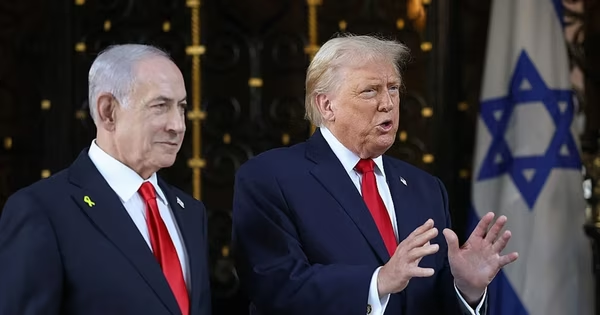
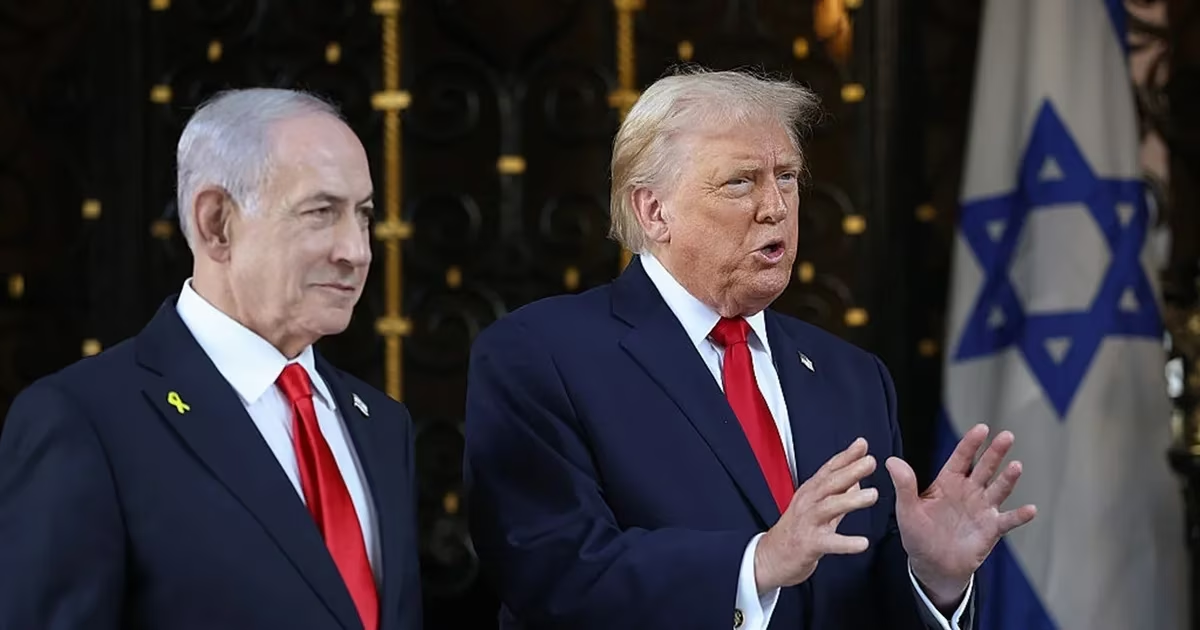
There are indications of high-level coordination between Washington and Tel Aviv, despite what is sometimes rumored about differences between Netanyahu and Trump. It seems that their recent meetings aim to arrange matters for a potential confrontation, while Tehran remains on high alert, with its finger on the trigger in anticipation of any military treachery.
Trump pursues a policy of distraction through contradictory statements, sometimes speaking of limited surgical strikes, and other times hinting at a comprehensive war using space-based platforms. Meanwhile, the massive US military buildup in the region continues, including aircraft carriers, destroyers, and a continuous airlift of equipment.
Hebrew media sources reported that the aircraft carrier 'Ford' may arrive in the region within a few days, which coincides with the deadline set by Trump. This timing raises concerns that the deadline given for negotiations is merely additional time to complete the military buildup necessary to launch a large-scale military operation.
Republican Senator Lindsey Graham, close to Trump, was explicit in his recent statements during his visit to Israel, where he affirmed that Washington and Tel Aviv are on the verge of taking decisive action. Graham described the Iranian leadership in harsh terms, emphasizing that there is no gap in positions between Trump and Netanyahu regarding dealing with Tehran.
The exorbitant cost of this military buildup, estimated at hundreds of millions of dollars, indicates that the matter has gone beyond mere deterrence or containment policy. The United States does not move its fleets of this size unless there is an actual intention to carry out a military operation that fundamentally changes the balance of power in the region.
In conclusion, the coming days remain pregnant with possibilities, as the short deadline set by Trump is not enough to address complex issues that have accumulated over decades. It is likely that the region stands on the brink of a volcano, awaiting the zero hour that could ignite a major war aimed at solidifying the occupation's sovereignty and redrawing the political map.
Overthrowing the regime in Iran is the key to redesigning the entire region according to the Israeli, American, and Western vision.
Share your opinion
Under the Nuclear Pretext: Is the Region Approaching a Comprehensive Confrontation to Redesign It?