







The current Israeli-American war on Iran comes to complete the short war launched against it last summer, which I then described as an example of an incomplete war ("Al-Ayyam" 25-5-2025). The sought-after goal was and still is to overthrow the regime in Iran and replace it with a domesticated one that meets all Israeli-American conditions. It is clear that Netanyahu has been trying for years to drag Washington into doing the job on behalf of Tel Aviv, to achieve Israel's goal of fully domesticating and dominating the entire region, which will not be achieved with the continued existence of a strong regional power hostile to Israel, curbing its absolute control over the entire region. For this purpose, Israel exaggerated Iran's military capabilities and magnified the dangers of its nuclear program, to instill fear in many, inside and outside the region. It is worth noting that Iran's policies and evasions gave Israel comfortable space to do so. As for the Trump administration's involvement in the two successive wars on Iran, although it seems like a drag that aligns only with the Israeli purpose, it is worth noting that Washington, panicked by the continuous decline of its absolute dominance over the international system, due to the accelerating rise of China, on the one hand, and Russia regaining some of its lost status after the collapse of the Soviet Union, on the other hand, means that America also has its own goals it wants to achieve. American goals do not contradict the Israeli goal, but rather intersect with it, as the control of the trusted organic ally in the region secures American interests in the long run. In addition, Washington, in its quest to secure the continuation of its global dominance, aims to specifically contain China's rise, by absolute control over the widest oil-producing regions in the world, as it is the artery feeding the prosperity of the Chinese economy. By controlling Venezuelan oil, on the one hand, and tightening the control loop over "Middle East" oil, on the other hand, the artery supplying China with what it needs of this essential and vital material becomes subject to American control. For these intersecting, but aligned, reasons, getting rid of the Iranian regime becomes a vital priority for Israel and America. But since Israel alone cannot overthrow this regime, it has always needed American support to do the job for it. However, America, which also wants to overthrow the Iranian regime, had a self-restraint as a result of its experience in two bitter wars in Afghanistan and Iraq, which is its unwillingness to engage in a new military "adventure" that would involve it in a new open war. Therefore, its means of achieving the overthrow of the regime in the first short war on Iran, and the current war as well so far, has been limited to launching a "remote war" on it, with attacks from the air and sea, without a ground invasion it is trying hard to avoid. However, it is known from historical experiences that overthrowing a well-established regime by external military intervention is difficult to achieve through launching "remote attacks," and ultimately requires ground intervention to achieve the purpose. So, will Washington be content with limiting its war on Iran to remote strikes, or will it get involved in a long and costly war that does not have the support of American public opinion? *** There are three possibilities (scenarios) for overthrowing the Iranian regime by launching an American-Israeli "remote war": First, continuing to carry out continuous attacks from the air and sea on Iran with the aim of striking the regime's capabilities and undermining its ability to maintain cohesion and control, which allows organized opposition forces to seize it from within, or allows allied forces from outside to do the job. However, this possibility remains weak, as the organized opposition represented by the "Mujahedin-e Khalq" movement does not have a vital presence inside Iran, and because employing allied forces to do the job by infiltration from outside requires the existence of such forces capable of carrying out the mission, and their acceptance of doing so, which is not currently available or guaranteed. Second, relying on an uprising of angry popular groups against the regime, who wish for its demise, by having American and Israeli attacks weaken the regime's control over internal affairs, which allows these groups to take to the streets in large numbers sufficient to eliminate the existing regime and hand it over to a new leadership loyal to America and Israel. At the beginning of this war, the American president expressed his reliance on this scenario, and stated that what America is currently doing is preparing the appropriate ground for this possibility to occur. However, this possibility remains weak currently because the Iranian regime is an ideological regime based primarily on the support of a guaranteed loyal popular base on ideological grounds, and because other groups are expected to unite with it during an external aggression against the country, and because the regime itself is expected to fight fiercely in its defense when it is subjected to external aggression aimed at removing it, which means it will not allow any unorganized "popular" opposition to exploit the opportunity to overthrow it. Third, that America and Israel rely on bringing about change in the Iranian regime from within, by a "soft coup" that brings forth a new leadership that is conducive to reaching "understandings" that achieve American and Israeli conditions, and gradually turns Iranian affairs in the desired direction by Washington and Tel Aviv. For this, the first strike targeted the Supreme Leader himself and a large group of first-tier leaders, especially military ones, which opens the way for a new leadership movement. The American president also expressed Washington's reliance on this option by stating the possibility of three personalities, who appear to be current regime leaders, taking over the leadership of Iran in the next stage. This possibility remains the most important and probable of the previous two possibilities, but it opens the door to questioning whether a deal has been struck with parties from the current Iranian regime for a "soft coup" against it when military attacks take effect by exhausting it. Although this possibility is plausible and brings to mind what happened in Venezuela, the structure of the Iranian regime is more complex and includes the presence of many safety valves protecting the regime, especially the "Revolutionary Guard" which, if not infiltrated, will not only be the defender of the regime's continuity, but also of ensuring the continuity of its ideological direction. *** Driven by Israel, but also to achieve American goals, it is clear that the Trump administration has started a war to complete the previous war to change the Iranian regime. It is also clear that it started this war without a clear plan for how to achieve this goal, as the available possibilities to achieve it through launching a "remote war" are weak and uncertain. If one of these three possibilities mentioned above is not achieved soon, Trump may find himself involved in a long, exhausting, and uncertain ground war that the majority of the American people, and even he himself, do not want or support. If that happens, Netanyahu will have dragged the American president into a muddy confrontation that will disrupt the remainder of his term. A side note: Contrary to Trump's goal of this war being swift, the Iranian regime's goal currently may be to expand its scope and prolong its duration, as this exhausts those with short breath, and Trump is at the top of the list. Another note on the subject: This war, if it does not achieve American-Israeli goals quickly and decisively, will be another important nail in the coffin of the organic American-Israeli relationship. There is a lot of change happening within the American arena in this direction, and this war will reveal this ongoing transformation.

ANALYSIS
Wed 04 Mar 2026 12:26 pm - Jerusalem Time
The Future of the Region in 2026: Implications of Weakening Iran and Risks of Israeli Hegemony
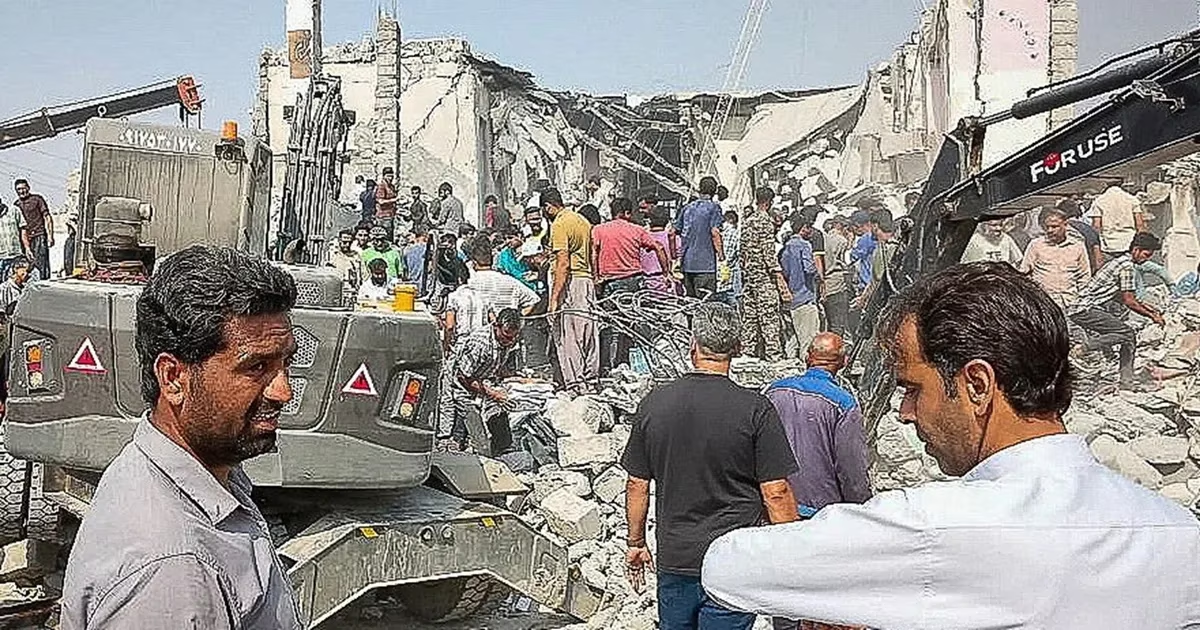
This analytical reading comes amidst complex regional circumstances, with Iran at the heart of its storms, amid a surge in American and Israeli military power characterized by a high degree of military arrogance. This perspective focuses on the repercussions of any major confrontation on Arab national security and regional stability in general.
The hypothesis of Iran's defeat in any upcoming conflict will have severe negative consequences for regional balance, as it will pave the way for the Israeli occupation to extend its absolute hegemony. This arrogance of power will necessarily lead to a state of popular and political unrest as a result of unprecedented Israeli encroachment on Arab affairs.
Hamas and Hezbollah are at the forefront of the forces that will be directly and fatefully affected in the event of the absence or weakening of Iranian support. If Hamas's capabilities decline, this could push the occupation forces to tighten their grip, reigniting resistance in the Gaza Strip and leading the situation towards a bloody unknown.
In the Lebanese arena, weakening Hezbollah could open the door for the Lebanese government to attempt to subdue it militarily or politically. This scenario could bring back memories of the painful civil war that plagued the country for decades, especially in light of the economic collapse currently paralyzing the state.
Hezbollah is expected to reject any attempt to disarm it, which could lead to an internal armed conflict that sets Lebanon back decades. In this context, concerns arise about direct external interventions by the United States or the occupation to support parties hostile to Hezbollah, which would further complicate the scene and destroy what remains of institutions.
Another scenario is the possibility of Hezbollah carrying out a military coup in cooperation with elements of the Lebanese army to impose control over the country. Such a move could be used by Israel as a pretext to destroy Beirut and other major cities under the guise of fighting terrorist organizations, exacerbating poverty and chaos.
Moving to Yemen, Ansar Allah will find themselves in a state of internal retreat to maintain their influence in Sana'a and the northern regions. With the قطع of Iranian supplies, the region may be subjected to American and Israeli aerial or ground interventions aimed at forcibly subjugating the Yemeni capital and ending the Houthi presence.
In Iraq, the task seems more complex for those seeking to dismantle armed militias due to their deep penetration into the social and political fabric. Any governmental attempt to subdue these factions by force could drag the country into a devastating civil war or a military coup that would destroy the capabilities of the Iraqi state.
Washington and Tel Aviv's success in neutralizing Iran's role will radically change the geopolitical map of the region, as Zionist influence will reach distant Arab and Islamic capitals. Israeli leaders no longer hide their expansionist ambitions that extend beyond the borders of Palestine to include neighboring countries under alleged historical slogans.
While the American administration tries to control the pace of the conflict to prevent it from turning into a comprehensive regional war that raises energy prices and affects global economic stability, the occupation is working to tear the region apart. The clear Israeli goal is to humiliate the Arab peoples and ensure absolute hegemony by fragmenting the major powers in the region.
The fall of the regime in Tehran could open the gates of hell through internal ethnic and sectarian conflicts in Iran, which will extend its impact to the Iraqi and Arab borders. The security and political vacuum that this fall will leave will be difficult to control, directly and unprecedentedly threatening Arab national security.
Despite these pessimistic scenarios, the most likely outcome remains the survival of the Iranian regime, albeit with severe economic and political weakening that will require years of recovery. These facts may change in the event of changes in the American administration, which could open the door for new international agreements that redefine the relationship with Tehran.
In the event of a decline in Iranian pressure, some Arab countries such as Saudi Arabia may find an opportunity to focus on their development and internal projects. However, caution remains necessary against Israeli ambitions that will not allow the region to stabilize, as the occupation's eye remains on the region's wealth, lands, and airspace.
In conclusion, Arab decision-makers must realize that weakening Iran is not necessarily a strategic gain for Arabs if the alternative is Israeli unilateralism. Higher political interests require a realistic outlook that transcends sectarian differences or the desire for revenge, to ensure that the Arab arena is not left vulnerable to expansionist projects.
The fall or weakening of Iran is not in the interest of Arabs, because it will leave the arena wide open for the occupying entity to tamper with as it pleases.
PALESTINE
Wed 04 Mar 2026 12:23 pm - Jerusalem Time
Hezbollah's Entry into the Battle... Escalating Internal and Regional Repercussions

Dr. Osama Abdullah: Iranian axis forces may escalate indirectly to expand the pressure theater without a comprehensive regional war. Nizar Nazzal: Hezbollah's entry was expected given the nature of the ongoing conflict, and what is happening reflects a radical shift in the objectives of the confrontation. Dr. Aql Salah: Hezbollah may seek to drag Israel into a war of attrition that prolongs the confrontation and depletes its capabilities, despite the high cost to Lebanon. Sari Sammour: The actual implementation of the Lebanese government's decision to ban Hezbollah's military activities may open the door to internal conflict. Dr. Reham Odeh: The Israeli escalation may develop into a limited ground incursion into South Lebanon with the aim of creating a buffer zone. Labib Taha: The most likely scenario is unprecedented Israeli destruction of Lebanon in parallel with a sharp escalation in internal polarization. Ramallah – Exclusive to "Al-Quds" – Against the backdrop of the American-Israeli war on Iran and its repercussions, Lebanese Hezbollah joined the war, amidst warnings of a major military escalation against Lebanon, in parallel with internal Lebanese alignments and placing the region before unprecedented escalation possibilities, in which other armed factions may become involved. Writers, political analysts, specialists, and university professors, in separate interviews with "Al-Quds", believe that any expansion of the scope of military operations between Israel and Hezbollah will increase internal divisions and deepen the fragility of the Lebanese state, given the difficulty of controlling the pace in the face of escalating regional tensions. They point out that the party's intervention opens the door to potential Israeli responses, including intensive shelling of party and civilian sites, with the possibility of a limited ground incursion into South Lebanon, with the aim of establishing buffer zones, which places Lebanon before a direct cost in terms of infrastructure and human losses, and the erosion of trust in the state, making the country face an unprecedented critical stage in its modern history. Regionally, writers, analysts, specialists, and university professors expect Hezbollah's involvement to lead to an expansion of the indirect engagement, including targeting American and Israeli interests in multiple arenas, from Iraq to the Red Sea. Reshaping the Internal Lebanese Equation The political researcher and academic presents three main scenarios after Hezbollah's involvement in the confrontation within the context of the American-Israeli war with Iran, warning that any military expansion will not be limited to the field, but will extend to reshaping the Lebanese equation internally. Limited Involvement Abdullah explains that the first scenario is "limited involvement" or within controlled fiery messages, where the party may be content with expanding the margin of calculated engagement on the borders with the aim of relieving pressure on Iran, without going to a comprehensive war. Abdullah clarifies that this path keeps the escalation below a calculated ceiling, but it places Lebanon in a state of continuous security and economic attrition, and deepens the fragility of the state, especially in light of an official Lebanese position expressed by the Lebanese government, leading to the banning of Hezbollah's military activities. The Scene of the 2006 War As for the second scenario, according to Abdullah, it is "comprehensive war," if mutual strikes expand significantly, which may bring back the scene of the 2006 war but with much greater destructive capabilities. Abdullah points out that Lebanese infrastructure will be a direct target in this path, which will push the already exhausted economy towards a deeper collapse, with possibilities of widespread internal displacement and increasing institutional disintegration, considering that this scenario is consistent with what the occupation government and its prime minister, Benjamin Netanyahu, specifically want. Mutual Deterrence Abdullah indicates that the third scenario is "mutual deterrence," where the threat of intervention is used as a political pressure card to enhance regional negotiation terms without extensive military implementation, and in this case, Lebanon remains hostage to a sustained state of tension, without a comprehensive explosion, but with continued risks. Sharper Internal Political Division Internally, Abdullah warns that any military expansion will lead to a sharper political division over the decision of war and peace, immense pressure on the lira and the banking sector, and increased probabilities of social tension, in addition to the erosion of what remains of trust in the central state. Abdullah believes that widespread intervention does not mean merely a military confrontation, but rather plunging the country into a phase of long-term instability. Indirect Involvement of Iranian Axis Factions Regionally, Abdullah links the scene to what is known as the Iranian influence axis, which includes armed actors in Yemen through Ansar Allah, and in Iraq through factions affiliated with the Popular Mobilization Forces. Abdullah believes that the likely scenario for the intervention of armed forces from the Iranian axis is indirect escalation, through missile or drone attacks targeting American interests or Israeli-linked targets, with the aim of expanding the pressure theater without providing a justification for a comprehensive regional war. Abdullah points out that the widespread intervention of Iranian axis forces remains dependent on two main factors: the extent of direct targeting of Iran, and Tehran's decision to turn the confrontation into a multi-front war. Abdullah emphasizes that Iranian strategy historically tends towards "managing escalation" rather than "comprehensive explosion," but the region is entering a phase of "dangerous strategic fluidity," where a small tactical error could lead to a wide regional transformation that transcends current rules of engagement. A Network of Iranian Proxies in Anticipation of an Existential War Nizar Nazzal, a researcher specializing in Israeli affairs and conflict issues, believes that Hezbollah's entry into the confrontation was expected given the nature of the ongoing conflict, emphasizing that what is happening is not related to a limited security operation or the assassination of a specific person, but rather reflects a radical shift in the objectives of the confrontation. Nazzal explains that the current escalation is related to targeting the Shiite community more broadly, within the framework of American strategic objectives with which Israel is fully aligned. Nazzal points out that the past period witnessed investment in the state of tension with Iran with the aim of reaching a settlement with Washington regarding its nuclear file, including zeroing enrichment and handing over quantities of enriched uranium, noting that things were moving towards a possible understanding before US President Donald Trump was convinced by the viewpoint of the Israeli Prime Minister, which led to a shift towards the option of war, with the central goal shifting to overthrowing the Iranian regime. Nazzal believes that Iran has worked throughout the past years to build a network of arms and proxies in anticipation of an existential war. The High Cost to Lebanon Nazzal emphasizes that Hezbollah's entry will cost Lebanon dearly, especially given the Israeli army's move to enter the entire South Lebanon and regain control of the areas from which it withdrew in September 2000, as Israel is waiting for the right moment or justification to reoccupy every inch it withdrew from. Regarding the Lebanese government's decision to outlaw Hezbollah, Nazzal questions the effectiveness of these measures, emphasizing that Israel now has the pretext to act, at a time when the party realizes that the Lebanese state is unable to stop the coming "storm." Potential Qualitative Entry of the Houthis Nazzal speaks of the expansion of the confrontation regionally, noting that Iraqi factions targeted American bases with drones, with expectations of continued targeting in Erbil and Syria. He points to a decision issued by Tehran calling on all its allies to engage in the battle. Nazzal believes that the potential entry of the Houthis could be qualitative and surprising, whether through targeting American naval vessels or carrying out large operations. Nazzal believes that the region is heading towards a regional war of an existential nature, transcending the logic of military pressure towards negotiation to an attempt to overthrow the state entirely. Hezbollah's Entry After Thousands of Breaches Aql Salah, a writer, political analyst, and professor of comparative political systems, believes that Hezbollah's entry into the war after the escalation with Iran came in the context of a long process of attrition, explaining that for about 15 months since the ceasefire between Israel and Lebanon, the Lebanese arena witnessed thousands of Israeli violations, including assassinations, shelling, and arrests within Lebanese territory, resulting in hundreds of casualties and widespread destruction. Preemptive Israeli Strike Salah indicates that the party had been warning and demanding the Lebanese government to pressure for an end to these violations, without success, which reinforced its conviction that its turn would come after Iran, but the Lebanese government's announcement of banning the party's military activities may exacerbate the internal crisis. Salah points out that repeated Israeli statements preceding the war on Iran confirmed the intention to carry out a wide operation to disarm the party by force, explaining that Tel Aviv's policy in recent months was based on exhausting and besieging the party in preparation for settling accounts with it. Crossing Red Lines Salah believes that targeting Iran, as the central supporter of the party, constituted a qualitative shift, especially with Israel and the United States going too far in killing Supreme Leader Ali Khamenei, which the party considered a crossing of red lines and an assault on its religious and ideological authority, thus imposing on it the duty of support and defense. Salah explains that not participating in an ongoing war against the party for more than a year would have been a blow to its ideological connection, which made it face the option of engaging in combat to impose the "non-aggression" equation that existed before October 7, 2023, and which is based on returning a blow with a blow. Opportunity to Rebuild Internal and External Understandings Salah points out that internal Lebanese governmental pressures, towards adopting American-Israeli policies to besiege and disarm the party, pushed the party to consider the confrontation an opportunity to rebuild internal and external understandings. Regarding the expected scenarios for Lebanon, Salah predicts a long war interspersed with mutual military operations, including Israeli shelling of party and other Lebanese civilian and military sites, in exchange for missile responses from the party, with the possibility of an Israeli incursion from several axes in the south. Salah believes that the party may seek to drag Israel into a war of attrition that prolongs the confrontation and depletes its capabilities, despite the high cost to Lebanon as well. Salah believes that Netanyahu is treating the battle as decisive for redrawing the Middle East under American cover, thus cementing Israel's regional superiority. Salah explains that the outcomes of the conflict are linked to the resilience of Iran and Lebanon; if Washington and Tel Aviv fail to change the regime in Tehran, they may be pushed towards a major settlement. Salah rules out the chances of a diplomatic settlement given the "Trumpian" mentality supporting Israel, pointing to Netanyahu's internal calculations and his political ambitions until 2030, and his endeavor to exploit the atmosphere of war to overcome his judicial crises. Salah warns of severe humanitarian and economic repercussions for Lebanon, including the destruction of villages and the southern suburbs, widespread displacement, and the exacerbation of internal division, in light of a fragile economy. Ideological Ties and Not Standing By Regionally, Salah expects the Houthis to announce their strong entry into the war in support of Iran and Hezbollah, considering that ideological ties make them uninterested in standing by. Salah points out that the Popular Mobilization Forces in Iraq have been involved since the announcement of the assassination of the Supreme Leader of the Iranian Revolution, Ali Khamenei, predicting an expansion of targeting American interests in Iraq and the region. Salah confirms that the scene is heading towards an open "bone-breaking" conflict with wide regional possibilities. Fears of Internal Lebanese Collision Sari Sammour, a writer and political analyst, explains that Hezbollah's intervention in the ongoing confrontation after the war on Iran "was expected and unexpected at the same time," noting that the sensitivity of the internal situation in Lebanon makes any military involvement of the party a highly influential factor on political and sectarian balances. Sammour points out that the Lebanese government quickly banned the party's military activities, considering that if this decision is actually implemented and does not remain within the framework of a media announcement, it may open the door to an internal conflict that may take on a sectarian or political dimension, especially since the party represents a fundamental segment of the Shiite community in the country. Sammour believes that Israel "will not pay attention to internal Lebanese considerations" and will continue its military operations, which reinforces the action-reaction equation, and leaves the door open to the possibility of the confrontation shifting from an exchange of shelling to ground clashes. Internal Lebanese Alignments Sammour points out that the Lebanese arena has been witnessing sharp alignments for some time that may deepen further in light of developments, describing the Lebanese government's decision as hasty, because Israel has not shown willingness to stop its operations, but rather has made a clear decision to "crush the party permanently." Regarding the expansion of regional intervention, Sammour explains that the Houthi group announced that it may intervene at "a certain moment" according to specific data, although Iran is a strong country that does not need immediate assistance, noting that parties in Iraq have already entered the confrontation, expecting this intervention to expand. The Scene Towards an "Oil Slick" Sammour believes that the scene is heading towards something like an "oil slick" spreading from northern Iraq through the Gulf states and Jordan to Palestine, with escalating tension along what is known as the Fertile Crescent region. Sammour believes that the possibility of containing the escalation still exists "with conditions," but things have become more complicated, especially given Iran's adherence to its nuclear program and its rejection of American and Israeli conditions. Sammour stresses that the region has entered a phase of "bone-breaking war and redrawing maps," and that returning to before October 7, 2023, has become unrealistic. Israeli Ground Incursion into South Lebanon Dr. Reham Odeh, a writer and political analyst, explains that Hezbollah's continued involvement in the war, through launching missiles towards Israeli targets, makes the most likely scenario Israel's continued shelling operations against party targets inside Lebanon, in parallel with intensified attempts to assassinate leaders and active members of the party. Odeh indicates that this path, with Hezbollah's entry into the war and the Israeli escalation, may develop into a limited Israeli ground incursion into South Lebanon, with the aim of creating a security buffer zone along the border. The Regional Scene is Prone to Further Expansion Odeh believes that the regional scene is prone to further expansion, as Israeli air attacks may extend to include Iranian military sites and Revolutionary Guard headquarters, with the possibility of additional assassinations of Iranian leaders within a period ranging from two weeks to a month. In the event of a failure to reach a ceasefire agreement, Odeh expects Israeli air operations against Iran to continue during 2026, but within combat phases interspersed with short truces. Odeh points out that Iran's continued launching of missiles towards Arab Gulf states, without a prospect for a ceasefire, especially if these missiles hit vital facilities such as oil sites, may push some Gulf states to modify their strategy from merely defending to adopting an offensive option aimed at stopping the pace of Iranian attacks. Odeh notes that the repercussions of these missiles have already affected international air traffic and economic activity in those countries. Iran and the Exclusion of Concessions Regarding the Iranian position, Odeh rules out that the current leadership will make strategic concessions related to the nuclear program or ballistic missiles in exchange for a ceasefire. However, she does not rule out, if the war extends for more than a month, the emergence of a new military leadership within the Iranian army that tends to negotiate on American-Israeli terms, while showing some flexibility with the aim of saving the country from security chaos and protecting state institutions from collapse. At the level of regional actors within the Iranian axis, Odeh explains that a number of Iraqi factions loyal to Iran have already announced their entry into the confrontation in support of Tehran, predicting that this intervention will materialize through the launching of drones targeting American sites in the Kurdistan Region of Iraq, such as the American consulate in Erbil or the military base there. Odeh expects the possibility of Houthi intervention in Yemen through launching drones targeting American or Israeli ships in the Red Sea, which expands the scope of maritime tension and deepens the regional nature of the conflict. Fears of Unprecedented Israeli Destruction of Lebanon Labib Taha, a researcher and political analyst, believes that Hezbollah's intervention in the ongoing confrontation opens the door to extremely harsh scenarios for Lebanon, considering that Israel will deal with developments as an "opportunity" to launch widespread strikes, using the maximum firepower it possesses. Taha explains that Israel only deals with the language of shelling and destruction, without any regard for the human cost, as it sees no problem in comprehensive destruction leading to dozens or hundreds of casualties. Taha indicates that the most likely scenario after Hezbollah's intervention is unprecedented Israeli destruction of Lebanon, in parallel with a sharp escalation in internal polarization. The Party Facing Complex Pressures Taha points out that the Lebanese scene after the 2024 war between Hezbollah and Israel showed the party in a state of semi-internal isolation, with governmental and presidential positions taking an anti-resistance path, which places the party in the face of complex pressures from within and without. Taha believes that Hezbollah is relatively weaker compared to previous stages, which makes it vulnerable to multilateral pressures, both on the Lebanese arena and at the level of the Arab region, where pro-Israel and US forces will stand against it. Nevertheless, Taha believes that the party will head towards confrontation, not out of "heroism or showmanship," but because the nature of the threat makes it face a battle it considers existential, and in which it sees no wide margin for choice or retreat. Entry of Iraqi Factions Regarding the expansion of the conflict, Taha explains that some forces and parties in Iraq have already entered the confrontation, pointing to the emergence of names of factions that were not widely known previously, while the Popular Mobilization Forces' situation is more complex by virtue of being part of the official Iraqi institution, which may push it - if intervention occurs - to follow indirect methods, such as logistical or armament support, instead of overt involvement. Regarding Yemen, Taha indicates that the intervention of parties there remains a possibility within a broader regional context. The Region is Heading Towards a "Dark Tunnel" Taha believes that the entire region is heading towards a highly ambiguous phase, which can be likened to a "dark tunnel," where it is difficult to accurately predict its outcomes, despite the possibility of anticipating some scenarios, emphasizing that future developments may exceed all traditional calculations.
ISRAELI AFFAIRS
Wed 04 Mar 2026 12:23 pm - Jerusalem Time
Strategic Confusion in Israel: Do Washington and Tel Aviv Have a Clear Plan for the War on Iran?
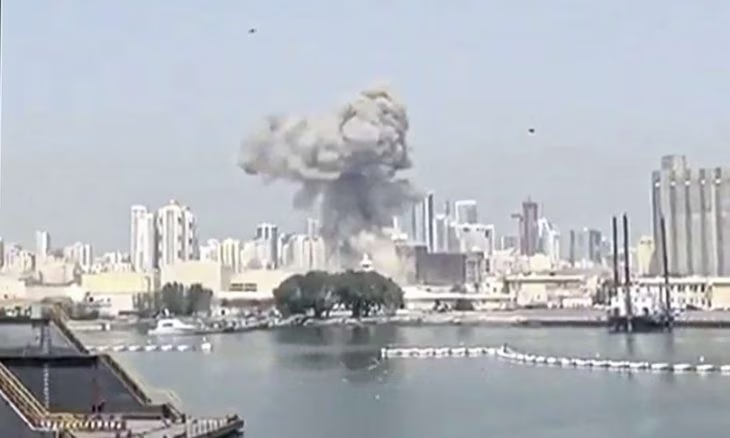
A state of anxiety is escalating within political and media circles in Israel regarding the absence of a clear strategic plan for the ongoing war against Iran. Observers indicate that the American-Israeli alliance appears to be moving without a long-term vision, raising questions about the ultimate goals of this extensive military confrontation.
Hebrew press sources revealed that US President Donald Trump has begun consulting with close media figures to find ways to end the war, a step that reflects wavering positions. Analysts believe that Trump tends to change his declared goals daily, having shifted from talking about regime change to proposing contradictory political and military objectives.
In an analysis published by Haaretz, experts warned that the American leadership is fighting the war without a pre-planned strategy, relying on instantaneous reactions instead of established strategies. This behavior places Israel in a complex position, especially with the discovery that direct confrontation with Tehran is more complicated than previously expected.
Military analyst Avi Sakharov, for his part, warned that Tehran seeks to emerge from this war capable of standing, drawing inspiration from the attrition tactics of its allies in the region. He explained that the Iranian strategy relies on pressuring Washington by targeting its interests and the Gulf states, which requires Israeli caution against promises of quick victory.
On the ground operations front, there appears to be a trend towards sowing chaos within Iran by targeting government and civilian institutions, including the Tehran municipality and leadership centers in Qom. These strikes aim to incite the Iranian street to revolt against the regime, coinciding with Israeli threats to assassinate any alternative leadership that emerges in the future.
In a related context, former ministers in the occupation government called for the necessity of escalating military targeting to encourage ethnic minorities within Iran to engage in armed rebellion. They believe that Israel may miss a historic opportunity if it fails to overthrow the current regime during this direct and unprecedented confrontation.
However, reserve generals downplayed the realism of betting on a minority revolution, emphasizing that the Iranian regime still possesses hundreds of thousands of loyal soldiers capable of protecting it. They cited the historical failure to change regimes in Gaza and Lebanon, warning against being drawn into illusions not supported by facts on the ground.
Former military leaders suggested the necessity of deepening air strikes to cripple Iran's capabilities for many years, instead of betting on immediate regime collapse. They stressed the importance of keeping channels for negotiation with any remaining leadership, warning that alternatives could sometimes be more dangerous and hostile towards Israel.
Regarding Israeli Prime Minister Benjamin Netanyahu's position, he appears more cautious in his public statements compared to Trump, focusing on slogans of 'empowering the Iranian people.' Netanyahu tries to distance himself from accusations of luring the United States into a regional war, while focusing on post-war gains such as normalization with Saudi Arabia.
Hebrew newspaper editorials warned against the illusion of achieving regional peace without resolving the Palestinian issue, emphasizing that removing the Iranian threat must be followed by steps to end the occupation. They considered that the cost of continuing the conflict has become too high, and that the time has come to move from the logic of regional wars to building a comprehensive and real peace.
On the defensive level, sources revealed that the Israeli cabinet is studying the possibility of providing technical and military support to American defense systems located in the Arabian Gulf region. This step comes within the framework of protecting common interests and confronting any Iranian attacks that may target neighboring Arab countries.
As for the northern front, the past hours witnessed a significant escalation with rockets and drones launched from Lebanon towards central Israel. Despite the decrease in the intensity of direct Iranian rocket barrages, the Lebanese front is still ablaze amidst Israeli demands for a ground operation to eliminate Hezbollah's capabilities.
A discussion is underway within the security establishment on how to deal with the Lebanese government and the Lebanese army in light of the confrontation with Hezbollah. While some call for striking infrastructure, others see the need to pressure the Lebanese government while avoiding the occupation of a permanent security strip in the south to avoid getting bogged down in the Lebanese quagmire again.
In conclusion of the developments, the commander of the Northern Command in the occupation army sent strongly worded threats, considering that Hezbollah committed a strategic mistake by joining the battle. The military official vowed to continue harsh strikes that will affect all Lebanese areas from Tyre to Beirut, emphasizing that operations will not stop until military objectives are achieved.
We must approach promises of 'absolute victory' with skepticism this time too in confronting Tehran.
ARAB AND WORLD
Wed 04 Mar 2026 12:23 pm - Jerusalem Time
Contradictory Justifications for the American War on Iran: Can Trump Resolve a Conflict Without Defined Objectives?
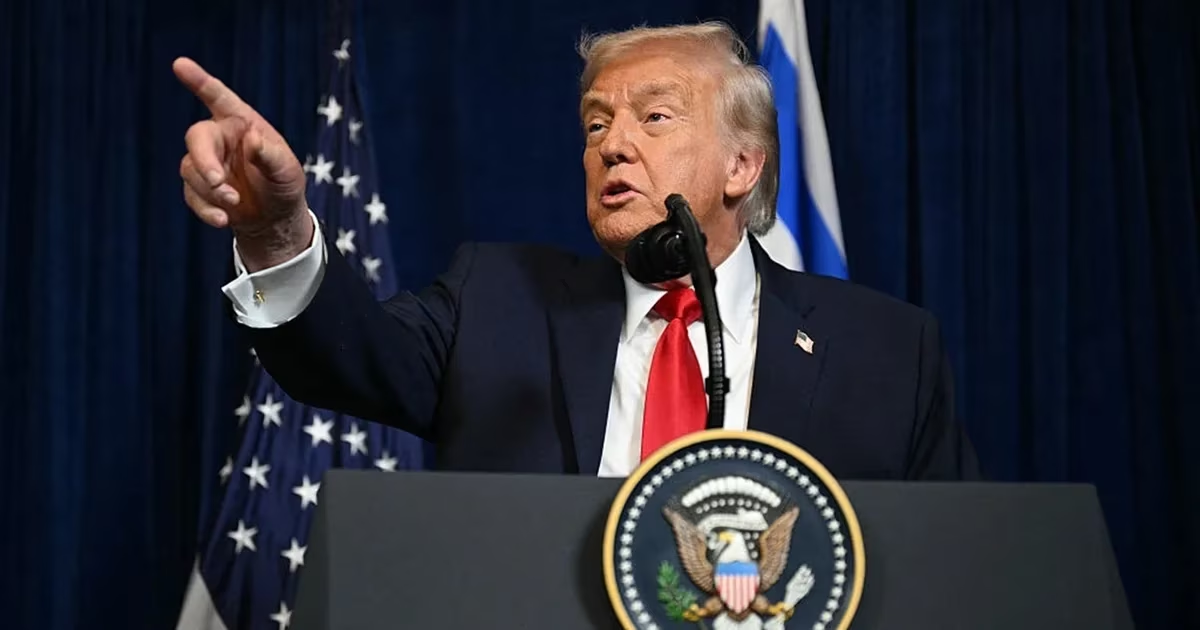
The wide disparity in justifications provided by the administration of US President Donald Trump for the war on Iran has raised deep questions about the clarity of military objectives. Justifications ranged from regime change and halting the nuclear program to ensuring regional security, revealing a contradiction in the strategic vision for the operation.
Press reports indicated that the declared explanations for the war appeared unclear and highly contradictory, despite the multiple objectives put forth by the White House. These objectives included supporting what Trump described as 'oppressed peoples' and stripping Tehran of its ability to extend its regional influence.
During the initial days of military operations, the US administration presented a wide range of disparate pretexts, including responding to previous attacks and taking preemptive measures. Some statements also focused on preventing the development of ballistic missiles capable of directly targeting American territory.
Observers considered this ambiguity to raise a central question about one of the most dramatic military operations in decades. The inability to define a specific meaning of victory could complicate the United States' field and political position in the region.
President Trump had appeared in a video warning of 'imminent threats,' reiterating his accusations against Iran of sponsoring terrorism. In his speech, he called on Iranians to overthrow what he described as an 'extremist dictatorship,' declaring that the hour of freedom had come for the Iranian people.
In subsequent interviews, Trump presented a different vision of victory, likening the optimal scenario to what had previously happened in Venezuela. He hinted that he might personally decide who runs the country, while simultaneously dismissing the right of Iranians to independently choose their leaders.
For his part, Defense Secretary Pete Hegseth announced that the goal of 'Operation Epic Rage' was to destroy the Iranian navy and nuclear capabilities. Hegseth affirmed that the regime had already changed after the Supreme Leader's death in the initial strikes, despite government structures remaining in place.
In a related context, Secretary of State Marco Rubio clarified that the operation's focus was on destroying Tehran's ballistic missile capabilities. Rubio described regime change as a 'hope' that Washington seeks, rather than a direct military objective of the current operation.
Trump did not address the economic consequences of the war in his last public appearance, such as the sharp rise in global oil prices. He also ignored the possibilities of reactions within the United States or the expansion of the conflict to include multiple regional fronts.
The region had already witnessed Iranian strikes targeting facilities and bases in several countries, including Bahrain, Jordan, Kuwait, Iraq, and Israel. Despite this escalation, the White House did not provide concrete evidence that Iran posed an intolerable threat before the attack began.
Trump affirmed his commitment to continuing the war, no matter how long it takes, indicating his readiness to remain in the confrontation for more than five weeks. His rapid shift from talking about military operations to secondary details related to renovations within the White House was notable.
Experts at the Washington Institute for Near East Policy believe that the multiplicity of objectives allows Trump to declare victory under any circumstances. By presenting a long list of possibilities, the US administration can choose any successful outcome and consider it the original goal of the operation.
Trump's current team differs from his advisors in his first term, who tended to be cautious and avoid direct confrontation. The new team includes carefully selected officials to support the President's escalatory decisions in a changing regional reality after the events of October 2023.
It appears that the most prominent motive for this war is to exploit Iran's current state of weakness to solidify a historical legacy for Trump. The President saw the overthrow of the Iranian regime as a historic opportunity that successive American presidents since 1979 had failed to achieve.
Can the United States win a war it chose to fight, at a time when it is unable to explain its reason or define the meaning of victory within it?
ARAB AND WORLD
Wed 04 Mar 2026 12:23 pm - Jerusalem Time
Child Dies in Kuwait, Missiles and Drones Intercepted Over Saudi Arabia Amid Rising Regional Tensions
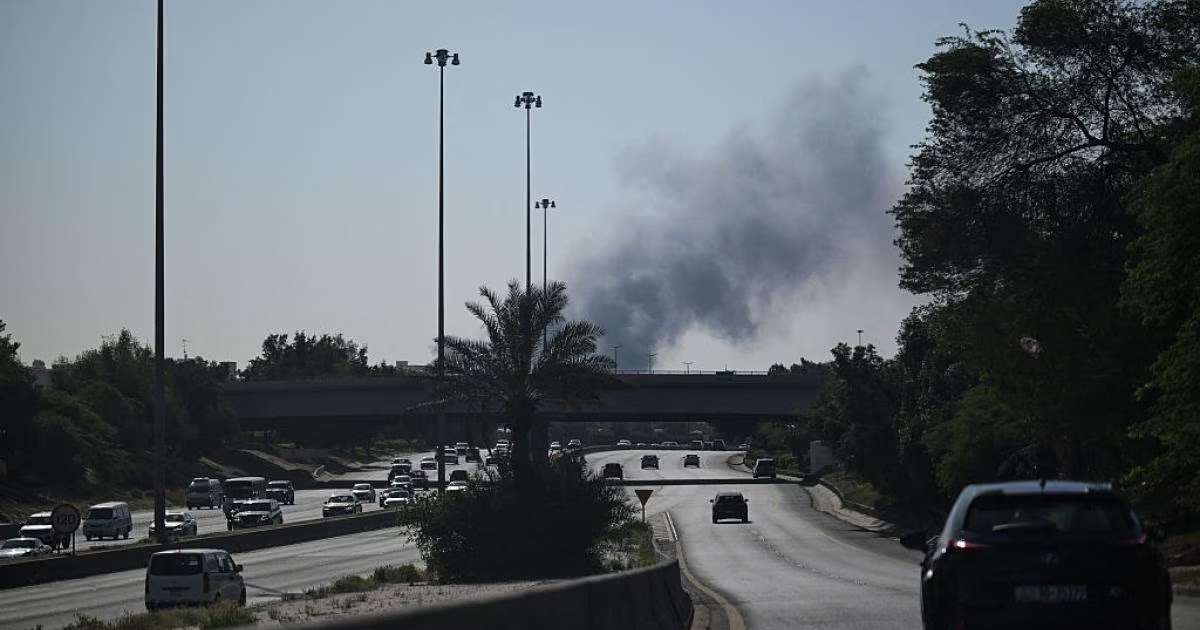
Kuwait witnessed a tragic incident early Wednesday morning, resulting in the death of an 11-year-old girl due to shrapnel falling from aerial interceptions over a residential area in the Capital Governorate. The Ministry of Health stated that the girl passed away despite intensive resuscitation attempts that lasted for about half an hour from the moment she was transported in an ambulance until her arrival at Al-Amiri Hospital.
In a related context, medical reports indicated that four members of the deceased girl's family are currently undergoing careful medical evaluation and observation at the hospital to monitor their health condition. The Kuwaiti Ministry of Defense confirmed that air defenses dealt with hostile targets that entered the country's airspace, leading to scattered shrapnel that caused material damage and human injuries in a residential home.
On the Saudi side, the Ministry of Defense announced the success of its forces in intercepting and destroying two 'Cruise' missiles that were targeting the city of Al-Kharj, located southeast of the capital Riyadh. This coincided with other interception operations, including the destruction of a drone in the Eastern Province, in addition to shooting down 9 suicidal drones immediately after they attempted to penetrate the Kingdom's airspace.
These rapid military developments come amidst a wave of attacks targeting several Arab countries, including Qatar, the UAE, Bahrain, Jordan, Iraq, and Oman. Informed sources link these attacks to the ongoing military escalation between Iran on one hand, and Israel and the United States on the other, with Tehran describing these operations as targeting American interests.
The Gulf Cooperation Council (GCC) countries expressed their strong condemnation of these aggressions against civilian objects and residential areas, demanding an immediate halt to these attacks that threaten the security and stability of the region. The region has been in a state of high alert since the start of the Israeli and American military aggression on Iranian territory last Saturday morning.
Field data indicates that the pace of aerial attacks has significantly escalated in recent hours, leading to civilian casualties and damage to non-military installations. Technical and defense teams in the affected countries continue to monitor the airspace and deal with ongoing threats, amidst international calls for de-escalation and avoiding the region's slide into a comprehensive conflict.
The Kuwaiti Ministry of Defense announced human injuries and material losses following the fall of shrapnel on a house after hostile aerial targets were intercepted within the country's airspace.
ARAB AND WORLD
Wed 04 Mar 2026 12:22 pm - Jerusalem Time
Iran begins Khamenei's funeral rites, Israel threatens his successor with assassination
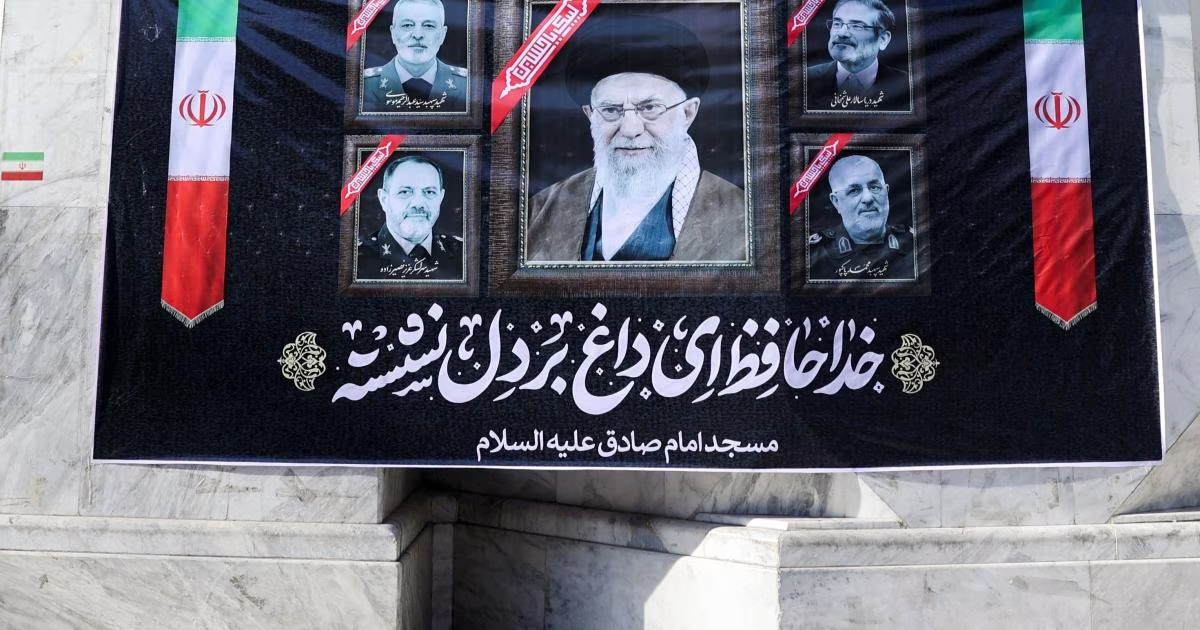
Iranian authorities announced the start of the funeral rites for the Supreme Leader of the Islamic Republic, Ali Khamenei, this Wednesday evening, following his assassination in a joint aerial attack carried out by Israeli and American forces last Saturday. An official statement issued by the Islamic Council for Development Coordination stated that the body would be transferred to the Grand Imam Khomeini Mosque in Tehran to allow citizens to pay their last respects, before completing the burial procedures, which will take three days.
Khamenei's body is scheduled to be laid to rest in his hometown of Mashhad, in the northeast of the country, specifically next to the shrine of Imam Ali ibn Musa al-Ridha, a site that also houses the remains of his father. Mashhad is considered the second spiritual capital of Iran, holding great religious and historical symbolism for Shiites, making its selection as a burial place an affirmation of the status the late leader enjoyed throughout his thirty-six-year rule.
In contrast, Israel escalated its hostile rhetoric, with Security Minister Israel Katz threatening to assassinate any figure chosen to succeed Khamenei if they continue the hostile approach towards Tel Aviv. Katz affirmed in official statements that any new leader who adopts plans to destroy Israel or threatens international interests would be a legitimate target for liquidation operations, emphasizing that security agencies would pursue new leaders wherever they hide.
On the internal Iranian front, informed sources revealed the formation of a temporary leadership council consisting of three prominent officials to steer the government and ensure the stability of institutions following the sudden vacancy in the leader's position. Ali Larijani, Secretary-General of the Supreme National Security Council, confirmed that this measure aims to manage the country's affairs pending the convening of the Assembly of Experts to elect a permanent successor, amid estimates indicating a potential conflict between the hardline revolutionary current and currents seeking political realism.
These developments come after the revelation of details of the military operation that led to Khamenei's death, in which about 200 fighter jets participated in a third wave of attacks described as the largest in decades. The attacking forces used advanced 'Black Sparrow' missiles to ensure penetration of fortifications in the official complex in Tehran, in an operation closely coordinated between Tel Aviv and Washington and included a precise distribution of strategic targets in the region.
Any leader chosen by the Iranian terrorist regime to continue the plan to destroy Israel will be a confirmed target for assassination, no matter their name or where they hide.
ANALYSIS
Wed 04 Mar 2026 12:21 pm - Jerusalem Time
Analysis: Do the attacks against Iran reflect the floundering of 'dying empires'?
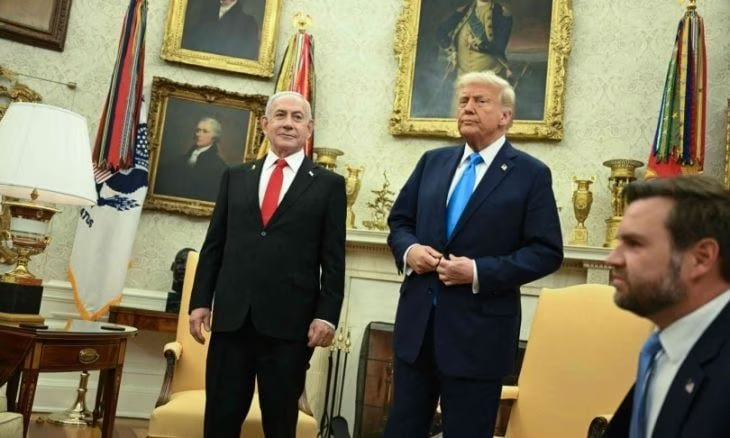
In a deep analytical reading, writer Richard Esko believes that the recent military attacks carried out by the United States and Israel against Iranian targets do not express an excess of power, but rather a behavior similar to 'dying animals' that become more ferocious in their final moments. The analysis indicates that the recent massacres, especially the targeting of educational facilities, reflect a state of strategic despair and a loss of moral and political compass.
The article touched upon the deadly airstrikes that occurred on February 28, 2026, where shells hit Iranian schools and resulted in the death of dozens of children. Esko considered these incidents not merely technical errors, but rather the product of 'tactical indifference' that is very similar to the ongoing genocide in the Gaza Strip, where the masks of shame from targeting civilians have fallen.
Regarding the internal situation in Iran, the analyst believes that the American and Israeli focus on assassinating leading figures, including news about the death of Ayatollah Ali Khamenei, stems from a superficial understanding of history and political reality. Power in Tehran is not linked to a single individual, but is rather the result of historical accumulations and resistance to Western interventions that began with the externally supported coup in 1953.
The analysis warned that turning leaders into 'martyrs' might grant the Iranian regime symbolic power that exceeds their influence while alive, complicating the task of protest movements and those demanding democracy internally. These groups now find themselves in an unenviable position, trapped between the pressures of the local regime and the bombs and missiles launched by international powers under the pretext of liberation.
On the Israeli leadership front, the article painted a bleak picture of Benjamin Netanyahu's future, emphasizing that global public opinion, especially among younger generations in the West, has begun to radically change its view of Israel. It is increasingly described as an 'apartheid state,' making the continuation of the 'Land of Israel' project in its current form unsustainable in light of current geopolitical shifts.
As for the American side, Donald Trump emerges as a representative of a political elite dominated by an existential panic over the loss of global hegemony that has lasted for decades. This elite attempts to compensate for its declining influence by increasing military spending to astronomical levels and adopting repressive policies, in a desperate attempt to stop the wheel of history that points to the rise of new powers and multipolarity.
The writer cited the philosopher Antonio Gramsci's quote about the 'twilight' phase the world is going through, where the old order dies while the new order struggles to be born. In this transitional phase, violent pathological symptoms appear, manifested in absurd wars and military aggressions that do not aim to achieve political victory as much as they aim to delay the inevitable fall.
The article described the United States as having transformed into a 'violent and miserable giant,' directing its people's wealth towards killing and destruction machines while the interior suffers from sharp class disparities and escalating social crises. The attack on Iran, according to Esko, is not a sign of imperial power, but rather a floundering similar to what great empires throughout history experienced before their final collapse.
The analysis concluded that 'time is running out' for leaders who feed on wars and perpetual conflicts to stay in power, whether in Washington or Tel Aviv. The brutality of the current attacks is the last price paid by innocents in a newly forming international reality, where geopolitics will not return to its former state no matter how intense the bombing.
In concluding his reading, Esko sent a message of solidarity with the victims in Palestine, Yemen, and Iran, emphasizing that the will of peoples and major historical transformations are stronger than war machines. He considered the current conflict to be the final throes of an old world order that refuses to acknowledge its end, making it more dangerous and deadly in its final days.
This is how dying animals behave; they do not intentionally seek out children to kill them, but rather strike indiscriminately in a desperate struggle against the inevitable.
ARAB AND WORLD
Wed 04 Mar 2026 12:21 pm - Jerusalem Time
Confusion in Washington: Trump Administration Faces 'Missing Alternative' Dilemma in Iran After Khamenei's Absence
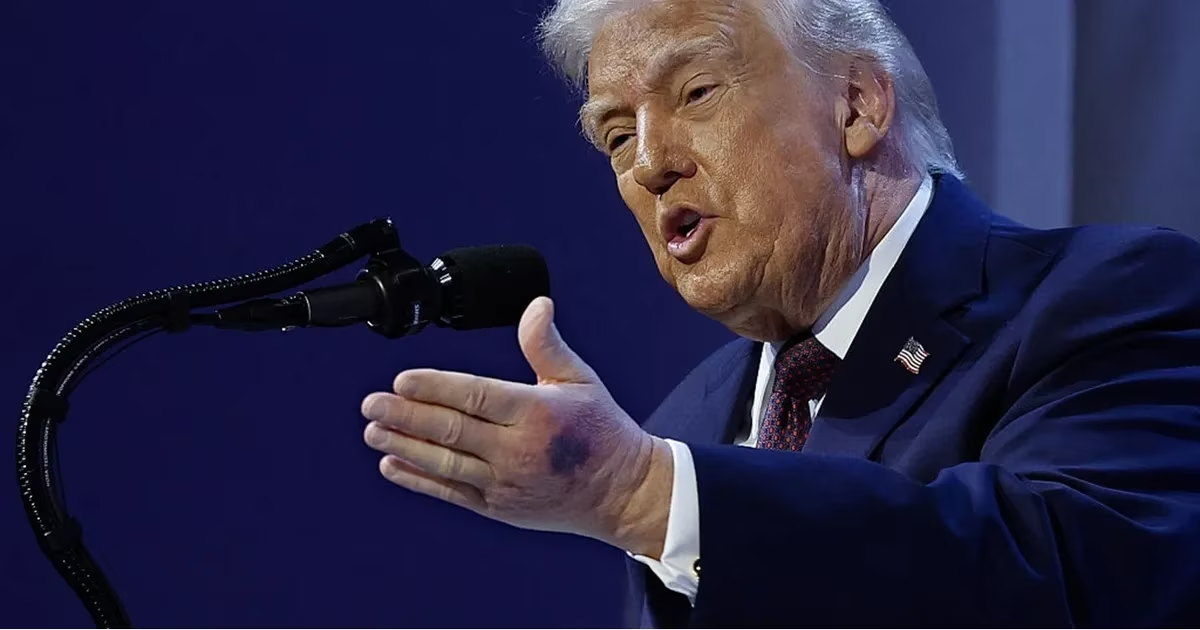
The administration of US President Donald Trump is facing increasing challenges in formulating a clear strategy for Iran's future, in the absence of a precise vision for the post-Supreme Leader era. Reports indicate that the structure of the Iranian regime remains cohesive, hindering Washington's ambitions for rapid and smooth political change.
Journalistic sources stated that Trump's comparison between Iran and Venezuela lacks political and on-the-ground realism. While the administration previously succeeded in establishing communication channels with parties in Caracas, the Iranian scene appears devoid of any organized or dissident opposition that could be relied upon to lead a transitional phase.
Leaked information revealed a joint US-Israeli operation targeting Supreme Leader Ali Khamenei and an elite group of military and political leaders. Despite the intelligence success in identifying targets, the on-the-ground results led to a leadership vacuum that Washington was unprepared to deal with or fill with loyal figures.
President Trump admitted in media statements that the intensive missile strikes eliminated the figures the United States had considered to take the reins. He explained that even the leaders classified in the second or third tier had died, complicating the calculations for a 'ready alternative'.
For its part, the US Central Intelligence Agency worked on attempts to infiltrate the ranks of the Iranian Revolutionary Guard to gather vital information. Despite the intelligence penetration, the administration remains unsure of the identity of the entity actually capable of controlling the ground and cooperating with the international community.
Observers in Washington describe the internal thinking of the national security team regarding the Iranian crisis as 'highly fragmented'. While Trump aspires to repeat the Venezuela scenario, which led to rapid political arrangements, this desire clashes with the nature of the deeply entrenched religious state in Tehran for decades.
The institutional structure in Iran differs fundamentally from traditional authoritarian regimes, as the system relies on a complex overlap between religious, military, and elected authorities. This complexity was specifically designed to ensure the continuity of institutions even in the absence of major leading figures, making the task of overthrowing the regime from abroad difficult.
In an attempt to justify the military operations, Trump's aides claimed that Iranian missiles posed an imminent and direct threat to American territory. However, these claims continue to spark widespread debate in political circles due to their lack of conclusive evidence publicly presented.
The White House outlined a set of strict military objectives, including the complete destruction of Iran's missile arsenal and the neutralization of its naval power. Washington also seeks to ensure Tehran is stripped of any future nuclear capabilities and to cut off supply lines to its allied groups in the region.
Strategic experts, including former advisors, warned that the collapse of the Iranian regime without an alternative could plunge the region into widespread chaos. They stressed that regime change from the air without ground forces or strong local allies is a risky gamble with uncertain outcomes.
On the diplomatic front, Secretary of State Marco Rubio acknowledged the difficulty of the situation, noting that political transition in Iran would be more complex than any previous experience. He explained that the administration is looking for paths that ensure stability and prevent the country from turning into an arena for armed civil conflicts.
Domestically, opinion polls showed widespread American public opposition to the military operation, with a majority of participants expressing concern about the absence of a plan. 60% of Americans believe that the President lacks a clear vision for how to end the conflict or deal with its long-term repercussions.
US allies abroad are awaiting more precise clarifications about the ultimate goals of the ongoing military operation. Diplomatic sources reported that Washington has not yet briefed its partners on a comprehensive plan to restore stability to the region after the major combat operations conclude.
Given these facts, it appears that the US administration has begun to scale back its ambitions from 'regime change' to 'capacity reduction'. This shift indicates a belated realization of the difficulty of dismantling the structure of the Iranian state and transforming it into a political model consistent with the American vision at present.
No one we were thinking of will be able to govern, because they all died in the missile strikes.
OPINIONS
Wed 04 Mar 2026 12:21 pm - Jerusalem Time
The Firefighter... The Arsonist!

The least that can be said is that he doesn't stop saying one thing and its opposite, nor does he stop exaggerating the losses of his enemies, and constantly slandering his opponents who concluded an agreement with Iran that almost led it to produce "11" nuclear bombs within days, as "Witkoff" stated in his justification for rushing into war.He said it, and the Americans believed him; when he announced the destruction of the Iranian nuclear reactor in his surprise attack in the "Twelve-Day War," only for us to discover eight months later the opposite of what he said. But he always relies on the goldfish memory of his audience, who have grown weary of his fluctuations and lies.Today, he claims to have eliminated ballistic missiles and the naval force, yet he continues his strikes, and promises more, setting deadlines for the finish line that fluctuate between one and five weeks, and perhaps less or more!"This is not your war," said Omani Foreign Minister "Badr Al Busaidi," the diligent mediator, to "Witkoff," in a scathing critique that implies the truth that Washington prioritized Israel's interests over its own, and was dragged into an "entrapment war" in which Netanyahu fired the first shot, with Trump joining him in his madness instead of curbing his impulsiveness and reining in his rush, which relies on a biblical doctrine dominated by the desire for expansion in "liquid maps."It is Israel's war then, according to what the American journalist "Tucker Carlson" revealed about the apprehension of "Mossad" elements in Doha and Riyadh, who attempted to carry out bombings in Gulf countries to pin them on Iran to fuel the flames.The firefighter aspiring for a Nobel Prize ignites fires to extinguish them, so that he can accumulate his achievements, multiply his good deeds, and earn the right to receive the prize he obsesses over in his travels and stays, in his sleep and in his wakefulness. You see him constantly filling his veins with gasoline, to spew it on the matches he plays with over gas fields, and he goes about his hobby of extinguishing fire with gasoline.The Nobel Committee would do well to award him the prize before its due date, content with what he has "extinguished" so far from fires and what "peace he has achieved"!
PALESTINE
Wed 04 Mar 2026 12:20 pm - Jerusalem Time
How did Trump decide to wage war on Iran?

- "New York Times": It was not surprising, but rather the result of secret consultations, military planning, and political pressure. Washington - "Al-Quds" dot com - Said Arikat - According to a report in the "New York Times" published on Monday, the decision by US President Donald Trump to wage war against Iran was not a surprising step, but rather the result of a long process of secret consultations, military planning, and political pressure, especially from the Israeli leadership, in addition to a decline in confidence within the US administration in the possibility of reaching a diplomatic solution with Tehran. The report indicates that the main turning point came during a lengthy meeting at the White House on February 11, where Trump and Israeli Prime Minister Benjamin Netanyahu discussed the possibilities of war and the potential timing of any attack. At that time, the United States was conducting indirect negotiations with Iran regarding its nuclear program, but Israel feared that these diplomatic efforts would disrupt the military plans that were secretly being discussed between the two sides. Days after the meeting, Trump began to openly express his skepticism about the feasibility of negotiating with Iran, considering that years of previous dialogue had not yielded results. He also hinted that changing the Iranian regime might be the best option. Just two weeks later, he authorized a large-scale military operation in coordination with Israel, which included intensive strikes targeting military and nuclear sites and centers within the country, resulting in the death of the Iranian Supreme Leader and the country entering a state of chaos, in addition to the outbreak of a wave of regional violence that led to American and Iranian casualties. Although the US President's public discourse seemed hesitant between seeking a diplomatic agreement and threatening military force, the report confirms that the move towards war was steadily progressing behind the scenes. Israel played a pivotal role in pushing Washington towards delivering a decisive blow, based on an assessment that the Iranian regime was in a weak position. Trump was also influenced by his growing confidence after a successful American operation that overthrew the leadership in Venezuela weeks earlier. The report indicates that opposition within the President's inner circle was very limited. Even figures previously known for their reservations about military interventions supported the idea of delivering a broad and swift blow if an attack was decided upon. In contrast, military leaders warned of significant risks, including the possibility of heavy American casualties, destabilization of the region, and depletion of American military stockpiles. However, these warnings were not fully reflected in public statements, as the operation was portrayed as easily decisive. The report also clarifies that US officials did not fully disclose to members of Congress that regime change was among the military plans, despite security briefings being held to discuss Iranian threats and the timing of potential strikes. At the same time, nuclear negotiations with Iran continued, but the report believes that they practically provided a time cover for strengthening the American military presence in the Middle East. At the beginning of the year, American forces were not ready for a long war, as no aircraft carriers were present in the region and air defenses were limited. Over the weeks, two aircraft carriers and a large number of fighter jets, bombers, and defense systems were sent, allowing for an extended military campaign. During the negotiations, Washington insisted on the "zero enrichment" demand, meaning completely ending Iran's ability to produce nuclear fuel, a condition that Tehran consistently rejected. With increasing doubts within the US administration, official statements began to reflect a growing conviction that reaching an agreement was almost impossible due to the ideological nature of the Iranian regime. Within National Security Council meetings, the discussion focused on the size of the military operation, not on the principle of its execution. Multiple options were presented, ranging from limited strikes aimed at negotiating pressure, to a broad campaign aimed at overthrowing the Iranian leadership. Intelligence agencies presented different scenarios for what might happen in the event of the Supreme Leader's death, including the possibility of a more hardline leadership rising, internal unrest erupting, or a more pragmatic wing of the Revolutionary Guard coming to power. Some officials adopted the latter scenario, believing that a pragmatic military leadership might be more willing to understand with the United States and abandon the nuclear program or reduce regional confrontation, although these expectations remained uncertain. The only prominent opposition came from conservative media personality Tucker Carlson, who warned of the risks of war to American forces, energy prices, and relations with Arab allies, considering that Washington might be drawn into the conflict due to Israel's security priorities. However, Trump informed him that he believed the United States would be involved in the fighting anyway if Israel started the attack alone. On the domestic political front, the administration did not seek clear authorization from Congress before commencing operations, which drew criticism from some lawmakers who saw the logic used to justify the war as circular, as it was considered that the military buildup itself might provoke Iran to retaliate, thus making an American attack inevitable. A final round of negotiations was held in Geneva days before the strike, where Iran presented a proposal allowing certain levels of enrichment to continue, which American negotiators rejected. After the talks ended, the negotiating team informed the President that the chances of reaching an agreement were very slim. Meanwhile, the United States and Israel were already discussing the timing of the attack, until an intelligence breakthrough led to the identification of a meeting of senior Iranian leadership in Tehran, and the decision was made to carry out a strike directly targeting the leadership, thus effectively starting the war. The course of events, as presented in the report, indicates that the diplomatic path was not necessarily a genuine attempt to avoid war, but perhaps served as a political tool to manage military timing. The continuation of negotiations coincided with the largest American military buildup in the region in years, reinforcing the impression that dialogue was providing a time cover to complete operational preparations more than it was a viable path to success. American demands, especially the "zero enrichment" condition, were known beforehand to be unacceptable to Iran, which made reaching an agreement almost impossible from the outset. In the same context, the announcement of the visit of US Secretary of State Marco Rubio, which was scheduled to take place on Monday, March 3, takes on additional political significance. The announcement of the visit seemed like a continuation of the diplomatic facade and an indication of normal political engagement, at a time when military decisions had practically been made. From this perspective, the late diplomatic moves can be understood as part of managing the international scene and preparing public opinion, not as a realistic last attempt to prevent escalation, which reflects a recurring pattern in international crises where negotiating channels are sometimes used to secure political legitimacy before moving to war.
OPINIONS
Wed 04 Mar 2026 12:20 pm - Jerusalem Time
Do not let the war swallow Jerusalem and the West Bank


Amidst this insane escalation of war in the region, and after all that our Palestinian people have witnessed of genocide, starvation, and displacement, especially in the Gaza Strip, and the open aggression that has affected all of Palestine, the current moment appears too dangerous to be read as merely another chapter in the series of bloodshed. It is a pivotal moment intended to be a thick curtain for the completion of a broader project, extending beyond Gaza to Jerusalem and the West Bank, by imposing new realities that are difficult to reverse.Historical experience has proven that major wars are not only managed militarily but are also exploited politically to the fullest extent. And every time the world is preoccupied with the flames of war, the pace of Judaization accelerates, the rate of settlement doubles, and geography and demography are reshaped in a way that serves the creeping annexation project. What is happening today cannot be separated from this context: exhausting Palestinian society, weakening its economic structures, deepening isolation between its cities and villages, and transforming population centers into fragmented islands that are easy to control securely.Missing the opportunity for the occupation at this moment is not by merely condemning or waiting, but by realizing the nature and danger of the stage. The danger lies not only in direct destruction but in the attempt to enshrine the results of force as permanent political facts. Hence, the protection of Jerusalem and the West Bank begins with fortifying the Palestinian internal front, ending the division, and rebuilding the national project on the basis of full partnership. The division has been, and still is, the most dangerous loophole through which the settlement project penetrates to establish its realities.Jerusalem is not just a spiritual symbol or an emotional title; it is the core and center of the conflict. Any legal or demographic change in it is intended to be settled as a fait accompli. The same applies to the West Bank, which is subjected to systematic fragmentation through settlement expansion, bypass road networks, and military checkpoints that stifle movement and life. The continuation of this path practically means undermining any possibility of establishing a sovereign Palestinian state and transforming the desired entity into scattered cantons without a real political horizon.At the Arab and regional levels, these developments impose a double responsibility. The widespread military escalation may be used to reorder the region's priorities, but the Palestinian issue must not become a marginal item in influence deals or bargaining chips. What is required is a clear stance that links any regional arrangements to stopping the aggression, stopping settlement, ensuring the protection of civilians, and serious commitment to international legitimacy resolutions.Internationally, the continued reliance on statements of concern perpetuates the logic of impunity. International humanitarian law is not a selective political option but a binding system. Any leniency in its application not only threatens Palestinians but also undermines the credibility of the entire international system and opens the door to the law of the jungle in conflict management.Missing the opportunity for the occupation also comes through strengthening the steadfastness of the people on their land. The battle is not only military but a battle of existence and survival. Supporting Jerusalemites in confronting policies of expulsion and identity revocation, protecting villages threatened with confiscation, and empowering the local economy in the West Bank are all forms of daily resistance that thwart plans of emptying and uprooting. The land protected by its people remains impervious to erasure, no matter how intense the aggression.The current moment, with all its tragedies, requires a transition from reaction to proactive action: a solid national unity, a clear political vision, active legal and diplomatic movement, and a serious Arab incubator that will not allow Jerusalem and the West Bank to be swallowed in the shadows of a raging war. Only this path can close the window that is intended to be opened to complete the project of annexation and liquidation.The scene may seem bleak, but history teaches us that projects based solely on force, no matter how long they last, remain fragile in the face of the will of peoples. As long as the Palestinian is rooted in his land, adhering to his rights, every attempt to impose a fait accompli will remain temporary, no matter how absolute it may seem at the moment.
OPINIONS
Wed 04 Mar 2026 12:20 pm - Jerusalem Time
From “America First” to “Israel First”


At the beginning of his last election campaign, Donald Trump delivered a speech that, on the surface, seemed to be a reversal of traditional American politics. He raised the slogan “America First” and pledged not to involve the United States in foreign wars, presenting himself as a candidate who would save Americans from the drain of blood and money in military adventures that brought them no benefit. However, this rhetoric quickly collided with a completely different reality, a reality that revealed that “America First” was merely an electoral slogan, while the actual policy placed Israel at the forefront of priorities, even at the expense of everything Trump claimed he sought to protect.What the region witnessed in successive explosions, and what it is witnessing today in increasing American involvement behind Israel, proves that the American administration has not moved away from the logic of wars, but rather has reproduced it in a more blatant way, where American interests have been organically linked to Israel's agenda, and Washington has been transformed into an open political and military umbrella for its wars, without any regard for regional repercussions or the cost that Americans themselves pay from their money, security, and stability.Under Trump, the United States transformed from a power claiming to manage conflicts into a direct party in fueling them, and from a country talking about withdrawal to a player pushing to expand the scope of fire, not in defense of its national security, but in defense of the Israeli project, until it became clear that American blood, like the blood of the peoples of the region, could be sacrificed if it served to keep Israel superior and protected from any accountability or pressure.This absolute bias revealed the falsity of the claim that Trump represented a break with the traditional establishment in Washington, as it quickly became clear that he had reproduced the essence of American policy itself, based on presenting Israel as an indisputable strategic priority, and on justifying all its aggressive policies, no matter their human and political cost, and no matter how much they destabilized the Middle East and pushed it towards open wars with no horizon.The most dangerous aspect of this path is that Trump did not hesitate to gamble with American interests themselves, whether by endangering American soldiers, or by draining the public treasury, or by deepening hatred towards the United States in the region and the world, all in order to maintain the image of “the ally who does not abandon Israel,” even if the price was burning the entire Middle East, and turning it into a permanent conflict zone that serves only one project.Trump's foreign policy was not an exception to the rule, but rather a more explicit expression of it, as the mask quickly fell, and it became clear that “America First” was nothing but an empty slogan, while the constant truth, confirmed by the facts, is that Israel has remained and will remain first and foremost among American priorities, even if that contradicts the interests of Americans themselves, and even if the whole world pays the price for this blind bias.In contrast, the Gaza war created a deep rift within American consciousness itself, where the official narrative no longer enjoyed the consensus it had for decades. Instead, American public opinion, especially among young people and economically disadvantaged classes, began to raise fundamental questions about the utility of this absolute bias. With the escalating scenes of destruction and killing in the Gaza Strip, a new internal discourse emerged, clearly speaking about American tax money that citizens need for health, education, and social security, but which is being diverted to support Israel and its open wars, at a time when millions of Americans are suffering from suffocating living crises.This shift is no longer marginal or isolated, but has become part of a broad public debate that questions the role played by American politicians, and with them a large number of former presidents, in dragging the United States into wars that do not serve its national interests or its internal security, but rather serve Israel's agenda and its regional superiority. As this awareness expands, the ability of traditional discourse to market wars as a defense of “values” or “national security” is diminishing, to be replaced by a simple but dangerous question: Why do Americans pay the price for wars that do not concern them, and why are Israel's interests always prioritized over the needs of American society itself? This question is likely to reshape American policy in the future, and to put this historical bias to an unprecedented test.
ISRAELI AFFAIRS
Wed 04 Mar 2026 12:20 pm - Jerusalem Time
Tel Aviv Considers Involvement in Protecting US Interests in the Gulf Amid Military Escalation with Iran
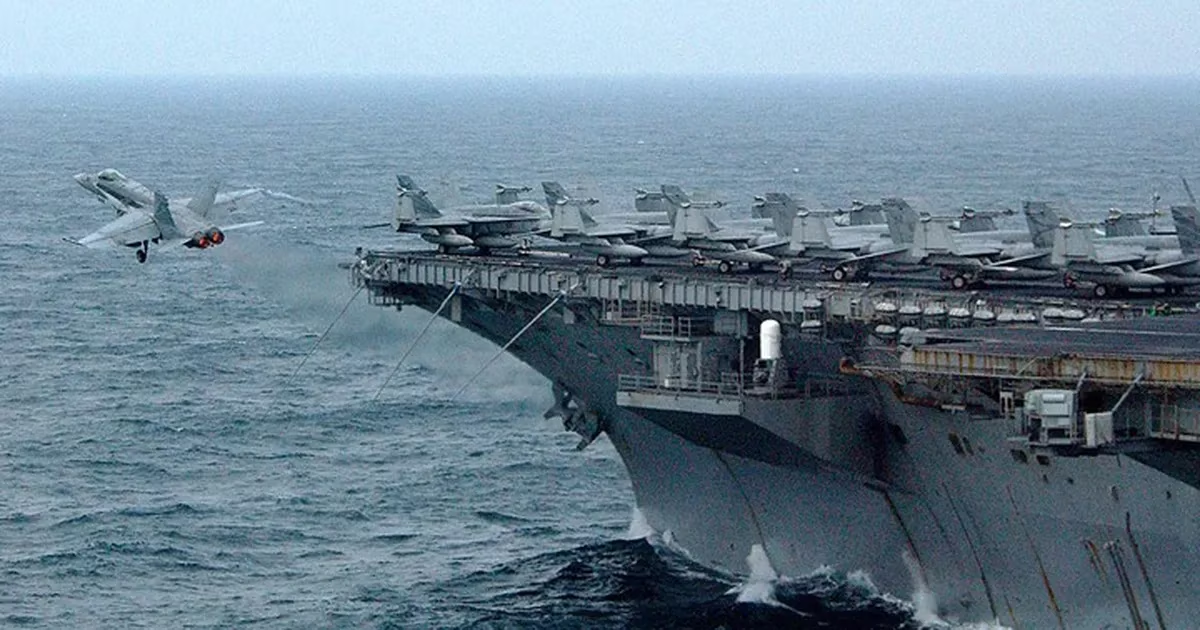
Hebrew media sources revealed on Tuesday evening intensive diplomatic and security movements in Tel Aviv to discuss the possibility of engaging in the protection of American interests in the Arabian Gulf region. These movements come amid unprecedented military tensions in the region following the outbreak of direct confrontations involving several regional and international parties.
Official sources quoted an unnamed Israeli official as saying that serious deliberations are currently underway regarding mechanisms for providing protection to vital US facilities and interests. The source indicated that these discussions aim to enhance joint American defensive efforts to confront the increasing security challenges imposed by the new field reality.
Reports clarified that what is known as the 'Joint Coalition of Regional States' is currently studying practical steps to provide a protective umbrella for Gulf states that have been subjected to a series of attacks. This move aims to repel threats attributed to Iran, which have targeted strategic territories and interests in the GCC countries over the past few days.
In a related context, the Israeli official noted that defensive cooperation with Washington might take on a reciprocal nature, as Tel Aviv seeks to return the favor to the United States, which actively contributes to protecting its security. These statements reflect the depth of military coordination between the two sides in confronting missile strikes launched from Iranian territory.
On the ground, the region has been in a state of turmoil since dawn last Saturday, following the start of a wide-ranging military aggression launched by Tel Aviv and Washington against targets inside the Islamic Republic of Iran. This escalation has resulted in a wave of Iranian military responses that have affected several countries, including Jordan and Iraq, in addition to the six GCC countries.
Tehran, for its part, asserts that it directly targets what it describes as 'American interests' in response to the attacks it is subjected to, although some of these strikes have resulted in civilian casualties. These aggressions have drawn widespread condemnation from GCC countries, which called for an end to the escalation, respect for national sovereignty, and the protection of civilian assets.
In parallel with the attacks in the Gulf, Tehran continues to launch intensive barrages of ballistic missiles and drones towards military and strategic sites inside Israel. According to field reports, these barrages have resulted in deaths and injuries, as part of what Iran describes as a legitimate response to targeting its leaders and vital facilities.
Incoming information indicates that the ongoing Israeli and American attacks have caused heavy human losses among Iranians, with hundreds killed and wounded. Among the most serious news circulating is the alleged death of Supreme Leader Ali Khamenei due to an airstrike, which has not yet been officially confirmed by all parties.
This sudden military explosion comes despite previous indications of progress in nuclear negotiations between Washington and Tehran mediated by the Sultanate of Oman. Observers believe that this escalation represents a second reversal by Tel Aviv of the diplomatic negotiation path, repeating previous scenarios that led to major confrontations in the region.
Iran maintains its stated position that its nuclear program is for peaceful purposes only, denying its pursuit of weapons of mass destruction or the production of nuclear warheads. In contrast, Washington and Tel Aviv continue to accuse Tehran of developing missile and nuclear programs that pose an existential threat to regional security and US allies.
Amidst this raging conflict, international contradictions regarding nuclear armament emerge, with Israel remaining the only country in the Middle East that possesses an uncontrolled nuclear arsenal. This military power coincides with the continued Israeli occupation of Palestinian territories and parts of Syria and Lebanon, and the rejection of all initiatives aimed at establishing a Palestinian state.
The regional scene remains open to all possibilities, with continued military buildups and mutual threats between all parties involved in the conflict. Global capitals are awaiting what the coming days will bring, amid fears that these confrontations will turn into a comprehensive regional war that will destroy everything in the Middle East.
Perhaps we can assist the Americans in their defensive efforts, just as they assist us in the face of current threats in the region.
ARAB AND WORLD
Wed 04 Mar 2026 12:19 pm - Jerusalem Time
Mosaic Defense: How Does Iran Counter Attacks Through Military Decentralization?
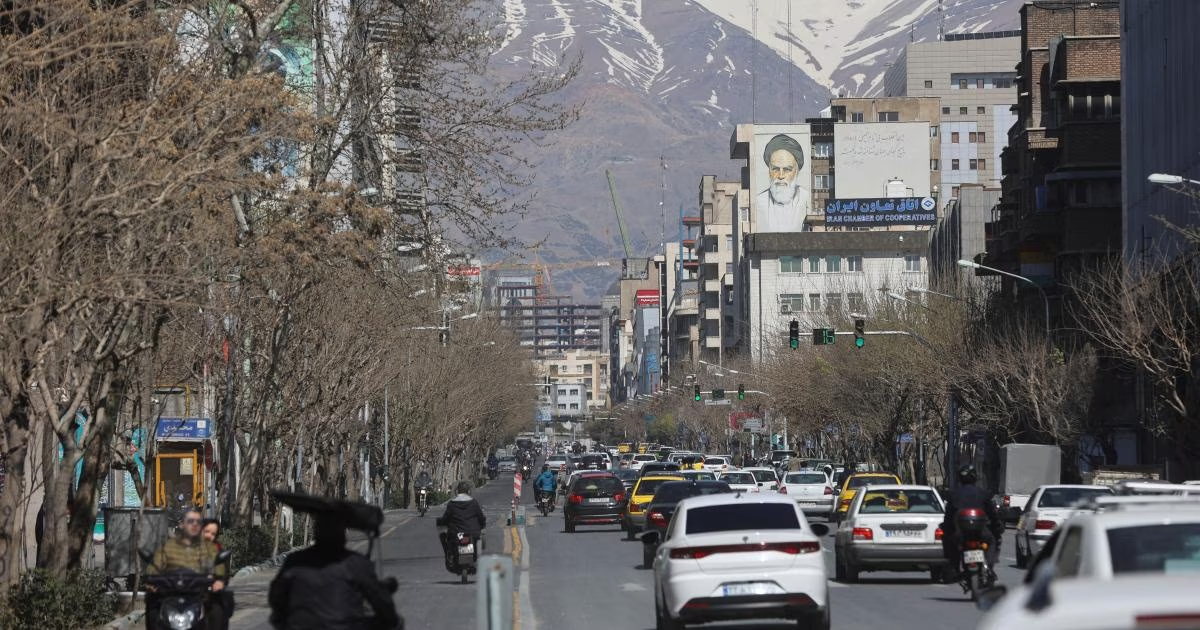
Amidst escalating direct military confrontation, Tehran has begun activating a complex defensive strategy known as 'Mosaic Defense,' a long-term plan aimed at protecting the army's structure from complete collapse. This move comes in the wake of airstrikes targeting the Iranian capital and high-ranking military leaders, which prompted the military establishment to activate a self-governing system for the provinces.
This combat doctrine relies on dividing the country into 31 independent regional units, corresponding to Iran's administrative provincial divisions. Each unit possesses the authority to make tactical and field decisions without referring to central command. This shift towards decentralization aims to grant forces high flexibility and speed in responding to direct field threats, especially in cases of communication breakdown with the center.
Developing this defensive system took approximately two decades, during which Iranian military experts intensively studied American military experiences in Iraq and Afghanistan. These studies concluded that technologically superior major powers face real dilemmas against decentralized resistance that does not rely on a single hierarchical head that can be targeted to completely paralyze movement.
The Mosaic Defense strategy allows Iranian forces to continue carrying out simultaneous offensive and defensive operations, including targeting military bases in the surrounding region. These units also gain the ability to influence vital waterways, most notably the Strait of Hormuz, placing international navigation within Iran's strategic pressure sphere.
Tactically, this approach falls within the framework of 'decentralized guerrilla warfare,' which integrates traditional methods with irregular operations to exhaust the adversary in the long run. This combination aims to execute surprise and precise attacks that prevent enemy forces from achieving field stability, while maintaining the units' ability to reintegrate into larger formations when necessary.
In this context, Iranian Foreign Minister Abbas Araghchi affirmed that strikes targeting command and control centers will not succeed in disrupting the Iranian military machine. He clarified that the adopted strategy allows Tehran to independently determine the timing and method of military response, emphasizing that the flexibility enjoyed by regional units ensures the continuity of operations under the harshest conditions.
Current field developments reflect the effectiveness of this defensive model, which blends flexible tactics with long-range strategic response, representing a qualitative shift in managing regional conflicts. This strategy demonstrates the ability of local units to continue targeting enemy interests despite losing communication with the supreme command, thereby strengthening the military resilience of the internal front.
Air attacks and direct targeting of command centers do not affect Iran's ability to wage war, thanks to the independent regional units.
PALESTINE
Wed 04 Mar 2026 12:19 pm - Jerusalem Time
Official Israeli Documents Bolster Palestinian Narrative on Nakba Massacres and Forced Displacement

Journalistic sources reported that recently revealed Israeli documents included additional details about the events of the 1948 Nakba, with these documents confirming the accuracy of the Palestinian narrative regarding forced displacement and the massacres committed. Analytical readings considered that these documents do not present unknown facts as much as they officially document what Palestinians have conveyed through their successive generations of living and realistic testimonies.
Israeli writer Amira Hass criticized attempts to portray these documents as a 'sudden discovery' of the truth, noting that Palestinians did not wait for Israeli archives to be opened to see their tragedy. Hass explained in an article that the testimonies of survivors and displaced persons were sufficient to formulate a coherent narrative about the ethnic cleansing practiced against them from the first moments of the conflict.
The sources indicated that historians who reviewed these documents, including Adam Raz, based their research on the works of prominent Palestinian historians such as Saleh Abdel Jawad and Adel Manna. These researchers, in turn, relied on the accurate oral memory of the residents of the displaced villages and cities, proving that Palestinian knowledge of the event preceded Hebrew academic documentation.
Reports touched upon the issue of information withholding, revealing that Israeli archives contain about 17 million files, more than 16 million of which remain closed to the public and researchers. Observers believe that the continued concealment of these documents raises serious questions about the nature of the crimes documented within them, which, if they denied the Palestinian narrative, authorities would have rushed to publish.
Analyses also pointed to the existence of a 'hierarchy of truth' in Israeli circles, where credibility is given to leaked official documents while the testimonies of Palestinian victims are marginalized. However, historical experiences have proven that official documents often later confirm the accuracy of what Palestinians said about the occupation's practices on the ground.
The writer gave examples of this from recent history, such as the use of white phosphorus against civilians in the Gaza Strip and the direct targeting of families during successive wars. These facts, initially denied by the Israeli military establishment, were later proven by official documents and investigations to have occurred exactly as narrated by Palestinian eyewitnesses.
In conclusion, the analytical reading emphasized that the essence of the Palestinian issue and displacement was never ambiguous or in need of testimony from the perpetrator to be a reality. The Palestinian narrative remained alive in the memory of the 'present absentees' and in the narratives of resistance, and the new documents are merely technical details added to a well-established historical truth, baptized with blood and refuge.
Israeli documents do not create truth out of nothing, but rather add precise details to a Palestinian narrative that has existed and been documented by survivor testimonies since the first moment of the Nakba.
OPINIONS
Wed 04 Mar 2026 12:08 pm - Jerusalem Time
American Bases in the Middle East: Security Umbrella or Permanent Liability?

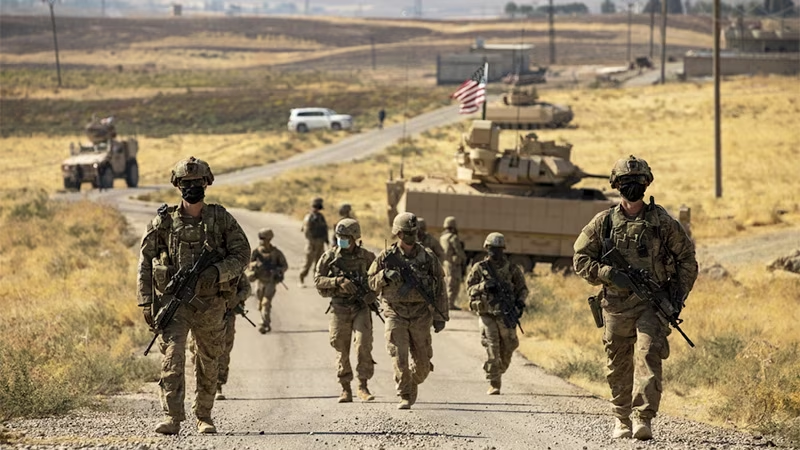
News Analysis
Within hours of Washington launching “Operation Epic Fury” against Iran, Tehran retaliated with coordinated strikes on American military installations across the Middle East. Six U.S. troops were confirmed killed. Billions of dollars in equipment were reportedly destroyed or damaged.
Iran’s Supreme National Security Council chief, Ali Larijani, vowed that Iran would make the “Zionist criminals and the vile Americans regret” the attack. The rhetoric was incendiary but unsurprising. What proved more consequential was how swiftly America’s vast network of regional bases—long described as pillars of deterrence—became a latticework of targets.
The episode revives a question that has lingered for decades but is rarely confronted directly: does maintaining an expansive U.S. military footprint across the Arab world enhance American security—or lock the United States and its partners into recurring cycles of escalation?
A Vast Architecture of Exposure
The United States maintains 19 permanent and temporary military installations across the Middle East, including eight permanent bases in Bahrain, Egypt, Iraq, Jordan, Kuwait, Qatar, Saudi Arabia, and the United Arab Emirates. Between 40,000 and 50,000 American troops are stationed in the region at any given time.
At the center of this posture sits Al Udeid Air Base in Qatar, the forward headquarters of U.S. Central Command and home to roughly 10,000 personnel. Two nuclear-powered aircraft carriers—the USS Abraham Lincoln and the USS Gerald R. Ford—have reinforced the regional presence, carrying more than 130 fighter jets between them.
Strategically, this network forms an arc around Iran’s western and southern periphery. From Tehran’s vantage point, it is less a defensive shield than a permanent encirclement. Iranian officials have long labeled these installations “legitimate targets.” In the latest exchange, that description moved from rhetoric to operational doctrine.
Facilities in Bahrain, Iraq, Jordan, Kuwait, Qatar, the UAE, and Saudi Arabia were struck by missiles or drones. The headquarters of the U.S. Navy’s Fifth Fleet in Bahrain was hit. Camp Arifjan in Kuwait suffered casualties. Al Udeid sustained damage, including to high-value radar systems. Bases and oil infrastructure in the UAE and Saudi Arabia faced repeated strikes.
The paradox of permanent basing is stark: forward deterrence can quickly become forward exposure.
Host Nations as Collateral
In Washington, the bases are framed as instruments of American power projection. In the region, they are also magnets for retaliation.
Missiles fell near Manama. Drones targeted Kuwaiti installations. Explosions echoed in Doha. Dubai’s Jebel Ali port—frequently visited by U.S. naval vessels—reported fires after suspected strikes. Saudi Arabia’s Ras Tanura refinery temporarily paused production following a drone attack.
Whether every strike caused severe damage is less important than the strategic signal: when Washington goes to war, Arab capitals absorb the shock.
This reality complicates the political calculus for host governments. Security guarantees and defense cooperation come with tangible economic and diplomatic benefits. But they also transform these states into immediate participants in conflicts they may neither initiate nor fully control. The line between ally and proxy becomes blurred when foreign installations invite retaliatory fire.
Deterrence Under Strain
Proponents of the U.S. posture argue that the network deters Iranian aggression and reassures Gulf partners. Yet the recent escalation illustrates an uncomfortable inversion: the infrastructure meant to deter provided Tehran with a pre-mapped set of targets.
Fixed installations—expansive airfields, dense aircraft concentrations, multimillion-dollar radar arrays—are inherently vulnerable in an era defined by precision-guided missiles and inexpensive drone swarms. Their scale and permanence make complete defense nearly impossible.
As President Donald Trump and Chairman of the Joint Chiefs General Dan Caine have acknowledged, the confrontation may continue and casualties could mount. That prospect highlights a structural risk embedded in forward basing: once hostilities begin, escalation can become self-sustaining. Each retaliatory strike validates the logic of the next.
A Changing Strategic Environment
The Middle East of 2026 differs profoundly from that of 1991 or 2003. Threats are more asymmetric. Precision strike capabilities are cheaper and more widely available. Regional governments pursue diversified foreign policies, balancing relations with Washington, Beijing, Moscow, and Tehran. Public opinion across much of the Arab world is increasingly sensitive to perceptions of foreign military entrenchment.
The core issue is not simply the number of bases the United States maintains. It is whether a large, permanent footprint remains the most effective—or safest—instrument for advancing American interests.
If every confrontation with Iran automatically exposes dozens of installations and tens of thousands of personnel to retaliation, the strategic calculus demands reassessment. Forward presence projects power. It also imports vulnerability.
Events on September 9, 2025, further complicated the narrative. When Israel struck Doha, the American installation at Al Udeid did not intervene to defend its host nation. The base neither deterred nor responded in protection of Qatari sovereignty. For many in the region, that episode reinforced a persistent suspicion: American bases are structured primarily as platforms serving Washington’s—often aligned with Israel’s—strategic priorities, rather than as shields for their hosts.
If that perception hardens, the implicit bargain sustaining America’s regional footprint may prove narrower—and more fragile—than policymakers assume.
ARAB AND WORLD
Tue 03 Mar 2026 3:27 pm - Jerusalem Time
Rubio: Washington acted because Israel was preparing to attack


Washington — Said Arikat – 3/3/2026
In a statement revealing a sensitive aspect of the background to the American decision, US Secretary of State Marco Rubio said that the United States launched its operations against Iran because it knew that Israel was planning to launch an attack, and that an Iranian response would have targeted American forces in the region.
Rubio explained that the administration concluded that any Israeli strike on Iran would have provoked a direct response against American interests, which prompted Washington to engage early in the confrontation. He added that waiting until Israel implemented its plan would have led to greater losses, considering that the decision came to protect American forces.
This narrative intersects with what the New York Times reported, which stated that journalist Tucker Carlson tried to persuade President Donald Trump not to engage in a new war, but Trump informed him that the Israeli attack was going to happen anyway, and that the United States had no choice but to participate in it.
According to the report, Israeli Prime Minister Benjamin Netanyahu was keen that American-Iranian negotiations not impede any potential military coordination, which reinforces the impression that the military initiative stemmed from Israeli calculations, not from an imminent Iranian escalation.
In contrast, the US administration continued to justify the war as a necessity to confront Iran's nuclear program, despite previous statements by its officials that the air strikes in June 2025 destroyed Iran's nuclear capabilities. Vice President J.D. Vance also said that there are indications that Iran is seeking to develop a nuclear weapon, providing an additional justification for the operations.
However, official messages seemed contradictory. In an initial statement, Trump hinted that the goal might extend to regime change, and referred to the killing of Iranian Supreme Leader Ali Khamenei in the first round of attacks, while Rubio returned to confirm that the goal was limited to neutralizing the "threat of short-range ballistic missiles" and Iran's naval capabilities.
When asked about the duration of the operations, Rubio said that the war would continue "as long as necessary," without specifying a time limit or clear criteria for ending it.
In this context, the issue is no longer about a preemptive strike against an imminent Iranian threat, but rather an American decision to engage in a confrontation that its ally was preparing to launch. The difference is fundamental: the initiative, according to statements and reports, did not come in response to an Iranian attack, but in anticipation of Iran's response to an Israeli attack.
The shift in narrative from "thwarting an Iranian threat" to "anticipating a response to an Israeli attack" redefines the moral and political framework of the war. If Israel was the party that intended to initiate the attack, then Washington's entry does not appear as a purely defensive step, but as a strategic choice to protect its ally from the repercussions of its decision. This raises a question about the limits of the United States' commitment to Israel's security, and whether this commitment automatically imposes involvement in wars chosen by the other party.
The multiplicity of declared goals — from neutralizing missiles to the possibility of regime change — reflects an attempt to reframe a decision made in a narrow context related to Israeli calculations. With the absence of a precise definition of the desired end, the risks of sliding into an open conflict increase. For when the primary motive is not a direct threat, but preventing the repercussions of an ally's attack, it becomes difficult to draw a clear line between support and full involvement in a long war.
ARAB AND WORLD
Tue 03 Mar 2026 3:27 pm - Jerusalem Time
Widespread Regional Escalation: Attacks Target Washington Embassies and Diplomatic Missions Close in Several Arab Countries
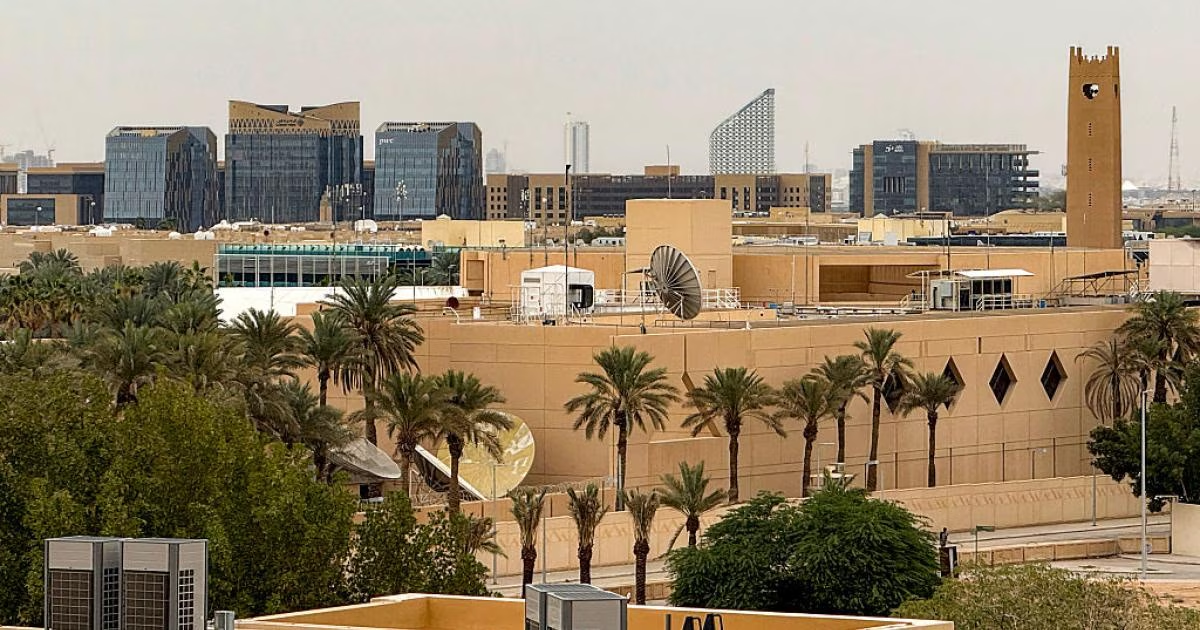
The region has witnessed a dangerous security escalation, leading to the temporary closure of US embassies in Riyadh and Kuwait and the suspension of all consular services. This step comes amidst an increase in attacks targeting American interests, prompting Washington to issue instructions for its non-essential staff to leave several Arab countries for their safety.
The US Embassy in the Saudi capital, Riyadh, announced that the mission's premises would remain closed, with all pre-scheduled appointments for American citizens canceled until further notice. The embassy warned its citizens to stay away from the vicinity of the building, urging them to exercise extreme caution and vigilance given the current circumstances.
In Kuwait, field sources observed smoke rising from the US Embassy premises following a series of attacks attributed to Iranian entities. Consequently, the diplomatic mission decided to halt all emergency and routine consular operations, stating that the closure would continue until the security situation is fully assessed.
In Jerusalem, the US Embassy acknowledged the difficulty of providing direct assistance or evacuation operations for American citizens currently in Israel. This announcement reflects the magnitude of logistical and security challenges facing American diplomacy amidst the widening scope of military confrontations.
On the ground, diplomatic sources in Riyadh confirmed that the embassy building was attacked by two drones, resulting in a limited fire. The Saudi Ministry of Defense clarified that the attack caused minor material damage, while American citizens were advised to stay in their homes in the cities of Riyadh, Jeddah, and Dhahran.
Politically, US President Donald Trump entered the crisis, vowing an imminent military response to the targeting of his country's diplomatic facilities. Concurrently with these threats, the US State Department issued evacuation orders for the families of diplomats and non-essential staff in Bahrain, Jordan, and Iraq.
These developments come after an explicit call from Washington for its citizens to immediately leave 15 countries due to imminent threats. This wave of attacks is linked to the Iranian response to US-Israeli military operations that targeted Iranian territory and led to the assassination of prominent leadership figures.
In Manama, the US Embassy announced the indefinite continuation of its closure with serious warnings of potential targeting of major hotels in the Bahraini capital. Diplomatic missions are in a state of maximum alert in anticipation of any sudden attacks that may affect staff or citizens.
The US Embassy in the Jordanian capital, Amman, also decided to evacuate its premises of all staff as an immediate precautionary measure. This decision was made to deal with security threats described as serious, at a time when the region is experiencing a state of turmoil and anticipation for the results of the mutual escalation between Washington and Tehran.
Since the beginning of March, the scope of the suspension of US diplomatic services has expanded to include Qatar, the UAE, Lebanon, and Syria, in addition to Israel. These comprehensive measures reflect the extent of American concerns about its missions being subjected to missile or suicide drone attacks, which now threaten the stability of the region.
The US mission in Saudi Arabia is closed today, with all American citizen appointments, whether routine or emergency, canceled.
PALESTINE
Tue 03 Mar 2026 3:25 pm - Jerusalem Time
UN experts reject 'Peace Council' in Gaza, affirm: Reconstruction is an exclusive Palestinian right

A group of UN experts affirmed in a joint statement that the reconstruction process of the Gaza Strip must be managed entirely in accordance with the principles of international law and universal human rights standards. The experts stressed the necessity of moving away from what they described as 'neo-colonial' interests, emphasizing that the Palestinian people's right to self-determination is an inherent and inalienable right under any circumstances.
The statement strongly criticized the so-called 'Peace Council' established by the UN Security Council, considering it an illegitimate maneuver backed by influential international powers driven by special agendas. The experts explained that this council starkly contradicts the right to self-determination and the advisory opinion issued by the International Court of Justice, thereby entrenching a colonial approach to dealing with the future of the devastated Strip.
The experts warned against treating the Gaza Strip as a 'real estate opportunity' or a arena for commercial speculation, calling on world leaders to view the Strip as a homeland destroyed by war. They pointed out that the residents have the full right to rebuild their lives on their land, with the guarantee of safe and voluntary return for all displaced persons and refugees to their properties from which they were forcibly expelled.
According to estimates provided by the experts, the scale of destruction in Gaza has reached catastrophic levels, with approximately 92% of housing units damaged or destroyed by October 2025. An analysis by the Special Rapporteur on the right to adequate housing concluded that Israeli practices of systematic destruction of homes amount to war crimes and crimes against humanity, reaching the threshold of genocide.
This stance coincided with the publication of draft guiding principles by the Office of the United Nations High Commissioner for Human Rights, which affirm the right of conflict-affected peoples to receive compensation and reparations. The draft clarified that this right includes the restoration of all economic, social, and political rights, ensuring that residents are empowered to lead the reconstruction process and benefit directly from it without external guardianship.
The experts held Israel, as the aggressor and occupying power, primarily responsible for funding and rebuilding what its military machine destroyed. The responsibility also extended to states that provided military support to the occupation during its campaign. They affirmed that securing funding and ensuring unimpeded entry of necessary construction materials and machinery is an international obligation that must be fulfilled to restore health, educational, and religious facilities.
In conclusion of their statement, the experts, including Francesca Albanese and Balakrishnan Rajagopal, stressed that no reconstruction path would be sustainable without clear preconditions. These conditions include achieving a permanent ceasefire, a complete end to the Israeli occupation, and providing genuine international guarantees against the recurrence of these crimes and violations against the Palestinian people.
The Palestinian right to self-determination is inalienable, and decisions regarding reconstruction and the future of Gaza must be in their hands alone.
PALESTINE
Tue 03 Mar 2026 3:24 pm - Jerusalem Time
A dead in Khan Yunis and UN warnings of repercussions of regional escalation on Gaza

A Palestinian citizen was martyred by Israeli occupation army bullets this Tuesday morning during an incursion into the Eastern Satar area, located north of Khan Yunis city in the southern Gaza Strip. Medical sources reported that teams were able to retrieve the martyr's body and transport it to the hospital, while a number of victims remain under the rubble and in rugged roads due to continuous targeting and preventing ambulance crews from reaching them.
In a related context, medical statistics revealed the arrival of the bodies of 18 martyrs to the Strip's hospitals over the past twenty-four hours, as a result of scattered raids and sniping operations. These field developments come at a time when the death toll from the ongoing aggression since October 2023 has exceeded 72,000 martyrs and nearly 171,000 injured, amidst massive destruction affecting 90% of the infrastructure.
For its part, the United Nations Office for the Coordination of Humanitarian Affairs (OCHA) warned that the ongoing military aggression against Iran has cast its dark shadow directly on the already deteriorating humanitarian situation in Gaza. The office explained that the closure of border crossings, including the Rafah crossing, has led to a complete paralysis in the movement of supplies and international personnel, threatening an imminent health and environmental catastrophe.
The UN statement indicated that fuel reserves have begun to run out sharply, forcing service institutions to ration consumption to the lowest levels, which has effectively affected the work of bakeries, hospitals, and water desalination plants. Waste collection services have also stopped in several areas, increasing the risks of epidemic spread among displaced persons suffering from a severe lack of basic necessities of life.
Regarding daily needs, local sources mentioned that some residents of the Strip now receive only two liters of drinking water per day, a rate far below minimum international standards. This scarcity coincided with a significant jump in the prices of basic food commodities in local markets, due to the cessation of supply chains and the closure of land crossings since the start of the regional escalation last Saturday.
In contrast, the Israeli occupation authorities announced their intention to gradually reopen the Kerem Shalom crossing starting this Tuesday, to allow the entry of limited quantities of humanitarian aid. The Coordinator of Government Activities in the Palestinian Territories stated that this decision came based on security assessments, after a period of closure that began with the launch of widespread Israeli-American attacks on Iranian territory.
There is a state of international concern about the Israeli government's evasion of ceasefire commitments in Gaza, exploiting the world's preoccupation with military escalation with Tehran. Reports confirm that recent attacks targeting Iranian facilities and leading to the death of prominent leaders have further complicated the field situation in the occupied Palestinian territories, where the occupation continues to control more than half of the Gaza Strip's area.
Continued complete siege and closure of crossings threaten to completely stop the flow of vital supplies to the Gaza Strip.
ISRAELI AFFAIRS
Tue 03 Mar 2026 3:23 pm - Jerusalem Time
Hebrew Reports Reveal Iran's Restoration of Missile Arsenal and Failure of Occupation's Estimates
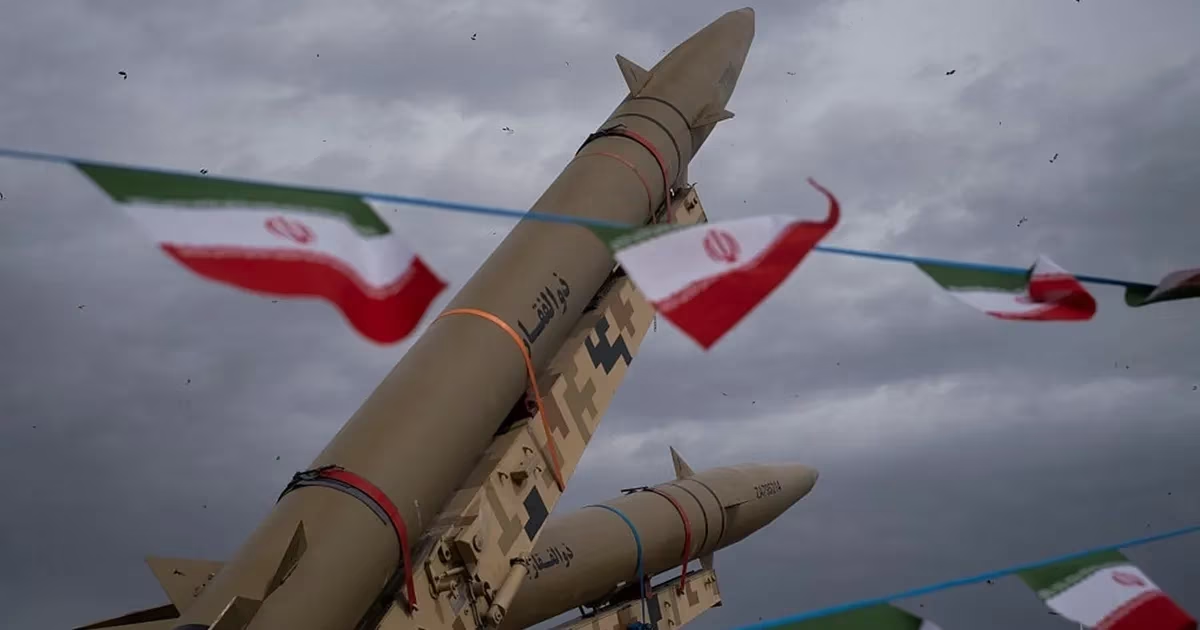
Hebrew press sources revealed in a recent report a deep gap between official statements issued by the occupation government after the June 2025 operation and the current military reality. The report indicated that Iran managed to significantly rebuild its missile stockpile before the outbreak of the recent confrontation, putting the credibility of previous Israeli security estimates to the test.
Occupation army estimates suggest that Tehran entered the current war possessing about 2,500 ballistic missiles, a number only about 500 missiles less than what it had at the beginning of the 'Year of Clavi' war. This proximity in numbers reflects the failure of military efforts to permanently neutralize the Iranian arsenal, despite previous claims of achieving strategic accomplishments.
According to military data, the previous June war had deprived Iran of hundreds of missiles and disrupted the production of at least 1,500 additional missiles, yet Tehran made intensive efforts to restore its capabilities. Iranian factories succeeded in accelerating the pace of production to dozens of ballistic missiles per month, with reports indicating ambitions to raise this capability to hundreds of missiles.
These data highlight a sharp contradiction with what occupation Prime Minister Benjamin Netanyahu announced on June 24, 2025, when he claimed that his state had eliminated a dual existential threat in the nuclear and ballistic fields. However, the first hours of Operation 'Lion's Roar' proved that the missile threat is still present and effective, and has not been undermined to the extent promoted by official propaganda.
For his part, Brigadier General (res.) Ran Kochav, former commander of the Air Defense Division, explained that Iran learned lessons from previous operations and developed its military response speed. While in the past, the Iranian response took many hours, Iranian forces in the current operation were able to respond within a few minutes, while maintaining an intermittent firing pace.
Iran's strategy in the first phase relied on the use of solid-fuel missiles, a technology that allows missiles to be stored ready for launch without prior warning. The attack later shifted to liquid-fuel missiles, which require a longer fueling process and extraction from fortified bunkers, reflecting a diversity in offensive tactics used against Israeli and American targets.
In a related context, reports indicate that Iran is seeking to strengthen its air defenses through negotiations with China to acquire advanced systems, although the deployment of these batteries may take a long time. The risk of targeting fighter jets and drones remains in light of these movements, further complicating the military calculations of the United States and its allies in the region.
On the Lebanese front, sources confirmed that the occupation army did not succeed in completely destroying Hezbollah's missile system, as the party still possesses thousands of projectiles and drones. Despite about 80% of its firepower being damaged, the remaining capability is sufficient to continue draining the Israeli home front for long periods.
These military developments coincide with the ongoing brutal aggression against the Gaza Strip, where the death toll since October 2023 has risen to over 72,000 martyrs. The occupation continues its control over large areas of the Strip with near-total destruction of infrastructure, amid fears of Netanyahu evading ceasefire commitments.
In light of these complexities, security experts warned against being carried away by the euphoria of 'false victory' or considering military outcomes final, especially with the fluctuations in the American position. The regional scene remains open to all possibilities, given the human and material losses suffered by both American and Iranian forces in recent days.
Life is much darker than the Israelis' tendency to consider everything either a celebration or a failure.
ISRAELI AFFAIRS
Tue 03 Mar 2026 3:22 pm - Jerusalem Time
Israeli Expert: Israel is Becoming a 'New Sparta' and Adopting a Paranoid Security Doctrine
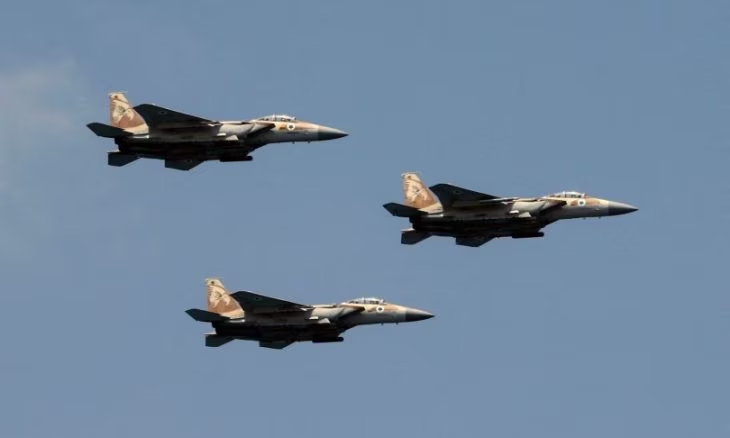
Israeli Professor Yagil Levy, a prominent expert in strategic affairs and civil-military relations, warned of the growing state of 'security schizophrenia' and military arrogance within the Israeli leadership following the events of October 7. Levy noted that Israel is effectively sliding towards a 'New Sparta' model, a description previously used by Prime Minister Benjamin Netanyahu about two years ago to express his vision for the future of the Hebrew state.
In his critical reading, Levy believes that current Israeli behavior can be framed within a frantic pursuit of what is called 'permanent security.' This term, which he borrowed from historian Dirk Moses, describes the state's aspiration to achieve absolute and permanent immunity from all threats. This aspiration is not content with eliminating current dangers but extends to attempting to erase any potential future threat through excessive force.
The Israeli expert explained that this approach is subject to a 'paranoid' consciousness that ultimately leads to the production of self-fulfilling threats, leaving no room for political or deterrent compromises. According to Levy, the pursuit of a final solution in this context is necessarily linked to policies of extermination, displacement, or imposing absolute control over population groups classified as an existential threat to the state.
Levy reviewed Israel's history with this concept, noting that for many years it pursued permanent security in a 'soft' form that recognized the limits of power and the constraints imposed by international law and the American position. He cited the 1973 war as an example, where Israel then realized the limits of its military capabilities, which led it to withdraw from Sinai in exchange for peace with Egypt, despite its previous description of those borders as 'Auschwitz borders.'
However, the events of October 7, according to the analysis, led to the collapse of all barriers that had constrained the Israeli paranoid logic, pushing the state to adopt a more rigid and violent version of 'permanent security.' Levy considered that this shift was driven by the assumption of overwhelming military superiority and a wide margin of international tolerance for unprecedented Israeli military operations.
In a direct critique of the field results, Levy pointed out that Israel killed tens of thousands of civilians and destroyed entire residential neighborhoods in the Gaza Strip merely to pursue a limited number of fighters. He also noted the effective expansion of borders through the establishment of buffer zones within the territories of neighboring countries, in an attempt to impose a new security reality based on complete regional disarmament.
Regarding Iran, the professor stated that Israel rejected all diplomatic solutions that restrict nuclear capabilities without eliminating them, preferring to resort to direct military action. This approach reflects a desire to permanently remove the missile threat, even in cases where Iran does not initiate direct attacks, which reinforces the logic of controlling others and changing regimes.
Levy warned that the pursuit of absolute security necessarily entails restricting democracy and curbing internal opposition, as the security of individuals and groups is subordinated to an abstract goal. In this context, protection gaps in border cities like 'Kiryat Shmona' become mere acceptable collateral damage in order to achieve the goal of destroying the capabilities of adversaries like Hezbollah.
Levy also criticized the transformation of Israeli prisoners in the new military consciousness into mere secondary 'bargaining chips' in the face of major strategic goals. He affirmed that political considerations have become entirely subject to military logic, where the timing of diplomatic negotiations is determined based on windows of opportunity available for targeted assassinations instead of seeking peaceful solutions.
The analysis suggests that Israel's unilateral effort to enhance security necessarily pushes adversaries to try to bridge their weaknesses by all available means, which repeats previous historical scenarios. The inevitable result of this clash is an increase in insecurity rather than its achievement, as the adversary is forced to respond with greater force whenever it regains some of its military strength.
Levy concluded that the 'permanent security' doctrine requires the depletion of national resources and their sacrifice on the 'altar of security,' with the delusional hope that the adversary will never be able to overcome its weakness. He affirmed that Netanyahu was not mistaken when he promised that this path would lead Israel to become a 'Spartan' state living on the edge of a sword and lacking the foundations of civil stability.
On the other hand, intelligence analyst Yossi Melman reinforced this view by indicating that Netanyahu's government has an agenda to keep conflicts burning for purely electoral considerations. Melman explained that the decision to go to war in Lebanon would have been made even in the absence of provocations, to ensure the continuation of the state of emergency until the next elections in the summer or fall.
Permanent security aims not only to eliminate immediate dangers but also future ones, and therefore it is subject to a paranoid consciousness that produces self-fulfilling threats.
OPINIONS
Tue 03 Mar 2026 3:15 pm - Jerusalem Time
Pantings Questions!
The least of words, with the speed of launching slogans, and layers of powerful narrations, and intercontinental missiles, that fill the land, sea, and sky with noise, brings to mind chapters of the war on Iraq that ended with the division of the country and its people, and the emergence of snakes and reptiles from beneath the earth, which fueled enmities, spread hatred, and awakened sectarian, confessional, and ethnic strife, and is still engineering the geography and demography of the entire Arab region, through imported narratives that the region's countries have not witnessed since their inception... With that supersonic speed, panting questions follow, seeking answers suspended about destinies and outcomes in a moment of excessive fluidity, during which new maps of the region are being drawn, tailored to the measure of the greedy and ambitious states in the new Middle East and its vast wealth.The burning questions are still panting, seeking answers to the size of the current and anticipated crowds, the outcomes, and the expected alignments for an open war on more surprises, which exceed the earthquake of killing the leader and forty senior Iranian leaders.Hezbollah's entry into the line of engagement, after a long silence about violations and repeated strikes, and assassinations of the party's cadres and sites throughout the past months without response, reveals a response to an Iranian decision that offered a pretext more than added value; it constitutes deterrence or prevents desecration, especially since the party contented itself with the missiles it launched that fell in open areas, but they brought responses to crowded areas that caused a wide wave of displacement that exacerbated the suffering of the Lebanese, and shocked the Shiite incubator; expressed by Nabih Berri, the Speaker of Parliament who sided with the government's discourse.The panting questions will not stop even after the war stops, as questions of "the day after" will multiply, which remained open to ambiguity and suspicion in the afflicted sector.Like the panting of charging steeds, and the dust of raiders, the questions rush, panting, anxious, and trembling.
ARAB AND WORLD
Tue 03 Mar 2026 3:13 pm - Jerusalem Time
Tehran accuses Israel of striking 'Aramco' through a 'false flag' operation to divert attention from its aggression

Tehran directly pointed the finger at the Israeli occupation for being behind the aerial attack that targeted the facilities of the Aramco oil company in Saudi Arabia this Monday morning. Sources quoted a military official as saying that the operation falls under the category of a 'false flag,' through which Tel Aviv seeks to stir up regional affairs and divert attention away from the military operations it is conducting against non-civilian targets within Iranian territory.
Iranian military sources confirmed that Aramco facilities have never been among Iran's target bank until this moment, despite previous warnings to place all American and Israeli interests in the region under fire. The official explained that Iran does not hesitate to claim responsibility for any strikes it carries out, noting that intelligence data warns of similar Israeli plans that may target the Port of Fujairah in the United Arab Emirates in the coming period.
On the ground, the Saudi Ministry of Defense announced the success of its forces in intercepting and destroying two drones that attempted to target the Ras Tanura refinery in the Eastern Province. Informed sources reported that Aramco took immediate precautionary measures, including temporarily closing the refinery to ensure the safety of facilities and workers, confirming that the situation is now under full control and the attack did not result in significant damage to oil supplies.
This escalation comes at a time when the region is experiencing unprecedented turmoil, as Israeli and American forces continue a wide-ranging aerial campaign against Iran that began last Saturday, resulting in the deaths of hundreds of people, including senior leaders. In contrast, US Secretary of Defense Pete Hegseth admitted that the operations are directly aimed at undermining and destroying Iranian military capabilities, amid human and material losses suffered by American forces stationed in the region.
On the Palestinian front, the occupation continues its policy of restriction by closing all Gaza Strip crossings, including the Rafah crossing, coinciding with its open regional war. Reports indicate real fears that the head of the occupation government, Benjamin Netanyahu, will renege on the commitments of the second phase of the ceasefire agreement, amid the ongoing massacres that have raised the death toll in Gaza to more than 72,000 martyrs since the start of the aggression in October 2023.
Observers believe that Iran's accusation of Israel carrying out the Aramco attack reflects the depth of the security crisis in the region, as all parties try to draw new red lines. While Tehran insists that targeting Gulf oil facilities is not in its interest at the moment, concerns remain about the region sliding into a comprehensive war that goes beyond direct clashes to striking the nerve center of the global economy in international energy corridors.
The attack on Aramco facilities was carried out by Israelis and is considered an example of a false flag operation aimed at diverting the region's attention from the crimes committed inside Iran.
ARAB AND WORLD
Tue 03 Mar 2026 5:07 am - Jerusalem Time
International Research Center Warns of Middle East Conflict Spiraling Out of Control and Deliberate Targeting of Energy Lifelines
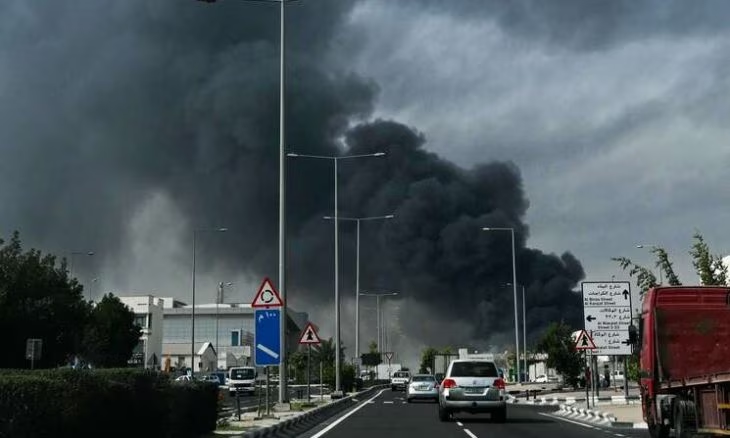
A report by the Soufan Center for Research stated that the ongoing conflict in the Middle East has transcended the boundaries of traditional regional confrontation, moving into a phase of deliberate targeting of the global energy sector. The report clarified that Tehran, through this strategy, seeks to send sharp political and economic messages, asserting its ability to destabilize international markets, which reveals significant challenges facing the United States and Israel in their attempts to contain the spread of the war.
As the direct confrontation with Iran entered its third day, Iranian forces expanded the scope of their operations to include American military targets and strategic assets in the region, coinciding with concentrated strikes on oil and gas facilities. The attacks included vital locations such as the Ras Tanura facility in Saudi Arabia, which is a key pillar of the global oil industry, in addition to the Ras Laffan facility in Qatar, causing a state of severe concern in international economic circles.
In a striking field escalation, Iranian military sources, speaking through Brigadier General Sardar Ibrahim Jabbar, an advisor to the Revolutionary Guard, announced that the Strait of Hormuz is now completely closed to navigation. Jabbar warned that any vessel attempting to cross this strategic waterway would be subject to direct targeting and incineration, which represents a direct threat to the energy supply lines on which the world's major economies depend.
On the ground, Iranian attacks targeted the oil tanker 'Athena Nova', registered in the United Arab Emirates, via drones, while Qatar Energy announced the suspension of production operations following the attack on its facilities. These developments caused an immediate shock in energy markets, with natural gas prices in Europe jumping by up to 50%, while crude oil prices recorded a 10% increase within a few hours.
On the other hand, Israeli authorities took precautionary security measures, including the temporary closure of a number of offshore gas fields, most notably the 'Leviathan' field operated by the global company Chevron. Inside Iran, sources reported hearing explosions on the strategic Kharg Island, through which most Iranian oil exports pass, amidst ambiguity surrounding the extent of the damage resulting from these explosions and their impact on Tehran's export capabilities.
Politically, Ali Larijani, Secretary of Iran's Supreme National Security Council, affirmed that his country would not enter into any negotiations with the current US administration, denying media reports about channels of communication for renegotiation. Larijani stressed that Tehran views the current conflict as a 'regime survival' battle, indicating that the previous rules of engagement have ended and that Iran no longer recognizes any red lines in defending its interests.
Analytical studies expect these attacks to lead to a long-term disruption in the global supply and demand balance, especially in Asian and European markets that are highly dependent on the region's gas. With the 'S&P Global Japan-Korea Marker' index rising by 39%, fears are growing that the global economy will enter a new inflationary wave resulting from a shortage of energy supplies and rising marine shipping insurance costs in the turbulent region.
Iran sends a clear message about its ability to impose global economic repercussions, indicating the limited ability of Washington and Tel Aviv to contain the war.
ANALYSIS
Tue 03 Mar 2026 5:07 am - Jerusalem Time
How Trump Decided to Wage War on Iran
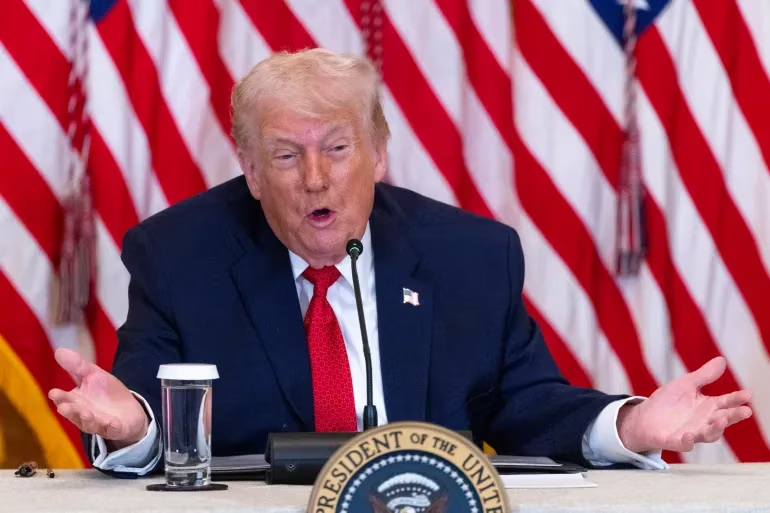
Washington – Said Arikat – 3/3/2026
According to a report in The New York Times published on Monday, President Donald Trump's decision to wage war against Iran was not a sudden move, but rather the result of a long process of secret consultations, military planning, and political pressure, especially from the Israeli leadership, coupled with a decline in confidence within the American administration regarding the possibility of reaching a diplomatic solution with Tehran.
The report indicates that the key turning point came during a lengthy meeting at the White House on February 11, where Trump and Israeli Prime Minister Benjamin Netanyahu discussed the prospects of war and the potential timing of any attack. At that time, the United States was engaged in indirect negotiations with Iran regarding its nuclear program, but Israel feared that these diplomatic efforts would disrupt the military plans secretly discussed between the two sides.
Days after the meeting, Trump began to openly express his skepticism about the usefulness of negotiating with Iran, considering that years of previous dialogue had not yielded results. He also hinted that regime change in Iran might be the best option. Just about two weeks later, he authorized a large-scale military operation in coordination with Israel, which included intensive strikes targeting military and nuclear sites and centers within the country, resulting in the death of the Iranian Supreme Leader and the country descending into chaos, in addition to the outbreak of a wave of regional violence that led to American and Iranian casualties.
Although the American president's public rhetoric seemed hesitant between seeking a diplomatic agreement and brandishing military force, the report confirms that the move towards war was steadily progressing behind the scenes. Israel played a pivotal role in pushing Washington towards a decisive strike, based on an assessment that the Iranian regime was in a weakened position. Trump was also influenced by his growing confidence after a successful American operation that overthrew the leadership in Venezuela weeks earlier.
The report indicates that opposition within the president's inner circle was very limited. Even figures previously known for their reservations about military interventions supported the idea of a broad and swift strike if an attack was decided upon. In contrast, military leaders warned of significant risks, including the potential for heavy American casualties, regional destabilization, and the depletion of American military stockpiles. However, these warnings were not fully reflected in public statements, as the operation was portrayed as easily decisive.
The report also clarifies that American officials did not fully disclose to members of Congress that the option of regime change was among the military plans, despite holding security briefings to discuss Iranian threats and the timing of potential strikes.
At the same time, nuclear negotiations with Iran continued, but the report suggests that they practically provided a temporal cover for strengthening the American military presence in the Middle East. At the beginning of the year, American forces were not ready for a long war, as no aircraft carriers were in the region and air defenses were limited. Over the weeks, two aircraft carriers and a large number of fighter jets, bombers, and defense systems were sent, allowing for an extended military campaign.
During the negotiations, Washington insisted on the demand for “zero enrichment,” meaning the complete cessation of Iran's ability to produce nuclear fuel, a condition that Tehran consistently rejected. With growing doubts within the American administration, official statements began to reflect a growing conviction that reaching an agreement was almost impossible due to the ideological nature of the Iranian regime.
Within National Security Council meetings, the discussion focused on the scale of the military operation rather than the principle of its execution. Multiple options were presented, ranging from limited strikes aimed at negotiating pressure, to a broad campaign aimed at overthrowing the Iranian leadership. Intelligence agencies presented various scenarios for what might happen in the event of the Supreme Leader's death, including the possibility of a more hardline leadership emerging, internal unrest, or a more pragmatic wing of the Revolutionary Guard coming to power.
Some officials adopted the latter scenario, believing that a pragmatic military leadership might be more willing to reach an understanding with the United States and abandon the nuclear program or reduce regional confrontation, although these expectations remained unconfirmed.
Almost the only prominent opposition came from conservative media personality Tucker Carlson, who warned of the risks of war to American forces, energy prices, and relations with Arab allies, considering that Washington might be drawn into the conflict due to Israel's security priorities. However, Trump informed him that he believed the United States would be involved in the fighting anyway if Israel initiated the attack alone.
On the domestic political front, the administration did not seek clear authorization from Congress before commencing operations, which drew criticism from some lawmakers who saw the logic used to justify the war as circular, as it was considered that the military buildup itself might provoke Iran to respond, thus making an American attack inevitable.
A final round of negotiations was held in Geneva days before the strike, where Iran presented a proposal allowing for certain levels of enrichment to continue, which American negotiators rejected. After the talks concluded, the negotiating team informed the President that the chances of reaching an agreement were very slim. Meanwhile, the United States and Israel were already discussing the timing of the attack, until an intelligence breakthrough led to the identification of a meeting of senior Iranian leadership in Tehran, and the decision was made to carry out a strike directly targeting the leadership, effectively starting the war.
The course of events, as presented in the report, suggests that the diplomatic path was not necessarily a genuine attempt to avoid war, but perhaps served as a political tool to manage military timing. The continuation of negotiations coincided with the largest American military buildup in the region in years, reinforcing the impression that dialogue provided temporal cover to complete operational preparations rather than being a viable path to success. American demands, especially the “zero enrichment” condition, were known beforehand to be unacceptable to Iran, which made reaching an agreement almost impossible from the outset.
In the same context, the announcement of US Secretary of State Marco Rubio's visit, scheduled for Monday, March 3, takes on additional political significance. The announcement of the visit appeared to be a continuation of the diplomatic facade and a sign of normal political engagement, at a time when military decisions had practically been made. From this perspective, the late diplomatic moves can be understood as part of managing the international scene and preparing public opinion, rather than a realistic last-ditch effort to prevent escalation, which reflects a recurring pattern in international crises where negotiating channels are sometimes used to secure political legitimacy before proceeding to wage war.
ARAB AND WORLD
Tue 03 Mar 2026 5:07 am - Jerusalem Time
Drone attack targets US Embassy in Riyadh, Saudi air defense intercepts 4 aircraft
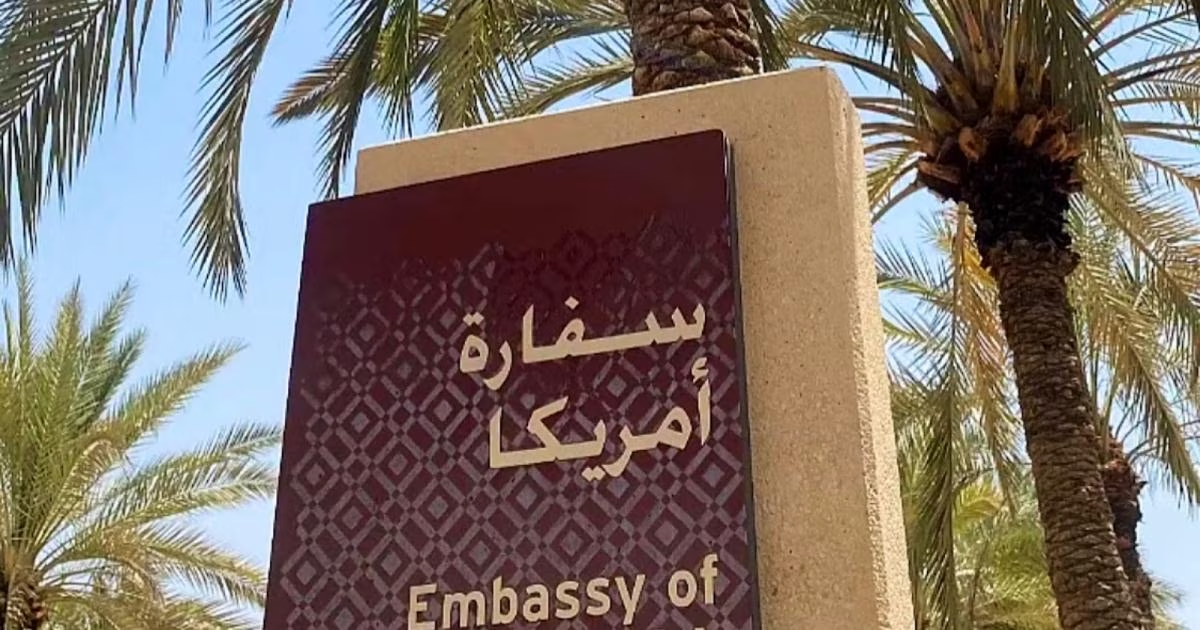
The spokesman for the Saudi army, Major General Turki Al-Maliki, announced on Tuesday morning that the US Embassy headquarters located in the diplomatic quarter of the capital Riyadh was subjected to an aerial attack carried out by drones. Al-Maliki explained that initial estimates indicate the use of two aircraft in the attack, which resulted in a limited fire and minor material damage to the building's structure, with no immediate human casualties recorded.
The diplomatic quarter, which includes the headquarters of foreign missions and diplomatic residences, witnessed strong explosions and rising columns of smoke, causing a state of concern in the area. Field sources reported that firefighting and civil defense teams rushed to the site to control the fire, while security authorities began evacuating the embassy building and its surrounding areas as a precautionary measure to ensure the safety of personnel.
Meanwhile, sources close to the Saudi military establishment revealed that air defense systems succeeded in intercepting and destroying four drones that were flying over the diplomatic quarter. This announcement coincided with press reports indicating that additional explosions were heard in the area, suggesting repeated targeting attempts of the security square that includes foreign embassies.
For its part, the US Embassy in Riyadh issued an urgent statement directing recommendations to its citizens residing in the Kingdom to stay in their homes and exercise extreme caution. The recommendations included citizens in the cities of Riyadh, Jeddah, and Dhahran. International media reports confirmed that the embassy building was empty of staff at the moment of the attack, which was attributed to Iranian sources in the context of escalating military tension in the region.
On the ground, the Saudi army raised its combat readiness to the highest levels since Monday, following a similar attack that targeted the Ras Tanura oil refinery in the Eastern Province. Military sources confirmed that the armed forces are working to secure vital installations and diplomatic centers to confront any potential aerial threats that may target the security and stability of the Kingdom.
These rapid field developments come amid a military aggression launched by Israel and the United States against targets in Iran since last Saturday morning. These operations resulted in hundreds of deaths, including Iranian Supreme Leader Ali Khamenei and a number of senior security leaders, which prompted Tehran to vow a decisive response targeting American and Israeli interests in the region.
The region is experiencing a state of military turmoil, as Tehran continues to launch barrages of ballistic missiles and drones towards the occupied territories and what it describes as American bases in neighboring countries. These mutual attacks have resulted in casualties and damage to civilian and military installations, amid international fears of the situation escalating into an uncontrollable comprehensive regional war.
The US Embassy in Riyadh was subjected to a drone attack by two drones according to initial estimates, resulting in a limited fire and minor material damage to the building.
PALESTINE
Tue 03 Mar 2026 5:06 am - Jerusalem Time
Gaza in the Throes of Regional Escalation: How Does the War on Iran Disrupt the Path to De-escalation?

The widespread war waged by the American-Israeli coalition against Iran casts dark shadows over the Gaza Strip, despite the relative calm that had recently prevailed in the area. The occupation government announced the complete closure of all crossings to the besieged strip, including the Rafah land crossing, raising fears that Tel Aviv would exploit the regional explosion as a pretext to continue tightening its grip on more than two million Palestinians.
Observers believe that the Gaza Strip has now become a hostage to the new power balances in the region, as the Palestinian street fears that Israeli Prime Minister Benjamin Netanyahu will evade the obligations of the second phase of the ceasefire agreement. These developments come at a time when the strip has not yet recovered from the consequences of a devastating war that lasted for more than two years and exhausted all aspects of life.
For his part, writer and political analyst Wissam Afifa affirmed that Gaza is not an isolated arena but an integral part of the explosive regional balance network. Afifa explained that the direct escalation with American participation rearranges international priorities, which may lead to a slowdown in the implementation of withdrawal clauses from Gaza or their renegotiation under the pretext of urgent security conditions in the region.
Afifa pointed out that Netanyahu may find in the regional confrontation a golden opportunity to postpone the reconstruction and military withdrawal from the areas controlled by the occupation army. In contrast, the Hamas movement finds itself facing a new reality that requires balancing the preservation of its position in the axis of resistance with the necessity of establishing a ceasefire to protect the exhausted internal front.
On the ground, this major explosion comes after previous rounds of escalation, most notably Tehran's missile attack in October 2024 in response to the assassination of Ismail Haniyeh. Those missiles then targeted the positions of the occupation army in the Netzarim axis in the heart of the Gaza Strip, reflecting the close field interconnectedness between the different arenas since the beginning of the aggression.
In June 2025, the region witnessed another wave of escalation that lasted 12 days, during which Israel targeted nuclear and military facilities deep inside Iran. That round coincided with the peak of the deliberate starvation policy practiced by the occupation against the residents of Gaza by closing the crossings, a scenario that is being repeated today in a more dangerous and comprehensive manner.
Security researcher Rami Abu Zubaida believes that the direct entry of the United States into the war means the transfer of the strategic center of gravity from Gaza to the confrontation arena with Iran. This shift will necessarily lead to a state of near-complete stagnation in the political movement related to de-escalation, putting the second phase of the agreement in a state of clinical paralysis.
Abu Zubaida warned that Gaza could turn into an arena for indirect deterrent messages, as the occupation might resort to expanding its limited operations within the strip, taking advantage of the world's preoccupation with the Iranian front. There is also another path, which is to tactically freeze military movements to avoid opening multiple fronts simultaneously that might include Iraq and Yemen.
On the humanitarian front, the numbers show the gravity of the situation, with 629 Palestinians martyred since the supposed ceasefire came into effect last October. This brings the total number of victims of the aggression since 2023 to more than 72,000 martyrs, amid the destruction of 90% of civilian infrastructure and the occupation's control over more than half of the strip's area.
Economically, researcher Ahmed Abu Qamar explained that the organic link between the Palestinian and Israeli economies makes Gaza immediately affected by any disruption in supply chains. He stressed that the closure of the Rafah crossing deprives residents of the only outlet for diversifying sources of goods, which doubles dependence on the Kerem Shalom crossing, which the occupation controls absolutely.
Abu Qamar warned that the strip's storage capacity has been completely eroded after the destruction of major warehouses during the past months of war, making markets highly sensitive to any closure, even for a single day. This reality has created a state of price distortion and a severe disruption in the availability of basic materials, threatening an unprecedented living crisis.
In a related context, field sources confirmed massive explosions in the vicinity of the Iranian Broadcasting and Television Corporation headquarters in Tehran, amid reports of hundreds killed, including high-ranking officials. Despite these strikes, the Iranian corporation announced the continuation of its broadcast, while the occupation army claimed that the headquarters was used as a cover for military operations.
The American side was not immune to losses, as the deaths of 6 American soldiers and serious injuries to 18 others were announced since the start of military operations against Iran last Saturday. Three F-15E fighter jets also crashed over Kuwaiti airspace, in what military sources described as possibly resulting from friendly fire during a state of maximum alert.
Finally, US Secretary of Defense Pete Hegseth stressed that the goal of these operations is to destroy Iran's security and missile infrastructure, not to build nations. This statement reinforces Palestinian fears that the region is heading for a wave of widespread destruction from which Gaza, which remains the weakest link in the struggle of major and regional powers, will not escape.
Washington's preoccupation with managing a broader confrontation with Iran will inevitably lead to a decrease in pressure on the Netanyahu government to complete the de-escalation requirements in Gaza.
ARAB AND WORLD
Tue 03 Mar 2026 5:06 am - Jerusalem Time
Operation 'Epic Wrath': An American-Israeli Strike Targets Tehran's Leadership and Shifts the Balance of Power
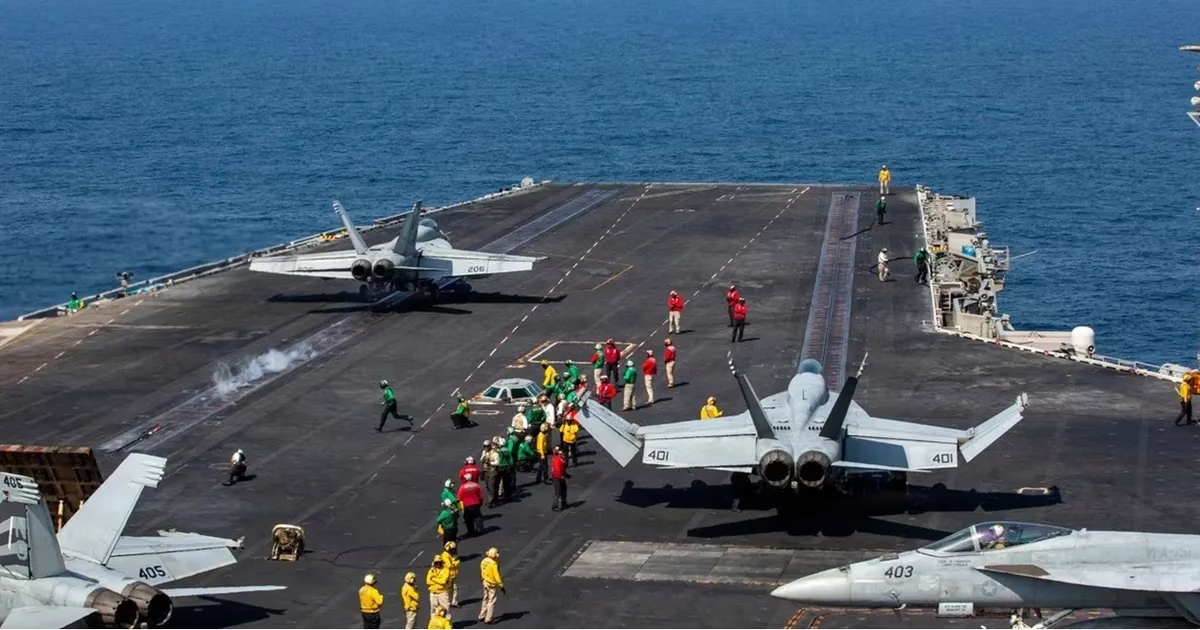
The Middle East witnessed a dramatic shift in the balance of power following the United States, in coordination with Israel, carrying out the largest direct military operation against the Islamic Republic of Iran in decades. The strike, dubbed 'Epic Wrath,' directly targeted the leadership structure in Tehran, including the Supreme Leader and high-ranking officials, plunging the region into a dark strategic tunnel.
Sources reported that the widespread attack included the destruction of sensitive defensive and missile facilities across the country, utilizing a sophisticated arsenal of naval missiles and fighter jets. The operation also featured the use of advanced 'LUCAS' drones, which contributed to neutralizing Iranian air defense systems in the initial hours of the attack.
These developments come after years of 'maximum pressure' policy and the failure of diplomatic efforts to revive the nuclear deal, with reports indicating that regional pressures pushed Washington to adopt the military option. Observers believe that the current US administration sought to end what it describes as the transnational Iranian threat through a decisive strike targeting the regime's head and its qualitative capabilities.
For his part, the US President announced that the operation's goal goes beyond mere military retaliation, aiming instead to redraw the rules of engagement and impose a new political reality in the region. Washington affirmed that undermining Tehran's leadership structure is the only way to prevent it from achieving a nuclear breakthrough or continuing to destabilize neighboring countries through its proxies.
In response, the Iranian retaliation was not long in coming, as Tehran launched retaliatory missile and drone attacks targeting American military bases in the Arabian Gulf region. The Revolutionary Guard announced that any aggression against the country's sovereignty would be met with an all-out war, warning that American and Israeli interests in the region have become legitimate and direct targets.
Economically, the strike caused an earthquake in global energy markets, with Brent crude prices immediately soaring to record levels. Major capitals are concerned about the potential disruption of navigation in the Strait of Hormuz, which is the main artery for the flow of about one-fifth of the world's daily oil consumption.
Economic analysts warned that continued escalation could push oil prices past the $100 per barrel mark, exacerbating global inflation rates. Financial markets have already begun to react to the crisis through investors fleeing to safe havens like gold, coinciding with a significant decline in regional stock market indices.
Diplomatically, a state of anticipation and caution prevailed in European capitals, which called for restraint and avoiding a slide into an uncontrollable comprehensive regional confrontation. Diplomatic sources confirmed that the European Union did not participate in the military operation, preferring to stick to negotiating paths despite the complexity of the field situation after the recent assassinations.
Russia and China, for their part, expressed grave concern about the repercussions of the attack on international peace and security, considering that the use of military force complicates crises rather than resolving them. Reports indicated that Moscow might increase its defense cooperation with Tehran in the face of this escalation, threatening to turn the conflict into a broader international confrontation.
Domestically in the United States, the operation sparked sharp political division between supporters who see it as a necessary correction of the strategic course, and opponents who warn against exceeding congressional authority. Democratic representatives demanded immediate restrictions on military operations, fearing the country's involvement in a long-term war of attrition in the Middle East without legislative authorization.
Military experts believe that 'Epic Wrath' aims to restore American deterrence, which has declined in recent years, and send a firm message to all forces allied with Iran. However, risks remain of Tehran resorting to asymmetric warfare tactics or cyberattacks that could target critical infrastructure of adversaries.
Targeting the supreme leadership in Iran represents a precedent in the history of the conflict, which puts the Iranian regime to an existential test to prove its ability to cohere and respond. All eyes are now on how Tehran will manage the succession and leadership file in the absence of its historical figures, and the extent of its impact on its regional influence in Iraq, Syria, and Lebanon.
In this complex scenario, concerns arise about the bilateral confrontation turning into a multipolar war involving many regional and international parties. The military objectives achieved in the initial hours may be followed by geopolitical repercussions whose extent cannot be predicted, especially if Iran decides to activate all available pressure cards.
In conclusion, the February 2026 operation remains a turning point that will be studied for a long time in strategic research centers, as it combined military audacity with major economic risk. The question will remain whether this strike will actually lead to regional stability under a new deterrence umbrella, or if it will be the spark that ignites an unquenchable regional fire.
US President Donald Trump: This step aims to impose comprehensive change in the regime's behavior and liberate the Iranian people from oppression.