ISRAELI AFFAIRS

Wed 08 Apr 2026 4:20 pm - Jerusalem Time

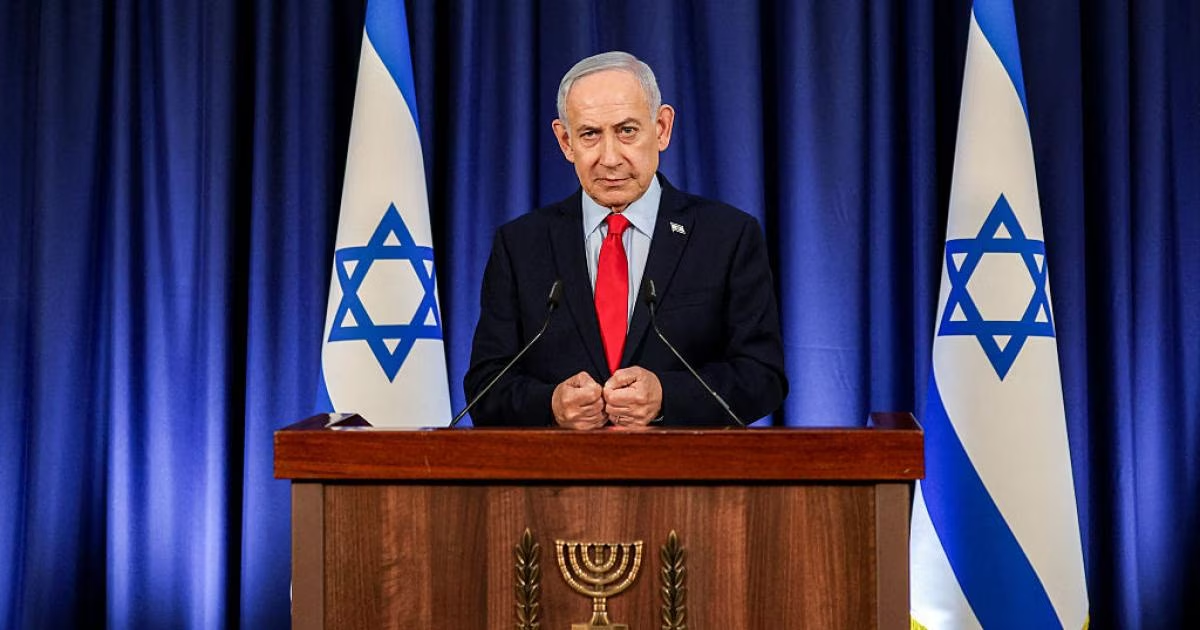
Anger and frustration in Israel: Trump imposes ceasefire, Netanyahu fails to neutralize Lebanon front

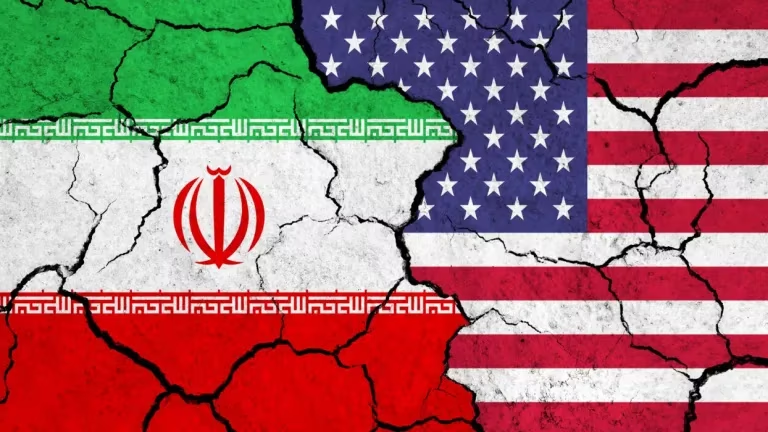
Political and military circles in Israel are experiencing a state of suppressed anger and widespread disappointment following the announcement of a ceasefire agreement with Iran. Observers and analysts believe that this agreement, which came under direct pressure from US President Donald Trump, represents a retreat from the ambitious goals announced by the Israeli government at the beginning of the confrontation, leaving the home front in a state of anxiety and confusion.

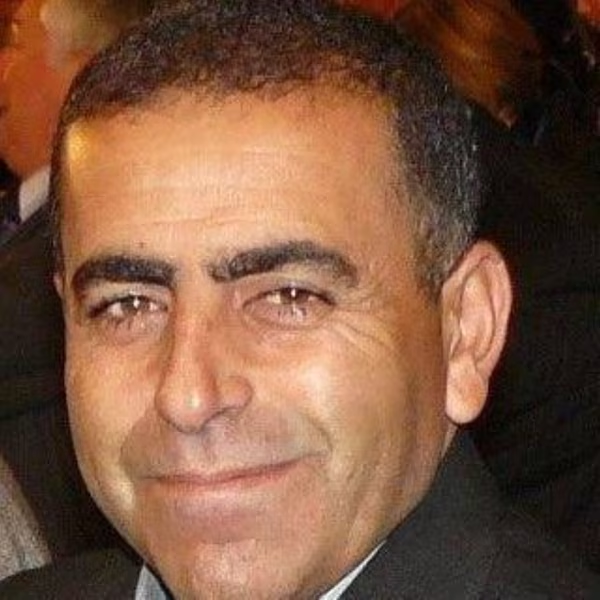
Reserve General Amos Gilad, former head of the political and security department in the Ministry of War, affirmed that the American commitment to a ceasefire might extend to include the Lebanon front, which would force Israel to comply. Gilad explained that the military gains achieved by the army did not translate into strategic achievements due to the absence of clear policy, warning that betting on the overthrow of the Iranian regime was an unrealistic goal that would take years.

Gilad strongly criticized the absence of real intelligence assessment bodies, pointing out that the position of National Security Advisor remains vacant. He added that Israel now faces a wounded Iranian regime that possesses the ability to restore itself and rebuild its strength, considering that Tehran emerged from this round feeling victorious after surviving a direct confrontation with Washington and Tel Aviv.

For its part, Hebrew media sources revealed that President Trump imposed a ceasefire on Prime Minister Benjamin Netanyahu, despite the latter's attempts to persuade him to continue military action. The sources indicated that Israel had been counting on Trump's threats to crush Iran, but Pakistani mediation succeeded in reaching a settlement that went against the wishes of the Israeli leadership, which aspired to radical change in the region.

There is a state of ambiguity surrounding the details of the agreement, especially concerning Iran's nuclear and missile projects. Sources reported that there are leaks indicating American acceptance of uranium enrichment for civilian purposes, which raises fundamental questions in Tel Aviv about whether the war has actually ended or if the region is heading towards a new round of conflict soon.

Regarding the Lebanese front, analyst Ohad Haimo expressed bitter sarcasm at the results of the confrontation, considering that the inclusion of Lebanon in the agreement represents a fundamental gain for Iran and Hezbollah. Haimo explained that Israel had rejected this linkage from the beginning, but Tehran succeeded in imposing its conditions, which raises major questions about the fate of military operations in southern Lebanon.

Heimo stressed that the true measure of the war's success or failure lies in the fate of the enriched uranium held by Iran. If this stockpile remains within Iranian territory, the war will be classified as a dismal failure for Israel, but if large quantities of uranium are removed, then a tangible strategic achievement can be discussed.

In a related context, Ofir Oppenheim, former director of the 'Peace Now' movement, launched a scathing attack on Netanyahu, describing the war as 'misleading' and based on unrealistic goals. Oppenheim accused the political leadership and media of suppressing the voice of reason and misleading the Israeli public, emphasizing that regimes are not overthrown by airstrikes alone, and that the price paid by Israelis was exorbitant and futile.

Military analyst Avi Ashkenazi described the agreement as 'strategic submission,' noting that 40 days of bleeding and damage to some 5,000 buildings in Israel ended without achieving a decisive victory. Ashkenazi added that the Iranian regime and nuclear project remained intact, while the Strait of Hormuz became a source of profit for Tehran instead of a tool of pressure on it.

Analyst Ron Ben Yishai believes that Trump bought political time with this agreement, while Israel is paying the price with its national security. He explained that Israel was forced to stop in Lebanon at the peak of its offensive, giving Hezbollah an opportunity to catch its breath and restore its capabilities, especially given the Israeli army's shortage of fighting forces and the exhaustion of reserve forces.

Ben Yishai indicated that Iran tactically retreated out of fear of 'Trump's madness' and his threats to destroy infrastructure, but it did not give up its basic demands. He considered that Trump achieved immediate gains by lowering oil prices and calming domestic opposition before the midterm elections, while Israel remained alone in facing security risks and open fronts.

There is a state of anticipation in northern Israel, where heads of local authorities fear the imposition of a sudden ceasefire on the Lebanon front before removing the threat of Hezbollah from the border. Security sources consider that the continued Israeli shelling of Tyre and other areas in southern Lebanon is an attempt to absorb internal anger and pressure the US administration to improve the terms of de-escalation.

Orly Sagi, former head of military intelligence, considered that imposing a ceasefire on the northern front would represent a major insult to the Israeli military establishment. He stressed that accepting the current situation without a tangible change in the security reality on the Lebanese border means that Israel emerged from this confrontation with a strategic loss that will affect its deterrent power in the future.

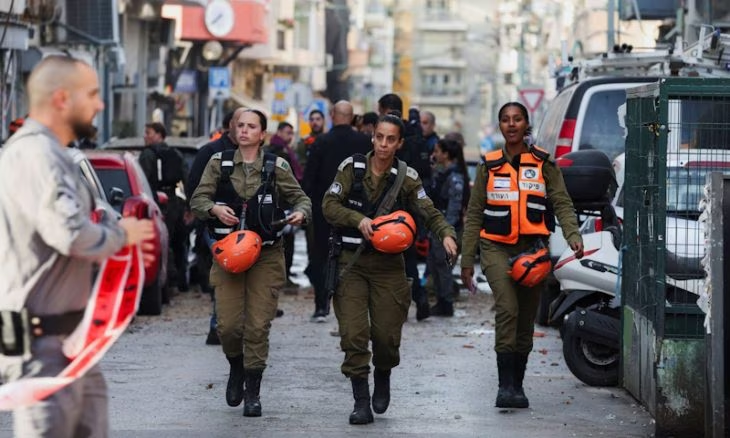
In conclusion, the Israeli street remains divided and frustrated by the results of the confrontation with Iran and its allies, amidst accusations against Netanyahu of failing to manage the crisis. With the continued rocket fire that followed the announcement of de-escalation, doubts are growing about the usefulness of political agreements in curbing Iranian ambitions and securing the Israeli home front, which suffered severe blows in Tel Aviv, Beersheba, and Haifa.

Israel and the United States emerged from the battle with an agreement of complete strategic submission, and the Iranian regime remained as it was.

PALESTINE

Wed 08 Apr 2026 4:20 pm - Jerusalem Time

Arab Barometer Survey: Historic Collapse of Washington's Popularity and Rise of China and Russia's Influence in the Region

The results of a recent survey conducted by the 'Arab Barometer' project revealed dramatic shifts in public opinion trends in the Middle East, with data showing an unprecedented decline in the popularity of the United States and its Western allies. The results clarified that the devastating war on the Gaza Strip, and the subsequent regional escalation, were the primary drivers of this reversal in Arab popular attitudes.

Research sources reported that citizens in countries such as Egypt, Iraq, Jordan, Lebanon, Morocco, Palestine, Syria, and Tunisia now view Washington as a morally biased party that undermines international law. This sentiment has led to a loss of trust in the regional system led by the United States for decades, and a search for other international alternatives.

In contrast, competing international powers such as China and Russia recorded a significant increase in popular acceptance levels, as they are now seen as more balanced parties in protecting regional security. The survey indicated that Arab peoples are increasingly inclined to prefer Chinese and Russian policies over American ones in the areas of protecting freedoms and supporting just causes.

Looking at the numbers, the policies of US President Donald Trump received very little support in most Arab capitals, with satisfaction rates not exceeding 12% in Jordan and Palestine. This widespread rejection is attributed to the absolute military and political support provided by the American administration to the Israeli occupation in confronting the Palestinians.

Regarding Asian powers, China's popularity reached record levels in 2025, reaching 69% in Tunisia and 58% in Iraq. Respondents believe that Beijing represents a rising power that can balance Western bias, even though it does not directly intervene in the complex military conflicts in the region.

As for Russia, the popularity of its President Vladimir Putin saw a qualitative leap despite the ongoing Ukrainian crisis, with his support rising by 33 points in Morocco and 20 points in Jordan. This rise reflects a popular Arab desire to see a multipolar world that ends the sole American dominance over the region's resources.

Regarding the Iranian role, the survey recorded a remarkable shift in the perception of the policies of the late Supreme Leader Ali Khamenei, especially after direct confrontations with the occupation. Despite continued concerns about the Iranian nuclear program, Tehran's stances on the Palestinian issue significantly raised its standing in the Arab street.

Results confirmed that the Israeli occupation remains the least popular state overall, with its supporters not exceeding 5% in most surveyed countries. The Arab street links the crimes committed in Gaza with the 'moral bankruptcy' of the international system that failed to stop the aggression or hold those responsible accountable.

The study touched upon the role of the European Union, which received slightly better evaluations than Washington, but still suffers from the accusation of bias. The perception of European countries varied based on their positions on Palestine, with Spain and Ireland receiving greater appreciation compared to Germany, whose popularity declined due to its military support for the occupation.

Researchers warned that Washington's continued disregard for Arab public opinion could lead to the loss of its strategic partners among governments. Despite the authoritarian nature of some regimes, Arab leaders fear popular protests, making public cooperation with the United States an increasing political risk.

The survey also showed that the United Nations was not immune to criticism, with about half of respondents believing it is biased towards Israel and more committed to defending it than defending the rights of Palestinians. This impression reinforces the idea of the collapse of the international legal and humanitarian system established after World War II.

Regarding future prospects, the results indicated that any improvement in Washington's reputation is contingent on finding a just and comprehensive solution to the Palestinian-Israeli conflict. Without a real change in American foreign policy, the region is heading towards a wider embrace of the Eastern axis led by China and Russia.

The report concluded that Gaza has become the primary moral standard by which Arabs judge the great powers, which explains why Washington's adversaries maintain a high standing. The failure to enforce international law in the occupied territories has completely undermined the Western narrative about human rights and democracy in the eyes of the Arab citizen.

In conclusion, this survey presents American policymakers with a harsh reality: military power is no longer sufficient to ensure influence. Restoring trust requires concrete steps to end the occupation and rebuild what the war destroyed, otherwise, the concession of the Arab world to international competitors will become an inevitable reality.

Most of Arab public opinion believes more than ever that the United States and Europe have failed the Palestinians and failed to enforce international law.

ARAB AND WORLD

Wed 08 Apr 2026 10:02 am - Jerusalem Time

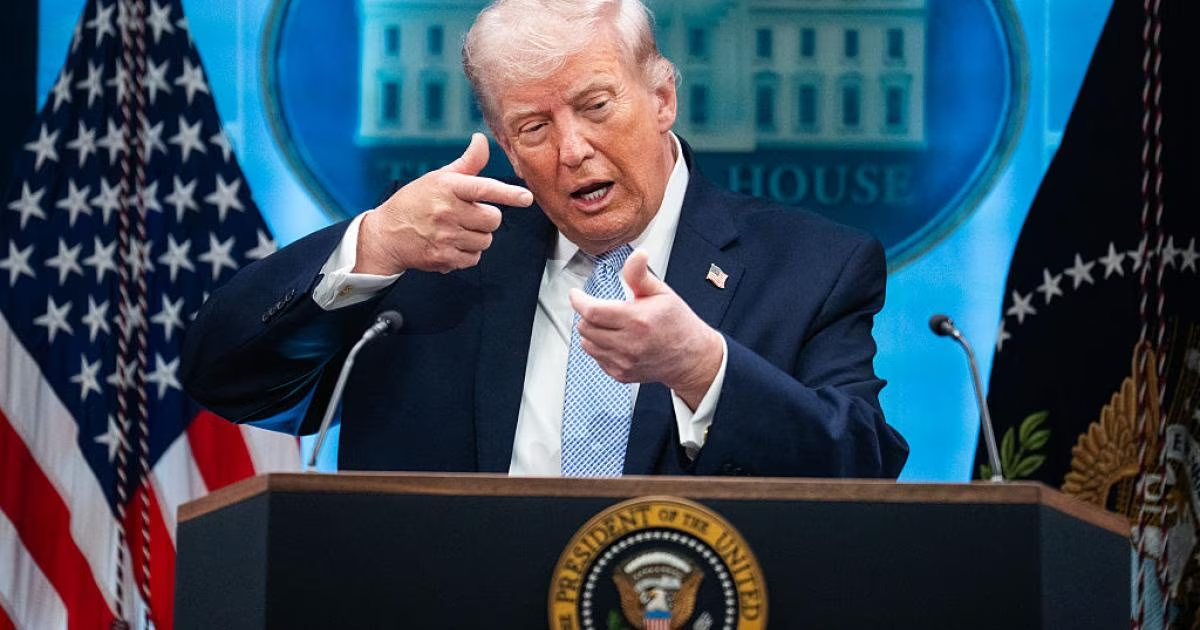
Trump announces ceasefire with Iran, heralds 'Golden Age' in Middle East

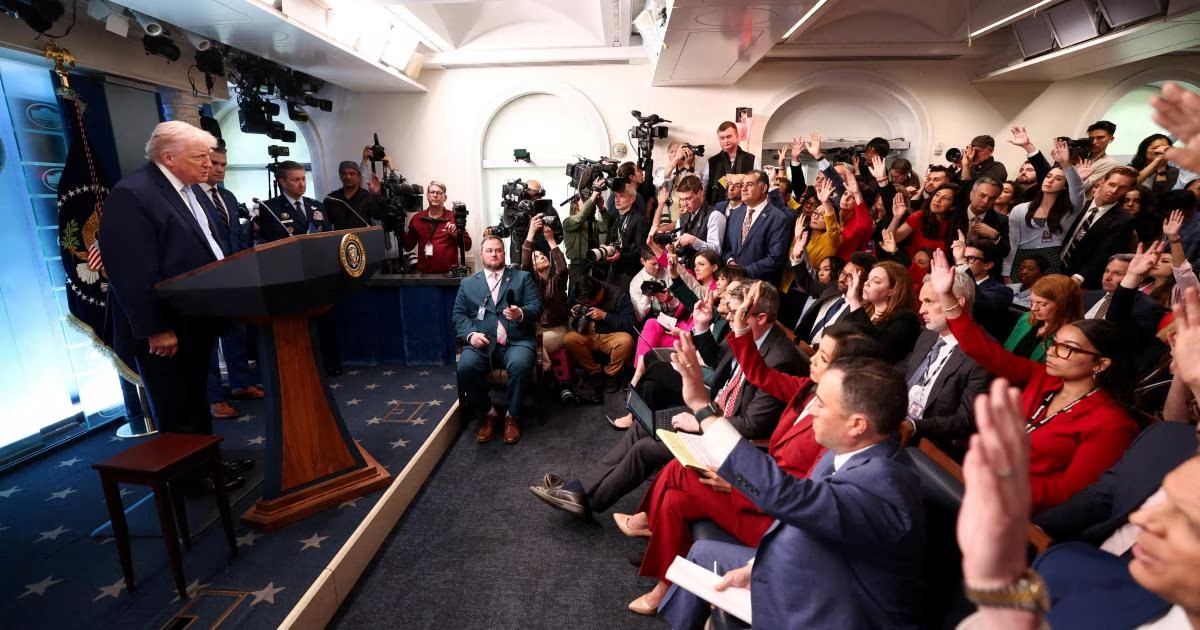
US President Donald Trump announced what he described as a 'complete and total victory' after reaching a formal two-week ceasefire agreement with Iran. This surprising move aims to contain the escalating military tension between Washington and Tehran, which was on the verge of spiraling into an open confrontation in the region.

In statements to international media, Trump affirmed that this agreement represents a 100 percent success, emphasizing that he has no doubt about the effectiveness of this de-escalation. Despite the optimistic tone, the US President did not disclose the precise technical details of the truce provisions or the mechanisms that will be followed to monitor its implementation on the ground.

Trump pledged that the United States would play a pivotal role in ending the disruptions affecting international navigation in the strategic Strait of Hormuz. He clarified via his 'Truth Social' platform that Washington would actively contribute to securing waterways, ensuring the unimpeded flow of global trade without military or security obstacles.

The US President indicated that the next phase would witness widespread positive measures, opening the door for significant economic gains for all parties involved. He considered navigation stability to be the key to transforming the region into a magnet for global investments and overcoming the era of armed conflicts.

In a notable economic gesture, Trump mentioned that Iran might soon begin a comprehensive reconstruction process for its infrastructure, which has been damaged by sanctions and tensions. He affirmed his country's readiness to provide Tehran with all necessary supplies for this process, while remaining close to ensure all parties adhere to the agreed path.

Trump heralded what he called the 'Golden Age of the Middle East,' considering that the current understandings could establish an unprecedented economic renaissance in the region. Observers believe these statements reflect Washington's desire to replace the language of military threats with the language of mutual economic interests to ensure long-term stability.

This announcement comes after weeks of acute tension, during which the US administration repeatedly threatened to target vital facilities and power stations deep within Iranian territory. However, Trump avoided clearly answering whether those military threats still stand if the temporary agreement fails or negotiations collapse.

Regarding the nuclear file, the US President stressed that the issue of enriched uranium remains at the core of Washington's concerns and will be dealt with strictly. He clarified that the ultimate goal remains to prevent Tehran from acquiring a nuclear weapon, considering this an essential condition that cannot be compromised in any final settlement.

In the context of diplomatic moves, Trump hinted at a potential role for China in mediating and pushing for this latest de-escalation. The US President is scheduled to visit Beijing next May to meet his Chinese counterpart, a visit expected to be dominated by trade issues and security arrangements in the Middle East.

Domestically, the agreement faced a wave of anger from Democratic Party lawmakers in Washington, who criticized what they considered extensive concessions to Tehran. Press reports cited party sources indicating that the agreement might grant Iran greater influence in the Strait of Hormuz, in addition to huge financial revenues from oil tankers.

The sources indicate that the new arrangements might allow Iran to charge up to two million dollars for each oil tanker passing through the strait, shared with the Sultanate of Oman. This truce is considered a real test of intentions, awaiting the outcome of complex negotiations on outstanding issues and the nuclear program.

This could be the Golden Age of the Middle East, and we will work to ensure things go well.

PALESTINE

Wed 08 Apr 2026 10:01 am - Jerusalem Time

Netanyahu Excludes Lebanon from 'Two-Week Truce' Amid Conflicting Interpretations of US-Iran Agreement

Israeli occupation government head, Benjamin Netanyahu, in his first official comment, announced his support for US President Donald Trump's decision to suspend military attacks against Iran for two weeks. However, Netanyahu stressed that this commitment does not extend to the Lebanese front, asserting that military operations there will continue regardless of understandings related to the Iranian file.\n\nNetanyahu's stance comes amid a state of diplomatic conflict, as Pakistani Prime Minister Shahbaz Sharif had announced via the 'X' platform that the agreement reached between Washington and Tehran includes an immediate ceasefire on all fronts, including Lebanon. This discrepancy reflects a deep gap in the interpretation of the agreement's terms and its geographical scope among the concerned parties.\n\nInformed sources reported that the current Israeli position seeks to play a disruptive role towards the truce imposed against Tel Aviv's wishes. Israeli estimates had banked on the collapse of negotiations, as the occupation army had prepared a wide target bank within Iranian territory and was awaiting a green light from Washington to carry out extensive airstrikes.\n\nField data indicates that Israel is trying to separate the Iranian and Lebanese tracks, under the pretext that the threat posed by Hezbollah can only be ended through continuous military pressure. Political circles in Tel Aviv claim that they will not allow the war in the north to stop without achieving the goal of disarming Hezbollah and securing the return of settlers.\n\nIn contrast, recent Israeli military briefings revealed implicit acknowledgments of the difficulty of achieving the declared goals in Lebanon through armed force alone. These reports clarified that disarming Hezbollah would require a full occupation of Lebanese territory and an invasion of every village, which is costly and complex, ultimately favoring diplomatic solutions.\n\nFor his part, political analysts explained that the absence of a literal and final text of the US-Iranian agreement opens the door to these contradictions in international positions. Observers believe that the initiative led by Trump may be based on initial points of understanding, but it has not yet settled the details related to the supporting fronts that Tehran insists on including in the truce.\n\nThe Islamic Republic of Iran insists on the necessity of including the Lebanese front in any de-escalation agreement, considering that regional stability is indivisible. At the same time, Israel finds itself in a field predicament, as ground and air operations have not achieved the desired results, but have led to significant attrition among its forces and a complete paralysis in the Galilee regions.\n\nReports indicate that the ongoing Israeli aggression has caused the displacement of nearly one million Lebanese citizens and inflicted massive destruction on infrastructure, but it has failed to stop the rocket barrages targeting Israeli depth. This field failure has begun to change the tone of internal discourse within the occupation, as warnings of sinking into a new "quagmire" have escalated.\n\nSerious fears prevail within the Israeli security establishment of engaging in a long-term war of attrition with no political horizon. Military readings confirm that the tactics of fighters in their rugged geographical environment give them a high ability to cause disturbing and painful effects to the occupation army, no matter how intense the firepower used against them.\n\nIn conclusion, the scene remains suspended between Washington's desire to impose a temporary de-escalation and Netanyahu's insistence on continuing escalation in Lebanon to escape political obligations. International circles await what the coming days will reveal regarding the terms of the agreement and the ability of the parties to compel Israel to stop its comprehensive aggression.\n\nThe ceasefire decision does not include Lebanon, and the proposed de-escalation is limited to specific fronts without extending to the Lebanese arena.

OPINIONS

Wed 08 Apr 2026 8:06 am - Jerusalem Time

How America Lost the Arab World


By Said Arikat

April 8, 2026

News Analysis — Washington, D.C.

In an article published in Foreign Affairs on April 7, 2026, Amaney A. Jamal, Dean of the Princeton School of Public and International Affairs, and Michael Robbins, Professor of Politics and International Affairs at Princeton University, argue that the reverberations of Hamas’s October 7, 2023 attack on Israel have penetrated nearly every layer of Middle Eastern society. The human and material toll has been immense: tens of thousands killed—predominantly in Gaza—millions displaced, and infrastructure losses in the billions. Within this context, the authors contend that the sweeping shift in regional public opinion is both profound and unsurprising.

Their central claim is that the United States has suffered a deep—and potentially enduring—erosion of its standing across the Arab world. This decline stems largely from Washington’s role in recent regional conflicts, particularly the war in Gaza and the subsequent war on Iran. Drawing on Arab Barometer surveys conducted between late 2023 and late 2025, Jamal and Robbins show that public attitudes across the Middle East and North Africa have turned sharply against the United States and, to a lesser extent, its European allies.

The turning point was Hamas’s October 7 attack and Israel’s devastating military response. The scale of destruction in Gaza decisively shaped public perceptions. Across the region, many attributed responsibility not only to Israel but also to the United States, widely viewed as its principal backer. This perception has proven durable, with subsequent polling indicating that distrust of Washington is now deeply entrenched.

Equally striking is the geopolitical reorientation reflected in these attitudes. Where the United States once exercised considerable influence, Arab publics increasingly view alternative powers—especially China and Russia, and in some cases Iran—more favorably. Respondents often associate these actors with defending freedoms, supporting Palestinian rights, and contributing to regional stability. This shift does not reflect ideological alignment with these states’ systems but rather growing disillusionment with the United States, seen as inconsistent and selectively committed to international law.

These perceptions have been reinforced by the escalation involving Iran. Israeli military actions extending into Lebanon and affecting Gulf states have intensified views of American complicity in regional instability. At the same time, the slow pace of Gaza’s reconstruction has deepened frustration. In many contexts, anti-American sentiment now appears even stronger than in the immediate aftermath of the Gaza war.

The political implications are substantial. Although many Arab governments are authoritarian, they remain sensitive to public opinion and the risk of unrest. As hostility toward the United States rises, overt cooperation with Washington becomes increasingly costly. Jamal and Robbins warn that absent a meaningful policy shift—particularly de-escalation with Iran and renewed efforts toward a just resolution of the Israeli-Palestinian conflict—the United States risks losing not only public goodwill but also strategic partnerships.

Survey data underscores the depth of this reputational crisis. Approval of U.S. foreign policy is exceptionally low across most countries, with only small minorities expressing favorable views. In several cases, current U.S. leadership is viewed more negatively than previous administrations. While exceptions exist—such as Morocco and Syria, where specific policies have generated limited goodwill—the broader trend remains overwhelmingly adverse.

European countries fare somewhat better but are still viewed critically, largely in relation to their positions on the Israeli-Palestinian conflict. Spain and Ireland, perceived as more supportive of Palestinian rights, receive relatively favorable evaluations, whereas Germany’s strong alignment with Israel has diminished its standing.

By contrast, China enjoys the highest favorability ratings across much of the region, and Russia often outperforms the United States. Iran’s image is more ambivalent: while many remain wary of its regional ambitions and nuclear program, its opposition to Israel has enhanced its appeal. Even figures such as former Iranian Supreme Leader Ali Khamenei have seen improved perceptions, reflecting a broader “enemy of my enemy” dynamic.

At the center of these attitudes lies the Israeli-Palestinian conflict. Large majorities across the Arab world view the United States as fundamentally biased toward Israel. This perception extends to international institutions, with many respondents also regarding the United Nations as partial. Disillusionment therefore encompasses not only U.S. policy but the broader international order, increasingly seen as inequitable and ineffective.

Despite widespread hostility toward Israel, Arab public opinion is not entirely rigid. Surveys indicate conditional openness to normalization if Israel recognizes a Palestinian state, alongside continued support for a two-state solution. However, ongoing Israeli policies—particularly settlement expansion in the West Bank—are widely viewed as undermining that prospect, reinforcing anger toward Israel and its allies.

Perhaps most consequential for the United States is the erosion of its perceived legitimacy as a defender of international law and human rights. In multiple countries, more respondents identify China—not the United States—as the actor most committed to upholding international norms. Similarly, when asked which country better protects freedoms or contributes to regional security, China consistently outperforms Washington. These perceptions reflect not admiration for China’s system but dissatisfaction with what is widely seen as American inconsistency and double standards.

The broader implication is a potential geopolitical realignment. As public opinion shifts, Arab governments may increasingly diversify their partnerships, strengthening ties with China and Russia while reducing reliance on the United States. In some cases, this process is already underway, with states exploring alternative alliances or limiting visible cooperation with Washington. Ongoing tensions involving Iran may accelerate this trend.

Yet, the authors note, this outcome is not inevitable. The United States and its European partners retain the capacity to rebuild credibility, but doing so will require substantive policy adjustments. France’s improved standing following its recognition of a Palestinian state illustrates how even symbolic actions can influence public opinion.

Ultimately, according to the authors, restoring trust will require aligning policy with principle. For the United States, this means de-escalating regional conflicts, addressing Gaza’s humanitarian crisis, and actively supporting a just resolution to the Israeli-Palestinian conflict. More broadly, it demands a consistent commitment to international law and human rights. Absent such changes, the United States risks a lasting loss of influence in the Arab world, ceding both moral authority and strategic ground to competing global powers.


OPINIONS

Wed 08 Apr 2026 8:05 am - Jerusalem Time

Temporary Ceasefire Between the United States and Iran—Agreement Details, Background, and Prospects for Endurance

Said Erikat

Opinion Writer

Washington - Said Arikat - 8/4/2026

News Analysis

In a critical moment that nearly pushed the Middle East into a widespread military confrontation, US President Donald Trump announced his approval of a two-week temporary ceasefire with Iran, an agreement reached shortly before imminent US military strikes against targets within Iranian territory were to be carried out. This dramatic development did not occur in isolation from a rapidly escalating context; rather, it reflects a delicate balance between military pressure and emergency diplomacy, opening the door to a potentially pivotal negotiation phase in the crisis.

The agreement stipulates a mutual cessation of military operations, including air strikes and direct and indirect hostile activities, in exchange for an Iranian commitment to fully and immediately reopen the Strait of Hormuz to international shipping. This strait is considered one of the most strategically important waterways in the world, through which a large percentage of global oil exports pass, making its closure during the recent escalation a step with serious economic repercussions internationally.

In a post on "Truth Social," Trump stated: "I have agreed to give Iran a two-week grace period in exchange for immediately reopening the Strait of Hormuz. We do not seek war, but we are fully prepared for it. This is a real opportunity for peace if they make good use of it."

This statement reflects a mix of firmness and openness, within a policy based on maximum pressure coupled with the possibility of negotiation.

Background of the Agreement: Last-Minute Diplomacy

Data indicates that this agreement was not spontaneous but resulted from intensive behind-the-scenes communications over the preceding days, with the participation of regional and international mediators, most notably Pakistan. Islamabad played a pivotal role in bridging viewpoints, leveraging its balanced relations with both parties and seeking to avoid the outbreak of a war whose effects could extend beyond the region.

International pressure, especially from major energy-consuming countries, also contributed to pushing both parties towards de-escalation, amid growing fears of rising oil prices and global market disruption. Reports indicate that US forces were already on high alert, reinforcing the hypothesis that the agreement came within the framework of "brinkmanship" diplomacy, where direct military threat is used as a means to force quick concessions.

Iran's Ten-Point Plan

The Iranian ten-point proposal forms the basis upon which negotiations will be built during the ceasefire period. Although its full details have not been officially announced, diplomatic sources have revealed its main provisions, which reflect an Iranian vision for a comprehensive settlement:

Guaranteeing freedom of navigation in the Strait of Hormuz in exchange for an international commitment not to target Iran.

Comprehensive cessation of direct and indirect military operations in the region.

Launching a gradual and deliberate process to lift economic sanctions imposed on Tehran.

Returning to specific nuclear commitments within a new or modified agreement.

Establishing a multilateral international monitoring mechanism to ensure mutual compliance.

Launching a regional dialogue on collective security involving Gulf states.

Recognizing Iran's regional role within agreed-upon balances.

Cessation of mutual cyberattacks and cooperation in cybersecurity.

Implementing humanitarian steps such as prisoner and detainee exchanges.

Setting a clear timeline for broader negotiations towards a long-term agreement.

These provisions show that Iran is not merely seeking a temporary de-escalation but rather a redefinition of the rules of political and security engagement in the region, ensuring its internationally recognized position.

Potential Regional Expansion: Lebanon within the De-escalation

In a notable development, the Israeli newspaper "Yedioth Ahronoth" reported that the understanding is not limited to the US-Iranian arena but may extend to include a ceasefire in Lebanon, indicating a potential containment of escalation on Israel's northern front. According to this proposition, any de-escalation between Washington and Tehran could directly impact Iran's allies in the region, especially the active forces in Lebanon, which could contribute to reducing tensions and preventing the confrontation from expanding to additional arenas. However, no independent official confirmation of this information has been issued, keeping it within the framework of media estimates that reflect an Israeli reading of the agreement's implications.

Between Tactic and Potential Transformation

Strategically, this agreement reflects a temporary convergence of interests between two parties that still harbor deep mistrust. The United States can claim to have achieved an immediate goal of reopening the Strait of Hormuz without entering a costly war, while Iran has gained an opportunity to halt escalation, alleviate economic and military pressures, and persuade the US President to accept its terms, or points, while its position in controlling the Strait of Hormuz is better than it was before the United States and Israel waged war on it on February 28th.

Nevertheless, the nature of the agreement remains fragile, as it is based on conditions that are susceptible to collapse in the event of any field violation or indirect escalation. Furthermore, the multiplicity of parties indirectly involved in the conflict, such as regional allies and armed groups, complicates the scene and makes controlling the course of events more difficult.

Regional and International Dimensions

Regionally, several countries welcomed this development, given the opportunity it presents to avoid a potentially devastating war. Global markets also reacted positively, with oil prices experiencing a relative decline immediately after the agreement's announcement, signaling a reduction in fears of supply disruption.

Internationally, this truce is seen as a test of the major powers' ability to manage crises through diplomacy rather than military confrontation. It also places mediators, especially Pakistan, in an influential position that could be strengthened if negotiations succeed.

Scenarios for the Next Phase

Expectations regarding the future of this agreement range between three main scenarios. The first is the success of negotiations that will begin on Friday between Iran and the United States in Islamabad, with the participation of US Vice President J.D. Vance, and the transformation of the truce into a longer-term agreement, and perhaps a comprehensive framework addressing contentious issues. The second, and most likely, is the continuation of the truce for a limited period without achieving a decisive breakthrough, keeping the crisis in a temporary freeze. The third scenario involves the possibility of the agreement collapsing due to a field incident or indirect escalation, which could bring the region back to the brink of confrontation.

The temporary ceasefire between the United States and Iran represents a delicate moment in a complex crisis, where military calculations intersect with economic and diplomatic pressures. While the agreement offers a real opportunity to contain escalation, it remains a difficult test of both parties' willingness to transition from a logic of confrontation to a logic of settlement. The coming days will be crucial in determining whether this truce will mark the beginning of a new political path, or merely a fleeting truce in

Although the ceasefire agreement opens a rare window to contain escalation, its chances of endurance remain dependent on a fragile balance between the political and military calculations of the parties involved. On the one hand, mutual exhaustion and international pressure may push towards consolidating and gradually expanding de-escalation. On the other hand, the history of ceasefire violations in the region, especially by Israel in previous contexts, raises serious doubts about long-term commitment. Any limited field incident could quickly turn into a pretext for collapse, making the agreement more of a temporary test of intentions than a stable path towards lasting peace.

LATEST NEWS

Wed 08 Apr 2026 8:05 am - Jerusalem Time

Netanyahu supports suspending attacks on Iran, excludes Lebanon from de-escalation

Israeli Prime Minister Benjamin Netanyahu expressed his support for US President Donald Trump's decision to halt military operations against Iran for two weeks. This stance came after Hebrew media reports indicated that Tel Aviv aligns with the new American vision for temporary de-escalation in the region. However, Netanyahu set a clear limit to this endorsement, linking it only to the Iranian arena and not to other active fronts.

Netanyahu stressed in his statements that the current understandings regarding the ceasefire do not extend to Lebanon, indicating the continuation of military operations there. This Israeli position comes at a sensitive time witnessing significant field escalation, raising questions about the effectiveness of partial de-escalation. This exception has sparked widespread debate due to the interconnectedness of regional issues in the ongoing conflict.

In contrast, Pakistan, as the mediator in this agreement, presented a completely different narrative from what the Israeli side put forward regarding the scope of the de-escalation. Pakistani Prime Minister Shehbaz Sharif announced that the agreement reached includes a comprehensive ceasefire on all fronts. Sharif affirmed that 'the Islamic Republic of Iran, the United States, and their allied parties' agreed to an immediate cessation of operations explicitly including Lebanon.

Pakistan's Prime Minister explained that his government's diplomatic efforts aim to end the war that erupted on February 28th. He indicated that the capital Islamabad is preparing to host high-level delegations from Washington and Tehran next Friday. These anticipated meetings aim to draft the final terms of a sustainable peace agreement that will end the state of tension that has plagued the region for the past weeks.

On the other hand, Israeli sources revealed a state of confusion that prevailed in political and security circles in Tel Aviv following the surprising American decision. Media sources quoted informed officials that Israel was not a partner in drafting the decision but received updates at the last minute. It appears that the US administration made up its mind regarding de-escalation before informing its close ally of the final details of the agreement with the Pakistani mediator.

US President Donald Trump announced earlier today his approval to suspend strikes against Iranian targets for 14 days as a gesture of goodwill. Trump stipulated that for this decision to be implemented, the Strait of Hormuz must be fully and immediately opened to international navigation without any obstacles. The US President also affirmed that the continuation of this calm depends on a bilateral commitment, indicating that this period will be sufficient to test intentions and finalize the drafting of the final agreement.

Trump considered this step a historic opportunity to resolve a long-standing problem in the Middle East, describing himself as representing the interests of the region's countries in this path. International parties hope that the Islamabad talks will succeed in transforming this temporary halt into permanent stability that spares the region the ravages of a comprehensive war. However, the discrepancy in interpretations between Tel Aviv and Islamabad regarding the 'Lebanon front' remains the biggest obstacle to the comprehensiveness of this diplomatic path.

Israel supports US President Donald Trump's decision to suspend attacks on Iran for two weeks, but the ceasefire does not include Lebanon.

ARAB AND WORLD

Wed 08 Apr 2026 8:05 am - Jerusalem Time

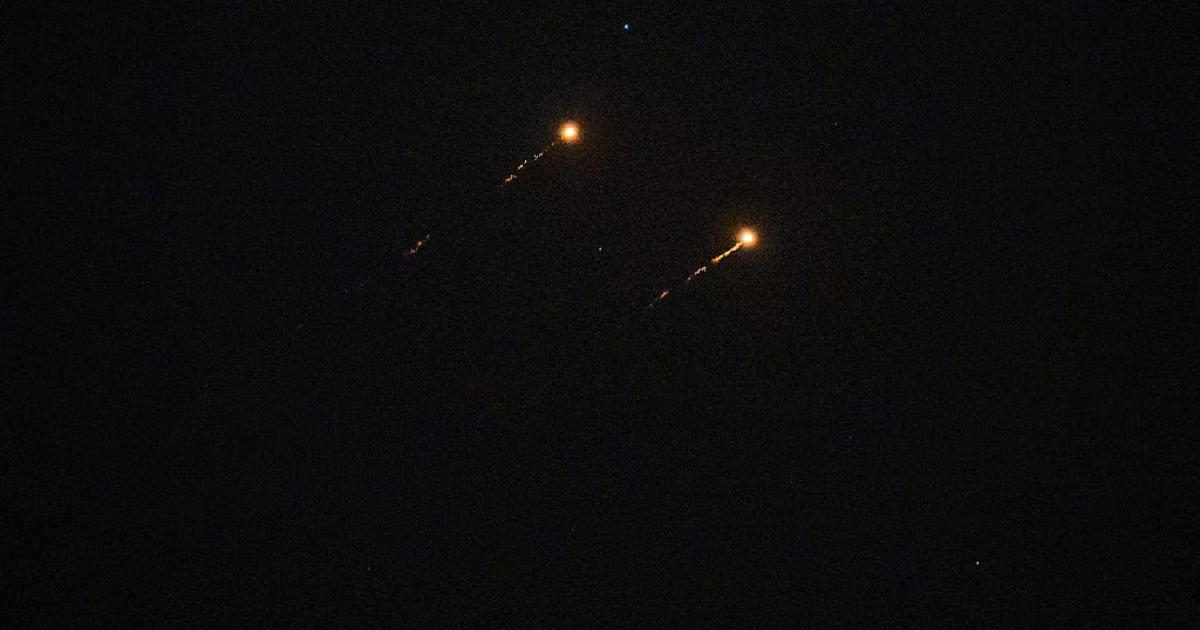
Widespread missile escalation strikes Israel and raids on Iran following Trump's ceasefire announcement

The early hours of Wednesday witnessed an unprecedented military escalation in the region, as cities and wide areas within Israel were subjected to intense missile attacks launched from Iranian and Yemeni territories. This field explosion came just minutes after US President Donald Trump announced his approval of a conditional ceasefire with Tehran, putting the fragile calm to a real and difficult test.

Media sources confirmed that the Israeli Air Force responded immediately by launching airstrikes targeting missile launch platforms deep inside Iranian territory. Residents of Jerusalem heard violent explosions in the sky resulting from aerial interception operations, coinciding with the detection of the first missile barrage that followed Trump's speech directly, before successive waves of attacks followed.

According to field data, Iran launched six consecutive missile barrages, the second of which targeted southern areas including Dimona, Beersheba, and the Negev, where sirens blared continuously. These attacks drove thousands of settlers into shelters, amid a state of confusion that prevailed in Israeli security circles due to the timing and scale of the shelling.

The third barrage extended to the Israeli interior in the central region, where warning systems were activated in Tel Aviv and the cities of Petah Tikva and Bnei Brak. Technical reports indicated that some of the missiles used were of advanced models, while sources spoke of the use of cluster missiles in some barrages that targeted vital centers.

Attacks were not limited to the Iranian front; defensive systems detected the launch of two missiles from Yemen towards Israel in two separate attacks following the White House announcement. Sources did not provide precise details about the results of the Yemeni shelling, but they confirmed that the attacks came within the framework of clear field coordination aimed at pressuring the Israeli side.

Regarding material and human losses, medical and media sources reported projectiles falling in Beersheba, in addition to a building being directly hit in Tel Aviv. Local authorities also recorded severe damage to a facility in Petah Tikva and a large fire breaking out at the site, while two people were injured in the town of Tel as-Saba in the south.

Israeli military censorship imposes a strict blackout on the true extent of losses resulting from these barrages, which is a common behavior in the face of missiles coming from multiple fronts. This blackout includes details of drone and missile interceptions, as well as the results of ongoing field confrontations on other fronts, to ensure that no free information is provided to the other side.

US President Donald Trump had earlier announced a temporary two-week truce, indicating that the United States had received a ten-point Iranian proposal that represents a basis for negotiation. Trump confirmed that this agreement was reached after mediation efforts led by Pakistan through its prime minister and army chief of staff, with the aim of defusing a comprehensive explosion.

The White House stipulated for the continuation of this halt that Tehran fully, immediately, and safely open the Strait of Hormuz to international navigation. Trump stressed that the cessation of military operations must be mutual and bilateral, considering that American military objectives have been largely achieved, paving the way for a long-term peace agreement.

Despite these diplomatic statements, the field reality on Wednesday morning reflected a large gap between political announcements and military movements on the ground. Sources confirm that Israel was surprised by the timing of the American decision and expressed reservations about security guarantees, especially with the continued flow of missiles that reached most major cities from the north to the Negev.

Trump conditioned the cessation of strikes on the full and immediate opening of the Strait of Hormuz, and that the ceasefire be bilateral.

ARAB AND WORLD

Wed 08 Apr 2026 8:05 am - Jerusalem Time

10-point plan.. Details of the Iranian proposal to end the confrontation with Washington

The Iranian authorities announced early Wednesday morning the submission of a ten-point political document to American negotiators, aimed at ending the direct military confrontation with the United States and Israel. Tehran's proposal stipulates Washington's recognition of its right to a uranium enrichment program, in addition to the comprehensive lifting of all economic sanctions imposed on it as part of a comprehensive settlement.

The Supreme National Security Council of Iran clarified that the proposed plan guarantees Iran's full sovereignty over the strategic Strait of Hormuz, which is considered the global energy artery. The official statement also stressed the necessity of a resolution from the UN Security Council to give any agreement reached a binding legal character, to ensure that international parties do not backtrack on their commitments in the future.

The demands, conveyed through Pakistani mediation, included a complete withdrawal of American forces from the Middle East region, and a halt to all military operations targeting Iranian territory or its allied forces in the region. Tehran also demanded the immediate release of all its frozen financial assets in international banks, considering this an essential step to prove American good intentions in the negotiation process.

Regarding the nuclear file, responsible sources indicated that Iran has officially expressed its readiness to commit to not seeking to acquire nuclear weapons, in exchange for Washington accepting its right to peaceful enrichment. The level and technical ratios of enrichment will be subject to negotiation, in a framework that seeks to balance Iranian demands with international concerns about the nuclear program.

The Iranian plan addressed the economic aspect by proposing the establishment of an international investment and financial fund aimed at compensating Iran for the massive losses incurred by its economy due to years of sanctions and war. Tehran linked the implementation of the ceasefire to the official acceptance of the terms of this plan by the American administration, which seems to have opened a new door for faltering diplomacy.

For his part, US President Donald Trump announced the suspension of a large-scale military strike that was planned against Iranian targets, describing the Iranian proposal as forming a 'practical basis' for starting a serious negotiation process. This shift came after strong American warnings, indicating that Pakistani mediation succeeded in defusing an escalation that would have led to a comprehensive confrontation.

On the ground, Iranian Foreign Minister Abbas Araqchi confirmed that his country would allow safe passage for ships through the Strait of Hormuz for two weeks, provided prior coordination with the Iranian armed forces. This step comes to relieve pressure on global energy markets, as the strait has remained closed to navigation since the outbreak of hostilities in late February.

The adoption of a Security Council resolution will make these agreements binding under international law and will constitute a diplomatic victory for the Iranian nation.

ARAB AND WORLD

Wed 08 Apr 2026 8:05 am - Jerusalem Time

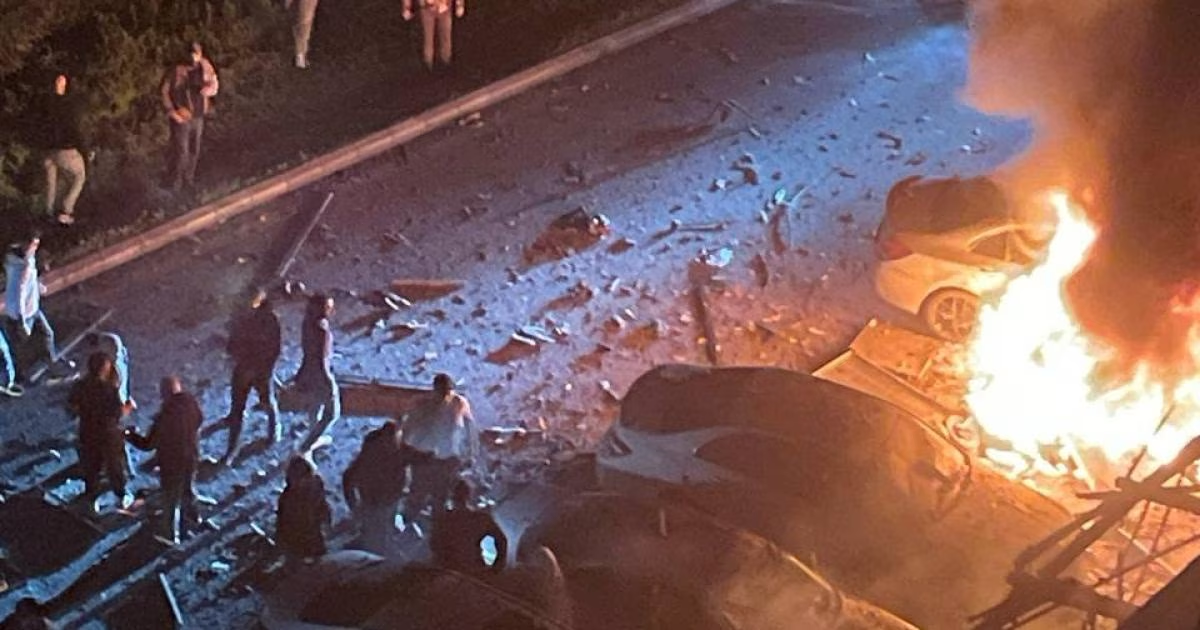
Massacre in Sidon: 8 Martyrs and Dozens Wounded in Israeli Raid Targeting the Waterfront

Israeli occupation forces committed a new massacre in the city of Sidon, southern Lebanon, resulting in the martyrdom of at least eight people and the injury of about 22 others with varying degrees of wounds. Official medical sources reported that the airstrike directly targeted the city's waterfront area during the late night hours, leading to this large number of casualties, with the toll expected to rise.

Video clips documented widespread destruction affecting a popular cafe in the targeted area, which was turned into rubble due to the intensity of the explosion. Firefighting and civil defense teams began extinguishing the fires that broke out at the site, while the Lebanese army imposed a strict security cordon around the site of the raid to facilitate the transfer of the injured to nearby hospitals, amidst a state of panic among local residents.

The Israeli strike caused extensive material damage to public and private property, with dozens of cars parked around the targeted cafe being damaged. This raid comes in the context of ongoing military escalation which, according to Lebanese Ministry of Health data, has led to the martyrdom of over 1500 people since the outbreak of the current confrontations, exacerbating the humanitarian crisis in various Lebanese regions.

On the political front, these field developments coincided with striking statements by Pakistani Prime Minister Shehbaz Sharif, in which he indicated the existence of international understandings for de-escalation. Sharif stated via his official account that there is an agreement for an immediate ceasefire between the United States, Iran, and their allies, emphasizing that this agreement is supposed to immediately include the Lebanese arena and other fronts.

Despite these reports of de-escalation, the field still witnesses intensive shelling operations targeting civilians and infrastructure deep within Lebanese territory. Political and popular circles are awaiting the extent of the parties' commitment to this international declaration, amidst the continued fall of casualties and the expansion of Israeli targeting to include major cities like Sidon, which was considered relatively far from direct targeting of its maritime center.

The Israeli enemy's raid on Sidon resulted in an initial toll of eight citizens martyred and 22 injured.

PALESTINE

Wed 08 Apr 2026 8:05 am - Jerusalem Time

Execution Law for Prisoners and Closure of Al-Aqsa: Israeli Escalation Puts the Nation Before Its Historical Responsibilities

The Palestinian issue is currently facing a dangerous and unprecedented turning point, as the Israeli occupation seeks to impose a new reality that targets both people and holy sites. Coinciding with the continued tightening and closure of Al-Aqsa Mosque, the Knesset approved in a first reading a law allowing the execution of Palestinian prisoners, in a move that reflects the desire of the far-right to settle political scores through military judicial platforms.

This legislation, pushed by National Security Minister Itamar Ben-Gvir, is not merely a legal procedure; it is a declaration of war on thousands of prisoners held in jails. According to the data, the law allows military courts to issue death sentences by a simple majority, which opens the door to systematic killings under a flimsy legal cover.

Historically, the occupation authorities have resorted to applying the death penalty only in very rare cases, most notably against the Nazi officer Adolf Eichmann in the 1960s. Today, the occupation is trying to revive this punishment against Palestinians who resist the occupation, in an attempt to break the will of popular steadfastness and intimidate the popular base of the resistance.

Historically and in the Islamic conscience, the issue of prisoners has never been merely a transient humanitarian file; rather, it is a measure of the nation's dignity and strength. History has recorded decisive stances in which armies moved to rescue a single prisoner, as happened during the era of Caliph Al-Mu'tasim, who dispatched an entire army in response to the cry of a Hashemite woman in Amorium.

The established Sharia rules affirm the obligation to rise up to rescue prisoners, as jurists considered the sanctity of a Muslim to be greater than the sanctity of lands. Scholars of the nation believe that ransoming prisoners is a religious duty that falls on everyone, and if official resources are insufficient, then it is incumbent upon the entire nation to contribute to freeing them from bondage and oppression.

In light of the presence of about ten thousand Palestinian prisoners, including women and children who are subjected to systematic torture, the international and regional silence seems reprehensible. The absence of an appropriate reaction to this great crime encourages the occupation to proceed with its abusive policies that no longer differentiate between a child or an elder inside the cells.

Observers link the law on the execution of prisoners with what is happening in the blessed Al-Aqsa Mosque, including continuous closures and incursions. The closure of the mosque is nothing but preparation for something more severe, as extremists in the occupation government seek to impose a complete temporal and spatial division, exploiting the world's preoccupation with regional and international conflicts.

The American position, which considered the execution legislation a 'sovereign right' for Israel, reflects a complete bias that gives the green light for more violations. In contrast, international organizations content themselves with statements of condemnation that are neither sufficient nor satisfying in the face of the aggression of the Israeli far-right, whose leaders celebrate the approval of killing laws.

The experiences of conflict have taught us that the occupation only retreats under real and tangible pressure, whether political or on the ground. The nation possesses many pressure cards, starting from popular movements in the squares to diplomatic and economic stances that can force the occupation to reconsider its calculations.

Here, the role of scholars and thinkers stands out in guiding the compass towards true responsibilities, away from routine statements that no longer affect the reality on the ground. The sincere fatwa is what places rulers and ruled before their duties towards Al-Aqsa and the prisoners, and clarifies that neglecting either of them is a neglect of the core of faith and identity.

The extremist minister who celebrated by distributing sweets after the vote on the execution law will not hesitate to commit greater follies in Jerusalem. Therefore, defending prisoners is essentially defending Al-Aqsa Mosque, and vice versa, as both represent the symbolism of Palestinian steadfastness in the face of the Israeli war machine.

Recalling the spirit of historical heroism in dealing with prisoner issues has become an urgent necessity in the current reality. Nations that respect their individuals are those that stake their future on the safety of every individual within them, and the occupation is well aware of this point and tries to exploit it to pressure Palestinians and blackmail their political positions.

In conclusion, the reliance remains on the awareness of peoples and their ability to act to protect their holy sites and their children behind bars. The execution law for prisoners must be a wake-up call for the entire nation, that silence is no longer an acceptable option in the face of a threat that directly and explicitly targets lives and holy sites.

The sky, which is hoped for when it is veiled, will one day rain down victory and relief for these heroes who sacrificed the prime of their youth for the dignity of this nation. Everyone must realize that rescuing a prisoner is an individual obligation by collective capabilities, and that failure to do so is a sin in which everyone who possessed a means of change and did not use it participates.

Rescuing a prisoner is an obligation upon the nation with all its capabilities; if it fails or retreats, everyone sins, so what if among these prisoners is the journey of our noble Prophet?

ARAB AND WORLD

Wed 08 Apr 2026 8:05 am - Jerusalem Time

Tehran Announces Date for Islamabad Negotiations and Proposes 10-Point Plan for De-escalation with Washington

The Iranian Supreme National Security Council announced that Friday, April 10th, has been set as the date for the start of official negotiations with the United States in the Pakistani capital, Islamabad. This step comes after Tehran submitted a comprehensive ten-point proposal to the American administration through Pakistani mediation, in an attempt to defuse the escalating military tension in the region.

Iranian sources clarified that these anticipated talks aim to finalize the details of the Iranian proposal, which addresses thorny strategic issues, foremost among them the mechanism for ships passing through the Strait of Hormuz and the lifting of economic sanctions imposed on Tehran. The proposal also includes provisions related to the withdrawal of American combat forces from regional military bases, while emphasizing that the start of dialogue does not necessarily mean the end of the existing state of war.

For his part, Iranian Foreign Minister Abbas Araghchi affirmed that his country is prepared to completely halt its offensive operations if other parties commit to stopping attacks against Iranian targets. Araghchi stated in an official announcement that Tehran would allow safe passage through the Strait of Hormuz for two weeks, provided that this is done in direct coordination with the Iranian armed forces to ensure the security of the international waterway.

In contrast, the American administration linked the implementation of any ceasefire agreement to practical steps on the ground. Media sources quoted a White House official saying that the truce would not come into effect until the Strait of Hormuz is fully opened for international navigation. This stance coincides with statements by US President Donald Trump, who expressed conditional flexibility towards military de-escalation in the coming period.

President Trump had announced via his 'Truth Social' platform his approval to suspend air operations and bombing of Iranian targets for two weeks, describing the move as potentially leading to a mutual ceasefire. Trump stipulated for the implementation of this pledge that Iranian authorities immediately and comprehensively open the Strait of Hormuz, which places the upcoming negotiations in Islamabad before a real test of the two parties' ability to reach a temporary settlement.

I agree to suspend the bombing of Iran and attacks on it for two weeks, and this will be a ceasefire from both sides provided the full and immediate opening of the Strait of Hormuz.

ISRAELI AFFAIRS

Wed 08 Apr 2026 8:04 am - Jerusalem Time

Tel Aviv expresses surprise at Trump's decision to cease fire with Iran

A state of astonishment prevailed within political and security circles in Tel Aviv following US President Donald Trump's sudden announcement of a temporary ceasefire with Iran. Media sources quoted an Israeli official as saying that the Israeli government received updates regarding this decision only at the last minute, indicating that the American move came after all details were settled away from full prior coordination with the Israeli side.

The US President had revealed on Wednesday morning via his 'Truth Social' platform his approval to suspend military operations and airstrikes against Iranian targets for two weeks. Trump stipulated for the continuation of this calm that Tehran commit to the full and immediate opening of the Strait of Hormuz to international navigation, emphasizing the necessity for the ceasefire to be mutual and bilateral to ensure the success of the initiative.

Trump explained that this shift in the American position came in response to mediation led by Pakistani Prime Minister Shehbaz Sharif, along with Pakistani Army Chief of Staff Asim Munir. The Pakistani leadership had asked Washington to stop using 'destructive force' against Iran, to which the White House responded on condition of ensuring the security of vital waterways in the region.

In the context of justifying the decision, the US President affirmed that his country's armed forces had already achieved all set military objectives, and even exceeded expectations in their recent operations. He indicated that the American administration had received a ten-point Iranian proposal, which he considered a practical basis for serious negotiation, stressing that most of the contentious points that were pending between Washington and Tehran had been almost agreed upon.

Trump concluded his remarks by emphasizing that the two-week period would be sufficient to finalize the agreement and implement it on the ground, considering himself a representative of the interests of Middle Eastern countries seeking stability. He described reaching a solution to this long-standing crisis as a 'great honor,' expressing his optimism about the imminent achievement of a lasting and comprehensive peace that would completely end the state of military tension in the region.

I agree to suspend bombing Iran and launching attacks on it for two weeks, and this will be a ceasefire from both sides.

PALESTINE

Wed 08 Apr 2026 8:04 am - Jerusalem Time

The Harsh Winter of Displacement: A Depression Drowns the Tents of 1.9 Million Palestinians in Gaza

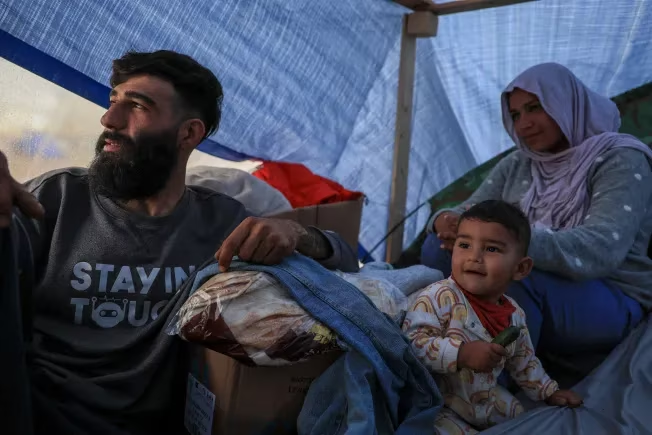
The tragedy of the displaced in the Gaza Strip is renewed with every downpour, as the atmospheric depression that hit the Strip today, Tuesday, revealed the fragility of living conditions in the overcrowded camps. Approximately 1.9 million people face harsh conditions inside dilapidated tents that lack the most basic protection, after the Israeli war machine destroyed their homes and turned them into homeless people in the open.

In the heart of Gaza City, specifically in Yarmouk Stadium, citizens rushed with primitive means to save what remained of their belongings and their children's bedding, which were completely submerged in water. These scenes reflect the extent of helplessness experienced by the displaced as they manually try to remove the mud and water that invaded their limited privacy, turning their lives into a daily struggle for survival.

As for the 'Al-Nour Shelter Center' camp west of the city, the roads have turned into stagnant pools surrounding the tents from all sides, hindering movement and increasing the isolation of the afflicted families. The displaced stand amidst the polluted water in a desperate attempt to save their simple possessions, while fears grow of the collapse of the remaining earthen barriers protecting their tents.

Medical and field sources warned of the danger of rainwater mixing with overflowing sewage, confirming that this contaminated mixture creates a fertile environment for the spread of epidemics, skin diseases, and intestinal illnesses. Reports also monitored a widespread proliferation of insects and rodents in neighborhoods such as Al-Zaytoun, as a result of the accumulation of waste and dirt amidst stagnant water that found no channels for drainage.

For its part, UNRWA clarified that obtaining fuel and essential cooking supplies has become a distant dream for the majority of families, in light of the insane rise in prices of scarce goods. The agency indicated that traditional kitchens have completely disappeared, replaced by primitive stoves that rely on burning wood remnants and plastic materials, which threatens public health.

Women and girls bear the greatest burden in this crisis, as they struggle to prepare food in polluted environments and near dense smoke that causes shortness of breath and chronic chest diseases. This physical and psychological burden is further complicated by the absence of any horizon for the end of suffering, and in light of a severe shortage of winter clothes and blankets to protect children from the cold of the night.

Despite a ceasefire agreement in effect since last October, the reality on the ground indicates the occupation's evasion of its commitments regarding the entry of humanitarian aid. Field reports confirm that the quantities of tents and shelter materials entering the Strip cover only a small fraction of the actual needs, leaving hundreds of thousands at the mercy of weather fluctuations.

Statistics indicate that the occupation does not allow more than 200 aid trucks to pass daily, while the Strip needs at least 600 trucks to meet basic needs and prevent famine. This deliberate tightening exacerbates the displacement crisis and makes the reconstruction process or even the provision of temporary housing alternatives impossible at present.

It is worth noting that the ongoing aggression has left a heavy toll exceeding 72,000 martyrs and approximately 172,000 injured, in addition to the destruction of 90% of the civilian infrastructure in the Strip. With the continued intermittent shelling of some sites, the lives of the displaced remain suspended between the danger of shells and the harshness of nature, amidst international silence regarding this escalating humanitarian catastrophe.

The situation has become dangerous after stagnant water mixed with sewage, which is contaminated and causes the spread of diseases and epidemics amidst a complete inability to confront them.

OPINIONS

Wed 08 Apr 2026 7:53 am - Jerusalem Time

A Fragile Pause on the Brink: Trump, Iran, and the Ceasefire Gambit


By: Said Arikat

April 8, 2026

News Analysis

Washington, D.C- At the edge of what could have erupted into a full-scale regional war, the announcement of a temporary ceasefire between the United States and Iran is less a triumph of diplomacy than a testament to high-stakes brinkmanship. President Donald Trump, having maneuvered the U.S. to the very edge of military confrontation, found himself in a corner: his maximum-pressure strategy, coupled with increasingly reckless rhetoric, had left few credible options besides escalation—or humiliation.

The two-week halt in hostilities, coming mere hours before anticipated U.S. strikes inside Iran, represents a carefully managed exit from the mess Trump had created. It is no coincidence that Pakistan played a pivotal mediating role. Islamabad’s ability to maintain trust with both Washington and Tehran allowed it to act as the “pulling force” that prevented Trump’s brinkmanship from tipping into outright war—a classic case of a mediator rescuing a leader trapped by his own strategy.

On paper, the agreement is simple: a mutual suspension of direct and indirect military operations in exchange for Iran’s immediate reopening of the Strait of Hormuz, the critical artery for global oil. The closure of the strait during the recent escalation sent shockwaves through energy markets, adding international pressure to Trump’s already self-imposed corner. By reopening it, Iran offered a concession with global economic impact while buying critical breathing room for itself—time to recover leverage and prepare for negotiations.

Trump framed the ceasefire as both restraint and strength, declaring that the United States did not seek war but remained fully prepared. He also emphasized that Israel had acceded to the truce, signaling a coordinated stance with key regional allies. This dual message is consistent with his signature style: blending bluster with the suggestion of flexibility. Yet the timing signals a deeper reality: a president cornered by his own aggressive posture, needing a credible intermediary to pull him back from potential catastrophe.

Behind the scenes, intense backchannel diplomacy unfolded, with Pakistan emerging as the indispensable broker. Its role underscores a broader truth about modern conflicts: even the most powerful nations sometimes require intermediaries to extricate them from situations they engineered themselves. International pressure also mattered. Major energy-consuming nations, wary of surging oil prices and economic instability, had strong incentives to push both sides toward de-escalation. Meanwhile, reports that U.S. forces were already at heightened readiness lend credibility to the idea that this was diplomacy conducted at the brink—where the threat of imminent violence becomes the leverage that makes negotiation possible.

Iran, for its part, entered the pause with a clear and calculated agenda. Its reported ten-point proposal aims not merely to freeze hostilities but to redefine regional rules of engagement. Key points include maritime security guarantees, phased sanctions relief, revised nuclear commitments, regional dialogue acknowledging Iran’s role, cyberattack moratoriums, and humanitarian measures such as prisoner exchanges. In effect, Tehran uses the ceasefire to translate its control over the Strait of Hormuz into leverage that could shape broader regional dynamics.

The United States faces a dilemma. On one hand, reopening the strait constitutes an immediate tactical win achieved without firing a shot. On the other, agreeing to broader Iranian terms would require policy shifts that may be politically uncomfortable for a U.S. administration already constrained by its own rhetoric and domestic politics. Trump’s cornering by his own strategy makes compromise a delicate dance—one requiring careful calibration and international brokerage.

Reports also suggest that the ceasefire’s effects could ripple beyond U.S.–Iran relations, potentially reducing tensions in Lebanon along Israel’s northern border. While unconfirmed, the prospect reflects how entangled regional conflicts are: a pause in one arena can affect multiple fronts, especially where state and non-state actors intersect.

Yet fragility is baked into this arrangement. Deep mistrust between the United States and Iran, coupled with the presence of proxies and regional allies, means that even a minor incident could unravel the ceasefire. For Trump, Pakistan’s mediation was not merely helpful—it was essential. The president’s brinkmanship had left no room for maneuver, and without Islamabad’s intervention, the U.S. risked entering a war it was poorly positioned to control.

From a strategic perspective, this ceasefire represents both opportunity and necessity. The U.S. avoids immediate military entanglement while retaining leverage. Iran halts escalation while projecting the possibility of broader negotiations, potentially easing sanctions pressures and securing political gains. But the margin for error is extraordinarily thin.

Looking ahead, three scenarios seem plausible. The first would see upcoming talks in Islamabad, involving senior U.S. officials including J. D. Vance, evolve into a durable agreement addressing core disputes. The second, more likely, is an extension of the ceasefire without breakthroughs, freezing the conflict in a state of uneasy stalemate. The third—and most dangerous—scenario involves a collapse: a field incident or proxy escalation could plunge the region back to the brink of war.

What makes this moment particularly significant is not the ceasefire itself, but the context: a president maneuvered into a corner by his own aggressive policy, needing external mediators to extricate him. It is a vivid illustration of the limits of unilateral power and the necessity of diplomacy, even—or especially—when force seems tempting.

History offers little reassurance. Ceasefires in this region often collapse due to violations or miscalculations. Yet the alternative—unchecked escalation—would be far worse, risking regional instability, global market disruption, and the involvement of additional powers. In that sense, even a tenuous ceasefire is preferable to full-scale confrontation.

In the end, this agreement is best understood as a reprieve, not a resolution. It creates breathing room for diplomacy without guaranteeing its success. It reduces immediate risk without eliminating it. And it underscores an enduring truth: in a world of high-stakes brinkmanship, the line between war and peace is often measured not in decisive victories, but in temporary pauses—moments when leaders step back from the edge, if only briefly. For Trump, it is both a narrow escape and a lesson in the perils of painting oneself into a corner: sometimes, survival requires the quiet intervention of others, as in this case, the indispensable mediation of Pakistan.


ARAB AND WORLD

Tue 07 Apr 2026 10:55 pm - Jerusalem Time

Tensions escalate in the Gulf as Trump's deadline to end the war on Iran begins to count down

The military confrontation led by the United States and Israel against Iran entered its sixth week, amidst intense anticipation as the countdown began for the deadline set by US President Donald Trump. Sources reported that the military strategy, which relied on the principle of 'shock and awe' and targeting senior command centers to cause political paralysis, did not lead to the expected collapse of the Iranian regime's structure. Instead, it revealed unexpected internal cohesion despite living and political pressures.

On the ground, bets on mobilizing separatist groups in Kurdish areas to open land breaches across the borders failed, leaving the fronts in a state of military stalemate. This impasse prompted decision-making circles in Washington to consider dangerous escalatory options, including the possibility of using tactical nuclear or chemical weapons to break Iranian defensive lines, which raises international concern about the region sliding into an unprecedented catastrophe.

Economically and navigationally, Tehran continues to impose strict restrictions on navigation in the Strait of Hormuz, exempting only ships belonging to China and India, in a move aimed at pressuring the global economy. In a related context, demands emerged from Iranian Supreme Leader Mojtaba Khamenei and Mohsen Rezaei for comprehensive financial compensation and a complete lifting of sanctions as a prerequisite for halting hostilities, while Doha demanded that Tehran bear its legal responsibilities for the damages resulting from the conflict.

The repercussions of the war were not limited to the Gulf but extended to affect global and regional markets, with gold prices in Egypt reaching record levels, with 21-carat gold reaching 7150 pounds. In contrast, major powers such as China began to fortify their energy security by boosting reserves and relying on local resources, in anticipation of a prolonged conflict that now threatens the stability of global supply chains.

The American-Israeli strategy, which relied on the 'shock operation' and targeting the top of the leadership pyramid, has not yet succeeded in achieving its desired political goals.

ARAB AND WORLD

Tue 07 Apr 2026 10:55 pm - Jerusalem Time

Russian-Chinese Veto Thwarts UN Security Council Resolution to Reopen Strait of Hormuz

The UN Security Council witnessed a sharp division today, Tuesday, leading to its failure to pass a draft resolution calling for the reopening of the Strait of Hormuz to international navigation. Both Russia and China used their veto power to strike down the proposal aimed at encouraging the escort of commercial vessels crossing the strategic strait.

The draft resolution, drafted by the Kingdom of Bahrain and widely supported by Gulf states and the United States, received the backing of 11 member states of the Council. In contrast, two permanent member states opposed the proposal, while two other members chose to abstain from voting in the session, which was marked by diplomatic tension.

These developments follow Tehran's decision, issued on March 2nd, to restrict navigation in the vital strait. Iran justified its move as a direct response to US-Israeli military operations that targeted security officials and prominent leaders, resulting in Iranian casualties.

The restrictions imposed on the strait have led to tangible global economic repercussions, with a sharp decline in the movement of oil and natural gas tankers. This decline directly impacted the increase in marine insurance costs and shipping fees, contributing to surges in energy prices and international inflation rates.

For his part, Bahraini Foreign Minister Abdullatif bin Rashid Al Zayani expressed the deep regret of the Gulf states over the obstruction of the UN resolution. Al Zayani, speaking on behalf of a bloc including Saudi Arabia, Qatar, Kuwait, the UAE, and Jordan, affirmed that this veto weakens the international organization's ability to protect international peace and security.

In the context of international interventions, the Pakistani representative to the United Nations stressed the need to give diplomacy an additional chance to resolve the crisis and avoid military escalation. He warned that continued tension in this sensitive region would lead to negative effects extending to the stability of the entire global economy.

On the American side, the US representative called on what he described as 'responsible' countries to unite to secure freedom of navigation in the Strait of Hormuz. Washington considered the protection of international waterways a collective responsibility that should not be subject to political tug-of-war or the narrow interests of certain powers.

In contrast, the Russian representative defended his country's position, indicating that Moscow intends to submit an alternative draft resolution in cooperation with Beijing to address the ongoing conflict in the Middle East. He explained that the Russian mission had previously engaged in negotiations to amend the Bahraini text, but the final version did not meet Russian reservations.

Informed sources reported that the resolution's failure was expected in the final moments despite amendments made to its draft during the negotiation phases. Diplomatic predictions suggest that the Gulf group may resort to the UN General Assembly to present the same project in the coming days to overcome the veto obstacle.

Russia and China's use of the veto sends the wrong message to the peoples of the world, implying that the threat to international waterways can go without a firm collective response.

PALESTINE

Tue 07 Apr 2026 10:55 pm - Jerusalem Time

Massacre in Al-Maghazi Camp: 10 Palestinians Martyred and Popular Anger Escalates Against Militias and Occupation

Al-Maghazi camp in the central Gaza Strip witnessed a horrific massacre yesterday, Monday, committed by the Israeli occupation forces in cooperation with affiliated armed militias, leading to the martyrdom of a number of people and dozens of injuries. Medical sources from Al-Aqsa Martyrs Hospital reported the arrival of the bodies of 10 Palestinian martyrs, in addition to a large number of injured people who were subjected to direct gunfire and shelling in the eastern areas of the camp.

Field details indicate that the attack began with the infiltration of armed groups from the direction of the Yellow Line, targeting a school belonging to the United Nations Relief and Works Agency (UNRWA) that was sheltering hundreds of displaced persons. These groups randomly opened fire inside the school and arrested a number of civilians, causing a state of extreme panic among the displaced families who had no means to defend themselves.

When the camp residents attempted to confront these armed groups, violent clashes erupted in the area, prompting the occupation army to intervene immediately to provide heavy fire cover. The occupation forces used warplanes and military vehicles to shell citizens, enabling the militias to withdraw after committing their crime against the residents who tried to protect their homes and shelters.

This incident sparked a wave of widespread anger on social media platforms, where activists circulated video clips documenting the first moments of transferring the victims to hospitals. Observers confirmed that what happened in Al-Maghazi was a treacherous crime targeting unarmed citizens who succeeded in cornering a group of agents before the occupation planes intervened to rescue them and shelled the area with "cowardice and treachery."

Palestinian activists stressed that the current stage requires national resolve towards those they described as "traitors" who operate under the command of the occupation army to carry out assassinations and kidnappings. They pointed out that these mercenaries receive financial and media support to dismantle the internal front, emphasizing that combating this phenomenon has become a top priority to protect the lives of displaced persons in border areas.

In a related context, tweeters drew attention to the ongoing suffering of thousands of displaced persons in the neighborhoods along the Yellow Line east of the Strip, where they face the daily risk of death away from the world's eyes. They explained that the past five months have not been without almost daily casualties and martyrs, as a result of repeated incursions carried out by gangs linked to the occupation with the aim of terrorizing the population.

This massacre comes amid the continued violations of the ceasefire agreement by the occupation army, with statistics indicating the killing of 723 Palestinians and the injury of about 1990 others since the agreement came into effect. These figures reflect the extent of ongoing Israeli violations targeting civilians in various areas of the Gaza Strip, amidst international silence regarding the crimes committed against displaced persons.

Every day that passes proves that the priority of our people is to fight traitors and those who promote and support them with money, media, and weapons.

ARAB AND WORLD

Tue 07 Apr 2026 10:54 pm - Jerusalem Time

Iranian Jews in the Face of Escalation: Military Involvement and Affirmation of National Identity Despite Synagogue Targeting

The Iranian arena is witnessing a state of national cohesion among its various religious components in light of the ongoing military escalation, with the prominent role of the Iranian Jewish community affirming its full involvement in defending the country's sovereignty. Field sources indicate that members of the community are actively participating in the armed forces, considering that anything affecting Iran's security impacts all its citizens without exception.

The Jewish community is locally known as the 'Kalimi community,' and it is a religion officially recognized in the Iranian constitution, where its members enjoy full citizenship rights. Community representatives emphasize in their statements that Iran represents the homeland and the nurturing mother for everyone, asserting that their national identity takes precedence over any other considerations in the face of external threats.

Statistical estimates indicate that the number of Jews in Iran ranges between 10,000 and 15,000 people, mainly distributed in major cities such as the capital Tehran and the cities of Shiraz and Isfahan. They freely practice their religious rituals in about 20 synagogues spread across the country, and their economic presence is prominent in traditional professions such as leather tanning and trade.

The Jewish presence in Persia is one of the oldest historical components in the region, with their roots dating back thousands of years. After the Iranian Revolution, a formula for national coexistence was reached that allowed them to fully integrate into the social fabric while preserving their religious particularity, which is reflected today in their performance of compulsory military service.

In a dangerous field development, media sources reported that recent missile attacks targeting the capital Tehran hit residential neighborhoods that include places of worship belonging to the community. The shelling caused significant material damage to surrounding buildings, raising concerns about the targeting of sensitive civilian and religious facilities.

Local press reports confirmed that the famous 'Rafi Nia' Synagogue in Tehran was completely destroyed as a result of raids launched in the early morning hours. This targeting carries highly sensitive political and social dimensions, given the symbolic status that places of worship represent in maintaining civil peace and coexistence among communities.

Observers believe that the targeting of Jewish synagogues in Iran sends complex messages, especially in light of the Jewish community's continuous affirmation of its loyalty to the Iranian state. Sources indicate that the collapse of parts of the synagogue and damage to neighboring homes reflects the extent of military violence that does not differentiate between military targets and historical religious facilities.

Despite these field pressures, the Kalimi community remains committed to its supportive stance towards the state, as its leaders believe that defending the land is a sacred duty that transcends international political differences. Jewish youth participate in military service alongside their Muslim, Christian, and Zoroastrian peers, which strengthens the concept of inclusive citizenship.

Sources indicate that the daily life of Jews in major Iranian cities is stable despite the atmosphere of war, as markets and religious centers continue to operate within available limits. However, the direct targeting of the neighborhoods they inhabit raises questions for the international community about the protection of religious minorities in times of armed conflict.

In conclusion, the situation of the Jewish community in Iran remains a unique model of coexistence in a region plagued by sectarian conflicts, where these citizens prove day after day that their belonging to Iranian land is the only constant in the face of the rapidly changing political and military variables affecting the region.

Iranian Jews affirm that this land is the homeland and mother for all, and that the first and last belonging is to the Iranian soil that unites all components.

ARAB AND WORLD

Tue 07 Apr 2026 10:54 pm - Jerusalem Time

International anticipation as Trump's deadline for Iran approaches, White House confirms: President alone decides

The White House announced in an official statement today, Tuesday, that President Donald Trump is the only person who knows the nature of the upcoming steps towards the Islamic Republic of Iran. This stance comes at a very sensitive time, with the approaching end of the deadline set by the American administration for Tehran to agree to the terms of an agreement that would end the current conflict.

In statements preceding the deadline, President Trump claimed that the goal of 'regime change' in Iran had already been achieved on the ground, pointing to the emergence of political trends he describes as 'less extreme'. Trump considered that these internal transformations might pave the way for a revolutionary event that would radically change the course of the region.

The American president emphasized in his speech that decades of what he described as 'extortion, corruption, and death' in Iran are approaching their inevitable end. He affirmed via his 'Truth Social' platform that tonight might witness the end of an entire civilization, expressing his unwillingness for that to happen despite his expectation of the worst-case scenario.

For his part, US Vice President J.D. Vance hinted at the possibility of Washington resorting to using 'new' and unprecedented tools in the context of this confrontation. International circles are awaiting 8 PM Washington time, which is the deadline for the American ultimatum directed at the Iranian leadership.

The American threats included an explicit promise of widespread destruction targeting vital civilian infrastructure across Iranian territory. The list of potential targets included strategic bridges and power generation stations, should a political agreement not be reached before the deadline expires.

On the ground, media sources reported that several sites inside Iran were subjected to strikes targeting infrastructure, including four major bridges hours before the end of the ultimatum. Air raids also targeted Kharg Island in the Gulf waters, a vital location that the Iranian oil sector primarily relies on for export operations.

In a related context, the White House quickly denied circulating reports about Washington's intention to use nuclear weapons against Iranian targets. American officials described these claims as misleading, in response to video clips attributed to Vice President J.D. Vance that were circulated on social media platforms.

On the Iranian side, press sources quoted officials in Tehran confirming that the Strait of Hormuz would not be opened in exchange for what they described as 'empty American promises'. Tehran expressed readiness to show flexibility only if it perceived a similar approach from the American side, emphasizing its categorical refusal to negotiate under threat.

The sources revealed that Pakistan continues to play the role of mediator in conveying diplomatic messages between the two parties in an attempt to defuse the crisis. However, reports indicated that the American administration has not changed its escalating tone, which complicates the chances of reaching precise understandings in the final moments.

In a firm internal reaction, Iranian Parliament Speaker Mohammad Bagher Ghalibaf stated that his country would not stand idly by in the face of external threats. Ghalibaf vowed to 'cut off the finger' that extends with a threat towards the Iranian nation or tries to force it to surrender, emphasizing the armed forces' readiness to respond.

All eyes are now on the next few hours, which will determine the course of the confrontation between Washington and Tehran, amidst international fears of a comprehensive regional conflict. The question remains whether these threats fall within the policy of 'brinkmanship' or are a prelude to a large-scale military operation.

An entire civilization will die tonight, and will never return. I don't want that, but it will most likely happen.

PALESTINE

Tue 07 Apr 2026 6:14 pm - Jerusalem Time

The Occupation Solidifies Division in Al-Aqsa: Facilitations for Settlers and Strict Restrictions on Worshippers

The occupied city of Jerusalem is witnessing a stark paradox in the management of the blessed Al-Aqsa Mosque, where the Western Wall plaza is expanding for Jewish worshippers, and restrictions on their numbers are being lifted, while the space available for Muslims to pray has been non-existent since the end of last February. This scene reflects a systematic Israeli attempt to redraw the boundaries of religious presence in the first of the two qiblas, exploiting current circumstances to impose a new reality.

In a move described as provocative, Israeli National Security Minister Itamar Ben-Gvir carried out an incursion into Al-Aqsa on Monday evening, with the aim of paving the way for new policies that grant settlers additional privileges. The Israeli Supreme Court recently approved an increase in the number of Jewish worshippers at the Western Wall from 50 to 100 people, in response to petitions demanding the expansion of Talmudic prayers.

Field sources observed dozens of settlers lining up in long queues in front of Bab al-Khalil (Jaffa Gate) in the Old City, in preparation for their crossing towards the Western Wall plaza to perform rituals for the Jewish Passover holiday. These crowds come at a time when the occupation police continue to tighten their grip on Palestinians and prevent them from accessing Al-Aqsa Mosque, turning the plazas into areas almost devoid of their owners.

The extremist Minister Ben-Gvir agreed with the police leadership on a new mechanism for opening Al-Aqsa Mosque to small groups not exceeding 150 people per round. Observers believe that this measure aims to equate the number of Muslim worshippers with the invading settlers, which is considered a dangerous leap towards the actual temporal and spatial division of the mosque.

For his part, academic researcher Saher Ghazawi affirmed that these practices fall within an accelerating path through which the occupation seeks to impose field realities based on politically employed religious narratives. Ghazawi explained that the occupation authorities exploit the state of emergency selectively, applying restrictions to Palestinians while facilitating the movement of settlers and their crowds around the Old City.

Ghazawi added that Ben-Gvir's recent incursion represents a deliberate political step to pave the way for intensifying mass incursions coinciding with the end of Passover holidays. This coincides with an escalation of restrictions on the Islamic Endowments Department and its employees, in a clear attempt to seize its powers and reduce its historical role in managing the affairs of Al-Aqsa Mosque.

Current developments indicate that the occupation is pushing towards an advanced stage of the project of complete control, driven by extremist religious discourse that employs myths to justify changing the status quo. Occupation leaders exploit regional weakness and international preoccupation to pass these schemes that directly target the Arab and Islamic identity of Jerusalem.

Al-Quds International Foundation warned that the decision to limit the number of worshippers to 150 people is 'dust in the eyes' and aims to deepen the division of the mosque. The foundation explained that this number does not fill a single row in the Qibli Mosque, which practically means keeping the mosque closed to Muslims and fully open to organized incursions by settlers.

The foundation considered that opening the mosque to invaders during the Jewish holiday after closing it throughout Ramadan and Eid al-Fitr proves the employment of war to change Al-Aqsa's identity. It also criticized the Supreme Court's delegation of authority to Minister Ben-Gvir to control the mosque's affairs, considering it an explicit annulment of the Jordanian role and the Hashemite custodianship over the holy sites.

Holy bodies issued a call to the Palestinian people to march towards Al-Aqsa Mosque and break the siege imposed on it by praying at the gates and thresholds. They stressed that imposing the opening of the mosque without restriction or condition is the duty of the hour to confront the Judaization attempts that have reached unprecedented levels of danger.

In conclusion, Al-Aqsa Mosque remains a sovereign and civilizational symbol uniting the nation, where Palestinian identity and existence intersect in the face of the occupation machine. The ongoing transformations necessitate the restoration of popular and official action to confront the partition projects that seek to transform the mosque into a shared holy site in preparation for its complete control.

The occupation seeks to impose new realities on the ground to implement its projects based on politically employed religious narratives.

ARAB AND WORLD

Tue 07 Apr 2026 6:14 pm - Jerusalem Time

Trump Calls Iranians 'Animals' and Justifies Targeting Infrastructure to Prevent Nuclear Weapons

US President Donald Trump made hostile statements against Iran during his participation in Easter celebrations at the White House, where he faced journalistic questions about the legality of targeting civilian infrastructure. Trump considered his threats to destroy Iranian power plants and bridges not to fall under war crimes, but rather a strategic necessity if tensions continued in the Strait of Hormuz.

In response to criticism, the US President claimed that the Iranian regime committed massacres against protesters, leading to the death of approximately 60,000 people in just one month. Trump used harsh language, describing opponents as 'animals,' emphasizing that the international community is obligated to act to stop what he described as continuous violations within Iranian territory.

Regarding the legal controversy related to targeting non-military facilities, Trump turned the tables, considering that the real crime lies in allowing Tehran to possess nuclear weapons. He clarified that all proposed military options primarily aim to prevent Iran from acquiring an atomic bomb, which he sees as a moral justification for using excessive force against vital targets.

Academically, researchers have linked Trump's rhetoric to a recurring historical pattern that relies on dehumanizing opponents to facilitate public acceptance of violence. Specialized studies on asymmetric warfare indicate that describing the enemy as an 'animal' aims to reduce the moral and psychological barriers that prevent harming civilians or destroying national capabilities.

Research reports confirm that this type of political discourse serves an ideological function that goes beyond mere verbal insult, as it removes the targeted party from the circle of human empathy. This approach makes the use of excessive military force justifiable and reduces the human rights pressures that the US administration might face if it carries out its threats.

On the level of public interaction, social media platforms were flooded with angry reactions that considered Trump's statements direct incitement threatening international stability. Observers believed that this language reflects the increasing external influences on American decision-making, warning that such descriptions undermine the moral standing of the United States and weaken its leadership role in the global system.

They are killing protesters, they are animals and we must stop them.

ARAB AND WORLD

Tue 07 Apr 2026 6:14 pm - Jerusalem Time

Anger in Lebanon after Lebanese Forces official and his wife killed in Israeli raid east of Beirut

A state of popular and political anger prevailed in Lebanon following the targeting of an apartment in the Ain Saadeh area east of the capital Beirut, which resulted in the killing of the head of the Lebanese Forces center in the town of Yahchouch, Keserwan, Pierre Moawad, his wife, and another woman who was with them. This incident came after a raid carried out by the Israeli occupation army's navy, targeting a building in the Maronite Project, while Israeli army radio later admitted the failure of an assassination attempt targeting a cadre in the Iranian Quds Force at the same location.

For his part, the head of the Lebanese Forces party, Samir Geagea, clarified the circumstances of the incident, indicating that the data confirms the occupation's targeting of a Quds Force element, which led to the collapse of the old building's roof onto Moawad's home. Geagea criticized what he described as the 'deep state' that preferred silence instead of confronting the dangers threatening the lives of safe citizens in their homes, stressing that responsibility lies with the security agencies in identifying the parties that pose a threat to civil peace.

In a related context, MP Shawki Daccache considered that the feelings of anger sweeping through Lebanese Forces supporters are completely justified after the violation of the security of their homes and their transformation into military targets. Daccache stressed that the party is still awaiting official reports from the Lebanese security agencies, demanding firm measures to prevent the recurrence of such crimes that claim the lives of innocent people as a result of the presence of armed elements in densely populated residential areas.

In turn, MP Ghayath Yazbek launched a sharp attack on the 'mini-state' logic that is expanding at the expense of the state, considering that the killing of Moawad and his wife represents a collapse of the logic of protection and law in Lebanon. Yazbek called on the Lebanese army command to intensify its presence in areas that adhere to legitimacy, in order to protect them from security breaches instigated by Hezbollah fighters and Iran-linked parties, who endanger the lives of civilians without regard for the consequences.

Regarding other political stances, the Free Patriotic Movement called on Hezbollah cadres to bear moral responsibility and refrain from hiding or residing among displaced persons and civilians in safe areas. The movement called in a statement for limiting the presence of fighters to actual confrontation fronts only, in order to preserve the national fabric and prevent giving pretexts to the Israeli occupation to continue its crimes against Lebanese people not involved in the fighting.

MP Fouad Makhzoumi also called on the Prime Minister to take practical decisions instead of merely issuing slogans, calling for an immediate meeting of the Supreme Defense Council to raise security readiness to its maximum limits. Makhzoumi proposed mandatory registration of all tenants and occupants of residential apartments and subjecting empty properties to strict periodic monitoring, with penalties including imprisonment for anyone proven to be involved in renting apartments to targeted elements without official permission.

In conclusion of the reactions, the head of the Maronite League, Maroun Helou, asked about the timeframe during which civilians will remain vulnerable to death as a result of a war imposed on them, demanding the necessity of a sense of responsibility among all parties. These developments come amidst a heavy security deployment in the Ain Saadeh area, amid popular calls to expel tenants suspected of belonging to military organizations to avoid future Israeli strikes that may affect innocent people.

What happened is that the Israelis were targeting an element of the Quds Force, and a strike was directed at an old building, which led to the collapse of the roof onto the home of our comrade Pierre Moawad.

PALESTINE

Tue 07 Apr 2026 6:14 pm - Jerusalem Time

Gaza Health Ministry Launches Distress Call: Medical System Enters Catastrophic Phase, Drug Shortage Exceeds 50%

The Palestinian Ministry of Health in the Gaza Strip issued a strong warning on the occasion of World Health Day, confirming that the health system has reached a stage described as "catastrophic." The ministry explained that this deterioration is a result of the systematic and continuous Israeli targeting of hospitals and medical facilities, making access to treatment a daily battle for survival.

Official data released by the ministry revealed shocking figures regarding drug shortages, with the deficit in essential medicines exceeding 50%. Medical consumables also recorded a deficit of 57%, while the shortage of laboratory testing materials reached about 71%, paralyzing the ability of laboratories to diagnose medical conditions.

Oncology services are the most affected by this medical blockade, with 4,100 cancer patients in the Strip facing a real danger due to a 61% shortage of specialized medicines. Primary care, neurology, kidney, surgery, and intensive care departments also suffer from a severe shortage of essential medicines exceeding 40%, threatening the lives of thousands of patients with chronic conditions.

Regarding complex surgical operations, the ministry announced the complete cessation of open-heart and cardiac catheterization operations due to the depletion of necessary resources and equipment. Reports also indicated a severe shortage of eye surgery supplies, reaching 89%, which caused the postponement of hundreds of essential operations to save patients' eyesight.

In terms of medical infrastructure, 22 out of 38 hospitals are completely out of service, in addition to the closure of 90 health centers due to direct damage. This destruction has led to a more than 55% reduction in hospital bed capacity, at a time when the number of wounded and injured due to the ongoing aggression is increasing.

Medical sources warned that the severe shortage of fuel, oils, and spare parts for generators threatens to halt the remaining health services at any moment. The sources explained that only 108 dialysis machines are currently operating to serve 676 patients, a number insufficient to meet the growing needs under the current circumstances.

Regarding human resources, the ministry confirmed the continued detention of 83 medical personnel by the occupation forces since October 2023, exacerbating the crisis of specialized expertise shortages. The remaining medical teams face immense pressure to work in harsh conditions with almost no resources to provide the minimum level of healthcare.

As for medical referrals, the waiting lists for travel abroad for treatment reached 21,367 patients and injured individuals, including 195 cases in very critical health conditions. The ministry recorded the deaths of 1,517 patients while awaiting their turn to travel, despite the very limited opening of the Rafah crossing, allowing no more than 50 people per day.

Despite ceasefire agreements, the occupation authorities continue to prevent the entry of agreed-upon quantities of humanitarian and medical aid into the Strip. This intransigence directly affects 1.5 million displaced people living in deteriorating health and environmental conditions, contributing to the spread of diseases and epidemics among the population.

It is worth noting that the Israeli aggression since October 7, 2023, has resulted in a heavy toll of over 72,000 martyrs and 172,000 injured. The continuous bombing has also destroyed 90% of civilian infrastructure, making the reconstruction and rehabilitation of the health sector a tremendous challenge requiring urgent international intervention.

The right to treatment has become a daily battle for survival, where the most vulnerable groups are deprived of the most basic forms of healthcare, and surgeries are performed under extremely harsh conditions.

PALESTINE

Tue 07 Apr 2026 6:14 pm - Jerusalem Time

International Study: War on Iran Establishes It as a Fourth Global Power and Reshapes the Geopolitical Order

Recent political analyses have confirmed that the military confrontation led by the United States and Israel against Iran has backfired, transforming Tehran into a fourth global power competing with the three traditional poles. Observers believe that previous assumptions, which confined power to direct economic and military size, have collapsed in the face of the ability to control vital waterways.

Iran derives its escalating power from its strategic control over the Strait of Hormuz, the artery that feeds the global economy with about a fifth of oil and LNG supplies. With the war entering its sixth week, Tehran has proven its ability to impose a new geopolitical reality that transcends the traditional military capabilities of Washington and its allies in the region.

The joint military campaign launched last February pushed the Iranian side to implement a selective military blockade on the Strait, leading to a decline in shipping traffic by more than 90%. This decline did not result from a complete closure of the passage, but rather from a strategy of intermittent targeting that caused international insurance companies to withdraw their risk coverage.

Sources reported that insurance companies re-priced war risks, making shipping through the Gulf economically unfeasible for many countries. Targeting just one ship every few days is enough to shake the confidence of global markets, transforming the energy issue from commercial contracts into complex strategic challenges facing major governments.

In the context of international positions, French President Emmanuel Macron considered that attempting to open the Strait of Hormuz by military force is an unrealistic step at present. Macron indicated that ensuring energy flow can only be achieved through coordination channels with Iran, which is an implicit recognition of Iran's new influence.

The old order, which was based on the United States securing waterways in exchange for oil flowing at market-determined prices, has begun to effectively collapse. Gulf countries today find themselves compelled to deal with a new reality that requires responding to the party capable of directly influencing the reliability of their exports, which is Iran at this stage.

Attention is turning to Asian powers such as Japan, South Korea, and India, which suffer from deep dependence on Gulf energy linked to infrastructure that cannot be quickly replaced. Any continued disruption in supplies will inevitably lead to global inflation and weakness in national currencies, bringing back memories of the recession crises the world witnessed in the 1970s.

On the ground, American strategies that bet on creating a political vacuum by targeting the top leadership in Tehran have failed. Instead of collapse, Iranian society showed national cohesion, while attempts to mobilize separatist groups in border areas to open military gaps faltered.

Reports indicate that Washington is considering dangerous escalatory options, including the use of tactical nuclear weapons or chemical weapons to break the current military stalemate. These trends come amid the inability of conventional forces to permanently secure navigation against Iranian drone attacks and naval mines.

Meanwhile, Iran continues to exempt Chinese and Indian ships from navigation restrictions, which strengthens its Eastern alliances and weakens Western pressures. Russia, in turn, benefits from rising and fluctuating energy prices, while China strengthens its strategic reserves to face the repercussions of a long war.

Iranian Supreme Leader Mojtaba Khamenei and prominent officials such as Mohsen Rezaei demanded huge financial compensation and a complete lifting of sanctions as a prerequisite for halting hostilities. These demands reflect the Iranian leadership's confidence in its negotiating position resulting from its control over global energy hubs.

The economic repercussions were not limited to energy but extended to precious metals markets, where the price of gold in regional markets jumped to record levels. This rise reflects the global panic over the conflict turning into a long-term war of attrition that will change the features of the international economy.

A grim scenario emerges, speaking of the formation of an energy 'cartel' comprising Iran, Russia, and China, which could deprive the West of about 30% of global oil supplies. Such a shift would mean a sharp decline in American and European influence in favor of rising Eastern powers in the new international order.

The United States finds itself facing two unpalatable choices: either engage in a long and costly military battle to regain control of the Strait, or accept a new world order in which Iran is a fourth center of power. In either case, the international order that emerged after World War II is undergoing an irreversible change.

Opening the Strait of Hormuz by force is unrealistic, and stable flows can only be achieved through coordination with Tehran.

OPINIONS

Tue 07 Apr 2026 4:31 pm - Jerusalem Time

Trump's Threat to Iran: Brinkmanship and the Embellishment of Political Failure

Donald Trump's threat that "an entire civilization will die tonight" was not merely a slip of the tongue or a fleeting exaggeration, but an intense discourse carrying multiple messages that extend beyond the surface of the phrase to the depths of political and military strategy at a highly sensitive moment. Ostensibly, the statement appears as a final ultimatum directed at Iran: either accept the terms of negotiation or face a devastating strike. But in reality, this type of language belongs to what can be called brinkmanship diplomacy, where the threat is amplified to the maximum possible extent to force a quick decision on the adversary without actually having to execute it.

To understand the code behind this statement, one must consider the target audience, which is not only directed at the Iranian leadership but also includes regional and international allies and the American domestic public. The message to the Iranian leadership aims to destabilize the cost calculations of decision-makers by implying that the United States is prepared to go beyond traditional rules of engagement and expand the scope of strikes to include vital infrastructure, not just military targets. The goal is not annihilation, but rather to cripple the state and impose psychological and strategic pressure on the leadership.

As for allies, especially in the Gulf and Europe, Trump seeks to reassure them that the United States is still capable of decisive action and controlling the situation despite navigation disruptions and rising energy prices, presenting himself as a decisive leader who holds the initiative. For the American domestic audience, this escalatory rhetoric is used to justify the continuation of the war or to market any subsequent settlement as a victory achieved under threat.

The phrase "an entire civilization" most likely does not refer to literal comprehensive destruction, but rather to widespread strikes targeting energy networks, transportation infrastructure, communication centers, and sensitive economic facilities—that is, crippling the state, not annihilating the people. This is a known pattern in modern warfare where the battle shifts from the military front to the heart of the state. However, raising expectations to such a high level with this grandiose language narrows the margin for retreat, and any partial execution of the threat could lead to uncalculated reactions from Iran, such as expanding proxy attacks or threatening navigation, which highlights the fundamental contradiction between rhetorical power and realistic options on the ground.

One of the most realistic interpretations of Trump's threat lies not so much in the intention to escalate as in managing the image of the outcome before it occurs. Trump's political history shows a clear tendency to raise demands to the maximum, not necessarily to achieve them literally, but to use them as a negotiating tool that enables him to declare victory even when accepting a much lesser settlement. From this perspective, Trump might be ready to accept a low-ceiling proposal, but he presents it as if it were the highest ceiling proposed by the United States, and upon reaching an agreement, he will announce that the Iranians have agreed to his terms, making Iran appear as if it has fully submitted to his will.

This threat represents the highest ceiling Trump could launch, and perhaps the highest in the history of his political speeches, which indicates that a real agreement might be approaching. It allows him to justify ending a war that proved his and his ally Netanyahu's misjudgment, a war that was not well-prepared for and was in part a failure. At the same time, Iran remains stronger in the long run than it was before the war, and perhaps the war has given it a new position in the region, showing that dealing with Iran cannot be done lightly or with a simplistic assessment of its capabilities and strategic flexibility.

In the end, Trump's threat is not a declaration of imminent disaster as much as it is a negotiating tool and a political strategy. It is the language of brinkmanship used to force the adversary to retreat, and to manage the impression among allies and the domestic public, but it always carries the risk of falling, and clearly illustrates the contradiction between rhetorical power and realistic options on the ground, emphasizing that the results in such conflicts are not measured only by what happens on the ground, but by how they are narrated to the public after they end.

ARAB AND WORLD

Tue 07 Apr 2026 4:31 pm - Jerusalem Time

Race Against Time: Intensive Pakistani Mediation to Avert Military Confrontation Between Washington and Tehran

The current crisis between the United States and Iran has entered a highly sensitive phase, coinciding with the approaching deadline set by US President Donald Trump for a new agreement. These developments come amidst intensive diplomatic efforts led by Pakistan to reach common ground and prevent the region from sliding into an open military confrontation.

Informed sources reported that Islamabad has intensified its efforts in recent hours to mediate between the two parties, aiming to contain the escalation and ensure that the Strait of Hormuz is not closed. Pakistani diplomacy seeks to bridge viewpoints, despite the significant difficulties facing the negotiation process so far.

For his part, US Vice President J.D. Vance stated that the next few hours will be crucial and will witness intensive negotiations with the Iranian side. Vance expressed confidence in receiving a response from Tehran before evening, emphasizing Washington's anticipation of a positive response that would end the current state of tension.

In a related context, sources quoted Pakistani officials as saying that communication with the Iranian leadership is continuous and uninterrupted, with strenuous efforts being made to persuade both parties to sit at the negotiating table. A security official indicated that Tehran has shown some flexibility, but still adheres to a set of essential preconditions.

Iranian conditions for establishing lasting peace include the immediate cessation of all forms of attacks and obtaining binding international guarantees that they will not recur in the future. Tehran also demands financial compensation for the damages it has incurred, affirming its rejection of any temporary ceasefire formula that does not guarantee its full rights.

There was also a notable Iranian demand concerning the Strait of Hormuz, where Tehran insists that any agreement include its right to impose transit fees on commercial vessels. According to the Iranian proposal, these fees would be determined based on the type of vessel, its cargo, and the security conditions surrounding navigation in the region.

On the international front, China has entered the crisis, affirming its support for all initiatives aimed at achieving stability and overcoming differences through dialogue. The Chinese Foreign Ministry stressed the need to protect civilians and vital installations to avoid catastrophic repercussions on the global economy, which relies on energy supplies.

In contrast, Iranian media sources revealed that President Trump is seriously seeking to reach an agreement that would end the current crisis. Reports indicated that Washington has presented a proposal that includes the exclusion of some figures close to the Israeli government from the negotiating team, in an attempt to build trust with Tehran.

Leaked information suggests that Iran has received calls from leaders of five countries and multiple international intelligence agencies in recent days. These calls focused on the need for restraint and avoiding any escalatory steps that could lead to an uncontrollable explosion of the situation in the Middle East.

Despite the threats, American sources stated that Trump might postpone any military action against Iran if genuine signs of progress emerge in the diplomatic track. The US President is known for using deadlines as a pressure tool, with the possibility of extending them if political necessity dictates.

For its part, the White House remained cautious, indicating that the final decision rests solely with President Trump, whether to de-escalate or implement military threats. All options remain on the table, awaiting the outcome of the final hours before the specified deadline expires.

In an assessment of the situation, international journalistic sources believed that the gap between Washington and Tehran remains wide and difficult to bridge in a short time. These sources suggested that the region might witness limited military strikes on Tuesday evening if a sudden diplomatic breakthrough does not occur to change the course of events.

We are confident that we will receive an answer from the Iranians by 8 o'clock, and we hope it will be the correct answer.

ARAB AND WORLD

Tue 07 Apr 2026 4:31 pm - Jerusalem Time

Trump threatens to end 'Iranian civilization' as zero hour approaches for opening Strait of Hormuz

US President Donald Trump issued a stern warning to the Iranian leadership, threatening to end the country's existence as a civilization if it does not comply with American demands and sign a new agreement. These statements come as the deadline set by Washington for opening the Strait of Hormuz to international navigation approaches, amid a state of global alert in anticipation of what the field and political situations will lead to.

In a controversial post on the 'X' platform, Trump indicated that tonight might witness the end of a 47-year era of what he described as 'extortion, corruption, and death.' The US President affirmed that a radical change in the structure of the Iranian regime has already been achieved, claiming the emergence of new leaders and minds characterized by greater intelligence and less extremist orientations than their predecessors, which paves the way for a pivotal stage in the region's history.

Trump described the coming hours as one of the most important moments in complex global history, emphasizing his seriousness in implementing military threats if a political solution is not reached before the deadline. The White House had set 8:00 PM Eastern Time as the final deadline for implementing American conditions, affirming that there was no intention to extend this deadline under any circumstances.

On the diplomatic front, sources reported that the Pakistani capital, Islamabad, has intensified its shuttle diplomacy in a last-ditch effort to defuse the escalating crisis between Washington and Tehran. Pakistani mediation seeks to find a consensual formula that prevents both parties from sliding into a direct military confrontation that could ignite a widespread regional war, in light of American threats to target vital infrastructure.

It is worth noting that American threats were not limited to political aspects, but also included a vow to launch intensive airstrikes targeting all power stations and vital bridges throughout Iranian territory within one day. Observers believe that this escalatory rhetoric puts the international community to a real test to prevent a humanitarian and military catastrophe in one of the world's most sensitive regions economically and security-wise.

An entire Iranian civilization will die tonight and will never return, and I don't want that to happen, but it most likely will.

PALESTINE

Tue 07 Apr 2026 4:31 pm - Jerusalem Time

Widespread Arab Condemnation of Ben-Gvir's Storming of Al-Aqsa and Warnings of Imposing a New Judaization Reality

Arab and Islamic countries strongly condemned the storming of the courtyards of the blessed Al-Aqsa Mosque again by the extremist Israeli National Security Minister, Itamar Ben-Gvir. These official stances came in separate statements issued by Saudi Arabia, Egypt, Qatar, Jordan, and Palestine, describing the move as a blatant assault and an unacceptable provocation to the feelings of Muslims around the world.

Sources reported that Ben-Gvir carried out his incursion through the Mughrabi Gate under tight security protection from occupation forces, where he conducted a provocative tour in the courtyards of Al-Haram Al-Sharif. This violation coincided with the continued closure of Al-Aqsa Mosque by the occupation authorities to Palestinian worshippers for the thirty-ninth consecutive day, which intensified the popular and official anger.

For its part, the Saudi Ministry of Foreign Affairs expressed its strong condemnation of this action, describing it as a blatant incursion that defies international will. The Kingdom affirmed its categorical rejection of such practices that undermine peace efforts and target the existing legal and historical status in occupied Jerusalem.

In Cairo, the Egyptian Ministry of Foreign Affairs considered the Israeli minister's move a dangerous escalation and a clear violation of the provisions of international law and international humanitarian law. It stressed that these provocations aim to change the religious identity of the holy sites, warning of the catastrophic consequences of such policies on regional stability.

In turn, the State of Qatar condemned the incursion and considered it a blatant violation of Islamic rights, calling on the international community to bear its moral and legal responsibilities towards Jerusalem. Doha affirmed the necessity of firmly confronting repeated Israeli violations that affect the religious and historical status of the blessed Al-Aqsa Mosque as a place exclusively for Muslims.

As for Jordan, it described the incursion as a flagrant breach and a violation of the sanctity of holy sites, warning against the occupation's attempts to impose temporal and spatial division in the mosque. Amman reiterated its condemnation of restricting freedom of worship and closing the mosque's doors to worshippers, affirming that the Hashemite custodianship will remain an impenetrable barrier against continuous Judaization attempts.

In the Palestinian context, the Ministry of Foreign Affairs demanded the immediate opening of Al-Aqsa Mosque and the Church of the Holy Sepulchre to worshippers, condemning the systematic policy of imposing a fait accompli by force. The ministry held the occupation government fully responsible for these violations, calling on international institutions to take urgent action to ensure freedom of worship and hold those responsible for these crimes accountable.

For its part, the Palestinian Ministry of Awqaf called for immediate action to defend Al-Aqsa Mosque, considering Ben-Gvir's incursion in the absence of worshippers to be of great danger. The ministry clarified that what the far-right government is doing is an assault on a purely religious site with an area of 144 dunams, and non-Muslims have no right to interfere in its affairs.

The Awqaf emphasized that the issue of the mosque's closure and daily siege must become an issue of international public opinion, given the fierce attack it is subjected to as the first of the two Qiblas. It appealed to Islamic and Arab institutions to fulfill their historical duties to prevent the entrenchment of a new reality aimed at obliterating the Arab and Islamic identity of occupied Jerusalem.

Regarding the factions, the Hamas movement said that Ben-Gvir's incursion reflects the occupation's insistence on imposing full sovereignty over Al-Aqsa through a systematic Judaization approach. Hamas leader Abdul Rahman Shadid affirmed that this action represents the peak of occupation arrogance, especially as it comes at a time when Palestinians are deprived of praying in their mosque.

Shadid added that the occupation seeks to empty Al-Aqsa Mosque and leave it an easy prey for settler incursions and their repeated attacks aimed at changing its features. He stressed that the Palestinian people will not stand idly by in the face of these attempts that target their holiest sites, calling for escalating steadfastness and resistance against these schemes.

Field reports indicate that occupation forces have tightened their military measures around the Old City, turning it into a military barracks to secure settler and official incursions. These developments come amid warnings that the continuation of these violations could lead to an explosion of the situation in all Palestinian territories.

Observers believe that the timing of the incursion with the prolonged closure of the mosque indicates a premeditated intention to establish new facts on the ground that go beyond previous international understandings. Palestinians affirm that Israel is intensifying its attacks to Judaize Jerusalem and obliterate its Arab identity, including both Islamic and Christian holy sites.

In conclusion, Al-Aqsa Mosque remains the primary focal point of the conflict, as popular and official activities continue to call for pilgrimage to it despite all obstacles and barriers. National forces demand the necessity of a firm international stance that goes beyond condemnation statements to actual measures that stop the Israeli encroachment in the holy city.

The extremist minister's storming of Al-Aqsa Mosque represents a continuation of the occupation's arrogance and its deliberate intention to undermine the sanctity of the mosque and empty it of worshippers.

PALESTINE

Tue 07 Apr 2026 4:30 pm - Jerusalem Time

A Reading on the Stalling of 'Shock and Awe': Why Did American-Israeli Bets Fail to Break Iran?

The American-Israeli war on Iran entered its sixth week since its outbreak in late February, amidst increasing indications of the stalling of the 'shock and awe' strategy that Washington and Tel Aviv had relied upon. The plan aimed to paralyze the Iranian administration through targeted strikes against the leadership, betting on a sequential collapse of state institutions and a severe vacuum in the political and security decision-making center.

Field realities proved that the Iranian state did not enter the expected state of paralysis; instead, the first strike turned into a factor of comprehensive national mobilization. Instead of the regime disintegrating, Tehran showed a high capacity to absorb the shock and reposition itself, transforming the battle in popular consciousness from a political dispute into a battle for national survival and existence that transcends internal divisions.

The second failure in Western calculations was the bet on mobilizing separatist groups, especially in Kurdish areas, to open border breaches that would multiply pressure on the interior. However, Iranian border cohesion prevented the creation of a new field reality, and border cities remained under full control, which shattered the illusion of a 'short war' in which parties quickly collapse.

On the social level, the American-Israeli project collided with a hard truth: the vast majority of Iranians rejected external war. Despite political differences, the masses placed national sovereignty at the forefront of priorities, which thwarted attempts to mobilize the street to overthrow government institutions from within, described by observers as 'the suicide of hostile psychological and propaganda bets'.

Sources reported that the current military stalemate pushed the political and military minds in Washington and Tel Aviv to consider higher degrees of dangerous escalation. Talk of using tactical nuclear or chemical weapons emerges as evidence of the strategic impasse, as the attacking powers seek to compensate for their inability to achieve a conventional decisive victory through unprecedented destructive tools.

Meanwhile, Tehran continues to impose strict restrictions on navigation in the Strait of Hormuz, with clear exceptions granted to Chinese and Indian vessels. This measure aims to pressure the global economy while maintaining strategic alliances that ensure the flow of essential supplies, at a time when the Iranian leadership insists on receiving full compensation for war damages.

Iranian Supreme Leader Mojtaba Khamenei clearly threatened to confiscate the assets of 'enemies' if the required compensations were refused, a stance supported by Mohsen Rezaei, who conditioned the lifting of sanctions as an entry point for any political path. These demands reflect Iranian confidence in its ability to endure long-term and turn the burden of war into a heavy political and financial cost for the aggressor.

Internationally, the repercussions of the conflict began to appear clearly in energy and commodity markets, with gold reaching record levels in the Arab region, and the price of 21-carat gold in Egypt reaching 7150 pounds. This economic turmoil places additional pressure on the American administration, which faces increasing international criticism for targeting infrastructure and civilians in Iran.

China, for its part, prepared early for this crisis by strengthening its oil reserves and increasingly relying on local coal for the production of chemicals and fertilizers. Beijing has become a pivotal player in mitigating the impact of the blockade on its allies, while countries such as Vietnam and the Philippines have requested its assistance to cope with severe energy shortages resulting from the closure of waterways.

Regionally, Qatar demanded that Iran bear its legal responsibilities and pay compensation for damages, in an attempt to balance international legal positions. These demands are based on United Nations documents that define forms of reparation and compensation, although the United States still refuses to recognize the jurisdiction of the International Court of Justice in this context, considering it 'politicized'.

The shift from the logic of military decisiveness to the logic of 'expanding pain' on civil society reflects a clear strategic bankruptcy, according to analysts. A state that fails to achieve victory on the battlefield usually resorts to destroying the foundations of daily life, which creates a historical stigma without guaranteeing the achievement of the political goals for which the war erupted.

The war that Washington and Tel Aviv wanted to be swift and decisive has turned into an attrition that revealed the limits of material power against the will of peoples. The current experience has proven that Iran is not an 'easy target', and that betting on dismantling states through assassinations or economic pressures often leads to counterproductive results that increase the cohesion of the internal front.

Ultimately, the great strategic truth remains that wars are not decided solely by the military arsenal armies possess, but by the ability of nations to persevere. As the war enters its sixth week, Iranian will appears to have shown unexpected resilience, placing planners in Washington before choices, the least bitter of which is withdrawal or suicidal escalation.

The scene remains open to all possibilities, with increasing warnings of the region sliding into an unconventional conflict that could change the face of the Middle East forever. As the fires continue to burn, civilians remain the weakest link in an international and regional conflict whose end does not appear to be near in the foreseeable future.

A war that begins on the basis of a mistaken perception of the nature of the adversary is doomed from the outset to produce adverse results.