







By: Said Arikat
April 8, 2026
News Analysis
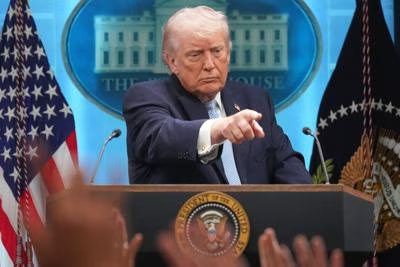
Washington, D.C- At the edge of what could have erupted into a full-scale regional war, the announcement of a temporary ceasefire between the United States and Iran is less a triumph of diplomacy than a testament to high-stakes brinkmanship. President Donald Trump, having maneuvered the U.S. to the very edge of military confrontation, found himself in a corner: his maximum-pressure strategy, coupled with increasingly reckless rhetoric, had left few credible options besides escalation—or humiliation.
The two-week halt in hostilities, coming mere hours before anticipated U.S. strikes inside Iran, represents a carefully managed exit from the mess Trump had created. It is no coincidence that Pakistan played a pivotal mediating role. Islamabad’s ability to maintain trust with both Washington and Tehran allowed it to act as the “pulling force” that prevented Trump’s brinkmanship from tipping into outright war—a classic case of a mediator rescuing a leader trapped by his own strategy.
On paper, the agreement is simple: a mutual suspension of direct and indirect military operations in exchange for Iran’s immediate reopening of the Strait of Hormuz, the critical artery for global oil. The closure of the strait during the recent escalation sent shockwaves through energy markets, adding international pressure to Trump’s already self-imposed corner. By reopening it, Iran offered a concession with global economic impact while buying critical breathing room for itself—time to recover leverage and prepare for negotiations.
Trump framed the ceasefire as both restraint and strength, declaring that the United States did not seek war but remained fully prepared. He also emphasized that Israel had acceded to the truce, signaling a coordinated stance with key regional allies. This dual message is consistent with his signature style: blending bluster with the suggestion of flexibility. Yet the timing signals a deeper reality: a president cornered by his own aggressive posture, needing a credible intermediary to pull him back from potential catastrophe.
Behind the scenes, intense backchannel diplomacy unfolded, with Pakistan emerging as the indispensable broker. Its role underscores a broader truth about modern conflicts: even the most powerful nations sometimes require intermediaries to extricate them from situations they engineered themselves. International pressure also mattered. Major energy-consuming nations, wary of surging oil prices and economic instability, had strong incentives to push both sides toward de-escalation. Meanwhile, reports that U.S. forces were already at heightened readiness lend credibility to the idea that this was diplomacy conducted at the brink—where the threat of imminent violence becomes the leverage that makes negotiation possible.
Iran, for its part, entered the pause with a clear and calculated agenda. Its reported ten-point proposal aims not merely to freeze hostilities but to redefine regional rules of engagement. Key points include maritime security guarantees, phased sanctions relief, revised nuclear commitments, regional dialogue acknowledging Iran’s role, cyberattack moratoriums, and humanitarian measures such as prisoner exchanges. In effect, Tehran uses the ceasefire to translate its control over the Strait of Hormuz into leverage that could shape broader regional dynamics.
The United States faces a dilemma. On one hand, reopening the strait constitutes an immediate tactical win achieved without firing a shot. On the other, agreeing to broader Iranian terms would require policy shifts that may be politically uncomfortable for a U.S. administration already constrained by its own rhetoric and domestic politics. Trump’s cornering by his own strategy makes compromise a delicate dance—one requiring careful calibration and international brokerage.
Reports also suggest that the ceasefire’s effects could ripple beyond U.S.–Iran relations, potentially reducing tensions in Lebanon along Israel’s northern border. While unconfirmed, the prospect reflects how entangled regional conflicts are: a pause in one arena can affect multiple fronts, especially where state and non-state actors intersect.
Yet fragility is baked into this arrangement. Deep mistrust between the United States and Iran, coupled with the presence of proxies and regional allies, means that even a minor incident could unravel the ceasefire. For Trump, Pakistan’s mediation was not merely helpful—it was essential. The president’s brinkmanship had left no room for maneuver, and without Islamabad’s intervention, the U.S. risked entering a war it was poorly positioned to control.
From a strategic perspective, this ceasefire represents both opportunity and necessity. The U.S. avoids immediate military entanglement while retaining leverage. Iran halts escalation while projecting the possibility of broader negotiations, potentially easing sanctions pressures and securing political gains. But the margin for error is extraordinarily thin.
Looking ahead, three scenarios seem plausible. The first would see upcoming talks in Islamabad, involving senior U.S. officials including J. D. Vance, evolve into a durable agreement addressing core disputes. The second, more likely, is an extension of the ceasefire without breakthroughs, freezing the conflict in a state of uneasy stalemate. The third—and most dangerous—scenario involves a collapse: a field incident or proxy escalation could plunge the region back to the brink of war.
What makes this moment particularly significant is not the ceasefire itself, but the context: a president maneuvered into a corner by his own aggressive policy, needing external mediators to extricate him. It is a vivid illustration of the limits of unilateral power and the necessity of diplomacy, even—or especially—when force seems tempting.
History offers little reassurance. Ceasefires in this region often collapse due to violations or miscalculations. Yet the alternative—unchecked escalation—would be far worse, risking regional instability, global market disruption, and the involvement of additional powers. In that sense, even a tenuous ceasefire is preferable to full-scale confrontation.
In the end, this agreement is best understood as a reprieve, not a resolution. It creates breathing room for diplomacy without guaranteeing its success. It reduces immediate risk without eliminating it. And it underscores an enduring truth: in a world of high-stakes brinkmanship, the line between war and peace is often measured not in decisive victories, but in temporary pauses—moments when leaders step back from the edge, if only briefly. For Trump, it is both a narrow escape and a lesson in the perils of painting oneself into a corner: sometimes, survival requires the quiet intervention of others, as in this case, the indispensable mediation of Pakistan.
Share your opinion
A Fragile Pause on the Brink: Trump, Iran, and the Ceasefire Gambit