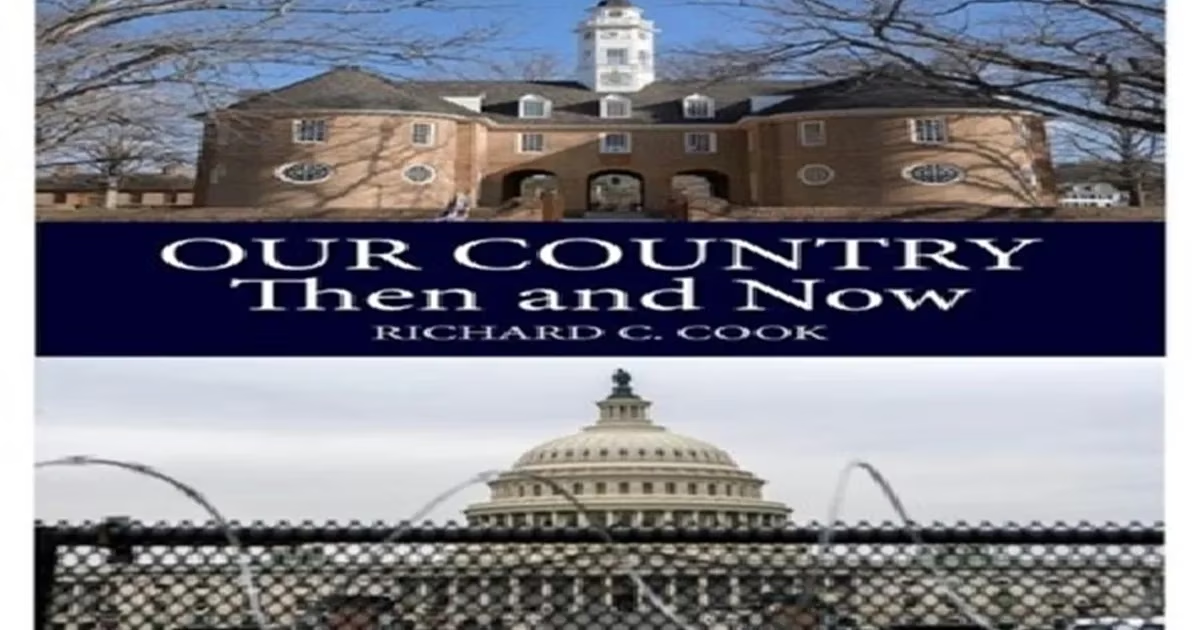







Retired American federal analyst Richard C. Cook, in his recently published book 'Our Country, Past and Present,' offers a deep critical review of American history, revealing the dark roots upon which the superpower was built. The book emphasizes that America's rise was not mere coincidence, but rather the result of systematic strategies that included the extermination of indigenous populations and the enslavement of Africans, leading to the financial elites' control over the state's key institutions.
Cook points out that the arrival of Europeans to the American continent caused the greatest demographic catastrophe in human history, as the indigenous population declined from 15 million to only a quarter of a million within three centuries. The author believes that this cleansing was not merely a result of epidemics, but a deliberate policy to dispossess tribes of their lands and consider them subordinate entities without the right to self-determination.
The book discusses the emergence of the ideology of 'Manifest Destiny' in the mid-19th century, a philosophy that granted America a supposed 'divine right' to expansion and dominance. Although the term has disappeared from contemporary political discourse, its spirit remains alive in the concept of 'American exceptionalism,' which justifies military interventions and the imposition of political will on countries around the world under the pretext of spreading democracy.
The author highlights the radical transformation in the American economy at the end of the 19th century, where power shifted from industrial production to financial speculation led by families such as Rockefeller and Morgan. This financial alliance managed to control the press and buy off politicians, paving the way for the creation of a monetary system that served the interests of the financial oligarchy at the expense of the people.
The book considers the assassination of President McKinley in 1901 a crucial turning point, as Theodore Roosevelt's ascent to power led to the end of an independent foreign policy. Since then, American interests have been linked to Anglo-American rapprochement, opening the door to a century of wars and foreign interventions that continue to this day.
Cook reveals the behind-the-scenes creation of the Federal Reserve system in 1913, describing it as a 'constitutional concession' that granted private bankers the authority to issue currency. This system enabled the United States to finance its entry into World War I, transforming it from a debtor nation into the world's largest creditor and a financial center dominating global gold reserves.
The 'Council on Foreign Relations' played a pivotal role as a tool for international financial control since its establishment in 1919, working to formulate foreign policies that transcended administrations. According to the book, this council saw in the world wars a golden opportunity to consolidate absolute American hegemony and ensure the continuity of the global agenda regardless of the ruling party in Washington.
The author believes that the 'Great Depression' in the 1930s was not merely a spontaneous market crisis, but resulted from deliberate decisions by central bank governors to raise interest rates. This crisis enabled financial elites to tighten their grip on the business sector and contributed to destabilizing Europe and creating the climate for the outbreak of World War II.
The book touches upon the role of the Central Intelligence Agency (CIA) as an executive arm of financial interests, transcending its role in information gathering to executing coups and assassinations. Cook asserts that the agency worked in coordination with the Rockefeller family to build a 'national security state' that seeks to integrate the world into a single political and economic structure serving major capitalist powers.
In his reading of President John F. Kennedy's assassination, Cook believes that Kennedy's orientation towards peaceful coexistence with the Soviet Union and his rejection of military escalation put him in direct conflict with the national security establishment. He points out that the cancellation of plans to withdraw from Vietnam immediately after his assassination confirms that the deep state rejected any approach that threatened the interests of the military-industrial complex.
The 'Petrodollar' system established in the 1970s is the primary pillar of current global hegemony, as the dollar was linked to Saudi oil in exchange for military protection. This agreement created a permanent global demand for the American currency, allowing Washington to print dollars without restrictions and finance its trade deficit at the expense of other countries forced to store their reserves in dollars.
The book explains that the 'Wolfowitz Doctrine' issued in 1992 represents contemporary American military doctrine, which is based on preventing the emergence of any international or regional competitor. This vision perpetuates a state of 'permanent war' and justifies preemptive interventions in conflict zones to ensure the United States remains the sole dominant power over strategic resources.
The author explains how regime change strategies shifted from violent coups to 'color revolutions' through organizations such as the National Endowment for Democracy (NED). These organizations use the guise of 'promoting democracy' to fund oppositions and delegitimize governments that reject American subservience, as was evident in Eastern European and Middle Eastern countries.
Cook concludes his reading by warning that current policies, including the conflict in Ukraine and tensions with China and Russia, are desperate attempts to preserve the eroding petrodollar system. He believes that the world is moving towards multipolarity, ending a century of American financial and military hegemony, amid increasing global awareness of the mechanisms of control he revealed in his book.
The underlying attitude of 'Manifest Destiny' of American exceptionalism and entitlement to global dominance has persisted to this day, manifesting in the imposition of will around the world.



Share your opinion
From 'Manifest Destiny' to Financial Hegemony: A Reading in the Philosophy of American Control Throughout History