







By: Said Arikat
April 14, 2026
News Analysis
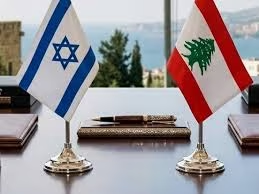
Washington, D.C-The decision by the Lebanese government to engage in ambassador-level talks with Israel in Washington, D.C. is not merely futile—it is politically reckless given the gravity of the moment and the overwhelming domestic opposition it faces. At a time when Lebanon is under sustained military pressure, such a move risks projecting weakness, fragmentation, and a troubling disconnect between the state and large segments of its own political landscape. Rather than reinforcing national resilience, this initiative exposes internal fractures at precisely the moment unity is most urgently required.
According to a State Department official speaking on background, the composition of the meeting itself underscores the sensitivity and high-level attention surrounding the talks. Participants are expected to include U.S Secretary of State, Marco Rubio, U.S Ambassador to Lebanon, Michel Issa, Counselor Michael Needham,Israeli Ambassador to the United States, Yechiel Leiter, and Lebanon’s Ambassador to the United States, Nada Hamadeh. While the presence of such senior figures might suggest seriousness of intent, it also raises the stakes of a process that appears to lack both domestic legitimacy and strategic clarity.
Far from advancing Lebanon’s strategic interests, these talks appear detached from both reality on the ground and the national consensus. Most major Lebanese political factions have either rejected or expressed deep skepticism toward any form of engagement under fire. Proceeding regardless does not signal pragmatism; it signals a leadership willing to bypass internal cohesion on an issue that demands precisely the opposite. In moments of external threat, states typically consolidate political positions to project strength and clarity. Here, the government is doing the reverse—opening another front internally while failing to secure any tangible diplomatic leverage externally.
The timing is especially damaging. With Israel continuing its military operations, any diplomatic overture absent clear leverage or preconditions risks being interpreted not as a peace initiative but as capitulation. More critically, the very act of convening such a meeting—under fire, without consensus, and without reciprocal commitments—amounts to a substantial and gratuitous concession to Israel. It offers engagement, legitimacy, and the optics of dialogue without extracting anything in return. In effect, Lebanon is placing a significant bargaining chip on the table for free, weakening its negotiating position before talks have even begun.
This dynamic hands a political advantage to Israeli Prime Minister Benjamin Netanyahu, who has long demonstrated a preference for managing conflict rather than resolving it. For Netanyahu, the mere existence of talks—regardless of their substance—can be weaponized diplomatically to deflect criticism, particularly in Western capitals eager to point to dialogue as evidence of restraint. The meeting itself thus becomes an asset for Israel: a diplomatic gain secured without the need for concessions, reinforcing an already asymmetric balance.
This dynamic underscores a deeper problem: the asymmetry embedded in such engagements. Lebanon enters these discussions politically divided and institutionally weakened, while Israel operates with a far more centralized decision-making structure and a clear strategic doctrine. Without internal alignment, Lebanese negotiators lack both the authority and the credibility to commit to meaningful outcomes. This imbalance turns the talks into a performative exercise, where one side manages optics and the other struggles to define its own position.
More troubling is the internal cost. Lebanon is already navigating one of the most severe economic crises in its modern history, alongside institutional paralysis and widespread public disillusionment. Introducing a highly polarizing diplomatic track—particularly one that lacks transparency and broad-based support—risks deepening these crises. It invites accusations of political overreach, fuels suspicion among rival factions, and erodes what little trust remains between the public and the state. At a time when the country needs a unifying national strategy, this move does the opposite: it sharpens divisions and amplifies uncertainty.
The absence of a clear mandate further complicates matters. Effective diplomacy requires not only external engagement but also internal legitimacy. Without a coherent national consensus or parliamentary backing, any commitments made in such talks are inherently fragile. They can be contested, reversed, or undermined by domestic actors, rendering the entire process unstable. This raises a fundamental question: who, exactly, is the Lebanese government negotiating on behalf of, and with what authority?
Equally problematic is the lack of a defined framework. Successful negotiations are typically anchored in clear parameters—whether territorial, security-related, or political—along with mechanisms for enforcement and accountability. None of these elements appear to be present here. There is no indication of binding commitments, no credible third-party enforcement mechanism, and no alignment with a broader regional de-escalation strategy. In the absence of these components, the talks are unlikely to produce anything beyond vague statements and temporary gestures.
Meanwhile, the broader regional context cannot be ignored. Lebanon’s position is deeply intertwined with regional dynamics, including tensions involving Iran, Israel, and various non-state actors. Engaging in isolated bilateral discussions without addressing these larger forces risks reducing the talks to a narrow, ineffective channel disconnected from the realities shaping the conflict. Diplomacy that ignores context is diplomacy destined to fail.
Ultimately, this initiative reflects a deeper misreading of both timing and leverage. By entering talks under pressure, without unity, and without a clear strategic framework, the Lebanese government risks undermining its own position while inadvertently strengthening that of its adversary. It allows Israel to claim engagement without making concessions, and it exposes Lebanon’s internal divisions to external scrutiny.
This is not diplomacy as a tool of strength or statecraft. It is diplomacy as miscalculation—an exercise that prioritizes appearance over substance and risks compounding the very challenges it seeks to address. At a moment that demands clarity, cohesion, and disciplined strategy, Lebanon’s leadership has chosen a path that delivers none of these. Instead, it gambles national unity for the illusion of diplomatic relevance, with consequences that could reverberate far beyond the walls of meeting rooms in Washington.
Share your opinion
Diplomacy Without Consensus: Lebanon’s Risky Gamble in Washington