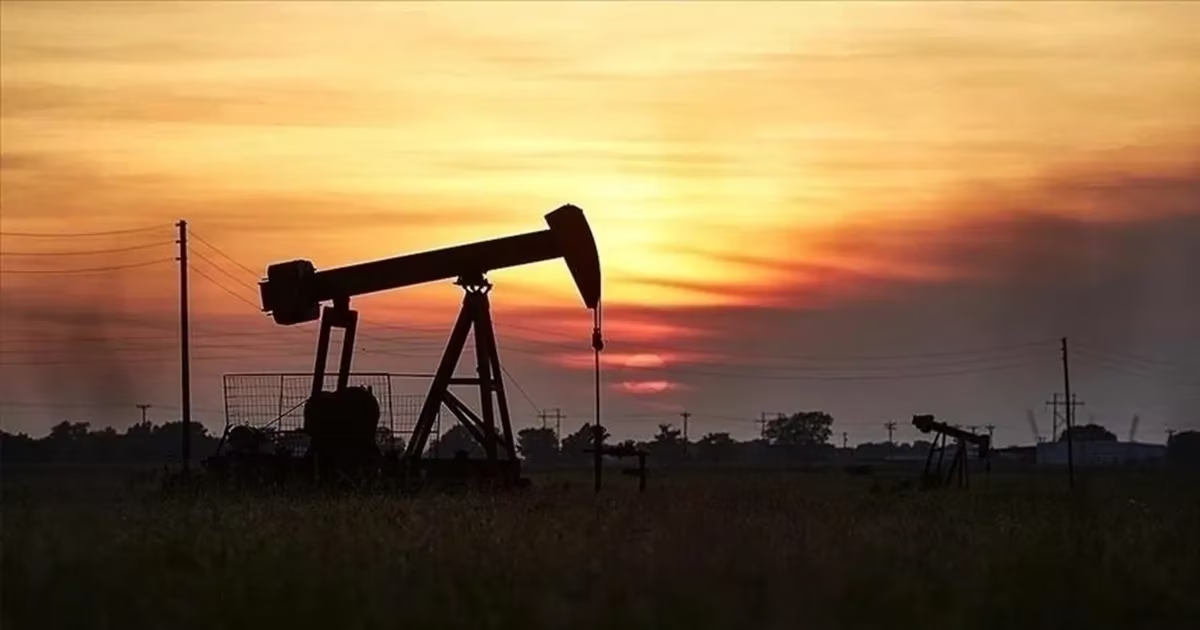







The year 1971 marked a pivotal turning point in the history of the global financial system when the United States decided to decouple its currency from gold due to the financial drain caused by the Vietnam War. This measure, taken by President Nixon, plunged the dollar into a vortex of uncertainty, before American diplomacy intervened to reassert its influence through the gateway of energy.
Henry Kissinger successfully brokered a strategic agreement with Saudi Arabia, stipulating that oil would be priced exclusively in dollars in exchange for security protection. This arrangement, which expanded to include all Gulf states, made the American currency a mandatory requirement for all countries wishing to secure their energy needs, thereby strengthening Washington's position as the sole financial pole.
This system granted the United States what is known as the 'exorbitant privilege,' allowing it to finance its structural deficit and borrow at very low costs. As a result, the dollar transformed from merely a medium of exchange into a cross-border geopolitical tool of influence, used to manage and direct the global economy according to American interests.
Today, this financial edifice faces unprecedented challenges as the US national debt reaches record levels, approaching $39 trillion. These figures, exceeding 120% of GDP, reflect a deep crisis in American fiscal discipline and raise questions about the sustainability of this economic model based on excessive borrowing.
At the recent G7 foreign ministers' meeting, notable statements emerged from US Secretary of State Marco Rubio regarding threats in the Strait of Hormuz. Rubio called on the world to take a firm stance against attempts to impose fees on navigation, hinting that Washington would not bear the burden of protecting this vital waterway alone. Observers considered this a retreat from historical commitments.
This American approach raises fundamental questions about the feasibility of countries continuing to price their oil in dollars if Washington reneges on guaranteeing the stability of the system. The paradox is that the United States might be the biggest loser from any disruption in navigation in the Strait, as it represents the fundamental pillar of the petrodollar system.
Although talk of a complete collapse of the petrodollar may seem exaggerated at present, there are serious indications of a disintegration phase beginning. Some Gulf countries have already started diversifying their currency basket for pricing through experimental deals in yuan and euro, indicating a desire to reduce absolute reliance on the greenback.
In contrast, Iran is adopting a strategy aimed at imposing the Chinese yuan as an alternative reference currency in the Strait of Hormuz, leveraging Beijing's economic weight as the largest oil importer. This trend is reinforced by China's success in developing a sovereign digital currency capable of completing massive financial settlements away from the traditional oversight of the Western financial system.
Current data indicate that the Middle East is on the cusp of a structural transformation that could end the dollar's monopoly on global energy trade. With the expanding use of national currencies in buying and selling transactions, the contours of a multipolar financial system are taking shape, redistributing economic power centers in the world.
The current scene reflects a decline in the strategic vision upon which American hegemony was built for decades, as current decisions appear to lack deep historical understanding. If the original architects of the petrodollar system were present today, they would feel bitterness at the crumbling of this structure, which was designed to be the permanent cornerstone of American power.
The dollar is our currency... but it's your problem.

Share your opinion
The Cracking of the Petrodollar System: Is US Financial Hegemony Nearing Its End?