PALESTINE

Fri 23 Jan 2026 2:21 pm - Jerusalem Time

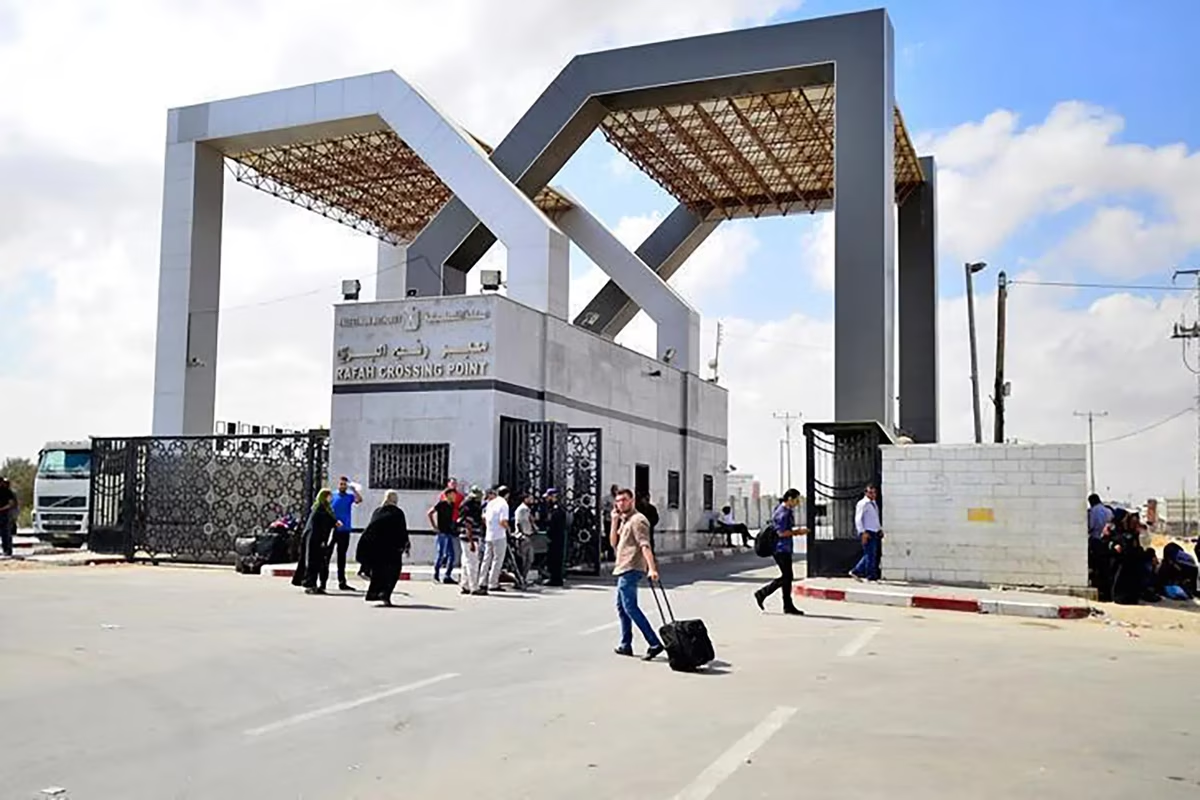
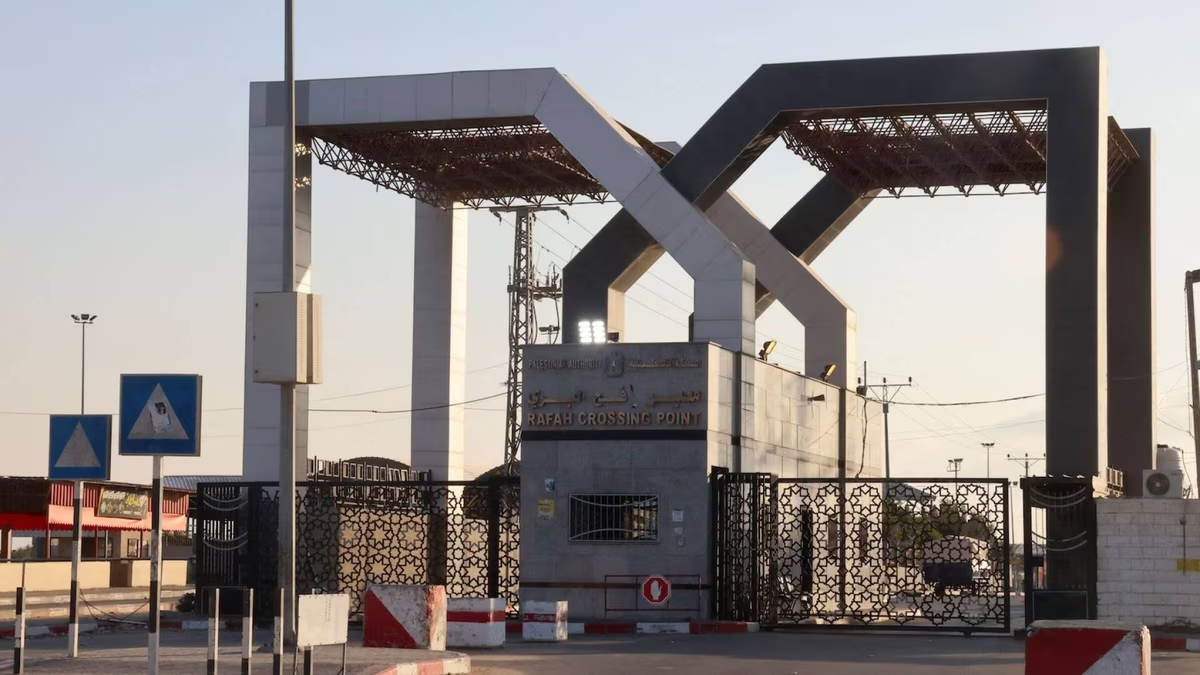
Hebrew media reveals details of "Rafah 2" crossing: Direct management and "Israeli" electronic control

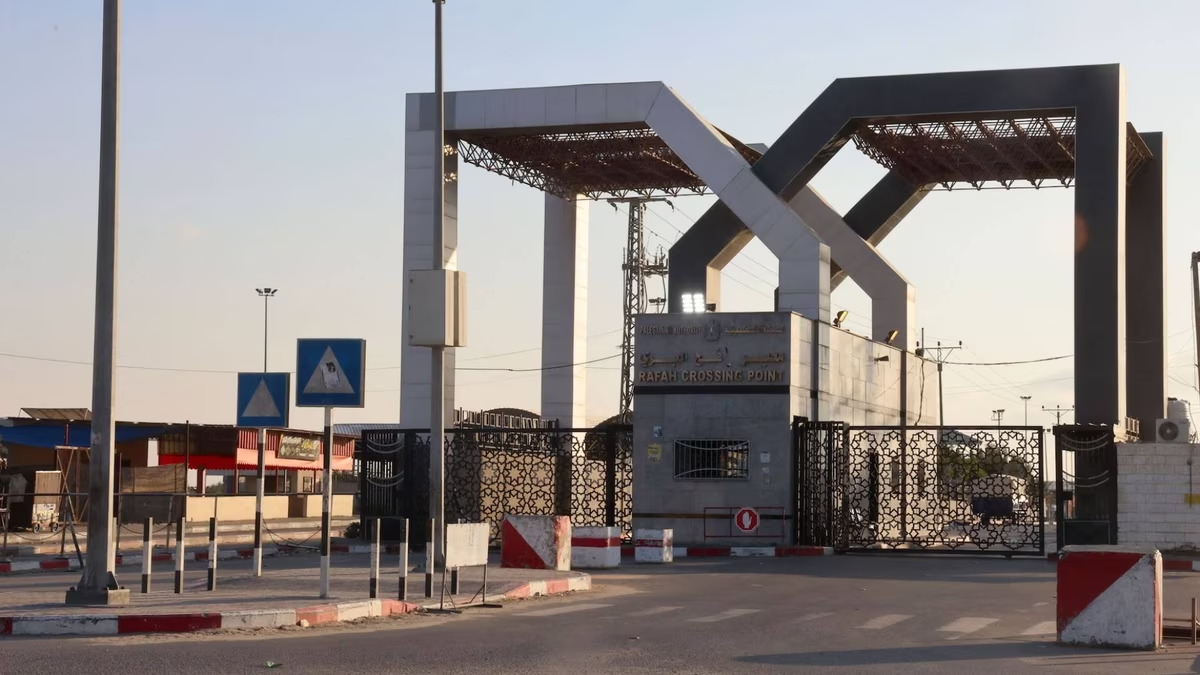
Hebrew media sources reported that preparations for the opening of the crossing have actually been completed, and the occupation's broadcasting authority revealed that the issue of operating the Rafah border crossing has been settled. It was decided to establish an additional crossing called "Rafah 2", which will be adjacent to the currently existing crossing, and the occupation forces will operate it themselves.

In contrast, the main crossing will be managed by the "European Union Border Assistance Mission", a civilian mission aimed at supporting local authorities in improving their border management, and will work in coordination with elements of the Palestinian Authority's General Intelligence Service to manage border movement.

The arrangements, according to what the broadcasting authority reported, stipulate that the European mission will provide the occupation side with lists of those entering the Gaza Strip, to be subjected to security checks by the "Shin Bet" agency.

This process will rely on remote verification technologies, which include facial imaging and identity card checks, without the need for a direct field presence of occupation forces inside the crossing's corridors.

These measures come within the second phase of understandings, despite the contradiction between the announced political statements and the executive data on the ground.

Hebrew media sources reported that preparations for the opening of the crossing have actually been completed, and it is expected to happen within 48 hours of the official approval, as part of the second phase of US President "Trump's" understandings.

Egypt had informed the technocrat committee of the imminent opening date as a result of pressure exerted by America on the occupation side to expedite the process, allowing committee members to enter and begin their tasks.

These trends were supported by the statement of the head of the technocrat government in Gaza, "Ali Shaath", during his speech at the "Peace Council" meeting held on the sidelines of the World Economic Forum in Davos, where he confirmed that the crossing would open in both directions next week.

In a related context, sources quoted a senior Palestinian source as saying that some members of the military wing of the Hamas movement, who left for treatment, may be able to return through the crossing without the occupation being able to prevent it, indicating the actual limits of control.

For its part, the office of the occupation prime minister announced that the mini-cabinet would discuss the issue of opening the crossing in conjunction with the file of recovering the body of the detained soldier "Ron Guili" at next week's session, stressing that special efforts are being made to bring him back.

These developments reflect the transition of the Rafah file to the operational implementation stage through a system that combines international and Palestinian administration and the occupation's security control, to achieve a balance between humanitarian needs and security demands.

PALESTINE

Fri 23 Jan 2026 12:35 pm - Jerusalem Time

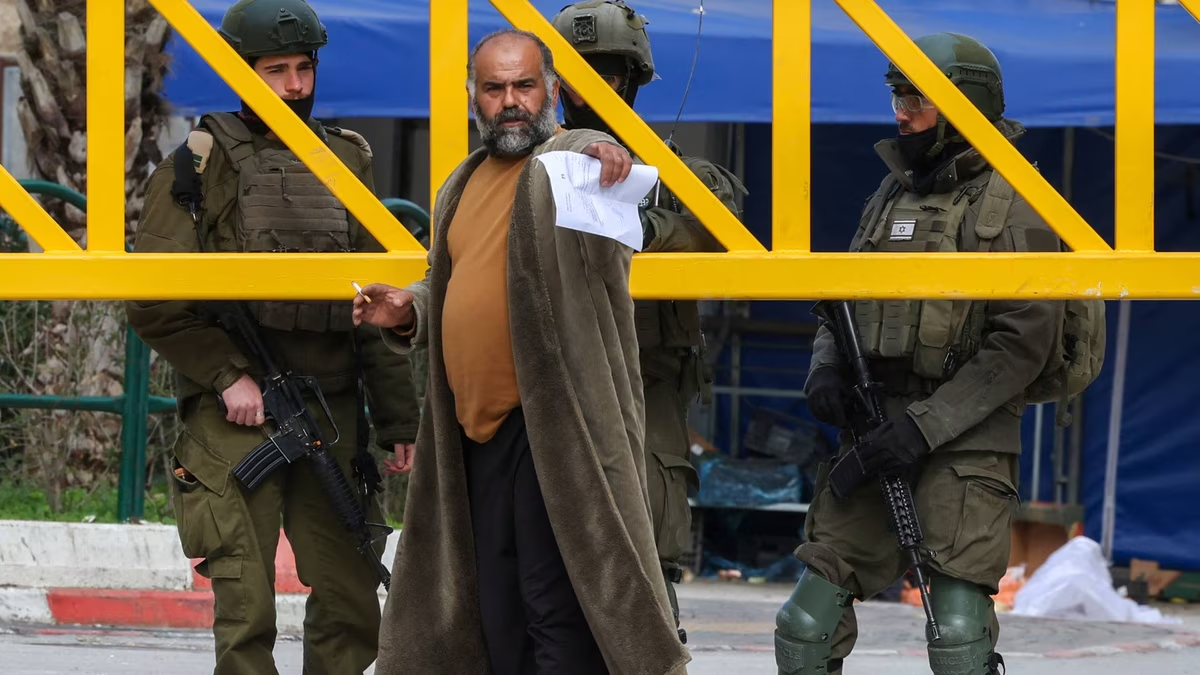
"Israeli" army announces end of military operation in Hebron after four-day aggression

Occupation forces announced on Friday the end of their military operation in the city of Hebron, following a widespread aggression that lasted for four consecutive days.

During this period, the city witnessed a series of incursions and raids that affected various neighborhoods, causing damage to property and a state of severe field tension.

According to Palestinian sources, the withdrawal of military vehicles began from some of the axes where they were stationed.

This announcement comes amidst reports of systematic arrest and search campaigns that targeted several areas in the city and its neighboring villages throughout the days of the aggression.

PALESTINE

Fri 23 Jan 2026 11:53 am - Jerusalem Time

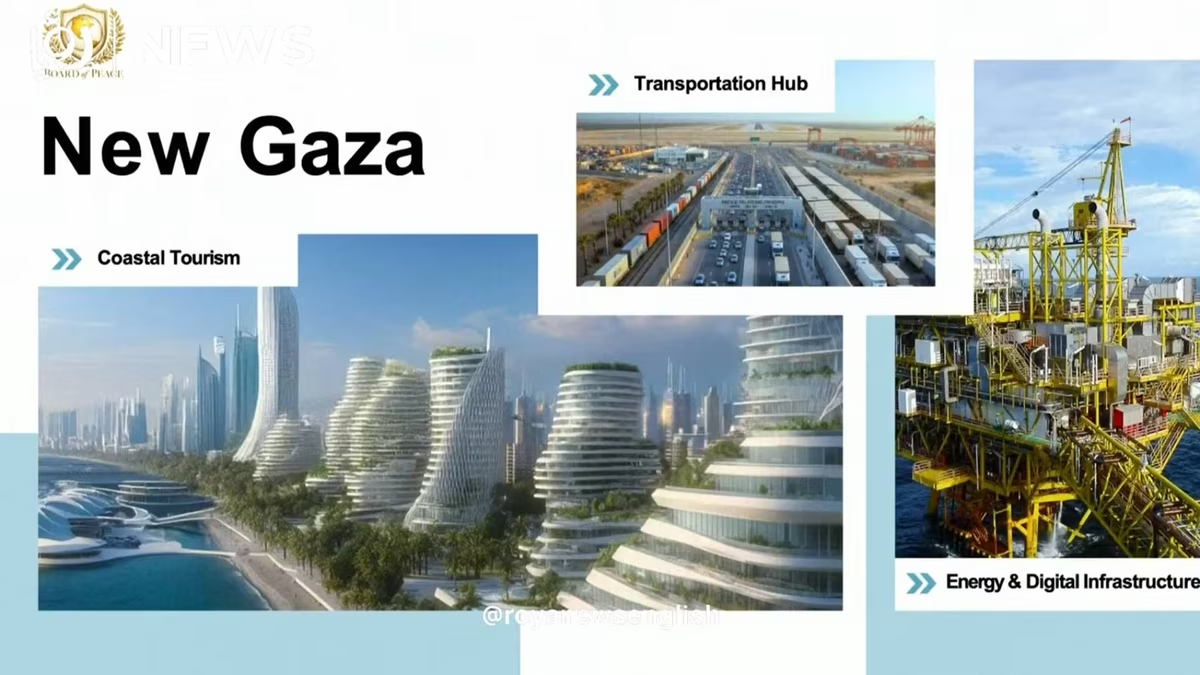
Kushner reveals "Master Plan" for "New Gaza" on the sea..photos

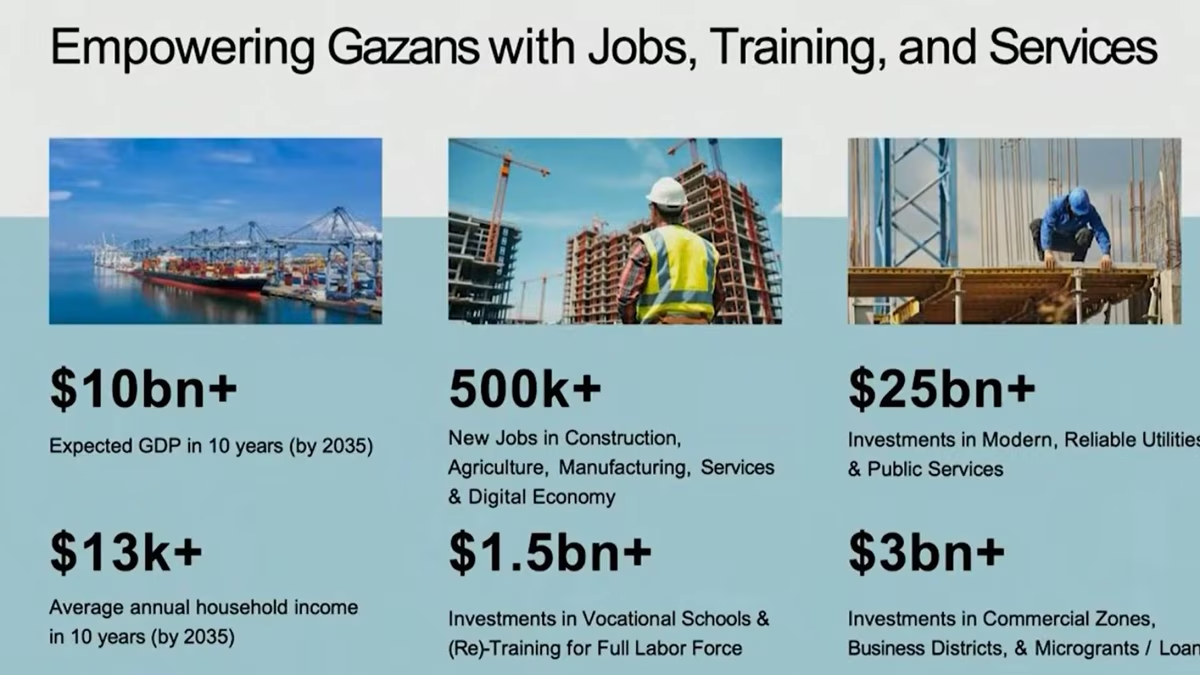
US President Donald Trump took the stage to reinforce this proposal with a realistic "real estate" perspective on Gaza's geographical location in a strategic move presented during the launch of the "Peace Council" at the World Economic Forum. Jared Kushner, the former son-in-law and senior advisor to the US President, revealed precise details of what he called the "Gaza Master Plan," showcasing a roadmap aimed at transforming the devastated strip into a global economic hub.

Kushner, with presentation slides showing plans and maps behind him, outlined a vision based on bringing about a radical change in the demographic and economic structure of the strip.

Kushner said in his speech: "The plan was based on some demolition operations, followed by the creation of a 'New Gaza,' which could be a source of hope, and could become a destination in itself."

He explained that the plan is based on comprehensive development stages targeting:

Achieving 100% employment for the workforce in the strip.

Establishing many industrial sectors that make the place a thriving environment.

Providing modern housing solutions within the first stages of implementation.

In the context of his discussion about commitment to this path, Kushner stressed that there were no other options, saying: "We asked people what our alternative plan was? We didn't have an alternative plan, we only had one plan."

He added, explaining the possibility of implementation: "They were building cities this way in the Middle East, with two or three million people, and building them in three years; so things like this were very feasible if we decided to achieve them."

Kushner's speech did not fail to mention the current security tensions, as he made a direct appeal after noticing someone trying to escalate, saying: "Just calm down for 30 days."

He continued, addressing the attendees and concerned parties: "I thought the war was over, so let's do our best to work together. Our goal here was to achieve peace between Israel and the Palestinian people.. Everyone wants to live with dignity."

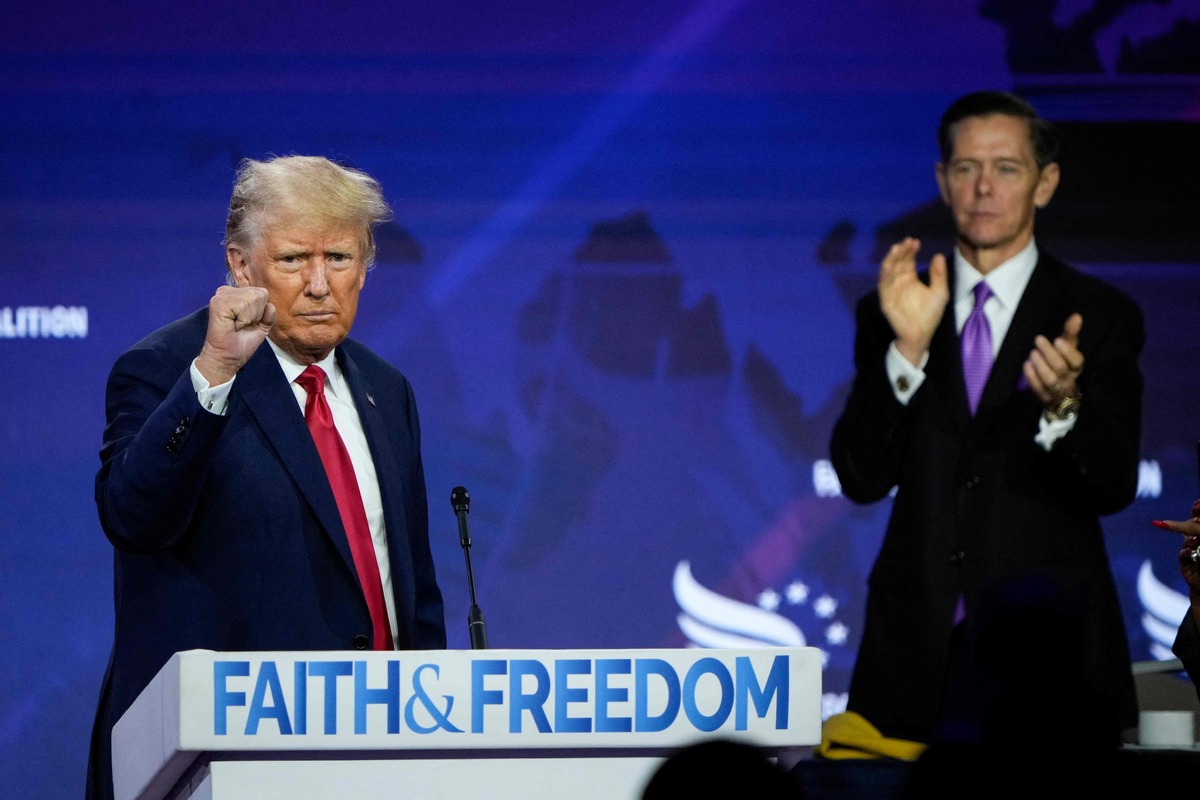
Following Kushner, US President Donald Trump took the stage to reinforce this proposal with a realistic "real estate" perspective on Gaza's geographical location.

Trump said in a striking statement: "Gaza is a beautiful piece of land on the sea, and it can become a great place if invested in correctly."

The US President added: "Those who live in difficult conditions now can enjoy a much better life, and everything starts with location."

This announcement of the "Master Plan" comes at a time when the Trump administration is proceeding with its plan despite reports of "Netanyahu's objection," and amidst efforts led by Ali Shaath, head of the Palestinian National Committee for the Administration of the Gaza Strip, who previously emphasized the utmost priority of reconstruction.

The chances of success for this "dreamy" vision remain contingent on the continuation of the ceasefire and overcoming security complexities on the ground.

ISRAELI AFFAIRS

Fri 23 Jan 2026 11:36 am - Jerusalem Time

Serious breach.. "Israeli" youth impersonates officer and participates in secret military meetings

In an incident that revealed serious and unprecedented vulnerabilities in the security system of the "Israeli" occupation army, the case of the accused "Assaf Shmuelovich" shook military circles, after it became clear that he managed to impersonate an officer with the rank of "captain" and infiltrate the Southern Command headquarters during the first days of the war on Gaza in October 2023, exploiting the state of chaos that accompanied the outbreak of hostilities.

According to sources, which were allowed to reveal the details of the case, "Shmuelovich," 32 years old, had indeed succeeded in infiltrating deep into the operations rooms without obtaining any official permission, and even actively participated in secret meetings and situation assessment sessions, where he sat around tables with senior army leaders, thus gaining access to very sensitive information.

Extensive investigations showed that the accused did not only physically attend, but went beyond that to document his observations inside the military base; he photographed sensitive screens containing precise intelligence data and information.

It was found that Shmuelovich, who in reality holds only the rank of "lieutenant," had placed the rank of "captain" on his shoulders to deceive those around him, and even succeeded in getting a military commander to sign an appointment letter written by the accused himself, to be used as proof of his presence as an accredited operations officer in the Southern Command.

In the context of the transgressions, investigations revealed that the accused exploited his fake identity to bring civilians who had previously served in the army into the headquarters without permission. Despite the seriousness of these actions, the Israeli occupation public prosecution confirmed in the indictment that the "fake officer" did not deal with any hostile party, and it was not proven that he handed over any information to an external party, but the case opened a wide door for discussion about the army's readiness and its ability to control its internal system and protect its secrets under the exceptional circumstances of the war.

OPINIONS

Fri 23 Jan 2026 10:16 am - Jerusalem Time

Speech by Palestinian Prime Minister Dr. Mohammad Mustafa at the Davos Economic Forum 2026

Ramallah - "Al-Quds" dot com

Ramallah - "Al-Quds" dot com

Opinion Writer

The speech by Palestinian Prime Minister Dr. Mohammad Mustafa at the Davos Economic Forum 2026 came at a pivotal political and economic moment, not only for Palestine but also for an international system that appeared exhausted by accumulated crises and hesitant to bear the cost of radical solutions. From this perspective, the speech cannot be read as a mere protocol address at an economic forum, but rather as a conscious attempt to reposition the Palestinian issue within the global consciousness, by shifting it from a discourse of conflict and abstract rights to a discourse of stability, governance, and long-term economic risks.

What distinguished Mustafa's speech was his understanding of the Davos audience: heads of state, financial policymakers, leaders of international institutions, and investors who are not driven by moral sympathy, but by calculations of stability, risks, and returns. Therefore, he did not begin his speech with the narrative of Palestinian oppression, despite its legitimacy, but with a question that at first glance seems technical: How can a world striving for growth and stability ignore an open hotbed of instability in the heart of the Middle East? In this sense, Mustafa redefined the Palestinian issue as an international system issue, not a deferred local conflict file.

In this context, the two-state solution in his speech appeared not as a traditional political slogan, but as a functional necessity for regional stability. Occupation, as he presented it, is not only a violation of international law but also a structural impediment to development, a constant source of market disruption, supply chain fragmentation, and growing security risks. This link between the political and the economic reflects the transition of Palestinian discourse from the stage of moral demands to the stage of building a rational argument directed at global decision-making centers.

When Mustafa emphasized the necessity of empowering the Palestinian Authority and extending its jurisdiction over all Palestinian land, it was not merely an affirmation of political legitimacy, but a proactive attempt to paint a picture of a workable partner in the post-war phase. The implicit message here is that a political vacuum is more dangerous than the conflict itself, and that any project for reconstruction or economic recovery will not be possible without a unified political address, capable of administration, accountability, and fulfilling international obligations. In this context, Mustafa presented the Palestinian Authority as a governing structure that does not seek sympathy, but practical authorization.

Economically, the speech carried a striking shift in language. Instead of talking about aid, Mustafa used terms like planning, investment, and sustainable reconstruction. He tried to move Palestine from the image of an emergency humanitarian economy to the horizon of a post-shock economy, where the reconstruction of Gaza and the West Bank becomes a long-term project, conditioned by political stability and good governance. This approach clearly aligns with the logic of international financial institutions, which are no longer willing to inject money into unstable or unaccountable environments.

However, one of the most significant dimensions of the speech was its shifting of the moral burden from Palestinians to the international community. Mustafa did not ask the world to feel the suffering of Palestinians, but to bear its responsibility towards an international system that claims to respect law and human rights. Here, the discourse shifted from a language of pleading to a language of quiet accountability, as if the Prime Minister was implicitly saying: the failure of the solution is not a result of the absence of a Palestinian vision, but a result of the hesitation of international will.

At its core, the speech can be read as part of building a new Palestinian narrative for the post-war phase, a narrative that does not deny the magnitude of the tragedy, but refuses to remain captive to it; a narrative that seeks to redefine the Palestinian not as a perpetual victim, but as a political and economic actor capable of managing their state if the imposed restrictions are removed. This narrative shift is extremely important because it addresses the world in its own language and breaks the stereotype that has confined Palestinian discourse for decades.

Nevertheless, the speech is not without structural challenges. It relies heavily on an international community that has repeatedly demonstrated the limited extent of its willingness to move from words to actions. Furthermore, the success of the proposed vision remains contingent on complex internal Palestinian factors, primarily political unity and rebuilding trust between citizens and governing institutions. Despite this, the value of the speech lies not only in its direct results but in its serious attempt to reframe Palestine's position in the world's mental map.

Dr. Mohammad Mustafa's speech in Davos 2026 was not merely a Palestinian participation in a global economic forum, but an attempt to reintroduce the Palestinian issue into the heart of global discussion through the gateway of economics, stability, and governance. It is a speech that reflects the transition of the Palestinian leadership at the discourse level from crisis management to thinking about post-crisis management, and from addressing conscience to addressing interests, presenting the world with a clear choice: either invest in a just and sustainable solution, or continue to pay the cost of open chaos.

OPINIONS

Fri 23 Jan 2026 9:41 am - Jerusalem Time

Trump's Speech in Davos: Peace of Power on the Ruins of International Legitimacy!

US President Donald Trump's speech at the Davos Economic Forum was not a fleeting protocol event, but rather a clear political declaration of the features of a new international phase, in which international legitimacy recedes in favor of the logic of power, and relations between states are reduced to the equation of deals and economic coercion.

From the first moment, the tone of the speech seemed condescending, seeing in the international system nothing but a burden restricting American will.

Trump did not speak of global cooperation or balanced partnerships, but rather of who pays, who commits, and who is punished. Here, Davos transformed from a platform for economic dialogue to a pulpit for political dictation, reflecting a structural shift in the American political mind: from leading the international system to bypassing it and controlling it from the outside.

Greenland and Gaza: One Logic

Trump's re-raising of the issue of "owning" Greenland, even in a negotiating formula, is not an isolated detail, but a clear expression of a mentality that considers geography a commodity, and sovereignty a negotiable file.

This same logic is applied today to Gaza, where the Palestinian issue is managed as a security-humanitarian matter, not a matter of national liberation and political rights.

In both cases, the will of the people is marginalized, the land is reduced to its strategic dimension, and international law is replaced by top-down arrangements imposed by the balance of power.

Gaza, according to this logic, becomes a testing ground for the peace of power: reconstruction without sovereignty, calm without a political horizon, and administration without national rights.


The United Nations on the Margins


The absence of any serious reference in Trump's speech to the role of the United Nations or resolutions of international legitimacy is not a coincidence, but rather consistent with accumulated American policy based on: obstructing the Security Council, withdrawing from international agreements, and replacing UN references with bilateral or regional understandings led by Washington.

In the Gaza file, this marginalization is clear: UN resolutions without implementation, versus an American administration that acts as the sole authority, not as a partner within a multilateral international system.


Security for Payment


Trump's attack on NATO and his linking of security to financial payment reflects a dangerous redefinition of the concept of collective security.

Security is no longer a mutual commitment, but a paid service. This is the same logic applied in Gaza: aid instead of rights, relief instead of a political solution, and temporary stability instead of a just peace.

In conclusion: Trump's speech in Davos confirms that the world is heading towards a post-international legitimacy phase, where conflicts are managed by the logic of power, laws are emptied of their content, and the issues of peoples are reduced to security and technical files.

However, historical experience confirms that the peace of power does not last, and that what is imposed without justice is doomed to explode. Gaza, like Greenland, is but a magnified mirror of a world where the international system is eroding, and the future of law and justice is being tested on the edge of brute force.

————

Historical experience confirms that the peace of power does not last, and that what is imposed without justice is doomed to explode. Gaza, like Greenland, is but a magnified mirror of a world where the international system is eroding, and the future of law and justice is being tested on the edge of brute force.

PALESTINE

Fri 23 Jan 2026 9:37 am - Jerusalem Time

Only a popular uprising can stop Trump

When a government violates democratic principles, massive peaceful demonstrations can send a powerful message. They are a means for the people to collectively express their commitment to democratic values and call for change without resorting to violence. The massive protests that followed the killing of Renee Good by Immigration and Customs Enforcement in Minneapolis were not spontaneous, but an explosion of anger and an accumulation of long-standing tensions with the government.

The demonstrations emerged from the struggle to reconcile law enforcement authority with greatly eroded public trust. The public's reaction reflects deep concerns about how immigration affairs are managed, how federal power is exercised, and the absence of accountability when deadly force is used by federal agents.

The protesters in American cities against Immigration and Customs Enforcement are doing what must be done, even if it involves serious risks. But there is no alternative to people taking to the streets and demonstrating peacefully. Popular protest is not symbolic or abstract; it is a concrete action of critical importance, as it makes it harder for the government to commit crimes without accountability.

The protests that followed Good's killing were driven by fear and insecurity as much as by grief, as demonstrations spread across the country. A consistent pattern emerged in cities with widely varying political and social spectra. Protesters expressed similar concerns, including the breakdown of law and order and the disgraceful conduct of the Trump administration.

The continuation of peaceful, persistent, and repeated demonstrations involving millions from coast to coast is an essential condition for protecting our democracy and ending the nightmare that has swept the country. Millions of Americans, regardless of their political affiliations, races, origins, or religions, who care about the future of the country, must take to the streets with one message:

We will not back down, we will not surrender, we will not be intimidated, we will remain steadfast and firm, and we will resort to any other peaceful means, including civil disobedience and strikes, until Trump ceases his violations of our democratic principles and fully adheres to his constitutional oath to defend and protect the Constitution.

However, expressing opposition is not limited to peaceful protests; open dialogue is another means of expressing opposition, and it can include various groups. Community leaders, educators, civil society organizations, and even ordinary citizens can contribute to public dialogues and community forums. It is about creating a space where people exchange their views and listen to each other. Saving our democracy is a shared duty and responsibility at the societal level.

Without effective accountability mechanisms, public trust erodes, and protest becomes the only remaining tool for citizens. From a political perspective, the scale of these protests indicates an institutional imbalance: law enforcement systems rely not only on legal authority but also on the consent of the people.

The people who will bear the brunt of dictatorial rule must be the first line of defense, ready to confront any threat, intimidation, or use of force, and remain steadfast and firm in their commitment to protecting our precious democratic way of life.

It must be emphasized repeatedly that continuous and widespread popular protests across the country from coast to coast are the only way to stop the lawless Trump administration from destroying our democracy before it is too late.

———

The massive protests that followed the killing of Renee Good by Immigration and Customs Enforcement in Minneapolis were not spontaneous, but an explosion of anger and an accumulation of long-standing tensions with the government.

PALESTINE

Fri 23 Jan 2026 9:35 am - Jerusalem Time

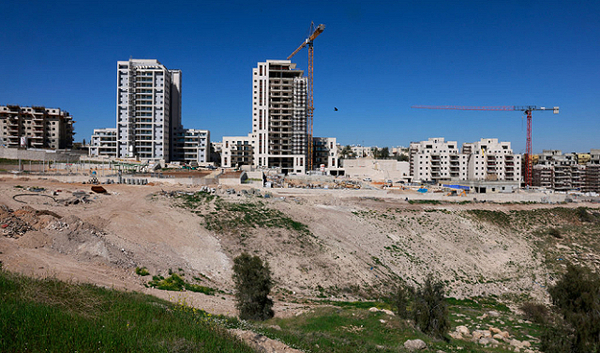
Settlement encroachment... a systematic policy to impose new realities and pass annexation

Nazmi Al-Salman: The occupation continues to establish an unprecedented settlement reality within systematic strategic policies to impose new facts on the ground and change the face of the West Bank

Muhammad Abu Allan Daraghmeh: Despite its unofficial disapproval, the American administration does not oppose annexation, by turning a blind eye to the unlimited settlement expansion in the West Bank

Anas Abu Arqub: Israel relies on the "settlement belts" strategy, which aims to create a network of interconnected settlements around Palestinian cities and villages to isolate them from their surroundings

Mazen Al-Ja'bari: Area "C" constitutes about 60% of the West Bank's area, and if it is emptied of the possibilities of life and sovereignty, nothing will remain of the idea of a state except a political title over isolated population islands

Amir Makhoul: The Israeli right is currently going through a difficult and critical stage and will seek to strengthen its control geographically, but it is unable to strengthen it demographically, as the migration balance to the settlements is not positive

Within systematic policies to impose new realities on the ground to change the geographical and demographic realities in the West Bank, the occupation is establishing an unprecedented settlement reality in the occupied Palestinian territories to control them, through decisions issued by various occupation institutions such as the army, the so-called "Civil Administration" and nature protection, in conjunction with settler violence, and what has become known as pastoral settlement, which controls vast areas of land throughout the West Bank, and has begun to form points for the launch of settler violence and their organized terrorism.

Writers and specialists warn in interviews with "Y" that the facts on the ground indicate an unprecedented increase in the pace of aggression by the occupation and its settlers, which is being carried out by organized groups of settlers trained to practice all forms of violence against citizens, including physical assaults, shooting, burning vehicles and property, stealing livelihoods, depriving citizens of water springs, and displacing them from their lands, noting that the issue of settlement encroachment in the West Bank is no longer limited to Area "C", but has extended to Area "B", and is even trying to reach Area "A", by imposing Israeli control over some sites on the pretext that they are archaeological, historical and religious sites, as is the case in Joseph's Tomb in Nablus.


Unprecedented increase in the pace of aggression and settlement


Nazmi Al-Salman, a specialist in settlement affairs, says: The Israeli occupation continues to establish an unprecedented settlement reality on the occupied Palestinian territories in all governorates of the West Bank, from Masafer Yatta in the south of Hebron, through Ramallah, Nablus, the northern and central Jordan Valley, and the north of the West Bank, specifically in Jenin, pointing to several systematic strategic policies of the occupation to impose new facts on the ground and change the face of the West Bank.

Al-Salman explained that the occupation aims to control Palestinian lands through decisions issued by various occupation departments such as the army, the so-called "Civil Administration" and nature protection, in conjunction with settler violence, which has become known as pastoral settlement, which controls vast areas of land throughout the West Bank, noting that the pastoral settlement outposts have begun to form points for the launch of organized settler violence and terrorism against the Palestinian people.

Al-Salman stressed that the facts on the ground and the extent of the attacks indicate an unprecedented increase in the pace of aggression against our people, which is being carried out by organized groups of settlers trained to practice all forms of violence against citizens, including physical assaults, shooting, burning vehicles and property, stealing livelihoods, depriving Palestinian citizens of water springs, and displacing them from their lands.

He explained that "in the face of this organized violence and terrorism, as indicated by the facts, it is done with the consent and protection of the occupation army, and dozens of Palestinian Bedouin communities have been forced to leave their homes and forced migration," stressing that this terrorism and fierce attack on citizens coincides with many decisions issued by various occupation departments, in a policy of sharing roles to achieve the main goal, which is to displace Palestinian citizens from their land and annex lands, through decisions that establish what is to come, most notably allowing settlers to buy land directly from the West Bank and allocating vast areas for pastoral outposts, and allocating huge budgets for new settlement construction projects and developing existing settlements, legitimizing pastoral outposts, and approving structural plans.

Al-Salman stressed that all these measures have led to the creation of an expelling environment, and forced many Bedouin communities to leave under continuous pressure from settler violence.

He said: In a clear continuation of the occupation's policy of expansion and annexation of Palestinian lands, the occupation's decision first comes to the return of settlers to settlements that were evacuated in 2005, especially in the northern West Bank, and the offering of tenders for the construction of thousands of housing units, and the occupation's approval of the establishment of 19 new settlements.

Al-Salman believes that these measures change the face of the West Bank and reshape Palestinian geography, as tenders for the construction of housing units have been offered in the vicinity of Jerusalem in what is known as E1, and another settlement project has been announced that separates the Qalqilya and Salfit governorates, and shows Palestinian towns and villages as isolated enclaves, while changes are taking place on the ground in favor of the settlers, such as: road construction, the establishment of bridges and sewage services, and communication and surveillance towers to serve the settlement project.

He added: These measures serve the occupation project that the Minister of Finance in the occupation government, Bezalel Smotrich, boasts about, which aims to bury the idea of an independent, geographically contiguous Palestinian state, and destroys the Palestinian dream of freedom, independence, and imposing sovereignty.

Al-Salman pointed out that "in the face of this unprecedented settlement encroachment that has swallowed vast areas of land classified as "C", and now has moved to the outskirts of Palestinian towns and villages in areas classified as "B", the Palestinian citizen stands unarmed and peaceful in the face of this occupying displacement project, and that it is necessary to support and strengthen the steadfastness of citizens through practical measures on the ground that citizens can feel, especially the land guardians who live in isolated farms and communities, with simple living necessities," adding that it is necessary to unify and integrate official and popular efforts to support the steadfastness of citizens, and to thwart the annexation and displacement project, and it is necessary to revive popular efforts, and to develop programs and plans to share citizens' concerns, and to emulate previous successful experiences, and to expose the occupation's policies at the international level through networking with many international organizations and human rights bodies.


Settlement encroachment is no longer limited to Area "C"


Muhammad Abu Allan Daraghmeh, a specialist in Israeli affairs, believes that "the issue of Israeli settlement encroachment in the West Bank is no longer limited to Area "C", but has extended to Area "B" and is even trying to reach Area "A", by imposing Israeli control over some sites on the pretext that they are archaeological, historical and religious sites, as is the case in Joseph's Tomb.

He confirmed that settlers have been allowed for some time to storm the city of Nablus, even in broad daylight, to perform their biblical rituals, which confirms that this falls within the framework of a systematic encroachment policy, which can be placed within three main contexts.

Daraghmeh believes that the first context is the endeavor to completely eliminate the two-state solution, which is actually being implemented on the ground. He referred to Smotrich's statements, who said that his life's dream is to end the idea of the two-state solution, stressing that "there will be no state between the sea and the river, but only the State of Israel," as he put it.

As for the second context, it lies in imposing new realities on the ground, which facilitates the official annexation process later. The current practices represent actual annexation, and what delays the official announcement is the lack of explicit American approval.

Daraghmeh explained that the American administration, despite its unofficial disapproval, does not oppose actual annexation, by turning a blind eye to the unlimited settlement expansion in the West Bank, which is clearly consistent with Smotrich's policy, who calls for the annexation of about 82% of the West Bank's area, and leaving 18% as cantons for Palestinians, without forming a real Palestinian entity or national gathering.

As for the third context, according to Daraghmeh, it relates to imposing new borders within the West Bank, pointing out that one of the most prominent evidences of this is the eastern wall of the Tubas Governorate and the northern Jordan Valley, which extends from the Ein Shibli area to the Tayasir checkpoint for about 22 kilometers. This wall comes within a broader project implemented by the occupation to completely isolate the Tubas Governorate from the Jordan Valley area.

He explained that what delays the annexation process is America's approval, which does not oppose actual annexation in the West Bank, noting that the separation wall being implemented from Ein Shibli to the Tayasir checkpoint, 22 kilometers long, and paralleled by a road extending along the area, forms part of a larger wall, two phases of which have not yet been announced by the Israeli occupation army.

Abu Allan Daraghmeh explained that this wall aims to impose new borders for the Tubas Governorate, by separating urban communities from agricultural lands in the Jordan Valley, which means isolating hundreds of thousands of dunams behind the wall. When completed, the governorate will be surrounded by a wall from the eastern side, which practically constitutes its final borders, despite its primary reliance on agriculture in the Jordan Valley area, which is besieged by the occupation army.

Abu Allan pointed out that after the war on the Gaza Strip, and during the past two years, about 33 pastoral communities were completely displaced, in addition to the partial displacement of about 12 pastoral communities, in the area extending from the northern Jordan Valley to the south of Mount Hebron, explaining that this displacement is carried out by the civilian arms of the occupying state, i.e., the settlers, who implement plans to control lands and attack Palestinians, under the patronage and protection of the Israeli occupation army.

Daraghmeh added: These attacks have now extended to various governorates of the West Bank, not only to areas classified as C, but also to areas classified as B, with the same approach continuing and settlers approaching city centers, if the pace of attacks remains the same.


Ways to confront settlement and occupation policy


Regarding ways of confrontation, Daraghmeh said: Palestinians no longer have effective tools to stop settler attacks, in light of the urgent need to unify the Palestinian political ranks, and to develop a national program to confront settlement and occupation policies.

Daraghmeh stressed that the continuation of the division, and the division of the Palestinian reality between the West Bank and the Gaza Strip, in addition to the projects proposed for Gaza, such as the so-called Peace Council, contributes to deepening the existing division. He stressed that the solution remains dependent on serious international and Arab action to stop the policies of the Israeli occupation state.


Focus on decisive action in desert areas


For his part, journalist and researcher specializing in Israeli affairs, Anas Abu Arqub, said: "Field readings indicate that the current stage of the settlement project in the West Bank focuses on decisive action in desert areas, especially the Jordan Valley and rural areas."

He stressed that settlement is no longer gradually creeping, but is advancing at a rapid pace that exceeds the expectations of the leaders of the Israeli settlement project. He added that in these areas, expansion is accompanied by the displacement of Bedouins to ensure exclusive control for settlers and to deprive local residents of pastures, while efforts continue to impose influence and expropriate agricultural lands in mountainous rural areas.

Abu Arqub pointed out that Israel relies in this context on the "settlement belts" strategy, which aims to create a network of interconnected settlements around Palestinian cities and villages to isolate them from their natural surroundings, stop their urban expansion, and impose demographic and geographical control.

He noted that internally interconnected settlements and settlements within the Green Line transform the surrounding lands into a continuous settlement extension, making Palestinian cities besieged islands with limited growth and development, as part of a long-term plan to reshape demographic and geographical maps to serve the Israeli presence.


Strategy of isolated settlement enclaves


Abu Arqub added that in addition to this, Israel adopts the "strategy of isolated settlement enclaves," based on expanding existing settlements and establishing geographically separate communities, supported by a network of bypass roads, checkpoints, and industrial zones, through confiscating private Palestinian lands and declaring them "state lands," explaining that this approach leads to tearing apart the Palestinian geographical space and undermining communication between villages and agricultural lands, and is accompanied by the destruction of agricultural lands that have been cultivated for decades and their transformation into settlement projects under the protection of the army and police, which reflects the goal of systematic control over the land, its fragmentation, and the imposition of new colonial realities that exclude Palestinians from their lands.

Abu Arqub warned that these policies have direct repercussions on Palestinian society, including weakening the agricultural sector, hindering access to land, distorting the environment and water resources, and creating increasing geographical and social isolation between communities, noting that experts confirm that generalizing this model in other areas, especially in Hebron, will increase fragmentation and undermine opportunities for sustainable development.

Abu Arqub stressed that the settlement project, whether as an Israeli government plan or a series of deliberate attacks carried out by settlers, enjoys actual international support through donations for arming settlers, political cover, or providing human resources for settlements, as a large part of the settlers hold European, American, and Canadian nationalities.

Abu Arqub believes that the ability of Palestinians to confront the settlement project by self-means, whether as individuals or as a political system, remains very limited, and cannot bring about change without a decision from the European Union or the United States to stop settlement, and to begin dismantling it and actually considering it illegal, otherwise the end of the Palestinian presence in specific areas is very near.


Area "C".. the actual decisive arena


Mazen Al-Ja'bari, a specialist in Israeli affairs, stressed that in the heart of the West Bank, Area "C" is the actual decisive arena for embodying the colonial project in Palestine.

He said: It is not just an administrative classification, but the space where land is managed as policy, through planning, licensing, road construction, resource control, and connecting settlement blocs to each other.

Al-Ja'bari added: For this very reason, Area "C", which constitutes about 60% of the West Bank's area, is the backbone of any future Palestinian entity; if it is emptied of the possibilities of life and sovereignty, nothing will remain of the idea of a state except a political title over isolated population islands.


A well-orchestrated colonial path reshaping the map


Al-Ja'bari believes that settlement encroachment in Area "C" can no longer be read as isolated events, but as a well-orchestrated colonial path that reshapes the map and transforms temporary control into actual annexation on the ground.

He pointed out that the figures for 2025 reveal the extent of this path, with structural plans for a total of 29,311 settlement units in the West Bank (excluding East Jerusalem) being pushed forward, which are not just paper projects, but official planning paths that pave the way for construction and consolidating facts.

Al-Ja'bari added: At the same time, part of this push moved to a more direct stage through record construction tenders totaling 9,629 units during the same year, meaning that the project is not content with expanding maps, but is moving towards establishing a permanent physical presence.

He stressed that "with the beginning of 2026, no slowdown appeared; as the pattern of pushing plans continued, and early indicators emerged such as advancing new plans for more than thousands of settlement units at the end of 2025 and early 2026, indicating an escalating pace to consolidate annexation and change the demographic and geopolitical features of Area "C".

He asked: Why is the battle focused specifically on Area "C"? He said: Because it is the area through which Palestinian cities and towns can be suffocated without directly invading them. When population blocs are surrounded by settlements, bypass roads, military zones, and planning restrictions, the Palestinian becomes a resident within a closed enclave, and the land around him becomes an open space for settlement expansion alone. Here lies the essence of encroachment, not just land confiscation, but future confiscation; by preventing urban expansion, suffocating the local economy, fragmenting communication between villages, and turning freedom of movement into daily hardship and continuous humiliation.

Al-Ja'bari explained that this policy gains its weight from a huge settlement demographic bloc; at the end of 2024, the number of settlers reached 503,732 in the West Bank and 233,600 in East Jerusalem, a total of 737,332 settlers. This figure is not just a population count, but a political, economic, and security pressure force that fuels annexation demands and transforms settlement into a system of governance over the land. The gradually forming result is a scene of scattered Palestinian "islands," surrounded by settlement blocs, road networks, and military checkpoints, turning Palestinians into residents of isolated cantons within a fragmented homeland.

He also asked: What will remain in Area "C" if the encroachment continues? He believed that there will remain an existence without space: Palestinian communities managed as a demographic issue, not a sovereignty issue, cities without depth, besieged villages, a disconnected economy, and a map that changes day by day to serve actual annexation and close the horizon of a state.

Al-Ja'bari believes that the way to stop this encroachment begins by returning Area "C" to the center of political and field engagement, not as a postponed file but as a title for the ongoing decisive action, and consolidating presence on the ground by protecting threatened communities and supporting agriculture, housing, and services to prevent slow displacement, and accumulating an organized legal and media battle that exposes the engineering of isolation and fragmentation and transforms settlement into a cost, not a gain, adding: The most important thing is to impose an effective political and economic price on the annexation project, because settlement advances when it is confident of the absence of deterrence. Only then can the equation of occupation without cost be broken, and the transformation of Area C into a permanent reality that ends the possibility of a state and leaves Palestine as isolated islands on a gradually swallowed land be prevented.


The dream of the Israeli right has reached its peak


For his part, Amir Makhoul, a specialist in Israeli affairs and director of the Progress Center for Policies, stressed that the dream of the Israeli right has reached its peak, and although the right seems to be living its golden age and best moments, fundamentally and deeply it is going through its deepest crises. The Israeli right is breaking; it broke in Gaza, where no actual settlement or displacement ultimately occurred. It also broke in Lebanon when it thought it was capable of sending archaeologists to search for synagogues and other things, in preparation for settlement and gaining a foothold, and the same is true in southern Syria.

Makhoul explained that the right was practically unable to legislate the annexation law due to Arab and international pressures, in addition to the American position, including the position of the American ambassador who may agree with the right ideologically, but in the end represents American policy. This policy fears the position of Arab countries, especially those that have diplomatic relations with Israel.

He pointed out that the right is currently going through a difficult and critical stage; it rules almost absolutely, but it is unable to implement its promised projects, whether the decisive plan or others.

Makhoul suggested that Israel is heading for an election year, which will be reflected in a very significant escalation against Palestinians in the West Bank, Jerusalem, and within the 1948 territories, especially in the Negev and coastal cities. He noted that indicators of this escalation have begun to appear with unprecedented clarity.

Makhoul added that the state of extremist right-wing lawlessness, supported by the army and state institutions, represents an attempt to save what can be saved of the right-wing project, and at the same time represents the peak of this project, specifically in the West Bank.

Makhoul explained that the right will strive with all its might to strengthen its control geographically, but it is unable to strengthen it demographically, as the migration balance to the settlements is not positive, neither for the settlers nor for Israel. At the same time, there are plans to build about one hundred thousand housing units, without actual settlers to live in them yet, which worries the right. It may try to push the Haredim to these areas, but that is not guaranteed.


The battle today is over land, not demography


Makhoul stressed that the right is in deep crisis, and therefore seeks to control the largest possible area of land, even through practices such as seizing livestock from Syria and transferring it to farms established for settler families, allowing each family to control thousands of dunams. The battle today is a battle over land, not demography, as the right is unable to displace or expel Palestinians, nor to bring enough Israelis to live in these areas.

Makhoul explained that control over land is linked to the plan to end what is known as Area "C", which is not only Smotrich's or Ben Gvir's project, but primarily Netanyahu's plan, with the aim of preventing the establishment of a Palestinian state, while intersecting with Smotrich's decisive plan, and Ben Gvir's plans for displacement and ethnic cleansing.

He considered that how to repel this project requires, as in Gaza, an Arab incubator, and he said in the absence of an organized or authoritative Palestinian capacity capable of actually protecting the population and preventing control.

He stressed the need for an effective Arab role, which makes pressure on Washington more effective than pressure on Tel Aviv, provided that this pressure is collective Arab pressure.

Makhoul stressed that organizing people and farmers within the framework of self-protection is important, but not sufficient, because it is about an occupying power, a state, an army, and armed settlers who possess all the tools of repression. He pointed out that the targeting is currently focused on remote areas, but it may later extend to cities, as is happening in Hebron, which seems more likely for this escalation, in the context of seeking to tighten control over the Jordan Valley.

Makhoul stressed that this does not necessarily mean Israel's success, emphasizing the existence of possibilities for diplomatic action through mobilizing Arab weight and the Arab bloc in the United Nations and at regional and European levels.


ARAB AND WORLD

Fri 23 Jan 2026 9:31 am - Jerusalem Time

Jared Kushner Presents "New Gaza Plan" in Davos

Said Erikat

Opinion Writer

In a moment the White House intended to appear as the opening of a post-war phase, Jared Kushner, former advisor and son-in-law to US President Donald Trump, presented a multi-stage vision for reshaping Gaza during the World Economic Forum in Davos, Switzerland, on Thursday. Kushner stated emphatically that there is "no alternative plan" for the reconstruction of the sector, which has been exhausted by a two-year war between Israel and Hamas, and that it is time to move from managing destruction to engineering a new future that promises "peace and prosperity."

The "Peace Council," signed by US President Donald Trump, along with a handful of world leaders, on the sidelines of the Davos Economic Forum on Thursday, has become part of political history. However, what is striking about this event is not the fanfare of the signing or the handshake photos, but rather the emptiness of meaning surrounding it. So far, not a single clarification has been issued explaining the nature of the council's mission, its boundaries, its tools, or how it is supposed to touch the reality of Gaza and its citizens, whom Israel has not stopped killing, according to field reports, since the ceasefire began on October 10. While the council is supposed to be a title for reconstruction and post-war calm, Gaza appears before a world celebrating a new entity without providing a single guarantee to stop death or restore life.

Kushner, who played a pivotal role in the ceasefire negotiations that ended the fighting in October, presented what he described as a 20-point "roadmap," some details of which are based on elements of the truce agreement that has only been partially implemented so far. The plan, according to what was presented, starts from the south: by reopening the Rafah crossing on the Egyptian border, then gradually moving north, stage by stage, until the complete reconstruction of the entire Gazan geography is completed. The vision includes provisions related to establishing a port and an airport, re-establishing basic infrastructure, and developing tourism projects that contribute to creating a new economy for the sector.

However, the backbone of this vision, as Kushner stressed, is the condition of "disarming Hamas" as the key to any real reconstruction. He went further by saying that reconstruction will only begin in areas where disarmament is actually taking place, and that the implementation mechanism will be based on the principle of "security first" before cement and cranes. He also hinted at a controversial option: granting limited amnesty to some Hamas elements who agree to lay down their arms, with the possibility of integrating them into a new security apparatus in Gaza, as a transitional framework to stabilize the situation and prevent the return of fighting.

Kushner, despite his optimistic tone, admitted that a project of this magnitude would not be without obstacles: it would require many years, funding of no less than $25 billion, as well as complex political and regional agreements. But he said the White House chose to "plan for spectacular success," referring to a political will that wants to transform the ceasefire from a temporary stop to a permanent path.

Concurrently, Trump held what was called a "signing ceremony" in Washington to launch the new Peace Council; an entity originally designed to follow up on Gaza arrangements, but Trump hinted that its scope might expand to include other international conflicts. Despite the United States inviting about 60 countries to join, the ceremony was attended by only about 20 countries, including Hungarian Prime Minister Viktor Orbán, Argentine President Javier Milei, and officials from Qatar and Saudi Arabia.

Orbán was the only European leader present, after other European capitals refused to engage in the council or expressed fears of a potential composition that might include Russia, and the possibility that the council could become a parallel platform that weakens existing international institutions—especially given Trump's rhetoric, which does not hide his disdain for some of these bodies.

But what attracted the most attention, politically and symbolically, was Israel's absence from the launch ceremony. Despite Prime Minister Benjamin Netanyahu's statement that Israel would join the initiative with reservations about the presence of Turkey and Qatar—as supporters of Hamas—he was not present in Davos, where Switzerland is a party to the International Criminal Court, which issued an arrest warrant against him. Israeli President Isaac Herzog, who was in Davos, also did not participate in the ceremony, leaving a question mark about the extent of Israeli enthusiasm for the new path.

In a notable development, an Egyptian official announced during the event that the Rafah crossing—closed since the October 7, 2023 attack—would be reopened in both directions next week. This announcement comes as Israel had linked the opening of the crossing to the return of the last Israeli hostage in Gaza, Ran Gvili, which Hamas agreed to as part of the ceasefire arrangements.

In the face of criticism and skepticism regarding the effectiveness and composition of the council, Kushner called on those with reservations to temporarily suspend their judgments, saying: "Just calm down for 30 days... The war is over. Let's work together," in an attempt to give political and media momentum to a project that the White House sees as an entry point for consolidating its influence in a highly sensitive issue.

Experts believe that what Kushner is proposing is not a "reconstruction plan" in the traditional sense, but an attempt to redefine Gaza politically, security-wise, and economically all at once. Reconstruction here is conditional on disarmament, meaning that the restoration of life becomes a reward linked to changing the power structure within the sector. This logic creates a dilemma: Can lasting stability be built without a comprehensive political settlement that guarantees Palestinians a horizon and rights? Or will focusing on security alone reproduce the crisis in a new form?

As for the "Peace Council" launched amidst semi-empty seats, it appears to be an American declaration of desire to form a platform outside traditional international frameworks, based on selective alliances rather than broad consensus. Israel's absence from it, despite its direct involvement in Gaza, weakens its symbolism from the very first moment, revealing that the project has not yet matured to become a comprehensive framework. Peace councils are not measured by celebrations, but by their ability to bind parties and provide enforceable guarantees.


PALESTINE

Fri 23 Jan 2026 9:30 am - Jerusalem Time

"Amnesty International": The establishment of the so-called "Global Peace Council" disregards international law and human rights

Said Erikat

Opinion Writer

"Amnesty International" stated on Thursday in a statement regarding the signing and launch of the so-called "Peace Council" concocted by US President Donald Trump with the advice of his son-in-law, Jared Kushner: "The ceremony held today to mark the establishment of the so-called 'Global Peace Council' reveals a blatant disregard for international law and human rights, and represents a new and clear embodiment of the escalating assault on UN mechanisms, international justice institutions, and universal standards."

The statement indicated that "led by its anticipated president, President Donald Trump, and with membership including US allies, among them a number of heads of state personally invited by him, this alleged mechanism fundamentally contradicts the international legal order upon which the global system is based."

The world's leading human rights organization affirmed: "This represents a strong slap in the face to decades of efforts to promote global governance through adherence to universal values and achieving greater equality among member states. It also obstructs legitimate efforts to address shortcomings and gaps in the current system. Now, specifically, is the time when international law must be supported, defended, and applied, not abandoned in favor of temporary arrangements shaped and distorted by political and economic interests, personal ambitions, or vanity."

Amnesty International's statement reflects a sharp and clear stance on the Trump administration's attempt to create alternative political frameworks outside the international legal system, within a broader context of systematic undermining of multilateral institutions, especially the United Nations and international courts of justice. The organization's use of terms such as "blatant disregard" and "escalating assault" indicates that the matter is not viewed as a fleeting political initiative, but rather as part of a confrontational path aimed at redefining international legitimacy according to power balances, not agreed-upon rules.

It is noted that the statement attributes a personal character to the initiative, linking it directly to Trump's political ambitions and a narrow circle of allies, which deprives it of any claim to neutrality or inclusivity, and makes it a tool for reproducing hegemony instead of achieving peace.

This statement is consistent with Amnesty International's historical position on the Palestinian issue, where the organization consistently affirms that any just settlement must be based on international humanitarian law, UN resolutions, and the principle of peoples' right to self-determination. The organization has described Israeli occupation policies, in documented reports, as amounting to an apartheid system, and has explicitly rejected all initiatives that bypass inalienable Palestinian rights, or redefine peace in isolation from justice and accountability.

From this perspective, the organization views the proposed "Peace Council" as an attempt to impose political solutions that empty international law of its content and provide cover for existing violations, especially in Palestine.

US President Donald Trump launched the Peace Council on Thursday, which was originally focused on ending the war in Gaza before Washington said it might play a larger role, raising concerns among international powers.

But Trump stressed that the council would work with the United Nations.

Trump said, "Once this council is fully formed, we will be able to do almost anything we want to do. And we will do it in coordination with the United Nations," adding that the international organization has great potential that has not been fully utilized.

Trump, who will chair the council, invited dozens of other world leaders to join, saying he believes the council will address other global challenges beyond the fragile ceasefire in Gaza, and that he does not intend for the council to be a substitute for the United Nations.

Some traditional US allies have shown reluctance to join the council, either with cautious responses or by rejecting the invitation. Trump says that permanent members of the council must contribute to its funding by paying one billion dollars each.

Representatives from countries presented as founding members were present in the hall during Trump's speech, with no representatives from other major world powers' governments, or from Israel or the Palestinian Authority.

The signing ceremony took place in Davos, Switzerland, where the annual World Economic Forum, which brings together world political and business leaders, is held.

With the exception of the United States, no other permanent member of the United Nations Security Council has yet accepted to join the council, these five countries being the most influential in international law and diplomacy since the end of World War II.

Russia said late Wednesday that it was considering the invitation to join, after Trump said it had accepted. France refused, and Britain said Thursday it would not join at this time. China has not yet said whether it will join.

The establishment of the council was approved by a resolution of the UN Security Council as part of Trump's peace plan for Gaza, and UN spokesman Rolando Gomez said Thursday that the UN's involvement with the council would be limited to this context only.

Amnesty International's statement reveals a deep awareness of the seriousness of the ongoing transformations in the international system, where the threat is no longer limited to violating rules, but to replacing them with parallel mechanisms managed outside global consensus. The most dangerous aspect of these initiatives is that they are presented in the name of "peace," while marginalizing justice, which makes them a tool for perpetuating conflicts rather than resolving them, especially in the Palestinian context.

What Amnesty International warns against, according to experts, goes beyond the Trump administration itself, extending to a political precedent that may tempt other powers to dismantle the international system according to their own interests. In a world where universal institutions are marginalized, international law becomes a selective option, not a binding reference. For Palestine, this means the danger of transforming established rights into bargaining chips, granted or withdrawn according to the balance of power, not according to justice.


ARAB AND WORLD

Fri 23 Jan 2026 9:28 am - Jerusalem Time

Trump: A huge American fleet is heading to Iran, I hope we don't have to use it

Said Erikat

Opinion Writer

US President Donald Trump announced on Thursday that the United States had sent a "huge fleet" of warships towards Iran, a move with clear strategic implications, but one that – according to him – does not reflect a direct desire to use military force. Trump affirmed, in his remarks to reporters aboard Air Force One returning from Davos where he inaugurated the "Peace Council," that his administration prefers political and diplomatic solutions, while keeping all options on the table if developments necessitate it.

The US President explained that the military movement comes within the framework of what he described as "preventive deterrence," stressing that Washington is monitoring the situation in Iran "closely," amid escalating tensions against the backdrop of internal protests and sensitive regional issues. He added: "We have a huge fleet heading in that direction, and we may not have to use it," indicating that the military presence is primarily aimed at political pressure and preventing escalation, not igniting it.

In a related context, Trump reiterated his claim that his public threats led the Iranian authorities to back down from executing 837 protesters. He said: "They said they canceled the executions, they didn't postpone them," considering this as evidence of the effectiveness of his administration's "maximum pressure" policy towards Tehran. However, these statements were not supported by independent confirmations from human rights organizations or UN sources, which raises questions about the accuracy of this narrative.

The dispatch of the American fleet near the Iranian coast reflects Washington's continued reliance on military deterrence as a tool for political pressure. The American administration realizes that any direct confrontation with Iran would be costly regionally and internationally, and therefore prefers to display force rather than use it. This approach is consistent with the American doctrine of "peace through strength," but at the same time, it raises the level of tension and makes the margin for strategic error more dangerous.

Trump's statements regarding the cancellation of death sentences in Iran fall within his usual political discourse that links threats with humanitarian outcomes. However, the absence of independent documentation weakens the credibility of this claim and reveals the instrumentalization of the human rights file within a political and media battle. Human rights issues, when used as leverage, may lose their moral dimension and turn into a bargaining tool.

In a remarkable development, Trump touched upon what he called the "Peace Council," indicating that he theoretically has the right to remain its president for life after his presidential term ends. He said: "I have the right to stay if I want... we'll see what happens," adding that he is unsure if he wants to continue, even though the charter allows it. This statement drew widespread criticism, given its implications regarding the concentration of political influence outside traditional democratic frameworks.

Trump affirmed that the Peace Council could play a pivotal role in complex issues, foremost among them the situation in Gaza, and perhaps in other international crises. He indicated that the Council would work in coordination with the United Nations, denying accusations that Washington seeks to marginalize or replace the international organization through it.

The US President revealed that countries such as Russia offered to contribute more than a billion dollars to fund the Peace Council, the same amount required for permanent membership in the Council. In contrast, he acknowledged strong opposition from major countries such as the United Kingdom and France, while other countries, including Italy and Poland, expressed their desire to join, pending the completion of internal constitutional procedures.

It is worth noting that the idea of a "Peace Council" raises a deep problem related to the future of the international system. The attempt to create parallel frameworks to the United Nations reflects a loss of confidence in multilateral institutions, but at the same time threatens to dismantle international legitimacy. The participation of major countries in this council may enhance its influence, but it will open the door to a more divided global system less capable of producing consensus.

Regarding the controversy surrounding the bruise on his hand, Trump explained that he bumped into a table, and that his aspirin intake led to a change in skin color, indicating that the matter carries no alarming health implications, despite the repeated appearance of similar bruises over the past year.


ARAB AND WORLD

Fri 23 Jan 2026 7:52 am - Jerusalem Time

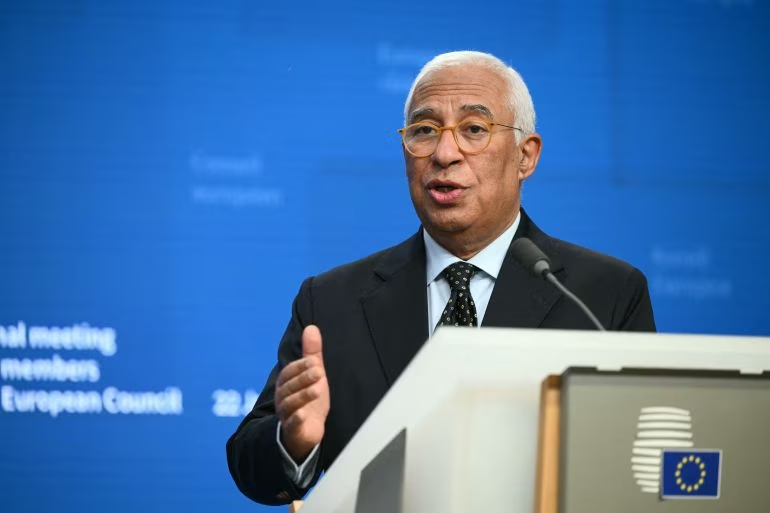
Costa: EU has serious doubts about the Peace Council

European Council President Antonio Costa announced early Friday that European leaders have "serious doubts" about the scope of work of the "Peace Council," announced by US President Donald Trump. Costa clarified after an EU summit in Brussels that the doubts concern "a number of provisions of the Peace Council's charter, related to its scope of work, its administration, and its compatibility with the United Nations Charter." However, he affirmed that European leaders have expressed their readiness to work with the new Council despite these doubts, adding: "We are ready to work with the United States on implementing a comprehensive peace plan in Gaza, with a Peace Council that undertakes its mission as an interim administration."

For his part, US President Donald Trump said that some European countries have informed him of their desire to join the "Peace Council" he founded, but are awaiting permission from their legislative councils to do so, referring to Italy and Poland. Earlier on Thursday, during the World Economic Forum in Davos, Switzerland, Trump announced the inauguration of the "Peace Council," affirming that it aims to maintain the ceasefire in Gaza. Trump stressed that "everyone wants to be part of the body," which he said could ultimately rival the United Nations, despite many US allies choosing not to participate. When asked if he would lead the group after his term ends, Trump said he was not sure, adding: "I have the right to be if I want, I will decide, it is theoretically possible for life, but I am not sure if I want that."

Bulgaria and Hungary are considered the only EU members to have joined the Peace Council so far, with the outgoing Bulgarian government also deciding to join the initiative, a decision expected to be ratified by parliament next week. Bulgarian diplomat Nikolay Mladenov, a former UN envoy, was also chosen to be the High Representative for Gaza in the Peace Council. On Thursday, the Albanian parliament ratified the government's decision to join Trump's "Peace Council" initiative, with Prime Minister Edi Rama describing the move as a "gesture of goodwill" and a "special honor," saying it would enhance Albania's role on the international stage. The legislation was approved by a majority of 110 votes in the 140-member parliament, and Rama affirmed that "joining the initiative guarantees Albania a seat at the table of global diplomatic dialogues." Kosovo also joined the Peace Council, being a close ally of the United States, which supported its independence from Serbia in 2008.

PALESTINE

Fri 23 Jan 2026 2:55 am - Jerusalem Time

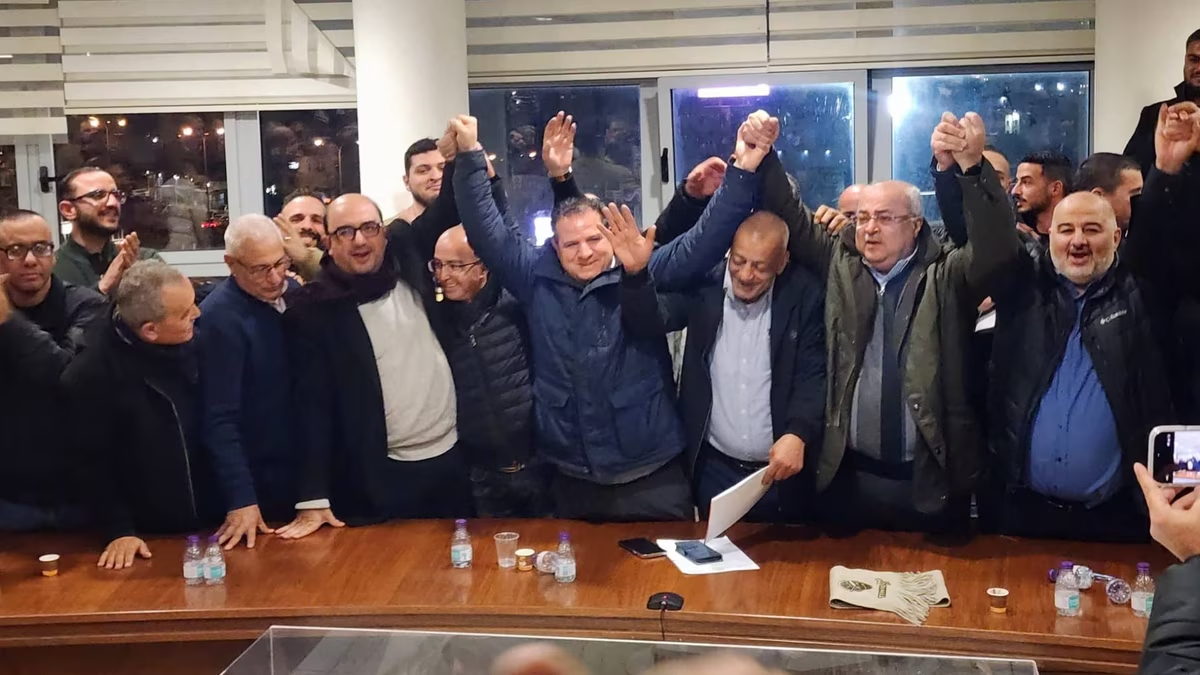
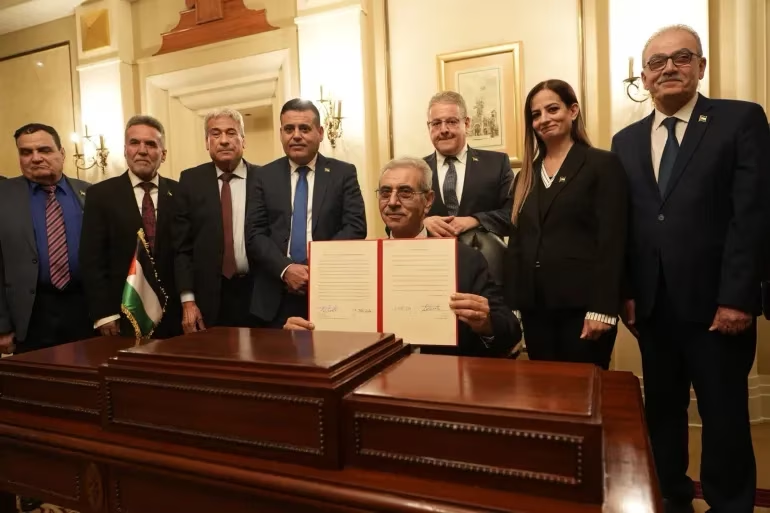
Heads of Palestinian Arab parties sign a petition to form the Joint List under public pressure in Sakhnin Municipality

Heads of Palestinian Arab parties and Arab Knesset members sign a "memorandum of understanding" inside Sakhnin Municipality headquarters 1 0 thumb_up 0 thumb_down Heads of Palestinian Arab parties sign a petition to form the Joint List under public pressure in Sakhnin Municipality Listen to the news: Published: An hour ago | Last updated: An hour ago | Palestine A massive demonstration in which tens of thousands of Palestinians from within participated.

Sources reported that the city of Sakhnin witnessed, on Thursday, a massive demonstration in which tens of thousands of Palestinians from within participated; expressing popular anger and rejection of the policies of the current Israeli occupation government.

This enormous public gathering constituted a direct and strong means of pressure on the Arab political leaderships, on the necessity of overcoming partisan differences and working to unify ranks to confront existential challenges.

In response to the public pulse, the heads of Arab parties and Arab Knesset members decided to sign a "memorandum of understanding" inside Sakhnin Municipality headquarters; aiming to re-form the "Joint List" to contest the upcoming Knesset elections as a unified bloc.

This signing represents an official announcement of the beginning of a new phase of joint political and electoral coordination.

The signing Knesset members affirmed that the strategic goal of reviving the Joint List is: to unify the Arab voting power to bring down the extremist "Netanyahu - Ben Gvir" government.

And to protect the rights of Palestinians within through a significant parliamentary bloc.

And to stop the racist and incitement policies practiced by the far-right poles against them.

PALESTINE

Fri 23 Jan 2026 12:25 am - Jerusalem Time

Widespread anger in Israel with the announcement of the imminent opening of the Rafah crossing

News circulating about the imminent reopening of the Rafah crossing has sparked a wide wave of political and media reactions within Israel, amidst conflicting statements between Palestinian and international parties, and official Israeli reservations about the move. The head of the National Committee for Gaza Administration, Ali Shaath, announced that the Rafah crossing would open next week, considering the step an indication that Gaza is no longer closed to the world and the future.

Shaath said that the opening of the crossing comes within a transitional path aimed at improving the daily lives of residents, rebuilding institutions, and restoring order, stressing that the Rafah crossing represents a lifeline for Palestinians and a symbol of opportunities and dignity, despite the difficulty of the upcoming stage and the challenges it carries. "Surrender" For his part, the leader of the "Yisrael Beiteinu" party, Avigdor Lieberman, attacked the announcement of the opening of the crossing, considering what is happening to be a "surrender" to the Palestinians, and wrote commenting: In the same context, Merav commented that the announcement by the head of the Gaza Executive Council, Nikolai Mladenov, of an agreement to open the Rafah crossing contradicts the official Israeli position, and said: "Beware" In turn, journalist Tal Schneider questioned the nature of the announced agreements, saying: Amir Dank also wrote, commenting that the October 7 war led to the internationalization of the Palestinian-Israeli conflict, in a shift that contradicts Israeli policy since 1967. He said:

In contrast, sources quoted a political source as saying that the issue of reopening the Rafah crossing is still under discussion within the "Cabinet," in conjunction with efforts being made to recover the body of Israeli Ran Gozali. Sources also quoted Gozali's mother as saying that she had not been informed of the intention to open the crossing, expressing her rejection of this step.

PALESTINE

Thu 22 Jan 2026 11:40 pm - Jerusalem Time

Martyrs by occupation fire in Gaza, and Shaath announces Rafah crossing to open in days

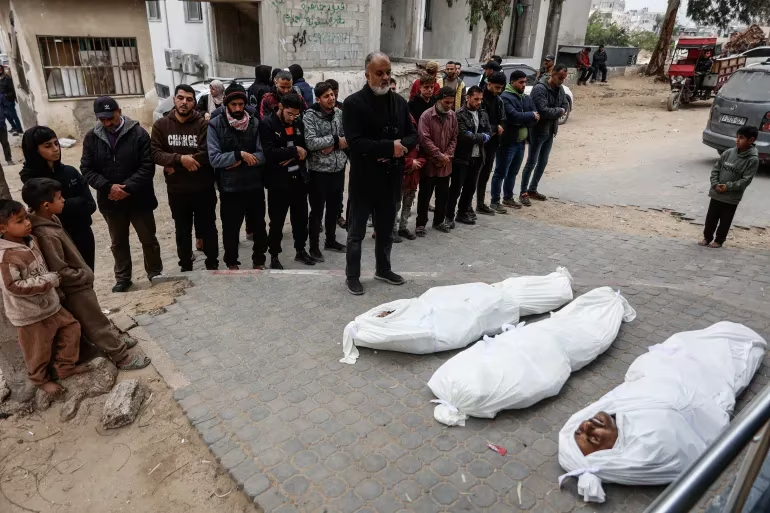
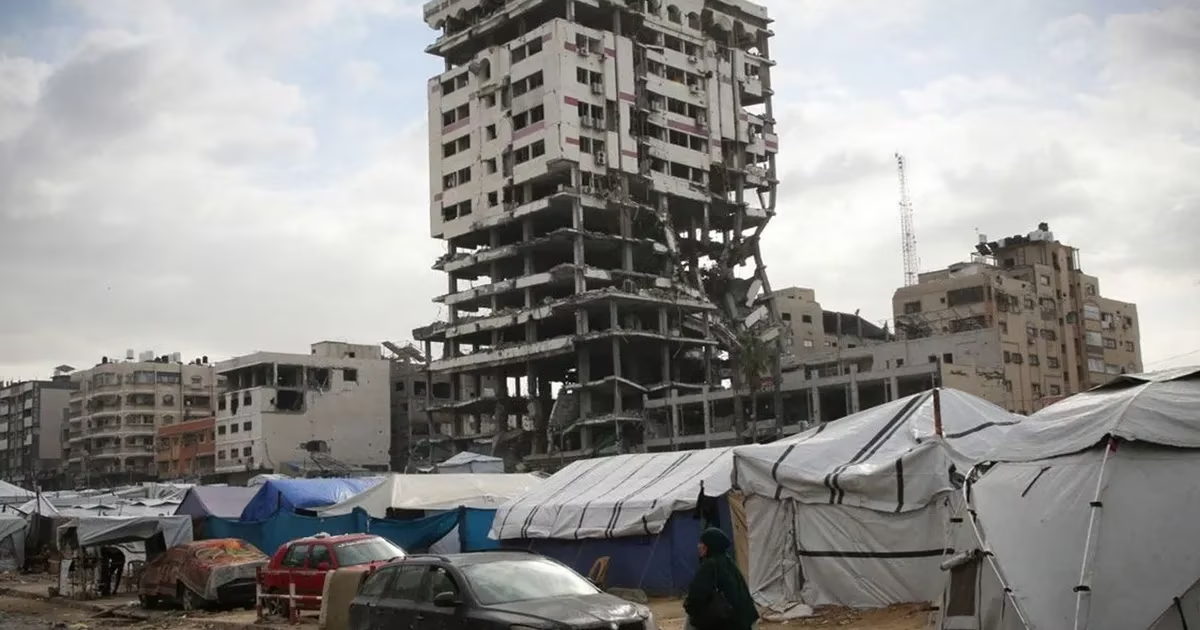
Five Palestinians were martyred on Thursday by Israeli occupation army fire in the Gaza Strip, and occupation forces carried out a massive demolition operation east of Khan Yunis, while the head of the Palestinian National Committee for Gaza Administration announced that the Rafah crossing would open next week.

Sources in ambulance and emergency services in the Gaza Strip reported the martyrdom of four Palestinians and the injury of others in Israeli artillery shelling that targeted a group of Palestinians outside the deployment areas of the occupation army in the Al-Zaytoun neighborhood, east of Gaza City, in the northern Strip.

The source explained that the Palestinians were targeted while trying to collect firewood for heating due to the lack of fuel and electricity in the Strip.

Earlier, a Palestinian was martyred by occupation fire outside its deployment areas at Bani Suheila roundabout, east of Khan Yunis, in the southern Strip.

With the continued Israeli restrictions on the entry of aid, sources in ambulance and emergency services in the Gaza Strip reported today the death of infant Ali Abu Zor (3 months old) due to the severe cold wave in the Strip.

The sources said that the child arrived at Al-Aqsa Martyrs Hospital in Deir al-Balah as a lifeless body.

With Ali's death, the number of children who have died due to the cold since the beginning of winter has risen to eight, according to the Ministry of Health in the Strip.

Demolition operations

Sources said today that Israeli occupation forces are carrying out a massive demolition operation east of Khan Yunis city, and sources said that the demolition operations took place at dawn today within the deployment areas of the occupation army, coinciding with helicopter fire.

Occupation forces continue demolition operations in various areas of northern and southern Gaza despite the ceasefire agreement (Reuters)

A report revealed satellite images showing that the Israeli army destroyed buildings in Gaza City outside the truce line, and the images also confirm Israel's encirclement of more areas of Gaza City.

According to the same sources, the occupation built fortifications in areas close to the yellow line, and also expanded this line within the Al-Tuffah neighborhood in Gaza City.

Opening of Rafah crossing

On the other hand, the head of the Palestinian National Committee for Gaza Administration, Ali Shaath, announced on Thursday that the Rafah crossing would open in both directions next week, saying that the crossing "is more than a gate, it is a lifeline and a symbol of opportunities."

Sources reported that Shaath said - in a press statement - that "it is my responsibility to turn this moment into an opportunity to achieve a dignified future for the residents of the Gaza Strip."

Israeli sources quoted sources as saying that the ministerial committee would convene next Sunday to discuss the issue of opening the Rafah crossing.

Earlier, Israeli sources quoted a source as saying that no order had been issued yet to open the crossing, explaining that a decision from the political level was required to settle this matter.

For its part, sources reported, based on a political source, that the Rafah crossing would not open until the last body from Gaza was returned, and the same sources quoted sources as saying that Tel Aviv would prevent Gazans from returning to Gaza through the crossing, except for humanitarian cases.

Israel - which controls the Gaza side of the crossing - had refused to reopen it until the Islamic Resistance Movement (Hamas) fulfilled its commitment - under the ceasefire agreement - to return the remains of the last hostage in the Strip.

After Ali Shaath's announcement, Israeli political sources said that special efforts were being made to return the remains of Ran Gvili.

Although the crossing was not officially under Israeli control after the crossings agreement signed between it and the Palestinian Authority in 2005, it has always exerted pressure - directly or indirectly - to control its opening and closing and the lists of those crossing through it.

PALESTINE

Thu 22 Jan 2026 9:34 pm - Jerusalem Time

The occupation raids Yabous Center and prevents the screening of the film Palestine 36

The occupation police and intelligence raided the headquarters of the Yabous Center on Al-Zahra Street in occupied Jerusalem, and handed the center's administration an order signed by the so-called "Jerusalem District Police Commander" to close the center and prevent the screening of the film Palestine 36. They expelled those present, including those who were in the center.

The decision stated that within the framework of the “Capital Shield” campaign, the screening of the film “36” at the Yabous Center on Al-Zahra Street in Jerusalem was prohibited, based on an order issued by the district commander, and in light of intelligence information indicating that the activity aims to support and promote the goals of a terrorist organization.

It is worth noting that the film was supposed to be screened at the Jerusalem Cinema, affiliated with the Yabous Center, for two days.

PALESTINE

Thu 22 Jan 2026 4:25 pm - Jerusalem Time

"The Cabinet" discusses opening "Rafah Crossing" early next week.. Shaath from Davos: "An indispensable condition for reconstruction"

Shaath indicated that the flow of raw materials and necessary machinery for rebuilding the destroyed infrastructure requires a fully operational crossing under Palestinian supervision. In a remarkable political development that could establish a new phase in the Gaza Strip, Hebrew media revealed on Thursday evening an imminent "Israeli" move to discuss the fate of the Rafah crossing, coinciding with Palestinian and international calls at the Davos forum linking the opening of the crossing to the success of peace and reconstruction plans.

In detail, high-ranking sources in the office of the occupation prime minister, Benjamin Netanyahu, reported that the Ministerial Committee for Political and Security Affairs (the Cabinet) will hold a crucial meeting early next week.

The sources confirmed that the main item on the agenda is to discuss mechanisms for "reopening the Rafah border crossing" with the Arab Republic of Egypt.

According to the sources, this discussion does not come out of nowhere, but is a direct response to: increasing international pressure on the occupation government. The new security arrangements stipulated by the latest UN Security Council resolution. The requirements of US President Donald Trump's peace plan.

This "Israeli" move coincided with statements made by Ali Shaath (the Palestinian official in the Reconstruction Coordination Committee) during the sessions of the World Economic Forum in Davos this morning. Shaath placed the international community before its responsibilities, stressing that any talk of a "Peace Council" or plans for rebuilding Gaza would remain mere ink on paper without a real lifeline.

Shaath said in his speech: "The opening of the Rafah crossing is not just a border procedure, but it is the necessary step and prerequisite for starting any real reconstruction process."

Shaath indicated that the flow of raw materials and necessary machinery for rebuilding the destroyed infrastructure requires a fully operational crossing under Palestinian supervision and international monitoring, calling for the translation of political understandings into tangible reality on the ground.

Observers believe that the upcoming "Cabinet" meeting will be a test of the seriousness of commitment to Trump's plan and Security Council resolutions, as the "Rafah" file is the cornerstone of any transitional arrangements for the Gaza Strip in the coming phase.

PALESTINE

Thu 22 Jan 2026 3:25 pm - Jerusalem Time

Trump and Kushner clarify Gaza plan linked to full disarmament

He also indicated that the plan explicitly links reconstruction to disarmament.

The President of the United States stated that Washington would be very successful in Gaza, noting that the United States would ensure the removal of weapons from the Gaza Strip and its “beautiful reconstruction.”

He claimed that the United States had maintained a ceasefire in Gaza and provided record levels of humanitarian aid, adding that reports of Palestinians suffering from hunger in Gaza were no longer heard.

These claims contradict developments on the ground. “Israel” has repeatedly violated the ceasefire, resulting in the deaths of more than 480 Palestinians since its implementation, while continuing to obstruct the entry and distribution of humanitarian aid in the Gaza Strip.

International organizations have consistently warned of the ongoing severe food shortages in large parts of Gaza despite continuous diplomatic efforts.

After a signing ceremony, Trump’s son-in-law Jared Kushner said he shared photos and policy outlines illustrating what they envision for Gaza within the framework of what he described as a proposed post-war “Peace Council.”

Kushner explained that the plan includes the establishment of a “single legitimate transitional civil authority” to govern Gaza. He said this would begin with a new civil authority for Gaza, then transition to the Palestinian Authority once reforms are completed.

He noted that the framework is based on the principle of “one authority, one law, one weapon,” meaning that all weapons would be licensed by a single civil authority.

He added that the plan stipulates a “monopoly on force,” requiring the dissolution or integration of all armed groups, internal security agencies, and police organizations after what he described as careful scrutiny and strict verification.

He affirmed that the process would be “Palestinian-led” but “subject to international verification,” and would include the destruction of heavy weapons, tunnels, military infrastructure, and facilities for producing weapons and ammunition.

He added that heavy weapons would be dismantled immediately, while personal weapons would be registered and gradually removed by sector, with the new authority's police force capable of ensuring personal security. He clarified that the ultimate goal is for weapons to be carried only by individuals licensed by the authority.

He also indicated that the plan explicitly links reconstruction to disarmament, as investments would only open in sectors that achieve complete disarmament.

He further added that the framework includes incentives for disarmament, including amnesty, reintegration, or safe passage.

According to Kushner, the plan will be implemented through a phased process subject to independent verification, leading to what he described as a gradual withdrawal of Israeli occupation forces to a defined security perimeter.

He added that complete disarmament in Gaza would enable a full withdrawal to this perimeter.

He affirmed that Arab countries have built cities “like this” within three years, adding that planners are studying global models and education systems to benefit from them.

However, he stressed that “governance represents a major issue” in any future arrangement for Gaza.

PALESTINE

Thu 22 Jan 2026 2:40 pm - Jerusalem Time

Kushner: The past 100 days have yielded great results.. and we will give the residents of the Gaza Strip opportunities to improve their lives

Jared Kushner, the US President's envoy and a member of the "Peace Council", revealed that tangible results have been achieved in the settlement process within the Gaza Strip over the past 100 days. Kushner affirmed that the American vision focuses on restoring security and providing basic services, paving the way for opening a new page of coexistence, while emphasizing Washington's commitment to disarming the "Hamas" movement as a fundamental condition for sustainable stability.

Kushner explained that the US administration has developed phased plans aimed at improving the quality of life for residents by providing real job opportunities and developed infrastructure. He stressed that the current effort is focused on complete disarmament to ensure no return to the cycle of violence, considering this step to be the bridge towards "economic peace".

Key axes of the upcoming American action:

Holding an international conference: To disclose the extent of major countries' contributions to the Gaza reconstruction file.

Commitment to services: Ensuring access to healthcare, education, and energy for residents in a way that preserves their dignity.

Security strategy: Implementing strict oversight mechanisms to disarm factions within a specified timeframe.

Kushner believed that transforming the region into a prosperous environment is not just a theoretical vision, but a path that has begun to take shape on the ground with the support of Washington's regional partners.

PALESTINE

Thu 22 Jan 2026 2:40 pm - Jerusalem Time

Putin announces Russia's readiness to contribute $1 billion to the "Peace Council" to support the Palestinian people

Russian President Vladimir Putin expressed his country's readiness to contribute $1 billion to the "Peace Council" concerned with the reconstruction and development of the Gaza Strip, explaining that these funds would be deducted from frozen Russian assets in America.

Putin stressed that achieving real progress in the region is fundamentally linked to the establishment of an independent Palestinian state, as it is the only way to achieve a comprehensive and sustainable peaceful settlement in the Middle East.

Putin's statements come at a time when international relations are witnessing sharp tensions over the fate of Russian funds frozen in Western banks since 2022.

His proposal to transfer part of these funds to a pivotal humanitarian and political cause in the Middle East represents a diplomatic step aimed at embarrassing Washington or finding a loophole in the sanctions regime.

The Russian President stressed that the commitment to provide $1 billion is not just a financial contribution, but rather support for the Palestinian people to overcome the effects of destruction. He explained that using frozen assets for this purpose is a pragmatic option to employ detained Russian resources in a way that serves global stability.

Highlights of Putin's messages:

Financial support: Readiness to inject $1 billion to finance development projects in Gaza through the "Peace Council".

Political solution: The belief that "establishing an independent Palestinian state" is the core of the solution and the only guarantee of security.

Implicit criticism: Referring to the presence of funds in America, which opens the door to legal debate about Washington's right to dispose of them or withhold them from peace efforts.

The Russian President believed that any plan that does not include respect for Palestinian sovereignty will be doomed to failure, which reflects Moscow's adherence to its role as a pivotal player in Middle East issues.

PALESTINE

Thu 22 Jan 2026 1:40 pm - Jerusalem Time

Head of the National Committee for Gaza Administration reveals date for Rafah crossing opening

The head of the National Committee for Gaza Administration, Ali Shaath, announced that the Rafah crossing will be opened next week, emphasizing the need for several steps to ensure regular movement and optimal service for citizens.

Shaath added in his statements that his responsibility is to transform this current moment into a real opportunity to achieve a better future for the Strip, after periods of setbacks.

For his part, the head of the Palestinian Technocrat Committee in Gaza confirmed that the crossing will open in both directions next week, allowing residents of the Strip freedom of movement and facilitating the arrival of humanitarian aid and essential services.

Officials indicated that the reopening of the crossing represents a pivotal step towards improving the movement of individuals and goods, and comes as part of intensive efforts to enhance stability and improve living conditions in Gaza.

PALESTINE

Thu 22 Jan 2026 1:37 pm - Jerusalem Time

Congressional Democrats Urge Trump Administration to Curb West Bank Annexation Path

Said Erikat

Opinion Writer


More than seventy-five Democratic representatives and senators from both chambers of the US Congress sent a public letter, published on Tuesday, urging President Donald Trump's administration to take a firmer stance against Israeli efforts to impose de facto sovereignty over the West Bank, warning of the repercussions for stability and the possibility of achieving a just political settlement. The signatories demanded clear American intervention to reset the compass and prevent a slide towards unilateral steps that would close the doors to diplomatic solutions.
The letter was originally sent last Friday (1/16/2026) to US Secretary of State Marco Rubio, and was initiated by Senator Peter Welch and Representative Ro Khanna. It emphasized the need for urgent and tangible actions to maintain the ceasefire in the Gaza Strip and prevent its collapse under the weight of increasing polarization, thereby ensuring that the prospect of a two-state solution remains a viable option, not just a political slogan that erodes over time.
The lawmakers affirmed in their letter that the American role at this stage is extremely sensitive, considering that Washington is capable – if it wishes – of effectively influencing Israeli decisions. They wrote that “American leadership is crucial at this moment,” demanding that the State Department unequivocally inform the Israeli government that its policies in the West Bank will lead to negative consequences that are not limited to opportunities for peace and regional security, but extend to the daily lives of Palestinians and the nature of the strategic relationship between Israel and the United States.
Congressional members pointed out that there are Israeli legislations being prepared or discussed that would gradually entrench annexation, either directly or through the establishment of "de facto annexation" paths. In this context, they called on the United States to re-impose sanctions adopted by the Biden administration and to condemn what they described as the expansion of Israeli settlers through pressure, violence, and the imposition of facts on the ground, making the West Bank an open arena for accelerated geographical and political change.
The letter noted that despite the United States' official rejection of annexation, Israel has recently seen voices within the Israeli government affirming its commitment to expanding "sovereignty" in the West Bank. Lawmakers also pointed to a preliminary vote in the Knesset in favor of two bills aimed at imposing Israeli sovereignty over the West Bank, in addition to dozens of other projects that, if approved, would grant annexation official legal cover in various forms and open the door to transforming settlement from an expansion policy into a permanent governance structure.
The signatories expressed grave concern about bills seeking to annex settlements north, east, and south of occupied Jerusalem, with the aim of creating an expanded municipality under Israeli control, which they consider a central step towards tightening control over Jerusalem and its surroundings and redrawing the map of both land and identity. One of the sponsors of these projects had previously described them as “a major station towards full sovereignty.”
In the same context, lawmakers noted that Benjamin Netanyahu's government has pushed for settlement construction in the "E1" area east of Jerusalem, an area estimated at about 12 square kilometers, and a tender for housing units was issued earlier this month. They considered that this type of project, coupled with other expansions, would practically divide the West Bank into separate northern and southern enclaves, severing the geographical contiguity of Palestinian territories, thereby deliberately undermining the possibility of a future Palestinian state.
The letter was not limited to warning against proposed legislation but also affirmed that the reality of "de facto annexation" already exists on the ground, through recurring patterns of systematic violence, intimidation of Palestinian communities, and forced displacement. It stated that settlers in several areas of the West Bank are working to displace Palestinians from their lands and expand settlements, including in Taybeh, Wadi Fukin, Silwan, and Al-Walaja, which exacerbates tensions and threatens to ignite the region more broadly.
The letter received support from liberal American Jewish groups that identify themselves as pro-Israel but oppose annexation and settlement policies. Hannah Morris, a representative of J Street, said that her organization appreciates Senator Welch's leadership in pressuring the Trump administration and Secretary of State Rubio to ensure a halt to de facto annexation efforts, emphasizing that the establishment of a Palestinian state – not the continuation of occupation or the entrenchment of annexation – is the only path capable of providing a just and lasting peace for both parties.
For his part, Hadar Susskind, president of the New Jewish Narrative organization, said that the Trump administration has failed to curb settlement expansion and destabilize the West Bank, adding that 2025 saw record levels of settler attacks on Palestinians, and that the letter serves as a direct wake-up call to Secretary of State Rubio. He also praised Welch and Khanna for their initiative, expressing hope that the administration would take this frank appeal seriously.
The importance of this letter stems from its issuance by a broad Democratic bloc within Congress, which gives it political and moral weight and reflects the widening gap within Washington on how to manage the relationship with Israel. Annexation, whether in the form of an explicit legal decision or through gradual settlement expansion, puts the United States to the test of its credibility: can it defend the "two-state solution" narrative as a policy, or will it merely repeat it as a diplomatic phrase that does not prevent the collapse of reality on the ground?
The paradox, according to experts, is that "de facto annexation" does not always require an official declaration to become a reality; it is enough for the land to be transformed into separate enclaves, for movement restrictions to be imposed, and for residents to be expelled under the pressure of violence or "laws," until the future is governed by power balances rather than decisions of international legitimacy. Therefore, the lawmakers' demand for the re-imposition of sanctions and decisive intervention is not a procedural detail, but a belated attempt to stop an accumulative process that, if completed, will leave the settlement with only its form, while its substance is lost.

PALESTINE

Thu 22 Jan 2026 10:25 am - Jerusalem Time

The Occupation Awaits Ramadan with Apprehension.. West Bank and Jerusalem on the Brink of Explosion

Security circles within the Israeli occupation are treating the upcoming month of Ramadan, astronomically expected on February 17th, as a highly sensitive security juncture in this year's agenda, amidst an unprecedented intertwining of economic, social, and security factors in the West Bank and East Jerusalem. According to estimates issued by the security establishment in Tel Aviv, this year's Ramadan comes as the Palestinian territories are experiencing one of their most complex phases in years, due to the repercussions of the ongoing war, severe economic deterioration, and the absence of any clear political or livelihood horizon, which – according to the Israeli perspective – portends an increase in the likelihood of field friction.

Jerusalem at the Heart of Security Concern Security sources reported that East Jerusalem represents the primary focus of concern during the holy month, due to the overlap between the intensity of religious rituals in Al-Aqsa Mosque and the tightening of Israeli measures, in addition to Tel Aviv's decision to impose sanctions on UN organizations operating in the Palestinian territories, most notably the United Nations Relief and Works Agency for Palestine Refugees (UNRWA). The same estimates add that the tense regional scene, including the possibilities of escalation with Iran, casts its shadow over the Palestinian arena, increasing the sensitivity of any field development during Ramadan.

Unemployment and Economic Pressure Security agencies believe that the economic factor plays a pivotal role in the current scene, as Hebrew reports indicate that the Israeli occupation government's decision to prevent about 140,000 Palestinian workers from entering the occupied territories for work since October 7, 2023, has caused a deep economic shock within the West Bank. According to data issued by the Central Command of the Israeli occupation army, unemployment rates in the West Bank jumped from about 13 percent before the war to nearly 29 percent currently, creating a stressful social environment, classified security-wise as prone to explosion if the stalemate continues.

Israeli military sources indicated that the Palestinian street is awaiting a tangible breakthrough before Ramadan, whether in terms of work or easing restrictions, while there is widespread fear of the scenes of destruction witnessed in Gaza and Lebanon spreading to the West Bank. According to sources, this fear does not negate Israeli concern about an opposite scenario, represented by the outbreak of confrontations if Palestinian hopes are dashed, especially with the approach of Eid al-Fitr, a period that security estimates describe as "traditionally charged with incitement and tension."

Field Preparations and Multiple Scenarios In this context, the Israeli security establishment is preparing to deal with a wide range of scenarios, including intensifying monitoring and follow-up of what it describes as "lone cells," and monitoring local armed organizations in the West Bank, in addition to strengthening military deployment. The Israeli occupation army is also preparing for widespread use of digital applications for managing movement at crossing points along the contact line, with the aim of regulating the entry of worshipers to Al-Aqsa Mosque during Ramadan, according to mechanisms that Israel describes as "digital and disciplined." Despite these preparations, the Israeli political level has not yet finalized its policy regarding Eid al-Fitr prayers at Al-Aqsa Mosque, but security reports confirmed the intention to hold an upcoming meeting between security and political leaders to present the military establishment's recommendations before making the final decision.

PALESTINE

Thu 22 Jan 2026 10:25 am - Jerusalem Time

Egypt demands clarification from the occupation after the assassination of journalists working with it in Gaza

Sources reported that Cairo requested clarifications from the occupying state regarding the bombing of Palestinians working with the Egyptian Committee for the Reconstruction of the Gaza Strip, while the Israeli occupation army claimed it bombed drone operators who “posed a threat to its forces.”

According to sources, “Egypt demanded explanations from Israel regarding the incident that occurred in the central Gaza Strip.”

It added: “Egypt is determined to understand why the Israeli Air Force bombed a car carrying Gazans working for the Egyptian Committee for the Reconstruction of the Gaza Strip.”

Earlier on Wednesday, the Islamic Resistance Movement “Hamas” said that “the targeting by the Zionist occupation aircraft of a car belonging to the Egyptian Relief Committee in the central Gaza Strip this evening, and the martyrdom of 3 photojournalists who were on board while performing their media duty in the shelter camps in the central Gaza Strip, constitutes a described war crime.”

The committee referred to is a non-governmental Egyptian relief committee that has been active during the war of extermination, overseeing the implementation of relief projects for residents and displaced persons, and the restoration of infrastructure in the Strip, in cooperation with governmental bodies and local institutions, according to Palestinian media and local sources in the Strip.

In contrast, the occupation army claimed, in an attempt to justify its bombing, that its forces detected “a number of suspects operating a drone belonging to the Hamas movement in the central Gaza Strip, in an area that poses a threat to the forces.”

It added: “Immediately after detecting the suspects, and due to the danger posed by the drone, the Israeli army forces specifically attacked the suspects who were operating it.”

Earlier on Wednesday, the Ministry of Health in Gaza said that the Israeli army assassinated 11 Palestinians and injured 6 others, as a result of raids and shelling carried out by the army on several areas in the Gaza Strip.

The Director General of the Ministry of Health in the Gaza Strip, Munir Al-Barsh, stated that among the martyrs were three Palestinian journalists.

On December 2nd last year, the government media office announced that the number of martyred journalists had risen to 257, since the beginning of the genocide war on the Gaza Strip” on October 8, 2023, and the Israeli extermination since October 8, 2023, which lasted two years, left more than 71,000 martyrs and over 171,000 injured Palestinians, most of them children and women, and destruction that affected 90 percent of the civilian infrastructure.

Since the ceasefire on October 10, 2025, the occupation has killed 483 Palestinians and injured 1287 others, and severely restricts the entry of food, shelter, and medical supplies into Gaza, where about 2.4 million Palestinians live in tragic conditions.

ARAB AND WORLD

Thu 22 Jan 2026 10:25 am - Jerusalem Time

Trump to Netanyahu: Don't boast about the Iron Dome, we made it for "Israel"

US President Donald Trump attacked the head of the occupation government, Benjamin Netanyahu, saying that his country contributed to the manufacture of the "Iron Dome" system that "Israel" uses for air defense. In his speech at the Davos Forum in Switzerland, Trump said that "the United States has achieved great things with Israel," adding: "I told Netanyahu not to take credit for himself, as the Iron Dome is our own technology," in what the Hebrew website "Walla" described as an "attack" on the Israeli Prime Minister.

The Iron Dome is a mobile air defense system used by the occupation state, developed by "Rafael" Advanced Defense Systems with support from the United States to intercept short-range rockets and artillery shells. It became operational in 2011.
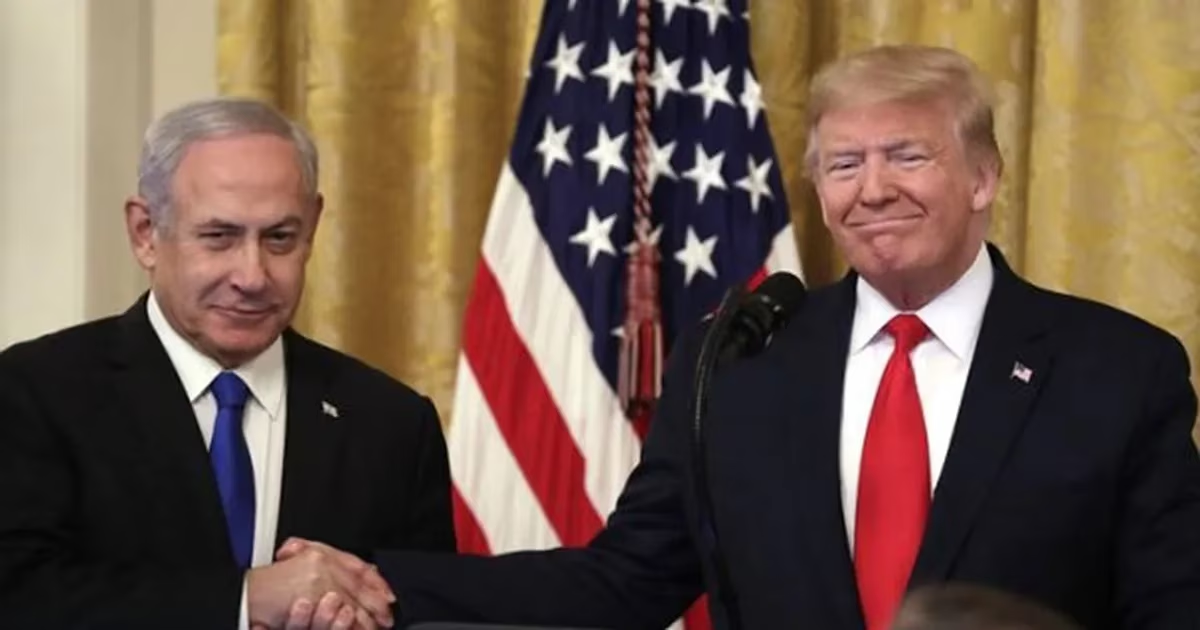
The development of this system began after the July 2006 war with Lebanese Hezbollah, to ward off the threat of short-range rockets from the occupation and 155 mm artillery shells, which have a range of up to 70 kilometers. The system includes a radar device, a tracking system, and a launcher consisting of 20 interceptor missiles called "Tamir."
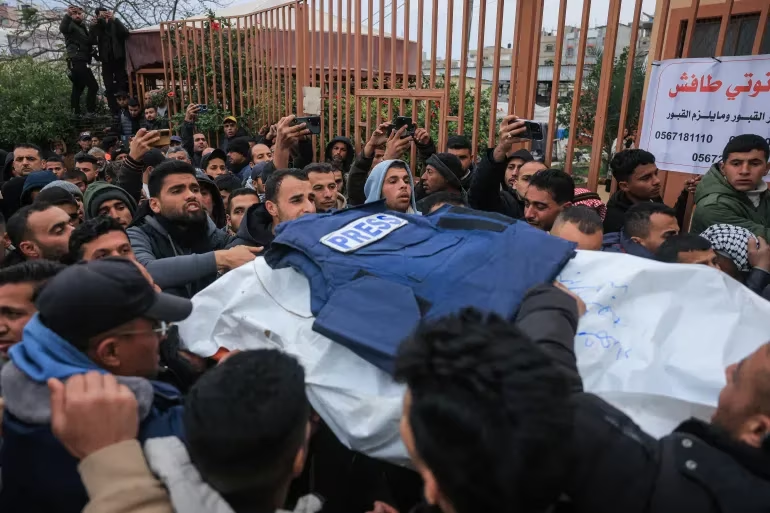
Iron Dome missiles hover around rocket projectiles until they collide with them. The longer the range of the missile, the longer it takes to calculate its trajectory, and any deviation can lead to a very significant change in the point of impact. Intercepting long-range munitions requires other radars, and the Iron Dome has a minimum range of 4.5 kilometers.
The military establishment of the occupation army admitted a decline in the Iron Dome's ability to intercept Palestinian rockets, due to the improved rocket capabilities of resistance factions and their penetration of the Dome system.

This acknowledgment means that the Dome does not meet the objectives for which it was developed in intercepting rocket projectiles, especially since the range of resistance rockets has reached more than 150 kilometers and to areas beyond the city of Tel Aviv.

Some experts attribute the resistance rockets' bypassing of the Iron Dome to the intensity of the response, while others believe that the Palestinian resistance has managed to develop its rockets. Meanwhile, Israeli military sources previously said that the matter relates to technical problems.

Trump announced on May 20 that the United States had defined the architectural shape of the "Golden Dome" system, which will involve launching interceptor missiles into space, stressing that the construction of the system would take about three years and cost approximately $175 billion.

US Secretary of War Pete Hegseth also confirmed that the system would be designed to intercept nuclear weapons as well.

The Golden Dome program sparked a wave of international criticism, indicating that the project aims to militarize space and violates international treaties that call for preserving space for peaceful uses only.

Russia and China criticized President Trump's proposal to develop the "Golden Dome" system, describing it as "deeply destabilizing," warning that it could turn space into a "battlefield."

The two countries said in a joint statement published on May 8, 2025, that they would begin consultations on preventing the deployment of weapons in space, and pledged to confront "policies and activities aimed at achieving military superiority and using space as a battlefield."

A spokesperson for the Chinese Foreign Ministry stated that the United States, in its pursuit of an "America First" policy, is obsessed with achieving absolute security for itself, noting that China is deeply concerned about this trend, and added that "this offensive system is extremely dangerous and violates the principle of peaceful use of outer space," and that "it will increase the risk of turning space into a battlefield and starting an arms race, and will undermine the international security system and arms control system."

Moscow had indicated that the Golden Dome program was similar to the "Star Wars" project, the term used to refer to the American Strategic Defense Initiative during President Ronald Reagan's era during the Cold War.

PALESTINE

Thu 22 Jan 2026 10:07 am - Jerusalem Time

Israeli media: Angry message from Cairo after the assassination of journalists from the Egyptian Committee in Gaza

Israeli Channel 12 revealed that Cairo demanded explanations from Tel Aviv regarding the attack on a car carrying Gazans working with the Egyptian Committee in the central Gaza Strip, which led to the martyrdom of 5 people, including 3 journalists. According to the channel, Egypt is demanding to "understand why the Israeli Air Force bombed a car carrying Gazans working for the Egyptian Committee for the Reconstruction of the Gaza Strip."

In the same context, Israeli sources said that Egypt "sent an angry message to Israel after a raid in Gaza in which 5 Palestinians were killed." The sources stated that "the dead were working for the Egyptian Committee for the Reconstruction of the Strip." They clarified that Cairo is protesting the execution of the raid outside the scope of the Yellow Line. The sources added that "Egypt confirms that the targeted area did not pose a threat to Israeli forces."

Earlier, medical sources in the Gaza Strip reported the martyrdom of 3 journalists working with the Egyptian Relief Committee due to an Israeli shelling in the Netzarim area, south of Gaza City.

The Director-General of the Ministry of Health in Gaza, Munir Al-Barsh, said that the Israeli occupation continues to kill Palestinians in the Strip, adding that the three martyred journalists work for the Egyptian Committee for the Relief of Gaza.

In turn, the Civil Defense announced - in a statement - the transfer of the bodies of the three journalists who were martyred as a result of an Israeli drone shelling to Al-Aqsa Martyrs Hospital in Deir al-Balah, central Gaza Strip.

Civil Defense spokesman Mahmoud Bassal said that "the journalists were performing a field photography mission in Netzarim, while documenting the conditions of camps supervised by the Egyptian Committee." He added that the journalists were wearing distinctive press clothing while at the targeting site.

OPINIONS

Thu 22 Jan 2026 10:03 am - Jerusalem Time

The American Peace Council and the Unity of Land and Institutions

Ramallah - "Al-Quds" dot com

Ramallah - "Al-Quds" dot com

Opinion Writer

The continuation of the occupation's crimes, along with the approval of the American Peace Council and the formation of a committee to manage the Gaza Strip, constitutes a provocative behavior that reflects a mentality of arrogance and disregard for international law and human values. It amounts to a full-fledged crime against humanity for which the occupation authorities bear full responsibility. The brutal practices and inhumane detention conditions faced by prisoners represent a blatant violation of the Geneva Conventions and all relevant international charters.
What the ministers of the occupation government, led by the extremist Itamar Ben-Gvir, are doing is unleashing their hatred and vengeful ideology against the prisoners within a systematic policy based on gloating and revenge. He bears direct responsibility for the execution and killing of dozens of prisoners inside prisons, whether through torture and causing death or through imposing deadly detention conditions. The continued international silence regarding these crimes is considered an insult to international law, international resolutions, and human rights, and undermines the credibility of international institutions concerned with protecting human rights.
The continuous incursions by the occupation army and settler gangs into the cities, villages, towns, and camps of the West Bank, and the commission of successive crimes, the transfer of crimes from the Gaza Strip to the West Bank, the rebuilding of a number of settlements that were previously removed by previous agreements, as is the case in the town of Sanur south of Jenin city, and the expansion of existing settlements through the construction of thousands of new settlement units, cannot continue and must stop. The national constants and goals that the Palestinian people believe in remain the compass for determining the national position in order to embody the establishment of an independent Palestinian state in accordance with international legitimacy resolutions.
 The United Nations and its specialized bodies, and international human rights and humanitarian organizations must take practical steps to punish the occupation and stop the continuous violations against Palestinian prisoners. Work must be done to organize broad solidarity campaigns at the Palestinian, Arab, and international levels to re-highlight the issue of prisoners, and the necessity for the International Committee of the Red Cross to play its full legal and humanitarian role and intervene urgently to ensure the protection of prisoners and stop the crimes committed against them inside the repressive occupation prisons.
 These political and humanitarian developments in the occupied Palestinian territories have cast their shadow over the region in general in light of the announcement of the Peace Council and its executive committee, in addition to the technocrat committee, in implementation of US President Donald Trump's plan, and Security Council Resolution 2803, and the importance of moving forward with political efforts aimed at achieving stability, and ensuring the return of the Palestinian Authority to assume its full responsibilities in the Gaza Strip, and the necessity of initiating a comprehensive national dialogue based on the consensus of all around the Palestine Liberation Organization as the legitimate and sole representative of the Palestinian people, and that the Palestinian National Authority must continue to provide its health, educational, administrative, and other services in the West Bank and Gaza Strip.
 The West Bank, including Jerusalem, the capital of the Palestinian state, and the Gaza Strip will remain a single unit in embodying the independent Palestinian state on the Palestinian territories occupied since June 4, 1967, within the framework of one political system, one law, and one weapon. Work must be done to establish political and legal links between the West Bank and the Gaza Strip within the framework of the unity of land and institutions, and the necessity of working to ensure that war does not resume, and to accelerate the entry of urgent humanitarian aid to relieve our people, in addition to supporting reconstruction efforts and the necessity of stopping settler attacks in the West Bank, and that the continuation of these violations undermines opportunities for stability and violates international laws and legitimacy.


PALESTINE

Thu 22 Jan 2026 10:00 am - Jerusalem Time

Preventing the Entry of "Technocrats"... A Desperate Attempt to Obstruct the Second Phase

Dr. Omar Rahal: Netanyahu will use facilitating the committee's entry as an additional bargaining chip on the table, as part of a policy of turning details into negotiation files.
Jihad Harb: The presence of the technocrat committee in Gaza and the actual start of its work will open the door to implementing the second phase, which Netanyahu does not want.
Nizar Nazzal: The committee is being prevented because it does not align with Israeli conditions, foremost among them disarmament and ending Hamas's organizational, political, and administrative presence.
Dr. Reham Odeh: Preventing the entry of the technocrat committee into Gaza is not related to the committee's work mechanism, but to lifting the siege on the Strip and the symbolism of opening the Rafah crossing.
Firas Yaghi: Israel seeks to send a message that everything happening in the Strip is subject to American-Israeli consensus and that it controls the scene.
Nu'man Tawfiq Al-Abed: Preventing the technocrat committee from entering Gaza clearly reflects the Netanyahu government's unwillingness to move to the second phase.


Ramallah – Exclusive to "Al-Quds"-

The prevention of the Palestinian National Committee for the Administration of the Gaza Strip, the "Technocrat Committee," from entering the Strip, as political analysts confirm, comes within the context of an escalating Israeli political move that goes beyond procedural or security dimensions. It reflects a systematic policy aimed at keeping the keys to movement and work within the Strip in the hands of the occupation, and in an attempt to obstruct the start of the second phase of the ceasefire agreement in the Gaza Strip.
According to writers, political analysts, and specialists, in separate interviews with "Al-Quds," this step shows that any administrative, humanitarian, or political path in Gaza remains conditional on direct Israeli will, in the absence of a real commitment to move to subsequent stages of the proposed understandings.
Writers, analysts, and specialists indicate that the occupation uses the issue of the committee's entry as a pressure and bargaining chip, by linking it to broader negotiation files, including the second phase, the cessation of war, and the opening of crossings, especially the Rafah crossing. This approach reflects an Israeli desire to obstruct any Palestinian administration, even if it is technocratic in nature, for fear that its work will establish a new political and humanitarian reality in the Strip.

Systematic Israeli Policy

Writer and political analyst Dr. Omar Rahal confirms that Israel's prevention of the technocrat committee from entering the Gaza Strip is not a new step in the occupation's behavior, but rather falls within a systematic Israeli policy based on controlling movement and transit and obstructing any path that could lead to real political or field changes.
He points out that the occupation previously prevented the late President Yasser Arafat and President Mahmoud Abbas from moving, leaving, and entering, in a similar context of restriction and control.
Rahal explains that this prevention carries a clear political message that the head of the occupation government, Benjamin Netanyahu, is the ultimate decision-maker, and he is the one who grants or denies permits, whether for the technocrat committee or others, as he controls all the details.

A Tool of Pressure and Obstruction of the Committee's Work

Rahal considers this step not merely a security measure, but a tool of pressure and obstruction of the committee's work, and a message directed to all concerned parties, stating that any progress in subsequent stages, whether in terms of reconstruction or the field reality in Gaza, will remain subject to Israeli will.
He points out that Netanyahu will use this issue as a bargaining chip in future political and diplomatic negotiations, so that facilitating the committee's entry becomes an additional item on the negotiating table, rather than a given, but rather part of a historical Israeli policy of turning details into negotiation files.
Rahal notes that the formation of the committee itself does not necessarily mean its ability to work, as its entry into Gaza may be subject to a new series of negotiations, procrastination, and Israeli conditions.

Agreements with Israel Lack International Authority

On the internal Israeli level, Rahal believes that this policy also represents a message directed to Netanyahu's partners in the current or future government coalition, stating that he is the guarantor of maintaining the status quo, and not allowing the committee's work to succeed or the situation to move to advanced stages related to reconstruction or direct observation of the extent of destruction in the Strip.
He stresses that the occupation does not respect agreements and does not adhere to deadlines or charters, due to the absence of real pressure tools and mechanisms that force it to comply, noting that the agreements signed with Israel lack a binding international authority, which allows the occupation to interpret and implement them only in its own interests.
Rahal refers to what media outlets have reported about the head of the technocrat committee, Dr. Ali Shaath, being delayed for about seven hours at the Karama Bridge before being allowed to leave for Jordan and then to Egypt, considering this incident to reflect the nature of humiliation and political blackmail.
Rahal believes that Dr. Ali Shaath should have announced his resignation after that incident and put international parties, especially the United States, in front of their responsibilities to pressure Israel to respect the agreements.

The Committee Will Eventually Enter

Rahal expects the committee to eventually enter Gaza, but after Israeli procrastination and the imposition of strict conditions, including controlling entry and exit times, and specifying the areas the committee is allowed to visit, which will prevent it from a comprehensive view of the extent of destruction in the Strip.
Rahal points out that any movement of the committee will remain subject to Israeli instructions, with the possibility of international interventions later to facilitate entry and exit, but without guaranteeing real freedom of movement.

The Second Phase That Netanyahu Does Not Want

Writer and political analyst Jihad Harb confirms that Israel's prevention of the technocrat committee from entering the Gaza Strip falls within its clear attempts to obstruct the transition to the second phase of understandings, due to the political and field implications of this phase that would undermine the occupation's pretexts for continuing the war and military control. Harb explains that the presence of the technocrat committee in Gaza and the actual start of its work will open the door to implementing the second phase, especially regarding the introduction of broader aid under the supervision of an independent body, which would end repeated Israeli pretexts about Hamas seizing aid, and the start of the second phase is not desired by the head of the occupation government, Benjamin Netanyahu.
Harb explains that the second phase goes beyond the issue of humanitarian aid, to include a complete cessation of the war, despite the possibility of continued limited Israeli violations through assassinations or sporadic military operations.
He points out that this phase includes preparations for two basic issues: the first relates to the formation of an international stabilization force and its entry into the Strip, and the second is the start of the disarmament process of the Hamas movement, which would strip Israel of its justifications for military presence in the Gaza Strip or in what is known as the Yellow Zone, in addition to stopping military operations against Palestinian citizens.
Harb explains that the opening of the Rafah crossing is one of the essential outcomes of the second phase, as it will bring about a qualitative shift in the mechanism of introducing aid into the Gaza Strip, and break Israel's almost complete control over the crossings, which will reflect on the humanitarian and economic situation in the Strip.

Maintaining the Stalemate

Regarding the possible scenarios, Harb indicates that the first and worst scenario is not moving to the second phase, and maintaining the stalemate, so that the technocrat committee cannot actually take over its tasks, with the continued Israeli military presence in the eastern areas for a longer period.
Harb believes that this option serves the head of the occupation government, Benjamin Netanyahu, politically and electorally, in light of his move towards elections at the end of this year, and his endeavor to use the war in his internal political battle, and to remain until the end of the current Knesset term with an extremist right-wing coalition.
As for the second scenario, according to Harb, it is based on allowing the technocrat committee to enter and begin its work, which opens the way for managing the affairs of the Gaza Strip and governing it, and leads to an escalation of international demands to launch a reconstruction process, in parallel with disarmament and a gradual Israeli withdrawal from the Yellow Zone.
Harb refers to a third, less likely scenario, which is the implementation of a reconstruction plan only in the eastern areas, according to previous American-Israeli perceptions, based on isolating Palestinian residents or Hamas's administration in the western areas, considering that this possibility has become weak in light of current indicators, foremost among them the formation of the technocrat committee and the executive council to administer the Gaza Strip and the beginning of the formation of a US-led peace council.

Multiple Messages

Researcher specializing in Israeli affairs and conflict issues, Nizar Nazzal, explains that the Israeli occupation's prevention of the Palestinian National Committee for the Administration of the Gaza Strip, the "Technocrat Committee," cannot be understood as a technical or security measure, but rather comes within a clear political context that carries multiple messages reflecting the Israeli vision for the future of the Strip and the nature of the control imposed on it.
Nazzal points out that the first message Israel seeks to establish is the delegitimization of any Palestinian administration that does not comply with its preconditions, noting that Israel wants to confirm the saying that "there is no authority in Gaza without full Israeli approval."
He believes that the refusal to allow the committee to enter the Gaza Strip, despite its technocratic nature, is due to its incompatibility with Israeli conditions, foremost among them the actual disarmament of the Hamas movement and the Palestinian resistance, working under an Israeli security umbrella, and ending Hamas's organizational, political, and administrative presence within the Strip.
Nazzal explains that the second message relates to the failure of the "gray administration," where the technocrat committee represents a compromise solution that is not subject to Hamas or the Palestinian National Authority, a model that Israel rejects because it keeps Gaza Palestinian in identity, and prevents the imposition of a long-term security arrangement.
Nazzal believes that through this prevention, Israel sends a message that the available options are limited to either a complete Israeli model or a vacuum controlled by force.
He points out that the third message is directed to international and regional mediators, foremost among them the United States, Egypt, and Qatar, as Israel seeks to raise its conditions and pressure Washington to impose arrangements that are consistent with the Israeli vision.
As for the fourth message, according to Nazzal, it is to prevent the establishment of any Palestinian authority in Gaza, even if it has no political color or program, while the fifth message targets the Israeli interior, by emphasizing the policy of "no concessions, no Palestinian administration, and no return to past experiences."

Possibility of Limiting to Limited Relief Administration

Regarding the expected scenarios, Nazzal suggests a scenario of continued prevention with a de facto administration, meaning the absence of the technocrat committee and the authority, and limiting to a limited relief administration and undeclared security control, warning that this path will lead to a long attrition and a potential explosion that will return the Strip to the square of war.
He talks about a second scenario based on modifying the committee according to strict Israeli conditions, which would turn it into a formal service committee without sovereign powers, with expected failure in the medium term. As for the third scenario, according to Nazzal, it is the imposition of an international transitional security administration or guardianship, a scenario that carries the risks of popular rejection, field clashes, and the reproduction of chaos.
Nazzal stresses that Israel does not seek to administer Gaza as much as it wants to control its fate without bearing responsibility, emphasizing that the Strip is no longer a service arena, but has become an arena of conflict over sovereignty and a real test of the will of the international community and a turning point in the future of the Palestinian issue.

Symbolism of the Rafah Crossing and Lifting the Siege

Writer and political analyst Dr. Reham Odeh believes that preventing the entry of technocrat committee members into the Gaza Strip is not related to Israeli observations on the committee's work mechanism or its composition and personalities, but rather is fundamentally connected to the symbolism of opening the Rafah crossing and lifting the siege on the Strip.
She explains that all committee members had previously obtained Israeli security approvals before the official announcement of its formation, stressing that the American administration cannot announce the committee without prior coordination with Israel.
Odeh explains that so far no official Israeli objections related to the committee have been issued, which reinforces the hypothesis that the reason for the prevention is primarily logistical, and lies in the mechanism of entry into Gaza through the Rafah crossing.
Odeh points out that Israel still objects to opening the crossing in both directions, under the pretext of not receiving the last body, noting that the occupation refuses to open the crossing exceptionally to committee members, for fear that this will turn into political and humanitarian pressure that forces its continued opening to the residents of the Gaza Strip.
Regarding the possible scenarios, Odeh expects in the first scenario that a solution will be reached for the Rafah crossing problem, allowing committee members to enter Gaza and begin their work from within the Strip, in coordination with Hamas.
Odeh points out that the committee's work in this case will be limited to humanitarian and relief files without security aspects, with an attempt to absorb Hamas government employees within the committee's administration.

Continued Targeting of "Hamas" Elements

Odeh suggests the continued Israeli targeting of Hamas elements, as part of a gradual attrition policy, while Hamas remains responsible for managing the security situation temporarily, until Arab and foreign countries agree to send forces for security supervision in coordination with the technocrat committee, with Hamas seeking to maintain a political and military situation similar to the Hezbollah model in Lebanon if Israeli operations against it stop.
As for the second scenario, according to Odeh, it is the continued closure of the Rafah crossing, and the technocrat committee's work remaining remotely from Egypt, with its tasks delegated to its deputies inside Gaza who coordinate with Hamas to restructure the government sector.
Odeh warns that this scenario may be accompanied by an Israeli announcement of its intention to disarm "Hamas" by force if it refuses voluntarily, which could lead to a return of the war on the Gaza Strip, even partially.

Initial Acceptance with Conditions

Writer and political analyst Firas Yaghi explains that the formation of the National Committee for the Administration of the Gaza Strip, the "Technocrat Committee," came after a long gestation and had previously received approvals from the United States and Israel, meaning that it had initial acceptance from the beginning, but this approval was not absolute, but rather linked to broader political and security conditions related to the second phase of the American plan.
He explains that the understandings that took place between the head of the occupation government, Benjamin Netanyahu, and US President Donald Trump regarding the frameworks of the second phase, confirmed that what has been done so far falls within the framework of formal procedures that do not affect fundamental issues.
Yaghi points out that any practical steps within the Gaza Strip, including the start of the National Committee's work, require a new and direct agreement between Washington and Tel Aviv, stressing that the formation of the committee does not practically mean the start of implementing the second phase of Trump's plan.

A Message from Israel of its Control over the Strip

Yaghi explains that through preventing the committee from entering Gaza, Israel seeks to send a clear message that everything happening in the Strip is subject to American-Israeli consensus, and that it is the party controlling the scene militarily and politically.
He cites the occupation's refusal to open the Rafah crossing except under conditions, most notably finding the body of the Israeli prisoner Rani Goili, in addition to security conditions related to inspection mechanisms and the number of entrants and exits through the crossing, so that the number of departures is greater than the number of arrivals.
Yaghi explains that Israel has put forward proposals that include establishing an electronic monitoring point between the Palestinian and Egyptian sides of the Rafah crossing for remote monitoring, and opening an additional lane after the Palestinian side of the crossing that is under its direct supervision, in addition to stipulating that the number of departures from Gaza be greater than the number of arrivals to it.
Yaghi believes that these conditions reflect the occupation's insistence on establishing its full control, and keeping the technocrat committee within the framework of an administrative service committee without actual powers.

Prolonging the Crisis and Preparing for Displacement

Yaghi confirms that Israeli procrastination in moving to the second phase aims to prolong the humanitarian crisis in the Gaza Strip, and prepare the ground for a displacement scenario.
He points out that Israel is still talking about potential military plans, if the Hamas movement is not disarmed within a specified period, according to what is being circulated about the "Peace Council" that Trump is expected to announce.
Regarding the possible scenarios, Yaghi stresses that the future of Gaza is now linked to the American vision for the region as a whole, which intersects with the Israeli vision on the issue of disarmament and the re-engineering of geography and demography.
Yaghi refers to Trump's statements in which he spoke about the desire of large numbers of Gaza residents to leave it, considering this part of a broader political project aimed at creating a new Palestinian entity without sovereignty, and a Palestinian leadership that is not linked to either Hamas or the Palestinian Authority, within the framework of what Netanyahu described as "de-radicalization," which makes displacement the most prominent scenario in the next phase.

Absence of Real Intention to Implement Commitments

Writer and political researcher specializing in international relations, Nu'man Tawfiq Al-Abed, confirms that the government of Israeli Prime Minister Benjamin Netanyahu has at no stage been concerned with stopping the aggression against the Palestinian people in the Gaza Strip, nor with ending the war or abandoning plans for re-occupation and settlement, and ideas of displacement, ethnic cleansing, and liquidating the Palestinian issue, noting that any path that leads to a ceasefire fundamentally contradicts the doctrine of this government and its political goals.
He explains that this position explains Netanyahu's continuous attempts to obstruct any political or field movement that leads to ending the aggression, noting that the occupation's failure to implement the first phase of the agreement, despite it being the easiest phase in terms of releasing Israeli prisoners and their bodies, reflects the absence of a real intention on the part of the Israeli government to implement its commitments as stipulated in the agreements.
Al-Abed explains that the second phase of the agreement carries commitments that completely contradict the approach of the Netanyahu government, foremost among them the withdrawal from the Gaza Strip from the Yellow Line to the Red Line, which the Israeli government rejects, in addition to establishing the Palestinian people in their land by confronting displacement plans, and launching a reconstruction and economic recovery process through donor conferences, as well as the role of the Palestinian technocrat committee, which the occupation believes contradicts its goals.

Rejection of Any Form of Palestinian Rule

Al-Abed points out that the Netanyahu government does not want any form of Palestinian rule in Gaza, regardless of the party in charge of the administration, explaining that its opposition is not limited to the Hamas movement or the Palestinian National Authority, but extends to a principled rejection of any Palestinian sovereignty or administration over the Strip.
He stresses that international intervention, whether through support or supervision of the technocrat committee, or through the intermediary executive council, or even through the presence of international forces, is considered by the Netanyahu government to be a threat to its approach based on monopolizing Palestinian decision-making, and seeking to impose its vision through the American administration.
Al-Abed warns of Palestinian and Arab fears that some of the proposed frameworks, foremost among them the Peace Council, will turn into an alternative to international bodies, which could harm the Palestinian issue.

A New Phase of Procrastination

Al-Abed confirms that preventing the Palestinian technocrat committee from entering Gaza clearly reflects the Netanyahu government's unwillingness to move to the second phase, and its failure to implement the outcomes of the Sharm El Sheikh summit, warning that this will lead to a new phase of procrastination and delay, and the obstruction of subsequent entitlements.
Al-Abed links this behavior to the internal political crisis Netanyahu is experiencing, and his endeavor to use toughness towards the Palestinian issue as an electoral propaganda tool as Israeli elections approach.
Al-Abed points out that the most likely scenario in the next phase is the Netanyahu government's attempt to keep the situation in Gaza as it is, and continue control and division, until after the Israeli elections, unless real international pressure occurs, especially from the American administration and Arab mediators and guarantors and influential countries, to enforce the implementation of the agreements as agreed upon.

OPINIONS

Thu 22 Jan 2026 9:59 am - Jerusalem Time

"An Iceberg" the Size of a Continent!

After Trump's speech in which he decided to ask for a piece of ice called "Greenland," as if it were an ice cube that accidentally fell from a cocktail glass onto the White House table, the world rediscovered that when the logic of power gets bored, it doesn't look for warm land, but for a refrigerator. Europe naturally refuses, then Trump returns to explain to them that refusal means nothing when the desire is supported by a long history of considering the planet an open store for whoever owns a strong war fleet and populist rhetoric suitable for electoral consumption.
 
The story seems at first glance a political joke, perhaps even suitable for sarcastic headlines that then pass, but behind this cold jest lies an old logic being recycled in a new language: the land is not a people, nor a history, nor a legal system, but an investment opportunity not yet reserved. In this sense, asking for a piece of ice is no different from asking for an oil field, or a strategic port, or a trade route, or even buying a people as slaves, but the difference is only in the degree of frankness, and in the media dose that accompanies the request.
Trump did not choose "Greenland" in vain, for the location is important, the resources are promising, and the changing climate turns ice into a treasure ripe for exploration and investment. Here, climate change, for which people pay the price, becomes a golden opportunity to rearrange maps of influence. The environmental catastrophe turns into an investment advertisement, and the world watches the show, then applauds in astonishment, and returns to its daily affairs.
What is striking is not only the request but also the way it was presented. There is no talk of sovereignty, nor of inhabitants, nor of historical rights, but only of a deal, as if global politics had officially returned to the era of pirates and major trading companies, when islands were bought and sold for shares, tea, and ships. But the difference is that we live in an age that claims ownership of a huge and impressive discourse of rights, but it is often used for display, not for implementation.
Europe's rejection of the request appeared outwardly as a moral stance, but the rejection itself was overly polite. No one said that the idea itself was scandalous; rather, it was said to be diplomatically inappropriate. The difference is significant when the discussion shifts from the rights of peoples to self-determination to the politeness of statements. At that point, we would have come a long way in normalizing the logic of acquisition in the language of the age, or colonialism in the language of the past, in its essence.
The irony here is that the international system, which is supposed to be based on respect for borders, is the very one that produced centuries of tearing apart and annihilating peoples and redrawing maps by force. The difference today is that the tools are a little softer, and the phrases somewhat more beautiful, but the essence is the same: whoever has power tests the boundaries, and whoever does not writes elegant statements of rejection, then waits for the next news.
The problem is that this pattern does not remain within the realm of anecdotes. When a leader of a major country presents the idea of acquisition as a debatable option, he sends a message to the whole world that international law is a suggestion, not an obligation. Today, a piece of ice or an island, and tomorrow a waterway or airspace, for the market is open only to those bold enough to say very loudly what others think, but with shameful silence.
The solution is not in ridicule alone, for although sarcasm is a necessary weapon to expose absurdity, what is required is to reconnect global politics with the logic of rights, not the logic of deals, and to restore the idea that land is not a commodity, and that peoples are not appendices in sales contracts. Without that, the world will continue to move from joke to crisis, and from a strange request to a new reality, then wonder how we got here?


OPINIONS

Thu 22 Jan 2026 9:58 am - Jerusalem Time

The Peace Council and Gaza... and Bypassing the Principles of International Law

In a move that goes beyond the framework of humanitarian or administrative arrangements for the post-war period, US President Donald Trump announced an expansion of the powers of what is known as the “Peace Council,” which he heads, granting it a direct role in overseeing the Gaza Strip.
This step comes concurrently with Washington's withdrawal from dozens of international organizations and agreements linked to the United Nations system, raising fundamental questions about the future of international legitimacy, the limits of the role of UN institutions, and the possibility of Gaza transforming into a testing ground for a new model of “peace of power” based on imposing facts rather than the force of law.
In this context, Gaza is no longer merely a war zone or an open humanitarian tragedy; it has transformed into a political and legal laboratory where new mechanisms for conflict management are being tested, mechanisms that bypass the principles of international law, marginalize the role of the United Nations, and replace the logic of right with the logic of dominance. Dealing with the Strip is no longer based on it being part of an occupied territory subject to clear rules of international humanitarian law, but rather as an “crisis management” issue amenable to special arrangements imposed from outside.
The international system, theoretically, is based on respect for state sovereignty and the right of peoples to self-determination, and on managing conflicts through collective institutions, foremost among them the United Nations.
However, what is being proposed for Gaza today represents a clear bypass of these foundations.
 The Peace Council is not based on a comprehensive UN mandate, nor does it stem from a free Palestinian will; rather, it derives its legitimacy from the balance of power and American patronage, which means shifting the center of legitimacy from international law to a de facto situation imposed by force.
More dangerously, Gaza is not being treated as an exceptional case imposed by war conditions, but as an experimental model that can be generalized. A model based on civil administration without sovereignty, reconstruction without a political horizon, security imposed from outside, and Palestinian representation stripped of its national and political dimension. If this model were to pass without actual objection, it could become a ready-made formula for managing other conflicts, where a just political solution is replaced by a long-term “forced stability.”
This path cannot be separated from the United States' decision to withdraw from a large number of UN-affiliated international organizations and agreements.
The political message here is clear: when international institutions do not serve power politics, they are bypassed, not reformed. Thus, international law transforms from a binding reference into a selective tool, used or marginalized according to interests.
What is being offered to Gaza today is not peace in the legal or political sense, but a formula based on calm without justice, reconstruction without sovereignty, and security without rights.
It is the peace of power, not the peace of law, where the weaker party is asked to adapt to imposed facts as the “realistic possible solution.”
Gaza today is not only under bombardment, but under test: a test of power's ability to impose a model of peace without justice, administration without sovereignty, and life without rights. If this model passes without conscious political and legal confrontation, its repercussions will not stop at Gaza's borders, but will extend to affect the Palestinian cause in all its components, as well as the core of the international system itself. What is happening is not the end of the United Nations, but the beginning of the formation of a world where conflicts are managed outside the law, and this is falsely called peace.