PALESTINE

Wed 11 Feb 2026 11:42 am - Jerusalem Time

Summit in Washington: Netanyahu Seeks to Extract 'Strict Pledges' from Trump Against Iran

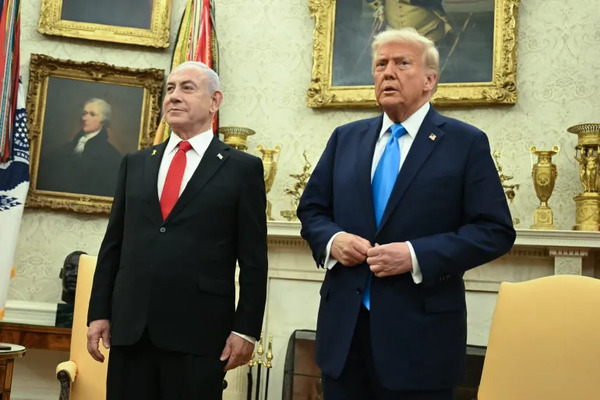
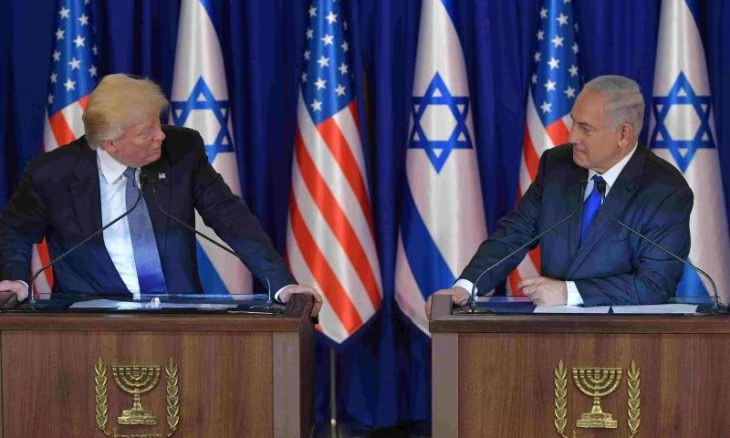
US President Donald Trump will host Israeli Prime Minister Benjamin Netanyahu at the White House on Wednesday, in a meeting of significant strategic importance given its timing and thorny issues. Netanyahu aims, through this visit – his seventh since Trump returned to power – to rally Washington's support for adopting a policy of 'maximum pressure' against the Islamic Republic of Iran.

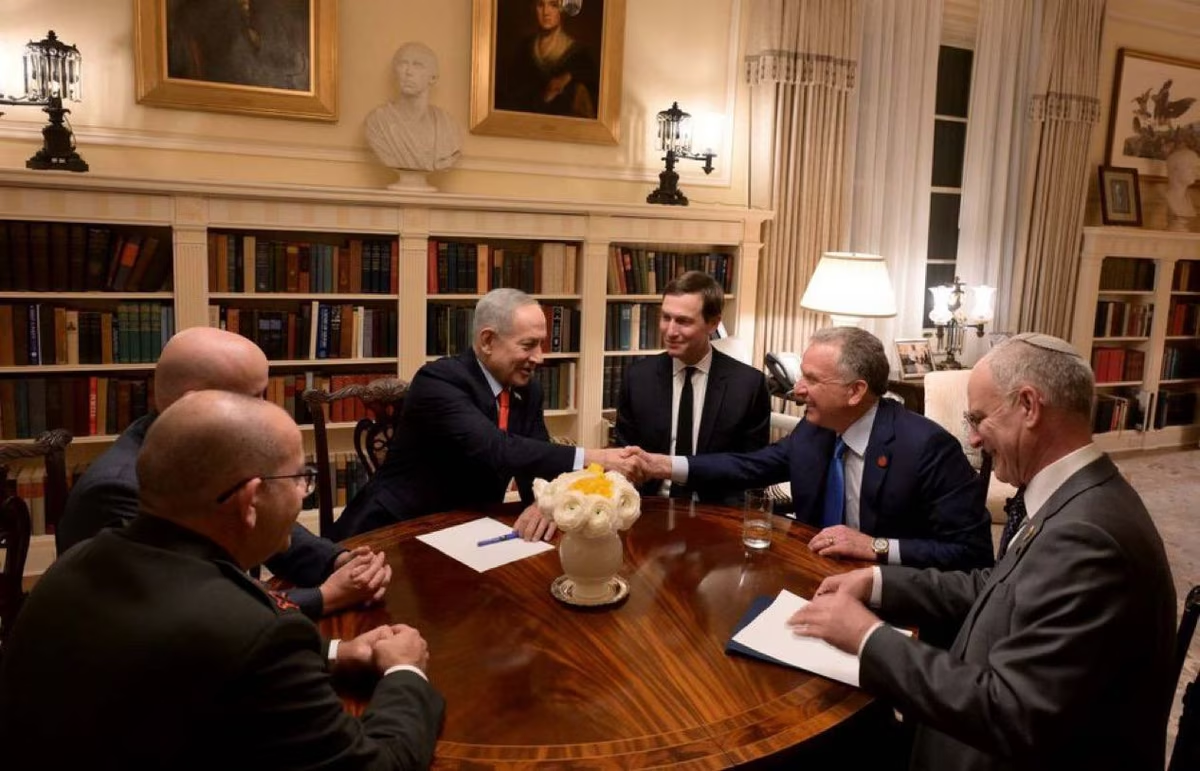
Netanyahu preceded the official summit by holding a lengthy meeting at Blair House, the presidential guest residence, with advisors Steve Witkoff and Jared Kushner, where he received a detailed briefing on the results of the first round of indirect talks recently held between Washington and Tehran in the Sultanate of Oman.

Informed sources indicate that the Israeli Prime Minister insists that any future understandings between the United States and Iran must not be limited to the nuclear file alone, but must extend to include strict restrictions on Iran's ballistic missile program, which directly threatens Israel's heartland.

For his part, President Trump adopts a dual discourse that combines brandishing military force with a desire to conclude a 'grand deal,' stating that he aspires to an agreement that ensures Iran is free of nuclear weapons and missiles, considering that Tehran will lose a valuable opportunity if it refuses to negotiate on Washington's new terms.

In the context of field escalation, Trump revealed that he is considering the option of strengthening the US military presence in the waters of the Middle East by sending a second aircraft carrier, in a move aimed at deterring any potential Iranian actions that might target American interests or allies in the region.

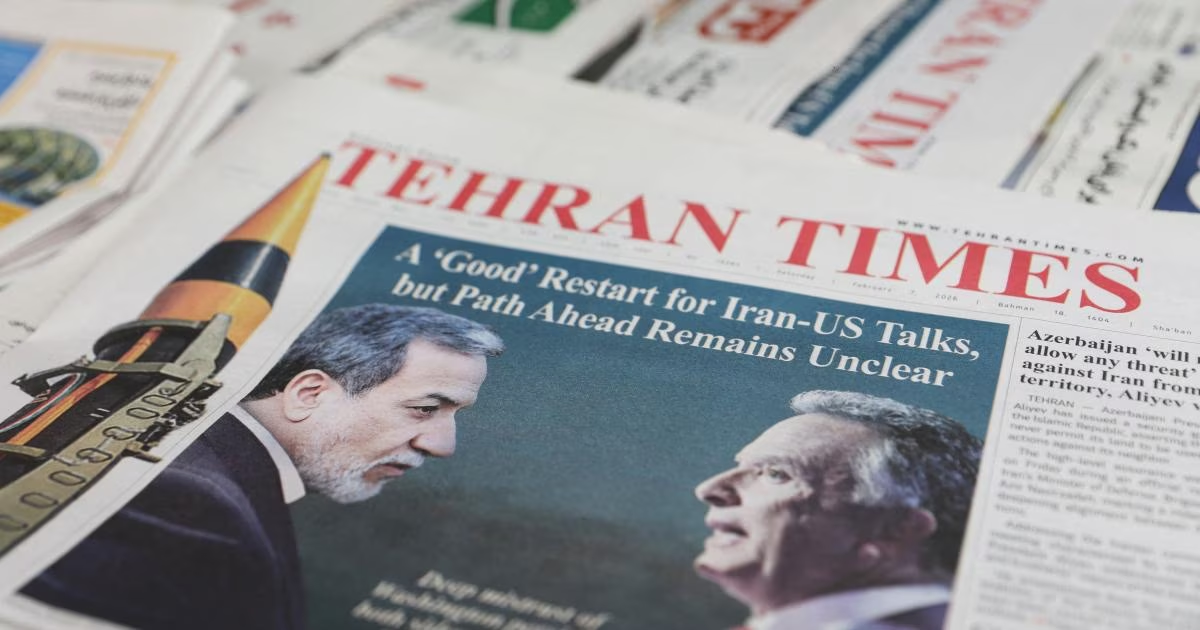
On the other hand, the Iranian Foreign Ministry warned that exercising additional pressure would lead to destructive results on the diplomatic track, affirming Tehran's commitment to limiting negotiations to the nuclear program and its categorical rejection of including its missile defense system in any discussion.

These moves come at a time when Israeli Defense Minister Israel Katz has hinted at the readiness of the air force, specifically F-35 aircraft, to carry out strikes deep inside Iran if necessary, which increases the intensity of the existing military tension between the two sides.

In a related context, Israeli President Isaac Herzog expressed from Australia his hope that the Washington talks would succeed in undermining what he described as the Iranian 'empire of evil,' emphasizing the necessity of freezing Tehran's support for armed groups in Lebanon, Yemen, and the Gaza Strip.

Away from the Iranian file, the issue of the West Bank emerges as one of the potential points of divergence, as sources in the US administration reported that Trump still opposes any Israeli plans aimed at annexing territories in the West Bank, despite recent Israeli measures to strengthen control there.

Observers believe that Netanyahu seeks to achieve external political gains to strengthen his troubled domestic position, especially with increasing pressure demanding early elections in Israel, which makes the results of his meeting with Trump a winning card in his local political struggle.

This summit coincides with international reports indicating the possibility of new parties entering the Gaza file, as Indonesia has expressed its readiness to send about 8,000 peacekeeping troops to the Strip, a proposal that may be discussed during the American-Israeli talks.

Foreign policy experts believe that Trump aspires to prove his ability to conclude a 'much better' agreement than the 2015 deal signed by Obama, which explains his insistence on including the ballistic missile file and support for armed groups as essential conditions for any rapprochement.

Iran's position remains firm regarding these conditions, as Tehran considers its missile capabilities a red line for defending its national security, warning that any attempt to link the nuclear file with other files will lead to a dead end in the upcoming Oman talks.

In conclusion, the international community awaits the outcomes of this summit, especially in light of the mutual threats and continuous military buildup, which places the region before scenarios ranging from cautious diplomatic détente to open military escalation.

Trump: I prefer to reach a good agreement with Iran that does not include nuclear weapons or missiles, and they would be fools if they refused it.
PALESTINE

Wed 11 Feb 2026 11:41 am - Jerusalem Time

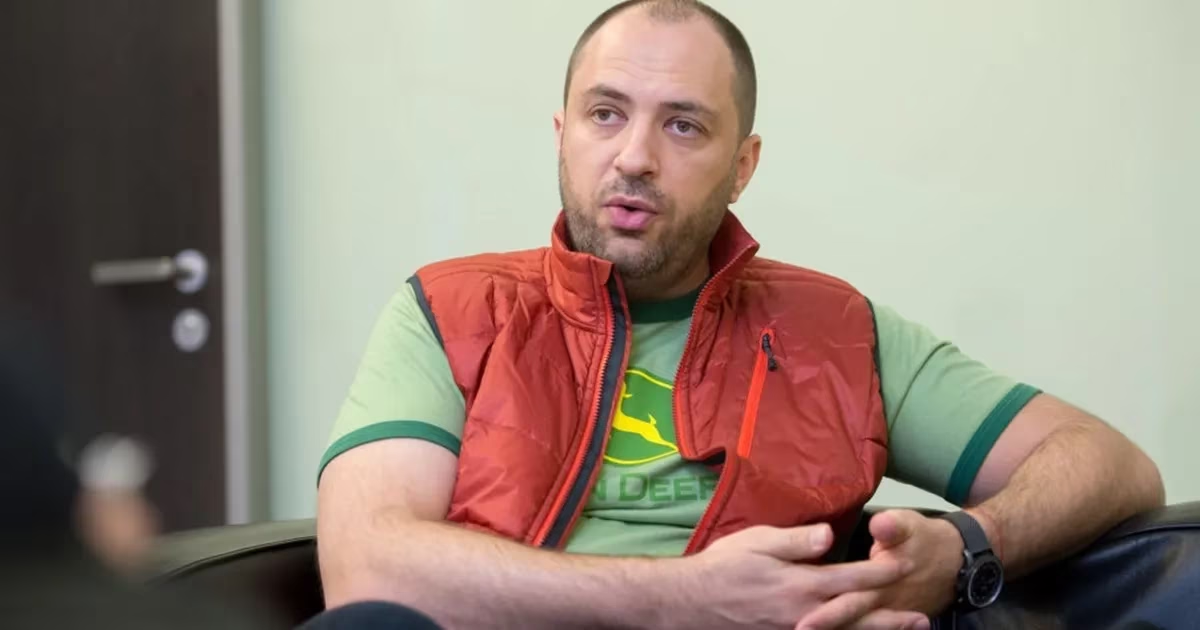
WhatsApp founder Jan Koum tops list of major donors to settlement organizations and the Israeli lobby

The non-profit organization 'Americans for Transparency' has revealed the pivotal role played by Jan Koum, co-founder and former CEO of the 'WhatsApp' application, in supporting the Israeli lobby within the United States. The organization clarified in a recent report that the American billionaire, of Ukrainian origin, is now classified as one of the most prominent generous donors to the occupation state and its associated organizations.

According to monitored financial data, Koum, whose fortune is estimated at about $15 billion, adopts a political orientation leaning towards the Republican Party and is keen to make large periodic donations. He topped the list of donors to the American Israel Public Affairs Committee 'AIPAC' with an amount reaching $7.5 million, reflecting his growing influence within the corridors of pro-Tel Aviv decision-making in Washington.

Koum's support was not limited to political aspects only, but extended to include direct funding of settlement activities in the occupied Palestinian territories. Reports indicate his donation of $6 million to the organization 'Friends of Ir David', an association actively involved in promoting settlement projects in occupied Jerusalem and changing its demographic features.

In the context of military support, the former WhatsApp founder provided $5.3 million to the Friends of the 'Israel Defense Forces' foundation, an organization concerned with providing logistical support and welfare to the occupation soldiers. These steps come within a broader strategy followed by Koum between 2019 and 2020, where he injected about $140 million into 70 different Jewish organizations.

Coinciding with these private donations, the 'AIPAC' committee praised the US House of Representatives' step to approve pro-occupation provisions within the financial appropriations bill for fiscal year 2026. This legislation includes allocating direct security and military aid to Tel Aviv worth $3.3 billion, as part of what the committee described as solid, unshakable bipartisan support.

Sources reported that these financial allocations, derived from American taxpayers' money, aim to enhance the occupation's ability to confront what it describes as strategic threats in the region. 'AIPAC' considered that the continuation of this funding ensures the existence of a strong and capable ally for the United States in the heart of the Middle East, serving the common security interests of both parties.

The committee also indicated that the security funding included in the new law goes beyond direct military objectives, extending its impact to the American economy through arms and manufacturing contracts. These contracts associated with aid contribute to creating jobs within the United States, linking American economic interests to the continued military support provided to the occupation army.

Jan Koum is considered one of the largest donors to the Israeli lobby in the United States, directing his wealth to support settlements and military activities.

PALESTINE

Wed 11 Feb 2026 11:41 am - Jerusalem Time

Moscow warns against undermining Oslo Accords, condemns occupation decisions in West Bank

The Russian Ministry of Foreign Affairs directed sharp criticism at the Israeli occupation authorities, demanding that they immediately reverse their recent decisions aimed at changing the legal and civil reality in the occupied West Bank territories. Moscow affirmed that these moves represent a dangerous escalation that threatens regional and international stability.

Russian Foreign Ministry spokeswoman, Maria Zakharova, expressed her country's deep concern over the intensification of Israeli inspection and control activities in areas administratively under the Palestinian Authority. Zakharova described these steps as a clear departure from the provisions of the 'Oslo II' agreement signed in 1995, which warrants widespread international condemnation.

Russian diplomatic sources clarified that attempts to impose Israeli control and enforcement in areas classified as 'A' and 'B' are a devastating blow to the prospects of achieving a just peace. They indicated that these measures directly undermine the foundations of the two-state solution and hinder reaching a final settlement of the Palestinian issue in accordance with international legitimacy resolutions.

These warnings come after the Israeli Ministerial Council 'the Cabinet' approved granting broad powers to demolish and confiscate Palestinian properties in areas under Palestinian control. The occupation justifies these policies by claiming environmental protection and combating unlicensed construction, effectively nullifying the effects of previously signed agreements.

Observers believe that this shift paves the way for imposing full Israeli sovereignty over the West Bank and transforming it into isolated and besieged enclaves. This accelerating settlement project aims to displace Palestinians and change the demography in the region, leading the political process to an impasse with dire consequences.

In a related context, reports have monitored an unprecedented escalation in the pace of Israeli attacks in the West Bank since October 8, 2023. Systematic killings have resulted in the martyrdom of at least 1,112 Palestinians, in addition to thousands injured with varying degrees of severity and widespread destruction of infrastructure.

The occupation forces also launched widespread arrest campaigns targeting more than 21,000 Palestinian citizens, amidst a frantic settlement expansion that devours more land. These data confirm the magnitude of the challenges facing the Palestinian people in light of international silence and Israeli attempts to impose a new reality by force of arms.

The occupation's measures represent a severe blow to the prospects of reaching a final solution to the Palestinian issue under international law and on the basis of the two-state solution.

PALESTINE

Wed 11 Feb 2026 11:41 am - Jerusalem Time

Kushner's Plan to Disarm Gaza: Hand Over Missiles and Temporarily Keep 'Light' Weapons

American press reports have revealed the outlines of a plan prepared by President Donald Trump's administration aimed at disarming the Islamic Resistance Movement (Hamas) in the Gaza Strip. The draft calls for the movement to hand over all military arsenal capable of targeting Israeli territory, with the possibility of allowing it to retain some light weapons in the first phase of implementation.

This diplomatic track is led by a high-level team including Jared Kushner, President Trump's son-in-law, Steve Witkoff, the special envoy for peace missions, and former UN official Nikolay Mladenov. The team aims to officially present this document to the Hamas leadership in the coming weeks to begin discussions on implementation mechanisms.

Informed sources stated that this plan represents a fundamental pillar of Trump's 20-point vision, which aims to end the conflict in Gaza and establish new security rules. The sources confirmed that the details contained in the current draft are still subject to modification based on ongoing consultations with regional parties and mediators.

For his part, White House spokesman Dylan Johnson stated that the US administration expects Hamas to respond to disarmament requirements to ensure the success of the stabilization plan. Johnson indicated that Washington is working in close coordination with mediators to provide a robust security framework that supports the long-term prosperity of the Strip.

The current principles of the plan are based on the proposal presented by Kushner at the Davos Economic Forum last month, which focused on the necessity of immediately decommissioning heavy weapons. The plan also includes registering remaining personal weapons in preparation for ending armed manifestations with a new Palestinian administration taking over the security file.

Data indicates that the disarmament process will be gradual and may extend for several months, as Israel refuses to withdraw its forces from the Strip before ensuring that factions are stripped of their combat capabilities. The occupation authorities consider the destruction of the tunnel network and military infrastructure an indispensable condition for complete withdrawal.

Under the American proposal, the 'New Peace Council' formed by Trump will oversee the subsequent stages following disarmament. These stages include deploying an international stabilization force in various areas of the Strip to ensure no return of military tension and to secure relief operations.

The plan also sets out a comprehensive vision for the reconstruction of the Gaza Strip in parallel with handing over civil administration to an independent Palestinian technocratic committee. This approach aims to separate the humanitarian and development track from direct military conflict, and to provide an attractive environment for international investments.

In contrast, the response from Hamas was firm in rejecting any proposals that affect the resistance's weapons, as Khaled Meshaal, head of the movement's political bureau abroad, considered these proposals to reflect a purely Israeli vision. Meshaal clarified that the movement will not accept dictates aimed at stripping the Palestinian people of their tools of self-defense.

Meshaal affirmed that Hamas has informed mediators in Qatar, Egypt, and Turkey of its openness to realistic approaches based on international guarantees and long-term calm. He stressed that any agreement must guarantee Palestinian rights and not be based on the principle of disarmament, which serves only the security interests of the occupation.

Despite the significant gap between the American proposal and the resistance's stance, sources indicate that diplomatic efforts to bridge viewpoints are continuing. The biggest challenge remains how to find a formula that ensures security without compromising the Palestinian national constants that the factions in Gaza adhere to.

Trump's administration expects Hamas to disarm and implement the 20-point plan to ensure long-term stability.

OPINIONS

Wed 11 Feb 2026 11:41 am - Jerusalem Time

From the Illusion of Settlement to the Entrenchment of Occupation

With the recent decisions of the occupation government, Oslo has become meaningless, not only on the ground but also as a document of understandings aimed at reaching a just settlement and a comprehensive solution. This was followed by statements from the occupation's finance minister, who said: "With these decisions, we are burying the establishment of a Palestinian state." He means this due to what these decisions represent in terms of encroachment, annexation, and Judaization, in addition to restricting Palestinian life, supporting settlers, and providing them with protection to continue their attacks on people who find no protection from anyone and are subjected to constant abuse, especially in rural areas and on the outskirts of Palestinian cities.Oslo has fallen, and there is no regret for it. It is true that it was a nucleus for the establishment of a Palestinian state, but after many years, it became a burden weighing down the Palestinian with conditions, pledges, and promises. And because it did not lead us to the desired state, there is no regret for it, because its goal was not achieved, due to Israeli rejection and the intransigence of successive governments, especially the governments of the far-right that wanted to end Oslo, which they considered the great sin committed by the Labor Party at the time when it signed it in the White House garden under international patronage and global and UN presence. The Israeli right has sought since that day to kill the peace process, which no sooner began than the then-Prime Minister of Israel, Yitzhak Rabin, was assassinated by a member of the far-right. Years passed, and whenever a knot towards a solution was untied, Netanyahu added ten more knots to the path, which has remained faltering until today. Oslo continued to burden the Palestinian leadership and people with pledges and conditions, while the Israeli side continued to evade implementing the requirements of the agreement and the agreed-upon clauses.What the racist right, led by Netanyahu, sought to impose, it tries to enforce sometimes with military force, oppression, and extermination, and other times with military laws that contribute to creating a distorted reality on the ground in terms of geography and a flawed demography, making the possibility of establishing a Palestinian state impossible when settlements cut off all geographical communication between the city, village, and refugee camp. Jerusalem was also isolated from its Arab Palestinian surroundings, besieged by the wall and surrounded by settlements from all sides. All of this happens while the world's voice is faint; neither international institutions nor the Security Council move to protect their own resolutions, nor does Trump change his policies and excessive bias, nor is the region capable of warding off the dangers threatening the Palestinian cause, nor is the Palestinian people united according to a unified strategy of action and a defensive line agreed upon by all Palestinians, to be a lifeline in this dangerous stage of our national cause's life.

PALESTINE

Wed 11 Feb 2026 11:41 am - Jerusalem Time

Israeli escalation targets Khan Yunis and Gaza, UN warns of undermining ceasefire

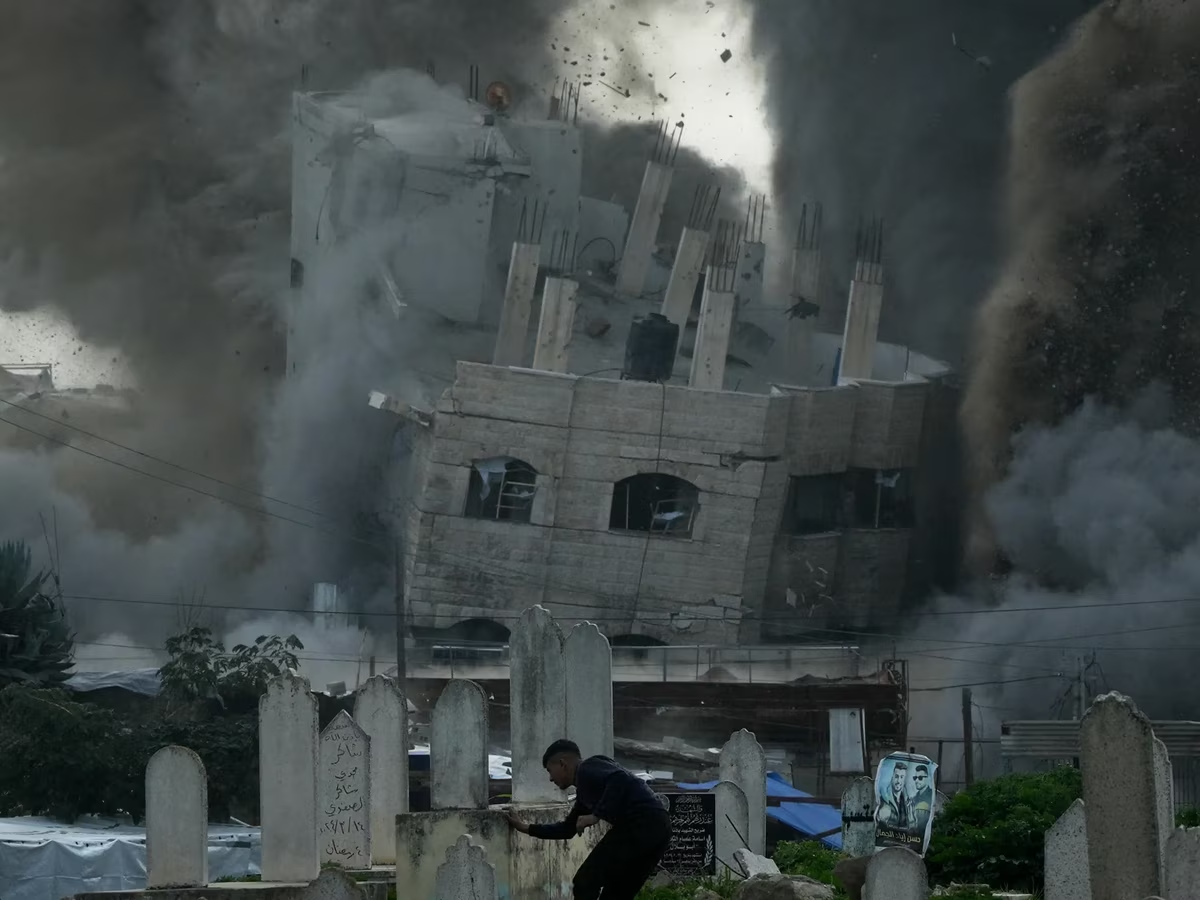
Field sources reported that the Israeli occupation army carried out widespread demolition operations of residential buildings in areas it penetrated east of Khan Yunis city in the southern Gaza Strip. This coincided with intense artillery shelling targeting several locations in the eastern areas of Gaza City, leading to a state of panic among residents amid ongoing military movements.

For its part, the Islamic Resistance Movement (Hamas) affirmed that this military escalation represents a clear and unprecedented violation of the recent ceasefire understandings. The movement indicated that the occupation government is deliberately seeking to thwart any efforts aimed at stabilizing the state of calm and field stability in the Strip.

Spokesperson for the movement, Hazem Qassem, stated that last night was bloody due to warplanes directly targeting civilian homes, resulting in the martyrdom of at least 5 people. Qassem added that the occupation continues its aggression, disregarding all conventions, in an attempt to impose a new field reality that serves its political and military agenda.

Leadership of the movement accused the Israeli government of working to sabotage peace plans and proposed international initiatives, including visions put forward by the US administration. It considered that the continuation of military operations reflects the occupation's lack of seriousness in adhering to any path that leads to ending the humanitarian suffering in Gaza.

On the international level, the United Nations issued strong warnings about the serious risks threatening civilians due to the continued air raids, naval and artillery shelling. The Office for the Coordination of Humanitarian Affairs (OCHA) stressed that international law guarantees the protection of civilians and infrastructure, calling for their neutralization from combat operations.

OCHA clarified in an official statement that humanitarian teams were able to provide emergency relief to thousands of affected families in recent weeks, but the need for sustainable solutions remains urgent. The statement emphasized the necessity of allowing the entry of construction materials and equipment needed to repair homes destroyed by the Israeli war machine.

Regarding psychological support, UN reports revealed that social and psychological services reached approximately 15,000 people in just one week. However, the demand for these services still far exceeds available capacities, especially given the suffocating population density within the camps and the deterioration of dilapidated tents.

In a limited positive development, UNRWA announced the reopening of the Bureij Health Center in the Deir al-Balah area, to provide primary care and maternal and child health services. This opening comes after a forced closure of the center that lasted several months, offering a glimmer of hope for patients in that area crowded with displaced people.

In turn, UN spokesperson Stéphane Dujarric indicated that thousands of patients in Gaza face the risk of death due to a lack of vital medical equipment. He explained that Israeli authorities are placing significant obstacles to the entry of necessary X-ray machines and laboratories, which hinders the development of critical local healthcare capabilities.

Finally, the Palestinian Ministry of Health in Gaza documented a massive increase in the number of casualties, with the total reaching 72,037 martyrs and more than 171,000 injured since the start of the aggression in October 2023. These shocking figures confirm the scale of the ongoing humanitarian catastrophe despite repeated announcements of ceasefire agreements.

Israeli military escalation represents a dangerous development and an unprecedented violation of the ceasefire agreement, aiming to undermine stability efforts.

ARAB AND WORLD

Wed 11 Feb 2026 11:40 am - Jerusalem Time

Colombian President Survives Assassination Attempt After 4 Hours of Maneuvering at Sea

Colombian President Gustavo Petro announced on Tuesday that he survived an imminent assassination attempt targeting his helicopter while en route to the Caribbean coast. Petro explained that the security team received intelligence warnings indicating that armed groups intended to fire upon the presidential helicopter as it attempted to land at its designated destination, necessitating an immediate change in the flight path.

The Colombian President described the details of the incident during a live-streamed government meeting, noting that the helicopter was forced to fly over the open sea for four continuous hours to evade the ambush. He confirmed that the journey ended with a landing in an unplanned area, as part of emergency procedures to ensure the safety of the presidential delegation from the assassination attempt that awaited them.

This incident comes amidst a series of warnings Petro has received for months, indicating plots by drug trafficking cartels to directly target him. Observers believe these threats reflect the severe security tension the country is experiencing as the presidential elections approach, amid a fierce struggle between the authorities and armed groups.

Petro directly pointed the finger at Iván Mordisco, who leads a dissident faction of the Revolutionary Armed Forces of Colombia, known as 'FARC'. This faction is known for its categorical rejection of the peace agreement signed with the government in 2016, and its continued engagement in armed activities related to drug trafficking and territorial control.

Gustavo Petro is the first leftist president to take office in Colombia since August 2022, which has made him a constant target for both his political opponents and criminal gangs. The President had previously announced in early 2024 the thwarting of other assassination attempts, highlighting the security risks facing the country's political leadership.

Colombia has historically suffered from the phenomenon of assassinating leftist political leaders, including prominent presidential candidates in previous decades. This latest incident puts internal peace efforts at stake, at a time when the government is trying to reduce the influence of armed groups that control vast areas of the country and rely on illicit trade to fund their operations.

"We headed out to sea for four hours and arrived at a place we did not intend to go, escaping being killed."

OPINIONS

Wed 11 Feb 2026 11:40 am - Jerusalem Time

Occupation without masks and authority without options...

The crisis did not begin with the recent decisions of the occupation's "cabinet"; rather, its roots go back more than a century, when Palestine was presented to the Zionist movement on a silver platter. Since the British Mandate, through successive Arab defeats, and the illusions of peace, up to an international system that has become addicted to sponsoring the occupation instead of ending it, the very late British warnings against making any changes to the Palestinian territories do not change the reality at all, but rather reveal a desperate attempt to wash their hands, as today there is an objection to the results without questioning the causes. In this long context of systematic dismantling, the Palestinian Authority has gradually transformed from a state project into a functional entity with limited powers, financially and politically besieged, and burdened by a system that is no longer merely a financial imbalance, but an integrated structure. The decisions represent an advanced stage in this path; they are not administrative measures or legal reforms as promoted, but rather a silent, de facto annexation. The occupation avoids officially declaring this so as not to embarrass its international supporters, but it imposes sovereignty over the land by force, and by facilitating the seizure of lands, or expanding the powers of military rule under the name of "civil administration," and granting settlers unprecedented incentives. The result is an environment that repels Palestinians, attracts settlers, suffocates the elements of economic and social life, and transforms the land into an uninhabitable space. The most dangerous aspect is that these measures do not target the Authority alone, but for the first time openly and directly extend to the components of Palestinian society; its properties and wealth have become within the scope of a political decision, and institutions have become formal and incapable of planning or building. Consequently, we are not only facing a military occupation, but an unprecedented return of it, controlling the land, what is above it and what is within it, the economy and society, and even water and air. In contrast, it continues to gradually withdraw the Authority's powers, without announcing its dissolution, seeking to make it appear as a burden in the eyes of Palestinians, and even tries to appear as a safe haven, pushing Palestinians to voluntarily abolish it, not reluctantly, and hand over its keys, and absolve itself of any responsibility for that. As for the Arab movement, its limits are known in advance, and even if the Arabs were to unite on a single word, which is far-fetched, they would not be able to stop these measures. So what is the situation when capitals are divided, positions are contradictory, and international weight is almost non-existent? Therefore, the Authority's crisis today exceeds the capacity of any Arab meeting, and requires a broader and more comprehensive approach, Palestinian first, then regional and international. The real question is no longer what the occupation is doing, but what is the Palestinian leadership doing? For a quarter of a century, it has been in a state of decline under the slogan of bending to the storm. In politics, one can bend tactically, but when bending reaches the point of touching the ground, it is no longer bending. What is required is not statements or tours, but a radical redefinition of the Authority's function, its relationship with the occupation, with its society, and with the world, and that it return to its foundations, and protect itself with its people, and that its leaders truly lead its ranks, not just in words. Without that, the occupation's measures on the ground will continue, and Palestinians will remain trapped between an advancing occupation and a political system eroding from within.

OPINIONS

Wed 11 Feb 2026 9:25 am - Jerusalem Time

The Key Handover Trap!

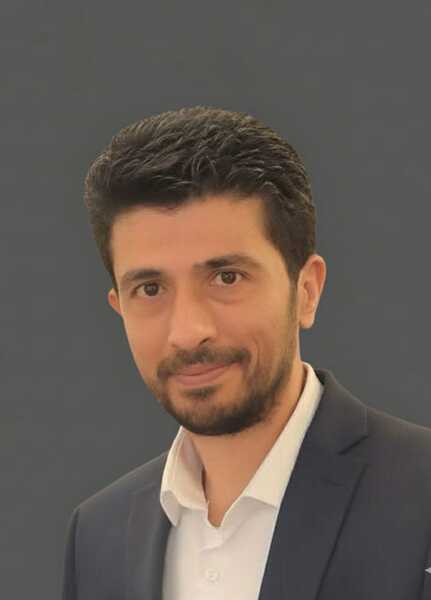
Dr. Ibrahim Melhem

Editor-in-Chief

In good faith, or with ill intent, with the naivety of the world, or the ignorance of the ignorant, some analysts and populist politicians are once again calling on the Authority to hand over the keys to its jailer and those who enact its execution laws, preparing the ground to undermine it, dry up its sources, and bypass its time. There is no greater service to Smotrich than this diabolical recipe, which would spread chaos, for the architect of the decisive plan loves a vacuum and wishes for it to remove the legal cover represented by the Authority, which none of the unregulated and uncommitted organizations and factions possess, and which seek to garner likes to maintain what remains of their supporters, after their popularity has eroded, their legitimacy has become outdated, and people have abandoned them. The Authority, despite its weakness and hardening arteries, represents the "legal personality" in the United Nations, the International Criminal Court, and all international organizations... and for these reasons, it is being demonized. The battle today is not about getting rid of the burden of the Authority, but about transforming this burden into a tool for political and legal engagement. The keys that some demand be thrown in the face of the jailer are the very ones that lock the doors against the legitimization of settlements, and handing them over is not a cry of protest, as much as it is an evacuation of the last official barricades of confrontation before full exposure to the comprehensive decisive action that those who salivate at its occurrence and rub their fingers to hasten its happening await. Political machinations, nor the impulses of revenge and factional gloating over the Authority and its mistakes, even if they were like the foam of the sea, should not push these factions to deny the importance of its existence and wish for its demise, because no one will be immune from the dangers and repercussions of its overthrow. Handing over the keys carries only one meaning: going along with Netanyahu, Smotrich, and Ben Gvir in their plans, and meeting them at their choices.

PALESTINE

Wed 11 Feb 2026 9:25 am - Jerusalem Time

Trump on the Eve of Meeting Netanyahu: "Good Deal" with Iran... and "Different" Negotiations Under the Shadow of Aircraft Carriers

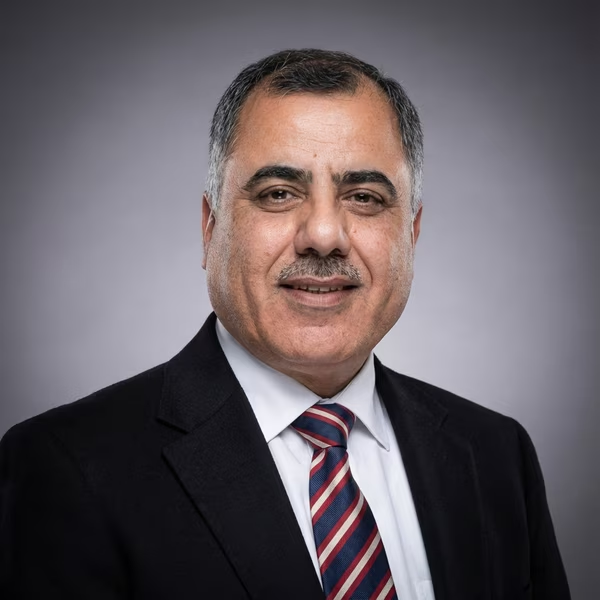
Said Erikat

Opinion Writer

On the eve of receiving Israeli Prime Minister Benjamin Netanyahu in Washington, US President Donald Trump chose to deliver a complex message: political reassurance to the Israeli ally that any understanding with Iran would not be "lenient," and a direct warning to Tehran that the option of force is still present, and perhaps closer than it imagines. According to Axios, Trump said that Netanyahu "also wants a deal... a good deal," stressing that the ongoing nuclear talks with Iran "bode well," and that this time they are "completely different."

Outwardly, Trump's statements appear to be an attempt to reset the relationship between Washington and Tel Aviv on a highly sensitive issue that has long been a source of friction between successive US administrations and Israeli governments. But between the lines, it is clear that Trump is not presenting negotiation as a traditional diplomatic path, but rather as a direct extension of a deterrence balance that was formed by force almost a year ago, when the United States carried out strikes on Iranian nuclear sites in June 2025 at the end of the 12-day Israel-Iran war, which came days after the collapse of the diplomatic track.

According to Axios, Trump recalled that moment to emphasize that he is a president who "does what he says," stating that the Iranians "last time didn't believe I would do it," and that they "overestimated their strength." However, the recall was not just a reminder, but an establishment of a new negotiating equation whose title is: agreement under the pressure of threat, not agreement through mutual concessions.

Here lies the fundamental difference between Trump's language and that of previous administrations: the US president does not speak of "de-escalation" or "building trust," but rather of an "excellent deal" on the one hand, and "very firm action" on the other if talks fail. This makes the negotiations seem more like a test of wills than a technical settlement on enrichment ratios or inspection mechanisms.

In this context, observers believe that what distinguishes Trump's approach is that he does not separate diplomacy and force, but rather integrates them into a single message managed according to the logic of a deal: an "excellent agreement" for a "heavy price." This model may succeed in extracting tactical concessions, but it carries a strategic risk, because Iran may interpret threats as a prelude to a strike, not just a negotiating chip. At that point, Tehran's goal becomes not an agreement, but buying time and expanding its deterrence margin through its proxies in the region.

According to Axios, Trump stressed that any agreement with Iran "obviously" must include its nuclear facilities, adding that he expects the possibility of including its missile program as well. This is a historically sensitive point, because Tehran has always considered its missile program "non-negotiable," and directly links it to the concept of national security after decades of sanctions, threats, and proxy wars.

Netanyahu's visit to Washington, therefore, comes as a double political test: a test of the American administration's ability to control the pace of negotiations without Israel becoming an explosive factor, and a test of Netanyahu's willingness to accept an agreement that does not reach the ceiling of "complete dismantling" of Iran's nuclear infrastructure. Trump tried to dispel the impression that Netanyahu stands against the diplomatic path, stressing that he is not opposed to talks, but wants a "good deal." However, this phrase itself carries a wide margin for interpretation: "good" for Washington may mean verifiable restrictions, while "good" for Tel Aviv may mean permanently depriving Iran of any enrichment capability, a demand that is difficult to impose diplomatically.

In contrast, the military dimension moves as a heavy shadow over the negotiating table. Trump announced, according to Axios, that he is considering sending a second aircraft carrier to the Middle East if negotiations fail, noting that "a fleet is heading there, and another fleet may set off." In recent weeks, the United States has reinforced its naval and air presence in the region, providing a political pressure element and ready firepower for any scenario.

On the ground, signs of limited engagement have begun to appear: US forces shot down a drone they said approached too close to the USS Abraham Lincoln aircraft carrier, and provided assistance to a US-flagged ship that Iranian forces attempted to stop in the Strait of Hormuz, the narrow entrance to the Gulf. Although these incidents appear tactical, they reveal the fragility of the situation, because any miscalculation could turn "pressure" into confrontation.

In this scene, the Sultanate of Oman returned to playing the role of mediator, in the first practical communication after the twelve-day war. Ali Larijani's visit to Muscat, in his capacity as Secretary of the Supreme National Security Council, carried important symbolic signals, especially with the circulation of photos of him alongside Omani Foreign Minister Badr Al Busaidi holding what appeared to be a sealed message. Historically, Iran relies on written messages as a preferred channel for dealing with Washington, because it gives it the ability to control the language, leave room for interpretation, and avoid public embarrassment.

Iranian media spoke of an "important message" that Larijani would carry, but official Iranian television surprised observers by indicating that Al Busaidi "delivered a message" to Larijani, without specifying its source. This ambiguity may be intentional: Tehran does not want to appear to be receiving "American conditions" at a moment of internal and regional tension, and Washington does not want to be accused of negotiating from a position of weakness.

Iran's official news agency said that Larijani also met with Sultan Haitham bin Tariq of Oman for about three hours, while the Omani news agency stated that the two sides discussed "the latest developments" and "ways to reach a balanced and fair agreement," while emphasizing the importance of returning to the dialogue table. It is also noteworthy that Larijani met with Mohammed Abdul Salam, the Houthi spokesman, in a move that suggests that Tehran links negotiations to the issue of regional influence and its proxies, not to the nuclear program alone.

Larijani is likely to head later to Qatar, which hosts the main US Al Udeid Air Base, the base that Iran attacked last June after the bombing of Iranian nuclear sites. This stop adds another dimension: Iran is signaling that it is capable of expanding the scope of retaliation if it feels that Washington is preparing to repeat the bombing scenario.

In this context, Larijani accused Israel of trying to play a "disruptive role" in the talks, warning that Netanyahu might seek to impose a "negotiating framework" on the Americans before his arrival in Washington. Such talk reflects Iran's sensitivity to the Israeli dimension in the nuclear file, but at the same time hints that Tehran does not see an agreement with Washington as separate from its open conflict with Israel.

Analysts believe that Larijani's visit to Muscat does not seem to be just a negotiating stop, but an Iranian repositioning after the 2025 war: Tehran wants to say that it is capable of combining the "diplomatic track" and the "regional influence network" at the same time. Larijani's meetings with the Houthis and his reference to Israel's "disruptive role" suggest that Iran will use regional issues as reciprocal pressure cards, and that any nuclear agreement will not be isolated from the security of navigation in Hormuz, from America's bases in the Gulf, and from the balance of deterrence with Israel.

In conclusion, Trump's statements appear to be an attempt to impose a new negotiating framework based on three pillars: escalating military pressure, traditional Omani mediation, and a political Israeli guarantee through the meeting with Netanyahu. But the success of this framework will depend on one point: does Iran want an agreement because it is convinced of it, or because it wants to temporarily avoid a painful strike? And can Washington control Israel's calculations if Tel Aviv feels that the agreement does not meet its definition of security?

So far, Trump says the talks are "different." But the Middle East has taught everyone that true difference is not measured by statements, but by the ability of the parties to prevent slipping from negotiation to war.

PALESTINE

Wed 11 Feb 2026 8:18 am - Jerusalem Time

Anticipated US Plan to Disarm Hamas in Exchange for Reconstruction and International Forces in Gaza

American press sources have revealed intensive movements led by President-elect Donald Trump's team, specifically special envoy Steve Witkoff and his son-in-law Jared Kushner, to formulate a plan aimed at disarming the Hamas movement in the Gaza Strip. This initiative comes as part of the new US administration's vision to end the conflict ongoing since October 2023, with its official presentation expected in the coming weeks to serve as a roadmap for the next phase.

The proposed plan relies on a precise timeline extending over several months, with the first phase focusing on the movement's necessity to surrender all heavy weapons and strategic equipment, primarily missiles capable of targeting Israeli depth. According to the leaked draft, the proposal notes the possibility of allowing movement members to temporarily retain light weapons under specific controls during a transitional period, before achieving complete disarmament.

The US administration links the implementation of these security conditions with the reconstruction of the Gaza Strip, which has been reduced to rubble as a result of ongoing military operations. Sources confirm that Washington considers disarmament an indispensable condition for approving the deployment of international forces in the Strip and providing the necessary guarantees for the flow of reconstruction funds and the commencement of building infrastructure and vital facilities destroyed by the war.

On the ground, these diplomatic movements occur amidst a complex reality, where the truce that began on October 10, 2025, continues to face constant violations from both sides. Israeli occupation army estimates indicate that Hamas still maintains a military force estimated at about 20,000 fighters, possessing an arsenal of approximately 60,000 automatic rifles, with a number of fighters remaining entrenched in complex tunnel networks near the Rafah border crossing area.

For its part, the occupation insists on its refusal to fully withdraw from the areas it has controlled, which currently exceed half the area of the Gaza Strip, before ensuring the complete dismantling of the military capabilities of Palestinian factions. Tel Aviv stresses that any future arrangements must ensure that the factions are unable to rebuild their missile arsenal or threaten the security of settlements surrounding the Strip again.

Regarding internal positions, reports indicate a state of division and debate within the leadership of the Hamas movement concerning how to deal with this American proposal. Some leaders fear that accepting disarmament would lead to a loss of security and political control over the Strip, placing the movement in a weak position against increasing international and Israeli pressures.

Amidst these political tug-of-wars, humanitarian suffering continues to worsen, with Gaza's Ministry of Health data indicating that more than 72,032 martyrs have fallen since the outbreak of confrontations. With the displacement of the majority of the Strip's population, the permanent opening of the Rafah crossing and the flow of aid remain contingent on reaching comprehensive security agreements, amidst anticipation of what Trump's team's efforts will yield in creating a real breakthrough in this thorny issue.

Washington considers the disarmament of factions a fundamental condition for deploying international forces and commencing the reconstruction process of the war-torn Strip.

ANALYSIS

Wed 11 Feb 2026 8:17 am - Jerusalem Time

Illusions of Imported Democracy: Why Washington Will Not Bring Salvation to the Iranian People?

The anniversary of the Iranian Revolution on February 11 this year comes amidst a tense political scene, as the country has witnessed the largest popular uprising since the fall of the Shah's regime in 1979. These events reveal a deep historical paradox, as the regime that was founded on the ruins of royal oppression has transformed into an authoritarian machine that practices brutality that may exceed the practices of its predecessor, attempting to impose its survival through bloody confrontations with protesters demanding change.

The current Iranian dilemma is inseparable from the context of the Arab region, where the waves of the Arab Spring in 2011 and 2019 collided with solid walls of systematic repression. This political deadlock has, in many cases, led to the re-production of authoritarian regimes with new faces, or a slide towards devastating civil wars, which raises serious concerns about a 'Syrianization' scenario in the Iranian case if the regime loses its ability for absolute control.

In light of this crisis, a question arises about the role of the international community and major powers in supporting democratic transformation, but recent historical experiences impose a kind of extreme caution. The era of the 'neoconservatives' in the United States proved that slogans of spreading democracy were nothing but a cover for imperial ambitions in Iraq and its oil wealth, leading to catastrophic results that the region is still paying for today.

Although the Iraqi experience produced a parliamentary system that is the most democratic compared to its surroundings, it remained hostage to sectarian quotas and rampant corruption. More dangerously, the infiltration of armed militias linked to Tehran, which did not hesitate to suppress popular Iraqi movements, reflects a complex overlap between cross-border authoritarianism and the failure of 'imposed democracy' projects from abroad.

As for the Syrian case, international hypocrisy was clearly evident, as the alleged American keenness on democracy was absent due to the lack of attractive economic interests compared to Iraq. This disparity in positions confirms that Washington's compass moves according to calculations of influence and energy, and not in response to the calls of oppressed peoples who face military repression machines with bare chests.

With Donald Trump's return to the scene, it seems that betting on American support for the Iranian uprising is an illusion that surpasses the dangers of past illusions. The Trump administration does not adopt the literature of spreading democracy, but rather focuses on a policy of imposing will and direct interests, which was clearly evident in its handling of the Venezuelan crisis, where pressures aim to subjugate regimes or replace their leaders in a way that serves American agendas exclusively.

The path to real change in Iran passes through the realization that external powers, especially Washington, will never be a sincere ally of democracy if it conflicts with their strategic interests. Sustainable change requires building legitimacy stemming from free popular will, away from interventions that may turn revolutions into proxy wars or open the door to a new authoritarianism wearing an international cloak.

Any rule that claims to derive its legitimacy from a divine will or a unilateral interpretation of the popular interest quickly turns into an authoritarianism that may exceed in its brutality the regime it overthrew.

PALESTINE

Wed 11 Feb 2026 8:17 am - Jerusalem Time

Between Verbal Rejection and Implicit Green Light: Why Doesn't Washington Stop the 'De Facto Annexation' of the West Bank?

The intensity of the contradiction between declared American diplomatic rhetoric and the reality on the ground in the West Bank is escalating, revealing a deep gap between Washington's official rejection of annexation operations and accelerating Israeli steps. These moves put the occupation government in a real test of the limits of American influence, especially as Tel Aviv continues to change the legal and political reality of the West Bank without effective deterrence.

In recent statements, US President Donald Trump affirmed his comprehensive opposition to the idea of annexing the West Bank, indicating that his administration is preoccupied with other issues and does not wish to engage in this thorny file at present. However, Trump did not address the procedural details recently approved by the Israeli government, which are considered a practical prelude to imposing full sovereignty over the occupied Palestinian territories.

The Israeli Ministerial Committee for National Security Affairs (the Cabinet) had approved a package of decisions aimed at making fundamental changes to the legal and civil status in the West Bank. These measures aim to enhance direct Israeli control, bypassing previous international understandings and signed agreements that regulate the administration of these areas.

Among the most prominent of these steps is the expansion of Israeli oversight and enforcement powers to include areas classified as (A) and (B) under the Oslo Accords, which were administratively under the Palestinian Authority. The occupation authorities justify their intrusion into the depths of Palestinian powers by pursuing unlicensed construction violations, water issues, and the protection of archaeological sites.

These new measures give the green light to the occupation army to carry out widespread demolition and confiscation operations against Palestinian properties in the heart of cities and villages belonging to the Authority. These policies also contribute to facilitating settlement expansion operations and legitimizing unauthorized outposts, which ultimately undermines any remaining opportunities for the establishment of a geographically contiguous Palestinian state.

These developments come in a cumulative context, as the right-wing government has worked in recent months to transfer civil administration powers and accelerate the approval of thousands of settlement units. Under the 1995 Oslo Accords, Area (A) was supposed to remain under full Palestinian control, but the new reality completely nullifies these divisions.

These Israeli moves directly contradict the requests conveyed by Trump's envoys, Steve Witkoff and Jared Kushner, to Benjamin Netanyahu during previous meetings. Washington had demanded the necessity of de-escalating the situation in the West Bank to avoid a security explosion that could affect regional stability and broader American plans for the region.

Informed sources reported that American officials express their concern about the recent Cabinet decisions in closed rooms, but they are still in the stage of 'studying the implications.' This hesitation coincides with Netanyahu's visit to Washington, where the Israeli side focuses on the Iranian file as a priority, trying to marginalize the West Bank issue on the agenda.

The White House believes that the stability of the West Bank is a fundamental pillar for Israel's security and for achieving the US administration's goals of reaching regional peace agreements. However, this rejection has not yet translated into real pressure, but has been limited to warning statements that did not prevent the Knesset from discussing explicit annexation laws.

In a move that analysts considered a retreat from pressure tools, Trump canceled the executive order issued by his predecessor Joe Biden to punish settlers involved in acts of violence. This cancellation stripped Washington of an effective means to curb settlement escalation, and signaled to extremist right-wing groups to continue their approach without fear of international sanctions.

Press reports indicate that the Trump administration clearly distinguishes between 'the ability to pressure' and 'political management' of the file, preferring to avoid direct confrontation with the Netanyahu government. It seems that Washington is content with verbal objection to 'official annexation' that might break the regional system, while turning a blind eye to gradual 'de facto annexation'.

This American approach has created a comfortable space for the Israeli government to proceed with its measures without fear of conditions on military aid or diplomatic support. Some institutions within Washington fear that any punitive action against Tel Aviv might be interpreted as abandoning a strategic partner at a sensitive time.

America's current priority is to prevent the economic and security collapse of the Palestinian Authority, not out of support for Palestinian rights, but to avoid waves of violence that could get out of control. This approach reflects a desire to manage the crisis and avoid the worst-case scenarios, rather than imposing a political path that ends the occupation or stops settlement.

Ultimately, observers believe that Israel is imposing its sovereignty through accumulated administrative and security decisions that lead to the same result of annexation without the need for a loud legislative declaration. The American position, despite its verbal opposition, remains a contributing factor to the continuation of this reality unless it is coupled with practical steps that stop Israeli encroachment in the occupied territories.

We have enough things to worry about right now; we don't need to get involved in West Bank affairs.

ISRAELI AFFAIRS

Wed 11 Feb 2026 5:33 am - Jerusalem Time

Netanyahu discusses Iran file with Kushner and Witkoff ahead of his summit with Trump in Washington

Israeli Prime Minister Benjamin Netanyahu began his intensive diplomatic moves immediately upon his arrival in the American capital, Washington, where he held a closed meeting at his residence at Blair House, the presidential guesthouse. The meeting included both US Special Envoy Steve Witkoff and former advisor Jared Kushner, as part of joint coordination ahead of the anticipated summit with President Donald Trump.

The discussions primarily focused on the indirect negotiations between Washington and Tehran, as Netanyahu seeks to understand the precise details of recent American moves. Witkoff and Kushner provided a comprehensive security and political briefing to Netanyahu and his security team on the results of the first round of these talks, in which they participated a few days ago.

Informed sources confirmed that Tel Aviv attaches utmost importance to the current negotiation process and is trying to influence the drafting of any potential agreement concerning the Iranian nuclear program. This visit, Netanyahu's seventh since Trump assumed his new term, reflects the deep coordination between the Israeli government and the current US administration on Middle East issues.

For his part, the Israeli Ambassador to Washington, Yehiel Leiter, published a photo documenting the meeting, indicating that work began from the first moments of the Israeli delegation's arrival. Leiter explained that the discussions included rapid regional developments, reflecting the desire of both parties to unify visions regarding Iranian threats in the region.

Coinciding with these diplomatic moves, the Israeli military leadership escalated its rhetoric towards Tehran, with Defense Minister Yisrael Katz announcing the Air Force's readiness to act. Katz indicated that 'F-35' aircraft are ready to carry out precise strikes against Iranian targets if security necessity demands it.

In a related context, Iranian advisors warned Washington against being drawn into what they described as Netanyahu's 'sabotage' statements aimed at undermining opportunities for de-escalation. Tehran affirmed that it is closely monitoring Israeli moves in Washington, stressing that any aggression will be met with a decisive and strong response that exceeds expectations.

On another front, attention is turning to the Gaza Strip amid reports of international plans to send peacekeeping forces to end the ongoing war. Media sources revealed that Indonesia has expressed its readiness to send about 8,000 soldiers to participate in this mission, becoming the first country to officially announce the size of its potential military contribution.

On the ground, Israeli raids continued on various areas of the Gaza Strip, with sources reporting casualties and injuries in a targeting of a residential apartment west of the city. These developments coincide with protests within Tel Aviv demanding the government stop the escalating violence in the Arab community within Israel.

In the West Bank, Israeli forces continued demolition operations, with their bulldozers targeting a house in Ramallah that a young Palestinian man had built in preparation for marriage. These measures come at a time when the region is witnessing increasing tension and international calls for restraint and an end to field escalation.

On the international stage, new European moves towards the Ukrainian crisis emerged, with French President Emmanuel Macron announcing the restoration of communication channels with Moscow. Macron urged European leaders to engage in dialogue with Russia to reach a political settlement that ends the conflict that has been ongoing for years.

In contrast, the Russian Ministry of Defense announced the success of its air defenses in shooting down 48 Ukrainian drones that attempted to target facilities within Russian territory and over the Sea of Azov. Moscow affirmed that these attempts reflect the failure of Ukrainian forces to achieve any tangible progress on the battlefield fronts.

In Washington, media reports indicate that the US administration intends to call for a new round of talks on the Ukrainian conflict in Miami next week. This round aims to discuss the possibilities of a ceasefire and the deployment of international monitoring forces, despite Russian doubts about the seriousness of Western intentions.

The Arab arena also witnessed active diplomatic moves, as UAE President Sheikh Mohamed bin Zayed received Egyptian President Abdel Fattah El-Sisi in Abu Dhabi. The bilateral summit discussed ways to enhance joint cooperation and address urgent regional issues, especially the situations in Gaza and Lebanon.

In conclusion, the anticipated meeting between Netanyahu and Trump remains the main driver of events in the coming hours, as it is expected to draw a roadmap for dealing with the Iranian file. Regional capitals are awaiting the results of this meeting due to its direct implications for the security and stability of the entire Middle East region.

Work has already begun within the first hour of the Prime Minister's arrival in Washington to discuss regional developments.

PALESTINE

Wed 11 Feb 2026 5:33 am - Jerusalem Time

Palestinian Diplomacy Knocks on the Doors of the UN General Assembly Presidency: Riyad Mansour Officially Nominated

In a move reflecting the escalating Palestinian diplomatic presence in international forums, La Neice Collins, spokesperson for the office of the President of the 80th session of the United Nations General Assembly, announced Palestine's official entry into the race for the presidency of the 81st session of the General Assembly. This announcement confirms the ability of Palestinian diplomacy to overcome the legal and political challenges posed by its 'observer state' status.

The list of candidates for this high-profile position includes three prominent names, with the Permanent Palestinian Observer to the United Nations, Riyad Mansour, competing against Bangladesh's Foreign Minister Touhid Hossain and Cyprus's Deputy Foreign Minister Andreas Kakouris. This competition is one of the most anticipated sessions due to the political weight represented by the candidates and the diversity of their geographical regions.

Collins stated in press remarks that Ambassador Riyad Mansour is the only candidate who has so far submitted a comprehensive official document outlining his vision for the future of the General Assembly and the development of its performance. This step reflects the Palestinian seriousness in leading the international organization and providing solutions to urgent global issues that fall within the General Assembly's jurisdiction.

Legally, UN regulations previously stipulated that the president must represent a full member state. However, a fundamental shift occurred in July 2024 when UN Secretary-General António Guterres issued an explanatory memorandum that opened the door for this historic nomination.

Guterres affirmed in his memorandum the possibility of electing representatives of the State of Palestine to this position, despite its observer status, which gave Palestinian diplomacy the green light to move towards this entitlement. The election process is scheduled to take place on June 2, with the world's attention turning to New York to follow the results.

In a separate field context, media sources reported that infrastructure facilities supporting the Zaporizhzhia nuclear power plant suffered severe damage as a result of a Ukrainian attack targeting the area. These developments raise increasing international concerns about the safety of nuclear facilities amid the ongoing fierce military conflict there.

Regarding international efforts related to the Gaza Strip, reports revealed Indonesia's readiness to send a large peacekeeping force of about 8,000 soldiers to the Strip. This initiative comes within the framework of broader international plans aimed at securing stability in the region after the end of ongoing military operations.

In the West Bank, Israeli occupation forces continued their escalating practices through the demolition of Palestinian homes and structures. Israeli bulldozers demolished a house in Ramallah that a young Palestinian man had recently built in preparation for his marriage, sparking a wave of local condemnation.

Politically, Iranian Supreme Leader's advisor Ali Larijani warned Washington against being drawn into what he described as Netanyahu's 'sabotage' statements. Larijani stressed that these statements aim to undermine ongoing negotiations between Tehran and international powers, emphasizing the need to be wary of attempts at regional escalation.

As part of Iranian diplomatic moves, Iranian Foreign Minister Abbas Araqchi undertook a tour that included Cairo, Ankara, and Riyadh to convey the results of the Muscat talks. This tour aims to reassure neighboring countries about Iranian orientations and enhance regional coordination to reduce tensions in the region.

For his part, Turkish Foreign Minister Hakan Fidan ruled out current indications of a direct war breaking out between the United States and Iran. Fidan explained that the region cannot bear the consequences of a new conflict, calling on all parties to exercise maximum restraint and prioritize dialogue.

Regarding the Lebanese issue, crowds mourned the victims of an Israeli raid that targeted a residential area, among whom was a child not exceeding three years old. This incident further complicates the security situation on the Lebanese-Palestinian border amid continued mutual raids.

As for internal Israeli affairs, Tel Aviv witnessed widespread protests during which activists blocked highways in condemnation of the escalating wave of violence in Arab society. Demonstrators accused the Israeli government of failing to provide security and protect Arab citizens from organized crime.

Finally, Russian movements in Ukraine stand out as a pressing element on the international stage, with the Russian Ministry of Defense announcing the downing of dozens of Ukrainian drones. These developments coincide with statements by Russian Foreign Minister Sergey Lavrov, who affirmed that the path towards a comprehensive political settlement is still long and arduous.

To date, only the Palestinian diplomat has submitted a document outlining his comprehensive vision for the future of the United Nations General Assembly.

PALESTINE

Wed 11 Feb 2026 5:33 am - Jerusalem Time

US Plan Led by Kushner to Disarm Gaza Factions in Stages

Diplomatic sources and informed officials have revealed details of a draft new US plan concerning the future of the Gaza Strip, primarily aimed at disarming the Hamas movement of its military arsenal. These efforts are led by a high-level group including Jared Kushner, President Donald Trump's son-in-law, and special envoy Steve Witkoff, in cooperation with former UN official Nikolay Mladenov, with the document expected to be officially presented in the coming weeks.

The current draft proposes a formula that allows Hamas to retain some light weapons in the initial stages of implementation, but it stipulates the surrender of all heavy weapons and systems capable of targeting Israeli depth. This plan is considered a fundamental pillar of President Trump's 20-point vision, which aims to establish permanent rules for a ceasefire and end the two-year-long conflict.

White House spokesman Dylan Johnson affirmed that the current US administration places the disarmament of Hamas as a top priority and is working with regional mediators to ensure the implementation of this path. Johnson indicated that Washington expects full commitment from all parties to the terms of the plan to ensure the transition to a phase of political and security stability in the region.

The plan is essentially based on the principles put forward by Kushner during the Davos Economic Forum last month, which focused on immediately decommissioning heavy weapons as a first step. The US vision also includes a mechanism for registering remaining personal weapons in preparation for their eventual elimination, coinciding with a new Palestinian administration taking over security responsibilities within the Gaza Strip.

On the ground, reports indicate that the Israeli side links the withdrawal of its forces from the Strip to the progress made in the disarmament process. This process is expected to take several months, with armed factions being dealt with according to a gradual timeline that ensures no return of military threats across the border.

Once the disarmament stages are completed, the plan moves to deploying an international stabilization force in Gaza to secure the transitional phase and prevent any security breaches. This step coincides with the launch of a large-scale reconstruction process aimed at repairing the dilapidated infrastructure and handing over administrative affairs to a Palestinian technocratic committee to manage civil matters.

In contrast, the response from the Hamas movement came through its political bureau chief abroad, Khaled Meshaal, who considered these proposals not to represent an international will but rather a formulation of Israeli demands. Meshaal clarified that the movement rejects the principle of disarmament and considers it targeting the resistance, emphasizing that any solutions must be based on genuine guarantees and not stripping the Palestinian people of their means of defense.

Sources close to the movement confirmed that it had informed mediators in Qatar, Egypt, and Turkey of its openness to realistic approaches that include a long-term truce and international mechanisms to prevent military escalation. The movement insists that the priority must be to lift the blockade and stop the aggression, considering that talking about disarmament while the occupation continues is an تجاوز of on-the-ground and political realities.

Disarming the resistance does not reflect a purely international demand, but rather an Israeli vision that is being marketed in international forums.

PALESTINE

Wed 11 Feb 2026 5:32 am - Jerusalem Time

6 Serious Legal Violations in Recent 'Cabinet' Decisions Regarding the West Bank

The latest package of decisions by the Israeli Ministerial Committee for Political and Security Affairs, the 'Cabinet', has sparked widespread concern in Palestinian and international circles, as they represent a blatant violation of legal references in force since before 1967. These measures, pushed by the Defense and Finance Ministers in the occupation government, aim to bring about a radical and comprehensive change in the civilian and legal reality in the occupied West Bank.

These decisions include the annulment of the historical Jordanian law that prohibited the sale of Palestinian lands to Jews in the West Bank, which opens the door to widespread acquisition operations. The measures also included declassifying land records, which allows settlers and Israeli entities direct access to owners' data and facilitates pressure on them to seize their properties.

In an escalatory step in the city of Hebron, the occupation decided to transfer building permit powers in settlement blocs from the Palestinian municipality to the Israeli Civil Administration. This measure also applies to the Rachel's Tomb area in Bethlehem, representing a direct seizure of sovereign powers approved by international agreements signed between the two sides.

The legalization of 'random' settlement outposts and the expansion of existing settlements through the construction of thousands of new housing units are among the most prominent violations included in the decisions. This step violates Article 49 of the Fourth Geneva Convention, which prohibits the occupying power from transferring its civilian population into the territory it occupies, and also disregards Security Council Resolution 2334.

The decisions extended to include the withdrawal of administrative powers in areas classified as (B) and (C), where the occupation authorities granted themselves the right to demolish Palestinian buildings under the pretext of protecting antiquities and the environment. This approach violates the Oslo II Accord, which grants the Palestinian Authority full civil control over Area (B), and transforms them into areas targeted for demolition and prevention of development.

On the financial front, the occupation authorities continue the policy of collective punishment by unilaterally and illegally withholding and deducting clearance funds. These practices violate the 1994 Paris Economic Protocol, which obliges Israel to regularly transfer taxes collected on behalf of the Palestinian Authority without prior political conditions.

The Israeli government also approved a new mechanism that allows settlers to purchase properties directly without the need to obtain prior transaction permits, as was previously the case. This legal amendment aims to accelerate the pace of settlement deep within Palestinian neighborhoods and facilitate the task of settlement associations in controlling vital lands.

The measures were not limited to land and money but also affected the political aspect by restricting the movement of Palestinian officials and withdrawing VIP cards. This step contradicts the security and political understandings attached to the transitional agreements, which guarantee the freedom of movement of Authority officials to carry out their administrative and service tasks.

Informed sources reported that these decisions come in the context of attempts to effectively annex the West Bank and undermine any opportunity for the establishment of a geographically contiguous Palestinian state. The Palestinian Presidency considers these moves 'criminal' and targeting the historical Palestinian presence on the land, warning of their catastrophic repercussions on stability in the region.

For their part, observers affirmed that granting the Civil Administration powers in the Ibrahimi Mosque and Islamic heritage sites in Bethlehem represents an assault on cultural and religious identity. Through these changes, Israel seeks to impose new realities that allow it to develop settlements within major Palestinian cities without the need for approval from local municipalities.

Meanwhile, Palestinian factions described these decisions as aiming to swallow what remains of Palestinian land and displace the indigenous population through livelihood and legal restrictions. These developments come at a time when the West Bank is witnessing unprecedented military escalation coinciding with the ongoing war on the Gaza Strip since last October.

Field data indicates that the occupation has intensified its attacks in the West Bank, with more than 1112 Palestinians martyred since the start of the recent aggression. Arrest campaigns have also targeted more than 21,000 citizens, amid a frantic settlement expansion exploiting international preoccupation with the deteriorating humanitarian situation in the Strip.

Legal experts believe that the annulment of Jordanian laws and the opening of land records represent 'legal piracy' aimed at legitimizing the theft of private property under Israeli judicial cover. Experts emphasize that all these measures lack international legitimacy and are considered null and void under United Nations resolutions that consider the West Bank occupied territory.

In conclusion, these decisions place the international community before its responsibilities to stop Israeli encroachment on international law and signed agreements. With the continued policy of imposing a fait accompli, Palestinians face existential challenges that require urgent legal and diplomatic action to protect their national rights and prevent the liquidation of their cause through the gateway of 'settlement laws'.

Israeli decisions aim to bring about a radical change in the legal and civilian reality in the West Bank to enhance full control over it.

PALESTINE

Wed 11 Feb 2026 5:28 am - Jerusalem Time

Experts: Israel Imposes New Reality in West Bank by Undermining Agreements and Dismantling Laws

The Israeli Ministerial Committee for Political and Security Affairs (the Cabinet) approved a series of escalatory decisions aimed at changing the legal and civil reality in the occupied West Bank. These moves are intended to tighten direct Israeli control and undermine the limited Palestinian authorities affirmed by previous international agreements. These steps come within the context of the de facto policy pursued by the far-right government.

The new decisions included the annulment of Jordanian law, which had been in effect for decades, prohibiting the sale of land in the West Bank to Jews, in addition to declassifying land registries. This measure represents a radical shift that facilitates the seizure of Palestinian properties and their transfer to settlers. It also reflects an Israeli desire to remove historical legal obstacles that protected Palestinian land ownership.

In another aggressive move, the occupation authorities decided to transfer building permit powers in the settlement bloc in Hebron from the Palestinian municipality to the Israeli Civil Administration. This decision directly affects Palestinian administrative sovereignty in one of the most tense cities. The decisions also included transferring planning powers in the vicinity of the Ibrahimi Mosque and other religious sites to planning institutions affiliated with the occupation.

The Israeli government expanded oversight and enforcement powers to include areas classified as (A) and (B), which are areas that are supposed to be administratively under the Palestinian Authority according to the Oslo Accords. The occupation authorities justified this encroachment by citing violations related to unlicensed construction, water issues, and the protection of archaeological sites. This decision allows for widespread demolition and confiscation operations deep within Palestinian residential areas.

Hassan Breijieh, head of the International Law Unit at the Wall and Settlement Resistance Commission, affirmed that these decisions represent a blatant violation of international law and the rules of the Fourth Geneva Convention. He explained that Israel is acting as an occupying power, exploiting absolute American support and current Arab weakness to implement displacement plans. He pointed out that the occupation seeks to impose 'creeping annexation' on the ground after the impossibility of officially canceling international agreements.

Breijieh stressed that Israel does not have the legal right to annul treaties that resulted in a new territory, such as the Oslo Accords, even in cases of declared war. He also noted that Jordanian laws that were applied before 1967 remain the legal reference for the occupied territory under international law. He considered what is happening to be an attempt to gauge international reactions in preparation for more dangerous steps.

For his part, political expert Suleiman Bisharat believed that Israel is using military force to impose a new reality that transcends all existing legal and political concepts. He explained that control over land is no longer linked to legal justifications, but rather to the occupation's ability to impose its will on the ground. He added that the far-right current aims to build a 'Jewish state' over the entire geographical area of the West Bank.

Bisharat warned that what is happening is a systematic dismantling of the legal and political structure on which the Palestinian presence in the West Bank is based. He considered that Israel is disregarding all international treaties that recognize it as an occupying state, to present itself as the sole guardian of the land. This shift places the Palestinian national project before existential challenges that require a comprehensive reformulation of the relationship with the occupation.

Field data indicates that these decisions coincide with an unprecedented escalation in settler and Israeli army attacks since the start of the aggression on the Gaza Strip. Palestinian institutions have recorded the martyrdom of more than 1112 citizens in the West Bank and Jerusalem, in addition to thousands of injured and detained. These numbers reflect the extent of pressure exerted on Palestinians to push them towards forced displacement and abandonment of their lands.

Observers believe that the annulment of Jordanian laws and the transfer of administrative powers represent the 'coup de grâce' for the two-state solution advocated by the United Nations. The Oslo divisions of areas (A, B, C) are practically fading with the entry of Israeli bulldozers to demolish homes deep within Palestinian cities. This reality imposes on the Palestinian leadership the need to take decisive political decisions commensurate with the magnitude of the looming threat.

Expert Bisharat called for the necessity of redefining the relationship with the occupation and implementing previous national decisions related to disengaging from the obligations of the Oslo Accords. He stressed that relying on international laws alone is no longer sufficient in light of American complicity and the implicit acceptance of some international parties. What is currently required is to build a comprehensive national confrontation strategy that strengthens the steadfastness of citizens on their land.

On the regional level, there is a need for urgent Arab and international action to stop the Israeli encroachment that threatens the stability of the entire region. The annulment of Jordanian laws directly affects the historical and legal status that Jordan defends in international forums. The international community's silence on these measures gives the occupation a green light to continue seizing land and destroying the foundations of the future Palestinian state.

Area (C), which constitutes about 61% of the West Bank, is currently the main arena for legal and field conflict. With the expansion of Israeli powers to include areas (A) and (B), there is no longer any safe place from confiscation or demolition. This policy aims to confine Palestinians to isolated enclaves surrounded by settlements and military bases.

In conclusion, Palestinian political will remains the key to confronting these schemes through unifying ranks and activating popular and legal resistance. The battle of laws that Israel is waging today is an integral part of the comprehensive war of extermination targeting identity, land, and people. This project can only be confronted with a solid national stance that enjoys genuine Arab and international support beyond condemnation statements.

Israel, as an occupying state, now presents itself as the guardian of Palestinian land, owning this land and planning and shaping its future features.

ARAB AND WORLD

Wed 11 Feb 2026 5:28 am - Jerusalem Time

Symbolic Messages and Military Mobilization: The Backstage of Indirect Negotiations Between Tehran and Washington

The region is witnessing intense diplomatic activity coinciding with escalating military tensions between Tehran and Washington, as indirect negotiations aim to contain the specter of a comprehensive confrontation. These moves come at a time when both sides are exchanging symbolic signals that reflect the complex nature of the conflict, whether through political channels or by demonstrating military power in regional waters.

In the Iranian capital, striking military implications emerged with the appearance of a model of the advanced Chinese fighter jet 'J-20' as a gift from the Chinese military attaché to the commander of the Iranian Air Force. This step is interpreted in political circles as a message of technical and military support from Beijing to Tehran, amid increasing Western pressure and continuous Israeli threats to vital facilities.

On the other hand, American movements recorded a notable presence in the Arabian Sea, where presidential envoy Steve Witkoff and Jared Kushner visited the aircraft carrier 'Abraham Lincoln'. The American delegation was accompanied by the commander of Central Command, who later participated in the round of indirect negotiations hosted by Muscat last Friday, linking the diplomatic track with direct military presence.

In the Sultanate of Oman, media sources monitored precise details during the meeting of the Omani Foreign Minister with the Secretary of the Supreme National Security Council of Iran, where files described as important appeared between the two parties. These meetings reflect the pivotal role played by Muscat as a key mediator in bringing viewpoints closer and attempting to formulate initial understandings to prevent a slide towards war.

Domestically in Iran, Foreign Minister Abbas Araqchi quickly held high-level meetings with Iranian army commanders immediately after the conclusion of the talks in Muscat. This coordination aims to inform the military establishment of political developments and ensure the readiness of the armed forces to deal with any emergency scenarios that the nature of the stalled negotiations might impose.

Despite ongoing diplomatic efforts to pave the way for a potential agreement, the American military buildup in waters near Iran continues to cast a shadow over the scene. The state of anticipation for what the coming days will bring continues, amid the intertwining of nuclear and regional issues with the ambitions of the new American administration to reshape the balance of power in the region.

Between diplomacy and the specter of war, efforts continue to pave the way for negotiations while military mobilization in the region persists.

PALESTINE

Wed 11 Feb 2026 5:27 am - Jerusalem Time

White House: Trump Rejects West Bank Annexation Plans

Responsible sources in the White House revealed a decisive stance by US President Donald Trump regarding the West Bank issue, where he clearly affirmed his opposition to any moves aimed at its annexation by the occupation authorities. The sources indicated that this position has been communicated to the relevant parties to ensure that no unilateral steps are taken that could lead to an uncalculated explosion of the political and security situation in the region.

The American official stated that Trump's vision stems from the conviction that any annexation decision would necessarily undermine the gains achieved during the past period within the regional de-escalation tracks. The White House believes that maintaining de-escalation channels requires avoiding major decisions that could end future stability opportunities and push the region towards a new wave of comprehensive escalation.

In the context of the security justifications for this stance, leaks from the US administration emphasized that a stable West Bank represents the core security interests of the occupation at present. Officials in Washington warned that the absence of stability would turn the region into a permanent attrition zone, which could negatively impact the deterrence capability of the Israeli military and security establishment.

The sources also clarified that this approach is not a retreat from Trump's previous policies, but rather consistent with the fundamental principles of the peace plan he proposed, which is essentially based on enforcing security and preventing major crises. The US administration believes that sliding towards annexation decisions will create a ground reality whose outcomes are difficult to predict or whose security and political repercussions are hard to control.

These surprising statements come to exert new pressure on the occupation government, which had been banking on absolute American support for expansion projects in the West Bank. These positions are expected to reshape the political movement in the region, especially in light of Washington's emphasis that the top priority currently is to prevent chaos and ensure the West Bank remains far from scenarios of field explosion.

President Trump clearly stated that he does not support the occupation's annexation of the West Bank, based on his comprehensive vision for the region.

PALESTINE

Wed 11 Feb 2026 5:27 am - Jerusalem Time

Obstructing the Arrival of the Gaza Management Committee: An Israeli Strategy to Perpetuate Chaos and Facilitate Displacement

The delay in the arrival of the national committee formed to manage the Gaza Strip and assume its duties is a deliberate Israeli political decision, not merely a routine procedural or administrative detail. This obstruction falls within the context of the fait accompli policy pursued by the occupation authorities, aiming to keep crises ongoing and persistent to serve their vision for the beleaguered Strip.

The latest developments raise a fundamental question about who will manage Gaza in the next phase, especially given the occupation's claim of searching for an administrative alternative. However, facts on the ground indicate that Israel is the primary party obstructing any Palestinian formula capable of organizing public affairs, even if it is a professional, independent committee.

The presence of a Palestinian technocratic committee on the ground necessarily means the end of the Israeli narrative promoting the absence of administration in Gaza. This path restores the possibility of Palestinian governance and imposes its political entitlements, which fundamentally contradicts the occupation's goals of keeping the region ungovernable.

Through preventing the committee, the occupation seeks to turn Gaza into an area open to permanent chaos, thereby facilitating long-term goals, foremost among them the displacement of Palestinians. The Israeli prevention does not target individuals themselves, but rather the idea of a national administrative authority capable of organizing relief and essential services.

Chaos, from the Israeli perspective, is a strategic tool to perpetuate control and achieve political gains, not merely an incidental result of military operations. This policy aims to push the population towards coercive and bitter choices, starting with accepting externally imposed administrations and ending with forced displacement under the weight of necessity.

The repercussions of this prevention extend to the humanitarian depth, as the absence of a central administration opens the door to difficulties in the delivery of humanitarian aid in the required quantities and qualities. The occupation has so far evaded implementing the agreed-upon entitlements, creating a state of confusion in the distribution of roles among international and local relief organizations.

This obstruction coincides with a systematic plan to marginalize UNRWA in preparation for ending its existence, in addition to restricting the most prominent international humanitarian organizations operating in the sector. This vacuum gives the occupation and its armed gangs an opportunity to exploit people's needs and turn relief into a means of influence and illicit competition.

The absence of a national administrative regulator leads to the creation of a dangerous security and social vacuum, followed by the outbreak of local conflicts over limited available resources. This situation contributes to the erosion of trust in any unifying national project and directly serves efforts to internationalize Gaza's administration from a purely humanitarian perspective, far from national rights.

Turning the conflict into merely a humanitarian crisis aims to strip Palestinian owners of their political decision and present external guardianship as the sole and inevitable solution. This deliberate disregard for the right of the population to manage their lives and future requires urgent national and international action to break the Israeli restrictions imposed on the administrative committee.

Overcoming these obstacles requires imposing a national political vision with effective communication mechanisms with mediators and sponsoring states of agreements. The committee must adhere to its inherent right to access the Gaza Strip and carry out its duties from within Palestinian territories, while turning the issue of its prevention into a legal case in international forums.

Preventing the committee's arrival is a clear violation of the Geneva Conventions, which guarantee the freedom of humanitarian and administrative work for populations under occupation. Silence on these transgressions gives the occupation a green light to continue its policy of administrative obfuscation and destruction of the infrastructure of Palestinian society in Gaza.

The responsibility does not lie with the occupation alone; success in empowering the committee requires a unified national stance that avoids dual discourse or disputes over legitimacy. Clear popular support is an essential pillar for turning the committee's arrival into an urgent societal demand that no party can bypass or circumvent.

The active Arab role, specifically the role of the Arab Republic of Egypt, is prominent here in pressuring the occupation to facilitate the committee's entry and permanently open the crossings. Arab coordination must aim to enable the Palestinian administration to fully supervise the relief file, away from the channels that the occupation tries to impose.

In conclusion, the battle for the arrival of the administrative committee represents a new chapter in the conflict over the identity of governance and the future of the Gaza Strip after the war. The choice today lies between an organized Palestinian administration that preserves human dignity and rights, or deliberate chaos that serves the political projects of the occupation, and the bet remains on solid national will.

Chaos, from the Israeli occupation's perspective, is not an incidental result of the war; rather, it is a tool to perpetuate control and achieve goals, and a lever to push the population towards coercive choices.

OPINIONS

Wed 11 Feb 2026 5:27 am - Jerusalem Time

The Crisis of Discourse in Political Movements: Between Authoritarian Exploitation and the Necessities of True Renewal

Ramallah - "Al-Quds" dot com

Ramallah - "Al-Quds" dot com

Opinion Writer

Discourse strategy is one of the fundamental pillars upon which revolutionary situations and exceptional transitional phases are based, with its levels varying between public, political, and media affairs. Analysis indicates that distinguishing between these levels requires in-depth studies of vocabulary and contexts to ensure scientific and practical effectiveness in influencing the masses.

The entirety of the discourse of Islamic movements stemmed from perceptions and understandings marred by some imbalances, which made the resulting discourse afflicted with ailments that limited its ability to achieve desired goals. The political arena witnessed adverse outcomes in many scenes due to the inadequacy of this rhetorical performance in addressing complex realities.

It is observed that the Arab revolutions, in their entirety, lacked a clear strategic discourse, which allowed for the emergence of conflicting discourses that created division instead of unity. This absence led to an imbalance in communication tools with the revolutionary situation, causing the paths of change to falter and lose their compass midway.

One of the most prominent observed errors is the lack of attention to the discourse of 'people's livelihoods' and their daily issues, as the forces that participated in power focused on the purely political aspect. This oversight created a loophole through which counter-discourse penetrated to cast doubt on achievements and create a state of hatred and demonization for national projects.

The discourse that touches the aspirations of the people is one that sincerely expresses the values of living, human dignity, and social justice. This discourse must pay special attention to the groups targeted by impoverishment policies and rising prices, to counter attempts at subjugation through intimidation and starvation.

Social and political organizations face a significant challenge in developing a discourse that keeps pace with the current stage and leverages the context to confront fierce media attacks. The ability to influence the masses requires a deep awareness of how to build popular support around a project that expresses the hopes and pains of the street.

Authoritarian regimes entered the conflict over religious discourse, attempting to promote special editions of religion that serve their interests and create a religious backing for their tyranny. This intervention led to the state's nationalization of religion and its political exploitation to strike opponents and justify repressive policies.

The phenomenon of political exploitation of religion emerged through the establishment of official and semi-official institutions that support autocratic regimes, in addition to exploiting certain religious orientations such as the Madkhali and some loyal Salafi currents. These forces used accusatory language and created hatred towards opposing formations to justify arrest and persecution.

Analyzing and self-reviewing discourse is a vital matter for Islamic currents, as it must be based on a conscious critique of past practices. This requires adopting a discourse of transparency with other political forces to determine the minimum consensus to confront counter-revolutions.

The upcoming discourse strategy must be based on the 'two-leg theory,' which is the balance between the political leg and the revolutionary leg without prioritizing one over the other. This balance is capable of preparing the ground for change and restoring the popular base that has lost confidence in traditional discourses.

Renewal in Islamic discourse represents an intrinsic necessity, and it requires recalling solid intellectual contributions such as those presented by Dr. Abdelwahab El-Messiri in 'Milestones of the New Islamic Discourse.' Building a comprehensive strategy requires integrating questions related to revolution, international relations, and societal effectiveness.

Previous discourses suffered from structural ailments and shortcomings in comprehension, as they were affected by a collective psychological state characterized by political one-upmanship and machinations. These complexities led to the failure of elites to build positive relationships based on consensus and trust, which weakened the entire revolutionary situation.

In contrast, the discourse of military coups relied on falsification and distortion to justify control over state institutions and economic arenas. This negative discourse contributed to the militarization of society and institutions, and exerted immense pressure on the Islamic phenomenon through paths of temptation and distortion.

In conclusion, the true renewal of discourse must stem from the principles of civilizational self-renewal, far from being dazzled by or subservient to others. 'Nurseries of change' require formulating a strategy that considers objectives and possesses the effectiveness to engage with people's concerns, and resist all forms of conventionality and intellectual stagnation.

The lack of a discourse strategy led to the process of change moving along paths, some of which went astray, and many of which distorted reality.

PALESTINE

Wed 11 Feb 2026 5:27 am - Jerusalem Time

Washington to Host First Meeting of 'Peace Council' for Gaza Reconstruction in February

The American administration intends to hold the first foundational meeting of the leaders of what is known as the 'Peace Council,' dedicated to the Palestinian issue, specifically the Gaza Strip, on February 19th in Washington D.C. This move comes as a first practical step within a high-level international conference aimed at mobilizing financial and political support for the next phase, with the United States betting on attracting investments and donations worth billions of dollars.

According to informed sources, the American vision seeks to transform this council into a comprehensive international umbrella that will directly oversee the transitional phase in the Gaza Strip after the war ends. The council will be responsible for managing reconstruction funds, and planning and implementing major infrastructure projects, ensuring the flow of aid and directing it towards sustainable development paths that serve regional stability.

The proposed plan indicates that permanent membership in the 'Peace Council' will only be available to countries and entities that provide significant financial contributions, with a minimum contribution ceiling set at one billion US dollars. These funds are intended to finance the 'New Gaza' vision, which aspires to transform the Strip from a devastated area into a regional economic and commercial hub connecting various parties through strategic projects.

In a related context, media reports revealed Israeli tendencies consistent with this proposal, as Prime Minister Benjamin Netanyahu issued directives to change the official seal used at the Rafah land crossing. According to these instructions, the designation 'State of Palestine' will be removed from official seals and replaced with the 'Peace Council' logo, in a clear indication of the beginning of the implementation of new administrative arrangements on the ground.

Obtaining a permanent seat on the Peace Council requires a minimum financial contribution of one billion dollars, allocated to transforming the Strip into a regional economic center.

PALESTINE

Wed 11 Feb 2026 5:27 am - Jerusalem Time

Denmark condemns occupation's decision to expand control over areas in the West Bank

The Danish Ministry of Foreign Affairs issued an official statement expressing its strong condemnation of the decision by the Israeli occupation authorities' security cabinet to expand administrative and security control over large areas in the occupied West Bank. Copenhagen affirmed in its statement its categorical rejection of these policies, which aim to impose a new demographic and geographical reality, threatening existing balances and undermining legitimate Palestinian rights.

The Danish diplomacy stressed that these Israeli steps represent a blatant violation of international law and UN conventions that define the legal status of the West Bank as occupied territory whose features may not be altered. Sources indicated that continuing these unilateral measures weakens the credibility of adherence to signed international agreements and further complicates the political and field landscape in the region.

The ministry warned in its statement of the serious field consequences of this decision, emphasizing that it causes severe damage to all efforts aimed at promoting stability and security for both Palestinians and Israelis. It clarified that such escalatory decisions contribute to fueling tension and pushing towards further confrontations, moving the region away from the de-escalation path required at this critical time.

In conclusion of its statement, Denmark reiterated its assertion that settlement expansion and control over land effectively eliminate the chances of establishing a genuine political dialogue leading to a two-state solution. It called on the international community to assume its responsibilities to stop these measures that end the possibility of establishing an independent and geographically contiguous Palestinian state, stressing the need to return to the path of negotiations based on international references.

This decision violates international law and constitutes a breach of the conventions that regulate the legal status of the West Bank as occupied territories.

PALESTINE

Wed 11 Feb 2026 5:26 am - Jerusalem Time

Netanyahu's Plane Crosses Airspace of 3 ICC Member States En Route to Washington

Air traffic tracking data on Tuesday revealed the flight path of Israeli Prime Minister Benjamin Netanyahu's journey to the United States of America. The data showed that his private plane, known as 'Wing of Zion,' entered the airspace of three European countries that are signatories to the Rome Statute, which established the International Criminal Court.

According to observations by the specialized website 'Flight Radar,' the plane flew over Greece, Italy, and France, all of which are legally bound to implement arrest warrants issued by the international court. However, these capitals took no action to close their airspace or intercept the flight, raising questions about the actual commitment to the court's recent decision.

This trip follows the decision issued by Pre-Trial Chamber I of the International Criminal Court on November 21, 2024, which ordered the issuance of arrest warrants for Netanyahu and his former security minister, Yoav Gallant. The Israeli leadership faces accusations of committing war crimes and crimes against humanity during the ongoing aggression on the Gaza Strip.

Observers point out that Netanyahu followed an aerial route similar to the one he took last December during a previous visit to meet Donald Trump. Although he had previously avoided entering the airspace of certain countries for fear of arrest, his recent movements indicate a clear disregard for the international legal restrictions imposed on him.

Netanyahu departed Ben Gurion Airport in Tel Aviv on Tuesday afternoon, heading to Washington D.C. on a diplomatic mission aimed at coordinating with the new American administration. Discussions with US President Donald Trump are expected to focus on the Iranian nuclear file and escalating tensions in the Middle East region.

This visit coincides with intensive diplomatic activity, as the Omani capital, Muscat, hosted indirect negotiations between Washington and Tehran last Friday. These movements come amidst statements from the American side about the possibility of a new round of negotiations early next week to de-escalate military tensions.

Netanyahu's visit to Washington is expected to conclude by next Friday morning, after which he will return to Israel upon completing his consultations. Attention remains focused on international reactions to European countries allowing a plane with an internationally wanted individual to pass through their sovereign airspace without legal impediments.

The three countries are parties to the Rome Statute and members of the International Criminal Court, and are bound by its decisions, yet their airspace was not closed to the plane.

PALESTINE

Wed 11 Feb 2026 5:26 am - Jerusalem Time

American Site: Liberal Organizations Document Palestinian Suffering but Fail to Dismantle the System of Oppression

A report published by the American website 'Mondoweiss' asserted that international liberal institutions are designed in a way that allows them to acknowledge the oppression faced by the Palestinian people, but they lack the necessary tools or will to end it. The writer, Abd al-Qayyum Ahmed, explained that these organizations operate within frameworks aimed at regulating and managing violence rather than dismantling the colonial systems that continuously produce it.

The analysis reviewed two prominent incidents that revealed the nature of these institutions' work, where the recent stances of both 'Doctors Without Borders' and 'Human Rights Watch' demonstrated the limits of the liberal ceiling in dealing with existential Palestinian rights. The writer considered these institutions to represent a model of the international system that documents genocide but is unable to comprehend the demands for liberation and the dismantling of colonialism.

In the details of the first incident, the report indicated that 'Doctors Without Borders' agreed last January to hand over lists of its Palestinian staff to the Israeli occupation authorities as a condition for continuing its operations in the Gaza Strip. This approach sparked widespread anger in Palestinian circles, which view these lists as a security tool for surveillance and arrest, and the organization only retracted under the weight of popular pressure.

The second incident involved the resignation of researchers from 'Human Rights Watch' after senior leadership intervened to obstruct the publication of a specialized report on the Palestinian right of return. The objection was not to the accuracy of the scientific research, but to the political ramifications imposed by the right of return as a tool to end historical injustice, rather than merely a legal description.

The report quoted researcher 'Omar Shakir' following his resignation from the international human rights organization, stating that the leadership explicitly expressed concerns that the report would lead to the organization being accused of challenging 'the Jewishness of the state.' This position reflects the unwritten boundaries that liberal institutions adhere to in order to maintain their standing within the existing global order.

The writer believes that these institutions face structural limitations stemming from the foundations of legal liberalism that emerged after World War II. While 'Human Rights Watch' relies on international human rights law, 'Doctors Without Borders' relies on international humanitarian law, both of which are frameworks aimed at regulating wars and atrocities without affecting the essence of hegemony.

The analysis added that international law has never failed to monitor colonial violence; rather, it has developed mechanisms to accommodate racial hierarchies and land appropriation under the guise of 'universal application.' Palestine is considered the fault line that exposes the falsity of this claim, as humanitarian interventions remain confined to the internationally permissible scope.

The policy of 'neutrality' adopted by these organizations imposes conditions that make the provision of medical care contingent on not disturbing the existing political conditions. This approach leads to the transformation of the catastrophe in the Gaza Strip into a mere isolated 'humanitarian emergency,' instead of dealing with it as a natural and inevitable outcome of the ongoing siege and settler rule.

In a related context, the report indicated that human rights organizations might go far in labeling 'apartheid' or 'collective punishment,' but they immediately retract when the analysis moves towards prospects of liberation and the future. These expressive boundaries narrow whenever the argument approaches challenging the international system that provides these organizations with their legitimacy and funding.

Wealthy donors from the 'Global North' play a pivotal role in drawing these red lines, as they have significant influence within the boards of major liberal institutions. The report revealed internal practices including the exclusion of employees known for their strong pro-Palestinian stances from sensitive meetings to avoid what are called 'reputational risks.'

Abd al-Qayyum Ahmed affirmed that terms such as 'settler colonialism' and 'decolonization' raise complex calculations within these corridors, where the standards of what is acceptable and unacceptable change based on the political moment. He stressed that these institutions are not necessarily 'malicious,' but they are ultimately tools for measuring injustice, not engines for actual liberation.

The article concluded that liberal boundaries always move in direct relation to power; they close completely when the global system or 'empire' feels a real threat to its interests. Therefore, betting on the expansion of these boundaries from within is a losing bet in the Palestinian liberation struggle, which requires external impetus.

In conclusion, the writer emphasized that liberation will not come from waiting for international organizations, but from resistance movements that render these liberal boundaries irrelevant to reality. Although these institutions may follow liberation movements in later stages, they will always remain constrained by the liberal system that grants them existence and funding.

International law has not failed to see colonial violence; rather, it has learned how to manage it and regulate atrocities without retreating from conquest.

PALESTINE

Wed 11 Feb 2026 5:26 am - Jerusalem Time

Tel Aviv informs Washington of the necessity of launching a wide-scale military operation in Gaza and the faltering of the de-escalation path

Informed media sources revealed decisive trends within the Israeli occupation government to inform the American administration of the failure of the current negotiation path related to the Gaza Strip. The sources clarified that Prime Minister Benjamin Netanyahu intends to brief US President Donald Trump on the field developments, indicating that the 'second phase' of the de-escalation proposal has not achieved any tangible progress on the ground so far.

In the context of this dramatic shift, reports quoted responsible sources as saying that Tel Aviv officially notified Washington that a return to a wide-scale military option in the Strip has become an unavoidable necessity. These messages come at a time when the region is witnessing great anticipation for the outcome of high-level diplomatic meetings, as Israel seeks to obtain political cover for its upcoming operations, which it describes as necessary to confront current challenges.

Leaked data indicates that the occupation is effectively paving the way for announcing the collapse of ongoing negotiations and the start of a new round of intense fighting in various areas of the Strip. Observers believe that these moves aim to preempt any international pressure that might be exerted to impose an agreement that does not meet Israeli conditions, especially with sources acknowledging that the diplomatic path has reached a dead end requiring alternative military interventions.

The anticipated meeting between Netanyahu and Trump is expected to constitute a turning point in the strategy adopted towards Gaza, where alternative military options to the faltering agreement will be presented. These developments confirm that the region is heading towards a new escalation that may change the features of the next phase, amid the Israeli side's insistence that political solutions are no longer sufficient to achieve the declared goals of the war.

Launching another wide-scale military operation in Gaza has become necessary given the current data.

PALESTINE

Tue 10 Feb 2026 8:15 pm - Jerusalem Time

Rafah Crossing.. 'Prison Gate' Manages, Not Breaks, the Siege Amidst Strict Israeli Restrictions

The Rafah land crossing is no longer just a border point connecting the Gaza Strip to the outside world; it has transformed into an intense symbol of the political and security restrictions imposed by the occupation authorities. Despite the announcement of its partial reopening, field realities indicate that the crossing operates within a very narrow margin, making it a tool for reorganizing the siege rather than breaking its imposed restrictions on Palestinians.

Official sources in the Government Media Office reported that the first week of the crossing's operation saw only 397 travelers cross out of 1,600 who were supposed to travel. The sources clarified that these numbers reflect an Israeli compliance rate not exceeding 25%, confirming that the occupation still fully controls the pace of movement and humanitarian supply chains.

Movement through the crossing is currently limited to very specific categories, primarily critical medical cases requiring surgical intervention unavailable within the Strip. However, these categories face complex security procedures, including the requirement for prior approvals and thorough inspections, turning the treatment journey into an arduous path fraught with psychological and physical risks.

Data from the World Health Organization indicates that over 18,500 patients in Gaza are in urgent need of travel to save their lives. Amidst the extremely slow coordination procedures, health authorities have recorded the deaths of over 1,600 Palestinians while on waiting lists, highlighting the exorbitant human cost of restrictions on freedom of movement.

Palestinian sources confirmed that the local role in managing the crossing is limited to technical and organizational aspects and preparing lists, while sovereign and security decisions remain in the hands of other parties. This reality places the Palestinian administration in the position of a 'crisis manager' who lacks real tools to expand the crossing's capacity or ensure the travel of thousands of stranded individuals.

The restrictions imposed by the occupation are numerous, including setting a very low daily ceiling for the number of crossers and subjecting travelers to lengthy interrogations before allowing them to reach the Egyptian side. These measures, according to observers, aim to maintain the state of humanitarian pressure and prevent the full return to normal life in the Gaza Strip.

Local residents and crossers described the new crossing as a 'prison gate,' due to its architectural design dominated by purely security features such as barbed wire and surveillance cameras. These images reflect the prevailing impression among Gazans that the crossing was designed to be a security control point that increases the burden of isolation rather than a window to freedom.

Travel lists still include tens of thousands of names, including university students who have lost their academic places and residents abroad whose residency permits are threatened with cancellation. Ismail Al-Thawabta, head of the Government Media Office, confirms that the absence of a clear timeline for addressing these cases exacerbates the state of anxiety and popular tension in the Strip.

Human rights organizations consider what is happening at the Rafah crossing to be 'forced selection' of humanitarian needs, where officials are forced to choose a very limited number from among thousands of emergency cases. This situation creates daily ethical and humanitarian dilemmas, amidst the continued intransigence of the occupation in increasing the number of security approvals granted to travelers.

Testimonies from crossers reported that some of them were subjected to pressure and blackmail by the occupation's security apparatus during the coordination or crossing process, adding a dangerous security dimension to the travel process. These pressures increase the suffering of patients and their companions, and make obtaining the right to treatment a means of political and security extortion.

On the political front, analysts believe that the opening of the crossing in this limited manner comes within regional understandings aimed at preventing the explosion of humanitarian conditions without offering radical solutions. These arrangements remain 'temporary and subject to cancellation' at any moment, making the stability of crossing movement hostage to fluctuating field and political developments.

The Palestinian Ministry of Health clarified that the limited number of daily travelers makes the travel process a race against time, especially for cancer patients and children with chronic diseases. The ministry affirms that the only solution to end this tragedy lies in opening the crossing permanently and fully, away from Israeli security interventions and restrictions.

Despite limited international welcome for steps to ease the siege, UN organizations emphasize that the crossing is still far from being a natural gateway for individuals and goods. The siege remains in essence, and what has changed are only the management mechanisms that ensure Gaza remains under close control and supervision.

Rafah crossing, under current data, remains a testament to the ongoing suffering of two million Palestinians living in a large prison. With each passing day without a full opening, the list of victims among patients and stranded individuals increases, placing the international community before its legal and moral responsibilities to end this ongoing crime.

The crossing does not operate at its actual capacity, but according to predetermined numbers, often less than the announced ceiling, making the impact of the opening limited on the humanitarian reality.

ISRAELI AFFAIRS

Tue 10 Feb 2026 8:15 pm - Jerusalem Time

Strategic Shifts: Why Israeli Circles Prefer Alliance with UAE and India Over Riyadh?

Diplomatic circles in Tel Aviv are observing with increasing interest the growing strategic relations between the United Arab Emirates and the Republic of India, seeing in them the formation of a new economic corridor that redraws the balance of power in the region. Observers point out that this alliance goes beyond traditional commercial dimensions to solidify Abu Dhabi's position as a strategic partner for a rising superpower, providing the Israeli occupation with a foothold within a stable regional system, away from escalating tensions in other issues.

In an interpretation of the Gulf scene, a former advisor to the presidency of the occupying state considered that recent Emirati moves reflect political maturity in dealing with regional pressures, especially in light of the fierce competition with Saudi Arabia. He explained that Mohammed bin Zayed's visits to New Delhi and Moscow aim to secure wide margins for maneuver in Central Asia, and ensure energy flows away from traditional dominance, which gives Abu Dhabi a high capacity to influence the global energy map.

On the other hand, analysts believe that recent Saudi behavior expresses a strategic predicament resulting from complex economic challenges, as Riyadh tries to assert its dominance by pressuring international companies to relocate their headquarters. Reports reveal that these pressures, which have reached the point of indirect confrontations in regional issues such as Yemen, reflect concern about the widening financial deficit and the difficulty of fulfilling the huge promises associated with Vision 2030 in light of current changes.

Economic data based on international reports issued in December 2025 indicate a structural gap between the two neighboring economies, as the public debt ratio in Saudi Arabia jumped 16-fold within one decade to reach 32% of GDP. This acceleration in borrowing raises questions about the sustainability of major projects, especially with the 25% decline in Aramco's profits, which caused a shake in the Kingdom's financial confidence in recent months.

In contrast, the UAE maintains remarkable financial stability, relying 78% on real productive sectors including tourism, logistics, and finance, away from artificial government spending. Economic sources confirm that Abu Dhabi has succeeded in achieving balanced growth of 4.8%, utilizing its huge reserves to purchase global strategic assets instead of depleting them to cover the financial deficit, which enhances its attractiveness as a stable financial center.

Regarding attracting investments, the disparity in figures is clear; while Riyadh aimed to attract $100 billion in foreign direct investment, it only succeeded in actually collecting between $12 and $20 billion. This failure to achieve investment targets places additional pressure on the Saudi decision-maker, who finds himself compelled to fulfill huge external investment commitments in the United States and other countries at a time when liquidity is urgently needed domestically.

Emirati leadership understands that 21st-century conflicts are not decided by traditional military confrontations or media campaigns, but by controlling logistical corridors, ports, and pipelines. From this perspective, Abu Dhabi has worked to solidify its position as the owner of the alternative energy artery heading towards Europe, thereby overcoming geopolitical complexities associated with Russia and Iran, and directly linking major gas reserves to Western markets.

Israel's reading of the scene concluded that the 'Emirati pillar,' along with India, represents the solid foundation for what is called the 'Indo-Abrahamic Alliance,' a project that Tel Aviv sees as a guarantee for its national security and economic expansion. It appears that the occupation has made its choice to align with this axis, which demonstrates strategic patience and the ability to maneuver among major powers, considering that the stability of this alliance is the real guarantee for survival in a changing regional environment.

The Emirati pillar, alongside the Indian pillar, is the true basis for the Israeli structure in the region within what is known as the Indo-Abrahamic Alliance.

PALESTINE

Tue 10 Feb 2026 8:14 pm - Jerusalem Time

Occupation carries out extensive demolition operations in Al-Bustan neighborhood in Silwan, injuring 4 Jerusalemites

Large forces of the Israeli occupation army, supported by heavy machinery and bulldozers, stormed the Al-Bustan neighborhood in Silwan, south of the blessed Al-Aqsa Mosque, where they began implementing a wide-ranging demolition campaign targeting citizens' facilities and properties. The forces imposed a strict security cordon on the area, preventing entry or exit, while soldiers climbed the roofs of neighboring houses to secure the demolition operations that affected commercial warehouses and agricultural sheds.

The destruction operations included warehouses belonging to citizen Muhammad Abd Odeh, designated for selling building materials, in addition to facilities designated for vehicles in the courtyards of homes belonging to the Odeh family. The demolition also affected warehouses of the Abu Diab family, which contained belongings and furniture from homes previously demolished by the occupation in the neighborhood, reflecting a systematic policy of pursuing residents in their remaining properties and tightening the noose on them to push them towards forced displacement.

Field sources reported that the demolition work was accompanied by brutal and direct assaults on residents who tried to confront the bulldozers, resulting in the injury of four citizens with wounds and bruises due to beating and abuse. Occupation forces obstructed the access of ambulance vehicles to the neighborhood for long hours, forcing medical teams to provide field treatment to the injured in difficult conditions before they were later able to transfer them to health centers.

In the context of the field escalation, occupation forces arrested two young men, Yazan Odeh and Yasser Dweik, after severely beating them during the raid, and took them to an unknown destination. These repressive measures come within the framework of the occupation's attempts to impose a new reality in the neighborhood, whose residents face the risk of mass displacement in favor of settlement projects and biblical gardens that seek to change the identity of occupied Jerusalem.

For its part, local sources in Jerusalem confirmed that the occupation authorities disregarded a judicial decision issued by the Central Court to stop demolition operations in the neighborhood, as they gave residents a formal deadline that did not exceed 20 minutes before starting the destruction. Concern prevails among the residents of Al-Bustan neighborhood about the expansion of the demolition area to include dozens of threatened homes, amid the occupation's insistence on implementing its settlement plans despite international and local warnings of the repercussions of these crimes.

The occupation authorities gave citizens only 20 minutes to object as a formal procedure, despite a judicial decision from the Central Court to stop the demolition.