






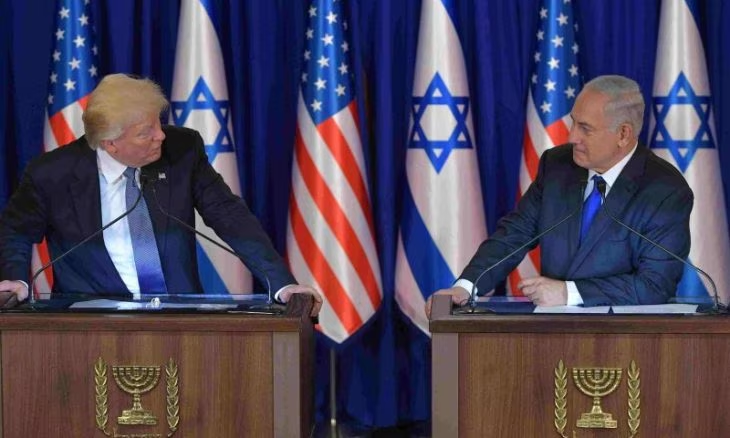
US President Donald Trump will host Israeli Prime Minister Benjamin Netanyahu at the White House on Wednesday, in a meeting of significant strategic importance given its timing and thorny issues. Netanyahu aims, through this visit – his seventh since Trump returned to power – to rally Washington's support for adopting a policy of 'maximum pressure' against the Islamic Republic of Iran.
Netanyahu preceded the official summit by holding a lengthy meeting at Blair House, the presidential guest residence, with advisors Steve Witkoff and Jared Kushner, where he received a detailed briefing on the results of the first round of indirect talks recently held between Washington and Tehran in the Sultanate of Oman.
Informed sources indicate that the Israeli Prime Minister insists that any future understandings between the United States and Iran must not be limited to the nuclear file alone, but must extend to include strict restrictions on Iran's ballistic missile program, which directly threatens Israel's heartland.
For his part, President Trump adopts a dual discourse that combines brandishing military force with a desire to conclude a 'grand deal,' stating that he aspires to an agreement that ensures Iran is free of nuclear weapons and missiles, considering that Tehran will lose a valuable opportunity if it refuses to negotiate on Washington's new terms.
In the context of field escalation, Trump revealed that he is considering the option of strengthening the US military presence in the waters of the Middle East by sending a second aircraft carrier, in a move aimed at deterring any potential Iranian actions that might target American interests or allies in the region.
On the other hand, the Iranian Foreign Ministry warned that exercising additional pressure would lead to destructive results on the diplomatic track, affirming Tehran's commitment to limiting negotiations to the nuclear program and its categorical rejection of including its missile defense system in any discussion.
These moves come at a time when Israeli Defense Minister Israel Katz has hinted at the readiness of the air force, specifically F-35 aircraft, to carry out strikes deep inside Iran if necessary, which increases the intensity of the existing military tension between the two sides.
In a related context, Israeli President Isaac Herzog expressed from Australia his hope that the Washington talks would succeed in undermining what he described as the Iranian 'empire of evil,' emphasizing the necessity of freezing Tehran's support for armed groups in Lebanon, Yemen, and the Gaza Strip.
Away from the Iranian file, the issue of the West Bank emerges as one of the potential points of divergence, as sources in the US administration reported that Trump still opposes any Israeli plans aimed at annexing territories in the West Bank, despite recent Israeli measures to strengthen control there.
Observers believe that Netanyahu seeks to achieve external political gains to strengthen his troubled domestic position, especially with increasing pressure demanding early elections in Israel, which makes the results of his meeting with Trump a winning card in his local political struggle.
This summit coincides with international reports indicating the possibility of new parties entering the Gaza file, as Indonesia has expressed its readiness to send about 8,000 peacekeeping troops to the Strip, a proposal that may be discussed during the American-Israeli talks.
Foreign policy experts believe that Trump aspires to prove his ability to conclude a 'much better' agreement than the 2015 deal signed by Obama, which explains his insistence on including the ballistic missile file and support for armed groups as essential conditions for any rapprochement.
Iran's position remains firm regarding these conditions, as Tehran considers its missile capabilities a red line for defending its national security, warning that any attempt to link the nuclear file with other files will lead to a dead end in the upcoming Oman talks.
In conclusion, the international community awaits the outcomes of this summit, especially in light of the mutual threats and continuous military buildup, which places the region before scenarios ranging from cautious diplomatic détente to open military escalation.
Trump: I prefer to reach a good agreement with Iran that does not include nuclear weapons or missiles, and they would be fools if they refused it.


Share your opinion
Summit in Washington: Netanyahu Seeks to Extract 'Strict Pledges' from Trump Against Iran