






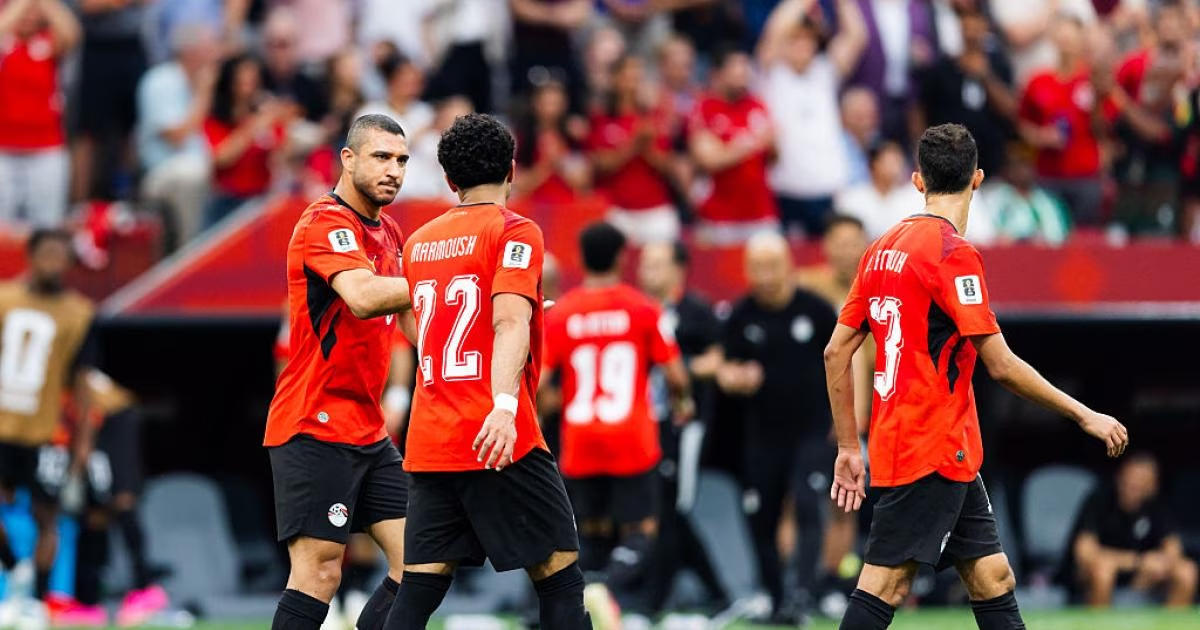
Social media platforms witnessed a wave of widespread controversy after the Egyptian Football Association published a video documenting special moments from inside the national team's locker room. The video showed the 'Pharaohs' players reciting Surahs Al-Fatiha and Al-Ikhlas in collective solidarity before the start of their crucial match against the New Zealand national team in the World Cup qualifiers.
The Egyptian Federation attached the clip with the phrase 'The Secret to Victory,' referring to the morale and faith from which the players draw their strength on the green field. This publication came after a valuable victory achieved by the Egyptian national team with a score of three goals to one, which enabled them to top their group in the global tournament.
These spontaneous moments did not pass peacefully, as media sources observed the launch of an organized attack campaign led by far-right accounts and others known for their absolute support for Israel on the 'X' platform. These accounts accused the Egyptian national team of practicing 'religious incitement' and spreading hate speech, despite the video being devoid of any political references.
The criticisms directed at the national team focused on erroneous interpretations of verses from Surah Al-Fatiha, as these accounts attempted to take the Quranic text out of its purely devotional context. The campaign's posts claimed that reciting these verses in a sports context represents a 'prayer of hatred' targeting followers of other religions, describing the behavior as exclusionary.
Pro-Israel media figures, including journalist Dalia Kurtz and an account named 'Michael,' played a pivotal role in amplifying this inflammatory narrative and spreading it globally. These parties worked to translate the content of the attack into several languages, including English, French, and Dutch, to ensure its reach to a wide international audience.
Observers considered that this campaign aims to turn a common religious practice among Muslim players into material for sterile political and religious debate. The instigators tried to link the incident to thorny issues related to minority rights and national representation, in an attempt to brand the Egyptian national team with religious extremism before the international sports community.
On the sporting front, Egypt's victory over New Zealand came after an exciting scenario, where the 'Pharaohs' fell behind by an early goal before turning the tables with a historic hat-trick. This victory placed Egypt in first place in Group G with four points, boosting fans' hopes in the current World Cup journey.
The match was held at 'BC Place' stadium and witnessed great rivalry between the two sides from the first minutes. The New Zealand national team opened the scoring through their player Finn Surman in the fifteenth minute, putting great pressure on Mohamed Salah's teammates to come back in the result.
The Egyptian national team regained its balance in the second half, as Mostafa 'Zico' managed to score the equalizer in the fifty-ninth minute. The second goal was not long in coming, as star Mohamed Salah added the second goal in the sixty-seventh minute, amidst immense joy in the Egyptian stands.
Mahmoud Hassan 'Trezeguet' concluded the Egyptian national team's hat-trick in the eighty-second minute, confirming the 'Pharaohs'' complete superiority in the second half of the match. The celebrations after the match reflected a state of solidarity between the players and the technical staff, which the Egyptian Federation tried to highlight through the 'Secret to Victory' video.
Monitoring sources indicated that the digital attack was not limited to individual accounts, but also involved newly established electronic committees that appear to have been created specifically for this purpose. This systematic move aims to tarnish the image of Arab and Muslim athletes in major international forums such as the World Cup.
Analysts believe that using religion as a pretext to attack sports teams reflects a state of bankruptcy in the face of Arab successes on the global stage. They stressed that reciting the Quran or praying are personal rituals and a guaranteed freedom for all athletes of different religions, and should not be used as a tool for incitement.
Despite the ferocity of the campaign, a wide segment of Arab and international fans expressed solidarity with the Egyptian national team, considering the attack to lack objectivity. Supporters emphasized that sportsmanship requires respect for the religious beliefs of players as long as they do not directly offend any other party.
The Egyptian national team remains focused on its sporting journey in the World Cup, overcoming these side pressures that attempt to affect its stability. Egyptian fans await the continuation of this strong performance in the upcoming rounds to ensure qualification for the knockout stages and achieve a new historical accomplishment for Arab football.
The secret to victory... This is how the Egyptian Federation described the players' recitation of the Quran before turning the tables on New Zealand.


Share your opinion
An incitement campaign led by pro-Israel accounts against the Egyptian national team over 'Al-Fatiha'