






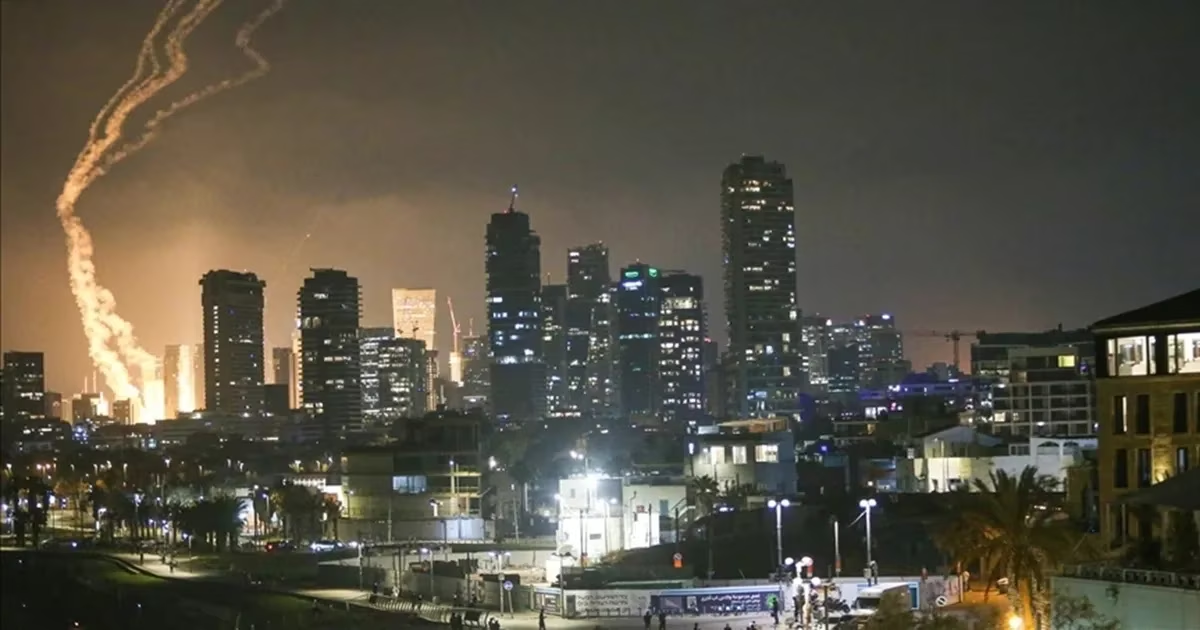
The repercussions of the ongoing military confrontation extend beyond the security field, striking at the core of psychological and social stability within Israeli society, which has begun to directly reflect on economic indicators. Experts believe that the state of uncertainty and constant tension has become a hidden front of attrition, draining the human and financial resources of the Hebrew state unprecedentedly.
Professor Itamar Grotto, a former official at the Israeli Ministry of Health, confirmed that the current reality is not characterized by a transient shocking event but by cumulative and continuous psychological pressure. He explained that repeated alerts, disruption of daily routines, and a constant sense of threat have become crucial factors in the decline of macroeconomic performance and the efficiency of the workforce.
Medical data indicate a steady and alarming increase in the consumption of antidepressants and anxiety medications among Israelis since the outbreak of fighting. This shift not only reflects an increase in demand for treatment but also points to a structural change in workers' ability to maintain stable performance levels, exacerbating the productivity crisis.
Economic repercussions are clearly manifested in increased absenteeism and the spread of professional burnout among employees in various sectors. Companies and employers bear exorbitant costs, whether direct through healthcare or indirect through the decline in the quality of overall economic output.
The mental health system in Israel is under immense pressure, exceeding its capacity, as it faces a severe shortage of specialists and wide gaps in access to services. Experts warn that the absence of comprehensive solutions to this medical crisis poses an imminent economic danger threatening the country's future growth.
The deterioration in the psychological conditions of Israelis directly affects workforce participation, the stability of the educational system, and family cohesion. These elements, which are fundamental pillars of any prosperous economy, are now at stake due to continuous psychological pressures that prevent individuals from realizing their potential.
Long-term costs of continuous treatment and lost workdays add to the burden of debt and financial obligations resulting from military operations. Observers believe that this accumulated burden may lead to large segments of the population permanently leaving the workforce, reducing growth rates for years to come.
The psychological reactions witnessed in Israeli society are not abnormal individual cases but a natural human response to a reality characterized by constant pressure and uncertainty. This situation requires a comprehensive governmental response that goes beyond security solutions to include massive investments in social and psychological infrastructure.
Even if military operations cease, the psychological repercussions will not disappear overnight but will continue to haunt the economy for long periods. Signs of recession are already appearing on the horizon, amidst serious questions about the public budget's ability to bear the cost of recovery from these side effects.
For his part, writer Kobi Arieli points out that self-employed individuals are experiencing continuous anguish due to successive financial losses and fear of the future. These individuals, who have learned from bitter experiences over the past two years, find themselves today unable to plan or act in the charged atmosphere.
The state of uncertainty accompanying workers is one of the most dangerous manifestations of economic consequences, as production and sales cycles that require temporal stability are disrupted. Under continuous missile alerts, the possibility of preparing for sales or advancing commercial projects is non-existent, leading to a state of partial paralysis in the market.
Israel is currently facing what is described as its fourth economic crisis in recent years, starting from the coronavirus pandemic to multi-front wars. A major question mark hangs over the private sector's ability to withstand, especially with the repeated scenario of 'one step forward and two steps back' imposed by the security reality.
Investing in mental health is no longer a social luxury but has become an urgent economic necessity to ensure the productive system remains capable of functioning. Without radical intervention, the invisible costs of war may exceed the destructive impact of the direct costs of weapons and military equipment.
Ultimately, the Israeli economy finds itself trapped between the hammer of massive military expenditures and the anvil of the psychological collapse of its human resources. Reports confirm that failure to address psychological aspects will inevitably lead to a deep recession that will be difficult to emerge from even after the guns fall silent.
Repeated alerts and routine disruption are not just a personal challenge but a factor with a devastating cumulative impact on macroeconomic performance.



Share your opinion
The Nightmare of Exhaustion: How Psychological Crises and Constant Pressures Are Eroding the Body of the Israeli Economy?