






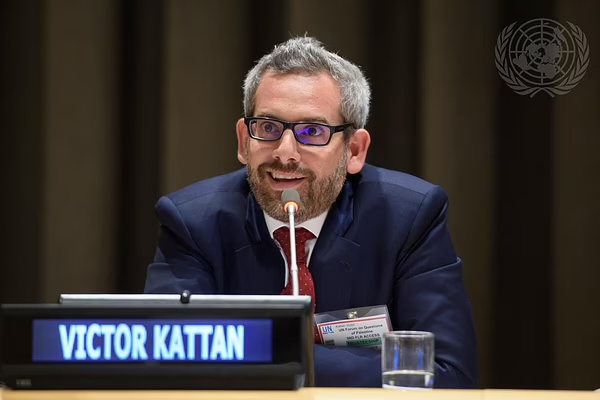
After 75 years, the Convention Relating to the Status of Refugees still fails to provide the protection promised to Palestinians, and Britain must face its responsibility for the causes that led to this reality, as Victor Kattan writes.
Today, governments around the world commemorate the 75th anniversary of the 1951 Refugee Convention. Speeches will be delivered to praise what is considered one of the most prominent achievements of the international community in the post-World War II era: a binding pledge that those fleeing persecution will never be left without protection.
However, Palestinians, the longest-suffering refugee population in the contemporary world, have spent these 75 years largely outside the full protection provided by the Convention, while the descendants of some 700,000 Palestinians displaced in 1948 remain stateless.
This reality is a result of decisions made by states, and no country bears greater responsibility than Britain for the chain of events that led to the emergence and continuation of this crisis.
The “Britain Owes Palestine” campaign addresses this history, having submitted a 400-page legal petition to the British government on behalf of 14 Palestinian petitioners.
The main petitioner, Munib al-Masri, was born in Nablus in 1934. As a child, he witnessed the punitive operations carried out by the British army during the Great Arab Revolt. As a teenager in 1947, he was shot in the leg by British soldiers during a demonstration. He then witnessed the chaos that accompanied Britain's withdrawal, and the arrival of thousands of Palestinians in Nablus after being expelled from their homes during the Nakba, the “catastrophe” that led to the displacement or flight of some 700,000 Palestinians from their homes.
Al-Masri's entire life encapsulates the era that this anniversary calls us to review, and it also traces Britain's responsibility for this crisis, whose chapters have not yet ended.
Britain created the conditions that led to this catastrophe
The 1948 refugee crisis did not emerge from a vacuum. Britain ruled Palestine for three decades under the Mandate system, which was based on contradictory and irreconcilable promises: independence promised to Arabs in the Hussein-McMahon correspondence, a “national home” promised to the Jewish people in the Balfour Declaration, and a sacred trust over the indigenous population under the League of Nations Covenant, a commitment that Britain largely failed to uphold.
As the campaign's legal petition clarifies, Britain altered the legal, political, and demographic reality of Palestine without the consent of its people and without legal authorization to do so.
Britain suppressed the Great Arab Revolt between 1936 and 1939 using emergency regulations and military operations that included war crimes and crimes against humanity. Then, between 1947 and 1948, Britain withdrew, leaving the population it was legally obligated to protect exposed to anticipated violence and mass displacement.
By the time Britain withdrew in May 1948, the conditions for the Nakba were complete. Britain not only failed to prevent one of the world's longest-lasting refugee crises, but its decisions directly contributed to its creation.
A system that was supposed to be temporary
When states met to draft the 1951 Refugee Convention, displaced Palestinians already constituted one of the largest and most prominent refugee groups in the world. The Convention, in its original form, was limited to persons displaced by events preceding 1951, and was confined to Europe, only becoming universally applicable under the 1967 Protocol. Palestinians displaced in 1948 did not fall within its provisions, and therefore states placed them in a separate institutional system of their own.
In December 1948, the United Nations General Assembly adopted Resolution 194, with the support of Britain. The resolution affirmed the right of Palestinian refugees wishing to return to their homes to exercise this right, with compensation for those who chose not to return or for losses and damages to their property. The resolution established the “United Nations Conciliation Commission for Palestine,” which was asked to facilitate the return of refugees to their homeland, their resettlement, and their economic and social rehabilitation. One year later, the United Nations Relief and Works Agency for Palestine Refugees in the Near East (UNRWA) was established to provide relief and assistance to these refugees in the interim.
Article 1D of the Refugee Convention reflected this separate arrangement, as its first paragraph excluded any refugees already receiving protection or assistance from other UN bodies, which practically meant Palestinians registered with UNRWA, from the scope of the Convention's application. However, the second paragraph included a special promise for Palestinians: if that protection or assistance ceased without a final settlement of their status, Palestinians would automatically become entitled to the same protection guaranteed by the Convention to any other refugee.
The purpose of this separate system was to ensure the continuity of protection for Palestinians, and perhaps to provide them with greater protection, rather than leaving them outside the framework of legal protection.
However, the reality was quite the opposite. The Conciliation Commission, tasked with achieving return and compensation for Palestinian refugees, has been largely inactive for decades, a deficiency that the UN General Assembly has noted year after year.
UNRWA, left to bear the responsibility alone, has a mandate to provide assistance, but it has no authority to ensure the permanent solutions of return, compensation, and national protection that the international refugee system provides to others. In contrast, states and national courts have often interpreted Article 1D as a blanket exclusion for Palestinians, ignoring its second paragraph, which has left Palestinians, unlike any other refugees in the world, outside the protection framework established to include all other refugees.
Britain was not merely an observer of this system. It was the power whose mandate led to the displacement of Palestinians, and it was the sponsor of the very UN resolution that promised return and compensation. That is, it drafted that pledge, then watched the mechanisms established to fulfill it weaken and fade. The exception that has shaped the lives of Palestinians for three-quarters of a century is also part of Britain's legacy.
What are we demanding?
The demands of the “Britain Owes Palestine” campaign's petition are, by any standard, modest given the scale of the injustices and violations it documents; it calls on the British government to seriously consider the petition and its evidence, to search government archives and release documents that are still confidential, to respond fully and publicly, to acknowledge the unlawful acts committed between 1917 and 1948, to issue a formal apology by the Prime Minister in the House of Commons, and to genuinely investigate appropriate forms of redress and compensation.
Successive British governments have consistently affirmed their commitment to the rule of law, including international law, and the need to confront the colonial past with honesty and transparency. Britain also constantly cites the Refugee Convention and refugee rights in its foreign policy, and lectures other countries on their obligations towards refugees. But it cannot do so credibly, while refusing to deal with a documented narrative about its own role in causing the world's longest refugee crisis, and in the continuation of the legal protection gap that still accompanies it today.
Recognition of the State of Palestine, which the United Kingdom has begun to move towards, is welcome but not enough; recognition addresses the future, but it does not fix what happened in the past. The harm inflicted on the integrity of Palestine and its people between 1917 and 1948 requires its own response and accountability.
Occasions gain their value when they push towards honestly confronting facts. As the world commemorates 75 years of the Refugee Convention, Britain has an opportunity to prove that its commitment to refugee protection goes beyond mere rhetoric, by seriously engaging with the people whose policies and historical record have kept them outside the scope of legal protection.
The petitioners, including those who lived through the final years of the British Mandate, are still waiting. They should not be forced to wait any longer, nor should their descendants have to wait another 75 years.
Victor Kattan is one of the legal advisors to the “Britain Owes Palestine” campaign, and an Assistant Professor of Public International Law at the University of Nottingham. He also serves as Deputy Director of the Nottingham Centre for International Law and Security.
شارك برأيك
Britain must acknowledge its role in the displacement of Palestinians and face its historical responsibility