






Washington Message
AIPAC and the Purchase of Political Influence… When Millions of Dollars Become a Tool to Re-engineer American Democracy
Washington – Said Arikat – 22/7/2026
News Analysis
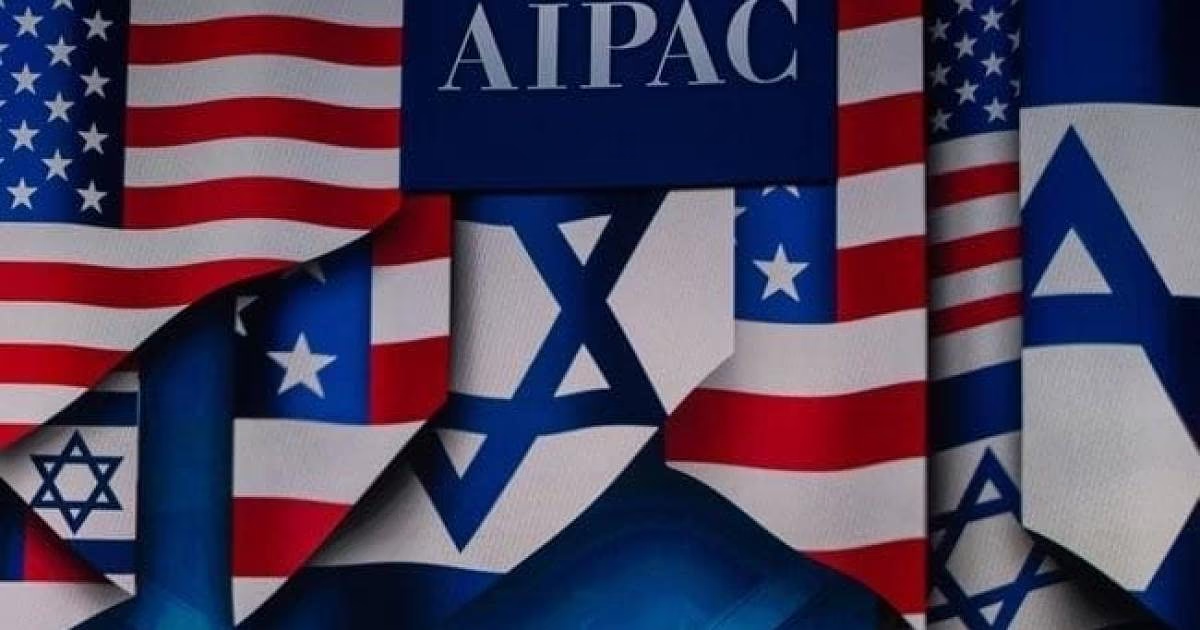
The Democratic Party's primary race for a Senate seat in Michigan is no longer just an electoral competition between Representative Haley Stevens and progressive candidate Abd al-Rahman al-Sayed. Instead, it has transformed into one of the most controversial political battles in the United States, after the American Israel Public Affairs Committee (AIPAC) and its affiliated organizations spent nearly thirty million dollars to support Stevens, in the largest single electoral investment in the organization's history. The question is no longer who will win the seat, but rather to what extent political money has become capable of directing voters' will and reshaping American political life to serve the agendas of the wealthiest and most influential lobbying groups.
This battle reveals a disturbing aspect of American democracy, where competition is no longer based on programs and visions as much as it relies on the ability of entities with massive financial resources to flood media markets with advertisements and craft the image of their preferred candidate, even if that candidate is not the most popular or the most capable of raising donations from citizens. While Stevens' direct campaign spending did not exceed one million dollars, external spending supporting her exceeded fifty million dollars, including tens of millions from AIPAC and other organizations, some of which do not even disclose the identity of their funders.
Notably, according to experts, this flood of money is not transparently injected before voters. Advertisements funded by AIPAC deliberately avoid making Israel the focus of their messages, even though the organization explicitly states in its literature that Israel is its top priority and that it only supports candidates who endorse it and adopt its political agenda. In contrast, there is no mention whatsoever of the Israeli massacre in Gaza or the political goals the organization seeks to achieve, while its messages hide behind general slogans that do not reveal the true identity of the funding entity or its motives. This approach reflects a growing realization within the organization that its name has become a political liability, especially among broad segments of the Democratic Party. As a result, millions of voters are exposed to intensive advertising campaigns without realizing who is behind them or the true political objectives of this unprecedented electoral spending.
Equally striking is the position of candidate Haley Stevens herself, who has repeatedly avoided directly answering questions about AIPAC, contenting herself with saying that all who support her do so in appreciation of her service to the people of Michigan. But this avoidance raises legitimate questions: If financial support does not affect the independence of political decision-making, why are candidates hesitant to talk about it? And why do they not provide voters with a clear explanation of the nature of the relationship with the entities that spend tens of millions on their behalf?
The problem is not in the right of AIPAC, or any other lobbying group, to participate in political life, as this is a right guaranteed by American law. Rather, it lies in the inflation of its financial capacity to the extent that it becomes a player almost on par with political parties themselves. When a single organization can spend amounts equivalent to tens of times what the candidate it supports spends, then talking about equal electoral opportunities becomes questionable, even if everything remains in compliance with the letter of the law.
The controversy intensifies because these elections are taking place in a state with the largest concentration of Arab Americans, at a time when the Israeli war on Gaza continues to cast a shadow over American politics. Since the outbreak of the war, anger has escalated within the Democratic base, criticism of American military support for Israel has widened, and a new generation of voters has emerged who believe that continued support contradicts the party's principles regarding human rights and international law.
In this context, Abd al-Sayed has made the issue of AIPAC's influence a central theme in his campaign, considering political money as a means to silence voices critical of Israeli policies within the Democratic Party. This argument is supported by prominent progressive figures, including Senator Bernie Sanders and Representative Alexandria Ocasio-Cortez, who considered the Michigan battle a test of whether grassroots campaigns can withstand unprecedented financial spending.
Criticism of AIPAC gains an additional dimension because it is not limited to Arab or Islamic circles but also includes Jewish politicians and veteran Democrats. Former Representative Andy Levin, who is Jewish, previously accused the organization of concealing its political identity in electoral advertisements, asserting that the average voter does not know that the messages they see daily are funded by a lobbying group with clear foreign policy objectives. Other Democratic representatives have also announced their refusal to accept AIPAC's future support, considering that the independence of political decision-making requires avoiding any impression that positions are bought with money.
This comes at a time when the Democratic Party is undergoing a significant shift regarding Israel. More than a hundred Democratic representatives recently voted in favor of an attempt to halt part of US military aid to Israel, the biggest indicator yet of the widening gap between the party's traditional leadership and its popular base. Criticizing AIPAC or rejecting its support is no longer a political taboo as it was years ago, but has become part of the internal debate about the future of American foreign policy.
Although some analysts downplay the impact of this issue on voter behavior compared to economic and inflation issues, the importance of the Michigan battle extends beyond the state's borders. It represents a real test of American democracy's ability to resist the dominance of political money, and of the voter's ability to distinguish between electoral messages and the entities that fund them.
The real danger lies not in the existence of lobbying groups, as these are part of the American political system, but in the imbalance of power between them and the ordinary citizen. When the ability to inject tens of millions of dollars becomes the decisive factor in determining who has a chance to appear in the media and who can reach voters, competition gradually transforms from a struggle of ideas into a struggle of bank accounts.
Even more alarming is that many politicians and institutions seem willing to turn a blind eye to this imbalance as long as it does not directly affect their interests. Silence about the inflation of political money's influence is no less dangerous than its inflation itself, because it bestows political and moral legitimacy upon it, making the accountability of lobbying groups seem like an anomaly, rather than a natural part of democratic oversight.
The Gaza war has revealed a profound shift in American public opinion, showing that the Democratic base no longer views Israel and its pro-Israel lobbying groups in the same way that was prevalent for decades. From this perspective, the Michigan battle appears to be more than just an electoral race; it is a confrontation between two models of democracy: one that sees money as a legitimate right to influence politics within legal boundaries, and the other that warns that the inflation of this influence empties elections of their popular content and makes them closer to a competition between funders than a competition between candidates. Ultimately, democracy is measured not only by ballot boxes, but also by the equality of opportunity among competitors, the transparency of sources of influence, and the ability of citizens to choose their representatives away from the dominance of organized money and the wealthiest lobbying groups.
شارك برأيك
AIPAC and the Purchase of Political Influence… When Millions of Dollars Become a Tool to Re-engineer American Democracy