






Washington Message
Washington – Said Arikat – 18/7/2026
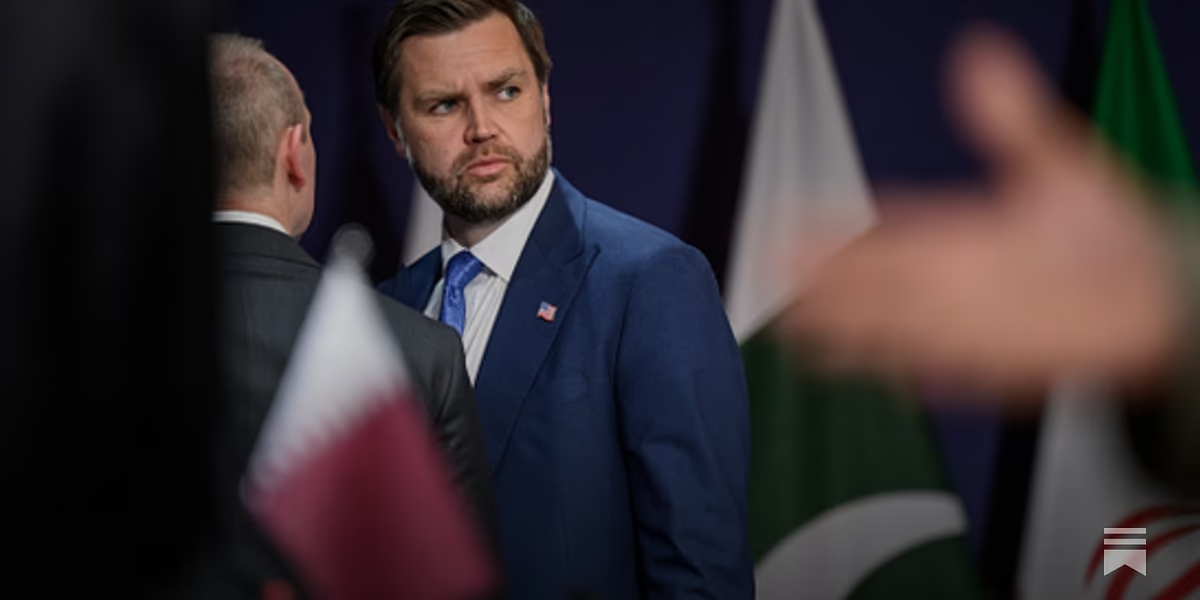
Drop Site revealed, in a report based on an exclusive interview with a senior Iranian official who requested anonymity because he was not authorized to speak to the media, that Tehran sent a secret message to US Vice President JD Vance during indirect negotiations with the United States in Lucerne, Switzerland, in late June. The message warned that the continued involvement of US Special Envoy Steve Witkoff and Jared Kushner in the negotiation process would undermine the chances of converting the understandings reached on June 17 into a permanent agreement.
According to the Iranian official, the message was conveyed to Vance through an intermediary and included direct accusations against Witkoff and Kushner, alleging that they were exploiting their access to confidential negotiation information to achieve financial gains in the markets, instead of focusing on the success of the diplomatic process. Tehran also expressed concern about what it described as repeated leaks reaching Israeli Prime Minister Benjamin Netanyahu, considering that these leaks harmed the progress of talks and weakened trust between the parties.
The report indicated that the Iranian official confirmed that his country had previously sent several messages to President Donald Trump's administration, through Pakistani intermediaries, warning of the "disruptive role" played by Witkoff in the negotiations. However, these messages did not achieve the desired result, which prompted the Iranian delegation to seek to convey its position directly to the US Vice President.
The official explained that Tehran deliberately addressed Vance alone because messages passing through traditional channels reach the entire American team, including Kushner, even though he holds no official position within the US administration. He added that the Iranians conveyed to Vance “data and assessments” through a private channel, emphasizing that Witkoff and Kushner “are misusing the diplomatic process and disrupting the negotiation atmosphere.”
Although Drop Site clarified that it could not independently verify whether the message reached Vance, the Iranian official affirmed that Tehran was confident that the Vice President had indeed received it.
In contrast, the US administration categorically denied this account. A US official stated that the Vice President and his team had not received any message with such content, describing the Iranian accusations as baseless. White House spokeswoman Anna Kelly also attacked Drop Site, considering that the report promoted what she called the Iranian narrative, and affirming that no such message had reached Washington.
However, a source close to Vance admitted, according to the report, that the Iranians had not hidden their objection to Witkoff and Kushner's participation in the talks, although he did not confirm receipt of the aforementioned message.
In another part of the Iranian narrative, the official said that his country had provided written documents to intermediaries in the weeks leading up to the signing of the memorandum of understanding, claiming to possess evidence that figures close to Trump exploited war developments and negotiations to influence financial markets and achieve huge profits.
He added that Tehran estimated the size of these profits at approximately nine billion dollars and formally demanded about half of it, approximately 4.5 billion dollars, considering that developments related to Iran were the direct cause of these financial gains, noting that all these correspondences would become part of the historical record of the negotiations.
The Iranian official also accused Witkoff of misrepresenting Tehran's positions to President Trump, especially regarding highly enriched uranium stockpiles, considering that the US envoy showed a lack of technical expertise in the nuclear file, and that the US delegation participated in some rounds without experts specialized in nuclear issues or Iranian affairs.
According to the Iranian narrative, the Iranian delegation had presented a detailed offer regarding its nuclear program during meetings in Oman and Switzerland, expressing great readiness to show flexibility in order to reach a historic agreement, but these positions were, according to the official, later distorted within Washington.
The official believed that Vance has a more realistic and professional outlook compared to the rest of the American team, stressing that sending the message to him came with the full approval of the Iranian negotiating team, with a willingness to expand the negotiating delegations and involve technical experts and specialists in the Iranian file.
In contrast, the report quoted an American source close to Vance as saying that the Vice President is indeed seeking to build broader communication channels with the Iranian side, considering that successful diplomacy relies on multiple channels of communication and not just one person.
The report also discussed the assessment of Robert Malley, the former chief US negotiator for the 2015 nuclear deal, who considered Tehran's attempt to open a direct channel with Vance a strategically logical step, but he doubted the Vice President's ability to provide guarantees independent of President Trump's positions, saying that the final word would remain with the US President, no matter how much influence his deputy had.
The report concludes by noting that the future of any agreement between Washington and Tehran remains uncertain, amidst continued military escalation and hawkish statements from President Trump, which Tehran believes undermine negotiation efforts and confirm that Washington is using diplomacy in parallel with military pressure, making the chances of reaching a stable settlement more complicated than ever before.
This narrative, regardless of its accuracy, reveals a deep crisis of trust within the negotiation process between Washington and Tehran. When one party believes that members of the opposing team are using sensitive information to achieve financial gains or to feed internal political agendas, negotiations become hostage to doubts rather than a forum for exchanging solutions. The Iranian accusations also reflect an understanding that decision-making centers within the US administration are not unified, and that the multiplicity of influence centers may be a factor no less dangerous than the fundamental disagreements over the nuclear file itself.
What is striking in the report is Iran's attempt to differentiate between JD Vance and President Donald Trump, suggesting that it is betting on the existence of a current within the US administration more inclined to solidify settlements than to continue escalation. However, past experiences in US-Iranian relations indicate that any negotiation ultimately remains subject to the US President's decision, no matter how wide the margin of maneuver for his aides. Therefore, relying on parallel channels may contribute to improving communication, but it does not necessarily guarantee the stability of any long-term agreement or protect it from political fluctuations.
Whether the accusations related to financial market manipulation are proven or remain within the realm of allegations, the mere raising of them reflects the transformation of wars and international crises into factors that directly affect global energy and investment markets. Political and military information has acquired immense economic value, which increases demands for stricter oversight of conflicts of interest among officials and decision-makers. This also highlights the growing interconnectedness between national security and the global economy, where any diplomatic or military development can immediately impact capital flows and energy prices.
شارك برأيك
Iranian Official Reveals Secret Message to JD Vance Accusing Kushner and Witkoff of Corrupting Negotiations