







Urgent: Washington Message
Washington – Saeed Erikat - 14/7/2026
US President Donald Trump, on Tuesday, backed down from his controversial plan to impose a 20 percent fee on all commercial vessels transiting the Strait of Hormuz, in a swift reversal that reflects the extent of objections the initiative faced from Washington's allies, Gulf states, and even from within the Republican Party.
Trump announced, in a post on the "Truth Social" platform, that the strait would remain open to "all vessel traffic except Iran," stressing that the United States would impose a "complete blockade" limited to vessels bound for or coming from Iranian ports, or those carrying goods linked to Iran, instead of imposing comprehensive fees on international navigation.
The US President explained that the fees he had announced one day earlier would be replaced by economic and investment arrangements with Gulf countries, stating that these countries would inject "very huge" investments into the United States, considering this option more feasible than imposing transit fees on commercial vessels.
This retreat comes less than twenty-four hours after Trump announced his original plan, which sparked a wave of widespread criticism as it represented a precedent in dealing with one of the most important international maritime passages, through which a large percentage of global oil and gas exports pass, and which is legally subject to the principle of freedom of navigation in international waters.
Trump told reporters in the Oval Office that his decision came after calls with leaders of Gulf countries, who informed him that they preferred to address the issue by expanding investments in the American economy rather than imposing navigation fees. He added that the idea of fees was for him a "compensation" for the cost borne by the United States in protecting the security of the strait, but he now prefers a model based on mutual investment, which achieves an economic return for both parties.
Internal and external objections
Criticism was not limited to the Democratic Party, as a number of Republicans expressed reservations about the proposal. Republican Senator John Kennedy said that the Strait of Hormuz represents international waters, and no party should impose fees on transiting vessels, despite his general support for the administration's policy towards Iran.
Democrats, on the other hand, believed that the plan would lead to an expansion of the military confrontation. Senator Tim Kaine warned that the US declaring itself a "guardian" of the strait would not go unanswered, and could endanger more American troops, as well as raise the cost of war on the American economy.
Britain also joined the objectors, as the British Foreign Secretary affirmed that London's position is based on supporting freedom of navigation and rejecting the imposition of any fees on transit in the Strait of Hormuz, stressing that no country has the right to impose restrictions or fees on this vital maritime passage.
Hormuz remains the knot of conflict
This development comes as the Strait of Hormuz remains one of the most complex issues in the escalating confrontation between Washington and Tehran. Despite a temporary truce previously reached between the two sides, it did not include a clear agreement on the security arrangements of the strait or mechanisms to ensure freedom of navigation within it.
With Trump's announcement last week that the truce had ended, mutual military strikes between the United States and Iran resumed, bringing the strait back to the forefront of the conflict as a strategic bargaining chip used by the warring parties, either through threatening to close it or through seeking to impose new security arrangements on it.
While Trump's retreat reduces the chances of a global trade crisis resulting from imposing navigation fees, it does not change the fact that the future of the Strait of Hormuz is still linked to the course of political and military confrontation between Washington and Tehran, in the absence of a comprehensive understanding that addresses the roots of the crisis.
A retreat reflecting the limits of American power
President Trump's swift retreat reveals that American power to impose unilateral arrangements in one of the world's most important maritime passages is not absolute, even with American military superiority. The idea of fees clashed with widespread legal, political, and economic opposition, because the Strait of Hormuz does not represent an American passage, but a vital artery for international trade. The crisis also showed that Washington's partners in the Gulf, despite their reliance on the American security umbrella, do not want policies that could destabilize energy markets or turn the strait into a permanent source of economic and political tension.
The Gulf prefers economy over escalation
Trump's response to the request of Gulf leaders reflects a growing understanding that these countries now have a greater margin to influence American decisions, benefiting from their investment and financial weight. Instead of entering into security arrangements that could lead to further militarization of the strait, Gulf capitals preferred to use their economic influence to defend the stability of navigation. This indicates a gradual shift in the relationship with Washington, where investments and economic partnerships have become tools of pressure no less important than traditional military alliances.
The crisis is not over yet
Despite Trump's retreat from the idea of fees, the underlying crisis still exists, as the US-Iranian dispute continues over the future of the Strait of Hormuz and its role in any future political settlement. The blockade announced by Washington on vessels linked to Iran may push Tehran to take countermeasures, thereby re-threatening freedom of navigation in a different way. Therefore, removing the fees does not mean removing the causes of tension, but represents an adjustment in American pressure tools, while the strait remains one of the most dangerous hotspots of geopolitical engagement in the Middle East.
شارك برأيك
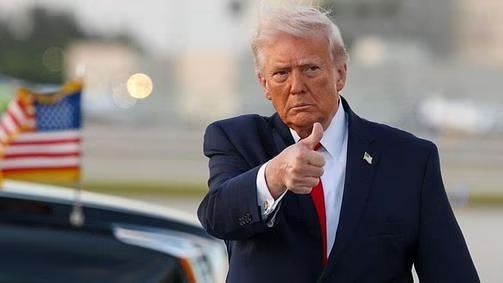
Trump backs down from imposing fees on navigation in the Strait of Hormuz after Gulf and international pressure