






Washington Message
Washington – Said Arikat – 24/6/2026
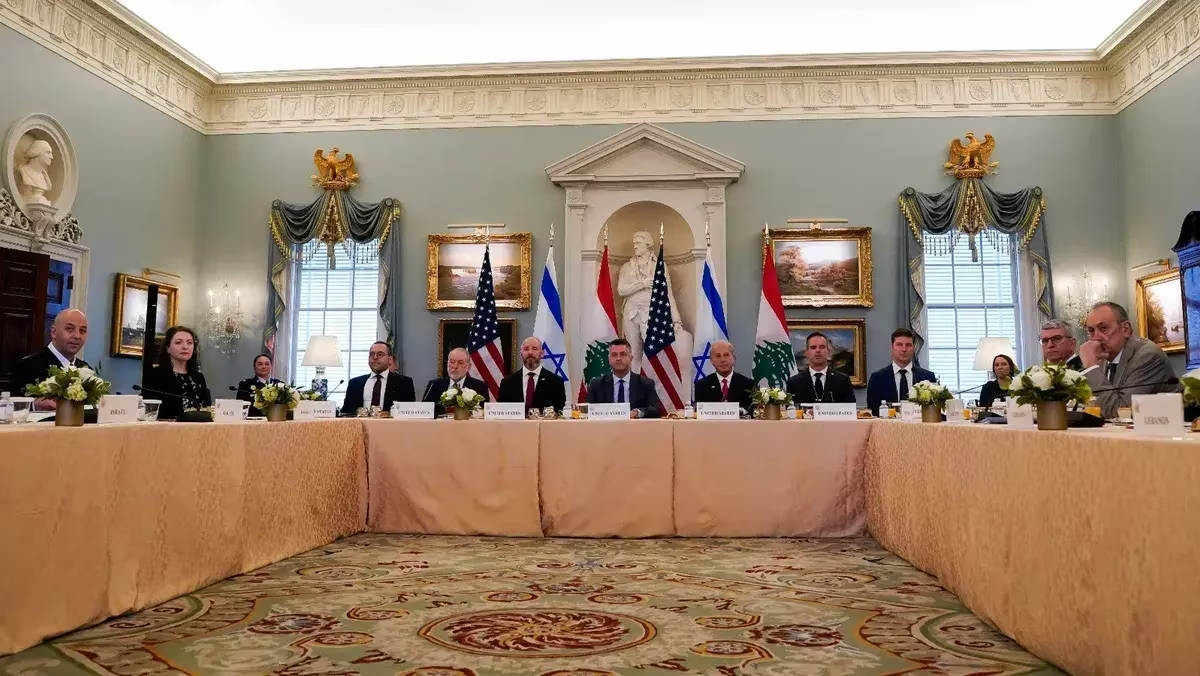
On Tuesday, the fifth round of negotiations between Lebanese and Israeli delegations, lasting three days, began in the US capital, Washington, in an attempt to solidify the fragile ceasefire agreement on Lebanon's southern border and discuss long-term security arrangements that would prevent a renewed military confrontation between the two sides.
These talks come under direct American patronage and in the context of accelerated regional diplomatic activity following recent understandings between Washington and Tehran, which contributed to reducing regional tension and opening the door for political endeavors to address a number of conflict hotspots in the region, foremost among them the Lebanese-Israeli front.
The current discussions focus on addressing outstanding issues that have prevented the ceasefire from being transformed into a more stable agreement. The Lebanese delegation demands a full Israeli withdrawal from Lebanese territories where Israeli forces are still stationed, an end to aerial violations and military operations within Lebanese territory, in addition to establishing clear and binding mechanisms for monitoring the implementation of the ceasefire agreement.
In contrast, the Israeli side focuses on obtaining strict security guarantees related to removing Hezbollah fighters and their military installations from areas south of the Litani River, strengthening the role of the Lebanese army in those areas, and preventing any future military operations or cross-border attacks.
This round is an extension of a series of unprecedented meetings hosted by Washington in recent months between representatives of Lebanon and Israel. Previous rounds had resulted in initial understandings regarding security arrangements and the deployment of Lebanese forces in the south, but fundamental differences remained over the Israeli withdrawal, the future of Hezbollah's weapons, and the nature of any potential permanent settlement.
Diplomats familiar with the negotiations say that the immediate goal of this round is not to reach a comprehensive peace treaty, but rather to consolidate calm on the ground, prevent a return to war, and create practical mechanisms for gradually addressing contentious issues.
The negotiations are taking place in a charged atmosphere, as Lebanese authorities reported two deaths in southern Lebanon as a result of Israeli shelling coinciding with the start of the talks, while Israel said it targeted Hezbollah elements, affirming its right to respond to what it considers security threats.
The continuation of these field incidents reflects the magnitude of the challenges facing American mediation efforts, as observers fear that any limited escalation on the ground could undermine the negotiation process and return the region to an open confrontation cycle.
These negotiations reveal a significant shift in the American approach to the Lebanese file, as Washington now views the stability of the Lebanese-Israeli border as part of a broader regional security system that is also linked to the course of relations with Iran. From this perspective, the US administration seeks to capitalize on the current atmosphere of de-escalation to push for sustainable security arrangements. However, the success of these efforts remains contingent on the mediators' ability to address the root causes of the crisis, rather than merely managing the field tensions that have recurred periodically for many years.
Despite increasing talk about opportunities to reach new understandings, the gap between the Lebanese and Israeli positions remains wide. Lebanon links any permanent agreement to Israel's full withdrawal from Lebanese territories and an end to its repeated violations, while Israel views the Hezbollah file as the central issue that must be addressed first. This divergence means that the current negotiations may achieve procedural progress on some technical files, but they will face significant difficulty in addressing the more sensitive and complex political and strategic issues.
The importance of these talks extends beyond the relationship between Lebanon and Israel, as they are seen as a test of the United States' ability to translate recent regional de-escalation into permanent political arrangements. They also represent an indicator of future trends in the Middle East, where paths to settlement compete with the potential for a return to escalation. If Washington succeeds in cementing the ceasefire and launching a sustainable negotiation process, this could serve as a model to build upon in other regional crises that remain open to various possibilities.
شارك برأيك
Lebanese-Israeli Negotiations in Washington to Cement Ceasefire Amid Deep Divisions Over Security and Sovereignty