






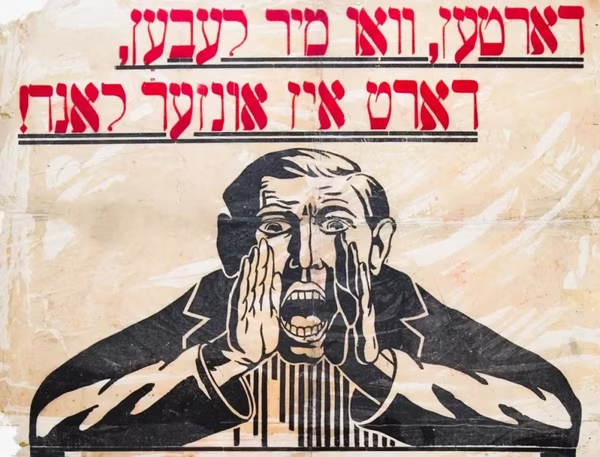

Young Jewish generations in the United States are increasingly distancing themselves from Zionism. This divergence is particularly evident in a renewed interest in historical movements such as the Bund, which advocated for a Jewish identity based on diaspora life, in contrast to the doctrine of a "Jewish state." In France, a similar trend is emerging, though still relatively limited. Philosopher Michel Feher's latest book, "Return to Jewishness," reflects this trend.
By: Sylvain Cypel – June 11, 2026
"Diasporic" Jewishness
American Jewish youth are showing a noticeable distancing from the State of Israel. This shift began gradually since the turn of the new millennium, but it accelerated significantly after the October 7, 2023 attack, as a result of what the author describes as the cruelty shown by the Israeli government towards Palestinians. One of the most prominent manifestations of this shift is that the word "Zionist" has become used as an insult among a segment of Jewish youth.
Another striking manifestation of this distancing is the growing interest in the history of the Bund movement, a Jewish organization founded in the late 19th century. In April 2026, American author Molly Crabapple achieved remarkable success with her book "Here Where We Live Is Our Home," which recounts the history of the Bund, and remained for weeks on the New York Times bestseller list.
But why this sudden interest in a Jewish labor and cultural movement that combined a political party, a trade union, and a community organization? The movement emerged in the late 19th century in the Jewish Pale of Settlement in Eastern Europe, then disappeared by the late 1940s.
Crabapple's book title encapsulates the essence of the idea: Jews, according to the Bund, do not need to leave the places where they live to be liberated, and certainly not by seizing the land of others. What particularly distinguished the Bund was its progressive orientation and its radical opposition to Zionism. It considered itself a Marxist movement advocating for cultural autonomy.
In October 1938, its prominent leader, Henryk Erlich, wrote:
"If a Jewish state were ever established in Palestine, its spiritual climate would be based on a constant fear of the external enemy (Arabs), and an endless struggle with the internal enemy (Arabs) over every piece of land and every job opportunity. Is this the climate in which freedom, democracy, and progress can flourish? Or is it the climate in which chauvinism and reactionary tendencies grow?"
In short, the Bund believed that Jews did not need to establish a state by expelling its indigenous inhabitants, and that this idea would lead to catastrophic results.
Renewed Interest in the Bund
The author believes that what drives American Jewish youth today to be interested in the Bund is what they perceive as Zionism reaching the peak of its violence towards Palestinians. This is not because the movement can come back to life; it disappeared with the extermination of Jews in Europe, and its remaining leaders were assassinated by Joseph Stalin's regime.
However, this renewed interest embodies the possibility of living a different Jewish identity, one not based on messianism, Jewish racial superiority, or the glorification of the Israeli army as the "most moral army in the world." Instead, it aspires to a Jewishness based on the diaspora experience itself.
The author points out that a similar phenomenon has also begun to appear in France, albeit on a smaller scale. Michel Feher's book is considered one of the first French works that attempts to construct a vision of a new "diasporic" identity liberated from the burden of Zionism, following the statement issued by the "Tsedek!" group in February 2026.
Ideological Convergence Between Zionism and Antisemitism
The author describes Feher's book as a profound intellectual work that addresses the history of the Zionist movement and its contemporary reality. Among the topics he discusses are the relationships between the American Zionist right and some wings of the "Make America Great Again" (MAGA) movement, including currents accused of antisemitism.
Feher provides examples of tensions within these circles, noting that some figures associated with the MAGA movement sometimes promote conspiracy theories targeting Jews, despite their political alliance with Israel.
The author believes that this climate, which combines ideological convergence with the Donald Trump administration and the persistence of anti-Jewish tendencies within some American right-wing circles, is pushing an increasing number of young Jews to seek an alternative to Zionist thought.
The Jew as an "Outcast"
Feher dedicates the last part of his book to discussing the image of the Jew as an "outcast" or "marginalized" in society. He reviews the ideas of Hannah Arendt, in addition to the French thinker Bernard Lazare.
Lazare was initially drawn to Zionism after the Dreyfus affair, and participated in the Second Zionist Congress in 1898, but he soon distanced himself from it and severed his relationship with its founder, Theodor Herzl. The author believes that this trajectory resembles what an increasing number of young American Jews are experiencing today.
He also evokes the works of historian Yuri Slezkine, who distinguished between two types of people: "Apollonians" associated with land, nationalism, and closed belonging, and "Mercurians" who embody crossing borders, cultures, and ideas. Slezkine considered the revolutionary and cosmopolitan Eastern European Jews to be a model of this second type.
In contrast, historian Enzo Traverso, in his book "The End of Jewish Modernity," argued that the success of Zionism and the integration of Jews in the United States pushed Jews from a position of revolution and change to a position of political conservatism.
Will the Future Change?
Feher hints that Traverso may have misjudged. American campuses today are witnessing a widespread presence of young Jews who are radically distancing themselves from the policies of Benjamin Netanyahu and his allies.
But will they succeed in achieving their goals? And will they be able to expand this trend outside the United States? The author does not provide a decisive answer, considering that the current stage is characterized by a great deal of uncertainty.
In conclusion, Feher expresses his fear that current Israeli policies will lead to a new wave of mass displacement of Palestinians, pointing to what he sees as widespread support for some of these ideas within Israeli Jewish society. Therefore, the project of "Return to Jewishness" in its liberating and diasporic sense may take a long time to crystallize and take root.
Note: This translation conveys the content of the article as it appeared in the original text, including the political opinions and descriptions contained therein, and does not necessarily represent agreed-upon facts or an objective stance on the issues mentioned.
شارك برأيك
"Return to Jewishness" for Liberation from Zionism