






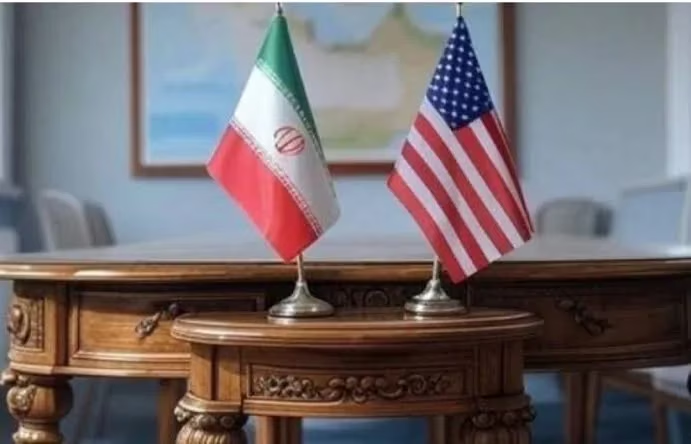
Washington's Message
Washington – Said Arikat – 23/6/2026
News Analysis
In a notable shift in American policy, President Donald Trump's administration announced on Monday a temporary lifting of oil sanctions on Iran for sixty days, allowing the purchase of Iranian crude with US dollars. This move could grant Tehran significant financial revenues after years of selling at discounts to buyers avoiding sanctions. Treasury Secretary Scott Bessent stated that the decision was the culmination of "continuous and fruitful" talks in Bürgenstock, Switzerland. Vice President J.D. Vance, the chief US negotiator, confirmed that Iran had agreed to receive UN inspectors at its nuclear sites, describing it as a "major achievement for the American people." However, Iranian Foreign Ministry spokesman Ismail Baqaei quickly denied that Tehran had made any new commitments, emphasizing that cooperation with the International Atomic Energy Agency would remain governed solely by "existing procedures." The Agency has not yet commented on Trump's and Vance's statements, casting thick shadows over the essence of the announced understandings.
The contradiction between American statements and Tehran's denial highlights the core of the dilemma: while the Trump administration seeks to market a quick diplomatic achievement that allows for a partial lifting of sanctions, Iran adheres to its traditional rhetoric rejecting any new concessions. This gap reflects a lack of solid trust after years of military escalation and assassinations. Without an independent and binding verification mechanism, the oil waiver could turn into a tactical maneuver that repeats the collapse of the 2015 agreement, and reliance on good intentions remains fragile given Tehran's insistence that it has made no new commitments. Experts warn that the American gamble could backfire if promises are not translated into inspections.
Vance added that the Geneva talks, which began on Sunday and were overseen by Qatari and Pakistani mediators, laid a "very good foundation" for a final peace agreement. He unveiled the establishment of direct communication channels to de-escalate tensions in the Strait of Hormuz and in Lebanon, where the intensity of clashes between Israel and Hezbollah has decreased. Vance considered these arrangements to prevent the "situation from getting out of control," noting that Iran had pledged to ensure freedom of navigation in the vital waterway that was closed during the June 2025 war, which drove global energy prices higher.
On the ground, these developments follow the 12-day lightning war in the summer of 2025, in which Israel and the United States bombed Iranian nuclear facilities, leading to the expulsion of IAEA inspectors. Since then, the fate of highly enriched uranium quantities, which Tehran claims were destroyed or buried, has been shrouded in mystery. Under the memorandum of understanding signed last week, Iran agreed to reduce that stockpile under Agency supervision, in a step aimed at restoring international confidence. Tehran had accused the IAEA of providing political cover for the Israeli-American raids after a resolution accusing it of non-compliance. Analysts believe that Iran's insistence on the right to enrichment, despite its commitment to reducing the stockpile, reflects its desire to maintain its nuclear infrastructure as a strategic bargaining chip. But President Masoud Pezeshkian reiterated that his country "will not back down an inch" from its right to peaceful enrichment.
As for the economic package, the US Treasury Department issued a 60-day license allowing the production, delivery, and sale of Iranian oil, which grants Tehran much-needed dollar liquidity. In parallel, Iranian Central Bank Governor Abdolnaser Hemmati announced the signing of memoranda to begin the release of $24 billion in frozen assets. However, US officials did not confirm this step, and Vance stipulated that any released funds be directed to purchase American goods such as soybeans and wheat, with a ban on their use to finance terrorism, an idea he attributed to Jared Kushner, with Washington and Doha overseeing the mechanism.
The temporary exemption from oil sanctions represents a lifeline for a suffocated Iranian economy, but the details of the agreement show that Washington has not given Tehran a blank check. Linking the release of frozen assets to the purchase of American agricultural products serves Trump's electoral base, turning the crisis into an opportunity to support American farmers. In return, the influx of dollars gives Iran liquidity that may alleviate internal protests, but it keeps it at the mercy of the expiration of the sixty-day deadline, which could end with the return of sanctions if nuclear inspections falter, making the recovery fragile and dependent on commitments whose seriousness has not yet been proven. Thus, it becomes a dual pressure tool in Washington's hands.
It is worth noting that the partial lifting of sanctions and the allowance of inspections practically restore the core of the 2015 nuclear deal, from which Trump withdrew in 2018, describing it as the "worst deal in history." Diplomatic circles fear that conflicting interpretations could lead to the collapse of the negotiation process, similar to what happened previously, especially since Iran began reducing its inspection cooperation after the US withdrawal, and then stopped it completely after the 2025 bombing.
Iran's closure of the Strait of Hormuz during the war represented a geostrategic weapon that disrupted global energy markets. Today, Washington offers financial rewards for reopening the vital passage, an implicit acknowledgment that military deterrence alone is not enough. However, linking oil flow to inspection commitments places global energy security at the mercy of fragile negotiations. If the closure scenario is repeated in the future, the Trump administration will face two difficult choices: returning to maximum pressure, which failed previously, or making additional concessions that might encourage Tehran to use the Strait as a permanent blackmail tool. Thus, Washington moves from being a hostage of escalation to a hostage of timed de-escalation.
Nevertheless, the gap between American victory rhetoric and Iran's adherence to red lines makes it premature to speak of a real breakthrough. While awaiting the outcome of the next sixty days, the world cautiously watches this new test of intentions between Washington and Tehran. While Trump sees the oil waiver as a passport to a diplomatic legacy that ends decades of hostility, Tehran treats it as an entitlement for its steadfastness under the weight of "maximum pressure." Between two conflicting narratives, only facts on the ground can confirm whether peace is truly under construction, or if we are facing a tactical truce that hides embers that have not yet been extinguished beneath its ashes.
شارك برأيك
Sixty Days on a Hot Plate: How Oil Became a Test of Intentions Between Washington and Tehran