






By: Said Arikat
June 22, 2026
News analysis
Washington, D.C—The most consequential lesson of the recent U.S.-Iran war is not that Iran defeated the United States militarily. It did not. Nor is American military power suddenly inadequate. The deeper lesson is that Washington emerged from the war on Iran more isolated, less respected, and strategically weaker than when it entered.
That outcome is striking given the imbalance of power. Iran entered burdened by sanctions and diplomatic isolation. Yet when the fighting subsided, it was the United States—not Iran—that faced allied skepticism, criticism, and growing doubts about its judgment as a global leader.
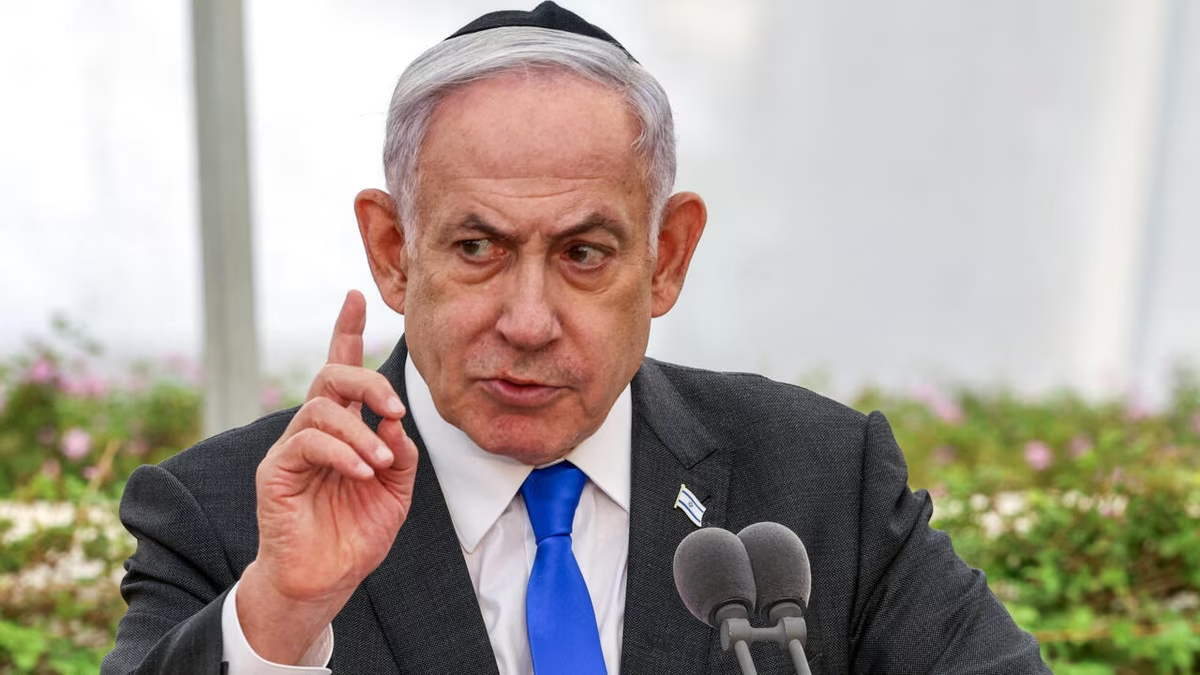
The reason lies not in the military dimensions of the conflict but in its political origins. This was a conflict Israel had sought for years. Prime Minister Benjamin Netanyahu repeatedly cast Iran as an imminent existential threat, pressed successive U.S. administrations to adopt increasingly confrontational policies, opposed diplomacy, and consistently advocated military solutions. In the end, Washington allowed itself to be drawn into a war that served Israel’s priorities far more than America’s interests.
For Netanyahu, the war capped a long campaign to align U.S. power with Israel’s regional agenda. For the United States, it exposed the dangers of letting a regional ally’s calculations dictate the actions of a superpower. Once again, America assumed the costs, risks, and international consequences while Israel stood to reap the principal strategic benefits. The result was not a decisive shift in the regional balance but a further erosion of American standing.
The reluctance of many traditional allies to support the war reflected this reality. Several governments restricted airspace, bases, or logistical support. Others publicly distanced themselves. Even countries that shared concerns about Iran’s regional activities refused to endorse a military campaign they regarded as unnecessary, destabilizing, or lacking legitimacy. The extraordinary image that emerged was of the world’s sole superpower fighting largely alongside one regional ally while much of its alliance network stood aside.
The episode exposed a truth that Washington’s foreign-policy establishment has often been reluctant to acknowledge: military supremacy cannot compensate for diplomatic isolation. Force can destroy facilities and weaken adversaries; it cannot create legitimacy, build consensus, or secure durable political outcomes. Those require allies, credibility, and trust.
This is why Oona Hathaway’s argument in the New York Times on Sunday deserves serious attention. She correctly observes that America’s greatest strategic asset after World War II was not merely its military strength but its ability to build an international order that magnified its influence. That order was never simply a benevolent project devoted to peace and cooperation. It was also an architecture of American hegemony.
The United Nations, World Bank, IMF, and NATO were presented as pillars of a rules-based system. They undoubtedly contributed to stability and economic growth, but they also served as instruments through which Washington projected and legitimized its dominance—centering the global economy on the dollar, extending strategic influence through NATO, and furnishing political legitimacy for U.S.-aligned policies. The genius of the postwar order was that it persuaded other nations to participate willingly in a system largely designed and led by the United States. American leadership was accepted because it appeared to serve broader interests, not just Washington’s. Power was reinforced by legitimacy.
The Iran war undermined that foundation. It reinforced a growing perception that the United States increasingly acts outside the order it once championed and that its Middle East policy remains vulnerable to the preferences of Israel’s leadership. For many countries, the conflict raised uncomfortable questions about whether Washington still acts as the steward of a global system or merely as the military guarantor of a particular regional agenda.
Those questions are harder to dismiss. For decades, American leaders justified support for Israel as consistent with broader U.S. strategic interests. Yet the Iran war highlighted that the relationship can also impose significant costs. Washington absorbed diplomatic isolation, economic disruption, and political backlash for a conflict widely perceived as serving Israeli objectives first and American interests second.
The strategic consequences extend well beyond the Middle East. Every time the United States alienates allies, sidelines institutions, or subordinates global stability to a partner’s priorities, it weakens its own leadership. Rivals like China gain opportunities to present themselves as more predictable and less disruptive on the world stage.
The war’s broader issue, therefore, is not whether America remains powerful—it clearly does—but whether it can continue leading while disregarding the alliances, institutions, and legitimacy that made its dominance possible. History is clear: no great power sustains primacy through force alone. Lasting influence rests on alliances, credibility, and the ability to persuade others that one’s leadership serves a larger purpose. The postwar order succeeded not because Washington was feared, but because it was followed.
The Iran war revealed how fragile that foundation has become. By allowing itself to be drawn into a conflict long sought by Netanyahu, the United States may have achieved tactical objectives while suffering a strategic defeat. It demonstrated overwhelming power yet exposed declining diplomatic influence, weakening alliances, and a diminished ability to mobilize international support.
That may prove to be the war’s most enduring legacy. Iran did not need to defeat the United States on the battlefield. Netanyahu’s war accomplished something more damaging: it exposed the widening gap between American power and American influence. For a superpower, influence is ultimately the more important measure of strength.
شارك برأيك
Netanyahu’s War, America’s Isolation: How Israel Drew the United States Into a Strategic Defeat