






Urgent: Washington's Message
Washington – Said Arikat – 6/18/2026
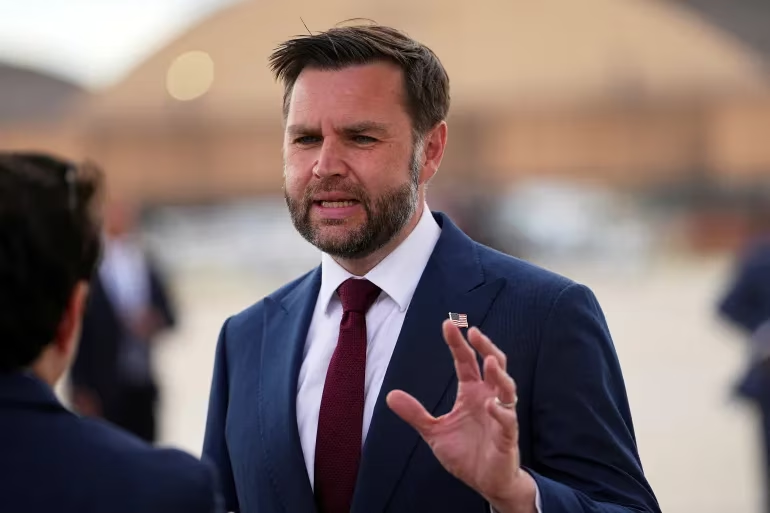
The memorandum of understanding signed between Washington and Tehran has entered the practical implementation phase, after US Vice President J.D. Vance announced the start of the sixty-day official negotiation period to reach a permanent agreement between the two countries, while simultaneously confirming the lifting of the naval blockade imposed by the US Navy on Iranian ports.
Vance's statements came during a press conference held at the White House, dedicated to defending the new understanding in the face of increasing criticism from the administration's opponents inside and outside the United States, who question the agreement's ability to achieve its stated goals or ensure Iran's commitment to its pledges.
Vance said that the lifting of naval restrictions allowed more than a dozen ships carrying approximately 12.5 million barrels of crude oil to pass through the Strait of Hormuz, considering this step to be an implementation of the obligations required from the American side under the preliminary phase of the agreement.
The US Vice President indicated that the sixty-day period represents a crucial test of Tehran's seriousness and its readiness to fulfill commitments related to reducing high-level uranium enrichment, an issue that has remained the main point of contention between the two countries for years.
In response to journalists' questions regarding previous statements by President Donald Trump hinting at the possibility of Iran retaining some missile capabilities, Vance clarified that any future arrangements in this area would be limited exclusively to defensive capabilities and would not allow the possession of systems that pose a threat to regional security or the international community.
He also stressed that the administration is not providing money to Iran, denying the accusations made by critics of the agreement. He affirmed that any sanctions exemptions or economic facilities will remain directly and fully linked to the extent of Tehran's commitment to the terms of the understanding and the ongoing negotiation framework.
The Trump administration seeks to market the agreement as a historic opportunity to end decades of animosity between the two countries, at a time when negotiations are preparing to move to a more complex phase during upcoming diplomatic summits and consultations that may define the features of the US-Iranian relationship for many years to come.
However, doubts still surround the negotiation process, especially in light of the strong opposition the agreement faces from political parties within the United States, in addition to Israeli and regional reservations that believe any easing of sanctions could give Iran additional resources to strengthen its influence in the region.
Test of Trust After Four Decades of Hostility
The importance of the announcement lies not only in the lifting of the naval blockade or the start of the negotiation deadline, but in that it represents the first practical test of the possible level of trust between Washington and Tehran after more than four decades of estrangement and repeated clashes. The two parties are not only negotiating technical issues related to enrichment or sanctions, but also about redefining the rules of political and security engagement that have governed their relations since 1979. Therefore, the success of the sixty-day period will largely depend on each party's ability to convince the other that it is ready to move from crisis management to addressing its root causes.
The Retreat of the Logic of Force in Favor of Pragmatism
The decision to lift the naval blockade reflects a significant shift in the Trump administration's approach to Iran. After years of maximum pressure, sanctions, and threats of military force, it appears that the White House has become more convinced of the utility of political and economic incentives in pushing Tehran towards long-term settlements. This does not mean that Washington is abandoning its pressure tools, but rather reordering its priorities to achieve strategic goals at the lowest possible cost. This shift may have broader implications for overall US policy in the Middle East.
Israel Faces a New Strategic Reality
The progress of negotiations is likely to raise increasing concern within Israel, which has built a large part of its regional strategy over the past years on the continuation of US-Iranian tension. The closer Washington and Tehran get to stable understandings, the less able the Israeli government will be to use the Iranian threat as an absolute priority in relations with the United States. Furthermore, the success of the agreement may strengthen voices within Washington calling for a re-evaluation of traditional policies towards the Middle East, including the approach to the Palestinian-Israeli conflict.
A Narrow and Risky Diplomatic Window
Despite the positive atmosphere that the US administration is trying to project, the path to a permanent agreement is still fraught with obstacles. The issues at hand go beyond the nuclear file to include ballistic missiles, sanctions, regional influence, and security arrangements in the Gulf. Moreover, any unforeseen military or political incident could threaten to derail the entire process. Therefore, the sixty-day deadline seems more like a narrow diplomatic window that both parties must quickly utilize, before the forces of extremism and confrontation regain the initiative and return relations to the cycle of escalation once again.
شارك برأيك
Vance Defends Understanding with Tehran: Lifting Naval Blockade and Starting Countdown to Permanent Agreement